|
FAQs about Marine Crab (Including some
Anomurans) Identification 15
Related Articles: Crabs, Hermit
Crabs,
Related FAQs: SW
Crab Identification 1, SW Crab ID
2, SW Crab ID 3, SW Crab ID 4, SW Crab ID 5, SW
Crab ID 6, Marine Crab ID 7,
Marine Crab ID 8, Marine Crab ID 9, Marine
Crab ID 10, Marine
Crab ID 11, Marine
Crab ID 12, SW Crab ID 13,
SW Crab ID 14, SW Crab ID 15, SW
Crab ID 16, SW Crab ID 17,
SW Crab ID 18,
SW Crab ID 19,
SW Crab ID 20,
SW Crab ID 21,
SW Crab ID
22,
& Marine Invertebrate identification,
Marine
Crabs 1, Marine Crabs
2, Marine Crabs 3, Marine Crabs 4, & Crab Behavior, Marine Crab
Selection, Marine Crab
Compatibility, Marine Crab
Systems, Marine Crab
Feeding, Marine Crab
Reproduction, Marine Crab
Disease, Micro-Crustaceans,
Amphipods, Copepods, Mysids, Hermit
Crabs, Shrimps,
Cleaner
Shrimps, Banded Coral
Shrimp, Mantis
Shrimp, Anemone
Eating Shrimp, Crustacean Identification, Crustacean Selection, Crustacean Behavior, Crustacean Compatibility, Crustacean Systems, Crustacean Feeding, Crustacean Disease, Crustacean Reproduction,
|
Whoa big boy!
|
|
Crab Identification 9/11/09
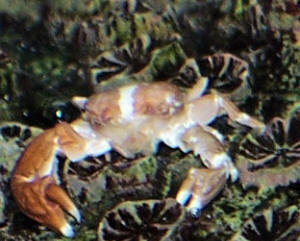
I have been unable to identify these crabs; and was hoping you
may be able to help. They were collected in the northeast US in
approximately 30 feet of water. The largest of the three is a
little larger than an inch. A similar crab I was able to find on
the internet was Cryptolithodes typicus.
<If it were Cryptolithodes typicus, they would be a long way
from home.
Butterfly crabs are generally found in East Pacific waters.
I have no idea what type crabs these are. There are
hundreds/thousands of species of crabs
<<... No... there are about 5k described species of
"crabs" of which about 500 are "false crabs",
Anomurans, like the Hermits... RMF>>
and researching to accurately ID would be much too time
consuming. As we are all volunteers with little time
available,
our time is focused toward animals generally encountered in the
tropical/sub-tropical
marine hobby. Now, if they were from tropical waters, an ID may
be possible. Time spent Googling would be your best bet, is what
we would need to do.>
Thank you for your time,
<You're welcome. James (Salty Dog)>
Cam
<<James, again, please don't respond to queries for
which you don't have a qualified opinion. RMF who doesn't
know what these are either. Am going to put in LynnZ's
in-box>>
Re: Crab Identification
Good morning Bob,
Mmm, does the "hundreds/thousands" not fall into the
"5k described species"?
<Mmm, perhaps I misread... as hundreds of thousands. Sorry
re>
Not being a smarty pants here either, just thought I was in the
ball park. You are correct Bob, I'm not qualified to ID
crabs, especially species not related to the hobby. Was just
trying to point out that we are not a research site as such, but
a knowledge base for subjects associated with the tropical marine
keeping hobby.
If I'm on the wrong track here, please do let me know.
Cheers,
James
<Thank you, BobF>
|
 |
|
Re Crab Identification
9/15/09
Thanks for passing the pictures along for id. I don't know if
it would help but the crabs were collected in Nantucket Sound
(south of Cape Cod). The crabs are currently at The Cape Cod
Museum of Natural History, they have yet to identify them.
They don't seem to want to feed, and I was wondering if you
had any suggestions for what to give them.
<I haven't a clue, especially not knowing what they are.
Likely specialized feeders.>
Also I thought you might have the name of a person or group I
could contact who would specialize in crabs that are not
tropical.
<I know of no one, Bob or other crewmembers may know. May want
to ask the folks at Cape Cod Museum Of Natural History.>
Thanks again for your time,
<You're welcome. Sorry we could not be of more help. James
(Salty Dog)>
Cam
Re: Crab Identification: Likely Elbow
Crab -- 9/22/09
<Hello Cam, Lynn here today with a follow-up.>
I have been unable to identify these crabs; and was hoping you
may be able to help.
<I'll sure try. As was noted in the previous response,
there are an awful lot of crab species out there!>
They were collected in the northeast US in approximately 30 feet
of water. The largest of the three is a little larger than an
inch. A similar crab I was able to find on the internet was
Cryptolithodes typicus.
<It is indeed similar, but I believe it's more than likely
a Brachyuran/'true' crab (4 pairs of walking legs) in the
family Parthenopidae. These are commonly known as 'elbow
crabs'. Cryptolithodes species (family Lithodidae) are
Anomurans/'false' crabs with 3 pairs of walking legs and
comparatively short claw arms. From the looks of your little
fellows, the term 'elbow crab' seems to fit rather
nicely. There are quite a few Parthenopid species that have
triangular (or near triangular) carapaces and fairly
small/sometimes hidden walking legs. Here's an example
(Heterocrypta lapidea):
http://www.scielo.br/img/revistas/bn/v5n2/en_a03fig22.jpg . This
specie's range is listed as the West Indies to Brazil so
unfortunately, it's not a likely candidate. However, it
appears similar enough to warrant more research in that direction
(including other genera within this family) should you desire to
pursue an ID. Unfortunately, I can't see quite enough detail
to go any further. Here are more examples from the Central
Pacific region. I know it's not the area your crabs are from
but you can at least see the various attributes within multiple
genera all in one location:
http://decapoda.free.fr/search_result.php?faname=Parthenopidae
Parthenopidae classification including genera:
http://animaldiversity.ummz.umich.edu/site/accounts/classification/Parthenopidae.html
>
Thank you for your time,
<You're very welcome.>
Cam
<Take care, LynnZ>
Hi Lynn,
Went to the UofM Animal Diversity site as you list below and I
did not see any pics???
Oops, I see now, one needs to click on Parent Taxa to locate the
pics.
James
|
Identification problem... Small crab, SW
8/30/2009
Hello,
<Maidie>
I would like to ask your advice please.
<Sure>
Whilst carrying out my second 10% water change of the week, today and
general cleaning routine, I noticed a tiny crab in my live rock, at
first I thought it was a tiny tarantula, but then quickly realised when
it
surfaced from the crevice in the rock, that it was in fact a crab. It
is grazing on the live rock and is about 1 centimetre big. Taking a
good picture has proved too difficult so I have tried to write a good
description of it.
White/cream coloured claws, with brown equally sized pincers, with
white tips to them. Pincers seem to have one serration on each pincer,
half way up.
On the end of the other legs there are pink tips.
<Mmmm>
The body is cream/white in colour and there are two thick black
vertical lines running through the shell of the body.
Eyes are black, not on stalks,
There are slight hairs on the legs and body. The legs are white/cream
with black dots where there are joints.
It is not a hermit crab.
Could you please advise me about this crab, I have tried to catch it
but it
is a fast mover, I am worried about my corals and fish:
<Mmm, at this size, not likely an issue. T'were this system
mine, I'd just ignore this little Decapod>
Blue male Psychedelic Mandarin
Red female Psychedelic Mandarin
Yellow Tailed Blue Damsel
Pair of Mated True Percula Clowns
Royal Gramma
Thank you in advance.
Maidie.
<Innocent till evidence of guilt... Bob Fenner>
|
Crab Identification: Fiddler Crab --
10/15/09
Hi :)
<Ah, bonjour Marie, Lynn here today!>
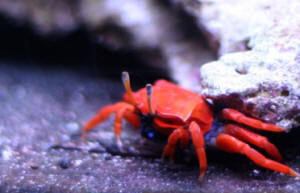
I received yesterday 2 little red crabs from the Philippines and
I'm not sure what they are because of the eyes. I think they
may be fiddler crabs...
<You're right. The overall shape/length of the stalked
eyes and sharply pointed carapace seem to be fairly common within
the semi-terrestrial fiddlers in the genus Uca, family
Ocypodidae. The closest I can find is a photo of something
alleged to be Uca arcuata (see this link:
http://www.geocities.com/rainforest/canopy/5280/philip.htm ).
Unfortunately, I can't confirm the ID. Either the
color/pattern varies quite a bit (as shown at the above link) or
they're different species entirely. Apparently, in the
Philippines, these are mainly mangrove/shallow water/intertidal
crabs that make their burrows in the mud and sand. Interestingly
enough, I've seen a similar species being offered for sale on
the internet, listed as a 'Red Burrowing' crab in the
genus Uca. >
..even if they don't have the oversize claw... maybe
they're female.
<Yes, my thought as well.>
I sent you a picture, maybe you can help me with this
identification.
<I sure wish I could give you a solid ID to species level, but
there are just too many possibilities and not enough available
information on the 'net and within my research books.>
I don't want to give bad information to my customers.
<Good for you! I wish all merchants were this conscientious!
Unfortunately, I have to add that these little crabs should not
be kept in a fully submerged marine system. They'd do much
better in an environment more closely resembling they're
natural habitat (mixed land/water). For more information on this
group of crabs, please enter the terms (Uca or fiddler) into our
Google search engine
(http://www.wetwebmedia.com/Googlesearch.htm). I've seen
several posts regarding solid red fiddler crabs with reports of
them being very reclusive. Apparently, once added, they tend to
burrow/hide and not come out much. In Barnes' Invertebrate
Zoology (sixth edition, pg. 717), it states that tropical species
of this genus 'tend to be active only during diurnal low
tides'. That's not a whole lot, even in the wild! Also,
they're still crabs and basically opportunistic, so hobbyists
will need to keep these well fed to discourage picking/killing of
desirable livestock.>
Thank you
<It was a pleasure, Marie.>
Marie
<Take care, LynnZ>
|
 |
|
Re: Anemone & Crab ID Query 10/9/09
Hi Bob and Crew,
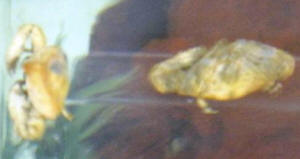
I saw this query come in but unfortunately can't ID the
anemone in question. As for the crab, it looks like a Xanthid of
some sort but unfortunately, there's just not enough
information for me to take it any
further. I don't know the crab's size, where it
originated, or if it was associated with anything else. In
addition, I can't quite see enough of the carapace or claws.
It looks like a lot of detail (how hairy...where hairy, surface
texture/bumps) is lost/obscured because the crab's out of
water, with water clinging. Anyway, all I can really offer is
that it's likely a Xanthid. Sorry about that...wish I could
be of more help!
Thanks!
-LynnZ
<Thank you Lynn... I can't tell much more myself.
BobF>
Lynn/Crew,
I also didn't grab the query because of the crab ID, but I
believe the anemone is a Long Tentacle/Corkscrew (Macrodactyla)
Anemone. The picture quality is poor/dark so I'm not betting
any money on it.
James
<Me neither. BobF>
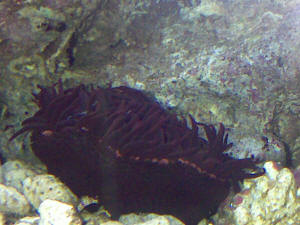
Anemone & crab ID
Hi need an ID for this anemone. it's color is dark
brown/maroon.
Thanks Siddharth
<Can't discern from this poor photograph. Bob
Fenner>
|
  |
|
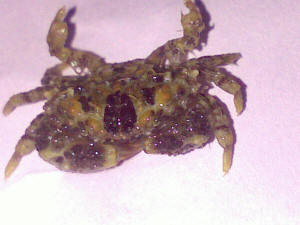
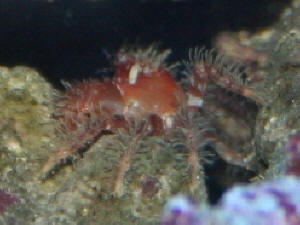
Mystery Crab (actually an Anomuran) -- Likely
Porcelain Crab -- 8/16/09
Hi.
<Hi Sarah, Lynn here today.>
I hope you can help me identify this little guy.
<Me too!>
I've had my tank up and running a year and a half now. The
last time I bought any new critters for my tank was about 3
months ago.
<Okay>
This morning, this little guy showed up.
<Neat! It looks like a little porcelain crab, family
Porcellanidae, of which there are many genera and species.
They're primarily filter feeders that rhythmically wave a
pair of interesting feather/fan-like mouth parts through the
water in order to gather organics, plankton, etc. Although these
are referred to as crabs, they're not actually 'true'
crabs (Brachyurans). They are instead Anomurans, a group that
includes hermits, mole crabs, squat lobsters, etc. Both
Brachyurans and Anomurans are Decapod (ten-footed) crustaceans,
however, crabs such as yours have 3 pairs of walking legs instead
of 4. A much smaller fourth pair is folded and held either above
or below the abdomen (not used for walking). They also have long
antennae just distal to/behind the eyes, a mobile abdomen that
can be used to propel the crab, and large claws that are used for
territorial disputes and defense instead of feeding/predation.
These crabs, although primarily filter feeders, are also
opportunistic scavengers and detritivores. Luckily, they're
generally small and don't pose anywhere near the risk that
true crabs do (such as Xanthids -- family Xanthidae). I would
keep this little fellow around and enjoy! As a scavenger,
it'll likely take most foods -- pellet, flake, bits of meaty
foods (of marine origin). For more information, please see the
following links: http://www.wetwebmedia.com/galatheids.htm
Similar species, listed under 'A new Porcellanid species from
the Caribbean Sea': http://www.uni-giessen.de/porcellanidae/
>
Thanks again,
<It was a pleasure.>
Sarah
<Take care, LynnZ>
|
 |
|
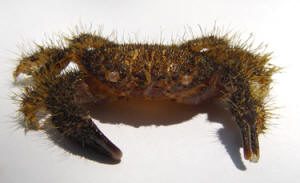
Crab ID: Possible Xanthid or Pilumnid, Brachyuran
Identification Issues -- 7/20/09
Hello Incredibly Helpful WetWeb Crew,
<Hello incredibly nice Lianne, Lynn here today.>
If possible, is there someone who might identify this crab for
me? (I checked your ID pages first.)
<I sure wish I could but for me to even begin to narrow things
down, I'd need some additional photos such as close-up shots
of the claws (showing the tips, and inside edges), a good shot
from above showing the carapace detail and all legs, as well as a
shot of the underneath/ventral surface. Unfortunately, even with
excellent photos, we'd be doing well to narrow it to the
family level. Identifying Brachyurans/true crabs can be quite a
challenge. According to an excellent study last year (See this
link: http://rmbr.nus.edu.sg/rbz/biblio/s17/s17rbz.pdf ), there
are 38 superfamilies, 93 families, 1271 genera and subgenera, and
a whopping 6,793 valid species! That's a lot of crabs! Some
are easy enough to narrow to family or genus because they have
such obvious and unique features, but unfortunately there are way
too many crabs left out there that look similar enough in
available photos to be easily misidentified. If it were only as
easy as 'hairy crab = X' or 'spatulate/spoon-tipped
claws = Y'! Wouldn't that be great? As it is, the most
dependable way of getting a definite crab ID is to have the
fellow right there in front of you, along with a really good
identification key or better yet, preserved specimens of similar
crabs. That way you're able see all the pertinent little
details that separate one family, one genus, one species from
another -- and believe me, those details can be small. Barring
that, we have to depend on photos and unfortunately not all
species are available online or (at least within my) reference
books. In a perfect world, we'd have online sites with
up-to-date lists, dichotomous keys, and detailed photos of all
the indigenous crabs from each ecosystem/locale around the world.
I think we're headed that way, but for right now, it's
just not out there.
By the way, please don't construe what I wrote above as some
sort of dressing-down because you asked for a crab ID. Believe
me, that's not my intention at all. I love seeing all the
neat little crabs that people find in their tanks and enjoy the
challenge of ID work. The fact is, we get crab related ID queries
fairly regularly and it's frustrating to only be able to give
general, instead of specific, information on most. I just wish I
were an expert and could offer swift/solid ID's, along with
species summaries! Anyway, enough of that - let's get back to
your crab! From what I see in the photo, I'm guessing that
it's likely either some sort of Xanthid (Family: Xanthidae)
or a Pilumnid (Family Pilumnidae). I've seen a number of
Xanthids that have one or both claws spatulate/spoon-tipped
(genera: Leptodius, Phymodius/Cyclodius, Chlorodiella, Etisus,
Pilodius, etc). Unfortunately though, they tend to have hairy
legs but not hairy carapaces. Pilumnus spp. crabs (Family:
Pilumnidae) are notoriously 'hairy' crabs (all over), but
I've never seen one with spoon/spatulate claw tips. Also,
they tend to have deeper bodies than what I'm seeing in your
photo. That doesn't necessarily rule this family out it's
just that I couldn't find any like yours. Please see the
links below for examples:
Leptodius :
http://www.wildsingapore.com/wildfacts/crustacea/crab/xanthidae/leptodius.htm
Cyclodius:
http://decapoda.free.fr/illustration.php?n=2&sp=628
Pilumnus hirtellus:
http://www.klissurov.dir.bg/black_sea/crustaceans/big/PilumnusHirtellus04.jpg
Pilumnus spinosissimus:
http://www.scielo.br/img/revistas/bn/v5n2/en_a03fig44.jpg
>
He is dead, as you can see here,
<Well, based on the fact that the eyes look empty behind a
thin shell/covering, I'm wondering if that isn't just a
shed from a recent molt? If you still have the 'body',
flip it over and take a look underneath. Is the abdomen opened
up? If so, can you see any of the crab's 'innards' or
is the shell empty? If it's empty, then the crab has recently
molted and will be in hiding until his shell hardens.>
..but I still have a tiny one (1/3") in residence, who also
hitchhiked into my reef tank on Vanuatu live rock. His carapace
measures 5/8" across and his total width is about
1.25." His pincer claws are the forceps style of a Mithrax
forceps crab, with only the tip of the pincer flattened, but he
is hairy on all but the pincer itself and looks quite different
to my eye.
<Heee! Don't get me started again! The good news is that
in lieu of us knowing which species you have, we can at least
derive some information from the claws. It's one of those
'form follows function' issues. Flattened or spoon-like
tips are excellent for scraping algae, etc., off hard surfaces,
grasping filamentous algae, and for scooping up soft materials.
These crabs tend to be a bit better risk in reef tanks, but
they're still omnivores and opportunists. They're
generally pretty well-behaved when small, but can be a problem
later on as their bodies and appetites grow.>
I observed him shyly clipping and consuming the algae on my live
rock over several months.
<Yep, that fits.>
I attempted to get him interested in meaty stuff to be able to
trap him, but no go. Then found him dead this morning.
<He may be in hiding. If it was just a molt, he should be back
out in a couple of days.>
His body appears to be completely unscathed, but perhaps he duked
it out with my newly-out-of-quarantine Leopard Wrasse?
<Probably not. Any attack resulting in death would have been
pretty obvious - dismemberment and/or nipped/missing appendages
and parts(like the eyes)>
(The only other tank occupants: two young percula clowns, a young
yellow-tail Damsel, two cleaner, two ghost, and one fire
shrimp).
<Doubt any of those could have done it -- unless the crab was
in a molt and exposed/not hidden. If that had happened, there
would have been obvious damage to the body as mentioned above.
I'm thinking that unless you can actually see tissue inside
that shell, there's a good possibility that what you have is
just a shed.>
Thank you for your thoughts
<You're welcome! Bet you weren't thinking you'd
get quite so many of my thoughts though, huh?>
..and your phenomenally helpful web column.
<On behalf of Bob and the crew past and present, you're
very welcome!>
Lianne
<Take care, LynnZ>
PS. He has 4 legs on each side in addition to his pincers.
<Thanks!>
|
 |
Re: Crab ID: Possible Xanthid or
Pilumnid, Brachyuran Identification Issues -- 7/21/09
<Hi Lianne!>
Thank you so very much, Lynn, for your thoughtful and informative
answer.
<You're very welcome.>
I simply had no idea of the complexity of the species
<It's easy to see how someone could devote a good portion of
their life towards identifying and classifying these guys!>
...(or would it be family: I get confused with the names for
different levels of scientific differentiation between
animals?).
<I know what you mean. Here's the order (from least to most
specific): kingdom > phylum > class > order > family
> genus > species. Frequently, prefixes like super, sub,
infra, etc., are added to create sub or superior categories. In the
case of true crabs, it's order: Decapoda, infraorder:
Brachyura, then on to superfamily, family, genus, and finally:
species.>
It's wonderful to have you open that door; I will begin doing
some research and will let you know if I discover similarities.
<Please do!>
It was great to be pointed in a direction!
<I'm glad I was able to help. Hopefully you'll enjoy the
subject as much as I have. I just find crabs to be fascinating
little creatures. Just the variation in appearance alone is
amazing. They range from the truly bizarre and outlandish to the
most simplistic - almost generic, to the near comical or
cartoon-like. All are wonderful!>
Sincerely,
Lianne
<Take care, LynnZ> |
|
Help Identify a Crab: Possible Xanthid: Paractaea
monodi - 8/22/09
Hello,
<Hello Susan, Lynn here today.>
Have you ever seen this crab before?
<Oh yes. I've seen this little crab before - or at least
those like it. My best guess is that it's most likely a
Xanthid in the genus Paractaea, possibly a fairly cosmopolitan
species: Paractaea monodi (Monod's round crab). Please see
the following links for comparison:
http://www.meerwasser-lexikon.de/images/mP9JnaH6Rn.jpg
See several photos half-way down the following page and another
good one at the bottom:
http://www.ivanov.ch/redseaMax/crabes.html . By the way, there
are also some 'red-eyed reef crabs' in the genus Eriphia
(family Menippidae) that look similar, but the carapace is not
quite right (spiny/serrated edges instead of smooth, different
overall shape and surface anatomy, etc.). See examples here:
http://www.wildsingapore.com/wildfacts/crustacea/crab/eriphiidae/ferox.htm
>
I have looked at many pages of crab pictures today and I cannot
find one like it.
<Well, there are an awful lot of crab species out
there!>
This crab was not purchased on purpose- it was apparently living
in a piece of live rock that was added to the tank!
<Yep, that's usually how they're introduced!>
The shell is a very deep purple/black color under the lights and
its eyes are dark orange/red.
<It's actually a very attractive little crab, but an
opportunistic omnivore and scavenger as well, with an unfortunate
potential to destroy livestock.>
Any leads to identifying it would be appreciated.
<Hope the above information helps!>
Thanks,
<You're very welcome.>
Susan
<Take care, LynnZ>
http://www.flickr.com/photos/infinitespirals/3844290588/sizes/l/
http://www.flickr.com/photos/infinitespirals/3843501515/sizes/l/
|
 |
|
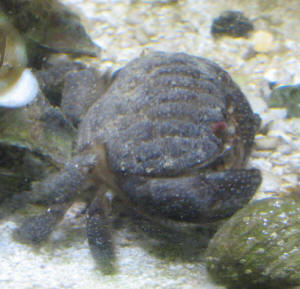
Hitchhiker Crab/ID 8/13/09
Can you tell me what type of crab this is and whether or not I
should keep it in my reef tank? I have looked all over and
can't identify it.
<I did a quick check with a 100 or so photos I have and cannot
come up with an ID. Let see, that leaves about 749,900 crabs I
have not saw:)
The crab does appear to be a specie of a swimming crab (last pair
of legs appear to be swim paddles), and most are very
predatorial. To be on the safe side, I would remove.>
Thanks
<You're welcome. James (Salty Dog)>
|
 |
|
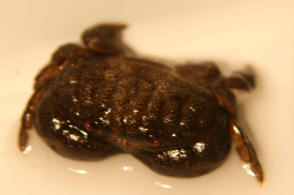
Crab ID -- 7/24/09
Hello!
<Hello there!>
I am hoping you can assist with the identification of a crab I
have had in my tank for approximately a year. It started out
about ½" across but now has grown to well over
1". I have not seen him in over 6 months and then there he
was tonight. I looked through all the available photos but did
not see anything that I could be sure about. I can speculate that
he came in on some rock from Florida.
<Unfortunately, I can't see enough of the little fellow to
be able to give you much in the way of an ID. All I can say is
that it looks a bit like a Pilumnid (superfamily Xanthoidea,
family Pilumnidae). Please see the following links for examples
of crabs in this family for comparison:
http://www.scielo.br/img/revistas/bn/v5n2/en_a03fig44.jpg
Pilumnus sayi:
http://www.dnr.sc.gov/marine/sertc/images/photo%20gallery/Pilumnus%20sayi.jpg
Just bear in mind that all crabs are opportunistic omnivores that
are usually okay when small, but can be a problem as their bodies
and appetites grow. If (and that's a really big if) what you
have is indeed something in the genus Pilumnus, those usually
stay fairly small. The same rules still apply though -- if the
crab gets hungry enough, it can cause problems.>
I am wondering if I should (attempt) to remove him from the
tank.
<If the opportunity comes along (he's out where you can
net him) I'd remove him and find him another home. I
wouldn't go so far as tearing the tank apart to find him
though. If you're unable to get him out, I'd make sure
he's got enough food to discourage him from sampling
something he shouldn't and keep an eye on him (and your
livestock). He may be getting a bit more bold because he's
hungry. You could try feeding him meaty bits of marine origin
(shrimp/fish/clam etc), sinking pellets or the like. Obviously,
if you're noticing any damage to your livestock, I'd
recommend getting him out of there sooner rather than later. You
can always try to trap the little guy. There are some
commercially available versions on the market or you could try
the tipped jar method. Once you figure out where he hangs out
within the rock, take a clean jar and lean/wedge it up against
the area. Put a piece of stinky shrimp or bait in the bottom and
wait. You might have to leave it in place overnight. The idea is
that the crab smells the bait, falls into the jar and can't
climb back out. Sometimes this works, sometimes you end up with
everything but the crab in there! Hopefully your little crab will
be bold enough to come out in the open where you can net him
without any fuss!>
I have noticed that starfish that I have added will get injuries
that appear as if the insides are exploding out from them and I
wonder if he might be causing them.
<Yikes. It could be but it could also be that the star is
dying/reacting to adverse water conditions, rough treatment prior
to (recent) purchase or any number of things. If it happens
again, do write us with all pertinent info -- water parameters,
what species it is, what other livestock you have, how long
you've had it, etc.>
Thank you!
<You're very welcome! Take care, LynnZ>
|
 |
|
|




