|
|
| Home | Marine Aquariums |
Freshwater Aquariums |
Planted Aquariums |
Brackish Systems |
Ponds,
lakes & fountains |
Turtles & Amphibians |
Aquatic Business |
Aquatic Science |
Ask the WWM Crew a Question |
| Please visit our Sponsors | ||||
Caulerpa control
2/20/14
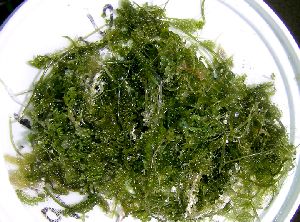
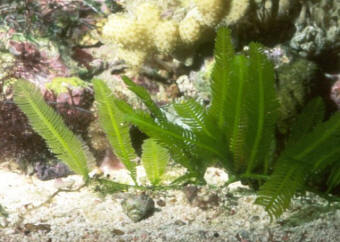
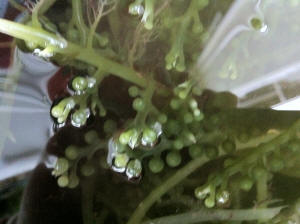
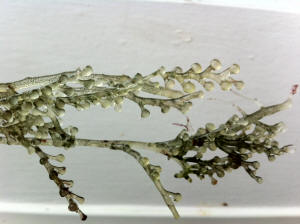
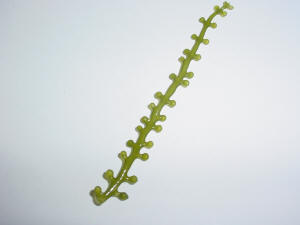
Caulerpa, gen., & Blue Mushroom Corals... incomp. w. 2-12-08 Good afternoon, <Big D> My reef tank is growing Caulerpa like crazy. Just to confirm, Caulerpa grows on a thick green stem in little bubbly pods right?? <Mmm... yes... some, and there are some other algae that do something like this...> In any event, it's doing an awesome job of starving out any Cyano or hair algae, but I have to trim it within every 3 to 4 weeks. <Okay> Meanwhile, my 200g tank is battling hair algae issues (I'm using RO/DI, 25% water changes, aggressive skimming, light feedings)... can I simply trim off some Caulerpa and put in my 200g tank? <Best to pull up some by the rhizome... even scoop out the substrate under to move> Will it reroot in my rockwork? <... not likely> I put a huge clump of this and placed some appropriate sized rocks to hold it down. Will this work, or do you think it will simply die? <More the last> My Foxface and Yellow Tang seem to take an interest in eating it. Of note, I am also running Chaeto in my sump. When trimming back the Caulerpa I noticed my soft coral Mushroom or Elephant Ear (?? don't know which) were looking poor. <Yes... good observation> Obviously they weren't' getting enough light. <Mmm, this and chemicals produced, nutrient competition with the Caulerpa> When trimming back the Caulerpa, the largest ear/mushroom broke off... will it die? When my halides came on, I did notice that it opened right up again. Can these reattach and grow anywhere given the lighting conditions and water parameters? David Brynlund <Maybe, yes and read here: http://wetwebmedia.com/caulerpaalg.htm and the linked files above. Bob Fenner> Water Noise vs. Flow Rates - 06/30/06 Hi! I am looking for a solution to eliminate noise from the overflow. <<A very common venture>> I tried everything and I started to believe a silent overflow is a myth. <<Hee! Indeed! At least at the "higher" flow rates>> Now there is a way and it would be to dramatically reduce the flow rate. <<This is what I always advocate. There are other things you can do to help...such as aspirating the return lines, submerging/adding ells to the termination ends, etc. ...but reducing flow probably makes the single largest difference. Few hobbyists (if any) need to push 1500gph or more through their sump. Much easier to deal with a sub- 1000gph flow rate here...employing other methods for increased flow in the display as/if necessary>> I have reached the point where it's either that or get rid of the sump and install an external skimmer. <<Mmm, let's work on quieting that overflow...>> Right now the skimmer is in the 1st chamber of the sump. There is already good circulation in the display (15X per hour) from 2 Tunze Stream 6100 with a multicontroller. <<Excellent! Reducing flow through the overflow/sump should not be an issue then>> I do a 5% weekly water change. Most of the sump (25 gal) is in fact a fuge for plankton/pod production and macro-algae. <<All the more reason to keep it>> Display is 90 gal reef with 150lbs Fiji LR and sugar fine 5" DSB. In these circumstances do you see any long term problems involved in having a flow rate from the return pump of only 6X per day instead of 6X per hour? <<Mmm...if I understand you, this would equate to just over 20gph (540gph divided by 24hrs). This is slower than I like, but I think a flow rate of 200gph-300gph would be fine...and easily dealt with/made quiet>> If I may ask at the same time a bioload question. <<Sure>> I am thinking of some change and would like to know if this is too many fish. <<Okay>> Is this a heavy bioload with my set-up, would I be on the edge? : -2 Ocellaris -5 to 7 Chromis viridis -1 clown goby (Gobiodon histrio) -1 mandarin -1 Tailspot blenny (genus Ecsenius) -1 yellow tang (Z. flavescens) <<This would indeed fill you up. I would like to suggest you forego the mandarin. This tank isn't really large enough (refugium or not) in my opinion to be able to provide the necessary nutritional needs for this fish for the long term. I would also suggest you keep the number of Chromis to 5, until you see what (if any) behavioral/environmental issues develop>> Lastly, would an Ecsenius blenny (like the Tailspot) be helpful to control Caulerpa growth in the display? <<I doubt it...the Combtooth blennies are more "filamentous" algae feeders. The tang will probably be more useful for this purpose, though there's no guarantee of that either>> And what about a tuxedo blue urchin (Mespilia globulus) for that same purpose? <<A neat critter...and likely a worthwhile addition...but it too will probably go for your hair, and most assuredly your coralline, algae first. You best bet re removal of the Caulerpa is manual extraction. If you can manual reduce it enough, the tang might be able to keep it in check for you. I guess you'll know better than to add this to your display next time, eh! <grin> >> Many many thanks! Dominique <<Quite welcome. Regards, EricR>> Caulerpa Going Sexual - 04/05/06 Hello - <<Howdy>> Thanks for the great postings in the past... <<You're welcome>> I have a strange situation going on in my tank... <<Ok>> I have a 75g FOWLR tank - Marineland Biowheel wet dry - Seaclone 150 protein skimmer. I've been growing 2 types of macroalgae in the tank. About every 2-3 weeks, a section of the Caulerpa seems to die off - it happens early in the morning, shortly after the light comes on - the tank goes cloudy and a section of algae turns white. <<Mmm, yes...A sexual event.>> I do a partial water change, remove the dead algae and everything goes back to normal for a few more weeks. <<Indeed...do keep this up as these events take place as there is possibility for severe fouling of the water.>> I'm doing 10% water changes weekly using RO water and Instant Ocean salt - all water levels are normal (pH=8.3, sg =1.023, ammonia = 0, nitrites = 0, nitrates = less than 10ppm, calcium is normal). What do you think is going on?? <<You are witnessing the algae do what is commonly referred to as "going sexual" and releasing gametes, other products in to the water (can be problematic in large quantities). This is triggered by the day/night cycle and is why you see it happening after the lights come on. Do have a look through our FAQs re...here's a good place to start (http://www.wetwebmedia.com/caulerpaalg.htm), and be sure to follow the associated links at the top of the page.>> Thanks for your help!!! <<Quite welcome. Regards, EricR>> Caulerpa going sexual - 22/03/06 Hi, here again requesting help. <Hello Edwin. John here with you this morning.> Have kept a 10gal refugium under my 55gal aquarium for almost 2 years. Have used feather and grape Caulerpa in addition to 4 mangrove plants in it since the beginning. During this period of time I have experienced some problems with the feather Caulerpa in terms of it growing very well for some time then it starts to turn white and disintegrates. With time I learned to read the signs when this was going to happen and I just take out the dying ones to avoid the disintegration in the water. Then I switched to grape Caulerpa and didn't experienced the die-off for several months. The strange thing is that for some time the grape Caulerpa have been disappearing gradually without signs of whiting like the feather and I am not sure if it has to do with the same phenomena or the reason might be an emerald crab that I added 2 or 3 month ago. I do not think is something related to the water parameters since I have not change anything in the water change schedule or the light schedule, everything have remained constant, even the mangroves have grow like crazy(2 of the plants already reached the bottom of the main display and started bending as they grew). Any suggestion will be appreciated. <What you've observed is correct: Caulerpa will undergo reproductive episodes that leave it white and dead, and foul the tank. Please look through our FAQs - and indeed the 'net at large - for many accounts of Caulerpa "going sexual". Constant pruning, or 24/7 lighting, are the only proven methods to mitigate the risk. <<Though not eliminate it. RMF>> For these reasons (and actually many more), other macroalgae are generally preferred over Caulerpa by most aquarists. Best regards, John.> Caulerpa query 2/22/06 Hi Guys, <David> I have Caulerpa prolifera in a Miracle Mud sump. The set up is about three months old and was doing nicely. However the Caulerpa is disintegrating. First the fronds appear covered in tiny hairs then these develop creamy coloured nodules at the ends and then the Caulerpa blade disintegrates. I tried sending some pictures of this but I guess they did not go through. The sump is lit 24 hours per day. <Mmm, I would check your water quality... particularly alkalinity and calcium and magnesium concentrations... and see below> I have read all about the problems of Caulerpa but living in the West of Ireland take what I can get. Is this it going sexual? <Not likely, no> Why would it do this? <Something amiss in the water most probably... or negative interaction with another algal species... chemically> Is it something else? I have another macroalgae which looks exactly like terrestrial moss but cannot ID it, any ideas?. <Bingo... it's likely this other algae mal-affecting your Caulerpa> Neither can I get my hands on Chaeto. Thanks for your endless help. David <See WWM re the terms "Algae Allelopathy". Bob Fenner> Re: Caulerpa query 2/23/06 Hi Bob, <David> Thanks for the reply. Alkalinity is 10.4, calcium 395 but I have not been measuring/monitoring magnesium. <Should be present in about a 3:1 ratio with Ca> I add Reef Solution at 5ml per week, change 5% water weekly (IO Salt) and top up with Kalkwasser. <Difficulties with Kalk here very common...> Have you any idea what the other algae is? The best description I can give is that it looks exactly like "moss". <... not much to go on... Perhaps a Derbesia sp. See WWM re Green, other algae identification> I will try attaching a picture of it again. It is dark green and the stands are "pinnate" it grows unattached in a bunch but has/can attach to the sand substrate. It also has a very sweet smell. I sourced it from two LFS, one in Ireland one in the UK and neither new what it was just that they had it in their sumps, it "worked" and seemed very hardy. Thanks Again David <A pic or drawing would help. Bob Fenner>
Caulerpa Invasion - 02/18/06 Dear crew member, <<EricR here>> I have a nuisance algae in my tank which (after searching this site and Algaebase) I believe is Caulerpa nummularia - there is also a photo of it on your site, under the heading Marine Algae ID 9. The email is entitled Algae ID 12/17/05. It is the photo on the bottom left. <<Yes, I see it.>> The thing is, there doesn't seem to be an abundance of information about it out there - or at least, with my amateur research skills, I can't find it. <<Hmm...a Google search re seems to bring up quite a few "hits"...though only working through them will determine if there is any useful information.>> What I do know is that it spreads like bird flu and seems impossible, short of a tank tear-down, to eradicate. <<All the Caulerpa species can be very difficult to remove once entrenched.>> Do you think a tang species might eat it? <<Maybe...but I think a Foxface would be a better choice.>> I don't know if it's toxic or not. Any help you can give me would be greatly appreciated. <<Have a look here, I think you'll find it of interest: http://reefshow.com/html/modules.php?name=AvantGo&file=print&sid=144 >> Thanks, Melinda <<Regards, EricR>>
A Solution to Caulerpa? 1/30/06 Hi everyone, <Mike G> I have a lot of Caulerpa in my tank and I read on your site that the lettuce nudibranch will take care of that. <Hmm... not in my experience. I've found that the only way to get rid of the blasted stuff is to pull it out by hand, 5 minutes a day, day after day after day. Lettuce Nudibranchs tend to focus on the filamentous Algaes - Caulerpa is really too tough, I'd think. In any case, none of the several Lettuce Nudibranchs, Sea Hares, Sea Urchins, Blennies, Snails, or crabs that I heard were supposed to eat the stuff would actually eat it, in my experience. There is one species of sea slug - Oxynoe viridis - that will take care of the stuff, but don't count open finding one any time soon.> My question is, will it harm anything else in my tank? <Aside from filamentous Algaes, nope.> I have: a bubble coral, bubble tip anemone, frog spawn, flaming scallop, <For the record/readers of this in the FAQs - Not a wise choice. Flame Scallops are next to impossible to keep alive for an extended period of time. A waste of money and life to purchase one.> orange cup coral, rock anemone, crocea clam, orange linckia that has lost 2 legs, (why?) <Linckia tend to lose their legs when very stressed or diseased/starving. Again, not a wonderful choice. It could also be the case that something assisted the star in removing the legs, though I'd say that is much less likely.> and polyps. <Zoanthids, I assume?> Maroon clown, firefish, cleaner shrimp, a scooter blenny, a lot of little white starfish (I don't know what kind they are) <Asterina sp. - identifying the exact species would be outstandingly difficult. Harmless, interesting. Reproduce via fragmentation. No cause for alarm.> and a lot of snails. Thanks for your help. <Good luck.> Kris <Mike G> Caulerpa racemosa growing conditions, tolerances 12/13/05 By the way I wrote a letter already in your site. But I want it to be sure hehehe... well I just want to ask you about the survival of Caulerpa racemosa with different salinity levels. what would happen to the Caulerpa if it is exposed to high salinity or low salinity levels? <This species is pretty euryhaline... widely tolerant of changes in specific gravity> what will happen to the cells? <Adapt quickly... btw is single celled...> by the way am KEN from Philippines... am looking forward that you'll answer my question. again thanks in advance... <Bob Fenner, just back from Indo.!> Grape Caulerpa 11-16-05 Hey Crew,
<<Hello>> We have some grape Caulerpa growing in our 50
gallon reef. It's growing fast, too!! <<Always a bad idea to
add Caulerpa to a display, unless you want it to look like a planted
freshwater aquarium.>> What can we do to get rid of it? It's
real hard to pull it out manually, as it is stuck to the rocks.
<<Pull out as much as you can by hand and find a suitable
vegetarian to add to your tank. I never suggest adding a fish to fix a
mistake in your tank, but a rabbit fish will do wonders for
you.>> <<And likely be too large for this system, if not
immediately, then in very short order. I suggest using this
animal only very short term. MH>> Any fish or
critters?? 50 gallon reef DSB 100 lb live rock 3 Chromis 1 Clown 1
Pseudochromis fridmani SPS Ricordea Xenia Emerald Crab Ca 425 Alk. 9.2
Mg 1350 Phosphate .05 Nitrate...undetectable Any advice is greatly
appreciated. Ronnie NYC <<TravisM>> Caulerpa/Cyano in refugium 11/16/05 Hi Crew, For a group of volunteer experts, you guys should be commended for keeping this site so informative and assisting more novices to succeed. <Glad you have found the site helpful!> Parameters: 250 gal. FOWLR with large wet/dry, refugium with live rock rubble/Caulerpa, protein skimmer (producing lots of daily skimmate), 40 watt UV sterilizer, trickle filter box with media pad, activated carbon, and PhosBan. Main display has ~250 lbs. of Tonga live rock, live fine aragonite DSB. On top of the refugium I have mini PC's that run 24/7. <All sounds good. Do consider that in order to thrive, Caulerpa needs about the same amount of light as moderate light corals.> I have a couple of questions: First question is that I seem to be having trouble getting my Caulerpa to thrive or grow in the refugium. The refugium is a section of my wet/dry whereby there is a small power head that pumps water from the main pump section of the wet/dry into the refugium section and the water level weirs over into the skimmer section. The flow seems low but is there none the less. The Caulerpa has been in the refugium for about two months now, and if anything it looks like the "clump" of Caulerpa is shrinking. <I would definitely consider current as a culprit. Just like any other marine organism, Caulerpa depends on water movement to deliver nutrients and carry away wastes.> Concurrently, I have been having a slight amount of Red Cyano forming on the fine DSB in the main display that I seem to have under control but occasionally it reappears. I seem to be an "over feeder" so nutrient export is important to me, hence Caulerpa in the refugium. I thought initially that maybe the Caulerpa did not have enough to thrive on; however with the Cyano forming, and the high fish load, I can't imagine that the Caulerpa wouldn't thrive. Last night I went into the refugium section to remove a small amount of red Cyano that formed on top of a section of the Caulerpa and noticed that the Caulerpa was very flimsy and slimy, almost as if I could have agitated the water enough to eliminate the clump. Also it did not seem to have set any hold fasts onto the live rock, but yet it wasn't floating either and there are a few small clumps of it that did attach to the sides of the refugium. I tested Phosphates and the reading was .2 so I am perplexed. <Obviously, the Caulerpa isn't healthy and growing, so it isn't exporting anything. Sometimes it takes a couple of tries to get it established, so I would suggest trying again and increasing the light and current a bit.> Attack Of The Caulerpa! Reefer Forced to Take a Hands-off Approach 10/22/05 I'm hoping someone has a solution for what has me ready to abandon my many years of marine aquarium keeping. <<uh oh...sounds like trouble...>> The Caulerpa housed in the refugium has migrated to the main tank and is threatening to completely take over everything. <<Not uncommon...this genus of macroalgae is known for its invasiveness. One of several reasons I prefer Chaetomorpha for refugium use.>> Unfortunately, I had hand surgery earlier this year and with my hands in casts was unable to stop the progression in time. <<Ouch! Hope things are getting better.>> My tank is sixty gallons and I have, live rock, which is being completely taken over, six small to medium fish and a few corals. I think because of the small size of the tank that a fish big enough to eat this Caulerpa would not fare well, if this is even a possibility. <<Mmm...maybe>> Since, my hands are still recuperating does anyone have a solution to this problem? <<Enlist a friend to help/contact an aquatic service... EricR>> Caulerpa Suitability 8/9/05 Hi guys! Thank you for your helpful FAQs, you guys have done a great job. I have a 2x1x1 feet tank, protein skimmed, aeration pumps, undergravel filters, cooling fan and live rocks. I have 2 feather dusters, 4 diff. clown species, 1 domino and 1 yellow tail damsel. All of them are small and doing fine. The lighting is a bit confusing because I place the aquarium outdoors under a shade where there's no direct sunlight but still the daylights outshined my 220 watts twin fluorescents (white and blue actinic). Is this ok if I take in polyps into the sys.? <If you are talking about Zoanthids, then yes. I wish we could all use natural sunlight!> I'm thinking off adding Caulerpa (grape) so as to help with the heavy bioload besides adding color and oxygenating the system. Do you think it will work? <I would not recommend adding Caulerpa to the display. It is fine in a separate sump or refugium, but there are many problems with placing it in the display. First, it will likely overgrow all of your rock. This is only a problem if you find it unattractive. Second, it only oxygenates the water during the day. At night, it consumes oxygen and could actually deplete oxygen at night. Last, if you plan to add polyps or other corals, the Caulerpa will probably overgrow them and the chemicals produced by the Caulerpa may inhibit their growth. If you can add the Caulerpa to a connected tank where it can be controlled, this may be a better option. This also allows it to be lighted at night so that it is producing oxygen when the display is not and vice versa.> How do I place them (i.e: aeration, lighting, depths, substrate burial)? Lastly, what would I feed them with? Thank you in advance. Sam (Malaysia) <Simply dropping some fronds of Caulerpa into the tank will usually get them established and no special care is required. Best Regards. AdamC.> What Will Munch Caulerpa? 8/17/05 Hello Bob, <Actually, Scott F. in tonight!> First of all, I'd like to say I appreciate your site and am thankful for the help you've given me in the past. I try doing the research myself as I realize your time is valuable. That said, I've read the algae control FAQ's and the Algae ID'S. The algae ID section noted that Razor Caulerpa was very hard to get rid of and not very palatable to most fish. <That's correct. Many fishes will not touch it.> So I read the algae control FAQ'S and didnt find Razor Caulerpa specific questions (most just read algae). I did read that lawn mower blennies do a great job of controlling algae but I wasnt sure if that applied to razor Caulerpa. <Not in my experience. It's simply too tough for these guys. In fact, I think that the Lawnmower Blenny is highly overrated as an algae eater...A great fish with a fun personality, but not all that great at consuming algae, IMO.> So my question is, "What will eat the Razor Caulerpa?" I have a 55 gallon tank with a hydor20 canister filter and a power head for water circulation. There is no media in the canister filter. I top my water off with water from my planted discus tank (remember that question?) and have some mangroves in lieu of protein skimmers and about 4" on aragonite #00 and 50 lbs of live rock. For lighting, I have two 65 watt 50/50 Power compacts. I've never had anything die on me except an octopus after about four months. The water is very clear and everyone seems happy except me because of Razor Caulerpa, which I fear will overtake my tank. I have about 20 Blue Mushrooms, a Blue Sponge, 1 large Yellow Gorgonian, Sun Polyps (theyve released spores that matured into little Sun Polyps throughout the tank), a small Orange Starfish covered in what appears to be orange thorns (not sure what kind it is), a mated pair of False Percula Clowns, a Mandarin Dragonet, and a Pajama Cardinal. Everyone except the Mandarin (Ive seen him eat formula 1 in addition to the pods all over the glass) has been in the tank for over a year. The only mineral supplementing I do is adding one of those little white cubes whenever one runs out which is about every two weeks. I scrape lots of red and green coralline algae of my glass weekly. Back to my question, what will help with my Razor Caulerpa problem? Any advice is much appreciated. Thank You. <Well, short of manual extraction, there are not a ton of fishes that will eat the stuff. Some Zebrasoma Tangs will do the job, but you need to have a system that suits the Tang's long term needs. And, Tangs are individuals; some may never touch any Caulerpa at all! You just cannot be certain. I'm afraid that manual extraction is the best bet in dealing with this algae.> p.s. I did have a Moorish Idol die on me, but it wasn't my fault. I casually told my wife I'd love to get one someday and one day I came home to see a Moorish idol lying on its side. She bought it for me while I was at work and it was dead a half hour after I got home. I wanted to yell at her because Ive advised her against buying stuff without proper research on my part many times but her smile at the thought of the wonderful surprise she thought she was giving me overcame the urge to yell. Still it was very sad to think the Moorish Idol was pulled from the ocean to die in my tank. I think she learned her lesson from that (we lucked out on the orange starfish being harmless so far, that was her surprise also). auughhh <Well, it is certainly a tragedy that these fishes are available to the causal hobbyist, but here intentions were certainly good. I guess we all need to educate our spouses and significant others on the suitability of some animals for captive life, and the unsuitability of others. It's a good practice for us, for the environment, and for the hobby. Best of luck! Regards, Scott F.> Caulerpa racemosa raising ammonia? Indirectly 7/18/05 Hey guys, <And gals> I bought a handful of racemosa Caulerpa last week and placed it in my sump. When I got home that night, all my racemosa skipped over my baffles and got sucked into my pump. <Oh oh> I saw racemosa floating everywhere. I know that this type of Caulerpa releases back several compounds. I immediately checked my water parameters and ammonia levels spiked up to 1ppm from 0! I did a large water change ( about 40%), checked my ammonia afterwards and it fell to 0ppm. I also tried to remove as much of the Caulerpa as possible. My fish and corals are ok. This week, the levels jumped up again but to .5 ppm. I've never had an ammonia problem. I did another water change and now the level is down to .25. I also cleaned my prefilters thinking that there maybe some decaying Caulerpa hanging around. What else to do you guys suggest I do? For how long? I hope that this ammonia problem levels out soon. Nilesh <Keep monitoring your water quality, watching your livestock for signs of overt stress... I would place activated carbon, a pad of Polyfilter in your filter flow path... Likely the Caulerpa stressed the livestock, which produced extra ammonia... Bob Fenner> Substitutes for Caulerpa 7/11/05 Hiya, After pouring over the FAQs, I've decided against Caulerpa. To me, the risks seem to outweigh the benefits. I was wondering what else I might be able to put in the tank I'm setting up for my tang and other veggie-munchers to munch on that aren't so potentially deleterious. Thanks your help, Marianne <Read here: http://www.wetwebmedia.com/maralgae.htm and the linked files above. Bob Fenner> Caulerpa toxicity! 7/9/05 Hey Anthony, <M. Maddox here today - not as good, but a lot cheaper! ;)> I need your help!!! <Mental or physical?> I just recently added Caulerpa racemosa to my new refugium. I know that you're not a big advocate of Caulerpa for nutrient control. <Not at all - and I've seen it take over tanks, smothering everything in the process> I've been careful pruning this algae without actually breaking off dead strands. Unfortunately, when I stepped out last night, the an entire handful of Caulerpa floated into my pump! When I got home, I found pieces of Caulerpa everywhere in my main tank. I tested the water and found that the Ammonia level hit 1ppm from 0. <Good god. 100% water change time!> I've NEVER had any other reading than 0 for ammonia. I did a 25% water change last night and checked my reading several times afterwards and the ammonia level fell to 0 again. <I would another, larger water change to be sure - ammonia is BAD> I also tried to remove every little piece of Caulerpa from my tank. I also placed a bag of carbon in my sump. Do you think that the shredding of this algae caused the ammonia spike? <Yep> Also, what else can I do to reduce the toxins released from this Algae? More water changes? <More/larger water changes, carbon, Poly-Filter (the one by PolyBioMarine)> I'll carefully test the water for the next few days. I'll also remove the algae and go for an algae like Chaetomorpha. <Good idea> Thanks Nilesh <You're welcome - M. Maddox> Macro Algae It is always the concept regarding Caulerpa and other sea weed feed off of the waste and nutrients in the water...but what do they excrete? <Basically, oxygen during the day, CO2 at night.> They basically filter feed right? <They take in dissolved nutrients/organics. James (Salty Dog)> Re: question about Caulerpa and other seaweeds If they take in dissolved nutrients and such, they still excrete more than pure CO2 or O2....what I mean to say is you would still need water changes.....no matter how much macroalgae you have, aggressive skimming and water changes are still necessary. <A tank always does better with frequent water changes. You are replacing many lost trace elements along with reducing nitrate/phosphate levels. Some companies such as Boyd's advocate no water changes necessary using a product they manufacture called Chemi-Pure. It is a great product, but it will never replace water changes.> A lot of people tell me they only put in top off water and never do changes because of skimming and having a refugium, and I was just wondering about this...<Keith, it is very difficult to duplicate nature in small closed systems. Most seaside aquariums have their water pumped in offshore to replenish/change their seawater in their display tanks. If they thought they could get away without out it, they would. James (Salty Dog)> Trying to Carve a Statue with a Toothpick - Maddening Caulerpa Infestation Hey all, I am at the point at which I am considering leaving this hobby. I no longer enjoy looking in at my tank, because all I can see is a jungle of Caulerpa. It kills everything, grows over it. It puts its roots through the mantles of my clams and the flesh of my corals. Just recently I had to snip away a part of my maxima's mantle to free it of "the root of all evil" (Caulerpa = all evil). I have a 4-5 inch thick layer of the stuff on all of the rock, the bottom 2" completely white (starved of light). Just last night, by flashlight, I removed 14 pounds of this aquatic demon. I swear, I am going to start calling people "Caulerpa" as an insult. I hate nothing more than this vile weed. I have set up a series of buckets filled with fresh water to kill whatever I pull out, to watch it deflate pitifully like a wretched little raisin. This brings me great joy, watching it suffer. Please, someone, anyone, help me! This is my final plea. There is a slug, Oxynoe viridis. I need that slug. It lives on a diet of solely Caulerpa racemosa, and is the answer to my numerous prayers. I have tried everything else short of tearing down the tank. Ripping the damn stuff out is futile. To control it by ripping it out, even aggressively and in such a small tank as mine, is like trying to use a toothpick to carve a statue. Once again, I ask you all, HELP! I know that all of you are accomplished aquarists, and hail from various places in the world. Someone receiving this email, somewhere, might just be able to locate a (or several) Oxynoe viridis. Find one for me, and I'll send you a bunch of Caulerpa. :-) Thanks in advance for finding the slug that will save my tank, Mike Giangrasso - WWM Crewmember <My advice is to sell this rock to any of a number of people that will actually value it for its plant life forms/coverage... And replace with new rock (cure for a couple of weeks). It's good to replace rock periodically as it is... and this is an effective solution that is more reliable than months of hopeful natural predation/control. A fast and furious fix ;) It will give you a chance to stack again/better (as with needing to build the rockscape away from all walls... do avoid the reefscape touching glass/walls... severe impediment to water flow overall and all that leads to) Kindly, Anthony> <Good advice... and along those same lines... I see Walt Smith took mine and started his "Fiji Gold" (named in honour of the bier there) supplement line. <VBG> B> Caulerpa mexicana outbreak 28 March 2005 Hi, <Howdy!> Just an update (as requested) about the Caulerpa outbreak which had taken over my 5' x 2' x 2' for at least two years and was smothering everything, growing back quicker than I could pull it out. Identified as C. mexicana I think. Followed your suggestion six months or so ago. Took all the living rock out and pulled off as much algae as possible, even down to picking bits out with tweezers. Put the rock back and after two months there was slight re-growth which failed to take hold. Not a single strand of the d**n stuff now. Thanks guys. <Great to hear.> Concerned about my Caulerpa Hello Crew, Thanks a ton for all your good advice so far. Here is my latest. I have some feather Caulerpa growing in my refugium that came along with my live rock. It has been growing well under a 12 watt Jalli daylight bulb. Recently I have noticed the long runner that the leaves come out of is looking white, and some of the leaves are more pale than the others. Also, there is some red slime growing on the leaves. Specs are as follows: pH 8.2 Salinity 1.023 Nitrates 0.00 Calcium 480 Is there something I am doing/not doing to cause this? I have recently added additional substrate to accommodate a jawfish. Some thing I will never do again to an established (3 mo) tank. Thanks in advance <Hello, it sounds like you are o.k. My advice is as follows: check the algae to make sure that there is not a dense overgrowth above it, shading the light. Check the water flow through the refugium for good water flow. You should be thinning the Caulerpa weekly to prevent die off. The part that is "bleaching" prune and remove from the tank. Good Luck. MikeB.> White Growth on Caulerpa prolifica Bob, <Don> I am new to the hobby and have read through a lot of the FAQs on Caulerpa but didn't seem to find what I am observing. I have some newly acquired Caulerpa prolifica from another aquarium owner that seemed to be doing Ok for a few weeks. However, over the last week I have noticed that it seems to be either sprouting stalks of growth that look like white cotton in various places or at the broken ends of stalks (due to possible transport damage). What is this and is it problematic? Thanks for the great support and web site...Don <Mmm, can you send along a (very close-up) pic? This sounds like either a fungal (there are lots of these organisms in marine domains) colony growth, as you state subsequent to damage, or calcium accumulation at the apices... Either way, not really likely a problem... will probably self-cure. Bob Fenner> Macroalgae In The Mix! WWM: <Scott F. at the keyboard this evening> Ive been reading through your FAQs on the Ecosystem Mud filter approach. Since these are not dated, I cant tell what is the most current line of thinking, but did note that there seems to be mixed feelings on this even among your staff. Thats fine and perfectly understandable. <Good, 'cause we do all have different opinions based upon our own experiences, which gives our fellow hobbyists an honest point of view.> New information comes along all the time. Can you give me an update on the following questions: <Will try!> 1. I see a lot of conflicting info on use of Caulerpa. Toxicity, etc. Is it still recommended? <Caulerpa is a great macroalgae that is prolific, easy to care for, and good at exporting nutrients if carefully harvested on a regular basis. Nothing is new here...It is prone to "go sexual" and release its cellular material into the water under the right circumstances, and some also theorize that it may produce substances which are potentially toxic to some corals. I prefer more "benign" macroalgae, such as Chaetomorpha. In addition, it is actually illegal to keep in some areas, such as Southern California, where it has been released into the wild, to great disdain.> <Editor's note: Under State law (Assembly Bill 1334), the sale, possession, and transport of Caulerpa taxifolia was prohibited throughout California in September 2001. Please see here: http://www.swrcb.ca.gov/rwqcb9/programs/caulerpa/caulerpa.html > 2. Is it okay to use a micron sock and prefilter sponge with this system? Do these remove the desirable critters? <In my opinion, using these filter socks is fine; you just need to clean them very frequently. Yes, it is certainly possible that some desirable organisms will be removed by such mechanical filtration, but I believe that the benefits of these "socks" far outweigh any disadvantages, as long as you pay attention to very frequent maintenance.> 3. Is 24 hour photoperiod still recommended? Noted FAQ that Anthony answered where he pointed out possible sexual crash, but then I also understand this is key to claim of keeping pH and oxygen levels more stable. <I have employed a 24 hour cycle with macroalgae with good results, but a "reverse daylight" (i.e. light the macroalgae when the display is dark). In actuality, the "reverse" daylight technique is a more natural system; I don't think that keeping macroalgae in "stasis" is really natural> 4. I see a some refugiums that dont use the Mud. They sometimes also use live rock in the sump w or w/o the algae. In these cases, is the 24 hour photoperiod detrimental to the live rock? <Well, it could be disruptive to the organisms which inhabit the rock, but the bacterial processes are probably unaffected.> 5. Are the bioballs that ecosystems recommends necessary? Will these become a maintenance issue down the road? <I don't think that they will become problematic. From my understanding, these are actually used to keep debris from the macroalgae from escaping the sump.> If youll indulge me on one more issue Im struggling with: Im trying to choose my aquarium size and have option of 18, 24, or 30 height. I like the look of the 30 height, but understand that it will drive the lighting requirements. I havent seen any quantitative numbers on this though. Is there a formula for determining difference in lighting level required to achieve same intensity as a function of water depth? <Good question. I'm sure that there are certainly some highly scientific studies on this, and some applications of the inverse square law and other principles that can apply. However, I am a simple guy and I like to keep things well...simple. Here's my take on it: I tend to favor the 24" high tank, because you can still utilize 175 to 250 watt halides for most corals. In a 30" high tank, conventional wisdom is that you will need 400 watt halides. This is not "scientific"; merely based upon the work of hobbyists and personal experiences. Of course, there are many hardcore reefers who believe that you need such intense lights even in 14" tanks! I guess it all adds up to the fact that there are no right or wrong answers to every situation. You just need to assess the needs of your animals and take it from there!> Thanks for your help. Bob. <Glad to be of service, Bob! Regards, Scott F.> Caulerpa addenda Hi Scott, All, You answered a query regarding the use of Caulerpa, and mentioned that it is illegal in SoCal. I have taken the liberty of adding an editor's note regarding the legality of, specifically, C. taxifolia in the state, with link provided. I hope I haven't stepped on any toes, but I felt that it's important for people to be aware of this, because many of our archives do date previous to September '01 and I'd like to help ensure we don't encounter any legal issues regarding any advice to use Caulerpa spp. Call it "COA" (kind of like CYA, but covering more butts). If it's preferred, I will remove the notation. Marina <Well done Mar. BobF> Caulerpa keeping ... the good side ! Hey guys
it's Klay from N.Z. .... <Hello from not-so-sunny Southern
California... where Caulerpaceans are outright banned, sigh, as
"noxious potential weeds"> regarding comments about
Caulerpa pro's and con's .... thru my various trials with this
and native sea weeds ( macro algae's for the purist ! ) ... I have
found that running an actinic 24/7 as a night light helps stop the
dreaded spawning/self destruction that plagues reef garden tanks ,
<Good> this is based on 8 months of trial. ( and error).
<Heeee!> ,1st system... 1 tank ( 3 ft) 200 ltr with usual
lighting ( 2 x actinic, 2 x full spec, 12 hours ....
plus 1 x 14000 k halide, 6 hours ) ...( invert tank ,
soft/stony corals (11 species), hermits, conch's , cowries, urchins
, starfish ( 5 types) ,tritons, banded shrimp, 5 x cleaner shrimps ,
whelks , Turbos ( and odd snails cant find I.D's for) + numerous
micro life forms...fish being mandarin , scooter, "who are bluddy
fat" , percula x 2 , flame, ( 4 x Caulerpa spec.. mexicana , grape
, + ?? , buttercup) ... filtration .. side overflow thru media back to
tank , no "skimmer" ( I know, but this is a natural system of
sorts based on live rock etc.)... monthly water change of 60 ltrs ( 30
%) no additives!. <Okay> 2nd system ... 3 tanks 4 ft
350 ltr running (each) 1 x actinic , 24 hours , 1 x full spec , 12
hours )........ ) ditto above plus used as seeding tanks for live rock
.......... filtration , all connected to main overflow to sump "
no skimmer" ..live rock "filter", debris trap
for organic feeders ( another type of natural system using
NZ native species 4 filters !! ) will explain if needed.... you'll
be surprised.! ;) <Looking forward to it> 3rd system ... 1 x 3 ft
240 ltr ( 1 x actinic ( 24 hours ) , 1 x full spec ( 12 hours) , 1
x14000 halide ( 4 hours ) + 3 hours full sunlight .... ( 1 x Malu
anemone 13 " dia ... 2 Clarks clowns, blue tang ,
leopard wrasse , 8 soft/stony corals , 4 x
Caulerpa spec's .. ) ... filtration enclosed system ( 3
x powerheads , 1 x " box filter ,absorbent packed " ...
weekly water change of 50 % ( 120 ltr
)... no additives!. ( planned Jaubert system for this one ). results
........ introduced 4 x Caulerpa to tank system 2 .... month
later handfuls of "cuttings" ( pinching edges ) to
other tanks ... system 1 , experienced periodic spawning/die
off of donored colonies ... grape sp. all gone...overall
,average life span! ... red algae(
macro) showed lightening of edges but still showed accelerated growth.
.... system 2 , massive growth ( water quality ++ ) , gave
away numerous " cuttings" ( no die off ).
... system 3 , massive growth ( to the point it was
pissing off the anemone ) .. same as system 2 .. red algae
same as system 1 this is by no way a scientific research , just a
result of a layman playing around with macro algae's , my
conclusions are that as long as there is light in the tank 24/7
Caulerpa will refrain from the " die off " plus with a very
healthily growth ( read forest) the water quality is kept good ... only
a guess but all debris+ organic nutrients helping macro along !?
<Yes, likely so> ........ plan
to morph all tanks into one 8 ft system using a combination of Jaubert
with separate refugium ( so to restart after toxic gas build up ...
sulphur blah blah )... minimal fish , heaps of inverts ( as they are
more interesting and not mainstream, then lets see the
forest turn into the jungle. hope this helps the novice/average
aquaculturist/aquarist with some alternative info !? .... no
responsibilities for said info thou. ... I'm sure there will be
others who have played with these " nasty" weeds and have
different conclusions and will dispute my findings , but , hey
! good onya , I think they look so damn good in a reef tank
that they deserve a better cred........ anyway cheers Klay. <Thank
you for your input. Bob Fenner, one of the remaining
"pro-Caulerpa" types> |
|

|
Features: |
|
| Featured Sponsors: |