 |
|
| Home | Marine Aquariums |
Freshwater Aquariums |
Planted Aquariums |
Brackish Systems |
Ponds,
lakes & fountains |
Turtles & Amphibians |
Aquatic Business |
Aquatic Science |
Ask the WWM Crew a Question |
| Please visit our Sponsors | ||||
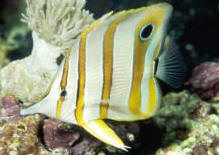
Copperband what? - 1/30/2006 Hello Folks,<Hello Tom> Great site and thanks for the input. <Output, and thank you!> For what it is worth, although you all never ask, I do make small contributions via Amazon Honor System with each question, it is the least I can do. <And is very much appreciated.> Anyway, I have recently introduced a new addition to my tank. Current setup: System one year old but recently (one-month) broken down and moved. 90 Gallon Rectangle Oceanic 100 lbs Live Rock give-or-take 100 lbs Deep Sand Bed (sloped back 6" front 4") give-or-take 460 watts of light VHO and PC (Actinics and White) A variety of Softies, Bubbles, leathers, Devils Hand etc... Some Chaetomorpha for nutrient export An ASM G2 Protein skimmer I also use a few tablespoons a week of Kent Phosphate Sponge (phosphate levels are immeasurable) RO/DI water for top-off <So far so good.> 1- Yellow Tang 4 Inches 1 - Damsel (There were two but one didn't survive the move) 2 - Cleaner Shrimp 1 - Coral Beauty 2 - Ocellaris (sp?) Clown Fish 1 - Blenny After a near three week Quarantine (yeah I know your gonna say should have been another week or two) <Not bad, 28 days much better.> I decided to move my newest addition a Copperband (CB) into the main tank. He was eating and seemed happy, more-or-less but my QT does not have any live rock to pick at and he started to just stay in the corner a lot. <A very difficult fish to acclimate.> Soooooo, I moved him to the main tank. One of the first things (within a couple of minutes) the CB did was go up to one of the cleaner shrimp and got a complete detail, amazing but I digress. His purpose is simple KILL AIPTASIA. After the first 24 hours (which is at the time of this writing) the Copperband is relegated to a corner of the tank by our friend the Yellow Tang who summarily chases the CB off whenever he ventures out into the aquarium. <Not unusual.> Drawing on your experience, what should I expect - Will this lessen over time? <It should.> If so how long before the Tang cuts the CB some slack or in other words socialized themselves? <I'd say things should improve within a week.> Should I be concerned for the CB? <I'd sure keep an eye on things.> How can I help supplement feeding for him as he doesn't come out when I feed the other inhabitants (usually Spirulina + Some Cyclop-eeze or frozen treat like Brine, Mysis, Sea Algae etc...<If he is eating the Cyclop-eeze this may work, if not you may try feeding some live brine. Stocking order is the problem here. Sensitive fish like the CB should really be introduced first. It's tough enough acclimating them without adding aggression to the problem. May want to leave the lights off for a couple of days. This may lower the aggression level of the tang.> As always, thanks a bunch you guys are the best. <And thank you. James (Salty Dog)> <<I'd remove the Tang for a week or two... to elsewhere. RMF>> Tom Tang/Butterfly Dispute - 01/18/06 Hello, <<Howdy>> I am having a major problem and don't know what to do. I have a 75 gallon FOWLR. Last night I added a Copperband Butterfly. I read everything I could find about the fish first before adding him and asked three of my LFS people before getting him but this still didn't prevent what has been happening. <<Don't ya just hate it when the fish don't read the same books, talk to the same people!>> My Powder Brown Tang has been chasing him all over the tank forcing him to hide in the top corners of the tank. I turned off the lights and the aggression seemed to drop off a bit. This morning I saw him chasing him around some more and back to the corner he retreated. My question is will this subside? <<Hard to say...>> Should I just yank him now and put him back in QT? Here are all the tankmates: 75 Gallons 80 pounds of LR 1 Tomato Clown 1 Powder Brown Tang 4 Green Chromis 1 Cleaner Shrimp Thanks, Jason <<I would leave the butterfly in the display, pull the tang and put it in the QT tank, rearrange the rockwork in the display, and reintroduce the tang in about a week's time...if all goes well the butterfly will be comfortable/familiar enough and the tang confused enough the aggression will be mitigated. regards, EricR>> Impulse Buying - 11/14/2005 I have been a little hasty and just purchased a Copperband butterfly, the tank is 23 gallons and currently serves a damsel, puffer, and clown. <Poor choice. As always, please research all purchases.> The butterfly is not yet eating, although he is picking off the live rock. Should I wait to see what happens or is the tank just to small? <Tank is too small (overstocked). And the puffer? - Josh> <<Return this fish, pronto. RMF>> Cyanided Copperband? - 03/31/2005 Hello, <Ahoy, thar, Rob!
Sabrina here, this fine evening.> A couple of months ago I emailed
you about my success with a Copperband butterfly in my 90 gallon reef
tank. In fact you guys posted on your website, very cool. <We
do try to post everything! Thank you for sharing your experience with
us before; I hope we can be of service now....> I have a question
though. How do I determine if a fish has been caught by cyanide?
<This can be extremely difficult to determine with any certainty....
Location of collection may shed some insight; I believe a fish can be
necropsied after death to discover if cyanide poisoning did it in or
not....> <<Editor's note: In general, not always,
Indo-Pacific fishes may be suspect. If not collected with
cyanide, may have been exposed via run-off, downstream of mining
operations.>> For the last two months this same Copperband
has been eating everything in sight, Mysis, bloodworms, squid, clam -
pretty much whatever I put in the tank but for the last 2 weeks he
seems to be getting thinner by the day. <So, he's eating
heartily, but he's losing weight? A few possibilities here,
including cyanide poisoning.> I feed my fish 2-3 times a day and I
vary their diet. I have quite a variety of fish in there. My water
parameters are pretty much where they need to be, ammonia - 0, nitrites
- 0, nitrates - 0, ph - 8.3. <Salinity? Alkalinity? Tank size?
Other fish? Most recent addition? Were all additions quarantined?> I
have been observing the tank for several days and nights to see if
other fish are harassing the Copperband causing it stress but none seem
to be. There are no signs of parasites, fungus or bacterial
infection. <Mm, actually, the fact that the fish is losing
weight despite an obviously hearty appetite is a strong sign of
internal parasites. Can't see 'em when they're on the
inside, after all. It might also be an indication of mycobacteriosis,
an essentially incurable internal bacterial complaint. Other signs of
mycobacteriosis are deformations of the spine, possibly clouded/frayed
fins, small lumps/granulomas, or bloating. Let's hope, for now,
that it's not mycobacteriosis, and not cyanide poisoning, as
there's not a whole heck of a lot you can do about those. Let's
turn to the possibility of internal parasites, and explore that a
bit.> I have many years experience with saltwater fish and inverts
but I have not seen this before. This Copperband seems to be wasting
away no matter how much he eats and he eats a lot. What should I be
looking for? <At this point, let's hope for the best. If
you have access to a high-powered microscope, collect a fecal sample
from the fish and take a look. You will probably need help from a
university biology professor, or a veterinarian, with this, unless you
have a lot of confidence in making a diagnosis. If you don't seek
the help of someone of that nature, then try to get a hold of
"Handbook of Fish Diseases" by Untergasser, "Fish
Disease: Diagnosis and Treatment" by Noga, or other book with
good, accurate microscopic photographs of what to look for in the way
of internal nasties. Mostly, you'll want to determine first if
there IS anything in those guts, and secondly whether it's
protozoan or a nematode, trematode, or cestode taking residence in the
fish. If it seems that you're dealing with a protozoan, I would
suggest treating with Metronidazole in food, as the fish is still
eating. If you find signs of nematodes, Trematodes, or Cestodes, I
would try treating with Piperazine or Levamisole in food. Now, if you
DON'T have access to a good microscope, or vet, or good book, or
you simply don't feel confidant with your findings, you could treat
with Praziquantel in food, which should handle any of the above nasties
- but you'll probably need a vet's help in obtaining this.
Metronidazole, Piperazine and Levamisole are easily available in the
aquarium trade, and can even be purchased already in foods. You might
take a look at http://www.flguppiesplus.com ; I
know they have some medicated foods available.> I have to admit I am
getting ticked off at the thought that he may have been caught with
cyanide. <I would be, as well. I'd be infuriated.> The
fish store that got him in for me guaranteed he was not but you never
really know do you? <Unless you feel you can trust the fish
store, and they the wholesaler, and they the transshipper, in
collection location, and you know that location does not permit
collection via cyanide, then no, you really can't know. And even
when the stars ARE in alignment, and you DO know the entire history of
the fish, well, I'm sure it's just not possible to be
absolutely 100% certain. Sadly, it is entirely possible that this IS
the problem with your fish. I've still got my fingers crossed that
it's a perfectly fixable situation, though.> I would appreciate
any thoughts on the matter. <And there you've got 'em.
If you need further treatment information, the two books that I
mentioned have great suggestions for treatment and dosages. Do try to
look the books up, if you have the opportunity.> Thanks, Rob
Mancabelli Syracuse, NY <Wishing you and your Copperband well,
-Sabrina> Marine Roulette Anyone? We all know how awesome the WWM crew
is - and so do they - that's why we all come back here! <They
told me there was free beer! You mean there isn't? I'm outta
here!> Enough said. What's odd is that so many of us have
learned what we know of the marine hobby right here and by reading the
works of WWM authors - yet so many of us insist on learning the hard
way.... <Heeeeee! Human nature... my fave species> For example, I
have an overstocked 75 gal mixed reef and have never quarantined so
much as one thing... The system has been up and running for over a year
and I've watched the dreaded white spot signs of Ich teeter-totter
between the fish's favor and the parasites favor. Had never had a
serious enough outbreak to warrant pulling all of the fish out for
treatment or letting the tank go fallow.... 'til now....
<Doh!> Hadn't seen any signs of Ich for close to six-months,
so in my infinite wisdom what do I do? Add a "King-O-Ich"
Hippo Tang. Well the pendulum quickly favored the Ich and I end up with
a major breakout. Fortunately I had a 55 gal. sitting around looking
thirsty so I tear the rockwork apart and catch the fish.... Yellow
Tang, Hippo Tang, Royal Gramma, Two Ocellaris Clowns, Copperband
Butterfly, and a Flame Hawkfish. They're being treated with
Cupramine and for all those who've had trouble measuring this, the
Seachem kit seems to keep a good handle on the copper levels.
<They do have good products> Did I keep a sponge in the
75gal display to use in case of an treatment emergency such as this? Of
course not.... <Doh times two~!> So I'm changing significant
amounts of water every other day to keep ammonia as low as possible.
Livestock seem to be progressively doing better - but I'm concerned
about the Copperband. He hasn't hardly eaten any provided foods
since we got him. He seemed to pick off the rocks rather than touch
anything we fed... Problem is - their obviously aren't any rocks in
the hospital tank - and I've yet to see him eat a thing. <Try a
small "bivalve"... clam, cockle... opened up... these are
almost irresistible to Chelmons... even stressed out ones in tiny
volumes and copper> It's been 8 days since he was admitted to
the hospital. Before this Ich outbreak began, we had already been
planning on a move into a 180, which is about another month out. We had
purchased 40 lbs of additional live rock, which is curing in
Rubbermaids. My question is this. ( I know - Finally) The new live rock
in quarantine will be cured about the time that the copper treatment
comes to an end, and hopefully the hospital tank has completely cycled.
Yet I will still be weeks from moving into the 180 - so the fish will
remain in the hospital tank until the move. The only thing in the
hospital is PVC material (nothing Calcareous). <Natch... as it would
absorb the copper...> For the betterment of the environment, can I
add cycled live rock to the cycled hospital once the copper is removed
with water changes, PolyFilter, and carbon? <Yes> Or should I not
add anything copper sensitive since the tank has been exposed to
copper. <A small amount of precipitated copper is not a big deal>
I had read somewhere (don't know the validity) that the tank seals
will act like a sponge and leach copper even after it is testing zero
and believed removed. <Very, very little... in most
cases/scenarios> Obviously, the best thing would be to not get into
this situation, but.... In light of the fact I am, what would be the
best way to proceed? And yes, lesson learned... From now on apply the
generous sharings of knowledge from those in the know.... Thanks, Brad.
<Better to move the Copperband elsewhere after two weeks
treatment... with larger, more stable setting... try Mysids (live if
you can get them)... soaked in Selcon or equivalent... Do pH adjusted
freshwater dip the fishes enroute... Bob Fenner> Butterflies that won't eat.. Marina offers a Tip to Induce Feeding Hi Bob, <Mar> You and James answered the same query re: Copperband not eating in qt (Marine Roulette?). When working at the LBAOP (coral lab, acclimation and tropical quarantine for said lab) there were several "special" q/t setups. One was for the butterflies. On their regular q/t menu was bloodworms. I saw many, many difficult species being induced to feed *while* being treated with copper (though, they have an actual LAB there) on these things. When they hit the saltwater they *really* start wriggling, and I swear, if you had a hook and line attached to them you'd be fishing out butterflies. They would eventually be weaned onto krill, minced clam, and a few other meaty foods before going into display. Marina - missing the smell of the skimmers.. <Thank you for this... Please do post. BobF> - Another Copperband Butterfly Question, More Follow-up - My Copperband is eating frozen Mysis shrimp, Spirulina and vitamin enriched brine shrimp and freeze dried brine shrimp. Can it survive on this diet? <I'd like to see you ditch the brine shrimp... doesn't matter what's it's enriched with, it still is the dietary equivalent of a diet potato chip with olestra. If you could, try to get some meaty seafoods in there... some krill, mussel, shrimp, squid... would all do well by this fish.> Thanks again, Larry <Cheers, J -- > Copperband not doing Well My Copperband seems to be on the way out. He's sitting on the sand, seems to be unable to keep his balance, tips over then rights himself. I don't know what else to do. I've partitioned the tank so with glass so the butterfly won't be bugged by my tang. I've had the butterfly for over a month now, it seemed to be doing good, eating lots of clam and very responsive. Don't know if it was collected from the Philippines, could this be an after effect of cyanide? I didn't think fish collected would live this long. <Tristan, I'm sorry to hear about your Copperband, a truly beautiful fish. Regardless of what some books or articles may tell you, the Copperband is not easily kept without a good diet and excellent water conditions. You didn't mention any white spots on the fish so I'm assuming disease isn't the culprit, so that leaves diet and water quality remaining. Copperbands need lots of live rock to graze on. Other food supplements should be soaked in a vitamin solution such as Selcon or VitaChem etc. I don't believe clam alone is going to do it for this guy. Ten % weekly water changes are also a must. Before making any other butterfly purchases, make sure you can furnish what these fish need to survive in a closed system. Good luck and again, sorry about your Copperband. James (Salty Dog)> - Adding a Copperband - Hi there I want to add a Copperband to my 200 gallon reef. It is 18 months old now and houses a Regal Tang, Yellow Tang, 3 common clowns, 3 zebra torpedoes, 2 mandarins and 4 green Chromis. I also have two large Malu anemones along with a forest of soft corals. All the fish and both the large anemones have been with me since the tank started. I really want to add a Copperband to my current happy crew but I had a few concerns. Will I be putting my Malus at risk? <Hard to predict - I'd say there's a 50/50 chance and of that, you may get lucky and the clown fish may step up and defend their space. But still... chances are better than winning a lottery scratch ticket.> They are 8-10" in size and house the gentle-natured clowns. Will I put the Copperband at risk with the Regal/Yellow tangs? <Maybe for a little while, just to establish the pecking order, but I doubt anything serious will result.> They are now reaching 5-6" in size. I have a 20gal qt tank. I also wanted to get more Chromis. What if I got 4 green (or blue) Chromis and a Copperband, QT'd them all together, then added them to the reef after lights out? Would the extra numbers confuse/dilute the situation - or would all the Chromis just squabble as well! <Hmm... hard to say. Is possible.> Thanks for any advice you could give me. <Unfortunately... this one fish I would have put in first, but there's always a chance. I think your plan to add after lights out may help a bit, and even keep the lights out for the following day as long as they get some natural light. Time will tell.> Deanne <Cheers, J -- > - Another Copperband Butterfly Question - Hi, I
just found the Copperband I've been looking for. It's big, fat,
beautiful and eating all sorts of frozen food aggressively at my
LFS. <Sounds good.> It was a trade in from another
customer who has had this fish quite a while. Unfortunately for the
customer and fortunately for me, it developed a taste for his corals
and was decimating his reef tank along with a flag fin angel (what was
he thinking?) so he traded it in with his 10" angel. I just put a
deposit on the fish while I get my quarantine tank ready. What I would
like to know is should I give this fish a freshwater dip like I usually
do on any new fish knowing that this is a sensitive species?
<I would.> Of course the fish will be quarantined for 3
weeks. This fish will be going in my 120g FOWLR tank. Thanks,
Larry, Heating up hear in Minnesota to a very summery 54F. <Funny,
that was the temperature overnight here in southern Florida... had the
natives wearing parkas and burning fires... wimps! Cheers, J --
> - WWM Kudos - Hi Bob, <JasonC here in his stead.> Just wanted to drop a line to you to say thanks for all the great information on keeping saltwater fish. Because of your website I finally decided to give a Copperband butterfly a try in my reef tank. I have been keeping saltwater fish for over 15 years with moderate to great success. I read the FAQs about Copperbands and gave one a try. A good friend owns a large pet shop here and he got me a real nice fish. That was a month and a half ago. The Copperband has been in my reef tank for about 2 weeks ( after quarantining him ) and he has become buddies with my purple tang, of all fish, and comes the front of the tank whenever I come near. Never thought I would have this much success with a Copperband. Let's hope that I can maintain this fish long term. <Indeed.> I used Mysis shrimp to get him feeding but now he eats anything I put in the tank. I think people need a reliable source of information to be successful. Experience has shown me that pet shop owners tend to have conflicting ideas about the needs of saltwater fish, which is why this type of site is so important to fishkeepers. So thanks again for such a great website. I highly recommend this site to fishkeepers of all types. Rob M. - Syracuse, NY <Thank you for the kind words. Cheers, J -- > Copperband Butterfly Behavior Hello, My newly acquired Copperband butterfly spends a large portion of his time swimming up and down with his nose against the glass on the left side of my aquarium. Otherwise he seems to be healthy. He looks good and spends some of the day grazing. He also eats pretty well. Me eats Mysis shrimp since he ran out of Aiptasia. Is he hungry? lonely? bored? itchy? Is there anything I can do to make him happier? Right now he's in my 55g reef, but I plan to move him to a 240g reef once its ready. Do you think that will help? <Well Justin, its not normal behavior for a fish to do that. As long as he is eating, you've won half the battle. Butterflies do appreciate very clean water. For starters (and in any marine system) do a 10% water change per month. You may want to try using some Chemi- pure in your filter. Something about this filter media that actually calms fish down. I've had a watchman goby for two months. Rarely ever saw it. After about a week with Chemi- pure he readily comes out at feeding time and noses around more so than he did before. May be a coincidence, but I have seen this trait before. James (Salty Dog)> Should I? Shouldn't I? Copperband in Shop >Hi, Just a
quick question about a Copperband at my LFS. >>Hello, yes,
let's hear it. >He has been there a week and is eating brine
shrimp, I've watched him forage around in the substrate looking for
more food. >>Is brine the only thing they can get him to eat, or
all they're offering? Are we talking live or frozen here? I'd
like to know that he's ready to try *anything* when it comes to
food. >He's about 4-4.5 inches and very nice color, good clear
eyes and very responsive. >>Sounds like an animal to consider.
>Is it safe to say that this was a well collected specimen?
>>Possibly, but without knowing where he was collected, and
better yet, by whom, no one but s/he who collected it can say. Shipping
stress, it appears, is not a problem for this one. Handling and
husbandry both in transit and while in holding facilities is just as
important as methods used for collection, in my honest opinion.
>I've have him on hold right now. Would it be better to get him
and bring him home to my 135 gallon reef or wait awhile longer at the
LFS. >>Neither - my preferred third option is to get him home
into my OWN quarantine system. He's exposed to too much in shop,
and there's little control over that. No shop owner, unless
quarantining in their own facilities on site, can have any guarantee
that they haven't introduced something (the most likely
"something" being C. irritans - Ich) into their own
system(s). There are those who treat with copper prophylactically, but
that can be stressful as well. I'd put him into my own, hyposaline,
quarantine. Search our site (via our Google bar) on quarantine
procedures. >I probably think it would be better to get him
here so I could get him better nutrition. What is your opinion? Thanks
A lot. Tristan >>I agree wholeheartedly, but conditionally.
First, IF you see him readily accept other, non-live foods. Second, if
he's already clear-skinned/scaled and fat (sounds like that's
not a problem), and third (AND ONLY), if you do not introduce him
immediately into the reef. Marina Tristan Got His Butterfly >Hi Marina, I sent you an email a while back about a nice looking Copperband in my LFS. >>Hi Tristan, I remember. >At $30 I couldn't resist him. I brought him home and placed him in my 55 quarantine with a regal tang. They're both getting along super. The Copperband has taken a fancy to fresh water clams. I chop up the clam meat really fine and feed 5-6 chunks to him twice a day. The blue tang doesn't like the clam so the Copperband has it all to himself. I was just wondering how Nutritious it is? >>I'd need to get that information from my mother (a registered dietician), but I generally avoid making freshwater flesh a staple for saltwater fishes. However, it's GOT to be better than brine shrimp, yeah? Every day, try new foods with him, and you should soon have him weaned onto a good prepared food and relishing every bit. >And also he twitches a little bit, I think its just normal but will keep my eye on it. Thanks for your advice, Tristan >>Yes, do keep an eye on it. You could also drop the salinity in that q/t, help force any external parasites to drop off. Daily siphoning of the bottom of the q/t is helpful in reducing numbers of dropped parasites. Otherwise, sounds very good! Marina Copperband & Aiptasia Hi all. <Hi George, MacL here with you today.> Would like to add a Copperband to my 1-year old 160. <Lovely fish.> My tank has 150+ pounds of live rock that is not stacked against the wall so there is access to all surfaces. <Sounds great.> I can see many amphipods and small brittle stars, Aiptasia too, which is why the desire for a Copperband. Would you expect there to be enough natural prey to sustain a 2-3 inch Copperband or would I have to supplement its diet? <Some Copperbands won't eat Aiptasia and sometimes they will eat any type of anemone just to caution you.> If supplementation is necessary, should that begin from the start or will it need to be a bit hungry to develop an appetite for Aiptasia? <George you don't mention whether you have other fish in your tank that you are feeding anyway. If you do, I think you'll find the butterfly will eat some of that as well. If not, keep a close eye on him to make sure he's eating Aiptasia and if not then definite supplementation. Just as a caution you should know that they might possibly eat or nibble on other corals. MacL>Thanks, George Chelmon rostratus Query Hello. <Hello! Ryan Bowen with you.> After proper acclimation and quarantine, I introduced 2" Copper-band into 180gal tank two days ago. The tank has been running for over a year with plenty of live rock, stable water chemistry and the only other fish are a 5" Sailfin Tang and five 1-1.5" Blue-green Chromis . First day, Copperband foraged well and looked like it was able to find food on the rocks although it left Aiptasia alone. By the end of the second day, it was no longer foraging and stayed in the upper corner of the tank. It looked a little battered, not bad, but made me suspicious that maybe tank mates were harassing it. Chromis would school up and sort of crowd him but were not overtly aggressive in other ways. Sailfin would brush by him as if to establish dominance, but nothing more than that. I only noticed this after coming home from work, but it was probably going on all day. As soon as I saw what was going on, I put the Copper-band back in the quarantine tank. I did not last the night. I thought the tank was large enough with plenty of hiding spots and docile tank-mates. Both SPS and LPS corals are doing well and the fish have been living happily since introducing them to cycle the tank a year ago. Assuming that all factors under my control are correct, should I chance another Copper-band introduction, or have the other fish made it clear that they will not allow that to succeed? <I'd say you had a relatively weak fish- Chelmon rostratus seems to be very hit or miss. If you'd like to retry one, try one that's a bit bigger, and try to rearrange your rockwork upon introduction. Perhaps a new source of livestock? This will throw the sailfin off long enough to let the Copperband acclimate. Good luck, Ryan> Thanks, George. What do you feed a Copperbanded Butterflyfish? Hey what's up> I am typing to talk to you about a Copperbanded Butterflyfish. I am getting one tomorrow. I would like to know the things I need to do to acclimatize it. << Okay, well first, don't get set on buying one tomorrow. It is better to ask these questions well before hand. To acclimate the fish, I would recommend floating the bag for 20 minutes, then gently scooping him out of his bag, and putting him in your tank. >> and what is its feeding habits. and one more thing what is it sensitive to. << That was the question I was waiting for. They are finicky eaters, and the key to their success is live rock. So I only recommend buying one if you have a thriving reef tank, and I would also feed them mixed seafoods. >> thanks so much. << You're welcome, and be careful, Blundell >> AIPTASIA CONTROL Dear WWM Crew, I recently purchased a Copperband Butterfly in order to control an exploding population of Aiptasia in my 437 gal. tank. The fish has taken care of the problem but has, to my surprise, killed all my Nassarius Snails. Apparently the Copperband assumes that the trunks of the snails protruding through the substrate are worms. << I've seen many butterflies go right up and eat snails that were on the glass and rocks. He may be confused, or maybe he isn't (just taking advantage of the situation). >> I had about 100 of these snails before adding the Copperband. What can I add to the tank that will keep my sand bed aerated but will not be eaten by the Copperband. << Bristle worms? Sand sifting gobies? Hmm, not sure what I would recommend. Certainly micro fauna of copepods are the best. >> How many Peppermint Shrimp would I need to keep the Aiptasia under control in such a large tank? << I'll just throw out a number... 10? That is what I would try. >> Thanks, Ron Allard << Adam B. >> Serving A Butterfly Buffet (A WWM Reader Shares His Technique) Hi gang: <Hi there! Scott F. with you today!> I'm a big fan of copper banded butterflies. . . but lost one several years ago when first setting up my system due to its 'shy' nature at feeding time. <An all to common occurrence, unfortunately> Essentially, it got out-competed for food by pretty much everything in my tank. A few months back I acquired another one. . . determined to find a way to see this one through. While he was in quarantine, I bought one of those plastic 'worm feeder' cones with a suction cup mount commonly used to feed blackworms to discus. Since the as-acquired-from LFS form has tiny slits allowing the tips of the worms to poke through (allowing any fish to feed and giving no particular advantage to a butterfly) I cut/opened a small 'vertical' slot big enough for him to get his 'nose' through just above the bottom of the cone. . . and no more than 1/4" high. By feeding him only in this feeding station, he was trained to it by the time I put him into my community tank. . . and now I can feed him worms, Mysis. . . whatever. . . in a way that doesn't allow the other fish to muscle him away from his dinner plate. Over time, he's even become (constructively) territorial about his feeding rights with respect to this setup. A final do-it-yourself note: If your tank (like my acrylic 60 gal.) has wide internal top-braces that ring the top and preclude suction-cupping the ring to the tank's side walls. . .then cement the top edge of the ring-the-cone-gets-suspended-from to the underside of the acrylic lip/top of the tank (allowing room to insert/extract the feeding cone for cleaning) along the edge of the top brace. With the hood in place, the whole rig is barely visible. Chuck <Well, Chuck, on behalf of WWM readers everywhere, I thank you for sharing your innovative solution! I'm sure that other Butterfly enthusiasts will benefit from this tip! Your unselfish sharing is what this site is all about! Regards, Scott F.> Copperband Vs. Yellow Tang? I have a 40G reef tank w/ 25# Live Rock, various corals, and three fish: a small Ocellaris clown, a small Clown Goby, and a juvie Yellow Tang (Zebrasoma flavescens). The tank is going very well... corals doing great, fish happy and eating, etc. The occupants will be moved in a few months to a 75 gal tank when I finish setting it up. I owe the success to my 40G to your site--I learned the importance of the major 'players' of a successful reef tank from y'all--skimmer (Remora Pro), DSB (in my case 6"), LR, Light (175 10K MH), and big time water movement (700GPH). <Cool! Glad to hear that we've been a positive influence to you!> My issue is that I have been wanting to pick up a Copperbanded Butterfly (Chelmon rostratus) that has been in the LFS for the last five weeks or so. He's about 2 ? " and looks very good. . . curious, not hanging at the back of the tank, obviously has been eating (they say Tubifex worms). I watched him for the last month at the store in what was essentially a QT because he was the only one in the tank. So anyhow, after reading all I could, I decided to take the risk and see how he behaves in my tank. . . knowing that the Fanworms (and possibly other inverts) would be doomed if he was going to do well. . . From what I've read, Copperbands either do great and are a great fish in a reef tank, or are problematic and can suddenly die, often due to nothing of the keeper's fault, but by what many suspect as cyanide poisoning from the collection process. <Among other challenges- yes. They tend to be widely variable in terms of how they cope with captivity. Glad that you're getting a larger tank, because the addition of this fish to your relatively full tank puts it on the edge of "overcrowded!"> I decided to take the risk w/ the Copperband--the specimen at the LFS looked really good and has continued to look good for the last month, so I made the decision to not QT him at home since I'd watched him basically QT at the LFS. <I have to get on my soapbox....PLEASE don't do this again. Yes, the fish may have been in a tank more-or-less by himself for the last few weeks, but many fish stores use centralized filtration systems, which can interact with the water in this "quarantine" tank. Besides, do your really know for sure if NO other fishes or water from other systems came into this tank at some point. Just not worth the risk, IMO...> After drip-acclimating him, I put him in my tank. He immediately started checking everything out and picking at the LR. In about 10 minutes he was eating the various sundry small Fanworms and other benthics. I was super psyched since from what I've read these fish can be very challenging to feed. So it looked to me that maybe the biggest hurdle to keeping him for the long term was already close to solved--he was eating w/o hesitation. So next will be to see what I can feed him for the long term. . . How do you feel about Tubifex worms? ,Well, Tubifex and other "terrestrial" foods, such as bloodworms, are fine for the short run to get the fish acclimated to captive fare, but in the long run, they may lack some of the essential nutritional components that marine fishes require. I'd try items of marine origin, such as frozen Mysis, clam meat, etc. I really like Hikari's "Mega Marine Angel" frozen food, which provides some of the food items that butterfly fishes eat, such as tube worms, etc. A good product, IMO.> What I did not expect was the near immediate aggression by my Yellow Tang. Within about 30 minutes, the tang was getting really aggressive towards the Copperband--unleashing his 'scalpel' and generally chasing and tormenting. This alarmed me because of what I've read about fish deaths after a 'Tang tangle'. . . I understand their scalpels can dole out some serious injury. <Yep, the "scalpel", or acanthus, is a pretty nasty little weapon when the fish wields it! I've been cut by one, and it doesn't feel to good!> After a few hours, the tang sort of left the Copperband alone as long as he stayed in one corner. But as soon as he ventured out of it the chase was on. I was really surprised by this behavior because I've read that Yellow Tangs are not known for aggression outside of their own species. <Well, tangs can take a "this whole tank is mine" attitude, especially in a small aquarium such as this. This constant harassment can lead to lots of problems...> With my particular tang, this certainly isn't the case! I'm afraid for the Copperbands life! <Agreed. This is a really big problem in this tank. Personally, I'd make arrangements to get him out. This is a potentially unviable long-term combination in any tank less than 6 feet in length, IMO> I decided to attempt to calm the situation down by putting the Tang in 'time out'. I got a decent sized clear acrylic box and drilled a bunch of holes in it then basically trapped the Tang in it, leaving the box in the display tank. He's been in there for a day now. Obviously, he's not too happy, but the Copperband is happily exploring the new environment. <A nice interim move, but there still may be long-term problems as soon as the tang is repatriated...Careful observation is essential here...> What do you think of this aggression, and is it likely to subside over time? Any hints on how to help the situation? Thanks in advance for your help. Kevin <Well, Kevin, there is no 100% certain answer I can provide. Fish, like people, are individuals, and never seem to follow entirely predictable behavior patterns! The situation may improve over time, but at what cost? The Copperband is in a critical acclimation stage, and the extra stress caused by an aggressive tankmate can be potentially fatal. I'd opt to get the Copperband out...Maybe not the answer that you might have hoped for, but I think that you'll agree-a conservative approach is a better way to go here. Hope this helps! Regards, Scott F> Imagine This: A Picky Copperband Butterfly! I have a Copperband BF in a 20g QT tank. It is clear bottom w/1 ornament for cover. It's been in QT for almost 4 weeks. I have been treating w/CopperSafe from day one. The slight case of Ick has cleared up and has shown no signs of reinfestation for the past four days. The fish seems to be in very good health and looks very clean. <Glad to hear that!> The only thing that this fish will eat are live black worms. I have tried live clams, Mysis shrimp, formula 1, flakes & red worms. It does not want anything to do with any of it. The funny thing is, I had it in a 10g QT for the first two weeks and was able to get it to eat the Mysis and red worms after one day. After putting it the 20g,(I wanted this fish to have more room for QT), I have not been able to get it to eat anything but live worms for the past two weeks. Your suggestions for getting this fish to eat something else would be greatly appreciated. Thanks again, Dennis <As you are discovering, these guys can be a bit finicky, in regard to their dietary preferences and eating habits. In my experience, one of foods that seems to work as an "interim" menu item to wean the fish off of live stuff is frozen blood worms. Although not of marine origin, they seem to have a flavor that attracts many butterfly fishes. Another fine frozen food that I have used for this purpose is Hikari "Mega Marine Angel", which, although targeted for angelfish, has ingredients such as tubeworms, etc., and is extruded into little "worm like" pieces. Still another idea is to add a small piece of fresh live rock into his tank, to see if he will start "grazing" a bit. Other people have thrown in an Aiptasia-infested rock in the hope of "training" the fish to acquire a taste for these nasties...and it does work! Whatever you do, don't stop trying...keep utilizing different foods until you provoke this fish into eating something different! Good luck! Regards, Scott F> New Copperband BF with Ich 3/29/04 I woke up this morning and see that my Copperband is starting to get s few spots of ICK. As mentioned before, it's in a 10g QT by itself w/LR/LS. Should I give it a fresh water dip? <I do believe this will be very helpful. 3 minutes bare minimum to be effective... towards 5 minutes at least ideally. Do be sure to adjust the temperature and pH of the FW dip water very accurately to match the tank water. Aerate this bath several hours in advance too> Should I medicate the dip? <Formalin would be fine, but any of the organic dyes (Meth blue, Mal green, etc) or Copper/metals may take their toll on this sensitive fish> Should I just treat the entire tank? <if it is bare bottomed (glass) QT, then this may be an option.> If you recommend medication, what should I use? <Formalin and FW dips gets my vote. Daily or nearly so for the next week> I'm giving this fish my all - I don't know who's stressed more - me or the fish (fish I'm sure). Thanks again, Dennis Nolan <best of luck. Anthony> Getting Copperband butterfly to feed - clam trick 3/28/04 I have a Copperband Butterflyfish in a 10g QT tank w/LRLS. I've had him for two days. I cannot get him to eat food that I offer, however he is eating off the LR - many critters on the LR. I have offered Mysis & Brine shrimp, Formula 1 and Blood Worms. <please resist using brine shrimp for most any purpose... a barren/hollow food. The Mysis are very good though... Pacifica plankton too. Most any other meaty food of marine origin if minced small enough> Not interested. Is the LR sustaining him? <helpful but not fully (too little)> What else can I try to offer? It still has a few weeks to go before going into the main tank. Thanks, Dennis Nolan <one of the best tricks for getting these fishes to feed is to get a live freshwater clam from the pet store (or food/grocery store). Rinse it well and drop it into your marine aquarium (you may want to notch the back hinge to get it to open faster). It will begin to die and open within 1-3 days. As the clam purses open, the butterfly is irresistibly tempted to stick its nose in there. After it has eaten all of the clam out... stuff the clam in future days with the frozen meaty foods of your choice. The association/habit will have been made with the clam shell. It will wean off of/ignore the clam shell in time. Anthony> Stocking Questions (1/2/04) Hey crew,<Steve Allen today> I have an established (2 years) reef tank (40 gal breeder tank with 15 gal sump, moving approx. 400+ gal/hr.). I have somewhere near 40 lbs LR, a 4-5" DSB, some polyps, purple mushrooms, a couple of finger leathers, gobs of little brown feather dusters (clumps of a couple dozen here and there, and a whole herd of what I believe to be Anemonia majano (REALLY need to find a way to get rid of these guys). <You may find some ideas by searching WWM.> I also have blue-leg hermits, assorted clean-up crew critters, turbo snails, a scopas tang <needs a bigger tank as it grows--absolute minimum 75G> and an ocellaris clown. The clown has been in there since the beginning, and the scopas for about 10 months. I'm thinking about adding a fish, and wanted your opinion of the suitability of a Copperband butterfly. <Tank too small. This fish grows to 7 inches or so. The fish is not very hardy and a picky eater. Adding this fish to you tank would be a mistake. I speak from experience.> the LFS got one in last night, that looks healthy and acts healthy. If you believe that this is an unsuitable addition for this tank, then what would you recommend? <Smaller things like a Royal Gramma, a Firefish, or a Shrimp Goby.> Thanks <You're welcome. Hope this helps. Steve Allen. Dow Mathis - Kerrville, TX Compatible Compadres? II >Marina, I do have great filtration but I have heard tangs don't do well with other tangs and I was told not to get a Copperband butterfly because they were delicate and some require a special diet, Is this true? Thanks >>Tang mixing is indeed tricky, but it can be done. Copperband butterflies are not delicate in the world of butterflies, and are actually quite often used to control the pest anemone Aiptasia. I've not known them to be especially picky eaters. Marina - Fish Acting Oddly? - My son recently acquired a beautiful healthy copper-band. To night he seemed to be staying near the surface of the aquarium, swimming horizontally and then rapidly swimming around in a circle and then back to the horizontal swim. Is this the behavior of a dying fish or is he just showing off to the other fish in the tank? <Hard to say - I have a butterfly fish that just recently decided it like to swim upside down... I have no idea why.> The yellow tang is not bothering with it, and the clowns, damsels and other fish seem to be fine with it also. He has had the fish for one week now and we are really hoping it struggles through the adjustment of a new tank and not working on his last few moments of life. <Without more information about the tank and system, it's hard for me to say much more than this: fish do this sometimes, and it's very hard to know the motivations of any fish. If the other fish are otherwise fine, this fish could still be adjusting to its new environment - it often takes up to a month, sometimes two before a fish feels comfortable, or perhaps resigned to its new confines.> Any suggestions? <Give it time.> Oksana <Cheers, J -- > - Fish Acting Oddly? Follow-up - Thank you for the reply. Our Copper-Band seems to be fine and doing well. We'll give him time and see what happens. Happy New Year. <Sounds really good. Happy new year to you as well.> Oksana <Cheers, J -- > Copperbanded Butterfly Fish (Chelmon rostratus) Hi, I have currently purchased a healthy clean 3inch Copperband butterfly, and introduced him with 1 regal tang, 1 ocellaris clown, 1 potters angelfish, 2 crabs and 2 cleaner shrimps. My tank has excellent water quality, and some live rock.<sounds good> I attempted to feed him using some of the Kent marine garlic treatment on the brine shrimp, but he didn't take a nimble. Can you give me any information about this species, and any tips when it comes around to feeding? <well I would try different methods...don't feed brine shrimp, instead try feeding with Mysis shrimp, krill, maybe even silversides (my semilarvatus used to love them) and flake food. Also you can try Life Line green or red (herbivore and carnivore food). I would just try every food type possible in order to get this some what difficult species of fish to begin eating. This is what it took for my golden moray to start eating.. persistence is the key my friend. Good luck and if you have any other questions/problems just email me back. IanB> Thanks a lot, regards Darrell Copperbanded Butterfly Fish 11/3/03 I have a 3inch Copperbanded butterfly fish, and curious of the amount of muscle chops I feed him, which are about 5mm/5mm. Could you recommend a certain daily amount of which I can feed him, <hmm... hard to say. But 2-3 small feedings (1/8th teaspoon?) daily are needed for most such passive species Much more than just muscle meat too... it will die of a deficiency if you limit yourself so. Add Mysid shrimp, minced krill and Pacifica plankton for example> as I don't want to loose him though underfeeding, but please bear in mind my other fish do eat these as well as flakes and brine shrimp. Thanks Regards Aaron. <some experimentation is indeed in order here. Do review Bob's feeding protocol and excellent homemade fish food recipes in the classic title, "Conscientious Marine Aquarist" by Fenner. Anthony> Copperbanded Butterfly Fish (Chelmon rostratus) Hi, I would just like to say that my Copperbanded butterfly is eating.<good> I thought, because he loves to nip and tear at the feather duster I'll put the muscle strands from the whole muscles in the tube. At first he didn't seem interested, but after a while he came up and sniffed it, and once the dwarf angelfish began to nip at it a pull it out, he shot for it a eat the whole thing which is about 2 inches long!<nice> And the butterfly fish is only 3inch. And now when I feed him the muscles, he's straight for them. I am very pleased with this, and I hope it helps other owners of this fish <thanks for the information and good luck with this fish, IanB> Regards Aaron. -Several fish questions- Hi, Is the Randall's shrimp goby an expensive fish? <Nope, generally under $30 from your local dealer.> And, will it live happily with a tang, clownfish, dwarf angelfish, and grammas and butterflies? <It should, so long no one picks on it.> Also, Can surgeonfish be kept with butterflies? <In an appropriately stocked and sized tank, yes.> And can the Copperbanded butterfly be reef safe? <Depends on the degree of reef-safeness you would like. They're not safe with everything, all the time, but there are many aquarists successfully keeping them in fully stocked mixed reefs. I hope this helps! -Kevin> Regards Aaron. Copperband In a Reef Dear WetWebMedia Crew: I have a Copperband butterfly in quarantine right now and plan on putting him into my 75 gallon reef when he comes out....I know they are "reef safe" as compared to other butterfly fish but have one question I can't find an answer to: Will he try to eat my tube anemone? Or, will he, like my other fish instinctively stay away from it? Thanks in advance for a quick reply:) <He should be just fine, but as with all new additions, please be over-observant in the first 24 hours. Also make sure you keep the QT set up for an emergency. Good luck! Ryan> Janey Copperband questions My 60g FOWLR tank has been running extremely well since it was set up 9 months ago (mostly due to all of the excellent information on WWM!) but I have a few quick questions for you: <K, shoot> 1) I currently have a Maroon Clown, Yellow Tail Damsel, Yellow Tang, Coral Banded Shrimp, and various hermits/LR hitchhikers. I am moving house in the next few weeks and thought that this would be an ideal time to add a Copperband Butterfly. My idea was to move the three established fish into the QT tank with the Butterfly for a few days (when it is Ich free - see Q2) and then re-introduce them all into the main tank at the same time when it was up and running in the new house. <Sounds kind of risky, you may crash the QT in the process...> What do you think my chances are that the Tang will get along with the butterfly? (They are both about 4") <Depends on how large the QT is, if it's small then the tang will fight for sure. Keep in mind both the Copperband and your yellow tang will get large and will have to be relocated to a bigger home.> 2) The butterfly has been in my quarantine tank for the past two weeks but I am struggling to get rid of a few small Ich spots (I think) that keep re-appearing on the fins. I have lowered the spg and increased the temp but am having no luck so far. <Hyposalinity is only effective at around a SG of 1.009.> I'm not a big fan of copper as the only death that I've had in the last nine months was an angel that was being treated. Are butterfly's just as sensitive to copper? <Not in my experience.> Should I try FW dips or one of the copper-free treatments? <Try some formalin and a freshwater dip or two, check out the dipping FAQ's first> 3) I recently tried to get hold of some Mysis shrimp at my LFS but they didn't have any in stock. I brought some glass worms instead which my butterfly loves but are these nutritionally hollow? <They're fine for now but do have your LFS order in some Mysis shrimp. It's readily available from several different manufacturers; my favorite is Piscine Energetics brand.> From what I can make out from the limited info. on the pack, they seem to be similar to brine shrimp so maybe not such a good choice. <The idea is to provide a variety of foods, brine shrimp and glassworms can be part of a slurry of other types of foods with great success. I suggest you go out and pick up a few different kinds of seafood based frozen foods.> Thanks very much in advance for your help. <Enjoy! -Kevin> Matt. Aiptasia, Copperband, No Quarantine? Hi all, my two month old 55 gal tank (only with LR and now some snails) is being overrun by Aiptasia. Was going to go the peppermint shrimp route until they died in transit via FedEx. My LFS (AWESOME) has offered a Copperband for a couple weeks to clean them out and then I can return him. I know we are not supposed to be adding non-quarantined fish to the display tank, and past experience proves that theory as valid for me. Should I use the fish without QT? Do we bend the rules in this case? Do I put the Butterfly right in the tank to go to work on the Aiptasia without a quarantine first? My understanding is that this Butterfly has a pretty specialized diet and is pretty hard to keep to begin with. Quarantining him in a bare tank would seem dangerous for the animal to begin with. I know your opinion on QT so maybe I am wasting my breath. <You are correct, nothing goes into the main tank without a 4-5 week QT.> He also says the Peppermint Shrimp route is a 50/50 toss since there are two species of Peps and you might get the one that doesn't eat the Aiptasia. Says the Copperband is the best route. <Not sure about the two species, but the camel back shrimp is oft confused with the peppermint.> This LFS is one of the most highly reputable and respected in my area, so chances are the fish would be in good condition and clean, but one never knows. <Exactly. You might check here http://www.wetwebmedia.com/marine/inverts/cnidaria/anthozoa/aiptasia/aipfaqs.htm and the links at the top of the page for more on Aiptasia. Don> Any advice? Thanks. Copperband Butterflyfish Would a Copperband Butterflyfish do okay in a reef like setting? I have 85 LB live rock, 100 LB live sand, 1 Flame Angel, 1 Yellow Tang, and some corals. What will it feed on? Oh the tank is 55 gal and I do have a star, cleaner shrimp and some snails. Thanks for your help <The Copperband is considered "reef safe", compared to other Butterflyfish. There is a good chance of the Copperband getting picked on by your other fish. Check out the links below for some good info. -Gage http://www.wetwebmedia.com/chelmon.htm http://www.wetwebmedia.com/chelmonfaqs.htm > Copperband Suitability Hello, all. Thanks, as always, for a great site. <Mornin. We're here to help.> I have a question about my all-time favorite fish - the Copperband Butterfly. I have a 75 gallon reef tank with a small upstream refugium. I had originally written off the Copperband because I thought it would pose too great a risk to my corals and my clam. I've poured through your FAQs, and I've noticed that most of them say that Copperband doesn't pose that much of a risk. <As far as Butterflies go the Copperbands are more likely to behave themselves.> I also have a growing Aiptasia problem, so the risk of the Copperband might be better than the risk of the Aiptasia getting out of control. Here's what I have in my tank: 1 Hippo Tang 1 Scott's Velvet Wrasse 2 Ocellaris Clowns 3 Firefish Gobies 1 Skunk Cleaner Shrimp 1 Peppermint Shrimp (I've had him for 5 days. No interest in the Aiptasia so far, but probably too soon to tell.) <probably.> 1 Bubble-tip Anemone 1 Colt Coral 1 Sun Coral 1 Wellsophyllia 1 Anthelia (small cluster) 6 Acropora (mostly small fragments, all growing well) 1 Maxima clam ...plus lots of live rock and a 3" sand bed. My water parameters are all good -- 0 ammonia, 0 nitrites, < 10 nitrates, 410 calcium, 9.6 dKH. I have a small amount of experience with the Copperband. Years ago I had a FOWLR tank in which I had a small Copperband. I was able to keep it for a while and get it to eat, but then a damsel fish decided to kill it. <ouch!> So my question is, do you think it's safe for me to get a Copperband? If the answer is no, please let me down easy! :-) <Well Patrick, we need to talk.... It's not you, its me. Ha, just kidding. The tang and the clowns may be a little to feisty for the Copperband, IMO. Check out the links below before making any final decisions. Best Regards, Gage http://wetwebmedia.com/chelmon.htm http://www.wetwebmedia.com/chelmonfaqs.htm http://wetwebmedia.com/BFsBestWrst.htm > Thanks! Blue throat trigger in reef 3/10/03 thanks for the info. <always welcome my friend> although I love to have a blue throat in my reef, I going to follow your advice and not put one in. Maybe a fish only tank instead. <very well... a beautiful fish better suited for a fish only display> In a related question with urchins: can i put my Copperband in with the urchin? <yes, indeed> currently, the Copperband is in a smaller reef tank that doesn't have the big urchin. the Copperband is a model citizen with my clams and everything else. He is also great in eradicating my glass anemones! <excellent! They truly are wonderful fish... they simply are too passive for most tanks with tangs, clowns, damsels, feisty wrasses, etc> He is getting big and i want to move him into the 240G. I don't think he will go after an urchin that is twice his size. do you? <not at all... I am certain it will not. Best regards, Anthony> Another Copperband Hello Guys ! <Scott F. your guy tonight!> I could not resist the temptation to buy another Copperband although I have lost a few in the past. <You're not alone! Lots of people have problems with them!> The last one was bullied by my 3 tangs (yellow, purple and hippo), even though I have a 300 gallon tank with plenty of hiding places. He ended up going blind in one eye from Popeye, most likely from an injury while escaping the wrath of the Tangs. <Frustrating...> Albeit too late, I discovered that hanging a piece of acrylic in my tank such that the tank is separated into two halves, virtually eliminated the bullying. Although the acrylic divider didn't completely reach from one side of the tank to the other, it disturbed the Tangs' swimming patterns enough to have a positive effect. After around 2-3 weeks the acrylic was removed and the Tangs only rarely chased the Copperband. But, alas, he died from a bacterial infection that may or may not have been caused by the previous injury to his eye :( <Sorry to hear that. However, your acrylic barrier was a great idea...guess it was just too late> My present CB is living a quiet, peaceful life in my refugium that is full of Gracilaria, pods and the like, so he is getting food meals every day. He has been in this "semi-quarantine" for around 2 weeks. <Not to pick, 'cause I think you've got some great ideas, but I'd do a "real" quarantine in a separate tank, so that the possibility of him transmitting disease to your other fishes is eliminated.. You've got a good thing going here- keep it that way!> He is still quite timid and scared of movement by any on-lookers including me. Eventually I hope to move him to the main display tank, utilizing a simple acrylic divider to keep the Tangs off of him. <Smart idea...the other. less desirable technique that is used successfully to introduce a new fish into an established social order is to re-arrange the decor...But I know that doing this would, ahem, suck, in a 300 gallon tank!> My question is: Should I get him eating frozen food in the refugium before I attempt to move him into the main display tank? <By all means, it's very important to get him to eat the "standard" fare that your other fishes will be eating. Unless there is an enormous amount of natural foods for the fishes to forage on, he really needs to develop a "taste" for the prepared foods> It seems that since he has plenty of live food that he may be less likely to eat the frozen. I am currently thinking that I will move him in 4 more weeks (6 weeks total), regardless of whether or not he accepts frozen food.....Is this an appropriate course of action ? <Well, as mentioned above- I'd get him to eat some prepared stuff first...> Best Regards, Chuck Spyropulos <Any time, Chuck> PS: Regrettably I missed Anthony's talk in Boston a few weeks back...I stupidly got the day wrong and went snowboarding that Saturday and attempted to attend the talk on the following Sunday....it was really quiet at UMass Boston that Sunday morning ! <A bummer...However, I'm sure that Anthony would forgive you, as long as you busted a few radical airs out there! Keep Rockin'! Regards, Scott F> - Copperband Update & THANKS - Dear Crew: <Hello, JasonC here...> Bob gave me some advice regarding abrasions that I accidentally inflicted on the side of my then newly-acquired Copperband Butterflyfish a few weeks ago. I just wanted to update & thank him <He'll be glad to hear this.> The abrasions are completely healed and the fish is robust, active and eating greedily (a variety of frozen foods). This fish rocks--he's a pride and a joy. This was definitely the way to get a Copperband--already 5" long and thriving in another hobbyist's tank for more than a year. It is his loss and my gain that he had to leave it behind when he moved away. I had failed with a smaller Copperband from my LFS before. <Sounds good.> Thank you so much for your ongoing assistance. I am convinced that I and my little wet friends are better off at this stage for heeding your sage advice these past 3 months. I hope to one day know enough about this hobby to help others as well. Steve Allen PS: I was reading the saltwater boards at about.com the other day--they sure seem to hate DSBs over there. <I wonder why... oh well. Cheers, J -- > Abrasion? Dear WWM Crew: I had the irresistible opportunity to purchase and ostensibly healthy 5" Chelmon rostratus that had been returned to my LFS after well over a year in another customer's tank (he moved). It is a beautiful specimen that eats just about any frozen food. I've never handled a fish this big before and had some trouble getting him into my 10G QT. Now I see what appears to be a slightly bloody abrasion on it's left side. (see attached photos). <I see> I have been adding Kent Marine Pro-Tech Coat daily since I notice this. Should I treat with an antibiotic? If so, what? Am I mistaking something more ominous for a "simple" abrasion? It continues to behave normally and eat well. <I would place this fish in your main/display system without much worry. It is very likely pathogen free... and will only suffer from being quarantined much longer. Bob Fenner> Your input will be highly valued. Thanks, Steve Allen QT Emergency I have had a Chelmon rostratus in QT for 36 hours. Tank is 20G with Whisper 3000 power filter, 200gph power head, heater. Initially, it did stay close to the pvc tee I have in the tank, but would come out and 'cruise' the tank until I came into the room and it saw me. Ammonia, nitrite 0ppm, nitrate <10ppm, SG 1.0243. (honestly the ammonia is a best guess, as I CANNOT read these @#$%!#$ color charts very well. The chart says clear for no ammonia, but the water 'fogs' and it is very hard to see color. I have checked the fresh RO/DI water and it is clear) But the pH this morning is 7.88! (Lights on about 3 hours) The fish is obviously stressed, mouth open, hiding, occasional head spasms (side to side shake). <Sounds like some kind of osmotic shock or other form of shock. Don't rule out disease or collection traumas as well. Continue to observe him carefully.> Can I bring the pH back up with water changes, and if so, how fast? <I'd do some medium sized water changes here-no more than say, 20% at a time. Did the pH drop suddenly, or was this a gradual downward trend? The solution could simply be to change water more often or to make sure that when you feed, nothing goes uneaten. Unfortunately, in a bare aquarium, buffering can sometimes be a challenge. Yes, there are products to assist in buffering, but you need to test for anything that you add, ok?> Or, do I need more drastic measures, i.e. baking soda? BTW it did eat fairly well the am (The mix from CMA, shrimp clams, Nori, Zoe) Thanks. <Keep a close eye on the fish and the water chemistry. If any of your readings are amiss, or if the pH fluctuate wildly, you will need to take more drastic measures, such as more massive water changes, etc. Keep on top of things, and your fish should be okay. Good luck! Regards, Scott F> Copper Band Butterfly Problem Thanks Scott! <My pleasure> (Did the pH drop suddenly, or was this a gradual downward trend?) On Friday pm the pH was 8.11 On Saturday am the pH was 8.03 (I wrote this off to overnight swing) The next time I check was right before I wrote you on Sunday am. I have the pH back up to 8.02 before lights out last night. (did about 30% water change) Will follow with more today. The fish appears much more relaxed, cruising, hovering, picking at the substrate. Eating well. <Good to hear that!> But, I am still seeing a spasm of some sort on occasion. Sometimes it is the belly fins, sometimes it is the head shake, sometimes it ripples through the entire body. I assume this is an abnormal behavior? I see no evidence of parasites, and there seems to be no damage that I can view. <Definitely abnormal...Hard to say- could be anything from an internal parasite to possible poisoning from the collection process...Tough call here> And I have seen it very well when it comes out. I am planning to offer small amounts of food several times a day, as long as it eats. <Good idea!> Since I am off work the next 3 weeks so I will be able to keep a tight eye on it. Don <That's what I'd do at this point, Don- just keep an eye on him and be ready for intervention if it becomes necessary. Good luck! Scott F.> Copperband butterfly, tusk & pinecone. Hi Bob/Jason C, <<And hello to you.>> All is going excellent with my tank and the tusk. Pinecone still does not want to eat, at least I never saw him eating but the live feeder shrimp and fish and being reduced everyday. I am assuming that the pinecone is eating them. The only other fish in that 55qt tank is a female maroon clown and should not be able to eat 8 feeder shrimp and 10 feeder live fish. Right ? <<I wouldn't think so.>> Pinecone is not going to be placed in the main tank (reef) for at least another 2 weeks per your advise in other posts and mine that I read always. Main tank (150G with 150lb LR) has 4 damsels, a lot of corals and tusk. I saw a nice Copperband butterfly and am interested in this beauty. Is he reef safe. <<They "can be" but are also known to perish for lack of proper food.>> I have brains, polyps, mushrooms, elegance, gorgonians, leathers, flowerpot, torch, feather dusters, finger corals, red chili coral, pink carnation and others like colt in the tank. <<You do know that the carnation and flowerpot corals are almost impossible to keep in captivity? Some people have limited success, and none without a specific regimen dedicated to those particular species.>> I know he is difficult to feed and needs proper acclimation and quarantine. Can he be placed in a reef tank like mine with an Aussie tusk and pinecone? Tusk and pinecone should not bother him but to what extent will be cause coral destruction if any. Do you think it is safe to put him in a reef tank? <<There is no way to guarantee something like this, but of all the Butterflies available, the Copperband is one of the few that has a decent "reef-safe" success rate.>> Will not proceed unless advised by you. Many thanks, Razi Burney <<Cheers, J -- >> White spot or ick on my Copperbanded butterfly Hello,
<<And hello to you. JasonC here...>> I was needing to get
information on treating what seems to be marine ick on my Copperbanded
butterfly. It is on one side fin and the tail. <<Are these fins
well salted or just a few spots? If not more than I few spots I
probably wouldn't be concerned, I would just keep up the
observation.>> No other fish is infected. I have coral and
invertebrate in my tank. <<Do you have a cleaner shrimp or neon
goby?>> Is there something that I can use that won't hurt my
coral and inverts? What do you suggest! Daniel <<Well, in all but
the most extreme cases, I try to leave the medications in the bottle
and instead either let nature take its course or add more nature,
meaning biological cleaners. Problem parasites like Ich and the like
are present in tank water almost 100% of the time, and usually a
healthy fish can deal with a parasite or two... it's when parasite
numbers grow to epidemic proportions that things get weird. Cleaner
shrimp and neon gobies can help keep these parasites in check.
Here's some reading for you:
http://www.wetwebmedia.com/marine/inverts/arthropoda/shrimp/cleaner.htm
http://www.wetwebmedia.com/neongobies.htm
http://www.wetwebmedia.com/mardisease.htm Cheers, J --
>> Chelmon rostratus & Christmas Tree Worm Hi Robert! <Steven Pro in today. Bob is in Arizona making a pitch to one of their local clubs.> Always Herv? the French aquarist owning the flounder ;-) I'd like you to confirm what I'm thinking : I have a Chelmon rostratus in my tank and someone would like to give me his Porites with "Christmas tree worms" but I'm afraid that the worms could become a great meal for my Chelmon! What do you think about that? <Yes, definitely would become food. The Porites and Christmas Tree Worms are popular, but fare rather poorly in captivity. The Porites are generally VERY bright light corals and the worms are difficult to feed. -Steven Pro> Copperband Butterflyfish, Chelmon Feeding Stimulation, Success Hi, <Hello> Really great website and very helpful. I have read you are very weary of introducing Chelmon rostratus because of its poor survival rate. I thought I might add a positive note by saying that I have purchased a specimen 6 months ago to put in my reef tank. At first I was worried sick that he wasn't eating anything, but it appeared healthy, if a little thin. That's why I got tempted to buy it... you know how it is. Well, I read somewhere that it might be tempted by whole mussels. <Yes. Among other places: http://www.wetwebmedia.com/BFsBestWrst.htm> I went to the local market and got some fresh ones and I put them in. He was eating like a pig as well as my Chaetodon rafflesi that I purchased a week earlier and that only rarely took a bite at live brine shrimps. I couldn't believe my eyes. Now I only pop a couple of mussels in in the morning and evening enriched with vitamins for about 20 min.s and they have a feast. They are completely healthy, and nicely plump. The rafflesi is slightly less sociable and he hides a little when I go near the tank with food (only for about 10 seconds), but the Chelmon looks at me and gets to the usual place where I drop the food. I couldn't believe how simple it would be! Hope this information helps other 'compulsive' buyers like myself. <Me too> Nothing could be more simple. Massimo Redaelli, Brighton, England UK <Thank you for relating your success. It will save innumerable losses and heartache. Bob Fenner> Copperband Butterfly Bob, I was reading your article on Butterfly fishes and didn't see mention of the Copper-banded Butterfly. I've read elsewhere that it eats Aiptasia and probably fits in your Medium category. What do you think? <You can read more about them beginning here http://www.wetwebmedia.com/BFsBestWrst.htm following onto the subsequent articles and FAQ files. There are placed in the "Questionable" category in TCMA. Some do eat Aiptasia, but are also capable of consuming various corals, too. -Steven Pro> Thanks, Mark Getting Copperband to eat... Hello Robert (and friends), <Steven Pro this evening.> I just have a quick question regarding my Copperband butterfly. I've read your FAQs about them and I've tried them all, but can't seem to get my Copperband to eat. He's one of the only fish I've gotten through mail order, because of the great deal I got. He is about 5-6 inches, in really nice shape. He just won't eat. I have tried several flake foods, frozen (formula I and II, angel formula, bloodworms, tubeworms), live brine shrimp, life Mysis shrimp, fresh mussels, fresh clams, fresh regular shrimp, stuffing algae strips into crevices. I have even tried garlic (Kent marine) drops soaking the food. Some of it he will look at, but he doesn't ever go up to it and at least pick at anything. I know they are real picky eaters, but I figured he would at least try something. All he picks at right now is my live rock, the red star fish, and the giant feather dusters. Specifications: -Size: 55 gallon -Lighting: 4-35 watt PC lights -Temp: 80 -Gravity: 1.023 -PH: 8.2-8.4 -Ammonia: 0-0.25 -Nitrates: ~20 -Filtration: Live rock, overflow to sump (floss filter, bio-balls, sponge filter), 15-watt UV filter. -Live Rock: only about 65 Lbs. (so far) -Corals: none yet (maybe a mushroom or two) Do you have any additional tricks that will maybe get this guy interested in food? He did clean out that Aiptasia. <Try a freshwater mussel. They will die and open up in saltwater. They are a good feeding stimulant for finicky Butterflyfish. After he has finished the mussel you can try stuffing the shell with various formula foods. Also, see if he won't eat bloodworms.> Thanks, Monty :-) <You are welcome. -Steven Pro> Re: Chelmon rostratus Hi Bob. Thank you for the reply. Through all my searches including books I have on fish there is very little information on the Copperband butterfly fish. <Lots of "general" information on most Butterflyfishes... not much ecology, nutrition, disease... et al. work on individual species> I followed your link for long term care on these fish this is the page that I found in my searches on info which gave me the idea of emailing you. <Mmm> I am interested in the way that this fish pairs up and if males change to females or they start out in life as male and female. <No sexual change as far as I know... determinate. Do occur in pairs seasonally over their range> This info would help in knowing the best way to get a pairing of male and female. <To raise a few individuals in a very large (hundreds plus) gallons system, starting at three or so inches standard length.> So far no luck in getting this information. Thanks again. Martyn Hulyer. <Perhaps you will be the person to compose a monograph on the biology of this species. Bob Fenner> Copperband Butterfly isn't Eating what it's Supposed to (Aiptasia) Bob, <<Actually, JasonC doing the do while Bob is away diving.>> I've just purchased a Copperband for my reef tank. He's less than 2.5" and constantly searches for food and picks at the rock but he has no interest in the Aiptasia. He's housed in a 36x18x18 tank with LR & LS and has a small Tomato Clown, a Banggai, a Blue Damsel and a Purple Firefish for tank mates. No one is harassing him. There are soft corals and some inverts in the tank. <<ok so far...>> Should he eventually become interested in the Aiptasia or does this disinterest happen occasionally. <<I would think so, sure - how long has it been in there? Probably still adjusting to your system - new surroundings.>> Either way, he's beautiful! <<They are, aren't they.>> What can I feed to supplement the Copperbands diet? <<Try a little of everything you've got - Mysis, brine, etc. Also check the FAQ's on the copper-band: http://www.wetwebmedia.com/chelmonfaqs.htm >> Thanks for your time, Tony <<Cheers, J -- >> Copperband Bob, I purchased a small Copperband about 2 1/2 to 3 weeks back for the purpose of controlling Aiptasia. I also think they are beautiful fish. This Copperband, however, never touched the Aiptasia. He constantly searched for food among the live rock and was very active. The Copperband died a couple of days back (probably starved). Any guesses as to why he wouldn't eat the Aiptasia? <Other than "this just happens" no... It seems some Chelmon are "eager Glass Anemone eaters", others could care less... Most Copperband Butterflies are lost as you describe> I will most likely purchase another and try again but I would appreciate your insight. <Please read here: http://www.wetwebmedia.com/chelmon.htm the FAQs, links beyond. Life to you my friend. Bob Fenner> Thanks, Tony Chelmon rostratus Hi Bob. I am from England U.K. I have a 1500g connect 16 tank SPS coral propagation system set up in my garage that has been running for 1.5 years now. <Some experiences!> I have been having problem getting rid of Aiptasia's of a few types I have tried many of the things recommended peps Kalk in many methods and a few other things with out to much success. I thought if I got a Chelmon rostratus and put it into one of the tanks that has frags in I could place a few Aiptasia infested rocks into this tank and if eaten remove the rocks back to the other tanks and add a few more rocks etc. <Worth trying> The tank size is 72"x30"x15"H it has a 1" depth Aragamax sand bed with at the moment 200 2" discs with a selection of SPS corals growing on them a few sand area's free of frags with ten pieces of liverock positioned so that the Chelmon rostratus can swim in amongst the rocks. The tank has a lot of water movement and turbulence and the ends have lower water movement and lighting is 3 BLV 400w HQI MH 10k 4" above the water surface. Water parameters or very good temps range depending on summer or winter between 26C to 29C There is a high diversity of critter infauna natural plankton etc. The Chelmon rostratus has been in this tank for 2 weeks it has been eating the naturals critters in the tank plus I have fed it Mysis shrimp brine shrimp it has been eating the tube fan worms and has just started on the Aiptasia and is very bold now and not timid as it was the first week. I feed golden pearls and brineshimp to my frags and stock corals as well but this is when the lights are out I also from time to time grow my own phytoplankton and rotifers and brine shrimp to give extra live food for the corals. There is also good diversity of algae's mainly different turfs on the rocks. I also have Spirulina and mixed flake and pellets that I feed my Centropyge loriculus and Zebrasoma xanthurum which are in my lounge tank which is 52"x24"x30"H. Any comments about any thing you may feel about the above info my cause a problem for this fish would be helpful. Questions. (1) Is this a good environment for this fish. <Yes, sounds fine> (2) Could I add a second Chelmon rostratus to this tank or would they fight can they be paired up how do you get male and female if they did not get along I have 15 other tanks I could put one into one of these. <Your system is large enough where two would likely be fine> (3) Any tips of the best way to care long term for Chelmon rostratus. <Please see: http://www.wetwebmedia.com/chelmonfaqs.htm and the articles on Butterflyfishes about this> (4) Is there any chance I could add a Chelmon rostratus to the lounge SPS coral aquarium which is 52"x24"x30"H and the fish are Centropyge loriculus and Zebrasoma xanthurum been in there for nearly three years. <Yes... if the current fishes "give the Chelmon a chance", don't attack it outright, it should acclimate to this system much as the one in your coral farm> Or would there be too much problems with this due to territory but they never venture to the top half of the tank. Thanks for any advice. I am new too keeping fish except for the two I have had for 3 years and feel I would like too keep a few more than two fish now as I have learned a little about corals I can now learn more about keeping fish and even attempt too breed some (I wish) <Maybe soon, my friend. Bob Fenner> Martyn Hulyer Copperband revisited Hi Bob! Hope you enjoyed your trip! <Yes, but the return has been exasperating!> You may remember me as the guy with the urgent situation with the Copperband, fish died of some mysterious illness and soon after a clownfish in another tank got the same disease and perished. I was (stupidly) sharing live rock from tank to tank and he probably caught it that way. Anyway, I am going to try a Copperband again as my big tank looks like an Aiptasia corn field, <Good/bad visual...> although I am tempted by the Berghia Nudibranchs for control. I have talked with Morgan Lidster of Inland Aquatics (great guy) and it seems they have excellent Copperbands. He gets them eating, trained to eat Aiptasia, from Fiji, and they are held for 6 weeks at his facilities. <A very good company, fine fellow, great practices> Pretty much everything I could want in a Copperband or any fish. They are pricey ($59.99) but I think its worth it to have it quarantined and eating. <Of a certainty, yes> However, he likes to use trained raccoon butterflies instead. Will the raccoon outgrow my 55? <In time, yes> Will he eat my clams and SPS when the Aiptasia are gone? <Possibly... the smaller the tank, the greater likelihood.> I also want to know what to do with the fish once I decide which one, after 6 weeks at IA, does it really need any additional time in my q tank? <Would at least do a prophylactic dip/bath: http://wetwebmedia.com/dips_baths.htm> Also, what should I be doing to keep it from succumbing to the same mysterious illness of my last one? <Please read through the WetWebMedia.com site re "Livestock Selection", "Quarantine"... and the many sections on individual species, groups listed under "selection, general to specific", Tank Troubleshooting, The Three Sets of Factors that Determine Livestock Health...> Here are some tank specs: 55 gallon Perfecto: 2 x Hagen 802 2x MaxiJet 1200 on natural wave strip 4" DSB with detritivores from IPSF, teeming with life- 90 pounds Premium Aquatics Live rock 2 x 55 watt PC lights AGA overflow estimate 300-400 gph 30 gallon sump: Turboflotor skimmer w/ Rio 2100, 600 and tetra air pump 2 Tronic heaters large refugium with 5-7 types of Macroalgae, Stomatella snails, copepods etc Live stock: 2 tank raised percula clownfish 30 Nassarius snails 6 Strombus snails 8 turbo snails 6 Trochus snails 6 Nerite snails 1 2" fighting conch 1 4" queen conch many amphipods/ copepods/ isopods many Polychaete worms many Stomatella varia snails many Aiptasia, ARGHHH!!!!!!!!!!!!!!!!!!!!!!! salinity: 1.026 ph: 8.0 ammonia: 0 nitrite: 0 nitrate: under 10 It has been about a month since the Copperband died and the clowns have all been happy and fine, except at night when they are very weird. Only the clown in my nano reef has died, which could of just been stress from a new DSB. What do you think of a Chelmon rostratus or marginalis in this setup? <S/b fine> When I upgrade to 2 x 250 HQI then I will have many clams and SPS corals, hopefully the fish will let these alone? <Would go with lower wattage MH, maybe 175s... and only experience will tell, Bob Fenner> thank you for your time, Andrew URGENT URGENT URGENT Bob, please help! I emailed you about my Copperband last week. He seems to be doing fine until tonight. He has been gasping and sticking his mouth out of the water. I just moved him into my reef from quarantine yesterday. He has been floating on his side and breathing heavily for a few minutes now. He has been pushed around by the current so I moved him back to quarantine. Please help. Its a 55 reef with 2 clowns 90 pounds of rock, cleaner shrimp, conchs, Nass. snails. The only reading I can test is that nitrate is at about 6 ppm. I have a large refugium, Turboflotor skimmer and 2 large powerheads for circulation? How can he not be getting enough air? <I take it the clowns are acting fine... likely not an anoxia problem... perhaps a loss of external integrity... but from what? A stinging incident, envenomation? You did what I would do by moving the specimen... If it recovers, perhaps we will be better able to assess what the cause of this dying behavior is/was... an internal parasite? Collateral damage from collection, shipping, handling? This can/does show up days to weeks later...> Please help, I am almost positive that he will be floating when I wake up tomorrow.... The tank has had cured rock for 2 1/2 to 3 months and has had sand for 5 months... Please help Andrew <Yes... a "mysterious" occasion, likely loss... unfortunately not uncommon with marine Butterflyfishes in general... and some of the more "sensitive" genera like Chelmon in particular... even from "good" collection areas, collectors (like yours from Fiji)> Here are my previous mails <Thanks for supplying these. Bob Fenner> Re: URGENT URGENT URGENT Thanks Bob, clowns are acting fine. I am feeling really bad about the fish, could he have been stung by an Aiptasia? <Yes, unfortunately> that's the only sting organism in my tank, I do have a few large ones( 3" plus) Also, could it be that the dark spots on my sandbed could have caused this? <Not much likelihood> The fish is doing full somersaults in my quarantine tank now. The manager of LFS knows exactly who collects his fish and assures me they are very professional divers. What do you recommend to beat this thing? Lowering specific gravity? <Just a bit... maybe a couple of thousandths... more would be more stress than it's worth> At 9 tomorrow my LFS opens and I will call the manager first thing as he is a friend and he had this fish for 3 weeks prior to myself buying it. I have also asked Dr. Ron Shimek as he has a few in his reef tank. <Once established Chelmon rostrata can do well for years... most die within hours to days of capture though> thanks again, please tell me there is something I could do, i.e. add a fresh clam:? Andrew <No to the clam or any food. Think positively, knowing that you have done your best to help this animal. Bob Fenner> Re: URGENT URGENT URGENT thank you so much for helping me and responding so quickly. The only thing I have noticed differently is that now there seems to be a brownish tint to the butterfly's skin.....????? <Not good my friend.> thank you again for helping a hobbyist in a time of need Andrew <I am a compassionate person... from the Latin meaning "to bear pain with"... from John/Jack Donne, "If a clod be washed from England's shore..." My thoughts are with you. Bob Fenner> Re: URGENT URGENT URGENT thanks, the fish died last night. I woke up to find him not breathing and had lost all color in his eyes. He had little white spots on him like Ich but I did not see these before, could it just be decomposition? <Yes> thanks again Andrew <Bob Fenner> Copperband Butterfly Fish Just wanted to thank you for the question and answer pages. I read them often. <Ah! Hope they're as much fun for you as myself> My question is about the feeding of my Copperband Butterfly. I have a 120 gallon tank with live rock and other fish. This fish has been in my tank for one week. It ate all my feather dusters the first night, which is fine with me. I have been providing a number of different foods including: flakes, formula 1 & 2, brine shrimp, fresh minced shrimp, blood worms, and even a half opened oyster. The only thing it will eat are the blood worms. I watch this fish forage all day. Will I be able to satisfy it's tummy and end it's search for food? <Yes... this sounds like a "good" specimen... Keep offering it a variety of frozen, fresh foods... it will soon be "eating out of your hand" (in actuality)> I feed the whole tank 2-3 times daily. Are there any types of plants or animals I can purchase for the Copperband to pick at? <"Live Rock" in general, mysids (frozen/defrosted, live...), the formulated foods on the market. You'll soon see. Bob Fenner> Thanks for your time! -Becky My new Copperband Hi again, can you comment on Chelmon Rostratus in an SPS tank w/Tridacnid clams? <Sure> This is what I was planning, but I have recently heard that they will nip at Tridacnid mantles. The Copperband is eating, not from the water column, he prefers to wait it settle on the rock or bottom. thanks again Andrew <In most all cases the bit of nipping is not a real problem... do know of Chelmons kept in public aquariums with very large, voluble Tridacnid specimens. I wouldn't worry. Bob Fenner> My new Copperband Hi Bob, I saw you at MACNA and really enjoyed your informative lecture I was one of the few teens there). <Ah, yes> Anyway, I am calling upon your advice as a ex collector/exporter/importer for nutritional needs of my new fish. I was planning on waiting a couple of weeks before buying my Copperband butterfly so I could establish more detritivores but I stopped by the LFS today and they had the Copperband I had my eye on for a while. I talked to my friend the manager and confirmed the fish had been there 3 weeks and that is was collected in Fiji by a professional collector. I watched him eat some brine shrimp, he didn't eat many pieces, just a few. My friend explained that they were not used to eating in the water column and that they are foragers by nature. <Mostly, yes> I have been keeping clowns, damsels, and Chromis for about a year and a half in reefs and wanted to step up to rarer, more needy fish. Anyways, I bought the healthy fish. I believe the main problem with Chelmon rostratus is feeding, correct? <Hmm, more often with rough handling, transport from the wild... but a lack of feeding, nutrition through this journey as well certainly> If so, what would be the best diet for my newest favorite fish? All I have right now is brine that is soaked in some nutrient stuff that I got free at MACNA. I have about 9 species of Macroalgae that I could offer. I was thinking about formula 1 or fresh clams. A mix of these sounds best to me, and you? Also, please mention some other foods that could be fed to offer variety. oh yeah, don't worry I am quarantining this fish in an environment with plenty of live rock. <Chelmons will learn in time to accept most all prepared, fresh and frozen foods... should they survive the first few weeks in captivity. Do try offering what mix you can of all food types... and with enough live rock, other fishes eating about it, your specimen will learn to accept foods even from your hand. Be chatting my new friend. Bob Fenner> thank you Andrew Copperband BF Hello again Mr. Fenner, It has been months since I wrote you, and things in my Butterfly tank have been going very well, although I did have a very mysterious and sudden loss of a Rafflesi. He was eating heartily for months, then just one morning he was gone, no warning and no visible wounds. <This happens... a bit less so in huge systems with more than one individual...> So the empty space made room for a Copperband, a fish I have admired for years. I had one about 10 years ago, but it lasted only a few weeks. He is very timid, and my bully of a threadfin sometimes chases him, but he is eating and looks very healthy after five weeks. He grazes the live rocks constantly (no more little fan worms!) he eats live brine with gusto and no competition. (funny enough my threadfin and my Punctato ignore live brine!) He will nibble on a fresh clam from the grocery store, but I think the aggressive feeding habits of the other two keep him from eating too much. <Yes> I have read on the Web in my research that this species has high nutritional requirements and brine shrimp alone will not be enough in the long haul. <This is so> This week he started taking frozen Mysis. I know that these are nutritionally better than brine, but are they enough? Do you have other suggestion for long term success? He is not taking Formula I/II at this time, but I can hope for the future! I truly love this fish as he has a grace and elegance that surpasses even other butterflies. <Keep offering different foods... perhaps consider adding a refugium/sump to culture your own... cycle in new live rock every few months...> Thank you so much for the great service you do for all aquarists. After 20 years of fish keeping, I can honestly say that no single source has increased my success as much as your Text and your Web site! <Thank you my friend. My utmost desire realized. Bob Fenner> Jim My Copperband Butterfly Hi again Bob; Rick your reefing friend here. I acquired a Copperband about 10 days ago. He is currently residing in my 20 gallon quarantine tank. He is doing extremely well. He is eating and looks healthy except he has white cotton like growths on his fins. <Likely the viral bits termed Lymphocystis... brought on by "stress"... and likely not infectious... would place this fish, use a biological cleaner... the white gunk will "disappear" in time> I have been treating the tank with CopperSafe to eliminate an ick outbreak on a flame angel acquired at the same time. The ick seems to be gone but I am worried about the white growths on the Copperband. I read on your site that these growths may be due to excessive copper treatment so I have completed two 5 gallon water changes in two days. I will complete another water change tomorrow. Can you tell from my layman's description what this butterfly may have? <Please read here: http://wetwebmedia.com/lymphfaqs.htm> Please help as I have never had much success with this species and actually this is the first Copperband I have ever seen eating. Please help me to save this poor fellow. <We will do what we can. As stated, I would "just" place this fish. Bob Fenner> Thank you Rick Johnston Copperband Butterfly Hi Again Bob, Rick your reefing friend here again with a question about a Copperband Butterfly. I purchased one last weekend even though my success rate with this species has been dismal in the past. For instance, I have never seen a Copperband eat before... until this one. He seems extremely healthy and just loves Hikari bloodworms. He is currently residing in a 20 gallon qt tank on his way to my 180 in about 2 weeks if everything is okeedokee. My question is, will bloodworms sustain him during qt until he gets into the 180 with live rock. <Yes, likely so> I plan on soaking the bloodworms in Selcon every couple of days just to make sure he gets his vitamins. I really like this species and want to give him every chance to flourish. I have tried mussels, squid, clam, beef heart, flake & angel formula but he will only eat the bloodworms. Perhaps a live mussel on the half shell? <Too messy for the twenty... stick with what you're doing> what do you think. Thanks again, your advice and guidance has helped me to realize full enjoyment of this extremely satisfying and sometimes frustrating hobby. <It is your actions my friend that have brought you to this state. My efforts are nothing> You should be very proud of the role you play in some many peoples/fishes/inverts lives. <I am happy to share in others joys, revelations. Bob Fenner> Your reefing friend Rick Copperband Quarantine ? Hi Bob, One of my favorite fish is the Copperband Butterfly. Unfortunately, I lost (killed???) two already. <A beauty, but often beat, touchy... easily lost> The first one was in bad shape when I got him (mercy purchase) and based on your advice I nursed him to health and he was fine and hand-feeding. ....until I added a purple tang who bullied him and eventually the poor thing died...I loved that fish because he managed to fight back from his ill condition and became a healthy friendly pet in my reef tank. <Ahh...> The second one was a small baby about 3" long. He suffered from Ich since I did not quarantine him. After other such losses, I will always quarantine and perform a Methylene blue/fresh water dip before and after the 2-3 week quarantine period. <A good commitment> Anyway, I want to get another Copperband but this time I want to do it right and quarantine the fish. However, since Copperbands eat copepods, and since my quarantine tank does not contain any live rock, will the Copperband starve ? I will try to feed it but I just wanted to check with you before purchasing so that I can avoid another loss. Also, is there anything that Copperbands find irresistible other than copepods that I could feed during quarantine ? <The food will not immediately die... try temporarily offering such foods with the equally temporary placement of a bit of live rock.> Thanks again friend, Chuck Spyropulos <You are certainly welcome. Kia orana. Bob Fenner> Fish (Copperbands) compatibility Sorry Bob, just one more question, then I leave you :-) <Okay> I'm having a outbreak of Aiptasia ( blargh ) … I'm thinking adding a Copperband fish… I read that he likes eating oysters and such… will be eating my softies and Tridacnids ? What about my shrimps ? <Almost always Chelmons and Chelmonops leave Soft Corals and Tridacnids alone... Bob Fenner> Thank you Proenca Shy Copperband Hi Bob ! I was wondering if you could shed some light on some trouble I am having with a Copperband butterfly. He will only feed and "roam" the aquarium when there are low light levels (i.e., dawn and dusk) when he can be seen picking at the live rock. He hides all day long deep inside the live rock the rest of the day. Is this typical of this species? <Hmm, not really... that is, in the wild I've seen them out and about most all the daylight hours... always near reef-cover though.> He was around 5-6 inches when I bought him and he was in really bad shape with open wounds and ick. Thanks to my many cleaner shrimp he looks to be parasite free (no more scratching and swift erratic swimming). Also, due to the high water quality and many good hiding places, the open wounds have healed and he looks generally healthy other than the "daytime hiding". <Glad to hear of the specimens recovery... maybe this at least partly explains its "shyness"> I really would like him to "stretch out" and enjoy the rest of the tank...Is he maybe just getting used to his new home ? I have had him in my tank now for about 6 weeks. <Oh! Yes... six weeks is very little time for thorough acclimation... If this Chelmon is readily feeding it will rally, even learn to eat from your fingers in time...> I have a 300 Gallon Reef aquarium with plenty of hiding places and water quality as follows: Salinity: 1.025 Temp: 78 degrees controlled via Aquadyne Octopus Nitrite: Never had a trace Nitrate: Never had a trace Ammonia: Never had a trace Calcium: 300 and increasing (using K2R Calcium Reactor) Alkalinity: 10 to 12 dKH Filtration: ETSS 1400 Gemini Protein skimmer, 550 lbs Live Rock, 6" Live Sand Bed Fish<es>: 1 Yellow Tang 1 Longnose Butterfly 2 Ocellaris clowns 1 Clarkii living in a Haddoni Carpet 2 Banggai Cardinals 2 Fire Gobies 1 Sunrise Dottyback 1 Regal Tang 1 Copperband butterfly 2 Green Chromis thanks, chuck Spyropulos <Sounds like a very nice system. Be chatting. Bob Fenner> Re: Shy Copperband Bob, Thank you for the prompt reply ! Pictures of my tank are at www.chuckspy.com if you are interested. (I really need to update the pictures and the site) <An ongoing adventure, for sure> Again, thanks for your words of wisdom...oh yes...I really enjoyed reading "The Conscientious Marine Aquarist" and refer to it quite often. Happy Holidays Chuck Spyropulos <Ahh, glad to hear my efforts are useful. And good holidays to you my friend. Bob Fenner> Feeding a Copperband Hi, I have a question about the amount of feeding: usually I feed dry food that a fish could consume within 3-5 minutes. I just got this copper band butterfly fish that only accepts live brine shrimp. How much should I feed each time and how often should I feed? It's about 2.5 to 3 inch long. In the store I saw them put in hundreds of live brine. I don't want to overfeed. I need some guideline on how much live brine to feed. <This can be an easy species to lose... especially to the ill-effects of under and non-feeding... So it's best to keep some food in the way of live rock about at all times and to offer foods that the Chelmon will take a few times a day... in practical terms, as long as the Butterfly is feeding, it can't be overfed... though your system may well be...> Also I read in your book that butterfly like clams or oysters. If the fish starts to eat that, for that size of fish, again how much (what size) of an oyster should I put in the tank? <A small one... for human consumption... it can be removed and stored in the refrigerator for later use...> Or how long should I leave the fresh oyster there? I don't want it to pollute the tank. It's so meaty that I am afraid the fish might eat too much. <I share your concern> Some of my fish would stop eating or at least slow down after eating a few minutes. Would butterfly fish have that kind of control? Would they eat too much and hurt themselves? <Not as much as larger, predatory species> Thank you. Jason <You're welcome. Bob Fenner>
|
|

|
Features: |
|
| Featured Sponsors: |