|
FAQs on Chelmon
Butterflyfishes Health/Disease 1
FAQs on Chelmon Disease:
Chelmon
Disease 1, Chelmon
Disease 2,
Chelmon Disease 3,
Chelmon Disease 4,
FAQs on Chelmon Disease by
Category:
Diagnosis,
Environmental,
Nutritional,
Trauma,
Infectious, Parasitic,
Social,
Treatments
FAQs on Butterflyfish Disease:
Butterflyfish
Disease 1,
Butterflyfish Disease 2,
Angels and Butterflyfishes &
Crypt,
FAQs on Butterflyfish Disease by
Category:
Diagnosis,
Environmental,
Nutritional,
Social,
Trauma,
Infectious,
Parasitic,
Treatments
Related Articles: Chelmon Butterflyfishes, Foods/Feeding/Nutrition,
Related FAQs: Chelmon Butterflies 1, Chelmon Butterflies 2, Chelmon Identification, Chelmon Behavior, Chelmon Compatibility, Chelmon Selection, Chelmon Systems, Chelmon Feeding, Foods/Feeding/Nutrition,
Using Chelmons as Aiptasia Controls, Butterflyfish Identification, Butterflyfish
Foods/Feeding/Nutrition, Butterflyfish
Compatibility,
Butterflyfish Behavior,
Butterflyfish Systems, Butterflyfish Selection, Butterflyfish Disease,
Butterflyfish
Reproduction,
|
|
 |
Butterflyfishes for Marine Aquariums
Diversity, Selection & Care
New eBook on Amazon: Available
here
New Print Book on Create Space: Available
here
by Robert (Bob) Fenner |
|
Copperband Ich or Lymph...? Using
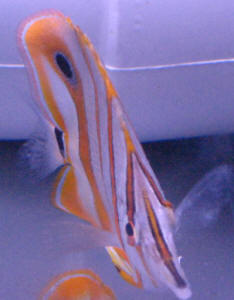
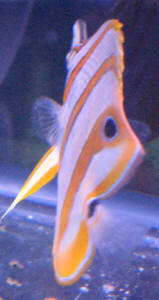
WWM 10/22/08 This is my third time
sending a question over to you guys, and I want to start by
thanking you for the great advice. I have been searching
for a Copperband for 2-months trying to find a good
specimen that is eating and is not too big. I finally found
an average sized specimen that was eating at the LFS,
however, it has some issues on in its pectoral and caudal
fins. <I see these> I have been wasting so much gas
driving around looking for a good specimen I decided to buy
it anyway and treat it in my QT. Please take a look at the
pictures I attached. It looks like white "stuff"
and "spots" in the fins. I think it is Ich but I
have also read that Copperbands are prone to something else
called lymphocytes sp?? <Lymphocystis... gone over on
WWM> I have used hyposalinity in the past to cure tangs
of Ich with good success. However, I don't know if that
would be good for the Copperband because that is a lot of
time in QT (at least 6-weeks) Is there a better way of
treating Copperbands that you recommend? <Also
posted> I have also read that copper is tough on them,
what about Cupramine copper or maybe formalin? I am open to
any suggestions. Please let me know what brand you
recommend as well. Thank you, Sorry the pictures are not
that great, it was the best I could get. <Please learn
to/use the search tool, indices on WWM... start reading
here re:
http://wetwebmedia.com/WWMAdminSubWebIndex/question_page.htm
This to me does not look viral... perhaps not Protozoan
either... could be "just" environmental... I
would read re Lymph, Crypt, Chelmon Health... Bob
Fenner>
|
  |
|
Re: Copperband Ich or Lymph...? Likely Crypt
10/22/08 Mr. Fenner, I read pages of great info on
WWM and I think formalin was the recommended treatment of
choice for Ich on a Chelmon. <Mmm... I would skip ahead
to later, greater technology here... and quickly read, try
to acquire Chloroquine Phosphate... Perhaps a dip/bath now
in diluted formalin, aerated pH-adjusted freshwater and
thence to quarantine/treatment further...> In one word
please, on a Chelmon would you personally use
formalin/bath, formalin/dips, Cupramine or hypo. I just
want to be sure because my Copperband does now look like
its fins were sprinkled with salt. Just looking for a
little reassurance, thanks so much for your time. <Sorry
to not be able to direct you to a complete set of ideas,
methods re Chelmon, Crypt, Quinine cpd. use... But do read
re the search tools on your computer, WWM. BobF>
re: Copperband Ich or Lymph...?
10/23/08 Thank you. I did the dip last night and
it did get some of the white spots off, and he seemed to
feel a little better. However, the Copperband is still
covered with Ich. I found the Quinine you mentioned online,
but I don't think it is going to get here in time. This
morning the fish is laying on its side breathing hard. He
gets up and swims around for a little then goes back down.
Not good. <Agreed. Very bad> Question, although I had
a strong cycle in my QT I must have lost some of the
beneficial bacteria while I was shopping for a Chelmon that
eats, because I was getting a little ammonia spike despite
the fact I was "feeding the empty tank."
<Happens> So, if my Chelmon does die, Can I put a
piece of cocktail shrimp in the tank and leave it be for a
month (testing water of course) to get another hard cycle
and also kill of the Ich that is in my QT? <Better to
just add a "pinch" of dried food every few
days...> Or is there some small chance the Ich can host
the cocktail shrimp <No> and live longer than 4-6
weeks? <Yes> Thanks again! <Welcome. B>
|
Copperband With A Squashed Snout?
09/09/08 Evening crew :D <<Hi there
Carolyn!...morning now>> After about 18 months of waiting
and researching, I have finally brought home a Copperband
Butterflyfish. <<Beautiful fish (have one myself!), but can
be quite the finicky feeder>> The animal in question has
been merrily eating in the LFS <<Ah, great!>> and on
getting him home was tempted out of hiding with a bit of brine
shrimp and garlic (purely to confirm he would eat in my QT). As
of tomorrow I aim to start feeding him Mysis and other meaty
treats <<Excellent>> - would he appreciate lobster
eggs (I've used them with great success with mandarin fish
previously to wean them onto prepared food)? <<Mmm,
maybe but I doubt it. My experience with these fish is they tend
to prefer small worm and shrimp-like organisms (Mysids,
amphipods, bristle worms, feather duster worms most ANY worm) and
tend to ignore things like prepared foods (e.g. flakes, pellets).
But do give the lobster eggs a try I've also found glass worms
(white mosquito larvae) to be readily accepted by these fishes
well as by other finicky feeders>> I've also noticed
that on getting the little fella home, his snout appears to be
slightly misshapen - the lower half seems to be bent forward, as
if he's pouting. I didn't notice this in the LFS; could
he have bumped his nose in transit?! <<Yes>> He ate
the shrimp merrily, so it doesn't appear to be causing him
any problems feeding (he's in QT with 4 Nemanthias carberryi
(1 male, 3 females)). <<Ah good, then hopefully the
Butterfly will be fine and the condition will heal or at the
least, not become any worse>> Many thanks in advance and
for all the time you take answering the inane ramblings of folk
like me!! Carolyn <<No worries is a pleasure to share.
EricR>>
Re: Copperband With A Squashed Snout?
09/10/08 Hi Eric, <<Hey Carolyn!>> Thanks
for the reply that's a relief! <<Ahh, quite welcome>>
The Copperband is giving me some cause for concern today as he
spends a lot of time swimming at the surface (not gasping at the
surface although his dorsal fin comes out of the water), and
swims at an angle. <<Hmm, I've not observed such behavior
from this species (though I have seen them come to the surface to
pluck floating morsels of food). This may be an environmental
stress indicator (do you have pieces of PVC pipe or other such
inert structure large enough for the fishes to take refuge in the
QT?), or an indication of more serious problems that were
present/manifesting before you bought the fish>> The
Anthias he's in QT with seem fine, so am hoping this is a
stress issue due to being transported? <<This is a
possibility, yes or an indication of less than gentle handling
during capture>> He was moved from a 10g tank to a 20g tank
with a small skimmer and powerhead, specific gravity is 1.025,
temperature is 77 Fahrenheit. <<Much better/a good move to
the larger tank (it is cycled yes?)do be sure to provide a place
to hide as well>> Have however got hold of some white
mosquito larvae (frozen) so am trying him on those. <<Very
good>> He does have a few spots where it looks like
he's bashed into the rock in the display at the LFS, so am
hoping he'll settle in soon, it has only been 2 days so not
going to panic just yet... Carolyn <<Mmm I expect this fish
has been mishandled/suffered injury during capture and/or
transport to the LFS. I am hopeful that your continued good care
will provide a speedy recovery (the fact it is [still?] eating is
a good sign). Do let me know how things progress. Regards, Eric
Russell>>
R2: Copperband With A Squashed Snout?
09/11/08 Hi Eric, <<Hello Carolyn>> Bad news
I'm afraid, looks like we might lose him tonight - got home
from work to find him looking in a bad way, rapid breathing/lying
on the bottom, no interest in food at all. <<Mmm, I was
afraid of this didn't want to voice earlier and cause extra
worry not much you could have/can do>> Did an emergency
water change (again) after matching temp/SG/pH to try and help in
case its a water issue (ammonia and nitrite 0, nitrate 5-10ppm,
but so many other factors we can't test for), <<I doubt
its your water quality>> but on close inspection he's
got red/blood marks on his flanks and his dorsal fin is closed
up. <<Sounds like a bacterial infection and likely secondary
to what I suspect is physical trauma as the original complaint
causing this fishs demise>> I doubt he'll survive till
the morning, I moved the four Anthias into a separate QT this
evening (they're all fine thank goodness, feeding like a
right load of pigs!), so I've turned the lights off so he
won't be bothered by them. <<Very good>> Thanks
for all your help - I'd like to get a better idea of whats
affected this poor fish so if it can be avoided in the future.
<<Short of a necropsy of the fish I don't think there's any
way to really tell and even then, not for sure in this case I
think. I do believe whatever ails this fish came about before you
acquired it (I still think some sort of physical trauma during
capture). The stress of bringing it to your home may have
expedited things but on that same note, more than likely it would
already be dead if left at the LFS>> Copperbands are a
great love of mine and would like to try again with one, but only
if I know I can care for it properly. Carolyn <<These fish
are one of my favorites as well I think your care of the fish up
to this point was fine (maybe a bigger QT). Like some others,
obtaining a healthy and undamaged specimen is more than half the
battle with these fish and once acclimated and feeding well I have
found them to be surprisingly hardy. You don't mention whether
your LFS quarantines their fish (many don't)even so, depending on
your relationship with the store perhaps you can arrange for the
store to hold a specimen for a few weeks just to see that it is
going to live. Placing a deposit on the fish may help with this
In the interim, keep reading up on/researching this fish and
design/redesign your system around the Copperband as the
centerpiece making the needs and requirements of this fish the
first priority re. Do keep me posted if you wish and feel free to
come back to discuss and conspire on your Copperband system.
Cheers my friend, Eric Russell>>
|
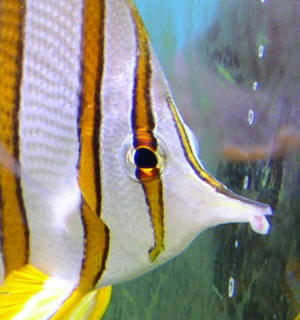
Copperband Butterfly Broken Beak? 7/18/08 Hi
Guys: <Blaine> Love your site and have gotten a lot of
really great advise <advice> from it. I just added a
Copperband butterfly to my display aquarium. WE got his a few
weeks ago and he's been doing very well. Today I noticed
that the bottom of his beak is turned down, so I'm
wondering if I have a big problem. I don't know if
he's bashed himself on the glass or something, <Very
likely so> and I'm wondering if this damage is
something that will heal on it's own, or if there is
something I can do for it. Blaine LeRoy <Really only the
former, and hope. Have seen much worse-damaged Chelmons
leading normal lives. Bob Fenner> |
|
|
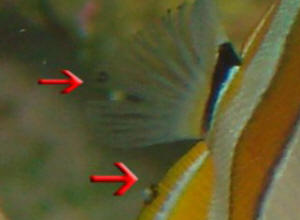
| Spot on Copperband ID Help?
4/7/08 Hello I have searched the WWM site and still
cannot find what I am looking for. I have a Copperband
Butterfly that has something attached to it's fins. I
included a picture to see if you could tell me what it might
be and how to treat it. Thanks. Brian <Mmm, I strongly err
on the side of caution here... and say these are not likely
pathogenic, but some sort of residual tissue from some type
of damage. If anything I might try adding a purposeful
cleaner here (Likely a genus Lysmata shrimp)... and leave
these to it. Bob Fenner> |
|
|
Saltwater disease??? Chelmon...
2/13/08 I know you guys hate opening pictures, so I included
a video on my MySpace page so you can see the tank in question,
and the other tanks I have created.
www.myspace.com/boctampa
<Mmm, okay... a nice, large tank (why is it situated so low to
ground level?), nice stands, Cheryl is a babe... but...?>
OK...Here is my setup and tank test results: 550 gallon main tank
180 gallon sump 10 Gallon Refugium a GX3 Skimmer a 2HP Chiller a
55 gallon RO/DI system @ 100 Gallons per day 650-700lbs or Gulf
Live rock 2-3 inches of crushed coral My test results are :
Nitrates : less than 10 Nitrites : 0 Ammonia : 0 12 dKH 480 ca
80.1-80.8 temp <Okay> My current fish roster is: 2 yellow
tail damsels 3 three stripe damsels 2 blue Chromis 4 domino
damsels 1 porcupine puffer I starts and stripe puffer 1 sweet
lips clown 1 sail fin tang 1 yellow tang 1 powder blue tang
(Dory) 1 lemon butterfly 1 copper banded butterfly 1 long nose
butterfly 1 raccoon butterfly 1 emperor snapper <I saw two>
1 fox face 1 powder brown tang 1 Koran angel I feed them: IQF
Krill IQF Silversides Marine Cuisine Bloodworms Emerald Entree
Mysis Shrimp Formula one Marine pellets Formula two Marine
Pellets Prime reef flakes My issue: My Copper banded butterfly
"LOOKS" like it ate to much and blew up its stomach,
and is bleeding on the inside. This is the second one that has
done that. I have other fish that are facing or have faced the
same fate. No one here at the LFS seems to know the cause.
<Mmm, likely something it ate here... hydroids, other toxic
life, that "came in with" the rock... not much to do
re... other than hope> There is no outer damage to the fish.
There is no fighting, as I have watched this tank for hours and
hours, since I started it. I had a clown fish, a pearl scale
butterfly and one of my Emperor Snappers that have died in the
same way. I'm not sure whats going on...HELP!!! Jim Wilhelm
<Looking at your video, set-up... all looks very nice... I
would just try to be patient here. Bob Fenner>
Re: Saltwater disease??? Chelmon et al.
2/13/08 Messiah of all fish knowledge a.k.a. Bob, <Heeee!
All bow down> Any idea what would cause the stomach area to
look like it exploded on the inside cause the fish to bleed
internally, with out any damage to the outside of the fish?
<As stated... summat it et> Also, what is your opinion on
the 100% organic Ich-attack by Kordon? <As much as I am a
friend, know the owner, Bob Rofen and respect him,
"like" most of their products... I am skeptical...
though have read a few credible reports of success with this
product... RMF>
Copperband fdg./beh. and dither fish 02/03/2008
Hello crew! <<Hello, Andrew today>> I have a quick
question that is a slight spin on something that you have
addressed very thoroughly in several other FAQ's. I purchased
a Copperband butterfly four days ago. I had the LFS hold the fish
for a week after receipt. It was eating frozen Mysis quite
energetically after the third day or so despite being in a
crowded tank with several tangs and Rabbitfish. Because of this
display, I felt assured that I was purchasing a more viable
specimen. My planned habitat was a 125 gallon frag tank with 125
lbs of live rock. The tank has been up and running for about a
year with stable parameters: Ammonia, nitrite, nitrate
undetectable; Ca 430 kH 11.2, pH 8.1, ORP 375. <<Sounds
like a nice home>> I planned to have the Copperband as the
sole inhabitant to control Aiptasia. Because I planned for this
to be the only fish in the system and because I was worried about
keeping this species (definitely more touchy than the fish
I've kept before) I decided to forego my usual 4 week
quarantine and just do the fresh water dip. <<Not a wise
step forward with any newly purchased inhabitant. All new fish
should be quarantined for your good, as well as the fish. Even
delicate fish will be fine in quarantine for the usual 4 week
period>> I expected that this would be less traumatic and
would give the fish a more soothing environment than my QT tank.
Anyway it's been four days and the CBB just hides in one of a
couple of caves in the LR not venturing for food or much else. He
was actually exploring more actively the first day or two and has
since become more secretive. I have tried feeding Selcon enriched
foods with garlic extreme such as Mysis and Cyclop-Eeze to no
avail. I will try the clam/oyster trick today. My main question
though is, could the CBB, who was quite energetic in a crowded
display at the LFS, be distraught at being the only fish and
might the addition of a few Chromis or some other fish be helpful
in coaxing him from his hiding spots? I'm afraid that adding
a few dither fish just might exacerbate the problem so I thought
I'd check with you first. <<Did you acclimatize the
fish at all? Sounds like its just suffering from stress. Give the
fish time to settle in to the new home, keep tempting it to feed
with the foods you have mentioned, it should be fine>> Your
advice is always appreciated. Thanks, Jeff <<Thanks for the
questions. A Nixon>>
|
Lymphocystis - Chelmon rostratus 1/6/2008
Dear Crew, <Andy> Good morning. I'm sending you
two separate messages, because they deal with separate
issues and I know they might get sorted among different
Crew members. <Ok> Here's the first! I purchased
a Chelmon rostratus, not only because it has always been
one of my favorite fishes but also because I have about 10
or 15 Aiptasia growing in my display that I'm hoping it
will eat. The butterfly has been in my 30g QT for 7 days
now. <I would move it to the main display> When I
purchased it, I made sure it was eating at the LFS. For the
first 2 days after I brought it home, it ate well--frozen
Mysis and blood worms. After day 2, however, it stopped
eating. I had done my research on the fish beforehand, so I
knew these fish can be finicky eaters. So, I got on WWM to
research what others have done in similar circumstances,
and I discovered that what I am experiencing is not
uncommon and that the advice has been to get some live rock
in the QT to get the fish to graze the worms, etc. on the
rock. It just so happened that I have a few pieces of LR
that were not supporting other pieces of LR and that host
some Aiptasia, so I decided to throw 2 pieces in the QT. I
placed the first piece in (which had about 8 Aiptasia) and
went back for the second. By the time I got back to the QT,
all the Aiptasia were gone. I thought, "this could not
be." Sure enough, though, this morning they are still
gone (along with a very pretty orange feather duster that
hiked in on the rock--oh well). The Chelmon has pretty much
denuded my LR of any worms, etc. So . . . Thanks for the
advice! <Welcome> ANYWAY, my question really relates
to 2 masses on the tail and pectoral fin of my Chelmon,
shown in the attached photos. Based on my research, I
believe that the fish simply has Lymphocystis, but would
like your concurrence. <I do agree> If so, I
won't hesitate to put him in the display after the 3-4
week QT if all else goes well. If it's something else,
then I'll proceed accordingly. <I would place this
fish now... this is much more an "environmental"
or stress condition than a type of pathogenic disease...
Won't be "catching"...> Thanks as always
for your time/help. Andy (Although I realize (think) that
15 Aiptasia is not an infestation by any stretch, I am
trying to figure out why they are appearing. <Some
cellular material must have been introduced at some
point... likely on/with LR, but could be algae...> I
have cut down feeding to once per day--usually frozen Mysis
or blood works, or Formula 1 flake. I employ a 30g fuge
with Chaeto, DSB and LR. I run Phosguard in the sump. I
have tested my display water, my RO/DI water, and my
storage water for phosphates and silicates--I have two test
kits--a Seachem (color never matches test strip) and a
Salifert (really hard to read!). No silicates are present.
The Seachem kit shows 0.1 phosphates (or 0.01, can't
remember the scale) in all three sources; the Salifert
shows 0, so I'm befuddled). <No need or use... Bob
Fenner>
Re: Lymphocystis - Chelmon rostratus
1/6/2008 Thanks, Bob. I presumed that everything
needs a long QT period, but it seems that with the
Copperband 8 days is enough as long as it isn't showing
other signs of disease/reason to keep in QT? <... please
re-read... "I would..."> I don't
understand your last response, "no need or use"
re my phosphate kits/readings. Would you mind explaining?
Thanks again. <These readings for soluble PO4 are in
agreement within the limitations of the test gear.
B>
|
|
 
|
Lymph on Copperband butterfly
12/2/07 Hello, Thanks for all of the help in the past and the
great site. I will try and keep this short. I have read through
the Lymph FAQ's and couldn't find what I need. I
received a Copperband from LiveAquaria.com about 2 weeks ago, I
put him in my 20 long quarantine and after a couple of days I
noticed the white clumps developing on his fins. They have spread
to his tail and even some on his body. He eats extremely well,
only Mysis though (I have noticed in the past that I only have
luck getting Copperbands to eat "white" food, anything
to this?) <Don't know... but interesting speculation>
which I soak in Selcon. I have read that there is no direct cure
for this and that good water quality and food are the best
medicine, there is also a cleaner goby with him but I don't
see him clean him though. My question is, would you keep him in
quarantine until it goes away or would you put him in the
display? <I would do the latter... This viral complaint is
"not that infectious" and yet, won't begin to
self-cure unless the Chelmon is "in a better place">
The only fish in the display are a tomato clown, lawnmower
blenny, and very expensive juvenile chevron tang. <Oh! Just
wrote a piece for this Ctenochaetus sp.... one of a few while am
out in HI... "in spare time"...> Thanks for all of
the help. Merry Christmas, Jeremy <I do hope the frenatus
clown doesn't go after your Butterfly. Only experience will
tell... do remove/float the clown in a plastic colander for a few
days if apparently so. Cheers, BobF>
Re: Lymph on
Copperband butterfly 12/18/07 Just wanted to let you
know that the Copperband is looking great now. He is still eating
and seems to be happy. I removed the tomato clown just in case,
as I had seen it chasing the chevron and noticed the fins on the
chevron looked "nipped". He is still eating great so I
assume they will grow back. Any reason to think it was caused by
anything else? <Mmm...> Only a few small crabs, lawnmower
blenny, and butterfly with him in the tank. Looking forward to
reading your article on the Chevy tang on the website. Have a
great Christmas. Jeremy <Will download after it runs in
print... have attached here for your perusal. Cheers,
BobF>
|
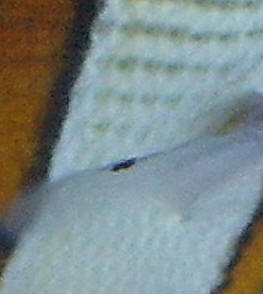
Unknown Fish Disease? Chelmon spots 11/12/07 Hello
there, Love the site it saved my sick sand sifting star
fish (he's now in a MUCH MUCH bigger home) not to
mention research here prevented me from buying a horse shoe
crab my LFS was trying to push on me. Hopefully you can
help me with my most recent problem for starters I'll
run my tank info at ya. 50 Gallon Tank about 4 months
running Remora C Protein hang on Skimmer 2 Hydor Koralia
Pumps #3 850gph each 1.5" Dolomite bottom <Mmm, do
replace this in time> 2" live sand bed on top of
the dolomite would this be considered a plenum of sorts?
<Of a sorts... but do you have the defined
"gap" water space alone underneath?> probably
40 or 50 lbs of live rock good coralline coverage on pumps
and back wall Water parameters: last tested 10/26 at LFS
<I'd get your own kits... water chemistry changes
with movement, time...> Ph 8.1 Ammonia 0 nitrite 0
nitrate 10 (was told this might be due to a 350 magnum
canister filter that I have removed from the system) KH 9
Calcium 450 Salinity 1.023 Live Stock: 10 Blue leg hermit
Crabs 6 Red Leg hermit crabs 3 zebra striped Astrea snails
1 turbo snail 1 gold ring cowry 1 queen fighting conch 1
Pencil Urchin 1 Cleaner Shrimp 1 long tentacle Anemone 1
anemone crab 2 emerald crabs 1 brittle starfish brown
How's the cleaning crew look? light heavy? <A mix...
I'd keep your eye on the Mithraculus> 1" colony
of star polyps 1" colony of Zoanthids 1" Florida
Ricordea Fish: 1 green mandarin (he eats live brine, frozen
Mysis, and chilled Arctipods along with the live pods on my
LR) My current worry is my only other fish a Copper band
butterfly <Hard to keep in small tanks like this> he
has 3 black spots on the very edge of his pectoral fin and
one black spot on the farthest back edge of his dorsal fin
I've searched your site for black spots but all I can
find is black Ich these spots are about the size of #2
pencil lead seemingly MUCH larger than the pictures of
black Ich I've found they haven't spread or moved
but just hold on. He hasn't shown any signs of rubbing
against anything or discomfort he's still eating an lot
of Mysis shrimp he never ignores it so I just feed him a
few minutes worth and leave it at that. <I would... do
nothing overt here... The spots could be "just
coloring"... melanism from?...> He won't stay
still long enough for my cleaner to go near him I don't
think it's a lazy cleaner because it loves to pick at
my fingers. I'm nervous that these black spots have the
potential to spread to my mandarin I haven't set up a
QT tank yet Any ideas what these might be? Please help
<Not likely at all to be a spreading problem> I'm
also considering in the future a black false percula clown
and a flame angel I don't want to overload the system
though does it sound ok to you? Thanks, Very nervous
<Don't be... Do start planning re where you're
going to put the new, larger system... You've got the
bug, not the Chelmon. Cheers, Bob Fenner>
Re: Unknown Fish Disease? Chelmon
spots 11/14/07 Hello again! I
didn't properly proof read my E-mail and there was a
miscommunication here on the Copper band spots. I'm
terribly sorry... They aren't really spots but have the
size of small black ants attached to the fins. <I see
them...> 3 on the pectoral and one on the tip of the
dorsal I've enclosed two pictures hopefully they're
high enough quality and yet small enough to meet your
standards. <Yes... good images... Don't appear to be
"organismal"...> here are some interesting
bits of info that might or might not help. The fish seems
to have a very minor case of Ich on the fins that do not
have these black things on them but no sign of white spots
on the pectoral that has them. I can't seem to get a
closer shot then the one I'm sending you and they have
shown no signs of movement it might be my imagination but
it seems like one has actually "fragged itself"
with 3 tiny spots next to it that I did not notice before
but I might be more paranoid now than before. Please help,
Sincerely Confused <Again... I do think these are random
bits of melanization... perhaps this specimen was
physically whacked, as with a net... even dropped to the
ground at some time. They could be from an accidental
run-in with the Zoanthids. I would leave it as is... not
subject the specimen to medication, moving... the marks
will likely fade over a long period of time... though a
purposeful cleaner might well remove them post haste...
Maybe a Lysmata species. Oh! I see you list a cleaner
shrimp below. Hopefully these will partner. Bob
Fenner>
|
|
 .jpg)
|
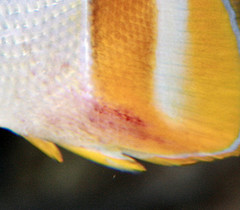
Need Help with Diagnosis:
Copperband Butterfly 09/17/07 I purchased a Copperband
Butterfly fish on Friday (9/14) from an online vendor. I
noticed some redness on the bottom right and left sides of
this fish today (Sunday, 9/16). The eyes and fins are clear.
I have pics of this fish located here:
http://www.flickr.com/photos/7329275@N05 <Bad scrape...
likely a thrashing with being roughly netted in the
wild...> The fish is not eating yet, prolly still
recovering from his trip. Is this a viral or bacterial issue?
Is this something that can be treated? If so, with what?
<May become bacterial... No "treatment"
suggested other than good care...> The other fish in the
tank <... this fish was not quarantined? Mistake> are a
pair of cinnamon clownfish and a gold spotted Rabbitfish. The
clownfish have been in the tank for 2.5 months and the
Rabbitfish for one month. they are healthy and are eating
vigorously. Salinity- 1.024 Nitrates-0 Ammonia-0 Nitrites-0
Calcium-420 Alk-3.43 Temp 80.6 Any advice and suggestions are
appreciated. Thanks Kirk
<Read... on WWM re Chelmon care... Bob Fenner> |
|
|
Ich, Copperband
Butterfly 6/27/07 Hi crew! <Hello> Quick question.. I
searched and maybe there is no answer to this but I'm asking
anyway. I have a Copperband butterfly fish in QT (6 days now). It
has Ich and I have been treating with Rid Ich+(4 days now).
<Toxic stuff, not one of my choices for treatment.> She
(assuming) eats like a pig, swims great, but her gills seem to be
pumping harder than they should. <Probably a combination of
the Ich's effects on the gills and lower O2 levels caused by
the medications.> I know this is due to the parasite. I did a
freshwater dip with Methylene blue last night for 9 minutes for
external parasites...she was fine. <Good> Is there anything
I can do to make her more comfortable or to make her gills not
have to work so hard?. or do I have to wait for this parasite to
get out of her gills? <Increasing circulation will help.> I
know this may sound like a stupid question. <Is not> But
I've read on WWM on Copperband Butterflyfish being fragile
and she is a fighter. I don't want to lose her...she already
eats from my hand. Thanks! Jen <Good luck> <Chris>
Re: Ich, Copperband Butterfly 6/27/07 Thanks Chris for the
quick response! <Sure> Rid Ich was not my first choice
either but from everything I read on WWM they are extremely
sensitive to copper and I have never had any luck with hypo.
<True, I probably would have gone with straight Formalin,
instead of the Formalin/malachite green in Rid Ich+, a little
less toxic.> I had sent quite a few emails to WWM concerning
the best course of treatment but couldn't get a definitive
answer. I know there are not a lot of absolutes in this hobby,
especially when it comes to this nasty parasite. <Lots of
different ideas out there, best bet is to stick with the
basics.> I do have a filter rated for a 40 gal on the QT so
the water is circulated quite well, should I add an air pump to
this as well for aeration? <Could, but probably
unnecessary.> When would it be safe to do another dip?
<Have to go on your judgment there, if it seems strong enough
go for it.> Thanks! <Welcome>
<Chris>
Copperband issue? 12/21/06 Hi crew,
<Good evening! Mich with you
tonight.> I bought a Copperband
(for Aiptasia) a month ago. He went straight into
quarantine, of course. <Good to hear.> He's
been eating very well, almost entirely
bloodworms. Very healthy. Last Thursday (six days ago)
we lost power during the storm that hit the
Northwest. We got power back about 18 hours later but
the temperature did drop in the tank. I've been
monitoring him closely. <Wise.> He's full
of energy and still eating but he has a single, dull whitish spot
on his tail fin. It doesn't look like
Ich. It has not grown in the past five days and I
can't see any other spots however today, he did start
scratching against some live rock I've got in QT with him.
<Watch and wait.> Since the
spot hasn't grown, I was planning to move him into the
display this weekend but the scratching has me scared. <Listen
to your gut. I would extend the time in
QT. If there is a problem, it will be much easier to
address and less stressful on the fish if he remains in the QT
tank. I think moving the fish to your main system
would be a mistake. The end goal of QT is to move a
healthy fish into a healthy system. If you move to
this fish now, you put the your display in
jeopardy.> Any advice
would be great! <Hope that
helps. Mich>
Copperband/Disease Treatment 7/11/06 I read
on your website that Copperbands can be prone to copper
medication. <<Prone? RMF>> <Yes.> I have a
Copperband in a QT tank with several other fish. Should I use the
same does as indicated on the bottle or should I reduce the dose?
I am using SeaChem activated copper, if this helps. <No such
thing as activated copper. You are referring to
Cupramine, a buffered, active copper. I would isolate the
Copperband in another tank. Copperbands are very
sensitive to copper treatment. Freshwater dips and
formalin (Rid-Ich+ by Kordon, formalin and malachite green) would
be my choice. > Thank you. <You're
welcome. James (Salty Dog)> A
BF spot, Dottyback color loss,
Centropyge feeding in QT 7/12/06 Thanks for your
prompt reply, <Please include prev. corr...> I have done as
you said and given my Copperband with a freshwater dip mixed with
M/Green. He has a parasite attached to his front left fin, I hope
it will come off after a few more dips. But he is looking much
better after the first dip, the itch has receded significantly.
And he's eating well as usual. <Mmm, a parasite? Might
just be a "spot" from bumping into something... I'd
try a purposeful cleaner organism... perhaps a Lysmata sp.
shrimp... Gobiosoma goby...> Now onto my Dottyback. He has
lost a lot of colour, when I got him he was a bright magenta and
yellow, now he's faded to a dull purple and yellow. I have
been told this is due to him not being the dominant fish in the
aquarium, as the Anthias don't seem to like him too much and
chase him sometimes. <Possibly a/the factor here> I feed
him Mysid shrimp, brine, algae flakes, angel fish mix, ocean
plankton, pretty much whatever I can get my hands on, and he is
still showing no signs of his original colour. Any suggestions?
<Spectrum pelleted food/s> My final question is about my
eibli angel, which is refusing to eat Mysid shrimp, marine algae,
brine shrimp and flakes. He is in my QT tank atm, and I'm
worried that he hasn't eaten for 2 days. I am not treating
the tank with any medication so I am thinking of buying a small
piece of live rock for him to nibble on. Would you suggest Nori
too? <Do add a good deal of ready-cured live rock with obvious
algal growth> I'll just like to add that you guys provide
a valuable service and your advice is greatly appreciated.
Thanks. Albany <Welcome. Bob Fenner>
Copperband
Butterfly acting lethargic - 2/11/2006 Hello WWM
Crew! First, let me thank you for your site and great
information. I have been reading for the last 2 hours
or so (not for the first time!) but haven't been able to spot
the answer I'm looking for. So if I've
overlooked it somewhere please do not think ill of me. <Mmm,
no. And if you have ideas on how to arrange the content here, to
make it more readily accessible, assimilable, please do speak
up> I have a 75g tank w/a 30g sump that has been up for about
2.5 months with LR, and fish and inverts for about 6
weeks. I let the LR cure for two months prior to
putting it into the tank, and it seemed to cycle during that
period. Since setting up the tank, I had my original
cycle and my NH3, NO2 and NO3 have all been staying pretty much
at 0. Ca was low at about 320 ppm but I managed to
increase it to 450 over the last 10 days. I add a
small amount of Iodine (<5 ml) once a week. Same
with Kent essential elements. I change out about 10
gallons per week with fresh saltwater. My SG=1.025,
Ph=8.2, KH=11. I have about 75-80 # LR in the main
tank, maybe another 15# in the sump, and am running UV and a
protein skimmer. I run a 1200 gph pump from the tank
through the sump and have a 2nd closed loop system w/a Squid and
an 850 Eheim pump. total flow in the tank seems pretty
good. I have one pearly Jawfish, one Sailfin blenny, 2
clowns, 1 blue tang, 1 Copperband butterfly, 2 Turbos, several
Astreas, several Trochus, and about a dozen total hermits (blue,
red and scarlet). I overfed a bit when starting out
and have some algae growth and a little Cyano started in the
areas out of the main current. I am getting these
under control now but still am working on cleaning it up a
little. Last week 2 emeralds died within a day of each
other, and two Turbos mysteriously bit the dust. All
the inverts and fish seem healthy with the exception of the
butterfly. So I guess I have two
questions. Any idea why the emeralds and snails would
have died? <Mmm, possibly from some sort of
"imbalance" from the addition of the supplements...
though these should be discounted due to your water changes... or
a biological agent/poisoning in situ> And now for the big
question! My Copperband, who I love dearly, went from
being perfectly normal and eating well one day, to laying on the
bottom, gasping and not eating the next. <... am gravitating
more to the latter stated cause> He was eating Mysis and then
decided one day he would only eat live brine
shrimp. (I guess even fish love McDonalds, eh?)
<Don't supersize!> Anyway, I tried a variety of things
to get him back on Mysis but he just wouldn't
eat. Eventually he showed what I was told by my LFS is
a Lymphocystis growth on his lower lip. <Environmental/stress
related/direct> I was told to not worry about it as it would
go away on its own in a month or so, <Yes, good advice> and
it never seemed to bother him eating. So in an effort
to keep him well fed while getting rid of his wart, I kept giving
him brine shrimp though I added Zoe and Zoecon vitamins and a
garlic elixir to the shrimp as well as feeding them to gut load
then before feeding. Unfortunately he seems to now be
in bad shape - drifting around the tank, wont eat, and even looks
somewhat emaciated even though he ate as recently as last
night. I haven't noticed any cysts on him and his
color is good. He looks normal with the exception of
his laying on the bottom on his side and slight pumping of his
gills. Is it possible for him to starve to death
eating brine shrimp? <Yes... not uncommon> Could he have
some sort of parasite? <Yes> Would a freshwater dip help
him? <Not likely> Also, it seems that I noticed the tang
scratch the LR a couple of times when I first added him to the
tank about 3 weeks ago but he is fine now, and he was fine at the
LFS for the week they had him. <They do this...> Did I
introduce a parasite to my tank with the tang? <Possibly... am
sure you're aware of the benefits of quarantine> I know -
I should have isolated him first but it seemed sort of foolish
since I had just bought all the other fish from the same LFS the
in the previous couple of weeks before. Sorry for the
long note but I wanted to make sure you had as much info as I
could remember to type! Thanks in advance - Rob <Mmm, I would
add a unit/pad of Polyfilter in your filter flow path here...
allow the calcium concentration to drift down into the upper 300
ppms... and suspend the addition of supplements for a while. Bob
Fenner>
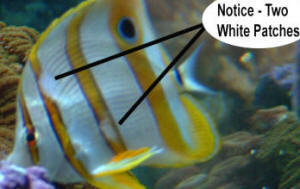
| My Copperband, a new addition, has developed two white
patches 2/1/06 on its left side. Please see
attachment. Please advise if you can identify what this may
be and how to treat. Thanks, Tom <Is trouble... could be
Protozoal and/or bacterial/pathogenic in nature. This fish is
(too) skinny, and this is likely a factor here as well...
There are a few "things" you might do to bolster
its immune system, indirectly curing the apparent
complaint... Soaking foods in vitamin et al. prep.s...
offering foods with more caloric content, adding purposeful
cleaner/s... Without these changes this animal will perish
(sooner). Bob Fenner> |
| Follow-on from sick Chelmon 2/3/06
Contagious and or a risk to fellow tank inhabitants?
<Potentially... yes. Depends on what the root cause/s are,
what "it" actually is... Copperbands "break
down" much easier... on a sliding scale than other fish
groups... the hyperinfectivity this inspires can be trouble,
contagious... Bob Fenner> |
|
|
Copperband Quarantine ? Hi Bob, One of my
favorite fish is the Copperband Butterfly. Unfortunately, I lost
(killed???) two already. <A beauty, but often beat,
touchy... easily lost> The first one was in bad shape when I
got him (mercy purchase) and based on your advice I nursed him to
health and he was fine and hand-feeding. ....until I added a
purple tang who bullied him and eventually the poor thing
died...I loved that fish because he managed to fight back from
his ill condition and became a healthy friendly pet in my reef
tank. <Ahh...> The second one was a small baby about
3" long. He suffered from Ich since I did not quarantine
him. After other such losses, I will always quarantine and
perform a Methylene blue/fresh water dip before and after the 2-3
week quarantine period. <A good commitment> Anyway, I want
to get another Copperband but this time I want to do it right and
quarantine the fish. However, since Copperbands eat copepods, and
since my quarantine tank does not contain any live rock, will the
Copperband starve ? I will try to feed it but I just wanted to
check with you before purchasing so that I can avoid another
loss. Also, is there anything that Copperbands find irresistible
other than copepods that I could feed during quarantine ? <The
food will not immediately die... try temporarily offering such
foods with the equally temporary placement of a bit of live
rock.> Thanks again friend, Chuck Spyropulos <You are
certainly welcome. Kia orana. Bob Fenner>
My Copperband Butterfly Hi again Bob; Rick your
reefing friend here. I acquired a Copperband about 10 days ago.
He is currently residing in my 20 gallon quarantine tank. He is
doing extremely well. He is eating and looks healthy except he
has white cotton like growths on his fins. <Likely the
viral bits termed Lymphocystis... brought on by
"stress"... and likely not infectious... would place
this fish, use a biological cleaner... the white gunk will
"disappear" in time> I have been treating the tank
with CopperSafe to eliminate an ick outbreak on a flame angel
acquired at the same time. The ick seems to be gone but I am
worried about the white growths on the Copperband. I read on your
site that these growths may be due to excessive copper treatment
so I have completed two 5 gallon water changes in two days. I
will complete another water change tomorrow. Can you tell from my
layman's description what this butterfly may have? <Please
read here: http://wetwebmedia.com/lymphfaqs.htm> Please help
as I have never had much success with this species and actually
this is the first Copperband I have ever seen eating. Please help
me to save this poor fellow. <We will do what we can. As
stated, I would "just" place this fish. Bob Fenner>
Thank you Rick Johnston
URGENT URGENT URGENT Bob, please help! I emailed
you about my Copperband last week. He seems to be doing fine
until tonight. He has been gasping and sticking his mouth out of
the water. I just moved him into my reef from quarantine
yesterday. He has been floating on his side and breathing heavily
for a few minutes now. He has been pushed around by the current
so I moved him back to quarantine. Please help. Its a 55 reef
with 2 clowns 90 pounds of rock, cleaner shrimp, conchs, Nass.
snails. The only reading I can test is that nitrate is at about 6
ppm. I have a large refugium, Turboflotor skimmer and 2 large
powerheads for circulation? How can he not be getting enough
air? <I take it the clowns are acting fine... likely not
an anoxia problem... perhaps a loss of external integrity... but
from what? A stinging incident, envenomation? You did what I
would do by moving the specimen... If it recovers, perhaps we
will be better able to assess what the cause of this dying
behavior is/was... an internal parasite? Collateral damage from
collection, shipping, handling? This can/does show up days to
weeks later...> Please help, I am almost positive that he will
be floating when I wake up tomorrow.... The tank has had cured
rock for 2 1/2 to 3 months and has had sand for 5 months...
Please help Andrew <Yes... a "mysterious" occasion,
likely loss... unfortunately not uncommon with marine
Butterflyfishes in general... and some of the more
"sensitive" genera like Chelmon in particular... even
from "good" collection areas, collectors (like yours
from Fiji)> Here are my previous mails <Thanks for
supplying these. Bob Fenner>
Re: URGENT URGENT URGENT Thanks Bob, clowns are
acting fine. I am feeling really bad about the fish, could he
have been stung by an Aiptasia? <Yes, unfortunately>
that's the only sting organism in my tank, I do have a few
large ones( 3" plus) Also, could it be that the dark spots
on my sandbed could have caused this? <Not much
likelihood> The fish is doing full somersaults in my
quarantine tank now. The manager of LFS knows exactly who
collects his fish and assures me they are very professional
divers. What do you recommend to beat this thing? Lowering
specific gravity? <Just a bit... maybe a couple of
thousandths... more would be more stress than it's worth>
At 9 tomorrow my LFS opens and I will call the manager first
thing as he is a friend and he had this fish for 3 weeks prior to
myself buying it. I have also asked Dr. Ron Shimek as he has a
few in his reef tank. <Once established Chelmon rostrata can
do well for years... most die within hours to days of capture
though> thanks again, please tell me there is something I
could do, i.e. add a fresh clam:? Andrew <No to the clam or
any food. Think positively, knowing that you have done your best
to help this animal. Bob Fenner>
Re: URGENT URGENT URGENT thank you so much for
helping me and responding so quickly. The only thing I have
noticed differently is that now there seems to be a brownish tint
to the butterfly's skin.....????? <Not good my friend.>
thank you again for helping a hobbyist in a time of need Andrew
<I am a compassionate person... from the Latin meaning
"to bear pain with"... from John/Jack Donne, "If a
clod be washed from England's shore..." My thoughts are
with you. Bob Fenner>
Re: URGENT URGENT URGENT thanks, the fish died
last night. I woke up to find him not breathing and had lost all
color in his eyes. He had little white spots on him like Ich but
I did not see these before, could it just be decomposition?
<Yes> thanks again Andrew <Bob Fenner>
White spot or ick on my Copperbanded butterfly
Hello, <<And hello to you. JasonC here...>> I was
needing to get information on treating what seems to be marine
ick on my Copperbanded butterfly. It is on one side fin and the
tail. <<Are these fins well salted or just a few spots? If
not more than I few spots I probably wouldn't be concerned, I
would just keep up the observation.>> No other fish is
infected. I have coral and invertebrate in my tank. <<Do
you have a cleaner shrimp or neon goby?>> Is there
something that I can use that won't hurt my coral and
inverts? What do you suggest! Daniel <<Well, in all but the
most extreme cases, I try to leave the medications in the bottle
and instead either let nature take its course or add more nature,
meaning biological cleaners. Problem parasites like Ich and the
like are present in tank water almost 100% of the time, and
usually a healthy fish can deal with a parasite or two...
it's when parasite numbers grow to epidemic proportions that
things get weird. Cleaner shrimp and neon gobies can help keep
these parasites in check. Here's some reading for you:
http://www.wetwebmedia.com/marine/inverts/arthropoda/shrimp/cleaner.htm
http://www.wetwebmedia.com/neongobies.htm
http://www.wetwebmedia.com/mardisease.htm Cheers, J --
>>
Re: white spot or ick on my Copperbanded
butterfly Hello Jason, <<And hello to you, Sir.>>
The Butterfly has only about 2-3 spots on fin and 2-3 spots on
tail. I have 2 cleaner shrimp, but no goby. Thanks, Daniel
<<Sounds good to me, I wouldn't worry much about those
spots. Do keep the fish under observation, look for scratching
behaviors, to make sure things aren't growing out of
proportion. No worries yet. Cheers, J -- >>
Abrasion? Dear WWM Crew: I had the irresistible
opportunity to purchase an ostensibly healthy 5" Chelmon
rostratus that had been returned to my LFS after well over a year
in another customer's tank (he moved). It is a beautiful
specimen that eats just about any frozen food.
I've never handled a fish this big before and had some
trouble getting him into my 10G QT. Now I see what appears to be
a slightly bloody abrasion on it's left side. (see attached
photos). <I see> I have been adding Kent Marine Pro-Tech
Coat daily since I notice this. Should I treat with an
antibiotic? If so, what? Am I mistaking something more ominous
for a "simple" abrasion? It continues to behave
normally and eat well. <I would place this fish in your
main/display system without much worry. It is very likely
pathogen free... and will only suffer from being quarantined much
longer. Bob Fenner> Your input will be highly valued. Thanks,
Steve Allen
QT Emergency I have had a Chelmon
rostratus in QT for 36 hours. Tank is 20G with Whisper
3000 power filter, 200gph power head, heater. Initially, it did
stay close to the pvc tee I have in the tank, but would come out
and 'cruise' the tank until I came into the room and it
saw me. Ammonia, nitrite 0ppm, nitrate <10ppm, SG 1.0243.
(honestly the ammonia is a best guess, as I CANNOT read these
@#$%!#$ color charts very well. The chart says clear for no
ammonia, but the water 'fogs' and it is very hard to see
color. I have checked the fresh RO/DI water and it is clear) But
the pH this morning is 7.88! (Lights on about 3 hours) The fish
is obviously stressed, mouth open, hiding, occasional head spasms
(side to side shake). <Sounds like some kind of osmotic shock
or other form of shock. Don't rule out disease or collection
traumas as well. Continue to observe him carefully.> Can I
bring the pH back up with water changes, and if so, how fast?
<I'd do some medium sized water changes here-no more than
say, 20% at a time. Did the pH drop suddenly, or was this a
gradual downward trend? The solution could simply be to change
water more often or to make sure that when you feed, nothing goes
uneaten. Unfortunately, in a bare aquarium, buffering can
sometimes be a challenge. Yes, there are products to assist in
buffering, but you need to test for anything that you add,
ok?> Or, do I need more drastic measures, i.e. baking soda? BTW
it did eat fairly well the am (The mix from CMA, shrimp clams,
Nori, Zoe) Thanks. <Keep a close eye on the fish and the water
chemistry. If any of your readings are amiss, or if the pH
fluctuate wildly, you will need to take more drastic measures,
such as more massive water changes, etc. Keep on top of things,
and your fish should be okay. Good luck! Regards, Scott
F>
Copper Band Butterfly Problem Thanks Scott!
<My pleasure> (Did the pH drop suddenly, or was this a
gradual downward trend?) On Friday pm the pH was 8.11 On Saturday
am the pH was 8.03 (I wrote this off to overnight swing) The next
time I check was right before I wrote you on Sunday am. I have
the pH back up to 8.02 before lights out last night. (did about
30% water change) Will follow with more today. The fish appears
much more relaxed, cruising, hovering, picking at the substrate.
Eating well. <Good to hear that!> But, I am still seeing a
spasm of some sort on occasion. Sometimes it is the belly fins,
sometimes it is the head shake, sometimes it ripples
through the entire body. I assume this is an abnormal behavior? I
see no evidence of parasites, and there seems to be no damage
that I can view. <Definitely abnormal...Hard to say- could be
anything from an internal parasite to possible poisoning from the
collection process...Tough call here> And I have seen it very
well when it comes out. I am planning to offer small amounts of
food several times a day, as long as it eats. <Good idea!>
Since I am off work the next 3 weeks so I will be able to keep a
tight eye on it. Don <That's what I'd do at this
point, Don- just keep an eye on him and be ready for intervention
if it becomes necessary. Good luck! Scott F.>
Copperband questions My 60g FOWLR tank has been
running extremely well since it was set up 9 months ago (mostly
due to all of the excellent information on WWM!) but I have a few
quick questions for you: <K, shoot> 1) I currently have a
Maroon Clown, Yellow Tail Damsel, Yellow Tang, Coral Banded
Shrimp, and various hermits/LR hitchhikers. I am
moving house in the next few weeks and thought that this would be
an ideal time to add a Copperband Butterfly. My idea
was to move the three established fish into the QT tank with the
Butterfly for a few days (when it is Ich free - see Q2) and then
re-introduce them all into the main tank at the same time when it
was up and running in the new house. <Sounds kind of risky,
you may crash the QT in the process...> What do you think my
chances are that the Tang will get along with the
butterfly? (They are both about 4") <Depends
on how large the QT is, if it's small then the tang will
fight for sure. Keep in mind both the Copperband and your yellow
tang will get large and will have to be relocated to a bigger
home.> 2) The butterfly has been in my quarantine tank for the
past two weeks but I am struggling to get rid of a few small Ich
spots (I think) that keep re-appearing on the fins. I
have lowered the spg and increased the temp but am having no luck
so far. <Hyposalinity is only effective at around a SG of
1.009.> I'm not a big fan of copper as the only death that
I've had in the last nine months was an angel that was being
treated. Are butterfly's just as sensitive to copper? <Not
in my experience.> Should I try FW dips or one of the
copper-free treatments? <Try some formalin and a freshwater
dip or two, check out the dipping FAQ's first> 3) I
recently tried to get hold of some Mysis shrimp at my LFS but
they didn't have any in stock. I brought some
glass worms instead which my butterfly loves but are these
nutritionally hollow? <They're fine for now but do have
your LFS order in some Mysis shrimp. It's readily available
from several different manufacturers; my favorite is Piscine
Energetics brand.> From what I can make out from the limited
info. on the pack, they seem to be similar to brine shrimp so
maybe not such a good choice. <The idea is to provide a
variety of foods, brine shrimp and glassworms can be part of a
slurry of other types of foods with great success. I suggest you
go out and pick up a few different kinds of seafood based frozen
foods.> Thanks very much in advance for your help. <Enjoy!
-Kevin> Matt.
Aiptasia, Copperband, No Quarantine? Hi all, my
two month old 55 gal tank (only with LR and now some snails) is
being overrun by Aiptasia. Was going to go the peppermint shrimp
route until they died in transit via FedEx. My LFS (AWESOME) has
offered a Copperband for a couple weeks to clean them out and
then I can return him. I know we are not supposed to be adding
non-quarantined fish to the display tank, and past experience
proves that theory as valid for me. Should I use the fish without
QT? Do we bend the rules in this case? Do I put the
Butterfly right in the tank to go to work on the Aiptasia without
a quarantine first? My understanding is that this Butterfly has a
pretty specialized diet and is pretty hard to keep to begin with.
Quarantining him in a bare tank would seem dangerous for the
animal to begin with. I know your opinion on QT so
maybe I am wasting my breath. <You are correct, nothing goes
into the main tank without a 4-5 week QT.> He also says the
Peppermint Shrimp route is a 50/50 toss since there are two
species of Peps and you might get the one that doesn't eat
the Aiptasia. Says the Copperband is the best route.
<Not sure about the two species, but the camel back shrimp is
oft confused with the peppermint.> This LFS is one of the most
highly reputable and respected in my area, so chances are the
fish would be in good condition and clean, but one never knows.
<Exactly. You might check here
http://www.wetwebmedia.com/marine/inverts/cnidaria/anthozoa/aiptasia/aipfaqs.htm
and the links at the top of the page for more on Aiptasia.
Don> Any advice? Thanks.
New Copperband BF with Ich 3/29/04 I woke
up this morning and see that my Copperband is starting to get s
few spots of ICK. As mentioned before, it's in a 10g QT by
itself w/LR/LS. Should I give it a fresh water dip? <I
do believe this will be very helpful. 3 minutes bare minimum to
be effective... towards 5 minutes at least ideally. Do be sure to
adjust the temperature and pH of the FW dip water very accurately
to match the tank water. Aerate this bath several hours in
advance too> Should I medicate the dip?
<Formalin would be fine, but any of the organic dyes (Meth
blue, Mal green, etc) or Copper/metals may take their toll on
this sensitive fish> Should I just treat the entire
tank? <if it is bare bottomed (glass) QT, then this may
be an option.> If you recommend medication, what should
I use? <Formalin and FW dips gets my vote. Daily or
nearly so for the next week> I'm giving this fish my
all - I don't know who's stressed more - me or the fish
(fish I'm sure). Thanks again, Dennis Nolan <best of
luck. Anthony>
Copperband not doing Well My
Copperband seems to be on the way out. He's sitting on the
sand, seems to be unable to keep his balance, tips over then
rights himself. I don't know what else to do. I've
partitioned the tank so with glass so the butterfly won't be
bugged by my tang. I've had the butterfly for over a month
now, it seemed to be doing good, eating lots of clam and very
responsive. Don't know if it was collected from the
Philippines, could this be an after effect of cyanide? I
didn't think fish collected would live this long.
<Tristan, I'm sorry to hear about your Copperband, a truly
beautiful fish. Regardless of what some books or articles may
tell you, the Copperband is not easily kept without a good diet
and excellent water conditions. You didn't mention any white
spots on the fish so I'm assuming disease isn't the
culprit, so that leaves diet and water quality remaining.
Copperbands need lots of live rock to graze on. Other food
supplements should be soaked in a vitamin solution such as Selcon
or VitaChem etc. I don't believe clam alone is going to do it
for this guy. Ten % weekly water changes are also a must. Before
making any other butterfly purchases, make sure you can furnish
what these fish need to survive in a closed system. Good luck and
again, sorry about your Copperband. James (Salty
Dog)>
Marine Roulette Anyone? We all know how awesome
the WWM crew is - and so do they - that's why we all come
back here! <They told me there was free beer! You mean there
isn't? I'm outta here!> Enough said. What's odd is
that so many of us have learned what we know of the marine hobby
right here and by reading the works of WWM authors - yet so many
of us insist on learning the hard way.... <Heeeeee! Human
nature... my fave species> For example, I have an overstocked
75 gal mixed reef and have never quarantined so much as one
thing... The system has been up and running for over a year and
I've watched the dreaded white spot signs of Ich
teeter-totter between the fish's favor and the parasites
favor. Had never had a serious enough outbreak to warrant pulling
all of the fish out for treatment or letting the tank go
fallow.... 'til now.... <Doh!> Hadn't seen any
signs of Ich for close to six-months, so in my infinite wisdom
what do I do? Add a "King-O-Ich" Hippo Tang. Well the
pendulum quickly favored the Ich and I end up with a major
breakout. Fortunately I had a 55 gal. sitting around looking
thirsty so I tear the rockwork apart and catch the fish....
Yellow Tang, Hippo Tang, Royal Gramma, Two Ocellaris Clowns,
Copperband Butterfly, and a Flame Hawkfish. They're being
treated with Cupramine and for all those who've had trouble
measuring this, the Seachem kit seems to keep a good handle on
the copper levels. <They do have good products>
Did I keep a sponge in the 75gal display to use in case of an
treatment emergency such as this? Of course not.... <Doh times
two~!> So I'm changing significant amounts of water every
other day to keep ammonia as low as possible. Livestock seem to
be progressively doing better - but I'm concerned about the
Copperband. He hasn't hardly eaten any provided foods since
we got him. He seemed to pick off the rocks rather than touch
anything we fed... Problem is - their obviously aren't any
rocks in the hospital tank - and I've yet to see him eat a
thing. <Try a small "bivalve"... clam, cockle...
opened up... these are almost irresistible to Chelmons... even
stressed out ones in tiny volumes and copper> It's been 8
days since he was admitted to the hospital. Before this Ich
outbreak began, we had already been planning on a move into a
180, which is about another month out. We had purchased 40 lbs of
additional live rock, which is curing in Rubbermaids. My question
is this. ( I know - Finally) The new live rock in quarantine will
be cured about the time that the copper treatment comes to an
end, and hopefully the hospital tank has completely cycled. Yet I
will still be weeks from moving into the 180 - so the fish will
remain in the hospital tank until the move. The only thing in the
hospital is PVC material (nothing Calcareous). <Natch... as it
would absorb the copper...> For the betterment of the
environment, can I add cycled live rock to the cycled hospital
once the copper is removed with water changes, PolyFilter, and
carbon? <Yes> Or should I not add anything copper sensitive
since the tank has been exposed to copper. <A small amount of
precipitated copper is not a big deal> I had read somewhere
(don't know the validity) that the tank seals will act like a
sponge and leach copper even after it is testing zero and
believed removed. <Very, very little... in most
cases/scenarios> Obviously, the best thing would be to not get
into this situation, but.... In light of the fact I am, what
would be the best way to proceed? And yes, lesson learned... From
now on apply the generous sharings of knowledge from those in the
know.... Thanks, Brad. <Better to move the Copperband
elsewhere after two weeks treatment... with larger, more stable
setting... try Mysids (live if you can get them)... soaked in
Selcon or equivalent... Do pH adjusted freshwater dip the fishes
enroute... Bob Fenner>
Marine Roulette Anyone? avec James' Response
We all know how awesome the WWM crew is - and so do they -
that's why we all come back here! Enough said. What's odd
is that so many of us have learned what we know of the marine
hobby right here and by reading the works of WWM authors - yet so
many of us insist on learning the hard way.... For example, I
have an overstocked 75 gal mixed reef and have never quarantined
so much as one thing. The system has been up and running
for over a year and I've watched the dreaded white spot signs
of Ich teeter-totter between the fish's favor and the
parasites favor. Had never had a serious enough outbreak to
warrant pulling all of the fish out for treatment or letting the
tank go fallow 'til now. Hadn't seen any signs of
Ich for close to six-months, so in my infinite wisdom what do I
do? Add a "King-O-Ich" Hippo Tang. Well the pendulum
quickly favored the Ich and I end up with a major breakout.
Fortunately I had a 55gal sitting around looking thirsty so I
tear the rockwork apart and catch the fish.... Yellow Tang, Hippo
Tang, Royal Gramma, Two Ocellaris Clowns, Copperband Butterfly,
and a Flame Hawkfish. They're being treated with
Cupramine and for all those who've had trouble measuring
this, the Seachem kit seems to keep a good handle on the copper
levels. Did I keep a sponge in the 75gal display to use in case
of an treatment emergency such as this? Of course not. So I'm
changing significant amounts of water every other day to keep
ammonia as low as possible. Livestock seem to be
progressively doing better - but I'm concerned about the
Copperband. He hasn't hardly eaten any provided foods since
we got him. He seemed to pick off the rocks rather than touch
anything we fed. Problem is - there obviously aren't any
rocks in the hospital tank - and I've yet to see him eat a
thing. It's been 8 days since he was admitted to the
hospital. Before this Ich outbreak began, we had already
been planning on a move into a 180, which is about another month
out. We had purchased 40 lbs of additional live rock, which is
curing in Rubbermaids. My question is this. ( I know - Finally)
The new live rock in quarantine will be cured about the time that
the copper treatment comes to an end, and hopefully the hospital
tank has completely cycled. Yet I will still be weeks from moving
into the 180 - so the fish will remain in the hospital tank until
the move. The only thing in the hospital is PVC material (nothing
Calcareous). For the betterment of the environment, can I
add cycled live rock to the cycled hospital once the copper is
removed with water changes, PolyFilter, and carbon? Or should I
not add anything copper sensitive since the tank has been exposed
to copper. I had read somewhere (don't know the
validity) that the tank seals will act like a sponge and leach
copper even after it is testing zero and believed removed.
Obviously, the best thing would be to not get into this
situation, but.... In light of the fact I am, what would be the
best way to proceed? And yes, lesson learned... From now on apply
the generous sharings of knowledge from those in the know....
<I don't think you would have a problem putting the live
rock in the QT once you filter out the copper. I would try one
thing for your Copperband. Get some Cyclop-eeze in the pump
bottle. I'm thinking that will trigger him into eating.
It's great stuff. Good for corals....my Percs love it and
really colored up nice. James (Salty Dog)>
Butterflies that won't eat.. Marina offers a Tip
to Induce Feeding Hi Bob, <Mar> You and James answered
the same query re: Copperband not eating in qt (Marine
Roulette?). When working at the LBAOP (coral
lab, acclimation and tropical quarantine for said lab) there were
several "special" q/t setups. One was for the
butterflies. On their regular q/t menu was bloodworms. I saw
many, many difficult species being induced to feed *while* being
treated with copper (though, they have an actual LAB there) on
these things. When they hit the saltwater they *really* start
wriggling, and I swear, if you had a hook and line attached to
them you'd be fishing out butterflies. They would eventually
be weaned onto krill, minced clam, and a few other meaty foods
before going into display. Marina - missing the smell of
the skimmers.. <Thank you for this... Please do post. BobF>
- Another Copperband Butterfly Question, More Follow-up -
My Copperband is eating frozen Mysis shrimp, Spirulina and
vitamin enriched brine shrimp and freeze dried brine shrimp. Can
it survive on this diet? <I'd like to see you ditch
the brine shrimp... doesn't matter what's it's
enriched with, it still is the dietary equivalent of a diet
potato chip with olestra. If you could, try to get some meaty
seafoods in there... some krill, mussel, shrimp, squid... would
all do well by this fish.> Thanks again, Larry <Cheers, J
-- >
Cyanided Copperband? - 03/31/2005 Hello,
<Ahoy, thar, Rob! Sabrina here, this fine evening.> A
couple of months ago I emailed you about my success with a
Copperband butterfly in my 90 gallon reef tank. In fact you guys
posted on your website, very cool. <We do try to post
everything! Thank you for sharing your experience with us before;
I hope we can be of service now....> I have a question though.
How do I determine if a fish has been caught by cyanide? <This
can be extremely difficult to determine with any certainty....
Location of collection may shed some insight; I believe a fish
can be necropsied after death to discover if cyanide poisoning
did it in or not....> <<Editor's note: In
general, not always, Indo-Pacific fishes may be suspect. If
not collected with cyanide, may have been exposed via run-off,
downstream of mining operations.>> For the last two
months this same Copperband has been eating everything in sight,
Mysis, bloodworms, squid, clam - pretty much whatever I put in
the tank but for the last 2 weeks he seems to be getting thinner
by the day. <So, he's eating heartily, but he's
losing weight? A few possibilities here, including cyanide
poisoning.> I feed my fish 2-3 times a day and I vary their
diet. I have quite a variety of fish in there. My water
parameters are pretty much where they need to be, ammonia - 0,
nitrites - 0, nitrates - 0, ph - 8.3. <Salinity?
Alkalinity? Tank size? Other fish? Most recent addition? Were all
additions quarantined?> I have been observing the tank for
several days and nights to see if other fish are harassing the
Copperband causing it stress but none seem to be. There are no
signs of parasites, fungus or bacterial infection. <Mm,
actually, the fact that the fish is losing weight despite an
obviously hearty appetite is a strong sign of internal parasites.
Can't see 'em when they're on the inside, after all.
It might also be an indication of mycobacteriosis, an essentially
incurable internal bacterial complaint. Other signs of
mycobacteriosis are deformations of the spine, possibly
clouded/frayed fins, small lumps/granulomas, or bloating.
Let's hope, for now, that it's not mycobacteriosis, and
not cyanide poisoning, as there's not a whole heck of a lot
you can do about those. Let's turn to the possibility of
internal parasites, and explore that a bit.> I have many years
experience with saltwater fish and inverts but I have not seen
this before. This Copperband seems to be wasting away no matter
how much he eats and he eats a lot. What should I be looking
for? <At this point, let's hope for the best. If you
have access to a high-powered microscope, collect a fecal sample
from the fish and take a look. You will probably need help from a
university biology professor, or a veterinarian, with this,
unless you have a lot of confidence in making a diagnosis. If you
don't seek the help of someone of that nature, then try to
get a hold of "Handbook of Fish Diseases" by
Untergasser, "Fish Disease: Diagnosis and Treatment" by
Noga, or other book with good, accurate microscopic photographs
of what to look for in the way of internal nasties. Mostly,
you'll want to determine first if there IS anything in those
guts, and secondly whether it's protozoan or a nematode,
trematode, or cestode taking residence in the fish. If it seems
that you're dealing with a protozoan, I would suggest
treating with Metronidazole in food, as the fish is still eating.
If you find signs of nematodes, Trematodes, or Cestodes, I would
try treating with Piperazine or Levamisole in food. Now, if you
DON'T have access to a good microscope, or vet, or good book,
or you simply don't feel confidant with your findings, you
could treat with Praziquantel in food, which should handle any of
the above nasties - but you'll probably need a vet's help
in obtaining this. Metronidazole, Piperazine and Levamisole are
easily available in the aquarium trade, and can even be purchased
already in foods. You might take a look at http://www.flguppiesplus.com ;
I know they have some medicated foods available.> I have to
admit I am getting ticked off at the thought that he may have
been caught with cyanide. <I would be, as well. I'd
be infuriated.> The fish store that got him in for me
guaranteed he was not but you never really know do you?
<Unless you feel you can trust the fish store, and they the
wholesaler, and they the transshipper, in collection location,
and you know that location does not permit collection via
cyanide, then no, you really can't know. And even when the
stars ARE in alignment, and you DO know the entire history of the
fish, well, I'm sure it's just not possible to be
absolutely 100% certain. Sadly, it is entirely possible that this
IS the problem with your fish. I've still got my fingers
crossed that it's a perfectly fixable situation, though.>
I would appreciate any thoughts on the matter. <And
there you've got 'em. If you need further treatment
information, the two books that I mentioned have great
suggestions for treatment and dosages. Do try to look the books
up, if you have the opportunity.> Thanks, Rob Mancabelli
Syracuse, NY <Wishing you and your Copperband well,
-Sabrina>
Re: cyanided Copperband? 4/5/05 - Response
4/14/05 Thanks for the reply. Unfortunately my Copperband did
not survive. I dissected him (I am a biology teacher) and found
his liver was pitted and mushy. Cyanide? <<Hello,
Marina today. I received an email from Sabrina a couple of weeks
ago regarding this issue, and I "sent" her to speak
with one Peter Rubec. He can be found under the username
"PeterIMA" on http://www.reefs.org/ - here you can
find more information regarding the use, presence, and effects of
cyanide (in the Industry Forum). Know that it is not
necessary for an animal to have been *collected* with cyanide. In
many countries there are also mining operations, and cyanide
seems to be associated with gold extraction. All that needs
happen is for an animal to be in the area of such run-off.
I can tell you that fishes exposed to cyanide do seem to
experience problems with their livers (do Google this, I sent out
links re) as well as the gut linings. What seems to happen is
that a fish may/can eat, but is unable to absorb nutrients, thus
gaining no nutrition from what is consumed. The fish can (and do)
essentially starve, like King Midas, eating all the while
starving to death. This process can (and often does) take months
to occur. This is much more commonly seen in fishes
found/collected in the Indo-Pacific regions, though it is NOT a
rule.>> I feel bad that this fish has died, I truly have
not lost a fish in over 3 years. I may try another Copperband but
I hate the thought of having the same thing happen again. I
usually only buy fish I believe I can maintain for long-term so
maybe a Copperband is not for me. Again thanks for your help.
<<I have not found this particular butterfly to be a
difficult fish to keep ASSUMING it has been collected AND
held/shipped properly. Easily as many fish are lost during the
holding process as are through cyanide fishing practices. I
understand your reluctance, but I will wager a guess that you
keep other Indo-Pacific specimens. What is more important is to
ensure that whomever you purchase the specimens from is
purchasing from a reliable wholesaler. In the meantime, I will
let Sabrina know that I've responded directly to you, will be
keeping this correspondence in case she has anything more
she'd like to add.
|
|
Butterflyfishes for Marine Aquariums
Diversity, Selection & Care
New eBook on Amazon: Available
here
New Print Book on Create Space: Available
here
by Robert (Bob) Fenner |
|