|
FAQs about Dendrophylliid Coral
Identification
Related Articles: Dendrophylliid Corals,
Related FAQs: Dendrophylliid Identification 1, Dendrophylliid ID 2, Dendrophylliid ID 3, Dendrophylliid ID 4, & Dendrophylliids 1, Dendrophylliids 2, Dendrophylliid Behavior, Dendrophylliid Compatibility, Dendrophylliid Selection, Dendrophylliid Systems, Dendrophylliid Feeding, Dendrophylliid Disease, Dendrophylliid Reproduction, Stony/True Coral, Coral System Set-Up, Coral System Lighting, Stony Coral Identification, Stony Coral Selection, Coral Placement, Foods/Feeding/Nutrition, Disease/Health, Propagation, Growing Reef Corals, Stony Coral Behavior,
|
|
|
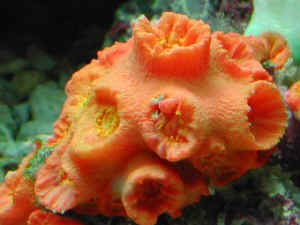
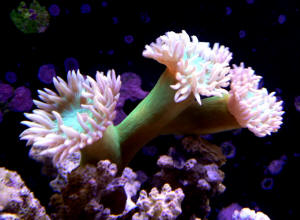
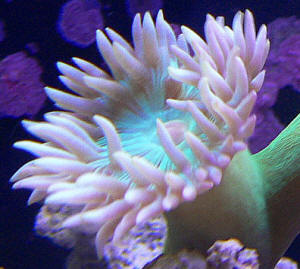
Non-photosynthetic stony coral... Dendrophylliids maybe
11/28/2007 <Hi Bridget, a confused Mich here.> I
noticed that your pictures are of the coral when it's not
happy. <Huh? Not sure what your referring to here.> Mine
started out looking just like the pictures. <Umm, which
pictures?> We've had it in the tank for about a year, we
started with 4, lost one and now have a new baby popping up. We
tried placing it in various locations, up high for more light
didn't make it happy. In the currents made it unhappy as
well. What we have found that makes it happy. <Am glad to
hear.> Low in the tank, on the ground, in the back away from
most of the currents. <Interesting, this does look like a
Tubastrea aurea to me, which generally like higher flow.>
I've been feeding it twice a week with formula one and meaty
chopped foods like shrimp and squid etc. <Better if soaked in
Selcon.> It has a very large mouth, and can take a small
shrimp cut in half with no effort. <Wow!> I divide a full
block of formula one between the 4 when I feed it. <Yikes! A
lot of food!> I've also started adding the bottled
vitamins, calcium, iodide, strontium, and carbonate alkalinity.
Made by Reef builder. <I hope you are testing for all that you
supplement.> I've also noticed that it swell's to
about 3 x it's daytime size at night so it is away from
anyone it can sting. <Very good.> Photo's of daytime
appearance, it's tentacle's will expand and get long and
stringy at night, about 4"-5" long. Tips will flash
that white in any reflections, making them stand out. It's
probably the most beautiful part of my tank and I really am happy
to have this hitchhiker on my live rocks. <Glad to hear.>
Your welcome to use my photo's, only wish the camera would
show all the real color in the coral. It's drop dead stunning
when it's happy!!! <Very good.> Take care <You too
Bridget.> Bridget <Cheers, Mich> PS. There is one of
those little micro stars (blue and white) next to it for size
reference. <Mmm, not seeing this either...>
Re: Non-photosynthetic stony coral...
Dendrophylliids Maybe or maybe not... 12/1/2007 <Hi
Bridget, Mich here again> Epizoanthus couchii
http://www.marevita.org/index.php?option=classification&path=Cnidaria/Anthozoa/Zoantharia/Zoanthidea/Epizoantidae
/Epizoanthus/Epizoanthus%20couchii Found this website, this is a
lot like what I have. <The polyp looks very close, especially
the white tips on the end. However Epizoanthus couchii originate
in the cold seas surrounding Britain. I would be rather surprised
if you somehow managed to acquire this coral, let alone keep it
in a warm reef tank. Though it is possible that this is a member
of the order Zoanthidea.> I'm finding in my research that
the Dendrophylliids are tube like at the base, my coral has no
tube, its mouth comes straight out of the rock.
<Dendrophylliids are reef-building corals, they have a coral
skeleton... The order Zoanthidea is comprised of corals that are
not reef building, thus they have no skeletons. This would be a
simple place to start to determine what coral you have. So,
skeleton or no skeleton?> Do you know anything about this type
of coral and are my feeding and care (listed below) correct?
<It is possible that the original ID is incorrect, it did
bother me that I did not see any pics that had the white tips
like yours did, but I find it doubtful that this is Epizoanthus
couchii as well, working under the assumption that you are
keeping a standard warm water reef system.> Thank you
<Welcome! Mich> Bridget
Re: Non-photosynthetic stony coral
Non-photosynthetic stony coral... Dendrophylliids Maybe or maybe
not... 12/3/2007 <Hello Bridget, Mich with you again.>
Thank you for this, <Welcome!> I had someone that directed
me in the direction of the cup coral's. <There are several
corals that are commonly called cup corals... Including Tubastrea
which may also be called an orange cup coral.>
http://www.kelpfish.net/winners/NovMac01.jpg <The picture is
fine but there is no ID on it... not exactly helpful.> Mine
varies slightly, most of its pretty darn close
http://www.drekster.com/myrescues/coral1.htm Website here of my
corals, before and after <I see this.> The variations are
in color, more than anything else, mine is brown and pink, one of
them has pink spots in the tentacle as well. I suspect they are
probably a form of the brown cup coral, or something fairly close
to this and yes, the one that died left a skeleton. <Then it
is not a part of the Phylum Cnidaria.> They don't retract,
just get bigger or smaller, so it's kinda hard to see the
skeleton. <But they are present.> In the top picture on my
site, bottom, left, middle. you can just barely see the old
skeleton, of the one that died. Kinda whitish in that murky
darkness, <I think I see what you're referring to
here.> and they are right next to the heater in the tank,
definitely not cold water. <No.> Thank you so much for your
help Hopefully this is a right direction? <Sort of back where
we started. Mich> Bridget
Re: Non-photosynthetic Stony Coral...
Dendrophylliids Maybe... 12/07/2007 Well darn! <Golly gee
willikers! Bridget!> You have been so helpful. <Glad you
think so... Can't say that I feel that I've been terrible
helpful here...> Do you think this might be something that
hasn't been named? <Mmm, no, not very likely, more likely
just something I'm not familiar with.> Or maybe over
looked because it's not real colorful? <Well it does bear
resemblance to some other corals, could be a color variation or
just not something very common.> I had someone mention to me
that they are the same color as the food I've been feeding.
I've been running an experiment, since that statement. I am
feeding them only formula 2 for 2 days now. Seeing a slight color
change, the brown is turning more red. Plan to give it a solid
week to see if they might turn green. <Well, I would be
surprised to see a color change that quickly, though not sure why
you think it might turn green.> We'll see what happens,
<Well, keep us posted.> might also explain why we can't
ID them. <Mmm, perhaps, but there more than 2000 species of
corals and many variations in looks within the each species, so
it in not unreasonable that I am unable to give a more certain
ID.> Will let you know <Please do!> Thank you,
sooooooooo much <You're welcome! Mich>
Bridget
|
|
|
Re: Non-photosynthetic stony coral...
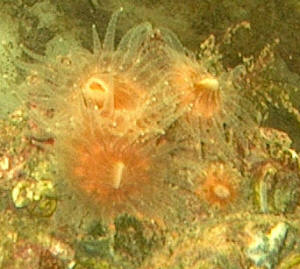
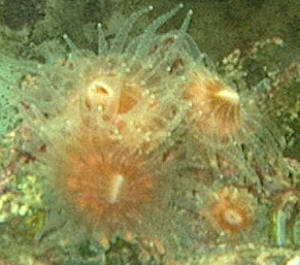
Dendrophylliids Maybe 11/29/2007 <Hi Bridget, a confused
Mich here.> I noticed that your pictures are of the coral when
it's not happy. <Huh? Not sure what your referring to
here.> >http://www.wetwebmedia.com/stonycoridfaq.htm The
pictures I referred to are on this page, top picture<
<<Umm, OK.>> >Mine started out looking just like the
pictures.< <Umm, which pictures?> We've had it in the
tank for about a year, we started with 4, lost one and now have a
new baby popping up. We tried placing it in various locations, up
high for more light didn't make it happy. In the currents made
it unhappy as well. What we have found that makes it happy. <Am
glad to hear.> Low in the tank, on the ground, in the back away
from most of the currents. <Interesting, this does look like a
Tubastrea aurea to me, which generally like higher flow.>
>Thank you for the ID on it, I've found many pictures of
them but no real ID, just stony coral!< <<Well it sure
looks like a Dendrophylliid, more specifically a Tubastrea aurea,
to me.>> I've been feeding it twice a week with formula
one and meaty chopped foods like shrimp and squid etc. <Better
if soaked in Selcon.> It has a very large mouth, and can take a
small shrimp cut in half with no effort. <Wow!> I divide a
full block of formula one between the 4 when I feed it. <Yikes!
A lot of food!> I've also started adding the bottled
vitamins, calcium, iodide, strontium, and carbonate alkalinity.
Made by Reef builder. <I hope you are testing for all that you
supplement.> I've also noticed that it swell's to about
3 x it's daytime size at night so it is away from anyone it can
sting. <Very good.> Photo's of daytime appearance,
it's tentacle's will expand and get long and stringy at
night, about 4"-5" long. Tips will flash that white in
any reflections, making them stand out. It's probably the most
beautiful part of my tank and I really am happy to have this
hitchhiker on my live rocks. <Glad to hear.> Your welcome to
use my photo's, only wish the camera would show all the real
color in the coral. It's drop dead stunning when it's
happy!!! <Very good.> Take care <You too Bridget.>
Bridget <Cheers, Mich> PS. There is one of those little micro
stars (blue and white) next to it for size reference. <Mmm, not
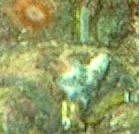
seeing this either...> >Sending picture again, micro star has
one long leg and four short legs (reproduction?) and it's in
the bottom right hand corner.< <<I see it now. It is an
Asterina star and the physical appearance is likely a result
reproduction or recovered injury. They are capable of
regeneration.>> Sorry should have told you where to look with
this, your site is so big it's easy to get lost. <<There
are lifetimes of work on this site.>> Take care <<Thank
you Bridget, you take care as well, Mich>>
Bridget |
|
|
|
Australian Scott's Fairy Wrasse 11/27/2007 Hi
Bob, <Hey Peg> I know I told you I'd send a pic of the
fabulous Aussie Scott's Fairy when I could get a good one,
and in the event I've not yet forwarded the pic, I'm
attaching one here. He's comfortable in one of the store
display reefs now (180) and draws a lot of attention! He goes 5
to 6" and has a great appetite. What a wonderful fish. The
H. trispilus/chrysus/cross/hybrid is also doing well and is a
stunning fish whatever he is. :O) Off to do some water changes.
Hope this finds you having a great week! Peggy www.all-reef.com
<Thank you my friend... am out visiting in much warmer
Hawaii... Will post with credit to you. Cheers, BobF>
Re: Australian Scott's Fairy Wrasse
11/27/2007 Hawaii, uh? I'm jealous. We're looking at
3-5" of snow tonight, and the temp when I awoke this morning
was 3 degrees with a -15 wind-chill. How's that grab you? :O)
<Low, and very hard... I "like" the snow... can
tolerate (short-term) some cold... but very much prefer the
tropics> I've attached some pics of a very nice piece of
Australian coral, a Duncanopsammia axifuga. They ship a bit
poorly but always bounce back with good care and lots of good
food. They're voracious feeders. <Mmmm, thank you for
this... Am thinking of asking how much time you might have to
help us/WWM out... with the more detailed reef questions...
And...> Off to work. Do enjoy the sweet and warm sunshine of
the islands for me! P <I spent many years "on the
floor" in pet-fish retail... and have a high sense of
compassion... Am very pleased to meet up with you, your apparent
"great" attitude toward the work, life. Cheers,
BobF>
Re: Australian Scott's Fairy Wrasse
11/28/2007 Hi Bob, <Peg> Thanks for the good laugh on
your comment regarding our weather. It was very descript. :O)
Looks like our snow will not be upon us until later today. One
can't rely too heavily on the weathermen or women. I prefer
the look out the window method. It's more accurate. <And
satisfying all the way around> Perhaps in the future I can
make time to assist on WWM as you suggest. I'm presently a
one-woman band in my store, i.e., chief cook and bottle washer,
the sole soul of proprietorship. <Outstanding... I spent some
14 years on the floor in pet-fish retail myself... Not an easy
job.> I'm flattered to think you would consider me though.
I've been considering sponsoring at WWM because it's such
an incredible site and offers a plethora of quality info. Because
I essentially detest forums (too many "experts" who
actually know less than those asking for help), <We share this
point of view. I wonder if folks would readily 'listen'
to such BBs for other important matters like their health... To
me, an unorganized mix of even "Dear Abby" quality
banter is a waste of time> I have the utmost respect for you,
Calfo, Borneman, Delbeek, and certain others in the industry who
do provide quality information. I do have a boatload of
information stored away in the noggin after almost 18 years of
serious reefing. I anticipate sitting in a retirement home many
(hopefully very many) years from now reciting species names and
no one else knowing what the hell I'm talking about and
assuming I've just slipped into dementia. :O) <Heeee! If I
have to go... am going to own the place. Oh, and we'll have
fish tanks aplenty> You are correct about the positive
attitude towards work and life. Always an optimist. I consider
myself extremely fortunate to be pursuing what I love as a
livelihood! I was a paralegal for 22 years in the court system
working with many judges and lawyers. It's obviously a very
political environment and over the past couple of years had worn
me down terribly. I finally pulled the plug to pursue my store
full-time just this past August. <Ah, congrats!> I had been
tinkering with it for over a year. Every morning when I wake up
and don't have to suit up and head to the government center,
I realize just how wealthy I truly am. I enjoy helping my
customers and teaching them how to be successful. <Ahhhh!>
My motto is if you don't learn something every time you come
into my store, then I haven't done my job. I've developed
a pretty good clientele already and word is getting out, so I
trust the store will survive. :O) Time to get a move on and get
down there. Lots of protein skimmers that need attention and lots
of hungry herbivores awaiting my arrival! I'm still jealous
you're in Hawaii, but I'll be close when I get to my
store! :O) <I see> Thanks again Bob, and make it a great
day! Oh, please give my regards to Charles Delbeek if you happen
to visit the Waikiki, which I can't imagine you wouldn't!
He doesn't know I exist, but you can say hello for me anyway.
:O) <Have been e-chatting w/ Charlie re he swinging over to
the Big Island this go... and us getting in some diving,
chatting... We'll see. Cheers, BobF> Peggy
www.all-reef.com
|
|
|
Cup Corals... Dendrophylliids?
6/21/07 I recently purchased to two cup corals for my 65g set-up
EcoSystem. I did my research and purchased one orange cup coral and one
(neon) yellow cup coral. Both reside in caves away from direct light
and sit on the live sand. <Tubastraeas? Live attached to hard
substrates, not in sand> The colonies are structured different for
both where the orange cup(s) are smaller and rounder where the neon
yellow is a larger (longer) cup. I direct feed with a syringe using
Cyclop-eeze, a tiny amount of defrosted shrimp and some trace
minerals/vitamins once a day. The two feed differently and the question
I have is this The orange cup opens up with a tiny hole for its mouth
and with very short polyps (almost appears plump around the small
opening with tiny polyps). The neon yellow cup however responds
differently with long neon green/yellow long polyps...almost hairy
looking! Do cup corals have differing polyp lengths like this or is
there something wrong with the orange cup with the small short polyps.
<Mmm, would you send along pix and/or scientific names for these
organisms?> They are healthy and look great but I don't
understand this difference. Thoughts? Thanks so much, Geno
<Bob Fenner>
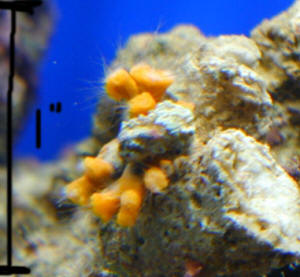
Quick coral ID 8/6/05 Greetings Bob & Crew!
<<Hello Ray. Ted on this end>> Sent this one off about
2 weeks ago and still no response. Lost in
cyberspace? <<Sorry>> Anyway, found this little guy
growing on a small LR frag. Thought it was just
coralline when I got it but it looks like coral as it is
growing. It has very thin clear-white filaments that
come out of the ends during the day and at night (from what I can
see). No idea what it is. I've done searches and
nothing looks familiar. Perhaps some sort of
SPS? I've also had sun coral suggested, but does not
look right to me. It's currently near the top of a rock pile,
under MH lighting and seems to be doing fine after a few weeks.
<<Identifying corals from pictures is difficult. Having said
that, I am going to take a stab at this and suggest it may be
Tubastrea coccinea (Orange Cup Coral). See http://www.wetwebmedia.com/dendrophylliidae.htm.>>
Thanks!
-Ray
<<Your welcome - Ted>> |
|
|
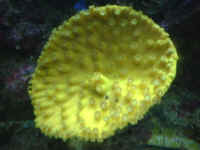
| Ughhh... dyed coral! The Fascists!!! Hello
Bob, etc... <Anthony Calfo in your service> I love your site,
and thank you for providing us reefers with such a useful,
purposeful resource. I just purchased a new coral from my LFS and
was trying to do a species ID to ensure that it gets proper care. I
think that I have it under control from a general point of view,
but I am after long term success, not 6-12 month torture...
<yes... thank you, pictures most always help a great deal>
Anyway, I have attached a pic for help, but in looking around your
site I see a species that I think fits better than the LFS ID of
pagoda coral. In my opinion, this is Turbinaria frondens. The shape
seems more like Turbinaria peltata, but it has the brilliant yellow
color of frondens. At first I was concerned about this being a dyed
animal, but upon further inspection, I believe that this is natural
coloration. Do you agree? <I am as certain as I can be without
seeing the animal personally that this IS a dyed animal. Tragic.
The polyps structure does not resemble T. frondens at all to me. T.
peltata> Also, now that this coral is home, and the polyps are
opening, I noticed that one polyp appears to have been taken over
by a critter with 2 slender antennae. <barnacles and
sessile snails are quite common and harmless. Rather a fascinating
incidental creature. Do enjoy> I noticed that there was a
reference to this situation in the FAQ, but not a lot of info as to
dealing with it. Should I be concerned? <not at all...
many hitchhikers and commensals make it through with little notice
or cause for concern> I really don't want to add to the
bioload of my system with a fish addition, but possibly a
shrimp/crab would be in order. Currently I have 1 tomato clown, 1
yellow tang, 1 scooter dragonette, 1 neon goby, and 1 PJ
Cardinalfish in my 50g tank. This system has been set up for a
little over 2 years with this bio load and 75lbs Fiji LR. <if
the cardinal hasn't been alone for too long, some mates might
be nice for a shoal. Shrimp would be an equally aesthetic move...
serving little functional purpose. Crabs tend to be a little more
risk... only add if you find one that attracts you and has a very
good reputation. Too many crabs are truly omnivorous> On a
side-note, one of the first uninformed decisions I made for my tank
was the purchase of a Sebae anemone. After reading about it I
thought it was doomed (it seems they all are) <not all,
but many/most> but I've had it for 2 years now, and it is
getting huge! I just wanted to share a success story regarding the
poor Sebae anemone. By the way...I think this is Heteractis crispa.
Thanks for your expert guidance! <and thank you for the success
story! Do share some thoughts on why you feel yours has made it.
What do you feed and how often? What kind of lights and changed how
often? Using carbon and doing regular water changes to maintain
water clarity for optimum light penetration? Any other
thoughts?> Jason <best regards, Anthony Calfo> |
  |
|
Re: Turbinaria species, Dyed coral Anthony...How can I better
tell if this is a dyed animal? <a matter of
experience/information... size/shape of corallites and polyp structures
on the corallum indicate that this animal is almost certainly T.
peltata. It really cannot be anything else. Color has nothing to do
with coral identification. T. peltata for that matter occurs in brown,
green, teal, pink/tan, etc. Unfortunately yellow is not a naturally
occurring color for this species. Furthermore, T. peltata is
categorically in the top three commonly dyed coral. A truly abhorrent
practice as I'm sure you'd agree. An insult to the magnificent
beauty of the coral reef in all of its natural forms. Reports indicate
that this animal for its hardiness may survive the dye job although not
without some stress. Occasional feeding of very fine food will be
especially helpful to compensate for the reduced symbiotic activity of
the now masked (dyed/pigmented) tissue for Zooxanthellae> All
areas of the coral that are flesh covered are the same shade of yellow.
There is an area near the base stem that are not flesh covered and it
is pure white. If this is in fact a dyed animal, what type of success
do you predict (i.e. is there any chance)? In the future, how can I
avoid the purchase of a dyed coral. <just research a species before
you buy it. Know its needs, hardiness, natural behavior (and
colors<G>). Also read about current trends in the industry...
many threads about dyed corals on the big forums and message boards.
Membership in a good local aquarium society as well will keep you
informed> Regarding the Sebae, I have it under 275w PC lighting.
3X55 10k/actinic, 1x55 6400k, 1x55 actinic. I change my bulbs app. each
12 months...not all at once, but about 1 every month or so until they
are fresh. <excellent technique with the bulbs! Kudos> I
feed the anemone about once per week, usually squid, octopus, or
shrimp. Also, I have "blender mush" that I feed the tank and
usually the tomato clown gives a chunk to the anemone. <also
excellent> When I bought the anemone it was pure white with purple
tips. A few days later it expelled more zoo (sp?) anthe and proceeded
to let go of the rock it was on and roll around the tank.
<yes... sadly typical> I moved it to a preferred (by me) position
under the lights, and it grabbed on, only moving about 8" to the
place where it has been for last 22 months or so. It has since turned
brown, but has grown in size from 3" across to now more than
14". <excellent... a success story. Thank you for sharing it.
FAQ readers take heed> I change about 15g per month in this 50g
system. I rarely use carbon at all, but I do get a lot of skimmate from
my Bak-Pak skimmer. <yes.... critical for exporting dissolved
organics especially with your lack of carbon and average water changes
schedule> My water is usually crystal clear, but I use tap water so
I get some diatom algae. <not a crime> For current, I have
the Rio 600 on the skimmer, AquaClear 802 ph, AquaClear 301 ph, and
Catalina 100 PH. They are all on different flow paths so the current is
pretty random. <wow... fantastic! over 1000pgh total
circulation in this 50 gall but strategically random turbulent. Highly
effective and to be recommended. Keeps detritus in suspension for a
good skimmer, feeds corals more, etc> Also, I have my LR elevated
above the DSB with the Catalina PH blowing directly under the LR
structure. I maintain my Ph at 8.4, Alk at 14dKh, CA at 350-400ppm. I
don't have any measurable NO2 or Ammonia, but my NO3 is usually
about 5-10 ppm. I supplement with Kent Superbuffer,
strontium/molybdenum, Zoë, and some other that I can't
remember. <sounds very fine> Other corals in the system are:
Hammer, Brain, Frogspawn, bubble, Candycane, lots of colts,
Sarcophyton, Sinularia, green star polyps, hairy 'Shrooms, other
misc. 'Shrooms, and fox coral. I'm thinking of adding a pink
Fungia and maybe a couple of brightly colored sponges. Attached is a
pic of the system taken in April...it looks a little different now.
<again... thank you for sharing. Best regards, Anthony>
Coral ID- Yellow Scroll coral 2/9/03 Hi Bob, or
whoever answers this. <Anthony Calfo in your service> What is the
name of the hard coral in the 5th picture down on the 'Marine
Maintenance' page? <Turbinaria mesentaria- Yellow Scroll coral.
It is very hardy and very weakly aggressive (protect from other corals
with, say, a 25 cm buffer zone). It does not/cannot feed on prepared
food (polyps are too small... requires nanoplankton and dissolved
organics), but does require very bright light and very strong random
turbulent water flow> I bought one of these from a bloke who was
giving up the hobby, but he did not know the name. I have had it now
for several months and it is doing fine. Many thanks Colin
<excellent to hear. Its not an especially fast grower... but will
let you know promptly when nitrates are too high or light is too low by
turning a darker (golden/brown) color. No worries on polyp extension
here... it is weak and usually just at night. Best regards,
Anthony>
| Orange Sun polyps or Zoo's? - Tubastrea it
is 7/23/04 Hey gang, Greetings from Denver, Colorado!
<cheers> I was told by the kid at the LFS, that these were
"some sort of polyp colony", as he put it. I wasn't
sure either, so I traded some Xenia frags for it. Anthony (or any
of the other fine members of WWM crew!) if y'all could
enlighten me as to what they are for sure, I'd appreciate it.
Thanks for the continuing effort in knowledge y'all provide
here, The Mile High Stormbringer. (aka; Scott in Denver!)
<yikes... this is definitely one coral that needed a correct ID
before buying it/bringing it home. They are ahermatypic
aposymbiotic Tubastrea. In other words... it is the night-feeding
stony "sun coral". They have no place in a reef tank but
need a species specific tank ideally. This is because each and
every single polyps is a separate coral and needs to be fed
individually several times weekly (if not daily). With those needs
met, it can be hardy, grow well and even reproduce in captivity.
Its shameless that the LFS sells these without advising customers
of their extraordinary needs. It honestly makes me a little sad at
times to think of how many of these coral they sell this way. For
you Scott... do search the web and beyond for info on Tubastrea. Do
note the special sections I give to it in my Book of Coral
Propagation (in the Feeding chapter as well as with its family in
the Overviews). Best regards, Anthony> |
|
|
Coral ID and Reef Husbandry 1/23/05 Dear Bob and Crew,
<howdy!> My name is Dean and I am an aquaholic. <I like to
drink water too... every day. No worries> I have what my LFS
identifies as a cup coral in my 55 gallon Tank. <yep...
Turbinaria peltata. A very hardy coral that favors feeding small meaty
foods like Mysids once weekly for starters> It is some type of
plating coral. I watched this coral for several weeks at the LFS before
I purchased it. I feel confident that if it could survive in their
tanks, then it would survive in mine. <This Turbinaria is an
excellent starter coral indeed.> I have extensively researched your
site and to no avail at an accurate identity. Would you please review
the attached picture for me. I have this coral at the top of my tank.
It is approximately four inches from the top of the water and the
lights are sitting directly on the cover glass. <moderate to
strong turbulent water flow is the key with this species> It is
probably six inches from the light source. This coral has been in my
tank since August 2004 and I did quarantine it for four weeks...
<excellent to hear! Thank you> ...before introducing it to my
display tank. When you look down at this coral from the top, it appears
that some of the tissue is receding. <not uncommon... a bit of
damage or lack of feeding over time. Resume good water quality and
feeding and it will heal fast> But if you look closely at the
picture along the lower edges, you can see a new row of polyps starting
to grow and the tissue is spreading on the non-light portions of the
rock. What are your thoughts? <I like natural vanilla (bean)
ice-cream... thanks for asking> Tank Parameters: 55 Gallon Oceanic
Flat Back Hex Tank. It has been in operation for two years. Lighting
consists of two 40 watt 20K Coral Life bulbs. <change these every
6-10 months for best coral health> Penguin 400 filter. HOT Magnum
Canister Filter. DIY Downdraft Protein Skimmer. About one cup of tea
color skimmate every one/two days. <good start... do dry smaller
bubbles or a lower active foam/water interface in the skimmer neck to
be able to collect darker/more dense skimmate> 20 percent water
change per month. 150 pounds of base rock mostly covered with pink
coralline algae. Plenum with three inches of aragonite on top. Several
Yuma Ricordea Mushrooms. One Pterogorgia guadalupensis. One three inch
Coral Beauty. One Four inch Yellow Tang. One four inch Lawn Mower
Blenny. One Coral Banded Shrimp. Too many button polyps and sun polyps
to count. Started with only one sun polyp and four button polyps free
from the LFS. Ammonia has always tested "0". Nitrite has
always tested "0". Nitrate "0" to only a trace.
Calcium normally runs 350. pH is normally 8.2/8.3 during the day. I did
test it early one morning this weekend, before the lights came on, and
it tested about 8.0. <do raise this to 8.3 minimum> Alkalinity
test normal to high with a Red Sea pH/Alkalinity test kit. I drip
Kalkwasser for the make-up water. I currently have a small trumpet
coral in my quarantine tank to be moved to my display tank next week.
Could you recommend a location after reviewing the full view if my
tank. I really enjoyed the CMA. I have read it several times from cover
to cover. I also have a copy of your Reef Invertebrates in the mail for
my birthday. Your help would be appreciated. Thanks Dean <best of
luck and life to you my friend. Anthony>
|
|

