|
|
| Home | Marine Aquariums |
Freshwater Aquariums |
Planted Aquariums |
Brackish Systems |
Ponds,
lakes & fountains |
Turtles & Amphibians |
Aquatic Business |
Aquatic Science |
Ask the WWM Crew a Question |
| Please visit our Sponsors | ||||
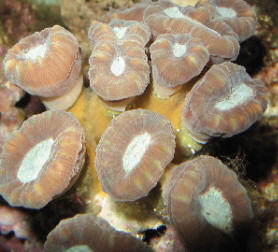
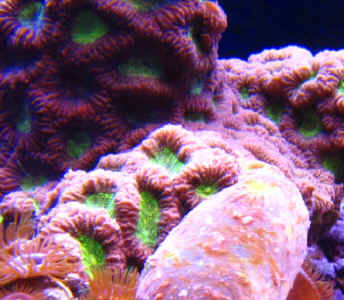
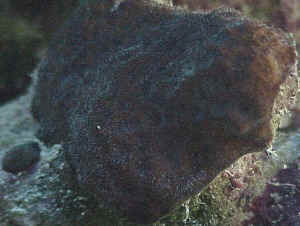
Oz collected coral - low light upgrades 6/18/04 Hi hopefully just a quickie! Anthony, I believe is the coral expert. My coral I have now ID'd after much searching as a Leptoria phrygia or closed/lesser brain coral or maze/labyrinth coral. According to the information I was able to find I believe it requires good lighting as it is found on reef ledges (which is where I collected it from) so after a few weeks acclimating to captive lighting (and admittedly a bit too much moving around but I got it home quickly in heaps of water so I figure I'm pretty safe as no long, dark, water restricted transporting) on the substrate at the bottom of my tank I have moved it two days ago to the top third about 4 inches under the water surface and another 2 inches from the light with glass cover in this space. My lighting is one 36W daylight globe and one 36W actinic globe both fluoro which are on 12-14hrs a day. Does this sound like the right spot for it lighting wise? <it sounds like very weak lighting to be honest. Actinics do not count for much beyond aesthetics. A decent rule of thumb is 5 watts per gallon with daylight colored lamps> I mainly moved it because it was starting to darken, by which I mean the valleys which are normally fluoro green were becoming dark brown in areas (I am thinking this is due to lack of light/lower lighting than it is used to?) <exactly... and I don't expect it to change much under these present lights (other than a little greener from the actinics)> and ridges looking thin and rigid, rather than soft and full. Feeds well but some areas haven't been putting out polyps even at night. Have seen brown hair like stuff coming from the mouths which I assumed was poop as I fed it up to begin with once I figured out what I was supposed to be feeding it. Collected it before research admittedly and before I realized the necessity for prior research which I am now doing vigilantly! Thanks so much for all your kicks up the butt to get my act together and be responsible, I needed them! <indeed my friend... its a bit like MASH surgery around here with the volume of mail we get, but all out of love and shared admiration for these creatures. We want you to succeed... and we want to help improve/save animals lives through better husbandry> Also where it is currently placed there isn't as good water flow as it was and I believe they need moderate current levels. It is enough to blow the poop away as I watched it yesterday afternoon (lovely past time let me assure you) so is removing waste material the main issue with water movement? <more to it... growth, gas exchange, etc. The goal here would be around 20X tank turnover> I target feed so it doesn't really need it for feeding, or does it for calcium etc? <always test for calcium and alkalinity (magnesium for stony corals too) and dose as needed> Your knowledgeable advice much appreciated. In great debt! <best of luck, Anthony> Coral feeding 6/14/04 Hi guys hey if my coral is a zooplankton feeder can I just feed it mushed Mysis shrimp or do I still need to get a zooplankton food for it? Is this ok as a staple or should I aim for more variety? <Depends on the coral. Please write back and let me know exactly what coral you are talking about. As a general rule, the size of the polyps is a good indicator. Larger polyps can accept larger food (although this is not universally true). Best Regards. Adam> Coral feeding 6/15/04 Adam or whoever else my coral is some kind of brain coral I think, collected it myself. Has tan/brown ridges in a maze pattern, with in between valleys being fluoro green. When ridges open the polyps are about 5mm in length and maybe 1.5mm in diameter. When I feed it mushed Mysis shrimp it seems to expand and close around them so the green valleys disappear and the brown ridges are all soft and greatly expanded and polyps have gone again. So should I just maintain this once a day or does it need other variety of zooplankton as well? << I believe that a variety is very important. I would use something like Cyclops shrimp or rotifers weekly. >> Or anything else, other than calcium supplements? << In addition to calcium supplements, please check and watch your alkalinity. That is every bit as important. >> << Adam Blundell >> Brain Food, and Other Coral Concerns! Hi Bob! <Actually, Scott F. in today!> I have looked thru a lot of your articles, but this problem I couldn't find. It may be me. <Yeap.. it's you! Hah- just kidding!> We have a 125 gal. tank with a wet/dry filter, protein skimmer, chiller, and even bought a r/o unit with deionizer. It is a starter reef tank with 120lbs. live Fiji rock, Yellow Tang, 3 Spot Domino, 2 Clarkii Clowns, Yellow Polyps, Orange Button Polyps, Open Brain, Red Mushrooms, one Ricordea, and misc. snails, starfish, crabs, and shrimp. <Nice mix> The problem is, our Orange Button Polyp which has tripled its size and is gorgeous has developed white spots on the front part of the cluster. They are only on the "stem" of the polyp. The polyp is still beautiful and shows absolutely no signs of distress, actually it is still producing polyps. The polyps on the front do stand real tall compared to the others, where the ones on the back make a ball shape. The only time they close is when the lights go off at night. They open readily when the lights come on. All other corals are totally clean. Please help me. We have had this polyp for 6 months and it is my favorite. <Hard to be 100 % certain. Possibly just a migration of pigment, but it could be anything from flatworms to some other pest, too. If the coral is otherwise reacting well, and appears healthy, I would not be too concerned at this point. Just observe carefully and let us know if you notice a decline in the coral's health at any point> I know I am being a pain, but could you also tell me the best thing to feed our Brain Coral and amount. Everyone I talk to disagrees and I haven't had much luck with the internet or books. Thank you sooooo much!!! Julie <You're NOT a pain, Julie! As far as feeding the Brain Coral is concerned, I'd use fine zooplankton-based foodstuffs, such as minced Mysis, krill, or other "meaty" foods. The newly-available frozen "Cyclop-eeze" is a great food for these species! Good luck! Regards, Scott F> Green open brain necrosis 4/14/04 First off: this site is incredible! You guys are one of the best resources I've found yet (still new to the hobby though). <Thanks for the kind words!> Anyway regarding my problem, I searched & browsed the site/FAQs, and got some good info, then tried the public forum, but no responses, so here goes. In a nutshell, after being out of town for 5 days my open green brain is suffering serious tissue necrosis which was not at all evident before I left. <You will find that one of the amendments to Murphy's Law states that these things will always happen when you are out of town.!<g>> This is a new 37 gal tank (2 months old), but the brain was doing quite well before I left town (already in the tank for 1 month, bad advice from my LFS). When I returned from my trip everything in the tank looked fine except for the brain, which showed a small area of what looked like irritation (bright green spot, slightly dented-in looking). Today it's blossomed into full-blown tissue necrosis across one lobe. I lifted up the brain (from the base, using a glove) and upon closer inspection the affected polyp tissue looks like it has some tiny holes bored into it--like termite holes in wood. <Open brains are a bit more sensitive to water quality than most folks consider them to be. They are also one of the corals most commonly picked on by fish. Their fleshy inflated tissue can be easily damaged.> Here are some possible culprits/factors: (1) a few days before I left town I added new cleanup crew members, an assortment of snails (Astrea, Nassarius, Ceriths) and some small blue leg hermits. Could these be doing damage? I've seen them waltzing through the button polyp but never anywhere near the brain. (The button polyp and finger leather are a good 18" away from the open brain, which is on the sand with decent light exposure and moderate water flow (no direct laminar flow)). <It is possible that the hermits damaged the brain, but unlikely. Any fish that may be nipping?> (2) the inverts had been added to battle green hair algae which started blooming a week or so prior. I set up the tank with dechlorinated tap water but have been using RO/DI for about 3 weeks now. So there are probably still some phosphates in the tank. I just read a reference to boring green algae on your site but didn't find much info on it. I'm guessing this is unrelated to run-of-the-mill nuisance algae but that's a newbies guess. The tiny holes got me thinking. <Such boring algae are quite rare, but conspicuous when encountered. The real issue is that when exposed skeleton becomes colonized with algae, the coral has a hard time overgrowing it.> (3) While I was gone the house sitter only topped off water with my RO/DI supply, but I think the weather was hot: when I got back the water level was low and specific gravity had shot up to like 1.027 from the normal 1.024. This would have been for 2-3 days at the most. <No concern over the rise in SG.> (I performed a 10% water change and brought the salinity down to 1.025, then 1.024 the next day. All other tests were not that remarkable--ammonia, nitrite, nitrate were zero, pH 8.3, temp. 77, alkalinity 3.5 meq/L). <Keep in mind that drops in salinity are far more stressful to inverts than rises. Water quality sounds fine.> (4) I have never fed the coral in the 4 weeks I've had it (more bad advice from the LFS). I just fed the poor guy some minced fresh shrimp per guidelines found on your site. <Great! Pieces up to the size of a marble or so should be greedily accepted.> (5) A week or so ago I moved the coral to the corner of the tank, as in its previous location it was growing upwards into a rock overhang and I was afraid it would get an abrasion. The new location should be getting plenty of light but it's possible water flow is weaker in that area. Even so, would that cause tissue necrosis? <Perhaps you are seeing the effects of previous damage? Open brains prefer moderate current, but are very tolerant of fairly low current.> Thanks for any advice. I have pics if that would help but it basically looks like the green brain 2/3 of the way down this page, but worse: www.wetwebmedia.com/corldisfaq2.htm Your fan, John MB <My hunch is that there was some damage, and the coral was not able to cope because of the immaturity of your tank. There are no measurable parameters that suggest maturity, and it is a very non-specific term. Suffice it to say that corals do better in systems that are at least a few months old. Best regards. Adam> Web courtesy when e-mailing images... and brain coral 3/18/04 <please only send/resend images to us in a web friendly size of a few tens to a mere couple of hundred kb (under 300) as a help/courtesy to our mailbox space and the many folks that write in my friend. Else we can get clogged pretty fast. Additional shot with a "Siamese Twin" brain, can the brain survive? <they are remarkably hardy and can survive if fed well (fine minced meaty foods 3-5 times weekly. A few months from now it may look anew> got it a couple of weeks back, expect it to acclimatize for a few more weeks before I see bigger expansion like my other brains <agreed... best of luck. Anthony> Coral Questions 2/29/04 I have a few questions about candy cane corals. I read over the < http://www.wetwebmedia.com/acclimcoralslight.htm> Acclimating Photosynthetic Reef Invertebrates to Captive Lighting but just became more confused with the too much lighting and not enough lighting issues. I also read over http://www.wetwebmedia.com/faviidae.htm all three parts, but there was no lighting, acclimation, feeding help for this one. I have just a basic lighting set up... 4 foot 32 watt aquarium bulb (fluorescent in a hood placed upon a glass top) which I just made the mistake of turning on and looking directly at (bright for 32 watts) <do realize that "bright" to our eyes is the warmer end of the light spectrum which does not penetrate water at depth very well and is not a fair measure of adequate light for corals. Around 5 watts per gallon is a fair minimum for most tanks. I cannot speak for yours here without knowing the size and depth of the aquarium> and was wondering if this is enough for a candy cane coral if it was placed near the top of the tank?? <likely so if the lights are no more than 3" off the surface of the water and the coral is no more than 10" below the surface> I was also wondering about feeding and water flow? <as an LPS coral, they need fed very finely minced meaty foods (most any meats but brine shrimp) several times weekly... moderate water flow here> Secondly I have some Zoanthid which came on some live rock and I was wondering about lighting for them. If Zoanthus species, they may be bright light... if Palythoa they may tolerate moderate> They seem to be doing good so far (been there for well over a month)...haven't given them any special care as I didn't know what they were until recently (sounds silly...but I wasn't able to ID it). <do use coralrealm online to help you in addition to a good book like Eric Borneman's Aquarium Corals> I am planning on upgrading the lighting but haven't decided what to go with yet. <150 watt HQI 10k K lamps are some of the best lights/values around in the long run all things considered> Thank you so much for the help, you guys/girls are the best. Thanks again, Todd Hawman <best of luck! Anthony> Does my Brain (coral) need help? Hi Crew ! You've been great help in the past so lets try it again. <Glad you have benefited!> Presently have a 46 gallon bow front with roughly 90 lbs of live rock and assorted healthy fish. Tunicate and sponge growth here and there. I would think this is a sign of a healthy tank also. Lighting consists of one Coralife 10k and one Hagen Marine-Glo actinic staying on 9 hours per day. Good filtration and moderate skimmer. I am a believer in Tom Walsh's theory that you don't have to have a complex system to be successful in this hobby just good husbandry. <All sounds reasonable. I do also subscribe to the KISS principal... Keep It Simple Stupid!> Now to my question. I was given a Green Closed Brain Coral two weeks ago . I have never kept corals before but have read that the Favia? was a good beginner. I have noticed that in the last week it is showing some brownish coloring around some of the edges. <A picture is worth a thousand words here.... This is most likely "browning out" due to differences in (likely less) light in your tank. If the tissue looks in tact, but is just changing color, I would not worry.> I have always used SeaChem Reef Calcium and Reef Complete but have been out since this coral was added. I dosed the tank last night and also added Reef Plus. What do you think will happen now. Will he recover from this? Will the supplements get him on the rebound? His feeder tentacles are out when the lights come on however. Thanks for your help. Randy <The only way to be sure what supplements are necessary is to test for those elements. My suggestion is to supplement only calcium and alkalinity (should be checked often), and nothing else unless you are testing for it. In most cases, regular partial water changes will supply enough of everything else. Over use of supplements can easily lead to overdose. Occasional feedings of finely chopped meaty seafoods will also be of great benefit. Best Regards. Adam> Caulastrea decline from shipping stress - 2/20/04 howdy, yesterday I receive my candy cane coral I ordered, only to find it appears the skeleton is protruding from some/most of the polyps <from the picture it looks a bit stressed. Acclimate, keep low in the tank and keep up the water quality. Do you feed? Try to target feed>... can u please tell me this is normal and it will grow back? <Likely will grow back in time with maintenance done on your part.> P.S the polyps have not inflated yet.. is it doomed? <Always a possibility but these are fairly hardy corals. Place at the bottom of your tank to help it acclimate to your lighting. Also, let the company know immediately of the issue upon arrival. Good luck to you and your coral. ~Paul> P.S.S my camera sucks ;)
Gall crab 1/13/04 I have what I believe to be a female gall crab living in my closed brain coral. Should she be removed? Thanks much! Jeff Wagner <they are rarely a problem my friend... the coral will usually grow around them. If your coral exhibits normal polyp cycles and feeding... no worries. Anthony> Candy Trumpet Coral -- where do I place this guy? 1/8/04 Hey guys. <Howdy Steve> It's a simple question, but I don't see an answer anywhere on your site. <no worries... we are simpletons with simple answers ready at hand <G>> So, thanks for taking the time. Do I put my trumpet coral in the sand or try to get his stony end into a hole in a rock? <they only occur on hard substrates and have shown a clear intolerance of heavy matter/sand being showered upon them (as from sand sifting fishes when placed near the bottom of the aquarium. Please only place this coral in the top half of the tank in/among the rocks> I don't have a lot of places in the rock to put him and he's not balanced, so I was wondering if the sand would work. <at best, you can epoxy it to a very solid, flat rock if there is no risk of tipping or sand settlement. To be placed on the sand bottom then> I have a 12g nano tank with good lighting. Thanks! Steve Johnston <best regards, Anthony> New Open Brain Health - 10/27/03 I recently purchased my first live coral - a brain coral. <Very well> It's about 3" long and has pretty fluorescent green coloring. It is very hard and relatively flat. Since I have purchased it (only about 10 days ago), I have seen pictures of other brain corals that are "fluffy" and appear to have fluid inside them. <Yes. Fascinating to watch> My coral has not changed in ANY way since I purchased it. Is it dead? <Likely not. Is the color bleached in any way? is the white of the skeleton showing through? Should be placed low in the tank preferably on a sandy bottom with some room for expansion> Was it dead when I purchased it? <I don't know was it? It is not necessarily dead because it is not expanding> What should I be looking for? <Tentacles extracted around the inner rim (feeding) and expansion of polyp> I tried looking for diseases on the net & saw bleaching etc. <On our site???? We have more than that!!> I just need to know if it's young & that is why it looks that way and that I should be patient or it's dead. <Be very patient!! Don't move it. It could still be in an adjusting phase. Read all that you can about Trachyphylliidae here: http://www.wetwebmedia.com/trachyphlliidae.htm> Please advise. <Knowledge is have the battle. Read through the various FAQs and articles for Trachyphyllia -Paul> Thanks so much for your time. JoAnne
Re: Candy Cane Coral: Polyp Bailout 7/16/03 Anthony: Thanks, your reply makes total sense. I had a leather coral right next to it which is what I suspected was the problem. I have since moved the Candy Cane away. I also have just replaced my power compact light bulbs but I think the bubble formed before that. I'll keep an eye on it. <all good my friend> If the polyp does bail, is there anything I can do at that point or will that "branch" die. <the corallite (skeleton of that polyp) likely will not regenerate a new polyp. For aesthetics, you may saw the dead branch away. The ejected polyp will need to be isolated in a shallow cup or like vessel to keep from blowing around. It will take some weeks/months to settle out but may very well survive. No worries.. a very hardy coral. Anthony>
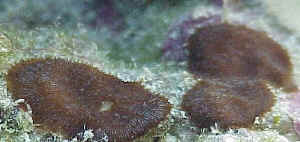
Faviid Growth on LR - Follow-up - 7/18/2003 Anthony: Thanks for the information on my new Faviid coral growth. A few follow-up questions, if I may: 1. I am now wondering, does this mean I have an SPS tank now? <no my friend.. the encrusting brain coral that you have is a large polyped species. Often needing only moderate light and water flow like many softies... and quite unlike the popular SPS corals> I have not purchased any corals yet, I am still researching. I have a 10-month old 55 gallon (48x13x21) glass, 130w PC, 4" DSB, BakPak2, 2 converging power heads, 2x weekly 5% water changes. I currently have 1-Fire Goby, 1-Yellow Clown Goby, 1-False Percula Clown (no anemone, thanks to you guys), 1-Orchid Dottyback, 1-Mithrax Crab, 2-Peppermint Shrimp, some hermits & snails. 2. Is it true that I am doing something good to help this creature grow from visibly nothing to a couple of inches across, or is it one of those "hey look at me!, too bad I can't survive here :(" scenarios? <nope... quite likely improved by your good husbandry. And they can be quite hardy and long-lived too. Easily over a decade captive is likely/possible> As I am referencing your BOCP, it looks as though my coral is a Favites because of it's "shared wall" appearance. <really tough to say for how small it is and looking at a pic only. It may not even be Favia or Favites, but rather another related "brain" coral> Also, This particular specimen is brown, and it formed on the side of the rock in a shady area, suggesting it is a "deeper water" species, yes?. <quite possible> 3. should I leave it where it is growing, or try to improve it's position? <nope... best success is to leave it be where it has struggled to adapt. No more stresses please by a move> The reason I ask #3 is that, and I am still in fish-stocking mode. This means I am still moving rocks around when a new arrival is presented, and I want to be mindful of what is growing in its current position. <hmmm... its a very bad habit with living corals... do resist> 4. will acclimation to a brightly lit position turn it more colorful, or WYSIWYG? <not necessarily. It may simply be naturally brown. And its too young/unstable for a move at any rate> 5. since I didn't find, nor did I expect to, a picture of my Favites on your site, would you point me to somewhere else to try to match it to a species (I can dream, can't I)? <books by Veron or Borneman would be great> Again, I want to say thank you to all of the people who contribute to make this website the finest place for wet pet information. I will remain a fan/participant/supporter for as long as you folks are around. Regards, Rich <thanks for your support and inspiration, my friend. Be chatting soon. Anthony> |
|
|||||||||||||||||||

|
Features: |
|
| Featured Sponsors: |