|
| |
|
Related FAQs: Faviids, Faviids
2, Faviids 3,
Faviid Identification,
Faviid Behavior,
Faviid Compatibility,
Faviid Selection,
Faviid Systems,
Faviid Feeding,
Faviid Disease,
Faviid Disease 2,
Faviid Reproduction/Propagation,
Stony/True Coral,
Coral System Set-Up, Coral
System Lighting, Stony Coral
Identification, Stony Coral Selection, Coral
Placement, Foods/Feeding/Nutrition,
Disease/Health, Propagation,
Growing Reef Corals, Stony
Coral Behavior,
Related Articles: Large
Polyp Stony Corals, Stony
or True Corals, Order Scleractinia, Dyed
Corals,
/The Best Livestock For Your Reef Aquarium:
"Honeycomb", Brain Corals, More and Less, Family Faviidae,
pt. 1
To: Part 2,
Part 3
|

|
|
By Bob Fenner |
Caulastrea echinulata
|
Family Faviidae Gregory 1900. The second largest family of stony/true
corals (after the Acroporids of course). More than twenty genera (24)... Most
are roundish to hemispherical and "brain like" in appearance, though
there are some notable exception. All bear zooxanthellae and are colonial.
Range:
Widely distributed in the Pacific and Atlantic Oceans. Two
genera in common, Favia, Montastrea.
Genus Australogyra (Veron and Pichon 1977). One species.
| Australogyra zelli (Veron and Pichon 1977). Branching
colonies of up to two meters across. Corallites of thick walls that are
smooth and rounded. Bunaken, Sulawesi, Indonesia image. |

|
Genus Caulastrea Dana 1846, Candy Cane Corals. From the Greek: "Kaulos"
meaning Cabbage stalk and "Aster" for star. Look like a sprouting
cabbage on their stick like ("phaceloid")
colonial structure.
| Caulastrea furcata Dana 1846. Small corallites (under
10 mm. in diameter). Septa are irregular, some much larger (tooth-like)
than others, sticking out. Have distinctive "candy cane"
appearance. Common in the wild and captivity. Easily kept, cultured,
reproduced by fragmentation. Aquarium pix. |

|
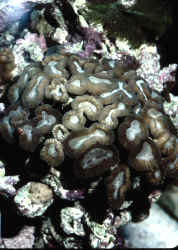
| Caulastrea echinulata (Milne Edwards and Haime 1849).
Though septa are exsert, they're all about the same size. Small polyps,
fleshy. Aquarium photo. |

|
Genus Colpophyllia Milne Edwards and Haime 1848. One species.
| Colpophyllia natans (Houttuyn 1772), Symmetrical
Brain Coral. Large roundish to hemispherical colonies or encrusting.
Long snake-like valleys. Septa short, equal and pointing out. A fine
ambulacral groove runs along the top between corallite walls. The world's
largest Brain Coral on the right off of Flying Reef, Tobago; below, a view
of it edge-wise and a colorful shot and close-up of smaller
specimens in the Bahamas. |

|
Genus Diploastrea Matthai 1914. One species.
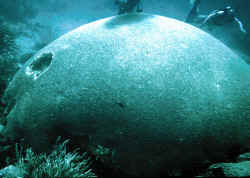
| Diploastrea heliopora (Lamarck 1816). Dome shaped
colonies with a smooth appearance. Corallites as small cones of thick
walls, and small opening for columellae. One in Bunaken, Indonesia, the
other off of Thailand in the Andaman Sea. |
 
|
Genus Diploria Milne Edwards and Haime 1848. Massive, meandroid
colonies. Columellae (centers of corallites) are interlinked with ridges. All
tropical West Atlantic.
| Diploria clivosa Here in Jamaica |
|
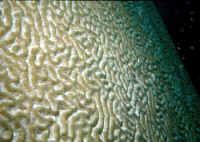
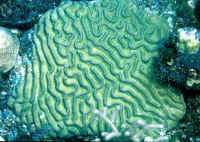
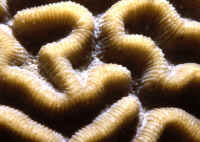
| Diploria labyrinthiformis (Linnaeus 1758). Typically
hemispherical in appearance. Often with some valleys being parallel,
spaced about 5-8 mm. apart. At right in Bonaire. Below, a boulder being shared with a
Montastrea in Belize and two Bahamas images. |
 |
| Diploria strigosa (Dana 1848). Massive or encrusting.
Valleys spaced 6-9 mm. apart. Surface is smooth. Tobago images. |
 
|
Genus Echinopora Lamarck 1816. Mostly wavy laminar sheets that appear
wavy on their ends.
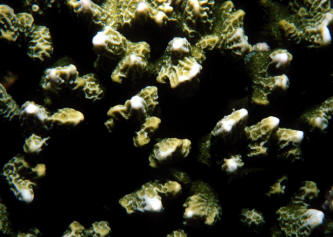
| Echinopora lamellosa (Esper 1795). Thin, wavy laminar
sheets.
Small corallites (3-4mm.). Indo-Central Pacific including the Red
Sea. Bunaken, Sulawesi, Indonesia image. |

|
To: Part 2, Part
3 | |
|