|
|
| Home | Marine Aquariums |
Freshwater Aquariums |
Planted Aquariums |
Brackish Systems |
Ponds,
lakes & fountains |
Turtles & Amphibians |
Aquatic Business |
Aquatic Science |
Ask the WWM Crew a Question |
| Please visit our Sponsors | ||||
Halimeda 01/25/09
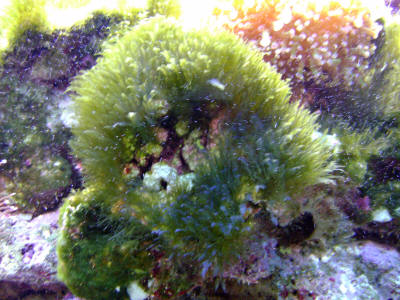
Hello, My name is Luke and I own a 220 reef. My problem is my Halimeda,
the stuff is starting to take over, <Typical... but good in a way
(for nutrient export). Just be sure it's not sucking down your
calcium levels.> everything I have read has said that it should not
do that, its a solid root plant. <Hmm... do you not read WWM? Or
even Wikipedia? Halimeda is not a plant. It is an algae. Please see
here: http://www.wetwebmedia.com/greenalg.htm
http://en.wikipedia.org/wiki/Halimeda> I think it might be the fact
that I have a very large number of corals so I cant get down to the
roots, and that might be what is causing the spread. My question is how
do I kill it, without killing or slowing growth of my other corals,
lots of SPS. <You might just have to do your best to keep manually
removing it. I don't see any other way to kill it without risking
your corals. But I wouldn't get too down about it... having it grow
so well, and continually removing it is great for nutrient export.>
Thank you so much, Luke Hines <De nada,
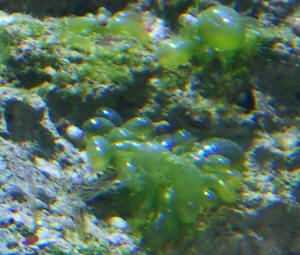
Bubble Algae Prevention 9/21/08 Thank you for your phenomenal efforts! I greatly appreciate all that you guys and gals do for the hobby! <Thank you for your kind words Joe.> My question today is about macro-algae of the Valonia sp. <A pretty pest.> I have been a marine hobbyist for 6 years and have had 1 FOWLR system as well as 2 reef systems, all with good success. <Congrats!> In each system, I have had/am having problems with bubble algae. This is a remarkable organism in the fact that it can flourish in a HUGE variety of water conditions. Even with near perfect water conditions and diligent extraction, it is still a problem in my systems. <Can be very problematic.> I have found that the often cited cures have limited results: protein skimming, carbon, and Mithrax Crabs have helped but IMO, do not offer a substantial solution. Manual extraction is the best method of control and this can be a real headache due to the organism's swift reproduction! <I would agree.> Finally, my question. I am in the planning stages of a 75 gallon reef tank and would like to do everything that I can to prevent bubble algae from entering the system. I will be careful not to use specimens, live rock, or substrate from any tanks containing Valonia sp. and will use only freshly made synthetic water. I will be quarantining everything added to the tank for at least 6 weeks. <All wise.> Do you have any other suggestions on how to prevent this species from invading my system? I have noticed that even quarantined live rock can eventually appear with these green spawns of Satan! <Well, though I am generally a huge fan of live rock, you might be interested in something like Marco Rocks, which is dried and has significantly less likelihood of bringing pests into your system. They just might be "Good for you!" More here: http://www.marcorocks.com > Thanks for all that you do! God bless! <On behalf of Bob and the rest of the WWM crew, you're welcome.> Joe W. <Mich L.> TDS and algae 11/24/07 Hi there. <Hello.> I just measured the TDS of my source water (run through my relatively new Coralife 3 stage RO unit) at 17 TDS. Could this in itself be the cause of an ongoing problem with GHA and Bryopsis?? <Probably not, a TDS of 17 out of an RO is not too bad.> Being that I have tried to remedy the problem in every other possible way (with the exception of using antibiotics), <Wouldn't help if it is algae.> I was banking on this being the explanation. Before I had a TDS meter to know for sure, and was actually expecting the reading to be a lot higher. FYI, my tank is 65G sumpless, mixed reef, Nitrates 0, Phosphates 0, PH 8.4, 5 small fish, Aqua C Remora, Aqua Clear HOB running carbon (changed monthly), MJ1200x2. Any thoughts on this would be appreciated. <You may want to test your makeup water directly for nitrate and phosphate after you have mixed the salt. Any mechanical filtration in the HOB should be cleaned at least once a week; detritus in it will raise your nitrate and feed your algae. Feed sparingly and make sure your water flow is keeping things mixed up (no settling). Please read through the website on substrates, they can also pose issues regarding nitrate and algae. Just keep testing and searching, you will find the source. Welcome, good luck, Scott V.>
Cladophora control? -- 09/14/07 Hey there guys! <You've got one of the gals tonight!> A few months ago I got an opinion of a mystery algae that's starting to become problematic, Mich believed it to be either Bryopsis or Cladophora. After a lot of searching and a few experiments I finally nailed it down and confirmed, positive ID of Cladophora Sp. <Glad to hear I was on the right track!> Now what I want to know is... how can I either remove it or control it? It has been suggested that I should either just toss the rocks in question <No. Do not do this.> or get an emerald crab. <Is an option, though may require an army of them depending on how bad the situation is.> But since I have various colonies encrusting on these rocks, throwing them away is simply not an option. <Good glad to hear!> The Emerald crab is pretty much also not an option either, since I have a porcelain crab and several small Eviota gobies, it would simply be too great a risk of conflict since they are all rock dwellers, in fact I rid myself of my old emerald when I learned of the threat it represented to my fish <Good to hear, I hope you found him a nice home.> (and it didn't even touch the Cladophora back then). <Some do, some don't.> So the big question is... what can I do? <A couple of options. First off you should try to control your water chemistry as well as possible. You need to limit your nitrates and phosphate, which, may test out as zero, because they are often present but are consumed by this nuisance algae. You want to maintain an alkalinity above 8 dKH as well. I presume you run a protein skimmer, if not, way past time to get one. Hopefully you have a refugium with macroalgae as well. If not, also way past time to start one. Increasing the frequency and volume of your water changes will help as well, provided you are using RO/DI water that has 0 TDS. A bit of reading for you: http://www.wetwebmedia.com/nutrientcontrol.htm http://www.wetwebmedia.com/algaeconMar.htm http://www.wetwebmedia.com/avoidingalgaeproblesm.htm http://www.wetwebmedia.com/scottsh2ochgart.htm http://www.wetwebmedia.com/marine/maintenance/marineMaint.htm http://www.wetwebmedia.com/water.htm http://www.wetwebmedia.com/calcalkmar.htm Potential herbivores might include tangs, Rabbitfish, and Diadema or tuxedo urchins. Tangs and Rabbitfish generally need systems of 75 gallons, usually even larger. The urchin also should be in tanks of 50 gallons or more and can present their own set of problems, including the nonselective eating of algae including beneficial coralline. Not really sure what, if any, livestock might be suitable for your system. Aggressive maintenance is likely the best solution.> Best regards, Mark Forsling <Cheers, Michelle Lemech.> Olive green coralline algae -- 6/17/07 Hi, <Hello Debbie> I have a 55 gal. standard sized tank. It is old (aprox. 15 years). The filter system is built into the back of the tank. First an overflow chamber feeding into a mini sump then through a baffle into the last chamber where the pump is. I have 40lbs. Live rock and I run carbon. Also I run a CPR BakPak skimmer that I modified by adding an airstone (that really made a difference). My lighting is 2 36² PC retrofit fixtures with reflectors each one being 96watts 50/50 (10,000/03 actinic). <Make sure you exchange the carbon every 30 days to maximize efficiency. Also add a 150g bag of iron oxide phosphate resin to aid in the removal of Dissolved organic Compunds (DOC) and any residual phosphates that may not be detected by hobby test kits> I have purple, lavender, pink, lime, aquamarine and UGGH dark olive green coralline algae growing in my system which has been set up for 12 years but totally recycled a year ago due to massive water quality changes. The dark green coralline algae started taking off about the same time as the purple (4 months ago). No one seems to be able to tell me much about this color coralline. Someone did say it has something to do with the light spectrum but couldn¹t say much more. Can you help me encourage the color I want to do better? I am worried about scraping the olive drab off anything. Please help! <Having coralline diversity is a good thing! However you have some options, You can remove the rocks with the green algae and clean it with wire tooth brush and vinegar, This will kill the coralline and after you rinse the rock and return it to the system the purple should grow in its place. Another option is the use of urchins that will graze the corallines and again the purple corallines should grow back. The main things that promote coralline growth is a lack of detectable phosphate, high light, and a proper Calcium/Alkalinity level. The levels should be 400-480ppm CA and 3.0meq/l to 4.0meq/l Alk> Thanks in advance, Debbie <Rich aka Mr. Firemouth>
Green hair algae 11/16/06 Hello, I have a 75 gallon tank with live rock, three blue hippo tangs, <Will need more room...> an ocellaris clown, a three stripe damsel, an orange spotted blenny, a maculosus angel, <... needs much more room> a cleaner shrimp and some snails and crabs. I have been dealing with hair algae for a few months now. I recently sold two of the blue tangs and the angelfish. <Oh... good> I realize my aquarium was overstocked. I perform a 15% water change every week with RO water. My test readings have been progressively decreasing - Nitrates - 30ppm, phosphates - 1ppm. <Mmm, still too high for these> I have an Eheim wet/dry filter, <Like the company, but not this product... See WWM re> aqua c remora pro, two actinic bulbs, two daylight bulbs - 3 watts per gallon. I've been told to purchase a sea hare to eat the algae. <Mmm, might help, though not a for-sure thing... will pick/choose the species it wants to eat, reject most all> My question is should a 10-12 hour light cycle be reduced to avoid algae growth. <Not generally a good avenue to take... that is, not usually effective... Need to address root cause/s... like excess nutrient availability (which you have), a lack of use by organisms you want, export mechanisms... all covered on WWM> It is currently on for 5-6 hours per day. I'm afraid increasing the photo period will increase the algae growth. My goal is to have an adequate water quality to start adding some soft corals without nuisance algae. I greatly appreciate your advice. Thank you, Michael <Please read here: http://wetwebmedia.com/avoidingalgaeproblesm.htm and the linked files there... till you understand your situation a bit better, your options... I strongly encourage you to consider changing your filtration, perhaps adding a sump/refugium... a DSB, lighting there... Bob Fenner> Hair Algae Problems 10/3/06 Hi <Hi> I have searched the
net and forums and I cannot find an answer for my problem, all the
suggestions are not helping. Please help. <Will try.> My problem
is hair green algae and brown diatoms, my tank is now coming up to 1 yr
old, I thought I had gone through the algae bloom stage but for the
last few months it has flared up again, the green algae is out of
control if I don't go in every other day it looks unsightly its
really disheartening, even the shop have no answers for me all they say
is its strange (no help there), I have put some sea urchins in but they
are like bull dowsers (doing a good job but I don't want to keep
them as they are to big) the hair green algae grows on my pumps,
protein skimmer Juwel filter the glass every where, and now to top it
off brown diatoms have started appearing what I don't understand is
that if all my levels are correct what must I do? Can you help please
as I am desperate now and I feel as though I am failing, any help will
be appreciated. my set up: 60gallon tank, 14 pieces of live rock,
arcadia lights 8 hours a day 3 maxi 1200 power heads so there is enough
water flow my nitrates are never over 10, my phosphate is zero my
alkalinity level is dKH 10 my ph 8.3 when lights go off, salinity 1.024
calcium 400 silicates zero I use r/o water <From store or own
filter?> Rowa carbon Rowa phosphate external filter bio star protein
skimmer takes roughly 1 cup a week out temp is 77 3 Mithrax crabs 10
red legged hermit crabs 12 turbo snails 2 cleaner shrimps 1 regal tang
1yellow tang 2 chalk goby 1 bicolour goby 2 clown fish 1 sand sifter 2
sea urchins 1 torch coral 5 gallon water change a week Thanks <May
be a couple of areas to address. How old are the RO/DI
filters, they may need replacing. Also, test your water
change water for phosphate and nitrate, these may be used up by the
algae in the tank leading to a false negative reading on the test
kit. Also you just have too much life in that tank, leading
to excessive biological waste which leads to excess
algae. Two tangs are just way too much for a 60G
tank. Also in future queries please spell check before
submitting, the amount of time needed to correct this before posting is
excessive.> <Chris>
Green hair algae control 9/9/06 Hello There, <And you> I've spend quite a bit of time searching and reading your site. There is quite a bit of information, but I thought I would toss my specific situation into the pot. My marine tank was set up by a local service and is services bi-weekly. The tank is as follows: Around 225 gallons - 40" tall, <Yikes... long arms only need apply!> 54" wide, 24" thick. Lighting - a pair of 400W metal halides, 8 hours/day. Fluorescent black light 10 hours per day. Sump w/ filter, protein skimmer, UV filter, chiller (temp 78 deg. F). I don't know the details. <Water chemistry? Tests for?> The tank is also cooled by a fan and vent system. Morning outside daylight hits the tank for about 4 hours before the lights come on. Less in winter. The tank is 13 months old. It was stocked with a few hundred pounds (or more) of live rock. There are numerous soft corals. Lots of mushrooms coral, leather coral, polyps, xenia, etc. Two turbo snails & ~50 Nerite snails. Two diadema urchins (blue dotted), and one "globe shaped" urchin. One blue Linckia star. One very small brittle star (a free rider on the rock or something.) One yellow tang (4"), one chevron tang (3"), one hippo tang (2"). A pair of percula clowns One six line wrasse One royal Gramma One long nose Hawkfish (most interesting personality in any fish I've ever had.) A pair of Chinese gobies One watchman goby One pair of cleaner shrimp. One lawnmower blenny In the last month, we have added one (small - 3"diameter) diadema, the "globe urchin", the Nerite snails, and the lawnmower blenny. All this is included in the totals above. Since the late Spring, I have had a huge bloom of green hair-like algae and green bubble algae. Did I say huge? <Heeeee! Twice> It is overgrowing a substantial amount of the smaller corals and killing them off. It's covered have the rockwork. Prior to that, we had very little green algae and a very robust purple coralline algae covering. The lawnmower blenny grazes a bit, but it is like emptying the ocean with a teaspoon. <An apt comparison> The snails spend their time on the acrylic and on the sand and show no interest in climbing the rocks (except the turbo snails). The larger (5") diadema has always ranged the tank, but avoids the serious algae growth, spending time on the acrylic and parts of the rock that are still green algae free. The new, small diadema hasn't come out of the crevice that it first backed into, although it has only been in there for about two weeks. In contrast, the "globe" shaped urchin spent a week doing nothing and then went nuclear. While it hasn't grazed over the half of the tank with the serious long algae, it has gone over some of the mid-sized stuff and completely denuded the rocks and hard coral skeletons. It is easy to tell where it has been because the path is almost white. Hopefully it will get to the long haired stuff and feast, but we will see. My tangs used to graze, but I go tin the habit of overfeeding with frozen brine shrimp mixtures while the tank was being stocked because I lost more than a couple of fish to starvation after introduction. The tangs got lazy. For the last three months, I've cut the feeding by 2/3 to two cubes every three days. They've started grazing again, but stay away from the long stuff. I'm losing a fair amount of the small coral, so I'm afraid that I have to undertake a drastic overhaul if the new urchin refuses to attack the serious algae growth. My service people assure me that the chemical balances are all fine. <Mmm, could be... though the "balance" of this whole system, web of life is not... in balance...> They change a fair amount of water every two weeks, clean out the skimmer, and adjust the chemicals. What I'm wondering is what brought all this on? <Mmm, in part "aging" of your hard substrates (gravel and rock)... their loss of solubility... a concurrent diminishing diversity of biota... You would do well to either add/and or trade out some LR... along with adding a refugium/DSB...> We had 6-8 months with minimal algae growth, but a growing livestock population. We are done adding livestock and may have to remove some of the recent adds (blenny, urchin) if the algae goes away. <Should help... but...> I've heard it suggested that the longer daylight hours could have done it with some sunlight hitting the tank. <Yes, can be a factor> I understand the argument, but the location of algae growth does not correspond to the half of the tank with the algae growth. The algae growth also corresponds with our addition on the chiller in the early Summer. The tank temperature was approaching the mid-eighties before the ambient temperatures started getting hot in So. California this summer. The tank is now around 78 deg. Would 82 degrees help curb algae growth. <Mmm, no... more likely the opposite> I would note that my toadstool corals have looked much less healthy since the day the chiller went in. <... Mmmmm> Would feeding/livestock levels have that much of an effect? <Oh yes... direct positive correlation... soak/drain frozen/defrosted foods for instance...> Will cutting the feeding by 2/3 have an effect or is the horse out of the barn? <Not quite yet> Any other suggestions? <Yep... Please read here: http://www.wetwebmedia.com/greenalgcontfaqs.htm and the linked files above and those you encounter in responses of note> Thanks very much in advance. Jason <Welcome. BobF in Jamaica> LR ID question, green alg. control success 9/2/06 Hi Crew, I do not have a picture but lets try anyway. I got a Zoanthid on a small rock (2inches) about 6 months ago. It blue and yellow. The rock now also has a few reddish brown tube worms with the tube and fan very thin and the same color. Then I have some polyps that I can not figure out. I first thought they we closed Zoanthid polyps but they look different and they never open. They are teardrop shaped with a round top and they are brownish with the middle of the top a bit white. Any guess as to what it is? <Mmm, nope. Could be a bunch of things from this description. I'd peruse the LR ID FAQs pages...> By the way I would like to report some success in battling hair algae plus some grass like algae. It was covering all my rock and even on the glass and sand. It is not all gone but I would say about 60% less than before. My phosphates used to be the darkest color on the test chart and now it is the second lowest. I first used a product that was supposed to be a bacteria that reduces phosphates. Then I added a phosphate remover to my filter and it really helped. I also got some keyhole limpets and when they clear the rock it is down to bare rock. I also got an assortment of algae eating snails that also helped. Now my rock is about half cleaned and what is left is thinning out. when I clean of a piece it stays clean longer. Lately the limpets seem to be on a diet, they do not eat as much as they used to. I have two candy cane also covered by algae but the snails or limpets never seem to go there. <Congrats! Bob Fenner> Cyano, Hair, and Temperature 8/31/06 Good morning... <Getting to be...> Just wanted to get your opinion on my battle against Cyano. I tell ya, except for learning the hard way once... not to add 4 fish into a new tank at the same time years ago, my tank has been running pretty smoothly. My only problem is the fight against Cyano bacteria. <A common pest> I have a 90 gallon salt tank with a deep sandbed 3 - 5". I have a 33 gallon sump that operates about half full. I am getting really good skimming out of my AquaC Remora Pro (I have to empty and clean 3 times a week, sometimes more). My water volume turnover per hour is approximately 17 times. pH 8.2 Ammonia: n/a Nitrite: n/a Nitrates: on my test kit, I'm either showing no signs or very minimal. Tough to tell between two shades of yellow on a piece of paper. Salinity 1.025 (am I missing a zero in there?) <Nope this spg is about right> I have just recently added a new lighting system, two 250watt metal halides, two 96watt compact fluorescents. I have only been using one of the halide lamps in order to get a handle on my aquarium room temperature as well as my tank temperatures... in addition to let my critters get use to the new lights. I don't have any corals yet. I am lightly feeding flake food maybe 3 times a week, and then using either krill, bloodworm, or Mysis shrimp, twice a week. Fish are only fed 5 of 7 days. Since I've been battling the Cyano bacteria for about a year... I had upgraded my protein skimmer (mentioned above) and my water flow. As well, I am watching that I am feeding only as much as the fish are consuming. With my light feeds, I don't notice much going to waste. At times, I don't think my yellow watchman goby is getting any... but he's quite large and is staying fairly plump and healthy looking. One of my friends with a fresh water tank is shocked that I feed them so little. <Likely getting quite a bit of nutrition/small animal life from the substrate infauna production> In short, I don't think overfeeding is my Cyano issue. <Doesn't read like it... just a dearth of competitors thus far> I have a refugium being setup in my sump. <Oh! Good> It's about a one foot square section with 1" deep Miracle Mud and I am waiting for a cluster of Chaeto' something-or-other. <Chaetomorpha...> You guys recommended it to me and I'm sure you know what I am referring to. I figure this will help a little in biological filtration and competing for nutrients. <Oh yes> My water changes... I am doing partial water changes about two to three times a month (5 gallons each time). After reading Bob's wonderful book... I'm thinking, that this HAS TO BE my solution? <Is of help> With approximately 115 gallons in circulation... I should be changing out approximately 30 gallons a month, correct? <Mmmm, or more... more frequently... see WWM re... 10-20% every two weeks or so...> As well, I have been taking straight tap water at about 22 - 25oc, mixing my salt until it appears to be fully dissolved... adding a minute amount of additive that removes chlorine/chloramine/ammonia, and then adding direct to my tank within about 5 minutes. <Mmm... Please read here: http://www.wetwebmedia.com/water4maruse.htm> As well, I have been topping off evaporation straight outta my tap without waiting. <I'd invest in an R.O. device...> In your opinion, would you say that this would be a likely cause of a continuing Cyano problem? <Mainly a lack of competitors...> With all the other upgrades I've made: water flow, skimming, lighting, working refugium soon!!... If increase my water changes to 10gallons 3 times a month from water that has been premixed an aged for a minimum 24hrs... if not 3-7 days and if I keep aged fresh water available for top up, should this remedy my Cyano issue? <I give you very good odds> If so, will the Cyano just die off over a month or so? Or, do I need to syphon what I see off first? <Will go a bit at a time... over a month or more likely... can siphon during water changes> On a side note, I have some pretty long green hair algae growing all over. Ya, it looks kinda nasty, but this actually beneficial to my tank, correct? <Mmm... marginally> I will be getting a tang soon... Can I safely presume that I shouldn't have to worry about adding 'greenery' to my tank for food as long as I have the hair algae with my tang? <Mmmm... not really. Many such "greens" are unpalatable... and/or of little food value> I was reading in a book that with all the chemicals in municipal water systems... that basic tap water is a sure cause of both massive Cyano and hair algae outbreaks and that a reverse osmosis mechanism is absolutely necessary. <Not always necessary... but often desirable... I/we use such for our drinking and cooking uses... but I skip for my African Cichlids... they get "hose water"... and a bucket of hot straight tap during the winter...> Yet, Bob mentions simply aging the tap water. Will aging tapwater really minimize nutrients and 'food' in the water?? <Yes... a good deal of the municipal additions and "picked up" soluble material precipitates, insolubilizes with time> Lastly, my aquarium room sits at approximately 23 - 25oc. My tank seems to have a low of 26oc after the single metal halide has been off for a few hours, but rises over several hours to about 28 or 29oc with the single lamp on. <Mmm... this is too much of a thermal swing...> I'm fearful that if I use two lamps... my temperature will rise twice as fast and will peak at maybe 31oc? <Not good> The fans are working on my CoraLife lighting unit. Is this daily temperature change going to be an issue for keeping corals? <Likely yes...> Should I wall mount a fan to cool the air in-between my lights and my tank? <Can try... but you may be a customer for a chiller> We get cold winters, so I'm thinking 8 months out of the year this won't be an issue, but during the summer it's tough to keep the tank cool. <Maybe> You guys are always a tremendous help... don't know what I'd do without ya! <Glad to share. Bob Fenner> Hair Algae competitor 8/18/06 Hello Crew, greetings again from Norfolk, VA. <And right back atcha from Southern Cal.> Tank Stats: Start date 28FEB06 50 gal FOWLR 20 lbs LR from LFS 20 lbs other porous rock <Mmm... of what make-up?> (which is where the problem hair algae has taken hold) tetra-tec 500 gph power filter/w 200 watt heater Aqua-C Remora skimmer Softball sized clump of Chaeto in corner for de-nitrification/nutrient control Twin bulb 24 inch fluorescent light. One Hagen 20W Sun-Glo and one 20W Marine-Glo bulb <Not much light...> Inhabitants - one 2 inch Huma Huma trigger (Quint) One 4 inch Coral beauty Angel (Brody) One 2 1/2 inch yellow tang (Hooper) <... need more...> (I know I will need a bigger tank eventually for these fish, but Spouses' mantra: when we get a bigger house you can have a bigger tank!) <Then need to get/house smaller species now> Some green mushroom anemones. One feather-duster worm Test results: Ammonia and nitrites - zero. pH 8.2 nitrates - 20 ppm s.g 1.022 Temp: 76-78 F I've written to you asking advice on how to minimize growth of hair algae on my rocks. <Takes time> Upon your recommendations and in keeping with the tips in your section on Nutrient Control, I upgraded my skimmer to an Aqua-C remora (from a SeaClone 100) and my filter to a tetra-tec 500 with 500 gph flow (from 2 whisper 40's). Total flow is now 585 gph for a 50 gal tank, up from about 400 gph. I also added a clump of Chaeto in the corner (no sump) and that is helping with denitrification, slowly, with nitrates down from about 40 ppm to 20 ppm after three weeks. I also do weekly 5 gallon water changes, along with scraping the glass clean, and scrubbing the regenerated clumps of algae off the rocks with a toothbrush. Overall the hair algae seems more manageable now, which is good. It has come back, but more slowly this time, and mostly on the tops of the rocks nearest the lights. Even after implementing the good advice I have found here, I have accepted the fact it will grow to some extent in a healthy system, <Yes> and I just need to keep removing it when it grows too much. Here is my question: The high spots on the rocks are fairly flat, and closest to the lights and well lit (about 8 inches down from the top of the tank), making it prime real estate for anything to thrive, not just hair algae. What can I put there to make better use of that spot? <Most any photosynthetic life... that will live with the animals listed> Is there a particular mushroom, soft coral, worm, or sponge, that you recommend that would give me some color and as a fringe benefit compete with and crowd out the hair algae which seems to have a good foothold in these locations? I thought about pulsing xenia, but read it can take over a tank and I don't want that. Right now there is nothing there, and it is easy to scrub the algae off weekly. Should I just be happy with that? <Mmm, no...> Another question - the Tang and Coral Beauty seem to pick at the base of the feather duster worm, where the tough yellow skin of the tube seems to be missing and there is a purple/bluish skin visible. Is that normal and is it hurting the worm? <Possibly, yes> Could this be because I feed them less now to keep nutrients down? <Likely a factor, yes> Also, is there any harm to the feathers of the worm brushing up against the mushrooms? <Might be... to all> I move the worm away, but it seems to keep coming into contact with the shrooms after a few days. Thanks in advance and keep up the great work. Rob <... I would like to cut to the proverbial end here and suggest you add a live sump/refugium... with a DSB located there... I would investigate the chemical make-up of the "other" rock... Bob Fenner> Green Hair Algae Control 8/3/06 I have a bit of a green hair algae problem. I have a 50 gallon tank with 4 fish. How do you keep nitrates down. I was doing a 25% water change twice a week and that kept them lower but not away. I have a small frogspawn and some colony polyps. I'm trying to cut back on some of the lighting. I have 130 watts and now I went to 65 watts to see how that will work. <Need the light for the corals.> Me and my fish are tired of scrubbing the rocks. <You need to write an article as to how you get your fish to help you out.> Do you think if I add a 20 gallon fuge to my tank, that will do something me ??? <Fuges certainly help, but you do not mention use of a protein skimmer. This is one item that will help in nutrient control. Read here and related links above. http://www.wetwebmedia.com/nutrientcontrol.htm> Thanks WD Bill <You're welcome. James (Salty Dog)> Re: green hair algae problem 8/4/06 Yes, I have a CPR Bak-Pak 2R protein skimmer, is it too small? <Should be fine.> And, what do you think about denitrator coil. I seen <saw> a article on about.com, on DIY coil denitrator. <Would be a waste of time and money...something else to fiddle with. Following advice given on the link I will post, including related links above, should be all that is necessary in reducing nitrates. http://www.wetwebmedia.com/nutrientcontrol.htm> I'm reading about mangroves some say they work, and others say they don't, are the worth while to get? <Read here, and you decide. http://www.wetwebmedia.com/mangrovetrees.htm> Thanks, <You're welcome. Wild Bill, in future queries, please do a spelling/grammar/cap check. Our time is limited, and the less corrections we have to make, the more queries we can get out to other aquarists in need of help/advice. James (Salty Dog)> WD Bill Start Up Problems...Mixed bag 8/3/06 I am about 5-6 months into my first marine aquarium. Being very conscientious of what to do and how to do it I took 2-3 months to educate myself on marine aquariums before starting. <A good start.> I decided to purchase a 55 gallon tank with 75lbs of live rock and Aragonite Substrate (with interest in a few corals and anemones to come later). <Do not mix corals with anemones, especially in a smaller tank.> I'm currently using a Fluval 305 canister filter with crushed live rock (idea from another aquarist), Chemi-pure and poly filter as media. Other components include a heater, 1xMaxi-Jet 900 Powerhead and a SeaClone 100 "hang-on" Protein Skimmer (which I'm considering updating to a Turboflotor Multi 1000, <Consider the Aqua C Remora also.> mainly due to advice that my current skimmer is not up to par). My current light fixture is a Nova Extreme T-5 which consists of SlimPaq 460nm Actinic and 10000°K T-5 HO lamps (216w all together). Being 5-6 months in I am now starting to run into complications. I am having a serious issue with green hair algae, possibly due to overfeeding which I have considerably cut down on the last 2 weeks. <Will definitely lead to nuisance algae growth.> I recently (2 weeks ago) had an incident with going on vacation and having a family member feed my fish which resulted in the unnoticed unplugging of my protein skimmer which stayed off for 3-4 days until my return and I have been losing / having trouble with fish since. <Not uncommon with those pesky family members.> Those that remain (3 green Chromis, 2 False Percula Clowns, 1 Banggai Cardinal (lost 1), 1 Neon Goby (lost 1), and a lawnmower blenny) seem to be doing fine with exception to the clowns. After a week and a half back, one has turned extremely aggressive/dominant towards the other (never has before) <Can/does happen.> and both seem to be having seizures (the aggressive one more than the other). <Unlikely a seizure, aggressive behavior can include shuddering, if that is what you are seeing.> It seems that my tank has taken a complete down-hill turn since returning from my vacation and I'm wondering on how to better my situation. What do you suggest I add or change about my current setup that would benefit my tank? I've been told that maybe the addition of a sump would help my situation all around but my current cabinet would not be adequate for that. I'm contemplating different options and if my fish continue to die I may consider starting over all together. With me being new to the aquarium hobbyist world I guess one would have to say "you live and you learn". <More learning here. First, do not buy anymore fish until you get the situation under control. I would seriously think about upgrading the skimmer. I've posted three links you can read to help you out. Do read related links on these pages also. http://www.wetwebmedia.com/marine/maintenance/marineMaint.htm http://www.wetwebmedia.com/nutrientcontrol.htm http://www.wetwebmedia.com/ca/cav1i1/protein_skimmer_impressions.htm> Thanks for the all the help! <You're welcome. James (Salty Dog)> Brent Green Algae Bob, I want to thank you for your last suggestion regarding the red slime algae. I have another problem, green hair algae. It is a 75gl tank, approx. 120 lb. of live rock. CPR Bak Pak skimmer, Magnum canister w/ bio wheel, 2 actinic and 2 50/50 lights (brand new), 4 power heads, approx. 1/2 live sand. Alkalinity 4.0, calcium 340, nitrate 0, phosphate 0, PH 8.0, water changes every 2 weeks (15 gal.). Approx. 30 red leg crabs, 3 emerald crabs, 3 sally light feet, 1 lawnmower goby, 3 tiger strip blennies, 1 yellow tank, 1 half black (brand new). This green stuff it ALL over the live rock, I try to clean as much as possible every water change, day later it looks like I didn't touch it. I have been running Phosguard on the magnum every 2-3 days. Any other suggestions? <Plenty! And all detailed on pages stored on the website: www.WetWebMedia.com under... Green Algae, Algae Control... Bob Fenner> thank you, Ken Cabezas Help from the Master! <Hair Algae in an established, otherwise
fine reef system> Hi Bob, Please let me begin by thanking you
for all you do to support the hobby. Your guidance and assistance in
both the hardcopy and electronic mediums have been exceedingly helpful
to me. Gurus such as yourself are gold mines for neophytes such as
myself. <A pleasure to serve, help ones new friends> Here's
the info on my setup: 100 gallon (glass) aquarium 10 gallon sump Aqua C
EV-90 skimmer (just added a month ago) 2 Rio 3100 providing water
return from the sump, circulation 2 small powerheads for additional
circulation 4 55 watt 10k power compacts - run 8 hours/day 2 55 watt
actinic power compacts - run 10 hours/day Approximately 100 pounds of
live rock Approximately 75 pounds of crushed coral substrate Water
parameters: SG: 1.023 PH: 8.15 Ammonia and nitrite: 0 NO3: <2 KH:
8.6 Alkalinity: 3.14 PO4: .5 Calcium: 410 Iodine: .06 Magnesium: 1425
Supplements: 10 ml Strontium (weekly) Iodine (as needed) Kent's
Calcium A/B (as needed) Water changes: 5 to 10 gallons a week with R/O
water Occupants: 2 yellow tailed damsels 2 Percula clowns 1 6-line
wrasse 1 PJ cardinal 1 Banggai cardinal 1 Cleaner shrimp 1 Cabbage
leather 1 Brain LPS (uncertain of species) 6 Mushrooms A few polyps A
few snails A few hermit crabs (primarily left-handed and scarlet) The
tank has been established for about 2.5 years. Most inhabitants have
been with me for most of that time. The PROBLEM: Hair algae. I hate
this stuff. It has covered everything. I do have a thick bunch of
volunteer Halimeda growing, but the hair algae is growing all over that
as well. I realize that hair algae is not an uncommon occurrence as
tanks age, but am confused as to the best correction method. I'd
love to culture more macro algae in the sump, but there is no room in
the existing sump and no way to upsize at this point in time to make it
possible. Do you have any suggestions within the confines of my
existing system to combat this irritation? How about biological control
agents (snails, hermits, fish) - any specific thoughts? Any direction
that you can provide would be greater appreciated. Thanks very much,
Mike <Would do a few things here... Replace or supplement your
Halimeda with a/some species of Caulerpa... in the sump, leave it lit
continuously (if you'd like you could buy one of a few companies
"mud's" to go with it... not necessary though), AND add
two small Salarias fasciatus blennies (aka Lawnmowers), AND a species
(your choice) of Ctenochaetus Tangs (got a pic of the Blue-eye
yesterday!)... will be adding to survey posted on
www.WetWebMedia.com... Probably add more, about a box of new Live
Rock... to re-set the population dynamics in your system... they've
gotten old... and this is about all... These steps will
"cure" your filamentous algae blues in a few months.
Bob Fenner> Hair Algae Can you please give me some suggestions on how I might solve my algae problem. The tank is a 125 gal. and about three years old. I have two 250 watt metal halide lights and two 40 watt blue actinic. One large sump houses a All Seas skimmer and a bag of carbon. The PH is 8.2, salt is 1.19 and the temp is 76. No live sand, about 50 hermit crabs, 40 turbo snails, 4 sally light foot crabs and six yellow eye tangs. <Thanks for the "graphic" graphic! A few things I would do here... add a bunch more new live rock, and new "dead" substrate (to shake up current bio-dynamic of what life is in there, what competitors, predators... and add needed biomineral and alkaline reserve... Would also suggest testing your water for these last two and if it's in your budget, getting/using a calcium reactor... Do read through the Algae and Algae Control sections of the www.WetWebMedia.com site... this system is a candidate for a blitzkrieg of algae eating animals... A Salarias Blenny, a couple of Mithrax/Emerald Green Crabs, a Ctenochaetus and/or Zebrasoma Tang or two... Other suggestions on the WWM site. Bob Fenner> Green water Please, please can you help me, the water in my 180l marine tank has gone green and visibility is down to about 3 inches, I have had this problem for 10 days and matters are not improving. My levels are fine but should I test for phosphate? <Possibly... what do you consider has led to your system being so out of balance?> I do have two poly filters in my filters, added last weekend, but they do not seem to have improved matters. I have new carbon and a have a skimmer which appears to have removed the Myxazin with which I successfully treated my Tang's cloudy eye. Would the installation of a UV Sterilizer solve this and my next problem? <It would help> How do I break the cycle of reinfection with my itchy Tang? <Please read here: http://www.wetwebmedia.com/parasittksfaqs.htm and the links beyond> I dip him and then he is fine for a couple of days and then he itches again. I have live rock and a hermit crab which I need to be careful of. If I added a chemical to treat the green water what would you recommend and would I need to take any special precautions to make sure my fish and crab did not come to any harm. <No need, desire to add chemicals as algicides, clarifying agents... Please study our site: www.WetWebMedia.com re set-up and maintenance, particularly Algae and their control: http://www.wetwebmedia.com/avoidingalgaeproblesm.htm Bob Fenner> Please, please help, James Matthams Green Microalgae Hello, <Hi, Bill... Bob Fenner offered me a bag of cheesy puffs and a gift certificate to Howard Johnson's to stand in. Anthony Calfo... in your service> I woke up this morning and my 58g reef system has neon green algae on the side of the tank.. it is algae I think.. speckled, and BRIGHT, I mean nuclear green. I've never seen anything like it.. it's almost a glow-in-the-dark color. <welcome to the world of algal succession in a young tank... I suppose you've already met (and hopeful bid adieu to) Mr. Brown Algae?> The rock beneath my Platygyra coral (with like neon recesses between the maze like pink peaks around the coral) is all I can contribute it to. The green matches the coloring of the coral, a bright green. The entire piece (about a 12lb rock) of LR beneath the coral is starting to take on a neon green tinge. Any clues as to what this is? Thanks again for all your help! <a microalgae and pure coincidence with the coral... just luck timing to join the party. Should stabilize or wane within weeks with good nutrient export processes (protein skimming, chemical filtration and water changes> Bill <kind regards, Anthony> High nitrates and hair algae 7/25/06 First, briefly, your site is awesome. I devoured Mr. Fenner's CMA and followed it as closely as I could when I set up my tank this past Feb, which thus far has been a resounding success. My system: 50 gal salt water, four months old. 42 pounds of live rock, twin Whisper 40 hang on power filters, SeaClone 100 skimmer. 150W heater, Twin 24 inch bulb fluorescent light, (one 20W Hagen Sun Glow (4200K) and one 20W Marine Glow (Actinic) bulb), on a timer, and on for about 7 hours a day. Occupants: one 2 inch Huma Huma trigger, one coral beauty, and one yellow tang. There are about half a dozen surviving tiny blue legged hermits, the remnants of an early attempt at clean up crew of 15, thanks to the trigger slowly crunching them away (knew that would happen), These six hermits are pretty wily and only come out at night when the trigger is sleeping (Darwin at work). Five green mushroom anemones and a one feather duster fan round out the cast. I also recently added one small piece of pulsing xenia way up high close to the light on the pinnacle of one of the LR, and it appears to be doing fine (I guess that changes it from a FOWLR to a mini reef) Testing results: Ammonia and Nitrites at zero. pH steady at between 8.2, thanks to adding 2 tsp baking soda weekly with top off water. Specific gravity hovers at between 1.022 and 1.023. I have been doing bi-weekly water changes of 5 gallons at a time religiously since I started the tank. My dilemma: Nitrates are high at 40 ppm and holding there. I think overfeeding was the culprit, as I went on vacation for a week and my stepdaughter fed the fish one whole frozen cube of mysis at a shot, on a mon/wed/fri schedule the week I was away. When I got back, all was well but I now have high nitrates, (though to tell you the truth they have been creeping up for awhile) and a thick mat of hair algae on the top of the LR closest to the lights. I will cut back on the food and start weekly 5 gal water changes to bring down the nitrates, in addition to changing out one of the 2 filter cartridges weekly on an alternating schedule to get some fresh carbon in the system for chemical filtration. My question: should I leave the mat of hair algae as a check against nitrates, or should I remove it? Is hair algae micro or macro algae? I figure since I can grab it now that makes it macro, which lends me to think I might want to keep it as some sort of algal filtration. I keep the front and sides algae free with a scraper and magnet. Should I let start letting the back glass grow? Not sure. Also, lots of bubbles are forming in the mat, my guess is oxygen after reading some of the other FAQ. Is this a good thing or a bad thing? I don't mind the hair algae mat, but don't know if it is good or bad. One more thing, the whisper power filters had a sponge-like part in addition to the changeable filter media, designed to foster aerobic bacteria for bio-filtration (what the box says). I thought is was good at first, but after reading many nitrate FAQ's, I removed it as I thought it would be a nitrate factory and figured I had enough LR in the tank for bio-filtration. Was that the right move? Thanks for all you do, you folks are super! Rob Trepeta <<Rob: Since your tank is still new, you are still going through the process getting the right balance between algae and clean up crew. If it were me, I would remove the rocks and brush off the hair algae as there very few critters that will eat it and it can get out of hand. Going forward, you have to also strike the right balance between feeding and lighting. When nitrates are too high, you can increase the size and frequency of your water changes to help control it (say 20% every week). It can also help to remove the sponges (or clean them frequently). In my experience, once of the best ways to control nitrates is to have macro algae growing in a sump. Since I don't think you have a sump, you could get a clump of Chaetomorpha "Chaeto" and tuck it into a corner of your tank. Chaeto is easy to control and when it grows too big you can harvest some and share it with another reefer. If you have hair algae growing on the back glass, I would scrape it off. Eventually, coralline algae will probably establish itself on the back of the tank. Best of luck, Roy>> Algae Control 6/9/06 Hello, <Hello Debi> My question is about a major hair algae problem in my tank. This has been a large problem for several weeks now and getting worse <Yikes> Tank Parameters: Six months old 46 gallon Bowfront reef with one frogspawn, one xenia, one lawnmower blenny and one sand sifting goby (who sifts his sand onto the live rock) , one cleaner shrimp, various snails and red and blue legged snails and crabs. <Certainly not the fish load doing this.> 50 lbs. live rock Ammonia-0 Ph 8.2 Alk 3.0 Calcium 440 Phos (reads 0) probably being taken up by the algae don't you think? Nitrate-0 Nitrite-0 SG 1.023 Temp 79-80 RO/DI for water changes (tested for phosphorus)-0 Salt Water (Seachem) tested also for phosphorus No additives except some baking soda to raise the alkalinity from 2.0, done twice in the past three days. Calcium stays up and alkalinity has been too low. Calcium has been up as much as 480 until I started using the Seachem. I was using Instant Ocean until about two weeks ago. Aqua C Remora skimmer HOB going 24/7 <Is the skimmer cleaned weekly? Does help efficiency.> Daylights on 10 hours, Actinics on one hour before and one hour after the main lights. Lunars on all the time. The tank is by windows but they have two inch wooden blinds that never get opened, so no discernable natural light is coming into the tank. Four Powerheads, one Seio 620, one Maxi Jet 1200 on the skimmer, one Maxi Jet 400 close to the bottom, one Maxi Jet 600 across from the Seio Water changes were 2 gallons twice a week, last water change 6 gallons three days ago. I am thinking of changing <Better to do five gallons weekly. Do you vacuum the substrate when doing water changes? I'm thinking part of your problem may lie here.> Tons and tons of green hair algae Having read your site for days I feel that I am pretty informed on the solution to this problem, but still a couple of specific questions. 1) What can I do to manually remove the algae from rocks I can't remove from the tank. There are several that just can't be removed without tearing the tank down and upsetting the corals that are glued down. I have read to scrub with a toothbrush but can that be done in the tank. <Yes, I'd look for something a little stiffer than a toothbrush.> I assume that would spread it around. <Do run a mechanical filter when doing this.> 2) The lawnmower is mowing the lawn he is just eating the flat reddish, greenish algae off the glass in the back and eating invisible algae off of the top rocks. Is there another biological answer? <You might want to try a Tuxedo Urchin.> 3) Thinking of doing 10% (4 gallons) every other day for how long? Would that help much? <Four gallons per week will be fine. Have to get to the root cause.> At this time I am not feeding anything except 10 ml. DTs every four or five days for the corals. The fish I have are not being fed since they are feeding themselves so I don't feel like it is a nutrient overload. I am so frustrated and have put so much work into this tank and am so disappointed to have this problem with no apparent solution. <There are solutions, with determination, you will win.> Please help me figure out what to do. <Are your bulbs changed at least on a yearly basis. Old bulbs tend to shift colors and a lower Kelvin temperature won't help matters. If you have a mechanical filter, I would start using Chemi-Pure, a great supplement to your protein skimmer. Will removed dissolved nutrients that the skimmer won't. Do clean/change pads on filters weekly, another nutrient trap. Do read the articles on algae/nutrient control on the Wet Web for more help/suggestions.> Thanks, <You're welcome. James (Salty Dog) Debi Re: Hair Algae 6/12/06 Ok, by cleaning the skimmer, do you mean to take it totally off an clean the whole thing? Would I clean it with just hot water, and wouldn't I then have to do the micro-bubble break in period again, I hated that, still haven't totally gotten rid of the darn little bubbles yet. <Not the whole skimmer, Debi, just the riser tube where the brown skimmate is formed on. A small sponge/paper towel works fine. Allowing the brown film to remain on the tube drastically reduces the efficiency of the skimmer.> Also, no I haven't changed the lights yet, as I stated this tank is only about six months old. Hopefully I don't have to change them that frequently. I am using a Coralife Power Compact fixture with 2 x 96 watts, daylight and actinics with lunar and running the daylights ten hours and the actinics twelve. <A yearly change is sufficient.> So on the water changes, I gather that either five or six gallons weekly will be good. Should this be in one change? <Yes, make it easy on yourself.> Also, on the substrate, I have had mixed input on whether to vacuum the substrate. I thought I wasn't supposed to vacuum so I didn't, then I decided I should so I did do it the last time, then I was told not to vacuum a reef tank's substrate so I don't know what to do now. To vacuum or not to vacuum that is the question. <If you have a live sand bed teeming with critters (detritus eaters etc), it would not be necessary, but I feel you do not have this. It then becomes important to vacuum the substrate. I'm sure when you did vacuum it, the tube was full of brown yucky water. This, we want to minimize, a good food source for algae.> I want to make sure I understand also on the scrubbing of hair algae off the rocks in the tank without taking them out. I understand that I can do that if there is a mechanical filter running? I have a Aqua Clear filter that I am going to be using Phos-Ban and Carbon in, would this be sufficient and is the Chemi-Pure something that I put in the Aqua Clear? <The Chemi-Pure comes in its own bag and I do not believe it would fit into the Aqua-Clear, although you can try it. A small canister filter works best for this. Once you get done with the scrubbing and the water clears, the filter pad must be cleaned/replaced. Remember, the waste is out of view but not out of the water.> I was afraid of spreading the algae spores around by doing this, (although I'm not sure how much more they would be spread). If I scrub with something harder than I toothbrush won't I kill any Coralline algae that is there? <You can use the toothbrush, just get one with stiff bristles, I believe they come in soft, medium, and hard. You won't damage the coralline in this regard.> Just want to be sure that I have all the facts straight before I do something to make it worse. <You are on the right track, and you won't make it worse.> Thanks, <You're welcome. James (Salty Dog)> Debi Fighting Green Water
5/31/06 I have been having this problem for a while now
and I was hoping you could help out. < I will do the best I can, but
I am definitely no Bob! > <<Only a need and possibility to be
yourself>> I will start by listing my parameters. < Thank you,
very considerate! > 75 Gallon approx 20 gal sump with skimmer
overflow AquaC Urchin Skimmer with Maxijet 1200 producing about
1/2" dark skimmate in collection cup daily. < No complaints
there. > Pentair 3000 (780GPH) return pump with loop output (3
output ports) Overflow return to sump (Wet/Dry) with sponge < The
sponge will trap detritus, and allow it to break down into nutrients
for the green water to use. If you must use a sponge to retard the
retuning of micro-bubbles to the tank, try to rinse it well, at least
once a week. > 2 150w Visi-therm heaters 4 32W T8 overdriven
fluorescents (3 -Phillips Natural Sunshine Full spectrum 5000K, 1
Coralife actinic) < That may be too much red and yellow spectrum,
especially as the tubes age, and shift to more red! > I figure this
is the equivalent of about 272W Glass canopy < If the glass is not
low iron polarized glass, such as Oceanic used to use, and/or if it is
not kept immaculately clean, it can and will filter light, changing the
desired spectrum. > Running Seachem active carbon and micro filter
pad in drip tray < The carbon should be replaced frequently, to
prevent it from dumping what it has absorbed. Use smaller amounts, and
replace it at least weekly. > <1" aragonite substrate 50lbs
of reef rock 15lbs live rock 3" yellow tang 2x1.5" green
chromis 2.5" chalk basslet 1.5" ocellaris clownfish 3"
convict blenny yellow polyps coral Parameters ------------------
ammonia: 0, nitrite: 0, ph: 8.2, nitrate: 0, phosphate: 0, temp: 79,
spg: 1.023 The tank has been operational for about 3.5months. Tank was
fully cycled with liverock before adding any organisms. I have a
wet/dry and am working to remove the media. I have removed half of it
currently and am waiting a few weeks to remove half of what is left.
But aside from that lets get to my problem. < You are already on the
right track, by removing the bio-balls. > I have unclear water. It
is a green haze. It has been like this for a while now and I want to
get rid of it. Items in the back of the tank are foggy when looking
from the front. I figured I could starve out this green water through
skimming and cutting back on feedings but things do not seem to be
changing. (I feed generally frozen mysis/brine shrimp a bit at a time
until they do not seem interested) I do not think the problem is
overfeeding as I am not leaving any food floating around and phosphates
are 0. < Your method of attack is appropriate. Do you rinse your
frozen food well? The gel binders and juices contained therein are
laden with phosphates. You will not be able to test these phosphates
once the solution is added to the tank, for it is used up quickly by
the micro-algae in question. > I want to get to clear water. I am
open to any suggestions on what to do. I am thinking that maybe the
problem is with the 5000K full spectrum lights. < Bingo! That
spectrum is closely simulating the shallow marsh areas around
coastlines. You know how snotty and slimy they can be! The spectrum we
are more want to replicate is that of much deeper water, say about
30-40 feet deep. At this depth, most of the red spectrum is filtered
out, with heavy amounts of blue being visible. Most undesirable algae
do not fare well when red light is limited and blue light is offered.
> Maybe with the 12hour photoperiod this is causing excessive free
floating algae. < Yes, the extended photoperiod is encouraging the
algae, while also shortening the usable lifespan of the fluorescents.
Someone much smarter than me stated that corals can only use so much
light. They apparently do not collect light all day long, as one would
assume. Some of the photoperiod is actually blocked by the corals, who
may already be saturated with as much light energy as they can process
in that one day. Strange, I know, but true. I would try a eight hour
photoperiod, at least until everything is under control. Then maybe
step it back up, maybe not. > Should I change the 5000K bulbs to
6500K Phillips daylight deluxe? (They have a good lumens and high CRI
value) < I am not familiar with those lamps in relation to coral
growth, but to change the color temperature would be wise. Think about
using two 6500's with two actinics. That should lower the amount of
red light you are producing. Also, try to keep your tubes changed out
every six to eight months, whether or not they "need" it.
This should help you avoid getting caught up in a shift to red! >
Please help me Bob!!! If there is anything else you need to know from
me please let me know. < I know I am no Bob, but I hope I was of
some assistance. Maybe he will jump in and hit upon points I most
probably missed! (Hint, hint!) > Regards, Jeremy
|
|

|
Features: |
|
| Featured Sponsors: |