|
FAQs on Controlling Marine
Green/Hair, Chlorophyte Algae 7
Related FAQs: Green Algae Control 1, Green Algae Control 2, Green Algae Control 3, Green Algae Control 4, Green algae Control 5, Green Algae Control 6, & By Group: Bryopsis &
Derbesia, Bubble Algae
(Boergesenia, Dictyosphaeria,
Valonia...), Caulerpa
Compatibility/Control, Chaetomorpha, Halimeda, Neomeris, Hair (Filamentous, Attached) Algae,
Green Water (Planktonic) Algae
Blooms, & Algae
Control, Marine Algicide
Use, Nutrient
Limitation, Marine Algae
Eaters, Culturing
Macro-Algae; Caulerpas, Controlling: BGA/Cyano, Red/Encrusting Algae,
Brown/Diatom Algae
Related Articles: Embracing Biodiversity, Green
Algae By Mark E. Evans, Algae
Control, Caulerpa Algae,
Marine
Maintenance, Nutrient Control
and Export, Marine Scavengers,
Snails, Hermit
Crabs, Mithrax/Emerald
Green Crabs, Sea Urchins, Blennies, Algae
Filters, Ctenochaetus/Bristle Mouth
Tangs, Zebrasoma/Sailfin Tangs,
Skimmers, Skimmer Selection, Marine Algae, Coralline Algae, Green Algae, Brown
Algae, Blue-Green
"Algae"/(Cyanobacteria), Diatoms, Brown
Algae,
|
.JPG) Having other
photosynthetic life present goes a long way to control algae.
Montastrea cavernosa Having other
photosynthetic life present goes a long way to control algae.
Montastrea cavernosa
|
 |
New Print and
eBook on Amazon
Marine Aquarium Algae Control
by Robert (Bob) Fenner
|
|
Hey Bob,
I have noticed recently quite few
green balls growing on my live rock. They are about 1cm in size,
and I can see about thirty of them. I think they may be algae of
some kind, and they look like they are starting to spread around
my aquarium. How do I get rid of them?
Many Thanks
Mark Baker
There are a few approaches to limiting to eliminating such
problem algae. Likely what you are seeing is some sort of
colonial Chlorophyte (Green Algae), perhaps Valonia, Boergesenia,
Ventricaria or Dictyosphaeria species.
One front of attack as with all (pest) algae control is nutrient
limitation'¦ you can do your best to exclude, deny the
introduction of nutrient in the first place'¦ by using
'clean' freshwater to make up your synthetic seawater,
rinsing frozen/defrosted foods, eschewing the use of supplements
and more that contain soluble nutrients, having good skimming and
maintenance protocol period. Using competing macro-algae culture
in competition for nutrient, best in an independently illuminated
refugium, and large DSB for nutrient sinking are also
profitable.
The second war-front might be physical removal. This is best
accomplished by utilizing an appropriate diametre syphon along
with a 'scraping stick', ideally the latter affixed to
the former'¦ for scrubbing off the algal colonies while
syphoning them out. Alternatively, if the algal balls are
relegated to but a few rocks, taking these out and giving the
spots a good scrubbing outside of the tank (and rinsing before
returning) may eliminate them. Don't make the mistake of
thinking that you can ablate these balls and leave their bits in
your system. Akin to cutting off the arms of starfishes, they
will simply proliferate in your system from such activity.
The last wave in your fight against these perceived pest algae is
biological. There are organisms that do/will feed on them, but
not to exclusion. That is, they may well prefer other foods.
Mithraculus (formerly Mithrax), Emerald/Green crabs have been
advanced as good controls, but they can get big,
predaceous'¦ Tangs of the genera Ctenochaetus
(Bristletooths) and Zebrasoma (Sailfins) and some Siganids
(Rabbitfishes) have shown promise as predators, assuring you have
space, physiological as well as psychological for one.
All three stated 'fronts' are best applied
together'¦ as a sort of blitzkrieg against these algae.
Oh, and I do want to issue a caution against stooping to chemical
control/s. Algicides of all sorts are problematical in set-up,
functional reefs, presenting the potential for total disaster. Do
avoid their use.
Finally a comment re not dreading these algal visitors'¦
most 'pass' of their own accord, and though seemingly
unattractive, they don't appear to pose much of a threat
chemically or through physical crowding.
|
Weird algal growth 7/15/15
Hey Bob,
<Bob>
I have an 80 gallon sps tank that's been running for about 6 months. I
have this odd turf algae growing on my sand, looks similar to the terrarium moss
you can buy for land frogs and chameleons.
<Seen it... see Derbesia; other pest Greens on WWM>
My po4 is 0 (Hannah checker) nitrates zero (salifert and api kit).
<Being absorbed....>
I have never seen this growth before in all my years. Only thing I can think of
is the black Hawaiian sand I am using (attract in more lighting)
and am using halides for first time .
I am moving soon, so I can to throw out sand during move and replace with new
white sand. But can that be the blame here, even though nutrients are not
detectable?
<... the reading>
Lastly, any advice on moving tank to new house (17 miles away) and not. Losing
any coral?
<The SOP:
http://www.wetwebmedia.com/movingaq.htm
and the linked files above>
Fish I'm confident with, but have heard coral losses are sometimes inevitable.
Thanks
<Search before you write. B>
|
RE: Help Needed!!
Filamentous algae in a comm. setting 5/4/13
Hello Crew , hello NateG !!
<Kostas>
Here is a quiz on which I have spent too much time on.
As Mr. Bob already knows , I am a pet shop owner specialized on aquariums.
In my corals tank I have the following problem the last 6 months.
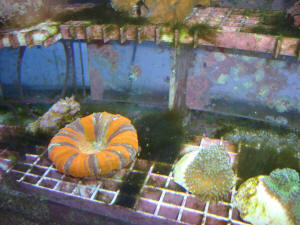
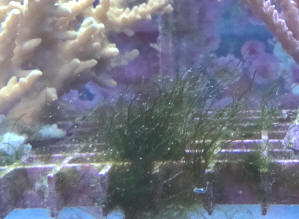
The tank "produces" 2 types of algae (as I believe) as per photos. First
time I noticed that was after I received for a customer a Caulerpa rock that
I hosted for about 14 days. In this tang as a cleaning crew I have a Lo
Vulpinus , a Ctenochaetus Tominiensis , Salarias Fasciatus , Six Line wrasse
and a Mandarin. Tomini usually was hitting the Caulerpa rock so at first I
was thinking that Tomini moved the Caulerpa at other places in the tank and
Caulerpa started growing , so after 2 months I removed the whole algae (or
as much as I could from the racks) manually. Removed all the corals and
cleaned theirs rock and then removed the sand bed , and cleaned all the
glasses and racks. After the cleaning procedure , changed the 40% of water ,
picked another sand bed (black one) but the quantity was less than what I
removed. After 2 approx months the same thing happened , cleaning once again
the whole tank manually. Right now , once again after 2 months we are at the
same point.
So here is the set up and parameters of the tank
700 Litres (350 x 40 x50 cm )
No sump.
<I'd add/ w a DSB, a RDP lighting arrangement>
An external filter (Rena XP3) 1250 ltr/h , with Sera's activated carbon ,
Sera's Phosvec Granulat and Sera's Silicate clear.
Aqua medic Skimmer shorty 3500 with 2 x Eheim 1260
3 x Tunze Turbelles , 4000 ltr/h each and Tunze wave box.
All the parameters are measured by Hanna's equipment.
Salinity 1026
Temp: 25 Celsius
PH: 8,1 - 8,3
KH : 8,5 - 9
Ca: 420-445 ppm
Mg: 1260-1300 ppm
NH4 undetectable
NO2 undetectable
NO3 <1,3
PO4 < 0,10
I dose manually every day Ca and KH , and magnesium as needed.
I use Seachem-AquaVitro Fuel twice a week ( I know that this could be fuel
for algae also)
<Yes>
I feed every 2 days Gamma NutraPlus complete feed (as per tank litres)
I feed every day Sera's GVG mix , and Gamma frozen Brine shrimp.
I use AquaVitro salinity salt.
If you need any other info please let me know
I would appreciate your thoughts.
Best regards
Kostas
<I'd likely add a phosphate limiting chemical (Lanthanum) or absorbent here
to knock the PO4 down an order of magnitude... The DSB arrangement will do
this long term. Bob Fenner>
|
 |
|
Re: Help Needed!! Comm. alg. control... new eBook
announcement 5/8/13
Thank you very much for your reply and your thoughts.
Unfortunately is not possible to install a sump at this tank. (no space
at all)
<Maybe large canister filters then?>
Any idea what kind of algae are those?? I tried to match them with some
other photos from WWM but with no success.
<Have to look through a microscope... could be some sort/species of
filamentous green (Chlorophyte) or even a BGA (Cyanophyte), or...?
Algae/Thallophytes and the Monerans that are Blue-Greens are classed at
the Division level on the bases of their gross micro-morphology, storage
foods, photosynthetic pigments... see the Net or works on
Phycology/Algology re.
Am writing an e-book re presently>
Best regards
Kostas
<And you, Bob Fenner>
|
Turtle Weed Algae 1/12/10
Good Afternoon crew,
I have a case of turtleweed algae.
<Chlorodesmis? C. fastigiata?>
It is definitely not Bryopsis. I cannot find a lot of information on
this but see that it is not terrible to have.
<Correct>
I don't like it though. It is on two or three of my rocks and does
not grow very fast but I do not really like the look of it. I was
thinking about getting a Kole Tang for my tank but do not think they
will graze on this.
<Might... sometimes do>
Below are my params....
55gal
50 lbs live rock
2 Talbot damsels
<A fave of mine>
3 turbo snails
1 Astrea snail
5 scarlet reef hermits
Ammonia = 0
Nitrites = 0
Nitrates = 5ppm
Sg = 1.24
AquaC Remora Skimmer
3 Koralia powerheads; 2 2's and 1 4
110W pc 10000K lighting
56W 20000K t5 lighting
I really want to get rid of this and before you tell me to remove it
manually, I used the PVC pipe method of placing my live rock so I
cannot take it out of the tank.
<Ahh>
Any help would be much appreciated. Like I said, I have read everywhere
on your site and just cannot find a good predator for this stuff.
Thanks again!!
Matt
<Best to wage a "war of attrition" (not like the U.S.
currently around the world); with nutrient deprivation and competition
being your best avenues of attack. Please read here:
http://wetwebmedia.com/marine/maintenance/maintindex.htm
scroll down to the pretty light green "Algae" tray... Algae
Control, Nutrient Limitation... articles and more. Bob Fenner>
Green Hair Algae Problem (Ready to quit!) --
08/31/09
I would like to thank you in advance.
<<We're happy to help>>
Since all systems seemed different I was unable to get any answers to
my problem. You mentioned not enough circulation as possible one aid,
protein skimmers, excess lighting and so on.
<<All mentioned on the site, yes>>
I have a 90 gal. display reef which is run off a 100 gal unlit sump and
a 30 gal frag tank that also runs off the sump.
<<Okay>>
This baffles even my supplier as "everything is right"
(apparently not) according to him.
<<Mmm'¦ Everything but the source of nutrients fueling
the nuisance algae>>
I do not use a bio filter of any kind relying on the live rock. I do
have Eheim wet/dry canisters at the ready if you recommend them, which
so far I have been advised against the use of (my supplier said their
use would come back to haunt me down the road) but to rather rely on my
live rock, all Fiji Island real stuff.
<<This is a bit over-simplified but, I do agree that on reef
systems a wet/dry filter can be so efficient at converting nitrogenous
compounds to Nitrate faster than the 'live rock' can deal with
it that they become problematic>>
The display tank is lit by 2-250 watt 14,000K bulbs. For circulation I
have about 700 gph being circulated up from my basement sump. I have a
Fluval FX5 kicking the circulation at 925 gph (running empty). I also
have two Hagen 802 powerheads adding an additional (est.) 440 gph each.
This tank really churns.
<<Indeed>>
Nitrates are kept at near zero, phosphates even lower, I use strictly
RO water have a sump mounted Kent 220 needle wheel protein skimmer
<<I think you mean a Coralife 220'¦and I have no doubt
(either way) that you could improve things with a better
skimmer>>
but only run carbon about once a month.
<<Time to step this up>>
I use strictly Salifert test kits so I know the following readings are
quite accurate.
<<Good test kits, yes'¦but I'm skeptical your
Nitrate/Phosphate readings are of much use re the abundance of nuisance
algae 'skewing' the results>>
Hard/Alk is kept at 1,250 ppm
<<I do hope you mean this to be the Magnesium level. Most test
kits measure Alkalinity as mEq/L or dKH'¦and while some will
give Alkalinity results in ppm (LaMotte), 1250 ppm would be some 4-5
times too high for an Alkalinity reading>>
calcium 450 ppm (as best I can as this system eats calcium at an
incredible pace so I am about to add a calcium reactor). I've been
a reef hobbyist for over 20 years and I have never had such an out of
control green hair algae problem like this one.
<<Does happen to the best of us. I've been in the hobby more
than 3 decades, and still do battle with nuisance alga from time to
time>>
I've done the snail and crab route (I saw in one of your answers
you recommend. snails vs. crabs)
<<I actually do not'¦but opinions do vary
here>>
but even my army of snails can't control this.
<<As is usually the case'¦ Often the snails
won't/don't even feed on the problem alga. And adding an
'army' of such generally leads to starvation and resultant
pollution/exacerbation of the problem>>
My sand bed is less than 1" deep in the display tank. In the sump
it is about 4" but kept vacuumed as this is where we do our water
changes from.
<<This vacuuming may be disturbing the bacteria layers and
nullifying the benefit re, if done to thoroughly/too often>>
My frag tank is also shallow in sand, has a 150W, 14,000K halide and is
on an alternating time schedule. Halides are on for 8 hour periods, no
other source of light. I have spent a fortune on this system (I am also
a serious planted wild caught discus hobbyist) and I am ready to call
it quits. This tank is not an enjoyment anymore, more of a nightmare.
PLEASE HELP, I'VE BEEN FIGHTING THIS PROBLEM FOR A YEAR NOW!
<<Well Cindy, the problem isn't going to go away until you
determine and correct the source of nutrient import (although, there is
speculation that at some point a large nuisance alga growth can
generate its own nutrient supply). This 'source' could be many
things and it is virtually impossible for me to say just what it
is'¦especially since you don't provide much info here re
your feeding/maintenance/husbandry routines. You did state you use only
R/O water, but have you checked this as a possible source? Perhaps the
membrane is faulty/needs changing'¦ At any rate, I would
consider adding a DI resin cartridge to the R/O filter setup. I would
also add carbon AND Poly-Filter to that empty canister filter you have
running. This won't 'cure' your problem'¦but it
can help slow down or stop the growth/spread of the nuisance alga.
There's also been anecdotal proof that maintaining pH for several
weeks in the 8.5-8.6 range can help rid a current nuisance alga
problem. But in the end, you still need to determine the cause and deal
with it. Do feel free to write back/discuss your maintenance/husbandry
procedures if you wish>>
Thanks so much,
Cindy
<<Happy to share'¦ EricR>>
Re: Green Hair Algae Problem (Ready to quit!) --
09/01/09
Hi Eric:
<<Hey Cindy>>
I have a little more time now. In addition to the following info I sent
you this morning
<<I'm afraid I haven't seen/received this>>
I thought I would share a bit more. My other problem I have had in the
past is with our FX5 being loaded with any form of media or sponges.
Being the ultra powerful filter it is, it is capable of drawing from as
far away as 4 ft. This has resulted in major air bubble production.
<<Mmm'¦ I seem to recall a member of my local reef club
having similar problems with one of these units. He ended up returning
it to the store>>
Our reef looks like a blizzard in the tropics.
<<Not good>>
This is why I have been running the FX5 empty.
<<Then maybe you could invest in a (couple?) smaller unit to use
for some ancillary chemical filtration>>
The first thing I put any kind of anything in it we get "whiteout
conditions" on my reef tank. I will remove the powerheads so as
there is less oxygen feed to the FX5.
<<Not necessary/not the issue>>
The reef was much cleaner with the FX5 loaded but the corals could not
take the bubbles and all retracted.
<<Indeed>>
My supplier called Hagen on my behalf today looking for a solution to
the air bubble problem with the FX5. Between us, we have not been able
to stop this problem to date. We have tried about most everything he
carries in his store but no success to date. Do you have any idea what
might help with breaking up this bubble problem?
<<Perhaps a reduction in flow via a valve on the 'output'
side to temper re>>
In the meantime he is going to order me a new, better membrane.
<<Did you test the effluent from your R/O unit? Perhaps this data
was in the info I have not received'¦>>
The skimmer we have been talking about is an Octopus Extreme (200
gal.).
<<Ah! Actually, I have heard some good things about the
'Octopus' skimmers>>
Is there something you would recommend more?
<<I am a big fan of the Euro-Reef skimmer line (is what I use).
But do also like/recommend skimmers from AquaC, H&S, Bubble King,
and Tunze>>
Incidentally the Coralife skimmer's cone and collection cup are
cleaned daily. The impeller and bubble column are cleaned monthly.
<<Very good>>
Thank you again for your time.
Cindy
<<Happy to share'¦ Eric Russell>>
R2: Green Hair Algae Problem (Ready to quit!) --
09/01/09
Thanks so very much Eric:
<<Ah! The missing query'¦ And you're quite welcome
Cindy>>
Yes, you are right, "Coralife skimmer"
<<[grin]>>
As to my husbandry methods.....minor details!!!!
<<But it truly is often 'in the details'>>
I feed strictly frozen foods about 3 to 4 times a week and only a cube
at a time.
<<Yikes! I know you are trying to limit nutrient
import'¦but you are starving your fish and your system. Algae
issues or not, please, please feed your fishes a varied and
'plentiful' diet>>
I only have a few fish on the reef, a clown, a Sailfin tang, a beta, a
Banggai and a goby.
<<Mmm, not so few as to justify your feeding regimen'¦ I
would feed at least several cubes of frozen food, a couple times A DAY.
Rinsing the defrosted food briefly under the tap (in a small fine mesh
net like that used for brine shrimp) can help to rinse away excess
nutrients from the pack water>>
The reef itself is heavily populated with soft polyped stony corals.
The display tank probably has about 150 pounds of live rock, about 8
inches from the water surface. We water change at about 25% once a week
normally unless I fall behind but we try to stay on top of our water
changes regularly.
<<Just a thought, but have you tested your salt mix for excess
Nitrate/Phosphate? Do also be sure to allow newly mixed salt water to
'mature' a bit before use (48hrs.)'¦and I'm also
going to suggest letting water changes slip to every TWO WEEKS (for a
while at least) to allow the system more time to stabilize/find its
balance betwixt these, and to slow down any possible importation of
algae fueling nutrients>>
Being into discus we know all to well the value of "keeping
up". We have ultra soft tap water but I run every last drop
through my RO. My tap water tests at 6.2 pH and no nitrates or
phosphates.
<<Wow'¦nice>>
We replace the fiber cartridge monthly. We recently replaced the DI and
carbon cartridges (upgraded brand my dealer ordered special for me) as
well but to no improvement.
<<Mmm'¦ I see'¦>>
Yes my dealer did recommend we replace the membrane if this doesn't
work which it hasn't.
<<Most any R/O membrane should have a useful life of 12-24 months
(often much longer) unless otherwise damaged>>
We have not gotten around to replacing the membrane but I will order
one today. Yes we have considered buying a stronger skimmer. What would
you recommend?
<<As stated in my earlier response I really like Euro-Reef but do
also peruse the offerings from AquaC, H&S, and others>>
My dealer thinks we should go with an Octopus (sp?) but a more
professional grade one as money is no object at this point in time
having spent so much already. We just really need to get this thing
straightened out. It has been so frustrating.
<<Indeed>>
Our dealer is going to a big aquarium show this month in Florida and
asked if I wanted anything special. I will order the skimmer you
recommend and was also wondering about a calcium reactor?
<<Can be a very useful adjunct. Check out offerings from Knop,
Precision Marine, AquaC'¦>>
Regarding the hard/Alk. = OOOPS, 11.2 to 12.5, usually to the low end
of that. I'll raise my pH as well. It is usually about 8.3 to 8.4.
Thank you so much. This has been a real tough road. I know so much but
yet so little and is so incredibly frustrating.
<<The learning process is indeed continuous. Aside from helping
others, one of the very best aspects of assisting at WWM is the
knowledge I gain each day re>>
We really do appreciate all your time and help Eric.
Cindy
<<It is truly my pleasure to share/conspire with you'¦
Eric Russell>>
R3: Green Hair Algae Problem (Ready to quit!) --
09/02/09
Hi Eric:
<<Hey Cindy>>
I use Instant Ocean salt mixes.
<<Mmm, okay'¦>>
I will test it.
<<Very good>>
My husband is mounting our gauge on the RO unit today we just recently
bought. I do think my membrane might have frozen once last year
<<Yowza'¦definitely a problem if this is so>>
so we will have to find a way to keep the new one from freezing.
<<Yes indeed'¦is important that the unit does not
freeze>>
I will up my feeding regimen.
<<Excellent>>
I do have every type of frozen food my dealer carries. My freezer door
is packed with an assortment of foods. We do "cook" (aerate
and heat) our mixed saltwater for 24 hours but will up that to 48
hrs.
<<This is better, in my opinion>>
My dealer was going to order me the Octopus Extreme today but I will
have him check into those other types you mentioned as he too was
curious.
<<Okay>>
His supplier uses the Extreme himself on all his reef tanks but Jim (my
supplier) has no first hand knowledge of them. Since our initial
conversation I have loaded a Hagen 205 canister filter with Matrix
carbon from Seachem (2 out of 3 baskets, floss in the third as a
prefilter).
<<That's great, but do get and use some Poly-Filter media as
well'¦is excellent stuff>>
I generally use a slow running (passive) filter for carbon or other
chemical media vs. using the FX5 which is just too fast to be effective
on chemical media. I also loaded my FX5 with sponges = so far no
bubbles but that will likely change. I now have an email communication
from Cheryl at Hagen (who manufactures and distributes the Fluval FX5
for those of you who may not know) directly on bubble production
problems with FX5s. When I get around to opening it I will forward it
on to you for your other readers who may be having the same
problem.
<<Thank you>>
They too are trying to help me get this under control once and for all.
The FX5 is a great reef filter but you need a big enough system. When I
had it on a 75 gal. enclosed reef it was indeed a nightmare. Now that
my system is approx. 220 gal. (total) I am hoping with the overflow
into the big sump and frag tank that I have defused the problem. The
FX5 is on my 90 display tank where it can rapidly grab water-born
particles. Other than water circulation it was doing me no good running
empty however. I have chosen to run wooden airstones behind my
"overflow barrier" to raise the pH to your recommended level.
This has worked well in the past and I get no bubbles backing up into
the reef display itself.
<<Hmm'¦ This would seem to indicate poor gas exchange/an
excess of carbon dioxide in your system. You don't happen to have
'covers' on the display do you? I would remove if
so>>
I will have to reread your "valuable emails" again to be sure
I have answered all your queries. You have certainly been a terrific
help Eric. My reef already looks better, my corals opened more and my
few fish more active.
<<Ah'¦ Quite redeeming to read/know>>
As always thanks so much,
Cindy
<<Always a pleasure my dear'¦ Eric Russell>>
Re: Green Hair Algae... Using
WWM 9/2/09
but do get and use some Poly-Filter media as well is excellent
stuff>>
<... PolyFilter... a product of Poly-Bio-Marine... look it
up...>
What is that? I have an assortment of Eheim filter medias.
Are you saying to set up a small regular bio-filter vs. a wet/dry?
<... Learn to/use the search tool, indices on WWM... RMF>
R4: Green Hair Algae Problem (Ready to quit!) --
09/03/09
Hi Eric:
<<Hey Cindy>>
This is between us Eric and I'll leave it up to you if you want to
put this online.
<<No worries'¦we do post most everything>>
I just wanted to bring you up you date.
<<Alrighty>>
My supplier is really pushing me to go ahead with a refugium as well as
all the steps we are now taking.
<<Ah! An excellent suggestion'¦and one I should have
made re your nuisance algae problems>>
He thinks I should do at least a 4' one because we do eventually
plan on expanding this reef system and wants the refugium ready to take
the load.
<<A smart man'¦the bigger the better!>>
I have sold frags to him in the past but since this problem with the
algae my corals have since stopped reproducing. I use to get so many
the 30 gal breeder tank could barely hold them all. He also would like
to see me expand into some hard polyped stonies as well as a few other
newcomers to the hobby. I know it is a good idea to go with a refugium
as well and he wants me to take advantage of the show coming up on the
11th of this month because of the 30 to 40% discounts.
<<Okay>>
My purchases would be the calcium reactor, another long, wide aquarium
for the refugium, a four bulb (he recommends T5 vs. compact
florescent)
<<As would I>>
which would be tied into the main basement system (glad I went with a
100 gal. sump!!!), and the new membrane and the skimmer. Gee and I
thought keeping horses was expensive!!!!
<<Indeed'¦ Most folks, including many hobbyists, drop
their jaws when they find out how much I have invested in my 500g (en
toto) in-wall reef system>>
While reef keeping is definitely his specialty (he can't do discus
to save his soul) he has been very interested in what all you have been
teaching me.
<<Oh?>>
He is especially interested in the products you are recommend.
<<Ah'¦ One of the perks here is hearing much about what
works'¦what doesn't. You do pretty much get what you pay
for>>
I think he pushes me more than most his clients and that is OK with us.
I do feel the pressure to "get it right" however.
<<You're on your way>>
Some of my trainers in carriage driving and dressage did the same so I
am use to that. I can roll with the tide pretty well at this point in
time in my life.
<<Ah yes'¦>>
I do totally expect my reef to start a major transition soon while it
"reseats" itself.
<<Indeed, and an interesting reference'¦ We do often
preach about a systems 'balance' and how things go awry when
this is upset>>
I know it will have to be monitored closely. I am anxious for the new
protein skimmer as I think that will be about my biggest aide at this
point.
<<Hmm'¦ Yes'¦ And probably about on par with
adding a large vegetable refugium>>
That low pH tap water is great until you run the risk of pH crash in
discus keeping. That happened once when I first got into discus
keeping. Our water is soooooo soft (the pH is 5.8 in the winter as we
get a lot of snow here) even the Salifert test kits can barely get a
reading.
<<Wow'¦ extremes, eh'¦ Bob's water comes
out in chunks (he's in San Diego)'¦is like liquid
rock>>
I love the challenges of the reef and discus aquariums but sometimes I
get a little gaga with it all. Both have the need for ultra clean
water. I know taking the sponges out of the FX5 was a big mistake as
that is when this mess all started.
<<They likely removed a lot of detritus/suspended
matter'¦and would be beneficial re if cleaned
weekly>>
We also have Central American cichlid and planted tetra aquariums. My
husband (my second) is comparatively new to the hobby and I use the
later mentioned aquariums to teach him. Someday he will graduate onto
the discus and eventually the reef as he has that will to learn.
<<It's nice to share your life with one who shares your
hobbies too>>
He loves it and is actually looking forward to having a lab with all
sorts of aquariums...........OHHHHHH NO.........here we go. We are both
semi-retired and the aquariums occupy so much of our lives.
<<Mmm'¦I'm far from retired and my aquarium
'occupies' much of my life [grin]>>
This reef has been real frustrating after all the money we have spent
and how successful it use to be.
<<And it will be again'¦with perseverance,
patience'¦and research/reading>>
I can't thank you enough for all your help.
<<Is why I am here>>
In many areas you confirmed what my supplier has been telling me.
<<Good to know>>
Before we took yet another "financial plunge" into this
system I wanted serious help from someone who wasn't trying to sell
me products that would eventually end up on a shelf.
<<Hee-hee! I won't sell you anything, but I'll certainly
help spend your money!>>
He knows we love our aquariums and will spend what we need to for the
benefit of the animals regardless. He wants me to back off the use of
the power heads
<<'¦!>>
and does not feel they are necessary but I really want them even though
they are an eye sore.
<<Strange he would recommend this'¦ Good water movement
is generally lacking in most hobbyists systems. If applied correctly,
it almost can't be overdone>>
I will need them if I want to eventually get into the hard polyped
stony corals anyway
<<Even the 'softies' need good water
movement'¦and generally is more than that need by many stony
LPS corals>>
which he doesn't sell much of because of their level of difficulty
to the average reef hobbyist.
<<'¦?>>
He has them in his personal aquariums at his home and believes I will
eventually be able to do them as well.
<<No doubt>>
I'm trying..... But my tanks have a long way to go at this point.
I've done some tough stuff in the past but would not attempt it now
with the way this system has been for the past year. I do seriously
believe it is the responsibility of all successful reef enthusiasts to
get into frag cultivation in the interest of reef preservation. I did
not make much by way of store credit when I sold our tank bred stuff to
my supplier but I was supplying him with a lot of entry level animals
which meant less animals being harvested off our natural reefs.
Thanks again Eric,
Cindy
<<Happy to share my friend'¦ EricR>>
R5: Green Hair Algae Problem (Ready to quit!) --
09/03/09
**<You don't happen to have covers on the display do you? I
would remove if so>**
I don't think so, what ever you mean here!
<<Hi Cindy'¦ I'm referring to covers/tops/lids on
the display tank/sump>>
HMMMMMM, carbon dioxide!!!!! Never thought to test for that one. I
can't make out what you mean here Eric.
<<If your system is accumulating Carbon Dioxide, you may not have
sufficient gas exchange. This can also happen when the house is
newer/tighter and the doors and windows are closed as summer for air
conditioning resulting in low air exchange in/out of the house. Another
thought'¦this CO2 accumulation could even be coming from the
large nuisance algae infestation>>
I will test for CO2 however. My oxygen levels are always at saturation.
I only use an extremely thin layer of substrate in both the frag and
reef
<<Then a DSB in a refugium would likely help much with your
nuisance algae problem>>
and the sump is turned over fairly regularly which you told me to back
down on. The frag tank does not hold much live rock and the reef has
that "tweaked" circulation.
Just tested for CO2. No Carbon Dioxide present on this tank, plenty of
Algae though
<<Hmm'¦ Try testing first thing in the morning when just
before the lights come on'¦>>
That airstone trick comes from freshwater fish keeping. Airstones do
raise pH so I use them on my husband's cichlid tanks since our tap
water is only 6.2. It works on our reef as well.
<<Indeed'¦but is messy (salt creep)>>
I can't use airstones on my planted aquariums because of the need
for CO2 and it would also raise the pH too high on my wild caught
discus aquariums. I am always looking for ways to avoid using chemical
additives and this is one trick that has served me well in both
freshwater and marine aquarium keeping. I am giving my supplier your
recommended list of protein skimmers and calcium reactors.
<<Okey-dokey>>
I'll be curious to see what he comes up with.
<<Me too!>>
Do you really think I need a refugium or will an extremely powerful
protein skimmer work for now?
<<I use and advocate the use of both'¦whenever
possible>>
We plan on moving inside of a year and are dreading moving these tanks
(especially the reef) as it is.
<<Moving tanks is no fun for sure>>
As always, you are great help
Cindy
<<As always, you are welcome'¦ EricR>>
Polyfiber vs. Poly-Filter --
09/03/09
The polyfiber material I use for our Central American Cichlids is made
by Aqua-Pure (distributed by HBH Pet Products). It is impossible to
imagine this stuff in MEDIA form unless it is loaded inside of some
type of bio balls. Media generally refers to either chemical or
biological filtration so I got confused. I will have my supplier check
on this stuff you mention but neither of us knows of any soft, fibrous
material that comes in a media form vs. pad. I am afraid you have us
both confused at the moment.
<<Hi Cindy'¦ I think Bob replied to your earlier query
re the Poly-Filter. Like he mentioned, this is made by Poly Bio Marine
(try a web search re). The 'Poly-Filter' is an ion-exchange
resin bonded to a woven filter pad that can be used as-is or cut up to
fit most any type filter. The resin scavenges organic and heavy-metal
molecules, and changes color when exhausted. It does a great job and is
a very useful product. EricR>>
Miscommunications? (I know "I'm" a
bit confused) -- 09/03/09
This is of a more personal nature. I am truly sorry if I have offended
you by sending ideas I have found helpful in my forty years in the
hobby Eric.
<<'¦? Not offended at all Cindy>>
I have only been in reef keeping for 20+ but I have been in freshwater
for twice as long. My friend has owned his fish store for 27 years and
he never heard of poly-filter MEDIA either.
<<Ahh'¦ I think you have confused me with a response Bob
made earlier re the Poly-Filter>>
You did not need to insult me online.
<<I can't/won't make excuses for my good friend's
seemingly terse replies at times'¦but I am sure he did not
intend to offend>>
If I didn't need your help I would not have contacted you. I value
your help very much. Right now I have my mother in Sloan Kettering in
NYC recently diagnosed with cancer.
<<Sorry to realize>>
We are in the midst of a home sale and I commute into NJ 1 1/2 hours
every day to work (one way) in addition to running my horse farm and
home. I do have a few things on my mind right now including my reef
system.
<<Indeed>>
Sorry if I seem a bit more dense than I should.
<<No worries here>>
I have been nationally published in horse management and training
techniques and have "donated" innumerable hours to helping
others with their horse problems as "The Horseman's
Advocate".
<<Admirable>>
If I have something I have come up with through my years of experience
in a field I like to share it such as the airstone and cone ideas.
<<And these will be posted with the next set of 'dailies'
for others benefit>>
I could care less about being given the credit.
<<Is not an issue>>
Try them yourself or if have a friend who is having problems with
keeping their pH up for example, they really work. In horses I have the
privilege of studying under some of the best in the business
nationwide. I cross trained long before this became popular. You learn
to borrow tricks from one riding discipline to another just as I have
learned to do the same in the aquarium hobby.
<<Indeed>>
Of course I know about poly-fiber FILTER PADS (but nowhere on the
packaging does it refer to the pads as media), we keep huge cichlids,
they are a must have. I am familiar with most products for mechanical
filtration on the market. I very, very much value your help, you have
been terrific. I am really truly sorry if I have given you the wrong
idea.
<<I think this has simply been a miscommunication>>
I just thought a few of my tricks might help others, I did not wish to
be given credit for such however.
<<I'm not sure where the issue of 'credit' came
from'¦but the credit will go to you simply as the submitter of
the information>>
If you know someone....................hopefully they will help others
as they have helped me.
Cindy
<<Take a deep breath my friend [grin]'¦all is good. Eric
Russell>>
>Not to be misunderstood. I do apologize for a lack of
communication... W/o the previous correspondence being included I
thought it best to encourage the writer to do their own searching,
rather than discourse on too-broad a topic. It IS my opinion, after
many years as a content provider in the ornamental aquatics interest,
and fifteen plus years of building this resource (WWM) that Cindy
would/will benefit from a cursory review of what is archived, rather
then a novel question/answer series. RMF<
Re: Miscommunications? (I know
"I'm" a bit confused), grn. alg. control. WWM, RMF
shortcomings/interface screening/resonance with internal
processes, current sys. status -- 09/05/09
I will try and follow your advice.
<<Hi Cindy, Eric here'¦ I'm assuming you are
responding to Bob's response re reading/researching. Please include
previous exchanges with your correspondences. And for the record, Bob
has very good reasoning for such advice. Our question and answer
exchanges are fine'¦but there really is so much more for you
to gain by your own research'¦to include discoveries
of/information on topics we haven't even considered>>
So much of what has been archived is conflicting or confusing to many
of us.
<<Varying opinions/experiences'¦ I do suggest folks to
gather info from several sources and use their own good judgment to
make a decision>>
I am not advanced in my pursuit that I can understand about much of
what is being published in Coral Magazine for example. I have tried to
follow the German approach in the past. I very much appreciate all your
work, time and effort into making this such a wonderful and helpful
site.
<<It is quite the collaborative effort, eh?>>
I do an incredible amount of reading and researching but I guess I
should seek out more recently chronicled research info.
<<Old info/ideas don't necessarily make for bad
info/ideas>>
Is this what you are telling me to do?
<<As I alluded earlier'¦ Bob is trying to impart that
you will gain by going through our archives re nuisance alga, water
chemistry, etc. But that's not to say you can't post queries on
what you find if needed, too>>
I really do try with all my tanks to have all of them be as best as
they can be and devote much of my time into keeping them running just
right. My reef, although obviously lacking should not be this bad. I
don't lose animals but still.....
<<Understood'¦ We all have 'visions' of what our
tanks should be>>
My supplier is amazed at the amount of studying and research I do, the
number of books and magazines, far more than any of his other clients.
I read just about anything and everything late night, sometimes all
night for nights in a row without sleep.
<<Yowza'¦>>
Perhaps I am only confusing myself by being so broad in my quest for
knowledge.
<<Mmm, no'¦this is an excellent approach'¦but
understanding does come with time>>
Is that what you want me to understand and do?
<<Keep reading/learning'¦yes>>
I want to learn but my time has been so limited these days and my reef
just kept getting worse (there for a while I thought I had it slowed as
there was a period of considerable improvement) to spite my management
practices, almost daily tests to determine it's patterns, weekly
water changes, light feedings, low phosphates and nitrates upgrading my
RO unit keeping up my pH, Alk/hardness etc. Even my supplier
couldn't imagine why my tank would be just this bad.
<<Determining the cause of such downturns is often difficult.
Sometimes even leading hobbyists to completely dismantle/start a system
over'¦as a last ditch effort>>
I think we will well be on the road to recovery now thanks to Eric and
I greatly appreciate and thank you for the use of your site.
Cindy
<<A pleasure to share'¦ EricR>>
R6: Green Hair Algae Problem (Ready to quit!) --
09/05/09
Hi Eric:
<<Hi Cindy>>
That CO2 test was done very early.
<<I see>>
Our reef lights do not come on till 1:30 PM - 9:30 PM as I generally
leave the house very early mornings under normal circumstances and want
to be able to enjoy (and work on) my reef when I get home.
<<Not an uncommon practice. I would like to mention'¦ I
think a photoperiod closer to that from which your livestock comes from
(Tropics) would be beneficial (and might even help your corals to
better 'compete' with the nuisance algae re nutrient
absorption)'¦something around in the 10-14 hour
range>>
I have not had too much problem with salt creep from the airstones in
the past but then are right next to the overflow. If they get to be a
problem I can always put them in this big sump. Getting back to the CO2
issue, we don't have air conditioning here in the great northeast
so our windows are always open, fans running.
<<Lucky you'¦ Here in the Southeast a very large portion
of our energy bill goes to 'conditioning' the
air'¦couldn't imagine being without it (though I did live
without it as a youngster)>>
Even in the winter I like to leave a window cracked.
<<Then I surmise the CO2 is originating from the
algae>>
I never told you entirely about our system. We use a Mag-Drive 1800 to
send the water straight up one level (approx. 13 ft. total) into our
display tank. The sump has the protein skimmer which I believe the
motor turns over at 765 gph. You of course have the reef overflow
sending water down a good 10 ft before it enters the sump so it comes
down with strong gravitational force and churns the surface of the
sump. The frag tank itself is fed by a Mag-Drive 500 tied into a tank
long (34") spray bar (on a 36" long 30 gal. breeder tank)
plus has yet another 802 powerhead all sending water into the overflow
box (500 gph) and returning it into the sump. There is nothing on this
reef that doesn't turn over at high speed. The sump is deep
however. Of course you are right, the algae is going to generate CO2
but I can't imagine CO2 staying in solution in a system with this
kind of turnover.
<<Ah'¦but the fact that simple aeration added to the
display increases your pH speaks for itself>>
There is a tremendous amount of surface agitation throughout this
entire system in the interest of oxygen generation.
<<And apparently, good that there is such'¦>>
Your tank sounds wonderful.
<<Thank you'¦having/enjoying such a large system has
been a life-long pursuit. Now I just wish it were bigger!>>
My reef is not fancy, never has been. My biggest reef was a 125 gal.
fully stocked. I lost that system however to a week long power outage,
about $10,000 worth of live rock and animals were lost.
<<Mmm'¦ And only strengthens my argument that the
$700.00 I spent on a gas-powered generator for just such contingencies
is 'trivial' by comparison>>
Of course you can always recolonize the rock but it was still a
devastating loss.
<<Have been there'¦can surely sympathize>>
We became stranded in an ice storm which crippled this area. A state of
emergency was declared so no one could leave their houses not that any
gas stations could pump gas. We ran out of gas for our generators
<<Oh!>>
but they were overheating anyway and could barely sustain all our
aquariums running at "vital operation" only.
<<Mmm, I see'¦ Sounds like more or bigger generators,
and a plan for ample gasoline storage, is needed>>
Since we plan on moving we have not installed a standby generator here
but will at our new location, another consideration if someone is
seriously considering a large reef.
<<Indeed'¦ But even a 'smallish' reef system
(around 100g) can represent an investment ten or more times the cost of
a small generator to support such, in an emergency>>
I actually did not want to return to reef keeping after that but my
supplier who is also my friend talked me into it. He was actually
disappointed (sp?) when I got into discus (thinking I would never
return to the reef), he doesn't even sell them but I can order
discus through him when he gets his weekly fish lists faxed over. I
plan on going to a longer and wider reef when we move but still not
overly big. I am spread far too thin as it is and the planted aquariums
are a lot of upkeep too (pruning, removal of dying leaves and so forth)
especially since most of them house discus who can not take plant
deterioration.
<<Ah yes'¦ I kept a planted tank when I was stationed in
the Netherlands back in the late 70s (was 'the' thing to do
there). I have often heard of planted tanks referred to as the
'reef tank' of freshwater fish keeping>>
The new protein skimmer and membrane come in next week. I will have my
supplier pick up the light for the refugium and calcium reactor at the
show next weekend. Jim wants us to make our refugium (we made our sump
too) with a waterfall into the reef.
<<Refugiums placed above, to gravity-drain in to the display, are
thought by some to be 'the best'>>
The real trick will be defusing the water pressure coming down from the
reef into the refugium, probably a network of strategically (sp?)
placed spray bars.
<<Okay'¦I'm confused'¦you did just state
the refugium would drain in to the display'¦>>
I appreciate you telling me exactly what to look in this media. Sounds
like great stuff.
<<The Poly-Filter? Indeed it is'¦>>
Normally, "believe it or not" I don't have time to spend
on a computer but I need to get this reef straightened out. Of course I
have supply catalogs from places like That Fish Place and Drs. Foster
and Smith and have quite a library on fish books and various magazines
such as "Coral" (Koralle) (I read late at night) but I avoid
the computer and don't watch television at all. I do not work today
so I will get around to those tests you asked of me at some point
today. Well I better get off this thing and get something
accomplished.
Thanks Eric,
Cindy
<<Happy to help'¦ EricR>>
R7: Green Hair Algae Problem (Ready to quit!),
& Polyfilter/Chem Filt. media f' -- 09/07/09
Hi Eric:
<<Hey Cindy>>
I really do not want to take up to much more of your site time and
space. You are just so darn helpful and I need to be organized before
the show, here goes another couple of thousand dollars.
<<Cha-ching!>>
I recently bought a book called the Conscientious Marine Aquarist
(seems more current then most my other books) which I was reading last
night.
<<Ah yes'¦authored by Bob Fenner here at WWM>>
They mention those Poly-Bio Marine Filter Pads there, a favorite of
advanced hobbyists such as yourself apparently.
<<An excellent product'¦very useful'¦all should
have a few on hand for contingencies, if not just daily
use'¦>>
When I told Jim exactly what I was after, he too knew right away and
highly recommended the pads as well.
<<Ah good'¦must admit I was a bit perplexed when you
stated earlier that he didn't know what they were>>
I ordered 6 packages since they only seem to come in 3x 10 sheets.
<<Ah no'¦ Can be obtained in 12'x12' sheets, and
though harder to find these days, also in 3' discs
(12pk)'¦with both of these being stronger
concentrations/formulations than the 3'x10' pads. But not to
worry'¦the 3'x10' pads will work very well for you. Do
take a little time to research the site/product and learn a bit more re
their use/function>>
At least I know I can get them through him.
<<Very good>>
I haven't seen them in my catalogs under ion exchange or filter
medias.
<<Hmm, should be'¦ Perhaps under 'chemical
media'>>
Why he didn't tell me about them sooner is part of my frustration
sometimes with him but he is by far the best game in town and only 1
1/2 hours away.
<<Yikes'¦still a long haul>>
He isn't always as helpful as he could be.
<<Can't always 'think of everything''¦ask
me, I know [grin]>>
Part of my frustration is "lack of availability" in this
area.
<<This is where learning/using the Internet is of great
value>>
I have traveled hours in the past in search of a good supplier only to
find their tanks look even worse than mine.
<<Indeed'¦nothing more perplexing than to walk in to a
store to see tanks in disarray'¦dying/dead fish on
display>>
The stores we do have cater more towards the average hobbyist (not that
there is anything wrong with that but product lines are often limited
for example I like much of Brightwell Aquatic's product line) but
anything specialized I might need I ALWAYS have to special order.
<<Okay'¦I'll say it again'¦
Internet'¦>>
I am trying to take advantage of the show next weekend and the
discounts they offer. The more info I can gather.......... Bob is
right, I have only been online for three weeks now so I need to do much
exploring.
<<Ah! Yes'¦ Much to explore/learn>>
I do not blame Bob at all; I know he is only trying to encourage me to
continue in my research. I know I have things I need to work on. It is
not that I am not trying heart and soul on my own. Jim told me I just
need to determine who seems to be in most agreement on topics and go
with the overall consensus because it can become so confusing.
<<But not to follow blindly'¦ The onus is on you to at
least understand the arguments>>
I had always wondered about light duration. I was told to only leave my
lights on about 8 hours.
<<And some reef enthusiasts do this'¦bit I think it
should be longer, as explained>>
I run my lights on my planted tanks 12 hours, even the one with metal
halide lighting.
<<Indeed>>
I always wondered why less for a reef!
<<'¦>>
I'll up the timers.
<<Yay!>>
Can I run my frag tank on the same light interval as my reef itself or
should it be on alternating.
<<Up to you'¦but an alternating schedule (since these
systems are interconnected) may provide some pH support>>
I have read the refugium has to be on alternating time intervals
<<Doesn't have to be, but can be beneficial for the same
reason just stated>>
but then again some stuff I have read recommends 24 hour lighting on
the refugium.
<<This is dependent on the type macroalgae utilized (if/when
utilized). Most Caulerpa species are best kept under such lighting to
preclude any 'sexual' events that can poison a system. But if
using Chaetomorpha (my choice/recommendation) in a refugium, a
'rest period' is beneficial>>
See things like this confuse me
<<Merely requires further reading/researching>>
and I do not no where to find a good reliable source until I found you.
I'm willing to spend the money, invest my time and do the research
but sometimes I just don't know where to look.
<<I do understand'¦and it 'will' become easier
in time>>
Re- Generators'¦ Please fellow hobbyists: I hope no one ever
has to go through the total loss of a reef. Eric is absolutely right.
The investment in a generator (small in comparison) by far outweighs
the cost of losing a reef system to say nothing of your time and work
investment.
<<Well said>>
Calculate that into the total cost of your basic set-ups, you'll
likely be glad you did. All it can take is 1/2 hour before you are into
serious biological breakdown, especially within your canister filters.
If in the event of a long term power outage disconnect all your
canister filters and remove the hoses because you know they are gone
anyway and will need to recycle, clean and be totally refreshed. Stale
water in hoses pumped into your system once power is restored can
easily kill a delicate tank. If push comes to shove and you can't
afford much by way of a generator, get enough of a generator that you
can keep your heaters running and install airstones to keep oxygen
going to your live rock, and stock.
<<Really'¦all that is 'needed' is enough power
to pump water from the sump to the display, and/or to run a powerhead
or two (if you don't have a sump) along with your
heater(s)>>
Small generators can usually power a compact florescent set-up but not
always a halide lighting system.
<<The lighting can wait anyway>>
They really suck "generator juice". Re- the refugium/sump: I
think I may be putting the cart before the horse here Eric so I need
you to tell me if I am wrong. I planned on using the overflow water
from the reef itself (hence the use of a multi directional spray bar to
defuse the water pressure coming down from the reef) to feed water into
the refugium (remind you I have the FX5 working on the reef
itself).
<<Ah, okay'¦this is fine'¦though the use of the
spray bar should not be necessary and may even cause unwanted
restriction/trapping of particulates>>
The refugium itself would be lighted and the waterfall would go into
the sump.
<<Okay>>
I have well established substrate in the sump complete with sand sifter
star fish, sea cucs etc. which I planned on putting into the refugium
along with some live rock. The sump would basically only contain the
protein skimmer (which is a foot in diameter) pumps and anything else
you recommend.
<<Ah good'¦best to keep the sump and refugium separate
when possible'¦in my opinion>>
I did not plan on lighting the sump too because of its close proximity
to the frag tank.
<<And not necessary or even desirable (re algae accumulation in
the skimmer body/other ancillary filtration devices) in most
instances>>
Oh yea, planted is definitely the freshwater equivalent of a reef,
especially if you use metal halide lighting and keep delicate fish!!!
The Netherlands!!!! You know planted aquariums don't you Eric?
<<Mmm, not really'¦ That was three decades ago (Yowza!),
and I've been totally committed to marine/reef systems for the last
two now>>
They wrote the book!
<<They were plentiful there/then'¦and beautiful
too>>
I am sorry this is so long-winded. I didn't expect to hear from you
again.
<<We do respond to 'all'>>
"Thanks Eric"
Cindy
<My pleasure Cindy'¦ Eric Russell>>
R8: Green Hair Algae Problem (Ready to
quit!)'¦Internet & Ozone -- 09/08/09
Hey Eric:
<<Hey Cindy>>
All info greatly appreciated and utilized.
<<Excellent>>
Yes I do need to learn to use my search engines but it has only been
three weeks and I have been otherwise distracted with my mother's
situation.
<<Understood>>
I didn't originally know it was made by Poly Bio Marine or we would
not have been so confused.
<<I see'¦knowing the manufacturer does help I'll
admit>>
There are so many poly-filter products out there.
<<Indeed>>
I ordered Bob's book first thing I found your site but it took so
long to come in or I would have known what you were talking about
immediately as would Jim. I was running out of time before this show
and needed to be organized. I never would have bothered you so much
<<Not a bother>>
had I been able to get Bob's book in a more timely fashion (it took
over two weeks and I was trying to get my hands on a copy. My husband
does not allow me to buy online because he doesn't trust
hackers).
<<Hmm, not sure how to address this last comment'¦ There
are many reputable 'etailers' with secure sites (Drs. Foster
& Smith, Premium Aquatics, Petsolutions, AquaCave, to name but only
a few)>>
Fish stores that cater to the marine aquarist are few and far between
in this area so competitive pricing does not exist and availability of
much of anything marine.....well you know.
<<Indeed I do'¦ But fear of the Internet does really put
you in a 'bubble'>>
You pay dearly for anything marine (so this show is a once a year
opportunity and I needed several expensive items), particularly animals
and live rock. We don't even have high speed internet in this area
yet.
<<Wow'¦your 'are' rural'¦>>
I did read that Bob highly recommends the use of ozone injection in his
book.
<<Yep'¦ And I advocate/use it myself>>
That always scared me because of the multiple risks involved in using
ozone (leakage, overdosing etc.).
<<Minimal concerns with these smallish hobby units most commonly
available>>
I need to look into advancements in those systems but won't have
time before the show.
<<Yes do'¦ Ozone is a very useful adjunct to your
filtration system>>
I am so glad I finally got Bob's book. It is great, most helpful in
all areas, current and easy to read and understand. You pointed out a
lot of things regarding refugiums Jim would not have told me about.
Your terrific and Bob's book is a "must have" for us
amateur hobbyists.
Cindy
<<We are pleased that you are pleased [grin]'¦
EricR>>
R9: Green Hair Algae Problem (Ready to
quit!)'¦Ozone & Water Prep -- 09/09/09
Hey Eric:
<<Hi Cindy>>
I read "Bob's" section on ozone last night (only my
husband had read it before) and went ahead and ordered an ozone
injection system from the show as well after reading it myself (put my
apprehensions to rest).
<<Ah good'¦is a beneficial addition>>
Hopefully the rest of my initial order (skimmer, membrane and pads)
will be here in a day or so.
I am already feeling so much better about my reef (my husband is having
heart failure over the cost however even though I had warned him that
they were a "money pit" right from the start) and that I may
finally have this situation foxed thanks to you and
"Bob".
<<So glad to have helped>>
Mr. Fenner is right, discus and planted aquariums are very expensive
indeed but at least "around here", REEF RULES IN THE COST
DEPT., probably because there are so few of us that do saltwater.
<<Maybe so'¦ (Can't help but to keep pushing the NET
on you re)>>
I'll start cooking my water for at least a week as he suggested and
seeding is a great idea and will make water changes much easier on the
corals.
<<Indeed'¦ Many hobbyists don't realize how
active/reactive newly mixed saltwater is, or how irritating/stressful
it can be on your tank's inhabitants'¦and maybe even
contributory to nuisance algae issues such as yours>>
That book (a real smart low cost investment in your reef systems) and
you have been so incredibly helpful!
<<Redeeming to know>>
Do you have pics of your reef online? Must be something!
<<I did have some posted on my local reef club's website at
one time, until we had a 'glitch' that wiped out the photo
library'¦just haven't gotten around to taking/posting
more>>
Thanks,
Cindy
<<Happy to share'¦ EricR>>
Hair Algae and it's
"Nemesis"?!? 8/24/09
Greetings to my favorite people at WWM!
<Hello to you Jamie>
Interesting observation that I like to share with you. I currently have
three tanks. Their parameters are all very similar as I use the same RO
water mixed with Coralife Reef Salt and I perform a 15% water change on
them every week. There are only TWO differences (Okay, I'm painting
with really broad strokes!) - they are the inhabitants and the presence
or not of CARBON in the filtration system.
<Mmm... often there are other more subtle diff.s, but let's
see...>
Tank 1: Carbon; Green Spotted Mandarin Goby, Barnacle Blenny, Eyelash
Blenny, Yasha Hase Goby, Pistol Shrimp, Peppermint Shrimp, Skunk
Cleaner Shrimp plus Hermit Crabs.
Tank 2: NO Carbon; Flame Angel, Bicolor Blenny, Black Percula Clown
plus Hermit Crabs.
Tank 3: Carbon; Rainbow Fairy Wrasse, Flame Hawk Fish, 2 Pajama
Cardinals, Lawnmower Blenny, Pink Spotted Watchman Goby plus Hermit
Crabs.
Tank 1 and 3 have been infested with hair algae over the past 4
months.
Tank 2 have consistently been without hair algae or slime algae, not
even a hint!
All tanks have been set up for more than one year and I do the same
routine for all three tanks, feeding in the same fashion. Tank 2 is the
"cleanest", absolutely no signs of hair algae and the tank
has a general clean
appearance - minimal detritus on rocks and macro algae where the other
two sometimes get that dirty, ash covered look and lots of stuff to
blow off during my weekly water changes.
<Ahhh!>
For several weeks, I was thinking that maybe the carbon was leaking
something back to the tank to encourage algae growth, but I renew them
with fresh carbon every two weeks, so maybe just the presence of
carbon... Then today I did an experiment during my weekly water change.
I took a green hair algae and red slime algae covered water return from
Tank 1 and swapped it with the coralline covered one from Tank 2.
Within five hours, that return is cleared of all green hair and red
slime algae! Yippi! Well, now, I'm guessing that one of the
inhabitants in Tank 2 is having a feast eating this stuff, I just
can't decide if it is the Flame Angel or the Bicolor Blenny.
<Could be both, either>
My bet is the Bicolor Blenny but the Flame Angel is the one showing
most interest. As I'm writing this, I placed a piece of hair algae
covered Zoanthid in the front...I want to watch nature in action, and
so far, the
Flame Angel is the one showing interest.
Thank you, each and every one on the WWM team, for creating this site
that helps all of us fish lovers to not only learn about the wonderful
creatures that we share our earth with, but also encouraging sound
stewardship to these wonderful creatures!
Jamie Barclay
<May, might I suggest an experiment with the carbon? Do soak some
bit, a tablespoon or so, in a jar of your RO water for a day or two and
test for soluble Phosphate... Some "brands" do leach this
often rate-limiting noisome algae nutrient. Cheers, Bob Fenner>
Re: Hair Algae and it's
"Nemesis"?!? 8/24/09
Dear Bob,
Thanks for your reply. I will definitely do this carbon experiment and
keep you updated!
<Thank you Jamie>
I checked my made up water parameters yesterday for phosphate (0),
<Can get "sucked up" by fast growing algae in short
order>
nitrite (0), and pH (8.0) prior to using it as I thought maybe my
drinking water RO system's filters need changing.
<Perhaps... the pH should definitely be lower...>
The piece of green hair algae covered Zoanthid I placed in Tank 2 is
40% "cleaner" this morning but I think that who ever is
eating it is having a hard time pulling the hair algae off as the small
piece of rock will move
which-ever direction.
Thank you all, again!
Cheerios!
Jamie
<Pip pip! BobF>
Re: Hair Algae and it's
"Nemesis"?!? 8/28/09
Hello Team at WWM!
<Hi there Jamie!>
Hope all is going well for you!
An update. I've soaked some charcoal in my fresh made up water for
48 hours and checked the phosphate level - it is 0.
<I see; thanks>
So, at least I know that my salt is not leaching phosphate into the
tank.
<Mmm, the salt mix, synthetic actually may be a/the source here. I
would test it as well>
Now, the piece of algae covered Zoanthid I placed in the tank still has
green hair algae on it, it is maybe
50% gone now. Humm, this sort of throws things off a bit on my
theory.
I've glued that piece of Zoanthid onto one of the largest rocks in
that tank...I just hope that I didn't introduce hair algae in
there!!![?]
<Some such material comes/goes in every bit of water... via spores
in the air if nothing else... It's the conditions that need to be
monitored, controlled>
I will keep observing my tank parameters and fish behaviors and keep
you updated!
Thanks so much!
Jamie
<Thank you. BobF>
Re: Hair Algae and it's
"Nemesis"?!? 8/29/2009
Greetings to Bob and members of WWM team!
I just wanted to make a clarification on "my fresh made up
water" that I wrote in my last e-mail. That is R/O water mixed
with my salt (Coralife) at specific gravity 1.023. I used it to see if
the combination will cause the carbon to react in a way as to leak
phosphate into my system. The result was a phosphate level of zero.
<I see.>
Re-reading our communications and thinking of the "other more
subtle differences" that Bob had pointed out. Tank 2 has an
abundance of macroalgae and Chaeto (yes, I don't have a refugium
and thought that Chaeto looks interesting so I just plopped some in the
display - the tiny brittle stars and copepods love it, and I love
watching them) and it is also the least "complex" of the
three tanks as there are only leather corals and ONE purple mushroom
compared to Tank 1 and 3 have an abundance and variety of corals.
Like Bob said in the last e-mail, the "conditions that need
monitored and controlled". I'm guessing that all three tanks
produce an amount of phosphate, the phosphate is used - In Tanks 1 +3
predominantly by the
green hair algae, in Tank 2 by the macro algae.
When challenges like this happen in my tank/tanks, I always experience
a sense of awe at how amazing nature is that it is able to balance
itself over and over again. Reef keeping has taught me to appreciate
all the little things on our planet.
<Ahhh~!>
And as always, I'm grateful that WetWebMedia and it's crew are
here to share the joys and troubles of reef keeping with me.
Thank YOU!!!
Jamie
<And you for sharing Jamie, BobF>
|
Nitrate And Hair Algae Problems 8/20-/09
Hi,
<Hello John>
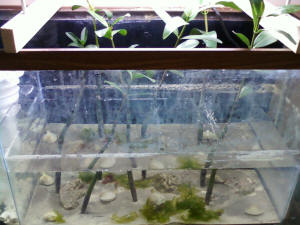
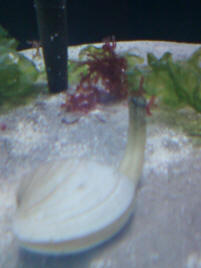
I would like to ask some advice on my constant Nitrate problem (I
attached some pictures of my tank and refugiums, sorry about the
picture of the tank, I took it this morning before the light
turned on).
<No problem.>
I have a 54 gallon corner tank with a sand substrate (used to
have crushed coral), live rock (about 40 or so pounds? not 100%
sure), protein skimmer, 250w halide (on about 8-9 hours), soft
corals (mushrooms, yellow polyps, Kenya trees, zoas, star polyps)
and 5 fish (tomato clown I've had for over 12 years, pencil
wrasse, black neon line goby, pixie hawk and green chromis. I had
a 15 gallon high refugium underneath the tank with a sand
substrate, mangroves and Chaeto where the water from the tank go
into the refugium, until the water level gets too low in the tank
and the return pump turns on, putting the water from the refugium
back into the tank. I recently upgraded the refugium ( a few
weeks ago) to 2 refugiums, a 29 gallon tank with 2 baffles where
the water goes in the 29 gallon on the left side underneath an
undergravel plate through a mixture of sand and refugium mud
where the mangroves are planted and over another baffle where it
is pumped down into the 15 gallon x-high where the Chaeto is and
then the water is pumped back into the tank the same way as
before.
<I would not use the undergravel filter plate, can elevate
nitrate levels.>
My question is, I used to have a lot of trouble with high
nitrates and hair algae, so I got rid of the crushed coral (which
almost everyone told me can cause high nitrates)
<Nonsense, crushed coral is actually aragonite.>
and replaced it with "live" sand (I don't know
about the "live" part, but it was the only sand I could
find at the fish store) and I thought between the new sand and
the water moving between the 2 refugiums my nitrates would go
down and it would starve the hair algae. However, when I checked
it again yesterday, it was still high.
<You are not going to see changes that fast.>
I even added some clams to the main tank and both refugiums to
help "clean" the water. I ordered some more macro algae
in the hopes I may just need some more things that will absorb
the nitrates, but I don't know where it is coming from.
<Coming from excess nutrients in the system somewhere.>
I only feed the fish once a day and usually it is a few marine
flakes or a few pellets, which always get eaten and never sit on
the sand. I do 10 - 20% water changes (probably not as often as I
should, usually once a month or maybe even twice a month if
I'm lucky, but I do use an RO system), but I can't seem
to get the nitrates to go down and also for the hair algae to go
away.
What am I doing wrong? Is there just not enough surface area in a
corner tank? I am hoping, once I move, to get at least a 125 -
150 gallon tank, and still use the refugiums.
<I'm guessing the Tomato Clown is very large and being so,
a high waste producer contributing to your high nitrate levels. I
did not see any mention of a protein skimmer
in use, a must have for controlling nitrates.
Do read here for further help with your problem.
http://www.wetwebmedia.com/nutrientcontrol.htm
http://www.wetwebmedia.com/nitratesmar.htm
http://www.wetwebmedia.com/algaeconMar.htm>
Thanks.
<You're welcome. James (Salty Dog)>
John
|
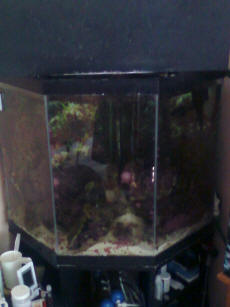 |
Re: Nitrate and hair algae problems 8/21/09
Hi again James,
<Ahh, he's marked himself "out". BobF
here>
Yes, I am using a protein skimmer (I thought I put it in my
original message somewhere, if not I apologize) and although it
doesn't get filled up with brown/green water as much as it
used to, I still have to dump it out about once a week.
<A good interval>
Even though my Tomato Clown can probably now join the AARP, he
has never really been in a large enough tank to get his full
size, so he's only about 3 inches long and is probably the
biggest fish in the tank except for the goby, but he's only
about 4" long, not very girthy.
I forgot to mention in the first refugium the water from the tank
pours through a 100 micron filter pad and a polyfilter which are
sitting on top of a filter sock. My poly filter seems to be
getting brown fast, although I'm not sure why since the 100
micron pad is on top of that and gets dirty fast.
I don't use the undergravel filter as a filter per se, I put
it in to prop up the mud, so that when the water flows under the
first baffle, it's forced under and through the mud to kind
of "filter" it before it comes up and goes over the
right baffle. I figured the mangroves might like it.
<I do agree>
I just don't know where the extra nutrients are coming from
(the clams have only been in there for about 2 weeks, so I
suspect it'll take them a while to filter through the
water).
<Yes>
Thanks again for your help and for the quick reply.
<Will fwd. to James>
John
<Bob Fenner>
Re: Nitrate and hair algae problems
8/21/09
Hi again James,
<Ahh, he's marked himself "out". BobF
here>
<<Back with a vengeance.>>
Yes, I am using a protein skimmer (I thought I put it in my
original message somewhere, if not I apologize) and although it
doesn't get filled up with brown/green water as much as it
used to, I still have to dump it out about once a week.
<A good interval>
<<And very important to keep the neck/reaction chamber free
of brown slime buildup, reduces efficiency of the skimmer very
much. What brand of skimmer are you using?>>
Even though my Tomato Clown can probably now join the AARP, he
has never really been in a large enough tank to get his full
size, so he's only about 3 inches long and is probably the
biggest fish in the tank except for the goby, but he's only
about 4" long, not very girthy.
I forgot to mention in the first refugium the water from the tank
pours through a 100 micron filter pad and a Polyfilter which are
sitting on top of a filter sock. My poly filter seems to be
getting brown fast,
<<Indicating a high organic load. Have you checked
phosphate levels in your system? You may have better results
using Chemi-Pure Elite which contains a high grade carbon, ferric
oxide for phosphate control, and beneficial ion exchange
resins.>>
although I'm not sure why since the 100 micron pad is on top
of that and gets dirty fast.
<<Is this pad changed/cleaned weekly?>>
I don't use the undergravel filter as a filter per se, I put
it in to prop up the mud, so that when the water flows under the
first baffle, it's forced under and through the mud to kind
of "filter" it before it comes up and goes over the
right baffle. I figured the mangroves might like it.
<I do agree>
I just don't know where the extra nutrients are coming from
(the clams have only been in there for about 2 weeks, so I
suspect it'll take them a while to filter through the
water).
<Yes>
Thanks again for your help and for the quick reply.
<Will fwd. to James>
<<John, do read the articles I linked you to previously.
James (Salty Dog)>>
John
<Bob Fenner>
|
Should I rinse frozen food to remove phosphates?
8/2/09
<Hi Jim, Jessy here>
I'm hoping you can help resolve what has become a HUGE disagreement
between my wife and I. We have two tanks: one 65 gallon that houses our
seahorses, that we've had for about three years, and one 210 gallon
fairly new reef tank with numerous fish (9 chromis, 2 clownfish, 1
flame Hawkfish, 1 yellow tang, 1 lawnmower blenny, 1 rusty angel, and 1
Banggai cardinal) established about 3 months ago. The seahorse tank has
a chronic massive problem with nuisance hair algae. I very much want to
avoid having this same problem with the reef tank. Both tanks are
regularly fed various frozen foods:
San Francisco Bay brand Marine Cuisine, Spirulina- and Omega3-enriched
brine shrimp, and various brands of frozen mysis. The fundamental
question that is the basis of our disagreement is whether or not it is
important and beneficial to rinse these frozen foods after thawing
them. As the person who has to clean the algae from the glass,
rockwork, and every other surface of the seahorse tank, and the person
who does all of the testing for nitrates and phosphates, and regularly
replaces the phosphate adsorption media, I maintain that it is
important to rinse the thawed frozen food in order to remove as much
phosphate as possible before feeding the fish and seahorses. As the
person who regularly feeds the fish and seahorses, my wife maintains
that the "juice" from the frozen food contains important
nutrients, and that rinsing the thawed food would remove essential
nutrition that was specifically added by the manufacturer for the
benefit of the fishes and other filter-feeding creatures in the tanks.
We recently asked the local "expert" at our LFS, who said he
personally doesn't rinse these types of frozen foods, because it
helps feed the filter feeders. I'm hoping that you can help settle
this disagreement we're having. I've been unable to get my wife
to take the time to actually read the numerous sources I've located
online, all of which state the importance of rinsing thawed frozen
foods to remove phosphates. What does wetwebmedia.com have to say on
this issue? To clarify: not asking for marital advice, just whether to
rinse or not to rinse!
Thanks in advance,
<Absolutely yes, you should be rinsing your frozen food. You can do
something as simple as putting it in a brine shrimp net and holding it
under cold tap water to thaw and rinse it at the same time. The things
that
you are rinsing off are mostly the binding agents for the frozen
food... and yes it can lead to phosphate problems. Your filter feeders
will benefit much more from a dose of phytoplankton or Cyclopeeze than
they will from the little particles found in that frozen mush. I'm
a huge proponent of PE Mysis, (who also suggest to rinse their product)
and I noticed that a lot of the pieces and parts that get rinsed off
are the lighter scrap, like tails and legs. When added to the tank,
none of the fish even attempt to eat those pieces, passing them by for
the meaty portions. I said all that to say, that by not rinsing
you're putting unnecessary binding agents in your tank and
particles of "food" that are just going to go unused and add
to a high nutrient problem. By the way, with the hair algae the best
way to combat it is to remove it with your fingers (yes elbow grease
is
unavoidable) and I've always had success with large turbo snails.
Every time you walk past the tank and they are not eating a patch, just
pick them up and plop them on top of it. With continued water quality
monitoring and a little bit of time, every hair algae problem treated
that way has been solved for me. Now Bryopsis, is a whole other ball of
wax. Make sure you're identifying it correctly. Hope that helps.
Jessy>
Re: Should I rinse frozen food to remove
phosphates? Now Bryopsis, Hair alg. control 8/3/09
Thank you, Jessy, for your reply. Regarding identification: I thought
Bryopsis was a type of hair algae. Three questions: 1) What type
of hair algae were you describing the relatively easy control of?
2) How can I tell that one apart from Bryopsis? 3) What do I do if I
have Bryopsis?
Thanks!
<I'm talking about the algae referred to as "hair
algae"
http://www.wetwebmedia.com/grnalgcontfaqs4.htm viewed/discussed here.
The best way to tell if you have Bryopsis is to look at the strands of
algae.
For me, Bryopsis always looked like a little fern. Basically a central
shaft with smaller hairs branching off of each blade. As opposed to
hair algae that just looks like thin green hair. If you have Bryopsis,
I suggest
doing a search on WWM for more info, I know there is a vast amount of
it.
Two ways I've heard of conquering it were raising the magnesium
levels in the water, or the use of a ruby lettuce Nudi. If you do go
with a Nudi, please make sure that you cover all power heads because
they will find them and get hurt, and also be prepared to pass it along
to someone else in need after all the algae is gone because it will die
in your tank otherwise.
Regards, Jessy>
Hair algae and lawnmower blenny... Sm. SW,
reading 7/10/09
Hi all,
Thank you for all your help in the past. You are a wealth of
information and I truly appreciate it! My problem is long hair algae. I
have a 28g nano cube about 1 year old. I have live rock and sand. I
must say, I have not been on top of water changes, so I know that's
part of the problem. I shortened the light and I go very easy on
feeding--I even skip feeding once a week (advice from LFS). I have a
black and white clown, purple firefish, and a firefish goby, a couple
mushrooms and polyps,10 hermits, 3 Trochus snails (new), and a
Nassarius snail or two (they hide). I use API Algaefix,
<This is a mistake... NONE of API's "fixes" is safe
nor effective... this one is outright toxic>
which starts to kill off the algae, but I sometimes miss doses (I know
I'm the problem.) I am now making a dedicated effort to clean up
the algae and stay on top of it.
<This is closer to the mark>
I would like to get a few more Trochus as well as an orange spotted
lawnmower blenny.
<Mmm, this volume is too small... better for you to read, set upon a
better plan for nutrient limitation, perhaps selective removal,
competition>
I read they are good at mowing hair algae. I know it may grow too big
for my tank, so after he has
had a chance to clean and grow in my tank, hopefully, I plan to move it
to the 250g reef tank (no problems there).
<Oh!>
I have, however, a regular lawnmower blenny in there--about 4-5"
long.
Will they get along in that size tank?
<There should be sufficient room there>
Anything else I can do to get the algae under control? I also hand pick
it out.
Thank you,
Marianne
<Read here: http://wetwebmedia.com/avoidingalgaeproblesm.htm
and the linked files... Bob Fenner>
Hair Algae 5/30/09
Hello there and thanks in advance for your awesome information.
<Welcome in advance.>
I have been a reader of your website for quite sometime now and I
believe this is the best place on the net to find info.
<I think so, but am a bit biased!>
Now I have tried to Google this and can't find any results. I
should know the answer to this put nothing I do seems to work. My
question is I have a couple corals that are being over taken by algae
its like a really dense Hair Algae one of the corals is a gorgonian and
the other is a pipe organ, what can I do to kill the algae and not the
coral?
<Algae control methods, do NOT try to outright kill the stuff with
something like an algaecide. The idea is to make desirables more
competitive than the algae in your system.>
I do have an algae blenny a yellow tang and an blue regal tang, all
aggressive algae eaters but none seem to munch on this type.
<Nope.>
Others swimming in the tank are 2 purple Firefish 1 Sixline wrasse
scooter blenny 1 green mandarin goby. I have a 125 gallon with dual
overflows the filter is a Marineland model 4 high capacity acrylic sump
and a remora protein skimmer the light is a Coralife Aqualight pro with
3 250 watt MH.
The biggest problem that I have chemically is nitrates at about
10ppm.
<A sign. Do you have live rock in your system, I assume you do with
the corals. How about biomedia in the sump? This tends to be a
"nitrate factory", which of course fuels algae growth. How
about flow in the system? Feeding?>
My KH ammonia nitrates calcium ph are all great thanks again for your
help.
<Welcome, do see here re algae control:
http://www.wetwebmedia.com/algaeconMar.htm
Scott V.>
Hair Algae in spite of new Basement Sump System
05/25/09
Hello to whoever is on board.
<Howsit?>
I have a healthy 90 gallon reef that is eight years old. I have had no
problems with the tank except for some hair algae issues. It is growing
in healthy clumps mostly in the lower part of the aquarium. I have
upgraded from a 15 gallon crammed sump to a 125 gallon predrilled sump
in my basement. The new sump sits on a stand level with my waist and
everything is easy to access. I love it. My back loves it too. I now
have a water volume of 180 gallons but a 90 gallon display tank. I also
have a huge refugium loaded with macro algae and lots of bugs. I had
installed a new hospital grade RO/DI Unit at the same time so I believe
phosphates or silicates coming from my water source is not an
issue. The new sump has been set up for three months now and the
hair algae is not gone. I don't know what I can do next. I would
have thought the extra water volume would have affected the algae. This
is what I have in my tank:
Yellow Tang Zoanthids (different varieties)
Pygmy angel Finger leather
Two clown fish Ruffled Leather
yellow watchman goby Frogspawn two varieties
two serpent stars A few SPF's
mandarin
red & blue hermit crabs
Astraea Snails
cleaner shrimp
sea hare - new addition and doing a great job
Coralife Calcium Reactor with Milwaukee Controller
Two Milwaukee PH Monitors - One for CO2 Tank and One for Display
Tank
EV180 Protein Skimmer - cleaned weekly
Sponges cleaned weekly.
Calcium is 420
PH 8.0 -
Alkalinity holding at 1.7-2.8
<Mmmm>
Ammonia -0-
Nitrite -0-
Nitrate -0-
phosphate -0-
Salinity l.025
Coralife 150 MH Bulbs - Reeflux 12K
Blueline Pump working everything and tank is now a cool @ 77.8
-78.0
Seachem Reef Salt
10% Water Changes Weekly
If you have any suggestions I would appreciate it. I am clueless.
<I'd be reading a bit re Alkalinity... yours is a bit low. And
hair algae... See WWM re Green Algae control period please. RMF out in
Indo. so can't spare the time (slow conn.) to search the links for
you>
Patty
<BobF>
Green Hair Algae, control, Wodka...
5/16/09
Hey guys and gals,
<Hey Scott.>
I need to replace the HOT filter on my 38-gal reef tank. I was
considering one of the CPR hang-on refugiums instead. Only the small
(2.5 gal) model will fit. I found one complete with light for $170
online. I've battled turf algae for about the last year; it has
subsided but some form of GHA is starting to take over now.
<Uh oh!>
I've never been able to find the cause or a cure. I've been
through all the FAQs here, wrote in to you guys a couple of times,
tried everything but vodka, and could never get the stuff to go
away.
<Well I find if you drink enough vodka the algae is not as
bothersome!>
So anyways, I'm looking at this hang-on refugium and I see
advantages in being able to grow more critters and macroalgae, and in
stabilizing pH with a reverse light cycle.
<It will aid in those respects.>
One potential disadvantage would be no mechanical filtration -- I have
a Remora skimmer taking up most of the other half of the tank.
<Well, a skimmer is a form of mechanical filtration, the only that
many run.>
I also would probably not be able to use poly-filter if I needed it,
though I suppose I could at least throw a bag of activated charcoal
into the refugium. Would the 2.5 gal unit be worth the cost in terms of
improving the overall health of my tank (vs. the cost of a new power
filter)?
<Well, for what it is worth I would attempt to jump to a sump setup
for the monies involved. Either drill, see: Glass-Holes.com or go with
multiple HOB style overflows. Then any simple vessel, an empty tank or
Rubbermaid container can serve as a refugium and filter. Add a cheapo
return pump, nothing more than a powerhead needed, and you are still
under the $170.>
Will the back wall of my tank support both the Remora and the
refugium?
<Yes.>
Your input is much appreciated.
Thanks,
Scott
<Welcome, Scott V.>
Re: brittle star question, beh., and
alg./Bryopsis control... Thank you. <Welcome!> I will
try to get a video to verify <I look forward to seeing it.> and I
also have another question concerning one of my other tanks
<Sure.> it has a bunch of this green algae Im am pretty sure that
it is Bryopsis because it looks like small palm trees and it is taking
over some of my corals and my rock is covered and I can't seen to
get rid of it. Is there any suggestions? Nitrates 0 nitrites 0
phosphate 0 PH 8.0 <Yes, I think you will find these articles
helpful. Please read here:
http://www.wetwebmedia.com/nutrientcontrol.htm
http://www.wetwebmedia.com/scottsh2ochgart.htm Hope this is helpful.
Cheers, Mich><<Try some small species of Cowries... C. moneta,
C. caputserpentis... RMF>>
Green hair algae 2/17/2009 Alg, sys, No useful
information I have a 55 gal. marine reef tank there is a rock
in the tank that has a great deal of green hair algae on it that has
become unsightly. I also have some Aiptasia I'd like to get rid of.
Do you have any suggestions? Thank You Pat <Hi Pat, While I would be
happy to help, you have not provided any useful information about your
system. Please include what specifics on your filtration system,
stocking, lighting, and water testing results. As to specifics on hair
algae and Aiptasia control, there are volumes of information on this
site. I would suggest you start here - for Aiptasia control:
http://www.wetwebmedia.com/marine/inverts/cnidaria/anthozoa/aiptasia/aiptasi
a.htm and for hair algae:
http://www.wetwebmedia.com/greenalgcontfaqs.htm ><MikeV>
Actinics and 10000K CF vs. Coralline and Hair
Algae 2/12/09 Hola WWM Crew. <Hi John> Thanks again for
all you do. <You're welcome.> Now that we got the poetry out
of the way, I would like to ask a variant on the old "should I
take out my actinics and replace them with high K CF bulbs"
question. I have a 75 gallon with good parameters (not essential here)
. Some nitrogen and phosphate evidenced by a little hair algae but I am
getting this under control with diligence. I have a 48" Coralife
Aqualight Pro 2X150HQI 2X96CF actinic. It is getting to be time to
change the actinics. I don't really like the actinic color that
much, and the coral doesn't care. I was thinking about putting in
10000K CF bulbs. Two questions: Will the 192 watts of CF 10000K provide
a material marginal benefit to my SPS relative to the 300 watts of HQI?
<Will help some, but I wouldn't base my decision on it.> Will
the move to 10000K hinder my coralline more than it hinders my GHA or
do GHA and Coralline like the same spectrum? <Coralline seems to do
better under actinic.> I was thinking about 6000-7000 but really
don't like the color. <The lower Kelvin temps are more prone to
growing hair algae than 10K and higher, but excess nutrients are going
to be the main cause of nuisance algae in your tank. You didn't
state what the Kelvin temperature is on your HQI lamps, but I do know
the fixture comes with 10K lamps. So, if you haven't yet replaced
them, I'll assume that is what you are using now. If plating
coralline is desired, I'd stick with one actinic and replace the
other CF lamp with a 10K. This will reduce the blue effect you are not
fond of and should give you a nice overall color balance.> Thanks
<You're welcome. James (Salty Dog)> John / Fishnut
Algae Woes, Control 1/26/09 Hello guys and gals,
<Hi Shelley> I have been struggling with turf algae in my 38-gal
reef tank for almost a year. My tank had been running for about 10
months when I added a Remora skimmer, which can theoretically handle a
tank twice the size. I have it set pretty aggressively, and it removes
several cups of green-tea colored liquid every week. After the tank had
been up a year, I changed light bulbs. I went from Coralife to SunPaq
bulbs, but kept the same 10K and actinic ratings. It was about a month
after changing the bulbs that the algae first appeared. It slowly began
to overrun the tank, and eventually covered basically every exposed
area of my live rock. Neither I nor my LFS has ever measured any
nitrate or phosphate in our tests. I began draining the liquid off my
frozen food instead of throwing it in the tank frozen. <Yes, a good
practice.> I am trying to maintain dKH at 10-11. I trickle my food
in a few pellets or flakes at a time, making sure they get eaten.
What's not eaten by the fish is usually pounced on by my two
peppermint shrimp. I actually spoon-feed the frozen. The fish come
right up and take it off the spoon. About 6 months ago I started
reading on DSBs and thought my 3" sand bed might be acting as a
"nutrient sink," so I added an extra inch of substrate. At
the same time, I had areas of poor circulation where detritus was
collecting in the corners, so I added extra powerheads and re-arranged
their placement. This increased circulation from 21X to about 30X/hour,
and the detritus is not accumulating like it used to. I do occasionally
vacuum or stir up the first half-inch or so of substrate. I took the
filter pads out of my HOB filter and have been running carbon, which
gets changed at least once a month. At times I have tried running two
carbon cartridges. None of these measures have improved the situation
in the least. Once a month or so, I find myself manually removing algae
which has grown to 4-5 inches in length, and even scrubbing the live
rock in a pail of tank water. For the last six months or so the
inhabitants have been a pair of Ocellaris Clowns, a Royal Gramma, and a
now almost-obese Algae Blenny. I have about 45lb of live rock, a large
colony of candy canes, a small frogspawn, a large-ish branching hammer,
a Trach, a large Sinularia (I think), and a finger leather of some
sort. So far, I have held off on trying vodka. <Drinking isn't
going to solve your problem:)> The other option I've considered
is trying to starve the algae by essentially quarantining portions of
the rock in another tank. Neither of these seems like a long-term
solution. I'm tired of scrubbing my rock, so any suggestions you
have are appreciated. <Scott, I'd start by reading here and
related articles/FAQ's. I'm quite sure this will lead you in
the right direction. http://www.wetwebmedia.com/algaeconMar.htm James
(Salty Dog)> Scott
Derbesia eradication 11/17/08 Welcome Back to
the States Bob! I am sure you had a enjoyable time. Can't wait to
see some photos! After much research on the topic of Derbesia
eradication I have found the following info on species that may chow on
it: It is seemingly apparent in Australia that the sea hare species:
Dolabella eats a variety of nuisance algae such as :Bryopsis, bubble
algae, some hair algae but not feather Caulerpa. Bryopsis feeders are (
herbivorous sacoglossan): Elysis virdis(Britain) , Placids dendritica,
limaponita capitata, Australian: Elysia ornata , Elysia rufescens
Herbivorous Snail: Scutus, Cypraea annulus, limpet( I used to have
hundreds of limpets) I contemplated your recommendations for my 15 y/o
tank, but just did not want to go that route at this time. I
respectfully request your opinion if they would do the job and if and
where can I purchase them. Also this sight link offers a photo of the
Slug that Wes just sent to you today.
http://www.seaslugforum.net/showall.cfm?base=stilcrem Also some camera
phone photos of Greenwich, CT. Thank you Bob Donna W. Hackert <Thank
you Donna... will share, post. BobF in Cozumel>
Re: Derbesia control 11/17/2008 Hello Bob,
<Donna> You forgot to answer with your opinions of these
creatures- are they chow hounds for Derbesia?? and where can I
purchase. I cannot locate anywhere in this country!! <Most all
listed can be found from time to time... I'd ask your LFS to
special order... and/or look to Dr.s Foster & Smith, Marine
Center...> Any assistance would be appreciated. Thank you Bob, Donna
<None listed are consistent for sure predators/eaters of Derbesia
spp. BobF>
New Tank, Hair Algae Galore! 9/12/08 I tore down
and reset up my 75 gal. sumpless tank 3 weeks ago. I took my live rock
to the LFS for credit and got only about 30lbs. of new live rock. I
plan to add more in the future. I used distilled water to fill the tank
and crushed coral from the tanks at the LFS. I have one clown in the
tank that's about 1.5 inches. I have PC lighting with new 50/50
bulbs (130watt) that is on about 9 hours a day. The tank never
registered any ammonia or nitrites, but I think from past experience it
is cycled. <Possibly with this bioload.> I normally start tanks
with fully cured live rock and have never experienced the
"cycle" you get with uncured rock. I have a Deltec MCE 300
Skimmer and two small powerheads in the tank. I have Tunze 6045
powerheads, but with so little rock they create so much flow the clown
cannot swim well, so I do not have them on yet. <I assure you he can
deal.> After trying to give as much background information...the
problem is I have hair algae all over the very thin layer of crushed
coral I got from the LFS, nothing of the live rock though. <Hmmm,
likely BGA in my opinion. Regardless, the same plan of action.> I
have never had this happen on a new tank and do not know how to
approach this. I do not know what could be causing it. I can rule out
overfeeding, high fish load, phosphates in source water, and too much
lighting. What else is left? <I do suspect the crushed coral. Any
detritus or other biologic materials/life forms that may have died may
well be the source of your issue. Did you rinse it before adding to the
tank?> What steps should I take (if any)? <Water changes, with a
gravel vac at this point.> At this time I do not have a filter but
am thinking of buying something just to run carbon and/or a phosphate
remover in, do you have any suggestions on something just to
occasionally run filter media in? <A HOB filter or canister can
work, with frequent cleaning. Do consider going with a sump at some
point, it make maintenance much easier. Scott V.> Kalkwasser
vs. Bubble Algae 8/23/08 Hi Bob, <Kiwi> I have a
question for you. I was using Kalkwasser to kill off some aiptasia
<Mmm, wouldn't do this... Do look into Red Sea's newest
product for... really spiffy> and got some Kalk on the bubble algae
cluster adjacent to the anemone. <Oops> Two days later the
cluster of bubble algae was dead and gone. Have you tried this?
<Nope> Is it safe? <Not likely... the killing, dissolving of
disparate life "in" system is often problematical... the
release of all sorts of chemicals, cells...> I haven't seen any
ill affects in the tank. I do however; wonder if the spores of the
bubble algae were released since it was entirely covered in Kalk?
<Don't know... but would not be surprised> Any ideas as to
how or what happened? Sincerely, Kiwi <Caustic, basic
"burn" reaction... toxified the algae to the extent that it
"gave up". Likely, as you state, this material dissolved as a
reflex defensive mechanism... is now spreading throughout the system.
Cheers! Bob Fenner> Qiwen "Kiwi" Feng Aquatic Express Inc.
451 Grandview Avenue, Ridgewood, NY 11385
Bryopsis control, reading 6/27/08 Hello. I have a
recurring Bryopsis problem, which I've had ever since adding Fiji
rock to my existing aqua cultured Florida Gulph rock last summer. I
have a 12 g , keep a royal Gramma and a Sixline wrasse, have a bare
bottom, use filter floss and ChemiPure in this all-in-one's
chambers, do weekly water/filter floss changes using distilled water,
feed remarkably light, once daily, and run the 48w PC's for
12hrs/day. Bulbs are new. Flow is a MJ 900. At this point I've
tried everything to get rid of it, and the only thing that works to
kill it is dosing magnesium, which my Ricordeas and polyps don't
seem to enjoy too much. <Uh, no> I can't imagine where the
stuff's getting the nutrients to be as rampant as it is, <Is a
successful competitor for... from foods, water...> as I'm as
diligent as ever in maintaining the tank. Like I said, i can't help
to be suspicious, as I never had any problem with Bryopsis before
adding the Fiji rock, though I had a clump or two of GHA here and
there, but nothing like this--HELP! Thanks a lot. Eric <... the few
general approaches to this pesky Green Algae are gone over and over on
WWM... nutrient deprivation, competition and predation are the broad
means... Read here:
http://wetwebmedia.com/WWMAdminSubWebIndex/question_page.htm put in the
terms: "Bryopsis Control" and read the cached views.
BobF>
GHA and DSB multiple choice, 6/26/08 Hi Folks, <Hello>
I have been battling green hair algae in my 38-gal reef tank for about
four months, and the algae is winning. Tank footprint is 36" x
12". Turnover is about 21X per hour. I run a HOB filter with
carbon, and squeeze out the pads in a bucket of tank water every couple
of weeks. <I would just remove these filter pads, they are not
helping your situation.> I also run a Remora skimmer which is
pulling out mostly clear water lately. <The algae is doing a good
job of scrubbing your water clean I would guess.> I have about 50lb
of live rock. I change about 5 gal a week. Tank KH tends to be around
9; LFS said getting it up to 11 or 12 might help. <Might a little,
but probably not appreciable.> Inhabitants are a pair of Ocellaris,
a Royal Gramma, a Coral Beauty, <Will need a larger tank in time>
and an Algae Blenny; torch, hammer, and frogspawn corals, a trach, a
bushy-type Sinularia, and a finger leather of unknown species. A couple
of months ago, I discovered that I had about 20ppm nitrate in my well
water, so I bought an RO unit, to no effect. <Will at least limit
nutrient input into the tank over time.> The salt mix tests negative
for nitrate and phosphate. I've begun to drain off the liquid from
my frozen foods. <Good, and you may very well need to cut back on
feeding.> My light bulbs are only about 6 months old. When I remove
the algae manually, it comes back with a vengeance within a week or
two. <Nutrient fuel is still being added to the tank somehow.>
Now, I do have my rock piled in such a way that gunk tends to collect
in one corner. I plan to rearrange my water flow and add another water
pump to address this. However, I've also read quite a lot on WWM
re: DSBs recently, and I seem to have the infamous 3" of
substrate. <Not very helpful for nitrate reduction, but should not
be driving the algae bloom.> I'm thinking maybe I should try to
add another inch. <Would help for nitrate reduction, but probably
not effect the algae growth much.><<RMF disagrees>>
Should I: A) pour the new substrate right on top of the collected
detritus; <I would, 1/2 inch at a time.> B) stir the gunk back
into circulation first, then put the new substrate in; <Could, but
won't make a big difference in the long run.> C) tear apart the
rockwork and vacuum the stuff out first; or <If it helps you pull
out more algae might be worth the effort.> D) none of the above?
What else am I missing? I'm getting pretty discouraged. Thanks,
Scott <Sounds like you are doing most things right so it is a matter
of finding out what is driving the algae growth. I would be it is
overfeeding, many hobbyists can easily 1/2 the amount of food they add
to the tank and the fish will be fine. Try doing this along with your
current actions and see if it helps over the course of a few weeks.>
<Chris>
Hair algae and Chlorodesmis Macroalgae or
Invasive Nuisance? "Hair" Algae Strikes Again!
5/27/2008 Hello again Crew, <Scott F.
your Crew member tonight.> Well, I've been having a lot of fun
cleaning out some hair algae today. <Almost as much fun as wiping
water off the floor!> I'd like to ask a few questions regarding
it. 1. What eats hair algae? <Depending on the type of "hair
algae", you can look to anything from Zebrasoma Tangs to Urchins.
"Harsh" grazers will help. Here on the WWM site, we literally
have volumes about various attack strategies against hair algae. Make a
positive ID on the type of hair algae that you're dealing with, and
add the appropriate grazer. Also, do identify and remove the potential
sources of organics that are leading to the hair algae growth> 2.
Does Chlorodesmis grow in the same pattern as hair algae? Or does it
stay on a rock and expand (like an encrusting coral)? <It does tend
to stay in tighter formation, and is distinctly different in appearance
than most of the hair algae. It does particularly well in very high
flow/high light situations. This macroalgae grows "taller"
than a hair algae does, and is typically tougher in texture.> 3. If
I get whatever eats hair algae, will it eat Chlorodesmis? <Quite
possible that the grazer may take a bite, but Chlorodesmis tends to be
distasteful to many grazers. In fact, it's actually a bit of a
challenge to grow, so if you're getting this macroalgae, you're
doing something right! Well, that's it. Thanks in Advance, Random
Aquarist < In the immortal words of Forrest Gump, "That's
all I've got to say about that! Hope this helps a bit. Regards,
Scott F.> Hair algae and pistol
shrimp aggression towards sea hare? Hello, I was wondering if you can offer some guidance. Before I
begin, my tank info is as follows: 29g nano reef (running 1 year);
approx. 25 lbs. live rock; 5g RO water changes every 7-10 days pH
8.3/salinity 1.024/iodine 420/calcium .06
ammonia/nitrite/nitrate/phosphate = 0 water temp. fluctuates between
80-84° Corals: trumpet coral, toadstool leather (2),
branching frogspawn, cluster of xenia, Ricordea florida 5 polyps,
asst?d. Zoanthids (approx 6-8? wide cluster) Livestock: 1 percula
clown, 1 yellow watchman goby, 1 Rainford's goby, 2 pistol shrimp,
2 lettuce Nudibranchs, 1 dwarf sea hare (deceased) Over the past few
months, I've been battling a problem with hair algae covering the
live rock and back wall of the tank. Some of the zoas are starting to
get suffocated by the stuff. I've tried blue leg hermits, Mithrax
crabs, and Cerith, Astrea, and Mexican turbo snails at different points
in time. The crabs hardly made a dent. With regard to the snails,
they've all been extremely lethargic following acclimation (hardly
moving around), then slowly die off. I took a water sample to my LFS to
see if they could give me any clues. Their results were similar to mine
above, and their only guess was that the water temperature could be a
cause of the snail deaths. <Your nutrients are likely measuring 0s
*because* of the hair algae growth. They are consuming them. As for the
snail deaths, how did you acclimate them? These animals are very
sensitive to changing water conditions (even more so than fish and
corals). Please see here:
http://www.wetwebmedia.com/snaildisfaqs.htm> I bought 2 lettuce
Nudibranchs to help cut down the algae, but have had similar results as
with the crabs. Then I was told by the LFS that sea hares were better
for consuming hair algae. I bought one and for several days it seemed
to be doing well, constantly scouring the live rock. One evening,
however, I couldn't find it. After searching with a flashlight, I
saw it in the back of a rock cave in the clutches of one of the pistol
shrimp, which was going at it with its smaller pincers. I scooped up
the alive but injured sea hare and tried to place it high on the glass,
away from the shrimp, but it was too weak to stick. I submerged a
perforated container and placed him inside so the shrimp couldn't
get it. But by the next morning, it was dead. <A lot of the sea
hares sold to the hobby are cold water animals that don't live long
in tropical tanks. Please see here:
http://www.wetwebmedia.com/seaslugsel.htm> The tank gets fed daily,
and I often see the pistol shrimp come out to snatch flakes from the
water column, so I don't believe they're malnourished. Your
answers to other pistol shrimp FAQs on your website state that
predatory behavior by pistol shrimps towards snails and crabs isn't
uncommon. I read somewhere else that sea slugs and Nudibranchs taste
bad, so they usually get left alone by predators. Your thoughts?
<They might not all taste bad.> The lettuce Nudibranchs are
unmolested and seem healthy, one even laying eggs often. Although I
like the interaction of the watchman goby with the pistol shrimp,
I'm inclined to trap the shrimp and remove them. <Hmm, I would
not remove the shrimp in hopes of saving the sea hare. And I would not
seek to solve this hair algae problem with invertebrate herbivores.
Please see here: http://www.wetwebmedia.com/algaeconMar.htm> I
really want to get this hair algae problem under control. Any
suggestions? <Please see the link above.> Thanks, Chris <Best,
Sara M
Re: Hair algae and pistol shrimp aggression
towards sea hare? 4/30/08 Sara, Thank you for your prompt
reply. To respond to your follow-up questions: 1. A few posts within
the FAQ on snails (that you referred to me) mentioned magnesium
toxicity/overdose as a possible cause of snail death. One suggested
poor quality salt mixes could be a source of high magnesium. Would
?Instant Ocean Salt? be considered acceptable quality in your opinion?
<Usually, yes, but if you are having problems, you should measure
the magnesium and consider trying a different salt (such as Reef
Crystals, made by the same company, but generally a better salt)>
With the exception of occasional doses of iodine (levels tested
periodically), no other additives are put into the tank. Could anything
else be the cause of elevated magnesium levels, based on the info
provided? <Hmm, not that I can think of...> 2. The snails were
acclimated by floating the plastic shipping bag in display tank (I
acknowledge that using a QT is preferable, and admit I do not have one)
in which they were shipped for 15-20 minutes, then opening the bag and
pouring ½ oz. or so of tank water into the bag every 5
minutes until full, then discarding half of the water in the bag and
repeating the cycle until bag is full again. Final step is placing the
snails in the tank and discarding the bag along with the water inside.
Total acclimation time is around 1 ½ hrs. In the same snail
FAQ, there was a post where you suggested an acclimation method
involving a bowl and wet paper towel; or in the alternative, placing
the snail on the glass side of the tank above the water level, allowing
it to lower itself into the water at its own pace. Do you suggest I use
this method? <IMO, It's worth a try for future snails.> 3. If
the sea hare was a cold water creature and the 80-84 degree water
temperature was the cause of death - as opposed to predation -
isn't it more likely it would have acted sick or lethargic from the
start? The sea hare was active and seemed to be eating, scouring the
rock and glass during the 5 days before I caught the pistol shrimp
clawing? it. <It's hard to say. It could have been solely the
shrimp's fault. But all the same, the slug would have likely begun
to decline anyway.> 4. I read the algae control article you referred
to me. The control methods outlined several factors, one of which was
the amount of nutrients in the water. My existing 3 fish get fed flake
1x/day (food totally eaten in under 1 minute). Also, I do 5g RO water
changes every 7-10 days. Is the above routine ok? <Normally, yes,
but you have a problem...so, something needs to change. Your tank might
be overstocked. Nano tanks can be especially touchy in this
respect.> Water flow is handled by the ?stock? Bio Cube 29 pump,
plus an additional in-tank powerhead. Lighting is by one actinic and
one 10000k (72w total, bulbs replaced every 6-9 mo.) running between
9:30 a.m. and 5:30 p.m. daily. Would modifying this routine help combat
the algae without affecting the corals? Mr. Fenner's article
indicates that most runaway algae problems are due to excess heat and
temperature fluctuations. I would hope to find a solution to the
problem without spending several hundred dollars for a chiller or via
higher monthly a/c bills. <If your temp is staying between 80-83F,
that should be ok.> As mentioned, my water temp. is currently
hovering near that upper threshold. Your thoughts? <I don't
think this is a temp. problem as much as a nutrient control problem.
Again, these things are all more difficult to deal with in small
volumes.> Current filtration methods include live rock for
biological, protein skimmer, bag of carbon/Purigen, and regular weekly
cleaning of the filter pads of particulate buildup. The only other
control methods are regular brushing/plucking/turkey basting of the
rock and back wall of the tank. <I hate to have to tell you this,
but if this just a little hair algae, you might just have to "deal
with it." Algae is a part of the ecosystem in "real
life." Changing salt mixes *might* help with the algae too...you
never know.> Thank you again for your guidance, Chris <De nada
and good luck, Sara M.>Green water in marine aquarium
04/05/2008 I have a 150 gallon marine tank
that I set up in December. I cycled the tank and everything seemed
perfect so I started adding inverts, fish and corals. Now I have water
that looks like pea soup and I am out of ideas. I have a protein
skimmer. I do weekly, ten percent water changes. I have good water
circulation and run an R.O. Filter. I have checked and double checked
the cartridge seating in the R.O. I have been running Phosguard and
Reef Carbon for two weeks. I set up a fan to control the temp. Please
Help. Any suggestion would be a blessing at this point. <<Sounds
like a common algae bloom. I would suggest adding am external
mechanical filter to the tank, and keep media cleaned weekly to clear
the floating up. I presume your skimmer is working correctly, I.E
producing thick dark brown skimmate. Read reading here and linked
articles and FAQ's
http://www.wetwebmedia.com/algaeconMar.htm>> <<Hope this
helps. A Nixon>>
Algae Control/Bubble Algae
3/16/08 Hello crew, <Hi Harry> Over
the past year I've had a small issue with bubble algae. I would
manually remove the individual bubbles as I would see them and
everything would be under control. Now I am in the process of upgrading
from a 75G to a 215G and I took down my 75 last weekend. As I was
pulling out the live rock. I noticed the back had very large hard to
get to bubble algae that I had not noticed before because they were
facing the back. The large bubbles broke as I tried to remove them.
I'm guessing they released all their spores. <Yep.> Now to my
question. I would love to solve the bubble algae problem before I put
the rock back into my 215 because it will be very hard to control in
the new tank. How can I completely 100% kill it so it won't return
I tried scrubbing the rock but that didn't solve the issue before.
Can I cook the rock, or maybe let it sit in freshwater for a few weeks?
now that I have all the bubbles removed I'm worried about the
spores. What will kill all the spores that popped permanently. I'm
not averse to anything drastic at this point. <Harry, I don't
think it is necessary to put the rock into freshwater. Leaving it air
dry for two weeks should kill the algae. After that process, I would
thoroughly rinse the rock in fresh water. To prevent further outbreaks
in your new tank, nutrient control is most important. Do read here and
linked files above. http://www.wetwebmedia.com/nutrientcontrol.htm I
have recently had an outbreak of this algae in my tank. I went to a
more efficient skimmer (AquaC) and hired a couple of Emerald Crabs to
help out. It is now gradually decreasing. Hope this helps you out.>
Regards, <You're welcome. James (Salty Dog)> Harry
Activated Carbon and Magnesium...
Bryopsis control 3/12/08 Hi,
<George> I've been trying to eliminate Bryopsis in my 75 gal
tank (plus a 20 gal refugium, so total gal=95) by elevating Mg (using a
crystal magnesium supplement sold on Marine Depot), <Mmm, this
won't do it...> but even after adding 1 cup (estimate 50-100gm),
the Mg measurement stays the same (1300ppm using ELOS Mg test kit). I
have activated carbon in a mesh bag connected to the overflow feeding
into my sump/refugium, have been overskimming (24/7), <Neither will
these> cleaning the skimmer every other day (getting good skimmate
production). Is it possible the activated carbon is removing the added
Magnesium? <No> I thought it might, but haven't found a lot
strictly saying this. Or is it that I must add Mg until alkalinity
stops fighting the Mg level ? <? No...> .(pardon me if my
chemistry is wrong here, which is why I'd rather ask that do more
at this point.) I THINK that the Bryopsis started in the main tank when
I removed a large clump of red macroalgae-Rhodophyton 'red on
rock'-) which I had in the main tank in the early summer of 2007
(and I am thinking I should replace now- gave it to friend in trade for
rock). <Happens> All other chemistries have been good (pH 8.4, Ca
375ppm, alkalinity 176ppm,ammnoinia, nitrite, nitrate's all 0;
tested RO/DI water for phosphate=0; spec. grav=1.025 to1.026. Tank has
1 clown, 1 yellow Tang, 1 solar wrasse, 1 lawnmower blenny (that eats
Nori or shrimp only); 1 open brain coral, some Xenia, and a small patch
of zoos. I have been vigilant about overfeeding (I only chop fresh raw
shrimp or clam, and feed making sure that most is eaten). Refugium has
Chaetomorpha, harvested monthly (though I see a huge increase in
growth/spread of Bryopsis in main tank when I do harvest). I know
messing w/chemistry may not be the best resort, but figure this is a
good learning experience as long as I am careful about it. I wonder if
perhaps the macroalgae that used to be in the main tank was effectively
exporting much of the nutrients. I thought the Chaeto in the 'fuge
would have continued the job. It probably is I think, just not as
effectively as the Bryopsis in the main tank does, and I note that the
Bryopsis grows much faster than the fuge's Chaeto. Sorry to ramble,
I've a bit of a cold and am resorting to whisky to ease the pain.
Any advice would be much appreciated! Best Regards George <Mmm, you
could use Kalk or other relatively safe alkalizing agent to temporarily
boost the pH (to about 8.6) to precipitate out essential soluble
phosphate... But other methods (predation, competition) are much more
useful long-term... Try here:
http://wetwebmedia.com/WWMAdminSubWebIndex/question_page.htm ... the
search tool... with the terms: "Bryopsis Control".... Bob
Fenner>
|
Hair algae that won't go
away 03/10/2008 Good morning guys,
<<Good Morning. Andrew here today>> First, let me say
excellent site! It has been a tremendous help in the past and
with the current problem. <<Glad to hear it>> We have
been following the advice we've found on the site for our
hair algae problem and have made good strides, but we can't
quite get over that last hurdle. We have had hair algae for the
past year and have been desperately trying to get rid of it. We
discovered that our initial source that started the whole mess
was that our RO filter wasn't getting all the phosphates out.
<<Ah..a good cause of hair / plague algae>> We fixed
that by buying a Kent marine RO/DI Hi S filter and doing weekly
water changes. Our phosphates and nitrates are now undetectable
by us and our LFS. <<Just because your test kit does not
show phosphates or nitrates, does not always mean they are not
present. Its quite common for plague algae to be absorbing these
nutrients and there are not enough in the water to show up on a
test kit. As hair algae is prevalent, I would say this is the
case here. If there were no elevated nutrients, the hair algae
would die off>> We got to this point maybe 5 months ago.
Since then, we do biweekly 20% water changes and during the water
change we scrub the hair algae off of all the rocks we can get to
without taking them out of the tank. <<You are possibly
doing more harm than good with scrubbing the rocks in the tank,
as all your doing here is spreading the hair algae. Pull the hair
algae out by hand, and ensure a clean hand goes back in to the
tank. I.E no hair algae goes back in. What I normally suggest for
this is to have two bowls of water. One for the plucked algae,
and a bowl of clean water. Pull out by hand the algae, then dip
hand in clean water before going back in tank. This ensures that
your hand is algae free and it cannot spread.>> We scoop up
all the algae with a net and then do the water change. This does
pretty good but by the time the next water change comes around it
has grown back. What I don't get is that if the nitrates and
phosphates are undetectable by both us and the LFS, what is
causing it to keep coming back? and how do we stop it? <<As
mentioned above>> We do not have a refugium so we don't
have the option of growing the "good" algae crop to
absorb whatever "bad" stuff is left in the tank. Nor do
we have the money to invest in one. <<You could always add
some Chaeto macro algae to a low flow area of the display tank,
this will help to compete with the hair algae and absorb more of
the nutrients before the hair algae can take them all. Hopefully,
starving the hair algae>> The LFS told us to add more Turbo
snails, a Lawnmower Blenny, and an Urchin. We already had an
Urchin so we added just the first two yesterday. I don't
think it will solve the problem but it may help. We have a 90G
tank, Aqua-C Remora protein skimmer, 125lbs of live rock, 75lbs
of live sand, 1 Coral Beauty, 1 Black Percula Clown, 1
Copperbanded Butterfly, 2 Pajama Cardinals, 2 Blue Chromis, 1 Sea
Urchin, 1 sand sifting starfish, 20 snails, 5-10 hermit crabs, 1
Chile coral, star polyps, several different colored mushrooms and
Zoanthids, and some kind of leather coral I don't know the
name of but spawns more like a weed ;). Any help is greatly
appreciated!! <<The lawn-mower blenny should help to
resolve in managing the hair algae>> We are at the point of
giving up and selling everything since we've gotten so
frustrated with it. <<It can be very frustrating, yes, when
dealing with plague algae's, however, its something to fight
through and beat.>> <<hope the above helps, thanks
for the questions. A Nixon>>
Re: Hair algae that won't
go away 03/10/2008 Thanks for the
help! <<No problem>> So, it sounds like we could
still be adding some phosphates to the tank from our water
changes. I have checked the water going in once and the test kit
showed negligible phosphates there too. But I suppose there could
be enough that doesn't register or register so low you
can't tell, but the algae knows its there and it is enough to
sustain it. Do you think investing in one of those PhosBan
reactors would help us? Seems like it would absorb anything in
the water column but if the algae already has it all absorbed up,
then would it even help? This is what has kept us from trying one
already. We don't want to waste money on something that may
not work. I will definitely be trying the "by hand"
technique instead for our next water change! <<When you say
negligible phosphates, what is the reading? A reactor is an
option. Another thought, how long is the lighting on for and when
was the last time you changed the bulbs?>> The Chaeto macro
algae in the main display tank was an idea I thought of trying
this before but I was a bit nervous about it. I was afraid that
it would spread throughout the tank as well and then I would have
two kinds of algae to battle. <<Quite a few have gone down
this route. It kind of keeps itself to itself>> Is this
likely or is it more apt to just kinda stay where I put it and
grow and would be easily trimmed or removed down the road?
<<Usually stays put and trim it on a weekly basis once it
starts growing>> Do you have any suggestions as to how I
could put it in the main tank and keep it kind of quarantined and
out of site? <<The macro algae does need to move a little.
People have chosen to have a ball behind the rock work, for
example, but still able to gain access to it for trimming>>
Thanks, Mark <<Thanks for the follow up, hope this helps. A
Nixon>>
Re: Hair algae that won't
go away... nor simple questions due to lack of referrals...
03/10/2008 I'll have to get back
to you on the phosphate numbers, they are escaping me at the
moment and I don't want to give you a wrong number.
<<ok, that's fine>> I can tell you though that
the color indication from the test kit is just off from the 0
color and not even close to the next number indicator. But that
is the best I can do from memory for now. The blue lights come on
at 10AM and the whites at 11AM. The whites go out at 6PM and the
blues go out at 7PM. The whites are probably about 8 months old
and the blues are a month or two older than that. The lights we
have are 2 48" blue VHO's and 2 48" white
VHO's. We started thinking that maybe some of the light from
outside is causing some of our headache and have put up a
blocking mechanism for that. If there are windows near by and
some light filters into the aquarium from the sides, will the
aquarium lights cancel out the bad with the good or is it still
just plane bad? We keep the curtains closed when the lights are
not on but some still filters in from other rooms. <<It
should not make a huge amount of difference unless its direct
sunlight>> A question on the Chaeto, does it grow fast
enough or absorb enough of the bad stuff to take away nutrients
from the hair algae resulting in starvation and dying off of the
hair algae? Or will it basically be absorbing any new nutrients
that are added preventing the hair algae from growing and it is
up to us to remove the existing hair algae? Are there any
benefits other than slowing the hair algae, like any of our fish
will eat it for example? <<Yes, it does have a good
absorption rate and can usually out-compete plague algae>>
<<Yes, algae grazing fish will pick at it as a food
source.. Thanks so much for the help! Mark <<Thanks for the
questions. A Nixon>>
|
Green water! -02/08/08
Dear Folks at WetWebMedia, I hope you can help me! For
the last few weeks I have been experiencing green water in my reef
tank. A few clues have led me to the conclusion that this is a
phytoplankton bloom. First, the problem worsens when the lights are
left on, and gets better when the lights are left off. Second, upon 40X
magnification, I can see very small unicellular spheres. <Ooo, you
have a microscope. Cool!> My reef tank is a 90 gallon system and is
about 4 months old. I have a typhoon skimmer running in the sump. The
fish population includes two clowns, two firefish, 6 green chromis, and
1 canary wrasse. The corals include a fox coral, pulsing Xenia,
Montipora capricornis, a blue acropora, a leather mushroom, some
zooanthids, a small frogspawn, and yellow polyps (which have already
created babies on the other side of the tank...very cool!). <very
cool indeed!> I should note that the Xenia has previously been
pulsing like mad, but in the last few days the pulsing has decreased.
Please read on. <This happens. We still don't know exactly how
or why.> We have cycled through the usual algae blooms associated
with new tanks, and for 2 months the tank has been perfect except for
low calcium and rather high alkalinity. After testing freshly prepared
salt water (Instant Ocean), I found that the these issues (the low
calcium and high alk) are stemming from the salt brand I was using. So,
upon consultation with LFS, I switched to a "better" brand
(Tropic Marin). And friends, this is when the trouble began! So all
parameters are now testing great, but the water is green, green,
green!! Today I could not see the back of the tank! I have performed
two 5% water changes over the last month, so in theory the tank is now
10% Tropic Marin Salt, 90% IO. I tested phosphate expecting high
levels, but no, the levels are low (between 0 and 0.1 ppm). <The
problem with testing these things when you have an algal bloom is that
the algae is most likely consuming them to the point that they
don't show up in tests.> Alkalinity is 3.5 meq/L, pH is 8.2,
calcium is 380 mg/L, Nitrites and Nitrates are 0, and I keep the SG at
1.025. One last note, I did overfeed the tank in an attempt to save a
starving coral goby (failed attempt). The over-feeding occurred just
before I switched salt brands. <This could explain the algae.> I
have placed a phosphate absorbing filter in the sump stream. Other than
leaving the lights off every other day, I cannot think of any other
solutions. Please help! I could not find much on phytoplankton blooms
on the media site. <In my experience, nothing clears up
phytoplankton like diatom filtration. If you have a magnum or some
other canister filter with which you can use diatom powder, I would
highly suggest you do this. Seriously, a diatom filter can make your
water crystal clear again in just hours. But don't leave it on for
days on end. It will have to be cleaned out after a day or so.> With
Sincere Thanks, Tina Henry <De nada, Sara M.>
|
Hair algae nightmare
2/5/08 I hope you can help, because I am
very close to shutting down this tank. <Don't lose heart,
the battle can be won!> Extremely close! I've read about
every article I can find and asked both LFS stores and have done
and spent all I'm going to spend. I have green hair algae in
my 70 gallon reef tank. Salinity 1.024 Alk 3.5 Calc 400 nitrate
20 nitrite 0 phosphate 0. <Raise your salinity to
1.025-1.0226, this will make the desirables that can replace the
algae on the rock more competitive. Also, the nitrate has to go.
You need more water changes, larger and more often for the time
being, until the problem is eliminated.> Bulbs are 3 months
old running 2 96 watt pc and 2 t5's. Lights on 11 hours a
day. This all started, I'm guessing, when the pc turned when
the bulbs were about 1 year old. The tank is 1.5 years old.
Phosphate reactor is running ROWAphos. Refugium on opposite light
cycle with micro algae. <macroalgae> 5 gallon water change
every Sunday with RO/DI water, tested at 0 with TDS monitor
<Test this water for nitrate and phosphate just to be sure,
even after mixing in the salt. Water changes do you no good if
your water contains nitrate/phosphate.> Moderately stocked
tank including a Foxface and 2 small hector gobies to eat the
hair algae. Foxface doesn't touch it, hectors too small to
matter. Over 100 crabs and 30 snails. <Way overkill here.>
Things I've done so far at the advice of others: added
phosphate reactor added uv sterilizer <This does nothing for
hair algae.> major water changes <More in order after
confirming your water is fine.> changed all bulbs run refugium
24 hours a day - didn't help and not doing now Removed every
freaking rock and scrubbed from top to bottom - twice now!
Reduced feeding down to next to nothing. shorten the light cycle
to 8 hours turn off half of my lights. Replaced RO filters added
TDS meter to RO system The only two things I haven't done is
completely turn off all the lights for several weeks or added
tons of urchins. <I would not recommend doing either.> I
have many large LPSs and leather corals with no place to put
them. All of the leather corals are attached to the rock and
sides of the tank. I would have to rip them off to get out or let
them die in complete darkness. The other is load up the tanks
with urchins which I think is ridiculous. <Me too.> After
doing all of this and scrubbing every rock again and only running
have lights for half time, in the matter of two weeks, it looks
even worse than before. What can I possibly be missing here?
Please help Thank you, Brian <Brian, what other filtration do
you have? Do you have a skimmer? What substrate is in your tank?
Do you have adequate circulation? The nitrate is coming from
somewhere; you just need to track down where. Feeding (maybe even
what you are feeding), detritus accumulation, make up water, etc.
Also, do realize that doing everything right will lead to the
hair algae dying off, adding these compounds back into your
water. Frequent water changes will be necessary until you have
this problem under control. Good luck, Scott V.>
http://www.wetwebmedia.com/algaeconMar.htm
Re: Hair algae nightmare
2/6/08 Thanks for your quick
response. <Glad to help out.> As far as your questions go,
my drain goes into a sock <Be sure to clean it frequently.>
and I do have an ASM skimmer which is pulling a lot from the
tank. <Good.> I have a "special grade" aragonite
substrate about 1 to 4" deep varying throughout the tank.
<I would even this out, in the four plus inch depth to help
out with the nitrate.> When doing the water changes, I've
also been siphoning the sand bad also. < Unless you have algae
or detritus you are siphoning off, I would leave the sand bed
alone for the most part. Allow it to reduce your nitrate. If you
have detritus accumulation it is an indication of insufficient
(or inadequately dispersed) water flow.> Besides the return
lines from the sump, I have a big Tunze powerhead providing tons
of circulation. <Tons? There are no circulation 'dead
spots' in the tank?> As far as food, I feed frozen cubes
and don't add the liquid, I use tweezers to pull the food
out. <Do be sure all food is consumed as it is added.> So
are you basically saying about the only thing feeding the hair
algae is the nitrates? <Not the only thing, but it is the
greatest contributive factor for the hair algae's
proliferation in your tank'¦and you can control it.>
Find that and the rest will take care of itself. <Find/resolve
it and you will be well on your way, yes.> Brian <Good
luck, Scott V.>
|
Hair Algae - despite reading all
your articles 1/23/08 Hi guys/girls,
<Nalaka> I promise this is not another redundant algae question.
I read all your articles before setting this tank up, but it is
possible I'm still missing something. I have a 90gal tank with a
AquaC Remora protein skimmer, 100lb of live rock, RO/DI unit, Mag 18
and Maxi 1400 for flow (Mag has a sponge to filter any floating
particles. I rinse the frozen food and drain before putting them in. My
Nitrates are between 5-10, Phosphates are .03-.1, Calcium is 420 and
last time I checked Magnesium was 800 (which is low right?). <Yes...
want something about three times free Calcium... there are
supplements... or just Epsom salt...> But I'm seeing green hair
algae slowly beginning to grow. I have two green chromis, two P.
clowns, a dwarf Angel, and about 25 Nassarius snails. So here are my
questions What am I missing here? <Likely nothing> Do I have too
many snails? <Mmm, more than I would have... and not of the species
I'd keep solely...> I hear Magnesium fluctuation can cause algae
blooms, could that be my problem? <Possibly... but is there really a
problem? I think not> Is my Nitrate level still too high? <For?
It's not "toxic" high...> What do you think about the
use of biological calcium to reduce nitrates and phosphates further?
<... one avenue> I'm trying the Berlin method so I don't
have a mechanical filter, only a protein skimmer, could this be it?
<It?> My pump for protein skimmer is about 8 inches down from the
top, should I move it up to skim better? <Not really> thanks in
advance, Nalaka <I would look into other means of competition,
removal of nutrient... a refugium, macro-algae culture, DSB... and not
worry re "some" hair algae... Bob Fenner>
|
Hair algae suddenly growing in
Refugium 1/23/08 Hi there and first of
all thank you for all of your help in the past and the incredible
resource you have created. My system is about 14 months old. It
is a 36 gallon mini reef with a small AquaFuge refugium. I had a
small outbreak of hair algae prior to adding the refugium which
quickly cleared up with the Chaeto in the refugium, decreasing
some of the light and feeding less. Recently I noted my sand bed
in the refugium looked pretty bad and my Chaeto was not thriving
(turning white and breaking apart). I decided I did not have
enough flow in the refugium and that my sand bed was not deep
enough as my Nitrates were starting to climb into the 20-30's
where as they had been in the 0-10 range. <Ahh!> So
brilliant me...I tore down my refugium, cleaned it out and
started over this time with miracle mud mixed with some of the
old sand, Chaeto, and a power head to keep the Chaeto spinning
around. This was about 2 weeks ago. All was going well, my
display tank looks perfect, everything is thriving. I started to
feed a bit more (rods food every other day to give it a try). My
ammonia remains 0, nitrite 0, and Nitrates are about 10 on the IO
test kit. Yesterday I noted some brown algae on the refugium
wall....today there is hair algae all over the refugium, the
power head, etc.... Not sure what I should do.....could the
refugium be going through a new tank like cycle? <Of sorts,
yes> Should I just ride it out....I am worried that this is
going to spread into the display tank which up until now has been
perfect. I am planning on cutting the feedings out for a week or
so and decrease the lighting cycle on the refugium....which has
been about 14 hours a day. Any advice would be greatly
appreciated. Thank you again for all you help and advice. Regards
Carlos <I do urge patience here... In the meanwhile... a bit
of reading... on WWM re Algae, their control. BobF>
Re: Hair algae suddenly
growing in Refugium - 1/24/08 Hi Mr.
Fenner and Thank you for the response. For the sake of brevity I
left out a lot of background on my previous post and my apologies
if it seems I have not been reading. On the contrary I have spent
countless hours on the WetWebMedia site months before and after
starting my system. I have read your book cover to cover and
reread sections at times as needed. I recently picked up your
invert book with Calfo (fantastic by the way) and I am slowly
getting through it. This is only my third post on your site in
the 14 months since I started my system. My system originally
developed a small amount of hair algae at month 3 when I
introduced it on a piece of live rock which got by me. It was
never a huge problem and I quickly got it under control with the
advice of your site and other reading. My ammonia, Nitrite have
always been 0, my nitrates have ranged 0-10. I responded by
adding some snails to the system, decreasing the feeding
frequency, cutting back on the light and starting the refugium
with Chaeto. This worked well and the hair and all algae
disappeared. I have not had an issue until recently (11 months
later). I run a Fluval filter with Purigen, carbon, and at times
SeaChem's phosphate remover. I have an AquaC remora protein
skimmer, and the AquaFuge- small 2.5 gallons on this 36 gallon
system. Water changes are done religiously 3.5-5 gallons every
3-4 days with the longest interval 1 week. I have two small
clowns, 1 royal Gramma, 1 yellow tail blue damsel, and 1
Randall's goby with pistol shrimp. There are 2 cleaner
shrimp, a serpent star, and various hermit crabs (5-6) and the
snails (turbo, Cerith, Nassarius), in addition to mainly LPS
corals. I also picked up a freebie totally bleached white 1 inch
BTA on one of my rocks that the LFS didn't want/couldn't
get off. Now 6 months later this anemone is a nice tan color and
is developing purple tips and has grown to about 3-4 inches when
fully expanded. So basically my display is doing quite nicely. My
error was a sand bed of only 4 inches in the refugium.
<Mmmm> After a few months quite a bit of detritus was
building up in it, the Chaeto was no longer looking good, and my
nitrates starting creeping up. This is why I tore it down and
restarted. I am glad I did as there was quite the sulfur smell
when I emptied the sand from it. It was obviously becoming a
problem. This time after searching through all the posts I
decided on a mud system rather than the 5-6 inch DSB that would
be needed so as to have more room in the refugium for the
Chaetomorpha to tumble. I used the Fiji mud and the instructions
stated it could be mixed with established sand. I mixed an amount
to form about 2-3 inches on the bottom of the refugium, added a
few pieces of rubble and this time added a small power head
inside so as to tumble the Chaetomorpha. The Chaeto is spinning
but it is difficult as this is a small confined space. <All
takes a while to "settle in"> My Nitrates are now
back on the way down. <10 but probably close to 10, at last
measure with the IO test kit. I continue to do 3 day 10% water
changes (RO water) over the last 2 weeks. I have tested the RO
water it is fine, although I have not tested for Fe, but doubt it
would make it through the filter. Phosphates are measuring at
0.1, <Soluble phosphate may well be being taken up... not
measured> pH 8.2, NH4=0, NO2=0, Ca= 410, Alk 4.2, Sp Gr=
1.024. Again the display is looking great but my alarm is the
sudden hair algae in the refugium. <Not a tremendous worry>
I plan on sitting tight other than siphoning off some of the
algae this weekend, decreasing the light period, and transferring
some of the Turbo's to the refugium from the display. I also
will feed less again. I used to feed every 4-5 days a small
amount (I know too little), and recently increased it to every
other day which I believe is part of the problem. <Okay> My
question was basically what your thoughts were on the sudden
outbreak of hair algae in a newly re-established refugium (2
weeks), and what else you would do in my shoes. <Not anything
really> My apologies if this is answered on the site, but
honestly I cannot find reference to my situation other than how
to deal with pest algaes by the methods I am currently employing.
Thank you again for all your help. Cheers Carlos <I sense
(think and feel) that you're doing most all
"right"... Continue your careful observation... with
patience Carlos. BobF>
|
|
Green gloom 1/17/08 WWM
Crew, Thanks a million for all the great information on your
site. I have learned so much! I've been searching for quite a
while and can t seem to find an answer to my specific situation
and it is driving me insane. My tank was going really well, I
have 2 fire clowns, a cleaner shrimp and some snails along with a
frogspawn, an open brain coral and a small frag of what I thought
was called cotton candy but it is a branching coral with pink
polyps. I also have an assortment of snails and some hermit
crabs. I really want to get more corals and maybe a tridacnid or
two but I m having problems with a single-celled Protist that
dies off some at night so my water is a little clearer in the
morning but by late afternoon it is really cloudy and greenish.
<Interesting> I m a chemistry teacher so I took some water
to school and looked at it under a semi-decent (public school
teacher that is) microscope. I found a high concentration of
single celled organisms that are quite motile. With the scope I
have I couldn't t get better information than this. I could
see they had chloroplasts but I couldn't tell for sure if
they had cilia or flagella. They didn't have the symmetry of
diatoms for sure. <Which, Bacillariophyta, are non-motile>
So I ve had this going on for about 2 months. I ve been trying to
ride it out but it is not improving at all. My livestock is doing
ok, but the corals are not expanding like normal and I m not
seeing any growth at all. I have tried several things: first I
tried leaving the lights off for about a week but had to abandon
this when my corals started looking pretty bad. I ve changed my
carbon (I use Chemi-pure) and even added more. I ve added a
Polyfilter which is not really changing color like it should if
it is absorbing nutrients, etc. The closest thing I ve done has
been to do several water changes in a row (I have a few 5 gallon
jugs I use, so I change 5 gallons at a time). By this I mean I
went through 20 gallons of water in my 24 gallon tank! How many
water changes in what sort of time frame is too much? <Mmm,
may not solve, change this situation at all... these organisms
are likely able to reproduce at a rapid rate> The next day it
looked really good for a few hours each morning but has since
gone back to being pretty much awful. On to tank parameters | I
have an Aquapod-24 with pretty wimpy circulation as I have
learned the last few days reading on your site. I added an AquaC
Remora skimmer 2 weeks ago (before that I had no skimmer) which,
I ve now learned from reading your site, ought to have been the
first thing I bought. I have live rock but I know I only bought
about half of the weight I ve seen recommended per gallon.
<Increasing this may "do it"> The tank has been
up for almost a year now and I have learned the hard way several
times about additives, etc. (Being a chemist I thought I could
control everything | wow was I stupid! A biological system like
this is fantastically complex, which makes it so interesting to
me) I have gotten my water parameters pretty good now I think:
morning pH is about 8.4 and evening pH is usually around 8.6. dKH
is 9, ammonia/um, nitrite and nitrates are all 0. I keep the
temperature at a pretty steady 25 Celsius. I ve thought about
adding more live rock and live sand (unfortunately I don t have a
quarantine) and I would like to stock more invertebrates but I
don t want to spend the money on, or take the life from, any
critters until I get this resolved. I do plan to add a powerhead
in the next day or two. Your help on this will be immensely
appreciated! -Craig Fox <Well... you could "force"
the die-back of the Protists... chemically or physically... a
"motor-boat" mentality/approach... but I would go the
"sail-boat" or motor-sailor route and add the new LR
and LS and be patient at this point... I do hope you stay in the
hobby long and well enough to "graduate" to a larger
system... and that we have more adventures together. Bob
Fenner>
Re: Green Gloom 1/29/08
Thanks Bob (and crew; you're all awesome),
<Welcome Craig> Thank you so much for your advice, info and
encouragement. I too can't wait to get a nice, reasonably
sized system. As far as your advice to sail as opposed to motor
boat approach, I'm going to take the sailboat approach.
<Ah, good. This is best> I doubled the amount of live rock
and I added an AquaClear 70 powerhead. Holy cow... my clownfish
and shrimp and frogspawn have never looked so happy! The Protist
bloom seems to be very slowly getting better. Also, by adding
more live-rock I have some new cool Polychaetes, polyps and super
tiny mollusks. <Ahh!> So I thank you again for having such
a potent resource for us trying this hobby. There is so much
beauty and learning to be had, its great! <Yes my friend. It
is indeed a wonderful world. BobF>
|
Bryopsis, control
1/5/08 I have Bryopsis growing in my reef
tank and I want it gone. I tried a of search WWM to find how to remove
Bryopsis but I came up with nothing. What is the best way to remove
this from my tank? <Just like any other algae, manually to the
extent possible and nutrient control.> I run PolyFilter and Purigen
and carbon on the tank (nano cube HQI 28 gal.) and use the skimmer that
came with the tank. <No real advantage to running all three chemical
media.> I feed DT 3x's a week for the Acros and clam that I
have. <How much? It can contribute.> The fish are feed one small
meal per day. <Be sure it is all consumed.> I have dwarf hermits
and turbo plus a few other species of snails. I do weekly 10% water
changes. <Could be helpful to increase this on a tank this size.>
All my parameters are where they belong except my Ca, which is a little
high, but I am not adding anymore and it will come down with the water
changes. <Nitrate is likely being consumed by the algae, keeping
levels low.> The tank is kept at 75*. I have zoos, mushrooms,
polyps, leathers and Acros in the tank plus 4 small fish and a pep.
shrimp. Can you tell me if Bryopsis is macro or micro algae?
<Macro.> Thank you for your help. You guys are the best! Laurie
<I do encourage you to read through the FAQ's on algae control.
The same factors that fuel other algaes are feeding your problem.
Welcome, good luck, Scott V.>
|
High pH And Hair Algae --
11/06/07 Hi Eric R (who I have conversed
with previously several times) and everyone on the crew!
<<Hiya Kerstin!>> As usual, I have researched your
site and books first to see if I can find this problem and a
possible solution, but have not run across anything exactly like
it (it seems like a popular chant - I have looked, but I cannot
find the exact problem I have). <<Mmm, indeed...and often
there is not an 'exact' replica of another's
situation...at least not as they see/understand it. Yet still
much useful info to process/help with learning and understanding
of the 'goings on' within our tanks. And often enough,
purposeful research will reveal that what you thought was wrong
is not that way at all, but something entirely different...but
enough lecture for now [grin]>> I apologize in advance for
the length - but it seems to solve the problems, emails are
longer as a good description is provided. <<Yes>> I
am writing for a friend of mine (honest!) <<Uh-huh...okay
[grin]>> who also has a 29-gallon Reef tank, but with a
hair algae problem that isn't going away. We are trying to
figure out how to solve this problem, and so would like to
describe the tank and see what inputs you have. <<I'm
happy to proffer my opinion>> She also has Aiptasia, but
she knows what to do to get rid of them; she is working on that
slowly, and purchased 2 peppermint shrimp to help.
<<Don't be too surprised if the shrimp
'don't' help much re the Aiptasia. Better to depend
on manual means (injection with lemon juice/Kalkwasser/etc.) of
ridding this pest>> However, the hair algae just isn't
going away...any ideas based on the descriptions below?
<<Let's see...>> Fish - In the past 2 months she
has had several of her fish die (a yellow tang, a "pajama
fish", and a goby), and she has taken the clown (became too
territorial and was killing her torch coral) back to the LFS
until this problem is resolved. <<The fish dying are a clue
something is not right with the environment/water chemistry...and
do be aware, this tank is way too small for ANY Tang
species>> She is down to having a lawnmower blenny (got it
to help with the hair algae, based on the LFS recommendation), an
urchin, <<You don't state the species, but Urchins
rarely help with hair algae problems in my experience...and again
due to the size of the tank, this animal will likely starve to
death>> a blue starfish, <<Mmm, a Linckia species I
imagine...another 'doomed' animal in this, and most all,
captive systems. Kerstin...You need to talk to your friend about
'researching before buying'...will save her AND her
livestock in the long-term>> 2 peppermint shrimp, and a
small crew of snails (mostly Astrea, some Nassarius). Corals -
Her corals all seem to be happier since the hair algae problem
began - does that indicate there's just too much in the way
of nutrients in the water, and that's what everyone is
feeding on? <<Possibly (where's the water tests?)...
Most 'corals' do benefit from the presence of some
nitrate and phosphate in the water>> She has polyps
(similar in look to brown Zoanthids), <<Can be toxic,
especially in small systems such as this. The use of chemical
filtration (carbon/Ploy-Filter) is highly recommended. Use of
these media can/will also help with the algae problem>>
several burgundy mushrooms, <<Another very noxious
creature>> a disk coral (Fungia - has almost doubled in
size in daytime inflation since the algae problem began), a small
organ pipe coral (limping along), <<Mmm, yes...likely being
poisoned by the Zoanthids/Mushrooms>> a small torch coral
(recovering from the clown), <<This coral will need
room/cleared terrain around it...very aggressive>> an
Acropora-style with a crab in it (not doing better or worse), a
lovely burgundy sponge, <<This can be a big problem if it
dies...many toxins released. There are some photosynthetic
species that can fare well in reef systems, but...>> a
white flower anemone (originally for the clown, although he never
lived in it - preferred the torch coral) <<Not surprising,
likely Epicystis crucifer, an Atlantic species...and thus quite
foreign to the clownfish...and possibly even a danger re>>
and a lovely feather duster colony (also propagating, spreading
to other rocks). Hardware - She has a Current-USA Orbit light
(she replaced her bulbs within the last 3 months, but reduced the
light cycle time some), <<Reducing lighting duration has
little effect on hair algae in my opinion...unless reduced to the
point it becomes deleterious to the other photosynthetic
organisms in the tank. Best to keep the lighting at 10-14 hours
per day and use other methods/determine the cause of the algae
problem>> runs a small AquaClear filter on the back for
being able to run a small charcoal bag (was being used all the
time, currently usage is being reduced), <<I would step-up
the use of chemical filtrants>> is running two powerheads
in the tank for extra circulation, and uses a SeaClone skimmer
(she will purchase my AquaC Remora HOT in about 2 weeks when I
upgrade my tank). <<This upgrade may well 'make all the
difference' here>> Tank details/what we have done: 1.
Tested water sample (which had sat about 2 hours) Thursday night
- Nitrates, nitrites, and ammonia were 0, <<The algae is
likely removing these faster than they can be tested>>
water sample temp. was close to 70, <This last is meaningless
since the sample 'sat about'>> pH was (I thought)
an amazingly high 8.8 <<Yikes, indeed!>> (Aquarium
Pharmaceuticals test kit), <<Hmm...I suggest you retest
with a new/different test kit to confirm>> don't know
alkalinity & calcium (didn't think to test for them).
<<Is necessary/all part of the overall picture>> 2.
She did one 5-gallon water change Saturday morning (Instant Ocean
water in buffered RO/DI water, bubbled 24 hrs. after salt was
mixed in). <<A good start>> 3. As of today (Monday),
after running full lights for close to 5 hours, test results
were: Specific Gravity ranges from 1.024-1.026,
<<'Range?'...why the fluctuation? This should be
more stable over this 5-hour period>> nitrates, nitrites,
and ammonia again 0, temp. runs at 81, pH was a more normal 8.2
(same Aquarium Pharmaceuticals test kit), <<Likely
inaccurate/old...I would consider a different/better brand
(Seachem/Salifert)>> alkalinity was off the scale (both the
Salifert and Red Sea test kits), Phosphate (Aquarium
Pharmaceuticals test kit) is 0.5, <<If accurate, this is
much too high (should be 0.02 or less>> & Calcium was
400 (she says she generally doesn't have to add much in the
way of calcium to her tank - stays pretty level). The RO/DI water
originally had an alkalinity that was low - we added 1/2 tsp.
Seachem Reef Buffer, and brought the alkalinity to a level of
about 8.3 dKH. She is not over feeding her corals (no more than 3
feedings per week with a variety alternating between frozen
shrimp, some homemade food (based on Eric Borneman's
formula), Fiji Gold, and some Kent Marine ZooPlex) <<I
would not use this last product, can be likened to
pollution-in-a-bottle...much too easily overused/abused...and of
suspect benefit, in my opinion>> or fish (only the
lawnmower blenny, so minimal feedings for it). <<The
Lawnmower Blenny will probably accept little supplemental feeding
anyway. But just to note, most all fishes should be fed well at
least once a day...just like harming corals by reducing the
photoperiod, don't punish the fishes by reducing/eliminating
feedings>> She previously had a red slime algae problem,
but it seems to be gone, <<Probably just
'out-competed' at the moment, may well return once the
hair algae starts to wane...but one problem at a time
[grin]>> and she now has the hair algae and Aiptasia.
<<Many hobbyists may not realize, but Aiptasia are
wonderful absorption feeders (can prosper quite well in
'un-lit' sumps with little to no particulate feedings)
and are probably loving the organic load (I suspect) in this
tank>> The lawnmower blenny likes to nip at the hair algae.
<<But is not the cure here>> Just recently she had 2
strands of what looks like Caulerpa grow - but they seem to have
few leaves, where the blenny has nibbled on it. <<Probably
not Caulerpa then (quite noxious to most
'grazers')>> Tonight we also saw some small leaves
of dark purple algae begin to form, as well as four bubbles of
bubble algae. <<She has quite the little ' vegetable
garden' going there, doesn't she...>> In general
the blenny doesn't seem to be making any inroads on the hair
algae <<Indeed... As stated, not a solution/remedy...though
this 'bio-control' can be helpful once the
'cause' of this problem is found and rectified>> -
and she only got this blenny when she developed the algae
problem. Our ideas, based on my reading of major amounts of FAQs
on your site are: - We're thinking 5 gallon water changes
every 2-3 days for a few weeks. Should that help? <<Yes, as
long as the source water is not the problem. Do test
this...perhaps the RO/DI unit is in need of maintenance/parts
replacement>> - I figure the new skimmer won't hurt -
having upgraded recently from the SeaClone to the AquaC, I know.
<<Will be a huge benefit...in my estimation>> - Since
adding the buffer to the RO/DI water first and then mixing in
Instant Ocean salt results in a high alkalinity level (matches
the tank), should we maybe mix the salt in first and then add
buffer if it still needed? <<Not sure I get what you're
trying to say here... If the Alkalinity matches the tank
(assuming proper levels) 'after' the salt is mixed with
the buffered water then this is fine...but...buffering after the
salt is mixed is okay too. The important thing is to
test/experiment to determine the correct amount of buffer to
preclude overdosing and precipitating Earth elements from the
mixed solution>> - Would adding water that is slightly
lower in alkalinity help lower the alkalinity in the tank?
<<If this is a problem, yes>> Or is there another way
to lower alkalinity? <<Water changes are your best method
for regaining 'balance'>> - Would high alkalinity
cause the hair algae? <<No...it is thought that keeping
Alkalinity and pH at the high end of the scale will actually help
with eliminating problem alga>> - Or do we need to try to
lower the phosphates? <<Most definitely...is a big factor
here>> - Or will they get lower by doing the repeated water
changes? <<Will initially...but you need also to
determine/correct the source of the phosphate>> Thanks
again for all your great help. We are clueless at this point, and
would love any input you can provide. The hair algae has been a
problem for several months now, and she is getting disgusted with
her tank for it not wanting to go away - and that would be a
shame to have happen. <<There will not likely be a rapid
reversal...this process will require diligence and determination.
My recommendations at this point are... Stop the use of any
'bottled' foods (e.g. -- the Kent product, etc.)...
increase the use of carbon and add a small canister filter with
an Iron-based Phosphate remover or cut up Poly-Filter pads... if
possible, add a small vegetable refugium to compete with the
nuisance algae and provide additional water volume (among other
benefits)... Maximize the use of that new AquaC skimmer... And
check the effluent from the RO/DI unit to make sure it is still
doing its job>> BTW, I am continuously amazed at how many
variations on the same theme you get for questions, and how
patiently you answer most of them. <<Mmm, yes...every tank
is different...though much of the investigation process and
solutions provided re can be applied 'across the
board'>> Thanks in advance in case I have missed
anything in your pages that addresses this issue. Kerstin:-)
<<No worries, just keep reading/researching... And let me
know if we need to discuss any of this further. Eric
Russell>>
Re: High pH And Hair Algae --
11/08/07 Hi Eric! <<Hey
Kerstin!>> Thanks for the quick reply <<Quite welcome
...we will work on incorporating your suggestions. <<I do
think they will help>> I have tried to answer some of the
questions - although not necessarily in the order asked...and of
course it sometimes prompted more questions (seems to be a
never-ending cycle...you learn more, so you get new questions to
supplement the new knowledge, and so on). <<Indeed>>
Re the Aquarium Pharmaceuticals test kit - I had an older test
kit (about 2-1/2 yrs. old) and a new one, and she had one
in-between those two in age - all three gave us the same values.
<<Still...I would try a different brand/better kits...and
seriously consider an electronic meter for measuring pH>> I
am working on getting the Salifert test kits for Ammonia,
Nitrate, Nitrite, and Phosphates...we'll see how that helps
(should be end of this week/ beginning of next week).
<<Ah...excellent>> At that point we'll test the 2
sources of RO water she uses again - one is from the LFS (who
gets her most of her water), recently also some from me (and I
will test it just to make sure it doesn't affect my
tank's chemistry as well). Hopefully that's not the root
- then again, that might be easier than finding other sources, I
have the feeling. <<Mmm yes, is a long shot
admittedly...but still worth checking>> I had mentioned
that she previously had a red slime algae problem - interestingly
enough, at the same time I had one (and we didn't share
anything from our tanks right before)...so can algae problems be
cyclical or weather related? <<Not so much in an enclosed
system...is most assuredly iatrogenic>> However, I had the
AquaC and have my problem almost resolved, while hers became a
hair algae problem. <<Thus the benefit of a
'quality' skimmer>> Now I just need to make sure I
don't transfer my slime algae to the new tank (I hope to move
everything next week, once my school's Fall Festival is
over...I think I will have my life back! -- ha-ha I am PTO
President, so I don't think that will happen). <<Ah
yes, I served a couple years on the board (the last as President)
of my local reef club (currently resisting nominations to do
again)...is amazing how time/energy consuming arranging monthly
meetings/functions can be at times>> But once I move my
tank's inhabitants, should I run my skimmer with a
vinegar-water solution to clear it out before selling it to her
(I have a Tunze 9010 for my new tank)? <<This should be
fine. You could even use a mild bleach solution (a cup of
non-deodorized bleach in a gallon of water) to clean the skimmer,
and then give it a short soak in a container of fresh water
treated with aquarium 'chlorine remover'>> And
should she do that with her SeaClone, so I don't get her
algae problem in my 29? <<Can't hurt>> (I plan on
selling my current 29 as a ready-to-go reef system...just not
with the good skimmer on it). <<I see>> Re Specific
Gravity - I think the swing in measurements is over a course of
days -- <<Ah...okay>> Monday it measured 1.024, which
is actually where it usually runs - with a few deviations before
adding fresh water of 1.025...interestingly enough, my tank
usually stays at 1.026 - can that be because I have more corals
than she does? <<No...you likely have a more regular
'top-off' regimen>> Re When to add the buffer - I
basically assume it doesn't matter if we add the buffer
before or after we have mixed up and bubbled the fresh saltwater?
<<Not really, in my opinion... And adding 'after'
if needed, may be the better approach for the uninitiated>>
My RO water runs low on alkalinity and pH, <<As it
should>> but her current batch of Instant Ocean salt
don't require the buffer to be added - they raise both pH and
alkalinity to a good point, whereas buffering it first brings the
alkalinity to a dKH of 16 or higher (Salifert and Red Sea test
kits). <<Indeed...this is too high>> So having a high
alkalinity and high pH are not all bad - they may help combat the
algae problem? <<Not 'high' per se...but rather on
the 'high end' of the acceptable scale (e.g. -- dKH 12,
pH 8.4)>> But will they come back down after the algae is
gone, <<Not as a result of this, no>> or will we have
to work on doing that ourselves? <<As long as Calcium
levels are not 'maxed' as well, the readings I have
outlined can be maintained indefinitely without harm>> Or
will having the skimmer help bring it down? <<Not
directly>> Finally, I had a brainstorm this morning.
<<Oh?>> We had discussed that she needed to add some
sand to her DSB again - if it is getting low (close to or below 3
inches for the 29 gallon tank) could that be prompting some of
the algae growth (since DSBs function in the NNR process)?
<<If the substrate is too coarse/trapping detritus and/or
water flow is deficient...certainly>> And I would assume
that removing the algae off the sand by hand will reduce the sand
level even more, so by adding a little bit of sand every few days
until the level is higher again, it should help?
<<Yes...about a half-inch or so at a time is fine>>
Well, I have once again been absolutely long-winded - I do
apologize (and yes, I talk lots too, so it's not just my
writing). <<Ha! No need to apologize my friend>> We
will try your suggestions - will write back to let you know
what's going on, and if we need more help. <<I look
forward to further exchanges>> Thanks tremendously for all
your inputs - always fun chatting with you, Kerstin:-) <<Is
my pleasure to assist. Eric Russell>>
R2: High pH And Hair Algae --
11/17/07 Hi there again!
<<Hello Kerstin>> Well, I hope we're making
progress on her tank...I want to keep you updated, and I want to
ask some questions as well. <<Cool'¦okay>> I
think I may have figured out where the phosphates come from -
tell me if you think I might be right. <<Alrighty>> I
have made several batches of coral/reef food, using Eric
Bornemann's recipe as a base. Included with the fresh seafood
and ground up flake food and other assorted stuff are also frozen
Mysis shrimps, daphnia, etc...all aquarium packs.
<<Okay>> If I am supposed to rinse them before
feeding them on an individual cube basis to get rid of the
packaged water (I read it's a good source of phosphates), and
I did not even thaw them before integrating them into the new
mixture, then could that be the source of the phosphates?
<<Is probable, yes>> Just a thought, because I
can't see where else they might come from. <<Let's
test and see to be sure, shall we? Thaw a chunk of the food
preparation in a small container of tank water (just like you do
when you feed) and then test that water for Phosphate. If
there's a chance a chance the tank water will skew the test,
then test 'before and after' adding the food
stuff>> re the new skimmer - she started running my AquaC
skimmer -- <<Excellent!>> collected 1/2 of a cup of
"guck" the first night alone...she is absolutely happy
that it's pulling this stuff out. <<Is
helping'¦that is a certainty>> Between that,
having a Poly-Filter pad in her little AquaClear filter, and the
fact that she pulled quite a bit of the hair algae wherever she
could, we'll see how her tank does...she really appreciates
all the suggestions and is happier about her tank already.
<<Very good to know>> Although, interestingly enough,
when she tested her water in the evening after lights had been on
all day (has done 3 5-gallon water changes in the last week), her
pH is still running 8.8 - but it is staying stable, so is it
something to worry about, or will it drop as the skimmer removes
stuff from the water (don't know how that would happen)?
<<The skimmer is not going to drop her pH'¦and
yes, this reading if accurate is too high/worrisome. I seem to
recall you stated before that you have validated this reading
with more than one brand of test kit'¦if not please do
so. Else'¦it is important to find and remedy the
source/reason for this high pH reading (source water is
prefiltered, yes?). Do revalidate the salt mix used'¦and
stop adding any buffers if using these. And do make sure there
isn't an unusual item/tank decoration that has been added to
the tank that may be leaching/causing this spike in pH>>
Thanks again for all your tremendous help, and we'll let you
know what happens. <<Happy to assist'¦please do
fix/let me know how things progress re the pH issue>> One
positive thing <<Hey'¦I counted more than one!
[grin]>> - I gave her a copy of CMA, and am loaning her
fish books - she is going to research more on her new tank
inhabitants once this problem is solved, since she has already
decided to return the lawnmower blenny to the LFS to trade
against something else. <<Very good'¦and do lead
her here/to this site and teach her how to do keyword searches
using the Google search tool>> Thanks, and I hope
you're having a lovely weekend, Kerstin:-) <<Weekends
are 'always' good, mate. Eric Russell>>
R3: High pH And Hair Algae --
12/02/07 Eric - Just a short update,
and big THANKS for all your help! <<Hi
Kerstin'¦you're quite welcome>> About 2 weeks
ago we got together and reworked her LR in her tank - we took out
about 6 lbs. worth, replaced it with a few smaller ones from my
old 29, and now she has a much more open system with less rock.
<<Excellent>> Not only did it help make the tank look
less crowded, it also should make for better water flow.
<<Indeed>> Her first Poly-Filter pad turned brown
pretty quickly, so she is on the next one - turning colors much
more slowly, and the Phosphates seem to have gone undetectable.
<<Very good>> She is still doing 5 gallon water
changes every 4-6 days - planning, in fact, to do a 10 gallon
change tonight (missed the last water change earlier in the week
due to various activities at school and work). But when she
tested her tank this morning after skipping her Calcium additive
this week, her Calcium was 320, her Alkalinity right at normal
(~8 dKH - down from almost 16!), and her pH still high at 8.8.
<<Mmm, okay'¦I would expect a better balance here
from the frequent partial water changes. The Calcium should be a
bit higher and the pH needs to be lower. Do check a batch of
freshly mixed saltwater (after aerating for 24 hrs) and see how
these values compare. Perhaps a different brand of salt is in
order>> I take it as long as the values stay consistent
without swinging radically, this is alright? <<Stability is
desired, and can mitigate out-of-bounds readings to a
degree/within reason'¦but actions should still be taken
to bring her water chemistry within prescribed/more acceptable
limits>> Or do you have suggestions of how to raise the pH
without negatively impacting the other two? <<I think you
mean 'lower' the pH'¦ The water changes should
do this'¦unless there is something you have not
mentioned at play here>> She removed much of the hair algae
by hand ~10 days ago, and that seems to have made a radical
difference <<Yes'¦manual extraction, though
tedious, can often foster a decline>> - so now she is
reading (CMA, Tullock's new book, and some other books with
fish descriptions) to determine what she would eventually like to
get. <<Cool>> She had a lawnmower blenny, but she
found the urchin eating it one morning - not sure why,
<<Hungry'¦so was scavenging on the blenny's
already dead carcass>> but she will most likely return the
urchin to the LFS before he starves from lack of algae.
<<Good'¦this tank is just too small for this
critter>> She wishes she had had a chance to do that with
the blenny. <<Indeed>> However, she really
appreciates all your help - she likes her tank again, and feels
that the problems it has had are slowly but surely being
conquered/eradicated. <<Ahh'¦is redeeming to
know>> So thanks again for all you help! <<Is truly a
pleasure to assist>> I really enjoy reading your site, and
best of all, appreciate that ya'll are putting dates on the
FAQs so that it's possible to see how long ago the
information was provided. <<Ah yes! My thoughts as
well>> Thanks for providing so much of your time, and
putting up with us who blather along like I do. <<No
worries my friend>> Hope you're keeping warm,
Kerstin:-) <<Not a problem here at the
moment'¦daytime temps ranging mid-60s to low-70s with
40s at night'¦not bad at all. Regards, Eric
Russell>>
R4: High pH And Hair Algae --
12/14/07 And a cheery Hello to you
and the entire Wet Web crew in this Holiday Season
<<Greetings Kerstin!>> - it's hard to believe
it's over halfway through Christmas...and nary a card is
written (spending too much time with my fish, according to my
husband!). <<Nevah!>> Just one more comment...I found
the source of the phosphates and even silicates (she and I both
have a lovely case of brown diatoms on our sand!). <<Ah
good'¦finding the problem is half the battle won>>
Hopefully this helps others as well... Last year we installed a
new RO/DI system...the Hi-S version from Kent Marine. As a note
to other users as well - remember your filter change schedule!
<<Hee-hee, indeed! Are not 'plug-in and forget'
units>> I forgot mine, and didn't taste a difference in
the water, <<Mmm, not a reliable gauge'¦as you
have learned. Better to use a TDS meter'¦or at the
least, a 'routine' exchange schedule>> and so all
of a sudden started having the diatoms on the sand. All my other
parameters tested normal (Nitrate, Ammonia, Nitrite all 0, pH
8.2, Alk. around 7.9-8 dKH, calcium ~460) <<I wouldn't
want this to go any/much higher'¦is good your Alkalinity
is at the bottom of the scale re>> ...so I thought I would
finally put in a Poly-Filter pad to see if it helps <<An
excellent product>> ...and it immediately started to turn
light brown! At this point I researched the filter schedules,
and, lo and behold, due to my own forgetfulness, found out that I
was being mean to my tank by not doing a filter change.
<<[grin]>> I should be getting new filters today, and
will start doing regular twice-weekly 5-gallon water changes to
my 92-gallon; <<10-gallons weekly will be
fine'¦and less of a disruption/irritation to your tank
inhabitants. Do be sure to mix your saltwater up ahead of time
and aerate it/give it some time to 'mature' before use
(minimum 24hrs is okay'¦72hrs or more is better).
Freshly mixed seawater is caustic to marine life'¦and
the chemical processes are still 'active' for a while
after mixing/dissolving'¦thus the need for some
maturation>> I am hoping that will reduce/eradicate the
diatoms. My friend will also get fresh water to continue doing
her water changes (and luckily she's not mad at me for also
"giving" her the brown diatoms).
<<Oops'¦>> Her tank has radically improved
since we started working with it, <<Excellent'¦am
sure she much appreciates your assistance here>> and now
she is working on determining what fish she would like. Quick
comment about trying to catch my 6-line wrasse...I haven't
bought a fish trap, but have tried several homemade models. I
think my fish thought that was the funniest thing I could do -
completely ignored all of them (only used one at a time, but
changed sizes and food types over the course of several weeks).
<<Mmm, yes'¦I have had similar experience with the
'traps.' Seems they are best at catching only those fish
you do not wish to capture'¦>> However, it did
calm down his "dominancy" over the Purple Tang, so they
get along well now...the wrasse has even stopped harassing the
Yellow Watchman Goby (at least when I am looking). <<The
'intrusions' have likely upset this fish's routine
enough/given it other things to focus on for the moment. As the
tang grows/matures I would expect the wrasse to become less of a
problem anyway'¦the goby may be another matter>>
And my dog was amazingly jealous over my sitting in front of my
tank to catch the wrasse - every time I sat there, he HAD to be
petted...too funny, as he is usually not so needy. <<Ha!
Well'¦between the tank and your dog, your husband must
be feeling 'really' left-out [grin]>> Anyway, I
wanted to thank you again for all your help. <<Quite
welcome>> I even found a link on your site to the Tunze
forum, which let me fix my skimmer (9010, after 3 weeks, had
still not foamed - simply needed to reconnect the air hose, which
had loosened during shipping - the skimmer works beautifully
now!). <<Excellent! Sometimes the simplest of
things'¦...>> Thank you as usual for the great
site - I love all the info you and all your cohorts provide.
Kerstin:-) <<Is our pleasure. EricR>>
|
Bryopsis Success!
10/20/07 Greetings, <Salutations> I
have been reading many of the horror stories about Bryopsis online on
your site and others. I had my own nightmare with the evil weed. I am
writing to share my pathway to success with your other readers.
Hopefully they will benefit. My Bryopsis journey actually started with
a major system collapse. I have been at this for some time and have
grown corals and fish successfully to the point that I regularly trade
my healthy specimens back in with my LFS when they outgrow my system.
I'm not really sure what went wrong, and that's not the topic
here. But after the collapse of almost all of my corals, I returned my
still healthy fish to the store, determined to start out fresh. This
was when the Bryopsis started growing. At first small patches. I
didn't really know what it was at first, and thought it was
innocuous enough. However, the next thing I knew it was growing
everywhere, and fast! I started with trying to scrub the live rock.
This worked for one week each time, afterwards the stuff came back as
if nothing had been done. Failure. I spent several months over the
summer trying other things and getting more and more discouraged.
Nothing seemed to work After doing more reading online, I decided to
try a "throw everything at it approach." This was expensive,
but it worked. First, my system: 75 gallons with 29 gallon sump (sump
has 55w power compact for light) Mag 7 return Two Seio 670s for
internal water circulation Orbit Current light with 2 150w MH and 2 96
power compact actinics Two CPR Urchin protein skimmers 1 AquaClear box
filter (holds the PolyFilter and carbon) Carbon, PolyFilter, PhosBan 1
15w UV with mag 2 pump (too much pump) 1/3 HP Prime USA coil chiller /
with heaters tied in (dual temp control holds 77 degrees +- one degree
all of the time) Here's what I added / changed to get rid of the
Bryopsis: 1. Bought an RO/ De-ion system, did six 20 gal water changes
to remove all "old" water - our untreated local water is full
of phosphates 2. Bought an 80 gph pump for the UV to slow down water
flow and make it more effective 3. I had a small amount of direct sun
that hit the tank at certain times of the day - I put up a screen to
keep the sun off the tank ( less light, less algae) 4. From GARF.org
bought a "janitor clean up kit" lots and lots of snails and
crabs 5. Bought a small Foxface tang and a Tomini tang (very similar to
Kole tangs) - by the way, the Tomini is a very cool tang AND really
seems to eat the algae. 6. Bought the two largest Koralias (I think
they are #4s) and set them on a 2 way ocean pulse wave maker gizmo to
alternate at 60 second intervals (running the two Koralias together,
along with the two Seios is simply too much water movement). They are
located facing each other on opposite ends of the tank, Alternating
these large water movers seems to have had a major positive effect on
the entire system. I never used to be a wave maker fan, now I am. 7.
Last but not least, I went back in and took all live rock with any
Bryopsis on it and scrubbed it thoroughly in tank water from the system
(then threw out the tank water used to clean the rock) I learned that
if you are going to scrub the rock, you MUST do it outside the tank.
Scrubbed off algae quickly re-establishes. Within two days - all
Bryopsis gone. I don't mean most of it was gone, I mean ALL of it
was gone. <Yay!> Tank looks spotless, rock almost looks
sandblasted, coral not only living but growing faster than I have ever
seen it grow As I said this was not cheap. Total dollar cost was
probably $350, not counting the GARF critters and two tangs. All of the
"cures" listed above were gleaned from simply reading about
other people's experience, the difference was, I did all of them
together. The good news and the bad news about that is that it is now
impossible to say if any one alone would have worked. I can only state
that together, at least for me, they were very successful. Frankly all
of the above took some dedication, money and time. But it was a small
price to pay for saving my interest in the hobby. I really was ready to
throw in the towel. I have read other postings online from people who
were ready to give up. That would be a shame, when there is a cure
other than putting the tank in the garage. If any of your readers can
get some benefit from my experience, this was worth the time it took to
write it. I would be curious to hear your thoughts. Scott Erickson
<I count all your efforts taken separately to be useful... and
together... Insurmountable as a cure in redirecting the mix of life
here. Congrats! Bob Fenner>
Hair Algae Vs. Our Urchin
10/14/07 Hello! <Hi there!> We have a
125 G. reef tank, 1 hippo tang, 1 blue damsel fish, 2 clarkii clowns, 1
clam, lots of corals: Zoas, Monti caps, frogspawn, hammer, SPS, etc. Oh
and 5 pyjama cardinals. Anyways, several months ago, we brought home
some LR we bought off of a guy that was downsizing. Big mistake. We no
longer have bubble algae (different story), but we have hair algae,
which came on the LR we bought. We figured that it would be no problem
to get rid of what was left, after most of it was scrubbed off. So now
there is a hair algae problem in the tank, along with Cyanobacteria. It
seems that the hair algae is slowly receding, but the Cyano is becoming
more prevalent. We have a pencil-urchin, maybe 3". We also have
lots of snails, emerald crabs & hermit crabs. Suggestions on
eradicating the rest of the hair algae & the Cyanobacteria?
<This is more than the rock introduction. Yes the rock can introduce
spores of nasties like hair algae and other unwanted guests, but
nutrients need to be present for them to flourish. The use of Activated
Carbon and an iron based phosphate resin will help dramatically over
time. The resin should be changed out every 30 days. An increase in
water change schedules will help also.> Every few days, we use a
turkey baster to blow off the LR from the Cyano & push it into the
sump & thus filter it out. Yeah, this hasn't helped. We use RO
water for changes. We've also recently added a larger sump, about
75 G, for a total (approximate) water volume of 200 G. The pH is
maintained at 8.2. Alkalinity is normal. Dose phytoplankton. once a
month. Haven't supplemented the tank with Kalkwasser for a while
(used to have it in a separate dosing tank). <The use of a dual DI
canister after the RO unit will bring the TDS (total dissolved solids)
to zero. This will help in reducing any nuisance algae. Returning
Kalkwasser to the system will aid in the precipitation of phosphates
and increase Calcium levels. I would return to dosing Kalkwasser.>
Do we need another urchin? If so, what type? We've tried lawnmower
blennies, but they seem to love to commit suicide by jumping out &
attracting our cats, who, in turn, love to chomp on them. After much
searching, it doesn't seem that this precise case has been covered
on WWM, and so have decided to post this question (actually these
questions.) to you! <The use of the Black Long Spined Sea Urchins of
the Diadema family work very well. Orange Scribbled Rabbitfish are also
very good herbivores but are hit or miss on small coral polyps.
It's worth a shot.> (Yes, just for you, as we know you have
nothing better to do) :-) Thanks all! <Bob and the Crew appreciate
your confidence! Thanks Rich-aka-Mr. Firemouth> Anna & Eric
Z
Hair Algae Battle
10/10/07 Hi WWM, <Hello> I have a
little hair algae problem. <I have a hair line problem, but
that's a whole other story.> My whole tank was covered in hair
algae 6 days ago. A friend of mine who owns the LFS told me to add some
new live rock to my tank. He came over to my place and reconstructed
the tank for me. We scrubbed all the hair algae off the rocks and put
fresh live rock into the tank. Today I noticed that there is Hair algae
growing back on some of the rocks. <Whatever is fueling it is still
there, phosphates and nitrates are the most common drivers.> I added
a second skimmer to the tank. It is a "Vortex 800" made by
'Reef Octopus' and it is suited for a 800 litre tank. <Is it
producing well?> The tank is 650 litres and the sump is 120 litres
and my fish are: Convict Tang, Blue Tang, 10 Chromis (3 big ones, 7
tiny ones), Lawnmower Blenny, Mandarin Dragonet, 1 Female Ocellaris
Clownfish, 1 Male Black Ocellaris Clownfish, 1 Longnose Hawkfish. Water
parameters: Nitrate: <2.5 Nitrite: 0 Ammonia: 0 pH: 8.2 Phosphate:
0-0.10 (I think this is inaccurate) <This is most likely the
problem, and much much more phosphate is probably tied up in the algae
and untestable. Figure out where it is coming from and remove the
source.> I have a Nitrate Reductor made by 'Reef Octopus'
called 'SulFusion' and I had 0 Nitrate before the
reconstruction. I drip limewater into the tank because the Nitrate
Reductor lowers the pH. How would I completely remove the Hair Algae
from the system so it does not grow back again? <Remove the
nutrients it thrives on.> Because I don't want to have to pull
the tank apart again. <Should not be necessary.> I am planning on
changing 20% of the water daily this week and siphoning out any parts I
see. <Will help, but if phosphates are being added back to the
system it will return, need to find where they are coming from.>
Thanks, Maison <Welcome> <Chris>
Nitrate/ hair algae 9/27/07
Hey Crew, <Hey!> Long time reader first time
writer. my tank is 75 drilled, 30 gallon sump, 125 lbs live rock,
3" sand bed, CoralLife 125 super skimmer,2x 150 watt 10k MH + 2x
54 watt 20k blue actinic t5 + 2x 54 watt 14k daylight, cascade 1500
canister filter filled with poly fill only. for motion extra motion in
tank I have a Hagen pro 420 power head 360gph the main return pump is
Rio 17hf, I have approximately 35 lbs of live rock in sump, along with
1" refugium mud and 1/2 lb various Caulerpas growing; lots of
amphipods and copepods, calcareous sponges all your typical fuge
creatures. for live stock I have 1 lawnmower blenny, 1 fuzzy dwarf lion
, 1 Fiji blue devil damsel, 1 yellow Chromis, 1 bullet goby, 1 Sixline
wrasse, 1 nine inch leather toadstool coral, 1 aprox 8 inches across
frogspawn coral, one 6 inch Tridacna crocea, 4 sand sifting stars, 1
pair of breeding coral banded shrimp, 2 black brittle stars, Nerite,
Nassarius, Trochus, Astrea snails between 1- 20 of each plus whatever
is breeding i have baby snails from time to time. i think that covers
it. I have been doing 5 gallon water changes on Tuesdays and Thursdays
I use only distilled water that i treat with ph 8.2 and once a week
purple up. <5g water changes twice a week on a system as big as say,
90g total water volumes is not enough. Work for water changes in the
range of 25% to increase nutrient export and to replace trace elements,
and stability.> salinity i keep @ 1.023.<1.025 is better for
micro faunas and is more like Natural Seawater Levels.> water tests
consistently show as follows calcium 450ppm, ammonia 0-.01,nitrite
0-.05, phosphate typically between 0,0.25- and .05ppm, most of these
are moderately acceptable no? <NO. Phosphate levels should be
maintained below .02ppm and better if they are not detectable on a
hobby test kit. The use of a phosphate resin is advised. Remember to
change the resin every 30 days if iron based.> but my dark nemesis
is nitrate It has gone from 2.0 to 50+ ppm I have my lights on timers.
the fuge I was keeping on when the main tank was dark now after tip
from a reef guru I will try keeping fuge lights on 24/7to keep the
plants going nonstop. the problem with this tank and my nano (same test
results same problems) is the hair algae and nitrates I feed once a
week to ten days PhytoPlex, frozen red Cyclop-eeze TM, and for fish and
inverts frozen Mysis the occasional fresh clam or raw shrimp . the
nitrates and the hair algae. what am I doing wrong please help. I know
your the crew to go to. thank you for all you guys do. respectfully,
Dan <Dan, the feeding is not the problem, per se. The real problem
is the source water may contain nutrients that you are continually
adding to the system. You also didn't mention if a strong protein
skimmer is being used. For now, increase water changes and add
Kalkwasser to your Evap replacement water. This will help to
precipitate phosphates. I personally use a quality Activated Carbon and
a phosphate resin on all my SW systems. Try to find RO/DI water or
possibly purchase a unit. This will also help. Finally, the nitrates
are a little high at 50ppm but that is not really bad. Maintaining this
level at zero would be yet another benefit to strive for. I would think
thru larger water changes with quality source water(0 TDS) and some
resins the tank will really come around.-Rich aka Mr.
Firemouth>
Bubble algae: Boergesenia forbesii -
9/17/07 <Hi Ken> I have a colony of
what I believe is Boergesenia forbesii. <Okay> I searched WWM and
can't find any citations, hence this question. The items in
question are attached to a small piece of rock on the floor of my reef
tank. <Good, sounds easily accessible.> They are pale green,
translucent, tubular (some with slight bulge in the middle) and are 1+
inches in length. <The individual cells/'bubbles' of this
specie can get up to around 2 inches in length and have an almost
club-like, or teardrop, shape to them.> Are they bad actors like
bubble algae? <Heeee! 'To be, or not to be - a pox upon the
aquarium: that, is the question.' Sorry, couldn't resist
<gr>.> They are interesting to look at <Agreed> but I
would remove them if there is a risk of proliferation. <While this
specie doesn't seem to be as invasive as Valonia or Ventricaria,
it's still a bubble-type algae and I would remove it. Interestingly
enough, a synonym for Boergesenia forbesii is Valonia forbesii. For me,
it's the old standard: 'When in doubt, take it out'. I
would extract the rock from the tank, and manually remove the cells --
trying not to burst them. Please see this link for more information re:
http://www.reefkeeping.com/issues/2002-02/hcj/feature/index.php>
Thanks <You're most welcome! -Lynn> Ken
Bubble Algae'¦ Boergesenia
forbesii 12/15/2007 Hi Crew, <Hi Dave,
Mich with you again.> We exchanged some Emails a couple of weeks
ago, and I would appreciate an opinion again. <Certainly!> To
save you from re-reading the previous communications I will just say
that I have a 1-month-old 120-gallon reef set up, with about 100 lbs of
live rock that was cured for about 4 months in another container. The
tank contains 4 LPS corals and 3 small fish from a "Nano"
tank I took down when setting up this one. No live rock from the nano
has been used. The tank is well maintained and both Phosphates and
Nitrates read 0. <There may be excess phosphate and nitrate in your
system even though your tests are not detecting them, as your nuisance
algae are likely taking them up, as quickly as they are produced.>
As sad as it seems (being melodramatic!) right from the get-go 2 of my
rocks became totally infested with Boergesenia forbesii. Based on your
advice, two times, one week apart I did a 10% water change and
scrubbed, picked, and rinsed the crap out of those rocks before
replacing them in the tank. I'm sure you won't be surprised
that within days I could see loads of new bubbles starting to sprout
once again. I can't imagine having to do this every week, so I just
removed the two rocks and returned them to the LFS for credit, at a
considerable $ loss!!! <Mmm, sorry for you troubles. This algae does
grow quickly, but I am surprised by how quickly it appears to be
growing in your system.> Today, I was looking closely at my rock,
and lo and behold I see new, tiny little bubbles sprouting from rocks
at the other end of the tank as well. <Very possible.> Some seem
like Boergesenia forbesii again, but others look more spherical like
either Macrophysa or Ventricosa (hard to tell since they're still
small) and ANOTHER spot with grape Caulerpa!! AHHHH! <Breath in...
Breathe out... breath in... Breathe out...> At this point I think
that removing rock and manual cleaning will be a losing battle, not to
mention a very laborious one. Starting over with new live rock seems
risky as there's no guarantee I won't have the same problem
again, not to mention very expensive. <Yes, Is best to control the
nutrients coming into your system.> Is it possible to have a tank
that is totally free of nuisance algae, <Mmm, theoretically...>
in the same way you can have an "Ich free" tank unless you
introduce it, or will it always be introduced on live rock and corals,
even if only as spores? <Spores can be present in the air
even...> Am I making a bigger deal of this than I should, and
fretting over nothing? <Is my impression, but I'm not looking at
your tank... So if it is completely covered in green and limiting the
growth of your corals you have a problem... If it is only an occasional
patch here or there I would be more concerned about controlling your
nutrients. Much more here:
http://www.wetwebmedia.com/nutrientcontrol.htm
http://www.wetwebmedia.com/algaeconMar.htm
http://www.wetwebmedia.com/avoidingalgaeproblesm.htm
http://www.wetwebmedia.com/scottsh2ochgart.htm
http://www.wetwebmedia.com/refugium.htm
http://www.wetwebmedia.com/maralgae.htm > I wonder if the way to go
in the future is to set up a reef with base/dead rock, and then seed
the tank with 1 or 2 cured pieces that have been carefully quarantined
until confident that no algae is sprouting!? <Some people have found
this preferable, but it would not be my first choice. If you go this
route, Marco rocks has some really beautiful dead rock.> I have read
everything I can on your site and on ReefCentral about how others have
dealt with this problem, and it seems discouraging. Any advice at this
point would be appreciated. <Please see above.> Thanks again,
<Welcome and sorry for the long delay, Mich> Dave
Hair Algae killing all good algae.
Hair Algae, Phosphates 9/6/07 Hi WWM,
<Hello> I have a big hair algae problem, my rocks are completely
covered in hair algae and I can't see any good algae for my tangs
and my blenny has gotten really skinny. I have tried siphoning it out
of the tank, I have tried water changes, but 1 day after I clean the
tank it grows all over everything again. <Water changes and
siphoning are not immediate fixes, take time and dedication to
work.> There are also all the bubbles in the algae which cover the
rocks. But its not bubble algae, they are just bubbles stuck to the
algae. <Gases released by the algae mostly, O2 most likely.> My
phosphate is a little bit high and this is probably the
cause.<Almost assuredly.> I used to have a snowflake eel and I
never had hair algae with him in there, my nitrates were always >30
and I used to do a 20% water change every week to keep it down. Now I
do water changes every three weeks because of less pollution, but I
think the weekly water changes kept the hair algae away. <Agreed>
My Lawnmower Blenny does not eat the hair algae and my yellow tang,
convict tang or blue tang don't eat it either. <Hope this is a
big tank to house 3 tangs.> My water parameters are: <10 Nitrate,
0 Nitrite, 0 Ammonia, .50 Phosphate (a bit high), <Very high, people
often see problems even when test kits read 0, .5 is very very
high.> pH 8.2, Calcium 350-420. If you could tell me a way to get
good algae back in my system, I would really appreciate it, my Blenny
really needs it. Thank you, Maison <You need to figure out what the
source of the phosphates are and eliminate it. The hair algae will
out-compete the macroalgae you desire, so until it is under control
getting macros to grow will be difficult.>
<Chris>
|
|
New Print and
eBook on Amazon
Marine Aquarium Algae Control
by Robert (Bob) Fenner
|
|
|

