|
|
| Home | Marine Aquariums |
Freshwater Aquariums |
Planted Aquariums |
Brackish Systems |
Ponds,
lakes & fountains |
Turtles & Amphibians |
Aquatic Business |
Aquatic Science |
Ask the WWM Crew a Question |
| Please visit our Sponsors | ||||
Cladophora - use in batteries (article)
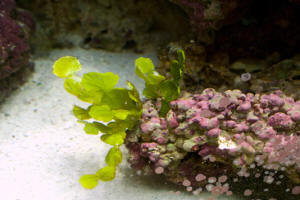
11/29/09 Possible error? 9/2/09 BLEACHED CHAETOMORPHA 4/1/04 Hi gang: I have two large-ish collections of macro algae sharing a common sump, aside from a 105 gal main reef. One is for a sixty gallon tank, with bright light, a rose BTA, and a pair of clownfish -- all doing well. In my fishless refugium, I have a mass of Chaetomorpha that's gone from a pound to ten pounds in the past several months. High growth rate due to excess nutrients in my system. . . I've added a DSB which has now matured into a great nitrate-processing machine, but this growth was mostly during its 'break-in period'. I was dosing Kent iron, but my supplement bottle was over a year old. . . and when the Chaeto started paling I realized the rusty color of the supplement probably meant the iron was no longer bio-available. New growth on my Ulva (lettuce) in the display tank began paling soon there after. I ordered a new bottle Ken iron. . . which is decidedly paler/yellower in color (a good thing, as I understand it). <I'm not sure about the color of the supplement vs. bioavailability. Certainly more red/brown is more oxidized.> My question is: Is the 'pale' Chaeto likely to generate more chlorophyll and 'green up' over time, or should I cull the paler growth (which is most of the total) and start over? <I suspect that the "bleached" parts won't recover. Also, considering how fast this stuff can grow and that it extracts nutrients faster while growing, I would hack out all of the pale stuff.> Water quality is otherwise good. . . Nitrates 0, Nitrites 0, always some ammonia in my system though. Ph varies from 8.1 @ night to 8.3 during later 'daylight' on the reef. <I'm suspicious of the ammonia reading and would suggest verifying this with another test kit.> Same question goes for some red calcareous algae I've managed to bleach. . . but this was because I hadn't read the WWM FAQs. . . which outline how little light the reds seem to want relative to green (and even brown) algae. <Coralline algaes go through many changes based on lighting, water movement, alkalinity and other conditions. Others will move into the empty space.> Lest you think I'm busy abusing various marine plants, I've got small quantities of about a dozen other species that are doing great. Codium, Halymenia, red Dictyota, yellow Dictyota, red grape, etc. (No Caulerpa though!) Thanks in advance for any help on this. Chuck <Getting a head start on the burgeoning macro-algae craze! I suspect that many will soon share your interest in these beautiful and useful algaes. Best Regards, Adam> Chaetomorpha question 11/10/04 In Today's Q/A there was mention of Chaetomorpha and to allow it to roll around. Is this a part of the requirements for successful growth of this plant? <Chaetomorpha does not root and does best when it is not allowed to simply lay on the bottom of the tank, but it is very forgiving. I have successfully grown it without keeping it suspended. IME, the most important thing is to thin it often and not allow it to become too dense. HTH. Adam Macro Algae...Which Chaetomorpha? - 06/07/05 Eric, <<Paul>> Thanks for your reply. <<My pleasure>> To control unwanted diatoms and algae, I hope to find a macro algae that can keep phosphate and nitrogen levels low. <<Most any of them will do this>> I haven't considered a macro algae that absorbs silica but the idea is intriguing! <<I may have confused you here...I'm not aware of a macro algae that will absorb/control silicates to any extent.>> My refugium is bare-bottom because the main tank already has a deep sand bed with "wall-to-wall" live rock. <<Understood. I just believe "more is better." But that be me <G>.>> So my "ideal" macro algae will keep nutrient levels very low and be able to thrive while floating in suspension. <<Then Chaetomorpha is a great choice. Easy (relatively) to keep, much less noxious and prone to sexual reproduction than Caulerpa species.>> You suggested Chaetomorpha linum. All of the suppliers that I have dealt with have no idea what species of Chaetomorpha they have in stock. Do you know of any website retailers that specifically carry Chaetomorpha linum? <<I'm no expert on macro algae, but I think you have little concern here. Though there are several species of Chaetomorpha (cannibina, antennina, linum, etc.), all would likely serve the purpose equally well. Chaetomorpha linum seems to be the most commonly available is very likely what your suppliers have on hand.>> Thanks very much. Regards, Paul. <<Very welcome. Eric R.>> Greens-Caulerpa and Halimeda... competition twixt Algal Divisions 7/30/06 Hey Crew! My main tank is incredibly healthy-90g with 60kg live rock; ammonia=0, nitrite=0, nitrate=0, calcium=360, pH=8.1. This tank is home to 4 Nemos, 1 eibli, 1 flame hawk, and 1 blue ring angel. <Will need more room... soon> It also contains 9 turbo snails for which there is barely enough algae to feed. Every piece of live rock has patches of beautiful purple encrusting algae. No green algae seems to grow in it. This leads to my question. My quarantine tank has nice patches of Halimeda, grapelike Caulerpa, and caterpillar weed. I would like to transfer this algae into my main tank. However I am under the impression, from reading many FAQs, that green algae needs nitrate to flourish. So, if I was to move the macro-algae into the main tank, is it likely to survive or will it die? <Conditions there favor/ing the encrusting Reds will likely preclude the Greens doing well> In the beginning (about 1 year ago) the tank was left for about 4 months to cycle and even in this time, no green algae grew. <Likely your lighting, supplementing habits...> I have moved some hair algae covered rock into the main tank previously and the hair algae slowly disappeared. I started off doing weekly water changes but have since begun doing fortnightly water changes in the hope I might get some nitrate, but it just won't happen! Thank you! <Mmm... like some folks lack of understanding re whether the world's terrorist population is static versus dynamic, you do have nitrate being produced... and readily absorbed... I would feed some of the Greens to the fishes here expressly, and/or offer dried human-intended products of same for the purpose. Bob Fenner> Chaetomorpha 7/15/06 Hey Crew. <Hello Wayne> Your site is great! A great service you are all providing! Keep up the great work. <Thank you.> A quick question for you that I couldn't find the answer to on your site. I've had a 40 gal refugium setup now for 6 months, supporting a 120 FOWLR (with softies). I bought a softball size of Chaetomorpha to start and it has not grown at all. It hasn't died either. Over the past few months, I've resorted to buying more and adding it to the refug. None of it has grown. I have a 40watt pc, 3"sandbed, live rock, and a powerhead to keep circulation. The Chaeto is not tumbling, and I can't seem to get it to do so. It's suspended at the surface by the flow from the powerhead, otherwise it sinks. <I've attached Chaeto to live rock with a rubberband and it grew fine.> I've always struggled with algae growth in my display. Any ideas that would help the Chaeto grow? My LFS suggested I add iron to the tank. I did so for 2 weeks, and hair algae is starting to grow in my display, without any noticeable growth in the Chaeto. The livestock in my tank won't allow for a cleanup crew. <No cleanup crew adds to the problem you have. Food should be fed sparingly, that is, feed only what the fish will eat. You will have to resort to siphoning out any uneaten food and/or waste to minimize nutrients which will become a pizza party for nuisance algae. Do read here and related links for help on controlling nutrients/algae in your system. http://www.wetwebmedia.com/nutrientcontrol.htm> Water parameters are... Nitrate - 0 Nitrite - 0 Ammonia - 0 PH - 8.3 Calcium - 400 Phosphate - 0 Thanks for your reply! <You're welcome. James (Salty Dog)> Wayne Halimeda Leaves 7/13/06 Dear Crew, <Paul> I have two questions regarding a batch of Halimeda leaves that has accumulated on the surface of my otherwise sugar-fine aragonite substrate: <Okay> (1) Will the leaves trap detritus and contribute to a high nitrate & phosphate problem? <No, not likely... in fact...> (2) Will the leaves harbor small organisms that can sustain a Mandarin Dragonet should I acquire one? <Will likely help, and...> In other words, I am trying to determine if the dead Halimeda leaves have any usefulness before I siphon them out. <I would leave them, enjoy their beauty and utility. Are almost completely calcium carbonate... of good shape...> My tank is a 75-gallon reef tank with plenty of live rock, coral, anemones, and 12 small (2" long) fish that unfortunately don't eat algae. I've had 20 of these fish (Blue Damsels, Pajama Cardinals) but I've recently reduced the fish population to 12 in an attempt to control high nitrates, phosphates and hair algae. There is also a 29-gallon refugium with a small batch of Chaetomorpha that does not grow as fast as the algae. Thanks very much, Paul. <If we could easily harvest such calcareous material and offer it as purposeful substrate... it would sell. Bob Fenner> Growing Caulerpa algae 7/7/06 hi, <Hi> I want to have a lush growth of Caulerpa green macro algae in my tank... I have a fish only tank with live rock.. its 90 litres capacity. <... please use spelling, grammar checkers...> Will adding snails or hermit crabs to control the slime and green hair algae, affect the growth of my Caulerpa algae, as I doubt whether the snails and crabs will consume the Caulerpa? <Impossible to state, guess, given the information presented. Please read here: http://www.wetwebmedia.com/caulerpaalg.htm and the files linked above. Bob Fenner> Please advise. Thank you, Anup Macroalgae Selection 6/13/06 Hello <Hi there! Scott F. here today!> Do you have an opinion on any type of macroalgae that can be used decoratively in the main display? Someone has suggested Halimeda from Live aquaria. John Arenz <John, as long as you are maintaining sufficient calcium and light levels in your system, I think that you'll do fine with this macroalgae. It's one of my personal favorites!> Marine macro algae, Mandarin systems 6/11/06 Hi Bob, <Sadanandan> I have a 90 litre marine tank with live rock.... My main aim to grow Caulerpa species of macro algae.....(green type) I have two fluorescent tubes....15 watt SunGlo (Hagen) and 15 watt actinic blue for the tank.... I have placed the algae... at the top most of the tank so the are the closest to the light.... <Most Caulerpa species do better "rooted" to/in the substrate> I just have a mandarin fish <Hard to maintain sufficient live foodstuffs in a twenty some gallon system for this...> in this tank and a single damsel (yellow tail damsel)... and I am not intending to add more fishes to the tank.... Is this light sufficient to help the algae grow? <Should be able to adapt to this make-up, intensity, yes.... though I'd switch out the actinic for more "white"> The tank has been cycling without fish for a month and the two fishes are there for a month now. I added the Caulerpa yesterday only. Parameter of my tank: Ph 8.3 0 nitrite and ammonia 10ppm nitrate. What other parameters are crucial for lush marine algae growth? <Do need some other micro-nutrients (e.g. soluble phosphate), sufficient and stable alkalinity, biomineral content...> Do they require bright light? <Variable by species... some do, some don't> One other question I have is the mandarin I have is a female.. is it advisable for me to add a male mandarin fish the same size or slightly bigger to the tank? Will they quarrel? <... not a good idea> Thanks for your wonderful support for my previous queries... Dr. Anup <Please read here: http://www.wetwebmedia.com/mandarins.htm and the linked files above. Bob Fenner> To-may-to or to-mott-o ... Chaetomorpha pronunciation 6/10/06 Hey wet-guys and gals, <Eric> Got a simple question for ya. How do you correctly pronounce "Chaetomorpha?" <"Key-toe-morph-ah"> Thanks, Eric <Bob Fenner> Would Chaetomorpha help during tank cycling ? 5/29/06 Ohio Gozaimasu Crew ! <And good morrow to you> I have been thinking(<==always dangerous) <Less than always feeling> about how to bolster the cycle process in my AquaPod 24 tank. My 'cured' LFS Fiji live rock went in last night after spending ten minutes each in a super-salinated (1.050) bucket followed by a distilled water soak. Vigorous swishing and scrubbing left both buckets so nasty that half way through the 22 pound box I stopped and replaced the water. Some of the obviously dead, decaying soft matter left me really appreciating the heavy neoprene gloves I was wearing while I scrubbed it off. Right now the LR is simply sitting on top of the DSB and a PVC frame. Aquascaping for esthetics will wait till the tank is properly cycled. Having gotten all the LR into the tank I made sure that the heater, powerhead and skimmer were all working properly and went to bed. This morning I tested the tank's water parameters and found that 'shocking' changes had occurred overnight: Ammonia 0.2 (was 0) Nitrate 35 ppm (was 0) Nitrite 0.3 ppm (was 0) Phosphate 0.1 (was 0) pH 8.3 (unchanged) Alkalinity 5.5 (unchanged) Temperature 78 (unchanged) Salinity 1.025 (unchanged) Skimmer cup empty <All about right thus far...> Retesting late this afternoon the numbers were essentially unchanged. <The alkalinity and pH will drop soon... Nitrogenous compounds increase...> After spending the last 2 1/2 (very pleasurable) hours Googling my way around WWM you can imagine my relief to be reassured that these 'instantaneous' changes in water chemistry are completely normal as a new tank begins the cycling process. <Yep> 20 gallons of buffered and aerated water with a SpGr of 1.025 are at the ready while I monitor the ammonia and nitrite levels like a hawk. Any readings above 0.8 ppm on either will trigger a change of 50% of the water, followed by re-testing twelve hours later. <Very good> Then, while fussing with the airstones and powerhead trying to ensure even water flow, an inspiration struck. I currently have the tank lights off because I subscribe to Anthony's advice that leaving them off will minimize the growth of nuisance algae during the curing process. <Some are of this opinion... I am generally not> Two of my synapses shorted out and I thought "Nitrogen + Phosphate can be controlled using a macro algae like Chaetomorpha (which I was planning on adding anyway)". If I were to add a 5 inch clump of Chaetomorpha (sp) available for less than ten bucks at the LFS, and then started a 10 hour light cycle, would that help or hinder the curing process ? <Maybe... it might "just die" or be overwhelmed by chemical changes, out-poisoned-competed by BGA et al.> Thumbing through my college Botany book it appears that these compounds which are toxic to the Kingdom Animalia would be ideal 'munchies' for a member of Kingdom Plantae. <Many, not all> Or so my 'reasoning' goes. Any thoughts/observations ? I certainly don't want to interfere with the establishment of viable cultures of Nitrogen-fixing bacteria but would really like to help ensure that the toxicity of the tank doesn't threaten the viability of the desirable organisms currently tenaciously clinging to life deep within the crevices of the live rock. And, maybe, save a few bucks in salt mix and buffering compound. <Mmm, well... the most "trouble free" process involves darkened curing conditions, time going by... but all can be expedited, much life spared by monitoring, doing the water changes you mention... Worth trying the Chaetomorpha though> Sayonara, and thanks once again for being willing to do all the 'donkey work' involved in keeping up such a great site ! John <Eeee haugh! Bob Fenner> Chaetomorpha Competition 4/18/06 Hi Crew, <Scott F. your Crew Member today!> I hope you are all well? <Yes, thanks! Hope you're doing okay, too!> I have a problem with my Chaetomorpha in my Miracle Mud sump, the Chaeto has been in there for about 2 months (shortly after addition of cured LR) I obtained Chaeto from two different sources which left me with what appears to be 2 different varieties - one with quite fine strands & the other with thicker/stiffer strands. The mud area in the sump is 11"x10" with a water depth of around 10" over this is hung a 20w Power compact spot lamp @ 6500k 24/7 currently due to Caulerpa. I estimate around 1000 to 1500 litres per hour throughput in the sump (carbon & Polyfilter in flow also). From my research during the design of the new system I believe these conditions should be ideal for Chaeto (however please do comment if you see any problems thus far). <They sound just fine to me.> Bio load is currently low in the tank (200 litre main tank) with about 26Kg LR, 15 Dwarf Hermits, 5 Nerites, 15 Nassarius, 2 Cleaner Shrimp some Xenia moved from my old tank (still running thanks to you guys) and 4 very small frags (Monti & Acro) which were earlier than I intended but... also there is algae of various sorts on the LR here (small amounts proceeding through succession I assume) The problem is that the thinner stranded Chaeto has been rotting - individual strands (which I understand are single cells joined end to end) have been losing their green pigments and becoming see-through with a general descent into a mushy mess. I have read that Chaeto should "tumble" in flow & despite the good flow through the sump this behaviour eludes me! This said there seem to be plenty of people who don't tumble Chaeto with good results. <I am one of them. To be honest, I have never tumbled Chaetomorpha, and have used this macroalgae for years with great results. It's important to have decent flow going through the dense matrix of fronds, to prevent buildup of debris and detritus, but I have never tumbled the stuff, and I don't personally know anyone who does. I've heard this assertion a lot on the 'net, and I'm not certain how this got started. Perhaps there was some confusion with Gracilaria, which absolutely should be tumbled for maximum success.> Strangely the thicker more wiry Chaeto appears to be fine (however there are no signs of growth). I have removed all of the Chaeto which was rotting & left only the healthy looking stuff (having first picked out all the beneficial life forms I could - waste not want not!! ;o) so I now have only a little handful of the thinner Chaeto In addition I have read that others Chaeto "floats" at the waters surface - mine however prefers to sit on the mud bed surface. <Largely a function of the density of the stuff, I guess. Mine has always sort of floated just below the surface. As long as it gets decent light and flow, and is not clogged with debris, I don't think that it matters, really.> Now I have a theory here which I wanted to run by you good folks. In the mud sump in addition to the Chaeto there is a small amount (handful) of Caulerpa (C. prolifera I think) which came from the same source/sump as the more wiry Chaeto - this seems to be growing fairly well with new green shoots visibly growing over time. Is it likely that this is releasing toxins to the water which are causing the dieback of the Chaeto? If you really think this is a likely cause I will rip the Caulerpa out & toss but I would rather not do this without a fair chance that this will resolve the issue as I don't want to find that I have no viable Macro in the sump of any variety. <A very interesting theory, although I don't know if it is caused by chemical issues. I'm thinking that it may really be more of a case of simple competition for light and nutrients. Caulerpa grows faster and more aggressively than many algae, such as Chaetomorpha, and it simply may be outcompeting the more delicate growth form of Chaetomorpha, or simply blocking out light and flow. There are other, well-documented reasons to despise the stuff, IMO, so I'd try to get out as much of the Chaetomorpha as possible.> Any suggestions? <As above. Also, I'd probably just stick to one form of the Chaetomorpha, since once it's growing, it can easily dominate. besides, you'll be able to harvest large quantities of Chaetomorpha for nutrient export, and to share/trade with other hobbyists. The stuff is always in demand. Besides, Chaeto is a great "substrate" for an amazing diversity of life (like amphipods, mysids, and even tiny brittle stars).> Many thanks as always & apologies for the rambling email but I have tried to give all pertinent information (if there are any further details I can provide please do ask) Cheers Chris <Thanks for the detailed information, Chris! It certainly helps us do a better job for you! Good luck! Regards, Scott F.> Wanting to grow green algae, macro, SW 4/14/06 Hi there James <Hi Matthew - Tim answering your question today!>! My tank is very healthy at the moment and everything is going well except for one thing. I can't get any green algae to grow. <Ah yes - I suppose it is true what they say - the grass really IS always greener on the other side... or perhaps in your case, the algae is always greener in someone else's tank! In all honesty, you are incredibly lucky not to have to deal with green algae problems - others would do anything for coralline algae whilst they fight a never ending battle against green algae!> I'm trying to get some Caulerpa or Halimeda growth but nothing is coming up. <In the case of these macroalgae you will almost certainly have to introduce them intentionally - i.e. purchase them from your LFS or obtain some from a fellow aquarist. With appropriate lighting you will find that even a small branch will quickly grow into a respectable plant.> I have an abundance of purple encrusting algae. Does this stuff use up all the nutrients that the green algae would otherwise use? <They will compete with each other - but lack of nutrients is not typically a problem in the home aquarium, quiet the contrary.> I do like this purple stuff but I would really like a few greens. Also, the fish in my tank are not algae eaters. Thanks for your help. <Best of luck! Tim> Re: Growing green macro algae - 04/14/2006
Thanks for the ultra quick reply Tim! <My pleasure!> I guess
you're right about the algae. Most people would prefer the purple
stuff. <I know I would! Cursed green hair...> I only have you
guys to thank, because before I set up this tank I made sure that I
read through all the relevant articles on your site. It's worked a
treat! <Thank you very much - your compliments make our efforts
worthwhile!> I know how hard it is to get rid of green
hair algae because it overran my old tank. That tank is now my
quarantine tank <Excellent to hear - a QT is undoubtedly one of the
best investments to make!> and it does have one branch of Halimeda
starting to grow in it. <Which you will in time be able to use to
start growth thereof in your main tank!> |
|

|
Features: |
|
| Featured Sponsors: |
.jpeg)