|
FAQs on Marine Water Quality involving
Phosphates, Importance
Related Articles: Phosphates in Marine Aquarium
Systems by Marco Lichtenberger, Phosphates in
Carbon; An analysis of the phosphate content of activated
Carbon by Steven Pro, Ammonia,
Nitrates, Nitrites, Silicates, Marine Chemical
Filtrants,
Related FAQs: Phosphates 1, Phosphates
2, & FAQs on Phosphate: Science, Measure, Sources, Control, Chemical Filtrants, Troubleshooting/Fixing, & Nitrates,
Nitrites, Ammonia, Silicates, Avoiding Algae Problems in Marine System,
Nutrient Control
and Export, Algae Control, Marine Maintenance,
Alkalinity, Chemical Filtrants,
|
Remember those "high energy" molecules
from Kreb's Cycle in H.S. Chem.? ADP, ATP... Phosphorus,
phosphate is an essential element/molecule. OTOH, Too high
concentrations of soluble phosphate can lead to algal problems
which in turn... and retard calcification in biomineralizing
life.
|
Stubborn Nitrites... Another case of zip [HPO4]
5/8/17
Hello Crew! Thank you for all of the advice over the years. Your site
has been an invaluable resource.
<Ah, good>
I'm having a problem with stubbornly high Nitrites after (during?) a
cycle for a quarantine tank and I'm out of ideas.
<Well; quarantine systems tend to be unstable, disallowing establishment
and ready metabolism of beneficial microbe populations... Do you have
sufficient biomedia, circulation about it to sponsor nitrification?>
QT is 20g, HOB BioWheel filter with bagged carbon and GFO
(there was a Phosphate issue from uncured dry rock in the display tank).
<Is there still "some" soluble phosphate present? You NEED some
for microbial conversion of Nitrite to Nitrate... Re-read that last
statement>
Also has a small skimmer as I intend to follow the mantra "Quarantine
everything, corals and all" with this new display tank (150g). QT is
bare bottom except for some pieces of pvc for hiding spots and tests at
0 Ammonia, 20 Nitrates, 2 Nitrites, 0 Po4,
<Bingo: Here's at least part of the problem. Remove most/all of the GFO>
480Ca, 9dkh, and 1250mg.
We use water from the display tank for water changes (was an attempt to
seed, but also a way of acclimating the critters to heir eventual
conditions. Currently the only inhabitants are 3 Scarlet Reef hermits.
Nitrates are coming down (artificially high from early on when the both
tanks were showing 100+ Nitrates.... DT now shows zero after water
changes and a little impatient Vinegar dosing).
<Won't help>
What is NOT moving however are the Nitrites. They've been floating
between 2-3 for weeks. The QT has been running for almost 2 months and
they just won't come down. I've tried everything. I've even added
SeaChem stability to the area behind the Filter wheel in an effort to
directly add <sic, aid?> the bacteria necessary. It just won't come down
(but isn't going up either). We are doing water changes, but only @10%
weekly. I know that a
bare bottom tank takes longer to cycle, but this just seems absurd. I
would have expected a spike and then drop over a longer time. Not a
constant 2-3ppm with no movement. The kit is Salifert, brand new, and
tests fine at 0ppm on the DT as well. I'm completely out of ideas. Any
thoughts? I know Nitrites are not as bad for marine organisms, but I'm
not relishing the thought of subjecting a really cool frag to Nitrites
just because I can't get this thing to fully cycle.
<Your situation is very commonly misunderstood. "Some" phosphate
is absolutely necessary to all life... part of DNA, RNA,
Phospholipids in every cell... ADP, ATP energy transfer molecules... AND
conversion of NO2 to NO3... The (over) use of chemical filtrants has
killed more livestock than pathogenic disease. Remove the rust and you
will find your nitrite gone in short order>
Thanks again!!
~Frank
<Glad to help Frank. Bob Fenner>
Reef Tank Nutrient Balancing
11/11/14
Dear WWM Crew (Bob),
<Hey Wes>
First of all, with the advice you provided some time ago
(http://www.wetwebmedia.com/movaqfaq5.htm, 9/1/14 post), I safely
transferred over all my livestock and rocks to their new, roomier home
(although now I see what a difference this makes, I now wish my new tank
was 240 gallons instead of 240 litres). Although it is still early days
(2 weeks), everything survived, is currently alive and my corals are
beginning to calcify: my corals, critters and I would thus like to send
you our collective gratitude for your help.
<Ah, welcome>
I wonder if I could trouble you for some more advice? My basic situation
is that despite starting regular feeding, my reef-tank setup appears not
to be accumulating measurable levels of nitrate and my phosphate has
additionally remained low.
<Happens>
I guess the available advice (including on WWM) about this appears to be
quite conflicting, but would I be right in thinking that even for more
autotrophic corals, a low, measurable level of both would be advisable
over undetectable levels?
<Yes; almost always so>
My question thus relates to how I should manage nutrients in my tank.
<Need to ask a question in return... is "all okay?". IF all organisms
appear to be doing fine... I would not fret here>
A summary of my (hopefully relevant) tank conditions are as follows:
It is a 240l tank with 35kg live rock and 0.5in SSB + 80l refugium
containing a 4in DSB (total water volume is approximately 285l-295l). LR
is well established with populations of various microfauna, filter
feeders and macroalgae (although the latter is not currently growing
excessively). The system is 2 months old from the end of cycling right
now, but half the rock is from my previous system and at least 9 months
old. I think the tank is understocked (6 small captive-bred "SPS"
colonies, 5 Lysmata shrimps, 10 trochus? snails and 3 Cerith? snails, no
fish) although I have been feeding a home-made meaty ration for my
corals/filter feeders every night for the last 10 days. I am running a
Tunze 9006 skimmer (rated to 600l) full time but this appears not to
skim all that much (no more than 200ml of dark skimmate per week).
<Again; fine>
There has always been a certain amount of detritus in the tank,
particularly in the refugium, which has become a settling tank of sorts.
I currently aim to change 5-10% of the water or thereabouts once every 2
weeks. Regular testing over the last 14 days has shown no
ammonia/nitrite, nitrates consistently undetectable, and phosphates
decreasing from 0.1mg/l to somewhere around 0.03mg/l (both relatively
new Salifert test kits). I challenged the system once with about
0.25mg/l NO3 using potassium nitrate (apologies for lack of subscript),
<No worries>
but the level fell to undetectable within 6 hours and I dared not add
more. The nitrate kit appears to be relatively accurate based on testing
the diluted stock solution in RO water.
<Ok>
Otherwise, the main tank circulation is temporarily reduced to 8000l/hr
from 16000l/hr as a snail broke my Vortech mp40 yesterday by going
inside it while it was off and jamming the propeller when I started it
up (ironically, said snail is completely fine. Grrrr!!!). Lighting is a
custom LED build definitely sufficient for at least macroalgae if not
corals. I dose using a three part system for Ca, Mg and alkalinity to
advisable levels for a reef tank, although may also now add some
Kalkwasser occasionally to counteract the high CO2 levels/relatively low
pH (8.0-8.1 sometimes, rises on aeration with outside air) in my tank
water.
So, broadly then, the question: What method(s) would you recommend to
maintain a sufficient, yet healthy level of nitrate and phosphate for
stony corals, and what levels would you aim for?
<Just what you're doing right now...>
From my reading, there are a number of different ways to accomplish this
(and of course, most marine tanks have the opposite problem), so what is
your opinion on the following strategies?
1) Increase feeding (gradually) to a level that generates detectable
nitrate. If I do this, would I need to use GFO to remove phosphate if it
starts to rise too high (say above 0.1mg/l) compared to the nitrate?
<Could do>
2) Decrease removal of the detritus from the LR and sand beds. Would
this set a dangerous precedent in terms of building a nutrient reservoir
that may later on cause the tank to crash?
<I wouldn't do this>
3) Put a small mechanical filter in to catch detritus and deliberately
not clean this (although detritus is still removed as normal from the LR
and sand bed).
<Nor this>
4) Reduce the amount of time the skimmer is running. Would increased
levels of DOCs as a result of this be harmful to stony corals?
<Could try; not likely harmful at all>
5) Dose nitrate directly in the form of potassium nitrate.
<Unless there was a demonstrable reason to do this... I would not.
Instead I'd rely on your feedings>
6) Increase the bioload with more livestock (I guess option 1 would do
this by increasing LR microfauna, but I don't know if this is comparable
to say, a small fish).
<Food in... excess energy... has got to go somewhere>
7) Reduce water changes or only change when nutrient levels rise. Would
I theoretically be risking micronutrient depletion from the water over
time?
<I'd stick w/ your current regimen>
8) A combination of some of the above (it's probably this, if anything,
but hopefully you've already suggested your preferred methods in the
individual feedbacks above).
<As stated above>
9) The opposite of all of the above: try to maintain water quality (aim
for undetectable nitrate and phosphate), export as much as possible,
keep a low bioload and feed minimally to a non-polluting level. In this
case, it implies feeding provides sufficient levels of bio-nutrients for
corals and microfauna and you don't want additional free inorganics in
the water if this can be avoided, since this is the situation in the
wild.
Any other suggestions?
<Just to enjoy your system, investigating the processes there in>
Also, I appreciate the anecdote in the last email you sent to my other
address post-donation; it would be a dream come true if one of my
relatives owned a successful marine aquatics business, but I suspect I'm
not closely related to the owners of All Seas Marine, and we're of
course separated by the Atlantic, which is inconvenient. That said, one
can dream about it. Maybe if my career in medicine doesn't work out, I
could go into professional coral-keeping and propagation. :)
<One never knows... as in soccer/futbol, best to keep ones passing lanes
open>
Many thanks for your time,
Wesley
<And you for your sharing. Bob Fenner>
Re: Reef Tank Nutrient Balancing
11/11/14
Dear Bob,
<Wes>
As before, your response speed is crazy. I guess you're at your
computer, but still, I can't even get to my LFS and back in this time. I
really appreciate it.
<<My question thus relates to how I should manage nutrients in my
tank.>>
<Need to ask a question in return... is "all okay?". IF all organisms
appear to be doing fine... I would not fret here>
As far as I can see, yes, everything that can move is actively out and
about at night, and my corals are showing polyp extension/mesenterial
filaments particularly on food addition.
>Ah, good<
<<So, broadly then, the question: What method(s) would you recommend to
maintain a sufficient, yet healthy level of nitrate and phosphate for
stony corals, and what levels would you aim for?>>
<Just what you're doing right now...>
<<Any other suggestions?>>
<Just to enjoy your system, investigating the processes there in>
LOL. A very polite way of saying I am worrying too much about my tank.
Advice taken.
Thanks for the helpful feedback.
Wesley
<Cheers, BobF>
The most difficult question. Coral hlth.
issues; some poss. influences, corrections
12/13/13
Hello again Mr. F.
<Andrei>
how are you? I hope all is fine with you .
I have a very important question: what is wrong with my system?
Let me explain: my 250 gallon display was set-up 1 year ago. 220 cm
long, 70 cm wide and 70 cm high. Sump, AquaMedic aCone 3.0 skimmer rated
to 3000 litres, biopellets reactor, antiphos reactor, active carbon
reactor running 24h. Ozone , full line apex Neptune system computer with
the following readings: ORP 350-390, pH 7.9-8.1 , temp 25.5-26.5 and
salinity 34.5-35.0.
Calcium reactor, kH 7.2-8.0 , Ca 420-450, Mg 1280-1300.
History: maybe you remember all my inquiries about crypt and fish
disease after my initial ordeal
<A good deal; yes>
With all my fishes dying in the first month because of crypt and
Oodinium, I have spent hundreds of hours reading and learning. I now
have Coral magazine subscription ( maybe one of the very few in Romania
) and dozens of books all read. About fishes , I now have all the fishes
I restarted the system with, P. Hepatus, Chelmon rostratus, A.
Japonicus, pair or mandarins, Z. Xanthurus, Naso lituratus, P.
Imperator ( juv. ) all 10 months now in the system and a beautiful Z.
Cornutus six months now in the tank, all doing very good. So lesson
learned there. ( I have 3. Quarantine tanks , I always perform fw dips
with Methylene blue etc )
<Good>
4-5 months ago I started introducing SPS corals. I always knew I wanted
a SPS dominated tank with these beautiful fishes I already have ( only
one P. Diacanthus is missing but I will get there also..) then the
problems started. I discovered that I had high nitrates: about 20 on
Salifert test so I started the maintenance program: got rid of the 2-3
cm sand in the DT because of the wrong depth, siphoning of the sump,
changing the media in the reactors etc. I bought some more corals, some
Acropora, some more Montiporas, Stylophora.. Because of a faulty
salimeter ( the paper with the scale moved inside the glass ) the
salinity went to 43 and lots of corals died or dying .
I slowly went back. After that, in September I drilled my pavement and
installed a 300 l refugium with 18 cm sand bed and Chaetomorpha in the
basement with reverse light schedule. After 3 weeks I installed another
200 l tank there with live rock. At the beginning I had some problems
with keeping levels of water ( maybe you remember our discussions )
so the salinity varied 1-1.5 points daily for some weeks.
Before installing the calcium reactor I had some variations in the
levels of kH and Ca. , 1 month ago.
After that I thought everything was stable, so I introduced some more
corals. But I kept losing some of them. Apparently lots of
Montiporas digitata died and also some Acroporas. In November, after the
last addition on sand in the RDSB and some more live rock the
Cyano started. I had to leave for one week and when I come back
more SPS were lost due to Cyano this time ( even thou my friend was at
my house every day feeding and cleaning the Cyano).
<I'd throttle back your carbon additions. In fact, I'd remove the
bio-pellets entirely. This/these are likely driving your Cyano problem
here>
So when I come back I reduced the lighting for the T5 ( I have an
AquaMedic 3x250 w CoralVue ReefLux 14000 K plus 4 T5 x 80 w ATI 2 white
2 blue ) turning them off . ( they were on 12 hours ON ) . I only kept
the MH. The Cyano receded , every day I clean it and blast with a 1200
l/h pump every rock and coral. But it continues to grow on some corals
killing them.
I fragged some of the Acropora and the frags until now seem to be doing
fine . But every day I discover that another SPS coral is declining.
Other values : nitrates : 2-3 Seachem test
Phosphates : <0.01 Salifert
<Not an issue; in fact, I'd feed more to increase>
Silicates : 0
About the lights: after turning down the 4 T5 I have seen lost in
coloration also in otherwise hardy corals : Montipora plates , so I have
turned them on again and I have measured the PAR readings : bottom 150
-100 between bulbs, middle 230 and top 400. Under the bulbs 1100
micromols/m2/second. . But before turning on again the T 5 (2 days ago )
the readings with only the MH were seriously lower ( 40-60 bottom
between bulbs ).
In the meantime I have lost some Acropora that was with me for 10 months
and survived all that. But there are some Montiporas and some a
Acroporas frags that appear to be doing great so far. I have colonies of
Stylophora and Porites that are ok.
So, why am I loosing SPS corals? Is the stability of the system?
All the changes I have done? Is there something wrong in the water even
if I get all these " normal " readings?
<Toxicity from the Cyano likely is number one; perhaps a lack of
chemical food (too little soluble phosphate) is an issue as well>
It gets pretty frustrating because is not only the money ( by the way
water movement is done by 4 Vortech MP 40 ) but all the energy and study
time ( we have 2 kids 2 and 5 years old so time is important)
<It always is my friend. An important "lesson" in life is to learn how
to portion ones attention. "First things first"... your own health,
happiness; the family and friends about you... petfish are way down the
line of importance>
and the willingness that I feel I am starting to question. I feed
the fish 4 times a day ( defrost and rinsed Mysis and krill and
bloodworms, spectrum pellets, Nori and Spirulina and 2 big fresh clams (
I think this is the term, the black shells) that I keep in my hands
until everything is eaten. All the fish eat a lot and they are fat. But
I arrived in one point when I look away from the DT when I pass by, just
to avoid seeing sick corals . It was not easy at all, all my friends
consider me strange at least do all this for a reef tank, even if they
like it when they come by. Keep in mind that I live in eastern Europe
where LFS are far away and don't stock livestock, and for example a A.
Japonicus costs 250 $. For me, having a SPS tank would mean that all
that I have done is worth it, but something is wrong, and I am not sure
what it is. My wife is supportive, but I would really want to see some
results .
So in conclusion I feel that I have done a lot of efforts and at the
moment I cannot see the results, so it seems it is very difficult, but I
see a lot of successful tanks done with maybe less efforts and I am
wondering what am I missing.
Thank you for your patience,
Andrei in snow covered Romania
<BobF in (today) sunny S. California. Do remove the carbon additions and
increase the feedings>
Re: The most difficult question. More Biology, Less "Technology""
12/14/13
Hello Mr. F
<Mr. Andrei>
thank you for your answer. I will stop the biopellets reactor, I
was just not sure if my RDSB is mature enough to handle the
denitrification by himself,
<You'll likely see no change in NO3>
my plan was that when the nitrates would arrive to zero I would stop the
biopellets .
About the nitrates, increasing the feeding sounds great, but aren't they
the ones that fuel the Cyano?
<Not necessarily, no... see WWM re the several inputs here>
Shouldn't the desired levels be zero absolutely?
<Never. The chemo-autotrophic life (e.g. corals, many microbes,
algae... ) NEED some/measurable nutrients, including nitrogen compounds
and phosphate>
Because I also have a anti phosphates reactor running as well... If the
chemical food might be missing for the corals,
<Yes>
maybe I should feed more amino acids and vitamins ( I do it like once
every 10 days half the dosage ).
<Am not a fan of such reactors in most settings... "More Biology, Less
"Technology"" Is my motto here. B>
Thank you again,
Andrei
Re: The most difficult question; further input re a/the
mysteries of too much, too little and out of balance nutrient issues
12/14/15
Hello,
Thank you. The biopellets are off.. will see what happens. I took the
biological route for sure, with the refugium and live rock tank.
What about all the beautiful tanks in several ' tank of the month '
editions that report zero NO3 and PO4 ? Normally you don't see any
outstanding SPS tank presented that has any detectable nutrients.
<Mmm, allow me to "try" explaining: All systems have something/s that
are "rate limiting"... An example, let's think of you and I and our
desire for more "stuff"... We're likely limited by funds/money... Most
aquarium systems have a nutrient limitation... but it is not often
well-understood what this is (a topic of huge possibilities): Your
system is likely being "too driven" by an excess of available carbon...
which is fueling the BGA/Cyano, that in turn is poisoning your stony
corals... I am hoping by limiting the carbon and allowing sufficient
simple nutrient presence, to have your Scleractinians (et al.)
outcompete the Cyano. Now; as to those other systems that are in
"apparent balance"; they have NO3 and HPO4 limitation... BY the desired
organisms taking these up readily; NOT by their reactor/media removal>
I think this is very important. Lots of people out there would benefit
from understanding these basic philosophies.
<Ah yes; I do so agree. Do you understand me above here?>
Please consider that I want nothing less than the most beautiful SPS
tank with colors and corals health. I am willing to invest time, energy,
and money. What would you recommend as optimal values for NO3
and PO4?
<Low, but still measurable.... a few ppm for [NO3], and 0.05-0.01 ppm or
so for [HPO4]>
And after my system description do you think I would need anything else
as hardware or technique?
<Mmm... likely THE best investment in your study, gear is an
understanding of RedOx potential, perhaps an investigation into ozone...
>
Thank you,
Andrei
<Thank you Andrei. BobF>
Re: The most difficult question 12/14/15
Oh, and this reading:
http://www.wetwebmedia.com/ca/volume_5/volume_5_3/phosphates.htm
Re: The most difficult question 12/14/15
Tank you, I understand.
<Ahh!>
One more question: I run ozone on my skimmer and have a 350 -380 ORP
reading. What do you think about these values?
<I see... this is very good. B>
Andrei
|
Bacterial Bloom or Algae? 8/14/15
Hi!
<Howdy!>
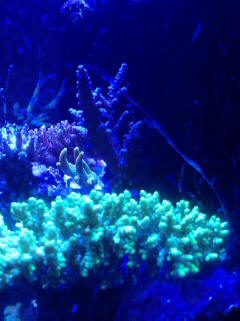
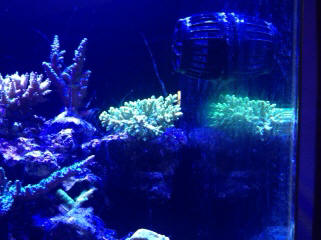
I've had three outbreaks of something in my tank and no one locally seems to
know what it is exactly. It basically looks like white snot all over
the tank. Clears up for about a week comes back brownish. Clears up
and returns as white snot again.
<Mmm>
I was told it might be dinoflaginate.
<Maybe>
My stats are as follows:
30 gallon innovative marine tank AIO
Amm 0
Nit 0
Nitrates 0
PO 0
<.... autotrophs, your "corals" and more need measurable NO3 and HPO4>
PH 8.4
Cal 430
Alk 10.2
Salinity 1.025
Using a innovative marine skimmer
Activated charcoal
RowaPhos
<I'd skip (take this out) for a while at least>
Starting dosing MicroBacter7 10 days ago based on someone's suggestion.
Not much of a change.
Any help greatly appreciated. Thanks.
<Mmm, I'd also not change out the activated carbon for a few
weeks... you may have inadvertently triggered a bloom of some sort (need
sampling and microscopic examination to know what)... Do read on WWM re NO3
and HPO4...
Bob Fenner>
|
 full size...
 |
Re: Bacterial Bloom or Algae?
8/14/13
Thanks for the quick reply!
<W.>
Fish:
Earmuff Wrasse
Christmas Wrasse
Maroon Clown (2)
Diamond Watchman Goby
Green Clown Goby
Hi-Fin Goby
Coral:
Staghorn
Surf N Turf Acro
Tri-Color Acro
Strawberry Shortcake Acro
Rainbow Millepora
Candlelight Acro
Green Pollicpora
Montipora Digitata (3)
Montipora Capri
Brain (1)
BowerBinki (1)
Various Zoas/Palys (8)
Invert:
Pistol Shrimp
Misc:
40lbs live sand
40lbs live rock
Normal Maint:
5 gallon water change every week
Feeding:
1/2 brine cube per day
<.... I'd expand this... very likely use a pellet (Spectrum,
Hikari) as my staple... frozen/defrosted in the AMs... PE Mysis, blends...
Not Artemia regularly; for reasons gone over and over on WWM; including the
issue/s you're having here>
Lighting:
EcoTech Radion Pro at 53% intensity of a 20K spectrum
Tank has been running for 6months.
I've started 5 gallon water changes daily and plan to continue for the rest
of the week, do I need to do more?
<More? As in more volume? Not likely; unless something dire in the shortish
term is of concern>
I'm using Hanna Instruments to check for PO4 and API to test for NO3, do I
need to use different tests to measure?
<No>
Should I continue to use the MicroBacter7 daily?
<I wouldn't. Of no use here; in established systems>
I did just change the carbon but it was after the bloom.
<No need for the extra C, as in the element>
How/where can you get a microscopic examination?
<Search WWM re; you may well enjoy and definitely benefit from having a
200-400X 'scope... BobF>
Tarrell
Re: Bacterial Bloom or Algae?
Hopefully the video isn't too large, it shows the problem better than
photos.
<<RMF Linked here: WWM
Video/Video Clips/Video Ter.MOV
Video Ter.MOV
Tarrell
<See some "waving slime" off your stony corals et al.... Could be...
reaction series... as noted; from deficiency syndrome/s; perhaps
allelopathy, though I discount this... in such a small volume, you would
highly likely see/have REAL troubles if so; fish dying etc... You really
need a much larger (volume) system... for the stock shown, your obvious
ambition/s; dilution... B>
Re: Bacterial Bloom or Algae?
8/15/13
I just want to make sure i got everything correct:
Continue daily 5 gallon water changes for 2-3 more days then resume my
normal once a week 5 gallon water change.
Feed spectrum marine life 1mm pellets as primary food and supplement a
couple days with brine.
Either reduce the number of fish/corals or get a bigger tank.
Remove the RowaPhos for now.
Purchase a 200X-400X microscope.
When you say measurable NO and PO, what's my target reading?
<... DO read on WWM re: 5-10 ppm of nitrate and 0.01-0.1 of phosphate is
about right. Don't "lose your mind" re periodic values higher/lower>
What's the acceptable range? I was always told zero.
<...http://www.wetwebmedia.com/ca/volume_5/volume_5_3/phosphates.htm
NOT zero; none detectable, no food/life...>
Thanks again!
Tarrell
<Certainly welcome. BobF> |
Can I remove too much PO4 from my marine aquarium?
5/5/13
Hello:
<David>
It has been several years since I last felt the need ask a question,
which I think is a good thing. I have a 35 gallon tall marine aquarium
with a pair of reidi seahorses ( I will soon be adding another pair), 1
mandarin (I would like to add an opposite sex mandarin), 2 turbans and 3
Strombus alatus. These critters have been in the tank for a long time. I
also have a variety of live rock with star polyps, mushroom polyps, and
Kenya tree coral. There is a healthy (to my sense anyway) mix of
calcareous algae and Bryopsis on some of the live rock. At least I think
it's Bryopsis. It is a dark green short tough filament. I also get a
very very light build up of diatoms on the tank sides which the turbans
seem to like. I clean it off once a week or so.
I have a Remora hang on protein skimmer, a PhosBan 150 reactor
<Unnecessary>
and a Penguin 250 bio wheel. I use the activated carbon filters in the bio
wheel. I have no other water movement because of the seahorses. I use
Instant Ocean Reef Crystals mixed with RO water and I use straight RO
water to top off. I also have a Coralife fixture with a 10k daylight and
an actinic blue light. I change the bulbs once a year.
Finally, my water is, with very rare occasions, crystal clear. Specific
gravity is 1.024, dKH is 7.8 and calcium is 350 ppm. There are no
measurable nitrites or nitrates. I am religious about water changes and
my chemistry is very stable at these readings. My question is
phosphates, they also always measure 0 or at least below 0.03 ppm. (For
alkalinity, calcium and phosphate, I use Salifert test kits and use the
higher sensitivity procedures.)
Can I have too little phosphate?
<Is possible, yes... the soft coral (Kenya) needs some as a
chemosynthate, and your snails need such indirectly in the algae they
eat>
Do I really have little or no phosphate?
<Likely little in solution; most all is "bound up" in the life in your
system, and/or insolubilized (precipitated) and not likely at all to
become available/measurable in solution again>
I know there must be some in the tank but it is not measurable. I recently
added some Palythoas and a couple of different button polyps
<Do take care w/ these... toxic Zoanthids... to you, your other
livestock if stressed, mis/handled>
each on fragments that I would like to train to the live rock. My goal
is to create a rock wall up one side of the tank with soft corals.
(These would be secured to PVC pipe with zip ties.) I know this will
take a long time but I've read on WetWebMedia that too little PO4 is bad
for corals. At one time, I had a very healthy growth of Halimeda but it
suddenly died off and I replaced it with the star polyp.
Is there anything I should be doing do to successfully grow the soft
corals?
<Not likely, no... "just" feeding your fishes will add sufficient HPO4
for all here... I would ditch the reactor as mentioned>
The tank is 24 inches tall and I know less light reaches the bottom. But
the star polyps have done well for over a year. Is the lighting
sufficient?
<Obviously>
I'd prefer not to spend a lot of money on halogens.
<I wouldn't either>
Thanks for such a great site!
<Thank you. Bob Fenner>
- David
Re: Can I remove too much PO4 from my marine aquarium?
5/5/13
Thank you sir! Thank you very much.
<Ahh! Welcome. BobF>
|
Unhappy Zoas 12/11/11
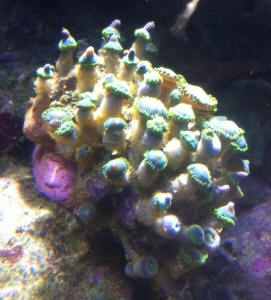
These were looking great for the first 2-3 weeks I had them, now
they are
decidedly very unhappy. Let me start with my tank specs:
29g biocube
150 watt MH lighting, 7 hours per day
1.023 sg
<A little low>
8.1-8.3 ph
10-11 dKH alkalinity
0 phosphate/nitrate/nitrite/ammonia
<Boing! Need measurable HPO4 and NO3... this is at
least one dire issue... starvation. Whatever you're
doing to render these at zip needs to change.
See WWM re Zoanthid needs>
Two 425gph flow heads
Phosphate reactor w/maxi jet 1200
AquaC remora skimmer w/maxi jet 1200
I've measured and checked everything I can think of, googled
for solutions and pictures, without much luck.
What's going on with these guys, and can they be saved?
Thanks in advance!
<Can. Bob Fenner>
|
|
Re: Unhappy Zoas, HPO4
12/11/11
I'm using a decent size phosphate reactor to get it down to
zero.
<Can't live...>
It was at 0.5ppm previously, and have been told elsewhere that
0.01 ppm is a "high side limit" for phosphates.
<Mmm, not so>
I target feed every other day with zooplankton and the
occasional frozen Mysis shrimp.
I found a lot of FAQs re: Zoas on the site, but did not find one
called "Zoanthid needs". Would you mind terribly
sending me a link?
<Read here: http://www.wetwebmedia.com/zoanthid.htm
The linked files above. B>
|
LFS and Water Quality 2/4/11
Dear WWM Crew,
<Paul>
I've been in the hobby for 7 to 9 years
<?... is the moon full?>
and currently I'm keeping a 110 gallon mixed reef tank. Its
predominantly populated by 10-15 small gobies (i.e. Trimnas, Eviotas,
Stonogobiops(s), Gobiodons ect.
<No such word>),
a Ecsenius blenny, a Serranocirrhitus Anthias, a high density of LPS
corals, a few SPS corals, and a large population of algae eating
inverts. I've certainly had a few hick-ups along the way, but all
and all the tank produces good rates of coral growth and very low
levels of fish loss. I feel my tank has come to this level of stability
based on quality livestock and good information from a variety of
sources, including the articles and FAQs on WWM and the information
provided by my LFSs. I recently moved the tank about 700 miles a few
months ago. In my opinion the move went quite well, albeit, stressful
for me, my family, and the livestock.
<IS tough to move for sure>
The first few days my corals and fish were a bit upset, but ended up
with 100% survival on corals (a few bleached and some interesting
colors are showing back up in a few of them), ~92% survival on fish
(based on the number I was able to bag in the tear down), and ~80% on
inverts. Since the move the tank has been as stable as ever.
Anyways, to the question, I moved from a city with 3-4 strong LFSs to a
town with one average LFS. I feel the staff seems knowledgeable and
informative, and the fish and coral are all competitively priced, but
their water quality leaves something to be desired, specifically their
fish system.
<Do help them>
Basically, from what I've been able to gather, its been running for
seven to eight years and is very large (~1200 gallons).
From the looks of it the tanks look pretty good. The glass is well
cleaned and algae build up on rocks and sand is low to moderate. The
fish go directly into it from the wholesaler (not quarantined, but fish
are pulled and medicated if signs of sickness).
<Mmm, I would use at least dips/baths... to prevent a majority of
problems>
They use RO/DI water, Instant Ocean salts and it is filtered by bio
balls, poly fibers, carbon, and UV sterilizers. I believe they do
semi-regular water changes (but even 10% is ~120 gallons). Sometimes
the whole system is medicated from time to time. I know this because
I've noticed a strong smell of Melafix in air once or twice.
<Garbage>
Upon first arriving I was surprised not to see any sort of skimmer
running on this system, and was immediately interested in their water
quality.
Thankfully they were pretty transparent with me and reported their
levels to me (I've double checked these on my own with Salifert
test kits/ refractometer): salinity: 1.020, ph: 8.2-8.4, Ammonia:
0-0.25 ppm, Nitrite: 0 ppm, Nitrate: 10-20 ppm, KH: 7-10 dKH, Calcium:
~ 460 ppm, and the crazy one Phosphates: 10.0 + ppm!!! (Like midnight
blue with the first drop of reagent 2 with the API phosphate test kit!
)
I know phosphate levels above 0.5 ppm can be toxic to coral but what is
the effect of such high concentrations of phosphates on the health of
fish?
<Toxic to degrees... more debilitating, an issue for fishes exposed
weeks to months>
From what I can tell their fish seem very healthy and vibrant the first
week or two, but most fish that are there longer than two weeks seem to
start looking a little drab, bleached, and/or stressed.
<Ah yes>
Due to these observations, I have avoided purchasing fish out of their
fish only system, however, I have been tempted once or twice. I
typically due a drip or a cup acclimation and quarantine, but will
moving from such high concentrations of phosphates to relatively
non-existent levels be too much of a change and consequently over
stress the new addition?
<Mmm, no; not really>
Will the fish permanently
suffer from being exposed to such high levels in the long term
sense?
<Not so much. When returned to better conditions... resume good
health.
Sort of like cigarette smokers who give up the habit... not too
late>
I know I could easily purchase a fish online and get a guarantee, but I
believe in trying to support local small business and keeping money in
the local economy as much as possible. I've been happy with my
coral and other invert purchases through them and would like to get a
new small fish addition every now and then. So I've gone back and
fourth about this but would like a objective opinion on purchasing
their fish based on the information I've been able to provide.
Would it be rude of me to suggest adding a skimmer to their system,
and/or using Phosguard or Phosban to help clean up their phosphate
issue?
<Not at all. You should do this>
I can't even imagine the quantities of media they'd need, but
would such high volumes of media affect other parameters such as pH and
their cycle?
<... have them read WWMs commercial/business Subweb. Or contact
me... Ozone and skimming will save them ten times plus the cost of
acquisition and operation vs. livestock losses>
Thanks in advanced and hope I wasn't over detailed in the
background information.
Thanks,
Alex
<Welcome. Bob Fenner>
Deflated Trachy 2/17/08
Gents
I'm writing to you from Guernsey, a small Island in the British
channel! I have a question that so far, despite trying many different
people, have not got an answer. I have a Trachyphyllia Geoffroyi that
has been deflated for about 3 weeks. I've had him for about 8
months and has always looked amazing. I recently upgraded my skimmer to
a Deltec apf600 on a 325 Ltr
(90 US Gallon?).
<About 86>
I changed my carbon and phosphate remover but nothing different to my
normal routine. My coral has since deflated. The flesh was very tight
over the skeleton and I thought all was lost. I was really gutted as
he's my favourite coral. I didn't remove the coral but left it
for a few days.
One night I noted he looked a bit inflated but the next day he was the
same. I have since put him in a Pyrex bowl on the bottom of the tank so
that I can get to him easily. I feed him in the bowl and he feeds well
but still no inflation. The flesh is no longer tight over the skeleton
but definitely not inflated. Any ideas what the problem is?
<Mmm, first guess would be a nutrient shortage from your new, more
efficient skimmer.... Do you have measurable phosphate?>
My conditions are:
S.G - 1.025
pH - 8.2
KH - 8
Ca- 420
Nitrite - 0
Nitrate - 15
I'm afraid that's all I test.
I do 25 Ltr water changes every 2 weeks with good quality reef salt.
Use a Ca reactor, Carbon, Phosphate remover,
<This too is too-likely a culprit... I would pull this media for
now. Some soluble HPO4 is absolutely essential to all life...>
Live rock, DSB, skimmer. All other fish / corals are in good health and
no fish appear to be irritating the coral.
Many thanks for any help.
Cheers
Jeff
<And a bit of iodine/ide supplement, and let's see how this Open
Brain does in a week or so, eh? Bob Fenner>
Re: Deflated Trachy, HPO4 2/25/09 Hi
Bob, or whoever this may be going to. Many thanks for responding to me.
I've tried what you suggested and no response as of yet. I
don't have any measurable phosphate. I removed the phosphate
remover and added some Red Sea Iodine at the stated dosage. I've
left the skimmer running. Do you think it might be worth adding a
Polyfilter? to remove something that may be irritating it. Maybe a
change in salinity? I'm running out of ideas and any further help
would be much appreciated. Cheers <Mmm, no to the chemical
filtrant... or changing SPG... Odd as it may sound, I'd look to
adding a supplement that included soluble phosphate... Life needs it...
BobF>
Clearmax aka Phos-X: why the cautionary warning re
inverts? 1/6/09 I have a 50 g reef tank, loaded
with live rock and a good, deep (4 to 6 inches) live sandbed, with 25 g
sump/refugium in which I have more live rock and sand in the refugium,
and in the sump an Urchin protein skimmer and a phosphate reactor where
I have been using Rowaphos. While my phosphate levels remain below 0.5
and my nitrate is about the same, I prefer to have the phosphate
reactor there to deal with any excess in case of occasional
overfeeding-- it's backup protection "Just in Case".
<I see> I did have Chaeto in the refugium, but I wasn't
paying close attention to it and it melted on me, and the resulting
toxin killed a couple of corals before I figured out the problem.
<Unusual... Do you mean the genus Caulerpa?> Livestock is: one
six-line wrasse, one flame angel, two percula clowns, one Firefish, two
cleaner shrimp, half-a-dozen blue-legged crabs, one Foxface (which I
will sell when he gets too big), and a mural goby. Coral includes
Duncan coral, frogspawn, hammer coral, torch coral, bubble coral, brain
coral, plenty of mushrooms of varying sorts, white star polyp, and some
xenia. I use distilled water for WCs, but I do use Prime-treated tap
water to top up the tank, having checked it out for bad juju. My
city's system is fresh water straight piped from Canada's
unpolluted Precambrian Shield. Its only problem is the chlorine and
chloramine the Prime removes, and in summer, we do get some algae bloom
in the lake the water comes from, along with higher than I'd like
phosphate (one reason for the reactor). My nearby LFS doesn't carry
RowaPhos so I picked up Clearmax (which used to be Phos-X). The product
insert says to use with caution on marine invertebrates, but offers no
further explanation, nor can I find one at the Hagen/Fluval site.
<Mmm> Have you any knowledge of why this caution would be there?
<My foremost guess is the identification of a need for
"some" soluble phosphate... is an essential nutrient... Think
back to H.S. chemistry... ADP, ATP... of all life... You don't want
to remove all... for fear of chemically starving chemoautotrophs.
Fishes and most mobile invertebrates should be fine via feeding...>
I can always put the stuff in the HOB filter I have dedicated to
phosphate removal in my discus tank if there any doubt whatsoever about
the wisdom of using it in the reef tank. Judy Waytiuk <I would not
be worried if you have any measurable HPO4 presence. Bob Fenner>
Re: Clearmax aka Phos-X: why the cautionary
warning re inverts? 1/6/09 Thank you for such a
quick response!!! It's much appreciated, especially knowing how
busy you WetWebbers are!! <Am barely keeping my head above water!
Wait! What am I saying? I'd rather that it be underwater! Cheers,
BobF>
Hair Algae killing all good algae. Hair Algae, Phosphates
9/6/07 Hi WWM, <Hello> I have a big hair algae problem, my
rocks are completely covered in hair algae and I can't see any good
algae for my tangs and my blenny has gotten really skinny. I have tried
siphoning it out of the tank, I have tried water changes, but 1 day
after I clean the tank it grows all over everything again. <Water
changes and siphoning are not immediate fixes, take time and dedication
to work.> There are also all the bubbles in the algae which cover
the rocks. But its not bubble algae, they are just bubbles stuck to the
algae. <Gases released by the algae mostly, O2 most likely.> My
phosphate is a little bit high and this is probably the
cause.<Almost assuredly.> I used to have a snowflake eel and I
never had hair algae with him in there, my nitrates were always >30
and I used to do a 20% water change every week to keep it down. Now I
do water changes every three weeks because of less pollution, but I
think the weekly water changes kept the hair algae away. <Agreed>
My Lawnmower Blenny does not eat the hair algae and my yellow tang,
convict tang or blue tang don't eat it either. <Hope this is a
big tank to house 3 tangs.> My water parameters are: <10 Nitrate,
0 Nitrite, 0 Ammonia, .50 Phosphate (a bit high), <Very high, people
often see problems even when test kits read 0, .5 is very very
high.> pH 8.2, Calcium 350-420. If you could tell me a way to get
good algae back in my system, I would really appreciate it, my Blenny
really needs it. Thank you, Maison <You need to figure out what the
source of the phosphates are and eliminate it. The hair algae will
out-compete the macroalgae you desire, so until it is under control
getting macros to grow will be difficult.> <Chris> Water
Changes Hello to the WWM crew, hope you all had a great labor day
weekend! <Not too bad, kind of busy, but nice.> I have a question
about water changes. I know you suggest frequent (even weekly) water
changes. <Correct> I have always used my tap water, treated
of-course; and I believe I have pretty good water, except for the
extremely high phosphates in my water. <Oh...> Oh my goodness, I
have a lot of phosphates, so I feel I am always on the verge of huge
algae outbreaks if I do weekly water changes. However, the nitrate
level in my water is not detectable, so I like to do frequent water
changes to keep nitrates down, as I am really looking into going
hardcore reef! <Not with high phosphates. Phosphates inhibit
calcification.> What is your suggestion as far as what would be
better, really high phosphates and low nitrates, or accumulating
nitrates but lowering phosphates via a overworked protein skimmer.
<Neither is tolerable or necessary. A good RO unit is all that is
needed.> I do use a protein skimmer now, but by the time the protein
skimmer has lowered the phosphates to barely anything, it seems the
nitrates are running about 40-50. Is this a case where you would
recommend investing in a RO unit? <Definitely> Will high
phosphates produce huge algae outbreaks as I think they will, and are
they bad for invertebrates? <Both> Your suggestions are greatly
appreciated, as I am really looking forward to going a lot further in
keeping a reef tank, and I realize number one is water quality. Thank
you for your help, Jen Marshall <You are welcome. -Steven
Pro>
Phosphates/Algae Scott Good day, Frank here again from
Malaysia. <Hello, Frank!> The fourth days in the process of cycle
my tank lots of brown diatom on live rock and glass tank. 3 days later
all the brown diatom gone, is that mean that my tank already cycle as
I'm using live rock. <Actually- no- algae can come and go even
in cycled tanks. Nitrite and ammonia readings must return to
")" for the tank to be considered "cycled"> This
is where many spots of grass like grow on the glass tank and long green
alga on the rock, is this call hair alga. My tank is 140gallon. The
tank water is yellowish, I think I should use activated carbon, am I
right?. <I am a firm believer in the use of activated carbon to
remove organics/color/etc. and PolyFilter pads for further organics
removal- they really work!> I tested my phosphate with sera tester
the color is "light deep blue". I use (multipurpose water
purified filtration - 3 feet tall ) which consist of the 3 media
(activated carbon, fine silica sand, coarse silica sand) before the
water enter the tank. <Always a good move to use filtered water
before mixing with salt> As far as I know (Silicate, phosphate) -
two chemicals that cause hair alga / unwanted alga type. In my country
two well-known product I can get (Hagen phosphate remover, Hagen
activated carbon), (Coralife - phosphate remover and silicate remover),
which product is better in removing all these chemicals? <To be
honest, I have no experience with either of these products, but I
usually find that water changes with good quality source water, coupled
with good protein skimming and the use of a phosphate-free activated
carbon product, will really help control these.> Will hair alga
affect my coral (hard coral, soft coral). I have added close brain
coral and open brain, elephant ear, mushroom. I have no idea what to
feed my brain coral and elephant ear. <Hair algae can potentially
choke off these corals if the buildup is too great. More important is
finding and combating the source of these algae-usually nutrients,
which you can readily control with the means discussed above!> Do
these coral eat dried Mysis? <Generally smaller zooplankton. Many
"mushroom corals" get their nutrition directly from the
water, and don't need supplemental feeding. Do check the
wetwebmedia.com resources for info., or get a copy of Anthony
Calfo's "Book of Coral Propagation" for much more
extensive information on feeding of corals than I can offer here.>
Thank you for your upcoming advice. Frank <Glad to help! Good
luck!>
Saltwater question Hello, got a question for you: I have high
phosphates in my tank. My LFS said that "I have to get them out
now, that that is a fish killer"<they said phosphate was a fish
killer? Honestly it will mainly just cause algae to reproduce in your
aquarium> That they will add to much stress.<may add some stress
but I doubt that it would kill your fish> Is that true? Do I need to
remove them?<I would unless you want an aquarium full of hair algae,
Cyanobacteria, etc> Where do they come from? Foods and what
not?<If you are using tap water from you aquarium you need to start
using RO/DI water instead. Good luck, IanB>
High Phosphate I have a huge excess of phosphate in my tank,
will it hurt my corals? <High levels of phosphate are fuel for
nuisance algaes that will harm the corals. Don>
Phosphates Hello crew! Thanks again for all your
help. Got another one for you. I have been deeply entrenched in the war
against red algae and Cyano for about 2 months now and I think the tide
is turning in my favor!! YAY!!<good to hear> There is MUCH less
algae growing and now green algae has started growing on the glass and
rocks instead of the red slime. I even have a few spots of coralline
algae growing on my Tufa rocks!<nice!> What I have done
(much learned reading FAQ's) is I switched to RO/DI, cut back on
feedings, put in several types of snails and micro-hermits (I know your
opinion on those but I like them and have had no problems), cut back on
the number of hours the lights are on a bit, change carbon filters
weekly, 10% water changes weekly, switched from a SeaClone to Aqua C
Remora and have started testing for phosphates and silicates. I have a
hang-on refugium that is on it's way as well (backordered).<you
are definitely doing things correctly> Now, Silicates have
been 0 for the last month. Ammonia and nitrites zero since Dec and
nitrates creep up to around 15 before I do my weekly changes but
usually hover around 5. Other readings are pH 8.3, SG 1.025, dKH 9, Ca
400, Iodine 0.7 and temp 78-79.<sounds good> Phosphates on
the other hand have been driving me nuts!! My initial readings 6 weeks
ago were around 1.0 (when I got the testing kit). I added SeaChem
Seagel to my whisper filters and the phosphates have dropped to 0.1 and
been there for almost 3 weeks now and don't move. I have no idea
how to get them to zero. Any other ideas? <It sounds like you
are doing everything correctly...I would not worry too much about a
reading of 0.1...it is not really going to harm anything, Good luck,
IanB> Thanks again for all your help.
Corals & Phosphate 5/5/04 To Web Crew, Many thanks in
advance for your time and enthusiasm. <It quite literally is our
pleasure! We are all here because we love the hobby.> I
have another issue that has been puzzling me. I recently
started going to a LFS closer to my home for my RO water and being the
lazy fool that I am did not test the water until a full-blown algae
bloom hit my tank. At that point I discovered the new water
I had been buying had sky-high phosphate levels.
<Yikes! Poor maintenance and cheap carbon block filters
often lead to this problem.> After a couple of months I got the tank
back under control. I am back buying water from the original
LFS. <Good choice! Better yet, invest in your own R/O
shop around and you will be surprised that prices can be quite
reasonable, and no more hauling water!> I have kept a wide variety
of corals now for close to 10 years. During the algae bloom
I noticed several corals that had always done okay but nothing
spectacular grew like wild - most notably a Goniopora that I have had
for many years. I have never seen it so
happy. Now that the algae bloom is under control these
corals have gone back to their average ways. <Quite the opposite of
where I thought this was going! Often algae blooms are
associated with poor coral health. Blooms of algae or other
organisms can cause drastic changes in water quality as well as
producing some pretty nasty chemicals.> My question then is - do
some corals need phosphate? <Every living thing needs small amounts
of phosphate. It is probably impossible to reduce phosphate
so low in the typical aquarium that it limits the growth of
corals. In fact, at anything above natural sea water
concentration, phosphate becomes a poison to the calcification
process.> I am of course reluctant to put phosphate in the aquarium
and I despise hair algae but was nonetheless very pleased to see these
corals thriving. Or is there something about heavy hair
algae growth (i.e. possibly more amphipods or more plant matter in the
water column or better "scrubbed" water or whatever) that
would encourage some corals to grow more? As far as I can
tell no other water parameters changed during this period of
time. Any thoughts on the matter? Thanks! Scott
<I think you hit the nail on the head! I suspect that the
algae bloom also created a lot of habitat and food for all kinds of
critters, which will have spawned and created a ton of tiny planktonic
food. You essentially made your display into a giant
refugium! Hope this is helpful! Adam>
|
|

