 |
|
| Home | Marine Aquariums |
Freshwater Aquariums |
Planted Aquariums |
Brackish Systems |
Ponds,
lakes & fountains |
Turtles & Amphibians |
Aquatic Business |
Aquatic Science |
Ask the WWM Crew a Question |
| Please visit our Sponsors | ||||
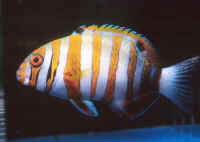
- Blind Harlequin Tusk - JasonC, <Hi.> Thanks for the quick reply. <My pleasure.> To answer your question about reacting to my presence, no he doesn't. <Oh, that is a bummer.> In fact, it was easier to net him out of the tank than it has been on the rare occasions that I have to retrieve an expired fish. <Yeah... that is a pretty definitive sign. These fish are typically very hard to catch.> To address the point you made about treating the display tank, I definitely agree with you, in principle. In practical terms, there is no way I can set up and maintain a quarantine tank big enough to treat the fish that were infected with ich. <I hear what you are saying, but quarantine is really your only good option.> Seven of the nine fish has ich to some degree. This was our first experience with ich and it went "unrecognized" until my Purple Tang had shared it with his fellow tank mates. <Is the nature of parasitic infections, and why quarantine before addition is so important.> (Temperature fluctuations were the likely cause and I have since replaced all of my thermometers with Ebo-Jager). The hospital tank was purchased and set up with future problems in mind. The whole reason I used chelated copper is because it is less toxic than copper sulfate and it does not get absorbed by the materials in the tank. This was a point Bob F. raised in his book. <I would suggest that you re-read that section. I have a copy here and checked... the book says nothing about absorption of chelated copper by the substrate. And in fact... Bob is sitting right here and I asked him to make sure... chelated copper is for certain absorbed by your rock and substrate.> I appreciate your input and any other advise you can provide would be much appreciated. <As far as the tusk goes... a blind fish is at a serious disadvantage. You have only a couple of options... your best bet now, if you don't want to euthanize the fish you will have to give it very close, personal attention. Personally, I would try and stick with the fish... I'm a real huge fan of Tuskfish and I just wouldn't want to give up so quickly. Do try using a feeding stick to offer its favorite foods - put them right in front of its face to make sure it can smell them. With any luck it will start eating again in time, but I'm sure right now it's adjusting to having just lost its eyesight. Can't be fun... sorry to hear of this. There are other sensory systems - lateral line, etc. - that will help this fish, and at some point in the future you might be able to reintroduce it to the main tank, but for now it's going to need a lot of help from you.> Bob Jones <Cheers, J -- > - Tuskfish Follow-up - Jason, <Good morning.> Thanks for the frank, open input. I've reread Bob's book and you are right (as is he). I over-interpreted what was written. Chelating agents only act to keep it in solution better than the sulfate form. He made no reference to preventing absorption. My quarantine tank is set up and although it is a small one (10g) it will be used to quarantine all new fish. <Fair enough.> As for Monty the Tusk I struggled to see a future with him that was not going to be cruel. He would have been tanked with a French Angel and a Sunset Wrasse. I fear he would have been mercilessly bullied so I tearfully (quite literally) put him down. <Oh... I am sorry to hear of this tough decision.> I, too, love Tuskfish and will be replacing him some time in the future. <Ah good.> Thanks again for you help with this and for all future help I know I will need. Bob Jones <Cheers, J -- > Re: Tusk acting aggressive Hi Bob, <Actually, it's JasonC... again.> Tusk has been doing very normal since last week in the tank and has been swimming around and eating great. Health looks great and I am keeping my water conditions excellent. He usually eats 2 times a day (Formula 1 - 2 cubes at one time). Total cubes he takes a day is 4 and sometimes misses 1 cube as they fall behind the rocks and are consumed by other inverts like stars and serpents. I have seen him aggressive against green serpent star but you mentioned that he will hardly go after sea stars. Can you please confirm. <I'm sure this is possible, but not a sign that the tusk will eat it. Just trying to show it who's boss, like the seastar cares or something...> Added a Sohal tang (3") today. They both did not like each other in the first 10 minutes as tang wanted to take his home away. I see both fishes trying to take the space that was originally chosen by the tusk. Sohal Tang is not really going after him but does not like him close either. Since then the tusk has been swimming aggressively and is all over the tank. His swimming patterns are aggressive and is swimming at all levels. Occasionally swims very fast which I have never seen him doing this before the tang was introduced. I have shut down the lights to ease the tension. Is there something that needs to be addressed. <Perhaps you don't have enough hiding places? These things usually take a couple of weeks to a month to work themselves out. How large is this system? You could be on the small side with the addition of another power-swimmer.> Salinity and all other water conditions are fine. Tusk's aggressive swimming pattern has made other small fish like damsels hide behind the rocks. He slows down for a while and then goes again. In most of these cases Sohal tang is not even close but is in eye sight. Any advice will be helpful. What should I do next ? <Be patient... you haven't had either fish really that long, and you need to give these time to work themselves out. You could also rearrange the furniture in the tank, to break up existing territories.> Many thanks in advance. <Cheers, J -- > Harlequin Tusk Thanks so much for your feed back. The tank will be under fished. Only one will be added next month a harlequin Tuskfish. <wow... so much for under fished :) That puppy pushes a foot long as an adult. With the puffers alone we are still looking at elbow rubbing in the near future. Still... you have time, my friend> Petaluma is the town I live in. <ahh... very nice. I was just visiting the area a couple of weeks ago. Gave a presentation to the SF reef club (BARE). Very dry this year to say the least! Bought my kitty last year in Geyserville too:)> I'm not related to any tribe. There are many in this area- Miwok, Pomo . and more that I can't remember. <all fascinating indeed!> Also thank you for writing your book. It is informative, and a good read all around, <ahh... thank you. Yes... Bob's book is a tremendous work!> Keep writing although I'm hard pressed to come up with any subject you haven't already covered. It really is a masterpiece. <yes... he is always writing... and we are also collaborating among Wet Web Media friends (Bob, Steve, Zo, myself et al) on a three volume set. We will be covering Reef Invertebrates, Reef fishes and Reef corals in a unique writing style that it seems many folks have come to appreciate from Bob and I :)> When I was in the fish store and said what books do I need to read in order to get this whole thing off the ground it was like a Greek chorus "The Conscientious Marine Aquarist " !!!!!!!!! Thank you again for your time. Gretchen Petaluma <best regards, Anthony Calfo> Re: Tuskfish Mr. Calfo, thanks for the answers. Harlequin Tuskfish a foot long? <I wish it weren't so in this case. Indeed... it is a max size, with most only getting say 8-10". Still, a heavy feeder and burden on the bio-load. A shame... such a magnificent fish. That settles it... lets talk about building you a 1000 gallon aquarium <smile> Maybe I'll reconsider Look forward to the collaboration . Gretchen <excellent my friend! Kindly, Anthony> Quarantining the Tusk Hello, Received my Australian Harlequin Tusk 3 days ago. He is one of the best I have seen so far and is now my favorite. It is about 6" and is very bright in colors. I have placed him in a 55G quarantine but don't know how long am I supposed to keep him in there. <Well.. it varies from fish to fish. The tusk I have was in quarantine for six weeks.> Also, he is not eating and stays in a dark and hiding place. This is expected per your articles and FAQ on this species so I am not yet getting my blood pressure high. I am checking my water and it is Ammonia=0, Nitrite=0, Ph=8.2 & Nitrates=10. Temp is running 78-79 and he seems to be breathing normal with no signs of stress or ick at this time. I have tried frozen shrimp & mussels but he has not yet even looked at them. Bough 6 live feeder shrimp today as they can live a couple of days if not eaten by the tusk. This should help me keep my water chemistry intact as there will be less food left over. I have no seen him going after them either. I have tried feeding him by the feeder stick and at one time the live feeder shrimp was swimming right next to him but the tusk did not even looked at it. Is this normal even after 3 days. <Yes - these fish get really freaked out but the whole capture and transport thing, barbless hook in the mouth, etc. My own tusk didn't eat for two weeks, which is about as long as you would want to wait. These fish are quite hardy, and as long as it's not already skinny can go quite a while without food.> He is the only one in quarantine tank but stays at the bottom of the tank, hiding behind a PVC pipe that I use for hiding places instead of LR. <Is all normal - no worries.> Please advise if this is normal and if there is anything that I can do to help him eat. <Whole krill, Mysis shrimp, clams - all favorites of my tusk. You might also ask the people you bought it from what they were feeding.> What if he eats after another week and goes on a hunger strike again when I move him to the main 150G? <I would predict that a second hunger strike, if there were one, will be shorter. These fish actually like to eat.> Should I move him in another 4 days to the display tank if he shows no signs of disease? <No... give it time to get used to captivity and get used to you. Be patient. Quarantine is as much about easing the transition as it is about treating disease.> Main tank has 4 damsels in there with corals. Water conditions are normal except that the nitrates are 20. <Sounds good.> Regards, Razi Burney <Cheers, J -- > Re: Quarantining the Tusk Many many thanks for your fast response. <My pleasure.> Tried feeding him today again but no luck there. <I know the feeling... make sure you do daily vacuums in the system to clean out this food.> I will wait for 2 weeks per your instructions. All water conditions are looking good and temp staying normal. <Good.> Saw some spots of ick on him and that just made my heart sink. I see them on the tail and back where the blue shade is. They are not very many but looks like he is getting it. Seems to me that it is in early stages. Thought about it for 30 minutes and finally decided to not take any chances and move him in a 10G copper treatment tank. 10G is just too small for him but that is all I have left now. I figured that leaving him in a tank with ick is not the best choice and usually copper starts showing results within 2 days if ick if detected in early stages. Also made this choice as he is not eating yet and his immune will just not have the kick to fight it off if I let him stay in the 55G quarantine. Is this the right thing to do? <I wouldn't have moved it... it's the whole moving thing that is stressing your fish, which is why it isn't eating, which is why you now see a spot or two. These are very tough fish and a spot or two or even five is not really a cause for concern on a tusk fish. He'd be better off back in the 55.> How many days should I keep him under copper treatment. <I wouldn't treat with copper at this juncture, but if I recall, copper treatment should continue for 15 days to be useful.> Usually spots go away within the first 2-3 days. Should I buy another tank about 20G or so and use something like turbo start to cycle it and treat him there ? or leave him in 10G copper tank during the treatment? <I thought the 55was a quarantine tank? Here's the rub, quarantine is supposed to be quiet-time. Time for the fish to do get back on its fins, so to speak... someone caught your fish with a barbless hook, and you can probably imagine the fight it put up - hook in the mouth and such. Then it's been shipped from down under to three or four destinations to get to your tank. If you were your tusk, you'd be wiped out... tired, and would want to be left alone. Moving it around just stresses it out. Quarantine is as much about relieving stress as it is about observation and treatment.> Does a copper treatment tank have to be cycled or a Ph and salinity adjusted fresh tank (non-cycled) can be used ? <When you start running a dedicated treatment tank, you also have to dedicate yourself to very frequent, larger than normal water changes. 25% at least every other day, or every day if you can pull it off. Recall that all fresh-mixed salt water should sit at least 24 hours before use. The copper will make establishment of a nitrogen cycle impossible.> Can't understand why all was fine for the first 4 days and now all of a sudden this problem started. <Stress... is all normal. Be patient and trust that this is really a very durable, albeit expensive fish.> Everything under my control stayed within guidelines and steady. <No worries...> On top of that I am more concerned because he has not eaten anything since 4 days in my quarantine tank. <Four days is not a long time. Like I said before, my own tusk went for two weeks - I was nervous too but it's not a anemic fish... a good supply of reserves to live on.> Bought him online from The Marine Center and they tell me that he was in their tank for more than 3 weeks and was eating. <And I would tend to believe them. I've had nothing but good experiences with Marine Center.> No hiding places for him in the 10G tank now but will add a PVC pipe if spots look any better. <Large PVC pipes are good. Tusks do like places to keep out of site from you.> I plan to change about 4G of water in the copper treatment tank tomorrow as nitrates were 30. No ammonia or nitrite were present. Please advise. <My advise - chill. I wouldn't be so quick to treat this fish. The capture and transport thing really winds these fish up and they just take a little while to come back down. The spots are most likely a symptom of the stress, not eating, etc. Be patient - it's only been five days.> Razi Burney <Breathe deep. Cheers, J -- > Room for a Tusk? Gentlemen: <Greetings to you.> I am debating about adding a Harlequin tusk to my 125G FO w/out LR tank. Current inhabitants are as follows: 1 Hippo tang (6") 1 Foxface (6") 1 Kole tang (4") 1 percula clown 1 Banggai cardinal 1 Arabian Pseudochromis The first 4 fish have been in the tank for almost 3 years, with the last two in about 1 year. <Gosh... in my view of the world, that's a full tank. Given the fact that tusks can grow to over a foot, as can your Foxface and hippo tang, I'd lean towards suggesting against it. As an aside, I'd be most concerned about a run-in with the venomous Foxface, which would end badly for the incoming tusk.> The LFS has a beautiful specimen which he says is from Australia. The stripes are very blue, I realize not totally indicative of being Aussie, but a perhaps a sign. The cost is $90. <That's a low price at LFS for an Aussie tusk, but... it could very well be. How's your tank for hiding spaces?> I would appreciate your assessment. <A 135 is not a small tank, but it may be too small for three fish who are still growing... tusks are fairly easy going, as are the fish you listed, but the tusk will be the newcomer to a well-established group. If you really want this fish, I'd make sure you have lots of live rock for swimming through, and hiding under. You may also want to rearrange the rock before you introduce the tusk so that the tusk doesn't snag someone else's spot, so to speak. Also, plan to quarantine the tusk for a month or more until you are positive it is familiar with you and your feeding habits. This will help ease the transition to the display which is pretty much guaranteed to not be hassle-free.> Thanks, Mitch <Cheers, J -- > Re: Can I have 2 harlequin tusks ? Hi Bob, <Greetings, Razi - JasonC here.> I am still trying to find an Australian tusk. Checked with one distributor on internet and he is telling me that they have not seen one for about 4 months. Do they come only in a specific season ? <Not as far as I know, but they do seem more 'around/available' in the summer months. Did you check with Marine Center - they report to have a 4" Aussie tusk available.> Also, Can I have 2 harlequin tusks in a 150 gallon reef tank? <No, that's not really enough space.> Since they love crustaceans like crabs and snails, what would be one of the replacements for the lost inverts. Crabs and snails do good cleanup job but I am sure that there are other alternatives available in their absence. <Your own elbow grease, perhaps. But seriously, a tusk isn't going to eat a snail that is too large to fit in it's mouth. You should be able to keep some vestige of a clean-up crew and not fear retaliation from the tusk.> I would like to keep in Philippine and one Australian if you think that they can coexist. <No, I don't think they will co-exist.> They will be tankmates with a tang that I have yet to purchase. I am so much in love with this tusk that I will change my setup if needed. <Just change your plan for two to one, and all will be well.> Will keep corals as he does not graze on them. Will use coral glue as tusks can knock them down if needed. <it's not an issue of glue but the size of the things most people glue the corals to.> Please advise if this will be a mistake. <Again, with the exception of wanting to house two tusks, you are on the right track.> Regards, Razi Burney <Cheers, J -- > Re: Will Harlequin Tusk eat starfish and serpent stars ? Hi JasonC, <Good day!> Many thanks for so much information so fast. I will be keeping one Australian tusk only as advised by you. Forgot to ask a couple of other questions. Here they are: Q. Will harlequin tusk eat starfish and serpent stars? if no, Any chances of HT hurting the stars and serpents? <The chances are very low to non-existent that a tusk would harm a sea star.> Q. Should I feed him live gold fish or give him frozen shrimp ? Any preference or advise to keep him healthy and well fed will help. <Absolutely no live feeders. These fish are very open-minded when it comes to food, and you should do fine with frozen krill, shrimp, clams, squid, and Mysis. Perhaps throw in something green once in a while - like Formula Two. Just mix it up, keep the diet varied.> I have contacted "The Marine Center" and am placing the order Tuesday. Spoke with them and they do have Australians in stock. They priced it at $119 for a large. Do you think this is an Australian as you mention that price is the best guide for these species. <Well, they are also on 'special' and Marine Center has a solid reputation for the fish they ship/sell. I'm quite confident that you will get a healthy Aussie tusk.> Many thanks in advance. You guys are great. Regards, Razi Burney <Cheers, J -- > Harlequin Tusk <Greetings, JasonC here.> Read your article of the harlequin tusk and cannot resist getting one in my tank. I have been shopping for an Australian since last week but just cannot get it. Do you know of some place where I can purchase this beauty for my tank ? <try both of our site sponsors, Flying Fish Express and Marine Center. If I recall they both have Australian Tusks on sale.> I am providing my setup below. Can you please see if this fish will is a fit for my tank. 1 lionfish - 4" 1 Blueface angel - 4" 3 sand sifting stars 2 brittle stars 2 red fire shrimp - 2" Inverts like crabs and snails (Will be tusk's snack eventually - per your article) Mushrooms Flowerpot Plate Toadstool Leather 3 Featherduster Brown Polyps 2 Brain Coral Colt Elegance 150 lb Liverock 4" sandbed 150 Gallon tank Skimmer Micron Filter Tank conditions within standard guidelines Will a tusk eat all corals ? <The tusk won't eat any corals. It might flip over a frag looking for something else to eat, but it won't eat corals.> What is a replacement of the inverts that he will eat up ? <Replace in what way?> Exactly what inverts will be go for ? <They like shrimp, crabs, and small bivalves.> Can he live with the lion and a Blueface angel ? <I think so, in a 150, yes.> I have a panther grouper but he stays in a smaller tank. These get too big and cause problems later down the road. <That won't last for long as these groupers get very large, as you know. As long as you don't add the grouper to the 150, all should be fine.> Can you recommend a fish that I can keep after the tusk as my fourth. I would like to have at least 4 fish in there if my tank can handle the bio-load. <I think your tank could handle it. Many, many choices... avail yourself to http://www.wetwebmedia.com/marine/fishes/ > Please advise. Just can't wait for this fish in my tank as I am looking for attractive/colorful fish. I am sure that this is the fish that will be my center piece (Only if I can find one). <And harlequin tusks are all that... one of my favorite fish.> My LFS is trying to talk me into a Philippine species but I am not going for it until you tell me to. <Both this season and last I have seen many good looking tusks hail from the Indo Pacific. You might want to consider it if the price for an Aussie tusk is too dear.> I read your opinion about them and am staying away from it. Will buy from internet if you know some trusted source. <Check the above ref. All and all the tusk is a very hardy fish. Do have a good quarantine tank set up in advance to hold this fish for a couple of weeks before releasing into the display system.> Many thanks in advance. Will wait for your response. Razi Burney <You are welcome. Cheers, J -- > Harlequin Tusk Hi <Hello, JasonC here.> I just recently purchased a harlequin tusk fish from a local pet shop I have been dealing with for years. The fish is doing well in my 150 gallon fish only aquarium. It started eating the minute it got into the tank and takes Mysis, clams, brine shrimp and just about anything else I put in the tank. It is active and fairly bold at feeding times. <Ah, good.> Here is my question. I have been reading many articles saying that the best quality specimens come from Australia and are fairly pricey. I paid $60 for my two inch fish. These articles now have me concerned that the low price I paid may indicate that I have a low quality Philippine specimen that is most likely doomed. <Not necessarily so. My own tusk was not from Australia and is doing well after more than a year. You just want to keep this information in hand when selecting a specimen. It sounds to me like you got a good one, and in general, these are pretty tough fish.> Is there distinguishing features between the Philippine and Australian fish. <Ahh, someone asked this question the other day. Check out my answer at http://www.wetwebmedia.com/marine/fishes/wrasses/choerodon/faciatafaqs.htm > Can you point me to any detailed information on this fish. <Do also check on www.fishbase.org> Thank you AJ. <Cheers, J -- > Tuskfish Hi Bob, I've been doing lots of research on the Harlequin Tuskfish. <Hello, JasonC here...> My question is do the Philippine version also have blue teeth? <Yes, they do.> What about the tooth coloring of a small juv Australian tusk? <In my experience, the blueness of the tusk teeth becomes more pronounced with age, and that juvenile's teeth have much less blue to them, to the point of being almost white. Again, this will change with time.> Do you have any recent pictures? <I do not, but Bob was recently in the GBR region and "thought" he had a photo of a tusk, but alas... with underwater photographs there are many, many variables which are often discovered once back home and examining your work. I believe his exact words were, "I used the wrong damn lens." Oh well, do check out http://www.wetwebfotos.com/ and use the search there to find the photos we do have.> Any help is appreciated. Thank you Ali Atapour <You are quite welcome. Cheers, J --> Re: Tuskfish Thank you for the quick reply, very impressive.. hehe <Oh thank you. Perhaps not so when you realize there are three or four people answering this stream of email!> I have another question if you don't mind, How can you distinguish a Philippine small juv versus an Australian small juv. <Probably the price. Shipping out of Australia is nuts, so it adds significantly to the price. The Philippines has very regular cargo flights heading into LA so it's much cheaper - up here in Massachusetts, an Aussie tusk might run you $150-200 or more, where the Philippine tusk would be no more than $100. Juveniles would be just a little less.> My local fish store insists that he carries only the Australian version, but how do I know for sure? He wants 75 for the small 3 - 3 1/2" juv (supposedly Australian) tusk. <Well many people talk about the coloration as a clue, and typically the orange of an Aussie tusk is very deep and bold. That being said, I've also seen this same orange on non-Aussie tusks. The same is true with the blue that occurs on the back and near the caudal fin. Aussie tusks typically have more blue, or are darker. But again, this can also lighten and darken with mood, and my own non-Aussie tusk has a good deal of blue on its back. Color may not be your best guide. I would use price - I paid $75 for my Indo-Pacific juvenile tusk (3in), and I live in Massachusetts. If you live in or close to LA, you might get a small shipping break but not that small.> Any tips on identifying the young? <Again, I think price - they don't cost any less to ship because they're smaller. The smallest of small tusks aren't nearly as handsome as their full-grown-selves and look more like a big eyeball with fins - ok, maybe not that bad, but certainly not easy to distinguish at that size. Do check out Bob's page on these - he has pictures of both: http://www.wetwebmedia.com/marine/fishes/wrasses/choerodon/faciata.htm> Thank you again, Ali Atapour <You are welcome. Cheers, J -- > Harlequin Tusk & Bird Wrasse Hi Bob, <JasonC here, greetings.> I've got a coral tank with clams in it. Beautifully decorated in a 4 feet tank. <Good deal> Now I've fallen in love with the Harlequin Tusk and Green Bird Wrasse. <understandable, both just absolute lookers... the Choerodon fasciata being one of my personal favorites.> Checked around and been getting contradictory views on whether I can put them in my coral tank. Some say YES and some say NO WAY. <'Could' and 'should' being two different answers.> Have a friend who has a HT in his coral tank for a year and he has not been biting off any of his precious corals. Well behaved indeed much like what you wrote in your site. <Well behaved for a fish who doesn't eat corals in the wild...> I'm confuse if I can have them in my tank or otherwise. Kindly advise and thanks. Steve <Well, the quick answer is no... it's not wise, mostly because the choice of tankmates in a "reef" system tend more towards the small scale and docile behavior. Even though either of these fish would be the passive member of a fish only system, they would be the most boisterous member of a reef system. Both grow to over a foot, and take up every bit of that space which means you would need to upgrade that tank sometime in the future if you wanted to keep the fish for any time. In addition, both are strong, fast swimmers and their darting can be disconcerting to less motile tank members. This same speed can make it hard to compete for food if you're not a Tusk or Bird Wrasse but instead living with one. Likewise, their taste for certain invertebrates is not good news for small bivalves, worms, copepods, and various shrimp that one might want to keep/encourage in a reef system. Would a tusk sample a Tridacnid? Probably not if well acclimated to daily feedings, but would that same tusk flip over a frag or two looking for food? For a certainty, it will happen. So are either of these fish a good choice for a coral and clam tank? No. Could you build a mixed system of photosynthetic gorgonians and a tusk fish? That could work well. Hope that helps... Cheers, J -- > Harlequin Tusk & Bird Wrasse Hi Bob, <Anthony Calfo in your service> I've got a coral tank with clams in it. Beautifully decorated in a 4 feet tank. Now I've fallen in love with the Harlequin Tusk and Green Bird Wrasse. <both magnificent fishes... neither are remotely responsible to put in a reef tank> Checked around and been getting contradictory views on whether I can put them in my coral tank. Some say YES and some say NO WAY. <no way doesn't begin to describe how bad the choice is. They do not eat coral at all. But their endless search and curiosity for crustaceans (shrimp, crabs... desirable in the reef at times) amplified by their large adult size (both approaching a foot) lends them to wreak havoc by randomly flipping coral over and off of the rockscape. I would regard their addition as unlikely to succeed in most tanks and irresponsible especially if one has LPS corals (brain, bubble, torch, elegant, etc> Have a friend who has a HT in his coral tank for a year and he has not been biting off any of his precious corals. <that's because they don't ever eat coral... just crustacea in the wild... and his tusk is almost certainly still young/too small to toss larger heads of coral to look underneath yet (its under 6"... perhaps 4" or less?)> Well behaved indeed much like what you wrote in your site. <yep... with other fishes in general> I'm confuse if I can have them in my tank or otherwise. Kindly advise and thanks. Steve <best regards, Anthony> Tusk, Angel and Pear Trees Yeah Anthony, I am working on the new tank still but the $$$ is a big issue you know. <indeed for all of us> I'm not parting with the Emperor for months ....I'd miss him too much. The Tusk is about 6in. He's calmed down mucho from his frantic swimming patterns. I'm keeping the lights off for a few more days. <agreed... be gradual waxing and waning light though> Just for you I'm going to look into a 55gall this weekend. <if it's for me then lets talk about the 1000gallon saltwater pond in the basement.. heehee!> I'm also going to see how much my LFS guy would give me for all of my stuff (tank, stand, hood).....if I buy a bigger system from him maybe he'll give me a credit towards it. <very good idea> Peace Rick <and peace be with you, my friend. Anthony> Tuskfish, shoe-horn, time, tolerance I think I hear you but perhaps you could clarify one thing Anthony: You're saying a 30gall tank for 3-6months correct? <yep... and I apologize that I don't remember the Tusk's size exactly (third tusk ? in three days)... if the little bugger is under 8" then yes...3-6 months> Then would I try to reintroduce? <eh...I was really hoping that you would have a better pulse on that possible bigger tank you were planning. At this point the Tusk would be strong and stable and better able to handle a trade in or move to a bigger tank.> You don't think that giving the Emperor a 2 week timeout will change his attitude when he returns as this won't be his territory anymore? <very unlikely... but you can try pulling the angel instead for a couple of months to let the tusk get established and try the reintroduction. I wouldn't bet the kid's college fund on it though> I agree that the tusk should not have to endure a move. My angel can handle a little stress....the thing is the toughest fish I've ever had (including when I was into the biggest things I could find like Volitans and Tessalatas). <yes... largely agreed, my friend> Problem is I don't want to keep set up a 30 just so I can have another fish. <well... you do need to always have a QT tank on hand for emergencies for the investment in fishes that you have if not their lives... and smaller tanks just will not work with your taste for big guns.> I don't even have a nice spot for it. Thanks again. Rick <Hmmm... How about alongside the display and just slightly above. In good health times it could be plumbed inline to make a very cool refugium for plants to grow to feed the angel and others (also natural plankton, etc)? Just a thought. Perhaps have the tank ready with one drilled overflow just in case <smile> Kindly, Anthony> Jason "Tuskman" to the Rescue! <Greetings, Rick, JasonC the ersatz Tuskman here, although I'm not sure I want to know what my 'costume' would look like.> Well I had to do something yesterday and I kind of went against your advice. I didn't have time to set up another tank, and I don't even think a 30 long is big enough for my Emperor or the Tusk. So I brought my Emperor to my LFS and he put him in a brand new 110 reef (to be) set up that doesn't have any other fish in it yet. I'm going to keep him there for a few weeks so that my Tusk can settle in and the Emperor will no longer be king of the castle when he comes back. <if that tank at the LFS is brand, spanking new, we'll have to see if your P. imperator is still there in a couple of weeks. Very sensitive to new-tank syndrome. Likewise, a 7" specimen is likely to eat everything in site in a reef tank, or at the very least pick it to death. The LFS may regret this decision.> I do have another question about the tusks behavior yesterday. Since the Emperor left he basically spent hour after hour swimming in circles along the perimeter of the front glass. He ate several frozen krill. I thought that Tusks basically cruised slowly around the tank. <sure, after they are well settled - it's been my experience that this can take as long as six weeks with a tusk fresh from import. I mean, we're talking about a wild animal here, yes?? Is one reason why quarantine is beyond useful in these situations. The aggression from the Emperor just exacerbated the situation.> This one whips around pretty fast along the glass. <and they are also powerful swimmers, capable of effortlessly leaping out of your tank.> Occasionally he pushes his snout above the water line. Normal? <no> Should I be concerned? <yes> Does Jason C. the "tusk man" have any comments here? <you're hearing them now...> Last time I didn't heed Anthony's advice I got burnt. <there-in is the lesson, perhaps.> I really hope I'm right this time my friend (although I have this bad feeling I'm not). If in two weeks the Emperor comes back and pounds the tusk again then one of them has to go for good. <don't really think two weeks will be enough for the tusk to settle in. As for the Emperor, well... there are just no guarantees and a fish that large is going to make a quick assumption it's OK to be the boss.> I don't have the accommodations for two big tanks at this point. My LFS has a nice 3.5in Asfur that would probably not be a problem but it hardly seems a fair trade for the Emperor (7in.....eats out of my hand.....2x the color of some others I've seen). <Well, I hate to say this but you've made the bed, and now you must sleep in it. I can't tell you which fish to keep. They are both magnificent animals. Perhaps the knowledge gained will be used in advance of the next fish you consider for purchase.> Thanks Rick <You are quite welcome. Cheers, J --> Ongoing Tuskfish trials Well it was for sure the biggest mistake of my aquarium experience to not quarantine the tusk fish, but after only being in the quarantine tank for 24 hours all the ick from his pectoral fins is gone!! I'm treating with CopperSafe at a concentration of .35 ppm. That seems to be working well. I also have a neon goby in the tank as well that may be helping clearing the ick off his body. Would 2 weeks be a long enough time in the quarantine tank? <Should be> I am heading back home from school in 2 weeks (3 hours away) would it be a good idea to quarantine him again after I get home to the new system he will be going in? <If the fish looks "iffy", yes. If not, I would pH-adjusted freshwater dip/bath and place it> and if it would be a good idea do I need to treat him with copper still or should a 20 L with water from the actual system he will be entering be enough? <Not IMO> He is eating well in quarantine, I am feeding him twice a day, in the morning Mysis shrimp and in the evening he is getting urchin and squid (all of which sitting in garlic and iodine for an hour) I want to thank you again for all the help you have given me, and my tusk thanks you as well! ~Matt <Do take/allocate the time to read over the Marine Fish Disease areas of WetWebMedia.com Bob Fenner> Tusk and Angel Thanks Anthony, I trust your judgment as your advice has proved time and time again to be the truth. <experience is the best teacher to my chagrin sometimes <smile> Well Yesterday was day 3 and when I came home from work at about 6:30, there was a pretty nice chunk taken from the tusks back fin and he seemed to be losing his resolve. <I would too...heehee> I killed the lights and covered the tank this morning so it will be pitch black all day. The violence seems significantly less in the dark. <maybe we should try that in the Middle east?> Bottom line is that this can't go till tomorrow. I'm milling a few options over now: 1) Return the Tusk tonight......use the credit to get something else this weekend......problem is I think at this point the Emperor just won't tolerate anyone new. <nope...too stressful on an already stressed fish. It may kill him and what a shame it would be to lose this living jewel> 2) Bring the Emperor in and have my LFS guy hold him for a week or two and then bring him back.....I noticed that fish that were in my tank before him were basically OK. <nope... the angel is what it is> 3) Bring the Emperor back and get a new smaller angel that has nice color as well (Majestic.....I can handle it)........ <not my vote either... rather pot luck to do so> Problem here is that this Emperor is SPECTACULAR, eats out of my hand, but is he just too big and mean for this tank now? <but magnificent I'm sure... I'd hate to part with him too> 4) Bring back the Tusk and don't add anything (this is the one you'll say I'm sure)...... <surprise... nope again. Moving this tusk would be my absolute last choice> just a bit depressing to think I can never add another fish until I get a bigger tank, <how about a smaller/mid sized tank that you can use as a larger QT for just such emergencies... perhaps a 30long? That's my vote for at least the 3 to six month picture to stabilize the tusk and give the poor fella a fighting chance to service having made it all this way from collection> not to mention the fact that I moved 2 fish out in preparing for the tusk so it'll be more empty. What do you think friend? Any of those options you like BESIDES #4? <yes... definitely a bigger QT/isolation tank for the angel or tusk (assuming they fit comfortably alone in say a 30long. A simply sponge filter and some live rock would be just fine with twice monthly small water changes most likely. Really a lot less expensive than watching either fish die or you getting hosed on a stressful trade in (for you and the fish <wink>)> Thanks. Rick Best of luck, my friend, Anthony> Got ich? Garlic won't really help much... Tuskfish <Greetings, JasonC here...> Sorry to bother you again, <no bother>I am sure you are pretty busy. Your never gonna believe what happened. I woke up this morning, 2 days after getting my tusk fish, and he has come down with ick!! I have never had a breakout of ick in my system since I have had it set up which was about a year ago. <do I detect you did not quarantine the tusk first?> I had been supplementing his food with garlic-elixir which is a garlic and iodine supplement and he seemed to have been doing fine until today. <certainly not a guarantee of much, as you now know..> I checked my water and everything is in check, my nitrate was a little higher than usual at 10 ppm. My specific gravity was 1.021 until the breakout (now at 1.018) and my temp is now at 85 (from 78). The tusk fish is now in a 10 gallon Q tank no substrate and one piece of coral. I have copper running in that system at the recommended dose and a small powerhead and AquaClear 200 running on it without the carbon media. There is a light on the system but I leave it off to reduce the stress. He has been in the Q tank for about 6 hours now and seems to be doing fine. <that all sounds good, could probably use a larger tank - like a 20L for quarantining a small tusk. You could/should probably return the display system to NSW conditions if no signs were seen on other occupants.> Is there anything else that I should be doing? <making sure it eats, and that you change 25% of the water every other day. You really should have started off like this, perhaps withholding the copper, and letting the tusk "hang" in quarantine for two to four weeks so it can get used to your rhythms, and you can get used to it - how they behave, what makes them happy, and what stresses them out.> and what kind of chances does it have of recovery? <all other things being equal and provided it was from a good source, I know from my own experiences with Tuskfish that they are amazingly tough. And I really mean that - like Rambo or Terminator tough. If your tusk has good girth - not skinny - then it will most likely weather this storm, no problem. Don't exceed the recommended dose on the copper.> I know your busy but I have never lost a fish before (aside from a few damsels) and would hate to loose such a wonderful (and expensive) one, anything you can direct me in would be greatly appreciated. <well, keep the top on the tank... how's that for some tusk advice? This I also know from personal experience. That and always, always quarantine all new arrivals along with a pre- and post- quarantine pH-adjusted fresh water dip. Don't place for several weeks. Any fish that doesn't make it out of quarantine, wouldn't have made it anyway.> ~Matt <Cheers, J -- > Harlequin Tusk... Angel and Aquarist behavior Gentlemen, Bob, <hmmm...since Bob was addressed separate from your greeting... I take it you've met him <wink> Anthony Calfo in your service> I read your Harlequin Tusk article several times and my question relates to the part that says that even the most incorrigible angels and triggers don't sustain their aggression or to damage. Well I hope that I'm not the exception but I fear I may be. I cleared out a few fish on Sat and added a gorgeous Aust Tusk that was eating (and is) like a champ. The problem is that my Emperor is pretty aggressive....he barks at everything in there. <ahhh, yes. Even a blind squirrel finds a nut sometimes. Your Emperor is a nut> Well that was Sat and this morning I saw the angel still going after the tusk. So how do we define "sustained"? <the problem is that your Emperor needs to read Bob's article to know how it should behave...Ha!> And there has been some damage.......a few small split fins. Do I wait any longer? <my rule is three to five days of reasonable tolerance. Seven days on exception. If aggression hasn't abated or if has led to actual wounds, separate them. And a week is very generous... perhaps too stressful for some fish to endure. Some may need to be extracted sooner. I'll trust your judgment in observance of the actual fishes> Will this mix just never work? <very possible> Thanks for the input. Rick <best regards, Anthony> Reef tank and Tuskfish I am at college right now in the Boston area studying marine biology and the LFS that I work at currently has a small Australian tusk fish, Lienardella fasciata (about 3 inch). <Now placed in the genus Choerodon. Please read here: http://www.wetwebmedia.com/marine/fishes/wrasses/Choerodon/faciata.htm and the FAQs beyond> in my dorm room I have a 20 gallon long reef tank with about 40 pounds of live rock and 30 pounds of live sand and run 2 55watt powercompacts on it. At home (which I will be going back to in 3 weeks) I have a 75 reef with 125 pounds of live rock and 90 pounds of live sand and run 4 96w powercompacts and a turbo hang on skimmer with 3 yellow tail damsels. In both my tanks I have 0 ammonia 0 nitrates and 0 nitrites. I have two questions. I only run a skimmer on both of my tanks along with a few power heads for water movement and rely on the live rock and the skimmer for my filtration. <Should be fine for low-stocked, low-fed, otherwise well-maintained systems> I was considering adding a bio-wheel Powerfilter to my 20 long to add some filtration by using Chemi-pure. would it be wise to remove the bio-wheels when adding them? <I would leave it with unless it presents noticeable problems later on (like excessive nitrates)> I heard it can increase your nitrites. <"ates", not "ites"> my second question is I can with my discount and because they are on sale get the tusk fish for around 50 dollars, which is considerably cheaper than usual. the fish is already eating in our dealer tanks and is doing fine. would it be ok to purchase him and put him in my 20 long (with only one convict goby right now) for just 3 weeks until I can movie him to my 75? <Mmm, yes... it might eat the Goby... raise metabolite concentrations> if it wouldn't be a good idea I understand its just I will never be able to purchase one at this price ever again. <I would not be so sure... But better than losing it> I am well aware of the risk of a harlequin tusk in a reef but am willing to take the chance I know plenty of people that have them in an established reef) if room would be a problem I can take out about 10 pounds of rock and put it in a holding tank back at the store. Any help would be great. ~Matt <Be chatting my friend. Bob Fenner> Re: Reef tank and Tuskfish I cant believe how fast that response was, you guys are amazing!! By the way I have found you site to be an unbelievable help to me working at a LFS. People are always coming into the store and requesting fish such as the dragon wrasse and clown Sweetlips and are less than accepting to "take my word for it" on how well they fare in captivity. Your site has been a great help in backing up what I say about these fish to the customers who are only interested in purchasing a fish based on looks without any knowledge of the fish's actual needs and I readily give your web address to everyone who comes into the store, thank you so much! <Very glad to find the work of use> I did go ahead and purchase that tusk fish for my 20 long and he is doing great (already eating), but I think there might be a problem. I take great care in examining my fish before I purchase it but I noticed something I didn't see before I brought it home. There is a faint line (about the width of a piece of hair) that runs down the length of its body. There is no making of it around his head, it begins right at the very top tip of his gill slit and continues all the way down to his tail. I am familiar with lateral line but every case I have seen has been a much wider marking, this is unbelievably thin, almost unnoticeable (unnoticeable it was under the dimmer lights of our tanks at the store). Any help would be great on what you think this might be and indeed if it is lateral line any suggestions above and beyond supplemental feeding with iodine and vitamins? thanks again for all your help. ~Matt <I have seen this "line" myself. Don't think it is anything to worry about. Vitamin and HUFA enhancing foods is always a good idea. Bob Fenner> Harlequin Tusk Wrasse Please advise the maximum size an Australian specimen of subject fish will attain in a 100 gallon tank. Thanks, Stephen Pace <You can find the info you wanted here http://www.wetwebmedia.com/marine/fishes/wrasses/choerodon/index.htm -Steven Pro> Re: Harlequin Tusk Wrasse Many Thanks, Bob and how rapidly do they generally grow <adult size in 3-5 years> and is there a good way to reduce such maximum potential without harming the fish's health? <not without being cruel or risking stunting and premature death. The animal is what it is and cannot be made to overcome evolution so easily> Regards, Stephen Pace <best regards, Anthony Calfo> Tusk Hey guys, Would a Harlequin Tusk make quick work of a cleaner shrimp? Thanks. PS....Hey Anthony! Rick <Please read over WetWebMedia.com re the specieshttp://www.wetwebmedia.com/marine/fishes/wrasses/choerodon/faciata.htm. Bob Fenner> Re: Tusk I know I know. I've read every marine section at least 2x. I was just hoped that the cleaner would have been recognized for the service it provides and be left alone. <More likely an expensive meal... I would try other cleaner species... You know where to read about these I'll bet! Be chatting, Bob Fenner> Re: Tusk My cleaner is already in the tank. I'm going to use selective FAQ reading and use the one where you told some guy that he could try a cleaner with a puffer and an eel if he put the cleaner in first. I know the "general rule" is that eels will leave cleaner shrimp alone. I'm assuming that a Harlequin is about the same or less of a threat then a puffer........? <We'll, well at least you'll, soon see! Bob Fenner> Re: Tusk You won't tell me huh? If a neon goby would do better I'd take out my shrimp and put in a goby before the Tusk. My last response on this one.......sorry and thanks for your patience <No worries... am sending you to Mr. Tusk (he couldn't get over his admiration of Stevie Nicks) himself: Jason.C, for his further input. Jas? Bob F> Re: Tusk <Greetings, Richard - JasonC here...> My cleaner is already in the tank. I'm going to use selective FAQ reading and use the one where you told some guy that he could try a cleaner with a puffer and an eel if he put the cleaner in first. I know the "general rule" is that eels will leave cleaner shrimp alone. I'm assuming that a Harlequin is about the same or less of a threat then a puffer........? <Well, I'll tell you... I've got a tusk fish, and I've got a cleaner shrimp, and they're in the same tank. The tusk does idle-up for a cleaning every now and then, and sometimes the shrimp obliges. Now the question I can't answer is how long that will last. In the wild, shrimps are normal Choerodon fare so the trick is to keep the tusk well fed I suppose. It's an expensive meal on the day the tusk decides he is still hungry. Same would go for the puffer, and likely a similar threat. You'd have much better long term results with a neon goby - have seen a lot of tusk-cleaning this way. Good luck. Cheers, J -- > Re: Tusk Thanks for the help Jason. I figure as much. I guess nothing is guaranteed in a captive environment. Since I already have a very productive cleaner shrimp, I'll take my chances there. My Emperor loves that shrimp. Puffer's don't interest me.......I just want a Harlequin Tusk really bad. I'll take a shot, if he offs my shrimp I'll try to sneak a goby in there one night. You guys are the best. Rick <Real good. Keep us tuned in. Bob Fenner> Harlequin Tuskfish Bob, I would like to get your advice on purchasing the Harlequin Tuskfish for my 125 gal. "Fish Only" tank. First, I want to know what to look for in a Quality fish? and if I could keep more than one in the same aquarium? <like most "wrasses", they can be very aggressive to like kind. A buddy is unlikely. The best (most colorful and hardy... read: not cheap drug caught Philippine product) come from Australia. Do pursue an Australian Tuskfish for your first choice. They are stunning!!! More red than orange> I have an 8" Snowflake Moray, 2.5" Longnose Hawkfish , two small Blue damsels and plan on adding a small Zebra Moray and Valentini puffer. What do you think? Thanks, Tom <A strange mix... the contrast between adult sizes is not good long term planning. The zebra and tusk are monsters while the puffer, damsels and hawkfish are eventually going to be Tusk food (1-3 year picture). Worse still.. the puffer flesh is toxic and can kill the tusk if molested/eaten. Please reconsider... although as adults, the eel and tusk take up most all of the bio-load for a tank your size. Best regards, Anthony Calfo> Re: Harlequin Tuskfish Anthony, Thanks for your reply! I did give thought to your advice on the long term size difference between fishes. I have reconsidered the Tuskfish and Zebra Moray, and opted for a Lunar Wrasse instead. <arghhhh! I hate to pick bones with you but I would be remiss if I didn't speak up. You haven't gained any ground at all with the T. lunare wrasse. If anything you have lost ground. The adult size of a Tuskfish is cited at 30 cm (12"). The adult size of a Lunar wrasse is cited at 25-30 cm (10-12") and I have personally seen them slightly larger! Plus, lunar wrasses become aggressive in aquaria... much more than Tuskfish. You need to at least reference these fish in an atlas first, my friend, before buying them> I now have in the tank a collection of an 8" Snowflake Eel, Longnose Hawkfish, a Valentini Puffer, 2 Yellowtail Blue Damsel fish, 4 Hermit crabs and the Lunar Wrasse. <everything listed after the snowflake eel can easily be eaten by the Lunar wrasse within 18 months. Starting with the hermits... they are a natural food for large wrasse species.> They all are doing really well, although the damsels can be somewhat aggressive at times. I've tried to include a variety of fish that occupy their own little niche in the aquarium and that would not eventually consume one another, what do you think of this combination? <I'm sorry to be the messenger... I know that you certainly mean well and want a successful tank> Also, the damsels appear to be two different shades of blue, one more lavender and the other more of an electric blue, could it be a sex difference? <actually... one already knows the wrasses long-term plan is scared...hehe> And lastly, what could you recommend that would add to what I have so far? <yes... a referee. Seriously, though... a smaller wrasse species would be great. There is a lot of information on this site in the archives and in Bob's book that describe ideal fish species including wrasses. take a look at some of these before you leap next> Thanks Again, Tom <I wish you the best, Anthony> Harlequin Tuskfish and Lunare Wrasse Bob, <Anthony Calfo in your service> I'm currently moving some fish out of an 80 tall and realized that when I'm done all that will be left is a 4 inch Lunare Wrasse and a 2 inch blue spot puffer. <a bit odd as the Lunare wrasse will dwarf the "Toby" (blue spotted puffer) by nearly a foot as an adult. The Toby is also toxic and may kill the wrasse if it ever gets an inclination to eat it> I've read the FAQs and asked around on the web and I'm trying to find out if a Harlequin Tusk fish would get along in an 80 tall (4 foot by 18 inches by 24 inches tall) with a Lunare Wrasse. My assumption is that I'd have to get a similarly sized tusk fish to match the Wrasse. <as two members of the wrasse family, there is a good chance that they will fight. Even if they don't, both max out as adults at around a foot long and will be too big for the tank within 2 years if they are kept well> Of course the LFS says "Yeah sure" and I tend to trust her because she's never steered me yet but I just want to make sure that I'm not hearing yes because she sees a $150 sale. <I disagree for the long-term> What are the odds that the tusk fish will go after crabs, shrimp and snails? <very good... they are natural prey. I feed mine live crayfish in part> I realize the puffer does but I'm not overly attached to him and the LFS is amenable to a trade for credit on this little guy. <do consider trading him in for mid sized sturdy fishes for the wrasse in the long term. Best regards, Anthony> David Rencher Re: Harlequin Tuskfish and Lunare Wrasse I thank you. <very welcome!> Everyone else has been flat out "No way man, Tusk Fish get to like 3 feet" <really even 12" is large... 8" in three to five years would be expected...still a big fish though and one to be reckoned with (filtration, feeding, etc)> At least you've given me an informed answer and some food for thought. I like the Toby but I really dig start fish and my little Toby just chows down if he gets a chance... so I'm thinking he may be gone soon. <agreed> The only reason I'm keeping the Lunare is because he's a bit bigger than the reputable LFS will take on trade. <actually, I love this fish! Gorgeous as an adult and incredibly hardy!!!...just a bit large and aggressive for most tanks> She's afraid he might be TOO big and the LFS that will take him has no problem with putting him in a tank that's HORRIBLY infected with ich. <some people/LFS seem to make money in spite of themselves (sheesh)> So... I'll have to do some thinking here. The odds are I will upgrade to a larger tank in the next little while. Or at least a similar sized tank to the house (I'm single, nobody cares how many tanks I have) so it would be possible in a few years to move one of the wrasses... <excellent... and on the basis that you can find a home one way or another for certain (and have a small QT tank necessary in the meantime) I could agree with a cautious mix of the two creatures (sending one to QT/penalty box...heheh... if necessary> Thanks for the input... I'll continue the research. I'm 2 months away from being ready to add any fish anyway. (I've decided to go really slow on migrating the existing fish into the new tank in order of hardiest fish first.) <very wise... best of luck, Anthony> Re: Harlequin Tuskfish Anthony, Thanks so much again for your quick replies to my e-mail questions! I also want to thank you and this website for all the great information. It is very helpful and interesting! <Steven Pro answering a few emails on this holiday weekend. I am glad we could be of assistance and I am sure Anthony will see your thank you on the Daily page.> I have been doing more research on the fishes I plan on keeping in my FO aquarium before I stock it any more. <A very good idea. Always best to create a wish list of all intended fish first.> Previous to finding this website, I have been acquiring info on the fish from the Marine Fishes book by Scott W. Michael and from my LFS. <I like the book, too.> The book is great for quick reference but it does not go into much detail, and at the LFS, it seems like I talk to a new salesman every time I go in. So from now on I think I'll stick to your site for advice before I make any more mistakes!! Right now I am observing the activities of the fish very closely and they seem to be doing fine. The Lunar Wrasse is only about 2 1/4" long right now and is the same size or smaller than the rest of it's tankmates (besides the 2 damsels), which may give me some time to determine who will go and who will stay in the final set-up! I still would like to acquire the Tuskfish in the near future even if I have to set-up another FO tank, but for now I will keep on researching and studying! Thanks once again, Tom <You are quite welcome. -Steven Pro> Re: Thanks, Drug Caught Tuskfish? Robert, <Anthony Calfo in your service> It's me again! This time I have a question of a different sort. I have purchased over the last 2 years 4 Harlequin Tuskfish for my 75 gal.. tank. Each one at around 5 months in the tank croaks! He will be eating excellent and swimming all over then one day he's dead. I checked the gills on the one that died today they (gills) were bone white. <pale gill tissue is often a sign of drug caught fish> This one was about 4" long and robust and still had his juvenile fin spot. Were these 4 fish cyanide collected in the Philippines? Could you please give your best guess on this one, I'd hate for the same fate if I purchased another. <do yourself a favor and spend the extra money on an Australian Tuskfish... they are MUCH more colorful anyway and hardier by far. Do expect to pay more. Anthony> Thank You, Gary p.s. The blue ring and golden puffer are doing excellent!! Tuskfish with Ich Mr. Fenner, <Spencer...Anthony Calfo here... author, veteran aquarist and friend helping out with the queries> Please help me. I just put a harlequin tusk in my 125g w/ a lunar wrasse and my harlequin looks like he's starting to get ick. <how long have you had him and do you have a quarantine tank that we can use (please be sure to quarantine all fish in the future... it spares lives, saves money and heartache)> It's mostly on his side fins. I've read their eyes are sensitive and that they are kind of hard to treat. <only moderately so. They are extraordinarily hardy fish. I have one correctly that arrived at 2 1/2 inches with hole in his side...disappeared in the rockwork of a reef for two weeks(!) and emerged just fine (now over two years captive). Tuskfish, like most wrasses, are particularly irritated by freshwater dips. It doesn't mean that they will not tolerate it or benefit by it... but they do stress more and must be watched carefully with such treatments. You need a gentle treatment. Your best bet with this fish is a bare bottomed quarantine tank. Stable water quality and small daily water changes for eight consecutive days has been demonstrated to eradicate common white spot by removing larval forms (tomtits) before they have a chance to rise from the seafloor an re-infect the host. Feeding medicated food at this time may also be helpful. Medicating the main display would just be no fun. The wrasse family can be sensitive to copper and like meds and the calcareous media will absorb much of the medicant.> I want to do something immediately, but I thought I'd ask a true veteran marine biologist first. My temp is at a steady 79 to 80 degrees and my lunar is completely unaffected. What can I do? I love this fish!!! Thanks, Spencer <do keep us posted. Best regards, Anthony> Tusk with Ich? Dear Mr. Fenner: "An Adventure In Fish Stewardship" I have a 165gal with approx 90lbs of live rock with originally three yellow tailed blue damsels (2months), one south seas devil (2 months), one Sohal tang (2 weeks), and one harlequin tusk(2 weeks). All fish were freshwater dipped with blue for 5 min before introduction. The damsels were continually getting chased by the devil so much that two of the damsels only came out to feed and then back in the rocks. They had split tails and impact bruises. <This happens... wonder why they're commonly called "devils"?> I think all this commotion caused the tusk to get ich. He had spots on his side fins and tail and a few on the back end of his body and forehead. <Possibly> I was told that this tusk does come from Australia. To alleviate this situation I removed all three damsels - by taking out all the rock and finally netting them. <An adventure in itself> I then gave the tusk another blue freshwater dip for 10min. When I put him back in he didn't even swim - sank straight to the bottom. I immediately grabbed him and put him in the current from the return line. His breathing was slow but steady. He did eventually swim out of my hand and to the rock. The next day swam and ate normally. Three days after this (mistreatment he seems to be developing spots again on the tail and side fins. <Yes... likely from generation/s of the parasite as part of the system...> He also went to the top of the tank and seemed to get air - but only a few times. His breathing seems steady and he still eats and swims normally - no scratching on rocks but does pace the glass every now and then. I've been told by my LFS to wait and see. The remaining Sohal and south seas devil don't show any signs. Should I wait and see, lower spg / raise temp, get a cleaner Gobiosoma, or add garlic to food, remove the tusk to quarantine tank and tread, or.... worse? Thank you again for your time and patience with me. I'll be reading all the FAQs I can find on this. <I would likely try all of these... and look for an Australian specimen if there is another occasion for a try. Bob Fenner> Steve Morvay Tuskfish tankmates Have a Huma trigger [3"] and a Holacanthus puffer [2"] - is the Harlequin Tuskfish a suitable tank mate provided the right size? <Yes, along with a large enough system... at least a hundred gallons> Am also planning a goat-fish per your suggestion. <You will enjoy this addition> Also, do puffers eat anemones? <Many can/do so. Bob Fenner> TIA. Re: tank mates Really, a 75 would be too tight? With plans to upgrade to a 100+ within 6 to 8 months? Tank is overflow type with a tidepool2 sump, bio-balls in the overflow and an AquaC EV 150 [per Jason Kim's suggestion]. 90+ lbs live sand and 15 lbs of live rock [more LR coming soon]. Can hold out if I have to. <I would. Bob Fenner> TIA J-- Re: Tuskfish Hey Bob how you been? I want to ask you something. That is what a good mail order company that I can buy a tusk fish from? <These companies are posted on the www.WetWebMedia.com Links Pages. Bob Fenner> Harlequin tusk Hi! I have been reviewing a lot of articles on your web site because of the research I am doing on the fish that I am interested in and would like your advice before I do my purchasing. <Okay> I "currently" have a 75 gallon with only live rock and one gorgonian. I have 20 pounds each of live sand and crushed coral. I would love to have a harlequin tusk but also have others in mind. Please help me with my list and tell me out of this list which would be the best for me to keep, as far as compatibility goes and size and volume for the tank. Thanks for you help. Robin Harlequin Tusk Blue headed wrasse (2-3, one male, two females) Niger trigger coral beauty sand sifting starfish, (if at all possible) lunar wrasse Huma Huma trigger <Hmm> This would mean so much to me if you could tell me which way to go with this. I listed the most important first and so on. These are all fish that I am seriously interested in. I have kept seahorses for over a year now and am passing on that trade to a very good friend so that I can go this route. I love my seahorses and they have done extremely well but I would like to move on to more active fish. Thanks Robin <Seahorses take real discipline to keep... I'd leave off with the Seastar (Archaster)... and likely one of the Triggers... Bob Fenner> Peeling tusk? hey, I've recently bought a harlequin tusk. and I've had it for two days now. and I noticed its mouth looks like it's peeling back, well the skin on the upper lip. I'm thinking he cut it on something? It's in a 240. not sure of water parameter yet though. <Read through the files on this species listed on the site: www.wetwebmedia.com (Choerodon fasciata)... likely an artifact of capture and/or shipping. Bob Fenner> Blind (Harlequin Tusk) fish. Hi! Bob, I hope all is well in your life. Well, I did something really stupid and I am not sure it is something fixable. Well here is the story. A H. Tusker developed some kind of parasite and would not move or eat. <For browsers, this is the beautiful wrasse Choerodon (nee Lienardella) fasciata, the Harlequin Tuskfish> So I treated him with copper and formalin. Unfortunately, I was impatient and kept adding <Too common, sorry to hear> Anyway... I changed water and all that, and he seems physically fine now, but he has not eaten in four weeks. He is a big fish, about a foot long. He is in a huge system with good water parameters now. The problem is, I think he might have gone blind. Is this possible? If so can I treat him? Also how long can he survive without eating? <The poisoning can indeed result in blinding... and not much longer... see below> You know I could kick myself for not getting an UV system earlier. I have a thousand gallon system so I had put off the UV because of expense but I finally got 160 watt unit. Hopefully I will not have to deal with a sick fish again. It is a shame when we decide to be responsible for one of these beasties and fail miserably. Thanks again for everything..... <Agreed on the "pounds foolish" note... But don't dismiss the power, practicality of simple quarantine and dip procedures for excluding such problems from the get go...> P.S. On a different note, I have been traveling around the world taking videos of public aquariums. Someday in the near future I will put together a two hour tape. Its actually quite interesting to watch over and over. <Much to discuss on this last note... Have associates, desires to produce such works (for myself just to post on the Net for free viewing, others for sale on the TV networks...), but let me state what I would do re your Tuskfish. Do rig up a plastic "feeding stick"... a dowel or length of rigid tubing... and split the end such that you can secure food items to it... and Do offer shrimp of different sorts (cocktail on down) to your Wrasse about where it hangs out... right in front of its snout... Soak these shrimp for a few minutes in a 'baby vitamin' mix (this will act as a feeding stimulator)... I am confident that this is the way to get this animal to resume feeding. Bob Fenner> Re: Blind Tusk fish. Hi! Bob.... My tusker is still not eating. I have isolated him to a 100 gal sump, since he was getting picked on by the emperor angel. Couple of days ago I put on a plastic glove, caught him and tried to force feed him some scallop and even pushed some "Selcon" down his throat with a dropper. However he spat out the scallop. <Good effort, try...> He is a gorgeous fish and he is over a foot long. Is there anyway I can get him better? His health seems better but he has not eaten in over a month now and he used to be a glutton. He also seems blind. Other than that he is o.k. When do I decide to put him to sleep? Should I just let him be and hope he will come around? Is blindness reversible? Is copper poisoning reversible? Thanks again for your time. If you have any suggestion on force feeding the fish please do let me know. <All tough questions... I would not give up just yet. Do provide a large enough dark area (like a cave) for this Choerodon to hide in... and no to the likelihood of the blindness being reversible... or copper poisoning for the vast majority of cases. I would wait and do hope as you do that it/he "will come around" in time. Force feeding for such animals is best tried with a flexible tubing attached to a "turkey baster" type arrangement (watch your fingers around this animals jaws!), with the animal in a net supported on a wet towel with your hand firmly about it, barely underwater and the tubing inserted far into the throat/buccal cavity. Blend/mix meaty foods and some of the Selcon into a chunky slurry... Bob Fenner><And one other suggestion: if you can find them, place whatever species of edible shrimps (bait types are fine) in with this Tusker... in the hopes these will stimulate it to feed, and otherwise keep the system tidy. Bob Fenner> Tankmate Tuskfish Hi Bob, Surfing through your site on wrasses I came across this beautiful animal. In fact I saw one at the LFS not too long ago I hope it is still available. I never thought it is a good fish for the aquarium and after learning from you I like to get my hand on it since it is compatible with my clown trigger. Can you share some ideas how to introduce the fish into the tank with a clown trigger? <I would try buying, introducing it on an early AM on a day when you could be there to watch... should be fine.> Is it expensive to own a Tuskfish in US? I'm not sure about the price here. <A good sized one (let's say 10 cm.) will run about one hundred US for a Philippine specimen, twice that maybe for an Australian of quality> At the moment, my clown is doing fine consuming live fresh water fishes, shrimps and tetra bit. How about some lettuces as fiber? <Nah, a mess, source of pollutants and unnecessary... plenty of fiber in other foods> Indeed it is a beautiful fish to admire beside its boldness display in the tank. In fact, it do not bother the mushroom and leather coral at all and some day I plan to get a chiller and add in more corals. How about the soft corals with clown trigger? <Worth trying> Nice chatting. David. > <Good day. Bob Fenner> Harlequin Breathing Hard This morning, I realized that my Harlequin Tuskfish in my quarantine tank (with copper) is coming up to the surface to breathe. His breathing pattern is normal and he has just recovered from ich. Any idea why? Just to avoid any loss, I had him transferred to another quarantine tank without copper and with a lower SG level of 1.015. Am I doing the correct thing? Thanks. > Sounds very much like the animal is having a hard time "breathing"... either the copper and whatever else stressing it is impairing it's respiration, and/or there is insufficient aeration/circulation in the system... I'd check on both quick... probably lower the specific gravity of the water a couple of thousandths to improve gas solubility and ease of gas transfer... and take care to not overfeed, or otherwise add to the fish's woes. Bob Fenner The Harlequin Tusk in a fish only tank Dear Mr. Fenner: I have been maintaining a marine aquarium for about 8 years, with a good degree of success. I have stayed with fish only systems, and have not ventured into the reef aquarium arena. I have enjoyed very much reading your articles over the years. <Thank you Sir> My local aquarium store has a couple of fish I am interested in, and it is about them that I have questions. One of them is a Harlequin Tuskfish. The shop owner indicates that the fish came from Indonesia, by way of a wholesaler out of California that has their own collection stations. In your article on the Harlequin, at Wet Web Media, you caution about staying away from fish that hale from the Philippines or Indonesia. Do you have any knowledge of a California wholesaler that does their own collecting in that area? The fish appears very healthy and alert, and has been in the store for a couple of weeks. <There are at least two that own/control their own there... All Seas Marine and Quality Marine... and you are right/in agreement with my thoughts, on examining and waiting on the specimen... wherever it hales from...> Also, it has the very noticeable blue outlines on its body, as you talk about being indicative of a fish coming from Australian waters. Should I assume that the Harlequin is an Australian species, or do specimens from the Indonesia area also have the blue? <They both show blue to a degree... and poor specimens from down under do indeed look worse than "good" ones from the P.I....> At the following web site ( http://www.aquarist.net/marine/harlequin2/tuskfish.htm ) an article cautions about NEVER having a Harlequin in a tank that uses copper as a preventive. Are you aware of a problem with using something like copper safe with a Harlequin? <Hmm, this is a semi-persistent rumor/rumor... and no, IMO, Choerodon Wrasses are no more susceptible to copper poisoning than other large labrid species... I consider the reference a spurious "wife's tale"> The other fish I am interested in is an Imperator Angel. It is a Red Sea specimen, about 4" long, and is in the final color change from juvenile to adult. It also is very healthy and alert, and has been in the store about a month. Because of its cost, the store owner has not been able to sell it. I have an 80 gallon Oceanic tank, with wet/dry, UV sterilizer, Protein Skimmer, and a very meticulous tank maintenance schedule (water changes, UV bulb changes, etc). In a fish only tank, of this size, what is your opinion of trying to keep an Imperator? The tank now has two Damsels, a Purple Tang, a Naso Tang, and a Fox Face. <The animal will indeed be crowded in a year or so... but this is a fabulous species from the Red Sea... If you think you might be moving it into larger quarters... I would be tempted> Thanks in advance for your help, and the terrific service you provide for aquarium enthusiasts. Pete Vosbury Aussie Tusks Better? <Glad to be here my friend, Bob Fenner>Hello, MY name is Jack and I would like to ask a question about Harlequin tusks. Is the Australian species considerably more colorful than the Philippine species? Also, does the retail price reflect the same? Thanks for your help. > Good question re this hardy, gorgeous Wrasse (Choerodon fasciatus). Yes, the Australian specimens are more red, blue, and brighter white than the P.I. ones... and historically much hardier... and more expensive, but worth it... Bob Fenner, whose article coverage on this species is stored at |
|

|
Features: |
|
| Featured Sponsors: |