|
|
| Home | Marine Aquariums |
Freshwater Aquariums |
Planted Aquariums |
Brackish Systems |
Ponds,
lakes & fountains |
Turtles & Amphibians |
Aquatic Business |
Aquatic Science |
Ask the WWM Crew a Question |
| Please visit our Sponsors | ||||
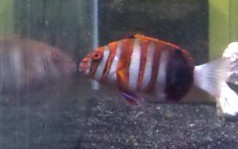
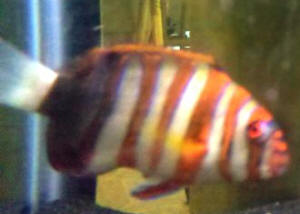
- Harlequin Tusk Eye Spots - I have just noticed on my harlequin tusk, that he has a spot on his bottom part of his tail and I tried looking up some stuff to see if it was what I thought, but do they get a fake eye spot on there tail? <Not that I am aware of - the more common place is on the anal fin and at the back of the dorsal fin, but these go away as they mature.> cause that is what it looks like. just wanted to make sure it wasn't anything bad <Probably not - there's always room for genetic variation and mutation. Could be you have a very unique Tuskfish.> thanks Angie <Cheers, J -- > Harlequin Tusk Hi <Hello, JasonC here.> I just recently purchased a harlequin tusk fish from a local pet shop I have been dealing with for years. The fish is doing well in my 150 gallon fish only aquarium. It started eating the minute it got into the tank and takes Mysis, clams, brine shrimp and just about anything else I put in the tank. It is active and fairly bold at feeding times. <Ah, good.> Here is my question. I have been reading many articles saying that the best quality specimens come from Australia and are fairly pricey. I paid $60 for my two inch fish. These articles now have me concerned that the low price I paid may indicate that I have a low quality Philippine specimen that is most likely doomed. <Not necessarily so. My own tusk was not from Australia and is doing well after more than a year. You just want to keep this information in hand when selecting a specimen. It sounds to me like you got a good one, and in general, these are pretty tough fish.> Is there distinguishing features between the Philippine and Australian fish. <Ahh, someone asked this question the other day. Check out my answer at http://www.wetwebmedia.com/marine/fishes/wrasses/choerodon/faciatafaqs.htm > Can you point me to any detailed information on this fish. <Do also check on www.fishbase.org> Thank you AJ. <Cheers, J -- > Tuskfish Hi Bob, I've been doing lots of research on the Harlequin Tuskfish. <Hello, JasonC here...> My question is do the Philippine version also have blue teeth? <Yes, they do.> What about the tooth coloring of a small juv Australian tusk? <In my experience, the blueness of the tusk teeth becomes more pronounced with age, and that juvenile's teeth have much less blue to them, to the point of being almost white. Again, this will change with time.> Do you have any recent pictures? <I do not, but Bob was recently in the GBR region and "thought" he had a photo of a tusk, but alas... with underwater photographs there are many, many variables which are often discovered once back home and examining your work. I believe his exact words were, "I used the wrong damn lens." Oh well, do check out http://www.wetwebfotos.com/ and use the search there to find the photos we do have.> Any help is appreciated. Thank you Ali Atapour <You are quite welcome. Cheers, J --> Re: Tuskfish Thank you for the quick reply, very impressive..
hehe <Oh thank you. Perhaps not so when you realize there are three
or four people answering this stream of email!> I have another
question if you don't mind, How can you distinguish a Philippine
small juv versus an Australian small juv. <Probably the price.
Shipping out of Australia is nuts, so it adds significantly to the
price. The Philippines has very regular cargo flights heading into LA
so it's much cheaper - up here in Massachusetts, an Aussie tusk
might run you $150-200 or more, where the Philippine tusk would be no
more than $100. Juveniles would be just a little less.> My local
fish store insists that he carries only the Australian version, but how
do I know for sure? He wants 75 for the small 3 - 3 1/2" juv
(supposedly Australian) tusk. <Well many people talk about the
coloration as a clue, and typically the orange of an Aussie tusk is
very deep and bold. That being said, I've also seen this same
orange on non-Aussie tusks. The same is true with the blue that occurs
on the back and near the caudal fin. Aussie tusks typically have more
blue, or are darker. But again, this can also lighten and darken with
mood, and my own non-Aussie tusk has a good deal of blue on its back.
Color may not be your best guide. I would use price - I paid $75 for my
Indo-Pacific juvenile tusk (3in), and I live in Massachusetts. If you
live in or close to LA, you might get a small shipping break but not
that small.> Any tips on identifying the young? <Again, I think
price - they don't cost any less to ship because they're
smaller. The smallest of small tusks aren't nearly as handsome as
their full-grown-selves and look more like a big eyeball with fins -
ok, maybe not that bad, but certainly not easy to distinguish at that
size. Do check out Bob's page on these - he has pictures of both:
http://www.wetwebmedia.com/marine/fishes/wrasses/choerodon/faciata.htm>
Thank you again, Ali Atapour |
|

|
Features: |
|
| Featured Sponsors: |
.JPG)