|
Related FAQs: Mussids, Mussids
2, Mussid Identification,
Mussid Behavior, Mussid Compatibility, Mussid Selection, Mussid Disease, Mussid Systems, Mussid Feeding, Mussid Reproduction, Stony/True Coral, Coral System Set-Up, Coral System Lighting, Stony Coral Identification, Stony Coral Selection, Coral Placement, Foods/Feeding/Nutrition, Disease/Health, Propagation, Growing Reef Corals, Stony Coral Behavior,
Related Articles: Large Polyp Stony
Corals, Stony or True Corals,
Order Scleractinia, Dyed Corals,
/The Best Livestock For Your Reef Aquarium:
Brain, Meat, Pineapple
Corals, Family Mussidae, Pt. 1
To:
Part 2, Part
3, Part 4,
Part 5, Part 6,
Part 7, Part 8,
|
|
|
By Bob Fenner
|
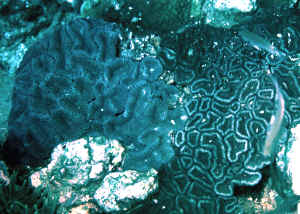
Acanthastrea
ishgakiensis and Lobophyllium
hemprichii, Malaysia
|
Family Mussidae Ortmann 1890.
Variously called Meat and Brain corals for obvious common
characteristics: large "meaty" polyps, wandering valley-like
arrangement of corallites like the sulci of grey matter. All have
distinctive thick columellae and corallite walls with toothed
septa. All Zooxanthellate; thirteen/fourteen genera; eight/nine in the
Indo-Pacific; four in the Atlantic; genus Scolymia in both.
Range:
Thirteen genera. Eight in the Indo-Pacific, four in the Atlantic and
Scolymia which is found in both the Atlantic and Pacific
Oceans (Though the Indo-Pacific Scolymia have been removed to the genus
Acanthophyllia by some:
https://reefbuilders.com/2009/06/04/acanthophyllia-deshayesiana-indo-pacific-scolymia-officially-recognized/).
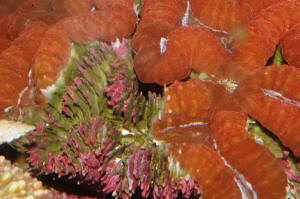
| Selection: Take care to examine prospective purchases
carefully. Avoid those with obvious damage, such as skeletal
breaks, algae growing on exposed parts of the skeleton as showing
in the Lobophyllia at right. |
|
Aquarium Care:
Other than the genera Acanthastrea, Scolymia and Lobophyllia, not
much used in the aquarium interest... due to slow growth, stinging
propensity (my mesenterial filaments). Not hard to keep... most
requiring not much light, water circulation. Need to be wide-spaced
from other sedentary invertebrates. Though all are hermatypic,
photosynthetic, most are voracious feeders of meaty foods.
Genus Acanthastrea Milne Edwards and Haime 1848. Typically
are made up of flat colonies that are either massive or encrusting; often
multi-colored.
Fleshy polyped corallites as individual circles to elongate in structure. Septa with
tall, thick teeth. Can resemble Favites. This genus now placed in the family
Lobophyllidae by some.
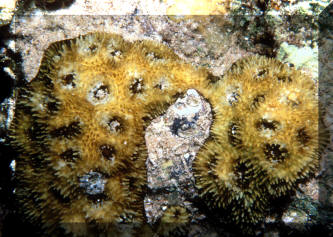
Acanthastrea brevis Milne, Edwards & Haime 1848.
/COTW:
Characters: Colonies
are mostly submassive. Corallites are cerioid to subplocoid with moderately
thin walls. Septa are thin and widely spaced. Larger septa have very long
upwardly projecting teeth giving colonies a spiny appearance. Colonies are
usually not fleshy.
Colour: Uniform
or mottled brown, yellow or green.
Similar Species: Acanthastrea
echinata, which has relatively fleshy corallites with thicker walls
and less elongate septal teeth. These two species may be difficult to
distinguish unless they occur together.
Habitat: Shallow
reef environments. DF macro image.
|
|
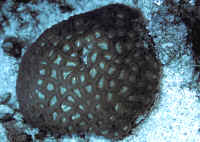
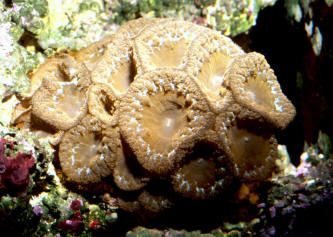
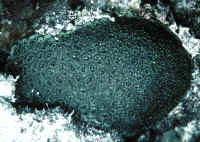
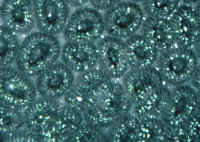
| Acanthastrea echinata (Dana 1846) Pineapple
Coral. Circular colonies tat are typically boulder-like. Septa with
long, pointed teeth (most easily seen in live specimens). Brown,
green to brightly colored. The most common member of the genus,
though this one not all that often seen. Maldives photo and
close-up. |
|
Bigger PIX:
The images in this table are linked
to large (desktop size) copies. Click on "framed" images
to go to the larger size. |
|
%20MD.JPG)
%20MD.JPG)
|
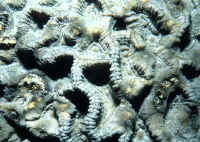
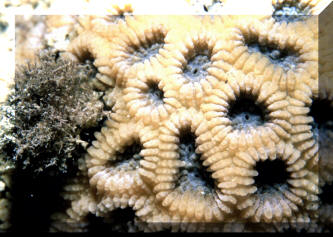
| Acanthastrea faviaformis (Veron 2000).
Distinctive septa-costae with thick teeth. All dirty brown in
color. Upper Red Sea photo. |
|
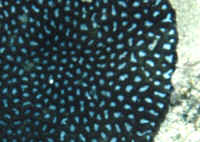
| Acanthastrea hillae Wells 1955. Encrusting
usually. Colonies to more than five feet in diameter, with
irregular shaped corallites. Contrasting colored walls and oral
discs. Bunaken, Sulawesi, Indonesia pix. |
|
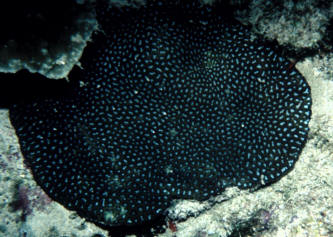
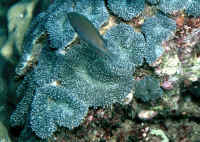
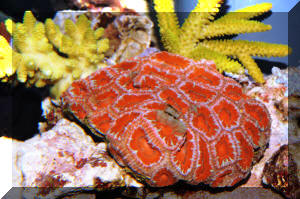
| Acanthastrea ishigakiensis Veron 1990.
Hemispherical, small boulder-like colonies up to a foot and a half
in width. Most are blue-grey in color with oral discs of
contrasting color. Usually fleshy in appearance. Colonies in
Bunaken/Sulawesi/Indonesia, Pulau Redang, Malaysia and the Gulf of
Aqaba, Red Sea below. |
Bigger PIX:
The images in this table are linked to large (desktop size) copies.
Click on "framed" images to go to the larger size. |
 |
Genus Acanthophyllia (Wells 1937):
|
Yo Bob
10/27/13
Mussid ID corr.s, Indo-Pacific Scolymia are now Acanthophyllia
Hi Bob,
<Hey Jules... now am humming the Beatles tune... A to middle C>
It was nice seeing you last weekend, as always.
<Ahh, a very nice time indeed>
I was just browsing Google looking at some coral photos to help
illustrate the answer to a taxonomic question someone sent me, and I
happened to notice that you have a very special photo on your site-- I
know, you probably are thinking that all of your photos are special.
They are, but this one is particularly so. I have attached it here.
<Will look for... oh, I see you explain below>
You use to illustrate Scolymia, hence the name you gave the photo, but
it is not Scolymia. It is Acanthophyllia deshayesiana. It is a common,
high-value import from Indonesia, usually imported as Scolymia,
sometimes as Cynarina, but now legally only as Acanthophyllia. Long
story. The are many many photographs of this coral in aquariums since it
is a very popular aquarium coral. There are to the best of my knowledge
no published photographs of it taken in the wild. Hence my interest in
your photo.
<Ahh, thank you>
You listed Raja Ampat as the locality. Do you remember the depth and any
other details?
<Aye yi yi... I barely remember what I made for bfast this AM. Many
years... decades back, I showed some discipline in labeling just
finished rolls of film with such notes... >
Even the "Cynarina lacrymalis" featured just above the
Acanthophyllia, also photographed at Raja Ampat, is likely a special
photo. I believe it shows Indophyllia macassarensis, which is
sometimes not easy to distinguish from Cynarina lacrymalis, and
sometimes not easy to distinguish from Acanthophyllia deshayesiana. If
you look at my book Corals A Quick Reference Guide you will see that I
grouped these three species into the genus Cynarina, which is what I
suspect will ultimately happen on the taxonomic front, though it may
take many years.
<Am very inclined to beg you to look through my (many, Way too many)
totally unidentified Cnid. pix, let alone my likely mis-id'ds>
With your permission I would like to forward a copy of this photo to
Charlie Veron. He has recently recognized the validity of this coral
(after many years of me beating him over the head about it because he
refused to separate it from Cynarina lacrymalis). He has lots of good
AQUARIUM photos of it to illustrate his online version of Corals of the
World, but he has no underwater photos from the natural setting. I am
sure he would love to feature your photo.
Best Regards, Julian
<Ah, certainly... I will take a quick look on my HD and attach the
original here for all's use; actually three others labeled in the same
series. Cheers, BobF>
According to Joe Fish: Acanthophyllia deshayesiana.
3/22/20 /FB
"This one is controversial. I regard Indophyllia as a synonym of
Cynarina, and Acanthophyllia as a valid genus and species. But these
need some taxonomic (i.e. molecular) study."
"Joe Fish
22 mins ·
Indophyllia is a taxonomic mistake that has lingered on in the hearts
and minds of taxonomists and aquarists for the past three decades. Best
& Hoeksema described the taxon in 1987 from Indonesia, differentiating
it from another sympatric monocentric lobophyliid that they identified
as Cynarina lacrymalis. However, their "Cynarina" specimens are clearly
a better match to Acanthophyllia deshayesiana, both of which have the
lower order septal cycles tall and thin. And their "Indophyllia" is
closer to C. lacrymalis, both having the lower order septa comparatively
short and thick.
This corresponds with what we see in nature, where two major phenotypes
are present. C. lacrymalis corresponds to a widespread coral with
translucent, solidly colored, bubbly tissue. A. deshayesiana is limited
to the West Pacific and has opaque tissue, with more variable color
patterns and a rugose texture. These do still vary, but only to a minor
degree, and it's usually the odd "intermediate" phenotypes that
aquarists like to label as Indophyllias.
Unfortunately, the classification of these corals was made even more
confused by the revision of Huang et al 2016, who lumped deshayesiana as
a junior synonym of lacrymalis, while still recognizing macassarensis as
a valid species. But these authors based this solely on the "septal
tooth size and septal lobe development [being] comparable between the
two taxa", without going into any further detail or confirming this with
molecular data. Based on my own experience with these corals, that
determination seems rather suspect, and it certainly fails to take into
account the many phenotypic differences in their soft tissues, along
with the biogeographic (and likely ecological) discrepancies.
Anyways, thanks for reading. Sometimes I feel the uncontrollable urge to
vent on matters taxonomical. I'll tag some coral nerds in this, in the
hopes that it spurs a bit more restraint when identifying specimens as
"Indophyllia"."
"Julian Sprung First, I did not tell Bob that this photo was
Indophyllia. Joe's right, that's a classic Acanthophyllia. I have
written about these corals at length, and you can see some of what I've
written online still, as well as in my book Corals, A Quick Reference
Guide, which is unfortunately now out of print. Joe, I've wanted to work
with someone on this topic for years (actually decades now). I stated my
opinion about the taxonomic status back in 2000 in my book Corals and my
opinion has not changed. A study of the DNA could change my opinion,
however, and I am open to learn whatever it reveals. I see that Joe
believe's Acanthophyllia is a valid separate genus. I don't. I think
there is just the genus Cynarina, with AT LEAST 3 species (C.
lacrymalis, C. deshayesiana, and C. massacarensis). There are additional
distinctive forms of what is most like Indophyllia that may represent
hybrids, ecomorphs, or additional species. The natural locality range of
these species is also much broader than Veron has stated (or anyone else
besides me realizes). Vincent Chalias proposed that Indophyllia or some
of its forms at least, could be the hybrid product of A. deshayesiana x
C. lacrymalis. While I believe that at least certain Indophyllia type
forms are a distinct species, the presence of hybrids as Vincent
proposed is in line with my own thinking."
|
| Acanthophyllia deshayisiana Bali 2014. Formerly
Cynarina lacrymalis according to Veron 2000;
Indo-Pacific. Raja Ampat |
%20MD.JPG)
|
Bigger PIX:
The images in this table are linked
to large (desktop size) copies. Click on "framed" images
to go to the larger size. |
|
%20MD.JPG)
|
Genus Australophyllia: Erected genus for Symphyliia
wilsoni, placed in family Lobophyllidae by some.
https://reefbuilders.com/2016/02/04/australophyllia-is-the-new-home-of-symphyllia-wilsoni/
massive colonies with large • irregular valleys, grove on
top of wall • large fleshy mantle similar to Lobophyllia but smaller
septal teeth • temperate water specialist /WA Coral
Genus Blastomussa Wells 1961. Colonies are phaceloid (polyps
on separate column-like branches growing from a common center). or
subplocoid (polyps having a gap between them or at least not fused at
their walls). Fleshy to the point of not being able to make out
corallite characteristics when live. Septa with lobed teeth that slope
to oral discs. Compare with the Faviid genus Caulastrea whose polyps
lack lobed teeth and lack fleshy mantles. Prefer low light and
current conditions.
/WA Corals: phaceloid colonies • weakly developed columellae •
fleshy mantle
Bigger PIX:
The images in this table are linked to large (desktop size) copies.
Click on "framed" images to go to the larger size. |


MD.JPG)
%20MD.jpg) |
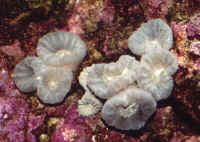
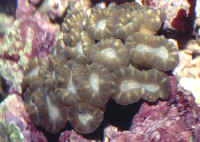
| Blastomussa merleti Wells 1961. Small
corallites Under 7mm. in diameter). Septa in two cycles, the larger
looking like white teeth. Mantles generally greatly expanded by day
(tentacles out only at night). Aquarium images. Easily
fragmented. A synonym of B. loyae according to Veron,
2000. |
|
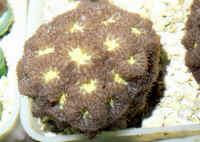
| Blastomussa wellsi Wijsman-Best 1973.
Pineapple Coral. Phaceloid colonies. Polyps 9-14 mm. in diameter.
Numerous colors, often with contrasting centers. Here under culture
at Dick Perrin's Tropicorium and in an aquarium. |
|
To:
Part 2, Part
3, Part 4,
Part 5, Part 6,
Part 7, Part 8,
|
|