|
FAQs about Mussid Coral Identification
1
Related Articles: Mussid
Corals,
Related FAQs: Mussid
Identification 1, Mussid ID 2,
Mussid ID 3, Mussid ID 4, & Mussid FAQs 1, Mussid FAQs 2, Mussid Behavior, Mussid Compatibility, Mussid Selection, Mussid Disease, Mussid Systems, Mussid Feeding, Mussid Reproduction, Stony/True Coral, Coral System Set-Up, Coral System Lighting, Stony Coral Identification, Stony Coral Selection, Coral Placement, Foods/Feeding/Nutrition, Disease/Health, Propagation, Growing Reef Corals, Stony Coral Behavior,
|
|
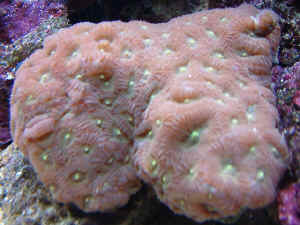
Help ID'ing LPS... Not Sure -- 10/01/07
Hi Crew Member, <Hello Querier> First I'd like to thank
you and the site for all the great information you provide. <On
behalf of Bob and the crew, you're welcome.> I bought a
piece of LR over a year ago now, about a few months after my
purchase I noticed a pink spot on an old LPS skeleton on the LR.
<Cool!> The pink spot has now grown enough to be somewhat
identifiable by the trained eye. <Mmm, maybe, but maybe not this
trained eye... Might be more helpful to see of the underlying
skeleton from which this polyp is growing.> I searched the net
to find something that would maybe resemble my mystery coral with
no such luck. <Sometimes not the easiest thing to determine when
they are this small.> I have included a pic if the nickel sized
LPS. Any help ID'ing this coral would be greatly appreciated.
<Fungia commonly produce these babies on skeletons... Maybe a
member of the family Mussidae looks a little like a Blastomussa but
I don't think it is, Scolymia or Cynarina maybe possibilities.
Is hard to tell from just one photo and this coral is still quite
small.> Thank you,
<Welcome! Mich> |
|
|
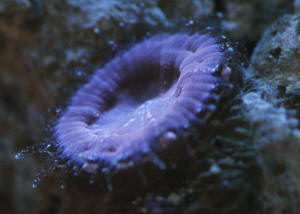
| Coral and Algae ID 3/15/06 Hi Crew!
<John> Just a quick question if you
please. I have attached the picture as well as insert it
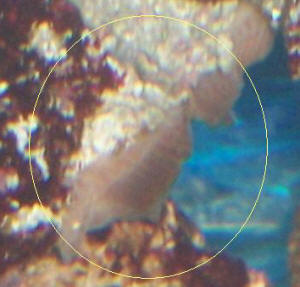
into this mail. First, can you tell me what the coral is
in the yellow circle under the mushroom corals? It stays
retracted like that during the day, but seems to "bloat"
when the lights go off at night. <Perhaps a juvenile Mussid...
can barely make it out> It has grown a little in size since the
rock was placed in the tank a little over two weeks
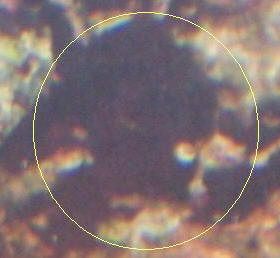
ago. Also, is the object in the second circle and pretty
much all over the rest of the rocks BGA? <Yes, of some sort>
At first, I know I am going to sound like a newbie, but it is okay,
because I am :), <No worries> I thought it was red coralline
algae. However, when cleaning my tank today I noticed
with a little effort that it can be scraped off an it only on the
parts of the rock that receive direct light. It appears
no where else in the tank than on the live rocks. I do
10-25 % water changes weekly (With R.O water). I have been adding
calcium and strontium (Sp) to the tank as well as Iodine for the
skunk cleaner shrimp. My levels are all zero with the exception of
my nitrite which this week was at .25 ppm. <Mmm, this is a
clue... should be zip> My ph is 8.3 . I am also using
a Berlin Airlift skimmer that is one of their in-tank
models. That also gets cleaned weekly to insure proper
operation. Thanks for the assistance! Oh yes my SG is 1.023 Thanks!
John <Do give the articles, FAQs files on BGA, Algae Control a
read over on WWM. Bob Fenner> |
|
|
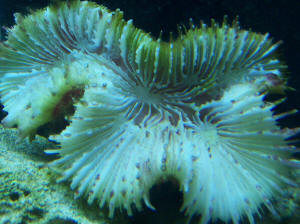
| Coral ID 12/22/05 Hi, I am hoping you can
help me ID this piece of coral that my loving husband got for me
today for Christmas. My husband can't remember the
name, only that it is a hard coral. lol I have looked
everywhere and the only thing that closely resembles it is a
brain. When he first brought it home, I thought it was a
clam cause of the shape of its mantle but it is indeed
not. There are spiky ridges all over it and if it has
tentacles/polyps they haven't extracted yet. The
crown is white with a pink center....the color of the pic is rather
poor. I hope this helps. <Sorry to say that you
either have a very ignorant or very unscrupulous fish
store. It looks like this was probably Lobophyllia, but
it is very much dead. If this is what it looked like
when purchased, I would demand a refund.> If you don't mind,
I have another coral question. I have two (red and
green) Montipora digitata frag, the green one seems to be secreting
this clear spider web like slime. Is this normal or
should I be worried? Thanks <If the coral looks
normal otherwise (good rich color, polyps extended, not tissue
recession), I would not worry at all. If it really
bothers you, you could blow it off with a turkey baster (a new,
clean one please!! Every reefkeeper should have
one.) Best Regards. AdamC.> |
| Anthony and Steve, The upside is that it may actually be easier
to ID in this condition! Heartbreaking that some
store actually took this guys money. Adam |
|
|
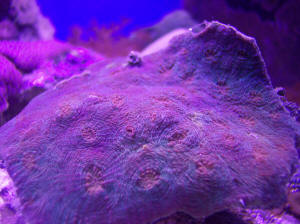
| Acanthastrea echinata 8/3/05 Hello (again) <Hi Niki,
Ali here...> Hope your day finds you well.....could you possibly
identify this coral for me? <Sure can...> I looked around,
and I couldn't make a definite I.D. It was shipped to us as a
Micromussa (not what it looks like to me!) <Acanthastrea
echinata, great coral, I just hope you didn't pay too much!>
Thanks again, <Take care, Ali> |
|
|
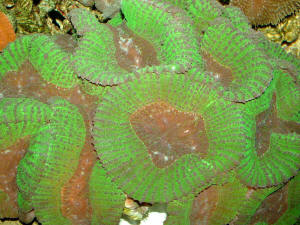
| What Coral? Hi Bob, I am hoping that you can help with
the identification of this coral. The hobbyist who has had a very
healthy colony for the last 10 years, insists that it is a
"brain coral". He also has a sister colony from it. I
have looked in several books but not found it. Thanks for your
help. All the best, Iggy <Mmm, a Mussid for sure, likely a
Lobophyllia species. Please see here: http://www.wetwebmedia.com/mussids2.htm Bob
Fenner> |
|
|
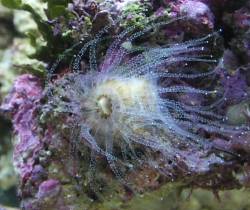
| Identification of Neat Looking Thing Hello
Mr. Fenner ~ Would you please identify the creature in the attached
photo? <A type of anemone... may well be part of a group
called Glass Anemones, particularly of the genus Aiptasia...
Ill-regarded due to their penchant for rapid reproduction, and
difficulty of control/removal. There is coverage of this family on
the WWM site: http://wetwebmedia.com/aiptasia.htm> If you look
at its middle, it is beginning to cleave and has two distinctive
oral grooves (disks?). <Oral grooves> Although the picture
does not show it, there is actually a third smaller oral groove on
the bottom. When it came attached to some rock purchased out of a
friend's tank a couple of months ago, it only had one oral
groove. Thank you! Sherri Lindsey <Please do read over the bit
on WWM here, and I would separate the rock these are on to limit
their spread somewhat. Bob Fenner> |
|
| Re: Identification of Neat Looking Thing
Oops -- I guess the picture I sent you didn't come across very
well or something. The neat looking thing is an ahermatypic coral.
(<A
HREF="http://www.reefcentral.com/vbulletin/showthread.php?s=
ad4770b8b8fba3f17801b79141c3f4d7&threadid=28129">
http://www.reefcentral.com/vbulletin/showthread.php?s=ad4770b8b8fba3f17801b791
41c3f4d7&threadid=28129</A>) The only reason I tell you
this is so that if you post the picture along with your response on
your site, I hope others who have something similar to mine
don't mistakenly eradicate it. <Hmm could be... a Mussid? Do
you detect, as in see, feel a solid base/theca to this animal?
Perhaps take a look through Dr. Veron's recent "Corals of
the World" through the ahermatypic Mussids. Bob Fenner>
Thank you, Sherri |
Blastomussa "Pineapple Coral" II Thanks for your
reply. I have had the coral for 4 months now and it "appears"
fine but, there is no new polyp growth or anything. <a
notoriously slow grower... please consider feeding very finely shredded
meaty for to keep this coral and grow it> It is located on top of a
rock in my 20 gal tank and I wanted to make sure that it didn't
like sand. <yes... but do be careful not to burn it... a
change or upgrade in bulbs could shock this animal terribly without
caution> I'm glad it doesn't because there is no sand in my
tank. Are there any good sources for information on this species? How
can I tell that it is truly happy? <regular polyp extension/cycling
and some growth. A rich dark color too> Just so you know, I kind of
"stumbled" upon this coral, the LFS had just received it and
they thought it was a red mushroom rock (which I had been wanting for
some time). I must say, it did look like mushroom rock in the shipping
package but, to my surprise shortly after I turned on the lights the
next day it was NOT mushroom rock but, a Blastomussa wellsi coral!
<yes... I agree. And it is often misidentified... even as a brain
coral (Faviid)> Thanks again! Ann
<best regards, Anthony>
| Atlantic Corals Anthony, or whomever is on
tonight, <cheers mate> Thank you for identifying the last two
pics I sent you. These are all hitchhikers on my LR from the
Florida Keys. <wow... hat is some killer live rock you
have there! Purchased or collected? Very beautiful diversity it
seems> I'm not going to add any corals to this tank, but I
like to know what I have in order to supply these creatures with
the best care I can give them. <admirable my friend> I
don't believe in the idea that when something dies to say,
"oh well, it came with the LR". Every organism deserves
its best chance in my setup. <I'm starting to sound like the
aquarist's version of M. L. King Jr.> <we are in
agreement... and you do have some rarities that many reef keepers
would trade dearly for and give a great home of you ever choose to
part with them> Anyway, some more pics, if you please. I thank
you so much (and my critters thank you even more), Mike <my
pleasure... the first image is likely a Faviid: the Rose coral
(Manicina)... although it is not crystal clear from the
image/age/size of coral. Possibly Mussa... but I think it likely
will be a rose coral. The second image is a solitary cup coral.
Three families with more than a handful of species looking quite
similar are included under this umbrella name. Both corals here are
scleractinian reef builders... the latter is weekly symbiotic or
not symbiotic at all (requires daily feeding). Feeding finely
minced meaty foods of marine origin 3-5 times weekly minimum is
necessary and will keep these beauties just fine, Daily feeding for
fast growth. Do consider buying the Humann and DeLoach set (3) of
dive books on Florida and Caribbean creatures... all of these
corals and so much more on your live rock are Id.ed therein. Great
books (Reef Creatures, Reef Coral, Reef Fishes). With kind regards,
Anthony> |
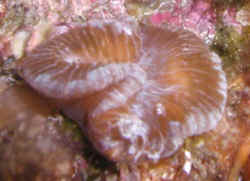 |
| Brain Coral ID Hi Everyone, One of my
friends is selling this coral to me. It is growing too
large for his tank. I would like to know what type of
brain is it and what type care it needs before I make
purchase? As always thanks for your expertise. Wayne
<Looks like a Lobophyllia sp. to me. Pls see here: http://www.wetwebmedia.com/mussids2.htm
Bob Fenner> |
|
|
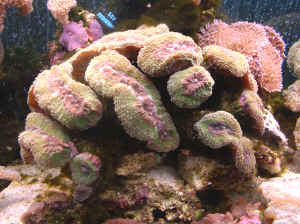
| Blastomussa wellsi? 4/11/03 Hello again, I
picked up this coral the other day thinking it was Blastomussa
wellsi... <it does appear to be so... often mistaken for Faviid
brain corals> I was really excited as it was sold for $28 and
the girl at the store shrugged her shoulders and said," I
think we call it moon coral." <indeed... it is how
Blastomussa are commonly imported (with Faviids)> Her
uncertainty only solidified my belief that it was Blastomussa. But
I think I am wrong. Could this be a Favia/Favites sp.? I need to
know, because as of now it is near the bottom of the tank and
I'd like to give it proper placement for light and current. I
hope the picture gets through. Sorry for the file sizes being a bit
large. Thank you, -RY <I'd need a clearer image of the
polyps to be sure... but as a red Faviid or a Blastomussa, it will
be treated the same (low light... moderate (not too weak!) water
flow. Best regards! Anthony> |
|
|
Coral identity 3/20/03 can you guys help identify as to what
kind of coral this is? Jonathan That would be a Lobophyllia... feed
weekly too (needs more than the best lights can give). Anthony>
Re: coral identity (part 1) (pictures will be sent in 2
separate emails as otherwise my computer automatically zips them) can
you guys help identify as to what kind of coral this is? Jonathan
<Looks like a Lobophyllia to me. Please see here: http://www.wetwebmedia.com/mussids2.htm
Bob Fenner>
Lobophyllia Hi, have any of you ever heard or seen of this
type of branching brain coral? <Yep... Lobophyllia
(hemprichii) form. Rather common. Hardy, handsome... and all round nice
guy as LPS species go> I have attached a pic for
reference. I never have and am wondering if it is a true
branching coral or a hoax? <not true branching... simply
phaceloid> There is one on the net right now and am thinking of
buying it but have never heard of or seen one. <a fine
coral, but don't pay a premium for it. Average value as corals
go> Should I buy a bridge in Arizona first? Thanks, Jeff
<Dude... I'm in Pittsburgh. We have got some serious bridge
action if you are interested. Best regards, Anthony>
|
|