Become a Sponsor

 
Home
Information Pages:
Marine Aquarium
Articles/ FAQs
(enter words you'd like highlighted in this page)
Freshwater Aquarium
Articles/ FAQs
Planted Aquarium
Articles/ FAQs
Brackish Systems
Articles/ FAQs
Popular Pages:
Features:
Daily FAQs
FW Daily FAQs
SW Pix of the Day
FW Pix of the Day
Conscientious Aquarist Magazine
New On WWM
Helpful Links
Hobbyist Forum bb.WetWebMedia
Ask the WWM Crew a Question
Calendars
Search Feature
Admin Index
Cover Images


Related FAQs: Mussids, Mussids 2, Mussid Identification, Mussid Behavior, Mussid Compatibility, Mussid Selection, Mussid Disease, Mussid Systems, Mussid Feeding, Mussid Reproduction, Stony/True Coral, Coral System Set-Up, Coral System Lighting, Stony Coral Identification, Stony Coral Selection, Coral PlacementFoods/Feeding/Nutrition, Disease/Health, Propagation, Growing Reef CoralsStony Coral Behavior,

Related Articles: Large Polyp Stony Corals Stony or True Corals, Order Scleractinia, Dyed Corals,

/The Best Livestock For Your Reef Aquarium:

Brain, Meat, Pineapple  Corals,  Family Mussidae, pt. 4

To: Part 1, Part 2, Part 3,

By Bob Fenner

Mycetophyllia ferox, TCI

Genus Mussa Oken 1815. Monotypic, only found in the tropical West Atlantic. 

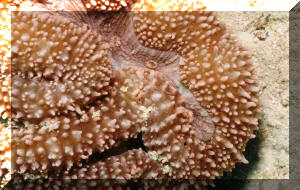
Mussa angulosa (Pallas 1766). Large, fleshy polyps that are well-separated. When retracted, skeletal elements/septa appear spiny. To two feet in diameter. Below: Bahamas images of  larger, smaller colonies and a close-up by Di.F in Cozumel. 

Genus Mycetophyllia Milne Edwards and Haime 1848. Flat colonies with outward radiating valleys. Poorly developed columellae. Septa-costae are outward facing. Found in the Caribbean only. 

Mycetophyllia aliciae, Knobby Cactus, Thin Fungus Coral. Usually found as thin convex plates, with distinctive raised star-shaped polyps. Bordered by ridges that run inward, though less pronounced, common than others of the genus in the region. Bahamas pix. 

Bigger PIX: The images in this table are linked to large (desktop size) copies. Click on "framed" images to go to the larger size.
Mycetophyllia danaana, Low Ridge Cactus Coral. Colonies as flat plates, mounds, domes. Ridges about edge turn to the inside, often crossing center, intertwine (definitive differences from M. lamarckiana in the same area). Occurs in green, brown, gray. Six to fifteen inches across. Bahamas pix.

Bigger PIX: The images in this table are linked to large (desktop size) copies. Click on "framed" images to go to the larger size.
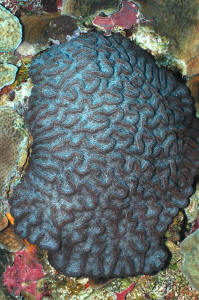
Mycetophyllia ferox Wells 1973. Colonies mainly as rounded plates, covered with sinuous valleys/mazes that at times form closed borders. Bahamas images.

Mycetophyllia lamarckiana, Ridged Cactus, Large Cactus, Fungus Coral. Colonies as flat, wavy-edged plates. Ridges fleshy, don't extend to centers. Wide, shallow valleys, usually fleshy. Color variable: browns, greens, grays. 6-12 inches in diameter. Bahamas pix.

Bigger PIX: The images in this table are linked to large (desktop size) copies. Click on "framed" images to go to the larger size.

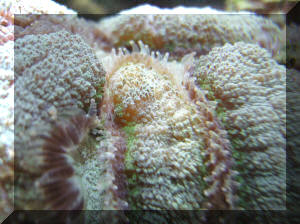
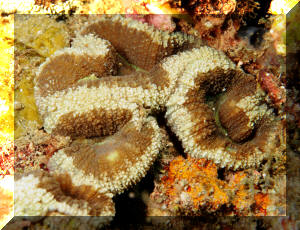
Genus Scolymia Haime 1852. Singular, circular polyps. Indistinct walls beneath their septa-costae. These are difficult species to discern one from the other. The three occurring in the tropical West Atlantic may be told apart by the shape of their septal "teeth". 

Bigger PIX: The images in this table are linked to large (desktop size) copies. Click on "framed" images to go to the larger size.

Scolymia cubensis (Milne Edwards and Haime 1849). Septa in 2,3 orders as spikes, pick-shapes. Found in the Caribbean and off of Brazil. Bahamas and Bonaire pix. 

Bigger PIX: The images in this table are linked to large (desktop size) copies. Click on "framed" images to go to the larger size.
 
Scolymia lacera, Atlantic Mushroom Coral. Tropical West Atlantic. To six inches in diameter, most a couple of inches. Have prominent triangular septal teeth ridges. Cozumel image by Di.F.

Bigger PIX:
The images in this table are linked to large (desktop size) copies. Click on "framed" images to go to the larger size.

Scolymia vitiensis Bruggenmann 1877. Septa slope up from the columellae, costae slope down to the perimeter. Look like Fungiids with a depressed center otherwise. One in Fiji, another in an aquarium. Below, two in Nuka Hiva, Marquesas, Polynesia.

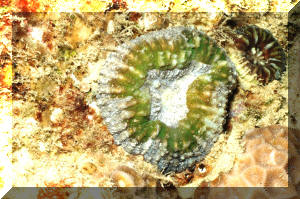
Scolymia wellsi, Solitary Disk Coral. Radiating, raised lines on polyp. Occur in greens, grays, browns. Has rough, irregular cylindrical, thin septal teeth. Bahamas pic. 

Bigger PIX: The images in this table are linked to large (desktop size) copies. Click on "framed" images to go to the larger size.
 

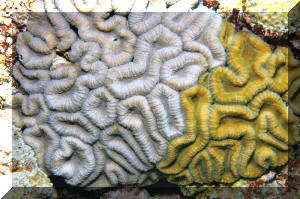
Genus Symphyllia Milne Edwards and Haime 1848. Similar to Lobophyllias but with a groove that runs along the top of corallite walls that fuses contiguous corallites, whereas Lobos are free from each other. 

Symphyllia agaricia Milne Edwards & Haime 1849. Thick fleshy appearance. Aquarium image. 

Symphyllia erythraea (Klunzinger 1879). Massive hemispherical colonies. Septa in two orders. Well formed columellae. Waikiki Aquarium photo. 

Symphyllia radians Milne Edwards and Haime 1849. Flat to hemispherical in profile. 20-25 millimeter wide valleys. Relatively thick walls. Less twisting valleys than S. recta below. Fiji colony and close-up.

Symphyllia recta (Dana 1846). Hemispherical to flat colonies. Small valleys (12-15mm wide), sinuous. A common coral in its range. Green to brown. A Fiji colony and a Philippine close-up. 


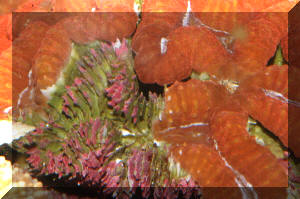
Not entirely compatible with other Cnidarian life. Here is a battle going on in a too-tightly stocked hobbyist culture system.

Bigger PIX:
The images in this table are linked to large (desktop size) copies. Click on "framed" images to go to the larger size.
  

Bibliography/Further Reading:

Coral Search

Borneman, Eric H. 2001. Aquarium Corals; Selection, Husbandry and Natural History. Microcosm-TFH NJ, USA. 464 pp.

Fossa, Svein A. & Alf Jacob Nilsen. 1998 (1st ed.). The Modern Coral Reef Aquarium, v.2 (Cnidarians). Bergit Schmettkamp Verlag, Bornheim, Germany. 479pp.

Gutierrez, Santiago. 1992. From a reef's point of view. Mussa angulosa. FAMA 3/92.

Hoover, John. 1998. Hawai'i's Sea Creatures. A Guide to Hawai'i's Marine Invertebrates. Mutual Publishing, Honolulu HI. 366pp. 

Humann, Paul. 1993. Reef Coral Identification; Florida, Caribbean, Bahamas. New World Publications, Inc. Jacksonville, FL.  239pp.

McDowell, Mark & Greg Smith. 2001. Meat Coral (Cynarina lacrymalis)- Where's the beef? FAMA 7/01.

Vargas, Tony. 1998. Feature Coral column: Cynarina. FAMA 7/98. 

Veron, J.E.N. 1986. Corals of Australia and the Indo-Pacific. U. of HI press, Honolulu. 644 pp. 

Veron, J.E.N. 2000. Corals of the World. Australian Institute of Marine Science. Queensland, Australia. three volumes. 

To: Part 1, Part 2, Part 3,


Featured Sponsors:
Google
 
Web www.WetWebMedia.com