|
Sipunculids, Peanut Worm, Identification FAQs
Related FAQs: Worm Diversity FAQs, FAQs 2,
FAQs 3, & Worm IDs
1, Worm IDs
2, Worm IDs 3, Worm IDs 4, Worm
IDs 5, Worm IDs 6, Worm IDs 7, Worm
IDs 8, & Worm ID FAQs by Group/Phylum: Flatworm Identification ID, Nemertean, Proboscis, Ribbon Worm ID,
Nematode, Roundworm ID,
Nematomorpha,
Horsehair Worm ID, Acanthocephalans,
Thorny-headed Worm ID, Polychaete Identification, Polychaete ID 2, Tubeworm ID, Hirudineans, Leech ID, Echiuran Worm ID,
Related Articles: Worms,
Polychaetes, Flatworms/Planaria,
|
|
|
Sea creature ID 1/17/18
Hi,
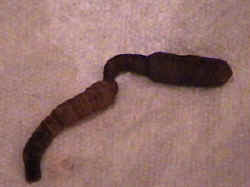
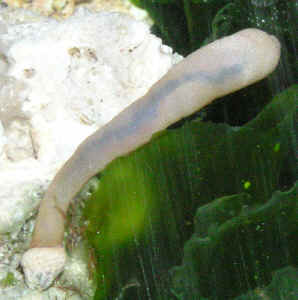
I found this creature on the beach at Sorrento, a town on Port Philip Bay, near
Melbourne, Southeast Australia.
It looks like a sea cucumber, but I have searched the net, including your site,
and haven't found any that are white.
It measured about 15cm end to end.
Could it be an albino? Or not a sea Cuke at all, but something else?
Thanks,
Daniel
<Looks too smooth to be a Sea Cucumber... my guess is on a worm group. Perhaps a
Sipunculid, Echiuran.
Bob Fenner>
|
 |
|
Weird invert buried in sand Id help?
12/12/17
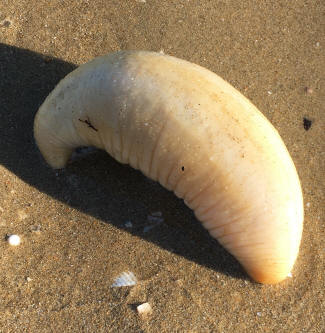
I was raking my sand with my Python and I started sucking up one of my Fighting
Conch or tiger conch and it looked like the Conch was attached to this thing or
just next to it Quinta dentley <Coincidentally?> but I thought it was just the
Conch having a really long sexual experience but it turns out it was its own
thing I have no idea what this thing is I do have a bristle worm issue in my
tank but it wasn't near a lot of them and it does not look nothing like a
bristle worm maybe it's some sort of bristle worm machine I don't know maybe you
guys can
Thank You!
<Neato! This appears to be a Sipunculid... not harmful; indeed, indicative of
healthy circumstances in your system. Bob Fenner>
|
 |
Peanut worm question. Comp.
6/19/15
Hello, WWM crew!
<Joshua>
I just wanted to ask a quick question that I was unable to find an answer for.
Do you think a Dwarf Angelfish or 6-line Wrasse would be likely to eat a
Peanut worm?
<Only if the worm were very small>
Somewhat of an odd question I suppose, but I've been thinking about adding one
of the two fish into my tank, and would
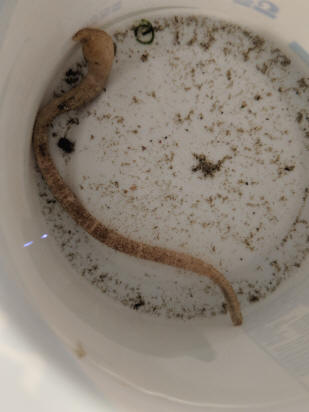
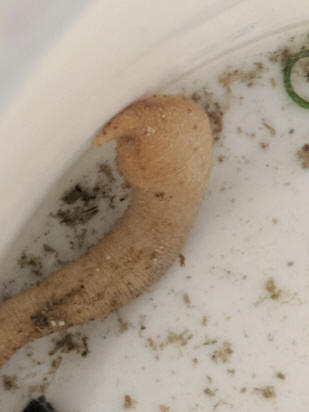
like to know if there is any risk. I've had a Peanut worm living in my LR for
about three years now, and he is just as big a member of the tank as the fish.
Any help with my wormy friend would be appreciated. Thanks!
<I do think they'll all get along. Bob Fenner>
re: Peanut worm question.
Good to hear. Thanks for the quick response, Bob. :)
<Welcome Josh>
|
Re: In need of an ID 2/19/15
<Mmm; thank you for providing the
MOV... this
is a worm of some sort...
will have to check when am not so tired.
Bob Fenner>
Re: In need of an ID 2/20/15
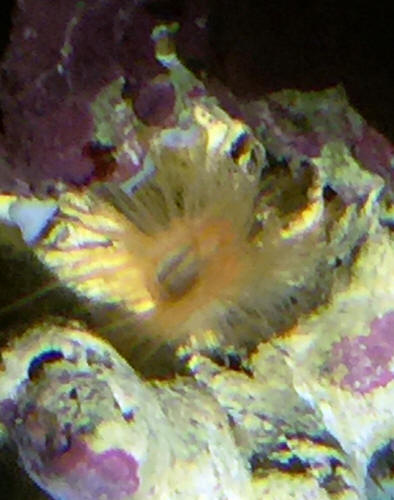
<Though it should be "in the substrate" the movement and oral appendages
of this animal remind me of a Sipunculid, a Peanut Worm. Bob Fenner> |
 |
|
Re: In need of an ID
2/21/15
Thanks for the reply,
I had a good laugh at the name, but I guess it could be, I will keep an eye on
it, do some reading on this, Sipunculid - Peanut worm.
P.s
My husband and I love your book. The book that turned us into reefers.
<The pleasure!>
Thanks again,
Sara Hartley
<Ah, cheers! BobF>
|
|
ID help 1/30/15
Can you help me ID this please
Your help is greatly appreciated
Katie Bramlett
<Appears to be a Sipunculid; a peanut worm; though it might be an
Echiuran. Bob Fenner> |
.JPG)
 |
|
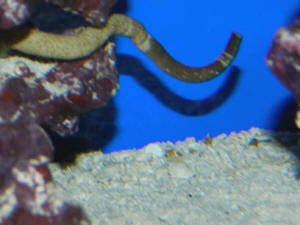
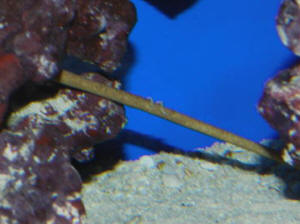
Peanut Worm? Yes! 4/27/12
Hello again Crew!!
<Hello Eric! Lynn here this afternoon, how may I help you?>
I once again have a question I hope you might help me with.
<Fire away.>
I recently noticed a new mysterious creature moving in and out of my live
rock. After perusing your various worm ID links, I believe it might be a
peanut worm.
<It is! It’s a sipunculid, otherwise known as a peanut worm.>
I have not been able to get a really good look at the entire thing all at
once though. It seems to be similar to an earthworm in body texture and
shape.
<Yes, sipunculids do have a worm-like appearance but one thing that
separates them from earthworms and bristleworms is their lack of a segmented
body. Indeed, sipunculids are in a completely different phylum (Sipuncula)
than earthworms and bristleworms (Annelida).>
I cannot identify any "bristles" like the many pictures of bristle worms I
looked at.
<Nope, these are mostly smooth, soft-bodied creatures that lack “stinging
bristles”.>
I have not seen its mouth open myself, but my wife said she saw it open
briefly and compared it to a dandelion flower when it has turned all white,
and is waiting for a wind to blow the seeds away.
<Yep, that’s a fairly apt description!>
When stretched across the rock it appears to be approximately six or seven
inches long.
<Offhand, that sounds like a big one but these guys can extend to impressive
lengths.>
When I removed a rock it was in and shined a light down the hole it seemed
to have contracted to approximately one inch or so in size. It does not like
light of any kind and will quickly retreat from it.
<Yep, this is typical.>
I have only witnessed it being active at night.
<This is also typical behavior.>
Late last night I was able to take some pictures of it which I will include.
<Thanks, but could you please reduce these photos to several hundred KB and
resend?>
Please note the small white attachments on the body. Are these tentacles or
possibly parasites?
<Sipunculids can have parasites, but typically they’re internal. What you’re
seeing is most likely innocuous, possibly some detritus; I wouldn’t worry
about it.>
If you are able to identify this I would be grateful as usual. Also any
advice on actions I should take or avoid with regards to this animal to
promote the safety and health of my tank would be appreciated.
<Peanut worms are harmless, beneficial, neat little creatures, so I say
enjoy! For more information, please see the following link:
http://www.wetwebmedia.com/pnutwrmidfaqs.htm >
My continued gratitude for your assistance,
<It was my pleasure.>
Eric
<Take care, Lynn Z>
|
 |
Re: Peanut Worm? Yes! 4/27/12
Thank you so much Lynn!!
<You’re very welcome!>
I am very pleased to have confirmation on the identity. May I assume
that this means you already saw the pictures
<I sure did.>
...and if so would you still like me to reduce and resend them?
<No need, we got your second email with the reduced file sizes, so we’re
good to go.>
Also I had an auto reply that said this email had been blocked permanently
due to the size of the photos the first time I tried to send it so I sent
you another duplicate email from a yahoo account.
<Ah, that explains it.>
I apologize for the duplicate post and please disregard the other email.
<No worries, Yahoo must have reduced the photos before sending so it all
worked out in the end.>
Thank you again
<You’re most welcome.>
.. and let me know if you need the pictures resent.
<No need, it’s all good!>
Sincerely,
Eric
<Take care, Lynn Z> |
|
Strange Creature
3/13/12
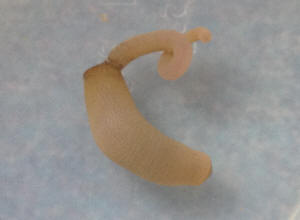
Pardon my crudeness, but what the heck is this creature that I
found lurking in my tank?
<One of two things, either a Sipunculid worm aka peanut worm
or a detached tentacle from an anemone or Euphyllia coral.
Jordan>
|
Re: Strange Creature,
Sipunculid 3/14/12
I have no anemones, so I'm guessing it could be this worm. If
it is, is it
harmful in any way?
<They are harmless. Read more here--
http://www.wetwebmedia.com/pnutwrmidfaqs
.htm Jordan>
|
|
Worm ID 6/29/2011
Hi guys.
<Hello Leon>
I love your advice and willingness to help out people with
questions. Your honest answers are amazing.
<Thank you, much appreciated.>
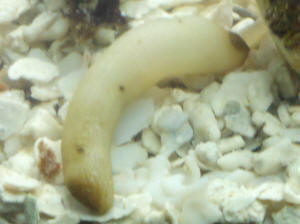
When I was doing some aquarium maintenance I found this (see
picture) it appears to be a worm or larvae can you help me
identify it? It is about 2 inches long.
<Appears to be a Sipunculid, a Peanut Worm. In the future,
please do not send large photo files, resize to a couple of
hundred kilobytes.>
Thanks.
<You're welcome. James (Salty Dog)>
|
|
|
|
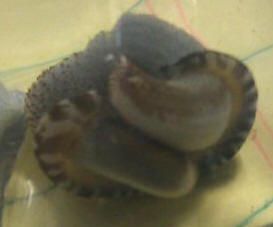
Mystery worm ID 6/11/11
Hello WWM crew!
My name is Justin and I work at a local pet store. I'm
currently attempting to become our aquatics specialist.
So to start off we usually have people come in with pictures or
mysterious creatures from their RT that are found, so we can Id
them. Today however, a young lady brought in a worm that I
haven't seen in any book that we carry.
Its about 6 inches long when fully stretched out and has very
fine feather duster-like tip.
<? Need a close up photo of this>
Its almost zebra striped with black and white sections. The odd
part is that it retracts it's tip into itself like if you had
pulled a pair of jeans inside out.
<Mmm...>
I did see a submission that sounded close to what I have
presented you with, and you couldn't come up with an answer.
The reason why I have resubmitted you with this question is
because I have a picture and was hoping that it would be enough
to help you with the answer.
Thanks
Justin R.
Mystery worm ID pic
http://cid-478c7353c7805235.skydrive.live.com/redir.aspx?page=browse&resid=4
78C7353C7805235!105&type=5&Bpub=SDX.Photos&Bsrc=Photomail&authkey=C*9PgYN9vL
I%24
<I suspect this may be a member of the Echiura, though I see
no example image via Google. Bob Fenner>
|
|
|
|
Re worm id... a vote for a peanut, nee Echiuran
6/13/2011
Hi Bob & crew,
<Alexander>
I saw this image today on WWM and think that it could be a peanut
worm - the description of the feeding apparatus and the striped
introvert would suggest as much.
http://www.wetwebmedia.com/WormPIX/Echiuran%20Sausage%20Worms/IMAG0017-1%20worm%20id.jpg
Alex
<Is also one of "next" guesses. Thanks, BobF>
|
|
Worm ID? 5/20/10
Hi, Great site you have, very informative!
I am in the process of setting up a 12 gallon Nano tank. I have
been using a red light at night to find cool hitchhikers on my
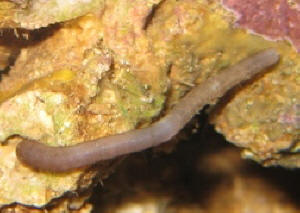
new live rock. I saw this worm last night and was able to snap
this picture before he retreated back into the rock. It only
comes out in the dark, approximately a little over an inch long
and gray in color. What type of worm is it? Is it
safe?...thanks!
<Can't tell from your image, even enhanced, enlarged... is
this animal segmented? Does it have any visible lateral
processes? Apparent labial or cephalic structures? Bob
Fenner>
Worm ID?, Sipunculid 5/20/10
Hi, Great site you have, very informative!
<Thanks.>
I am in the process of setting up a 12 gallon Nano tank. I have
been using a red light at night to find cool hitchhikers on my
new live rock. I saw this worm last night and was able to snap
this picture before he retreated back into the rock. It only
comes out in the dark, approximately a little over an inch long
and gray in color. What type of worm is it? Is it
safe?...thanks!
<Looks like a Sipunculid, aka a Peanut worm, harmless to
beneficial.
http://www.wetwebmedia.com/pnutwrmidfaqs.htm
>
<Chris>
Re: Worm ID?
Thank you so much for your quick response!
<Welcome>
<Chris>
|
 |
|
Odd Looking Worm: Sipunculid -- 5/26/09
Hi there!
<Hello!>
I have searched all over the Internet, including your website,
for information on this one type of worm that I have found in my
saltwater fish tank. The size is 30 gallons. I have one Tomato
Clown, one Blue Damsel, one Yellow Watchman Goby, and a feather
duster. I also have an assortment of copepods and Fireworms.
<Okay>
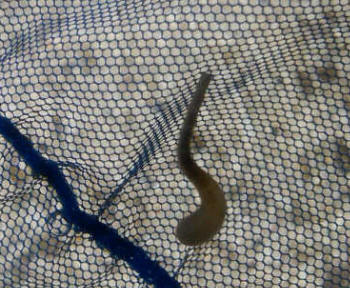
However, today I noticed a very odd worm. It looks like a sack
with a long appendage on one end and a short and sharp point on
the other end. It's about 1/4 of an inch when it is all
"rolled up" (which is seems to "roll up inside of
its skin") and 3 inches when it's all stretched out. It
seems to take its long snake-like end and bury into the sand very
quickly, and disappears fast. It really looks like a maggot,
<Eeuwww!>
..as no feet or suckers as visible. The color is like sand. I
have attached a picture. I would like to know what this is, or at
least what your best guess is. I attempted to take a picture of
it inside of a cup, but I had to settle for a picture of it
inside the net since the flash was too bright. However, when it
was in the cup, I noticed it crawling up the side of the cup into
air, almost 80 or 90% out of the water.
<Good news -- what you have is a very common and harmless
hitchhiker called a Sipunculid, aka a "Peanut Worm".
Please see WWM for more information, starting here:
http://www.wetwebmedia.com/pnutwrmidfaqs.htm .
Here's another excellent link as well:
http://www.seaslugforum.net/factsheet.cfm?base=sipunculid
>
Thank you very much for the help! :)
<You're very welcome! Take care, LynnZ>
Re: Odd Looking Worm: Sipunculid --
5/26/09
<Hi Jeremy, Lynn here again.>
Thank you very much for the prompt reply and valuable
information!
<It was a pleasure! Peanut worms are neat little creatures. If
you have a chance, take a look at the rockwork in your tank after
the lights have been out for an hour or two. A flashlight with a
red lens is best, but a regular one will do in a pinch
(especially if you can dial the beam to something less than
laser-like). You might be surprised how many critters are out and
about, including the peanut worms. They look like elephant trunks
sticking out of crevices in the rock, sniffing around on nearby
surfaces. That is, until they see the bright light of a
flashlight. At that point, they retract back into their homes in
nothing flat!>
I will certainly be visiting your site more often.
<Excellent! Please let us know if there's anything else we
can do for you.>
Regards,
Jeremy Buff
<Take care, LynnZ>
|
 |
|
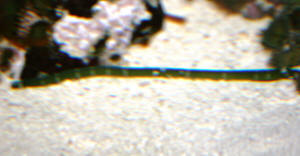
worm id, Peanut 4/8/09
I've seen this worm on numerous occasions after the lights go
out.
Usually it retracts when I put a flashlight on it but tonight it
kept on going. I ended up capturing it. Greenish in color with
light yellow bands. I would guess it is approximately 14" in
length.
Thank you
Rick
<Looks to me to be a Sipunculid. See here:
http://wetwebmedia.com/pnutwrmidfaqs.htm
Bob Fenner>
|
  |
|
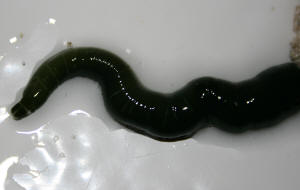
What is it? Peanut Worm! 1/19/09 <Hello
there, Lynn here this evening.> I have a couple of these
"worms" in my saltwater fish tank. <Neat> They
don't like light, <No kidding. They really hate
flashlights!> they stretch out to 5 inches. I was just
wondering if they were bad or if I should be concerned about
them. <No need for concern. They're harmless, beneficial
little Sipunculids, aka 'peanut worms'. Please see WWM
for more information, starting here:
http://www.wetwebmedia.com/pnutwrmidfaqs.htm Here's another
excellent link as well:
http://www.seaslugforum.net/factsheet.cfm?base=sipunculid Take
care, Lynn>
|
 |
Peanut Worm
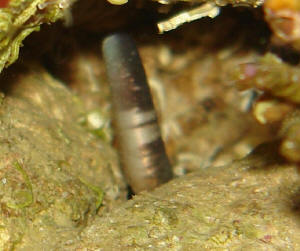
(Sipunculid)- 3/4/08 <Hi there!> After researching and
reading several articles I finally found pictures, on your site, of the
creature I was trying to identify. <Yay!> Although I haven't
seen the main body, I'm certain I have a peanut worm living in my
Live rock. <Excellent> My question involves multiple worms. Is it
common to have more than one worm living in the same hole? <It's
not something I've seen or heard of (until now!) in aquaria, but
they do sometimes group together in the wild in very high numbers
indeed. Barnes' Invertebrate Zoology tome states that densities as
high as 700 per square meter of rock have been reported in Hawaii.
That's a lot of peanuts! Whether any share the same hole, I
couldn't tell you. However, it does say something about their
tolerance for close proximity to each other.> I have three of the
"elephant trunks", coming out of the same small area, working
on the rock independently of each other. <Interesting> (These
things remind me of the creature in the movie Tremors, kinda creeped me
out at first, I thought "now this can't be good" lol)
<Heheee! I know what you mean. Thankfully, these won't chase,
hurt, or otherwise try to eat you or any of the critters in your
tank!> Thanks for your help and maintaining an excellent resource
for us newbies! <You're most welcome, thanks for sharing your
observations! Take care, -Lynn>
|
Worm or snake? 12/28/07 <Hello Heather and Mr. Vice
President... Mich here asking to be pardoned for the long delay
in response.> We are setting up a reef tank (65 gallons) and
have been at this for about 2 months. Two days ago we noticed
this little guy. <Well I didn't invent the Internet or win
a Noble Prize, but is sure looks like a Peanut worm (Sipunculid
sp.) to me!> We've seen him stretched out about 2" in
length. He doesn't seem to be particularly afraid of the
light and will only go back into hiding whenever we try to go
anywhere near him. Is he friend or foe to the reef tank? <The
convenient truth, is he is a friend!> Thank you for your
assistance. Heather Cleaveley & Al Gore <Welcome! Michelle
Lemech>
Worm or snake... Peanut worm (Sipunculid sp.)
12/29/2007 You are pardoned Mich. <Thank you kindly!>
But don't really think my Al Gore can pardon anyone.
<Heehee! But I bet he improves your chances of getting a
dinner reservation!> Thank you very much for your assistance.
<Welcome! Mich>
Heather
|
|
|
|
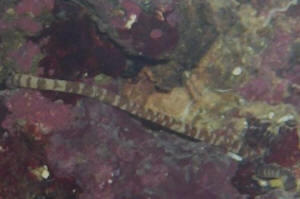
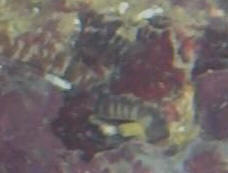
Worm Identification? -- 10/04/07 Sorry for the blurry
pics, but I was hoping you might get enough to help me figure out
if this is a good or bad worm. He only comes out at night and the
minute my flash goes off he is sucked up back in his hole. The
worm appears to be brown with white stripes. I would have to
guess it is more than 8 inches long, just how long I have no
idea. When it is extending, it appears to be coming out of
itself. The head part looks sort of like a short thick white
feather duster when it comes out but it almost immediately goes
back into itself and repeats this action over and over. It always
comes out of the same hole every night, never ventures. Thanks
for all of your help! Bellinda <Does it look like a Sipunculid
to you: http://www.wetwebmedia.com/pnutwrmidfaqs.htm BobF>
Re: Worm Identification? 10/5/07 <Hi Bellinda, Lynn
here this time! Bob's off diving - lucky fellow!> Thank
you so much for your quick response. <On behalf of Bob,
you're very welcome.> I have never seen it when it is not
stretched out so it is hard to tell. It stays in a hole in the
rock all of the time and only comes out at night. <Typical of
Sipunculids/Peanut Worms. I love these little guys. They remind
me of elephant trunks, the way they appear to snuffle around
looking for food - and wow, do they not like it when you shine a
flashlight on them! It's amazing how quickly they can retract
back into their little abodes (not that I blame them!). They vary
in color from shades of gray, brown, black, or white - some with
bands of those same colors, some without.> However, I do
believe that is what it is. I'm assuming from what I read
that it is safe to leave this worm in my aquarium.
<Absolutely. Sipunculids/peanut worms are harmless,
beneficial, little detritivores, and a joy to have/watch!>
Thanks Bellinda
<You're most welcome! -Lynn>
|
|
.JPG)
|
| Hi Guys I Need Some Help Identifying This
Item...Me Too! 9/10/07 Hi guys <Hi Chris, Mich here.> I
need some help identifying this item... <Me too!> He showed
up on some live rock and looks like he is boring his way through
the rock, he seems to be eating a 1/3" hole in the rock.
<This seems unlikely to me. I suspect it is just living in the
hole. But could be wrong. Why do you say it appears to be eating a
hole in the rock?> Its brown and about 1" tall with a
1/3" circumference. I have had a tough time trying to describe
it to search for it, also turned up no results on Google and other
aquarium related boards. <Well how about 20 questions? Does it
react to touch or light? How does it feel? Hard, soft, smooth,
rubbery? Does it move? If so how does it move? Fast? Slow? Does it
appear to have a shell? Can you get a picture from a different
angle? Are you using the macro feature (symbol usually looks like a
flower) on your camera? Can you provide any more description,
distinguishing features? My best guess, and is only a guess, is
some type of sea cucumber. Mich> Chris Edwards |
|
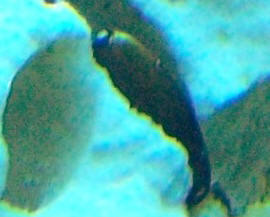 Likely a
Sipunculid... RMF Likely a
Sipunculid... RMF
|
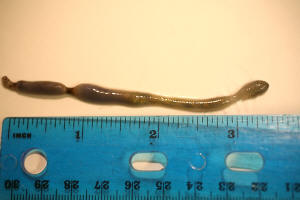
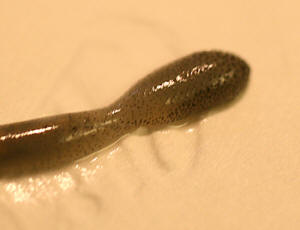
| Worm ID'¦ Sipunculid 8/22/07 Thank
you for your time, <Welcome, Mich here.> I've been
visiting your site for a few years and I absolutely love it,
<Nice to hear!> but this is my first question. As a
background, I decided to try a 10g tank since I had to leave my
150g and 55g at my parent's house because of the frequency of
me moving. I got some sand and rocks from the 150g and started it.
It did ok for a while and put in 5-6 hermit crabs and two snails. I
realized though that one cannot maintain a tank when it evaporates
10-15% of its volume a day so I took out the snails and crabs and
started to take out the rocks when I found a worm hanging out of
the bottom of one of them. It looked very cool so I figured I could
try and keep it alive. I positioned the rock so I could see it
better but it disappeared after a couple days and I couldn't
find, and thought it had died. I kept doing top-offs and the
powerhead and lights just to see, but after a couple weeks I again
decided to break down the tank. I stopped topping off and the
volume cut in half. All of a sudden the worm reappeared in the same
hole in the rock, slowly extending itself, possibly probing the
sand. This thing had lived through very bad water quality to this
point. It could retract similar to an earthworm but had more of a
nub at the end resembling a mouth to my guess. I didn't have
any ro water or supplies since I was breaking the tank down and
sadly had to watch the little guy die over a couple days, not
having any time to take it to my parents or knowledge of its good
or badness. <Was a good one.> The constricted black ring
formed right before he died. I pulled him out and inspected. The
front end, left side of the ruler picture, was light blue with
small specks and the back end, second picture, was white with black
spots, which I found are tiny barbs. The back end was pretty deep
in the rock and almost anchored in. Sorry this is so long, but even
with the Internet I couldn't convince myself what it was and I
find it very fascinating. <From your description and images I am
fairly certain this was a Peanut worm (Sipunculid spp.).
Sipunculids are beneficial detritus feeders. You can see some
similar images here: http://www.wetwebmedia.com/pnutwrmidfaqs.htm
Thanks a lot, <Welcome! Mich> Adam p.s. I have a larger
version of the ruler shot, about 600kbs that shows some better
detail including some internal organs if you're interested.
<Sure! Please send along, will be posted.> |
|
|
| Unknown Marine Life, Sipunculid? - 03/17/2006 Hi Bob,
<Josh here. Sorry for the delay here.> I am hoping you can
shed some light on the identity of the critter in the attachments.
<I'll try.> I found him accidentally while relocating a
piece of live rock. This rock is home to a toad stool that our
maroon clown decided should live somewhere else! <The nerve!>
I am wondering 2 things, what is this creature and should he remain
a welcome resident in our reef tank? If you happen to know I would
be grateful for your insight. <Well Dawn, I'm not 100%
positive here but noticed that you've re-sent this yesterday,
and are still waiting. I would say this is a Sipunculid or Peanut
worm. Try throwing those terms into a search.> Thank you so much
for all of the knowledge and humor you have provided since I have
discovered the passion of Marine Aquaria! <Thank you for
allowing us to "spout off" to any who will listen.>
God Bless you, Dawn Borgstrom <And you. - Josh> <<I
forgot to add, if this is in fact a Peanut worm, it's
completely harmless and very beneficial. - Josh>> |
|
|
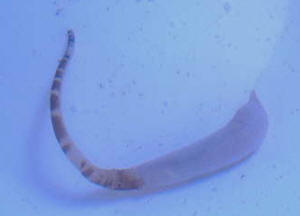
Spectacular Sipunculids! - 09/03/2005 Hello Wet Web
Crew! <Ahoy thar, matey!> Just had a quick question for you.
I was wondering if this looked like a Peanut Worm to you. <Yup.
Sure does.> I've searched the internet and found a few
pictures of Peanut Worms that looked like this, and several which
did not match. If you have an idea what it is, could you also tell
me if this is a harmful species to have in my tank? <This does
indeed look like a Sipunculid to me. I think they're the
coolest worms out there.> Should I search the live rock to find
and remove any more that might linger? <Nope. Just observe and
enjoy.> Thank you. very much for your time! I really appreciate
it! <You bet.>
Tina
<Wishing you well, -Sabrina> |
|
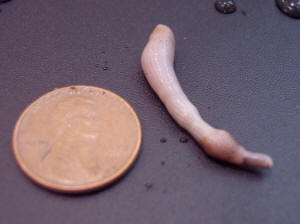
|
|
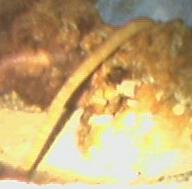
|
Sipunculan Hello! <Hey, Mike G here> I have what
looks to be some sort of deep-sea-looking worm thing in my
aquarium. <You have no idea how common that is in this
wonderful hobby :-) > My pictures are a bit lacking, but could
you give me a hint as to how to go about identifying this
creature? <Your pictures are fine for identification of this
specimen.> The most significant characteristic I've
observed is that to retract back into the rock, he inverts
himself and crawls back inside his own body... what a party
trick, huh? It's like when you take a long balloon (the kind
they turn into animals) and push with your finger on the end so
it goes "inside" of itself. <He is a Sipunculan,
more commonly referred to as a Peanut Worm. Harmless, benign, and
entertaining.> I like him 'cause he seems to get along
with my fish (one yellow-tailed damsel, one tomato clown, one
royal Gramma.) Is he dangerous? <Not in the least.> If not,
I don't want him to be eaten, so are there any types of fish
I should avoid adding? <Butterflies, triggers, wrasses, and
possibly Dwarf Angels will make a quick snack of him if provided
with the opportunity.>
|
|
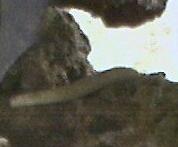
|
| A Wacky Worm! Dear Crew: <Hi there!
Scott F. here today!> Hello again! Just a quick ID here if it is
not too much trouble. I tried to keep the .Jpg size as small as
possible:-) I just ordered 50lbs of NANO size Marshall Island rock.
I placed the rock in a couple small QT tanks so I can make sure of
it before adding to my already settled main display tank without
any problems. <Excellent procedure!> On day 2, this little
thing made its' way to the front of the glass. Any ideas what
it could be? Thank you so much in advance for all of your help!
Steve <Well, Steve- it looks to me to be a Sipunculid, commonly
known as a "Peanut Worm" (Now, ask yourself- does that
thing look like a peanut to you?). They are fairly common on South
Pacific rock, and are essentially harmless detritivores or
suspension feeders. It will eventually settle back into the rock or
substrate if it is healthy. They do best in situations where
supplemental "feeding" systems, such as refugia, are
connected to the main tank, or where you have a thriving reef
system. Enjoy this oddity! Regards, Scott F> |
|
|
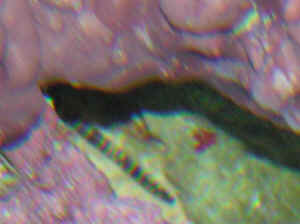
| Worm ID 3/26/04 Hello Crew: My 45 SW system
has been up and running trouble free for about 9 months now. About
90% of my insight and direction has been from this website, and
Calfo and Fenner's amazing Reef Inverts book. I thank you so
much for everything. <your success is our impetus> Tonight I
noticed a little worm hiding in a sweet cave in one of my larger
rocks. I can only see about 3 inches total of it in the opening of
the cave feeling around. It looks like it is black and white
striped width wise, not length wise. <tough to discern from the
pic (distance/clarity of the image) but is does sound like it could
be the browsing of a Sipunculid peanut worm (hobby-common species
are often striped as such)> It's body almost seems
telescopic in nature, and has a tiny circular ending (almost looks
like a mouth of some sort). I hope the pic I am including is
visible enough to see. Any info would be great on this little guy!
Steve <best regards, Anthony> |
|
|
What is this? Dear Bob, Anthony, or Steven, I was hoping you
could help me out with identification of what I think is some variety
of worm? I have enclosed 2 pictures, though they r not crystal clear,
they give you a good basic look at the creature. The first photo is
lightly circled in red and the other picture is of it feeding on the
acrylic wall. Things I have noticed: 1. Cannot stand light. 2. Has a
minute dark green spot at the end of each lobe, which I believe are
either mouths or sensors because it searches the substrate (seeming
like a snake sniffing the air when it sticks its forked tongue out) and
also at times if you look real close you can see the detritus it is
collecting by use of its internal conveyor belt. 3. As for its size, it
can easily stretch 18 inches long in search for food. Its coloring and
shape is comparable to that of Caulerpa taxifolia runners, maybe a tad
thinner and bit more translucent. Also, when it is roaming slowly
across the substrate, you can tell it is sticky much like the
'sticky hand' toy that kids play with (hand with stretchy arm
that kids fling and the hand attaches to pretty much anything). 4.
Finally, it retreats very quickly inside a hole in the rock (Fiji rock)
no bigger than a pin (it is attached inside that hole), folding its
lobes neatly before slinking out of sight. I have never seen anything
like this in any books, nor have I heard anyone having such an
interesting organism. It reminds me of a Terebellid 'spaghetti'
worm with the way it feeds, but without the mass of tentacles. Yet is
shaped like a snake's forked tongue, with the size and translucent
glow of a Euphyllia ancora sweeper tentacle. I'm sure you probably
know what it is if anyone does and I am sorry if this may seem a bit
jumbled, just trying to give you as much information as possible in a
hopeful i.d. Thank you so much, <we appreciate the attempt at the
photo, my friend... it can be so helpful. Alas... the creature is still
too vague in the image. Please do try for a better photo and perhaps
post the description on reef central for Dr Ron Shimek... he is a
specialist in low life forms (insert you own joke here). In sand beds
and rock, that is <G>>
What is That? II Steve Pro, Glad you had a great Father's
Day and welcome to the world of parenting. Such a wonderful experience
do enjoy every minute! <She is a joy!> I looked on the WWM and
found a picture of a Bristle Worm and that is not what I have living in
my overflow. The worm I have is all smooth. No leggy things. But still
creepy looking. Sorry snakes and creepy crawlies give me the CREEPS.
Looks to have a stomach or something towards the end of it, fatter at
the bottom if that makes sense. <When you want to know about worms,
snails, and other critters, you need to go to the expert, Dr. Ron
Shimek. Take a look and try to work through his "Key" to
animal ID,
http://www.rshimek.com/Invertebrate%20Key%20to%20Major%20Taxa.htm If it
lives in an aquarium, you should be able to find it there.> Thank
you, Lori <You are welcome. -Steven Pro>
What is That? Conclusion Thank you Steven Pro I was able to
find it and quite quickly I might add, this is a great site thanks for
the info. It is a Sipunculan or Peanut Worm should I leave it be in the
overflow? <Sure> Thanks, Lori <You are welcome. -Steven
Pro>
| Awwww.....nuts! Peanut (worms) that is
4/19/03 [AKA... "Excuse me, Miss... but there's a
Sipunculid in my soup."] Hey, Thanks for the reply. I took
your advice and looked at tons of pics and descriptions of how
different worms act, and I am pretty sure it is some type of peanut
worm. <Ahhh... very cool. A Sipunculid> He hangs from his
hole in the base of the rock and retracts into himself with
lightning speed when you shine a flash light on him. If this is a
peanut worm then most of what I read is that they are beneficial
and should be left in the tank. Do you agree with this conclusion?
<very much agreed... good sleuthing> Thanks again for your
time, Shawn <always welcome, my friend. And do peep a pic of an
exposed worm, attached here... quite fascinating. Anthony> |
|
|
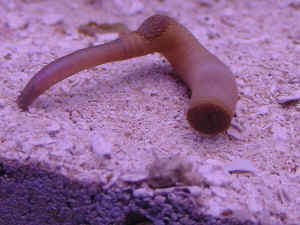
| Peanut worm? I found this worm in the
intake of a powerhead that was running an undergravel filter in my
marine aquarium. It is about 4 inches long and brown in color,
looks similar to earthworm but not glossy instead it appears to
have a rougher texture, maybe even hairs on it, a leathery
appearance. I looked at the pictures of the peanut worm on
Shimek's site, it looks very similar but is a much darker
brown, is it likely the same type of worm? <It is indeed... a
Peanut Worm... A Sipunculid> I took this one out because I
didn't know what it was and it startled me, plus when I pulled
it out it tore in two pieces. In the future if I find more should I
leave it in the tank and where, just put in the sand or on the live
rock? <Interesting animals, completely harmless... I'd leave
it/them in place> Is it beneficial at all to the tank or
harmful? Thank you very much. Kylee Peterson <Put the terms,
"Peanut Worm" or "Sipunculid" in your search
engines. Bob Fenner> |
|
|
|