 |
|
| Home | Marine Aquariums |
Freshwater Aquariums |
Planted Aquariums |
Brackish Systems |
Ponds,
lakes & fountains |
Turtles & Amphibians |
Aquatic Business |
Aquatic Science |
Ask the WWM Crew a Question |
| Please visit our Sponsors | ||||
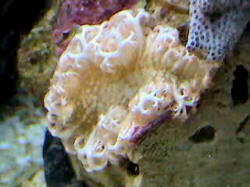
Worm IDs 1/4/05 I apologize to bother you, but I am really new to the saltwater tank world. <no bother at all my friend... ask and learn> I have gotten my levels down, my live Fiji rock and live sand in. I have looked at your postings and kind of found some info but descriptions are not really clear on my end, To my amazement I have some interesting what look like half long earth worms, and other items that look like (well) like intestines floating out of the live rock, but attached. <the former being an Errantiate polychaete of some sort most likely (common bristleworms perhaps)... and the latter specifically being Spionid hair worms, making an educated guess. Both harmless if not helpful> The worm (2 or 3) right now are beige in color with a purple like tentacle reaching out. Are they keepers or throwers? <keepers... and we do have a new book describing these creatures and so many more in "Reef Invertebrates" by Calfo and Fenner> I had found one on the sand one day and put it up on the rock and now it set itself inside a hole in the rock. Again I apologize for being naive. John J Bailey <no worries... best of luck Anthony> - The Worms! The Worms! - I checked out your worm FAQ, and I can't find the kind I have listed! I have no idea what these little buggers are! They came on some live rock I ordered (no hard yet as there are no fish in my tank. i.e. starting it up) I found the first one kind of dead and half hanging from the rock. He looked small (maybe a half inch) but when I pulled him out he turned out to be a little over four inches! I checked the other rocks as I "cleaned" them off, found no others, and thought nothing of it. Well, its been about 24 hours (at least, maybe a little more or less) and I checked my tank and there are ... well a LOT of the guys in there. Various sizes! From the very very small (under a 1/2 inch) to the very very large (I'm not sure, I can see its "tail" and its REAL thick). They range from a light pink (the smaller ones) to a deeper red. The one I pulled out of the rock is now all... well dried up, it looks to be flat, or wider on one end then the other. And it looks like it has some kind of "spines" on the sides of the flatter end. (The large alive one in my tank seems to follow the same pattern). I have No idea what these things are... Please give me a clue! <They are worms... you got that part right. Worms are perhaps the most diverse group of life on the planet, and to snag a line from one of my favorite movies, "Only a few know them all." I am not one of the few... chances are good that you have a variety of bristle worms as these are the most common live rock stow-aways. They are mostly harmless and at some point will provide a food source for your fish, they also do a really good job at keeping things cleaned up. I wouldn't worry about them all that much but would keep my eyes out for any more of the super-size ones. Other than that, enjoy...> Thanks very much. Alisha C. <Cheers, J -- > Unidentified worm I found an odd worm in my marine aquarium. I have finally caught it so I have more information about it. It is neon orange (similar to safety cones you see on the highway), it is about 12 - 14 inches long when it is not stretched out, approx. 1/5 inch around, it was living in the sand bed, and has bristles along each side of its body. The bristles are also orange. They are more a single row on each side of the body rather than the small clumps of many bristle seen on fire worms. << Sounds like a typical bristle worm. >> It appears to use them to "walk". It produces a thick, clear mucus-like substance that it appears to "hide" in. The worm produced this mucus within minutes after I put it in a plastic container. Everywhere the worm crawled, large quantities of mucus was left behind. (at least twice the thickness of the worm) It even left behind the mucus when it crawled over the edge of the container, outside the water. I put it in a small quarantine tank. It immediately went back into the sand and has produced more of the slime under the sand. It appears that it is using this slime to move about the sand bed quickly and freely. Do you have any idea what it could be? Thanks for any help. << This sounds very much like a typical bristle worm. They are great to have in the tank. If it 12 inches long, I would consider taking it out. You probably have hundreds if not thousands of them around 2 inches long. >> Vicki << Blundell >> Terebellid Worm Inquiry Hi crew, wish you all well. <Nice
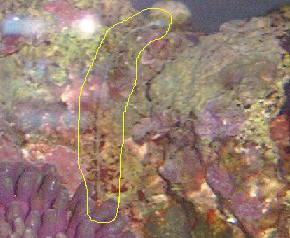
to hear! Hello, Ryan with you today> On the tip of one of
my live rock branches, there is a curious little
pup. I'd compare it to a snail embedded halfway into the
rock. It looks like a "hard" worm. It
extends a 9 inch "filament" mostly in the
evening. It seems to have 2 or 3 tentacles occasionally
reaching out, "holding on" to the outstretched
filament. Just curious as to what it is. <It's a
Terebellid Worm, commonly called a spaghetti worm. Harmless,
and will remove unwanted nutrients from the water column.> I'm
sending a poor pic of it. Thanks crew. James
RI It looks like an eye on the bottom left tip
of the rock <Enjoy the diversity! Ryan>
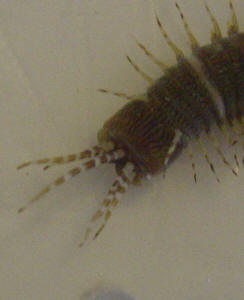
Worm ID I have some new aquacultured live rock from the Florida keys, Along with the same old hitch hikers (I've been here before) there is a very mean, strange looking worm, It has the typical millipede look, but it has 4 large antenna/feeders coming from the top of it's head. It moves extremely quick, so a picture would be tough because the slightest movement and this guy is gone. I own your Reef invertebrates, Julian Sprung's Invertebrates as well as Anthony's Coral Propagation, but he is in none of these. Can you recommend a web page or a name I can search to find out what it is please. If this is Anthony, we've met. Chris aka (mafiaman) <Sorry, MikeB here today. Anthony is out until the 12th. Without a picture it would be hard to identify what kind of critter you have. My first suspicion would be that it is a bristle worm. But from your description I think it might be something else. Try searching on Google for the description you gave me and then click on images. Lets see what you can find. Otherwise, we will need a picture or something. Thanks MikeB.>
Red Worms? <Hello,> We just noticed a couple hundred eggs under a rock in our tank when we were removing our engineer gobies. We moved them to an isolated tank. Within three days, what looked like little red worms, some a couple inches long with little red tentacles coming out all over it, started coming out. They seem to attach to the rock. We waited because we thought these may be what was hatching, but now the eggs have gone a clear color. Can you tell me what these little worms are? Thanks! <The little worms sound like they could be bristle worms. They sometimes burrow into rock. It sounds like they came to feed on the eggs. Now that the eggs are clear they are no longer going to hatch. Keep the gobies together with the eggs next time and see what happens. MikeB> Tube Worm ID First off, thank you for all the help you've provided in the past.<Sure, no problem.> I don't know if I would have made it this far in the hobby if it weren't for all of you. Awhile back, I purchased a button polyp colony at the LFS. The salesman noticed what he mistakenly called a Christmas tree worm on the back of the rock when he was bagging it up and seemed excited. I thought nothing of it at the time. A couple weeks later after actually purchasing a rock with three Christmas tree worms on it I returned to the original rock to try and determine what I had on the first rock. The tube is about 1 cm in diameter, somewhat translucent with what appears to be the head of a worm at the top. I've noticed it spewing mucus from the head in the past and was somewhat worried after reading that this is often a sign distress or sickness.<You are correct.> Tonight, however I witnessed the worm actually consuming the previously expelled mucus with attached particulate matter. The mucus is acting like a web that the worm expels and then consumes again. Have you ever heard of anything like this. I tried doing several searches on the site but tonight the search feature doesn't seem to be working. Any help is much appreciated. Thanks <Hello, MikeB here, would you happen to have a picture available to help identify the worm that you have. It could be a tube worm or possibly some type of crinoid. I mucus membrane can act as a "net" to catch food to be consumed. But, I would not be able to identify what exactly you have until I see a picture. Good luck. MikeB> Parasitic worms? Hi I have very very small almost parasitic type white worms in tank seem to pull together to for compact bubble formation and if you touch it ruptures and a thousand parasitic worm s go every where any ideas what these are they harmful to fish and coral? << Wow that is odd. Not sure I understand how they are behaving. I'll say they are not harmful. Best thing to do (in my opinion) is to add an arrow crab or small wrasse. Both of which love to eat things like that and may take care of them. >> how to eradicate please! Thanks Jean << Blundell >> Centipedes In My Saltwater Tank? <Hello,> I have a 200 gallon saltwater tank. I have a grey angel and Kole tang which has died. They didn't seem to have any symptoms. I have a Naso tang which has clouded eyes and seem to be losing some scales. While I was moving the rocks to get the dead fish I notice some centipede like creatures which were pink with white bands. They looked like gummiworms. My questions are: 1) What are these creatures? <They are called bristle worms.> 2) Could these creatures infest the fish in some way? <No they cant but they can be a nuisance to the tank, and make sure you don't touch them, they sting.> 3) If not what could be causing the cloudiness in the eyes of the Naso tang? <The cloudiness in the eyes are probably as a result of a bacterial infection in the eyes of the fish.> The water quality is fine re: ammonia and pH. <what were the exact measurements? Also, I need to know what the nitrite and nitrate are. Is this a reef tank or a fish only with live rock?> Any suggestions? <I would catch the fish that are sick and put them in a quarantine tank and treat them with a mild copper medication.> Vito <Good Luck!!!! MikeB> Worm help I know you're probably sick of doing worm ID's by now but I really care about my fish and I'm really new to all this. I've had my marine aquarium set up for about 8 months now. all has been going well up until last night when I was doing a routine water change last night I saw a light pinkish worm that was about an inch to an inch and a half long come out of my live rock. it was the first time I've ever seen anything like it since I started my tank. then I saw a smaller worm of the same description during the water change. the worm had a row of short tentacles coming out of ether side of it. my boyfriend brought to our local marine life supplier and said it was called a strip worm. he said they can be harmful and are almost impossible to get rid of. I can't find any information on the strip worm so I think the supplier was wrong. do you have any idea what it could be or what I can do about it. will it hurt my fish? I have two tank raised clowns, one coral beauty, a yellow tang and a blue tang, and a small blue damsel. will any of them eat the worm or will the worm eat them?? I would greatly appreciate your help. sincerely, heather Spacek. >>>Greetings Heather, There are a TON of worm species that can be found in the ocean, as well as in our marine tanks - from small annelids in the sand bed and rock to huge bristle worms. Most of them are harmless, as I suspect the ones you've seen are. I wouldn't worry about it. I have yet to have a problem with a worm. Jim<<< Unknown worm Guys, I have a visitor to my reef tank, it normal live beneath the crushed coral bed, but I have occasionally seen them early in the morning moving about on the glass. Normally all you seen is the thin tendrils. Are they harmful to my corals. << I'll say it is safe and nothing to worry about. >> Recently my small Acropora [about 10cm tall] polyp eject all it's polyps [I only had it for about a 2 weeks in the tank], but what I noticed was that it was wrapped in the tendrils of this animal. Can you help. << Hmmm, tough. If it is one worm then I'd pull it out just to be safe. If you have dozens of them, then you can't manually remove them. I would also consider a wrasse or some other great predator. >> All my corals are store purchased in Australia, presumably local GBR << Well do you have a lot of experience with keeping corals? Are the rest of your corals doing well? If so then this may be a pest. If not then maybe this isn't the source of the problem. >> << Blundell >> Transparent tentacle worms I recently purchased new live rock for my salt marsh aquarium. On the live rock, I have noticed several tiny feather dusters (?) and one rather larger blood red feather duster or fan worm perhaps (It spreads outward perpendicular from the rock in an arc, not a complete circle). What I cannot really identify are three tentacled organisms which protrude from holes in the live rock. They each contain many tiny tentacles all centered around a disc. When viewed from above, << Sounding like either a medusa worm, or if short tentacled an anemone. >> the disc is dark, not perfectly round (more octagonal) and flat, but a bit fuzzy or soft-looking. The tentacles are transparent and sway in the current. I've searched and searched online to ID them. I don't think they're hydroids. I'm guessing they're worms. They don't seem to be bothering my other inhabitants, which include one Fiji Blue Devil damselfish, two fiddler crabs, three blue-legged hermit crabs, and two Astrea snails. Should I be concerned? << No definitely not. I'm sure they are beneficial and I wouldn't worry about them. >> Ms. K Blister worms Hi there, We've had a saltwater tank (25 gal) set up for about a year now. I was turning one of the rocks and a bunch of wormlike things came out. I caught one and took it to our local pet store. They told me it was a blister worm. Is there something I should do or put in the tank or do I just try to catch them and remove them? Thanks for your help, Kim <Please read here: http://www.wetwebmedia.com/polychaetes.htm and the related FAQs (linked, in blue, at top). Bob Fenner> Sipunculid worm? 10/02/04 I've been seeing this purple, white-spotted worm creature in my tank, and I was hoping someone could tell me what it is. I saw a similar question on your site that described it well, but there was no photo (I have attached photos). <the photo here is way out of focus (commonly occurs when using the digital zoom for close-ups of aquatics... a bad habit). I'm sorry my friend... but this pic is a blur and not very discernible> It apparently came out of the interior of my uncured live rock, which has been in my tank since I started it 4 months ago. Its head has a 'crown' like a Medusa Worm, but its body seems less bumpy than that of a Medusa Worm. It can stretch its body from about 4" long to about 8" long, and it seems to eat algae and detritus all night long. The cool thing is that I've seen what looks like its offspring crawling all over my tank - I've seen about a dozen different ones, and I'm sure there are many more! They are about 1/2" long, clear, and have a distinct crown. <it actually looks instead like Sipunculid peanuts worms, as best I can see here> You'll notice a lot of hair algae in those pictures - it had a growth spurt when I added MHs about a month ago. I haven't cleaned it up because I'm giving my invertebrates a chance to flourish before I start stocking the typical reef aquarium, so it is sort of an experiment. I have a very healthy looking tang who is slowly getting the better of it though. You can also see one of my Mermaid's fans in one of the pictures. This one fan has sprouts coming out from all different sides of that rock now! <very cool> I think I have more fan worms than usual, and my Halimeda and Mermaid's Fans are spreading very quickly. I also have a very dark red, almost blood-colored, coralline algae starting to take hold instead of the normal light purple variety. Is my experiment going to cause any problems for future additions? I really enjoy the extra invertebrates! <it is a very fine idea IMO. Too many folks stock their tanks with harsh grazers too soon and fast and lose the opportunity to see many interesting organisms establish. Rock on my brother> Thanks for all the info already present on the site, and even more so if you can tell me what this creature is! ===>David Creel <do search for pics of peanut worms and see if this fits the bill... else do try to send a better image. Do so by getting the subject close to the front of the glass... and getting your camera lens (without digital zoom) as close to the glass/subject as possible. You'll see the difference :) Anthony> Strange hair worm 9/17/04 Hi, I have just started up a saltwater tank about a week ago. I have noticed many different little creatures growing on the live rock. However I noticed one that has me concerned. It is in a hole in one of the pieces of live rock, it has long tentacles that are so thin that they are easily over looked (about the same diameter of cat hair, and some strands even thinner). The only reason I noticed it was when it was moving some of the sand back into the hole. I looked at pics of the medusa worm but this worm is a lot smaller than the pics. Also if it is a medusa worm, should I remove it? I haven't heard anything good or bad about this type of creature. Thank you for your help! I love your website, keep up the great work!!!!!! <your worm sounds like it could simply be the harmless detritivorous Spionid hair worms. Do a keyword search of that name on our website and beyond to see if the descriptions sound like a match. kindly, Anthony> Sticky stuff in substrate Hi there, << Hi. >> I have a 75 gallon reef tank that is about 9 months old with about 4 inches of crushed coral substrate. While I was scraping the algae off of my glass today I shook up some of my substrate and noticed that there was like a rug on the bottom. << Hmmm, could be Cyano holding it together, or "glue" from worms>> Do you have any idea what this might be? It looks like a bunch of worms colonizing sticking straight in the air.<< Yep you got it. That is what does it, worms. It isn't bad, just their way of making a home in the sand. >> They are about 1mm in dia. and about 1/4 of an inch tall. They look the same height all over. Could they be harmful? << Nope, not bad, don't worry. >> Thanks, Josh Breeds << Blundell >> Filtering worms 12 Aug 2004 Hi, <Hello Randy, MacL here with you today.> I have a silly question. <No such thing.> I have a 55 gallon, 25 LR, fish only tank. I recently noticed that there were what appeared to be tiny tube worms growing all over. I looked closer and realized that they look like a tube worm, but they are white and have the shape of a flower with a stem and have what seem to be filaments or tentacles extending from the flower shaped area. <Its hard to tell from your description but I'm pretty sure you do indeed have a worm and they are good ones to have. I have colonies of these in my life sand. They dig into the sand bed and collectively filter with their tentacles.> I have seen some strange things grow in the tanks but this is the most interesting yet. <Let me suggest you take a look at this http://reefkeeping.com/issues/2002-12/rs/index.htm and see if that's what you have?> Thank You Randy
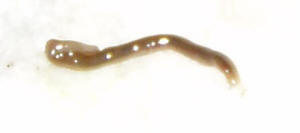
Large White Worm 8/2/04 Hello. Could you please help me out? <Will try> Yesterday we went to the beach at a state park in Ohio. My son was exploring and found three large flat white worms (3-4 inches long) buried on the beach. He was playing around with them and I'm afraid that they may be some sort worm from an animal feces (as there was several piles along the beach). <Mmm, very doubtful> Could you please tell me what type of worms these may be and if they could be harmful to him. Thanking you in advance, Darla <Perhaps a type of flatworm per se (Platyhelminth), though my best bet is on the segmented annelids (polychaete worms)... and very, very unlikely to be a health problem. Some of the marine worms are "spiky" (aka the Fireworms often used as fishing bait along the U.S. east coast), but these do not harbor human-infectious agents. Bob Fenner> Strange saltwater worm: Spionid "Hair Worm" 7/31/04 Let me start by saying what a fantastic resource your website is. I have found it most helpful on a number of topics. <thanks kindly... and please do tell others about our archive/site> I have been trying to identify an odd worm in my Nanocube, and I haven't found anything similar in your forums and FAQ's. It lives up under a rock encrusted with hairy mushrooms, and appears to extend 2 (or more) elastic tentacles, of up to 5 inches long. <many possibilities... almost certainly a harmless/beneficial polychaete of some sort... and if hair like, paired tentacles then perhaps a Spionid worm> They are mainly clear and appear hollow, and about the thickness of human hair. <ah, yes... spaghetti, medusa or Spionid worms. We describe all in detail in our heavily illustrated "Reef Invertebrates" book by Calfo and Fenner> Mostly, they're invisible to the naked eye, but I'm one of those new tank geeks that checks it out with a magnifying glass. <way cool> I have been unable to photograph the animal because it is so small, and generally up under a rock. There may be two of them, or the one has moved, since today I noticed another one (?) that had constructed a tube for itself out of my crushed coral substrate. The tube is nearly an inch long, has appeared rather quickly (my tank is only a couple of months old), and the same elongate tentacles extend from it as with the original critter under the mushrooms. I am concerned that it may be munching my polyps. <not a chance... form follows function, and these types of worms don't have the "form" (mouthparts) to be able to do this. They are helpful detritivores. No worries> When the tentacles are extended, they typically snake around through the water. However, at times they appear to latch on to other rocks, and then they are quite taut. At this point, you can see white-ish material being "sucked" back toward the "mouth" of the critter. I thought he was sucking a polyp, so I tried to catch him with hemostats. Instead, I merely snapped a tentacle, at no apparent harm to the critter. The piece of the tentacle lost its elasticity upon being severed, and is about 2 inches long, and apparently hollow. When it snapped off, the white-ish contents were released into the water, as if he really had been sucking on something. Do you have any idea what this critter is? Is he harmful to my inverts and fish, and if so, how do I get rid of him? <as per above> I appreciate you help. Since I'm new to your site, I'm not sure how I'll know if you post an answer to my question. Is it possible to carbon copy a response to this email address? Regards, Kyle <we answer all messages directly to you/your e-mail and copy some each day to also post/archives. Best regards, Anthony> Strange saltwater worm: Spionid "Hair Worm" II 8/1/04 Thank you so much! That is exactly what they are. I have gone from hating them, and worrying about my polyps, to thinking they're pretty cool. <excellent... they truly are helpful (detritivores) and interesting to watch> The one I can see best definitely has paired tentacles, and is very similar to the pictures of Spionid worms that I was able to find online, now that I know what they're called. Very cool. Cheers, Kyle <keep learning, sharing, growing. Anthony> Unidentified Vermiform Marine Life <Hi, Mike D here> I've had some electric flame scallops in my 125 reef now for about a month and they have been eating well and doing great!<That's a new trade name on me. I'm assuming these are the brilliant red or orange variety?> However, this morning, I noticed that there are hair like creatures that have attached to the glass right in front of them that almost look like they are some sort of worm. The part that is attached to the glass is almost fuzzy in appearance while the rest of it is stringy, getting thinner as it goes down the line. Is it something from my scallops or could it be something from my live rock?<It's almost definitely NOT from the scallops, and may well be bristle worms, from your description> I've got at least 150 pounds of it in my tank!<This is something I've never heard of. Any chance of sending a photo?> Thanks! Worms that Bob May Have Eaten Before 7/18/04 Bob... <Anthony Calfo here in his stead while Bob is away to Galapagos... riding tortoises naked, last I heard. The tortoises that is... I'm not sure if Bob is naked. You'll have to ask him that personally. Assuming he's not too chaffed to discuss it, if its true.> Roaming by Cancun beaches I found floating near the shore, several cylindrical masses, of diverse sizes (10 cm. to 30 cm. with a diameter of no more than 3 or 4 cm.) covered with stuck sand grains. Examined through the microscope they showed a transparent gelatin with multitude of thin diatoms, small opened elliptical bags, without any shell and hundreds of very small worms of less than 1 mm in length sliding on the jelly. <interesting> These are flattened-cylindrical, without evidence of segmentation. A blunt head, with two eyes, surrounded by a belt of very long cilia, an alimentary canal with a first clear portion (that it could be a pharynx) a sacciforme intestine, with terminal anus. The later end is also blunt, dark, surrounded by a belt of cilia similar to the cephalic ones. Dorsum without cilia, belly uniformly ciliated (cilia short, a quarter of those of both belts). Packages of chaetae, only ventral, after half of the body. Three packages, the anterior ones with 1 long chaeta of lanceolate end, 1 short one also lanceolate, with the wide extremity 4 times wider than that of the previous one, and 1 more placed in a very opened angle and finished by a small curved claw of 4 or 5 teeth. The third one with only a chaeta, similar to the first one of the previous packages but shorter. <hmmm... are you familiar with "epitokes"? A reproductive stage of some Errantiate polychaetes? Bob has eaten these... seriously. Supposedly they are delicious when you have no idea what they are. That and a hunger that has not quite reached the "dirt-eating" stage. We include this repulsively fascinating anecdote in our chapter on worms in "Reef Invertebrates" Calfo and Fenner (2003)> The absence of parapodia, and the only ventral packages of chaetae make me think about an Oligochaeta, but the habitat and the form of chaetae are more of a Polychaeta style. The chaeta also discards any Turbellaria. The marine Archianelida are of a very different construction and without chaetae. Did you think that these are larvae of some Polychaeta? and in this case of which family? <I am not well-informed enough to speak to it my friend. Not for a reliable ID on your excellent text description. Bob did graduate work on polychaetes as you may know and will be back from holiday the end of next week. Please feel welcome to call again> many thanks for your time and attention. Walter <with kind regards, Anthony> Mystery Worm (7/7/04) Hello again crew: <Steve Allen tonight.> For many months now I have been trying to track down this worm(?) that I knew was living in one of my rocks in my saltwater tank. Every time I have caught a glimpse of it, it has disappeared before I could get the camera out. He only shows himself at night after the lights are out to no surprise. I am not sure how big it is, but I know there are others much smaller than this all living in the same rock. Is it good, bad, should be removed, or indifferent? thanks in advance! In the pic he can be seem coming out of the cave in the rock. Steve <Nice picture, but I can't see the whole thing. It is some sort of roundworm, not a bristleworm. Could be a ribbon worm of some sort, though these aren't often seen in aquaria. There isn't a lot of info in the aquarium literature. I doubt this worm is harmful, but you may want to try some more research on the internet on marine worms. If you can find a good invertebrate zoologist somewhere (a university perhaps) you may get more. Sorry to not be of more help.> Acoel flatworms on Corallimorphs 6/18/04 I hope you all are well at WWM, I have not written with a question for a while as all was well in paradise. However just today I noticed some brownish flat heart/gall balder shaped things on the Shrooms they are about 4-5mm in length and about 2-3 mm across. Looks like some sort of fluke, there are several on every Shroom and blend in with the colour of the mushroom they have kind of spasms from time to time without any obvious movement. At first I thought that it was part of the body of the Shroom, they are of the Rhodactis species. Do you know what they could be? <yes... Waminoa Acoel flatworms. Do use this term in the Google search tool on the home page: wetwebmedia.com find more info on them fast in our archives. Search for Convolutriloba too> Are they harmful to the Mushroom and if they are what is the best thing to do? <they are not directly parasitic, but they cause harm by blocking light, water flow, etc. Increase water flow and skimming first for a cure. And be sure to properly QT all new livestock in the future to prevent the introduction of such pests> Regards, Jorell <kindly, Anthony> - Alien Worm - Dear WWM Team, This morning when I was feeding my polka dot groupers, sand-sifter Archaster and Stenopodid, I discovered something like a pinkish ribbon-like organism (polychaetes or Nemertean?) fluttering and flitting about nearby the surface and swimming in hi-speed. I'm not sure if it's polychaetes, and it was swimming in high-speed, relentlessly and energetic, hardly ever stationary in the water column. I cannot remember when I was seeing this worm before, and it's about a month my liverock has thriving in my aquarium and the wriggly apparition comes today ( from where did it come from? <Probably the live rock.> the truth is out there...). <Or in there as the case may be.> Well, it was hard to photograph and hardly pose in front of my lens. Do you know material they feed on? <Hard to say as I don't have a specific ID for you... I'll just guess detritus.> if this species non-parasitic, I may permit it in my aquarium, if I could provide them food. <I'd just let it be... chances are it will find what it needs from the leftovers you feed your fish.> Because I can't take the pic, I decided to draw them in Microsoft. Paint (sorry if the drawing a bit bad), but if I could take them with the camera, I will provide you the photo. <Actually, a pretty good drawing.> And also, there's an amphipod (or isopods ? hmm...) bloom in my aquarium, visible as miniature sea-roaches in transparent body and happily scuttling around the live rock and algae, all around the places; how could I get rid of them? <Let the fish take care of it for you - the presence of these is not a bad thing.> Thank You ! PS : Is it hard to keep a small Protoreastor? <Not at all.> Sincerely, Anargha. <Cheers, J -- > Bristling With Bristleworms? I have found several worms about one inch long. They look like centipedes. Bodies are purple and have bright reddish orange head segments. What are they, and are they good or bad? Rex <Well, Rex- without photos, I'm just guessing, but it sounds like your talking about one of the many species of bristleworms that are found in aquaria. I find them to be relatively harmless, despite the fearsome reputation they seem to have among hobbyists. When their numbers and sizes are kept in check, they seem to perform services similar to those performed by terrestrial earthworms; helping to work the sandbed and consume detritus and other material found in the substrate. If the population of these animals is getting out of hand, you can always employ the services of a Pseudochromis or an Arrow Crab, both of which are avid consumers of many small bristleworm species. Hope this is of assistance to you! Regards, Scott F.> Worminess I just went back to the tank and decided to do a thorough visual review to see if there are any more worms. I found small groups of even smaller ones on the glass down near the gravel. There are really small like the diameter of a fine hair and 1/16" long. I really need to know what these are but they are too small to photograph. Thanks, Mark. <<Hello. Sounds like Planaria to me. Do not overfeed, and make sure to vacuum your gravel more frequently. They will go away on their own. -Gwen>> Spionid hair worms 5/5/04 I have a 80 gallon reef setup over two years old. All corals and fish are very healthy. However, I am starting to notice small worms that resemble a single strand of hair emerging from my live rock and empty shells. Near the substrate they build a small tube with the substrate about the diameter of an ice pick. They are white and about an inch long. Are they dangerous to my system? James <no worries... they are harmless detritivores and quite beneficial. Likely Spionids (hair worms - paired tentacles). If not, perhaps spaghetti or medusa worms (multi-tentacled). Anthony> Worm or snail ID Tube dweller 4/28/04 I'm sorry about the picture quality, best I could do. Just wondering if anyone knows what that little yellow guy is in the tube. I just call him Kilroy. <the pic quality is very low, alas... its tough to say for sure. But the tube-dweller appears to be a Vermetid snail (sessile tube dweller) or a Serpulid worm (feather duster without the feather). Do use these terms to search our site and the Net abroad for more pics to compare to your creature. Best of luck! Anthony> White Hair Like Worms on Live Rock Bob, <James> I have a 150g reef system that is 2 years old. Everything is very healthy. However, I am starting to notice these white worms that look like a single strand of hair emerging from my live rock. They are not long, maybe an inch at most. No legs, no stripes or color. They build little tubular structures with my live sand on bed and use old hermit crab shells as well. Are they dangerous to my reef ??? James <Some sort of tubiculous (tube-dwelling, building) worm species... very likely a Sedentariate polychaete worm... not harmful, likely useful as food, filters, ornament, source of wonder. Bob Fenner> -Mysterious worm- I have a mysterious black and white worm thing coming out from out from under my live rock <Cool!>, I think what I've only about 2 to 4 inches of him, looked on the site, I'm almost positive it is not a bristle worm but I'm not sure what kind it is. The head had some kind of feathery thing coming out of it like a tube worm but it tried to dig with it. do you have any idea what it could be, is it bad or good, what do I do about it? <You've got me, I have no idea. I'm sure you'll be able to get a much better viewing of this critter at night when it comes out to feed. It's unlikely that it will pose a threat to any of your other critters, but just keep an eye on it. If you happen to be able to remove it from the tank, take a picture of it, odds are one of us has seen something like that before. -Kevin> Non-Motile Worms Hi, I have a question. I have noticed something odd on my live rock. My tank is two months old, and something weird has taken up residence on the LR. IT is a 1/4 inch tall orange spiral. It is a solid hard piece, but something inside it keeps emitting what looks exactly like a spider web. It floats out and attaches to another rock, there may be a few of these at a time. It is not a spaghetti worm. It definitely is not tentacles coming out. It is a thin, web like filament that will break off and whatever is inside that orange spiral, will generate another strand. I would swear there is a spider in my tank. I have seen a slight bit of movement at the top of the spiral, but it is so small, I can't make it out. But there is definitely something in it. I will try to get my hands on a digital camera, and send a pic, if you don't have any ideas what this could be. I would appreciate any insight until then though. This might be common, I have no idea. Thanks again. <Hi, you're most likely looking at a non-motile (Sedentariate) segmented worm (polychaete). It's nothing to worry about, in fact it's a sign of good water quality. Enjoy it, it's helping to remove debris from your tank. Good luck, Ryan>
|
|

|
Features: |
|
| Featured Sponsors: |