|
Bristle/Fireworms Identification
FAQs 2
Related FAQs: Polychaete ID 1, Polychaete ID 3, Polychaete ID 4, Polychaete ID 5, Bristleworm ID 6, Bristleworm ID 7, Bristleworm ID 8,
Bristleworm ID 9,
Bristleworm ID 10,
Bristleworm ID 11,
FAQs: Worm Diversity
FAQs, FAQs
2, FAQs 3, & Worm IDs
1, Worm IDs
2, Worm IDs 3, Worm IDs 4, Worm
IDs 5, Worm IDs 6, Worm IDs 7, Worm
IDs 8, & Worm ID FAQs by Group/Phylum: Flatworm Identification ID, Nemertean, Proboscis, Ribbon Worm ID,
Nematode, Roundworm ID,
Nematomorpha,
Horsehair Worm ID, Acanthocephalans,
Thorny-headed Worm ID, Tubeworm ID, Hirudineans, Leech ID, Sipunculids, Peanut Worm ID, Echiuran Worm ID, & Bristle/Fireworms 1, Bristle/Fireworms 2, Bristle/Fireworms 3, Bristle/Fireworms 4, Worm
Identification, Polychaete Behavior, Polychaete Compatibility, Polychaete System, Polychaete Selection, Polychaete Feeding, Polychaete Disease, Polychaete
Reproduction,
Related Articles: Worms,
Polychaetes, Flatworms/Planaria,
|
What's worse than finding a whole live worm in
your apple?
|
Polychaete ID
5/15/10
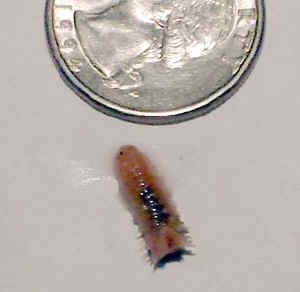
Hi. I'm trying to identify a particular type of Bristleworm, so
I'm hoping you can help me.
<Mmm, I "did a couple of years" ID'ing benthic
Sedentariate Polychaetes for some studies at USD... there are thousands
of species... need careful examination of the heads, podia
elements...>
I've searched online and found differing opinions on what this may
be. They are up to about 1-1/2 inches long, with long, narrow,
segmented bodies. The "head" is very small, slightly narrower
than the body, comes almost to a point, and is mostly a reddish-orange
color. The "body" section is an off-white color. The
"tail" end is a dark color, almost black. They live in my
coral substrate and don't seem to really bother anything. I've
seen my snails crawl right through a group of these worms with no
apparent problems, and my Ophiolepsis sea star and micro stars have been
living happily among them, too. I think they're neat because when
they're startled
(like when the lights come on), they turn an iridescent, translucent
blue color as they press themselves up against the glass and into tiny
crevices. Any ideas? I was thinking possibly Eurythoe Complanata, but
I've seen varying reports of what that species is supposed to look
like. Thanks for your help!
Bryan
<Uhh... read here: http://wetwebmedia.com/polychaeidfaq2.htm
and the linked files above. Bob Fenner>
| Identify This if you can Polychaete Id -- need
more info 10/8/07 <Hi Richard> Just wondering if you
could identify this worm, it came out of a piece of coral that was
dying. I broke it apart to get the bad part or dying part out of
the tank and keep the living part in. <Unfortunately, I need a
close-up image of the head especially, in order to see
placement/number of antennae (if present), eyes, and the mouth.
Please see these sites for more info re:
http://home2.pacific.net.ph/~sweetyummy42/hitchworms.html
http://www.reefkeeping.com/issues/2003-03/rs/index.php > Thank
you, Richard. <You're most welcome. I just wish I could have
given you a definitive answer! --Lynn> |
|
|
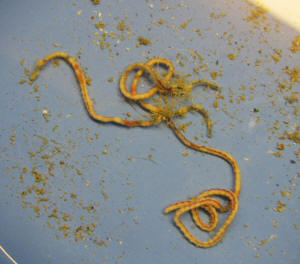
Unknown Worm (A Cirratulid Polychaete I Believe) -
04/20/06 Bob, <<EricR here>> First off thanks again
for the advice with my tank, I've done a few extra water
changes and everything seems to be running perfectly
fine. I mentioned in my last email that I was going to
try to get a few pictures of this worm I've found to maybe come
to a better conclusion as to its species. I think I
might have seen it before when reading the sites on your site, but
I can't seem to find it again. Either way here are 3
pictures of this awkward looking worm. Looks to me like
maybe he needs a good barber. <<Mmm, your comment is more
intuitive than you probably realize. What you have here
looks to be a Cirratulid Polychaete worm...commonly referred to as
a "Hair" worm...often confused with/misidentified as a
"Spaghetti" worm (a Terebellid Polychaete). What do you
think? <<A beneficial detritivore...I'd keep it
<grin> >> Thanks again,
Anthony
<<Quite welcome, EricR>> |
|
|
Worm ID 6/10/06 Hey crew, <John>
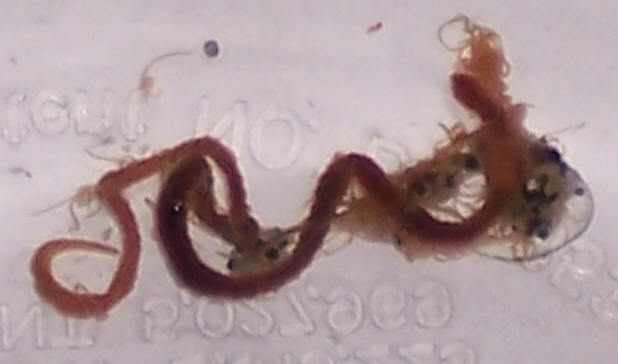
I have been stalking this guy for
about two months trying to get him out of my tank. Is he just your
regular bristle worm? <One of many thousands of species...>
The other bristle worms I have seen seem to be red and purple in
color, while this monster is yellow and orange. Also, the
"bristles" on the side seem to be different than on the
other worms. This guy was almost a foot long when fully extended
<Yikes... be very careful when not-handling this specimen... use
tongs, a net, not your skin... as these podia bristles may be quite
sharp, painful... Bob Fenner> Thanks!
John |
|
|
| Worms in tank - 09/07/06 Howdy
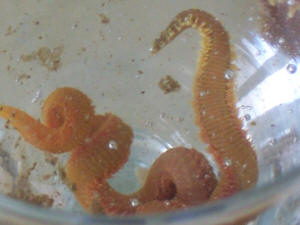
crew!<Hey Kandice, MacL here.> I have a worm question- I
tried to identify them myself, but forgive me if the identification
was obvious. <You have bristleworms in your tank. Lots of FAQs
here on them. They don't look like Fireworms to me from the
pictures but I would consider getting a fish that eats them or
pulling them out of the tank with some type of tweezers. They can
become a problem.> I don't have any fish yet, just live
rock. I think that they are bristle worms, but they
don't look as "feathery." They look like aquatic
centipedes to me! There are about 5 of them that I can count, about
an inch long, maybe 1.5 at the longest. They all have
the same basic structure but vary slightly in color: some are red,
red and black, and black and white. If the picture is not good I
can try to pluck one out of the tank, however if they are
beneficial I would like to refrain from doing so! Thank
you! <I liked to keep some in my tank, honestly because my
puffers think they are a delicacy from heaven. Good
luck, MacL> |
|
|
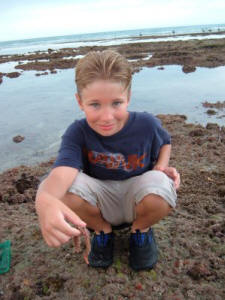
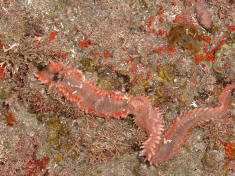
What type of sea worm is this?????
8/11/06 Hi Bob, <Koraine> I just came upon your question
and answer site when I was looking up different types of sea
worms. My son and I just got back from Mexico and we
caught lots of things. Octopus, stingrays, and lots
more, but it's the first time we caught this weird
looking worm thing. I read about Fireworms, is this that
or something else?? <Is a type of Errantiate Polychaete... a
Bristleworm... would have felt like fire had you grabbed it firmly
by those lateral processes (notopodia, parapodia...)>
It didn't' hurt us when we held
it. We would love to know. Please send e-mail
with answer, plleassse!! Koraine
<Yikes! Glad you didn't get stuck! Bob Fenner> |
|
|
|
|
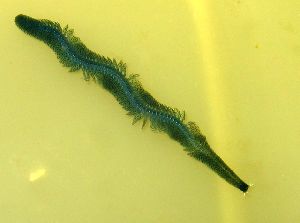
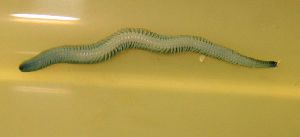
| Hitchhiker worm 10/16/05 Hi guys, I found a
blue worm-like guy working his way across one of my hard corals
this morning. Managed to fish him out to try to ID him. Thanks to
your site, I guess he's some form of Errantiate, but I
can't find any matches for his particular description: 3-4cm
long, blue colour, white tentacles on what I assume is the head
end, segmented body, each segment bearing a pair of rather stumpy
legs, moves by undulation, able to curl up into a ball, no obvious
bristles I attach a couple of photos - the second of which shows
his belly. What do you think - friend or foe? If benign, I'd
like to pop him back in the tank ASAP as I doubt there's much
to eat in the Tupperware box he currently calls home! Many thanks
for providing such a great resource. jc <Here is the response
from Dr. Ron Shimek: I'd need a better shot of the front end
to be sure, but it appears to be a Phyllodocid Polychaete. These
are "active hunters" and generally eat other worms. It
has no "gripping" appendages. I suspect it was on the
trail of some other worm, which would have been dinner had it
caught it. It likely would not harm corals, or any other decorative
livestock. Basically, these animals are normal type of the worm
fauna of a tank. See these three of my articles: http://reefkeeping.com/issues/2003-03/rs/index.htm;
http://reefkeeping.com/issues/2003-04/rs/index.htm;
and http://reefkeeping.com/issues/2003-05/rs/index.htm.
Cheers, Ron <While Dr. Shimek finds such worms
infinitely interesting and would be horrified at the idea of not
keeping it, I would suggest leaving it out of the tank and flushing
it. It will likely prey on other worms that are beneficial to your
tank. If you find this critter interesting as well, you can
certainly choose to keep it! Best Regards. AdamC.> |
|
|
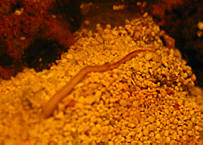
| Spiraling worm 3/14/06 Hello, <Hi
there> Thanks for your site, great
info. Need critter ID: Worm type organism,
which harmlessly crawls around during the day eating
detritus. Looks like a white centipede with head that
tapers down to the tail, with hundreds of small legs running down
the length of the worm. <Is an Errantiate Polychaete
(Bristleworm) thus far...> Also some of them have a black line
down the back some don't. <Might be more than
one species...> At night when the timer shuts the daylights
down, you can observe on occasion a worm spiraling through the tank
fro one side to the next. Figure the worm is just
propelling itself to get from one place to the next, in search of
food. Figure it must be a harmless hitchhiker until one
turned into ten. Please if you could identify these
critters. Mini pictures of the worms attached. Thanks,
Marc <Need closer images, larger, bigger resolution to make out
mouth parts, eye number and arrangement, podia characteristics...
to get to family ID... Bob Fenner> |
|
|
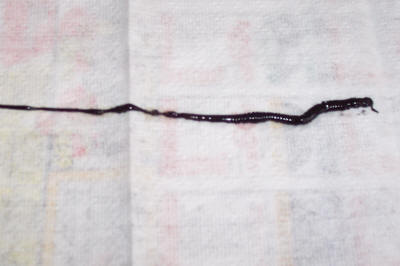
| Mysterious worm in my tank (ID wanted) Hi there,
<Hello> A weeks ago I noticed a black worm in my tank that
was climbing on my hammer coral
fragment. It's body looked like
a caterpillar's with bristles covering it. <Hence
the name: "Bristleworm"> It looked more like
a caterpillar than a slug or worm and was black with
blue dots on it. <Neat> While I was watching it,
it took a bite out my hammer coral and I knew I needed to get it
out of there. Over there next few weeks the little
bugger eluded me until finally I decided to pull the
rock out (as a last resort). I left it out of
the water for a bit, in hopes of making the worm come out
to search for water. After a bit, I poured
some water into its container and its head came out of a
hole. I went to remove it with a
tweezers (thankfully, it was dead) and came to find out
that what I expected was maybe an inch or two long was
actually 7 inches long!!! <A youngster!> Attached is a
picture of the worm and though it's a little fuzzy,
<Man, I've got to give up drinking cheap vino... This pic is
way fuzzy to me> hopefully you can see some of the detail
on the head. I was also wondering what type of worm it
was and how it got into my tank? <Mmm, in, on rock or other hard
substrate... like a stony coral base> I have added nothing
new to the tank in at least 4 months, so I'm curious
as to how it grew without me knowing? Thanks for
any help you can give! Melissa <Take a gander at our Worm ID
files posted on WWM... many, many of these worms on this planet.
Bob Fenner> |
|
|
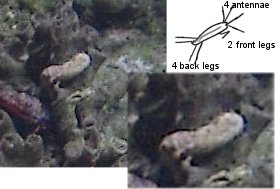
| Weird Spiky Alien Things! (4/22/04) I found
this thing tonight after doing a good cleaning in my tank and
re-organizing some of the live rock. It has two or three long
antenna/tentacles and two or three small antenna/tentacles. It also
has four mandibles that it extends when it's eating. Three of
them can be seen in the picture, they are the black things on the
end. It's flat and I've seen it extend about 2 - 2.5 inches
out of the rock. He's really fast when spooked. I found two
small black & white striped snake-star starfish a few days ago
and was wondering if this thing is going to eat them. The rock was
the first and only piece introduced. It has been in there for well
over a month so I figure if things were going to go wrong for the
starfish it should have probably already happened. <From your
description, and confirmed by the picture, it's definitely a
bristle worm (Neanthes sp.). They're detritivores that can
attain several inches. Often despised because they have been known
to eat weakened fish and certain corals, the smaller ones are
actually excellent detritivores. I wouldn't worry about them
unless you see several large specimens (5+ inches) and these can be
removed with bristle worm traps> Thanks for your help and time,
<Not a problem> -Jim & Shawna Hensley <M.
Maddox> |
|
|
|
|

