 |
|
| Home | Marine Aquariums |
Freshwater Aquariums |
Planted Aquariums |
Brackish Systems |
Ponds,
lakes & fountains |
Turtles & Amphibians |
Aquatic Business |
Aquatic Science |
Ask the WWM Crew a Question |
| Please visit our Sponsors | ||||
clear Mucus from new Goniopora
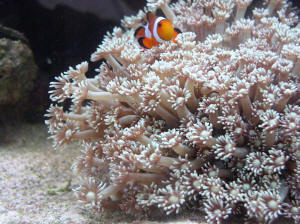
4/24/14 Pink Skunk Clownfish Hosting In Goniopora
-- 08/11/09 Re: Pink Skunk Clownfish Hosting In
Goniopora -- 08/13/09 Clowns hosting in Goniopora 9/28/08
Hello all at WWM, <Lyssa> I have a 55 gallon reef tank. All water
parameters are good and established. We get tested every week to be
sure. <Mmm, I'd get, use your own kits> My question is, I
have 2 clown fish, (amongst many others) a true percula and an
Ocellaris that are paired up. I have several places for them to host
such as a RBTA, frogspawn, hammer coral, torch coral and so forth yet
they choose to host in my most sensitive coral, my Goniopora.
<Happens> (I know I know, Goniopora are difficult to keep and
usually don't last longer than 6 months, but I've had some
success with it in my tank as has my friend with his which he has had
for over 2 years) The problem is that they are rubbing it to death.
<This also> Do you have any suggestions that I could use to force
my clowns to host in a different coral? <If you can't, don't
want to move the Goniopora, cover it with something like a strawberry
basket (inverted)> I was thinking of putting some drilled up Plexi
around it to protect <As long as there are plenty of holes for
circulation, feeding each polyp> it from the clowns. What are your
thoughts. Thanks so much. Lyssa
Corals At War! (An Unnatural Mix of Coral) Hello all, <Hi there! Scott F. with you today!> First off, thanks for your website... it rocks!!! <Excellent! Glad that you like it!> I am asking about my 55 gallon reef tank. It is in very good health for a 2 year old tank and everything is well (for the most part). I have 4x65W PC lighting, 2 Dual Daylight and 2 Dual Actinic that I run for about 11 hours per day. I change the bulbs about every 9 months or so. <A good habit to have..> I have healthy fish (2 Tangs, a Blenny, a few gobies, 2 mated clowns and a few Chromis). Most of my fish are over a year old and I do not intend to add any more since they are happy (very little aggression - a quasi-peaceful tank if you will). I have slowly added specimens and my protein skimmer is fully functional so this patience and water clarity I hold responsible for their health. I have been diligent not to overstock my tank and do frequent water changes (~10% every 2 or 3 weeks) because I realize my bioload is heavy (I have many corals). <You're doing okay!> I have many soft corals and 5 LPS and 2 SPS. My Galaxea, Trumpet, Tongue, and Hydnophora are all healthy and growing like crazy. My tank looks great! <Great to hear...That is a potentially problematic mix of corals in a relatively small tank. Allelopathic compounds are no doubt being released by these corals, which is problematic in this sized tank if you don't keep at your diligent water change/maintenance/protein skimming schedule.> (I also have 4 other reef tanks that are doing awesome). By the way, I have about 90+ lbs of live rock and about 2 inches of live sand as my biological filter). I don't use a trickle filter. I have a few questions: 1) I have a piece that I got from a friend that has a Spaghetti Finger Leather on a sort of conical rock. Around the perimeter, was the light brown version of Goniopora which COMPLETELY died off several months after I got it. <Not an uncommon occurrence with this coral, unfortunately> I let the leather keep growing where it was and 5 months later, the Goniopora came back!!! It is growing like mad. I was very surprised to see it come from "nowhere." <Cool!> My first question is twofold. a) My Leather has never grown large. The fingers are small and extend only a fraction of a cm. I have had this coral for over a year and it's size has not changed. I want it to expand. Now that the Goniopora is growing around the leather (again) will it kill the leather? <It is possible, as these are strongly aggressive corals. Of course, Sinularia species are very aggressive, as well. To be quite honest, I think that you need to really re-think your overall stocking plan of corals for the long term in this tank. A smaller tank like this is tough to manage with an unnatural mix of aggressive corals like this...Specialize!> b) What can I do to get the Leather to expand? It has looked the same with and without the Goniopora present. <Well, you actually answered your own question. You can't have 'em all in this tank. You really need to think about what kind of corals you want to keep, especially in a smaller system such as this. Someone needs to go.> I have been waiting for it to grow but it doesn't; it looks healthy, but does not grow large. I have thought about cutting the Leather like a pizza pie and let it heal for a while and then take the frags and rubber band them to small rocks, hoping the frags will grow better than the "mother." <Not in this situation. The "chemical warfare" occurring in this tank will not go away if you keep this mix. These are corals that are not found together in nature in such proximity, so the odds of success with this mix in captivity are really small.> HOWEVER, I like the rock as it is with the Goniopora circling the leather. I really want the leather to grow with longer fingers and have better polyp expansion with everything else the same. Also, my Devil's Hand Leather is small and behaving the same way (without the Goniopora). <But with the Hydnophora, etc...Do rethink this mix again!> Both are about midway in the tank... I want my Leathers to grow. Can you advise me on this? <Again, I'd "specialize" in one type of coral: soft corals, LPS, etc. In this sized tank, an unnatural mix such as this is a real problem.> 2) My Pagoda Cup has two strange air bubbles. Everything else is fine; the polyps are healthy. How can I make these bubbles go away and are they a problem? What should I do? <If they are somewhere on the surface of the coral, you could gently brush them a way.> 3) I have a Hammer coral that has 4 branches/polyps (the pink variety). One polyp got damaged in transportation and is dead. A second polyp is not looking good; it is not expanding and the tissue seems to be receding. My question is two fold again (sorry): a) Should I remove the dead polyp branch or should I leave it - a healthy polyp is right next to it - could it grow back, I mean could the healthy polyp spread to the dead one? <Do watch for the dreaded "Brown Jelly" infections for which these corals are known. If it makes you feel better, you could remove the dying branch for isolation/observation.> b) As far as the "sick" polyp, it still expands somewhat during the day but the adjacent polyp which is very health seems to be over crowding it. Should I cut the branch off or treat it some how for the recession? <If you're only talking about a single polyp, it may not be too problematic. If it's an entire branch of polyps, then it's far more serious.> I realize I am asking a lot of questions, so thanks for listening. Cheers, Karlo <My pleasure, Karlo. Again, I think if you try to keep more compatible species together...The real recipe for long-term success, IMO. Good luck! Regards, Scott F.> Goniopora Bob--the flowerpot that I recently moved away from the finger leather is not doing well. If you recall, about a month ago I mentioned that it had a small "hole" on top, that I discovered when I used a turkey baster to wash away what I thought was just detritus on top of it. Since that email and your response, I have left it alone and not "basted" it or anything. The only change is that it's been moved away from the finger leather and up a few inches in the water column. <What? I must have said to "leave it on the bottom"...> It's now got a bald spot about 2" in diameter on top and is shedding its polyps. It was already starting to shed the polyps on top at the time that I moved it. It's located on top of a rock about 6" below the water's surface. I'm running 4 110W VHOs. Water parameters are NH3/4 0, nitrite/nitrate 0, PO4 0, temp is 79.5 and SG is 1.024. Ca has come up to 360 and alk is 4.2 meq/L since all the water changes last week (still trying to get the alk down a little and Ca up around 400. . .) <...> Is this one a goner? If there is something I can do to try and turn it around, then I'll take the responsibility to do so, since I'm the reason it's here and I never should have supported the market in this species in the first place. <maybe... yes...> I scoured the WWM site for some ideas, however, most of the FAQs discuss the fact that these are inappropriate specimens and don't survive for any length of time in captive systems. <You can appreciate the position of placing "information" in such a forum... on the Net... better/best at this junction to say "no"...> Unfortunately, I didn't know that when I bought it, and like most people who enter this hobby, it was one of my first coral additions to the tank. It was added on 2/11, according to my log. It has always extended the polyps on the sides 3-5 inches, however, the polyps on top have never extended more than 1/2 to 1 inch. <Very typical scenario...> (That crazy maroon clown that took up residence in the plate coral that didn't make it through the calcium crash, just took up residence in the polyps on the side of the Goniopora today, believe it or not. . . If the Goniopora doesn't make it, the clown will deserve an anemone or something else to live in--but only after thorough research and patience waiting for the best species and specimen to come available. . .) Thanks for your thoughts. --James D, who is resolved to thoroughly research every future addition before adding it to the system due to past inappropriate and incompatible additions. . . <Ah, steps toward improvement... Press on my friend. Bob Fenner> Re: Goniopora To clarify--it previously was not on the bottom of the tank, but about halfway up on some LR. My mention of moving it up a few inches in the water column meant that the piece of LR it's sitting on now is a little higher up than its previous location. What I meant in my statement about leaving it alone is that I had been trying to use a turkey baster to clean off whatever food or other stuff was falling on it and getting trapped between its polyps. You mentioned in response to an email that these species live in dirty conditions in the wild. I took that to mean that food or other detritus falling/collecting on it should not cause it to decline, and that I should leave it alone, so I quit trying to clean stuff off of it since its natural habitat would be more "dirty" conditions. So no, don't worry--you definitely didn't say to leave it on the bottom--in fact, one of your FAQs specifically says that these species don't live in the sand. My prior email just wasn't entirely clear, and in typing it, I forgot to take into account that you have received and responded to hundreds of emails since that exchange! --James D <Ahh, no worries. Let me try to be clearer though: I would place this specimen on the bottom, irregardless of how they are found in the wild, and not be fastidious about "keeping its area clean". Bob Fenner> Sailfin Tang and Flowerpot Coral Hi Robert, Hope this finds you enjoying the holiday season! <Yes my friend, thank you> I have a question about my Red Sea Sailfin Tang. He is about 5 in. and has a voracious appetite. He will eat just about anything I feed to the inhabitants, and immediately consumes all of whatever I place into his lettuce clip. But lately I have noticed from a distance that he appears to be nipping at the green Goniopora (flowerpot coral). When I go up to the tank he will swim away, so I am not really sure if he is doing this or not. However I discovered some of the tips of this coral appear to be missing. The other tank inhabitants are 2 Ocellaris, some turbo snails, a few red-leg hermits, 1 Lysmata wurdemanni, 1 Lysmata amboinensis, some (rapidly spreading!) pulsing Xenia, and a Bubble-tip anemone. Do these Sailfin tangs eat flowerpot corals??? <They can> And if so, will this harm him? <If sufficiently nibbled, sure> One day he did not look very well, He was swimming strangely and appeared to be excreting tons of white flaky stuff, almost as if his insides were falling out, or as if he just ate a whole fish or some snails (which he didn't). There were also what looked like lumps protruding from his stomach. <Very likely what you so accurately describe was bits of substrate ingested, egested... normal> Since I never saw a fish excrete this type or amount (constantly for a couple of hours), I was very alarmed. I was not sure whether to remove him to quarantine or wait and see what happens. I decided to wait, and wanted to see if he still had his appetite. He would not eat right away, but after some time, he did eat the seaweed sheet that was in the clip. The next day he was back to normal. This is very confusing. Have you ever seen or heard of anything like that? Could the flowerpot coral have gotten him sick if he did eat some? <Could be the Goniopora involved... in the wild acanthurids consume, defecate surprisingly large amounts of material. Perhaps give the Surgeonfish sections and FAQs a read on WetWebMedia.com for other input. Bob Fenner> Thanks in advance for your always helpful advice! Laura Quick Question Hello Bob! My most recent fish purchase a Skunk Clown (Amphiprion sandaracinos) has taken to my Branching Flower Pot coral (Alveopora gigas) as if it were a anemone. <This happens> Will this harm/irritate/kill my Branching Flower Pot coral? If so, what would you suggest (besides adding an anemone)? Thanks again for your wonderful web site and help! <Thank you for writing... In all likelihood the interaction of the species of Skunk Clown will actually improve the health, your chances of keeping the Flowerpot Coral... the Clowns will keep it clean... help feed it. Bob Fenner> Adios, Curvin York, PA USA Fireworms and coral Good Evening, Mr. Fenner. I e- mailed you yesterday regarding Fireworms in my aquarium. I'm sorry I should have been more descriptive. I read in your book that they can attack corals. <Some species, yes... most mainly only if very hungry> I have noticed recently that a flowerpot coral that I been having for about a year and half has dwindled down to almost a shell. Just a few polyps seem to open. Could this firework be the culprit? <Possibly but not likely. This genus of corals, Goniopora do generally "melt away"... not an easy group to keep, despite their popularity and commonness> If so what would you do to get rid of it? <Please read: http://wetwebmedia.com/bristlewrmfaqs.htm> My others corals seem fine for right now. I have tried to get him out but this seems to be a hide and go seek contest between us. Whatever advice you give would be greatly appreciated. I would like to personally thank you for all of the great advice you have giving to me and other aquarist alike. Not to mention a great set of books!! Thank you for your time. Ryan H. <Thank you for your input and involvement. Bob Fenner> Bisma rock (AKA Koko worm rock... a Porites species) hello, <Cheers... reefer Anthony Calfo in your service> I was wondering about purchasing some Bisma rock but I have gotten a lot of different responses some people say fish won't eat them and others say that they will leave them alone, <my heavens... that really depends on the fish species!> they also told me the rock they are in is actually coral and if it dies the worms die also. <half true...the rock is live coral (Porites species) but it does not die when the worms die. However.. this is one of the most demanding coral species (and fanworms) to keep alive. It needs extremely !!! high light (Metal halides almost without exception) and extraordinary water movement that will bother most fishes> I was wondering if you could give your opinion on the situation. I have a 3"red sea Sohal tang, 3"clown trigger, 3" Miniatus grouper, 6"Adult emperor angelfish, hermit crabs, snails, xenia, mushrooms, 100lb LR in a 100 gallon tank w/ reef sun lighting. thank you <the trigger and angel are both likely to make this addition a sacrifice and waste of money. Save part of the reef and don't buy it, my friend. Anthony Calfo> Ian Behnk Chemical warfare Hello, will my Goniopora (flower pot) and my anemone wage chemical warfare on each other? <yep... and I'd bet good money on the Goniopora losing the war in the long run> Because it seems that when the flower pot is open and happy the anemone is upset and retracted and vice versa. <very good of you to notice...seriously> Sorry I know these are two specimens that you don't advocate buying, but hind site is always 20/20! <no worries... I have already FedExed a dead snail to your location for someone to place into your locked car on a very warm day with instructions to roll up the windows> My tank is 135 gallon with 40 gallon refugium 180 lbs LR, 5 inches LS assorted corals and community fish and inverts all parameters are perfect (sorry don't have them with me or I would pass them along). <just knowing they are "perfect" is enough without those bothersome numbers...hehe> If this is the case (warfare) will they learn to get along or will one have to become store credit? <ehhh... most all cnidarians will wage some sort of warfare. Some are worse then others. Most are intolerable in the big picture without aggressive protein skimming. chemical filtration and water changes. My advise beyond that is keep them far away from each other, conduct more frequent water changes and carbon changes and continue to observe> Thanks again in advance: Joe who wishes he could snorkel in his tank <Always welcome: Anthony, who does (snorkel in his own tank... not Joe's> Re: Chemical warfare Anthony thanks again, now should I run a
skimmer also? <I would strongly recommend a skimmer for most
marine aquaria. While skimmer less systems are having a slight surge in
popularity... most aquarists that I speak to cannot explain how they
are able to succeed without such a critical vehicle for nutrient export
or what system dynamic has replaced it. It sure isn't Caulerpa as
one methodology purports. Caulerpa alone puts Into the water a
significant amount of antibiotic, discolorants and noxious compounds
that inhibit some coral. I do not personally believe Caulerpa alone
without skimming serves the greater good. So yes, I most likely would
recommend a skimmer. For aquarists that fear or suspect that I do not
subscribe to skimmer less systems and that's why I do not recommend
them... I would say that my current reef is skimmer less and my
favorite reef in the past ten years was skimmer less. But I keep
animals known to feed most only by absorption and/or I compensated to
the lack of such efficient nutrient export by weekly water changes or
more ten. Food for thought> my tank does so well with my refugium,
But I suppose that all that caluerpa,rock,24 hour lighting and
"good bugs" are not the best chemical warfare filtrant.
<exactly, my friend... they have other merits> I was under the
impression that if possible "the refugium" is the best way to
go because a skimmer will take out all the plankton and other good
stuff as well! <wow...so many misunderstanding and mistruths
out there about so many things. Specifically... skimmers do not extract
much or any zooplankton at all. They take out far more bad elements
than good. For that matter, corals take out plankton and vitamins from
the water too... but we're not removing them from our reefs
<smile>. If negative impact were the only factor for inclusion in
aquaria... Caulerpa would never be allowed in. Unnatural with most/many
coral in the wild state, competes with them for nutrients, can directly
retard their growth... don't et me started on Caulerpa...hehe. In
small portions it is wonderful... as a vegetable filter, there are much
better choices like the seagrasses.> I also run an Emperor 400 with
carbon ,and I change carbon biweekly! hhuummm what's your thoughts?
<very nice schedule on the carbon. Small frequent changes are quite
good/better. Do consider PolyFilters too... very helpful too. If
tempering allelopathy (Chemical warfare) is your primary goal, you may
want to look at ozone and a RedOx controller...very good for oxidizing
the nasties> Joe |
|

|
Features: |
|
| Featured Sponsors: |