|
FAQs about Small Marine System Filtration,
Circulation 3
Related Articles: Small
Marine Systems, Tom Walsh's Small Reefs,
Large Marine Systems, Fish-Only Marine Set-up, FOWLR/Fish and Invertebrate Systems,
Reef Systems, Coldwater Systems, Plumbing Marine
Systems, Refugiums, Marine
Biotope, Marine
Landscaping, Fishwatcher's
Guides,
Related FAQs: Small System Filtration 1, Small Marine Sys. Filt. 2, & Skimmers for Small Systems,
Skimmers for
Eclipse Systems, & By Type
of System: FO System Filtration, FOWLR
Set-Ups, Reef Tank
Setups, Reef Filtration,
& By Aspect and Gear: Biol.: Biological
Filtration, Denitrification/Denitrifiers,
Fluidized Beds,
DSBs, Plenums, Algal Filtration, Mech.:
Marine Mechanical Filtration,
Power Filters, Outside Power Filters, Canister, Cartridge Filters,
Undergravel
Filters, Wet-Dry Filters, Phys.:
Ultraviolet Sterilizers, Ozone, To Skim or Not to Skim, Best Skimmer FAQs, Chem.: Nutrient Control
and Export, Chemical Filtrants (e.g. Polyfilter, Chemipure,
Purigen), Carbon, Mud/Algal Filtration ,
Phony: Magnetic
Field Filtration, & Troubles: Bubbles, Noise, Small
Tanks, Small System Lighting, S Small
System Stocking, Small System
Maintenance, Small System
Disease, Small
Marine Systems 1, Small Marine
Systems 2, Small Marine Systems
3, Small Marine Systems
4, Small Marine Systems 5,
Small Marine Systems 6, Tom Walsh Systems, Skimmers for Small
Set-ups,
|
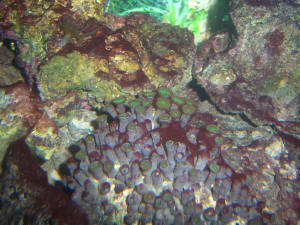 You want to
avoid the BGA blues. You want to
avoid the BGA blues. |
 |
 |
 |
Small Marine Aquariums
Book 1:
Invertebrates, Algae
New
Print and
eBook on Amazon:
by Robert (Bob) Fenner |
Small Marine Aquariums
Book 2:
Fishes
New
Print and
eBook on Amazon: by Robert (Bob) Fenner |
Small Marine Aquariums
Book 3:
Systems
New
Print and
eBook on Amazon:
by Robert (Bob) Fenner |
DSB for Nano tanks
7/1/29
Dear Team
<Hey Srinivas>
Am sorry to crowd you with the same old stupid question..
<There are no stupid questions>
However, pot a lot of reads on various sites, the confusion seems to
have
increased many-folds
I previously had a 240 Gallon FOWLR
I had a sump and a DSB and it worked fine for more than 5 years until I
was
posted at a different location (Job Rotation).
Owing to space issues, I now made a nano cube. A diehard fan of the sump
system, I build a 20 galllon ( net volume) sump.
Since the old tank was dismantled, I used the rocks and the sand in the
sump for a DSB.
The DSB chamber is 6 inches x 12 inches with 6 inches of fine sand. The
nano has been running for 9 months with only percula clowns.
Am planning to convert it to a mini reef and obviously needed
modification
( lights and filtration)
The sump needs to be modified and am adding a new chamber to accommodate
a
better skimmer.
Just wanted to check whether I can continue with the DSB or is it
hazardous for a nano system.
<I am a fan of using sumps with DSB, so I advise you to use it in the
nano,
no hazard at all, it would be more beneficial using it than not.>
Warm Regards,
Srinivas
<Cheers. Wil.>
Re: DSB for Nano tanks 7/2/19
Thanks for the assurance Wil
<You're welcome Srinivas>
Please suggest if I should increase the flow over the DSB through a
small/mini powerhead
<Yes, but it must be very snall or you will disturb the sand bed, a
single air stone will do the job IF the surface on the DSB looks
stagnant, otherwise I’d leave it with the flow created by the main
pump.>
Currently it is a drain system with 1" bulkhead flowing
<Enough pipe diameter for a 20 gal.>
Warm Regards,
Srinivas Manian
<Greetings. Wil.>
Biofilter... for <"aggressive nutrient uptake"> for <small>
Biotope 6/1/2017
Hi Bob,
<Hey Greg>
I've been slowly putting together a Caribbean biotope over the past 6
months and am now sort of stuck. The thing is, I'd like to add some
coral to give the tank some ''movement'' but mainly for aggressive
nutrient uptake.
<Mmm; well, macroalgae are better for this... or a DSB; perhaps
remoted in a sump/refugium; best w/ an RDP lighting arrangement.
"Corals" (the groups hobbyists label many Cnidarians) are really low
metabolism by and large; mostly skeleton biomass>
Based on what research I've done there doesn't seem to be any coral in
the Western Tropical Atlantic that would meet my needs.
<Agreed; unless under quite specific circumstances>
Xenia is my favorite for nutrient uptake and aesthetics but obviously
it's not found in the Caribbean. I know green star polyps can grow
pretty quickly if the conditions are favorable - but would they be good
for nutrient/dissolved organic control?
<Not really; no... and can/do produce allelopathogenic substances>
I'm very tempted to take some xenia from my other tank but keep fighting
the urge so any suggestions/advice you might have would be greatly
appreciated.
<Investigate what I've hinted at above... perhaps one, two macroalgal
species in the main/display and/or a tied-in live sump>
Here's what's already in the tank: (10 gallon)
<Oh! This is a very small volume... hard to manage... should "something"
go sideways (e.g. power outage, overfeeding, mysterious death....>
- 1 rusty goby (Priolepis hipoliti)
- 3 tiger gobies (Elacatinus macrodon)
- 4 scarlet reef hermits (Paguristes cadenati)
- 3 blue leg hermits (Clibanarius tricolor)
- 1 white claw hermit (Phimochirus operculatus)
- 2 green emerald crabs (small, about 1/2'' carapace)
- Halimeda opuntia
- 2 Ricordea mushrooms
- 2 Periclimenes pedersoni shrimp
-10 Nerite snails (Nerite virginea)
Thanks,
Greg
<One last time/repetition: I'd add a sump here... for many reasons... a
DSB there, it's own illumination on an alternating light/dark cycle...
the algal culture there. Bob Fenner>
Re: Biocube Stocking. Filtration area set up; maint. this time
12/10/16
Hello again WWM!
<Howsit James?>
I've decided to take the next step in filtration. Can you double check my
decisions before I integrate them into my Biocube 14?
<Sure>
I've been throwing a Scotch Brite pad between chamber 1 and 2, and putting the
guard/sponge over the propeller on my Vortech mp10. Then, I've been using a
turkey baster to blast the rocks. After the water is clear again I pull the pads
back off, rinse them out, and let them dry. It seems to be very effective and my
water parameters have not changed.
<Sounds/reads like a good routine>
The only negatives have been a hair algae outbreak early on. The hair algae
seemed to evolve into a Bryopsis style fern shape?
<There are a few pest types that look like this... and various means to counter
them... Gone over and over on WWM>
That all died out in about a week. Now I have a clump of hair algae again on the
back wall of the tank. I'm wondering if extra nutrient management is necessary.
Here's my current rough draft.
Chamber 1: Cermedia MarinePure 1.5" balls. filled approx 70%. Im assuming the
bottom half of chamber 1 is lower flow. So in theory helping with biological
filtration live rock style. Chamber 1 is still empty except for the heater.
Chamber 2: Seachem Matrix Biomedia in the bottom half and some sort of
macroalgae with a small submersible led light. I haven't done research on the
type of macro algae or light yet. I'm hoping to out compete the hair algae.
Chamber 2 is currently completely empty with false floor removed.
Chamber 3: Seachem Purigen for the final polish before returning to the tank.
I plan to continue the turkey baster/mechanical removal and I like having a very
hands on approach to my tank. What do you think?
<Again, this appears to be a very nicely managed small system. I'd proceed with
the stocking... even consider one hermit crab and snail for routine cleaning and
interest>
Thanks again for your time!
<Welcome! Bob Fenner>
|
Re: lighting, pumping, and new tanks oh my! James! LED input please.
Now flow/circ. rate in sm. SW
5/3/13
Hey Mr. Fenner,
<Hey Eli>
Once again thanks for all the input, it was greatly appreciated and
James did an awesome job at answering all my questions and more!
<Ah good>
Since then I have decided to go in a much smaller direction I'll be
going away for school soon and bringing that large of a system with me
would be impossible unfortunately. So while that behemoth is in storage
I decided to purchase 29gallon biocube hqi system, I have kept
everything stock except for the bioballs which I have switched out to
make a small fuge. So my question is about water flow. Currently I have
the stock return pump, a 250gph Aqueon powerhead which faces against the
back wall of the tank to help prevent detritus buildup and another
powerhead that was given to me and I'm not sure it's power but it's
probably equal to or less than the Aqueon. From what I've read the more
flow the better
<Up to a point>
I just want to make sure my inhabitants aren't living against the glass!
<Ah yes>
They seem to be ok one have a percula clownfish, one blue green Chromis
and one fire fish. As far as corals go I have two stalks of pulsing
Xenia, a few Zoas and a small patch of green star polyps. So do you
think it's to strong of flow for them, or could possibly be too strong
for corals in the future?
<Might be. The only real way to tell is to set up and fire all over>
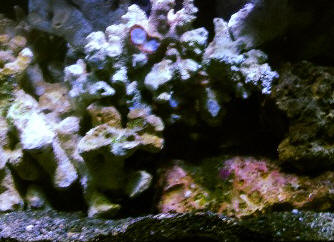
I have about 50lbs of live rock. Here's a photo of the setup Thanks again
for your input
Regards
Eli Ramos
<And you, Bob Fenner>
|
 |
Return Pump vs. Skimmer Size – 12/11/12
Hi,
<<Greetings>>
I have had my small reef tank set up for about a year now and I was considering
upgrading my return pump and skimmer. My tank is a 25 gallon with
a 20 gallon sump and I currently have a Mag 5 running a dual return line that
seems to provide about 180 gph after head loss etc.
<<More than sufficient for this size sump/system>>
I have an mp10 in the display to provide for circulation (provides between
200-1500 gph max, depending on the setting that it is running).
<<Excellent>>
I also have been running a Tunze 9002 nano skimmer. A few months ago my
return pump started making a lot more noise and I have tried everything to quite
it down. I have cleaned it many times and tried to place it carefully to avoid
vibrations but nothing seems to work.
<<It likely needs a new volute…these pumps tend to “wear” where the impeller
inserts in to the volute…and/or it may need a new impeller. Both can
generally be found on the Net as replacement parts>>
I have decided that I would just buy a new return pump and keep this one as an
emergency.
<<This is another option>>
I am considering a Water Blaster pump as they seem to be built very well and run
extremely quiet and with less power consumption.
<<Have heard good things about these pumps, but my first choice would be one of
the small Eheim Hobby pumps…superb quality/reliability>>
I have been looking at two models but not sure which one to use. The
2000hy Water Blaster would probably provide about 120-180 max gph based on the
flow chart where as the 3000hy would probably provide about 240-300 gph.
<<If your estimates are accurate based on your plumbing configuration, I would
go with the smaller pump. 100-200 GPH through your small sump is fine, and
will greatly reduce any issues re noise, excessive bubbles, etc.>>
I based the estimates by comparing the actual gph my Mag 5 was putting out to
its flow chart and then using that head height number for the Water Blaster flow
chart. This was to accommodate for unions and elbows in my plumbing in an
attempt to get an accurate estimate.
<<Okay>>
I think that the 2000hy should be fine but it may be a little slower than what I
have running right now, but the 3000hy seems like it may be a little fast and
would turn over my display volume 10x per hour. What would you recommend should
I have a faster sump turn over or should I try the slower pump and possibly have
a lower turnover around 4.8 times per hour.
<<As stated, I feel the smaller pump to be sufficient here. But if you
want to get/use the larger pump to see how the higher flow rate works with your
system, you can…just be sure to plumb a gate-valve on the output side of the
pump to temper the flow if needed>>
I also have a 'fuge in the middle chamber of my sump so it would be running at
whatever gph is pulled though my tank. One other thing to consider is that I
will be purchasing a new skimmer as the Tunze 9002 does not seem to be
performing that well for me and the new one I am considering seems to be a
better design. I am looking at The Bubble Magnus Nac 3.5 cone skimmer which has
a pump rated for 340 gph. I have read that it is good to match your skimmer pump
to your return and that the return should be if anything, slower. Is this
correct?
<<Can’t recall that I have ever heard this…and certainly have never paid such
any mind>>
Both pumps would be under this number but I suspect the ATMAN 1100 pump in the
skimmer due to the needle impeller will probably only push about half or 180 gph
and that would make it slower than the 3000hy. It seems to me that I should go
for the 2000hy water blaster pump as it is closer to what I am running now but
my only fear is that it will not be able to push the estimated gph into my
display and it is a very expensive pump.
<<Then use the ‘3000’ and add the gate-valve as mentioned>>
Also maybe I should have had a faster sump turnover rate all along not
sure. Let me know what your thoughts are.
<<You have them>>
Thanks so much for taking the time to read over this.
Cheers
<<Happy to share… EricR>>
In tank filtration/Bob Fenner 5/19/12
Bob,
<Marcelo>
It was a pleasure meeting you at the Williamsport frag swap in April!! I
enjoyed your presentation and finally got the courage to ask you some
questions.
I have a Nuvo 16 gallon reef tank with 12 lbs of live
rock , 2-3" live sand/crushed coral mixed in. Have 3 small Chromis, a
Firefish, a 6 line wrasse
<Keep your eye on this... can become very mean>
and yellow Jawfish and some snails. I will be adding some Chaeto
on a reverse light cycle in the back and will be buying filter chambers
made by Intank- in effect vertical chambers to hold media that water
runs through.
After reviewing discussions on your site was thinking of running a
little floss on top, and below Purigen, Chemipure and Polybio marine.
<Not full size units I hope/trust... I'd be filling small Dacron bags
from the larger commercial packs>
My plan was to rinse all weekly in RO water while doing my 10-15% weekly
water changes and replace the floss daily or as needed.
1- is this too much that could be bad for the tank in any way or ok if I
am willing to pay for these items as needed. Just want max protection
for times when I travel for a few days as extra piece of mind.
<I think it's a bit too much... again, smaller (one-two ounce)
applications of any/all is about right>
2- the chambers are under return grills for water flow, any advantage to
which order the media is housed?
<Some small amount... the order you list>
Thank you for any help you can provide and keep up the great work- one
day I will visit Fiji!!
<Ahh! Do speak w/ the artist, Nate Wilson in the group. He's been and is
going back this summer. He and I have been i-chatting re. Cheers, Bob
Fenner>
Marcelo
H.O.T. Magnum 250 canister
filer/Filtration/Mechanical 12/7/11
Hi
<Hello Rudy>
I am setting up a 30 gallon cube saltwater aquarium
FOWLR.
Could I use my H.O.T. Magnum 250 canister filter as the only mechanical
filtration if I stock live rock?
<Certainly.>
I also have a Hydor Koralia Evolution 550 Aquarium Circulation Pump,
550 GPH that I will use for additional circulation.
Currently I have a large JEBO 5 basket canister filter that came with
the used aquarium.
Which canister filter would you recommend?
<I personally like the HOT Magnum myself. I've had one for
years and use it when needed, very versatile, easy to perform
maintenance on it, and quiet.>
Thanks,
<You're welcome. James (Salty Dog)>
Rudy
Saltwater Stocking and Filtration Question
5/26/2011
Dear sir or Madame,
<Hello Camron>
I have a question regarding saltwater stocking.
I have an 18 gal. tank with a 40 gal. filter. I the tank I currently
have 2 Cerith snails and 1 Green Clown Goby.
I am going to receive a Firefish.
The goby requires 10 gal. minimum. The Firefish requires 10 gal.
minimum.
The goby is already a resident in my tank. And I cannot return the
Firefish.
My question is with the 40 gal. filter, would both the goby and the
Firefish be okay in my tank? If not, would buying a 50 gal. filter or
stronger be helpful? Would moving the snails to another tank help?
<The 10 gallon minimum does not necessarily mean each fish requires
ten gallons, but is the volume of water each fish would feel relatively
comfortable in. James (Salty Dog)>
24g cube, SW, set-up
principally 4/12/11
Hey crew! I've had a 14G Biocube for 2 years now, and all of the
inhabitants including a now near 2 year old peppermint shrimp and
Percula have remained alive. (I've read 1 year is the life
expectancy for a peppermint shrimp, so I expect it to die off soon
:'[ )
Recently a friend offered so sell me his 24 gallon JBJ nanocube for 150
dollars so I bought it. I'm going to use the 14 gallon as the new
quarantine, and was wondering if it is safe to transfer the Percula to
the 24 gallon (which has nuisance algae and worms) without any special
treatment.
<It is>
The live rock in the 14 is blue and pink with coralline, but I will let
it stay simply because I don't want the bristle worms going
over.
<Mmm, you could likely remove (most) all with "spritzing"
(even immersing) the rocks in "soda water">
Would there be any chance of something spreading to the 24 gallon by
moving the Percula there?
<Very little, no>
I have already added 10 pounds of live sand and 25 pounds of aragonite
to the 24 gallon, and was wondering if base rock would be necessary for
a tank of this size.
<Mmm, no; not necessary>
Long term I plan on adding Montipora to the tank, and I assume that
with base rock in addition to live rock with spreading Montipora will
result in restricted swimming spaces.
<Easy enough to curtail, break pieces off... generally this genus
grows slowly in such small, change-able settings>
Could I get away with simply picking out choice pieces of live rock and
arranging them against the back? Or should I purchase some base rock
"just in case".
<I think you'll be more than fine w/o>
Ah, and I nearly forgot about this one. The 24 gallon included bagged
"pellets" of activated charcoal, which I ran through water
until the water going through it was clear. After running the tank for
about 48 hours with the filter on (just sand and saltwater at this
point) I can easily smell the charcoal when I put my nose a few inches
away from the water. Should I remove the charcoal and replace it with
another brand, or does the smell indicate nothing wrong. I'm not
exactly sure of what the effects of dissolved charcoal could have on
the water quality.
<I'd leave it where it is... not move any livestock for a few
weeks.>
Because it is a nanocube, it is self contained and doesn't leave
too much room for modification. I was wondering if, when I introduce a
bioload of 3 or so fish, several crustaceans and possibly Montipora
(several months from now, of course) to the tank with a simple trickle
filter which goes through sponge, charcoal, and some ceramic rings,
leading to a pump with a 250 gph flow will be able to handle that
bioload.
<Should; yes>
I may be able to add a small canister filter if I punch a hole through
the lid if necessary, but want to know beforehand if that will be
needed.
<Not needed, but nice to have redundancy in function, extra margin
in filter, carrying capacity should the inevitable
"something" go awry>
If you are aware of any high quality filter media that I could use in
place of what I have said I would appreciate it, because I'd rather
not blindly buy something that I won't need.
<Eheim's products here>
Sorry for the multitude of questions, but I really don't want to
make too many mistakes this time around.
Best wishes,
Sam Sutonovski
<And you. Bob Fenner>
29 gal reef filtration,
10/6/10
Hello WWM, I am a fan of your site.
<Thanks>
This is my first time writing here. Well to start off I have a 29 gal
reef tank it has been running for about a year and a half. I have had
several filters on it from sumps to hob but can't decide what to
stick with. Currently I have a Aquaclear 70 and a Nano Koralia power
head. Just the other day I purchased a red sea Prizm, this is the first
time I use any skimmer on this tank.
<A quality skimmer is important, I would not run a tank without one.
The Prizm does not have the best reputation.
http://www.wetwebmedia.com/ca/volume_1/cav1i1/protein_skimmer_impressions.htm
>
Should I use only the Prizm and the powerhead. Because I heard that the
hob filters are nitrate factory
and I'm getting some hair algae and its growing by the day.
<Depends on how much live rock and circulation you have. Mechanical
filters need to be cleaned often.>
< http://www.wetwebmedia.com/marsetupindex2.htm
>
Thanks in advance
,Benny.
<Welcome>
<Chris>
Re: re: 29 gal reef filtration
Well the tank has about 40+ lbs of LR and 1.5 inch of live sand. I went
and removed the sponge from the Aquaclear and I'm going to use it
to run carbon only. I also think my lights have something to do with it
I have a Coralife 130 watt pc I just changed one of the bulbs to
actinic and the other one I changed about 4 months ago and its a 50/50.
But I'm thinking of replacing the pc for t5, do you think that
would be better? And if so how many watts would I need to keep sps?
Thanks again for the speedy reply
Re: re: 29 gal reef filtration 10/7/10
Well the tank has about 40+ lbs of LR and 1.5 inch of live sand. I went
and removed the sponge from the Aquaclear and I'm going to use it
to run carbon only.
<Ok>
I also think my lights have something to do with it I have a Coralife
130 watt pc I just changed one of the bulbs to actinic and the other
one I changed about 4 months ago and its a 50/50.
<Light is not usually the deciding factor on algae growth,
phosphates and nitrates are usually the cause of excessive
growth.>
But I'm thinking of replacing the pc for t5, do you think that
would be better?
<I don't think it will make a difference in regards to the
algae.>
And if so how many watts would I need to keep sps?
<Depends, see here for more http://www.wetwebmedia.com/CnidIndex2.htm
.>
Thanks again for the speedy reply
<Welcome>
<Chris>
Tank cycling, nutrient presence
9/14/10
Hello people,
<Hello Robert>
I am having some difficulty with understanding some of the processes
within my system and was hoping someone could please shed some light to
my issue. (I didn't really know how to present the problem due to
the length of the build up so it is in note form.)
<Okey dokey>
I am setting up a 20 gallon marine tank with a 100 watt heater, two
power heads (one with canister) and 2 24 watt PC bulbs with generous
sand bed (1.5 inches depth). I have some experience within the hobby
but I am would really benefit from someone with more knowledge in the
area. I have recently set up my tank in a very isolated place in
Australia (in the middle), and I placed some live rock (1kg) within the
tank (about 3-4 weeks ago). After about three days (approx) an ammonia
spike was then followed by a nitrite spike 1.0-2.0 mg/L. After some a
period of days the spike began to subside. At this point I went on
holidays to the coast (1500kms away). During this time I came across
awesome pieces of rock (required) and various coral frags (desired). As
logistics is an issue I decided to capitalise on the opportunity as my
tank would surely be cycled. After packaging both rock and frags they
undertake a 1500 km trip over a 13 hour period. That night I check
Nitrite and pH and find that the 10 days I spent away has resulted in
no detectable nitrite, a good pH (8.2), and thick algal growth.
<Ok>
My assumption is that the system is reasonably established.
<Yes I agree, but with caveats..>
Sure of present nitrate I do a 10% water change and then add newly
collected rock and frags (water looks good/no smell). Next morning my
system looks like the Chernobyl incident with extremely poor water
clarity (smells dead). After checking, nitrite jumps to 1-2 mg/L. panic
stations are at the fore and I remove possible dead material and do a
40% water change. Testing again I find that ph is about 8.0 and nitrite
remains the same.
<The new rock had some life in it that did not survive your trip.
Since the biological filter of your aquarium was very 'light'
(because there were no real 'producers' within) then there was
not enough bacteria present to combat the sudden introduction of dead/
dying material (hence ammonia and nitrite accumulation). A second
die-off 'cascades' from this, producing more toxins, and so on
until either action is taken, or most all dies.>
Not wanting to lose new arrivals I go the LFS and browse through
limited Marine stock, the only possible item to assist my problem is
Bio Accum (appears to be an activated carbon bag),
<this might help with some released toxins/ poisons, but not with
ammonia & nitrite>
although the potential is limited it is a last option in an attempt to
hold onto what I have left. Put the bag in, and test water nitrite is
the same but pH has dropped to 7.6-7.8 (ish). And nitrites are still
about the same. It is now about 5 hours after the addition of the
carbon and water still reeks and looks radioactive (cloudy);
<It will do for a few days at least. Daily, or twice daily water
changes for a week along with the removal of dead material is your best
course of action here>
retests show a nitrite of 0 (?) and pH weak but stable at 7.8. I am
clearly perplexed. Is this the work of the bag? Are nitrates still
responsible for the poor water clarity and smell?
<No. This is dying animals you are smelling>
Where is the tank at now? And do you have any advice to extend the life
of the inhabitants through what I had thought to be a finish tank
cycle?
<You are misunderstanding this concept of 'cycle'. The
initial cycle of your system was done, but too much was added in the
way of pollutants for it to handle. Bacteria populations must be give
time to build up, this is why animals should be added slowly, and is
also why from a certain point of view there is no such thing as a
'cycled tank', closed systems are always cycling, as the
nutrients, bacteria et al. eb and flow with time and changes to the
system.>
Cheers Thank you for your thoughts.
<No worries>
P.S. Although I didn't say it before; the depth and knowledge in
your site is pretty much the definitive source (in my opinion) for
anything to do with my aquatic system and interests, you people do a
great job in maintaining such a knowledgeable and descriptive website,
thanks heaps!
<Awww, shucks;) Simon>
Water Quality 8/3/10
Hi Crew,
<Sam>
I have an 24 gallon Aquapod.
<Oh I know, in fact, I know enough about you to assume your identity
(smile)
Now, if I could just get that SSN from you.>
It has been running for 18 months and I am very happy with the results
(credit to the Crew).
<We thank you for this.>
I have a glass to <?>>top< and 96W T5 and a hang on
skimmer. The way the tank is set up is there is a back compartment
where there is a sponge filter the height of the tank.
There is a grate where the water goes thru to the back but there are 5
sliding pieces so you can block portions of the grate. I block most
sections. I removed the foam because it is one big block and the part
that touches the great <grate> get blocked too quickly. Instead,
I put regular filter material at a midway point in that back section so
that the whole filter pad is filtering instead of just one small spot
by the grill. I did not want the pad to be the full height of the tank
so I put bio balls at the bottom and placed a filter material over it.
I never used bio balls (they came with the tank) and have read the many
negative things about them.
<Not really negative, is the fact the bio balls are so efficient at
denitrification that their use could increase nitrate levels. In well
maintained and not overly stocked systems, this should not be a
problem.>
In this case I am just using it too fill space. In fact I did fill it
with a piece of the sponge but every once in a while I would take it
out to clean and there would be amphipods in it and they either went
down the drain or got killed when I cleaned it. Do you see any problem
with this setup?
<No, just ensure the sponge is cleaned weekly.>
Thanks,
<You're welcome. James (Salty Dog)>
Sam
Side view of back area. Left is open and has return pump. Middle line
is where I have filter material. Grate - - - with bio ball at bottom
half.
Water flows through grate, then filter then to left side. Grate where
bio balls are is blocked plus filter sheet on top of balls.
| |- - - -|
| |- - - -|
| |- - - -|
| |ooo||
| |ooo|
----------------
Re Water Quality 8/3/10
whadaya mean " In well maintained and not overly stocked
systems". Of course it is overstocked. That's why we have so
many problems.
<Heee, not to do Sam.>
Thanks
<You're welcome, and have a nice day Sam. Good to hear from you.
James (Salty Dog)>
Nano DSB? 7/8/10
Hi WWM Crew,
I replaced the sandbed in my Mom's 24G Nano cube over the weekend
with a 3-4" DSB. Since I don't have the ability to add a
refugium or skimmer to this tank, I added a second powerhead behind the
rockwork opposite side of the tank from the return outlet in hopes of
creating better circulation along the bottom near the sand while
reducing opportunities for dead space to develop. When I pulled the
live rock and sandbed out, I found only a 2-Astrea snails, 2-Margarita
snails, 1-small Tonga Nassarius snail and only 1- fairly large white
leg hermit crab.
<Predaceous>
The underside of the live rock had the usual bristleworms and various
tiny critters. The new sandbed is a sugar-fine bed about 3-4"
deep. I ran the new sand in a cooler for a little over a month with
water siphoned out of my tank, a couple handful of sand and rock pulled
from my sump from my 90G reef.
<Good technique, prep.>
The rear media chamber of her Nano-cube is filled with rock rubble. I
was initially thinking that I needed to add a sandsifting goby and/or
more hermit crabs, snails to the new sandbed.
<Mmm, no>
However, in doing a little research I've seen several
recommendations for not adding crabs, snails or gobies as they can
decimate a sandbed in fairly short order. Is this correct?
<Yes>
If so, will the worms/pods from her existing live rock along with
whatever fauna transplanted from my tank populate her new DSB before
nutrients have a chance to build up in the tank?
<Over time, yes>
Are there any clean up critters that you would suggest for use with a
DSB?
Thanks,
Tom
<In such small systems, none that I'd add purposely. Instead,
periodic, slow stirring as proscribed on WWM is about all I'd
do.
http://wetwebmedia.com/dsbmaint.htm
Bob Fenner>
Filtration & Lighting Questions --
07/08/10
I currently have a 38 gallon reef system and am
seeking advice on filtration and lighting options.
<<Okay'¦happy to proffer my opinions>>
My tank has been running for approximately 2 years and I feel it is
time to upgrade and add equipment.
<<I see>>
Note: I plan to purchase a larger tank within the next 6 months.
Somewhere around a 90-120 gallon.
<<Mmm, do go with the latter if it is within your
budget'¦is a 'lot more tank' for a not much bigger
footprint'¦the extra 6' front-to-back makes a huge
difference in the appearance/aquascaping/your viewing
pleasure>>
I now have a sump with bioballs
<<These can be a source of increased Nitrate'¦on a reef
system, it is better to remove plastic media such as this, or replace
it with live rock (or even a bag of carbon) which will allow for the
further processing of nitrogenous materials>>
and Chemi-Pure filtration, a MAG5 return pump, and a Maxi-Jet 900 power
head. I have been struggling with Majano anemones, and I have read on
your site that adding a protein skimmer may help remedy the
situation.
<<It can, yes'¦through the reduction of dissolved
organics. But don't expect it to be a panacea. Often the pest
anemones must be dealt with directly'¦either by removal and
cleaning of the affected rock, or by attempted 'poisoning' with
such things as Kalkwasser, Lugol's, Aiptasia-X, etc.>>
Do you have any suggestions for a reasonably priced skimmer that I
could use now and when I upgrade?
<<That depends on your definition of 'reasonably priced'
but do have a look at the offerings from AquaC, and also the Reef
Octopus line of skimmers. One or the other should be able to provide
something that won't 'break the bank' while still offering
a quality piece of gear>>
In addition, I am looking to replace my lights and would like to know
my best, again reasonably priced, options for bulbs for my reef system.
I currently have a 96W PCL and 65W Actinic.
<<My preference is metal halide, but if the cost of replacement
bulbs is an issue then a T5 lighting system is likely more acceptable
here. There won't be a 'big' difference in the cost of
initial setup between the two, but the T5 bulbs, though needing
replacement more often, will take a smaller bite out of your wallet for
the individual bulbs>>
I would be happy to provide more information as needed. Thanks in
advance.
Ashley
<<Happy to share'¦ EricR>>
|
Lots of questions re: Nano system (protein skimmer,
return pump size, plenum) 7/4/10
Hello from North Queensland, Australia where it's 2am in the
dead of winter and 21 degrees Celsius!
<Ah, a nice 32 Celsius here at midnight in central
California!>
I had a tank from my student days which was about all I could
afford (2 foot tank of about 23 gallons with a sump of about 15
gallons) which I had the cheapest hardware known to man in. It
was loud, ugly and didn't work very well. I still have all of
it (a Queen Turboskimmer which I never got proper foam out of and
a few hot 2000lph pumps) but I think I should upgrade. Which
leads me to my first question
1. Protein skimmer. I've read a fair bit on your site about
this. The range is fairly good here in Australia, though we
don't seem to have the Euro-Reef range you guys rave about. I
have narrowed it down to either the Tunze DOC 9002 ($235au) or
the AquaC Remora ($220au + pump). Which is the better option?
Also, as I have a plenum in my sump (and not much room), I'm
thinking if the Tunze intake is at the bottom of it, it
wouldn't fit anyway
<I have used and love both of these skimmers. My nod does go
to the AquaC though. It is just simple to run, install and
maintain. Do look for the Urchin option, it is the same as the
Remora except it is configured for in sump use. The Remora will
work in sump, but the Urchin will take up less room without
modifying it.>
2. Which leads me in to my next question. Should I ditch the
plenum?
I set it up according to this article by Roy Meeke
http://www.saltcorner.com/Articles/ArticlePics/Meek_PlenumSystem.pdf
Should I just go a pure DSB?
<I personally would in such a small volume.>
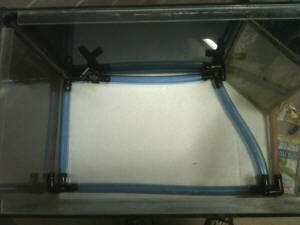
3. I've attached a photo of the return system from the sump
http://img.whirltools.com/i/76018022453724210559.jpg
The top left (black pipe) is where the water from the sump will
come back in and then the multiple two headed outlets hopefully
will create a bit of a stir before the water goes back through
the overflow weir (top right)... Is this a good idea?
<Nope. When the power goes out you will have to rely on siphon
breaks and/or check valves to keep from draining the tank. It is
far more safe to run such a return off a closed loop.>
What sized pump should I be using in the sump to power this?
I'm looking at an AquaBee Up 3000lph, would it do the trick
(and is it an OK brand/model)?
<Great pumps, good size for this system depending on your
overflow drain diameters. See:
http://wetwebmedia.com/BulkheadFloRateArt.htm>
From memory, the diameter of each of those outlets is 15mm... Any
pumps you recommend?
<AquaBee, Eheim and Oceanrunner are all fine choices that you
should be able to get your hands on down under.>
I've got good lighting (110w CF, tank depth 15 inches) and
know I have to buy lots of live rock. I'm going to hang a
stocking on the end of the weir->sump tubing and change it
regularly. I can't wait to get the whole thing fired up
again. I plan on just running it with plain water and no sand to
ensure there's no new leaks from multiple transits and
hopefully to get rid of some of the salt creep, then I'll get
things going.
First I need to get the right hardware though! Look forward to
hearing your thoughts and my apologies for the LONG winded
questions.
<No problem, not too long! Look into a product called LocLine.
It will allow you to keep your return outlets near the top to
minimize siphoning and yet still allow you to precisely direct
the flow to the tank. And do check your overflow capacity against
the link above!>
I first started reading WWM 7 years ago!!! LOVE IT!
<That is about when I started reading WWM too! I have always
dearly loved the site and now it is an honor to participate along
with the crew. Thank you, it is always good to hear others are
gaining from it too!>
I'm definitely excited about the relaunch.
<Congratulations on jumping back in!>
Cheers
Ben
<Scott V.>
|
 |
Upgraded tank and filter question, Marine
3/12/10
Good evening.
<Good morning.>
I recently upgraded my 20 gallon reef into a 30 long. I have for
circulation 2 400 gph Koralia 1 power-heads and a 260 Koralia Nano. I
am also running an AquaC Remora skimmer. In my 20 I was using an
Aquaclear 70 (300gph) with Chemipure and 2 smallish (70-155 gph)
power-heads but no skimmer. I was originally planning on using this
filter on my new tank as well but the tank lip is deeper and instead of
the water flowing across the top of the water it waterfalls down
disrupting the flow and basically giving too much flow to the low flow
coral/softies areas and making dead spots even with the flow turned
down to low (which is basically I think 100 gph) . I do own another
brand power-filter that is a much better fit and gently cascades the
water across the surface but is only 150 gph full open.
I primarily want to have a HOB for occasional carbon and poly pad of
some sort. My question is if I am not using a power filters numbers to
add into the calculated turnover or surface agitation will this filter
be ok for my application or am I basically running electricity for not
too much function?
<Should work ok, less water will pass the carbon/Polyfilters so it
will be less efficient, but ultimately it will still work.>
Any help would be greatly appreciated.
Keith
<Chris>
Re: upgraded tank and filter question,
small Marine 3/12/10
Thanks for the reply.
<Welcome>
I have only been reefing for about 2 years now and most of my knowledge
comes from years and years of keeping
freshwater tanks where getting the most ginormous filters with largest
media, flow and surface areas are the primary building block of a
healthy tank.
<Similar in reefs, but nitrates are a bigger issue so water changes
are important and live rock substitutes for the filter media.>
I just wasn't sure if a certain turnover rate was important for a
filter in a reef even with good circulation, a skimmer and live rock
for bio....so cool.
Thanks again.
Keith
<Welcome>
<Chris>
Eclipse 3 and Protein skimmers --
3/3/10
Hello WWM,
<Hi there>
About 3 months ago I purchased the Marineland Instant Ocean 29 Gallon
setup that comes with an Eclipse 3 hood, as well as filtration. The
tank cycled fine after adding live rock and sand. I have two
questions:
1) Because of my limiting hood, and very low filtration would an
in-tank skimmer be suffice?
<Better than zip>
Would something like the Red Sea Berlin Airlift Internal Protein
Skimmer fit ?
<Can be made to. May have to cut the top summat... Likely with a
Dremel tool or such>
2) And the Bio-Wheel that comes with the hood, should I remove it?
<I wouldn't. Likely of more positive use than
detrimental>
I have heard it eventually becomes a main source for nitrates. If I
take it out should I keep the standard carbon filter pad it comes
with?
<I'd leave both in>
As of now I have:
Eclipse 3 hood on a 29 Gallon aquarium
802 POWERHEAD (that's all it says on it, got it from a friend)
Marineland submersible heater
30 lbs of LR
15 lbs of so called "live sand"
1 Ocellaris Clown
1 Green Chromis
<A social species, but there's no room for a group here>
1 Sixline Wrasse
1 Orange Spotted Diamond Goby
As you can tell my main concerns are with the filtration of the system,
as of now water parameters are good
any help would be much appreciated :)
-Jacob
<Keep reading re small systems
(http://wetwebmedia.com/marine/setup/marsetupindex1.htm) enjoying the
process and your system! Bob Fenner>
Re: Eclipse 3 and Protein skimmers
3/3/10
Would you personally recommend any skimmers that are good for a smaller
system?
<Mmm, yes... am partial to the AquaC Nano... But please do read
here:
http://wetwebmedia.com/skimrs4smsysfaqs.htm
and as w/ all "equipment" recommendations, query the various
bb's re. There are a few "Small Marine System" groups.
BobF>
Improving Nano tank sump/DSB
2/26/10
Hello Crew,
<Hi Stan>
I have a question about "fixing" the shallow sand bed in my
sump, but first a brief system description...
<Ok>
I have a 29g display with around 40lbs of live rock and base rock, with
an overflow into a 20g (long) sump. The sump has an Aqua Remora skimmer
in the first chamber, then a refugium area that is about 18 inches
long, with a 5-6 inch layer of (very) live rock rubble suspended on an
egg crate rack over a shallow (1-2 inches) bed of live sand. Water
flows over this area, and the live rock rubble is covered with
tunicates <Nice!> and small feather duster-like worms. This
spills over into a pump chamber housing a Marineland 3000 pump, which
goes to a SCWD that I have estimated to be flowing around 450gph.
Display is lit by a set of 65w PC bulbs for 11 hours a day. The sump is
not lit.
<Really? Your system might benefit from this.. have you read WWM
re?>
Primary inhabitants are a single purple Condy (which is large and
beautiful), a few Mushrooms, one Gorgonian, a single Rock Anemone, a
Green Brittle Starfish, a few Hermits and Snails, and a huge bristle
worm. <No fish? Unusual>. I will not add any more livestock other
than either some Peppermint Shrimp or a pair of Coral Banded
Shrimp.
My question is what is the best course to take regarding the sand in
the sump? I don't want to compromise the fauna on the rock there,
or risk an event with the sand that's already there. I feel like
the shallow depth is a time bomb of sorts, and I am leaning toward
adding sand (1mm or smaller) an inch at a time, covering 50% of the bed
at a time, until I get it to an acceptable depth (is 3" enough, or
should I go deeper?).
<I would either remove an inch, or, better, add several inches, one
inch at a time, a month at a time. To a total of not less than 4
inches, preferably 5-8>
If removing the sand altogether from the sump is best, I will go that
route.
<I would not. This is a habitat for a multitude of animals>
My display is 1" or less.
<Fine>
Thanks for all your efforts at putting together and maintaining such a
super website!
<No problem, although most of the work has been compiled by
'older' crewmembers than me!>
On a personal note, you were very helpful a while back in setting up
what has been my favourite tank in my past 20 years of aquarium
keeping, and it is looking very much like the Caribbean biotope I was
going for.
<That's marvelous news!>
I did cave when I saw the Anemone, but have been resolute in not adding
a fish to the aquarium as I feel it would be irresponsible.
<Could indeed be. I am not an expert here, but I don't think
this Anemone is easily paired with Clowns, and is definitely a danger
to other fishes>
I committed myself to waiting for the tank to mature, and this has made
all the difference!
<Patience pays!>
The fun my family and I have watching all the tiny creatures in and
around the rock has more than compensated for the lack of fish and
heavy coral stocking I see in similar tanks.
<Outstanding Stan! There certainly are several different ways to
'skin a cat'>
Stan
<Simon>
Small FOWLR
filtration 1/18/10
Hi! <Hello Emmaline>
I have a question (actually quite a few questions) about filtration in
a smaller FOWLR system <okey dokey>. If these questions were
asked elsewhere, I didn't see them anywhere (and I spent a lot of
time reading/researching here). I would like to set up a 10 or 16
gallon tank and want good filtration considering this will be such a
small system. My first question regards skimmer sizes.
I want either an AquaC Nano Remora or Remora. If I put a Remora, which
is rated for 20-75, in a 10 or 16 gallon system will my tank be
"over-skimmed"? <not in my opinion>
Is there such a thing as overskimming? <depends on the type of
system you have and the 'methodology' you want to employ, but
in your case, and probably 99% of all other cases, no>. The reason I
ask is I'm anticipating my wanting to upgrade to bigger tank and
would like to use the same skimmer <a sensible approach>.
Besides a skimmer I will install a hang-on-tank power filter <would
convert this to a refuge if it were me:
http://www.wetwebmedia.com/hagenrefugart.htm, or leave out
altogether> a powerhead <do consider one of the excellent Hydor
Koralia range for your system>
for added water circulation, and live rock (16 pounds for the 16 gallon
aquarium). Does this sound like adequate filtration if I stock it with
3-4 fish that stay small, a couple feather dusters, a few shrimp, and
some snails? <I can't think of 3-4 small fish that would fit
into a 10 gallon. I would review this number down to maybe one small
fish, but these systems really are better suited for invertebrates. See
here:
http://www.wetwebmedia.com/nanoreefsysart.htm. I would definitely go
for the larger of the two systems, and even larger if you can>. I
understand that the power filter does not have the same role as it does
in a freshwater setup <you are correct>. Should I pick one that
is rated for my tank and simply use a sponge pad (leaving out the
carbon) as mechanical filtration <no, I would not purchase one at
all, unless you want to use it as a refugium> and added circulation?
<A Hydor Koralia in-tank should do you fine for circulation>.
One last question about quarantine tanks. What sort of filtration
should I use for a 10 gallon QT? Will a power filter and small
powerhead combined
with frequent, small water changes be enough without a skimmer or live
rock?<Yes, usually. See here:
http://reefkeeping.com/issues/2004-10/sp/feature/index.php>
Sorry for such long-winded questions <I've seen longer!>.
Thanks for all the help! <No problem, Simon>
Re: Small FOWLR filtration 17.01.09,
reading 1/23/10
Hi WetWeb Crew!
<Emm>
Ok, I've finished digesting your response to me and (of course!) I
have more questions. I more specific questions about livestock now, but
first I'll recap my set up so far. I have a 16 gallon tank which
I'll be filtering with an AquaC Remora skimmer and twenty pounds of
Fiji live rock. A powerhead will be used to increase water circulation.
I am keeping my eyes open for an AquaClear filter to turn into a
hang-on refugium. I've cut back my planned fish to two small fish:
a Yellow Clown Goby
<Gobiodons really need live Acropora to be happy, do well>
and another small compatible
fish. This is going to be a small aquarium and I'd like to avoid
any potential problems between my future fishes. Is there a blenny or
goby species that will be compatible with my selected clown goby?
<Keep reading>
My last set of questions is about the saltwater itself. I have kept
freshwater fish for many years and have always had a problem with the
well water that we use at home. High nitrates, high phosphates, and
water parameters that changed with the seasons... so I plan on using RO
water available from my local Wal-Mart.
<I'd be rigging up something at home for your potable (drinking,
cooking) as well as pet-fish needs>
Is there something I will need to add to this water?
<Depends... what do you measure that is missing?>
It will be aged, of course. I was planning on keeping a 5-10 gallon
bucket of mixed saltwater constantly heated and aerated (via a small
powerhead rigged up to a timer) to use for water changes. Should I just
test the RO water for alkalinity and calcium then custom adjust to the
ideal ranges (which I have found on this great site already).
<Is one approach... and should work if you're eschewing stocking
more sensitive ("coral") life here>
Considering this water will be used for evaporation top-offs what
ranges should I aim? The same as for the saltwater (just with no
salt)?
<... Depends once again on what your system water tests... you may
want to bolster the Alkalinity and Biomineral content of the make-up
water or just use aerated R.O.. Again, this is gone over on WWM. Are
you familiar with the search tool, indices? Please read here:
http://wetwebmedia.com/WWMAdminSubWebIndex/question_page.htm
Bob Fenner>
Sorry if these are obvious questions, just want to make sure I'm
getting it
right.
Thanks so much.
Nano Lighting And Filtration (or lack
of..)/Reef Lighting 10/23/09
Hi,
<Hello Shawn>
I'm starting to get back into the marine hobby again, I learned a
lot of lessons from my first reef tank and this one I want to start off
the right way.
<Great.>
I've done a lot of research but maybe you can help me here. My fist
concern is with filtration, It's a 15 gal. tank and I'm going
to use 16-20 lbs. of live rock and about 1 inch of live sand, say
around 15 lbs. and weekly water changes of 2-3 gal. around 20%. That
should cover biological and chemical but I am having trouble finding
any sort of mechanical filter that will work within my constraints,
being that I have very little room outside of the tank area to put
anything such as a canister filter etc. My original idea was to use a
single large power sweep pushing 270 gph and its sponge pre-filter.
However its quite an ugly thing in such a small tank. My other idea is
to get rid of mechanical filtration entirely and use 2 small Penguin
power heads in each of the back corners, or use sponge pre filters at
most. How necessary is mechanical filtration, would only live rock,
sand, water changes, and vigorous circulation be enough?
<Yes, you can get by with this method along with vacuuming of the
sand bed during the water changes and employing a small clean-up
crew.>
I would like to stay away from protein skimmers as well mainly because
of the noise as this tank is in my bedroom. Another concern is with my
lighting rig. I plan to use T-5 fluorescent and I have a choice of a 4
bulb lamp or a 6 bulb. I'm leaning toward the 6 bulb lamp, 3 10K
daylights and 3 actinic, 144 watts total. I plan to keep easy to keep
corals like polyps and mushrooms with some other various softies.
That should be plenty of light but not too much correct?
<Correct.>
The big concern is that with the rooms slanted ceiling, I can only
raise the light about 2 inches above the tank and would preferably like
to just set it on top of the tank. Is there any danger, besides heat,
of having the corals so close to the light?
<No, you should be fine here. Most hoods have built-in
cooling/exhaust fans. If you are just going to keep softies and no LPS
or SPS corals, the four light fixture with 3 10K, and one actinic
should provide plenty of
light for their needs.>
Roughly 4 or 5 inches from the bulb? the bulbs can be turned on and off
independently so I can adjust the lighting if necessary. Any ideas
would be great, nothing is set in stone yet, doing research before I
commit.
<You may want to check out some of the smaller HOB filters from
Hagen and Tetra.
You may also want to read here and linked FAQ's and articles in the
header body.
http://www.wetwebmedia.com/nanoreefsysart.htm>
Thanks,
<You're welcome. James (Salty Dog)>
Shawn
Sm. SW filtr. re-do
7/21/2009
Howdy Crew,
I have a question as to what you would recommend I do so far as a
filtration mod or addition. I have a BioCube 29 that has been setup for
about 2 1/2 years now. I have totally redone the filtration from the
beginning going through different designs and well its time for another
improvement. I currently have a diy skimmer in my 1st chamber that is
running on an airstone so not too effective but better than nothing. I
also place my heater in there during the winter (its not needed during
the summer in san Antonio.)
<They're thermostatic... I'd leave in, set at whatever
temp.>
I have kept the original spillover and it flows down evenly over the
foam block used for an Aquaclear 110 (which fits perfectly) then
through polyfiber and then carbon and Phosguard. Then through the pump
prefilter before going out the return pump. I have the pump on a pvc
stand of sorts to increase the volume of the tank however minimally as
well as to decrease the head and increase flow. The out put goes
through the Hydor flo, which is a new addition 15 bucks seemed fair. In
the tank I have a Hydor Koralia 1 on the center of the left wall angled
across to the center/right of the front wall and opposing that a
Koralia nano going across the rockwork and corals intersecting the flow
in the middle.
<Better to set up on the upper opposite corners near the surface and
have pushing water to the distal walls... to set up a gyre>
I recently have bought into the idea that water flow is extremely
important for coral growth.
<It is indeed>
I have about a 1 inch sand bed with about 26 lbs of live rock.
Livestock is as follows: mated tomato clowns, clown goby, cleaner
shrimp, 5 turbo snails, 10 red leg hermits, bubble tip anemone (I know
too small of a tank for this specimen, I will either move to my
girlfriends 75 or my managers 90 gallon), colt coral, yellow Fiji
leather, dragon eye polyps, pulsing xenia, multicolor Ricordea, and 2
small misc leathers. When I'm home from college I do 3-5 gal
partials every 2 weeks and when I'm at school I do 5 or so gallons
a month. My ammonia, nitrite and nitrate stay at a constant 0 ppm on
every testing interval, ph is 8.2 and when I test calc it is usually
420-440, phosphates and silicates 0 ppm. However I am still getting
algae growth and I know this to be because nitrates are still being
produced at the end of the nitrogen cycle and thus the algae eats it up
as soon as its produced so its not going to show up in tests. I have
had green hair algae in the past which the snails and crabs have tamed,
but now I am getting Cyanobacteria in the front left side of my tank. I
would have thought I have adequate flow to get oxygen in high enough
percentages in all areas in my tank as to prevent Cyanobacteria as it
tends to be an anaerobic bacteria.
<Yes... but there are other factors, types...>
So the question is this: should I flip my current filtration setup in
the second chamber on its side and force the water down and through by
first going over a cut down section of the overflow strainer and down
by a Plexiglas wall using weather-stripping (I used this stuff in a
sump redo at my work and was surprised as to how easy and effective it
was to do.) Then force the water flow up through a DSB, possibly with
crushed coral on bottom to use as a calcium buffer, and then live rock
rubble with Chaetomorpha on top. Then another barrier on top with
eggcrate to use as a strainer before it goes through the prefilter and
return pump?
<A good plan>
And if I go with this course of action do u think the thinner pieces of
Plexi would be sufficient to use instead of the full 1/4 inch Plexiglas
since it is only 3 or 4 inches wide and wont have as much pressure
exerted on it so it cant bow as much and slip out of place?
<Yes>
I plan on also upgrading my current skimmer by removing the false
bottom in the first chamber and making the skimmer taller to increase
dwell time and hopefully efficiency. Or should I forgo all of that and
get an AquaC skimmer and Dremel out a section for it and have the
intake come from the first chamber as its the only constant water level
chamber?
<Could>
Which do you think would be more effective in a tank that wont get as
much tender loving care during the school year when I am gone and will
keep it looking pristine longer as well as the healthiest environment
for the inhabitants.
<The former plan>
I realize your take is first biological filtration is a must and then a
good skimmer so I personally am leaning towards the remodeling, plus
with any luck I will have enough money left over to buy an auto top
off.
Thank you in advance for your response and if u have any questions as
to more information or anything just ask, or if you have any other
recommendations as to what I should do those are always welcome, as I
take large stock in what your view is (if you cant tell I have read
just a few of your articles *wink wink*)
-Steven
PS I am attaching a PowerPoint of a kind of sketch as to what my
existing filter is like and what the proposed filter is to look
like.
<Either proposed improvement will be a step forward; again, I would
go with the first design, incorporating the DSB. Bob
Fenner>
Best Filtration (HPO4, NO3) and Lighting --
06/12/09
Hi Eric,
<<Hello again Oowais>>
Thanks for your quick reply.
<Quite welcome>>
I have a question about a 20gallon reef tank and I
would like to have your opinion to what is best to have a coil
denitrator or an algae scrubber for removal of nitrate and
phosphate?
<<For simplicity/less fiddling/complication I would go with the
scrubber'¦but for a small system as this I myself would simply
opt for frequent water changes and possibly a small canister filter
loaded with Poly-Filter media>>
Is 150w MH with 2 blue tubes ok for coralline algae propagation and how
many hours should the lights be on?
<<Will be fine'¦ I prefer a 12-14 hour photo-period for
the Metal Halides'¦with about an hour longer, before and
after, for the Actinics>>
Regards Oowais.
<<Cheers, EricR>>
20gal Nano Reef/DSB 3/23/09
Good day WWM Crew,
<Hello Adriel.>
I have a question regarding DSB's. The only livestock I have now is
a brittle star and a yellow tail damsel. Nitrates are at 10ppm. My
20gal "wannabe" reef has 1 inch think aragonite fine sand for
a substrate with some growth of worms etc. Would like to try a DSB, and
as per my reading, would require it to be 3" or greater?
<Yes, 3" minimum, four is even better for NNR in my
opinion.>
My question is could I just remove the LR and the star and then
literally pour the sand over the existing bed over the course of a day,
given that I don't have too much livestock (would also keep the
protein skimmer on at this time)? I'd hate to disrupt the existing
bed and lose any existing critters.
<Well you certainly could just pour all the new sand in, but if you
have a well established sand bed you may be better served to just add
say a 1/4" to 1/2" at a time, over a period of several days
to a week.>
Any help would be really appreciated, keep up the good work!
Thanks,
Adriel Rebello
<Thank you and you're welcome, Scott V.>
Re: 20gal Nano Reef/DSB
3/24/09
Hello WWM Crew/ Scott V,
<Hello Adriel.>
Sorry to bother you guys again, just having panic attacks right
now!
<OK, stay calm.>
Was wondering, how does a DSB turn bad? Is it due to a lack of sand
sifters?
<Not really, generally a DSB is stirred up on a small level, not the
large sandsifter types most tend to add. A Nassarius snail or two would
be fine.>
Too much depth?
<Nope, not having quite enough can make a DSB fail though.>
Can it become "too efficient", consuming all nitrates and
then resulting in an excessive production of anaerobic bacteria?
<Nope.>
I do plan on stirring the top level of the sand a bit, and adding more
after a year as recommended. Would a max of a 5" inch thick live
sand bed in a nano-reef be overkill?
<Not really.>
In the event that the DSB goes bad, is it possible to salvage the sand
and use it in a FO setup? (By salvaging, I mean by curing and adding it
in small amounts to the FO tank).
<Oh yes, the sand can always be rinsed and reused.>
I'm sorry for asking so many questions, but the sand is quite
expensive and I'd hate to waste anything.
<Well do see http://www.wetwebmedia.com/dsbdangers.htm for the
dangers and causes...there is not much to worry about though.>
Thanks a lot!!!
Adriel Rebello
<Welcome, Scott V.>
Nano reef issue, maint. and Hang-on 'fuge
f' 02/09/09 Dear Crew! I have a question regarding
my 10G nano reef ecosystem. I hope you'll be able to answer ASAP
because I am a bit afraid. Thank you in advance. I have a 3.5G HOB
Aquafuge with 3" DSB and Caulerpa + Chaeto macros. About 2 weeks
ago I noticed that my HOB refugium skimmer/CPR Aquafuge wasn't
making any skimmate. At first I did not pay serious attention. After a
few weeks I got suspicious. I did some troubleshooting and finally
found when I took off the powerhead that runs the fuge (MaxiJet 1200)
that there were 4-5 small scavenger snails at the intake. I cleaned the
powerhead and reinstalled it, and the skimmer started to work again
immediately. Previous to this my nitrate test reading was 0ppm. After
fixing the powerhead issue the reading has been 15-20 ppm. I did a 20%
water change this morning but it didn't lower the nitrate levels
too much. I think nutrients have been pushed back from the fuge to the
tank. <Hmm... it doesn't really work that way. But in any case,
your 3.5G "refugium" with what you're calling a
"DSB" is not functioning as either. I understand why these
tiny HOT "refugiums" are tempting. I had one myself back
before I knew any better. But basically, all you really have is a
puddle of water with sand in it. The only good use for these things
(imo) is macro algae growth (and maybe some gas exchange). But if you
put sand in them, you're just asking for trouble. If I were you,
I'd remove the sand, thoroughly clean the thing, and use it only
for macro-algae cultivation.> I've never had nitrate problems
with this tank before. What do you think? Will the DSB and the
macroalgaes break down the nutrients again, or should I clean the fuge
and introduce a "new" macroalgae colony? Should I wait a day
or 2 and re-check? I'm very afraid because it is a fully grown 2
year old set up and I have put lots of work into it. <Again, if it
were me (and it was me once upon a time), I'd remove the sand and
just use macroalgae. If the macroalgae you have looks weak or dying (or
is covered in debris)... maybe rinse it well, or get new macroalgae.
That's your call.> Please advise! Thank you, Sonny <Good
luck, Sara M.>
20g nano system refugium equipment
2/3/09 To whom it may concern: After reading your website
fantastic article about system requirements on a nano system, I
recently started one of my own. It has been running for 6 month now and
everything seem to be working fine. I have a Remora skimmer, 20 pounds
of live rock, a air pump, a compact florescence light with 6000k and
10000k tubes and a power head for water flow. I have a small crown
fish, a quadcolor anemone, a green spotted puffer, a small snowflake
eel <Needs more room than this... and may well have trouble/contact
with the Bubble Tip Anemone here> and a turbo snail. I know the tank
is way too small for the eel and the puffer once they got bigger, I
will get a bigger system or surrender them to a fish store if
necessary. I do a biweekly 20% water change, but I still have a problem
with high nutrient because of all the microalgae and glass anemone on
the live rock and on the glass. <Ah yes...> I want to start
running a 10g refugium. <An excellent addition!> I am ready to
purchase all the necessary equipment, but I can't figure out all
the equipments that I need. How can I make sure I don't get too
much water from the tank to the refugium before it overflow? <A
matter of calculating where the overflow will drain water down to (and
adjustment)... the pump capacity (and possibly adjustment with a valve
on the discharge end)... and measure to not overfill the transit sump
(the refugium) when all is up and running (with the power turned
on/off)... Do you understand this?> How can I make sure the water
pump is pumping out the same rate of water as the tank is flowing in to
it? <Again... the factors above.> Can you make a list of all the
things I need to buy? <By careful reading... Either the first
chapters of Anthony Calfo and I's Reef Invertebrate book... or on
the Net... These areas: http://wetwebmedia.com/marsetupindex2.htm the
second tray down... and/or good help pages on the Web: Melev's
Reef, OzReef.org...> I have read your web page about refugium and
all the benefit from it. I can't wait to start mine. Thanks a
million in advance for your help. I am sure my fishs will appreciate it
as well. <I agree... do read, take good notes... and write back with
specific questions you have. Bob Fenner>
New nano setup w/refugium 9/10/08 Hello,
<Hello Jim.> Kudos for your site and all the knowledge, time and
effort you've put forth to help!! I've read just about every
entry! <Wow! Thank you.> My wife purchased a CAD 39g nano for my
birthday and it should arrive soon. My question has to do with the
built in refugium. I'm not sure if you're familiar with the CAD
39g, so here are the spec's before I ask about the refugium. Tank:
39 gallon: (L)24" x (W)20" x(H)20" 150w 14k HQI w/2 24w
Actinics Direct overflow Refugium: (L) 23" x (w) 5" x (H)
19.5 " with PC light strip w/flow control Pin-wheel skimmer
w/silencer and ozone 6w Drop-in UV 70g cooling unit 500GPH pump
Automatic top off unit I've left out the details of the tank
construction and the overflow filtration since I only plan to use the
filtration area for poly, Chemipure and Phosban. Since I haven't
received the tank yet, I'm still in the planning stage of what I
want for live stock but will most likely keep a small reef w/1-3 fish
(read very small fish). I'll be using live rock (35-40lbs) and
maybe 1/2 inch of live sand for the "break-in" period, which
I plan to extend well past the initial stabilization period. <All
sounds good.> My real question is the refugium. Any suggestions
would be greatly appreciated, when would be the best time to add the
refugium substrate and what if any suggestions would you have for the
type of substrate I should use? Or any other suggestions for that
matter! <I would add the refugium as soon as you can, let it mature
with the tank. As for substrate, I like a fine aragonite, deep sand bed
in the refugium. The more DSB the better, whys not have one here?>
I've kept fresh and saltwater (but no reefs) for many years and
currently have a 55g FOWLR that's been up and running for about a
year. (got to love that AquaC skimmer) <Yes, nice skimmers.>
Thanks in advance! Jim Ferguson Canyon Lake, Texas <Welcome to
reefing, you will undoubtedly enjoy it! Scott V., somewhere in the
Sierra Nevada range tonight.>
Aquarium Setup and Pump/Overflow Questions 6/25/08
Hi there, <Hello.> I am in the planning of 40 gallon breeder with
external coast to coast ( I like the setup and that there's no
space taken inside my tank) that goes to a 25 gallon sump. My plan is
to keep softies and SPS corals with little LPS (if I cannot avoid the
temptation @ all). Anyways, I am planning to follow same system as
http://www.reefcentral.com/forums/showthread.php?s=25431f8f03640480f5d7cce63c204925&threadid=1310585&perpage=25&pagenumber=1
with 1 inch drain pipes. To give you the brief summary, there're
two 1 inch pipe draining water but most of the work is being done by 1
pipe (3rd pipe is for fail safe). I had some questions over here: 1. I
am planning to bring water back from sump to display via Eheim 1262.
It's a simple return from bottom that will split into 2 pipes (I
need the size recommendation from you) and will be connected to
¾ or ½ inch LocLine (as you recommend) over the
top. The pipes will move water upwards about 5 ft. Do you think this
will work? <Well, yes and no. As far as the overflow, this employs
one drain as a full time siphon, with the second gravity fed taking a
bit of flow. The third is a gravity fed backup. The problem is that a
gravity fed 1' drain can handle just a bit more than 300 GPH. The
siphon 1' drain can flow 900 GPH or so. What happens when (not IF
in my experience) the siphon to fails? The other two drains (one of
which already had part of it's flow used before #1 failed) cannot
handle the flow. There are many of these 'overclocking
overflow' designs, all end up relying on a gravity fed drain for a
backup. The reason is that the gravity fed drain is far and away the
most reliable. If you have enough gravity fed backup capacity to
accommodate the flow of the siphon fed drain if it fails, why have the
siphon drain to begin with? It is an overflow design that does work
most of the time, I am just not a fan of it after many (hundreds) of
hours building and actually flow testing/trouble shooting overflows. In
regard to the return, the issue with bringing it through the bottom of
the tank is the potential for sump flooding. In the event of a power
outage the water will siphon or simply drain down to the level of the
sump output. Even if the return comes through the bottom and you bring
it up, you risk the possibility of a leak in the line somewhere
(LocLine is NOT watertight) leading to the same problem. All of this
seems paranoid, but this stuff does happen, if you plan on having the
tank for any length of time you will likely end up experiencing these
events first hand.> What size returns should I use? <A few
½' or a single ¾'.> Can Eheim handle
such load and is it fine for this kind of setup for optimal working of
sump (which may contain refugium to it too)? <Yes, this is my
personal favorite return pump.> 2. I am planning to add 2 Maxijets
1200 (modded) and two Koralia (need size recommendation) to move water
inside the aquarium too. Do you think it's sufficient for SPS?
<Yes, definitely. You will not need so much flow, either the MJ
mod.s (another personal favorite) or the Koralias (fours would be my
choice) will be more than enough for a SPS tank this size. > Do you
think water will get too hot? <It may, especially with the MH, time
actually set up will tell.> I live in Seattle so it really is not
that hot over here except for occasional heat wave. <The occasional
heat wave is what can get you.> 3. I am planning to add 1 250 WH
Metal Halide with 2 VHO on the aquarium as light? Is the light
sufficient? <Oh yes, quite.> Other questions may come up but I
need your recommendation on #1 and #2 so that I can start ordering
plumbing stuffJ <OK> Thanks Ghazni <Welcome, have fun setting
up, Scott V.>
HOB refugium on a 10G nano 05/31/2008 Hello
lifesavers! <<Hello Sonny, Andrew this evening>> Right
now I have a 10G nano tank with 20 lbs of live sand, and approx 15
lbs of live rocks. For filtration I run a Marineland C-160 canister
and a AquaC remora nano skimmer+ Hydor Koralia powerhead. The tank
has been set up about 7 month ago. I have a six line wrasse, a
cleaner shrimp, some Nassarius(or something like that:-) sand
snails, few crabs. I have a trumpet and colt coral, a chili cactus,
red and blue mushroom colonies, a GSP, some zoos and a clam.
<<A very busy 10g nano there>> I am seriously thinking
about set up a HOB refugium. What do you think about the Ecosystem
40? Sounds like a great, beneficial refugium. I've never had
one before. Would that be enough for filtration? <<Yes, I
think it would be very good for your system. A nice piece of
equipment indeed>> In case I'll set up one, can I get rid
of the canister filter? <<You have adequate amounts of live
rock to provide the filtration, so, yes, you can remove the
canisters>> The one I keep my eyes on has a built in modified
Prizm skimmer. What about the chemical filtration? Can I place
Chemi-pure or carbon anywhere inside the refugium? <<No, I
would not. all you want in a refugium is sand, rock rubble and
macro algae. You could remove the media from the filter, and run
chemical filtration in that>> O.k., let's skip the crap..
The main question is : A HOB refugium with all the good microalgaes
and sand inside + a skimmer would be enough filtration for my tank?
<<Yes>> I appreciate your time, Sonny <<Thanks
for the questions, hope this helps. A Nixon>>
Re: HOB
refugium on a 10G nano 06/02/2008 Thank you very much Andrew!
<<No problem, glad to help>> Just one more thing I
forgot to ask. Would that be ok to switch the canister to the
refugium right away? Wouldn't it be breaking the biological
cycle in my 10G tank? 3.5 G of new saltwater and the live sand
added to the refugium might break the nitrogen cycle.. <<No,
it wont, will be fine as the live rock can cater for dealing with
bacteria levels on its own after this amount of time being in the
tank>> Don't you think? Is there any beneficial
difference between miracle mud and aragonite? (I know it's two
questions, but hey, I love you guys:-) <<Personal preference.
I am a sand lover, where as others i know are mud lovers.>> I
really appreciate all the effort you folks put into this website!
The Harvard library can do you a favor... Thanks again,
<<Thanks for the follow-up Sonny. Good luck. A
Nixon>> |
Hello, I have a 16 gallon bioglobe aquarium with a
hairy frogfish. Sys. 4/9/08 <Needs more room...> The
tank has a uplift tube and an under-gravel filter. My question is,
would it be more beneficial to use an air pump or an powerhead on the
uplift tube. The air pump allows the surface of the water to break
better, while the powerhead allows more circulation in the tank but
minimum water turbulence at the surface. What is more important in
properly oxygenating the tank? <Good question... and the
"real" response is that none of the above will work in time
to provide adequate aeration, circulation or filtration for this
Antennariid in this setting... So, rather than lead you on re your
chances of success here, I advise your reading on WWM re the care of
the family and general marine set up:
http://wetwebmedia.com/anglersysfaqs.htm and here:
http://wetwebmedia.com/marine/index.htm The indices on Set Up. Bob
Fenner>
|
Starting an AquaPod reef... 3/14/08
Hey Crew! Quick question...I've got a 12 gallon nano reef, up
and running for 2 months now with one small clown, blood shrimp
and 4 blue legged hermit crabs occupying this tank. Prior to
putting the shrimp and clown in the tank I did my water tests and
everything was perfect. Since putting in the shrimp and the clown
and eventually the 4 crabs (who were supposed to be a clean up
crew but as far as I'm concerned they make more mess than
they clean - I'll be getting rid of them tomorrow and
replacing them with smaller blue or red hermit crabs) my ammonia
has shot through the roof to 2.0. <How much did you suddenly
start feeding the tank when you added the livestock? The
combination of the added livestock and food might have been too
much too soon.> I know the obvious way to bring the ammonia
down is to do more aggressive water changes or perhaps more
frequently, but as I experienced last week; when pouring in the
salt due to it's small nature of the nano the corals get
burned from the contact with the salt (mental
note....pre-mix)...can you recommend any piece of equipment that
can help me with keeping the ammonia down? If it was a normal
setup I would immediately purchase a protein skimmer but as I am
now realizing, these nano tanks aren't all they're
cracked up to be <Bingo. They're often without adequate
filtration.> as there is NO space for a skimmer or at least
not one that I can find. Any of the nano skimmers I have found
involve me altering the hood which I am not confident in doing.
Is there a nano skimmer out there that will help me, perhaps if I
threw in a mangrove plant? <A mangrove won't help. It
wouldn't do well in such a tank anyway. Honestly, there's
not a whole lot you could do that wouldn't involve altering
the hood to add filtration or drilling the tank to add a sump.
This is the trouble with nano tanks systems. If you don't
want to alter the tank, you'll have to find a way to do the
heavy, frequent water changes (i.e. pre-mix your water,
etc.).> HELP ME PLEASE!! Thanks so much! I've been a
reader for over 5 years now and have enjoyed every minute of it!
<De nada and good luck, Sara M.>
Re: Starting an AquaPod reef... 3/14/08 Hi
Crew, <Hi> This is in response to the above heading in
today's questions. The person has a 2 month old 14 gal nano
and has problems with ammonia and one clown in the tank. I
started a 10 gallon over 5 years ago and lost quite a bit of fish
and critters during my first 6 months. Then I found the Crew. I
still have the 10 gallon and 2 of my fish are over 4 years old.
So if you follow the advice of WWM you can be successful with a
nano. And rule number one is patience. You can't load your
system with more than it can handle. <Indeed, this is true of
any tank of any size.> Give your clown a break and ask the
store to hold it for a while. The only reason I am responding is
because the crew has the tendency to shrug off nano problems
because they can be difficult to control. <Hmm, I certainly
didn't mean to "shrug off" the writer's
problem. The person who asked the question said he was reluctant
to alter the tank in any way that would allow him to add
equipment or water volume. He also said he was reluctant to do
more aggressive water changes. Thus, I was at a loss to offer him
any other solutions. Taking the livestock out would only be a
temporary solution.> But if your advice is followed then
people can have a good success rate. You can't cut corners.
The systems are not forgiving. There just is too little water to
dilute problems. <Very true and I thank you for writing in
with your support/advice. In my opinion, the best way to keep a
nano tank is with a large sump hidden underneath. It might be
"cheating," but it works. ;-)> Thanks <Best, Sara
M.>
|
Need help on new tank set up, small SW
03/06/2008 Hi first of all I love your site it has helped me plenty
of times. <<Hello, Andrew here...And thanks for the kind
comments>> I have a 28gal bow front marine aquarium with a 3in
DSB 20 pounds of live rock (not exact amount) one coral life 19in PC
bulb a Aqua Clear 20 pump an external power filter and a Sea Clone 100
protein skimmer. I am very dissatisfied with the quality of foam
produced and want to upgrade. <<SeaClones are not the best of
breed when it comes to skimmers>> I have bean looking around and
cant decide between the Prizm skimmer and the BakPak both would suite
my needs but i don't know witch would be best. <<Prizm
skimmer....hmmm...They make superb door wedges / door stops ;O)
....Seriously, they are not a very good skimmer choice at all, very
hard to get a good skimmate from and so finicky to get setup and keep
running correctly. Out of the two you've suggested, i would choose
the BakPak>> Can you tell me in your opinion what you think would
be best for my set up? Also I want to get an external canister filter
to replace my power filter price is definitely an issue (I would like
to stay around the 100 dollar range) can you tell me what would be best
for my price range? (Keep in mind when my tank is set up I plan to keep
coral and fish) <<My suggestion would be to not spend the money
on the filter, and simply up the amount of live rock in the tank. Up
size it to around 30 - 35lbs and then there will be no need to have a
filter on the tank as the live rock will provide all the filtration you
need, via natural methods. However, if you still require a
recommendation on a filter, i would go with something like a Rena Xp1
or an XP 2 filter.
http://www.marinedepot.com/ps_AquariumPage~PageAlias~filters_rena_filstar_xp_canister.html>>
Thanks! <<Thanks for the questions, hope this helps. A
Nixon>>
Mechanical Filtration 2/20/08
Hello! <John.> OK, yet ANOTHER "active filtration"
question: I just thought of a theory (imperfect as it probably is):
When you think about it, the "problem" with canister filters
being nitrate factories (due to the accumulation of crud inside them)
may not really be A problem. After all, the way I see it, the crud that
used to be in your tank has only moved to a different place - inside
the filter. Either way, it is STILL part of the makeup of your water -
correct? <Yes, the problem with canister filters and other
mechanical filtration media.> Doesn't this mean that moving it
from one place (all over your LR) to another (inside a canister filter)
shouldn't technically do ANYTHING to your nitrates? <Not if you
leave it there. Hopefully the filter will be cleaned often and the
detritus removed.> The reason I ask is because I am DESPERATELY
seeking a way to eliminate all the mulm I see all over my LR between
"turkey bastings". I felt that if I had active filtration
(instead of just the tons of LR I have in the back chamber of my
Aquapod 24) then at least I could export this fluffy grey gunk out of
the tank and periodically clean my filter out. <Exactly what you
need my friend.> With just the LR, all I'm getting is biological
- no mechanical. <Do consider a protein skimmer, it will remove much
of this out of the water column. This is what makes these such a
powerful filtration tool.> Regards, John <Thank you for writing,
Scott V.>
Freshwater to Marine, Overflow and Filtration
2/13/08 Hi, <Zach> I have been reading through the posts and
have tried the search but am still having a hard time. I have a 30
gallon bowfront (undrilled) that I am currently using as a freshwater
aquarium and I would like to convert it to saltwater. I am confused as
to whether or not I should try drilling it myself and just add a sump
(I'm afraid I'll shatter it), do I really have to drill it to
use a sump or can you refer me to a post that would explain how to run
a sump without drilling? <There are many such posts throughout WWM
about using siphon type overflow boxes such as CPR. If you are not
comfortable drilling or cannot find a shop to drill for you, it would
be the way to go. Do consider running two in case one fails.> I was
also wondering whether or not a wet/dry or canister filter is ever
going to be capable of doing as good a job as a sump? <Adequate
filtration can be accomplished; it will just take more maintenance on
your part cleaning the filter frequently to maintain good water
quality. Obviously you will lose the extra water volume and its
benefits going with a canister.> Should I just bite the bullet and
get a H.O.B. "sump"? <I would opt for a true sump or the
canister, perhaps in addition to a hang on the back refugium.>
Thanks a lot for your time and my apologies for probably asking a bunch
of questions you've probably already answered elsewhere. Zach <I
have included some pertinent links for you to read through below. Keep
reading and all will be clear, Scott V.>
http://www.wetwebmedia.com/ovrflosel.htm
http://wetwebmedia.com/refughangonmodelfaqs.htm http://wetwebmedia.com/pbholestools.htm
Conflicting Filtration Advice, New Marine Setup,
12/17/07 Dear Experienced Expert(s) <Hello> My son & I
wish to start a marine tank after much freshwater & brackish
experience. We have spent much time reading (your excellent site),
talking to family & friends who currently keep marine tanks
(successfully and unsuccessfully, recently and long ago), and three
respected LFS. The realities of our home (including wife and other
kids) means starting with a 29 gal (30"x12"x18"H) on a
large built-in bookcase with room for hang-on-backs (HOB). <A little
small, but workable if you are diligent.> The tank is not "reef
ready". We desire to achieve a full reef system (with both hard
and soft corals, a clam/scallop, shrimp/crabs and a few fish &
couple of blennies/gobies/mandarin). <Too ambitious for this sized
tank, looking at a few coral, most likely softies, and 2-3 fish at
most, along with a couple shrimp max.> I have had good experience
with three LFS (for freshwater). These store actually are more targeted
to marine but have diverse recommendations on filtration. <Not
uncommon.> LFS1 recommends: 10-15 lbs of "Premium" Fuji
live rock (7$/lb), 20 lbs of live sand, a HOB filter (Emperor 400) and
says this will be good enough "for now". I asked "What?
- no protein skimmer?" and as evidence the staff indicated that
two of her home tanks ran just fine this way (albeit with lower
loadings then her other marine tanks). This store is a
"large" operation (not a chain) and I did notice plenty of
PSs for sale. Although I didn't ask, the recommendation was
probably a way to get us into the marine hobby with less money outlay
leaving the option to "upgrade" later (more LR, PS...).
<Most stores are unfortunately hesitant to let people know what it
will really cost to set up a proper tank, and instead try to figure out
how much you are willing to spend, get your money and then hope you are
lucky and have a little success and then come back and spend more on
what you should have bought originally.> LFS2 recommends: 40-45 lbs
of Fuji live rock (4.5$/lb), 40 lbs of live sand, a HOB filter (Penguin
350) and a power head. Again, given our research I asked "What? -
no protein skimmer?" and was then shown behind the tanks and
indeed most all of their marine coral tanks were set-up that way
(everything from 20 gal to 120 gal, with numerous corals, many
"clean up crew" and a few small fish per tank)! <For short
term until they are sold, its really tough to compare units designed
for short term holding until sale to what you need to house a creature
long term at home.> One tank had a HOB PS but it wasn't running.
Only one coral tank had a classic sump/PS/refugium set-up. Their
nicest, largest (>400gal and with at least two dozen fish covered
top to bottom with soft corals) heaviest loaded tank had "no"
filtration other than live rock/sand/power heads (albeit the tank was
much more filled with live rock than the smaller tanks - i.e. rocks
covered all of the bottom of the tank and went all the way to top of
the tank with half of the tank width still filled with rocks). <The
massive amount of LR is part of it, but also they can easily switch out
livestock so while it may look successful it may be a maintenance
headache with large amount of livestock turnover.> Whenever I visit,
someone is busy "working" on the large on-the-floor LR cure
tank. They also said that even with the LR/LS I should use BioSpira
(tm) at tank start-up. Most of their tanks had aerators bubbling away.
<BioSpira is helpful but unnecessary, what it provides will occur
naturally with time anyways.> LFS3 recommends: 30 lbs of Fuji live
rock (6$/lb), 40 lbs of live sand, a HOB CPR 19" 3.6 gal
AquaFuge2(tm) PS Small Refugium (includes Protein Skimmer) w/ lighting,
and a power head. All of their coral tanks have the full treatment
(large sumps with much algae/seaweed/mud, PS) and their hard corals are
the best by far. They also indicated that the set-up would not only
provide filtration but also the other benefits of a Refugium. Their own
sumps/refugiums had PS, bits of LR, sand/white-mud/ and both green and
red macro algae - no bio-balls but a bit of submerged sponge material
upon water entry/exit. CPR's own web site makes it sound like you
can either use the AquaFuge2 as a filtration device or for other
refugium benefits but not both and when I shared that upon return LFS3
said yes the LR/LS provide the main "filtration" but if I
wanted I could also add a smaller HOB filter (e.g. Penguin 200) in
addition to the Aquafuge. <Closest to what I use, but I avoid
"multi-functional" units, I find they generally don't do
anything well enough. A good skimmer and if you want a separate HOB
refugium would be the way I would go.> So if I've done my
homework LFS3 is recommending a Berlin system with Refugium while LFS1
and 2 claim PS isn't a requirement (LFS1 "to start with",
LFS2 "ever"). Obviously each approach has a certain appeal.
<I would not run a tank without a skimmer, especially for a new
hobbyist, they offer a nice buffer to potential mistakes.> Similar
to "genes vs. environment" I'm curious if there is an
equivalent aquarium "operator skill"/equipment. I've read
material in conflict with the recommendations, but its difficult to
ignore my own eyes. I'm not adverse to getting a PS with either
LFS1 or 2 system. Is this just a question of how many corals/fish and
which types we can stock before pushing the limits of any one
recommended system? <None of the systems will allow stocking like
you see in FW or brackish, so what it comes down too is what keeps what
livestock you have healthiest and ease of maintenance.> I'm
curious if the Refugium is too much to learn to start with (although I
am a ChemEng). <A refugium is actually quite easy, it is merely a
separate area where algae can be grown without interference from the
livestock to help remove organics and nitrates. A light, some algae and
a pair of scissors to harvest the algae is all that is needed.> If
we start with bigger HOB filters w/ or w/o PS there will be no room to
later add HOB refugium w/o switching to a smaller HOB filter (e.g.
Penguin 200). <Get a big PS and forget the filter, they need lots of
maintenance to reduce nitrate production. A PS removes the same
material from the tank completely while the HOB filter only traps it
until you clean it out.> Does the fact that we have a 29gal tank
direct us in a particular direction? I'm also curious if
"premium" Fugi LR is marketing or what - interesting that the
store with the cheapest LR was the one that depending most upon it.
<Premium is usually for the nicest shaped pieces, and many places
keep all the LR together so it really doesn't matter much. If you
are inclined go half premium half cheap rock, it will all end up pretty
much the same with time.> Another item of difference was that LFS
1&3 said (for creating initial salt water) to use RO water, while
LFS2 said Houston tap water was fine (my home testing indicates 0.0
phosphate & copper). <RO is always nice, try to test for Total
Dissolved Solids (TDS) to get a rough idea how much "stuff"
is in your water.> I haven't even gotten to start-up procedures.
<All I know and much much more can be found here
http://www.wetwebmedia.com/marine/setup/index.htm .> Thanks for your
time & advice, Marine Want-to-bees <Welcome>
<Chris>
|
|
|
|
Small Marine Aquariums
Book 1:
Invertebrates, Algae
New
Print and
eBook on Amazon:
by Robert (Bob) Fenner |
Small Marine Aquariums
Book 2:
Fishes
New
Print and
eBook on Amazon: by Robert (Bob) Fenner |
Small Marine Aquariums
Book 3:
Systems
New
Print and
eBook on Amazon:
by Robert (Bob) Fenner |
|
|


