|
FAQs about
Overflows, Bulkheads/Through-puts,
Stand-Pipes, Holes vs. Boxes... Sizing, Number,
Placement 3
Related Articles: Overflow Box Arrangements,
Plumbing
Marine Systems by Bob Fenner, Myth of the One Inch
Beast (Why Relying on One Inch
Overflows... or Overflow! Is foolhardy) by
Scott Vallembois, The
Flowrates through various Bulkheads (In relation
to overflow drains) by Scott
Vallembois, Plumbing Return
Manifolds, Refugiums,
Related FAQs: Through Puts Placement/Number/Size
1, Through-Puts
2, Through-Put Sizing/Number/Placement
4, Through-Put
Sizing/Number/Placement 5, Through-Put Sizing/Number/Placement
6, & Overflows 1, Overflows 2, Overflows 3, Overflows 4, & FAQs on: Rationale/Use, Through-Hull Fittings, Hang-On Selection, Plumbing, Troubleshooting/Repair...
Marine Plumbing
1, Marine Plumbing 2,
Marine Plumbing 3,
Marine Plumbing 4, Marine Plumbing 5, Marine Plumbing 6, Plumbing 7, Plumbing 8, Plumbing 9, Plumbing 10, Plumbing 11, Plumbing 12, Plumbing 13, Plumbing 14, Plumbing 15, Plumbing 16, Plumbing 17, Plumbing 18, Holes & Drilling, Durso Standpipes,
Make Up Water Systems, Pumps, Plumbing, Circulation, Sumps,
Refugiums, Marine Circulation 2, Gear Selection for
Circulation, Pump
Problems, Fish-Only Marine Set-ups,
Fish-Only Marine
Systems 2, FOWLR/Fish and
Invertebrate Systems, Reef
Systems, Coldwater Systems,
Small Systems, Large Systems, Water Changes, Surge
Devices,
|
Calculator, plumbing,
flow-rate 12/16/07
Bob, This calculator seems like it would
be useful, what do you think? http://www.aquaticeco.com/index.cfm/
fuseaction/popup.calc_pumphead James <Best one I've
ever come across. Will post/share.
BobF>
|
|
Possible Megaflow solution??
Plumbing questions?? 12/22/08 Hey guys, Thanks for
the great site! <Thanks for visiting, hello!>
Here's my current dilemma. I just attempted to install
a "Glass-Holes overflow kit" on my 72 bow. They
offer a 2x1.5" overflow box that runs 1500gph. The
issue here, is that the overflows are predrilled in the
rear of the box at aprox 3" apart. I bet you can guess
the next part.?? <Hmmm, no.> Well, I assumed that
this sounds logical and worked well in the video on their
site. <And for 1000's of installs around the
world.> So I started drilling as per the attached
template and instruction, hole one-ok,...hole two-looked
ok. After I wiped away the milky film, I saw a nice thick
hair line crack between the 2 holes. After discussing this
with a glass company, they said to stay 8" apart min.
on holes. <Based on what? This is quite an arbitrary,
ridiculous number. Many factors are involved: glass
thickness, hole size, height of the tank, and placement
within. The tried and true industry standard is one hole
width apart. Take a look at the Oceanic Tech series, many
holes drilled mere inches apart.> Ahh... Hindsight!!
<Really just the risk one takes anytime drilling glass.
I do own a stake in the Glass-Holes.com company, do contact
us re a refund of your purchase if you wish, we do stand
behind what we do!> So I now have a 72 bow
turtle/reptile tank. OK, now that, that's done, the
reason I am writing is I am now looking at a new 90 gallon
reef ready tank setup. This new 90 gal RR tank will feed a
30 gallon sump with a 300micron sock, a ASM G2, 2 sets of
baffles and a return compartment for internal pump and
heater. I may also hang a HOB CPR 19"x4"x12"
fuge on the sump as well. I will be keeping softies, LPS,
and possibly SPS once I get MH lighting. I can't afford
big $$ on a custom tank, and it seems the only option that
I have found in the Chicagoland area is the terrific
"Megaflow"...... <As you imply, not so
"Mega".> So, I started thinking on how to make
the Megaflow, flow better. What is your thought's on
this. Using both the 1" drain and the 3/4" return
for drains to the sump. <Honestly common practice with
these. Do note that these holes here too are drilled within
8" of each other.> Then as a return line, I want to
use a 3/4" SCWD, and just feed back into the tank with
2- over the rim returns/modular fittings--one on each
corner. <A fine way to route returns.> So could I
assume that total drain to the 30 gal sump is 1-
3/4"(aprox. 300gph) and 1- 1" drain(aprox.
600gph)=total drain to sump approx 900 gallons(this of
course does not include any 90's or restrictions)? Is
this at all close? If it is not correct, what would you say
the flow would be? <Not really. A 1" will only flow
300 gph safely, with a ¾" about 160
gph.> What mag pump would you recommend to return via a
1" flex into a 3/4" SCWD, then out to the corners
and over into the tank? <A Mag 5, maybe 7 with a ball
valve to control the amount of flow. Neither leaves you
with any overflow redundancy.> Does this idea of using
the additional 3/4" drain sound like it's worth
the time and effort? <It is worth it with these
things.> Is there a better way? <Drill it, even if
just one 1.5" drain through the back, within the
Megaflow box.> What is the best way to plumb the 2
feeds? 2 Dursos? <In this scenario yes.> Is there any
way to get better flow from the "MegaFlows"?
<A new product we/GH are currently working on, not quite
there yet.> Should I stay away from the MegaFlows? <I
in all honestly would.> Any better, economical options?
<The one you bought IMO, just a bad turn here. Like I
say, it can and does happen sometimes whilst drilling
glass, or drilling wood/anything for that matter.> So my
other thought to gain some flow in the new 90 gallon
megareef tank, besides a single Koralia 3, is to drop a
pump into the rather large Megaflow overflow chamber and
use the factory Megaflow modular return as an internal
closed loop(since I am using the 3/4" return as a
drain) . Any thought on this? <This can work so long as
the intake and output of this pump are drilled through the
overflow box. Otherwise it will affect the amount of water
in the box, creating many other issues.> What MAG pump
would you recommend to use in this Megaflow cavity for
return? <Would not, a traditional closed loop or
powerheads are a far better way to go.> Is there a
better pump for less heat then the MAG? <Eheims,
Oceanrunners, among many others.> Also, what do you
think of this setup as a whole(drains--1-3/4",
1-1"------return possible mag 7.5 or 9.5 thru SQWD
into 2 returns-----small pump in the Megaflow cavity thru
factory return-----Koralia 3 across top of rocks? <See
above.> Does this sound like enough flow for SPS's?
Should I use another Koralia 3, one on each end? <I
would for SPS here.> What is ideal flow, although-not
direct flow, 15x-ph, 20x-ph? <On the higher end
here.> Why can't AGA see the need for bigger drain?
<A question I have asked for years.> Thanks for all
your time and thoughts on this. Randy-Chicagoland
<Welcome, best of luck, Scott V.>
Re: Possible Megaflow solution?? Plumbing
questions?? B-feel free to post PDF 12/24/08
Hey Scott, Thanks for the info and the timely response.
<Hello again Randy, happy to assist.> I have been in
the fish hobby for 18 years(13 fresh, 5 salt), and I find
the info from this site is 2nd to none. <Thank you!>
It has been a constant, reliable resource for anything fish
related. I send thanks to you and all of your partners for
this! <Will be seen/passed along!> I do have a few
other questions if you don't mind. Also, by no means
was I bashing GlassHoles.com, I found their
product/overflow box to be of excellent craftsmanship.
It's a cool setup and a way to get the surface skimming
without losing lots of space. <Ah, no worries. Not
perceived as a bash, just want to help you and others out
where I, we can. I do apologize if my response seemed
defensive.> It's just a bummer that I drew the short
straw this time when drilling! <Tis the case, it does
happen, but stinks.> I have thought about trying another
tank and putting the overflows on each corner but knowing
my luck I may have the same results.?? <Consider
visiting a glass co and acquiring some scrap to practice
on, you can easily get 20 holes or so out of the bits.>
So, as my plans are still pretty liquid in structure
regarding the new tank setup, I am now narrowing my choices
down based on drain size and flow. With this said and after
reading both good and bad reviews about Glasscages.com, I
am looking either their 90gal(48x18x25) or a
oddball-125Tall(60x18x25). <I have dealt with many
customers using their tanks. The general consensus I have
heard from them is good for the money; perfectly
functional.> Most likely it will be the 90(based on wall
location and size). Glass cages will drill what ever I
want, wherever I want(I know this is a little possible with
AGA and Oceanic, but seams to be more difficult based on,
LFS, dist, Aqueon's involvement). <They will, but
dealing directly with the builder does have advantages.>
BTW, to refresh, My setup-- 90gal will have 1 overflow in
the rear center(overflow and drain size/qty to be
determined), it will feed a 30 gal sump(currently setup for
2-1.5" intakes) into a 300mic sock, ASM G2, 2 sets of
baffles, then return pump in final compartment. I may add a
18x4x12 CPR HOB fuge onto the sump. Return will have a 3/4
or 1" SCWD and either thru tank(high) or over the top
modular returns. Tank will have 1 or possibly 2- Koralia
3's. So here are my questions: -My overflow box will be
drains only and will not be used for any returns. If you
had a perfect world to live in, and were asking for the
ideal flow for the 90 w/center rear overflow, what would
you want with my 30gal sump? 2-1.5"?, 3-1.5"?,
2-2"? 3-2"?? <Dual 1.5� or
2� will do the trick. You do want to have
a 100% redundancy in case of a drain plugging/failure.
Taking this into consideration the dual
1.5� will allow you 750 gph, while the
dual 2� will give you 1300 gph, both of
these scenarios offer 100% redundancy.> I am going to
try and design this as best as possible for SPS's, but
it will be in the family room and noise needs to be as low
as possible. -How far apart do the drains need to be for
Durso clearance? <Not too far, the width of a PVC
elbow.> Do you know how wide the top of a 1.5"
Durso is? <Whatever the width of the elbow/fitting is,
2� or so.> -I think Glass cages std.
overflow is a 6"x10". <Plenty of room.> For
the above "ideal" drain info , ideal drain number
and sizes, what is the perfect overflow box size? <A
loaded question for me! The 6X10 is fine.> I know
it's based on linear flow? <Not really, more a
matter of bulkhead size. Linear overflow length is highly
overrated in the forums nowadays.> Not sure how noise
and suction plays into it? <Suction should not play into
it at all with these appropriately sized drains. Noise is a
function of the amount of water flowing and the Durso you
will use.> -What do you think this will put my GPH thru
the sump at? What's ideal sump GPH? <Flow does
depend on the pump ultimately. Ideal IMO is 600-900 for
manageability here.> -Should I run a Y and 2 sea swirls
instead of the SCWD? <You could, this is all about
implementing the flow you have, see here:
http://www.wetwebmedia.com/circmarart.htm > -On my
return, based on the above drain number and size, which MAG
pump do you recommend for the SCWD? <A Mag 9.5>
-Which SCWD(3/4" or 1") do you recommend based on
above drain number, size and return pump? <A
¾" for one return, dual ½"
for two.> -My returns, is there any
advantage/disadvantage to going thru the tank or going over
the rim? <The big disadvantage with drilling these is
siphoning into your sump when the return pump is off; this
will happen with over the top returns also, just usually to
a lesser degree. The advantage is merely aesthetic to
some.> Where is ideal placement if I go thru the glass?
< If you do drill you will want to do so as high as
possible, making sure your sump will have the capacity to
handle all the water that will end up there in a power
outage.> -With the sump return and the 2 Koralia
3's, is there any need for a closed loop? Location??
<Hmmm, no need with the 3�s. Powerheads
are the way to go IMO. Just so much benefit re
adjustability and power consumption.> -Will the 18x4x12
CPR HOB fuge(on sump) do me any noticeable good or is it to
small to do any good for the 90gal? <Bigger is better,
but something is better than nothing. You do not have room
to divide off a section in the sump?> -Any thoughts on
Glasscages.com? <Stated above.> -And last, I have
always used MAG pumps, what do you recommend in it's
place that is more efficient and less heat without breaking
the bank? <First choice is Eheim, cheaper second is the
Oceanrunner series.> Thanks again for all the time
dedication to this awesome site. Randy <Thank you. I do
urge you to either contact us at Glass-Holes.com re a
refund if you do not intend to use the box or have the tank
drilled by Glasscages for the G-H box (I have attached a
PDF for hole location you can send them if you do go this
route). This is too much to spend and not use or get
reimbursement! Best, Scott V.>
|
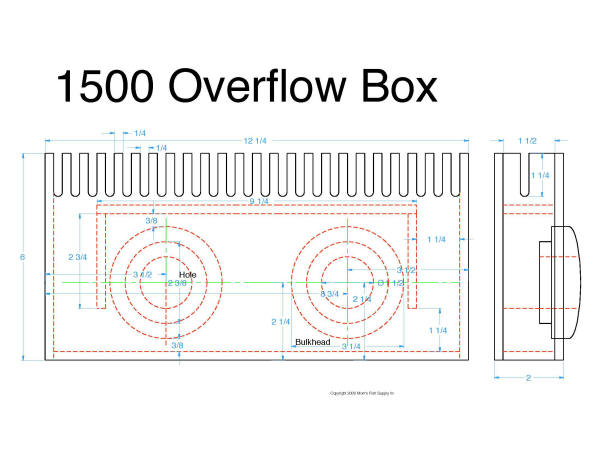 |
Improved filtration/Overflow, sump setup
11/24/08 I recently set up a new 135 gal Oceanic reef
tank. I converted my old 55ga tank into a refugium underneath.
The refugium is a simple design. It consists of three
compartments, divided by two acrylic sheets. The first
compartment is where I keep my skimmer and heaters, this spills
into my second compartment, which contains some live rock rubble
and Chaeto algae, and then the final compartment simply contains
my two return pumps. The volume of the system is approximately 40
gallons. My question is do you think this simple design will be
very effective? <Yes, tis the setup nowadays.> Could I
improve on it by putting a small pump (200 gph or so) in the
final compartment and pump the water that was going to go to the
display back to the first compartment to run through the process
again so to speak? <No, you want the raw water from the tank
running to the skimmer.> Also, I'm not sure what my two
overflows are rated at (if that means anything). <Typically
1� bulkheads, good for a bit more than 300 gph
per, though �rated� much
higher.> My return pumps are rated at 740 gph ea (again
ratings don't seem to mean much). <Nope.> The water
level draining at the teeth on the overflows is not even half way
up the teeth. <Not a factor, the bulkhead is the limiting
factor here.> Last question, can it handle more return?
<Likely not.> Is looking at the water level on the teeth a
half-way accurate way to judge this? <No, see above.> Thank
you Corey <Welcome, Scott V.>
Re: Revised Tank Plan (Last one) Revised Tank Plan
9/1/08 Crew, <Blake> The planning of tanks can be
very detrimental to all those around the planner, it makes for
such entertaining day dreaming/"spacing out"! If only
we put as much planning into work, relationships, etc...
<Exactly, could you imagine?> The thought process on the
Dolphin was that I could throttle it back using a gate valve
without harming the pump. I was considering having aprox.
1000-1200gph through the sump. <You could do this, I would
just choose a smaller, cheaper to buy and operate pump.> Are 2
in. drains necessary? <Even with this flow they will be if you
want two drains with either one being able to handle the entire
flow. A 1.5' drain is only reliable for 750 gph or so.>
The Herbie method of overflow only uses one of the throughputs
and the other is strictly a safety measure. <Ah yes, I am
familiar with the method, not the name. I apologize for not
catching this in your previous email. While many use this method
with some success, it is still not a good idea in my book. Taking
an overflow and restricting it to balance the flow will always
fail in time. I understand that is what the second drain is for,
but consider the real danger: By using this method a siphon is
created in the line that drains the water (many would argue there
is not, but that is a whole issue in itself). By siphoning a
1.5' line can handle 1200 gph+. The issue comes in when this
line fails. The remaining drain is now either expected to drain
this flow gravity fed (and it won't) or counted upon to
create a siphon of it's own. This just too risky for the
floor/walls in my house! > I travel a lot and want as many
safety checks as possible. Can you recommend a pump that may be
more appropriate? <I personally like and use the larger Eheims
in such applications, there are other great pumps out there:
Iwaki, PanWorld, even a small Reeflo just to name a few.>
After reading Anthony's book "Book of Coral
Propagation"(great read by the way), I've decided to use
my old Coralife 220 skimmer and also upgrade to a MSX 200 (he
recommended having 2 types of skimmers). Additionally, I am
trying to plan plumbing a 5 gal. bucket of sand for a deep sand
bed underneath the main display(unlit) and only using a 1/2 in to
1 sand bed for the main display. <Sounds like it will be a
great setup.> And oh yes, I love the idea about shaded areas
and the aesthetic possibilities. Hopefully, I can find home for
some softies and different types of bio topes in the same tank.
<A matter of researching re compatibility.> Again, thanks
for the time and help. Thanks, Blake <Welcome, Scott
V.>
Tank Overflow Design 9/1/08 G'day WWM
Crew, <Ben> I have a 1500 litre 15mm thick glass tank
(currently empty, upgrading from my 46 gallon) with no overflows
and thought I already knew what I was going to do for overflows.
I have an Iwaki MD20RX pump that will return about 3000 litres to
the display tank. I will be using 2 x Tunze 6301 pumps for
circulation, so the Iwaki is purely to return water to the
display tank and supply my OctopusTDNW-300-6530 Recirculating
Protein Skimmer via the overflow with about twice the tanks
volume every hour, which should be perfect. My idea was to have 2
vertical corner boxes each with a 1" drain with possibly 1
extra 1" drain just for insurance. I thought I would read a
few Q&A's on WWM to see if this is the best way to go,
and haven't read anything too positive on this set up, most
articles I have read are suggesting a box mounted top centre
running lengthways, but I can't find anything reliable on the
net as to how best to build this type of set up. <There is
nothing wrong with the vertical boxes. Most the dissention you
have read about is due to the throughput size that these types of
boxes are usually sold with, they are simply too small. Your tank
would fall into this category with dual 1' drains, it will be
dangerously close to the capacity of these. Having the backup
will be helpful, but if you are starting from scratch you might
as well go larger, 1.5'. Another consideration re the
overflow type is the fact that many tanks use tempered glass on
the bottom pane (cannot be safely drilled). You will need to
check with the manufacturer to see about yours, if it is
tempered, a through the back overflow will be your choice.>
Would it be best to make an internal box from glass or acrylic,
with 3 or 4 1" bulkheads, if so what would be the best way
to attach this to the tank? I've read that there isn't
really a good way of bonding acrylic to glass, so would I be
better off making something from glass? <You could use glass
if you wish, nothing wrong with that. You can easily use acrylic,
building a back panel on the box. Then you can drill the box to
match the throughputs in the glass and use the bulkheads to hold
the box in. Just pay attention to where your gaskets go! I highly
encourage you to try the acrylic route if you are at all handy
with DIY projects. It will make the box removable and once you
learn to work with acrylic you will open up a whole world of DIY
equipment options for yourself.> What do you suppose the Ideal
length for such a box would be? (I have an 8 foot tank). <Up
to the whole length of the tank if you wish! Really, a foot or
two is more than plenty, there is a greatly diminished return re
surface skimming after this length with this amount of flow.>
I hope you might have some suggestions or be able to point me in
the right direction. Thanks again for your help as always, Ben
Adelaide, Australia <Welcome, have fun with this project!
Scott V. in Monterey, Ca today.> Sump/Overflows
8/29/08 Hello again Guys, thank you so much for all the
information you have given thus far. I have learned a lot from
reading the FAQs as well. I have some thoughts and would like
your opinions. I've decided to build my own sump out of a 15g
glass tank; this is the only size that will fit in my stand. I
read the info about the use of foam rubber to seal the baffles in
place and will try that. <It is a good way to start out, you
can adjust if needed.> In your previous response you said to
use two 1.5" drains, looking at the Glass-Holes.com site I
saw the one rated at 1500GPH. I assume this is the one you were
referring to correct? <It qualifies as one. Any 1.5' drain
can work, even without a box. It just depends on what you want to
see in your tank. Do a quick Google search on overflows, you will
find a few to choose from.> It seems to me like overkill for a
46g display tank, which will give it a turnover rate of about 32x
per hour. Then again the more turnover the better right? <More
flow is good within reason. You do not want to run ANY overflow
to the limit. Ideally an overflow will be run to 50% or less of
its capacity, with multiple drains. Overflows can plug, having
redundancy in place keeps the water where it belongs.>
Here's the plan: 1500GPH overflow, 15g DIY sump, skimmer,
Knop "C" reactor, plus the return pump and plumbing of
course. I was thinking of an Eheim, I need it to match or
outperform the overflow right? What do you think of this? Am I
missing anything? <Eheim is a great choice, as for flow, see
the above.> I'm also going to the LFS to scope out their
setups for plumbing ideas. Thanks again guys for all you do.
Craig
<Welcome, Scott V.>
|
Protein Skimmer, sel. refugium plumbing
mostly 8/13/08 Hello Everyone,
<Ramon> I have a couple of questions about a protein
skimmer for my system. <Ok> My tank is a 55 gallon
(not drilled), with a 2 inch sand bed (adding 2 more
inches) and 2 15 gallon Rubbermaid containers. 1 is a
refugium and the other is a sump. <Nice> I am
planning to upgrade my refugium and sump with two 20 long
or two 30 gallon drilled tanks, I also want to know if I
stay with my 1 inch gravity return line how large should I
have my feed line drilled? <For what you can get
practically through this one line, I'd run all
consecutively through both sump, refugium... first the
'fuge... I'd make two overflows if you're
drilling... run one each independently to...> How far
down from the top and should it be level with the return
line? <Two inches and yes> the platform is only
18"w by 24"l by 13 1/2"h which the bottom of
the platform is sitting level with the tank, it would
gravity feed to the main tank, so I was wondering which
tank would be my best bet? <The bigger the better> I
plan on staying with my 55 for a long time and not
upgrading. it will house some fish with mostly button
polyps, mushrooms and leathers. I was wondering if the Aqua
C Urchin series would work for my set-up? <Of a
certainty, yes... a very good choice> or should I get
another type of skimmer? It will sit in the sump and budget
is tight as always. <Save up...> Thanks Again, Ramon
Ortiz Tampa, FL <Bob Fenner, Kona, HI>
Re: Protein Skimmer, actually sump/fuge
plumbing 8/14//08 <Howsit?> I was
wondering should I have a pump for the fuge and one for the
sump or one for the fuge and "T" it to the sump?
Or just run a line from the sump to the fuge and then to
the tank? <I would definitely run two pumps... but have
an "equalizer line" (pipe and through-puts) twixt
the two sump/refugiums... lest one overflow or return
be/come out of balance. BobF>
|
Bulkhead Placement/Drain 7/7/08 Hello,
<Mark.> After much searching on your site I still
cannot find the answer to my question. I have a 38 gallon
tank that I would like to have drilled. I am however not sure
of where I should have the hole for the bulkhead drilled. I
will be having the back drilled as the bottom of the tank is
tempered glass. <OK> I am thinking that one 1"
bulkhead should be sufficient, for this size tank, as it will
not be a reef tank. I do need flow but not tons as it is for
seahorses. I was wondering if you could help me out with the
placement of the bulkhead. I will be running and external
Durso. I really do not want to use an O/F but was thinking
instead of using a spa screen which you can see in the
attached picture. The spa screen will be flush against the
wall. I can do an O/F if I have too. <An overflow box is
not a necessity. Although the screens you have are very nice,
do be aware that these will drastically restrict flow through
a gravity fed drain and will of course clog very
quickly/easily.> Please help me in figuring out if the
1" bulkhead is large enough and where to place it in the
back wall of the tank. <First off, do not plan to have too
much flow through this. A 1' drain will give you 300 gph
reliably, count on half this with the strainer (brand new and
clean), seriously! As for the height/placement of the
bulkhead, it is hard to give you an exact number, too many
variables, the amount of flow, plumbing on the other side of
the bulkhead, buildup on the screen etc. Fact is you can run
at 50 gph and have a water level right in the middle of the
screen, kick it up to 150 gph and you will likely have the
entire screen submerged. This is the advantage (one) of using
a box. It will preset your water level no matter what the
flow (within reason). Consider placing you bulkhead a few
inches down from the desired water level and then use a
simple PVC elbow to control the water level. It can be left
to swivel in the bulkhead, making adjustment easy. If your
water level is still too low a short length of pipe can be
added to the elbow to raise the level. Screen/gutter guard
can be used to keep things out.> My apologies in advance
for the rather foolish questions but this is all a new way of
plumbing for me, and I am learning as I go. I have asked many
people, but have gotten so many varying answers I thought it
was time to head for the best. Thank you in advance
Mark
<Welcome, Scott V.> |
|
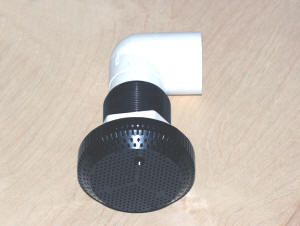 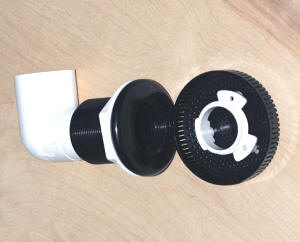
Re: Bulkhead Placement/Drain 7/9/08
Dear Scott, <Mark> Thank you for such a quick reply.
<Very welcome.> I understand what you are saying, The
flow I am looking for is between 200-400 GPH. So in order
to kick up flow should I go with a slightly larger bulkhead
say 1.5" or 2" or have two 1" bulkhead holes
drilled into the tank. <Two 1' bulkheads will work,
I would opt for the 1.5' though.><<Mmm, RMF
will (not rudely hopefully) butt in here and say he'd
definitely have two (or more!) 1.5" ID through-puts...
redundancy is a VERY good idea here... as one never
knows... when a screen/intake will be occluded, blocked to
an extent, NOR if/when one will want to upgrade their flow,
overflow>> If I should go the route of two 1"
holes drilled for a 1" bulkhead what should their
placement be? <Still too many variables to know for
sure, best to make it adjustable or try it in a throw away
container first to figure out where your water level is
going to be, relative to the bulkhead, using your pump at
the same head pressure it will see with the tank. Even then
it will change as crud builds up on the screen.> One
last question I would not mind putting an O/F into the
aquarium, but am unsure where to buy/find an O/F that is
out of glass and not acrylic, or how to make one or have
one made. <They are fairly straightforward. A bit of
acrylic and solvent (like Weld On 3), add a saw and you
have all you need to make your own. Another alternative is
to have pieces of glass cut and silicone into the tank to
form an overflow box. If you wish to buy there are several
sites; WetDryFilter.com, AustinOceans.com and
Glass-Holes.com (my site to disclose) are three sites that
offer through the glass overflows.> Thanks again for you
help it is much appreciated. Mark <Welcome, have fun,
Scott V.>
Re: More Re: Bulkhead Placement -- 07/10/08
>Rude? No way!! This is a very valid point we both know
I am educated on, shame on me for not including the
statement. Redundancy is a key aspect of any overflow
system's reliability. Thank you for adding this! Scott
V.< <<Mmm, RMF will (not rudely hopefully) butt in
here and say he'd definitely have two (or more!)
1.5" ID through-puts... redundancy is a VERY good idea
here... as one never knows... when a screen/intake will be
occluded, blocked to an extent, NOR if/when one will want
to upgrade their flow, overflow>> <Thank you
Scott. BobF>
|
Aquarium Setup and Pump/Overflow Questions 6/25/08 Hi
there, <Hello.> I am in the planning of 40 gallon breeder
with external coast to coast ( I like the setup and that
there's no space taken inside my tank) that goes to a 25
gallon sump. My plan is to keep softies and SPS corals with
little LPS (if I cannot avoid the temptation @ all). Anyways, I
am planning to follow same system as
http://www.reefcentral.com/forums/showthread.php?s=25431f8f03640480f5d7cce63c204925&threadid=1310585&perpage=25&pagenumber=1
with 1 inch drain pipes. To give you the brief summary,
there're two 1 inch pipe draining water but most of the work
is being done by 1 pipe (3rd pipe is for fail safe). I had some
questions over here: 1. I am planning to bring water back from
sump to display via Eheim 1262. It's a simple return from
bottom that will split into 2 pipes (I need the size
recommendation from you) and will be connected to ¾ or
½ inch LocLine (as you recommend) over the top. The
pipes will move water upwards about 5 ft. Do you think this will
work? <Well, yes and no. As far as the overflow, this employs
one drain as a full time siphon, with the second gravity fed
taking a bit of flow. The third is a gravity fed backup. The
problem is that a gravity fed 1' drain can handle just a bit
more than 300 GPH. The siphon 1' drain can flow 900 GPH or
so. What happens when (not IF in my experience) the siphon to
fails? The other two drains (one of which already had part of
it's flow used before #1 failed) cannot handle the flow.
There are many of these 'overclocking overflow' designs,
all end up relying on a gravity fed drain for a backup. The
reason is that the gravity fed drain is far and away the most
reliable. If you have enough gravity fed backup capacity to
accommodate the flow of the siphon fed drain if it fails, why
have the siphon drain to begin with? It is an overflow design
that does work most of the time, I am just not a fan of it after
many (hundreds) of hours building and actually flow
testing/trouble shooting overflows. In regard to the return, the
issue with bringing it through the bottom of the tank is the
potential for sump flooding. In the event of a power outage the
water will siphon or simply drain down to the level of the sump
output. Even if the return comes through the bottom and you bring
it up, you risk the possibility of a leak in the line somewhere
(LocLine is NOT watertight) leading to the same problem. All of
this seems paranoid, but this stuff does happen, if you plan on
having the tank for any length of time you will likely end up
experiencing these events first hand.> What size returns
should I use? <A few ½' or a single
¾'.> Can Eheim handle such load and is it fine
for this kind of setup for optimal working of sump (which may
contain refugium to it too)? <Yes, this is my personal
favorite return pump.> 2. I am planning to add 2 Maxijets 1200
(modded) and two Koralia (need size recommendation) to move water
inside the aquarium too. Do you think it's sufficient for
SPS? <Yes, definitely. You will not need so much flow, either
the MJ mod.s (another personal favorite) or the Koralias (fours
would be my choice) will be more than enough for a SPS tank this
size. > Do you think water will get too hot? <It may,
especially with the MH, time actually set up will tell.> I
live in Seattle so it really is not that hot over here except for
occasional heat wave. <The occasional heat wave is what can
get you.> 3. I am planning to add 1 250 WH Metal Halide with 2
VHO on the aquarium as light? Is the light sufficient? <Oh
yes, quite.> Other questions may come up but I need your
recommendation on #1 and #2 so that I can start ordering plumbing
stuffJ <OK> Thanks Ghazni <Welcome, have fun setting up,
Scott V.>
PVC Size/rate of flow 6/16/08 Hey
All! I hope your Saturday is going as well as mine! <Hello, it
is/did!> I am sorry to bother you with this, but I cannot seem
to find the answer myself. <No problem.> I am in the
plumbing stages of my 150 setup -- it will be plumbed through the
wall into a 120 refugium and a 55 sump. Can I tee the 2 x 2'
drains from the 150 into a 3' to go through the wall or
should I use 4' PVC instead? <3' will yield enough
flow to handle dual 2' drains.> The answer will then allow
me to determine how far from the wall the stand needs to be. I
would hate to go with the 3' only to find it to be too small,
and although it may be easier to just run both 2' drains
through, I'm thinking that on pipe through will look much
cleaner. <Your choice, dual 2' lines may very well be
easier to handle and setup.> Thanks in advance for your help.
I have been an avid reader of the FAQ's for several years --
the help all of you have provided me (and countless others) is so
very much appreciated!!!! <Thank you very much for the kind
words. You're welcome, always a pleasure to help, Scott
V.> Drains, Returns and Closed Loops, OH MY!
6/1/08 Hey Guys! <Brian> So here's where I am
at and need some plumbing help. I have a 120g (48.5x24.5x24) AGA
with center overflow that has a 1.5" drain. The tank is also
drilled with 4 1" bulkheads along the back. I originally was
going to use just the 1.5" to drain to the 40g breeder sump,
and 2 of the back holes for returns with the other 2 for closed
loop intakes, but after much reading on your site I think it
might be best to change that train of thought. So here is where I
am at, and would love to hear your thoughts. <Okay>
1.5" drain and the 2 outer 1" to drain into sump. That
would put approx 2200ish gph into sump. <Uhh, no... about half
this at most> So first question is with 5' of head, what
should my return pump be rated at to handle that. <I'd
stick with about 1,000 gph maximum calculated> Internal,
external doesn't matter. I would run 1" return line back
up T'd off to separate 20g fuge(this will gravity feed back
to sump return area). The 1" return line would T off again
up near tank and drop back over the top into tank. The other 2
1" drains would T together up to 1.5" to feed into Dart
pump for closed loop. I would run the dart up through a OM 4-way,
2 returns would come up over the top to the front corners with
loc-line, the other 2 would come over the back of the tank, run
along the very back inside the tank to the bottom middle on each
side and come back up through the sand with more loc line to
generate flow back up. I have to run the lines through the tank
as the bottom is tempered and can't be drilled. The goal is
to have no powerheads anywhere in the tank. <Will, can be made
to work.> I am sure there is something I'm missing in
here, so any help is appreciated. Thanks, Brian <Just
"missing" the estimate (of probable gravity/drain feed
from the 1.5 and 2-1" lines) and need to consider the return
in turn... all else reads as fine. Bob Fenner>
|
Bulkhead And Non-Standard Hole Size
Question -- 04/22/08 Hi Crew, <<Howdy,
Paul>> I'm going to try and make this issue short
and sweet because I know how busy all of you are.
<<Ah, no worries mate>> I couldn't find
this issue when searching through the site. <<Mmm,
well'¦guess there will be one after this
[grin]>> I am setting up my new 110g tank but I have
one problem. The tank has a 1" overflow hole drilled
in the bottom of the tank that was used for a wet/dry. Only
1 hole and it was previously capped off with a
bulkhead/pvc/cap. <<I see>> It was covered with
LS so it was not being used. I had to cut off the bulkhead
in order to move the tank out of the stand because there
was 5 inches of pipe hanging down. Now that I have the tank
set up I am going to cap off the hole. I was going to do
the same thing as the previous owner by using a bulkhead.
<<Hmm'¦do you want to keep this hole/have
the hole available for use at a later time? If not, maybe a
glass 'patch' silicone over the hole would serve
better. A double layer of inexpensive 3/16' float glass
from your local Lowe's/Home Depot/Hardware Store will
do the trick (they will even cut it for you). Just cut a
pair of patches to overlap two-inches beyond the perimeter
of the hole'¦center the first patch and secure to
the bottom glass of the tank with silicone (apply enough
silicone to fill-out/adhere the entire surface of the
patch)'¦next, apply a thin layer of silicone over
the entire surface of the first patch and then lay/secure
the second patch on top of this (use a small weight to hold
all in place). The resulting 'laminated' 3/8-inch
patch will be quite strong and water-tight'¦and
nothing will be sticking out the bottom of the tank to
interfere with the stand and equipment below>> To my
amazement, the hole opening is 1.5". The old bulkhead
barely fits in the hole and is also 1.5". <<Can
be found...though generally not from an 'aquatics'
source>> As you can probably see I can't find a
1" bulkhead that will fit into a 1.5" hole.
<<Will probably take a little searching of industrial
fittings, but they are out there. A good place to start is
USPlastics.com>> They all require at least 1 5/8.
<<Most of those available from hobby sources, yes (or
even a 1 ¾' hole>>> I tried to
enlarge the hole using 50 grit sandpaper.
<<Mmm'¦save your strength>> After 2
hours I didn't feel like I was getting anywhere and I
was extremely tired. <<Indeed>> I'm looking
for options. <<A Dremel tool and a diamond-grit
bit>> I thought about buying a 4"x4" square
of glass and silicone it, keep grinding away to enlarge the
hole, or maybe you know of a 1" bulkhead that will fit
into a 1.5" hole. Any thoughts on the best solution?
<<All three are viable options'¦but the
glass patch (as I outlined) would be the easiest and
'cleanest' fix, in my opinion>> The hole will
be covered with LS when the tank is up and running. Thanks
as always. Your input is invaluable. Paul <<Always
happy to share. EricR>>
Re: Bulkhead And Non-Standard Hole
Size Question - 04/22/08 Thank You for your response.
<<Quite welcome>> I was thinking the glass
patch would be the best solution as well but I wasn't
sure if I was going to run into any structural problems
using a thinner piece of glass with all the weight on top.
<<Easy enough to 'build-up' the patch to
match the thickness of the glass on the tank's
bottom>> I can get glass pieces from a local glass
store. Would it be better to get 1 piece of 3/8 or is
having 2 pieces siliconed together stronger. <<The
single piece of thicker glass will work'¦but a
laminated patch 'will be' stronger/more
durable>> I will definitely go the glass patch route
though. <<Excellent choice>> Thank You. Paul
Kelly <<A pleasure to assist. Eric
Russell>>
|
Bigger Overflow Holes 4/9/08 Hello Crew!
<Hello John.> Thank you for all that you do. You are
appreciated and admired by aquarists and fish everywhere!
<Thank you for the kind words and encouragement!> I have
one quick question. I have been reading, over and over, that in
many instances, the diameter of the overflow holes on the A.G.A.
MegaFlow systems [factory-ready] is not large enough. <No,
they are not really large enough.> Can you/would you name a
glass aquarium manufacturer, who makes standard-size/pre-drilled
(reef-ready) tanks that have BIGGER diameter holes than those
found in the A.G.A. tanks? I've done MANY web searches for
this information, and I keep coming up empty. <Most tank
manufacturers will drill more/larger holes for you, for an extra
fee of course. I have particularly found www.aqueonproducts.com
(formerly AGA) to be great with their customer service. No long
waits on the phone! Just give them a call and explain what you
want, they will help you.> Much appreciated. Have a great day.
John D. <Welcome and thank you. Have a great day also, Scott
V.> Combining Overflows/Refugium Substrates 2/26/08
Greetings WWM Crew, <Hello Bart.> I have always enjoyed the
hours I have spent reading on your site and the valuable info you
provide. For this I offer my thanks. <Thank you.> I have a
few plumbing questions for you regarding a system project I am
undertaking. After three years of successful reef keeping in my
72 gallon bow-front I have acquired a pre-drilled AGA 120 and am
making the switch. I am especially excited to do away with my
siphon overflow (no major mishaps...Just lucky I guess). <I
hear you my friend!> I will keep a variety of LPS corals on
about 120 lbs of liverock and stock fish very lightly. The tank
is pre-drilled with two Megaflow overflow chambers installed.
They have the standard 1" drains with Durso standpipes and
¾" returns. I understand from my research here
that these are smaller than is to be desired, but my thinking is
that I can get healthy water flow if I add some big powerheads in
the tank and take care of filtration and skimming in the sump
with the 12 or 1300 GPH I will get from the twin drains. Is this
reasonable to assume? <I am sorry, but no. These are smaller
than to be desired, a 1' bulkhead will only flow around 300
GPH safely, giving you around 600 GPH total draining
capacity.> My plan is to place a 50 gallon sump in the
basement, directly below the tank. If I were to combine the two
1" drains into one 2" pipe, will my drains slow down?
<This will work fine, the 2' has about 4-5 times the
draining capacity as a 1'.> I'm thinking it would be
easier to send one pipe through the floor than two. The sump will
be a simple design and house a skimmer (not selected yet)
followed in line by a refugium. The return pump will be an IWAKI
MD70RLT which should be able to handle return flow approaching
1400 GPH at the required head. <You will want to choose a
smaller pump.> Since the combined flow to the sump directly
below the tank should be around 1200 GPH, would this be too much
flow for a refugium housing only Chaetomorpha? <No, that is
fine for the Chaetomorpha, but you will not be flowing this
much.> I am considering a sump with no substrate because I
have heard that the substrate can become a nitrate factory. This
is confusing because I have also heard that Deep Sand Beds are
denitrifiers. What are your thoughts regarding refugiums without
substrates? <I like and use the DSB method. Substrate can
become a nitrate factory when it traps excess detritus, usually a
trait of large grain substrates. The use of fine substrates will
not be an issue and will benefit your system with proper water
flow, which you will need even if you leave the refugium bare
bottom.> My plan is that the Refugium and the skimmer would be
the ONLY filtration in this tank. <And the live rock in your
display.> I thank you in advance for any help you can offer.
Keep up the good work! Bart <Welcome, will do. Scott
V.>
Doing an Overflow "Calfo" Style
2/23/08 Hello Crew, <Good evening.> I've been
reading and searching on WWM for my question to "Calfo"
style overflows but can't seem to find the answer. I'm
installing an overflow in the back of my 90 gal tank which has
been drilled for two drains. Both drains are using 1 1/4"
PVC attached to 1" bulkheads running to the sump. <OK>
Due to space limitations where the tank is located the bulkheads
for the drains are reversed ( flange on outside of tank) allowing
the plumbing to fit closer to the tank. Thus this places the
longer threaded end of bulkhead inside the tank. <Not a
problem.> The bulkhead and PVC down elbow protrude approx 3
1/2" into the tank. If I install a "Calfo" style
overflow obviously it will have to be at least 4 1/4" wide
to allow for removal of the elbow if necessary but the question I
have is how deep does the overflow have to be? How much water
should be inside the overflow below the level of the drain
bulkhead? <You will want the inside bottom of the overflow to
be at least 1 ¼' from where the water will enter
the elbow in this case. This will allow unrestricted flow into
the elbow. You can go deeper if you like, but it is not
necessary. You may also be able to trim the bulkhead and elbow
down a bit to get the width down a little.> I was going to
purchase an overflow that I could drill and attach to the
bulkhead fittings but after some consideration on the hefty
prices of the commercially available overflows, I'll make
mine. <I do sell overflows and do always encourage people to
make their own whenever they are comfortable doing so.> Any
input on design considerations for my tank is greatly
appreciated. <It sounds like you have the right idea and a
good plan. I will give you one tip from experience: If you do not
go all the way from one side of your tank to the other, do be
sure to leave enough room between the overflow and the side to
fit in a magnet cleaner! It is all the small things that make
life easier.> Keep up the outstanding support. <Will do,
thank you, Scott V.> Overflow Options 2/15/08 Dear
crew, <Hello James.> I currently have a 300 gallon acrylic
tank. 96x24x30 with two overflow boxes, 5x6 inches in each
corner. I was planning on putting 2in bulkheads in each, but I
can't fit the 2in Durso standpipe in that narrow box.
<Bummer.> I've trimmed the elbow and tee down so the
standpipe now barely fits in, but I would have to drill the hole
very close to the seam. I'm trying to get 3000gph through the
tank. Question#1 Should I get rid of the standpipe so I can keep
the 2incn drains in the overflow box fairly centered and away
from the seam. < With this much water being moved it will be
quite noisy without some sort of standpipe.> Question#2 should
I use the overflow boxes for the 11/2 returns and just drill the
back for 2-3, 2inch drains? <If you are set on running 3000
gph through the sump then this is your best option.>
Question#3 If I drill the back, how far below the top seam would
I have to drill for the 2inch bulkheads. <I assume you intend
to drill the back inside the overflow box? This will allow you to
fit an inverted elbow inside the box to quiet things down. As for
height you will want the top of the bulkhead to be a few inches
down from the top of the overflow. Go too far down and you will
hear the water falling inside the overflow. If you planned on
drilling outside the box your height will depend on how you plan
to set the drain up. If you just plan on running an elbow inside
the tank you should drill fairly close to the top, but leave at
least one hole diameter between the hole and any edge. If you
plan on building a box for the overflow, then the same
recommendations apply as above for the built in boxes.> I
would greatly appreciate your advice and opinion on this matter,
thanks james <Welcome, good luck, Scott V.>
Horizontal Overflow 2/8/08 Hello! <Hello
Mike.> I have a 75g tank I would like to use with a sump setup
for an African Cichlid tank.. <OK> I would like to try the
"horizontal overflow", however, I'm not having a
whole lot of luck finding any "standards" to go by for
what actually "works best", such as, length, width,
height, how far below the waterline you should place it, optimal
bulkhead depth, (2) 1" bulkheads, or (1) 1 1/2"
bulkheads? <Nor will you'¦there are no such
standards. Each individual application is entirely
different/custom. The size of the box/weir will be dependent on
how big you want it. As far as waterline it may take some trial
and error. This aspect will depend on the size of the box you
build and the flow running over it. If you run 1000gph over a
5'X5' box the water level is going to be higher than a
5'X10' box. The bulkheads are again totally dependent on
your planned flow through them, but larger is usually better. As
far as bulkhead placement, I would recommend you place the
bulkheads as high up in the box as possible. If you place them
too low you will hear the water as it falls from the top of the
box down to the bulkhead's level.> If you could point me
to some useful resources to help me in my planning, I would
appreciate it.!! <I build (and sell) a similar product to
this. You can view my installation instructions in the link below
to get some ideas regarding placement and size/flow. The general
idea for your project is the same.> Thanks for your time (and
help)! Mike <Welcome, have fun, Scott V.> http://www.momsfishsupply.com/overflowinstallation.html
100g Tank Transit Volume/Overflows 2/4/08
Hi Bob, <Hello Lewis, Scott V. with you.> The website is
great but I was wondering if you could give me some advice about
my current situation. <OK> I have a 100g tank given to me
for free that was drilled with 2 x 1 inch holes at the waterline.
I have a 500 GPH pump returning water from my sump, but because
of the head, this is about 250 GPH. I would like a reliable
method (ie. power cut tolerant) of draining water from my tank to
my sump, without flooding. I know you have recommended 6 x 1 inch
holes for a 180g in the past, but I can't drill my tank. I
currently have a siphon set up, controlled by using a tap on the
32mm drain, but this is not practicable long term, as in the
event of a power cut, my tank would drain about 15g into my sump
with a total capacity of about 10g. So, which parts of my setup
need I change/add? Many Thanks in advance! Lewis <Your issue
here is the transit volume, that is how much water is above the
overflow, in the lines or gets siphoned out via your return line
when the power is off, not the overflow itself. You may be able
to lessen this by positioning the return line output directly
below the water level in your tank or drilling a siphon break in
the line. The transit volume will always be there, as a certain
percentage of the tank volume, so it is likely you will simply
need a larger sump for a tank this size. A note on the overflows,
your 2X1' will easily handle the flow you are running and be
far more reliable than the siphon type. Welcome, good luck, Scott
V.>
|
Re: Size of Water Pump 2/3/08... actually
size/drain flow rates, referrals... Did I mention I
have 2 intakes and two returns <Yes you did, unless they
are larger than 1' you will need to throttle back the
PS4, or go with a smaller pump, Scott
V.><<Scott... refer this person... They need to
read... comprehensively. RMF>>
Re: Size of Water Pump 2/4/08 Will my
tank drain about 1200 gph?? <No, more like half this
with two 1' drains, Scott V.><<...>>
Re: Size of Water Pump 2/4/08 Found something online
that is identical to my overflow kit. It says it drains
600gph. <Not safely with a 1' line.> All-Glass
Aquariums MegaFlow Overflow Accessory Kit * For efficient
water collection and replenishment for all All-Glass
Overflow Aquariums * Simple to install - no tools required
* Easy to clean Plumbing kit designed to fit pre-drilled
MegaFlow and Corner Overflow aquarium systems for efficient
water exchange. Requires no tools or glue for convenient,
easy assembly. Includes 1" and 3/4" bulkhead
fittings, adjustable "J" drainpipe, return pipe
with flexible nozzle, 90° elbows, and intake
strainer. Handles a flow-through rate of 600 gph.
http://www.drsfostersmith.com/product/prod_display.cfm?c=
3578+10090+12079+12078&pcatid=12078 This tells me that
my tank should drain 1200gph?? AM I right?? <You are
correct that it tells you that, but the statement is wrong.
A 1' drain will not flow 600gph without siphoning, no
matter how many manufacturers say that it will, and many
do. A 1' will drain over 600 gph with a siphon, but
there is many issues doing this. First is noise: unless you
run the drain exactly at full capacity, you will have a
cyclical flushing noise (very loud) as the drain outruns
the pump and then water fills above the drain until the
siphon starts again. All of this assumes that the siphon
does in fact start every time. To combat this you must
match the pumps flow exactly to the drains flow, a
balancing act that you will lose very quickly, overflowing
your tank. I would use three of your holes as drains,
leaving the fourth for a return. The three will give you a
safe, quiet, gravity fed 900 gph, more than enough flow
through your sump. As far as the return, one 1' line
coming off a pump is more than enough to handle this flow.
You can stick with the pump you propose and throttle it
back, although I do invite you and try it with two drains
(pvc is cheap) and see for yourself, you will be a convert!
Good luck, Scott V.>
Re: Size of Water Pump 2/4/08 <I
have combined the bombardment of emails sitting in my inbox
into one email for the sanity of all involved.> My
overflow accessory kits (2) are made by oceanic. They are
reef ready model # is 70009. The pipes are about an inch
and a half but at the bottom they taper down to 1 inch
which are then connected to I believe a 3/4 bulkhead. If my
flow is only 600gph. Is this enough water flow to convert
it into a saltwater tank or reef tank?? Is there enough
water movement @ 600gph?? Also, should I look at other
water pumps besides the Poseidon or maybe an Iwaki?? Thanks
again. How do I connect my 2 dual nozzle spray bars off one
return in the over flow box. Do I use flex tubing of some
sort with a tee?? Is this enough flow for a salt water
tank??? the 900gph using the 3 holes for drainage as u
mentioned?? Which pump would u recommend?? thanks again!
When I build my sump, it will have 2 independent holes in
the cover for the drain pipes at 1 inch. Should that make a
difference in the GPH??? <All of the above is answered
time after time either by our previous correspondence or on
WWM, the site you are instructed to search before writing.
Scott V.>
|
|
Question about tank
integrity re: drilling -- 1/28/08 Dear Crew,
<Brian> Hope all is well with you fine ladies and
gentlemen. Once again, I find myself seeking the advice of
the sea water sages. I know a few of you have prior tank
building / fabricating experience, and wanted to run this
by those who may have more experience than myself. I've
drilled the back panel of my 75 gallon, which I believe is
3/8 inch glass, in preparation for the overflows to the
sump, and intake and outputs for the closed loops. 6 holes
in total, 5 are to accommodate 1.25 inch bulkheads, and one
for a 1.5 inch bulkhead. <Okay> My question is re the
integrity of the panel once filled with water. I understand
people drill their tanks all the time, and even I admit
that the process was much easier than I thought it would
be. However, I read many threads on various forums with
people stating their tanks have failed usually with cracks
radiating from near the location of the holes. I am
wondering, would it would be advisable to silicone a few
pieces of glass length wise to the back panel in order to
provide stability, and reinforce the weakened panel? I was
thinking of adding three strips to the back of the panel on
the long dimension (48"). Will I gain any added
stability to the panel by doing this? Or rather, a waste of
time? <Mmm, not an idea w/o merit... do look up the term
"Euro-bracing" for ideas on how I would approach
this> I appreciate your input, and await your advice.
Cheers, Brian <Mmm, a few more statements, related... I
encourage you to make sure there is no/little stress from
the plumbing "hanging" from the through puts
(VERY important) and that the bulkheads themselves are well
seated (with a smear of Silastic on the inside and outside
faces, including on the gaskets) and that these are
securely tightened... once again, to distribute the force
about their perimeters... Bob Fenner>
Re: Question about tank integrity re:
drilling 1/28/08 Bob, <Brian> Thank
you for the swift reply. After researching "euro
bracing", I've decided that it would indeed be in
my best interest to beef up the integrity of the tank. Will
take the suggestion to heart, and visit the local plate
glass shop for some reinforcing strips. <Ah, good>
Also, I wanted to thank you personally, Bob. When I was new
to the hobby and wandered into my LFS to purchase a tank
and some fish a few years ago, after speaking with me for a
few moments, the clerk told me that there was only one
piece of equipment I would need to start with. He then
proceeded to walk me over to the hobby literature section,
pick up a copy of "The Conscientious Marine
Aquarist", and advised me to go home and read it over
several times, then come back when I was ready to go. To
this day, I still find myself referring to it for advice
and guidance. Both I, and my reefs inhabitants thank you.
<Welcome my friend> Next time you're in
Chesapeake Bay country, drop me a line and the beer and
crab cakes are on me! <Mmm, yummy!> Kindly, Brian
Rinehart <BobF>
|
Enough "fall" for Overflow 1/6/08
Crew, <Ben> Thank you in advance for you response. Before I
go hole sawing through my living room wall, I thought I better
run this by you. I'll try to ask this in a clear concise
manner, but bear with me. <OK, no problem.> I have a
240gal. "through wall" set up, as in the display with
stand & canopy is in one room, and everything else (sump
etc.) is in the garage behind it. My concern is that the sump
sits on a 30" high table and there might not be enough
"fall" for the return lines. I have no experience with
hydrodynamics, but do know that this depends on how much &
over what distance, so here are the specifics. I have 4 X
1.5" drains drilled along the top back wall of the tank. My
return pump is doing 2460 gph with my manifold configuration as
is. (I've tested it several times) The drains, however, will
only have about 10" of fall over a 10' span. Is this
enough to keep up with the pump? <Should be, 615 gph per
1.5' bulkhead.> <<Mmm, what re the horizontal run?
This may have a decided impact. RMF>> I'm thinking that
because I have some overkill on my drains, that I should be okay.
<The more the better.> I guess the question boils down to
how fast does water move downhill? <The problem won't be
the 10' drop (you are not siphoning), it will be the 10ft
run, that does decrease flow somewhat, but you will be fine
here.> I hope I made this somewhat clear... Any help would be
appreciated. Thanks, Ben <Very clear Ben. Sounds like you are
on the right track. Have fun setting up, it is one of the best
parts of reefkeeping, Scott V.> Re: FOWLR Setup for Messy
Eaters 1/4/07 Thanks Scott for the response! <Happy to
help Brian.> I was looking at drilling tanks and found that
drilling tempered tanks (by me) may not be the best idea. I'd
rather not have a glass "sculpture" in my living room.
(Maybe I can sell it off for millions as contemporary art?).
<The bottom is likely tempered. Do check with the tank
manufacturer if your back is tempered, chances are it is not. You
can overflow through the back too. If you find a buyer for such
art, please let me know, I have many old tanks I can bust up!>
I was looking at hang-on overflow boxes. Would these work in
conjunction with the LR to keep the water clean with messy eaters
in it? <It would work fine.> I understand these work by
suction, so it would be prudent to have 2. <Highly recommended
to have redundancy with these and any overflows.> Do overflow
boxes come with a GPH rating? <They should, but the bulkhead
the box uses on the backside is usually the true limiting flow
factor with these boxes.> How should I match it up with the
return pump GPH rating? <If you have two boxes, there will be
nothing wrong with matching the pump's flow at the head
height you have to the full flow capacity a box/bulkhead. This
will leave you with each box being able to handle the pump's
flow should the other box fail.> For example, should one be
higher than the other? <If anything, have the pump flow less
than the box/bulkhead can handle.> Or should I just use a
variable ball valve to balance everything out myself? <If you
get a larger pump than needed, you will need to. Don't try to
balance the flow right on the verge of what the box/bulkhead can
handle. Leave yourself some margin of safety for things getting
partially plugged.> Scott also mentioned a filter sock. Is
this just like what it sounds? A sock placed somewhere where
water gets forced through it trapping particulates? <Yes,
usually the overflow line is dumped into the sock hung on the
inside of your sump.>Thanks again guys! You've been very
helpful! Brian learning a little bit. <Welcome, keep reading
and learning, have fun, Scott V.>
Questions Regarding
Overflows'¦(Another Unrealistic Expectation) --
12/26/07 Dear Crew, <<Hello Brian>> Hoping this
correspondence finds all you fine ladies and gentlemen in good
health, and enjoying a happy holiday season. <<Mmm, funny
you should ask as I'm still getting over a rather nasty bout
with the 'crud' for the past 8-days '¦ Not how I
had hoped to spend my vacation...but happy nonetheless to be
starting to feel 'human' again. Thanks for asking!
[Grin]>> My question today is in regards to providing
adequate flow through a 75 gallon reef system.
<<Okay'¦and I'm sure you've already read
through our more than ample information on the subject>>
Rather than buying a grossly under achieving
"reef-ready" system, <<Hee-hee! I guess you
have!>> I've decided to go the route of purchasing a
standard 75 gallon aquarium and having a go at drilling it
myself. <<Goodonya mate! Not such a tough task if
you're a bit handy'¦just be sure you get a tank that
doesn't have 'tempered' panels where you plan to
drill! Generally, on a tank of this size only the bottom is
likely to be tempered. If purchased new, the manufacturer should
have any tempered panels labeled as such'¦but it
doesn't hurt to contact them to be sure, especially with
older/used tanks (assuming you can identify the manufacturer, of
course)>> After reading through the various FAQ's
regarding overflow plumbing, and seeing the high praise and
feedback that glass-holes.com have received, I'm inclined to
go with their 1.5 inch through-the-back overflow system.
<<Okay>> Per their website, they indicate that this
should accommodate up to 1500 gallons per hour. <<Hmmm,
looks to me like this setup features a single 1.5'
bulkhead'¦750gph is a more realistic expectation here,
as well as a much more manageable flow rate re noise/sump
plumbing simplicity>> For safety's sake, I'm
considering adding a second bulkhead/overflow to provide for a
backup in the event that a blockage should occur.
<<Redundancy can be a life saver...>> Since this is a
system that is not dependent upon a siphon for facilitating the
overflow, am I correct in assuming that any return pump should
work provided that the rate does not exceed the overflow
capacity? <<That is correct'¦the return rate will
match that of the pump rate'¦assuming, as you correctly
stated, that the overflow rate of the throughput is not
exceeded>> The way I see it in my mind, the rate of the
return pump would dictate the amount of water that would flow
over the lip of the box, correct? <<Correct'¦and
thus you are likely also aware the 'height' of the
overflow box helps in determining the 'running' height of
the water in the tank'¦something to be considered when
positioning the box>> Sorry if this seems like a silly
question, I'm just preferring to err on the side of caution
as I only plan on doing this once. <<No worries mate, well
understood'¦ Do be sure to plumb a gate-valve on the
output side of the pump to temper flow if needed>> Many
thanks for your collective continued efforts, Brian <<A
pleasure to help, do let me know if I can be of further
assistance. EricR'¦back with the living>>
ScottV chimes in: <The Glass-Holes.com kit mentioned
does indeed include two 1 ½' bulkheads. It is
actually the kit shown in the video on the same page. The
picture/listing is generic'¦I will remedy this. Sorry
for the confusion, Scott V., fellow crewmember and a partner in
Glass-Holes.com.>
Re: Questions Regarding
Overflows'¦(Another Unrealistic Expectation) --
12/26/07 Eric, Scott, <<Brian>> Many thanks for
the clarification, and again for the excellent advice. Cheers,
Brian <<Ah yes, I am glad Scott stepped in to
clarify/correct my perception of the "kit"...don't
need any added confusion. Good luck with your project.
EricR>>
Drilling overflows in AGA 12/16/07 Crew,
<Hello David.> I just ordered an Aquarium Glass Diamond
Hole Saw Kit from Diamond Tool King who advertises as one of your
sponsors. I already paid for the purchase through PayPal. Do you
know if Steve @ Diamond Tool King is legitimate? His prices are
excellent, which sort of scares me. I hope his being one of your
sponsors, or his advertising on your pages shows he is
legitimate. <No worries, the bits will work fine.> Here is
why I am ordering from him. I am setting up a reef tank starting
with a 120 gallon AGA tank. I keep collecting pieces and parts,
and reading and continually Reading and rereading. Sorry to say I
did not find out about your site until a few weeks ago. I have
now repeatedly read that the bulkheads holes are to small too
begin to consider the tank a "reef ready Tank".
<Unfortunately the case.> Yes I will, after tank aging, use
the tank principally as a SPS tank, with a small scattering of
LPS and even less soft corals. To date I have obtained two Iwaki
40RLXT's, Turboflotor 1000 with Ocean Runner 2700 pump for
skimming, Aqualight Pro with two 250-Watt 10,000 K and two
96-Watt PC's. I also have a Megaflow Model 4 Sump, which had
to be trimmed to even allow for the TurboFlotor. If I had known
that drilling bulkhead holes was not such a great task I would
have never gotten the MegaFlow sump. I might still replace it
with a glass aquarium and place the baffles where they will work
best. <Whatever it takes to suit your setup, drilling the
glass is fairly straightforward.> I do not plan on using the
Bio-balls that came with the sump so it might workout OK. I plan
on about 100-150 lbs Live Rock some thing from at least three
different areas. Probably large Fiji rock, Tonga shelf and branch
rock and some other exotic rock. Now for questions and
suggestions. I plan on cutting out the AGA overflow boxes and
plugging the small bulkhead holes with plugged bulkheads. Yes I
even footed the stupidly high price for two Megaflow overflow
kits. Learning can be expensive! <Learning generally costs
something, whether it be time or money!!> Anyway I plan on two
3 inch holes for 2 inch overflow bulkheads on the tank's back
wall, giving a space of at least 3-3.5 inches between hole edge
and tank inner wall. Top of 3 inch holes about 2 inches below
tanks glass cover ledge. <Sounds good, perhaps a little bit
lower. General rule of thumb is one hole diameter away from any
edge. Two inches down should be fine, but three will give you
that much more strength in the end. Good choice on overflow size,
plenty of capacity here.> The return locations I am not sure
of. With the tanks present setting viewing will be almost
entirely through front wall of tank allowing me free rein to
drill return holes in side wall which I believe would create
better turbulent flow possibilities due to the opposing flow from
returns at both ends of tank. What do you think? <I am not a
fan of drilling for sump returns, at least not too far down due
to siphoning issues.> What with live rock, crushed coral, and
live sand/gravel (from GARF) displacement eating up probably 20
gallons of space I figured targeting 2000-2100 gph for flow would
probably be acceptable. Shouldn't be able to get around there
with my two pumps returning through 1 inch PVC pipe and 1 inch
bulkheads. <Yes.> I really don't know what would be
optimum location for return bulkheads, ie. where on side walls.
Middle of front to back? How far from top edge. How did I prevent
back siphoning if pump power is loss. <Yes, this is the
problem. Some rely on check valves, but these are not to be
trusted to work 100% of the time.> I also have two Pan World
pumps with 1 inch inputs and outputs that I could use for running
circulation loop(s) or possibly throttling down one for use with
a AquaC EV series skimmer if the TurboFlotor does not work out.
<A closed loop is the way to go here. You will be able to put
the intake/return(s) where you would like to optimize flow
(perhaps even use the predrilled holes for the intake). This will
also allow you to run whatever flow through your sump you desire
rather than running the tanks full circulation through.> I
also have a 1/4 HP chiller, lots of Maxi-Jets (900'sand
1200's) and two Wave Masters. Think I need to sale some
circulation heads and wavemasters. <It always seems like you
can never have too many extra utility pumps!> Is there any
reason I should even consider putting return bulkhead holes in
the tank backwall? <Over the top will be fine. If you want to
drill consider putting it fairly close to the top (again, at
least one hole diameter from any edge) and use some Loc-Line for
adjustability to minimize siphoning.> Opinions and suggestions
please, before I start drilling, that is if the diamond hole saws
show up. Sorry this is so long, but I only have three weeks
before school starts up again and I am really antsy to get
started on this tank when I am not working. <Nice project to
work on with time off.> Its been over six years since I last
had a reef tank and things seem to keep getting better as time
goes on. My last tank was a 125 gallon with a "high"
turnover rate of 4 times per hour, 2 Maxi Jet 900's, a 20
gallon sump, 3 250-Watt 650 K halide shop lights, and a
Kalkwasser drip. No skimmer, auto top off, CO2 calc reactor, hood
with double ended halide bulbs, Actinic Power Compacts, LED
moonlights. Things do change!!! <Wow! They sure do.>
Thanks, David E. Harris <Welcome, have fun with your project,
Scott V.>
|
Manifold Closed Loop Question,
Circulation, des. 12/12/07 Hi All. <Hi
Dan> Great site with much good info. The praise never
stops! <Thank you.> I have a standard 90g reef tank
manufactured by Perfecto. It has a corner overflow with 2
bulkheads at a diameter of 1.25 inch. <Mmm, I'm
guessing outside diameter here.> I have a 3 boxed
sump/fuge below. First is sump with skimmer (EuroReef
RS135), second is return, third is fuge. I have the pvc
outlet tube T-d with some of the water diverting to the
fuge at a slow rate. The return pump is a Mag 9.5 directly
in the return part of the sump. <OK, 950gph at the
head.> I seriously need to get more flow, as I have a
huge Cyano problem that never goes away. <Yes, that 950
is probably around 800gph in your tank.> I have scoured
the site about CL systems. Since the tank is
"live", I can't drill any new bulkheads. I
don't want any 'U' tubes going over the tank
top for fear of leakage. I am thinking that my best option
is to get a submersible pump and put it directly in the
tank, maybe behind some of the live rocks to conceal it. I
am not sure what size PVC I should use for my manifold, nor
how many T-s to have for direction of output water, nor
what size diameter the T-s should be. I was thinking of
just getting some PVC and T-s from Home Depot and making
something up. I would like the T-s to be directional. I
also don't know what kind or size pump I should get.
<With two one inch ID drains you should have the
capacity to go with a larger return pump, somewhere around
1200gph. This would give you the flow rate you require. You
may consider getting a SCWD (Switching Current Water
Director) you can mount to your return line which will give
you an alternating current effect. Another way to go is to
add a couple of powerheads in your tank. A good match would
be two Aquarium Systems 1200 powerheads with a Hydor FLO
Rotating Deflector mounted to each. With shipping, you
would only have about 65.00 invested. Drs Foster/Smith has
the best prices on both items. I use this system and it
works quite well.> Much thanks, <You're welcome.
James (Salty Dog)> Dan
"Salty" not getting it...
"<With two one inch ID drains you should have the
capacity to go with a> larger return pump, somewhere
around 1200gph. This would give you the flow rate you
require. You may consider getting a SCWD (Switching Current
Water Director) you can mount to your return line which
will give you an> alternating current effect. Another
way to go is to add a> couple of powerheads in your
tank. A good match would be two Aquarium> Systems 1200
powerheads with a Hydor FLO Rotating Deflector mounted
to> each. With shipping, you would only have about 65.00
invested. Drs> Foster/Smith has the best prices on both
items. I use this system and it> works quite
well.>> Much thanks,> <You're welcome.
James (Salty Dog)> "> > > I don't
think you're getting through to him. Eric< <
<James... let's chat re this/our physical
universe... have you actually seen/tried to get this much
water through 1" ID lines? BobF>>
Re: "Salty" not getting it...
Pb, flow rates... - 12/13/07 Hi Bob,
<James> I'm going by Reef Central's Reef
Calculators which I use from time to time. They tell me for
600gph a drain size of just slightly over once inch will
produce this. <I assure you, this guess/stmt. is
incorrect, by about half> Of course, no elbows and/or
restrictions are figured in. So by their calculators, two
one inch drains should produce close to 1200gph total flow.
Take a look here, maybe they are all wet.
http://www.reefcentral.com/calc/drain.php James <Or
something. The only way such a given pipe arrangement would
deliver this volume is by siphoning... Try it and see.
BobF> Bob, <Msieu Salty> On another note, looking
at some of the prefilter overflows on the market, the
models with one inch bulkheads are rated at 600gph??? James
<Easy enough to measure... do so. B>
Re: Manifold Closed Loop Question,
Circulation, des. 12/12/07 Ok. If I upgrade my
Mag 9.5 return pump, what brand(s) would you recommend?
<I'd probably go with a Quiet One Model 6000
(1500gph), on sale at Drs. Foster/Smith for 98 bucks.>
Can you explain how a SCWD works and how it connects? I am
unfamiliar. Brand recommendation? <Go here, will give
you a good idea how it works and you can read reviews of
users.
http://www.marinedepot.com/ps_ViewItem.aspx?idproduct=3Q1111>
If I go the powerhead route, where would the best place to
mount them be? Opposite corners of the tank? <If you use
the Hydor Rotating Deflectors, I'd place a third of the
way in on each side of tank. These units spread the flow
close to 180 degrees. If not, place the heads in corners.
Here is a description of this device.
http://www.marinedepot.com/ps_ViewItem~SearchStr~flo%20rotating%20water%20deflector~
action~view~idProduct~HD01401~idCategory~FIWMIW~category~Hydor_FLO_
Rotating_Water_Deflector_
Saltwater_Aquarium_Supplies_Wavemakers_Internal~vendor~.html
Dan
|
Re: James, flow rates through
plumbing, fittings 11/13/07 OK,
bottom line is...the calculators are in err, and the
manufacturers of the HOB overflows are fibbing about
the 600gph flow rate. Also, when you say the only way
you would get that flow rate is by siphoning.
Isn't that what the HOB's are actually doing
with the "U" tubes? <Yes! Again... much
more water to be had via siphoning... but the
downsides of... what happens if the siphon/s stop?
The issue of transit volume...> Anyway, I must
find a more reliable source for calculating such. So
goes answering plumbing queries for now.. do not want
to look like an ass doing so, for sure. James <The
construction, presentation of such
"tables", inherent difficulties in
explaining their limitations to users is why
I/we've chosen not to even present such... You
and I can only guess the number of wet floors,
shorted electrics, dead livestock... frustration and
consternation of hobbyists from such
"data". Cheers, BobF>
Re: James, flow rates through
plumbing, fittings 11/13/07 OK, I see
I have a message in my inbox from the querior. I
think I'll tell him my wife is answering this
because I passed away yesterday. <Heee! You can
only use this one time...> In looking at plumbing
calculations on the web, I do see there is much
involved, one notably is friction. <Yes... induced
drag is a huge factor... I have seen systems where
the latitudinal "runs" from lines in the
backs of large tanks were very long... there was/is
NO way that water was going to get magically
"sucked" down these...> Depending on the
product being used, <?> friction can decrease
flow rates of course. So now I'm thinking the
ribbed hose connecting from bulkhead to bulkhead
would rank high on the list because of all the ribs
present, but probably no where near as bad as direct
plumbing using elbows and such. <Oh!
Interesting... Well, not much... inside diameter is
inside diameter... the ribbing is outside this
measure> This job is going to drive me nuts. Have
a good day. James (I too, take blood pressure
medication, Ziac. I thought this was suppose to be a
relaxing hobby. <I use (don't laugh) black
flaxseed and 10 mg. of Norvasc daily... Cheers,
BobF>
Overflow rates... again.
11/13/07 My flow meter data shows a 1"
bulkhead flowing right at 300 gph in a best case
scenario. With much plumbing it was more in the
neighborhood of 270-280. I used to think they flowed
more too!! I plan on confirming the flow meter rates
with time vs. volume displaced tests. I will write
these up and sent it to you this weekend. Talk soon,
Scott V. <Thank you for this input Scott... Am
STILL dreaming of that "Aquarium
Engineering" book by you and Eric Russell... and
I know just the excellent editor that should oversee
this project. Am cc'ing James Lawrence
(Microcosm) here. James... it's way past time for
an update, bettered tome than Pete Escobar's on
the topic... What say you? I will gladly help with
review of lighting, aquarium and stand, electrical,
plumbing... sections. BobF>
Calculator, plumbing, flow-rate
12/16/07 Bob, This calculator
seems like it would be useful, what do you think?
http://www.aquaticeco.com/index.cfm/fuseaction/popup.calc_pumphead
James <Best one I've ever come across. Will
post/share. BobF>
|
|
|