|
FAQs about Marine Worms, Vermiform Animals
Identification 11
Related FAQs: Worm
IDs 1, Worm IDs 2, Worm IDs 3, Worm
IDs 4, Worm IDs 5, Worm IDs 6, Worm
IDs 7, Worm IDs 8, Worm IDs 9, Worm
IDs 10, Worm ID 12, Worm ID 13, Worm ID
14, Worm ID 15, Worm ID 16, Worm ID
17, Worm ID 18, See
Also: Flatworm ID 1 +,
Nemertean, Proboscis, Ribbon Worm ID
1, Nematode, Roundworm ID
1, Nematomorpha, Horsehair Worm ID
1, Acanthocephalans, Thorny-headed Worm ID
1, Tubeworm/Featherduster ID
1 +, Bristle Worm ID 1 +,
Hirudineans, Leech ID 1, Sipunculids, Peanut Worm ID 1, Echiuran Worm ID 1, Invertebrate Identification, Worms 1, Worms
2, Worms 3, Flatworms/Planaria, Fire/Bristleworms, FAQs on:
Worm Behavior, Worm Compatibility, Worm Selection, Worm
Systems, Worm Feeding, Worm Disease, Worm
Reproduction,
Related Articles: Worms,
Featherduster Worms,
|
|
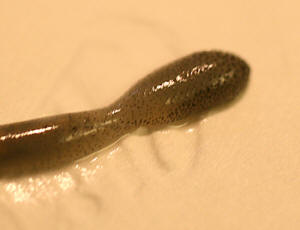
Unidentified red/purple worm...
bristle... 11/21/07 First off, I would like to thank
you all for your vast knowledge. I would not be a successful reef
keeper without the help of your site. <A pleasure to share,
serve> I have a worm in my live rock that I have not been able to
identify through your site or other research as well. It has many white
legs like a centipede and the body is red (somewhat bright, not deep
red) and purple, only about 1" long. <An apt description for
one of many possible species of Errantiate Polychaetes... A
bristleworm> The red covers the top first half of the body and the
light purple covers the top 2nd half. I haven't seen it doing any
harm and was exploring a snail but did not seem to do anything to it. I
don't see it often and it comes out in the light, which seems
unusual. It's a very nice looking worm and has a dangerous look to
it, and doesn't seem to be a fireworm. It seems to be a type of
bristle worm, however, does not seem to be nocturnal. Any help in this
identification would be greatly appreciated. Thanks, Sean T <...
Even with a pic this is difficult... could likely narrow down the guess
given a close up of the head... number, placement of eyes, palps et
al... See the Net re the scientific designation above. Bob
Fenner>
Long Clear Thin Worms on Rock... On
top of Spaghetti (Worms) All Covered With Cheese... 11/9/07
Hey guys! <Hi Jane, Mich here.> I have recently added a new piece
of very live rock into my tank about 2 weeks ago. While the moon light
was on last night, I noticed there were 4-5 long (4 inches, and can
stretch) very thin, clear worms of some sort coming out of a hole in my
new piece of rock. They resemble fishing line and can stretch to long
lengths. They are a solid clear color with no obvious head I can see.
Are these harmful to my tank? <Nope!> Should I try to eradicate
them, <Nope!> they are on the bottom of the rock, in a hard to
reach area. <Leave it be. Sounds like a Spaghetti worm (Terebellidae
sp.) to me. They are harmless scavengers feeding on particulate organic
material and detritus. More here:
http://www.reefkeeping.com/issues/2002-06/rs/index.php > Thanks for
your help! <Welcome! Mich> Jane
Worms!!! Help!!! 10/27/07 Hello,
I'm having a huge problem with a tube worm "tubiculous
polychaete"? <That's actually not an animal name. It's
an adjective put before a descriptive noun. Basically, it's just a
fancy way of saying "tube worm."> It started out as two
that where in my tank for a couple years. They were really cool at
first, never multiplied or disturbed anything, just cast a silk line
out every now and then and would reel in various things that floated
by.? <They sound like Vermetid snails. They're actually not
worms. Please see here:
http://reefkeeping.com/issues/2005-01/rs/index.php> Suddenly, after
all this time, they have started multiplying exponentially. I've
literally got hundred of them and there silk is bothering corals and
making the tank look nasty. <They're probably not bothering the
corals, but they can be aesthetically unpleasing.> To top it off,
the tubes they make are sharp and I've cut myself several times on
them. Do these things have any natural predators that I can put in the
tank, or is there some other way to get rid of them? <I don't
think they have any predators you could keep in an aquarium. But these
things usually go through booms and busts. They'll likely start to
die down eventually on their own. There are some desperate measures you
could take (involving things like NaOH), but if I were you, I'd
just make my peace with them for now and hope they go away
eventually.> Any help would be greatly appreciated. Thank you for
all the great info! Will <De nada, Sara M.>
|
Worm Identification? -- 10/04/07 Sorry for the
blurry pics, but I was hoping you might get enough to help me
figure out if this is a good or bad worm. He only comes out at
night and the minute my flash goes off he is sucked up back in
his hole. The worm appears to be brown with white stripes. I
would have to guess it is more than 8 inches long, just how long
I have no idea. When it is extending, it appears to be coming out
of itself. The head part looks sort of like a short thick white
feather duster when it comes out but it almost immediately goes
back into itself and repeats this action over and over. It always
comes out of the same hole every night, never ventures. Thanks
for all of your help! Bellinda <Does it look like a Sipunculid
to you: http://www.wetwebmedia.com/pnutwrmidfaqs.htm BobF>
Re: Worm Identification? 10/5/07 <Hi Bellinda, Lynn
here this time! Bob's off diving - lucky fellow!> Thank
you so much for your quick response. <On behalf of Bob,
you're very welcome.> I have never seen it when it is not
stretched out so it is hard to tell. It stays in a hole in the
rock all of the time and only comes out at night. <Typical of
Sipunculids/Peanut Worms. I love these little guys. They remind
me of elephant trunks, the way they appear to snuffle around
looking for food - and wow, do they not like it when you shine a
flashlight on them! It's amazing how quickly they can retract
back into their little abodes (not that I blame them!). They vary
in color from shades of gray, brown, black, or white - some with
bands of those same colors, some without.> However, I do
believe that is what it is. I'm assuming from what I read
that it is safe to leave this worm in my aquarium.
<Absolutely. Sipunculids/peanut worms are harmless,
beneficial, little detritivores, and a joy to have/watch!>
Thanks Again, <You're most welcome! -Lynn>
|
|
.JPG)
|
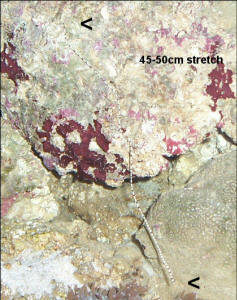
Worm ID please... Spaghetti Worm (Terebellidae
spp.) 9/28/07 Hi Guys... <Hi Jo, Mich here
apologizing for the delay.> I found another hitcher the other
night...its the first time I've seen him so I quickly snapped
the pic before the lions, who were circling, grabbed him up...He
got tangled in my Elegance Coral, and after tugging for a good 5
min.s, finally broke free and retreated back into the smallest hole
in the live rock...fully stretched he measured around 50cm and was
flat, but as he retreated, he took on a round shape a inched
himself backwards slowly...he is red and white striped any only
about 2mm in diameter...again, I've not had any luck searching
the web... <I believe this is a spaghetti worm (Terebellidae
spp.) My crew mate Brenda found this image:
http://www.poppe-images.com/images/image_info.php?picid=912498 >
Cheers and Thanks... <Kind regards and welcome! Mich>
JO... |
|
|
Worm ID/Control...No Photo, Can Only
Speculate -- 08/30/07 I have been looking for the kind of tube worm
I have. It is not a feather duster. It is a white circle with hair
around the circle. It is taking over my tank. It is on every rock and
on the glass etc. <<I can't really say what these might be
without a good close-up photo. These could be a small Sabellid worm
species...or something more ominous like Hydroids or Anemonia majano.
Suggest you do a keyword search on both and see what you think>>
How can I get rid of it. <<The Sabellids will likely cycle out in
time...but if these are Hydroids or Anemonia majano they can be more
problematic. For these you might consider some of the solutions
discussed here:
http://www.wetwebmedia.com/ca/cav1i3/aiptasia_impressions/aiptaisia_impressions.htm
But 'identification' is your first step>> The store I use
suggested I put a wrasse in the tank. <<You might try taking a
rock with these 'worms' on it to your LFS and see if they can
provide a positive ID>> I have a 24 gal. nano tank and I have a
Fiji blue and its buddy a clown fish. <<Mmm...this 'Blue
Devil' damsel and the clownfish will make it difficult to add more
fishes in this small volume>> I put the wrasse in and saved its
life by taking it out. <<Indeed...>> My tank does not look
like a fish tank it is full of the worms and that's all you see. Is
there some other way I can get rid of them? <<Make sure your
filtration/water quality is up to par and be diligent about not
overfeeding>> Thanks I will pad your coffer.
<<Cool!>> It's great to have a place to ask a question.
<<Indeed, but I can only speculate at this point without a
photograph of the organism. As stated earlier, do some keyword searches
on the NET re the names I gave you...once you make an ID you can search
our site re 'controls' for the identified organism>>
Thanks, Pat Zahner <<Regards, EricR>>
| Worm ID'¦ Sipunculid
8/22/07 Thank you for your time, <Welcome, Mich here.>
I've been visiting your site for a few years and I absolutely
love it, <Nice to hear!> but this is my first question. As a
background, I decided to try a 10g tank since I had to leave my
150g and 55g at my parent's house because of the frequency of
me moving. I got some sand and rocks from the 150g and started it.
It did ok for a while and put in 5-6 hermit crabs and two snails. I
realized though that one cannot maintain a tank when it evaporates
10-15% of its volume a day so I took out the snails and crabs and
started to take out the rocks when I found a worm hanging out of
the bottom of one of them. It looked very cool so I figured I could
try and keep it alive. I positioned the rock so I could see it
better but it disappeared after a couple days and I couldn't
find, and thought it had died. I kept doing top-offs and the
powerhead and lights just to see, but after a couple weeks I again
decided to break down the tank. I stopped topping off and the
volume cut in half. All of a sudden the worm reappeared in the same
hole in the rock, slowly extending itself, possibly probing the
sand. This thing had lived through very bad water quality to this
point. It could retract similar to an earthworm but had more of a
nub at the end resembling a mouth to my guess. I didn't have
any ro water or supplies since I was breaking the tank down and
sadly had to watch the little guy die over a couple days, not
having any time to take it to my parents or knowledge of its good
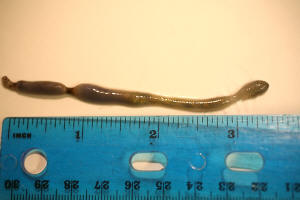
or badness. <Was a good one.> The constricted black ring
formed right before he died. I pulled him out and inspected. The
front end, left side of the ruler picture, was light blue with
small specks and the back end, second picture, was white with black
spots, which I found are tiny barbs. The back end was pretty deep
in the rock and almost anchored in. Sorry this is so long, but even
with the Internet I couldn't convince myself what it was and I
find it very fascinating. <From your description and images I am
fairly certain this was a Peanut worm (Sipunculid spp.).
Sipunculids are beneficial detritus feeders. You can see some
similar images here: http://www.wetwebmedia.com/pnutwrmidfaqs.htm
Thanks a lot, <Welcome! Mich> Adam p.s. I have a larger
version of the ruler shot, about 600kbs that shows some better
detail including some internal organs if you're interested.
<Sure! Please send along, will be posted.> |
|
|
|
Id help: Epitoke - 8/14/07 Hey everyone, <Hey Noah>
I'll start with the required (but well deserved of course)
Wow your site is awesome, I love it. <Thanks!> Anyway, just
recently I found this odd little thing in my tank (pictures
included). The white part is the head, and it does seem to have
visible eyes, mouth, etc. It behaves very oddly. It will swim
like an eel to the top of my tank, sit there trying to get its
head out of the water (at least that's what it looks like),
then suddenly stop moving and sink to the bottom of the tank. It
does this entire cycle maybe once every 5 minutes. Any help would
be greatly appreciated. <Well Noah, what you've got there
is an epitoke, sometimes called a 'swarmer'. It's a
reproductive form of an errant polychaete worm (sorry - can't
quite see enough to give a better Id). There are several
different ways these worms reproduce. In this case, the back half
develops into a segment filled with gametes (eggs or sperm). When
the time is right (usually a phase of the lunar cycle), the worm
emerges and the posterior section breaks away. That section then
swims up into the water column, and releases its gametes in a
mass spawning event. The head/anterior section returns to the
bottom and regenerates. By the way, with only one of these
present in your tank, you don't have to worry about an
imminent plague of polychaetes! For more information, please
Google the terms 'epitoke' or 'epitoky'. Also,
here are a couple of photos of one I had in my tank for
comparison. It had a very similar looking segmented posterior
section and is in the Family Nereididae. Size-wise, it was a
little over 4.5' long.
http://wetwebfotos.com/usermedia/high/0/2470_44.jpg
http://wetwebfotos.com/usermedia/high/0/2470_46.jpg > Thank
you very much, Noah <You're very welcome! -Lynn>
Re: Id help: Epitoke - 8/14/07 Thanks again!
<Anytime, Noah! It's pretty strange to see something like
that swimming around in your tank, isn't it (but pretty neat
too!). <lol> I hate to admit it, but that one I
photographed initially scared the living daylights out of me.
I'd just woken up, the lights were still off in the tank, and
I went in for a close look to check things out. Evidently, the
worm had been floating/resting up at the surface, and suddenly
decided to zoom by, right in front of me. I jumped back about a
foot and let out the most embarrassingly girly shriek ever. I
laugh about it now, but at the time'¦yikes! The lesson I
learned was to avoid going in for those close-ups first thing in
the morning! I figure it spares me, as well as the creatures
living in my tank! <g> Anyway, it was a pleasure helping
you, and please let us know if there's anything else we can
do for you. --Lynn>
Re: Worm Identification, Follow-up - 8/17/07 Thanks
again crew! <You're very welcome!> Sadly, the little
guy was sucked into a powerhead last night.:( <Aw, I'm
sorry to hear that. Thank you for sharing the photos and
experience with us, though. By the way, here are several good
links for future reference re: polychaete Id:
http://www.reefkeeping.com/issues/2003-03/rs/index.php, and:
http://home2.pacific.net.ph/~sweetyummy42/hitchworms.html. Good
luck, and thanks for keeping in touch. -- Lynn>
|
|
 .JPG)
|
|
Re: Identification? Worm 8/15/07 Ill
try to find it and get it out of tank, should be able to get a
close-up of it then! <Real good>
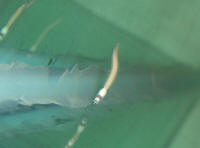
Re: Identification? 8/16/07 Ok, so i got it
and looked at it under a microscope. It has 8 legs (or whatever
the proper term is) on each side of the forward half of the body.
It has two dark lines going from head to tail, and a visible
blood vessel (or something of the sort) that has a visible pulse.
It is about 3 mm wide at the front half, and 4-5 on the back. It
is about 14 mm long. Some more pictures are included, hopefully
they will be better. Noah <Ahh, thank you for these. I do
agree with Lynn that this is very likely an epitoke... a
"reproductive unit" of a polychaete... Very common in
the world's oceans... and not a worry. Bob Fenner>
|
|
.JPG)
|
|
Worm That I Can't Identify and Is This Worm Bad For My
Tank? 8/8/07 Hi, <Hello Ed, Mich here.> I
purchased live rock a few days ago to add to my tank. I currently
have a Blue tang, two fire shrimp, two Percula clowns, a Firefish
goby, three Blue Hermit crabs, and a starfish that I cannot
remember the name of right now. <Sea stars do seldom fair well
in captivity. I would discourage you from any future purchases.
Brittle stars generally do much better and can be a beneficial
addition to your tank.> My parents have a 55 gallon back at
home in Florida. They only have one Yellow tang in the tank at
the moment, and have had it for a few years now. <This tank is
too small for a Zebrasoma flavescens. Should be in a 75 gallon
tank at a minimum.> They had told me that a hitchhiking worm
had grown to a large size and was prey to the tang. I have
recently purchased some live Fiji rock and have noticed that a
hitchhiking worm was present in the rock. The pictures are below,
is this a worm that I should be fearful of? <Let's put it
this way... I would not name him George or hug him or pet him or
squeeze him... Is definitely an errant polychaete worm, hard to
tell much beyond that. Most are harmless scavengers but a few can
cause problems. Is hard to get a perspective as to size. But
generally, bigger is badder! So if this guy is bigger than you
basic earth worm it may be time for manual extraction.> I do
not want to lose any of my livestock over this. What can I do to
remove it? <Manual removal is often the most successful. If
the head is removed it is unlikely to regenerate.> Is there an
invertebrate or a fish that I can add to the tank for removal of
this worm? <There are natural predators but I can't think
of any suitable for a home aquarium.> Thanks in advance!
<Welcome! Mich>
Re: Worm that I can't identify and is this
worm bad for my tank? Yep! 8/12/07 Hey Mich,
<Hi Ed!> Thanks again for the reply. <Welcome!> The
worm is about 6-8 inches long and about half inch wide. <Yipe!
Yipe! Yipe! Get rid'a that bad boy!> I was asking about
the Peppermint and Cleaner shrimp since I am looking at
alternatives to Pseudochromis and Arrow Crabs. I am trying to
find something that will live in harmony with my inhabitants but
will "take care" of my worms, in the deadly sense!
<Heeheee! I understand why. I think manual removal will likely
be the easiest method here, with a pair of forceps or thongs not
with your fingers of course!> Ed
<Good luck, Mich>
|
|
|
|
|

