 |
|
| Home | Marine Aquariums |
Freshwater Aquariums |
Planted Aquariums |
Brackish Systems |
Ponds,
lakes & fountains |
Turtles & Amphibians |
Aquatic Business |
Aquatic Science |
Ask the WWM Crew a Question |
| Please visit our Sponsors | ||||
Blood Parrots (sometimes called Jellybean or
Bubblegum Cichlids) and Flowerhorns (also called Luohan cichlids) are
both hybrids rather than naturally occurring fish. Blood Parrot
cichlids appeared during the 1980s, and Flowerhorns during the 1990s.
Both became instant hits, particularly in Asia, where both fish became
wildly popular, with good quality specimens commanding high
prices.
These fish have sharply polarised the hobby. Many
fishkeepers dislike them immensely purely on philosophical grounds:
they don't like hybrids. But there are ethical reasons why Blood
Parrots and Flowerhorn cichlids may be worrying. Blood Parrots, being severely deformed, are seen
as being crippled and disease-prone. The deformed spine and spine
bladder makes Blood Parrots more prone to swimming disorders, and the
beak-like mouth cannot chew food properly. A variety called the Heart
Parrot Cichlid lacks a tail fin, and can barely swim at all. One
British fishkeeping magazine revealed that some Blood Parrots have
their tails cut off specifically to produce this heart shape, though
how common this practise is remains unclear. Both Blood Parrots and Flowerhorns have been
tattooed. Contrary to what some retailers suggest, this is neither
painless nor safe. Needles inject dye into the muscle, not the skin,
and there are high levels of infection and mortality after the process.
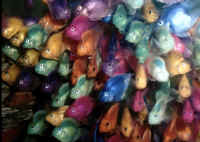
Tattooed Blood Parrots are often sold as Jellybean cichlids, and
include all ones with colours other than orange, including the yellow,
purple, red, green and blue Parrot or Jellybean
cichlids.
Despite these issues, Blood Parrots and
Flowerhorn cichlids remain quite popular, if perhaps less so than they
once were. In this article we'll review what you'll need to buy
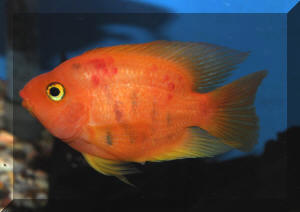
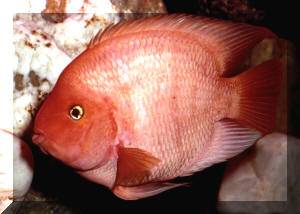
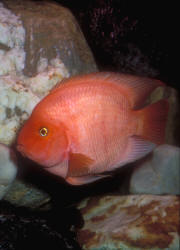
and do to keep them successfully. Identification Blood Parrots are unmistakeable, looking rather
like fancy goldfish in shape but with spiny, cichlid-like fins. They
are some shade of orange in colour: from pale whitish-orange through a
lemony yellow to a deep carrot orange. Blood Parrots in any colour
other than orange have been dyed and should not be purchased. Blood
Parrots get to about 20 cm/8 inches in length when
mature. Flowerhorn cichlids when young are easily
confused with the very similar cichlid Cichlasoma
trimaculatum. Adults are highly variable, and numerous varieties
are known. They typically have big, laterally compressed body, at least
partly red in colour around the head and throat, and with a series of
roughly circular blue-black spots along the midline of the flank.
Mature males sometimes, but not always, develop large nuchal humps
between the snout and the front of the dorsal fin. Some varieties of
Flowerhorn have been further crossed with Texas cichlids (Herichthys spp.) and "low quality" offspring from
such parents may be all but indistinguishable from Texas cichlids.
Flowerhorn cichlids get to at least 30 cm/12 inches in length when
mature. Aquarium size Blood Parrot cichlids are fairly large fish and
need to be kept in a reasonably spacious aquarium. A pair might be
maintained in a system 180-litres (47.5-gallons) in size. A group of
five specimens would need a bigger tank, around 285 litres (75 gallons)
being recommended. Flowerhorn cichlids are very large fish, and need
a very big tank; 285 litres (75 gallons) is the absolute minimum for a
single mature specimen. Water chemistry Like all Central American cichlids, Blood Parrots
and Flowerhorn cichlids want hard, alkaline water. Aim for pH 7 to 8,
10-20 degrees dH, and a carbonate hardness of at least 5 degrees
KH. One way to ensure good water chemistry is to add
a Rift Valley cichlid mineral salt mix, though a 50% dose should be
adequate unless your water is very soft. Per 5 US gallons (20 litres)
add the following amounts of each ingredient: one-half level teaspoon
baking soda; one-half level tablespoon Epsom salt; and one-half level
teaspoon marine salt mix (Reef Crystals, Instant Ocean, etc.). Stir
these into each bucket of water before adding to the aquarium. Provided
you do regular water changes, the minerals added this way should raise
the pH and provide sufficient buffering to prevent the pH dropping
between water changes. Temperature Blood Parrots and Flowerhorn cichlids are
tropical fish and cannot be kept in coldwater (unheated) tanks. The
minimum temperature for successful maintenance is 25 degrees C (77
degrees F). The temperature can be raised a bit to encourage spawning,
but keeping the tank warmer than 30 degrees C (86 degrees F) for long
periods will cause stress. Blood Parrots generally do not damage glass
aquarium heaters, though it is a good idea to place a plastic heater
guard around the heater just in case. Flowerhorn cichlids are very
likely to dislodge or break a heater when they are digging, so the
heater should be placed outside the tank. Options include putting a
glass heater inside a sump; using an inline heater connected to the
canister filter hoses (e.g., Hydor ETH); or using a filter with a
built-in heater to warm the water (e.g., Eheim Thermofilter).
Filtration Both Blood Parrots and Flowerhorn cichlids need
excellent water quality. Ammonia must be 0 mg/l and nitrite must be 0
mg/l at all times. Nitrate should be as low as possible, ideally below
20 mg/l. What these numbers mean is that filtration should be generous
and water changes frequent. Blood Parrot cichlids cannot swim well, so
turbulent water flow must be avoided. An external canister filter with
a spray bar to break up the current is ideal. Aim for a water turnover
rate of 4-6 times the volume of the tank in turnover per hour. In other
words, for a 55-gallon tank, look for a filter rated at 220-330
gallons/hour. Most canister filters have taps that allow turnover to be
adjusted up or down as required: experiment with these to get the
optimal water flow. Other options include large hang-on-the-back
filters, big internal canister filters, and undergravel filters with
two uplifts, one at each end of the tank. Flowerhorn cichlids are very big and very messy,
and large external canister filters or hang-on-the-back filters will
provide the easiest way to ensure good water quality. Aim for turnover
rates of not less than 6 times the volume of the tank per hour.
Diet Both Blood Parrots and Flowerhorn cichlids were
bred from omnivorous species that fed on a wide variety of foods. Their
wild ancestors would be eating algae, decaying plant material, insect
larvae, worms, snails, crayfish and occasionally small fish. In
captivity they will eat most foods, but the ideal diet would be a good
quality cichlid pellet (e.g., Hikari Cichlid Gold), softened vegetable
matter (e.g., cooked peas), and wet-frozen invertebrates (e.g.,
bloodworms, mosquito larvae, tubifex worms). Vegetable foods are
particularly important for avoiding constipation and
bloating. Live food isn't necessary and in particular
goldfish and minnows must not be used. These are not only unhealthy
(containing high levels of fat and thiaminase) but are also very likely
to introduce parasites. If you want to offer live foods as a treat,
choose things like river shrimps, brine shrimps and
earthworms. Contrary to what some retailers suggest, there
are no foods, repeat NO FOODS, that make the hump on a Flowerhorn grow
bigger or faster. A healthy male Flowerhorn will grow its hump at a
rate determined by its genes. Healthcare Blood Parrot cichlids are reasonably healthy
fish, but their deformed spine and swim bladder makes them particular
prone to swimming problems. Constipation is the most common reason that
swimming problems begin. Early signs of constipation include lethargy,
disinterest in food, abdominal swelling, and unnaturally long faecal
strings hanging from the anus. To avoid constipation, Blood Parrots
should be regularly fed green foods, particularly cooked or tinned
peas. Live and wet-frozen foods with a lot of indigestible material
(typically chitin) are also helpful; of these, brine shrimps and
daphnia are the most easily obtained. By contrast, freeze-dried foods are very likely
to cause constipation if used as the only foods. Flake, pellets, and
freeze-dried shrimps and worms should be used in moderation or not at
all. Like other big cichlids, Flowerhorn cichlids are
prone to Hexamita infections. This protozoan lives
in the gut of cichlids and ordinarily does no harm, but when the fish
is stressed, Hexamita infections can cause major
problems. Without treatment, infected fish will die. At least two stress factors have been identified:
poor water quality and poor diet. Besides zero levels of ammonia and
nitrite, nitrate levels must be kept as low as possible. When cichlids
are continually exposed to nitrate levels above 20 mg/l they seem to
develop Hexamita infections with alarming
regularity. Whether it's the nitrate that causes the problem or
something else to do with old, dirty water isn't clear, but regular
water changes are the key to avoiding Hexamita
infections. In terms of diet, Hexamita
appears to be most common when fish are given a vitamin-poor diet.
Fresh green foods are particularly important, and Flowerhorn cichlids
should be offered cooked or tinned peas, cooked spinach, or some other
soft green food at least once a week. Like Blood Parrots, Flowerhorn cichlids may also
become constipated if given just freeze-dried foods. Social behaviour and
tankmates Blood Parrots are territorial but their limited
mobility means they cannot swim away from trouble easily. Their
deformed mouths mean they cannot fight particularly well either. If
combined with more aggressive cichlids of similar size, Blood Parrots
invariably come off worse. They should not be kept alongside other
cichlids. They are best kept singly, in matched pairs, or in groups of
five or more specimens. Potential tankmates should be robust enough to
avoid trouble, but not aggressive or nippy themselves. Plecs make good
catfish for the bottom of the tank, while Platies and Swordtails
appreciate similar water conditions and tend to be left
alone. Flowerhorn cichlids are much more aggressive than
Blood Parrots and cannot usually be kept with other fish. They are best
kept singly or in matched pairs. Sexing Blood Parrots are difficult to sex. The only
reliable external details are the shapes of the genital papillae. Males
will have a longer, narrow papilla than females, which have a shorter,
rounder papilla. As with most other cichlids, the papilla on the male
will be visible a day or two before spawning, whereas that on the
female will be visible only a few hours before spawning. Otherwise,
Blood Parrots cannot be sexed except by watching them
spawn. Flowerhorn cichlids cannot be sexed when young.
Males should develop larger nuchal humps than females, but some males
have small humps not much different to those seen on the females.
Moreover, only a big, mature male will have this feature, and a cichlid
will need to be a couple of years old for its nuchal hump to be fully
developed. As with Blood Parrots, the only reliable ways to sex
Flowerhorn cichlids is to either watch them spawn or to examine the
genital papillae. Breeding Blood Parrot cichlids are generally infertile,
though sometimes pairs breed successfully under aquarium conditions.
Spawning is much like any other Central American cichlid, pairs
cleaning a flat surface such as a rock, and then spawning on it. Both
sexes help to guard the eggs and fry. Once the fry hatch and it will be
a few days, up to 5 days, before they use up their remaining yolk
supply and starting moving about looking for food. At that point they
can be reared on brine shrimp nauplii and egg-layer fish
food. Flowerhorn cichlids are usually fertile and spawn
readily, but the quality of the fry produced per batch tends to be very
poor. In other regards, breeding Flowerhorns is similar to breeding its
ancestors, such as Amphilophus citrinellus and
Cichlasoma trimaculatum. |
|

|
Features: |
|
| Featured Sponsors: |