|
FAQs on the Flowerhorn Cichlid
Selection
Related Articles: Flowerhorns by Ong, Blood Parrots & Flowerhorn
Cichlids: maintenance and healthcare of two popular hybrid
cichlids by Neale Monks, What do you think of
Flowerhorn Cichlids? By Neale Monks, Cichlid
Fishes,
Related FAQs: Flowerhorns, Flowerhorn Identification, Flowerhorn Behavior, Flowerhorn Compatibility, Flowerhorn Systems, Flowerhorn Feeding, Flowerhorn Disease,
FAQs on Flowerhorn Cichlid Disease by Category:
Environmental,
Nutritional (e.g. HLLE),
Social,
Infectious (Virus, Bacterial, Fungal),
Parasitic (Ich, Velvet...), Genetic,
Treatments,
Flowerhorn Reproduction,
Cichlids,
Dwarf South American
Cichlids, African Cichlids,
Angelfishes, Discus, Chromides, Neotropical Cichlids,
|
.jpg)
Some cichlids can be
purchased as "mated pairs"... most of the time, it is
best to raise a batch yourself, have them choose, grow together
over time.
|
1st International Flowerhorn Show in
Singapore 4/15/12
Bob
Flowerhorns from the region were in town for the
show.
Judging standards -
Overall impression 15.00
Head growth 20.00
Face and eyes 5.00
Body shape 20.00
Flower markings 5.00
Pearl 10.00
Color 10.00
Finnage and tail 15.00
Total 100.00
<Thanks for sending all along Per. B>
|
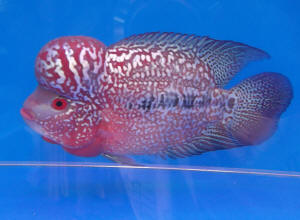 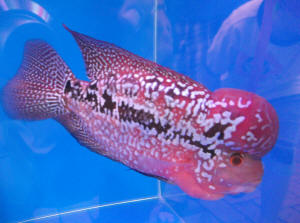 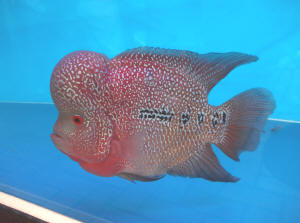 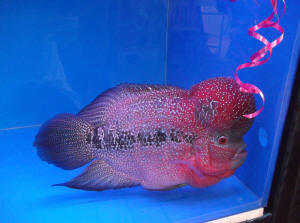 |
| Grand champion, Class C 1st, Class B 1st, Class A 1st. |
|
11th Pramong Nomjai Thai Tuala Show
4/2/12
Bob
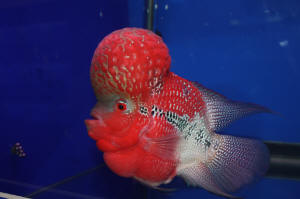
This Flowerhorn was a prize winner in the short body
category.
<Ohhh, I'm getting a headache! B>
|
 |
FH question,
stkg./sel. 7/12/11
Hi there! I've been searching all over the net for answers to my
flower-horn question and may have found an answer but I'm not to
sure. I have a huge tank (130 Gal). At the time it housed one full
grown FH, 2 small algae eaters, 2 small cichlids and a rope fish.
<Am wondering how the poor Rope gets enough to eat here!>
About 2 weeks ago a friend gave me her female FH to add to my tank.
Within the first 3 days she laid eggs. My FH didn't respond to her
and the eggs were eaten by the algae eater. Now here is my problem,
Since adding the female my male FH hunger slowly decreased and now he
doesn't eat at all. He will chase the female away from the food,
trying to prevent her from eating.
<I would remove or at least separate the new/female and older male
Flowerhorn... They need to be introduced to each other slowly>
They don't fight anymore ( they did at first for the first couple
of days)
I don't want to lose my male FH. Should I remove the female or do
you think if I give it more time his hunger will come back. Thank you
for taking the time to view my email. Krissy
<I would remove the female. Bob Fenner>
|
THAI SILK FLOWERHORN NUCHAL HUMP
5/4/10
Hi Neale!!!!
<Hello,>
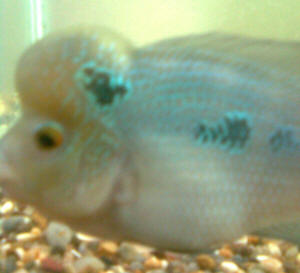
I recently purchased a Thai Silk which is 3.5" from a well
known aquarium shop in my city, the fish is amazing and has nice
features, its got a big bubble head too,
<Yes, I see.>
however I am worried after a recent chat I had with another
aquarium store owner, he said that the fish that I have has been
injected with silicon gel in its head
<Yikes!>
which is used by the local aquarium shop so that the fish head
looks big and can be sold at heavy price and after few days my
fish head is going to disappear even if I feed him best of food
and its never going to come back to normal again,
<Indeed, the silicone could easily leak out, and deflate the
nuchal hump.>
I have almost paid more than $200.00 for my FH which is quite
expensive
<I'll say.>
for a fish in my city, my concern is what if the head size goes
down in spite me feeding it well and maintaining good water
conditions, right now I am feeding it Grand sumo red and chingmix
head booster, can you please advice me some tips on this
please.
<Do read here:
http://www.wetwebmedia.com/FWSubWebIndex/FHParrotCichArtNeale.htm
Nothing more to add beyond that! Despite the myth, there's no
special foods that make their humps bigger or their colours
brighter, though feeding crustaceans, plants and algae will
ensure they have the best colours their genes allow. Foods
advertised as "head booster" are lying to you, because
they will do no such thing. Colour-enhancing foods enhance mostly
red, and do this with beta-carotene, and this comes from
crustaceans. Nothing magical about fish food for
Parrot/Flowerhorn cichlids except marketing!>
Thank you.
Vishwas
<Good luck, Neale.>
|
 |
FH stunted growth 4/26/10
Hi, Just recently acquired a Flowerhorn Thai Zz at a very low price. My
only concern is that it's 8 months old and it's
4"-5"?? the dealer said it's because he kept it in a
smaller tank and if I put in a larger tank (currently in a 40 gallon
tank) that I would still grow bigger. Is this true or has the
Flowerhorn's growth been stunted and won't grow anymore.
:(
Thanks,
Ingram Lim
<Your Flowerhorn will not grow much more, no matter what you do.
While fish grow throughout their lives, they grow fastest when they are
young. So a large cichlid species will typically grow very fast for the
first 6 months, a bit slower for the next 6 months, and very very
slowly across the next 10 or more years. Your specimen may grow a few
percent, but it will never reach the same size as it would have done
had it been kept in a big tank.
Flowerhorn Cichlids need about 75 gallons, and if you want to grow a
specimen to its maximum size, you will put it into a tank this size as
early as possible, ideally when it is less than 6 months old. Do
read:
http://www.wetwebmedia.com/FWSubWebIndex/FHParrotCichArtNeale.htm
Cheers, Neale.>
Flowerhorns, sel.
4/15/09
Hi, bought a Flowerhorn from an internet website its a zz malau it does
not look like the picture of the fish I bought.
<You might bring this up with the shipper>
Its red brown color not green. Its not as pearly as the picture and the
mouth looks bigger. I was told I was getting the exact fish in the
picture, I had read that they can change colors.
<Mmmm>
I thought the fish might have changed its colors because of stress. I
have two other Flowerhorns I bought they are brown color. Is there a
brown low grade flowerhorn? i read that there are some Flowerhorns that
are not good grade that are brown? i have been buying from internet I
have a small fortune in flowerhorns. I would like to know for buying
other Flowerhorns.
<I'd be sending your note, with some photos, to others who
specialize in keeping this cichlid hybrid. Bob Fenner>
|
Purchasing Flowerhorn 11/3/07
Dear WWM Crew, I have been keeping a community aquarium for about
4 years now and have got a fair amount of success with it. Thanks
to you people. <You're welcome!> I saw a Flowerhorn
last month and have been researching on it ever since. <Hmm...
understand it cannot go into your community tank.> I have got
a 50g tank with a heater, filter and other necessary stuff.
<50 US gallons or Imperial gallons? Either way, likely not
enough space. 50 US gallons is a mere 190 litres and way too
small a tank for a cichlid that normally exceeds 30 cm in length
and can be quite a bit bigger. 50 Imperial gallons is about 230
litres, which is only marginally better. Realistically, these
fish need around 500 litres of space (130 US gallons, 110
Imperial gallons). They are also destructive fish. Heaters need
to be protected by a heater guard or (ideally) placed inside the
filter. Obviously you need a massive filter for a tank this size
and for fish this messy.> Now I would like to buy a Flowerhorn
for my tank and was having a few queries. 1) What is the ideal
size/age to buy a Flowerhorn? <Same as most other cichlids:
not so small they're still delicate fry, but big enough they
are adaptable and willing to eat the foods on offer. I'd
suggest something in the 8-15 cm size bracket.> 2) Will a 6-7
inch Flowerhorn be okay for my tank? <For a while, maybe. But
since they get twice that big (and therefore 8 times the mass)
your 50 gallon tank will be viable for maybe 12 months.> 3) I
know the hump is a fat storage, but at what size/age does it
start developing? <It isn't for fat storage, although it
is made from fat. It's a secondary sexual characteristic. The
males develop them to show to females they can afford to
"waste" energy on a functionless organ. This reveals to
the female the quality of their genes, which in turn makes the
males more attractive mates. Being hybrids, Flowerhorns have no
"definitive" growth pattern like true species, so while
you should see the hump develop within the first year, this
isn't always the case.> 4) Is it so that only the males
have humps? <Not all males have humps of equal size, and some
don't really develop very substantial humps at all.>
Kindly advise. Regards, Sohiel. <Numerous articles and FAQs on
these hybrid fish at WWM. Start off with this one: http://www.wetwebmedia.com/FWSubWebIndex/flowerhorns.htm ,
and then read some of the related FAQs. I'm not a great fan
of these fish, and if you're looking for a first cichlid to
move onto from community fish, there are LOTS of better choices.
In a 50 gallon tank, you could keep any number of medium sized
species that are at least as pretty, if not prettier. Cichlasoma
salvinii and Hemichromis bimaculatus immediately spring to mind.
Both of these have amazing colours, and their relatively modest
size, around 15-20 cm, makes them much easier to house and look
after. Cheers, Neale.>
Re: Flowerhorn sel. 11/5/07 Dear
Neale, Thanks for the quick reply about my Flowerhorn questions a
few days back. It was tremendously helpful. Well, I have decided
to go with your advice and am going against purchasing of the
Flowerhorn. May be I will get one when I have another tank, in 6
months. In the meantime can you suggest me a few more moderately
sized but pretty Cichlids? Thanks a lot, you have been very
helpful. Hoping to meet you some day! Regards, Sohiel Deshpande
p.s. I read you have a fish named after you! Can you send me a
picture? <Hello Sohiel! I think choosing against Flowerhorn
cichlids is a good idea. Flowerhorns are too big for most
aquarists to look after properly. I think you should look at some
small to medium sized species. There are many, many cichlids that
can be kept easily in tanks as small as 20 gallons. Among my
favourites is Pelvivachromis pulcher, the Krib, a dwarf cichlid
from West Africa. This is a widely sold species that is unusual
in many ways, not least of all because the female is more
colourful than the male! She is also much more forward at
breeding time. Kribs make excellent first cichlids for any
aquarist, adapting to most water conditions and being very easy
to breed (largely because this species is a superb parent that
does all the work!). Another superb small cichlid is Laetacara
curviceps, the Flag Acara. It is a smallish South American
cichlid with very variable colours that depend on mood and
conditions. When happily settled in a tank with lots of shade
(real or plastic plants) it has colours that vary from cream to
green to blue with lots of spots of red and silver on the fins
and scales. Mikrogeophagus altispinosus is known as the Bolivian
Ram and is a dwarf cichlid from South America. It is not as
colourful as the Common Ram (Mikrogeophagus ramirezi) but it is
100 times hardier and easier to keep. It is also a brave,
outgoing fish so makes an excellent pet. A final recommendation
is Apistogramma cacatuoides, the Cockatoo Cichlid. This is
another South American dwarf. It has lovely colours, and unlike
most other Apistogramma, it is basically a hardy, easy to keep
fish. If you are prepared to take on a challenge, then some of
the Rift Valley cichlids might appeal. Labidochromis caeruleus
(the Yellow Lab) is amazingly brightly coloured -- like a coral
reef fish! -- but its aggression and largish size (around 10 cm)
makes it more difficult to keep than some of the others
mentioned. Neolamprologus brichardi (Princess of Burundi Cichlid)
is a peaceful and beautiful Tanganyikan cichlid but like other
Tanganyikan cichlids needs excellent water quality as well as
hard, alkaline water conditions. It is an adorable animal, famous
for the fact older offspring help the parents look after the
younger offspring, so you have a whole family working together as
a colony! Note that there are almost 2000 species of cichlid out
there, and many species make superb aquarium fish. Spending a
little time reading up on this amazing family before making any
decisions is well worth doing. Ah, and as for my fish, do a
Google image search for "Ellaserrata monksi" and
you'll find it. It's a fossil fish. A kind of Porgy,
something like a cichlid or wrasse. Hope this helps,
Neale>
|
Buying, shipping Flowerhorns Dear sir/ madam, <Bob F.
here> We want to buy from your store about Flower horn ?Lou Han,
I'm from USA some to do business fish store in
Indonesia. Can you ship to Indonesia if I need to pay with my credit
card for international payment. If you can do, please reply me soon and
I will choose for the models. Thanks and Regards <Mmm, we don't
sell Flowerhorns, cichlids, or actually any livestock. Please see this
article re this "species" here: http://www.wetwebmedia.com/FWSubWebIndex/flowerhorns.htm
Mr. Ong's e-address is linked there. You might contact him re this
fish. Bob Fenner>
Identifying Flowerhorn fry 8/20/05 Today I went into the pet
shop in Chinatown, Manhattan, NY. I was looking to purchase some
Flowerhorn fry's about 1 inch or less ... the pet shop guy showed
me some "Flowerhorn fry" that were with parrot fish fry but
to me when looked at the "Flowerhorn fry" they didn't
have red eyes, very dark coloration, some spots, and really looked like
some sort of other cichlid ...... my question is how do you tell apart
Flowerhorn fry from other cichlid fry? What are the major or key
distinctions to look for if any? thanks a lot. < At one inch
Flowerhorns look like the fry of red devils from which they are
partially derived. They may range in color from solid red to
grey with stripes. This makes it very difficult to determine if you
truly have a Flowerhorn. I personally buy fish from breeders if I am
concerned about genetics. In this case I would ask the store to
guarantee that they are truly Flowerhorns. If they are not, make sure
you bring them back for a full refund. If the store owner declines then
you already have your answer and you don't need to waste your time
and money on a fish you have no interest in.-Chuck>
|
|