|
FAQs on the Flowerhorn Cichlid
Disease 2
Related Articles: Flowerhorns by Ong, Blood Parrots & Flowerhorn
Cichlids: maintenance and healthcare of two popular hybrid
cichlids by Neale Monks, Cichlid Fishes,
Related FAQs: Flowerhorn Disease 1,
Flowerhorn Disease 2, Flowerhorn Disease 3, Flowerhorn Disease 4, Flowerhorn Disease 5,
FAQs on Flowerhorn Cichlid Disease by Category:
Environmental,
Nutritional (e.g. HLLE),
Social,
Infectious (Virus, Bacterial, Fungal),
Parasitic (Ich, Velvet...), Genetic,
Treatments,
& Flowerhorns, Flowerhorn Identification, Flowerhorn Behavior, Flowerhorn Compatibility, Flowerhorn Selection, Flowerhorn Systems, Flowerhorn Feeding, Flowerhorn Reproduction,
Cichlids,
Dwarf South American
Cichlids, African Cichlids,
Angelfishes, Discus, Chromides, Neotropical Cichlids,
|
|
|
Flower horn, env. "disease"
6/10/09
good day to the Crew! I inherited yesterday this 3 year old
flower horn, which came with a 55 gallon tank, I changed the
overhead filter to a 3 leveled canister one.
<Will need more filtration, circulation than this canister can
provide>
he's very active and eats anything I feed him. but just
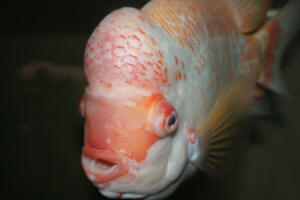
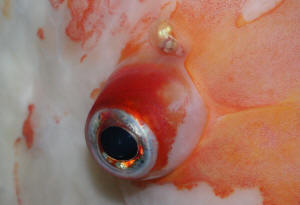
today, I noticed one of his eyes is popping out with a some sort
of skin growth above it (img_0199) I asked the previous owner and
he acknowledged that it was like that ever since a year or so. I
just want to know what it is?
<Looks like some sort of idiopathic tumour, arising out of an
Neuromast...>
and can it be cured and how?
<Mmm, likely self-limiting... with good/better/best water
quality and nutrition. Nothing to "treat" with per
se... Consider it/this as some sort of "callus" on your
hand.... from not wearing gloves let's say...>
I also noticed the other eye started to pop out (img_0202), ill
be guessing stress and new water?
<Ah, yes!>
I've been reading some articles on your sight, you really
help a lot of aquarist, hope you can help me too in in query.
Thank you in advance. Hoping for good news.
Albert
<Do a bit more, wider reading re this hybrids care... and look
into more filtration, water movement... and weekly partial water
changes of size. Bob Fenner>
|
  |
|
Re: Flower horn, env. dis. -- 06/10/09
Thank you so much for the quick response, you gave very sound
advices. : )
ill provide more circulation tonight, and more filtration maybe
by the weekend. ill just compensate with daily water change of
10% until that time.
I'm quite new with the aquarium set up. I'll do wider
reading on this topic.
<Sounds very good>
Thanks again Bob and the Crew! Let's just hope that its
condition would be better soon. I'll just post some updates
maybe on the weekend.
best regards to everyone!!!
<Thank you Albert. BobF>
Re: Flower horn... reading -- 06/10/09
No, Thank you sir. By the way, if ever I would consider any
medication for it, can you recommend anything? Salt, antibiotic,
temperature, any, none, etc.... ?
<Read here:
http://www.wetwebmedia.com/FWSubWebIndex/flowerhorndisfaq.htm
and the linked files above. B>
Re: Flower horn -- 06/10/09
Bob, thank you. id probably stay with salt first, increase
aeration, water movement and steady 28C temp until Saturday, if
it wont respond then id probably go with the antibiotics. of
course daily water change and addition of salt. its a bit easier
with aquarium set up, I can measure everything with a jug, unlike
with my Koi pond. : ) thank you so much for the help and the help
that u extended to all of us.
More power to you and the Crew!!!
Albert
<Thank you Albert. BobF>
Re: Flower horn 6/17/09
Bob and the Crew, Greetings!!!
<Albert>
just an update with my Flowerhorn, it has been 7 days since the
PopEye, did the following as advised by Bob: added pump for
circulation and aeration, salt at 1 tablespoon per ten gallon,
daily water change of 20% (salt added also), daily washing of
filter fiber matt, and voila... eyes back to its socket by good
90%. he looks normal now, very active, eating three times a
day...or more, re decorating the stonescape I provided for him in
the tank... : ) Thank you Bob for the fast response and advices.
More power Crew!!!
Albert
<Thank you for this update and good news! BobF>
|
Flowerhorn help needed desperately! 5/17/09
Hello there,
<Hello,>
Greeting to you from Bangalore, India. I bought a Flowerhorn MALE
almost 6 months back age being probably 3 months old. It was very
active and used to play with us the moment we went near the tank. We
were feeding it Humpy Head Ocean Free pellets. Once we went out of town
and had to leave it with my caretaker to feed it on daily basis. After
coming back for our 10 days tour we found that the water is dirty
probably because of extra food given by my caretaker and the Flowerhorn
fish has stopped eating. And even after a complete water change I found
it not eating for almost 4 to 5 days and excreting a white mucous
substance.
<Likely a reaction to poor water quality (ammonia, nitrite,
nitrate); stop feeding the fish, do a big (50%) water change, and then
another big water change the next day. You should find the fish
recovers quickly.>
After changing the water I treated the water with Sera Baktopur and
little bit of Rock Salt and pumped up the heat to 32 degree centigrade.
- Nothing happened.
<No, it wouldn't. Why would it?>
I tried to feed it frozen dried shrimps, and Blood worms - nothing
happened. It wont take any food. I read your message board and tried
to
feed it Metronidazole along with food - it still wont take it. We
don't have vets here to inject the fish or force feed medicine.
<For the love of God, stop feeding and start changing water!
That's all you need to do. This fish is being poisoned by water
quality problems. Very common when people have "helpers" feed
their fish. Just a note: these fish can go two weeks without food, so
better to leave them unfed during holidays if you don't have a
reliable person to look after your fish. Alternatively, do what I do:
put measured portions of food into paper envelopes, hide the rest of
the food, and tell the "helper" to empty one envelope each
time they visit your fish. I leave only enough envelopes for
feeding the fish once every 3 days.>
Then I tried to feed live Mollies and Guppies - which it happily chased
and ate, however it was still continuing to excrete the white mucous.
After almost a week's feeding on live fish...it has stopped eating
again.
<Don't feed this fish feeder fish! Why...? Why...? Cichlids of
this general type don't eat fish in the wild, and certainly not
cheap fish bought from pet stores. Feeder fish are an EXCELLENT way to
make your fish sick, by introducing parasites and bacteria of various
types.>
We stopped the live fish feeding and kept on changing 25% to 50% of
water every week. We did a complete water change last week.
<You needed to change the water immediately you got back. It's
likely that stress over the weeks caused latent Hexamita infections to
become dangerous. This is very, VERY common when cichlids are
continually exposed to high levels of nitrate. See Hexamita and
Metronidazole articles here on WWM.>
Its 3 months now. It still doesn't eat, its weak and now gone pale
in colour and still excrete the white mucous. It shows signs of hunger
as it charges to the pellets given but once it takes it in its mouth,
it spits it out again. I got the Flowerhorn as an import from Malaysia
and he is a part of my family. It's a torture to see him slowly
wilt away like this.
Desperately need your help.
Thanks & Regards,
Sumann
<Cheers, Neale.>
Re: Flowerhorn help needed desperately! 5/17/09
Dear Neale,
<Hello again!>
Thanks for the quick reply. It would also be helpful if you could let
me know if I have to use Sera Nitrovec after water change?
<No. Sera Nitrivec is a product that supposedly boosts biological
filtration; the thing with most of these products is that they're
redundant: a healthy biological filter will essentially maintain
itself, provided you're keeping the filter media reasonably clean
and providing enough water flow and oxygen.>
Also what is this white mucous excretion that my Flowerhorn is giving
off. Sometime after the water change I see a bulbous appendage sticking
out of its anal aperture - what is this?
<The mucous produced by Hexamita infections is caused by the
parasites irritating the wall of the gut. The gut secretes extra
mucous, and this binds with the faecal matter to produce the long,
white, stringy faeces we associated with the disease.>
Will just 2 consecutive days of big water change be followed up by 3rd
or 4th day water change or its just 2 days change.
<Change as much as you can, provided pH and hardness remain
relatively constant (and in the case of Flowerhorns, this should pH
7.5-8.2, hardness "hard" to "very hard"). If your
fish has an Hexamita infection, as is possible, then water changes
won't do anything other that optimize water quality; you will need
to medicate the fish to cure the disease.>
How often do I have to do water changes for Flowerhorn fish. Mine is a
300 litre tank with only one Flowerhorn in it.
<By default, 25% per week is a good amount; but 50% per week is even
better, especially if the tank looks messy!>
Thanks & Regards,
Sumann
<Cheers, Neale.>
|
I need immediate help please
I have a Flowerhorn. He's been sick for two weeks now.
5-10-09
<Oh?>
He used to eat floating pellets but when he got sick, he refuses
it not even trying swim upwards.
<With cichlids, it is almost always the case that when they go
"off" their food, it's because something isn't
right. Nine times out of ten, it's an environmental thing:
review water chemistry and water quality in
particular. Flowerhorns are hybrids, but they are basically
Central American cichlids at heart. Therefore they need hard,
alkaline water conditions; aim for 10+ degrees dH and pH 7.5-8.
Water quality needs to be
consistently good, 0 ammonia, 0 nitrite, and a very low level of
nitrate, less than 20 mg/l. Temperature should be middling,
around 25 C/77 F. There should be strong water circulation;
realistically, 8-10 times the volume of the tank in turnover per
hour. So for a 55 gallon tank -- the absolute minimum for a
Flowerhorn -- you'd be looking at a filter rated at 440
gallons per hour. If you're failing on any of these criteria,
that's almost certainly the cause of your fish's ill
health.>
So I've decided to give him freshly chopped shrimps and help
him eat through tweezers. But then after taking 3 small shrimp
pieces he tends to swam away from the food. I am so desperate
about his condition. He lies down on the tank floor horizontally
every now and then. Also I have noticed his rotten left fin and
white spots on both fins.
<Externally sounds like Finrot, in terms of lethargy, loss of
appetite, like Hexamita or plain vanilla ammonia or pH stress.
Regardless, these are all caused by environmental issues, so
while treating the symptoms is
important, you also need to fix the environment.>
when he got sick I began to discover this site and tried treating
him with all the advices I found here.
<I'm glad you're reading.>
I tried treating him with salt
<No value here...>
in combination with Methylene blue,
<Methylene Blue is more a preventative than a cure... many
much better medications for bacterial infections and fungal
infections on the market.>
changes 20% water everyday (which we used to do it every after 3
days) then with Flagyl (Metronidazole) 50mg everyday as it was
hidden on 3 chopped shrimp pieces.
<This is very specifically a medication for Hexamita; is there
evidence of an Hexamita infection? Specifically, copious, stringy
white faeces?
Ulcers/pits on the face? Dark body colour?>
Today is our 5th day of medication.. For the past 4 days we have
noticed a little improvement in him. Although he still lye down
on the floor tank but not as often as it was prior his treatment.
But just recently after administering his last dose, after eating
he begun to lye down very often.
As if he cannot carry himself. We use to let him stand but he
goes back lying down.. Please help me.. I am very much worried
and desperate. Been thinking he might have Flagyl toxicity or
what... I need your immediate help... Thank you very much..
<Hannah, you haven't actually given me any useful
information here, so I can't really help. Specifically, I
need [a] the size of the aquarium; [b] the water chemistry, at
minimum the pH and some idea of the hardness; [c] the filter
turnover (in gallons per hour or litres per hour, will be written
on the filter somewhere). Do remember that Flowerhorns are not
"hardy" but actually very demanding fish that need a
lot of space and robust filtration. Most fatalities come from
people sticking them in small tanks (20, 30 gallons) and equipped
such tanks with hang-on-the-back filters. Cheers, Neale.>
|
 |
Re: I need immediate help please
5-10-09
hello Neale.
<Hannah,>
thanks for your immediate response..
<You are welcome.>
here are the answers for the specific details:
1. the size of the aquarium: 20 gallons
<Far too small; unless this Flowerhorn is smaller than, say,
three inches/7.5 cm, 20 gallons of water will not be safe. The
problem is that there isn't enough water to dilute the ammonia
it produces. It also means
that between water changes, nitrate concentration will rise very
rapidly, while pH will likely drop very rapidly. Both these factors
place a heavy stress on cichlids.>
2. the water chemistry, at minimum the pH and some idea of the
hardness:
how can I check this?
<Using test kits; you should have at least a pH test kit (for
water chemistry) and a nitrite (not nitrate) test kit (to test
water quality).
These are the two essential test kits.>
we use a tap water direct from the faucet but we always to put an
anti-chlorine solution, and a tablespoon of salt.
<Your tap water might be fine if you live in a hard water area,
e.g., Southern England, but if you live somewhere with soft water
out of the tap, e.g., Northern Scotland, your tap water will not be
acceptable. Also, if you have a water softener in your house, the
water it produces is also very bad for your Flowerhorn cichlid.
Ordinary salt has no impact at all on water chemistry beyond
raising salinity, and this isn't helpful. You need to be using
a specific cichlid salt mix, which contains a variety of minerals,
not just sodium chloride. See here:
http://www.wetwebmedia.com/FWSubWebIndex/fwh2oquality.htm
Read especially the section on making these salt mixes, and why
this is necessary.>
3. the filter turnover: 600 L/h as written on the top filter
<That's about 150 gallons/hour, which would be 7.5 times the
volume of the tank per hour, a good amount for a 20 gallon tank.
But not nearly enough for a Flowerhorn cichlid being kept in a 55
gallon system!>
what should I do?
<First, buy a pH test kit and a nitrite test kits. Dip-strips
with both these tests (and others!) are inexpensive and while not
especially accurate, are good enough to start with. You may prefer
to buy the more accurate liquid tests though. Either way, get back
to me with some numbers.
I'm almost certain the problem is that tank is too small, and
moving this fish to a bigger aquarium would help. Whether that
means you upgrade your aquarium or pass the fish onto someone with
a bigger tank is up to you.>
thank you very much.
Hannah
<Happy to help. Cheers, Neale.>
Re: I need immediate help please
thank you sooo much for your help Neale.. I'll definitely get
back to you as soon as I have finished doing your advice, and that
would be later tomorrow... thank you so much!!!
<Glad we could help. Good luck, Neale.> |
Help Pls.... sick Flowerhorn
Flowerhorn With A Change In Stool Color 5/12/09
Hi, this is Anthony from the Philippines. I have a 5 month old FH and
just recently transferred him from a 20 gallon to a 75 gallon
aquarium.
Everything is well until 2 days ago, he stopped eating. I've been
feeding him Oceanfree and Sumo. The activity is the same though. Then
just this morning I noted that his feces, that was usually red in color
became white in color. Hope you could help me. tnx very much
Anthony.
<I have checked out the foods you are feeding your FH. There may be
a problem with too much protein stressing the digestive system of your
fish. I would recommend not feeding you fish for three days. If his
appetite does not comeback then start treating with a combination of
Metronidazole and Nitrofuranace. If his appetite has returned then try
feeding less a few times a day.-Chuck>
Flowerhorn bumps head and swims upside down
Trauma To Flowerhorns Head 4/12/09
Hi, My dad's Flowerhorn was swimming well until he bumped his head
trying to get to our baby looking at the aquarium. he bumped it on the
glass and afterwards started swimming upside down without control of
his position, direction or balance. is there anything we can do for
him? what happened to him? Thanks! Nina
< Unfortunately there is not much you can do but watch for secondary
bacterial infections. The blow to the head has caused nerve/brain
damage and only time will tell if he will recover.-Chuck>
HI Neale, FH hlth. 4/12/09
Hi Neale,
Thanks for your help buddy, my Flowerhorn is doing much better than
before but it still doesn't eat anything, I have treated my FH with
Metronidazole (200mg) I tried to get Nitrofuranace as well but its not
available in India as individual drug. Nitrofuranace is mixed with
other chemicals so I didn't find that to be a good idea to use
those drugs, could u pls suggest me alternative drug & food that I
can feed my FH, waiting for ur reply, take care & happy Easter.
<Hello Sujit. I'm not a vet, and I have no personal experience
of using Nitrofuranace (it's not available in Britain except with a
prescription, in which case your vet will give you the precise drug
required). I'd recommend looking over this page first:
http://www.wetwebmedia.com/furancpdfaqs.htm
But failing that, you really will need to ask a vet or medical doctor.
I simply don't know anything about alternative drugs. Cheers,
Neale.>
VERY URGENT HELP PLEASE (Flowerhorn) 4/7/09
DEAR SIR,
*VERY URGENT HELP PLEASE*
I have a Flowerhorn & it has a bloated stomach & when I tried
pressing it stomach we can see a liquid coming out, I tried feeding him
green peas, which it didn't eat, I have reduced the water in the
tank & mixed Terramycin 250gm as per the instructions by local fish
vendor, but still FH is not able to swim & also there is a white
spot that has appeared on his tail, plzzzzzz suggest me some remedies I
don't want to lose my Flowerhorn, plzzzzzzzzzzzzzzzzzzzz help
ASAP
<Hello. Need more information than this. Specifically, how big is
the tank?
What sort of filter system do you use? What are the water chemistry and
water quality parameters? To say anything sensible we need, at minimum,
the pH and nitrite values, and the general hardness and nitrate values
are also very helpful. What do you feed this fish? How warm is the
water? Just to cut to the chase, most cichlids (indeed, most aquarium
fish) get sick because of environmental issues. Poor water quality and
water chemistry instability are both major killers. Flowerhorn cichlids
-- for some reason -- are often purchased by people who haven't
read anything about their needs first. Despite being hybrids, they are
Central American cichlids in the general sense, and therefore need
hard, basic water to do well (pH 7.5-8, hardness 10+ degrees dH).
Nitrite and ammonia values need to be zero, while nitrate should be as
low as practical, ideally less than 20 mg/l. Aquarium size needs to be
upwards of 55 gallons/210 litres, and the filter should be rated at 6
times the volume of the tank in turnover per hour, i.e., at least 330
gallons/hour for a 55 gallon tank. They are of course tropical fish, so
you can't keep them in an unheated tank. Like most Central American
cichlids, they are omnivores that need a mixed diet containing mostly
invertebrates but also green foods, particularly algae.
Let's put it another way: a diet of feeder fish will surely make
them sick eventually, while too much dried food leads to bloating and
worse. Cheers, Neale.>
Re: VERY URGENT HELP PLEASE (Flowerhorn) 4/7/09
my tank is 250 litres, there is no filter system
<Tank is acceptable in terms of volume, but the lack of a filter is
why this fish is sick! You must have a filter! I'd recommend
something with capacity 6-8 times the volume of the tank in turnover
per hour.>
& I don't know what is the ph level & nitrate value,
<Then find out! I can't help you without knowing these
things.>
could u plz let me know how to check it so that I can check it &
let u know, plzzzzz help,
<For gosh sakes, please use proper English, not "text
messaging" spelling.
Usually such messages get sent back, unread.>
*VERY URGENT HELP PLEASE*
<We answer messages on a first come, first served basis, so
there's really no point asking for extra help. We assume everyone
who writes to us needs urgent help. Cheers, Neale.>
Flowerhorn lying down - Urgent Please 04/04/09
Injured Flowerhorn
Hi , I am having a Flowerhorn fish of 8 months old. It is in a 20
gallon tank with filter pump. Before two days it hit the glass hard.
Suddenly it starts swimming side-wise. Now it is lying in the floor.
Its mouth is open. Its gills were slowly moving. It often opens it
mouth as it were gasping. I am changing 50% of water daily. Can you
please suggest a solution for its recovery. Now its skin color is
changed to black. Do I need to take some preventive action from
infection.
< The trauma from the head injury sounds like it is getting worse.
The black coloration may be the result of nerve damage. I don't
think it is an infection. The water changes are good. If you think it
is an infection then you could try Nitrofuranace or Erythromycin, but I
don't think that is the problem. You could try a little salt or
some Pimafix/Melafix. Sorry I can't be more positive about the
outcome.-Chuck>
Growth on Gill of Flowerhorn 10/22/08 Dear Crew, My
Flowerhorn who lives in a 75 gallon has this reddish peach ball thing
growing out of its right gill. He is eating fine, and acts very normal.
He eats , cichlid excel, Cichlid bio- gold, Cichlid Gold and
bloodworms. The water quality is good because I change the water a lot.
At first I thought it was a cut, then the circle grew a 2nd one, the
lumps also made his right gill stick out more. Should I be worried? or
is it a thing that comes and goes? Thank you for your time. < I have
had this in the past and currently have this now on a jewel cichlid.
Before your letter I have only seen or heard of this on jewel fish and
dwarf jewel fish. The first time I cut it off with an Exacto knife. The
fish bled a little and was fine and it didn't grow back. The fish
that has it now is doing OK. I don't know what causes it. The fish
were tank bred so I don't think it is a parasite. I am thinking
about giving the fish to UC Davis Vet school so the can check it out.
If you feel that it is causing too big a problem you can remove the
fish from the tank and hold him down in a wet towel from the aquarium,
lift the gill plate and cut off the growth. Treat him in a hospital
tank with antibiotics to prevent infection. Increase the aeration so
the fish doesn't have to breath so heavily.-Chuck>
My Flowerhorn Died due to Fungus and I need to replace the
same. 10/3/08
Dear Sir,
<Hello,>
I am writing this mail from India. I had a Big Flowerhorn fish (Short
Body - 2 Yrs Old) which Died yesterday due to Fungus all over his body.
I had tried my level best to cure him by adding Rid-All Anti Itch and
Rid-All General Aid along with a dose of Teramycine and Abson Salt as
instructed by a Local Fish Dealer/ Breeder.
<None of these are anti-fungal medications...>
I have one more small Flower Horn Fish (2-3 Months old - Long Body) and
I am thinking of keeping the same in the tank in which my existing Big
Flower Horn was.
<No, you're really not thinking about this. Sit back, wait for
the tank to stabilise, and check that the existing fish is healthy. Do
water chemistry and water quality tests to make sure that you're
maintaining the tank correctly. Don't do anything for at least 6
weeks.>
Request you to kindly guide me with the procedure to treat the tank
before doing the same.
<No such thing. Your job is to review the needs of these hybrid
cichlids, and then make sure you're offering -- consistently -- the
conditions they need.>
Air Filter has been washed using warm water and the old oxygen pipes
have been replaced with the new one as the same were in the infected
water for more than 3-4 days.
<Irrelevant.>
Entire tank has been cleaned and fresh water has been added.
<Potentially dangerous if the filter has been damaged: understand
this, the filter bacteria start dying within a few minutes of the
filter being switched off. Many of the bacteria and fungi that cause
disease are present in all aquaria, all of the time. Normally they are
beneficial, playing a role in the nitrogen cycle by breaking down
organic matter. If a fish develops Finrot or Fungus, that's because
the fish was damaged or stressed, and those bacteria and fungi can
infect the weakened fish.>
Do I need some extra care to be taken apart from the above so as to
avoid the infection to the other fish which I may release in the bigger
tank within a day or two ?
<You aren't adding any more fish for a few weeks... your job is
to make sure you understand the needs of these hybrids, and are
providing appropriate conditions. In other words, a 55+ gallon tank,
temperature around 25 C, hardness above 15 degrees dH, pH 7.5-8.0.
Water quality needs to be good: zero ammonia and nitrite, and nitrate
below 20 mg/l. Realistically you need a canister filter offering 6x the
volume of the tank in turnover per hour, that is, something upwards of
330 gallons per hour for a 55 gallon tank. Make sure you are fulfilling
every single one of these requirements.>
Can I put a partition in between the tank and add some other fish (Gold
Fish/ Angel Fish/ etc ) on the other side of the tank keeping the Baby
Flowerhorn separate from them ? My Tank Size is 30" x 15' x
15".
<Tank is far too small...>
Kindly advise.
Regards,
Amit
<Stock this tank with small fish suitable for its size, or else
upgrade the tank if you want to keep Flowerhorn cichlids. Cheers,
Neale.>
|
Flower Horn (Golden Trimac) with Bloated Belly..Urgent
Help needed 9/29/08
Bloated Flowerhorn
Dear WWM Crew, I am from India (Chennai City mean day temp 35 deg
C). I have a two and half year old FH-Golden Trimac. I have him
in a 250 litres tank with bed and liquid filter system. The feed
is dry shrimps once a day. I changed the entire water after
cleaning the bed and filters on first week of September.
< When cleaning an entire tank you run the risk of over
cleaning the tank and removing all the beneficial bacteria from
the aquarium. With no beneficial bacteria fish waste and uneaten
fish food quickly are broken down into deadly ammonia. Tough fish
like Flowerhorns may not out right die from the ammonia spike but
the stress can lead to diseases such as bloat/dropsy.>
The problem started then onwards. It has developed a swollen
belly with a 3/4 inch tissue sticking out from his rectum. Based
on our local aquarium guy's suggestion ( piles infection..?)
I kept him in a small tank mixed with
half tab Flagyl. I could not see any significant improvement. He
had stopped eating since then. I had taken few photos which I am
enclosing.
Since three days he is standing vertical and not active with his
mouth facing tank bed. I am distressed at his state. Please send
me your advice ASAP to save my lovely FH. I had earlier gone
through your posting and FAQ
on FH diseases. I am enclosing the Photographs taken a week back
and few more taken yesterday.
Yesterday night I transferred the FH in a plastic bucket with 15
litres of water I mixed tab Metronidazole one # 250mg and put the
aeration pump. Till 11 AM this morning he is stable. Now at least
he is swimming and moving. His
mouth and teeth appear a light pale yellow in colour
Thanks and Regards K.M.C. Ranges Chennai
< The Metronidazole/Flagyl is the right drug of choice. The
pressure from the internal infection have forced some of the
intestines out through the rectum. These tissues can become
infected as the fish drags them across the aquarium. The internal
infection can be difficult to treat. Ideally you need to get the
medication in the fish through the fish food. Since your fish
isn't eating I would recommend a little different treatment.
Treat with the Metronidazole every other day doing a %50 water
change on the days you don't treat. I would also add an
antibiotic such as Nitrofuranace with the Metronidazole. After
the third treatment I would try to feed the fish and try to get
them to eat. If things aren't any better you could try Clout
if it is available in your area.-Chuck>
|
  |
|
Re: Flower Horn (Golden Trimac) with
Bloated Belly..Urgent Help needed Flowerhorn Dies, Resetting the
Tank Back Up -- 10/02/08 Dear Chuck, You are right. The
mistake of completely cleaning the tank is costing (morally) me
heavily. < Everybody makes mistakes and nobody is perfect. The
important issue here is that we all learn from mistakes so others
don't make them. This is one of the reasons WWM exists and I
participate as part of the crew.> Yesterday I did a 50% water
change. When I returned back he was much more stable and
moving/coming up to see me and draw oxygen. By night I again did
50% water change and added a tab of Metro and one tab of
Nitrofurantoin, the trade name was Martifur 100mg in 20litre of
water. The water turned light yellow. I aerated and put my FH...I
unfortunately didn't monitor him. Morning at 6 I saw him
dead, which left me my wife and daughter very sad and grief
stricken. For two years he had been so pro-active and fine with
us, now left us depleted and left a void in our dining area.
Please advice me, what we should do with the tank and its filters
polished stone and marbles. Do we have to disinfect it before
using the same for other fishes (I have 10 Koi karbs 4/6 inches
size. Please advice Regards Rangesh <Get an ammonia and
nitrite test kit. You have already cleaned out the tank so no
need to do that again. Keep a few fish in the tank and control
the ammonia and nitrites with water changes. When the tank has
its biological filtration up and running the ammonia and nitrites
should be zero. Keep the nitrates under 20 ppm with water
changes.-Chuck>
|
Need help! :o, FH... fdg., hlth. "feeder
goldfish"... 9/27/08 "Hi. Can you please help me
with my cichlid, commonly known as Flowerhorn locally. Our fish has not
been eating for 2 weeks already, or maybe even more. Since then, his
head lump decreased in size and even his body size decreased.
<Starving... maybe has parasitic worms. Often happens when people
use unclean live food, particularly live feeder fish, what I call
"parasite time bombs"...> We changed water every after 3
days, put salt after every change. And for the past days, we've
been dropping Methyl Blue and Melafix, since we've been suspecting
that the fish is sick. The gills have some black stuff, seems like
burns or bruise, a part of the tail has it too. <Salt irrelevant
here. Melafix useless. Methylene Blue is a treatment for Fungus; not
much use otherwise. Do attempt to ID the disease before randomly adding
stuff to the water.> We saw a white, sponge-y thing inside his tank.
And every time we remove it, some thing like it comes out again. A
relative told us that it's probably fungus. It looks like cotton in
the tank, but once removed, it feels like white-mucus. We're not
totally sure where it's coming from. <Fungus does indeed look
like cotton wool. Do also consider Finrot and Mouth Fungus, diseases
that often occur in the same context: typically poor water quality.>
Just today, we bought and submerged a water heater, <You were
keeping this fish in cold water before...? No wonder its sick. Cichlids
are extremely intolerant of cold water.> changed the water, dropped
Methyl Blue and Melafix, and placed salt again. We tried feeding him
but he didn't even touch the food. When we were removing the
wastes, we noticed a scale detached out of his body. <Hmm...>
He's usually playful and swims around the tank. But now, most of
the time, he's just at the bottom of the tank, in one area and
stays there for a long time. And seems like his mouth is almost always
open (though I'm not too sure if the mouth is always open).
<Have you done nitrite and pH tests?> Please do help. We're
actually running out of ideas on what to do already. And we're
hungry for answers already. And we really do feel bad for our pet.
<I bet. Please review the needs of these fish. Flowerhorn cichlids
are extremely demanding animals, and frankly cannot be considered
"newbie" fish. You need a big tank (55 gallons upwards); zero
ammonia/nitrite/ 20 mg/l or less nitrate; pH 7.5-8.0; and moderately
hard water. If you're failing on any of these -- that's your
problem!> The fish is actually a gift from a relative. He's been
with us for months already, and never encountered any problem since
then. <Hmm...> We've fed him fish food (pellets) and
bloodworms bought from our local fish store. We've suspected that
the bloodworms caused the disease, but we can't really point it
out. <Bloodworms unlikely to cause parasitic infections... look at
environment in particular...> I wanted to have the water checked for
ammonia, nitrites, nitrates, etc. since I've been reading that
mostly, but I just can't figure out where I can have the water
checked. <Where? At home: you go buy (minimum) nitrite and pH test
kits.> We placed Tetracycline powder in the tank yester eve. The
fish seems to be moving better, but he still doesn't want to eat.
What else can we do for him? <Many things: in particular read up on
Central American cichlids, review water quality and water
chemistry.> Please do help immediately. We're worried and
don't want the fish to die. We are even desperate for answers
already! <Oh.> Thanks and God bless! :)" <Well, the Fish
Gods will be expecting you to go test nitrite and pH, review water
quality/chemistry issues, and evaluate whether the environment you have
prepared for this fish matches its demands.> `Chrys <Cheers,
Neale.>
Re: Some more info (Need help! :o)... 9/27/08 Hi
again. My Uncle told me just now, that the feeders we were feeding him
is not bloodworm, we just don't know what it's called, but we
got it from our local pet store. <Live food is fine, provided
it's safe and clean. To that end, the live foods you should NEVER
use are live fish or live Tubifex worms. Of the common live foods,
these are safe: Daphnia, River (estuarine) Shrimps, Glassworms,
Bloodworms, and Brine Shrimps. Earthworms collected from
"organic" terrain are also good, but do bear in mind that if
you spray pesticides in your garden, the earthworms can pick them up.
Do also understand though that Brine Shrimp especially are not
"complete" in the sense of having a range of nutrients. Fish
eat them happily enough, but then people eat all kinds of stuff that
isn't particularly nutritious as well. So live Brine Shrimp are
fine as a treat, hopeless as a staple. Most cichlids are at least
partially herbivorous, and some portion of their diet should be green
foods such as tinned peas or Sushi Nori. Without the vitamins from
green foods, they are more prone to nutritional problems and
constipation.> I really am not knowledgeable about fishes, since
it's my first time to really be hands-on with a fish. I checked on
him after reading your site's FAQ, from what I got from my nights
of researches, I am suspecting tail/fin/gill rot. Though I'm not
really sure if that's what it is. I also saw some white spots at
the bottom of his mouth. I think that it is a normal part of the
fish's structures. <Difficult to say without a photo. Finrot is
easily confused with Mouth Fungus (actually a bacterial infection,
despite the name) and Fungus. All can be treated with Maracyn and/or
eSHa 2000, so if in doubt, use them. Avoid medications based on
Tea-tree Oil (e.g., Melafix); these are not consistent, and despite
being cheap, aren't worth buying.> We bought a water heater,
(Sera Aquarium Heater Thermostat) and set it at 32. <32 Celsius is
WAY to hot for these fish. Do read, review the needs of these fish and
act accordingly. If in doubt, 25 C is safe for most tropical fish.>
We're planning on trying to feed him bloodworms and see if it will
increase his appetite. Do you think this would be of help? We have been
feeding him Ocean Free Super Red and Humpy Head interchangeably and
some worms occasionally. <There's no need to cram food into a
fish: it will eat everything you give it, but most will be egested as
waste. Indeed, excessive protein and especially fat do more than harm
than good. One or two small meals per day is ample for most fish.
Mammals (like us) have evolved over millions of years to eat huge
amounts of food relative to body weight, trading the effort involved in
collecting food against the benefit (in the case of our ancestors
especially) of being active at night when its cold. Fish don't work
that way, and instead leave their metabolism to fluctuate up and down
with the environment. They only need relatively tiny amounts of food
for growth and repair, and of course reproduction. In real terms, the
average fish gets by on 10% what a similar weight mammal would, and
furthermore lives many times longer. It's a very VERY common
mistake among newbie aquarists to overfeed their fish, compromising
water quality and potentially causing harm to the fish. Again, read
before doing random stuff.> Please do extend your help! We really
are desperate to help our Flowerhorn. <Hope this helps.> Thanks
very much for your time in advance. God bless, Chrys <Cheers,
Neale.>
|
Sick flower Horn Cichlid... just new
9/25/08 Dear WWM Crew, <Trinh> I have a 4 inch
Flowerhorn that I just bought about two weeks ago and is now in a
10 gallon tank. <Needs more room than this> So here is the
situation: The day after I bought the fish ( thurs 9/4), I try to
feed it all kinds of pellets including alife by Hai Feng, but it
wouldn't touch any of the foods. <Likely will take a few
days to settle in> So I thought it was stress in the 10 gal
quarantine tank <Yes, agreed> and didn't want to eat. I
did try to feed it for about a week, but it didn't touch any
of it and scooped the uneaten food out with in several minutes.
It comes up and looks at the food and then swims away. There is
no visible signs of heavy breathing or scratching, but the fish
bends its body into a semi-U-shape once or twice I have seen.
Also there are visible signs that there are stress bars on its
body. The stomach seems a little bloated or big. There is no
visible signs of hole in the head. It has not poop anything out
since for about a week, but a week later there is this white
stringy noodle looking poo that hangs out of its anus. Reading
from the advice of the Flowerhorn forum, I was told to use
"Metro" and treat in for almost a week now. <Mmm, I
wouldn't have done this> It's in a 10 gallon hospital
tank with a small filter and heater set at 82 F with 10% water
change every three day recommended by the package. So....day 6; 4
metro treatment. I guess it's a little bit of improvement
since my latest post on Sunday. It still refuse to eat anything
even bloodworm and krill. Stomach still looks swollen a little. I
sort of over look this but the mouth seems to never close shut,
rarely, and sometimes it seems like it's does these rapid
coughing not sure what is it 1. Any one have any ideas? <Just
stress, not hungry... Very likely water quality issues... are you
monitoring ammonia, nitrite here?> Well it poop more, no more
sign of white poo, but still that stringy-thin brownish/yellow
thread poo...see in pics <Is what was in its stomach from
wherever it was cultured... Inexpensive plant-based
material...> 2. Is this a good sign that the medication is
working? <Not necessarily> Not sure what it is, but
there's this dark spot on the stomach area like two days ago.
3. Can anyone identify what it and if harmful how to treat it?
<Not from the information presented, no> 4. How's the
recovery rate of this fish?...will it ever improve <Generally
very tough animals... I would move to permanent larger,
well-established, better-filtered... quarters... stop the
exposure to Metronidazole... Will kill the kidneys (and the whole
animal) if prolonged> thanks so much for your help!!
<Bob Fenner>
|
 |
|
Re: sick flower, reading
9/25/08
....so when should I be worry about the fish not
eating...it's two weeks now of not eating
What should I do in the time being so I can keep it feed or some
nutrition in its body? Is it even worth buying those vitamin fish
tablet that you put in the tank if the fish doesn't want to
eat at all? Also if it's not eating base on my description
what's your diagnosis and how should I treat it. I was told
that its digestive tract was maybe damage...not sure...but if so
how can I repair it.
-Thank you very much for the help
<Read here:
http://wetwebmedia.com/FWSubWebIndex/flowerhornfdgfaq.htm
and the linked files above. BobF>
|
Flowerhorn with Air Bladder Disease, reading -- 6/17/08 Hi, I
have a Flowerhorn that is about 6 years old. He appears perfectly
beautiful and healthy. He has developed air bladder disease. <...
from what cause?> He is not constipated. We noticed he was spending
a lot of time sitting on the bottom, but in the past few days he is
swimming with his head down. I have found that there are various
opinions whether this is caused by a bacteria or virus. <Can be
either, neither> I do not know how to "dose" antibiotics
or which ones to use. He is about 12" long and in a 55 gal. tank.
<Needs more room than this> We were planning on getting him a 75
gallon tank in a few weeks. Can you tell me what antibiotics to use and
in what quantities? Thank you. J. Farmer <I would read here:
http://wetwebmedia.com/FWSubWebIndex/flowerhorndisfaq.htm and the
linked files above... Perhaps try Epsom Salt, improving water quality,
nutrition... Bob Fenner>
What happened to my FH? 5/6/08
Flowerhorn Going Through Tough Times I've just done a complete
clean up of my tank (taking out everything and cleaning it). I put the
FH in a small bucket. It was lying on its side in the bucket but my
brother says it's ok. When I put the FH back into the tank, it was
not active as before. It was just staying in one spot. I tried feeding
it but it did not eat. I felt that the water was too cold so I took
some water out and poured in hot water and installed a heater. I had a
new Whisper filter installed. I have a 50gallons tank and the Whisper
can handle 60 gallons. My FH is about 6 inches. I felt odd because it
usually was really active so I used a net to poke it and it moved
around a bit. Then I picked it up out of the tank with the net to take
a closer look. When I put it back in, it suddenly moved very fast and
hit the tank 3 times (as if it bounced from one corner to the other).
Afterward, it would just stay still in a corner at the bottom of the
tank. A few hours later, I found it lying on its side with white stuffs
all over its body and his eyes also has the white stuffs. I thought it
was dead so I picked it up but then I notice it is still breathing. I
believe it is internal bacterial infection? I read somewhere to put
salt in so I thought it is table salt (didn't know it was Epsom
salt). I drizzle some table salt into the tank. I think it got worst.
It is barely breathing now. Can it still be cure? Or should I just kill
it? <Check the ammonia levels in the tank. When you cleaned the tank
you probably removed all the beneficial bacteria that breaks down very
toxic ammonia to less toxic nitrites and nitrates. I use to recommend
Bio-Spira but it was discontinued some time ago. Now I would recommend
frequent water changes to keep the ammonia levels under control. The
water should be at 78-80 F. You will need a thermometer. If you fish is
being attacked by bacteria then I would recommend using Nitrofurazone.
This will impact the same bacteria you are trying to culture but will
cure your fish. After the cure is complete you will need to watch for
ammonia spikes or the same thing may happen all over
again.-Chuck>
|
Fin rot dose or not? Pls help 5-1-08
Flowerhorn With Tail Rot and Bloat Dear Sir/Madam, Greeting of Peace! I would like to seek
your advice because my Flowerhorn is so sick. About 2 weeks ago I
noticed that his fin is like being eaten out. So I search the net
and it said that the med to be given is Tetracycline. So I bought
the meds, and left it there for a couple of days. When I came
back last week his condition didn't improve. So I bought
Metronidazole. Together w/ the tetracycline, changed again the
water and cleaned the container. I have also noticed that his
body flexed only to one side and noticed a bulge in his stomach.
I was wondering what it is? I just thought that since he flexed
at one side it could be an effect. But noticed today that the
bulge became bigger and his anus seems inflamed (white in color).
I tried to feed him today but he doesn't have any appetite.
Yesterday he ate and passed a stool, same color and consistency.
Please help me what to do. What proper medication do I need to
give? Thank you in advance. Sincerely, Claire Philippines < I
have heard that Tetracycline only works well in very soft water.
I would recommend using Nitrofuranace for the fin rot. If it is
severe then I would cut off the infected area back to health fin
tissue and then treat the tank. The bloating sounds like an
intestinal infection. The Furanace will help if the problem is
bacterial. If it is caused by a protozoan then the Metronidazole
should be used. I have used these in combinations without any
side effects. If you fish is eating then try and feed him some
medicated food with Metronidazole in it.-Chuck>
FH Fin rot dose or not? Pls help I think
my fish is dying 5-1-08 Dear
Sir/Madam, Greeting of Peace! <And you> I would like to
seek your advice bec my Flowerhorn is so sick. 2 weeks ago I
noticed that his fin is like being eaten out. So I search the net
and it said that the med to be given is tetracycline. <One
possibility, yes> so I bought the meds, and left it there for
a couple of days. when I came back last week his condition
didn't improve. so I bought Metronidazole together w/ the
tetracycline. <Mmmm> change again the water and clean the
container. I have also noticed that his body flexed only to one
side and noticed a bulge in his stomach. I was wondering what it
is, I just thought that since he flexed at one side it could be
an effect. But noticed today that the bulge became bigger and his
anus seems inflamed (white in color). I try to feed him today but
he doesn't have any appetite. yesterday he eat and passed
stool, same color and consistency. Please help me what to do.
What proper medication I need to give? thank you in advance.
Sincerely, Claire Philippines <Need information your system,
water quality, history of care... Please read here:
http://wetwebmedia.com/FWSubWebIndex/flowerhorndisfaq.htm and the
linked files above... to gain a greater understanding of the
sorts of data we're looking for, review others experiences.
Bob Fenner>
|
|
Sick Flowerhorn, no data... reading
4/20/08 Hi to everyone, <Cora> As you can see from the
picture below, my flower horn has something red sticking out of
his anus. He is also not eating well and doesn't seem to be
happy. What could be wrong with him. <No pic enclosed or
attached> I've searched the internet for an answer but
found none. Please help me. Thank you very much. Thanks again,
Cora <Please read here:
http://wetwebmedia.com/FWSubWebIndex/flowerhorndisfaq.htm and the
linked files above. Bob Fenner> Cora
Re: sick Flowerhorn. Pix, but still no data, using WWM --
04/21/08 Hi everyone, <Cora> I'm sending this again
with the pictures attached and not pasted as I did before. I hope
I did it right this time. <Yes> My flower horn has
something red sticking out of his anus (as shown in the pictures
attached). He is also not eating well and doesn't seem to be
happy. What could be wrong with him. <... need information...
as per where you were referred prev.... Re the system,
foods/feeding, water tests...> I've searched the internet
for an answer but found none. Please help me. I'm desperate
as to what to do with him. Thank you very much. Thanks again,
Cora <Please read again re FH hlth. on WWM for examples of the
type of info. we're looking for. Bob Fenner>
|
|
|
Help With My Flower Horn Fish Sick Flowerhorns --
03/08/08 Dear WWM: I purchased a FH about 1.5 years ago. He was a
very happy and attentive fish until 4 days ago. Now, he is
non-responsive and he is not eating at all. He is just starting to turn
black at his tail. The FH is in a 75 gallon tank with 6 other African
Cichlids.
<FHs are not African cichlids. B>
The FH is about 7" long and has a nice red and black
coat, with red eyes. This is why we named him "Red Eye". My
husband and I love him dearly. We are planning on transferring him to a
10 gallon take so he can heal. We changed the water on 3/5/08 and took
a sample of the water to a local pet store. The attendant at the pet
store said, the water is good. Now what should we do? I am not sure if
it is fungal or bacteria? Is Metronidazole the savior for my FH? Please
advise, thanks. Desperate Ms"J" < Turn the water temp up
to 82 F in the 10 gallon. Offer him his favorite food for 5 minutes. If
he does not eat then he may have an internal infection. Treat with a
combination of Metronidazole and Nitrofurazone every other day with a
50% water change in between the days you don't medicate. After 6
days offer some food again and see if he responds. He should be pretty
hungry by then.-Chuck>
|
Very sick Flowerhorn, reading 2/11/08
hello, My flower horn is very sick right now and I have no idea
how to make it better. Two days ago, it was fine. Then suddenly,
it started to swim on its side. My fish was living in a 10 gallon
tank whose filter was busted about a month prior. <... needs
more room than this> I tried doing 50% change every 3 or so
days. It got sick so suddenly that I'm not sure what
contributed to it. My fish got sick on Friday evening. I
immediately put it in a bigger tank, 150 gallons of water but it
does not seem to be better. <Residual damage...> It did not
move or when it did, it was swimming on its side. I changed 50%
water of the small tank, put in some erythromycin with some
aquarium salt. I then put it back into the small tank to soak up
the medicine for about 2 hours. My dad then put it back to the
big tank and tried to make it exercise to help with the
breathing. It was more lively afterward but still swims
abnormally. The next evening, I noticed that my fish seemed to
have problem swimming downward since it keeps being buoy upward
upside down. I'm afraid that it may have bladder disease or
something similar. Its stomach has not enlarged. Its eyes
somewhat protrude. Then this morning, my Flowerhorn seems to have
problem straighten its body out. Its body keeps on bending like a
half moon and it swims on its side more. Since Friday, I've
been feeding it anti-biotic food from Jungles. It ate some of the
food, not a lot though. Also, the anti-biotic food have been
about a year old, Is it still safe to feed it with it? <Yes...
though likely has little food value or antibiotic activity>
I've been having problem finding a pet store near where I
live. I'm trying to buy furan, tetracycline, etc. Please
help!!! I have some Epsom salt but I don't know if I should
put some in. In short, my fish is now in a 150 gallon tank, being
fed with at-least-year-old anti-biotic food. Please help! Thanks
<... Please... read here:
http://wetwebmedia.com/FWSubWebIndex/FHDisF2.htm and the linked
files above. Bob Fenner>
Re: very sick Flowerhorn Urgent Help Needed!!
Metronidazole/Flagyl f' warning... 2-12-08 Hi, Today is
the 4th day that my Flowerhorn exhibits weird behavior. I tried
treating it with anti-biotic as directed. However, I only have
tetracycline and general cure with 125mg of Metronidazole.
<This is fine> The fist store I went to buy the medicine
told me that tetracycline is even better than furan. <Mmm...
not in most cases like this, no> So this is basically what I
did today; I changed 25% water (I changed 50% yesterday), I put
in both tetracycline (3 pills) and General Cure (1 pill) in the
tank (dissolve 4 pills in a 40 gallon tank). I put in about 4
spoons of Epsom salt in the tank. I also mixed a bit of
tetracycline and General Cure pill with metr. into a liquid
solution. Using a syringe, I force-fed the liquid solution into
my FH, about 1 1/2 syringe of medicine. <I would not force
feed this fish this material> I also soaked some pellets in
General Cure with Metr. but haven't feed it. I also notice
that my FH's stomach is noticeably distended. It just floats
on top of the tank now. It is so much less active than yesterday.
I hope I did not make things worse. Please let me know if
tetracycline is good to use. If not, I'll try to find Furan
tomorrow. Please let me know if what I've been doing is good
for it. Thanks <If you do find a Furan compound, do a series
(like three days) of water changes to dilute the Tetracycline...
ahead of application. I would NOT continue the use of
Metronidazole... this continuous exposure can/will the kidneys of
your fish. Bob Fenner>
Re: very sick Flowerhorn Urgent Help Needed!!
2/13/08 thank you for your reply, I'm still very confused
now. If you don't mind, can you detail the steps for me? My
fish have been force-fed <... should not be force fed
period> tetracycline for 2 days straight now. I've fed the
pellets with Metronidazole once but it spit the pellets right
out. <... Please read on WWM re FW antibiotic use:
http://wetwebmedia.com/FWSubWebIndex/fwantibiofaqs.htm The
medicine I now have is tetracycline, general cure (with 125mg of
Metronidazole), and Furan. So far, my fish have been exposed to
tetracycline the most. I also put in Epsom salt whenever I change
the water. I have yet to see any improvement but the fish store
told me that it would take up to 2 weeks to see any changes.
Please itemize the steps for me. Thanks <Please read.
Don't write... READ. B>
|
My Flowerhorn hit the tank. 2/4/08 Dear Sir,
<Sophie> Ten days ago, Thursday Jan 24, 07, my Flowerhorn (around
30cm long) hit his 50-gallon tank <Needs more room than this>
with his mouth when seeing me stand by another tank closer to his (he
usually does that when seeing us come back home or pass by his tank).
But this time, he hit so hard that he fell upside down right away
within a second after hitting the tank and could not swim anymore. He
cannot control his swimming and let himself float upside down at the
top of the water. <Yikes, bad> I then put him in a smaller tank
(20-gallon) in order to keep him stay upright. He was floating upside
down at the top of water for few days then lying flat (also at the top
of water) for few more days, and by doing so, his left side was exposed
to the air and getting dry. And now, after a week, he is sinking and
lying flat on his right side at the bottom, exposing his left side.
Also, I just realized today there is white cloud in the center of his
right eye while his left eye looks normal and clear. I don't know
when this happened and just guess it is because his right eye has
touched the bottom for a while, but not sure if it is the reason. So,
today I use a bottle full of water to hold him upright. Is it ok to do
so? <We'll see> He has not eaten anything since he hit the
tank, although I tried a couple of times feeding him directly to his
mouth with pellets ground then soaking in water to make it soft, but he
threw out everything. What medication should I give him? <Perhaps a
little salt in the water... as a general cathartic> I feel very bad
for not knowing what to do or what kind of treatment to follow to keep
him alive. He has been with us for 3 years and I don't want to lose
him. Please help. I really appreciate your great knowledge about
Flowerhorn. I could cure another smaller Flowerhorn with
bloating/dropsy problem thanks to the Questions & Answers from your
website. <Am glad it was useful> I forgot to tell you that during
few hours after hitting the tank, he produced lots of stools with
normal dark brown/red colour (like colour of pellet food). Few days
later, stools are lighter in colour. Also, few days after he hit the
tank, I tried to help him walk around the tank because I was afraid
that he would be paralyzed if not swimming. But now I realized from
your web site that I should not hold him and can make him sick for
doing so. Please help, Sir, I don't know what to do without your
advice. Should I treat him with Maracyn-2 or something else? I feel
very uncomfortable for not doing anything to save him. I change water
twice a week. Best Regards, Sophie <Mmm... I do hope your cichlid
recovers. The neural damage it did itself... is not really
"treat-able" other than being patient; hoping for self-cure.
Bob Fenner>
Pls help, asap, my Flowerhorn is sick! 1/29/08
Dear Sir, Greeting of Peace! <Hello,> I would like to seek your
advice what will I do w/ my Flowerhorn. This started when I bought an
XO product for color enhancement (ever red) w/c is the usual brand we
buy. Unfortunately, when I bought this last Wednesday(01/23/08) I ask
the saleslady what is the expiration date because I can't see it on
the label. But when she look at the product there is no exp date on the
can, so she said that the product just arrived last week. So, I bought
it anyway even w/o exp date. <Doesn't sound promising.> I
started to feed him w/ these last thu but after a few days, I've
noticed that my fish seems in active, he didn't even consumed the
one I fed him last night . Until this morning, I saw him upside down
and can't even move. <Oh.> So I transfer him to smaller
container but when I came home this afternoon his lying flat on the
floor of the aquarium. <Why to another tank? How big is this
"smaller container"? Does it have a mature filter?> I
noticed on the water that there are fragments of dead skin or I just
don't know how u call it but the appearance is white. I also
noticed his right eye that there is a white spot on the center. <All
sounds like a bacterial infection, such as Finrot or something similar.
Treat with an antibiotic or antibacterial. Regardless, almost always
connected with either physical damage (e.g., rough handling) and/or
poor water quality. You need to check out the ammonia/nitrite level
immediately. The damage to the eye makes me also think the fish was
carelessly handled, perhaps with a net, or maybe damaged by another
fish in the aquarium. Lots of things can cause these symptoms. Tell me
about the aquarium, its size, what other fish are in there.> He
can't move unless you lift him up and let him sink that is the time
he will try to swim. <Stop touching your fish. It's bad for
them. Every time you hold a fish you remove mucous, and that lets
bacteria get into the skin.> What shall I do and is this because of
the food?? Is he poisoned?? <Possibly either of these, but without
knowing more about the size of the tank, the filter you use, what the
pH and nitrite levels are in the aquarium, I cannot say anything
helpful.> PLS HELP... Thank you once again and hoping for your
immediate response. Sincerely, Claire <Cheers, Neale.>
Re: Pls help, asap, my Flowerhorn is sick!
-01/30/08 Hi Sir, The tank is between 30-50 gallons. It has no
rocks, sand or ornaments. He's the only one on the tank. I usually
change the water once a month and within this month I have changed 50%
water after 2 weeks. I changed the water last Jan 20 and again this
evening. I gave him Flagyl 500mg and now he seems a little livelier
compared yesterday, but most of the time flat on the bottom of the
tank. Sir, how can I check for ammonia/nitrate levels? I haven't
tried it yet. < There are many reliable test kits available from
retailers online. The ammonia and nitrite levels should be zero nearly
all the time. The nitrates should be under 20 ppm.> I usually
don't do netting that often unless I change 100% water w/c is once
a month. What I observed is that when he sleeps he loves to stuck his
face on the side of filter machine. I have two filter machine but I use
the other one to keep water flowing or moving. His color didn't
change and his stool is just the same. I tried to feed him but he keeps
on spitting it. I rarely touch him either, it's just that I'm
so worried to what had happened to him right now. Thank you also for
the information about that, quite not aware of it. This morning his
right eye is clear but this evening I noticed the spot again. Sir, how
long will I treat him w/ antibiotics and do I have to change the water
every time I give him the meds? How frequent and how often? Thank you
again and more power! You're really a great help. Sincerely, Claire
< First lets fix the tank problems. Get the kits and check the water
quality. Keep the water parameters as suggested above. Check the water
temp, it should be around 80 F all the time. If the fish is still not
acting normal, lying on the bottom and not eating. It could suggest
that there is an internal infection that is blocking the internal
organs. The Flagyl was a good choice but if the fish is continuously
stressed then it will continue to get reinfected and never seem to be
cured. Eventually the medications will become less and less effective
and you won't be able to save your fish. Get the tank right then
treat with a combination of Metronidazole( Flagyl) and Nitrofuranace as
per the directions on the package.-Chuck>
Sick Flowerhorn Fish - 1/17/08 Hi, <Hello,>
My Flowerhorn fish has been laying at the bottom of the tank for about
two weeks now and it doesn't eat either. <Not good. How big is
the tank? What is the water chemistry/quality? Almost always with
cichlids that lose their appetite the problem is quite serious and
often related to the environment in some way.> We have another
Flowerhorn fish in the tank separated by a divider and it is okay and
fine. <For now, anyway.> The sick one just lays there it
doesn't swim and if it does swim when I try to touch or move it, it
swims in vertical circles or with the head facing down and settles back
down in a lying position, I don't see anything wrong with the
outside of the fish. <Need more info. For example: what does the
fish eat? What plant material does it get in its diet? Have you ever
used live feeder fish? How big/old is the fish? What about the water?
Apart from the obvious need for zero ammonia and nitrite, cichlids are
ALL sensitive to nitrate, so big water changes help enormously.> We
tried changing the water and added some salt. <Well, they don't
need salt, but like any other Central American cichlid they do need
water with a moderately high carbonate hardness (that's the KH test
kit) and plain old aquarium salt won't do anything to help with
hardness. Instead, I'd recommend using Malawi Salt mix (either
purchased or home made) at a 25-50% dose to get pH 7.5-8, carbonate
hardness 5-15 degrees KH.> Please help I don't know what to do
and I don't want it to die. <No-one wants their fish to die!
Except maybe fishermen. Do get back to me with some additional
information, and we'll try to help.> Thanks, Mic <Cheers,
Neale.>
Re: Sick Flowerhorn Fish (RMF, please comment on last
bit if necessary) - 1/17/08 Hi Neale, thanks for a quick
response. <Mic,> Here is some more info maybe it'll help.
<Can't hurt!> Fish tank is 55 gallons and divide for two
Flowerhorn fish, it has Pentair filtration system (Mechanical, Chemical
,Heater, UV and Fluidized bed) on both side. Fish have been with us
since they were baby it's almost a year old and about 6? now.
<All sounds good.> I never feed it with live fish they have been
feed with Jumbo Head Food for about 6 month. <Good. I only asked
because many people keeping cichlids do feed them Goldfish, and the
results are, unfortunately, not good.> I did the water test Nitrate
0.5; Ammonia 0.001; pH 6.8 and temperature is at 82 deg. but I think
the water quality is good. <Right. Here's one possible problem.
There is no "good" level of ammonia, and I'd be
interested what your nitrite level is (as opposed to nitrate). I'm
a bit dubious about a "0.001 mg/l" reading with a hobby-grade
ammonia test kit. If you can detect ammonia or nitrite, this tends to
mean the water isn't clean. Either you're overfeeding, or else
your filter isn't working as it should. Since your filter systems
sounds pretty good, I'd perhaps check that it isn't blocked in
some way, or that the water is flowing through things in the right
order. Another problem is the pH: this is far too low. Flowerhorn
cichlids are hybrids, yes, but they're basically Central Americans,
and that means they prefer hard, alkaline water. You need to raise the
carbonate hardness I'm sure. Do this, and you'll find the pH
goes up to 7.5, which is healthy. Do remember changing the pH by itself
is NOT ENOUGH! You need to concentrate on the carbonate hardness.
I'd start by making some Malawi salt mix. To make Malawi water per
5 gallons/20 litres the following is one recipe that works well. * 1
teaspoon baking soda (sodium bicarbonate) * 1 tablespoon Epsom salt
(magnesium sulfate) * 1 teaspoon marine salt mix (sodium chloride +
trace elements) You likely won't a full dose for your Flowerhorns,
so I'd start by mixing one bucket of Malawi water to every three
buckets of plain tap water and see how that goes. If the KH is still
too low (less than 5 degrees KH) I'd go with one bucket of Malawi
water to one bucket of tap water. Remember not to make massive changes
in water chemistry all at once. Space them out across a week, doing one
smallish water changes (say, 10-25%) per day.> I do a gravel clean
and water change from 1/3-1/2 every month. <Another problem.
Cleaning gravel is fine, but the water change is too little. Should be
at least 25% per week, and I'd recommend 50% per week for any
cichlid aquarium because of their hyper-sensitivity to nitrate.>
I've read some of the articles on the website, about the Flowerhorn
swimming upside down or lays on the bottom and inactive like my fish,
but I'm confused on how to treat it. <The problem with these
symptoms is they can be associated with many different things:
constipation, ammonia poisoning, Hole-in-the-Head, swim bladder
infections, and so on.> I don't know I've read something
with metracyn2, tetracycline, nitro furnace, or Metronidazole, or furan
3, I'm confused, I don't want to treat it wrong. Please further
advice. <I'm not experienced with any of these medications, so
hesitate to advise. I'd initially try to eliminate water
quality/chemistry issues and dietary issues (i.e., constipation, by
feeding high-fibre foods such as peas). There are "swim bladder
infection" medicines on the market, and these would be my next
port of call (for example: Interpet Swim Bladder Treatment #13 and
Maracyn-Two). If these didn't help, then I'd personally seek
help from a vet before randomly administering antibiotics.> Thank
you, Mic <Cheers, Neale.> <<I am in total agreement.
RMF>>
|
My Flowerhorn has a prolapsed anus, please help!
1/7/08 Hi WWW Crew, <Hello,> Your
web site is so great and informative. Now, I really need your
help to save my FH. He has a prolapsed anus (see the attachment)
hanging there about 3 weeks and there some dead white tissues
come out sometime. He doesn't eat much and not happy as he
was. I tried to clean it with Epsom salt solution, but not
improved. Please tell me what to do with it. What medicine should
I use to help him to pull his prolapsed anus back inside his body
as normal. Is it ok if I cut it off from him??? I am looking
forward for your help. Please answer me ASAP. Attached is his
pix. Your time is my appreciation. Thank you very much, Tony
<Hmm... the problem with this condition is that it isn't
caused by any one thing, and it isn't easy to cure. The most
important thing to do is identify the possible causes and reverse
them. For a start, what are you feeding your Flowerhorn? Like
virtually all other cichlids, these fish are omnivores and need a
balanced diet that includes at least some plant material and
algae. Tinned peas, cooked spinach, and Sushi Nori, as well as
algae wafers, all work well. Just as with humans, a lack of green
food can create constipation, and over long periods this makes
the gut of the fish more sensitive to bacterial or protozoal
infections. Ultimately, it's the "bloom" of
micro-organisms in the bowel that causes the anus to become
exposed in this way. Anything that increases the chances of
bacterial or protozoal infections -- such as poor water quality
or the use of "feeder fish" -- can trigger the problem.
So, the three things to check are as follows: [1] How much green
food does your fish get? Regardless of what it wants to eat, only
feed green foods from now on until the fish gets better. The
fibre will help the muscles of the bowel get back to normal. Soft
foods (like shelled prawns) and dried foods (like pellets) must
be avoided at all costs. Never, ever use feeder fish or unclean
live foods like Tubifex. Brine shrimp and Daphnia are also
"high in fibre" and can be used, though I suspect your
fish is too big to eat them. Oh, and if your Flowerhorn ignores
the tinned peas and spinach, don't worry! Starving this fish
for a couple of weeks will get him hungry again, and will do NO
HARM at all! [2] What's the water quality like? Cichlids are
notoriously sensitive to dissolved metabolites, including
nitrate. 50% water changes each week, minimum, are important. A
big Flowerhorn needs a big tank, and you're going to have a
hard job keeping it healthy in anything less than 200 l/50
gallons. [3] Keep using the Epsom salt treatment, adding it to
each new batch of water during water changes. Understand that
this may take weeks, even months, to get better, and during that
time you must keep water quality 100% perfect and the diet as
rich in fibre as possible. Hope this helps, Neale.>
Re: My Flowerhorn has a prolapsed anus, please help!
1/7/08 Hi Neale, Thank you very much for
your quick reply. <You're welcome.> Actually, this fish
got an internal infection with stringy white feces which caused
his anus prolapsed I think. <Quite possibly a protozoan
infection, as I said; something like Hexamita, which will require
a very specific treatment. In the UK, we'd use something like
eSHa Hexamita.> I treated him with mediated food and his feces
is normal color now. <Good.> However, his prolapsed anus is
still there. <Does take a while to go back; fibrous foods will
help.> I keep very good water quality and all parameters are
fine by changing 1/4 water in the tank twice a week.
<Good.> He doesn't eat tinned green peas at all, but
bloodworms. <Bloodworms are very soft and not good for this.
Try Daphnia or Brine shrimp, but honestly peas are the best. If a
cichlid is starved for a while, it will usually devour peas!>
As you advice, I am going stop feeding him for couple days. I
just worry that he'll be ok with his prolapsed anus
that's hanging there for a long time. <Can be a site of
secondary infection, so is something "not good".>
Will it get back inside his body soon? <Not soon, no. Takes
time to heal.> Thanks <Cheers, Neale.>
Re: My Flowerhorn has a prolapsed anus, please
help! - UPDATED 1-11-2008 Hi Neale: <Hello Tony,> How
are you doing? Thank you very much for your helpful information.
As you know, my FH got a prolapsed anus. I let him sits in a 20G
hospital tank with Epsom salt for a month already but his
prolapsed anus gets worse and worse. I do not want to see the
fish dies by this problem. So, I went to the LFS and asked for a
medicine. The vet gave me a small bottle of Biofuran and
instructed me how to use it. I stopped feeding him and treated
him with Biofuran. After three days, the fish's prolapsed
anus is retracted inside his body completely, but he got another
problem. His body looks thin, his face is gaunt, and his eyes are
hollow. He's been hanging to the water surface in 60 degree
position versus the tank bottom during the treatment. So I took
him out of the hospital tank and put him back to his clean tank
last evening. This morning, I gave him his favorite food, but he
ignored and still hanging to the surface in that position. Please
tell me what wrong with him and what I need to do to save the
fish. I don't want to lose him. Please help me. Thanks a lot
Tony <Well, at least you've fixed one problem! Some fish
medications are pretty nasty chemicals, and stress the fish only
marginally less than they are toxic to the pathogen. Copper- and
formalin-based medicines are the classic examples. So let's
assume this fish is feeling shaky and unhappy. The Biofuran drug
is not one I am familiar with so I can't offer any expert
help here. What I would suggest is that you do everything
possible to optimise conditions, so that the fish settles down.
For a start, I'd not keep him with any aggressive tankmates;
quite possibly the quarantine tank is the best place for him.
I'd also ensure the water is well filtered and well
oxygenated. I'd do 50% water changes per day for the next few
days, so that the fish feels "fresh". I'd add some
floating plants (plastic or real) to the tank to produce shade,
and I'd install a flower pot or similar as a hiding place.
I'd keep the tank dark and away from anything noisy. I'd
then offer the fish small live foods, such as earthworms or river
shrimps. Don't keep adding food... if he doesn't eat in
the morning, leave him for 6 hours before trying again, so he
doesn't keep getting disturbed. Basically, do everything you
can to make the fish feel he is in heaven! It is possible you
fixed the problem slightly too late... but that said I've
rescued fish "starved" fish successfully. If the fish
really gets thin, say after a week of still not eating, then
force feeding may be an option. This is difficult to do, and it
is very easy to damage the fish in the process, so is not
something to undertake casually. But it can make the difference
between life and death... so if you must force-feed the fish, get
back in touch and I'll explain what to do. Good luck,
Neale.>
|
|
|
|
Flowerhorn w/ "second head"
11/28/07 Hi, I noticed a few minutes ago that my Flowerhorn
was growing a "second head". It looks really weird so I
thought I should ask to see if there is anything wrong with him.
Sorry I couldn't get a clearer picture. He was moving around
too much (that fish is way too camera shy). <Greetings.
It's not a second head. But it does look like some sort of
growth, certainly. Assuming it isn't an obvious blister or
wound (I can't tell from your photo) it is likely genetic.
There's nothing you can do about it. Because Flowerhorn
Cichlids are hybrids, their development is unpredictable at the
best of times. Inbreeding was part of creating this hybrid, and
this makes it easier for "bad genes" to stay in the
Flowerhorn gene pool than would be the case with a proper cichlid
species. At the height of the Flowerhorn fad a few years ago
unscrupulous breeders were cranking out Flowerhorns with little
regard for quality, and this has meant that nowadays Flowerhorns
generally are plagued with developmental problems like bent fins,
crooked spines, and I dare-say lumps and bumps of precisely the
type you're seeing here. Provided their is no sign of a
secondary infection, simply leave things be and enjoy your fish
for what it is. Just don't breed from it. Cheers,
Neale.>
|
|
|
Help... Flowerhorn hlth. 11/06/07 Good day! Thank
you for continually helping hobbyist. I tried other fish websites but
they do not seem to know anything. I feel like my FH is dying and they
still want me to monitor and observe. Here are the things that I have
noticed. 1. Continual flashing and scratching. 2. Body, pelvic fins,
and dorsal fins twitching. 3. Stays at the bottom or near surface with
clamped fins. (Sometimes, using only 1 pectoral fin) 4. Lethargic. 5.
Body slime is visible on the body. 6. Gills are like hidden inside its
gill plates and gill appears to be pale. (He does not appear to have
rapid breathing. Slow and shallow breathing actually.) 7. Losing
equilibrium. I also noticed that he began to have small holes in his
head. A secondary disease because he is not eating anymore, I guess. Is
it bacterial or parasite? My guess is gill fluke so I went to a pet
shop in New Zealand but they do not have fluke tabs. I was told by
"apparently a fish doctor" that he's not sure what it is
because fishes are hard to diagnose and that he told me that my best
bet would be Furan 2. I want to know what you guys would suggest before
I medicate my fish. By the way, he recently had Finrot so I gave him
erythromycin, then he had this disease subsequently. Thanks again and
again. Please save my fish from his imminent demise. Take care!!! Nina
<Nina, your fish sounds as if it has the symptoms of Hexamita and/or
Hole-in-the-Head (these may be one and the same disease). It is very
common among cichlids, and seems to be related to water quality and
diet issues. The classic set of causes are a tank with high levels of
nitrate caused by overstocking and infrequent water changes, plus a
monotonous diet, in particular lacking in greens (vitamins!). Some
aquarists have also implicated things as varied as electrical fields
and the dust from activated carbon. Regardless, it's difficult to
treat without recourse to a (normally) prescription drug called
Metronidazole. (See here:
http://www.wetwebmedia.com/metranidazole.htm
.) Nothing
much else works. Ideally, it's fed directly to the fish. During
treatment, make sure you remove the carbon from the filter (if
you're using it) and make sure you optimise water quality. Once the
fish is better, pay close attention to water quality and diet. Think:
big tank, lots of water changes, no live feeder fish, and a balanced,
varied diet with plenty of greens. Cheers, Neale>
Flowerhorn Cichlid Bloated 07/27/07 Hi crew. I
have a sick flower horn. For the past 5 days he has been bent and on
his side, sometimes with his belly up lying listful at the bottom of
the tank. He has gone of his food and can hardly move. I have done a
25% water change, cleaned filters, vacuumed and cleaned the gravel. I
checked pH levels they are perfect. Put some stuff in, can't think
of the name of the top of my head but it turns the tank green. Still no
improvement, if not worse. He has just recently change his colour and
is now black. I have asked every one possible for help even to the
expense of going to my vet and he was no help. Any advice you could
give would be great. It would devastate me if I lost this fish as he is
30 cm.s and just a beauty. My kids love him, he is a much loved fish.
Please can any one help me I will try anything. < You are off to a
good start. I would recommend a 50% water change and treat with
Metronidazole and Nitrofuranace. treat with both medications on day
1,3,and 5 as per the directions on the packages. On day 2 and on day 4
do 50% water changes. when you fish starts to eat then he is on the
road to recovery. You may have waited too long. To treat successfully
you usually need to medicate the fish right away. Good
luck.-Chuck>
Flowerhorn disease -- 10/24/07 Dear Mr. Fenner,
<Not Mr. Fenner. Have to make do with me, Neale!> Greetings of
Peace! <Likewise.> Good day sir, first of all I would like to
inform you that I've search the web looking for a vet for fish. But
I've search nothing, so it came up to me to search for a disease in
a Flowerhorn and that is where I've found your site. I tried to
register for the forum but there was an error from the site so I went
to the homepage and it was written there that we can ask you for a
question. <OK. What's the problem with your fish?>Sir, this
is regarding the situation of my 2 1/2 yr old Flowerhorn which I've
noticed that his eyes popped or bulged. Its 3 days from now that his
eyes pop, at first it was only his right eye but yesterday I've
noticed that his left eye also popped. <This is called
"Pop-eye" and is (usually) a symptom of poor/wrong
environmental conditions. In other words: too small an aquarium; not
enough water changes; insufficient filtration; wrong water chemistry,
etc. It is basically a secondary (opportunistic) bacterial infection.
Think of it as "Finrot for the eyes" and you have a good idea
of what Pop-eye is all about. So when you see Pop-eye, as well as
treating the symptoms, you have to figure out what made it happen in
the first place.> For the whole day he didn't eat and his eyes
slightly became white and there was this scaly or flake around his left
eye. 1 or 2 wks ago I've also noticed flakes all over his body but
it disappeared after 2 days. aside from that his color is normal but I
didn't noticed he passed a stool for the whole day. <Hmm... this
is all sounding like a systemic bacterial infection. Or, put simply,
your fish is suffering from bacteria all across his body. Again, this
is *almost* always a result of environmental problems rather than a
"germ" that somehow crept into the aquarium while you
weren't looking!> I'm thinking that he had kidney disease
like a human who had a symptom of edema around the eyes. or a person
who have hyperthyroidism who experienced "Exophthalmus".
<Exophthalmus is a symptom, not a disease. Exophthalmus is therefore
like chest pains, or a runny nose, or a fever. It can mean many things.
In fish, Exophthalmus is called "Pop-eye" but they are
exactly same thing.> I've read some of the FAQ and I went to buy
a Metronidazole and Nitrofurazone, but the Nitrofurazone is in the form
of topical/ointment. Can I use a topical? <No. You need a medication
like Maracyn 2, which contains 10 mg Minocycline per tablet. The dosage
is about 10 mg per 10 US gallons/38 litres of water. Other antibiotics
might work, but Maracyn 2 / Minocycline is generally quoted as being
the most reliable.>I have put tsp of rock salt/5 gal. and the water
was changed last Sunday and I placed him in a 30 gal tank.<Salt
won't make much difference, especially not a mere teaspoon per 5
gallons. Much more important you optimise water chemistry.
Specifically, these fish need fairly high general hardness and
carbonate hardness, plus an alkaline pH. I'd be looking at 15+
degrees dH, 10+ degrees KH, and pH 7.5-8.0. Rock/table/aquarium salt
won't have any effect here. Crushed coral in the filter is much
more useful. These are Central American cichlids, and do need to be
given stable, hardwater conditions to thrive.> Sir please help me
how to treat his condition and what actions do I have to take so that
his condition will not aggravate. Can I use the Metronidazole and
topical Nitrofurazone? <Metronidazole may well work; topical
Nitrofurazone probably not. The bacterial infection is inside the fish,
so putting it on the outside won't help much.>I'll be
leaving for the province this Friday, do I have to keep his light on
and can I give the antibiotic for 3 days? <Use the medications as
instructed on the package or by your vet. As a rule, do a big water
change first (say, 50%) and then add the medication and leave for a few
(three or four) days before doing another 50% water change. Make sure
you remove carbon from the filter. Thereafter, take special care the
water is spotlessly clean for the next few months: otherwise the eye
will not heal! Zero ammonia, zero nitrite, and nitrate no more than 20
mg/l. You can leave the lights off while the fish are feeling sick;
this does tend to help them feel more mellow.>Thank you very much
and hoping for your immediate response... More power to your company!
Respectfully, Claire<Good luck, Neale>
Re: Flowerhorn disease
-- 10/24/07 Dear Mr. Neale, Good Day! Thank you very much for
responding quickly and I'll follow your advice. Sir, I have another
question, if I have the Maracyn 2 at hand, do I still have to use the
Metronidazole? Again, thank you very much and more power to all of
you!Respectfully,Claire<Hello Claire. No, just use the Maracyn 2 by
itself, and see how things go. Best not to mix medications unless you
know it is safe or are following advice from a vet or doctor. Good
luck, Neale.>
Re: Flowerhorn disease -- 10/24/07 Hi there once
again sir. Thank you so much... More power to all of you! Respectfully,
Claire <No problem. Good luck, Neale.>
In need of help... My FH is constipated --
10/18/07 Hello guys! My FH is constipated, he still poops but very
little and rarely. <Let's rewind a little. What are the
environmental conditions, and what are you feeding the fish? Flowerhorn
cichlids, like virtually all cichlids, are omnivores. That means that
green foods are just as important to their condition as meaty foods. In
other words, they need fibre. Tinned peas, fresh algae, Sushi Nori,
spinach, blanched lettuce etc are all good. Sure, they prefer meaty
foods, but then most humans prefer the steak on their plate despite the
fact it's the vegetables that are essential to good health.
Sometimes you have to starve your fish for a day or two to get it to
eat green foods. But tinned peas though usually work straight away, as
most cichlids seem to like them. Once you have green foods as a regular
part of a fish's weekly diet, constipation as good as never
happens.> I started not feeding him today because I'm afraid he
is beginning to bloat. <Bloating is extremely serious in cichlids,
and disturbingly common. Lack of greens and the wrong water chemistry
are two factors widely considered to be critical.> I read from your
site that I should put Epsom salt so I went to the pet shop, but
instead, they gave me marine salt mix and told me it was the same.
<It's not; marine salt mix is largely Sodium chloride. Take it
back. They took advantage of you. Marine salt mix is absolutely not the
same thing. It's like saying Salt and Sugar are the same because
they're both white powders.> I don't know if it was stupid
of me to buy it. <Stupid is too strong a word, but they certainly
took advantage of the fact you didn't know any better. Not a good
sign in a retailer. You can buy Epsom salt (Magnesium sulphate) from a
chemist or drugstore if your aquarium store doesn't have it.> I
realized I should ask you guys first before putting that marine salt
mix because I do not trust those peeps at the pet shop. <Indeed.>
Does marine salt mix have the same effect as Epsom's regarding my
FH's constipation? <No.> Should I put it then? <No.>
Thanks! Take care!!! Nina <Use Epsom salt as indicated to treat the
symptoms, but also review diet to fix the underlying problem, i.e., the
lack of fibre in your fish's diet. Good luck, Neale>
Re: In need of help... 10/19/07 Omigosh! He is a
fast feeding fish gulping pellets. I only feed him pellets and never
greens. I didn't know... thanks Neale! I did not feed him for 2
days now, he has not pooped. So, should I put Epsom salt and wait for
him to poop before feeding him greens or should I feed him greens right
away while on Epsom? Also, when should I feed him greens? Once a week?
Once a day? Every other day? Thank you so much for all the help you
guys? <Do the Epsom Salt treatment *and* feed him green foods
(tinned peas are cheap and work well usually). The green food is fibre,
and that helps the digestive system "push" everything alone.
Basically exactly the same as in humans. I'd be planning on making
2 meals out of 7 green foods of some sort. The more, the better. No
cichlid is harmed by eating too much green food. So see how things go,
and try out different things. Good luck, Neale>
Help... FW... FH... dis. 10/3/07 Good day WWM
Crew! Finally I found a site with professionals like you who actually
replies to worried people (and an updated site too to top it all off).
<Thanks for the kind words.> I have a Flowerhorn named Prince. I
understand that Ich looks like salt or sand sprinkled on the body or
fin of the fish but what he has is different. <Oh dear.> It's
like some portions of his left pectoral fin are turning white and his
pelvic fins has some small white circles, nothing on his body but some
portions of the lower part of his gills also has turned white.
<Either Finrot or fungus. Assume both, and treat accordingly. There
are lots of medications out there that treat Finrot and fungus, saving
you the job of figuring out the exact problem. Hurrah for science!>
My problem is, I do not know if he has Ich or fin and tail rot.
<Ich/Whitespot looks like the fish has salt scattered on its body.
Velvet looks like icing sugar. Finrot and fungus are white patches of
necrotic tissue; in the case of fungus, you can usually see the fungal
threads as well, but not always.> There are no ragged fins to
conclude it is fin and tail rot and he has had these white stuffs for a
week now. <Treat anyway.> He scratches and sometimes seems to be
very agitated while swimming on the surface. He is not lethargic
though, thank God. He still has good appetite, he's still very
interactive and still swims. <Cichlids will eat until they burst, so
appetite isn't always a good indicator of anything much (though
loss of appetite with cichlids usually is serious).> What does he
have then? Please help me. <Understand this: Finrot and fungus are
both directly linked to poor water quality. There may be aquarists who
have had fish with Finrot and/or fungus in tanks with good water
quality. I'm told some people have seen fairies too, and that Elvis
still performs twice nightly at the Paradise Club in Topeka, KS. But
for me, Finrot in healthy tanks, fairies, and current Elvis
performances all fall into the "myths and legends"
category.> We've been through a lot lately, he has been sick and
then better again for the past 6 months. I gave him rock salt,
Methylene blue, and malachite green in case he has Ich instead of doing
nothing. <Use proper medications. I happen to like eSHa 2000, a
European Finrot/fungus remedy, but if you live elsewhere, you'll
need to track down some other product with the same functionality.>
It worries me not to know what he has and not treat him right away.
<Indeed.> It also worries me that if I don't treat him right
now, he might have secondary diseases. <yep.> Thank you and more
power. By the way, I always do water change every after 3 days. Thanks
again! <What matters isn't so much the water changes but the
water quality. A Flowerhorn should be in a 55 gallon tank given its
size, with a filter providing not less than 300 gallons per hour
turnover, 50% water changes weekly, and 0 ammonia and nitrite. The pH
should be around 7.5, the hardness around 10+ degrees dH, and the
temperature a steady 25 C. Hope this helps, Neale>
Sick Baby Flowerhorns 7/21/07 Please help, I was
given about 30 baby Flowerhorns. I put them in a separate tank at 80
degrees. All water conditions are perfect I do water changes everyday
and they are dying. They look like they have a skin disease of some
sort but it does not resemble Ick. What am I doing wrong? I have many
other tanks of fish and none are ever sick. How should I care for these
little guys? Thanks for the help < Hard to tell. Cichlids are really
pretty tough. First check the water for ammonia and nitrites. Readings
should be zero for both. If the water is Ok then they may have a
bacterial infection from the previous tank they were raised in. Baby
cichlids grow very quickly and generate a huge bioload . Under crowded
conditions they become ill very quickly. they may have been ill before
you got them. If the water is good and they are eating then I would
recommend an antibiotic like Nitrofurazone. Follow the directions on
the package.-Chuck>
|
Flowerhorn Not Looking too good... 8/16/07
Hi, I just noticed the other day that my Flowerhorn's eyes
have become swollen. A few minutes ago he began to flip onto his
side. I've noticed that he has stopped eating and playing
with my dad. I don't know what's wrong with him. We
already did a 50% water change a while ago. Will he live? and is
there any way to treat the puffiness of his eyes? BTW, we keep
him in a 20 gal tank all by himself. And he's around 7in.
<Greetings. Without a photo its impossible to say precisely
what the issue is, but my guess would be a combination of poor
water quality and physical damage. Let's recap: 20 gallons is
WAY too small for a Flowerhorn cichlid. Try 55 gallons instead. A
20-gallon tank is only just big enough for an angelfish! You
don't tell me anything about water chemistry and water
quality, but as a reminder, these fishes need something around pH
7.0-7.5, and a hardness in the "medium hard" to
"hard" range of whatever test kit you're using. As
with any cichlid really, ammonia and nitrite MUST BE ZERO, and
nitrates as low as is practical (ideally, less than 50 mg/l).
Provided you have good water conditions, it sounds to me you need
to treat immediately with antibiotic or antibacterial
medications. This sounds like an opportunistic bacterial
infection. Depending on where you are, your options will include
over-the-counter antibiotics (in the US) or prescription
antibiotics (almost everywhere else). Antibacterial medications
like JBL Furanol or Interpet #9 (Anti Internal Bacteria) are
over-the-counter options in Europe that can work well, though
generally only when used early on in the disease cycle and
alongside excellent water quality management. As ever, remember
to remove carbon before using a medication. Cheers, Neale>
Flowerhorn Looks a bit.... Mental 8/16/07
Hi, I just noticed 2 days ago that my Flowerhorn had a swollen
eye. He stopped eating just yesterday and we did a water change
yesterday. He is now refusing to play with my dad and just floats
near the heater. He's still breathing and occasionally
slapping his eye. Just a few seconds ago he also began to Hit the
rocks at the bottom of the tank. He's in a 20 gal. tank all
alone. Is there anything wrong with him? (The previous Email you
sent was deleted by me by accident.) <Please seem my reply on
today's FAQ page, here:
http://www.wetwebmedia.com/daily_faqs3.htm? It's at the
bottom. Cheers, Neale>
Re: Flowerhorn Not Looking too good...
8/16/07 I know nothing about water chemistry since we just
got the kit today, but I do have pictures now. <Well, you
can't expect to keep fish WITHOUT knowing about water
chemistry/quality. That would be like driving a car without
knowing what all the road signs meant. So time to start reading
about water chemistry/quality and then using your test kits. For
any freshwater aquarist, the critical ones are these: pH, general
hardness, and nitrite. You can't expect to keep fish without
understanding these and having test kits to measure them. Other
test kits, like nitrate, ammonia, and carbonate hardness, are
useful but less critical. Your photo reveals a case of "pop
eye" also known as exophthalmia. This is almost always a
problem when fish are kept in tanks with POOR WATER QUALITY.
Almost certainly, the tank is too small, the filter too weak, and
the water changes too infrequent. Since exophthalmia is typically
caused by bacterial infections that have set in because of poor
water quality, you need to treat IMMEDIATELY with an antibiotic
or antibacterial medication. Consult your local fish retailer, or
better, vet, for information on what's available in your
state. Please note, this WILL NOT get better "by
itself". Nor will things like salt help. Cheers,
Neale>
Re: Flowerhorn Not Looking too good...
8/18/07 ok, thanks. I'll keep that in mind. I have the
medications right now. I hope he gets better soon... Oh, before I
forget, what size fish tank is recommended for him?
<Greetings. We have lots of information here for you on
Flowerhorn cichlids. Start reading here --
http://www.wetwebmedia.com/FWSubWebIndex/flowerhorns.htm --
and then read some of the other articles linked there. You will
find recommendations for aquarium sizes and lots more. Cheers,
Neale>
|
|
|
|
|

