|
FAQs on the Flowerhorn Cichlid
Behavior
Related Articles: Flowerhorns by Ong, Blood Parrots & Flowerhorn
Cichlids: maintenance and healthcare of two popular hybrid
cichlids by Neale Monks, What do you think of
Flowerhorn Cichlids? By Neale Monks, Cichlid
Fishes,
Related FAQs: Flowerhorns, Flowerhorn Identification, Flowerhorn Compatibility, Flowerhorn Selection, Flowerhorn Systems, Flowerhorn Feeding, Flowerhorn Disease,
FAQs on Flowerhorn Cichlid Disease by Category:
Environmental,
Nutritional (e.g. HLLE),
Social,
Infectious (Virus, Bacterial, Fungal),
Parasitic (Ich, Velvet...), Genetic,
Treatments,
Flowerhorn Reproduction,
Cichlids,
Dwarf South American Cichlids, African Cichlids, Angelfishes, Discus, Chromides, Neotropical
Cichlids,
|
|
|
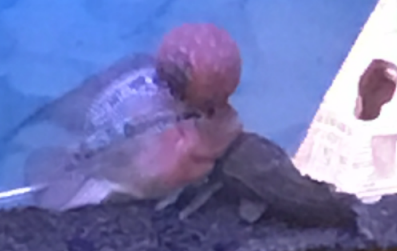
FH snuggling? 3/30/17
Hey Crew,
<4 megs....>
I got this FH around Valentine's Day. I'm not sure how old he is but he has
quadrupled in size (about 5inches + tail) since I've had him and has grown
and considerably large hump, and from which I've read seems to be a sign of
good health.
<Mmm; not necessarily, no>
Before getting him I already had a large, 8 or 9 inch Pleco. At first the FH
would "attack" the Pleco, I think soon realizing that he has little effect
on him the "attacks" decreased, now, he just kind of muscles him around.
However, now he's doing this weird almost snuggling thing with him.
<Social animals; actually crosses>
At first I was thinking maybe the water temp and went down and they were
trying to keep warm with body heat, but I just don't know.
<Are poikilotherms... no heat to be had>
Is he trying to mate? (Sorry if the picture is too big, I don't know how to
resize). It's about a 45gal tank btw, and I know both of my fish are
probably too big for it.
-Tori
<Just like Gilligan's Is.; looking for a little buddy is my guess. Bob
Fenner>
|
 |
|
Re: FH snuggling? 3/31/17
Thank you so much for your response. As long as his snuggling is
normal I guess I have nothing to worry about.
Except, maybe his hump. His seems to be a lot bigger than some of the other
ones I've seen of FH his size. Am I doing something wrong? Or is that just
genetics?
<The latter. Naught one can do. BobF>
Re: FH snuggling? 3/31/17
Ok. Thank you so much
<Welcome. B>
|
FH, env. READING
3/9/16
My fish is rubbing against glass of tank and the oxygen pipe I don't
know what is wrong I have a small Flowerhorn
<Stop! Need data; re the system, water quality, history of the set up...
foods, feeding... >
it is rubbing since two three days and scratching it's body also it's
body turns red for sometime are there any possible medications please
help ??
<Need to check water quality... Let's have you READ: Here:
http://www.wetwebmedia.com/FHEnvDisF.htm
Bob Fenner>
Re FH, making more belligerent
5/22/15
Thanks once again for your help sir...now my flower horn is in good condition..
He is in 250 liters aquarium.. And a good filtration system is there.. The pit's
of his head is healed.. "BT now he is not so aggressive like before". I tried to
feed him green food suggest by u...but he is not taking green foods....now he is
eating 'humpy head' and 'red sumo'. what can
I do for bringing back his aggressive ness like before? Pls help. Now
he is 1ft long...and the head is like a cricket ball.
<Mmm; well; there are two general approaches here: Feeding live foods and
placing a "whipping boy" fish in with it. The first might incorporate
known-clean (parasite free) freshwater organisms; but I would use marine or
brackish... fishes, shrimps. The second; some very sturdy, but smaller, faster,
smart fish that could evade the FH; perhaps a large barb or three.
Bob Fenner>
Phase of breeding 3/6/13
Do you have any reason why a female FH darkens when it is ready
to breed?
Thank you
<No, sorry. But many cichlids change their colours when courting.
Cheers, Neale.>
|
Flower Horn that lost its markings 10/8/12
Hi Crew,
I have owned 2 Flower horns for approx. 2 years now, they have both grown
into fairly large fish at about 25cm’s. They appear to be generally happy
and healthy, we keep them in a large 350 lit tank, however, we learned in
the early stages that we had to keep them apart as they appeared to want to
fight to the death, so the tank is divided with holes small enough not to
allow either FH to get to each other.
<Good>
OK the main point is, one of FH appeared to catch a disease, its bright gray
facial area, became a patchy dull gray colour and its still patchy after 6
months. The worse thing is, it had beautiful markings, (Just like everybody
says .... like Chinese writing) along it body, but now, all the markings
have gone ! Its as if they were only stickers, but they couldn’t have been
of course. We had the FH fish for over 12 months before this happened ...
any ideas on this ?
<As you state; disease, and/or genetic determination... perhaps behaviorally
modified>
Are we ever likely to see the marking come back again ?
<Not likely; no; unless the cause is the last mentioned>
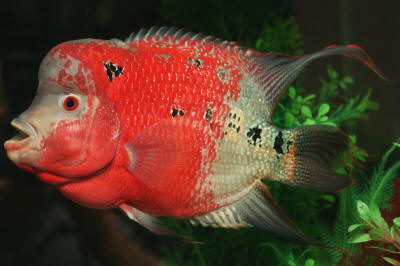
Our FH’s are called Nemo and Dory, Dory is the one with problem, however, I
couldn’t help send you the attached photo of Nemo and his/her vibrant
colours
<Ah, very nice>
(Note; We suspect that both fish are female as their horns haven’t grown
much, and it is hard to tell if the anal area is a V or a U unless you have
another to compare with)
I thank you guys in anticipation, your doing a great job and a great service
!
Regards, Paul S.
<Welcome. Bob Fenner>
|
 |
|
Re: Flower Horn that lost its markings
10/9/12
Thanks very Bob for your prompt reply, very much appreciated !
Kindest Regards, Paul S.
<Welcome Paul. BobF>
|
Didn't find this in FAQ's........ FH Beh.
9/12/12
Dear Bob,
Hi again.......
How r you doing?
<Fine Vinay, thanks>
Well I am back here again with a query, The pearl scales on my FH are
slightly disappearing..... WHAT COULD BE THE REASON......?
<Water quality issue/s, nutritional deficiency, just genetic/ontogenetic
expression... stress>
More than him I am stressed......... Please help and revert back
to me for any cure or steps to be taken to retain those pearled skin on
him.
Regards,
Vinay M.
<BobF>
My Flowerhorn 7/5/12
Nothing sent
My Flowerhorn 7/5/12
Hi I'm Ivan from Myanmar.
<Hello Ivan>
I want your help to define what my Flowerhorn type is is he a red
dragon?
I just got it as a gift 2 months ago
I used to keep Flowerhorns while I was kid they all passed away real
quick
But now I want to make sure this little fella grow strong NAND happy.
I'm sure it's a male it is 3inch and he really enjoy beef, prawn and
chicken I also feed him pallets.
I saw some Flowerhorns smaller than his size got big knob will he ever
grow a knob?
<Yes; in time, IF this fish is indeed a male. Just good care, nutrition
and time going by is all that is needed for nuchal hump growth>
I'm really looking forward to your reply
Im sorry for former empty mail I got poor connection here so forgive
that for me
<Ahh, no worries>
I also read a lot of articles about Flowerhorn from ur site
I am a student and I got a crazy idea to make thesis about Flowerhorn
and get the degree here
How would u suggest? Would this work out?
<Ask your teacher/instructor/s re what sort of aspect of their biology
might suffice as a topic. Cheers, Bob Fenner>
Flowerhorn eating it's own poop... please help...
6/15/12
Hi Bob,
<Hey Nihal>
I am not too sure that you remember me. I had mailed you regarding a
feeding query for my juvenile Flowerhorn about 3 months ago.
<I do recall>
Well, my Flowerhorn has been doing well for the past few months without
any problems. But now, I think I have a problem that only an expert like
you might be able to solve.
<Ok>
My Flowerhorn which is about 3.5 inches long now has developed a habit;
a dirty one! It likes to eat it's own feces (poop)! I have only noticed
this since the past 2-3 days.
<Mmm>
I use a bare bottom tank for cleaning ease and this little guy thinks
that the poop twirling at the bottom is food. He'll swallow it, chew it
and then spit it out. Unfortunately, even though he spits it out, he
still manages to consume at least half of it!
<Interesting>
I have also noticed that he does this mostly with the poop that comes
the day after I feed him Freeze Dried Worms. For the day after eating
pellets, he will only swallow the poop and spit it out.
He is always fed well twice a day. So, I am sure it is not due to hunger
that he eats his feces! I fear that he might do himself some harm by
eating his feces.
Can you please guide me and help me to teach my Flowerhorn not to eat
his own poop?
<Don't think the behavior itself is problematical, but it does lead me
to wonder if like dogs, cats, there is something missing in this
animal's diet... Which I would expand. Please read here:
http://www.wetwebmedia.com/FWSubWebIndex/flowerhornfdgfaq.htm
Thanks a lot in advance...
- Nihal Adsul
<Welcome. Bob Fenner>
Re: Flowerhorn eating it's own poop... please help...
6/16/12
Thanks a lot Bob... You always surprise me with the prompt help!
<If/when am on-line>
Well, I am currently feeding him Hikari Cichlid Gold pellets and Freeze
Dried Tubifex worms. I also feed him a thawed Pea once a week.
<I'd add Spectrum pellets if you can find them>
So, I really don't know the reason why he might be having a deficiency
in the diet. Maybe it's time I changed his pellets to some other brand.
<Yes; though Hikari is a fine brand>
Thanks again. Will keep you posted if I notice a change in his behavior.
- Nihal Adsul.
<Thank you, BobF>
Re: Discuss fish feeding problem; now FH beh., nuchal hump 6/12/12
Dear Neal,
<Ali,>
I hope you are fine the grace of God,
<I am well, thank you.>
please help me out. Can a female Flower horn develop the Hump on her
head?
<A small hump, sometimes.>
If yes then which food is best to make her hump bigger?
<There isn't a food that makes the hump bigger. It's partly genetic, and
partly reflects good health. Cichlids grow a hump as an advertisement of
how healthy they are. The hump is "expensive" to grow because it's
mostly fat. If the fish is unhealthy, it won't have the energy needed to
grow the hump. But a healthy animal can grow the hump. So it's an honest
way for a (usually male) cichlid to show a female cichlid that it is a
healthy, genetically robust specimen. In other words, the healthier your
cichlid, the bigger it's hump will be -- assuming it has the genes for
growing a hump. Females rarely grow the hump -- they don't need to! The
role of the hump is to allow males to advertise to females that they are
healthy. It's the females who choose which male they want to mate with,
so the female doesn't need to do anything except say "yes" to the male!
Some females have a slight hump, but it's never very big. It's like how
male sheep have bigger horns than female sheep.>
I have a female flower horn of size 5 inch but I am concern about hump
on her head. As larger the hump fish look more beautiful. Please help
me.
Thanks
Regards, Ali
<Hope this helps, Neale.>
|
Flowerhorn abnormal behaviour 6/12/12
Hi,
<Subha>
I have found out this website recently. U guys are doing great job :):)
keep it up. This forum is really helpful for the needy people. I am not
sure whether this email would reach you or not.
<Hi there!>
I am new to this Flowerhorn hobby. I am interested in having good
aquarium and I am crazy of Flowerhorns. So My husband gifted me 65
gallon aquarium last month with 6 inches ZZ Flowerhorn with pearls in
the next half of the body. He was completely dark with no head when he
come to our home on the first day, When we fed him the pellet, he did
not eat it till evening. Then after I transferred him to the fish tank,
he was fine and happy. I taught him to chase my fingers and he is too
aggressive and fast. He is my favourite. He bit my husband finger once
when he was fixing the air tube inside the tank. He is kind of very very
active, non stop, always hungry and always beg for food who ever goes
near the tank. During night times he used to jump and catch the
mosquitoes. He is scared of stick, fish net and shawls if I wave. Other
than that he was such a wonderful gift to me. Once he ate the cockroach,
after that 2 days he was avoiding his food. But then he was again back
to the normal life. He is kind of cute, he started getting good kok
also. I was not seeing stress marks for a while. Me and my husband are
working, so morning while going to office I used to feed him and leave,
then till evening he used to be alone. After I come back, I used to feed
him again with pellets. Last week, I was out of town for 1 and half
days, my husband was at home. He never used to interact or play with
Flowerhorn, first time in this one month, he feed him food. That night
and next day morning FH was fine. But in the evening when he comes back
from office, FH was upside down, rotating circling at an angle
of 15 degree, he was restless, something was bothering him, It
was looking like he was crying aloud inside water. It was pathetic to
look at him. he couldn't have direct face to face vision from inside, he
was suffering from something, his stomach and area between
pectoral fins and gills (neck) were bloated.
<Unusual>
I was also back on the same day late evening, I changed 70% water then.
<Good>
Next day I moved him to small tank of 10 gallons and medicated with Epsom
salt, Flagyl, amoxicillin (Terramycin) for 1 hour after referring
few websites and transferred him to old tank. I did this treatment for 3
days and I didn't feed him for 3 days completely. after that his stomach
bloating is gone, but still the neck part is still bloated types. I am
not sure about it. Then I had fed him with cooked and smashed
peas, he ate first 2 pieces then he didn't have. Upside circling
movement is gone after 1st day of medication itself. But he forgot me
completely now, he is not chasing to my fingers. He is not very active
like before. He looks always stressed and his face also turning black
nowadays. His kok head has come down. Now he is completely scared of me,
always hiding behind the decorations whenever I pass by except when I
feed him food, Past 2 days I am feeding him with prawns and chicken
Liver. He ate everything completely.
But still he is not fine. His wastage is blackish maroon in color, few
were black. He is active (not so much as before) as like other fish, but
he forgot everything, not looking casual as earlier always scared of
people especially me.
Water changes - 70-80% weekly. Only one filtration and one air tube.
Diet - Only Humpy head quality pellet food till last week. Twice a day
with 7 pellets each time. Pellets are 2mm diameter. Now added shrimps
and chicken liver as part of diet.
Light settings - One pink color light I used to switch on evening till
night.
Heater - Now it is summer season in India, so we are not using any
heater.
We have heater but most probably its not required except on the month of
December.
Tank mates - No.. but there is goldfish small tank kept near by in this
eye site.
<Shouldn't be problematical>
I use Bactonil FWsolution 5ml for every 10 gallons,
<I wouldn't keep using this as a preventative>
Mr. Yellow, 2 Spoons of aquarium salt after every water change. Used to
clean the filter sponge completely. I am not used to clean the gravels
for every water change. Because my tank dimensions are 3 feet Length x
1.5 feet Breadth x 2 feet height. While the water is sucked outside
using hose and I used to try getting the dirt out of the gravels.
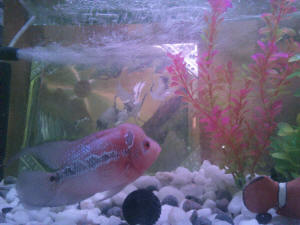
Please find attached his picture. Please let me know how to get my baby
back to normal condition. I am not sure if he has recovered completely
from treatment.
Thanks a ton. Sorry for such a long mail. Awaiting your reply.
Thanks,
Subha Prabhu
<Nothing "jumps out" as being of probable trouble. I would ask you to
read:
http://www.wetwebmedia.com/FWSubWebIndex/FHDisF4.htm
and the linked files above for general input, in the hope that whatever
the issue may be here it will come live to your conscious.
Bob Fenner>
|
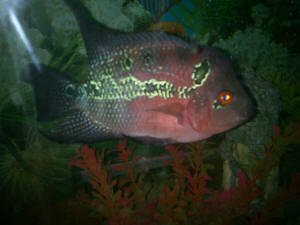
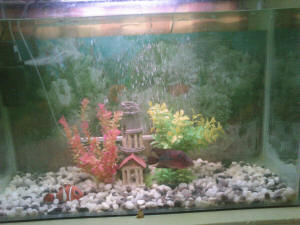 Before, after and sys.
 |
Flowerhorn Breathing Through
Mouth 3/30/12
Hello, I have a young Flowerhorn (approximately 4.5 inches) in a
40 Gallon tank (I do plan to move him to a 75 Gallon tank). The
tank has two Marineland Bio Wheel filters, one is a 350 the other is a
200. The water temperature is 80F, Ph is 7.4 with a general
hardness of 180, Ammonia is 0, Nitrite is 0, and Nitrate is 5.0
ppm. I have a 28 inch bubble wall with a large air pump. My
Flowerhorn appears to be healthy, active and eating well (always
hungry). However, he breaths through his mouth the majority of
the time.
<This is what they do. Fish breathe water in through the mouth, then
expel it through their gill openings. Now, if your fish is breathing
heavily, that can indicate stress, higher than optimal temperatures,
poor water quality, toxins (e.g., copper) in the water,
varying/incorrect pH… all sorts of things.>
His gills also appear to be the correct color and healthy. Do I
have enough oxygen in the tank for him or does he possibly have some
disease?
<Yes, Velvet and Whitespot can irritate the gills, causing heavy
breathing. But you should see white spots on the body, too. Would
assume this is environmental, and act accordingly.>
Thank you for your concern, Kathieen
<Do read:
http://www.wetwebmedia.com/fwsubwebindex/FHParrotCichArtNeale.htm
…and follow the links to other articles of interest, use.>
I apologize, I forgot to include my Flowerhorn's diet in my
previous email. I feed him 3 times daily and he eats - Monster Kok and
Hikari Cichlid Gold pellets, frozen Mosquito larvae (blood worms),
frozen Krill, frozen Spirulina and Brine Shrimp, live Brine Shrimp and
live Ghost Shrimp. Note: cannot get him to eat soft peas. Thanks
again, Kathleen
<Sounds fine. But make sure you are not overfeeding and/or
under-filtering and/or not doing enough water changes. Cheers,
Neale.>
FH beh. NNS 3/21/12
i have a Flowerhorn who likes to attack the glass each time i try to
train it to follow my hand. what should i do to train it to follow my
finger and not attack the glass? tq.
<Nothing that can be done as far as I'm aware. Part of this
hybrid cichlid's naturally territorial/agonistic behavior. Bob
Fenner>
weird question... FH,
fdg./beh. 1/12/12
hi, my Flowerhorn is a red dragon male of 3.5 inch as your crew said me
to feed him food only 2 times a day. so i gave him food in morning and
then after 3-4 hrs i have noticed that the color of flower horn became
white and her eye color i.e. orange circle became black. when fed him
it became normal. can you tell what happened ?
<Likely just the reflection of light... but could be a diurnal
behavioral (colour) change, due to mood...
Bob Fenner>
some questions about FH
Flowerhorn Questions, fdg., hump dev./beh.
1/10/12
Hi Crew,
I am from India, bought a Flowerhorn 2 days ago which is 60 days old
and it is a Red Dragon (male) and the size of my Flowerhorn is of 3-3.5
inch's. From this afternoon my Flowerhorn started eating xo humpy
head food which was referred by the seller. For now my flower horn is
doing fine but after some time it waits and watches the humpy head box
for a long time and then I feed him 2 pellets of humpy head but still
after 30 min.s it does the same. I don't want to over feed my fish.
Please tell me how many time's should I feed the fish in a day and
how many pellets in each feed ?
< Feed once or twice a day and only enough food so that it is
completely gone in a couple of minutes.>
There is also other question I want to ask is that the fish does
not have hump for now when inquired to the seller, he said that the
hump will be visible when the fish size grows to 4-4.5 inches and he
said that the father of the fish is red dragon and the mother is KOK as
I was confused that the Flowerhorn that I got is a kamfa. As I have
done lots of browsing its mentioned that the male gets the hump fast
compared to female so how to check that my fish is male or female?
<Flowerhorns are a cross between a few different cichlids but they
all have similar secondary sexual characteristics. Males are usually
larger and have longer unpaired fins. Mature males may get humps on
their forehead.>
Also the seller said that he shipped me a yellow red dragon but the
fish I got is a combination of white and
pink, when inquired he said it will change the color with in 2 days as
because of travailing the color has been changed to white and soon it
will change to yellow. I have attached the pic's of my Flowerhorn
please check it and let me know. Please tell me that my fish is a kamfa
or a red dragon and a friend said that red dragon hump growth is faster
than the kamfa hump growth. Sorry for such a huge mail as I am new to
this stuff I am confused btw things. Thanks Regards Ali
< Since the Flowerhorn is a cross there are many "types'
available. I would recommend getting photos of the pair to make some
determination of how the fry will turn out. Maybe the seller could
refer to online photos to what his fish look like.-Chuck>
A sulking Flowerhorn? Is that ever
possible? <Oh yes> 12/14/11
Dear WWM Crew,
<Satadru>
Yours is such a wonderful forum for fish lovers. I get to learn so much
every time I visit your web site.
<Good>
I have a female Flowerhorn fish. I think it is a female because its got
a dark spot on its dorsal fin.
The way its fins are spread out most of the time, closely resemble
those of positively identified female Flowerhorns. Despite what I could
manage, I could not understand whether its anal vent was a
"U" or a "V" shaped one.
<Only prominent of fully sexual and reproducing individuals
really>
Its about 5 inches long, and probably a couple of years old at the
most. However, its finnage (if I may call those) or the trailing tips
of its dorsal and anal fins, are a good 2 inches longer than its entire
body length. It lives in a tank sized 24 inches x 15 inches x 15
inches. There are two sponge filters which are powered 24 hours x 365
days by a dedicated air pump of 12 Watts, approximately. Besides this
arrangement, I also have a multilayer canister filter with a power head
attached - the kind of those which have ceramic pellets as one of the
filter layers.
<Good to have redundant filtration>
But I am not writing you to describe any problem related to disease or
illness afflicting it. Not that I can make out. I think my
Flowerhorn is - how do I put it - annoyed with me.
I feed it AZoo 9-in-one Flowerhorn pellets. I vary its diet; but mostly
its pellets as its staple. However, a few days ago I bought a new type
of freeze-dried Tubifex food - packaged in small cubes to be crushed
and fed. My Flowerhorn did not like it one bit. I let it go
without food for a day except with a solitary cube of that freeze-dried
Tubifex stuff. It still refused to eat.
My family has grown rather very attached to this fish which has been
with us for just over a year now. My wife and my aunt both claim that
it can recognize each one of us individually. Personally, I think this
is rather far-fetched. I have never heard of fishes recognizing humans
the way mammals do.
<I agree w/ your wife and aunt. I am almost certain that some
species of fishes can easily distinguish humans; and cichlids as a
group among them>
Curiously though, now that my wife and my aunt feeds it with its usual
pellets (the AZoo ones) it has gone back happily eating and swimming
around wagging its tail. This is another sight that I have never seen
in my life - a fish wagging its tail and swimming back and forth during
feeding time!
<Ah yes>
The whole point of writing this long story (and probably wasting a good
deal of your time all for nothing) is that whenever I try to feed it
now those very same pellets, it wheels around and nestles itself in a
corner of its tank. It will not budge from there until I have moved
away! Its been three days now without a change in this behaviour.
<Patience... DO be present when the two women are feeding... Your FH
will "forgive you" in time>
At once it will swim up to the surface to gobble the pellets which are
given to it by my wife or my aunt, once I am out of its sight!
What do I do now to make it let go of that "sulking"
behaviour when I am around?
<I concur w/ your observations, rationale>
By the way, I always try and do a 30% change of water every week;
failing that - 50% change every two weeks. Care is taken not to
overfeed it. But that is a rule which we find hard to stick to given
the fish's fondness to keep on eating every two hours or less!
Many thanks for your patience.
With sincere regards,
Satadru
<Thank you for sharing. Flowerhorns are intelligent, social animals.
Bob Fenner>
Re: A sulking Flowerhorn? Is that ever possible?
12/15/11
Dear WWM Crew,
<Satadru>
Thank you for your reply and for your advice to be present when it is
being fed either by my wife or my aunt.
<Welcome>
Your suggestion appears to be working for I saw that the fish did not
bolt away immediately upon noticing my presence. It slowly but surely
back off from the glass nice and slow. But it ate the pellets. Not the
ones that I gave it though.
<Heeeee! Take your time here>
With sincere regards,
Satadru
<Thank you, BobF>
Flowerhorn; colouration
12/6/11
Hello. I have a flower horn that is about 3 1/2 inch. I do change its
water frequently and it too ha a proper lighting. However, it
does not have a good colouration and I would like to enchance its
colour. besides that, i would like to know when would i see the proper
colouration of the fish and how long would it take for its hump to
grow. tq
<Do read here:
http://www.wetwebmedia.com/fwsubwebindex/flowerhornselfaq.htm
http://www.wetwebmedia.com/fwsubwebindex/FHParrotCichArtNeale.htm
Colouration is 50% genetic and 50% environmental. Since the fish are
hybrids, it's very difficult (impossible) to predict precisely what
a young Flowerhorn will grow into. The best you can do is buy a good
quality specimen, maintain it in a big, well-maintained aquarium with
excellent water quality, and ensure a varied, good quality diet.
Crustacean and algae foods are particularly important sources of the
chemicals that are turned into colours. Cheers, Neale.>
Flowerhorn restless
Flowerhorn Help -- 10/12/11
Sir, I got a Flowerhorn, kamfa on Sunday, its a male and its a 3 month
old baby. The problem with it is its restlessness. The first day he
hide himself beneath the air filter pump, then after a day he just came
out. I'm feeding him with humpy head. He's not eating. He puts
one pellet in his mouth and spits it out. When I feed a shrimp, he eats
it for an hour and then from the time he had a shrimp he is jumping out
of water I have a cover for my tank and he's active but not as much
as he was in the pet shop. Can I feed him shrimp every day and what
sort of diet should I maintain for him?
< Shrimp can be part of a good varied diet. I would recommend a high
quality pellet food that is good for the overall health of the fish and
doesn't really enhance a particular part of the fishes
body.>
How many times should I feed him?
< Feed once or twice a day and only feed him enough food so that all
of it is gone in a few minutes.>.
How I should train him not to jump out of water?
<Place some floating plastic plants at the surface of the tank and
he will soon learn the tank limits end at the top of the
plants.>
Can he be feed with all sorts of non veg and homemade food?
< There are many homemade recipes for fish food online. Most of them
need to be frozen afterwards. I prefer a shrimp and frozen peas recipe
myself.>
Please help I'm new with Flowerhorns., hope you can help me
Regards
Avinash India
< A good reference might be the pet shop you got your fish from.
They should be able to provide some customer service even after the
sale is made.-Chuck>
Re: Flowerhorn restless
Flowerhorn Help II 10/13/11
Hey thanks Chuck. If possible would post his photo. He is eating only
shrimp and how many days until he takes to his new tank?
<Depending on outside interference it may take a couple of
weeks.-Chuck>
Re: Flowerhorn restless 10/17/11
my Flowerhorn is eating only 2-3 balls in 5 min is that enough 2
it??
<? Read here: http://wetwebmedia.com/FWSubWebIndex/flowerhornfdgfaq.htm
and the linked files above. Bob Fenner>
Re: Flowerhorn restless 10/19/11
dude is there any thing like a place or a corner in a room that effects
the behaviour of a Flowerhorn!!
<Yes. Like all cichlids, they prefer quiet areas. They dislike
slamming doors and loudspeakers with a heavy bass that causes the water
to vibrate (often imperceptibly to us). Big cichlids often seem to
enjoy a certain amount of interaction with humans, so having a chair or
sofa nearby is a good idea, so they can watch you while you're
reading, watching TV, or whatever. On the other hand, bright flashing
lights at night, like from a TV set, would annoy them. The big picture
though is that a bored or listless cichlid is more likely to be
stressed by aquarium conditions than what's going on outside the
aquarium. Oh, please don't call me "dude". Cheers,
Neale.>
Problems with my FH
7/1/11
Hi WWM
I have 2 questions regarding my FH, I just got it yesterday and its not
eating and always hiding in the filter. Is it normal for a newly bought
Flowerhorn?
<How did you cycle the aquarium? If you add a Flowerhorn cichlid to
an aquarium without a mature biological filter, then yes, it will be
stressed and shy because water quality will be dangerously
poor.>
Secondly, how to set the water to 80F do I have to buy a heater for the
tank. If I have no heater is there other ways to keep the water to
80F.
<You need a heater. You need to keep the water at a steady 25 C/77
F.>
Thanks for your time
Wayne
<Read:
http://www.wetwebmedia.com/fwsubwebindex/fwset-up.htm
http://www.wetwebmedia.com/fwsubwebindex/FHParrotCichArtNeale.htm
Cheers, Neale.>
Flowerhorn hump reducing ?
6/9/11
Dear WWM,
you can see the huge hump. but now the hump is reduced for 30%. just
want to know do breeding reduce hump of male Flowerhorn? or keeping
with female Flowerhorn reduce hump?
<No. Genetics and environmental conditions are what matter
here.>
I feed Flowerhorn humpy head of ocean free & cing mix head
booster.
<No food makes the hump bigger. Genes determine how big the hump can
get.
Environmental conditions how well the fish fulfils its genetic
potential.
Being hybrids, you cannot predict how big the hump will get.>
please guide asap. even let me know to grow hump bigger &
faster?
<Keep the Flowerhorn well, and it will grow its hump to the best
size its genes allow.>
one more question
I have bred Flowerhorn. male Flowerhorn has hump will the babies will
have hump? cause my friend gets 3inch Flowerhorn monkey head mean with
marble size hump from Bangkok and sell. he say breeding the monkey head
Flowerhorn will not get hump to the babies in India. it is not possible
to breed Flowerhorn in India and get hump on 3 inch babies?
<The nuchal hump is a secondary sexual characteristic of males. It
develops as the fish become sexually mature, and gets bigger as the
male gets older.
Genetics determines its maximum size and maximum growth rate. Poor diet
(including lack of variety), poor water quality, poor water chemistry,
and lack of aquarium space will all reduce growth rate of the fish,
including the growth of its hump.>
please let me know is thar true? if not then guide me how to get hump
on 3inch babies of Flowerhorn fish
Thanks & Regards
Zakir
<Enjoy the fish for what it is. Trying to grow a fish with the
biggest hump is completely pointless. Maximum hump size is a lottery
because you cannot predict what genes a hybrid will carry. Instead
provide the best conditions for your fish, and enjoy him for what he
is. Cheers, Neale.>
help! our fish is scared of us!
11/5/10
our fish has develop this reaction whenever we go near its tank...it
would swim to a corner like its scared of us...sometimes it would
charge at the glass as if attacking us. he hurt himself doing this
though! he'd jump so that he would hit the aquarium cover and get
gashed.
we don't know what to do...we cleaned the tank..kept temp, ph,
ammonia levels checked.
we feed him cichlid gold pellets and he wont eat it unless were away
from the aquarium...then we'll hear a splash...like he would grab
the food and bolt away.
help!
Tina
<Hello Tina. Fish do become nervous if water quality isn't good,
so double check that. Non-zero levels of ammonia and nitrite irritate
or stress fish, and in turn that triggers their fight-or-flight
response. Sudden pH changes can do the same thing, so again, double
check that. Make sure water chemistry is right for the species being
kept. You haven't said what fish you have, or what the water
chemistry is. A South American cichlid would be happy with soft and
acidic water chemistry, but an cichlid from the Rift Valley lakes would
be stressed by those conditions. Likewise the hard water enjoyed by
Mbuna would be unpleasant for cichlids from West Africa where the water
is soft and acidic. If all these things are fine, then yes, check the
tank for swimming space, shelter and shade. Fish will become stressed
if the tank is too small; an Oscar that was happy as a baby in a 40
gallon tank will be terrified by being trapped in that once its an
adult. Cichlids and in general most other fish need shade and shelter.
Floating plants are very useful and help nervous fish settle down. Try
a clump of floating Indian Fern and see what happens. Caves are useful,
but fish will usually hide in them if they feel scared. If you have
floating plants AS WELL as
caves, fish will swim in the open more because there's more shade.
Dither fish are helpful in many cases, but you need a big enough tank
for both dither fish and the nervous bottom-dwelling fish to be
comfortable. You've given me no data at all to work with, so I
really can't offer you anything more specific. Cheers, Neale.>
Re: help! our fish is scared of us!
11/09/2010
So our ammonia <0.02 ppm;
<Needs to be zero; tank too small, fish too big, filtration
inadequate, overfeeding'¦ review and correct.>
ph level is between 7.4-7.8; temperature 78*F. Its a Flowerhorn cichlid
but I don't know any other specifics on that. Its about 6 inches
now..in a 30 gallon tank.
<Tank is too small. This species needs 55 gallons. It is unhappy and
stressed. Read:
http://www.wetwebmedia.com/fwsubwebindex/FHParrotCichArtNeale.htm>
I will get a cave and floating plant (live?) but it might crowd this
the aquarium.
<Least of your problems. It needs a BIGGER aquarium.>
Thanks for your help
<Glad to help. Cheers, Neale.>
|
|
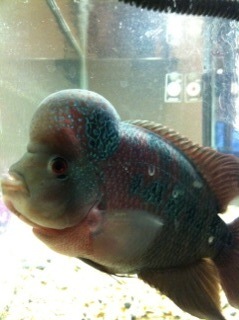
FH, feeding as it relates to humpiness...
6/29/10
Hi,
<Hello,>
I just bought a new Flowerhorn. It has a very big head for a 5-6 inches
long. Someone told me to feed him chicken liver because chicken liver
is made up fat will increase his color and Nuchal hump.
<Rubbish. The size of the hump is almost entirely genetic. Since
Flowerhorns are hybrids, it is very difficult to predict how large the
hump will be.>
Will chicken liver kill my fish?
<Certainly is bad for them. Never, ever give mammal or bird meats to
fish.
The fats in these meats congeal inside the fish, causing damage to
their blood vessels. The exception is cardiac tissue, such as beef
heart, but this should be used very sparingly, perhaps once a
week.>
Do you know it will help the Nuchal hump to grow bigger?
<Nothing. It will get as big as its genes allow. Good water quality,
a big aquarium, regular water changes, the right water chemistry all
improve the chances of healthy development.
http://www.wetwebmedia.com/fwsubwebindex/FHParrotCichArtNeale.htm
There are NO wonder foods that make cichlid humps bigger. Any food that
says it will do that is a CON.>
Thanks
<Cheers, Neale.>
Re: re:
Thank you for your help. I appreciate for the information on my
Flowerhorn.
<A pleasure to help. Cheers, Neale.>
FH stunted growth 4/26/10
Hi, Just recently acquired a Flowerhorn Thai Zz at a very low price. My
only concern is that it's 8 months old and it's
4"-5"?? the dealer said it's because he kept it in a
smaller tank and if I put in a larger tank (currently in a 40 gallon
tank) that I would still grow bigger. Is this true or has the
Flowerhorn's growth been stunted and won't grow anymore.
:(
Thanks,
Ingram Lim
<Your Flowerhorn will not grow much more, no matter what you do.
While fish grow throughout their lives, they grow fastest when they are
young. So a large cichlid species will typically grow very fast for the
first 6 months, a bit slower for the next 6 months, and very very
slowly across the next 10 or more years. Your specimen may grow a few
percent, but it will never reach the same size as it would have done
had it been kept in a big tank.
Flowerhorn Cichlids need about 75 gallons, and if you want to grow a
specimen to its maximum size, you will put it into a tank this size as
early as possible, ideally when it is less than 6 months old. Do
read:
http://www.wetwebmedia.com/FWSubWebIndex/FHParrotCichArtNeale.htm
Cheers, Neale.>
Urgent reply please
Fighting FHs 4/6/10
Hi,
Actually I have a pair of FH which had bred day before yesterday and
now when I returned home from college I found them fighting very
badly.
<Yes, happens in tanks the cichlids deem too small. As I've
stated repeatedly, even a single Flowerhorn needs 75 gallons, and for
two specimens to coexist permanently, you'll need several times
that much water.>
The male is twice as big as the female, it took me 15 days to leave
them together and they seemed to be getting along.
<Famous last words.>
Now the female is getting too aggressive and she has bit the male on
his scales and the are biting each other's mouths.
<What they do.>
The male is not aggressive at all.
<Separate them. Use egg-crate to form a divider so they can see each
other but water can mix freely. Do buy or borrow a copy of 'The
Cichlid Aquarium' by Paul Loiselle and READ this book from cover to
cover, especially the sections on behaviour and breeding. You can't
expect to breed aggressive cichlids such as Central American cichlids
without this sort of problem.
You need a very big aquarium to leave them together permanently,
realistically 200 gallons. Otherwise maintain in their own 75 gallon
tanks, and put together for spawning, and then rear the eggs
yourself.>
Please help and reply soon.
Thanks.
<Cheers, Neale.>
FH behaviour
Flowerhorn Sex 2/10/10
Hello crew Musa here. I'm very thankful to you people in raising my
Flowerhorn.
Actually my problem is that my FH is 5.5 inches long, it is developing
its hump.
The shopkeeper said he(Flowerhorn) is a male because it has a hump. But
since last week my FH has started to pick stones in its mouth and
transport them to other side. Today I asked my friend about it and he
said that its
definitely a female. Please help me out in this and also tell me the
reason behind the transport of stones. Thank you very much.
< Your Flowerhorn is probably a male. He has started to mature and
get his hump. He is also starting to set up a territory by rearranging
the tank to his liking.-Chuck>
Flower horn acting strange -- 01/29/10
Hello crew,
I'm Musa,
I have a FH of 4.5 inches. Since last week he has started a strange
behaviour of picking up stones in his mouth and spitting it away, he
dug and made a circle with no stones in it.
When I asked about it to the seller, he told that SHE is ready to
breed.
He has a hump on his head, so I thought that he is a Male.
Please explain in details and Thank you very much.
<Hello Musa, your Flowerhorn is acting normally. Even if
"he" has a nuchal hump "he" could be a female,
usually breeders keep on trying to improve the fish qualities focusing
on bigger hump on the head, colours, black marks on the body and so.
Perhaps you have fishes selected mostly for bigger hump, also the
female has the hump, maybe smaller from one of the male. What do they
eat? Protein food is the main dish? This could be another reason for
the nuchal hump, a fat store. Remember to offer them some vegetable
matter, boiled zucchini, Spirulina flakes, veggie sticks. Probably your
seller is right, your Flowerhorn wants to build a nest: he or she
cleans a big area in the sand, transporting away anything he/she
doesn't like. Both sexes work in it. The egg are laid on a flat
surface, a big rock, a glass, the bottom of the tank, a driftwood,
female has the task of take care of them while the male patrols the
territory. The eggs are moved very frequently to secure them. Musa you
have only to wait! Tell us the end of the story.
Daniela Rizzo>
Flowerhorn hump -- 1/22/10
Hello Melinda,
Musa here,
I wanted to know whether there is any way to make the hump of FH
bigger.
Are the following ways correct?
1. Applying a partition in middle of the tank and a fish on the other
side.
<No.>
2. Partition with a female Flowerhorn on other side.
<No.>
3. Putting a mirror in the tank.
<No.>
4. Increasing the temperature of the water.
<No.>
5. By getting more involved in sex.
<No.>
Thank you very much.
<The size of the hump is related primarily to genetics and
secondarily to the overall health of the fish. If you want a Flowerhorn
with a big hump, first buy one with parents and grandparents that had
big humps. (Don't forget, the gene for a big hump can come from the
mother, just as the gene for a big penis on a human can come from that
man's mother.) Even with the right genes, if you keep your
Flowerhorn badly, it will not develop to the best of its potential. So
aim for a balanced diet of meaty and green foods, clean water, the
right temperature, and the right water chemistry.
EVERYTHING else said about these fish with regard to hump size is sheer
myth. Cheers, Neale.
Re Flowerhorn
Flowerhorn Development -- 1/8/10
Hi Chuck Thanks for the prompt reply regarding my previous query. I
would like to know whether is there any specific age as to when a good
genetically Flowerhorn will start developing nuchal hump. I know the
hump is largely dependant on genetically quality and water parameters.
But is there any age of the fish when he will start developing the
hump. Thanks in advance
Amit
<Secondary sexual characteristics are dependent on age, water
quality, temperature and diet. These fish are usually fully mature at
about 2 years at normal conditions. Nitrogenous wastes like ammonia,
nitrites and nitrates will effect the growth and development of fish so
you want to keep them as low as possible. By keeping the water temp at
82 F you will be maximizing the growth rate. A quality diet high in
protein (30-50 %) should get you fish to its maximum potential. These
fish get about 10 inches or so depending on the sex. When they start to
mature then they may start to show the hump, which is a fatty
tissue.-Chuck>
Hi. FH... hump... 1/5/10
Hi,
<Hi>
I have two Red flower horn fishes. Both of them have grown nicely since
I bought them. The problem is, their hump are too flat.
<Not much to do re... genetics mostly, some aspects of development
(nutrition...)>
They are almost 15-20 centimeters now. I feed them with prawn and food
pellets. Is there any special food that can be used to get good hump
for them?
<No>
Please suggest.
Thank you.
Regards,
Mohan.K
<Read here:
http://wetwebmedia.com/FWSubWebIndex/flowerhornfdgfaq.htm
Bob Fenner>
Flowerhorn poo -- 12/15/09
Hi WWM CREW
I have a Flowerhorn 5 inches long. He is in 20 gallon tank with power
filter, sponge filter .
<Too small.>
I offer him ocean free xo humpy, red chili pellets. I use a bare bottom
tank with some pebbles to play with.
<Play? He doesn't play. He couldn't care less. Choose a
substrate that darkens the tank. If the tank is shiny or bright
underneath, the cichlid will "fade" his colours and not look
as pretty. Cichlids are prettiest in DARK tanks with DARK
substrates.>
I have a heater in the tank and it is at 26 degrees. I changed the full
water 1 day back and I had feed him with fresh small prawns only in
small quantity about 10 to 12 in nos.
<Use prawns sparingly. They contain a lot of thiaminase, so used
more than 2-3 times per week could cause long term problems. Remember,
whole prawns, not shelled prawns, are better. The calcium in their
shells is very helpful.>
Problem with my Flowerhorn is it is mostly sitting in corner of the
tank .
Whenever I approach the tank I do not see the normal behaviour like
finger following or aggression. Kept him hungry for 1 day and then Fed
him with one or two pellets he ate them but after that sat in the
corner.
<Have you read the articles about Flowerhorns we've already
mentioned?
http://www.wetwebmedia.com/fwsubwebindex/FHParrotCichArtNeale.htm
These fish need lots of space, a good water current, and preferably a
dark substrate and some floating plants (e.g., Indian Fern). If the
tank is small, if water quality is not good, if water chemistry is
wrong, the fish will not behave properly. Cheers, Neale.>
|
Re: Flower horn doesn't eat pellets --
12/14/09
What should I do to increase the hump of my Flowerhorn
<Nothing. It's all genetic. Since these are hybrids,
unless you've seen the parents, you can't predict how big
the "hump" will get. Old males have the biggest humps,
but this varies. Lots of myths exist about making bigger humps:
certain foods or putting mirrors by the tank to make them more
aggressive for example. All utter rubbish.
Cheers, Neale.>
Flowerhorn acting strange -- 12/14/09
Hello,
I got two flowerhorns,
<One fish per aquarium, I hope. Allow at least 55 gallons,
ideally 75 gallons, per fish. Do read here:
http://www.wetwebmedia.com/fwsubwebindex/FHParrotCichArtNeale.htm
>
in a tank of size-18 inches its length, 12 inches its height and
9 inches its breadth.
<Too small.>
I got two questions to ask.
1-why does my Flowerhorn floats on top of the tank? its happening
since I changed the water in the tank
<Almost certainly bad water quality.>
2-Can u tell me which breed it belongs to?
<No. These fish are hybrids; there are no "breeds".
They do not breed true.
You get what you pay for. Unless you have seen the parents, you
can have no idea what your juveniles will grow into.>
Thank you.
<Cheers, Neale.>
|
  |
|
My new Mate Rosi (FH), gen. care, training
12/12/09
Hi there
<Hello,>
I am a Newbie in taking care of Flowerhorn. One week ago I have
bought 2'' Short-body Flowerhorn. Initially he was under
stress and not eating properly. As days go, he is getting better.
Now he is eating normally and active. I'm so happy of it.
<Good.>
What should I do to enhance his color and body?
<Ensure the aquarium is well maintained. Almost all the colour
in a Flowerhorn cichlid is "programmed" into the fish
by its genes. There is NOTHING you can do to make them better.
But there ARE things you can do that will make their colours
WORSE. These including poor water quality, the wrong water
chemistry, a diet that isn't properly balanced in terms of
animal and plant foods. Because these fish are hybrids, you
cannot predict their colours. If you have seen the parents, then
its colours will be somewhere in between. Do read here:
http://www.wetwebmedia.com/FWsubwebindex/FHParrotCichArtNeale.htm
>
Please also tell me how to train him to follow my fingers and to
jump for food.
<Jump for food? Never heard about that. Adult males follow
fingers because they are being aggressive. They aren't
"trained" to do it. It's instinct. If the fish is
male, and if he decides your finger is a threat, he will come to
the front of the tank and try and bite it. Simple as that.
Otherwise, behaviour is much like other large cichlids. These
fish aren't as intelligent as Oscars though.>
Cheers,
Push
<Cheers, Neale.>
|
[1]%20FH.JPG) |
Flowerhorn colour queries 12/7/09
Hi WWM crew
<Hello,>
I have a Flowerhorn about 4 inches. Must be approx 6-7 mth old.
<They grow fast, don't they!>
My query is that does the colour of the Flowerhorn intensifies as the
Flowerhorn ages.
<Not really. It's mostly down to genes, good environmental
conditions, and a balanced diet.>
Also does the hump start to develop after the growth of the Flowerhorn
is sustained. Is it true.
<Again, no, it's largely down to genes. A common myth is certain
foods make the hump grow; they do not. Give your Flowerhorn a big
aquarium with good water quality, the right water chemistry, and a diet
containing at least
some plant and crustacean foods, and you will get the best from your
fish that its genes allow. Do read here:
http://www.wetwebmedia.com/fwsubwebindex/FHParrotCichArtNeale.htm
Cheers, Neale.>
Male Cichlid Beating On Female Cichlid,
FHs 12/6/09
Hello, can you please help me. my female Flowerhorn was attacked by my
male Flowerhorn. so I removed the female Flowerhorn from the tank. now
she is badly injured and can hardly move around. Do you know if there
is anything I can do, to help nurse my female Flowerhorn back to
health. Thank You.
< Usually the female is smaller than the male. Experienced cichlid
keepers place a piece of plastic pipe that is only big enough to allow
the female in and not the male. This gives the female a place to escape
from a eager
male looking to breed. In the wild the male is looking for a female
willing to spawn with him. He chases or kills the unwilling females and
tries to attract another that will. If the pipe is not too attractive
then others have been using ZooMed Aquarium Logs too. These have the
additional advantage in that they float and allow the female a chance
to get to food more easily. Now that the female is damaged you need to
carefully nurse her back to health. Luckily cichlids are pretty hardy
creatures and things may not seem as bad as they first appear. First
keep the water very clean. High nitrogenous waste levels will lead to
diseases that will kill if going untreated. Do lots of water changes
and keep up on the filter cleaning.
Treat with an antibiotic called Nitrofuranace. It will work against
disease causing bacteria and fungi. Add a little salt to the water.
This will put a slime on the fish to keep parasites off. Look at some
of the water conditioners that have some sort of wound control. Use
these when changing water. When your fish acts hungry then go ahead and
feed her. Good luck.-Chuck>
Flowerhorn colour queries -- 11/10/09
Hi WWM Crew
<Hello,>
I am having a Flowerhorn about 4 inches from tip to toe. I would like
to ask you that does keeping a mirror in the tank for about 2 hours
help in giving a Flowerhorn good colours.
<A mirror will not do this. All a mirror will do is annoy the
fish.>
Further my Flowerhorn is not that red coloured.
<These are hybrid fish and there is much variation. Genetics is the
single biggest factor. Most Flowerhorn cichlids are farmed and the
colours will not necessarily be very good. You may be lucky... or you
may not! You get the best colours from keeping water quality and water
chemistry optimal. A diet rich in algae and crustaceans also helps. But
understand this: with Flowerhorn cichlids, there is nothing, NOTHING,
you can do to make the fish more colourful than its genes will allow.
Talk about mirrors, special "magic" foods, and so on is all
rubbish.>
Shall I keep a white aquarium light or keeping a Hitachi fluorescent
tube will help in growth of the colours of Flowerhorn.
<Strong lighting makes fish "fade" their colours. Add
floating plants to produce shade. Use a dark substrate as well.
Don't use a colourful substrate.>
Secondly is it mandatory to keep the heater in the Flowerhorn tank or
these fishes can be raised without heater also.
<Must have a heater. Do read here:
http://www.wetwebmedia.com/fwsubwebindex/FHParrotCichArtNeale.htm
Cheers, Neale.>
Aggressive Flowerhorn 10/7/09
Hi WWM Crew! This is the most helpful site I've ever visited so far
when it comes to Flowerhorn fish! Great job!
<Kind of you to say so.>
I'm Steve from Philippines, and I have a few questions regarding my
FH.
First, I bought my FH about few days ago and it's about 4 inches
with its head now starting to develop its hump, can anyone please give
an idea even just for the estimated age of my FH for its size?
<Likely 6 months old. Obviously, you cannot sex them at this size,
so your fish might be a girl, might be a boy. Juvenile Flowerhorn
cichlids look *exactly* the same. Do read here:
http://www.wetwebmedia.com/FWSubWebIndex/FHParrotCichArtNeale.htm
>
and secondly, I want my FH to be very aggressive but for every time
that i went home from work, I always found it just on the corner of the
tank.
<Sounds scared. Does it have a cave? Is the tank big enough? Is
water quality good? Flowerhorn cichlids need, at minimum, a 55 gallon
tank and realistically a 75 gallon tank. The filter should be mature
and rated at
not less than 6 times the volume of the tank in turnover per hour
(i.e., for a 75 gallon tank, the filter would be rated at 450 gallons
per hour.
Water chemistry should be hard and basic (10+ degrees dH, pH 7-8). Like
all cichlids, they appreciate floating plants, and a cave (such as a
flowerpot) will be needed for the fish to feel secure.>
What I'm doing now is to put a mirror beside the tank for a about
an hour at least twice a day (morning and evening) and it keeps on
trying to get it out of his sight.
<Then remove the mirror. Why stress the fish?>
What I've read is that it only not helps the FH to develop its head
but also helps him to be more aggressive.
<This is nonsense. The hump grows depending on genes. How aggressive
the fish is makes NO DIFFERENCE. Why would it? Think about this
scientifically for a few seconds. If I became more aggressive, would my
secondary male characteristics become more enhanced? Would my beard
grow faster? Would my voice get deeper? Of course not. I suppose this
idea came from the same "box of crazy ideas" from whence the
idea Flowerhorn cichlids bring good luck to their owners. They
don't. They're just hybrid cichlids, nothing special or
magical.>
My other question is what kind of fish do I have to put in the tank
with him in order for him to be more aggressive?
<None. You cannot keep other fish with Flowerhorn cichlids, and you
DO NOT want to make him more aggressive. There's no point, and it
would only stress your poor fish.>
They said that you can put a parrot fish with him so he can practice
fighting with that fish since parrot fish doesn't fight back.
<Flowerhorn cichlids can (and will) kill Blood Parrot
cichlids.>
Please help me which of the things I've said will be more effective
in order for my FH to be more aggressive.
<Why...? Why...?>
Thanks in advance to all you guys! More power WWM.
<Thank you.>
God Bless!..
<If there is a God, I'm not sure he/she would be wild about the
idea of keeping animals for the sake of making them stressed and angry.
Think about what you're doing. Give your Flowerhorn a good home and
treat him well.
Cheers, Neale.>
Re: Aggressive Flowerhorn 10/8/09
Great!! Thank you so much Neale, you cleared up my mind from all that
crazy ideas!..
<Then my work here is done...>
More power WWM and God bless WWM Crews. -Steve
<Thank you for your kind words. Good luck, Neale.>
Flowerhorn cichlid (small tank, lack of growth)
9/23/09
heh
<Heh?>
i have been having a flower horn for 5 months but it still is very
small......about 10 cm.
<For a five-month old Flowerhorn that isn't a bad size. In fact,
it will likely take between one and two years for a Flowerhorn to reach
full size.>
when i bought it it was around 6 cm. my tank is 3feet long
<Your tank is too small. Cichlids grow best when given optimal water
conditions. In particular, nitrate has a very pronounced impact on
their health and growth rate. While cichlids don't become stunted
in small tanks,
other issues such as Hexamita infections can cause overall poor health,
and this can indeed slow down their growth rate. Flowerhorn cichlids
reach an adult size of at least 30 cm/12 inches, and such fish need
aquaria
measuring 210 l/55 gallons. You also need to be providing hard, basic
water (aim for 10+ degrees dH, pH 7.5 to 8). Water quality must be
excellent, zero ammonia, zero nitrite, and nitrate levels below 20
mg/l. A middling temperature of 25 degrees C/77 degrees F is also
important. If the water is too warm, then oxygenation of the water
becomes an issue, and if the water is too cold, their immune response
weakens. They are much like other Central American cichlids, so
reviewing the needs of those fish will be informative.
http://www.wetwebmedia.com/ca/volume_6/volume_6_1/central.htm
Since Flowerhorn cichlids are hybrids, there are no certainties over
what colours or final size a particular juvenile will acquire. To some
degree "you get what you pay for" and juveniles from good
parents, which are likely to become good fish themselves, will be
expensive (at least in those parts of the world where Flowerhorn
cichlids are popular). Cheers, Neale.>
Re: Flowerhorn cichlid (small tank, lack of growth) --
09/25/09
Feeder Fish
Can I feed live fish to my Flowerhorn?
<In the wild, fish eat each other all the time. In the aquarium,
this is not such a good idea. Feeder goldfish, minnows, guppies
shiners, etc...are raised in very poor conditions and usually are
heavily infested with parasites. When these fish are introduced to your
aquarium they then can make your Flowerhorn sick. I would first feed
your Flowerhorn a very high quality pellet food. In the mean time set
up a quarantine tank. Put the feeders in the quarantine tank and treat
accordingly. When the fish are parasite free for two weeks then offer
them as an occasional feeder as a "treat". Feed the feeders a
very high quality flake food. This makes the feeders more nutritious
too.-Chuck>
My FH wish to hiding 7/30/09
hi dear Crew
I have an male FH with about 15cm length
1 month ago I bought him, he was very active in seller's tank but
since he came to my tank , he wishes to be hide. please help me to make
him aggressor, what do I do?
<Flowerhorn Cichlids are large fish, and the most common reason they
become shy is that the aquarium is too small. Flowerhorn cichlids will
need a tank at least 210 litres/55 gallons in size. They also need good
water quality and the right water chemistry. You need 0 ammonia and 0
nitrite, and the nitrate should be less than 20 mg/l. Water chemistry
needs to be hard and alkaline. Aim for pH 7.5 to 8, general hardness
10+
degrees dH. Water temperature should be middling, around 25 C/77 F. So,
check that you are providing the right conditions. Diet should be
varied.
While good quality pellets are important (e.g., Hikari Cichlid Gold)
they also need some invertebrates and plant material to ensure
sufficient fibre.
Small snails, brine shrimp, earthworms, and cooked peas are all good.
Do not ever feed them live fish! This is very risky because of fat,
thiaminase, and parasites. Flowerhorns are best kept singly, and do not
mix
well with other fish. Cheers, Neale.>
Flower Horn Behaviour 7/23/09
Hello, a little background first before my question. My setup at this
moment is a 55GL tank with a pair of FH, natural gravel, caves, hiding
places, PH is stable at 7.5, their sizes are 7" the male and
5" the female,
they have laid eggs and successfully hatched them twice, their diet is
Hikari Gold, Spectrum and dry shrimp. I have had several Flowerhorns
besides this successful pair which display their normal behaviour ( lip
locking,
chasing each other, tail slapping, etc, etc.) and this pair are not the
exception. They are not separated and they never had.
<Do keep your eyes on them... not hard for real damage to be
done...>
But there is a particular behaviour that I have not been able to find a
why in any forum and I wanted to see if I'm the only one that seem
to experience this or there is other FH owners that have had this
happened to
them and that is, " every time I do a 30% water change, which I do
every week, along with the filter and gravel cleaning their aggressive
behaviour tours each other is so intense that I think their going to
kill each other" this only happens with water changes and all
water changes ,no exceptions.
Can anybody tell me why could this be happening.
Sincerely
Manny Vivero
<I am guessing that the water change triggers something similar in
their "natural behavioral regimen" re spawning... and that
the extremeness you are observing is intensified by their being so
proximal; in such small quarters. Again, I would either keep them
separated except during planned spawns, or at least put them in a
larger setting (six foot instead of the present four foot). Bob
Fenner>
problem with my FH
Skittish Cichlids 5/10/09
Hi, I recently bought a 3 inch Flowerhorn which I have kept along with
a pair of 3 inch green terrors. They are doing quite fine together and
do not seem to be fighting at all. I also have a pair of 1 1/2 inch
blue morphs which seem to be dominating the 3 inch green
terrors!!!!!!!
The problem I am having is that the terrors were always scared of me
and used to go into hiding as soon as I came near the tank. Now the FH
follows them every time they go hide and so I don't get to see any
of them. What do you suggest I do?
< The fish are startled by sudden movements and seek refuge because
they think you are a predator. Add some dither fish like barbs or
Danios so they add some movement to the tank but won't be eaten by
the cichlids.>
Secondly, I read in one of your threads that a FH gets its hump when it
reaches 8 inches or so but recently I visited a shop where they were
selling a 2 inch FH with an amazing hump and it was priced at 3000
Indian rupees!
How is this possible? Thanks, Samuel
<This is not a natural occurrence and could be a mutation thus the
rather high price. Since this fish does not exist in nature it
doesn't surprise me that hormones and chemicals can alter the
morphology of young fish at any age. If someone pays the price then
that will encourage more of these fish to be produced.-Chuck>
Re: Ask a question... FH beh.
5/1/09
my Flowerhorn is about 3 inches. may i know how old it is?
<A few months, perhaps 6 months? Difficult to say without knowing
things like water temperature, diet and water quality since these
factors affect growth rate. Genetics plays a role, too, and male
cichlids tend to grow faster than females. Cheers, Neale.>
Ask a question... NNS, FH... beh.
5/2/09
hey my Flowerhorn is about 2.5 inches long and probably 6 months old.
will it have exactly the same colour pattern when it grows big? at the
moment it doesn't seem to have a lot of red colour. Thanks
$and£ep
<Flowerhorn cichlids are hybrids, and that means it's very
difficult to predict anything much about them. Colours do vary a great
deal, particularly among the less expensive fish. The best you can do
is provide optimal water quality; the right water chemistry; a varied
diet that contains both algae and crustaceans; and an environment with
a dark-coloured substrate and plenty of shade. All of these factors
will improve the colours of your fish. Cheers, Neale.>
Flowerhorn growth and survival rate???
1/8/09 I am a master student of fishery, and now I have a
thesis in the title of "comparing growth and survival rates of
Flowerhorn fingerling by feeding on different ratios of earthworm,
Artemia and artificial feed" I want some information about
Flowerhorns. I wanna know if I wanna use the combination of these feed
(earthworm, Artemia and artificial feed) what is the best ratio of
these three feed to have the maximum growth speed of this fish???my
fish is 1 gram and I should observe its growth for 2 month. I want
these information for these 2 months I would be glad if you give me
information about speed of growth in these 2 months for each of these
feed separately, I should have a diagram of its growth in these 2
months for each of these feed and for the combination of them (4
diagram)?? tanxxxxxxx <Hello. We all "want information"
but unfortunately the only way to earn your Masters Degree is to
actually do the work yourself. I got my PhD the traditional way, by
doing experiments and collecting data. I suggest you do the same for
your MSc. What I suggest you do is run an experiment across two months
with a sufficiently large number of juvenile fish that your results
will be statistically significant. Feed each fish a specific
combinations of foods, and then measure its growth rate. After two
months, you will have precisely the data you need. You can compare the
growth rates of the 10 fish fed one combination against 10 fish fed
another combination. Lo and behold, the science will be done! Cheers,
Neale.>
Re: Flowerhorn growth and survival rate??? 01/09/09
hi you are right but here in my country it is very difficult to find
this fish tanx for your guidelines <You can't get Flowerhorns in
your part of the world? No great loss! There are plenty of alternatives
among the Cichlidae, with Convict Cichlids in particular being very
well suited to laboratory work. Have been widely used in labs for 60+
years. Much literature on them, both scientific and hobbyist. Edible
cichlid species, particularly Tilapiines, are also much used in labs,
and much written about. You might look around your part of the world
for native cichlids: most work on cichlids has concentrated on the
African and American species, but the Madagascan, Levantine, Iranian,
and South Asian species are interesting and not at all well studied.
This would make them great subjects for MSc or PhD research, where
originality is everything. Cheers, Neale.>
Flowerhorn being aggressive - 12/06/08 Dear Sir,
<Big Z> My 4 inch Flowerhorn is at times being too aggressive and
at times too shy. <What they do> what might b the problem...he
just starts swimming aggressively here and there and bumps his head on
the tank whenever sum1 <...> moves around. he even broke the
thermometer in the tank and keeps on pushing the oxygen pipe. further
he eats less now a days but is still healthy... Regards, Zolwala <Is
the nature of this cross really... Please read here:
http://wetwebmedia.com/FWSubWebIndex/flowerhornbehfaq.htm and the
linked files above. Bob Fenner>
Juvenile Flowerhorns peculiar behaviour 9/14/08
Flower Horns Lost Their Color
Hi ,I've been reading your website for a few days trying to find a
solution for my problem. A couple weeks back I bought a couple of
juvenile flower horns (2.5 inch each) from my LFS. He assured me that 1
was a male & the other a female. They were both pearl silver/grey
with black markings, and neither had a hump. When I brought them home,
I placed them in my 30 gallon tank with a divider in between.
My tank has dark red gravel & no other decorations. The tank has no
background & is next to the window where there is indirect sunlight
all day. Immediately both of them turned dark brown/grey in color.
There is good filtration and I do weekly 20-25% water changes.
I feed them regularly with flakes, blood worms, etc. They are active
but the color is not changing back. On 1 of them the colour is a
lighter shade of brown now but not the original pearl silver grey.
Another peculiar thing I've noticed is that they are behaving like
they are spawning. I've checked for parasites & flukes but cant
find any. Any help will be appreciated.Regards,Frz
<Stressed fish will not be very colorful. They have no place to hide
and probably feel threatened by each other. I would recommend getting
hood or hoods with a fluorescent lamp. Use a daylight color temp of
around 6500 K. Start to feed a high quality pellet food with lots of
shrimp in it. Make sure the water temp is up around 82 F. You should
start to see some improvement in the colors. If not then add some caves
or decorations to give them something to hide behind when they feel
scared.-Chuck>
Re: Juvenile Flowerhorns peculiar behaviour
9/16/08 Flower Horns Losing Color II Thanks chuck.. but how do
v explain the peculiar thing I've noticed is that they are behaving
like they are spawning Rgds,frz < Spawning behaviour would include
lip locking, flaring of fins, cleaning an area and digging in the sand.
Usually fish get more colorful when they spawn. At 2.5 inches they may
still be a little to young to spawn.-Chuck.>
Re: Juvenile Flowerhorns peculiar behaviour-my flower horns
are still brown Brown Flower Horns With No Color 9/18/08
Flower Horns, Hi again. My flower horns are still brown. I have done
the following as per your advice * Changed the hood. < A hood is a
good idea. It keeps fish from jumping out and controls some of the
ambient light entering the tank. Hopefully you added the florescent
light with the right color temp. too.> * Started feeding shrimp [one
of the two FH refuse to eat it, whole or diced] < Shrimp is a part
of a very good diet for your fish. Offer the shrimp once each day.
Leave it in the tank for 5 minutes. After 5 minutes remove any uneaten
shrimp. They will eat it in a few days. I would still try a commercial
pelleted food with shrimp in it.> *Added caves. <Giving them a
spot to hide will give them a place to retreat from any perceived
threats and make them feel more comfortable.> I'm quite worried
as both the flower horns are still brown, in fact they are extremely
jittery & scared every time I approach them to feed or clean the
tank or change water. I've even moved the tank to get direct
sunlight in the tank. < Moving the tank will be very stressful on
these fish and it will take a while for them to calm down.> Dose
having no background make a difference? <If the aquarium is in an
are with lots of foot traffic close by then a background will help
darken the tank and block out some of the external distractions that
may be adding to the stress of the fish.-Chuck> any help is
appreciated rgds,frz
Bigger Better Flowerhorns 4/24/08 I have 6
Flowerhorns and I was wondering how come they don't have humps at
all? I asked the store where I bought it from, he told me that he never
fed it hormones, so today decided to buy hormones which where called
super luohan. I waned to ask for your opinion if that product really
works? The store told me that it will help the Flowerhorn grow hiss
head. Is that true? I also bought another product FAST COLOUR for
enhancing there color. What other product do you recommend in buying
for my Flowerhorn to grow there head? What live food should I feed it?
What other strategies should I use for it to grow? Is there any
specific way to enhance their growth and color quicker? If you have any
good recommendations and advice please let me know. I would like other
opinions rather than hearing it from the store. Thanks for your time
Chuck. < The hump on the forehead is a fat storage device for male
Central American cichlids. Since the Flowerhorn is a cross between
numerous species of cichlid, the mechanism for enhancing the hump
should be the same. To bring out the most in both color and the hump of
the male fish you need to feed you fish often with quality foods. As a
base I would use the best pelleted food I could find. In the U.S.A. I
would recommend Spectrum or another high quality cichlid food. I would
supplement this wish my own home made fish food. The recipe can be
found in a book by Ad Konings titled "Enjoying Cichlids" by
Cichlid Press. It a mixture of peas and shrimp that could be modified
to have more shrimp that peas to increase the protein content. I would
feed it three times a day but make sure all of it is eaten in a few
minutes each time. Keep the water clean with frequent water changes.
Keep the nitrates under 20 ppm to keep you fish at the peak of health.
Clean your filters often too. The last thing that many aquarists fail
to mention is lighting. Strong bright light will bring out very vivid
coloration on even very young fish. I have never tried hormones. I know
that they can temporarily boost colors but soon fade when the hormones
are removed.-Chuck>
FH Pairing Flowerhorns Reacting To Red Light --
03/08/08 Hi to all the crew, I'm Lance from the Philippines,
sorry if I just sent you a trial mail just now. I was trying to send
you my query since this afternoon but failed so I tried to look for
another way. Anyway here are my questions. I have this FH that I bought
from different owners. I am not sure if the pair are male and female. I
have read some of the reply that you have made to most of the people
asking you and I have compared some facts regarding this issue. The
other one is that I'm sure that it is a male for it's hump that
is quite visible than the other one and the round shape of the body
which is full. The other is with a long face and flat belly. Is this a
female? < The best way to determine if you have a pair is to examine
the genitals. It is also called venting. Take the fish out of the tank
and look at the belly of the fish. Just at the base of the anal fin you
should see two openings. If the two openings are the same size then
that should be a male. If one of the openings is much larger than that
should be a female. Secondary sexual characteristics would be longer
more pointed fins on the male. The female would be smaller and not have
a hump on her head.> This FH has been in the tank for 3 weeks now
without partition. They have been able to coup with each other very
well until last night that I have decided to change the light from a
regular fluorescent lamp to a colored one which is RED. As soon as I
have turned on the light they both became so uneasy and start biting
each other. They have been biting and locked lips or jaw whatever you
call them and can not separate for maybe around 10 minutes. I decided
to separate them with a partition and still they are banging their
heads on the glass portion as it they were attacking each other. As a
result they have both scratches on their heads and lips some on the
side. Anyway, I was afraid that this can lead to serious injury as one
of your articles said. So what I did is that I turned OFF the RED light
that I have installed and for a surprise they stopped for that
behavior. I read also from your articles that this are some of the
signs of mating so what I did is that I just turned off the light. I
was not really convinced regarding the light so this morning I turned
ON again the RED light and they went back to the attacking behavior. So
my question is that does LIGHT affects FH? Specially the RED color?
secondly is that the one that I have described a FEMALE? Thanks and
more power on your sight, really helps people like me who are
fascinated with this variety. Actually I have already 4 of them. Those
pair that I put in the tank are 6 inches by the way. I'll wait for
your reply, Godspeed Lance < What is very interesting about your
question is the effect of red on your Flowerhorns. One of the cichlid
species that makes up the Flowerhorn is the red devil. This red
coloration seems to indicate dominance to other non red red devils. It
appears that the red coloration projected with the red light has
stimulated this behavior between your two Flowerhorns. If they are a
pair and are thinking about spawning then the color of the light really
shouldn't matter.-Chuck>
Flowerhorn Growth 2/3/08 Hello sir or
madam, I would like to ask these questions. I know Flowerhorn is a
hybrid and their growth differ from one to another within the same
species. But I hope you can answer me in general. When do flowerhorns
reach their max size? < Cichlids in general have a pretty good
growth spurt when they are little and then start to slow down a little
when they get older. They can be forced by keeping their metabolism up
by keeping the water at 82 F. Any nitrogenous wastes like ammonia,
nitrite and nitrate will also inhibit their growth. They will probably
really start to slow down after a couple of years.> When did the
hump start to grow? < The hump on the forehead is a fat storage
device usually associated with males. After about 8 months when the
fish 's growth starts to slow down you may start to see the
beginning on the hump on the forehead.> When did they attain their
max hump size? Thanks. < Probably after the they have stopped
growing and all the excess food goes into fat storage and is not
utilized for growth.-Chuck>
| Growing A Hump On A Flowerhorn
3/6/07 Hi Guys, This is Ramanan. Pls find the attachment of my
FH. I hope it is a male b'cos of its colour. Pls help me in
growing his hump. I am feeding him with XO HUMPY HEAD, E-SHRIMPS
and XO STARRY. Regards Ramanan < The hump on your male
Flowerhorn will increase as he ages. This is a fat storage device.
I am not familiar with the food items you are currently feeding
him.-Chuck> |
|
|
Flowerhorn hiding in the corner. Flowerhorn Up Keep --
2/25/07 Hi, Your site is great and you guys are doing a great work.
I have a problem with my flower horn. He is around 15-18 cm in length.
I bought him a couple of weeks back and this is what I see while I
observe him, 1) The fish most of the time hides in the corner of the
tank. 2) If I keep a mirror he strikes at it thinking its an opponent.
3) Scratches himself on the gravel and pebbles in the aquarium. 4)
Doesn't eat pellet food but eats prawns. 5) If I switch of the
light he comes out and swims and that is the time when he hunts the
feeding fish. 6) He generally flips his tails like shivering. I have a
big tank around 150 gallons for him and I change water 40% every 10
days, I add salt and have good filtration mechanism like under gravel
filter and power filter. I thought he would be infected with
parasites and so gave him salt bath dip, after that he reduced
scratching himself. I do the same to feeding fish before letting them
in to the tank. I have a small tank where I have the feeding fish
treated before putting them into the main tank. 1)My question is, is
this the normal behaviour of Flowerhorn? < Pretty much what a
Flowerhorn does.> 2)He doesn't seem to be aggressive against
small fishes in the tank and kills them only when hungry? < He is
only not hungry when he is full.> 3) What extra I could do to
improve his growth and coloration? < Stop feeding him feeder fish .
Get rid of the undergravel filter. Keep the water at 80 F. Vacum the
gravel while doing more water change. Add a high quality pelleted
food.> 4) He eats around 1 big prawn say around 5-6 grams and not
more or 10 to 14 small fishes around 0.5 to 1 cm length is it a good
appetite? < His appetite is fine.> 5) I don't see him very
aggressive is it that he is stressed? Please advice. Thanks &
Regards, Arun < He will get more aggressive as he gets
bigger.-Chuck>
Re: Flower horn hiding in the corner. - 03/02/07
Hi Crew/Chuck, Thanks for the help. Your answers are gr8. I have few
doubts; it would be great if you can answer them. 1) Why do you want me
to remove the under gravel filter, any specific reason? <The
undergravel filter works by pulling water through the gravel down to a
filter plate. As the water passes through the gravel the bacteria
living on the gravel perform the biological filtration needed to break
down the fish waste. When you have fish that like to dig like cichlids,
they usually expose the filter plates by digging through the gravel to
establish a territory. The water now takes the path of least resistance
and goes directly through the filter plate and not through the gravel.
Without a current of water going through the gravel the filter is
essentially useless.> 2) Can I partition the tank and
keep another small flower horn around 5-8 cm in length, I heard that
they get more coloration and better hump growth when they get
aggressive?( my tank dimension is ( 3.5 feet length * 1.5 feet width
*2.25 feet height) < They will not develop any additional color.
That is the result of conditioning and genetics. It will get them to
display what colors they have more often.> 3) I use Humpy head
pellets. He eats them now? < Sorry, never heard of "Humpy head
Pellets". 4) Can I feed him chicken and beef heart in small
pieces? < If you use a high quality food, then these items
shouldn't be needed. I know long time discus keepers use to feed
beef heart mixtures to discus. I would not recommend it.> 5) Is live
feeding harmful other than chances of disease and parasites? < Many
feeder fish have been raised in such poor conditions that they have
almost no nutritional value except for being a protein source. If you
take your feeder fish, treat them for diseases and feed them a high
quality flake food, then they are full of vitamins and minerals and
become a better food for your bigger fish.> 6) Is there any other
pellet food that you can suggest me please? < I like Spectrum Food,
but it not always easy to find. I use to feed MarineLand food until
they quit making it.-Chuck>> I greatly appreciate your help in
this regards. Thanking you once again. Regard's Arun
Flowerhorn Not Swimming Or Eating 11/12/06 Hello, I
chanced upon your website while looking for a cure for my sick flower
horn fish, but was unable to find any similar cases. I have a flower
horn fish that is about four years old. Two weeks ago, it stopped
eating, following a bout of fin rot. It no longer has fin rot, but has
a swollen mouth and swims vertically, with its mouth facing the bottom
of the tank. It does not have a distended body, or have any other
obvious symptoms. I have tried changing the water (50% of it) every
week, washing the filter, vacuuming the bottom of the tank, and putting
a little salt in the water, but nothing works. It is still refusing
food, and hardly swims at all. I really have no idea how to cure it or
what to do to make it feel better, and am really hoping you guys could
help! Thanks very much. Lirong Lim < Take him out of the water and
look down his mouth for an obstruction. He may have swallowed something
or something is choking him like a bit of plastic plant or
wood.-Chuck>
Flowerhorn Asleep on the Job 10/11/06 hi,
good day to you all. uh, my fish keeps lying on it's side (i have a
Flowerhorn by the way) but when i turn the lights on, it
swims well, normally. why is that so? and my other Flowerhorn, (they
are many, given to me) swims upside down, though not most of
the time. could you explain this to me too? thank you for any response
on this matter. Cecille <<Please provide details of the tank,
test readings (ammonia, nitrIte, nitrAte), any changes in the tank
recently, and I will gladly help. Thanks. Lisa.>>
Lonely Flowerhorn? - 09/14/06 Hi! Good day to you all!
I'm Cecille from the Philippines. <<Hello, Cecille. Tom from
the U.S. (Michigan, specifically)>> Uh, I have
managed to put two FHs <<Flowerhorns, just so folks know,
Cecille.>> together and they seemed to get along well, they do
not fight, it was great. But one of my FHs died =( and its tank was
emptied, and so I decided to take the other FH and place him into a
tank of his own. <<Sorry to hear about your pet, Cecille.>>
It's been about a day now and the other one seems to go along well.
But the other one seems quite lonely to me. Is that even possible?
<<In a certain sense, it is, Cecille, but not in the way that we
humans feel "loneliness". Fish are creatures of habit like
most all animals are and, once adapted to specific
circumstances/situations, do not readily accept changes in their lives.
The loss of its tank mate along with the new aquarium has, no doubt,
left your Flowerhorn stressed to a degree. There was a psychological
attachment there rather than an emotional attachment. In other words,
the Flowerhorn you lost was part of the remaining Flowerhorn's
environment and, one that it was accustomed to. Your pet's
"world" changed in two ways and now it's struggling to
re-adapt. In truth, if you had left it in its old tank, there probably
wouldn't be as large a degree of change in his behavior.>> He
just stays at the bottom of the tank and hardly eats. <<A typical
reaction to change, Cecille. It happens even when it's for the
better sometimes.>> Why is this so? Is he just not used to being
on his own tank? Will he get used to it? <<Don't worry. As
long as he's healthy, he'll adapt and come around to being
himself again. Be patient and, be attentive to him. Seeing you
(particularly with food he likes) will bring "normalcy" to
his life again.>> Thanks in advance. Any response will do.
Cecille, <<Hope this helps, Cecille. Best of luck to you.
Tom>>
Sleeping Flowerhorn Night Pattern -
07/30/06 Hi to all crews of WWM, I just want to ask about my new
Flowerhorn. Is it normal that when the lights are off, (I think he is
sleeping) that there are black markings in its body and a black mark
around his pupil?? < Fish normally take on a different pattern when
they are asleep so they are less obvious to a would be predator.>
What live plants can you suggest me to put with my Flowerhorns fish?
< Plastic. All others will be torn up and eaten.-Chuck > Thanks,
I hope you reply soon! God Bless to your website!!
Cramped Flowerhorn
7/25/06 Today I noticed that one of my male Flowerhorn is being
getting dull from several months and the size of his head is also not
increasing. I have kept him in 2'L X 10"W X 1'H Tank. He
is about 7 inches. I have put lights on his tank, whenever I turned on
the lights his colour gets dark and when the lights are off, his colour
looks good. Please help me with this. <No wonder your fish isn't
well or growing properly, you have a 7", very large bodied/mass
fish in a 12 gallon tank! Check the water parameters,
ammonia, nitrites, nitrates & pH. Your fish needs a much
bigger tank, it's stunting in there. ~PP>
Flowerhorn Growth Questions - 05/13/2006 Hi again,
I've some questions about flowerhorns. First, what is he ideal size
(growth rate) of a Flowerhorn if he reaches 1 yr., 2 yrs., and so on?
And can Flowerhorn siblings be able to mate? Thanks and more power.
< At one year the average size should be 5 to 6 inches for a female
and 7 to 8 inches for a male. All this is dependant on temperature,
food and waste in the water. Siblings do mate.-Chuck>
Flowerhorn help PLEASE!! Hello, I think this
is one of the most informative sites for Flowerhorns! I need help about
my Flowerhorn (Louis). I've had him for about two wks now, and
you'd think that it'll be already used to its environment. but
it still gets flared black stripes. whenever someone walks in the room.
I have Louis in a 10 gallon tank, with mint green rocks, and one
plant/rock thing. When you peek in the room, I'll see Louis
swimming around, all white with its black spots, but when he senses
someone walking in the room. or coming. it darts to its rock and its
stripes come out, I don't think it is hurt...it did jump out of the
tank once, but even before that, the stripes would come.. what does
this mean? < This is the fishes fright pattern and it is trying to
blend in with its surroundings.> This is the second Flowerhorn
I've had, the first one died, because it was a JUMPER and jumped
out of its tank *twice.. the people who sold me the fish, never heard
of Flowerhorns jumping, but so far, all the Flowerhorns I've
brought home have jumped! I am considering returning him and getting
more blood parrots, but I really love the way Flowerhorns look.. I am
pretty frustrated! I feed my Flowerhorn floating pellets and
bloodworms. PLEASE HELP! < Feed a very small amount of food every
time you walk up to the tank. After a while she will associate you with
food and will not be afraid any more. Try not to make too many sudden
moves until your fish settles in. Give her an area to hide and she
won't jump out.-Chuck> NuNu Flowerhorn pair
behavior Respected sir/ madam, I recently brought a pair of flower
horns from a local dealer (a male and female), male slightly bigger
than the female (the male is about 8-10 cm long, the female 5-6cm
long). Now I see the male attacking the female and the female has some
scars on her body. should I now remove the female or is this a
temporary action by the male. Hope to get a reply soon. < Remove her
to another tank or he will kill her. Many times pair bonds are broken
when fish are moved and need to be reestablished. Try dividing the tank
and keep each one on its own side. When the female is ready to spawn
she will begin to start to flare back at the male. You can try and put
them together for a short time and see how it goes. Be aware that he
can decide to kill her in just a few hours so only put them together
when you are home watching them. Eventually when they start to breed
again you can start leaving the female with the male, but there is no
guarantee when large cichlids begin to breed.-Chuck> Thanking you ,
Rohan
Re: Separated Cichlids Respected sir/madam, I wish to thank
you for giving me the solution for my problem so soon. I have as
suggested by you. I have divided the tank into two by placing a glass
piece in between the two, hopefully this solves the problem. One other
thing I wish to ask is I was thinking of introducing a albino parrot
fish with the male flower horn (of the same size), do you think its
safe to do so & what are the signs to look for to separate them.
Can I maintain the flower horn on dry worms alone. Well I once again
thank you for your suggestion. Thanking you, < Big cichlids get very
territorial, so much to the point that they don't even like some
people in the same room with them. This makes them very personable but
also a pain to match up with other fish. You can try and put them
together. Rearrange all the decorations and put them together at night.
It is best to do this if you are going to around for awhile to see how
it goes. If they don't like each other you may need to get another
tank. -Chuck> Rohan
Flowerhorn needs a Bigger Hump Hey there I'm a Flowerhorn
fancier. I have a question. My flowerhorn's forehead isn't big
enough. What should I do/feed to make it bigger? Is it okay if I put
pebbles in the tank of my flower horns? Signed, Mario < The hump on
the forehead of Flowerhorns depends on a few different factors. The
hump is a fat storage device for many male Central American cichlids
from which the Flowerhorn was derived. Genetics plays a part of which
you can't do anything about. I would cool the water down to 75 to
76 degrees. This will slow down the fish's metabolism so it will
start storing some food as fat. Look for high quality pelleted fish
food. Many lesser foods have fillers that are not as nutritious as they
could be. Washed earthworms would be good too. Don't keep him in
too large a tank. The extra activity will burn up fat. I would put a
half inch layer of fine sand in the bottom instead of pebbles. The sand
will act as a site for the good bacteria to help break down fish waste
and food won't become trapped between the pores space of the
sand.-Chuck>
Cichlids Fighting But now the flower horn is just staying at
the bottom of the tank with her beautiful colors in place is this a
disease only Flowerhorns get or is this normal? < It is a survival
tactic. To color up and move around would invite an attack by the more
dominant fish.> But she still eats but then goes back down. < She
still has to eat but doesn't stay out in the open any more than she
has too.> And also my red devil is hurting my Oscar now because last
night before I went to bed I turned of the lights of the fish tank and
then I saw my red devil hurting the Oscar to the bottom all the way to
the top and the Oscar is not even fighting back! I can see many scares
on him right now so what do you think I should do? I'm thinking of
selling him or putting him in his own little fifty gallon or if not if
you can help me in stopping him from doing all this stuff so help. Sean
Thanks < Big cichlids get pretty territorial. Once they get on the
rampage there really isn't too much you can do but separate them.
Lowering the temp may help. But the red devil will always be hard to
get along with.-Chuck>
Fighting Flowerhorn - 08/11/2005 Hello Bob. <Actually,
Sabrina here, in his stead> I have a question or two about
Flowerhorns. I have three flower horns housed separately in
50gallon tanks each. They are about 6-7inches long and 8
months old. How do you distinguish between a male and
female? <Can be very difficult with this
unnatural/man-made hybrid.> One of my flower horn has a huge nuchal
hump but short fins. One has long fins but no nuchal
hump. The third one has a nuchal hump and long
fins. All have been purchased from the same
brood. <It could be entirely possible that all are
males.... or not. Again, with no natural
standard, it can be exceedingly difficult to have any sort of guideline
to tell you "this is female" or "this is male"
until they actually breed.> I want to breed them, but the problem is
that when I put them in my 125 gallon tank all three start kicking each
other. <Could be all males, or could just be that none
are willing/able to breed yet.> There are no other fishes in the
tank. I would be very thankful if you help me out. <If
you are absolutely bent on breeding this hybrid, I would pick the
likeliest male (long fins, obvious hump) and the likeliest female (no
hump) and let 'em duke it out. Keep in mind, if they are
both males, or if they're just not as ready to breed as you are,
one or both may die. Be CERTAIN to offer PLENTY of hiding
locations (PVC pipes big enough to fully hide in, rocks, plants....)
for the fish to "get away" from each
other. Wishing you well, -Sabrina>
Flowerhorn Questions 8/27/05 Hey, I got a couple
questions about a flowerhorn's hump on the head.... This guy is
selling a Flowerhorn online, and in the picture it has a pretty big
hump, but when I finally decided to go buy it and pick it up, he told
me, that since he had sold his 150gallon tank, and the fish has been in
a 29gallon tank, the hump on the head has gotten "a bit
smaller", but he said it will regrow in my big tank.... My
questions are; 1) Does a flowerhorn's hump shrink?????? < The
hump on the head is nothing more than a fat deposit that can shrink or
swell depending on the diet, genetics and environment that it is kept
in.> 2) Will it regrow when I put it in a larger, if it shrank? <
Give it good food and clean water will definitely bring it back, maybe
to the same extent that it was before depending on the age.> 3) Does
the size of the tank affect the size of the fish (or hump) once it has
grow to adult??? (so for example, you have a fish it grows to adult in
a 150gallon tank and then u put it in a 29 gallon tank, does it size or
hump shrink?)... < Larger tanks tend to be more stable than smaller
tanks. Nitrates accumulate quicker in smaller tanks between water
changes with bigger fish due to the dilution factor and better
filtration.-Chuck> Thank You very much for reading my email I hope
hear from you soon ;)
Flowerhorn Stopped Growing 9/19.5/05 I separated my
Flowerhorn from each other since they were starting to be aggressive (2
out of 4 died) and one was brutally injured (I placed it in a small
aquarium first) but one remained strong. The one who was in perfect
condition grew rapidly but the one who was injured stopped it's
growth for about 2 months already. It's now in a big aquarium but
it is still not growing. It has a very low appetite and would not even
eat pellets but choose to eat insects of different kinds instead. What
should I do for it to grow bigger again. <First, if this is a female
it may not grow as large as a male. Also, it's normal for the fish
to stop growing if stressed from a bad injury or aggression. For now I
would keep it in a low aggression tank. Give it time and plenty of
water changes. Insects are a fine natural food for a cichlid. But too
many with hard shells can cause digestive problems. Earthworms would be
better. You can wean him her back to pellets after it's appetite
returns. Don>
Flowerhorn Cichlids Don't Have Color 2/10/06
Hi! I'm Joan from the Philippines. My husband and I are
newbies in FH care. We have 2 Flowerhorns that are almost 1
year old. The thing is, both their colors are not as vibrant
as other Flowerhorns that I see in the website. They are
mostly black with red along the gills but that's it. I
did some research but nothing that can possibly answer specifically to
my problem. 1.What can I do/feed my FH to make their colors
change? (the aquariums have coral backgrounds. No gravels or
sand. No decorations either.) < A Flowerhorn is a hybrid of three
different cichlid species. Their colors can range from grey to bright
red. This is determined by the genetics of the parents. If your fish do
not contain the correct genes then they will never look like the web
site photos.> 2. Can it still be remedied? They are almost 1 year
already. 3. One of the FH's aquarium water becomes
greenish in color after a few days. What causes these
things? (note: the aquarium is not in direct sunlight). < You can
enhance what color they do have with good nutrition, but you cannot
create color on a fish. The green water may be from the food or high
nitrates in the water.-Chuck>

