|
FAQs on Genus Acanthurus Tang
Identification
Related Articles: Acanthurus Tangs, Naso,
Related FAQs: Acanthurus Tangs 1, Acanthurus Tangs 2, Acanthurus Tangs 3, Acanthurus Behavior, Acanthurus Compatibility, Acanthurus Selection, Acanthurus Systems, Acanthurus Feeding, Acanthurus Disease, Acanthurus Reproduction, Powder Blue Tangs, A. sohal, A. nigricans
& A. japonicus, Tang ID, Tang
Behavior, Compatibility, Systems,
|
|
Surgeonfishes: Tangs for Marine Aquariums
Diversity, Selection & Care
New eBook on Amazon: Available here
New Print Book on Create Space: Available
here
by Robert (Bob) Fenner |
 |
|
Tang issue; dis. and ID 7/1/15
Hello there,
<Josh>
If you would be so kind to point me in the right direction, I would be thankful.
I had this tang for about 3 weeks in quarantine and after I checked it for the
all clear I put it into my system. About a week later it developed these
blotches all over its body and the next day 2 of my other fish got them too.
<Mmm; best guess these are simply "stress markings" (though could be Flukes; see
WWM re).... will go of their own accord; and likely in just a few days; once all
become familiar w/ each other>
I have since put the three fish back into quarantine.
<I would put all (back) in the main-display. More stable, optimized conditions>
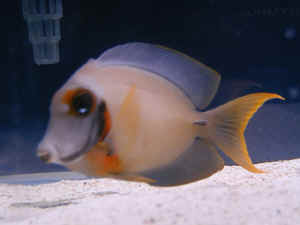
Could you help identify what this is?
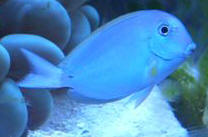
<Appears to be a juvenile Acanthurus nigroris. Bob Fenner>
|
 |
|
Question ID Tang 6/7/15
<14 megs of pix? Why?>
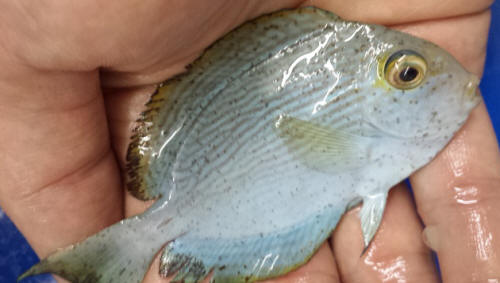
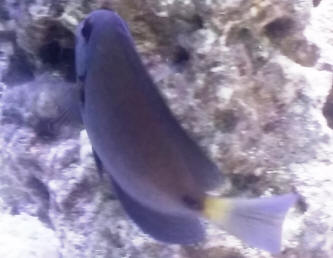
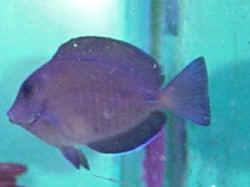
I collected this tang in the Florida Keys within FWC rules etc. I thought it was
a common tang for the area.
<It is>
He is about 3.5 inches long, mostly dark grey except for a light colored band at
the base of his tail - that sometimes disappears completely. Researching I found
juvenile ringtail surgeonfish and Dussimieri tangs are often less colored as he
is. And both species are indo pacific natives...not sure if you can help
identify this one. He does not like dried seaweed either. Just algae fish food
flakes or pellets.
Thanks if you can help!
SB
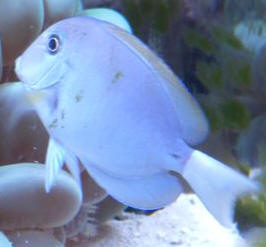
<This is highly likely Acanthurus bahianus. Bob Fenner>
|
 |
|
Re: Question ID Tang 6/7/15
Thank you :)
<Welcome.>
|
|
Help with Tang ID 7/24/13
Hello crew,
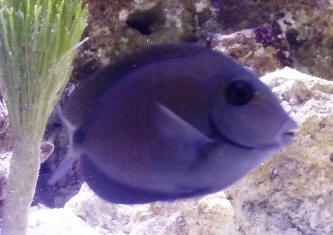
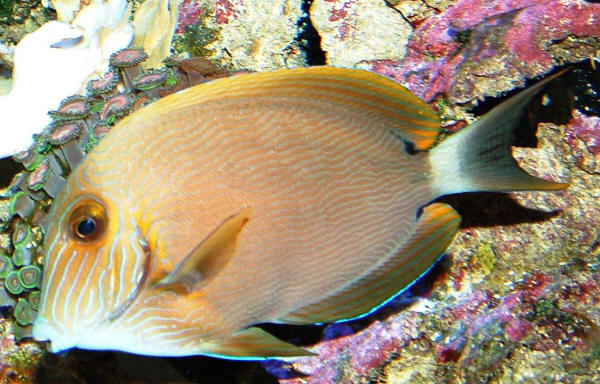
A couple of years ago, I purchased the tang in the attached picture.
It was sold as a Lavender tang. Today, I noticed the white band on
its tail.
I don't think it's a Lavender tang. It has blue lips, blue stripes
on its face, body, and fins, and yellow around its eyes. I'm
worried that it is actually a Ring Tail tang. What do you think?
My tank is 150 gallons.
<Mmm, this is almost assuredly an Acanthurus nigroris... Cuvier's
Bluelined Surgeon... by other name/s. Bob Fenner>
Thanks,
Laurie
|
 |
Re: Help with Tang ID
7/25/13
Thank you Bob. Just before I read your reply, I found a picture and
description of the Bluelined Surgeon, and wondered if that was my fish.
After a little further searching, I found its home aquarium specifications -
max adult size of 10"; 75 gallons minimum tank;
<I'd state twice this>
rare in the aquarium trade. I am lucky to have one! And It
should be just fine in my tank. It's been very healthy and hardy, so far.
Thank you, once again, for your help.
Laurie
<And you for this follow up. Cheers, BobF> |
|
Fish ID – 09/24/12
I hope you can tell me what kind of fish this is....i think it is some
sort of tang but i am not sure.
Thanks
<An Acanthurus sp. of some sort. See here:
http://www.wetwebmedia.com/acanthurTngs.htm
and the linked files above. BobF>
|
 |
|
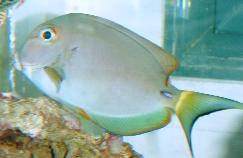
A Fowleri? 11/7/10
Hey Bob and Crew,
<Howdy Chris>
The below picture appears right under your listing of Acanthurus
fowleri ( http://www.wetwebmedia.com/acanthurtngs.htm),
but with no species name associated with the photo. We were given
a 4 incher of this guy a month ago and I have been having trouble
IDing it. Is this indeed A fowleri?
<You know... looking at the linked/larger pic I think
you're referring to... this looks more like A. bariene; good
gosh even A. nigricauda possibly... But was labeled as a
Fowler's at Preuss's when/where I took the shot... Is a
gorgeous species when in good shape, happy...>
I originally assumed that it was not due to the lack of the
horseshoe behind the ear,
<And I do agree w/ this salient characteristic>
but would appreciate your opinion. Many thanks,
Chris
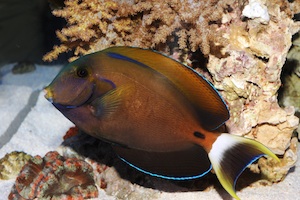
<Sorry re the lack of clarity here... Have attached what I
believe (...) to be A. fowleri... from a tank Quality had set up
recently. BobF>
|
|
|
Re: A Fowleri?
Thanks Bob.
<Thank you Chris>
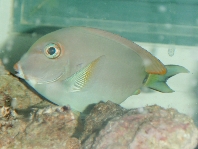
I'm convinced that we do not have A. fowleri - I had some hope
with that photo of yours, but am still not sure what the heck it
is. Here are two photos that I took this morning in the QT.
<Mmm, this looks like A. bariene to me... I do wish I had the
TMC Kuiter/Debelius book with me re Acanthurids/oids... am out in
Fiji presently>
The lighting from the flash is a bit off, but it's tail is
currently bright yellow with a dark blue / slightly iridescent trim
to it and the fish is just under 4" long. The mark above the
pectoral fin is a scratch. I've been trying to narrow down the
ID based on the stripe at the peduncle and I keep coming to A.
bariene. What's throwing me off is the lack of the ear spot,
dark coloration mid-caudal fin, and the lack of a good deal of
yellow at the eye ... which I'm noting in all of the juvi A.
bariene photos I've seen online.
Many thanks!
Chris
<Do you have the TMC books? BobF>
Re: A Fowleri?
Jealously. My wife has been kicking my butt because we missed the
Maldives trip this year!
<Ahh! They're atolls are indeed a treasure. I was hoping Rob
Bray (House of Fins) and MarvinV would want to go that route ahead
of the next Aquarama. Looks like we're headed out to Sipadan
ahead instead... Join us>
I don't have them and am not sure as to their availability here
in China, but I'll look. Enjoy the weather and the water!
<Just done w/ beer pong round two after three bottles of
French... back to the net ho buoy. BobF>
Thanks again, Chris |
  |
|
Tang ID 7/29/10
Hi,
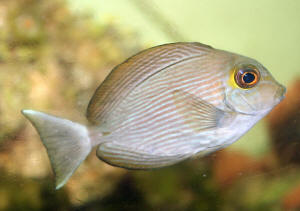
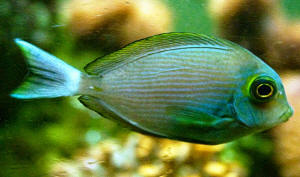
I need an ID on this Ctenochaetus?
<Mmm, I don't this fish is of the comb-tooth genus... It
may be Acanthurus nigroris>
Tang. Its around 2 inches in size and has no spots on its face.
The pics attached are with and without flash.
Regards
Beta Mahatvaraj
<Any idea where (geographically) this fish was collected? Bob
Fenner>
|
  |
Re: Tang ID
Hi Bob,
Do any of the Acanthurus have yellow around the eye as juveniles?
This one does.
<At least five of the thirty two species I'm aware of
do>
These were collected off the South Western coast of India.
<See Fishbase.org, WWM re. BobF>
Regards
Beta
http://fishbase.org/Summary/speciesSummary.php?ID=4738&genusname=Acanthurus&speciesname=nigroris&lang=English
http://wetwebmedia.com/AcanthurusBad.htm
Re: Tang ID 8/2/10
Thanks Bob. I will look it up on Fishbase.
<Okay... there are not many species of fishes that are
well-documented pic-wise as juveniles on up... BobF>
Re: Tang ID 8/9/10
Hi Bob,
I sent the pics to a scientist at the Zoological Survey of India
and she thinks its likely to be *Acanthurus xanthopterus*.
Regards
Beta
<Possibly. Thank you for this follow-up. BobF>
|
|
Unknown Tang -- 11/10/09
Hello,
<Hello, Lynn here this evening.>
We are a small aquarium store, and recently one of our customers
gave us one their Tangs they've had in their tank for several
years. It was getting quite large and he needed a bigger
tank.
<Heeeee! If only we had a dime for every time that's
happened!>
When he bought it originally, the store and himself, wasn't
sure what kind of tang it was. We've done our own research
and we cannot find a good match either. We were wondering if you
can look into it and hopefully find the answer. He is about 9
inches,
<Yikes!>
..and has a few scratches from trying to catch him in the
tank.
<That had to have been difficult for everyone involved! As for
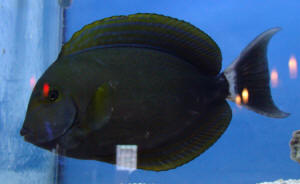
the ID, the closest thing I can find is Acanthurus gahhm (aka the
Monk Tang or Black Surgeonfish), a fast-growing and potentially
very large fish indeed (reportedly 40-50cm/15.75--19.7').
Please see the following links for comparison and more
information:
http://fishbase.org/summary/SpeciesSummary.php?id=17471
http://fishbase.org/Photos/PicturesSummary.php?ID=17471&what=species
Another possibility is a very similar, though ultimately smaller
species, Acanthurus nigricauda, (aka the Brown-Eared
Surgeonfish)
http://www.fishbase.org/summary/SpeciesSummary.php?id=4747
See Bob's notes regarding both species, towards the bottom of
this page: http://www.wetwebmedia.com/AcanthurusBad.htm >
Thanks in advance!
<You're very welcome! Take care, LynnZ>
--
Eric Bergevin, Co-Owner
Fish Tail Aquariums
|
 |
|
Re: Tang Aggression, now ID 6/3/09
Hi, Mr. Jenkins
Thanks for advice.
< Your welcome. >
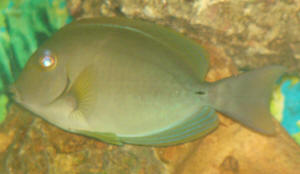
Please do me a favor by identifying the fish in the
attachment.
< I'll try !!>
Initially I had doubts that it might be a Monrovia tang but the
lines on the body are missing. Neither does it have the shape of
the Scopas.
Regards Richard
< The markings on the fins makes me think sp. Acanthurus
blochii. Can't say 100 % sure. Some closer shots of markings,
interesting colorations , etc. could help with identification. GA
Jenkins >
|
 |
|
two pictures for Bob
5/15/09
Hey there Bob. Just me, the guy who drops off pictures from time
to time.
<Hello Grant>
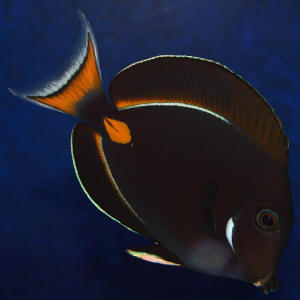
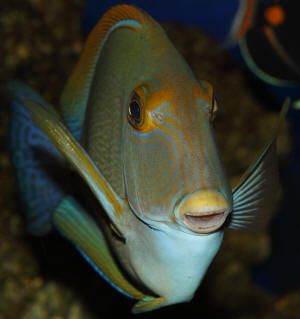
If you want a free and what I consider good picture of a
dussumieri tang and an achilles tang, feel free to use these. If
not, just take a second to enjoy them, they are really gorgeous
fish ;) No color enhancing done through
Photoshop or any other means, I just adjust the exposure (both of
these were pretty blown out) and hit save.
If you want the details, the Achilles is about 3.5" and the
dussumieri is 7". Both feed on a diet of Nori, mysis, NLS
pellets and angel formula, all soaked in
garlic/Zoë«/Selcon/vitamin C.
Hope you enjoy!
Grant
<Thank you for sharing. Bob Fenner>
|
  |
|
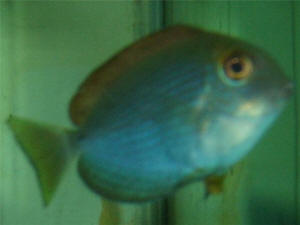
unknown fish 4/19/09
I know that WWM is not for answering for one,
<?>
but I am puzzled and would appreciate your help. I took some
pictures of a fish at my LFS that I eventually purchased as a
"Mystery Tang".. I have taken those pictures to
numerous LFS and e-mailed them to three online fish retailers but
nobody can tell me what kind of fish this one is. I took more
pictures today to send to you. Have you any idea what type of
tang or (angel) this is? He (or she) is a 1 1/2" long
juvenile.
Anything you can tell me would be Greatly Appreciated.
Thank You,
Carl Pepper
Trevor WI
<Mmm, the pix are a bit too blurry, but this is a juvenile
Acanthurus species of some sort... maybe an A. blochii. Bob
Fenner>
|
 |
|
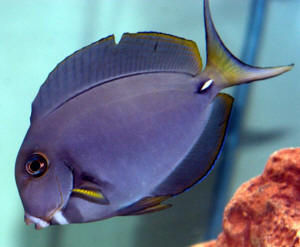
Tang ID: Pale Lipped Tang 4/6/2009
Hi Crew!
<Hi Terri>
I've tried identifying this tang but alas, I cannot. I've
included two pictures for you to have a look at. I've looked
at fishbase.org and at every
tang picture I can get my hands on. This tang was collected in
Cairns, Australia. He has a few war wounds courtesy of a cranky
Sailfin Tang but is
on the mend. Any ideas greatly appreciated!
< I got your second email as well, yes, it is a Acanthurus
leucocheilus - The Pale Lipped Tang. With a Sailfin and an Pale
Lipped Tang, I hope you have a very large tank - 200+
gallons>
<You can read more here:
http://www.wetwebmedia.com/badacanthurusaq.htm >
Terri
<Mike>
|
 |
|
Tang ID 3-31-2009
Good evening crew,
<Hello! Merritt here today!>
I was wondering if you could tell me what type of Acanthurus you
think this? I believe it is a blochii or possibly a dussumieri.
Doubtful on the last one though. It is 5 inches in length. I was
also wondering how long do you think it will be okay in my 90
gal. There is only about 60 pounds of rock in it so there is
quite a bit of swimming room in there. I know this fish gets
quite large. In your opinion what size tank should this fish be
housed in? I would like to keep the fish but I can not set up a
larger tank right now. I do have a 125 gal. I could set up within
a few months if need be but do you think this fish would be okay
for say 1- 1 1/2 yrs. in the 90gal?
<First, could you resend this email with the picture attached.
That would greatly help with the identification! :-) >
Any input is greatly appreciated.
Thanks,
Nick
<Merritt A.>
|
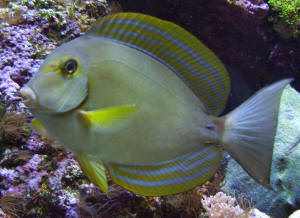 |
Re: Tang ID. 4/1/2009
sorry bout that! here's those pics.
<Almost certainly an A. dussumieri. Could live in an uncrowded
90 for this time frame... being fed sparingly. Ultimately needs
at least twice this volume. Bob Fenner>
Tang ID Part II 4-14-09
Thank you for the ID. and I can also agree with that. But for the
main question from my original e-mail, how long do you think I
could keep this fish in my tank? As stated prior, it is a 90gal.
standard rectangle with about 60-70 lbs. of live rock and just 2
small damsels and an orchid Dottyback. Everything seems fine for
now but I know this fish gets big. I would like to keep it but I
would not be able to put this fish in a larger than a 125 gal.
tank for about 1-2 years. The earliest I can put the fish in my
125 gal. would be 3 months. I could stand to turn a profit on
this fish since I only paid $40 on it because I was the only one
who know what it probably was. What should I do for the best
benefit for the fish?
Thanks again for you time.
Nick
<Hello Nick and sorry about the wait. To answer your first
question these tangs, the A. dussumieri can get up to 14 inches
some even 20 inches! You might be able to keep him in the 125
gallon for 1-2 years depending on his growth rate and current
size but, I would advise passing this fish along to someone with
a larger tank. These guys need space (hundreds of gallons) and I
don't think 125 gallons is enough. Merritt A.>
|
|
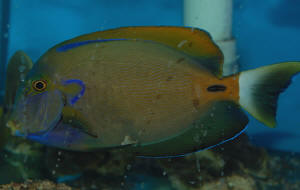
Acanthurus ID (Attn: Bob) -- 02/19/09 Hey
Bob! <Brian> It's been a while since we have spoken,
hope all is well. <Yes my friend, thank you> My turn to ask
a question. My first guess of ID of the fish in the attached
picture was A. dussumieri but now I' thinking maybe A.
fowleri. <It is a Fowler's...> Maybe it's neither,
but an ID would much appreciated. Give me a call when you get a
chance 908-226-1100 and let's shoot the "Fish".
Working at Ocean Gallery and maintaining the website has been a
full time job, but I do login every so often and answer a
question or two when I get a chance. Brian K. Griffin Ocean
Gallery II http://www.oceangalleryii.com <I saw a bunch of
these (had no pix, never had seen up to the point) at Sea
Dwelling Creatures, up visiting a few weeks ago. Cheers,
BobF>
|
 |
Acanthurus spp., ID -- 09/24/08 Hi,
<Hello Chloe.> I am a student at the University of Hawaii at
Manoa and am currently enrolled in the Marine Option Program. Part of
what I am learning is the Latin names of various critters that live in
Hawaiian waters. One of the fish we must learn is Acanthurus blochii,
but when I saw it I immediately thought of Acanthurus mata. Though I
have never physically seen either of them and certainly have never been
able to compare the two next to each other, they look extremely similar
if not the same. Even the pictures on your website show their
similarity. Are they the same or is there a significant difference?
<These two are sometimes confused with each other (following
Randall, this happened often). Their coloration is indeed similar, but
not identical. An easy character for differentiation may be the white
band at the caudal peduncle of Acanthurus blochii, which the vast
majority of this species has. Therefore it is sometimes called by the
common name Ringtail tang. While A. mata has a yellow band across the
eye (as a double band in front of the eye), it's rather a yellow
spot behind the eye at A. blochii. Also check fishbase.org for further
pictures. What also would be quite useful for you is Randall's new
book on Hawaiian reef fishes, which you most likely will find in your
university's library.> Thanks, Chloe. <Cheers, Marco.>
|
Mystery Tang 6/3/08 Hi guys <Michael> I bought
this tang yesterday (see attachments for pics). He was labeled as
a "Bristletooth" tang. However, I definitely think he
is an Acanthurus species. I have not be able to find an ID on
this guy anywhere. All I know is that the importer who brought
him got just got a shipment from Hawaii, so this could be his
likely origin. <Maybe... almost looks like a Acanthurus
thompsoni in some of your pix... but the ones with a white caudal
are a bit different and from elsewhere. My guess is that this is
a juvenile A. dussumieri See here:
http://wetwebmedia.com/tangshi.htm and here:
http://fishbase.org/Photos/ThumbnailsSummary.php?ID=1256> Can
you please help? Cheers Michael <And you. Bob Fenner>
Re: Mystery Tang 6/3/08 Hi Bob <Michael>
Thanks for that. I spoke to the importer and this fish came from
his Hawaiian supplier <My old survey piece on Acanthurids of
HI was linked last msg.> I do not think he is an Acanthurus
thompsoni for a couple of reasons: Hawaiian variants not having a
white caudal <Which I stated...> Many specimens I have seen
on the web are either dark, or light blue, whereas, this guy is
light grey, or white, or dark grey/brown depending what mood he
is in His fin colouration. His dorsal fin seems to be grey, with
gold running along the top (visible in some of my attached pics).
Also, a third of his pectoral fins seem to be yellow, with the
base of the pectoral fins being a very (I emphasize very) pale
blue (almost white) <Agreed> Out of your two suggestions, I
would lean to Acanthurus dussumieri - mainly because of the
colouration. However, from juvenile pics I have seen, there seems
to one difference. Just behind each of his eyes there is a small
dark grey patch (the patch being in similar position to that of
an adult orange shoulder tang, only smaller in proportion and
dark grey). <Mmm, might even be a hybrid...> I am going to
keep looking into him as it would be interesting to see what
species he/she turns out to be. Cheers Michael <Please do send
along pix of the further developed specimen, input re as time
goes by. Cheers, BobF>
Re: Mystery Tang - 6/3/08 Hi
Bob <Michael> Thanks for your help. I will do as you
suggested and take pics over time as it sure will be interesting
to see how he/she turns out. If it is a hybrid, it would be
pretty awesome as I only paid $76NZD for him/her. <Mmm... at
.784 to the U.S....> However, there does seem to be a great
possibility that he/she turns out to be just another variation of
A. Dussumieri or another species. Will keep you informed. Cheers
Michael <Thank you my friend of "the long white
cloud"... will think of you later while working the weeds
about my Avocado trees here in S. Cal., as I know NZ grows many
Hass as well. Cheers! Bob Fenner>
Re: Mystery Tang - 6/3/08 Fair
enough. Trust me, $76NZD is cheep for any tang here. And we
don't just grow avocados here either! ;) Although they are
pretty good Cheers Michael <The place is supposedly a
wonderland of agriculture and sheep raising... Have only been to
Rotorua... with the HHH... thus too blinded by alcohol to
remember much... but can't get the Sulfur smell out of me
clothes! Cheers, BobF>
|
|
|
| Tang ID question 'A Hybrid
Maybe? --05/13/08 I have been trying to identify the
attached to no avail, and am beginning to think it might be a
hybrid. <<I think you may be right>> It was called a
Charcoal Tang in the store, which only produces epicurean results
on Google ;). <<Mmm, yes 'and likely a label placed
(made up) at the holding facility>> It has elements of
Japonicus but I am unsure. Sorry for the furniture reflection.
http://i31.tinypic.com/2webcwi.jpg <<Well John 'it
certainly looks 'Acanthuridae' in appearance; and I
can't find anything like it in my reference material. The
markings and colors suggest to me a mix of A. leucosternon (Powder
Blue Tang) and possibly A. pyroferus (Chocolate Tang). This fish
also looks to be a juvy'¦so the color/markings will likely
change a bit yet and may provide more clues at a later
stage>> Thanks in advance! John <<Sorry I couldn't
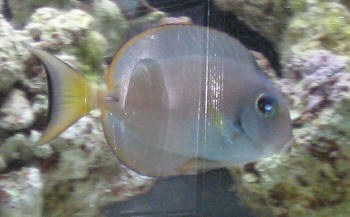
give you a more definitive answer. EricR>> |
 |
| Re: Tang ID question 'A
Hybrid Maybe? -- 05/21/08 Hi Eric, Bob and Crew,
<<Hey John 'Eric here>> I appreciated your
help on this ID. <<Was it of use?>>
http://i31.tinypic.com/2webcwi.jpg"http://i31.tinypic.com/2webcwi.jpg
http://s3.tinypic.com/2u9od44.jpg"http://s3.tinypic.com/2u9od44.jpg
Someone on Reef Central suggested this is a pale lipped surgeon and
attached the following photo.
http://www.abrisousroche.com/EauMer/Animaux/Fiches/Chirurgiens/Acanthurus-leucocheilus.jpg
<<Hmm, perhaps 'as it does look similar to
yours 'but then, neither look anything like that shown for
Acanthurus leucocheilus on fishbase.org>> Now I am even more
concerned as this is a no-no for a 75 gallon, even more than the
powder blue/chocolate hybrid you suggested. <<If what you
have is indeed A. leucocheilus, then yes 'as this fish
reaches 20' in the wild>> I will probably ask my LFS to
consider an exchange for a more tank appropriate fish. Do you agree
that this is a pale lipped? <<Unless yours is in a juvenile
color phase, based on what I see on fishbase.org'¦no, I do
not agree. The fact that someone has a 'similar' specimen
does not necessarily indicate a species specific find, as it too
may be a hybrid>> The tail is blue instead of yellow, but
mine may be younger. <<Maybe so>> Looking at all the
photos on Bob's article The Tangs, Surgeons, Doctorfishes, of
the Genus Acanthurus, on WetWeb, I identified many fish it
'could' be, including bahianus, dussumieri or a Hawaiian
thompsoni which is frustrating. <<Indeed 'and none
of them close enough to be of a certainty>> Anyway, thanks
again. <<I do wish Bob were back so he too could
comment/voice an opinion re your mystery Acanthurus sp. tang.
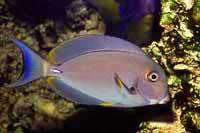
Regards, Eric Russell>> |
 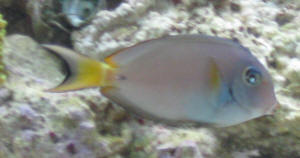 |
|
R2: Tang ID question 'A
Hybrid Maybe? ~ 01/01/09 Hola Crew! <<Hiya
John!>> Last year I wrote to you about the below referenced
Tang and wanted to update you. <<Excellent, thank
you>> While I have not attached a new picture, the tang in
my tank http://s3.tinypic.com/2u9od44.jpg has become increasingly
like the tang pictured in the
http://www.abrisousroche.com/EauMer/Animaux/Fiches/Chirurgiens/Acanthurus-leucocheilus.jpg
in that his tail is increasingly blue, and his bib and lip and
peduncle are increasingly white. <<Okay>> However he
remains much lighter colored than the leucocheilus in the
fishbase.org photos and video. <<Perhaps a regional color
difference'¦ Or simply an anomaly>> Is there
natural color variation in this species, or do they darken with
age? <<I honestly don't really know. But I would
suspect that if this is A. leucocheilus that the latter would be
the case>> I am seeing more photos of this tang on the web,
many with taxonomy questions. Seems like mine is not the only
one, but classification remains unclear. <<Perhaps more
time will tell>> Happy New Year John, aka Fishnu
<<And to you mate! EricR>>
|
Achilles tang hybrid 4/19/08 I saw an
interesting tang at the LFS today. The fish was sent from the
wholesaler as an Achilles and the markings are generally in the usual
distribution for an achilles, but the colors are off. There is the
usual orange coloration across the tail as well as the tear-drop
marking in front of the tail. The body is a muted blue-gray to brown
color rather than black, and there is a distinct white "bib"
like marking across the chest, reminiscent of a powder blue tang. If I
had to guess based just on looks I'd favor a powder blue/achilles
hybrid but that doesn't make sense geographically. My next thought
would be a Dussumieri. I only see references to Achilles x Goldrim
hybrids so I thought I would see if you had seen any other crosses.
I'll try to get a photo if you think that would help. Thanks, Jeff
<Have seen a few crosses twixt A. achilles and the Gold-Rim (or Cat
Tang in HI), A. nigricans (nee glaucopareius). Do send along a pic if
you can. Cheers, Bob Fenner>
Tang taxonomy, naming 03/04/2008 Dear WWM
crew, Thanks for your extremely informative and helpful site. I
recently added a tang that has been called a lavender tang, it was sold
from LFS as a Palani tang. From the picture on the WWM section dealing
with tangs, it is listed as Acanthurus nigrofuscus. <Yes... this is
likely the most commonly applied name for the Lavender... the Palani is
most often Acanthurus dussumieri> Another site has the same fish
listed as Ctenochaetus Nigrofuscus. <Mmm, there is no such fish... I
think they've got the genus wrong here... the only species name
applied to Acanthurid/oids for nigrofuscus is Acanthurus...> Can you
please help to clarify which is the correct listing? I'm asking
because it is behaving very much like a member of the Ctenochaetus
family. <Mmm, not a family, but a genus...> It is actively
feeding on a lush growth of algae in my 40 gal. holding tank that
contains live rock and cleaner shrimp. I prefer to use this method to
quarantine my fish instead of using copper. Thank you for all the past
and present help. Matty T Cleveland OH <The Lavender is one of my
fave Tangs... is very common in the wild where it's found, stays
small, is relatively peaceful, and an ardent algal picker... Please
read here: http://wetwebmedia.com/tangs,.htm and the linked files where
you find, lead yourself. Bob Fenner>
Acanthurus pyroferus... sel..., mimic tangs
period 2/16/07 I need some smarts. <Hey, get
in line behind me!> I've seen/heard various
conflicting reports regarding the commonly referred to "mimic
tang." <Mmm... well...> Quite simply, I've
heard of three species, Acanthurus pyroferus, Acanthurus chronixis, and
Acanthurus tristis. <There are these three... perhaps some
others...> As juveniles, they all have quite their specific looks,
but I very much enjoy the look of the A. pyroferus as an adult. I think
it's understood that the yellow mimic juveniles are indeed the A.
pyroferus, but the question; how can you determine if an eibli or half
black juvenile is the aforementioned A. pyroferus instead of the other
options such as A. chronixis or A. tristis (your website implies the A.
pyroferus can mimic many different Centropyge sp.)? <This is so...
and for the purposes here... really only practical to have you check
numerous images for comparison twixt the Surgeons and Dwarf Angels...
they are distinctive seen side by side I assure you... Perhaps
fishbase.org, Scott Michael's Reef Fish series...>
I'd hate to find out months or years later as to what
my selection turns into, and I'd like something a little more
unusual than the common yellow mimic juvenile. <Oh... and to further
toss in a monkey wrench, these fishes are capable of changing quite a
bit... tend to "drift" from seeming pre-disposed coloring,
marking in captive circumstances... Less so in larger volumes, in the
presence of "biotopic" (naturally co-occurring) species. Bob
Fenner> Thanks!
Chris
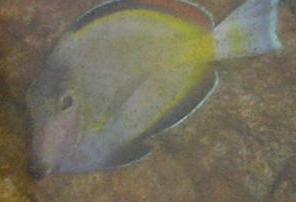
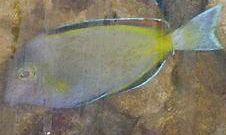
| Tang ID. Picture attached of Tang in
question. Was sold to me as a Lipstick tang "Naso
lituratus", I'm thinking that I may be fortunate that it
is more to the name of a A. japonicus, but it doesn't have the
white "cheek" marking as described, The rest of the
coloring doesn't look like it would be the a. nigricans either.
Attached is a couple pics of it, since its color does vary a bit in
the body. Mainly, seems when it gets startled, also, aprox.
3.5-4". <You are correct... this is not a Naso sp.
tang. IT IS either A. japonicus or A. nigricans. Both of these fish
are commonly referred to as "powder brown" or "gold
rim" tangs. See here: http://www.wetwebmedia.com/GoldRimSs.htm
A. Japonicus is the far better aquarium fish, and I suspect that is
what you have. To verify, look also for the characteristic yellow
tail bar of A. nigricans. Hybrids are thought to occur between
these fish and A. Leucosternon (powder blue), and it is possible
that this is one of those or just an unusual morph. These fish
often display unnatural looking colors under stress, so a positive
ID may only be possible if the fish reaches peak health.> Please
disregard the algae spots, that at least seems to be going away, as
last week it was pretty much sheet, instead of spots. Midnight
sleeper goby and Red Sailfin Blenny seem to have been working
overtime. Additional tankmates: Firefish goby, pair of cleaner
shrimp, yellow tail damsel, and false percula clown. Temp 76,
Salinity 1.023, ph 8.3, alk 325, ammonia 0,nitrite 0, nitrate 20
and falling, was 40 a week ago. Would be appreciated if you could
id this tang for me. Hoping it is more suited for the 48"L
tank, it is eating anything from Frozen Brine, Zooplankton, Marine
flakes, and devours seaweed salad. <Your tank mates sound
fine, and this tang should help clear up any algae problems. Any
48" tank will be too small for this fish. It may do OK for a
few months, but it will soon out grow it. These fish appreciate
strong water movement (at least 15x tank volume) for both high
oxygen saturation and the swimming stimulation. I am not sure about
the ppm scale for alkalinity, so please consult your kit
instructions and maintain it in the high end of the normal range.
Also, I would avoid significant amounts of brine in any fishes
diet. Ocean nutrition frozen "pygmy angel formula" is one
of my favorite tang foods for it's high marine algae content.
Lastly... I hope that this fish was quarantined. All tangs are high
Ick risks and often take tankmates with them when they cause an
outbreak. Best Regards. AdamC.><<Is japonicus.
RMF>> |
|
|
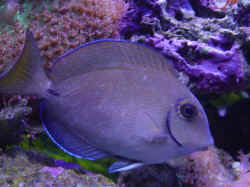
| Acanthurus bahianus and chirurgus I
recently found two un-identified tangs at my local supplier. As
shown on your page, I have identified them as juvenile Acanthurus
Bahianus & Acanthurus Chirurgus. <I concur... these species
are what are pictured> They eat like horses and are well
behaved, their color changes at the drop of a hat. They are
presently in a 66 gallon reef with a Kole and a Powder Blue. I
could of never imagined how colorful they became after settling in.
It was an experiment and I'm curious to see just how well they
will continue to adapt as they mature. <Many organisms are
overlooked... due to being so "local"> Your initial
comment about them on your site was right on the money for the
Bahianus, the Chirurgus so far is about the same yet was quite
timid at first. Now the Chirurgus has asserted himself and
won't take any guff from anyone. <Good... now about the size
of their system... needs to be much larger> The main reason I
bought them was the fact I had never seen them offered over the
years in any supplier and that you quoted the Chirurgus as
"rarely offered in the trade". <Ha! And very abundant
in... Florida, and points east and southward...> Worth noting is
that the Chirurgus & Bahianus are quoted by many sources as
being found together in mixed schools in the wild. <Not that
common, but not rare> They stick together like glue much to the
dislike of the Bahianus, yet even more amusing is the affinity that
the Chirurgus has for my adult Powder Blue Tang. This Chirurgus has
an extremely strong schooling instinct, it may be due partly to his
small size and immaturity. All in all a good experience so far,
find attached pics of the juvenile Chirurgus & Bahianus. As
they grow maybe it'll convince the better half that we really
do need that 180 gallon that I'm always talking about! <Yes!
Bob Fenner> Van Vlaardingen St.Hubert, Quebec, Canada |
 |
 |
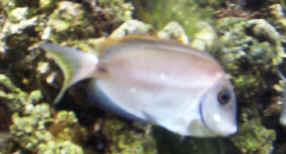
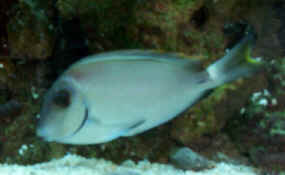
| Fish ID Help - 2/17/03 Hi
Anthony, Here are some pictures. Thanks. Ron <Ron... thanks for
the images, but they are neither clear nor close enough to be
certain. Yet they do resemble Acanthurus blochii very much. I
don't think we can be of any further help to you on the ID. I
forget how big this aquarium was too? Any of the Acanthurus that
this turns out to be exceed 40 cm at maturity (16"!) and I
fear you may not have a tank long enough to grow it to adulthood.
More importantly, its apparent that this fish has suffered from the
rigors of import and is remarkably emaciated. You need
to fatten it up ASAP to save it. Focus on high protein greens like
Spirulina tablets... as well as Mysis shrimp and even some freeze
dried foods if it will taken them (we're looking for 20%
protein or better... much better actually). I also saw some
hermits one of the pictures that look like temperate
species from the gulf (janitor types). Do ID them if you are not
sure they are tropicals. Best regards, Anthony> |
 |
 |
| Fish identification please Can you identify
this fish? I think its a Tang, but what kind is it? <This is an
Acanthurus pyroferus, one of the mimic tangs. Please see
here re: http://www.wetwebmedia.com/acanthurTngs.htm
Bob Fenner> |
|
|
HAWAIIAN CONVICT TANG BOB, YOU LINK
http://wetwebfotos.com/Home?actionRequest=articleView&articleID=10
http://wetwebfotos.com/Home?actionRequest=organismView&organismID=108
this link has a Hawaiian Convict tang (sub species) in the top
picture. Hint: the Hawaiian has the second bar extending past the
pectoral fin all the way to the bottom of the belly. The
number of bones/rays in the fins is also different than the
non-Hawaiian. I must spend too much time reading Jack Randall's
books. ABOUT Hawaiian tangs has a picture of the NON-Hawaiian
convict tang. Do you know how to tell the difference? ALOHA John Dawe
<Evidently not... though have seen, photographed "Maninis"
in a bunch of countries, places... That Dr. R... just two nights back
was stymied at a SDMAS meeting by someone asking what species of
Bristlemouth tang they had... I said, "likely a Ctenochaetus
striatus"... but Dr. Jack has expanded the number of species
recently (groan). Be chatting. Bob Fenner>
Tang ID Hi there!! Thank you so much for the opportunity to
get your feedback!!! This is a great feature! I have two different
questions: 1) I purchased a fish and was told that it was a Pacific
Blue Tang. However, according to pictures I've found while
researching, he is NOT a pacific blue at all! How can I possibly find
out what he is? Is there an online guide that YOU know of (with
pictures) that might possibly help me track down exactly what kind of
fish this is? I'm at a complete loss! Just in case you can place
him: He is a mottled blue and yellow -- very fine striping on his
sides, and not as linear tiger striping on his face (alternating a pale
yellow and deep blue). Yellow fins. Yellow 2) I just purchased a
55-gallon corner tank for my home, and am a little intimidated by the
filtration for this tank (I have a 30 gallon and 10 gallon salt). Can
you please recommend some of the hardware I should buy to keep this new
tank healthy? THANK YOU SO MUCH!!!!! Best Regards, Margaret
Pennell >> For the first query, do have a technical site that is
a fabulous tool: http://www.cgiar.org/iclarm/fishbase/ Do your
initial search of all the Surgeonfishes under their common name or
family: Acanthuridae... and click away at the pictures associated with
the species... But, I'm also attaching an image of what is very
likely a juvenile stage Atlantic Blue Tang, Acanthurus
coeruleus... which is probably what you do have.... It will grow,
change color to look more like the typical images of the adults. The
second.. what sort of gear for the 55 corner tank? Hmm, lighting,
filtration/circulation... including a skimmer...? Sorry, I don't
know if I follow what you're looking for. The set-up will probably
incorporate the same sorts of elements of your smaller systems. Bob
Fenner
Question On A blue tang Hey there, I enjoy reading your Q
& A on the Flying Fish Express web site. You've help me several
times before. I had a blue jaw Goby the had a hole in his side. The
medicated food didn't help. But I finally caught him last week. I
treated him with Karcyn <probably Kanamycin>( mis spelled) and
the hole has stopped growing and the White area has diapered. Thanks
for the Advice. My New Question: I recently bought a blue Tang (yellow
tailed with blue maze like pattern) The fish is still a juvenile. He
was fine for the first week in Quarantine and now has black patches
near his belly. Also had a clear white growth near his eye but has
fallen off. The tang eats constantly. I feed him brine shrimp, macro
algae and veggie gum drops. He does swim around a lot. He is in the
same tank as the Gobies. He also received the same medication as the
Gobies. Any Suggestions what it maybe and the treatment if any? Thanks,
Anthony >> <Sounds like a nervous/environmental
"disease" that will cure itself with the animal adjusting to
captive conditions... Not infectious or parasitic. I would just place
the fish in your main system... and do start a "algae sheet"
food offering regimen... strips of Nori you can buy from pet fish or
oriental food sources. Bob Fenner, who says, oh, yeah, this is the same
species (Paracanthurus hepatus), as you folks from elsewhere call a
Hippo or Palette Tang.
Re: Question On A blue tang Thanks for the help, The Tang is
basically all blue with yellow tail. Has the body shape of a Yellow
Tang. He is just a juvenile. Is he still a Paracanthurus hepatus?
Thanks, Anthony >> Hmm Yellow tailed, blue body with maze-like
dark markings... could be a Paracanthurus... or maybe just a juvenile
Atlantic Blue, Acanthurus coeruleus... take a look at this site:
http://www.wetwebmedia.com/tangs,.htm And read down to the genus...
this species goes from a tiny all-yellow to blue with yellow tail... to
all azure blue... Is this it? Ah, good, Bob Fenner
Re: Question On A blue tang thanks, Its a Atlantic Blue Tang.
>> Ah, yes. Bob Fenner Acanthurus pyroferus Hello again! I
am trying to discover if anyone has grown a Pyroferus to maturity in a
hobbyists' aquarium. Our friend in our reef is growing bigger and
into the Sub-Adult stage. He/She receives foods in many varieties and
has developed plenty of physical bulk. The caudal fin shows the
beginnings of the "feathers" carried by adults. The
orange/black coloration is prominent around the operculum and the pale
yellow lip on a dark background is visible. Is the normal development
experienced by reefkeepers? Regards >> Yes, if the animal is kept
long and well enough... Public aquariums are where I've mainly
seen/photographed such advanced development individuals... of a few
"normal" and mimic varieties. Bob Fenner
Re: Pyroferus Good Evening Bob!, Further to my earlier
messages. My pyro has developed in a different way to other
histories I have read. The head has almost adopted the adult form and
the rest is still quite yellow. However, the upper rear of the fish has
shaded as the adult. It is still subject to body colour changes, tied
to emotions; especially when feeding. The tail extensions are
developing. I am looking at the new range of Canon SLR autos to buy and
photograph the progress of this particular fish. I will also shoot the
other fish which are not behaving in the accepted manner. I feel very
privileged to be an observer of these changes. Regards Anthony Barden
>> <"In the accepted manner...?" Curious. Well,
Canon does have about the fastest lenses in their 35mm SLR's.
I'd use Velvia (Fuji's super color rich 50 ISO slide film).. Do
this documentation, and know that such observations have been remarked
upon... seems like if some mimics don't have "things to
copy" they go a bit awry. Bob Fenner>
Surgeonfishes: Tangs for Marine Aquariums
Diversity, Selection & Care
New eBook on Amazon: Available here
New Print Book on Create Space: Available
here
by Robert (Bob) Fenner |
|
|
|