|
FAQs on Genus Acanthurus Tang
Diseases
Related Articles: Acanthurus Tangs, Naso,
Related FAQs: Tangs/Rabbitfishes & Crypt, Acanthurus Tangs 1, Acanthurus Tangs 2, Acanthurus Tangs 3, Acanthurus ID, Acanthurus Behavior, Acanthurus Compatibility, Acanthurus Selection, Acanthurus Systems, Acanthurus Feeding, Acanthurus Reproduction, Powder Blue Tangs, A. sohal, A. nigricans
& A. japonicus, Tang ID, Tang
Behavior, Compatibility, Systems,
|
|
Surgeonfishes: Tangs for Marine Aquariums
Diversity, Selection & Care
New eBook on Amazon: Available here
New Print Book on Create Space: Available
here
by Robert (Bob) Fenner |
 |
|
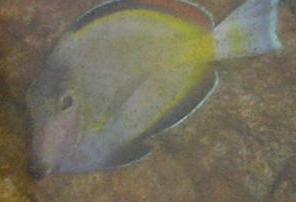
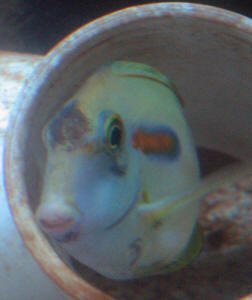
White ring on Clown Tangs head 1/20/19
Hi Crew,
<Hey Lloyd!>
I was admiring my fish and noticed this ring on my clown tang that is on his
head near his left eye. I would like to know what this is. And if it is a minor
or serious condition? He is still aggressive with the other fish, eating and
swimming, no visible signs of stress. But I worry that it could get out of
control quickly. To me it looks like he may have rubbed a rock or gotten into a
small fight that has caused this.
<You´re right, it is a physical trauma, I wouldn't worry as it will heal in a
few days/weeks, just pay attention to its behaviour to see if it is scratching
against the rocks; I hope your tank is big enough (150+g).Surgeonfishes need
plenty of space to swim freely.>
Regards,
Lloyd
<Cheers. Wil>
|
 |
|
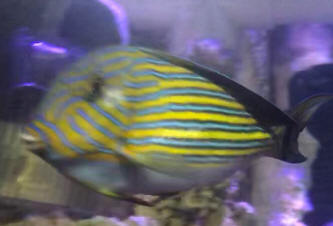
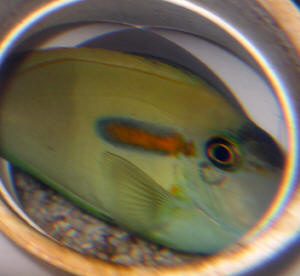
Mimic Tang issue 11/21/17
Hello,
<Hey Ron>
Looked online trying to diagnose whatever this aliment is affecting the fish in
attached picture.
It is of a friends fish. She states that the area is raised and that fish is
swimming and eating normal.
Any help would be appreciated.
Thank you in advance,
Ron Ruesch
Wisconsin Reef Society
<What is this? Looks... almost viral; or possibly resultant injury from... a
brush with a very powerful stinging organism. What other life present here? NOT
HLLE; and I would not treat this fish, system. Just good care... water quality
and nutrition. And time going by. Bob Fenner>
|
 |
|
Re: Mimic Tang issue 11/21/17
Thanks for the reply Bob.
Only stinging organisms in the tank according to my friend are a torch
coral and a mini maxi anemone.
<Ahh; these might well "be it">
She is going to work on better diet and
vitamin supplement.
Hope you have a great thanksgiving,
Ron
<Thank you Ron; and you and yours. BobF>
|
|
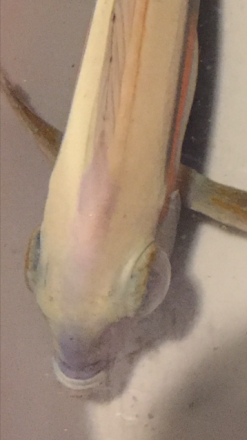
Cloudy pop eye tang 7/8/17
Hi, thanks as always for the wonderful service you provide everyone! Your
advice, articles, and information are all super!
<Ah, good>
I have an orange shoulder tang I just got and apparently the sellers other fish
picked on it and damaged its eye.
<This beautiful species is on the end of the scale w/ a few others (Powder Blue,
Brown...) in terms of being hard to keep in captivity. REALLY needs a BUNCH of
room (hundreds of gallons)... VERY clean water...>
I attached a picture of the eye. It is in a 100 gallon stock tub QT now.
Should I treat the fish with something or just rely on good water quality and
food to help it get better?
<A tough question... as the bulging eye is unilateral/one side; this is highly
likely a case of trauma (rather than bacteria, parasitic...) issue>
If I should treat it what should I use? Does it look like it will be okay
eventually? Thank you!
<Let's have you read here re:
http://www.wetwebmedia.com/Popeyecures.htm
and the linked files above as much as you'd like; to gain perspective.
Unfortunately the prognosis for this species, kind of injury is poor. Bob
Fenner>
|
 |
|
Re: Cloudy pop eye tang 7/8/17
Hi Bob, thanks for the incredibly timely response. I read the FAQ's before
emailing, but didn't see a definitive answer, but after evaluating it more I
think what I'll do it wait and see.
<Ahh, yes. This is what I would do. This IS a fave species of Tang, esp. when
out diving in Hawaii, am always looking for its broad flanks scooting about the
bottom, feeding>
The fish came from someone's established tank and went to another reef keeper
whose fish picked on it, and then I got it so it is not brand new to a tank.
This evening I think the orange shoulder tang is looking a bit better. He is
eating Spectrum pellet food like a pig and picking on nori.
<Good food choices>
His eye looks close to the same. I'll just keep him in the 100 gallon QT tub for
a while and keep the water clean, it has a decent skimmer too. After that if he
is okay in 3-4 weeks he can go in my 300 gallon tank which has 500 gallons of
total volume going through it. Hopefully that'll be big enough. By the way, you
spoke at our reef meeting in San Diego and I saw you speak at the last MACNA on
butterfly fish, which I was contemplating getting but decided not to after
learning more about them. ��
<Ahh! Am hoping that Mark Lawson will help resurrect the San Diego Club. Have
offered to help in what ways I can/may... Giving programs, lining up others,
manufacturers, distributors for donations et al. Hope to see you at the upcoming
(August) MACNA in LA. Bob Fenner>
|
|
8 year old Shoulder Tang
1/27/17
Aloha,
<Howsit? Darrel, you owe me some part of twenty US... your too large file
wouldn't load here in Fiji. Had to sign up for the advanced svc. Hundreds of
Kbytes mate, NOT megs>
I really appreciate the service wet web media provides. Mahalo. To Bob
Fenner and the crew.
<Follow our guidelines then!>
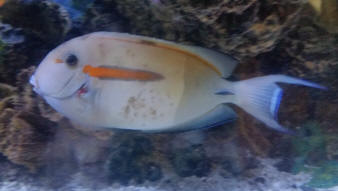
I operate a Marine aquarium maintenance service and recently some thing
happened to an 8 year old shoulder Tang that I haven't seen before.
The Tang resides in a 650 gallon Fish only aquarium 8.2pH 40ppmNitr 1.021SG.
<A bit low>
About 3 weeks ago, a golden head goby I added died fairly quickly.. 2 weeks
or so after 15 days QT time. A little while after the Tang developed brown
splotches and started to hide.
<Mmm; likely not related>
With parameters in line, I immediately suspected parasites of some kind.
Close inspection of some of the other larger fish, 2 yellows, 3 Blue Hippos,
and a 10 year old Stars and Stripes puffer, revealed little.
Nothing evident on the fins, clear active eyes, no scratching, etc.
However the fish mostly clustered in one area of the reef insert for about a
week.
<Mmm; environmental. Something/s you don't measure are off>
There is also an 8 year old Heniochus that is mostly hiding but has no
visible discolorations.
Any advice?
<When, where in doubt, punt! Massive water change (like half), with gravel
vacuuming, addition of a few units of ChemiPure and PolyFilter in the flow
path. Bob Fenner>
Thanks in advance.
|
 |
|
Re: 8 year old Shoulder Tang
1/27/17
Oh, the system also is running a 120 watt Emperor Aquatics Smart UV (40wx3)
6 months of service for the current bulbs.
<I'd be checking the Fe +2 and 3 coming off the igneous. B>
Darrel
Re: shoulder tang 1/27/17
Mahalo. I will send you a check or money order. U.S. funds?
<Heeeee! Thank you for the offer Darrel>
I already did everything you suggested prior to contacting you.. the
markings improved and then came back albeit in a different pattern. I will
repeat process.
Thanks again.
<This Acanthurus (does) suffer/s from many types of environmental (over)
stress. IF it's still eating, moving about... I give you good odds of it
recovering. A hu'i hou! Bob Fenner>
|
|
Tang issue; dis. and ID 7/1/15
Hello there,
<Josh>
If you would be so kind to point me in the right direction, I would be thankful.
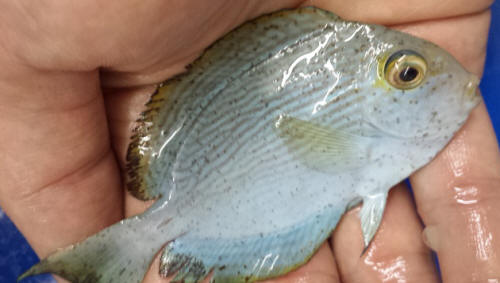
I had this tang for about 3 weeks in quarantine and after I checked it for the
all clear I put it into my system. About a week later it developed these
blotches all over its body and the next day 2 of my other fish got them too.
<Mmm; best guess these are simply "stress markings" (though could be Flukes; see
WWM re).... will go of their own accord; and likely in just a few days; once all
become familiar w/ each other>
I have since put the three fish back into quarantine.
<I would put all (back) in the main-display. More stable, optimized conditions>
Could you help identify what this is?
<Appears to be a juvenile Acanthurus nigroris. Bob Fenner>
|
 |
|
Research question about surgeonfish photo
5/18/14
Hi there!
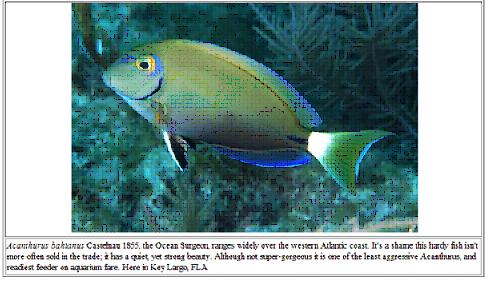
I am doing some research on ocean surgeonfish disease and was wondering
if you can tell me who the photographer is for the photo below and when
the photo below was taken. Thanks for any information that you can
provide.
Rita
<I shot that pic in Nov 2011 while in Key Largo... likely near
Pennekamp. Bob Fenner>
|
|
|
|
Re: Research question about
surgeonfish photo 5/18/14
Thank you!
<Welcome. BobF>
DR. RITA PEACHEY // CIEE
Director - CIEE Research Station Bonaire
Executive Director – Association of Marine Laboratories of the Caribbean
Resident Director – Tropical Marine Ecology and Conservation program
|
Blindness in freckle tang
4/1/14
Hi everyone,
<Marc>
Hope all is well. I have found myself in a somewhat stressful position
and looking for some advice on the best way forward. I have a freckle
tang that I have had in QT for the past 4 weeks
<Mmm, well; this, a fave Acanthurus sp., decidedly does not like (gets
easily stressed by) small space confinement>
and he has been eating and looking great (I love these fish). However a
week ago he displayed the signs of significant swim bladder issues and I
treated with antibiotics (I was concerned it may be biological and he
didn't look happy - I understand it may have also just been a gut
blockage)
and I am pleased to say he is now swimming upright. The problem is and I
blame myself for not picking it up early enough during his issues with
his swim bladder he scrapped his eyes quite badly and I fear he may have
physically blinded himself by damaging the surface of his eyes. He does
not appear to be able to see right now and I was wondering do I continue
to persist with him and see if he improves or is it more humane to
euthanize.
<I'd hold off on the latter for now>
It has been a week since he began swimming properly and I have made sure
water qualities are spot on and stable.
Thanks from a disappointed fish lover.
Marc
<Acanthuroids have remarkable powers of regeneration. Bob Fenner>
|
Weird Skin Disease? Env. likely 9/21/13
Good day everyone,
<Hey Lyndon>
Appreciate it if someone could advise what this could be and possible
treatment?
<Sure>
Weird discolouration that I haven't come across on a tang so far.
Thanks for the assistance.
Lyndon
<Have seen such "markings" on Surgeonfishes many times. This is highly
likely not anything pathogenic (i.e. caused by a biological agent), but
a reaction to something "too much" (or possibly too little) in the water
here. If it were my fish, and I had another established system, I'd move
it there. If I didn't, I'd look into water quality such as we have tests
for, and add a few to several pounds of healthy live rock to the
existing system... To modify the water, offer other foods.
Bob Fenner>
|
.jpg)
.jpg) |
|
My Atlantic blue has form of some patches on it fins and body (
pigmentation) 8/21/12
Hi there,
<Les>
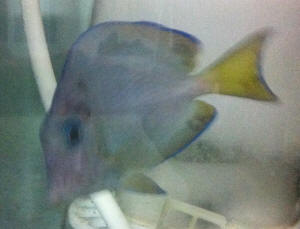
I have some problem with my Atlantic Blue tang, i had it since he is a babe,
almost a year now.
Lately he show some brown patches on its skin, is it normal?
<Mmm, yes; simply evidence of capture, shipping/handling and isolation
stress>
I am worry sick.
<Don't be>
I remove him to the sump and monitor closely.
He is still eating so well and still active.
Do you think he is sick or he is normal and changing into adult?
<I'd move back to the main/display tank>
Hear from you
Regards,
Leslie
<And you, BobF>
|
 |
Dussumieri Tang Lip 4/22/12
Good afternoon.
<And you Nate>
Yesterday I bought 6 inch or so Dussumieri Tang. Today I noticed his
upper lip is kind of pull back a bit, exposing his entire front teeth,
tooth, beak, whatever you would call it. I would guess it was from
banging into tank walls or rocks before I got it.
<Agreed>
Is this something I need to worry about? Also do you think this is an
issue that will fix itself on its own or will he have this problem
forever?
<Mmm, not to worry much, nor "do" anything extraordinary. These fishes
(Acanthuroids) are quite good healers given good water quality, space
and nutrition. I wouldn't "treat" the fish, system>
Thanks for your time,
Nate
<Welcome. Bob Fenner>
|
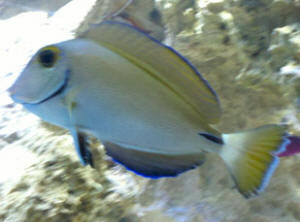
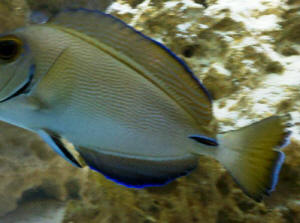
Fraying Tail 11/7/11
This is my A. bahianus. Tail's been fraying for three or four
months.
<Mmm, no big deal really>
This started in a hospital tank while the show tank was fallow
for Ich treatment. At the time, the fish were in Cupramine.
<Hard on Acanthuroids (copper)>
I tried a Maracyn product (the one for fin rot), but it made no
difference. A firefish, Perc and gramma have never been affected.
Another firefish had similar symptoms at first, but that
particular fish was taking a beating from the gramma, and
eventually starved to death hiding in the rockwork.
<This Acanthurus is too thin as well>
This gets better and worse. Right now it's the worst I've
ever seen it on the tail. The ventral fin is better, and the
dorsal fin is almost completely cleared up.
Still, I have no idea what's causing it, or how to beat
it.
<I do... in addition to what foods you're utilizing, add
Spectrum pellets to the staple list... This added nutrition will
cure the thinness and fraying fin issues in a few weeks>
Tank is a 72 gal bow. Nitrates range 5-15 (I skim continuously),
and I try to keep pH at 8.0+. SG = 1.024-1.025. All water goes
through an RO/DI. My pumps are over 150W, and my typical temp is
80-82F with open "eggcrate" tank covers.
There are shrimp in the tank, and if I need to medicate I'm
prepared to trap him and move him to a hospital tank.
<Not necessary or advised>
What do I have, and how should I treat?
<The NLEnterprises food product. You're soon to be a
"believer". Oh, do read here re if interested:
http://wetwebmedia.com/SpectrumFoodsF.htm
Cheers, Bob Fenner>
|
  |
|
Re: Fraying Tail of
Acanthurus 11/7/11
I'm familiar w/ Spectrum. If you think this is a nutrition
problem I'm happy to make it a tank staple.
<Is largely. Again, this specimen has a low index of fitness
period>
He does seem undersized for his age. I've been using mainly
saltwater multi-packs supplemented with dried seaweed, but in
retrospect this does seem less than adequate for grazers.
Thanks, Bob, you're a lifesaver. They're little tiny
coldblooded lives, to be sure, but you definitely make up for it
in numbers!!!
<Cheers Rick. BobF>
|
Fish Question 8/30/11
Dear Bob (and Crew),
<Rick>
I've had a nearly 4" Acanthurus bahianus for almost three
years. Around four months ago I converted my 72-gallon bow-front tank
from crushed coral to a fine aragonite. Around the same time I also
introduced a dwarf angel who has since died. Somewhere along the way,
the tang started pooping white sand.
<Tangs do ingest substrate... thought to aid in digestion, perhaps
trituration, akin to the crops of some birds>
Nothing slimy looking, nothing "clingy or stringy," but also
no other kind of poop that I've noticed. He just poops white
sand.
<Not to worry>
I'm not sure whether this is related to a parasite that might have
come from the angel, or if the fish just happens to eat this new kind
of substrate while grazing. Appetite seems fine, and he doesn't
seem to be losing weight. I'm tempted to throw in a
Praziquantel-based food in case there's a parasite, but there are
also some shrimps and a hermit and I don't know what it would do to
them.
<I would hold off on treatment>
None of the other fish (two Firefish gobies, a false perc, a royal
gramma)
are pooping anything unusual.
Should I be concerned?
<No>
Thanks in advance,
Rick Koch
<Welcome. Bob Fenner>
|
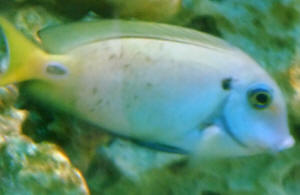
Vampire tang with freckles??-- 03/20/11
Hi,
<Kate>
We have a Vampire Tang (Acanthurus tennenti) who is about 3'
and has developed brown splotches over the surface of his skin
that look a lot like freckles. They are not raised and don't
appear to have moved. We were concerned that it could be black
Ich but after doing research on the net I have not found any
pictures that look like what he has.
<Stress>
The problem started when we went on holiday for a week and came
back to find our Bannerfish had died after getting trapped
between 2 rocks. We tested the water and had high nitrites and
ammonia obviously due to the death of the poor fish. We did an
immediate water change (20%) on the first day and another the
next day. This returned the parameters to normal.
I wondered if the tang could have ammonia burns?
<Yes, though more psychological than physiological likely
here>
We also have a freshwater tank that houses 2 goldfish we bought
who were already suffering ammonia burns and we have basically
rescued them-- they are now both very fat and happy. The markings
on the tang seem similar to what they had and have progressed in
a similar way. He has been scratching on rocks, but has been
receiving good cleans from our cleaner wrasse and the cleaner
shrimp. We thought we had noticed some rapid gill movement so
added 2 extra air stones to supplement our normal system.
<Good>
Other than that his behaviour is
normal, he is swimming around fine with no balance problems and
is as sociable as usual. He is eating well, loves the Nori and
flake that we put in and is foraging around the tank. All of the
other fish (2 false clowns, 3 Pseudochromis,
<Mmm, which species? Tank bred? How large is this
system?>
flame Hawkfish and the wrasse) are fine with no abnormal markings
or abnormal behaviours.
We are not sure what to do with him. We were thinking of doing FW
dips but he is impossible to catch and I don't want to stress
him out further.
<You are wise here>
Is there anything you think we should be doing or something we
may have missed?
<Patience>
We are going to the LFS to buy a vitamin supplement in case it is
a dietary problem.
<Also a good idea>
Any help you could offer would be great, he is our first tang and
is so interesting to watch. It would be a shame to lose him!
Kate
<Just time going by, your good care. Bob Fenner>
More re Vampire tang with freckles??
3/20/11
<Now that I see your pic/photo, I do agree with your that this
is very likely a chemical burn of some sort. I see evidence of
BGA/Cyanobacteria on your rock... toxic. BobF>
Hi,
We have a Vampire Tang (Acanthurus tennenti) who is about 3'
and has developed brown splotches over the surface of his skin
that look a lot like freckles. They are not raised and don't
appear to have moved. We were concerned that it could be black
Ich but after doing research on the net I
have not found any pictures that look like what he has.
The problem started when we went on holiday for a week and came
back to
find our Bannerfish had died after getting trapped between 2
rocks. We
tested the water and had high nitrites and ammonia obviously due
to the
death of the poor fish. We did an immediate water change (20%) on
the
first day and another the next day. This returned the parameters
to
normal.
I wondered if the tang could have ammonia burns? We also have a
freshwater
tank that houses 2 goldfish we bought who were already suffering
ammonia
burns and we have basically rescued them-- they are now both very
fat and
happy. The markings on the tang seem similar to what they had and
have
progressed in a similar way. He has been scratching on rocks, but
has been
receiving good cleans from our cleaner wrasse and the cleaner
shrimp. We
thought we had noticed some rapid gill movement so added 2 extra
air
stones to supplement our normal system. Other than that his
behaviour is
normal, he is swimming around fine with no balance problems and
is as
sociable as usual. He is eating well, loves the Nori and flake
that we put
in and is foraging around the tank. All of the other fish (2
false clowns,
3 Pseudochromis, flame Hawkfish and the wrasse) are fine with no
abnormal
markings or abnormal behaviours.
We are not sure what to do with him. We were thinking of doing FW
dips but
he is impossible to catch and I don't want to stress him out
further. Is
there anything you think we should be doing or something we may
have
missed? We are going to the LFS to buy a vitamin supplement in
case it is
a dietary problem.
Any help you could offer would be great, he is our first tang and
is so
interesting to watch. It would be a shame to lose him!
Kate
|
|
 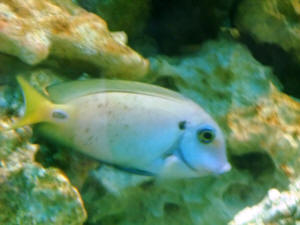
|
Re: Vampire tang with freckles?? 3/21/11
Thank you for your reply!
What do you suggest we do re cyanobacteria? And is there anything
we should be doing for the fish that we currently aren't?
Thanks again,
Kate
<... Please learn to/use the search tool, indices on WWM. Read
here: http://wetwebmedia.com/bluegralgae.htm
and the linked files above. B> |
|
sick convict tang
9/20/09
Hey there Crew, hopefully you can help me with my sick fish!
<Will certainly try>
My little 4" convict tang seems to be all bound up
inside.
<I see this... looks like me after a big night of pizza and
beers>
I had written in about a week ago about having a high pH and
wondering if that was maybe why he had stopped eating, but it
appears to be worse than that, see the attached pictures for what
I mean.
For what it's worth, water is 1.024 salinity, 77.5 degrees F,
pH is 8.45,
<A bit high>
ammonia/nitrite are 0 and nitrate is 60. This is a 210 gallon
FOWLR, no corals.
Any idea what could be wrong with the convict? It looks to me
like he either has a really huge parasite load or else has real
bad gas. I looked at him yesterday and he didn't look swelled
like this. I thought yesterday he was
maybe a little big in the stomach area, but nothing near like
this.
Thanks for any help you can provide.
Grant
<I think this A. triostegus has just "overeaten"...
I want to relate to you that the root cause of the food
intake/exercise may well be that this fish is lacking the company
of its own kind. The Convict/Manini (in Hawaiian) is one of the
most social of Tangs... REALLY needs to be kept in a group. I
cannot encourage you enough to add two, or four more individuals
if they can be fitted in here... The added exercise of schooling,
milling
about will make this specimen fitter and much happier. Bob
Fenner>
sick convict tang #2
9/20/09
I got some better pictures right after I sent my email in to you,
the convict came out into the light for a little while.
<Thank you for these>
Just a little more information on the issue, the convict has been
barely eating for a week and for the last couple days it
hasn't eaten anything at all. It follows the food I feed (NLS
pellets) around and the Nori pieces, but it wont eat. It wants to
eat though.
<It is noshing on the algae et al. in your system. The foods
you are offering are excellent though. BobF>
|
 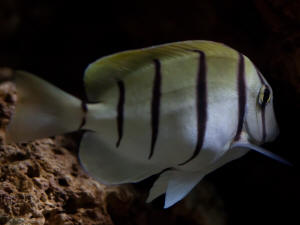 |
Re: sick convict tang
9/20/09
I agree with you that the convicts should be kept as a group.
I've been to Hawaii 6 times now and my latest trip was this
last February, I recall how many convicts I would see ranging
around together. Originally, I had 4 convicts in my system.
However, after about a week of settling in, they started chasing
each other nonstop. They were relentless. There were two in
particular that would go back and forth the tank all day long. One
would chase one into his little cave, then they would turn around
and the other would chase the one back into the other cave they
picked out. This would go on nonstop unless I was feeding, then
shortly after feeding they would start again.
<Happens>
I feed to excess, hence the high nitrates, so it wasn't as if
they were competing for food out of starvation. I feed NLS daily,
normally 3 times a day and at least one sheet of 12" x
12" Nori, sometimes 2 sheets.
<Wow! You could start your own sushi bar doh!>
I also about every 3 or 4 days do about 1/4 of a shot glass of PE
mysis soaked in Selcon, garlic extreme, vitamin C and Kent Zoe,
then I slowly feed that to the tank over the course of a couple
hours until it is all gone. Anyway, I don't think the convicts
were ever starving :)
<Agreed>
At the point I decided to sell 3 of them, it was because they were
all 4 looking really battered. I don't mean as in ready to be
deep fried, I mean they were beaten up. Scratches all over their
bodies from running into the rocks in their chases and their tails
were all getting in bad condition from the tang behind them chasing
and biting. One day I witnessed the smallest convict chasing around
my equally small majestic angel (about 3 inch) and I decided they
had to go. I sold them to a LFS and they have them in their 600
gallon tank where all three of them do fine, although I do see them
squabble from time to time but they at least look healthy, in my
tank, which is a 210, they were close enough together all the time
that they never were recovering from the slight injuries they were
inflicting.
<I see>
It's worth noting that in my tank, the 4 convicts were so
aggressive for the Nori clip that my other much bigger fish
(9" dussumieri and 7" emperor angel) couldn't even
get to the clip. They are normally the bosses of the tank, everyone
gets out of their way but during feeding it's like the convicts
didn't even care, the dussu and the emperor would flare up and
try to get them to move and they just chowed down without a care in
the world.
I could feed two or three full sheets of 12" x 12" Nori
and the convicts would eventually fill up, but even then they would
still just circle around the algae clip waiting for just the
tiniest bit of food to digest so they could work more in. My
emperor and dussu were OK because once the convicts slowed down a
little bit, they moved in and ate, but my majestic was a little too
skittish to get much food.
Maybe I should get just one other convict?
<I'd get two>
Try a small group of two? I'm not willing to try 4 again, that
was bad for everyone involved.
<Small, odd numbers are best>
I hope you're right that the convict in question has just
overeaten, although I'm really hesitant to believe that as
it's been a week now since I've seen him eat. I don't
really have any algae in my system to eat either, so it isn't
as if he's foraging and getting full. I don't see how he
could swell up that much in one or two days, especially with not
eating. But I guess I'll just watch him and wait and hopefully
he starts getting skinny again.
Thanks Bob!
Grant
<The bumpiness in the sides is indicative of ingestion of
sand/gravel... Common as well... Let's hope "this too
shall pass". Cheers, BobF> |
|
Black Frayed Markings on Fowleri Tang --
09/08/09
Good Afternoon,
<AM here now...>
I have searched for a couple hours and haven¹t really
found a good answer for this one. Attached is a picture of my
Fowleri Tang that is currently in QT. It has developed black
frayed marks in a couple of places on its fins... I
don¹t know if this is only a coincidence, but this is
a day after I added a final 50% dose of Prazipro to the tank.
<Mmm, not likely related directly. This is evidence of
physical... oh, I see you surmise this below>
Is this a sign of physical trauma from the other tang I have in
QT, or is this something else I should worry about?
Thanks,
Landen
<Is the other tang... I'd be placing both, soon. Bob
Fenner>
|
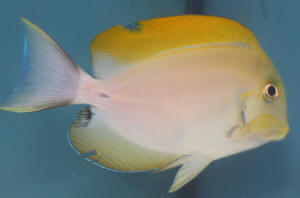 |
|
Tang in QT too long 4/24/2009
Hey guys,
My Maculiceps tang has discoloration on the top of his fins and
on the bottom as shown in the picture. He has changed his
behavior as well and swims at the very top of the tank and
refuses to eat. Prior to this he
ate like a pig. He is in a 55 gallon qt and has been there for 3
weeks (new fish). What treatment courses do you recommend?
<Moving this fish summarily to more permanent quarters>
Thanks as always for your
help.
Mike
<Prolonging the quarantine period is not likely to benefit
further... Being in more propitious conditions definitely will.
Bob Fenner>
|
 |
|
Sick Atlantic Blue Tang, reading --
04/12/09
I purchased this fish two weeks ago. At the store it looked fine
but within a few days it showed this abscess in its shoulder
area.
<Acanthurus coeruleus is inherently not a very strong fish for
aquarium use...>
it doesn't seem to eat and it just picks at the rocks. Now it
has a brown belly and brown spots, he has lost his color and is
now very pale.
<Very bad signs>
I am hoping that I can help this fish but I am having difficulty
identifying what's wrong.
<Unsuitable environment mostly, likely issues with
tankmates... I see a Premnas... as stated, this is not a good
captive species... Had you read on WWM you'd know
this>
He also has ich. Please advise. The first pic is two days after I
brought him home and the other pic is today.
<See WWM re this Atlantic Acanthurid and Crypt... Bob
Fenner>
|
  |
|
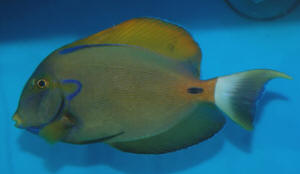
Re: Acanthurus ID (Attn: Bob) 2/19/09
I'll clean the glass and take another picture for you then.
<Heeee! Is a neat species... very beautiful, and reportedly
quite captivity suitable. Thank you, BobF>
Re: Acanthurus ID (Attn: Bob) Pics as
promised One customer saw it and said it had lateral
line disease. I can't see it. Can you? <I cannot... even
at enlarging the images... The family does have more pronounced
lateral pores... There is some minor damage to the lower half of
the caudal fin... but this will no-doubt heal, re-grow in time. I
rate this specimen highly. BobF>
|
 |
Atlantic Blue Tang 2/17/2009 ABT Health, Selection,
Disease Hello Crew, hope all is well. <Hello.....everything
is fine, thanks.> A few days ago a fellow reefer was visiting some
aquarium shops in a neighboring city and picked up a beautiful 7"
Atlantic Blue Tang for me. <How long did they have this fish, and
was it caught in the wild or was it a "trade-in"?> I added
the tang to my 600 gallon aquarium and he looked very healthy and
strong but I haven't been able to get him to eat. <How long was
the fish quarantined? ABTs seem to be more vulnerable to Crypt than
others>I've tried Mysis Shrimp, Brine Shrimp (with and without
garlic), algae sheets and still cannot get him to eat, all my other
tangs are pigs but he just swims around while everyone else is pigging
out. <Wild caught adult Tangs generally have trouble adapting to
captivity, which is why it is recommended that Acanthurus are
introduced between 3 - 4 inches (7.5 - 10cm) in length, as they are
more adaptable to captive conditions at this age.>He is the third
largest Tang in the tank after my Naso and Vlamingi and nobody picks on
him, but I cannot get him to eat. He will pick at the rocks but
won't eat anything else and his health is starting to fade, he now
has ich <Likely caused by stress and a poor diet.> and still
swims around acting like the king of the tank but will not eat, do you
guys have any ideas? <I would get this fish out of your display and
get it into a quarantine\hospital tank for treatment. For further
reading on Crypt, I would suggest that you start here:
http://www.wetwebmedia.com/ichartmar.htm and here:
http://www.wetwebmedia.com/crypttangs.htm As far as feeding is
concerned, I would keep trying different foods, live brine shrimp, or a
freshly opened clam to entice it to eat. More information can be found
here http://www.wetwebmedia.com/acantfdgfaqs.htm .> Thanks. <No
problem, MikeV>
Lavender Tang with mouth problem 2/11/09 I recently
rescued a lavender tang from a misinformed hobbyist who was planning on
keeping the fish in their 10 gallon nano tank!!! <Lock them in the
closet for a month> The fish is eating and looks great however the
flesh over it's mouth is gone. You can see its teeth. It kind of
resembles a birds beak. The missing flesh is only on the top and the
bottom portion of it's mouth is ok. Does the flesh over the
fish's mouth regenerate like it's fins? <It can, yes> Is
this going to be a permanent injury? How do injuries like this occur?
<Mostly from manic rubbing... the fish's face against the
viewing panels...> Is it from rubbing on the glass or is this more
of a transport injury where the fish got stuck in a net? <More
likely the former by far> Thank you for reading and I look forward
to your response. Sincerely, Eric <Patience here... Bob
Fenner>
Black Spot on Atlantic Blue Tang 4/25/08 I
want to first off say thank you for all the help you and your
website have given me. I recently lost my UV light for about a week
and was waiting for the replacement to arrive. During that week I
was out of town and when I got home I noticed a few things. One was
this large black spot on my Atlantic blue tang about the size of a
small pea. I attached a picture I hope you can see the spot. <I
do> I looked up Black ick but I do not think that is it. Do you
have any suggestions of what it maybe? <Looks very much like a
"recovery area" from a physical trauma...> Another
thing I noticed was since my UV had gone out I now have this dark
green almost black film on all my flex hose and my skimmer is
working overtime. Any ideas of this blackish green film?
<Microbes of various sorts likely... will go with the lamp
replacement> It is not on anything but the hoses and plumbing
nothing in the tank. Thanks Again
Brad
<Not to worry here... Bob Fenner> |
|
|
| Bloated Yellow Mimic Tang, 3/22/08 About a
week ago I noticed my juvenile mimic tang is very bloated (see
picture attached). <I see this> He ate has been eating this
week, but did not eat anything this morning. I have had this fish
since November 2007. He is usually pretty active. For the past day
or so, he stays hidden most of the time. Do you have any clues as
to what could be wrong? Is there any treatment? <Mmm, perhaps a
gut blockage, could be a form of egg-binding...> 7 month old, 75
gal FOWLR. Fish include: Yellow mimic tang, imperial angel,
<Needs more room than this> coral beauty, tomato clown,
Sailfin tang, sand sifter Gobi. Water conditions: NH4 - 0, NO2 - 0,
NO3 - 4ppm, pH - 7.9, <A bit low> PO4 - .07ppm, salinity
1.026, dKH - 8.7 <I do see quite a bit of BGA/Blue-Green algae
in the pic as well... it could be that this Acanthurus has
swallowed too much of this... and is being mal-affected... There
are cases where the addition of Epsom Salt can "free up"
such apparent swellings. Do use the search tool on WWM:
http://wetwebmedia.com/WWMAdminSubWebIndex/question_page.htm and
read the cached views re. Bob Fenner> |
|
|
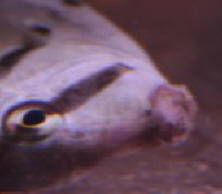
| Convict tang mouth disease 8/7/07 Hey folks -
<Chris> I've read on your site that a surgeonfish with a
mouth infection/disease is pretty typically a goner. <Yes> I
received a shipment of fish four days ago and put them in QT. These
fish are slated to be the inhabitants of my newly upgraded 150
gallon tank, <Not this one...> which has been running for a
couple of months now. Seeing as the tank has no new live rock or
other substrate (all of it coming from my previous tank), high flow
(~50x), and a EuroReef CS250 skimmer, I'm quite confident in
it's ability to handle the fish load, which include a blonde
Naso, pair of blue throat triggers, and Kole tang, all of which are
currently under 3 inches in size and share the QT with this convict
tang. The QT consists of a 20L, which I used tank water to setup,
currently has a nitrate level of ~5ppm, a SG of 1.024, temp between
78-80 degrees, a simply light, some LR and PVC. Because these fish
were bought sight unseen on the internet, I was taking a risk of
getting diseased/damaged fish. While I will likely get a credit for
the value of the convict tang, I'm more concerned now with the
health of the other fish in the QT. <I understand, and agree>
They all seem fat and happy (assuming they have no emotion of the
dying fish in their quarters), continue to eat and swim around, and
appear to be in good health. Are there any recommendations
regarding the care of the other fish? And do you know exactly what
this injury/disease is based on the picture? - Chris <Likely
this manini was beat in collection, handling (with nets) and/or
repeatedly bumped into whatever container it was kept in (need to
not be placed in too-small "cubicles"... It's problem
is not contagious per se. Good water quality ought to do it here.
Bob Fenner> |
|
|
| Help With Sick Shoulder Tang, env. - 7/23/07
Good afternoon, geniuses! <Uhh... okay> First, thanks for
such a great website. I've found so many answers to so many
questions on the site, that I've never needed to write before
now! <Yay!> I bought an Orange Shoulder Tang last weekend
from my LFS. Brought him home and put him in quarantine with a
smaller Sailfin Tang. <Mmm... I would NOT mix these...>
They're in a 30-gallon quarantine tank (too small, I know, but
it's for a relatively short time). <Like you, I and a black
bear?> I noticed some small (very small) gray spots on him when
I brought him home and figured that it was just discoloration or
some pigment loss, but now the gray spot on his forehead is getting
bigger and seems like it might be growing outward too. <Mmmm>
It's behaviour is definitely different than it was. It swims
VERY fast, sometimes in a very jerky manner, sometimes brushes
against the gravel or PVC in the tank, but, a lot of time he spends
in one spot directly under where the water pours back into the tank
after being filtered. He has a really healthy appetite and goes
crazy for frozen herbivore food. <Ah, good> He's a
beautiful fish and has a ton of personality, so I don't want
anything to happen to him! <This is one of my fave Acanthurus
species (of the 32...) and am out seeing them most days while
diving/snorkeling currently in HI> The tank setup is 30 gallons,
has crushed coral on the bottom (going to be removing it when/if
these guys come out of quarantine) with a basic pump pouring over
charcoal/biorings filter. No protein skimmer yet (installing one on
Wednesday). <This will help for sure> Water quality is good -
Ammonia and Nitrite undetectable, Nitrates are 10-20. We did have a
little bit of ammonia in the tank a few days ago - 0.5 - but we did
water changes and it dropped down right away. Any idea what the
problem could be and, more importantly, any suggestions on what to
do to rescue this poor guy? He's obviously uncomfortable. By
the way, the Sailfin is just fine. Doesn't exhibit any problems
at all. Thanks and I'm including two pictures of him. Wes
<The difficulty here is very likely "just"
environmental... This is a wide-ranging species (needs hundreds of
gallons really)... and even a trace of ammonia can be real trouble.
Improve this animal's world and all will be fine. Bob
Fenner> |
|
|
Re: Acanthurus tennenti disease -- 04/30/07 Hi, Thanks again
for all the help. Unfortunately when I got home today the tang was in
worse shape, it has some red in the lesion and more white fluffy marks
on the other side. In addition the Sixline wrasse who was doing fine,
eating voraciously and swimming around, suddenly died. I did a 25%
water change but I'm starting to think that there is something
wrong in the QT tank. Do you think that the two events are related
someway? <Yes. Highly likely so> I'm thinking that maybe I
should dip the tang and put him in the main tank to reduce the stress,
would it make sense now or it could spread the disease? <I would
take the risk and do as you suggest> Thank you, Diego <Welcome.
Bob Fenner>
Re: Acanthurus tennenti disease -- 04/30/07 Hello again Bob.
<Diego> Thanks for the help. I'm writing you again to get an
opinion on what is happening and also to share what happened since I
suspect that it may be useful to others. <I thank you for this>
After your email I agreed on taking the risk, I was hoping that the QT
was stressing the fish and it was the cause of the skin lesions. The
fish was eating with more appetite, probably because he was getting
used to my presence. I prepared a freshwater dip and dipped him for 1
min. I decided for just 1 min for a couple of reasons: first I was
doing a preventive dip since the fish didn't show signs of ich or
parasites, second my previous bad experience forced to be more cautious
in the length of these dips. <Okay> In addition after 1 min the
fish was becoming a rocket fish trying to leap out of the dipping
container. <Typical with Tangs> After the dip I placed the fish
in the main tank and I noticed that the skin lesions had white bumps or
bubbles of what seemed to be skin. I don't now hot to describe it
precisely, I'm pretty sure that the bubbles weren't parasites
but more similar to dead skin. <Likely so> As soon as it found a
nice cave to hide in, my cleaning crew, made of a coral banded, a
scarlet and a fire shrimp (I now a dangerous combination but they get a
long wonderfully and I'm closely monitoring ready to separate them
in case of war signs) started frenetically cleaning for 5min (never
seen a fish stay so much) removing all the bubbles. Sorry for the long
email but I would really love to have your opinion on what is happening
and if the stress hypothesis still holds or the new information points
more towards a disease. <I think the Tang's symptoms are/were
resultant from general stress in QT, that the behavior elicited the
response of cleaning by the shrimp...> I know everybody says it but
I really want to thank you and the rest of the crew for the great help.
It really gives a huge boost to this hobby. Thanks. Diego <A
pleasure to serve my friend. Bob Fenner>
| Mimic Tang Problems... improper env., nutr.,
4/6/07 Good morning, Crew. <Andy> I love your web site. I
am in need of some help. I have a 55 gallon FOWLR tank with about
60 lbs of live sand as substrate, 40 lbs of live rock, an Aquaclear
70 hang on filter, 4- Maxijet 1200 powerheads, and a Prizm
<Proper nouns are capitalized> protein skimmer. In the tank,
I have two green Chromis, two tomato clowns, one yellow shrimp
goby, one orange spotted diamond goby, an anemone that I think is a
Caribbean anemone (that unfortunately my clowns have shown no
interest in), <It may consume them...> and a mimic tang.
<Not enough room here for this species> Recently, my mimic
tang has been showing up with black splotches on his body.
<Likely principally "stress" at play here... the lack
of space, the Tomatoes acting aggressively toward it...> The
first one showed up just in front of his tail. Now, it is
predominantly on his head between his eyes, and has shown up on his
tail fin. He seems to be acting normally, eating as much as usual,
fighting with his reflection, <More stress...> swimming
between the rocks, and playing in the sand. My
fiancé's first thought was that he was bruised from
fighting his reflection, but I was skeptical about that. My
thoughts were that it was either (1) black ich (which I thought
only affected yellow tangs) <Not this... has other
symptomology... but this species can be afflicted with
Paravortex> or (2) he's been stung by the anemone, <Is a
possibility> which is a fairly new addition. <And is
mis-placed here. I would remove this Condylactis> He has gotten
very close to the anemone, though I've never seen him actually
touch the tentacles. <"Bits" do come off... float
about in the tank...> I've attached some pictures. Any help
you can give would be greatly appreciated. I lost a green Chromis
to HLLE, and I don't want to lose this one. <Is an
environmental/nutritional complex...> Oh, and I tried feeding
him the freeze dried seaweed, but he didn't seem to take it. He
seems much more interested in the algae on the live rocks and the
veggie flakes from Omega One. Thanks. Andy Anderson <... Please
take the time to search, read on WWM re Acanthurus, Acanthurid
care... Caribbean Anemone Compatibility... Your and many more
as-yet non-conscious questions/items are addressed there already.
Bob Fenner> |
Re: Mimic Tang Problems - 4/6/07 Thanks for
the quick answer, Bob. I did want to make a correction, though. The
anemone is a long tentacle anemone. In my ignorance, I assumed I
knew the type, but after I sent you the message, I asked the LFS
where I bought it, and he gave me the correct info. The clown at
the LFS was wallowing in it and loving it, but mine will not go
near it. <Ahh, these associations often take time (weeks to even
months) to develop> Regarding the mimic tang, my
fiancé surprised me with this fish because I had
commented that I really liked it. <Are beauties> The LFS
where she purchased it said that 55 gallons was sufficient, but I
did have my doubts. I probably would have stuck to smaller fish for
my system. The clowns appear to leave it alone. <Appearances...
can be... deceiving> The only fish I have that have shown any
aggression are the gobies toward each other. He did start eating
some macro algae, so I may start soaking that (and his flakes) in
Selcon to boost his nutrition. I have a friend building a house in
which he's setting up a 200 gallon tank, so if this fish does
not improve, depending on what other livestock he is planning to
add to his tank, I may just go ahead and give him this fish if he
wants it. It will be a lot happier in 200 gallons. <Yes>
Thanks again for your help and the great website... I'm new to
the hobby and have literally spent hours at WWM trying to absorb
all the info. Andy
<A pleasure to share. BobF> |
|
|
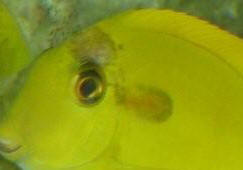
Possible HLLE or injury to Acanthurus 4/5/07
Hi Crew. <What's up Ryan?> Can you tell me what the
splotch is above my orange shoulder's left eye? <Mmm...a
little blurry but appears to be either a physical abrasion or
perhaps the start of Head Line Lateral Erosion...I would check WWM
articles re: to see how it compares as well as possible effects and
treatment. Judging from the abrasion only being on one side of the
animal I would just wait it out, pristine water quality and an
appropriate diet, and watch for possible aggression as well.>
I've included three pics so you can see. Any help would be MUCH
appreciated. Thanks in advance.
<Welcome.>
Ryan Mullinax
<Adam J.> |
|
|
Mimic Tang Behaviour 3/19/07 Hello - First off, thank you for
providing such a great site. I often have questions and find the
answers just by browsing around. <Yes... and thank goodness... there
are tens of thousands of unique ISPs here every day...> But this is
one I couldn't find. I have a 75 gal tank that has only been up and
running for about 4 months. So far so good. I have 2 clowns (percula
and Clarks) and a yellow mimic tang. Just in the last few days, my
mimic tang has been rubbing his side against the sand? <Not an
unnatural behavior... and not to worry unless this becomes
"excessive"> It is very brief, quick movement and then he
is back to swimming as usual. He is just doing it every now and then
and not constant, but I have seen it happen at least 4 times today that
I have noticed so I assume he is doing it more. Is this something I
should be concerned about? <Not really> I am hoping it isn't
any kind of skin condition or whatever. He is showing a little bit of
aggression to one of my clowns, but that is only when the mimic tang
feels the need to invade the clowns space around and underneath our
BTA. <Also to be expected for the species, genus> Other than
that, they get along. Thanks for your thoughts on this. Hoping it is
just a little quirk of the mimic tang, and not a problem - Stacy <No
worries. Bob Fenner>
(Acanthurus) Tang Issues From Singapore; Some Much
Needed Reading 3-12-2007 Hi. <Hello.> I have this problem
with my tangs. <I'll see if I can help.> I used to have a
clown tang, <Acanthurus Lineatus, is a notoriously poor choice for
most marine aquariums, suffering from shipping and acclimation to
captive life. Those that do survive are quite aggressive and get quite
large as well 15'+ and should arguably not be housed with other
surgeons in all but the largest settings (100's to 1000's of
gallons)'¦definitely not other Acanthurus.> blue tang
<Which blue tang? Paracanthurus , A. Coeruleus or A.
leucosternon'¦'¦'blue tang' is a common name
used for all of these species.> and powder blue tang <Or
Cryptocaryon magnets as I call them.> in my tank at different period
of time. I supposed that all of them died of Ich. <A common plight
for many captive surgeons.> All of them died the same way <Well
of the two tangs I was able to verify that you have kept, these are
both notoriously poor choices, disease wise in captive
environments.> and each time I try many ways to sustain their lives.
My first clown tang was seen struggling with Ich and I remove to do a
freshwater dip. But I forget to buffer the pH and it died in a few
minutes time. <Dips are a good start but due to the lifecycle of
Cryptocaryon this type of care won't do much good alone. Read here
for more detail: http://www.reefkeeping.com/issues/2003-08/sp/index.php
http://www.reefkeeping.com/issues/2003-10/sp/feature/index.php
.> Horrible instead. My next blue tang died before I can do a
freshwater dip. Also seen struggling with Ich. <Mmm'¦I will
also direct you here as well: http://www.reefkeeping.com/issues/2004-10/sp/feature/index.php
. You need to start quarantining your animals in a separate area before
addition to the display. And if the animals to get ill in the display
they need to be moved back to the quarantine container and treated
there.> When I had my blue tang and clown tang, nitrate lever was
high to around 20ppm. <Not ridiculously high but does need to be
lowered.> But when I kept my powder blue tang, nitrate level is at
zero or undetectable level. It starts to show sign of Ich when I
switched off the filters and skimmer to do a huge water change and
clean up. Before that it was a healthy and excellent specimen. <The
ich/crypt was already there it wasn't just being
'expressed,' likely something changed which affected the
animals immune system and allowed the parasites to gain the upper hand.
Refer to the above articles posted above for more.> I did a
freshwater dip for it when I saw it struggling. Instead of helping it,
the freshwater dip impacted on it. At first it can still hold itself up
and swim but when I did a freshwater dip, it became hard and started
breathing rapidly. <What type of freshwater are you using?> After
I add it back to the main tank, my boxer shrimp actually went to help
clean him up. Pretty amazing that my boxer shrimp can actually do his
cleaning job because very few people have witnessed boxer shrimp's
cleaning capability. It helped to clean the tang off the ich and the
fish just lie down there, but it did move on occasion. In the end, I
choose to move him to another quarantine tank. <Should have been the
first choice my friend.> I was thinking that maybe the water quality
is not good so maybe the other tank is better. But in the end he died.
I think I should just leave it alone to the boxer shrimp. Think I made
a wrong decision there. I am very sad about all their death and faced
with great difficulties in maintain another tang. Fearing that I will
kill another tang, I decided not to house any fish for now but to
improve on my phosphate level. I am planning to get an ozonizer.
<Phosphates can usually be linked to source water'¦what is
it?> What's your suggestion into housing another tang in the
future so that the same drama doesn't occur again? <Allow your
display to run fishless for 6 weeks, at least, and quarantine all new
additions for at lest 4 weeks. Also make better initial choices, both
of the tangs we discussed here are not good captive choices. And PLEASE
read the articles I posted.> And I am keep a 50 US gallon tank.
<This is also to small for what you are/were keeping.> How much
dosage of ozone is good for my tank since I don't plan on getting a
monitor now. Can you can me a rough estimation on how often and how
long should I intro ozone into my tank if the output is 100mg/hr?
<Read this too: http://www.reefkeeping.com/issues/2006-03/rhf/index.php
.> And maybe give me some guidance on it. Thanks. <Welcome, Adam
J.>
| New tennenti tang has white on part of lip... -
03/12/07 Just got a juvenile tennenti tang. Noticed that its
lower lip is white and it looks like it is misaligned with the
upper lip. <Mmmm, likely damaged in collection (are collected
via fence-nets, herding/directing...)... possibly in holding,
transit> The tang is otherwise doing fine and eating like crazy.
Any thoughts on what this is and any suggestions on how to treat
it? Thanks. <Mmm, just good conditions, nutrition, time going
by... Not treatable per se.> <Mmm. Bob Fenner> |
|
|
Acanthurus tennenti disease, env. likely -- 03/09/07 Hello,
<Diego... I live in your town> I have a 75 Gallon tank with 2
ocellaris clownfish, a Pseudochromis and an Acanthurus tennenti
<Will need more room... perhaps already does...> along with some
shrimps, crabs and snails. The tang is showing different symptoms each
day. At first I saw him scratching in the sand for a couple of days and
I noticed I white spot on the body. The spot disappeared the following
day. <Only one? I wouldn't be concerned> After a day with no
symptoms, today I noticed that the fish had some bumps behind the eye
region and along the lateral line. <Ah... neuromast destruction...
stress... water quality... related> I also noticed a black spot on
the body. The thing that worries me most is that these bumps seem to
brake leaving a scar. I don't understand if it is the beginning of
ich, black ich or internal parasites. <Mmm, not likely any of
these> The fish doesn't show other problems, it feeds well on
seaweed enriched with garlic extract and shrimp dipped in garlic
extract. Any suggestions would be greatly appreciated. Thank you, Diego
<I suspect that stress from being in a small environment is mostly
at play here... second-string influences might be water quality... If
you can't move this fish to larger quarters, I would try bolstering
its immune system... with vitamin, HUFA soaking of foods, addition to
the water once a week during/after water changes... Water quality best
improved with the use/addition of an as-large-as-you-can fit refugium.
Bob Fenner>
Re: Acanthurus tennenti disease 3/10/07 Hello,
<Hi there Diego> Thank you for the suggestions. I was actually
planning on adding a refugium next week (there is an add-on version
with Miracle mud) and I'm currently adding vitamins (Selcon) to the
food. <Good moves> Having said this I feel that your main point
on aquarium size is right. Unfortunately my larger aquariums are in
Europe and here I don't have many alternatives. Since you mentioned
the fact that you live in my town <Oh... sorry for the obscure
reference... I live in San Diego... the Saint of your namesake> I
was wondering if you know somebody that might want to take this fish
and give him the space he needs. Please don't misunderstand, I
don't want to get rid of him but I feel that I made a mistake in
taking this fish (the LFS said it was perfect for this tank, but I
guess this isn't something unheard of) and without a bigger tank in
the near future the best solution is to find him a spacious new home.
Thank you, Diego <Mmm, do look about... for a marine/reef club...
perhaps Craig's List? Other retailers who may allow you to trade
this animal in... Bob Fenner>
Question regarding a sick tang
12/23/06 Hello WWM Crew <Cole> Hopefully you can help me with
the following problem. I'm getting pretty desperate and I'm
worried sick about my tang. I went on vacation for a week and had
someone look after my tanks. When I came home I noticed my orange
shoulder tang kept hiding and didn't eat anymore. <Unusual for
such a bold species once acclimated> The person who looked after the
tank told me that the tang stopped eating 3 days after I left. We
usually feed them twice a day but when we were away, he only got fed
once a day. I've been home for a week and he's still not
eating. He hides in a cave all day and only comes out when the lights
go off. He swims around and it almost seems like he can't see well
and he keeps swimming into things. I put my hand in the tank and he
bumped into it. He spends a lot of time swimming up and down in one
corner. All the levels are normal and none of the other fishes are
sick. (He shares the tank with Anthias, a flame angel, a coral beauty,
several cardinals etc) All the SPS and LPS corals and a sea star are
doing ok. I've had him for over year and a half and he's been
very healthy until now. He used to like eating from my hand and
interacting with me daily. He was always more like a puppy than a fish.
I can't see any visible marks/fungus or spots on him. He's not
scratching or twitching and his balance seems ok. I don't think his
eyes are cloudy either. He doesn't seem to have any HLLE symptoms
either. I could take him out and put him in a separate tank and treat
him but I'm not sure what to treat him with. I understand sometimes
tangs get stressed out and get sick. Is it possible that someone else
looking after the tank caused him to get stressed out? <Mmm, no>
What could cause his illness? <Most likely a nutritional
deficiency... possibly a pathogenic disease... internal... specific to
this one fish> Anything I can do? I added a new ChemiPure, a
PolyFilter and did a partial water change already and been over
skimming for several days. <All good moves> I haven't moved
him as I'm worried about stressing him out even more. What could I
treat him with? Thank you in advance for any help and advice. Cole in
Vancouver, Canada <I would add a vitamin supplement both to offered
foods and to the water directly. Please read here: http://wetwebmedia.com/nutrdisf.htm
Bob Fenner>
Tangs with mouth trouble - 10/17/06 Hey guys, <Hey Ron,
MacL here with you tonight. Bob's on a trip and we are all pitching
in.> I bought a powder brown tang yesterday. The tang has ich, which
is not a problem. I have treated many tangs with ich. It is in a
hospital tank right now. I will be lowering the salinity today. The
tang has a sore or spot on it's mouth, right on the tip. The sore
is white, almost clear. The tang is eating and acting normal. Is there
anything i can do for its' mouth? I know mouth troubles on a tang
are not good news. <Is it large enough to determine whether its
Lymphocystis or something else? Lymphocystis on a tangs mouth can be a
large problem but often its bad water parameters from the previous
water. I'm sure that as you supply it with good, clean healthy
water it will help it immensely. Keep watching the fish to determine if
there is red shooting through it in any way, because that is a possible
infection. Keep a close eye on it and watch to see the marks growth
patterns and how it looks, whether it becomes like a cauliflower in
shape and texture or something else. I would not suggest adding any
type of antibiotics until you are sure of what it going on with the
fish but I would DEFINITELY suggest get him eating Nori or some other
types of greens. Its amazing what a difference algae can make for a
tang.> Please help. Thanks, Ron <Good luck, MacL>
Treating a Powder Brown Tang (A. nigricans) with Crypt.
9/27/06 Hello Crew, <Mark> First let me tell you what a great
service your website is to those of us who love the hobby. It is simply
the most accurate source of information I've found. It has really
helped me make better decisions at the LFS, separating truth from
fiction. <Ah, good> I'm treating a powder brown (A.
nigricans) for crypt that was in a 120 gal reef tank. The tank is
located at a business and is "taken care of" by a local
service. I have salt tanks at home and have seen/treated crypt before
but never on such a delicate species as a powder brown. I was the first
to notice the fish had a slight case and suggested to the service that
they remove all the fish and treat in a separate tank. They obviously
didn't QT the tang before they brought it to us. We'll they
didn't listen and went to dipping and then to Kick Ich and......you
know the rest. <Oh yes> Yes they put Kick-Ich in the main tank,
soft corals, inverts, and all. I have nothing good to say about
Kick-Ich. I fell pray to it a long time ago. It's worthless. <We
are in agreement. Perhaps worse than worthless... as folks actually
believe they're doing something of use> I do not have experience
with this species. I've now educated myself about the powder brown
on your site and realize I may not win this battle, but I have to try.
I brought my 10 gal H.T. in from home and set it up in my office. I
removed a small power filter I run on my 55 at home just for this
purpose. The fish had a fairly severe case when the "fish
service" finally cried uncle and let me try 3 weeks later. I'm
at day 5 of a 14 day copper treatment (Mardel, Copper Safe) and the
fish is doing very well now. I've got it eating dried seaweed, it
won't take dried foods and I haven't tried frozen yet. <Very
likely it won't feed till the copper treatment ceases> Spots are
gone, I'm doing daily 4 gal water changes using water from my 55
gal at home in attempt to seed the tank. Copper is probably killing
bacteria as quickly as I put it in. <Likely so> I am fighting
ammonia; it's at a steady 0.5 ppm as long as I continue water
changes, which was predictable. Nitrite is 0, which may change next
week. Salinity is at 1.023. that's where I keep my tanks. I am
testing for Copper and levels are where they're supposed to be.
Here are my questions: Assuming I can keep this delicate fish alive
through the copper treatment, should I return the fish to the main
display after two weeks or try to get the 10 gal to cycle and keep the
tang out of the "infested tank" for a full 30 days? <The
latter... the main tank has been left sans fish hosts? Or
"nuked" as in bleached?> I say "infested"
because none of the other fish are showing signs of crypt. <It's
there> I understand there is a potential for the fish to become
infested again <Almost a surety> I just don't know if the
extra time out of the tank really means anything since we didn't
let the system go fallow. <A mistake> I'm conflicted between
stressing the fish by keeping it in the 10 gal longer than required and
potentially re-infesting it in the main tank. How much stress am I
putting the tang through keeping it in such a small tank? <A
bunch> I realize they like large spaces! Do you see any thing wrong
with my treatment method? Thanks for a wonderful site! Mark Gustin
<Mmm, nothing per se... but the "whole picture" is
incomplete w/o the "treatment" of the main display... Bob
Fenner>
Complications arising from treatment for Ich on a
Acanthurus achilles 9/1/06 Hi Bob, <Matt> Firstly thank you
so much for taking the time to read and reply. About seven weeks ago I
purchased an Achilles tang after years of wanting one I finally felt I
had the system capable of supporting one. He initially went into my
refugium for a month and proceeded to do very well with no signs of ill
health and eating voraciously, after being introduced into the display
he showed a few spots for about 10 days before he worsened
considerably. I made the decision to remove him to Hypo at that point.
I lowered him to what I thought was 1.009 however later discovered it
to be 1.012 due to a faulty hydrometer. Whilst in hypo he degraded into
the worst case of Ich I have ever seen. The fish was totally listless
and unable to move effectively. I was concerned that I may have a
strain resistant to Hypo so decided to administer a half dose of
Cupramine. Within three days all signs of Ich had abated, and with the
specific gravity being maintained at 1.010 I decided to replace the
carbon and remove the Cupramine. Now five days later the Ich has not
returned, respiratory rate is normal. <Good> My problem is the
fish is still very listless, unable to control his orientation and is
not eating. <Not too surprising> Could I have somehow poisoned
him with Cupramine or would a massive Ich infection cause enough
electrolyte imbalance to cause these ongoing symptoms? <Perhaps a
bit of both> I am at a loss, I don't know whether to slowly
raise the salinity once more in the hope that may help or whether to
wait it out. <I would raise the spg... a thousandth per day or
so> It has been about a week now since he last ate and I am
concerned that he will become to weak to recover. <Me too> Thank
you in advance for your reply Matt <Life to you my friend. Bob
Fenner>
Clown Tang/Health - 8/10/2006 Good Evening
Ladies and Gentlemen, <Good morning Eric.> I'm writing
you today because I am concerned about my newly acquired Clown Tang
(he is very pretty). He is in QT right now (has been for about a
week) waiting to go into my 55 display. My concern is that he has
developed "discolored" splotches on his left side (please
see attached photo) and has begun to "scratch" that area
of his body against the ground and the bits of cover in the QT.
Even upon very close inspection I can not see any white specs
(watching for ick). I'm also worried about nutritional
conditions as he is my first Tang and I'm still learning,
although he seems to be eating healthily... the scratching is my
concern. <Not a good first tang for sure. It appears to be an
Acanthurus lineatus, one of the more difficult ones to keep. The
Acanthurus sohal is similar in appearance and much easier to
keep.> He has been eating, what appears to be
"normally" (though I've never had a tang before and
do not know how much to expect him to eat). I've been placing a
1"x1" to 2"x2" piece of dried seaweed on a clip
in the QT for him every other day (I hope this is right, it seems
so from what I've read on WWM). <If eating well, the fish
should have a slightly rounded belly.> I am becoming concerned
about putting him into the display even though he has a while to go
in QT. Should I hyposalinate the QT? Copper? <No, do not add any
more stress.> I don't want to cause undue stress to the poor
little guy by treating him for Ick if it isn't there, but I
don't want him to die either and as we all know, early
detection (and treatment) is the key to everything. <Along with
selecting fish that are easier to acclimate to aquarium
conditions.> Any other words of advice on this species I may not
have read yet? <I'm guessing your experience level is low.
Should have done some research before buying this fish. OK, I'd
ensure plenty of cover is available in the form of PVC pipe large
enough to accommodate him. I would treat with Mela-Fix, but the
fish appears to be suffering more from environmental/nutrition
issues more than anything else. Do soak the sea-weed in Selcon or a
similar vitamin complex. Do alternate feedings with a good frozen
food, such as the Ocean Nutrition brand. I would not illuminate the
tank as well. This fish does not tolerate poor water quality very
well and the tank you plan on putting him in is much too small, as
this fish can grow over one foot in length under ideal aquarium
conditions. Somewhere in the 150 gallon range would be more like
it. I'm hoping your QT is large enough (no 10 or 20 gallon) to
make this fish reasonably comfortable during QT. I might add that I
would seriously consider asking your dealer if you can return this
fish.> Thanks again for everything you are doing! <You're
welcome. James (Salty Dog)>
Eric |
|
|
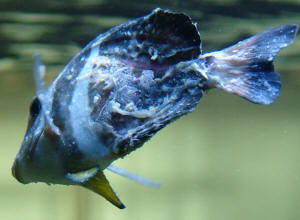
| Unusual Tang Species, Rapidly Breaking Down
8/7/06 Hello from England, I am in need of some urgent help
please. <Okay> I have a 6' long x 3' wide x 2'
deep reef with a mix of 60/30/10 SPS/LPSs/softies. parameters-
nitrate 5ppm nitrite -0 ph 8 temp - 26 Alk - 9 dKH 4 weeks ago I
bought this Acanthurus guttatus <Interesting... not an
oft-collected, kept Tang species> from my LFS where I work
part-time and all was well for a few days then, what I thought was
ick started to appear, (fish was quarantined for at least a month)
<Mmm... "even the best laid plans"... and their
execution!> In the last 2 weeks I noticed some small skin
lesions on one side of the fish, the fish was feeding from hand and
by far the most greedy of my 3 tangs. In the last week it got worse
so I dipped the fish in SeaChem's ParaGuard, There was an
improvement for 3-4 days then it started to come back, as I'm
writing this its getting worse FAST, I mean I can see its flesh
being 'eaten' by the hour (see pic). 6 hour ago the fish
was still eating fine but has lost its appetite in the last few
hours. All my other fish are fine. Where the skin has been
'eaten' you can see redness although the pic does not show
it too well, Am pretty sure Am going to lose this fish and I am
kicking myself for not mailing you sooner. I've attached a pic
of the other 'good' side of the fish too. Thanks in advance
Matt <Yeeikes... can't discern what this is specifically,
but I would immediately remove this fish to a separate
quarantine/treatment tank... and enroute dip it in a seawater and
formalin/formaldehyde bath. Please read here: http://wetwebmedia.com/infectio.htm
and the linked files above. And soon. Bob Fenner> |
|
|
<Not so> Weird Death of Achilles Tang 7/26/06 Hey Crew,
<Jeremy> About a week ago, I decided to purchase an Achilles Tang
(3.5"-4"). I researched the species for about 3-5 months
reading whatever I could find on it. Well, my LFS owner and I worked on
a shipment of them for about two weeks in the store's medic tanks
because they had an ick infection. <Common> Mine had what looked
to be a secondary infection of fungus around the mouth area when it was
in my tank. <Not fungal... bacterial> I didn't QT him for my
system as I had him QT'd in the LFS <Not usually a good practice
to rely on anyone else...> and I thought the ick was over. Like I
said, I checked in on him at the LFS, so I saw first hand that he was
being taken care of and was well. I thought so anyway. <Very easy
for "cross-contamination" to occur in commercial settings...
nets, other gear, water, livestock getting mixed...> The tank was
small for the species (55g), but a much bigger tank is scheduled to be
setup in the house around the end of September (130g). The tank had a
good amount of current and had a heavy amount of dissolved Oxygen in
the water. I have had a blue tang (hippo) for a little over a year so I
would think I would know how to take care of a tang... Especially since
I nursed the blue one back after feeling sorry for the pathetic look it
had in a bad LFS. I did read how hard the Achilles could be and I knew
I was up for a challenge to say the least. The water parameters were
spg:1.025, ph:8.4, temp:78F, Amm:0, Nitrite:0 and Nitrate:10. I set my
medic tank up (29g) using water mostly from my main tank (about 75%)
and some newly made water that set for about 36 hours. The Achilles
tang was doing ok and I was just starting to get him to eat prepared
foods that the other fishes ate. Meanwhile, he was making quick work of
my Live Rock. Not that I cared, I was happy to see him eat anything. He
was full bodied, almost all black with vibrant, bright orange markings,
swam around normally, even sociable to me and others. Not near the
schizo that the blue one is. I would imagine everything sounds ok up to
this point doesn't it? Despite the tank size... The only thing
wrong that I saw was the little bit of mouth fungus. I went back to the
LFS and he said Maracyn was probably the best idea. I read that on the
FAQ's too. I noticed the remaining Achilles Tang's looked ok
(in the mouth area) and that I wasn't overreacting. I figured I
would have a tough time getting him to eat if his mouth was hurting him
so I wanted to get his mouth healed ASAP. I waited until it was dark
(less stress) to move the fish into the QT. I gave him a FW dip and
then into the QT. At first he swam around a little, and then he was
laying on his side breathing heavily. My blue tang does this when
stressed (mostly during water changes) and I decided best to just leave
it alone and let it recover. I got up early the next morning to check
on him and he was dead as a doornail. Any thoughts? Could a fish go
from doing "ok" to dead in a matter of hours with little
change in the biological environment? <Can/does happen... "just
stress"...> Was it doomed from the beginning? An anomaly? I
don't know what to think. Thanks again, Jeremy <A percentage
risk... Your reactions, plans were not "off"... I would
likely have done what you state. Bob Fenner>
Re: Weird Death of Achilles Tang - 07/26/06
Thanks Bob. Any chance you can catch me another one while diving in
Hawaii? <Do see these most days while out diving... And thanks for
the chance to add a bit re their capture, husbandry... This Acanthurus
species is surprisingly "soft-bodied"... and the best/better
specimens are collected at night (while they're "lying"
on the bottom, vs. in a barrier/mist net as most all marine fishes are
captured... but where they get "beat" easily... and suffer
consequently for it)> It will be a while before I try any new fish.
I may try another Achilles, but later on. The little monsters already
swimming in my tank are a handful as it is. One of the hardest aspects
of this hobby is the planning. You see so many fish that you would love
to keep, but you can only keep so few... Jeremy <I suspect this is
an "adaptive behavior" of worth... and of economic
principle... "Folks always want, and their wants can never be
fully satisfied"... Wish you were out diving with us! BobF>
Gold Rim Tang with Blue Bumps... learning not an easy way
7/10/06 Hey guys. I have a gold rim tang and have had him for about
a week. I noticed this morning that he has a few blue bumps on his face
and about 6-8 blue bumps on his side. I noticed that he also has 3
white bumps on his other side. I am unsure as how to diagnose this and
treat. If it was only white bumps that would be ich, but not sure about
the blue bumps. He is acting normal. The other 3 fish are healthy and
happy. We added some new Fiji live rock a couple days ago. I have been
testing the water every 3 days. Water parameters are: salinity 1.021,
<I'd raise and keep this up to NSW, 1.025...> Ammonia 0,
nitrite .05 (had a small spike), <Dangerous> nitrate 5 (again
tied to that small spike when I added the live rock) and ph seemed low
this morning 8.1. I know the ph needs to be raised ASAP. <Uh, no>
I tested the water 3 days ago and the PH was fine. Not sure what caused
the drop. I read that you can dissolve a small amount of baking soda in
a cup with dechlorinated water and that will raise the PH. How can i
safely raise the PH? <Not with sodium bicarbonate here: Please read:
http://www.wetwebmedia.com/marphalk.htm and the linked files
above> Sorry, not to get off topic... but I did not heed your advice
about a QT tank, and am setting one up as we speak. How can I help this
little guy get better? <... now a treatment tank. Actually, this
fish likely "came in" with either a protozoan (likely, and
likely a Sporozoans of some sort) or Cercaria infestation... is
"under the skin"... not able to be treated easily... except
to treat the environment... That is, to optimize, stabilize the
habitat, deal with through reduced stress, good nutrition... Very
common for this species (Acanthurus nigricans, nee glaucopareius) to
have problems. Read here: http://www.wetwebmedia.com/GoldRimSs.htm and the linked files
above. Bob Fenner>
Torn caudal spine, tang 7/3/06 I have a 250
gallon reef tank and I recently noticed that my sohal tang has a torn
caudal spine. Not sure what it could have been from but am concerned
about it. What do you recommend? Thanks Brett <Mmm, actually
"nothing"... such tears/damage are not uncommon, and can,
often do heal of themselves. Handling tangs is dangerous business...
most all collectors have been sliced, gashed as times (I have on
several occasions)... It's not worth the possibility of damage to
yourself or the fish... The usual recommendation here to do what you
can to provide good environmental conditions, nutrition otherwise. Very
likely there will be no repercussions to the health of this fish from
this damage. Bob Fenner>
- Help with Ick on a Goldrim Achilles Tang -
6/14/06 I am interested in a Goldrim achilles hybrid at the local
LFS but he has bad ich. They don't seem to know very much. I
suggested vitamin C and algae to feed and Kick Ick but they don't
know about any of it. <I don't know that the Kick Ich is a good
idea.> Would I be better off to buy it and treat it myself or let
them teat it. <Your choice - one of the two ways will cost you
nothing.> I guess I should ask if the fish would be better off.
<Too late for that...> I think I know more than them but do you
have any tips as to aid in its survival. <You can try but when these
tangs get sick for real, they rarely make a comeback. You'd have to
have a large quarantine system with excellent water quality to even
begin to turn this fish around. Odds are not in your favor.> Thanks,
James G. PS. They are only asking 40 dollars so I wouldn't be out
too much... <Or... you could save your $40 for the next one that
comes in healthy. Cheers, J -- >
Clown Tang Problem...A Tang For Expert Aquarists Only -
06/06/2006 I have a small Clown Tang that I have had for a few
weeks. When I got up yesterday morning his head was very dark, almost
black. This happened overnight. Also he is swimming only using one
lateral fin. His appetite is fine. <Water quality issue more than
likely. You certainly didn't pick one of the hardier ones. These
guys have a very high mortality rate. Pristine water quality and a good
diet will go a long way in keeping the Clown Tang healthy. You say his
appetite is good, so you won one of the battles. Do feed marine based
seaweed and algae. It will strengthen their immune system and become a
little less aggressive...Yes, a very aggressive fish. Good luck. James
(Salty Dog)> Any suggestions? <If your experience level is low to
moderate, I'd see if you can return this fish for store
credit/exchange.> Dan
Re: Clown Tang Problem...A Tang For Expert
Aquarists Only - 06/06/2006 I have had a Achilles as well as a
Powder Blue successfully. <A little easier to keep than the Clown
Tang. "Have had"?> My water quality is good 1.023.
Nitrates below 20. Nitrites 0. <Water quality isn't just 1.023
salinity and nitrates below 20 and nitrites 0. Other factors are stable
non-fluctuating temperature and pH, absence of dissolved nutrients (An
excellent skimmer goes a long way here), weekly 10% water changes are a
few. Do read here, Dan. http://www.wetwebmedia.com/watchgantart.htm>
If it is water quality, wouldn't it have developed over a few days?
<Not necessarily. Very hard to tell water quality by looking at
it.> And why would it affect his use of a lateral fin? <Was not
implying that this was the cause of the fin not being used, is
difficult to say without actually observing. For brief periods, I have
observed tangs exhibit this behavior. What I was getting at is the
difficulty in keeping the Clown Tang alive for any length of time.>
He is eating Nori and grazing. <Good> I know that is an
aggressive fish but I needed to have something straighten out my
Achilles. <As long as the fish is eating well, just observe/monitor
for health decline, hopefully you will have some luck with this fish.
James (Salty Dog)>
Poorly Atlantic Blue Tang.... 2/3/06 Hi
All, We have a 55 UK gallon tank, with 30 kilos of Live Rock, MC500
Deltec, 2 power heads, 250 halide and two blue arcadias. Fish stock
includes Mandarin Yellow tang Atlantic blue tang 2 Green Chromis 2
percula clowns Brownbarred goby Six lined Wrasse 9 red hermits 6 turbo
snails 1 cleaner shrimp. Our problem is our Atlantic blue tang, it
seems to have what I can only described a bubbly skin and there are a
couple of white spots on it. <Unfortunately... quite prone to such
troubles... as are most Atlantic Surgeonfishes> We are guessing its
Ich but we're not getting much help from our LFS who have told us
the just leave him and he will get over it?!? <Not if it were indeed
crypt/ich... but I doubt this is what you are observing... otherwise
your other fishes would be mal-affected as well> We are concerned as
we are relatively new to this and would like to do what is right!
I've read a lot of articles on this site with regards to freshwater
dips, garlic copper and so on and from this have deduced freshwater
dips are the way to go. Would you think this was advisable? <Not w/o
knowing what is going on here> He is still eating well but does seem
a little irritable. Many thanks for any help and advice you can give to
us Brits as I haven't found a website as useful as yours in the UK.
Emma and Simon, Lake District, UK <Mmm, need more information re the
chemical make-up of this system. Were your fishes quarantined ahead of
placement? I would be leery re "adding something" here in the
way of "medicine"... Is there an aquarist friend, stockist
who might come by and take a look at your set-up, livestock? Bob
Fenner>
Re: Poorly Atlantic Blue Tang.... 2/6/06 Thanks to Bob Fenner
for is prompt reply, The tang seems to have deteriorated overnight, he
now have a number of visible white spots and his skin is very bumpy and
has developed two 5mm white patches which looks like the loss of
pigment. All the chemicals are fine all tests have come back as spot
on. No fish have been quarantined prior to putting in the tank as we
"assumed" this was done by the place we've been buying
them from. <Not a good assumption> Unfortunately there isn't
anyone local to come and check out our system we're a little in the
middle of nowhere the most local person originally advised us to us
water out of the stream which runs through our back garden at first
(!!!) so wouldn't trust anything he had to say. That's why we
have to travel over an hour to the best one in the area. No other fish
are affected at all which makes me wonder if it is ich as I would have
thought maybe the clowns would have got it by now. <As stated, this
fish (Acanthurus coeruleus likely) and other TWA tangs just don't
"cut it" in captivity... for whatever reason/s> We have a
cleaner wrasse but the tang won't let him near and just chases him
away. <Labroides are not found in the Atlantic...> The fish store
is posting out some bacterial type to put into the system but I'm
hesitant to use it, especially due to the loss of pigment on his skin.
Many thanks if there is any help you can give me, Emma, UK. <Not
much more to say unfortunately. Bob Fenner>
Acanthurus Tangs
12/28/05 Dear Mr. Fenner <James today> I read over your
website, specifically on the Acanthurus genus. I have been a
reef-keeper for nearly 10 years now, and like many have had my
resounding success stories with livestock and dismal failures as well.
I have noticed that whenever I have purchased a number of different
Acanthurus species over that last several years, they tend not to be
long-lived like Zebrasoma tangs. <The nature of the beast. One of
the most difficult fish to keep.> I'm speaking specifically of
Ã'. japonicus and A. Leucosternon. Powder Blues,<The worst
of the family.> I understand from some sources consider them touchy,
although I had one that lived in my tank for three years and I only
removed him because of size and aggressiveness. Even the Powder Browns
(an understated beauty) full bodied and strong colored seem to thin way
down in captivity, relatively quickly. <A good vitamin enriched diet
is most important.> I have one now. Perfect condition when I got him
(color, body fullness) he eats like a pig and still has sunken behind
the head and body. His color and behavior are still normal and he still
eats very well but doesn't look it. Purple and Yellow Tangs in the
same tank are fine and healthy. (150 gallon tank -very little
aggression between them. They even "school" together) 4 802
power heads in tank for strong water movement. Water parameters are
tested regularly and fine. pH, Nitrates, Nitrites, Phosphates,
Alkalinity. All fish in the tank are feed Vibra-Gro and Dried green
seaweed (specifically for Tangs). Fed once, sometimes twice a day.
<Consider using Ocean Nutrition frozen cubes specifically designed
for herbivores. Soaking your food in Selcon is recommended.> Is
there something else missing diet-wise for this genus ??<As
above> Have I come to an illogical conclusion about them ?? Just bad
luck ?? <No bad luck. You are just choosing difficult fish to keep
for any length of time. Water quality is very important also. Are you
using a skimmer? Do you change at least 10% of the water on a weekly
basis or 20% every two weeks?> Please respond if you find the time.
I would hate to have this fish die out of my ignorance for information.
<Bob Fenner wrote a good article on the Powder Blues in Sea Scope,
Volume 21, Issue 1, 2004. I think they are archived at the Aquarium
Systems web site. Check it out. James (Salty Dog)> Sincerely Douglas
Fix
Achilles QT 9/21/05 <Adam J answering this
evening> I will try to be to the point. Thank you very much for your
time. <The pleasure is mine> I have a 125 G tank with a 75 G
sump/make-shift refugium. I have 2- 6"x6" overflows with
Durso standpipes. I would estimate about 150 lbs of live rock. The tank
was set up six months ago and I would consider it relatively well
established with copepods/amphipods/Mysis throughout. I am using a
Berlin Turbo Protein Skimmer. My return pump is a Laguna 5000 (1100
gph). <Cool, sounds like a nice set-up> I regret buying that
pump, but them's the breaks. I have an auto top-off unit that is
hooked into a 5 stage R/O unit. Water parameters are always ideal,
although I only test for nitrite, nitrate, and ammonia. <This being
a reef tank I would start testing calcium and alkalinity at the
least.> pH is 8.2 and falls to about 8.05 at its lowest. I add one
cup each of A & B from Three Little Fishies daily. Temp between
78-80 (damn Metal Halides!) <This is an ideal temp. Nothing to be
concerned over.> Salinity is 1.023. After some trial and error, all
corals seem to be thriving. I have a blue spotted watchman goby that
sifts the sand like a champ, a fairy wrasse (rubriventralis), and a
mandarin goby. <I fear the Mandarin may have been added prematurely,
keep an eye out for signs of starvation. Sadly most of them don't
live over a year in captive systems> Various hermit crabs, snails, 3
conchs, and 2 sand sifting stars. I needed more fish, and I bought one.
The Achilles Tang. <Ok> I did my research and am aware of the
difficulty in keeping this beautiful fish. He is in a 35 G QT that has
been set up for over a month with rock and water from my show tank.
<I prefer bare-bottom tanks with PVC pipe for hiding rather than
live rock in a quarantine tank, should you need to medicate this tank
you will likely sterilize the live rock within it.> I have a small
venturi skimmer and a emperor 400 filter on the QT. The tang has been
in the tank for three days. He is eating anything I put in the tank and
devoured the racemosa that was on the live rock as soon as he saw it. A
little early to declare victory, but I am optimistic. <Maybe not
victory yet but very encouraging nonetheless.> How long should he
stay in QT? I would rather he be in a tank with better skimming and
more rocks sooner than later. <My recommendation is to quarantine at
least 30 days. Some diseases may not express themselves for up to 21
days, and tangs are notorious for bringing Cryptocaryon (marine ich)
into a system.> How often should I be performing water changes and
how much should I change? <Due to a quarantines water volume they
tend to be unstable, many aquarists (myself included) perform small
daily water changes on a quarantine tank.> I have done one 5 G
change with water from my main tank since introduction. I am planning
on doing 5 G changes with water from my main tank until the water
parameters are virtually identical to help the acclimation process when
the time comes. Is this OK? <As long as the water quality is stable
in the display I see no problem, just be careful when using equipment
on both tanks, you don't want to contaminate your display.>
Also, should I upgrade my skimmer and main pump in the main tank? <I
would wait and see how things play out, if you are able to maintain the
tank to your expectations then an upgrade would not be necessary. If
the time comes when you are unsatisfied with your current products then
I would upgrade.> What would you recommend? <As far as skimmers I
am fond of ASM, Euro-Reef and Aqua-C. As for pumps I like Iwaki for
'dry' and Eheim for 'wet'> Other than keeping an
undesirable Tang, any other areas of concern? <Tangs are in large
part herbivorous so make sure he is offered fair such as Nori or dried
seaweed as well as meaty affair.> I would like to thank you again
for all your help... I did try to be brief. Oops. <No worries.>
BJ Wincott Niagara Falls, ON <Adam J>
More Comms. From the Dyslexic (Or, "It's a Good Thing
His Name is Bob!) - Itchy Fishy Ok Bob, enough about my dyslexic
spelling problems. I'm a bit touchy when people correct me on it,
sorry if I came across as a bit crabby. <No worries> Well, I put
the little regal back in the main tank and within 2 days he looks like
his getting it again, grief! I cant figure out why the other fish are
not catching it, why does it hit the regal tang first?? <This
species is just touchy, more susceptible... Ones from further into the
Indian Ocean are tougher by far than those from the tropical west
Pacific> Having read up some more on other methods of killing white
spot, I was thinking of taking the fish out that are infected and
treating them buy lowering my salinity in the QT tanks rather then
using copper based medication. Would that be a better answer. <Try
it and see... IMO no> I must admit the thought of the white spot
exploding as the salinity drops is very satisfying indeed. Also if I
took my corals and inverts out of the main tank and lowered the
salinity to say 0.10 for 3 weeks would that kill the white spot quicker
then just leaving it fishless for a month or two? <No> I am
learning through all this and will put the experience on my web site to
help others. Glad you liked my site hope its content was up to scratch.
<Looked good> Your help is greatly appreciated. Mark and Kathy
<Bob Fenner>
Mimic Tang 5/6/05 Thank you for your reply, I do think I will
place any new fish in quarantine, <This is very reassuring to hear
my friend. It is the only way to enjoy long term success! IMO> the
fish in my tank are established eaters and very competitive I have
never had problems before with fish not eating, I guess this is an eye
opener, it is sad that a fish has to suffer because of my own
ignorance. <I regret that I must agree, my friend... lucky> I
will also be picking up B12 do I just soak food in it prior to feeding
or do I just add it to the tank?. <Both please - as per previous
reply/instructions> Thanks, Drew <Best regards, Anthony>
Disappearing Convict Tang Hello, <<And hello to you,
JasonC here.>> I have a convict tang which I owned for about 6
months that is having trouble maintaining weight. He eats very well but
seems to be slowly getting thinner. Lately I have been feeding 4 times
a day alternating Mysis, brine shrimp plus, seaweed selects, and a high
quality Spirulina flake but he continues to get thinner. <<As a
quick aside, these Tangs [Acanthurus triostegus] really lean towards
the more vegetarian side of things... you may want to try and encourage
some hair algae to grow on live rock in a separate system and then
cycle this in and out of the main system as needed so the fish has
something to graze on.>> Originally I suspected that he was being
outcompeted for food by his tankmates but he seems to get plenty of
food. He is housed with a hippo, Sailfin tang, emperor angel, maroon
clown, Sailfin blenny, and a wrasse all of which are in excellent
shape. <<How big is this tank?>> Would you have any
suggestions on determining if internal parasites are the cause and any
course of treatment? <<No way to determine this for certain, but
is a definite possibility. If so, you might try the garlic treatments
others are so fond of for treating Ich [I'm not a believer in
garlic as an ich treatment]. But I do know the original use of garlic
was specifically for treating internal parasites.>> I was
thinking of feeding freeze dried brine soaked in a solution of Flagyl.
<<It might be worth a try, but I would try the garlic first - it
also acts as an appetite stimulant.>> Thanks, Richard
<<Cheers, J -- >>
Re: Disappearing Convict Tang Thanks for the advise. I will
give the garlic a try and let you know the results. The tank is a 140
gallon. <<Ah good, was just making sure things weren't too
crowded. Crowding causes social problems that would add as much to the
wasting away of your tang, just due to intimidation and the like. Good
luck with the tang. Cheers, J -- >>
Acanthurus dussumieri Dear Mr. Fenner, <Steven Pro this
morning.> I write you because I would wish to buy an Acanthurus
dussumieri but I had a bad experience some years ago with Acanthurus
leucosternon which ended in the almost total loss of all my fishes
(with Cryptocaryon). <That is the reason we are all so strict about
proper quarantining measures.> It is for this that I inquire to know
if A. Dussumieri is as sensitive to the white points as A.
leucosternon, A. japonicus, A. Achilles that I decided never to
maintain for the reasons quoted above. I am afraid that in the
introduction of this fish in the tank, it makes one pushed with white
points, if it is hunted with the present fishes in the tank (Berlinois
of 1000 liters with surgeon: A. sohal, A. coeruleus, A. tennenti, A.
olivaceus). I thank you beforehand for your answer. Cheers <Setup a
quarantine tank and hold the fish for a minimum of four weeks and you
should be ok are far as disease goes. Take a look here
http://www.wetwebmedia.com/quaranti.htm for additional information.
-Steven Pro>
Re: Acanthurus dussumieri Dear Steven, I planned to put the
A. dussumieri in a quarantine tank for several weeks. But I'm
afraid that it does white points once it will be in the reef tank in
spite of it stay in the quarantine tank. This is the reason I wanted to
know if this species is as sensitive to the white points as A.
leucosternon. <IME, all surgeonfish are equally prone to
Cryptocaryon, but a four week minimum stay in QT will alleviate the
problems. -Steven Pro>
Regal Tang problem Hello Mr. Fenner, First I want to say how
helpful your writings have been. A great source of advice.
<Couldn't agree with you more ;)> My question is: I have a
blue regal tang, about 2 1/2", been treating him for ICK, in
hospital, hyposalinity, Warner temp and used a product called
"Quick Cure" which is none copper. He has recovered very well
and has no signs left. He is eating well and very active. Now there are
brownish colorings around his eyes. Areas about twice the size of his
eyes. What could be the cause of this coloring? <Mainly the
treatment... with time it should "go away"... the
animal's natural coloring will return> I tried searching out
information but received mixed opinions. Some thought it was diet and
some thought is was a bacteria. Thanks in advance for any advise. Dave
Konwinski <Only secondary... sorry... that is/I mean, there might be
some sort of organism(s) involved secondarily/opportunistically...
after the fact, the treatment... These influences too, will "go
away" with time, good care. Maybe weeks, perhaps months. Bob
Fenner>
Re: Regal Tang problem Hello again, Oops, I mean I will not
reintroduce him to the main tank. Should the brownish marks be complete
gone before he returns to the main tank? Thanks again, Dave <No need
to wait, leave the fish out as long as the disease problem is solved...
it will cure up much faster in a stable, optimized, larger system. Bob
Fenner>
Re: Regal Tang problem Hello Bob, Thank you for the input. I
will put him back in the main tank and keep an eye on his diet. Dave
<Ah good, and you're welcome. Bob Fenner>
Re: fish health appearance thanks for the info on a the gray
angel but for my clown tang how do u know he is well feeding? <Look
at the fish "head on"... it should appear convex, rounded
outward on the sides... you don't want a skinny tang... especially
one that is thin in the head region. Bob Fenner> Miguel
Re: fish health appearance It's really hard to tell for
my clown tang? are you saying the body should be larger then the head?
<Yes, wider in profile> if that is the case my fish I don't
have that I see no cones on the fish I can tell when his stomach is
empty that mask of the fish is quite large compare to the rest of the
body! <Please read through the Acanthurid fish sections where I keep
sending you: http://www.wetwebmedia.com/tangs,.htm and the linked files
beyond... there are examples and pictures of well-fleshed, and not
high/low index of fitness tangs there> I feed the 3 time a day a
salad thing for tangs and flakes what is a good food that gets them
fatter ? <READ. Bob Fenner> when I first got the clown tang is
was hard to feed but not now I just want him to be healthy thanks
Miguel
Surgeonfishes: Tangs for Marine Aquariums
Diversity, Selection & Care
New eBook on Amazon: Available here
New Print Book on Create Space: Available
here
by Robert (Bob) Fenner |
|
|
|

