|
Related FAQs: Acanthurus, Acanthurus Tangs 2, Acanthurus Tangs
3, Acanthurus ID, Acanthurus Behavior, Acanthurus Compatibility, Acanthurus Selection, Acanthurus Systems, Acanthurus Feeding, Acanthurus Disease, Acanthurus Reproduction, Mimic Tangs, & Surgeons In General,
Tang ID, Selection, Tang Behavior, Compatibility, Systems, Feeding, Disease,
This Article Continued as part 2:
Bad Acanthurus
Species, The "Unknowns" and Disqualified Due To
Size
Related Articles Tangs, Surgeons,
Doctorfishes, family Acanthuridae, species of Acanthurus:
A. leucosternon (Powder Blue),
A. sohal, A.
nigricans & A. japonicus, other tang genera: Ctenochaetus, Naso,
Paracanthurus, Prionurus, Zebrasoma, The Surgeon Family, Acanthuridae
The Conscientious Marine
Aquarist
The Tangs, Surgeons, Doctorfishes, of
the Genus Acanthurus, Part 1 of 2
To: Part 2,
Bad Acanthurus Species,
|
|
|
By Bob Fenner
|
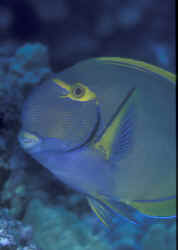
Acanthurus dussumieri
|
Surgeonfishes: Tangs for Marine Aquariums
Diversity, Selection & Care
New eBook on Amazon: Available here
New Print Book on Create Space: Available
here
by Robert (Bob) Fenner |
 |
How many Surgeonfishes in the genus Acanthurus do you
know? There are Powder Browns (A. nigricans (nee glaucopareius) and A.
japonicus), the Powder Blue, Atlantic Blue, Achilles, Orange-Shoulder,
Oriental/Pajama/Lineatus... any others? Hey, no cheating by looking
below. All told there are some forty described species in the genus;
two "mimics" often mistaken for Dwarf Angels!
Some Acanthurus make hardy captive specimens, others have
a dismal aquarium history; most are too poorly known to be judged as
yet. Here I'll present my version of who's "good",
"bad" and unknown; how to select and maintain the tangs in
the genus Acanthurus.
Classification: Taxonomy, Relation With Other
Groups
The Surgeonfish family Acanthuridae comprises six genera
and about seventy two species. Many are important food and aquarium
fishes. Think of the other genera that include the yellow and other
Zebrasoma, yellow-tail blue Paracanthurus, various Naso, and less known
Prionurus and Bristlemouth (Ctenochaetus) Surgeonfishes in addition to
the Acanthurus. What do they have in common?
All Surgeonfishes are laterally compressed covered with
very small scales giving their bodies a leathery appearance. They have
long continuous dorsal fins, and small terminal mouths with fine teeth.
What really distinguishes the whole family though is the presence of
one or more spines on the caudal peduncle (the part of the body right
before the tail fin), hence their scientific name from the Greek,
acanthus = "thorn". With a twist of the tail these spines are
used to as a formidable weapon when needed.
Modern classification schemes divide the six genera of
Acanthurids into two subfamilies (names ending in "inae") and
three tribes (ending in "ini").
The subfamily Nasinae, with one genus (Naso, the
Unicornfishes) and seventeen species have two anal fin spines and three
soft pelvic fin rays. Several have a frontal "horn"
protuberance that gets larger with age. Four branchiostegal (gill
supports) rays.
The subfamily Acanthurinae, the rest of the
Surgeonfishes, bear three anal fin spines and five soft pelvic fin
rays. Five branchiostegal rays.
Tribe Prionurini; one genus (Prionurus), six species;
rarely offered in the trade. Have 3-10 non-retractile bony plate
"scalpels" on their caudal peduncles.
Tribe Zebrasomini; containing the genera Paracanthurus
(one species, the yellow-tail blue), and Zebrasoma of seven
species.
The Tribe Acanthurini; genera Acanthurus and Ctenochaetus
can be discerned from each other by the six species of Bristlemouths
(Ctenochaetus) peculiar long, comb-like teeth.
Genus Acanthurus
("Ah-Kan-Thur-Us") Species; The Good, The Bad, and The
Unknown
Dear Reader, in checking through the voluminous
worldwide pet-fish literature which are the anecdotal accounts of
hobbyist attempts at keeping this genus, I am struck by several
opinions that greatly vary from my own. After handling tens of
thousands of these fishes, diving and talking with collectors and
public aquarium personnel hundreds of times these are mine... My
criteria for "good" species are ones that more than half live
three plus months after arrival. "Bad" ones, have behavioral
problems and/or a mortality of more than 50% in the first month.
"Good" Acanthurus (One's That
Generally Live):
| Acanthurus bahianus
Castelnau 1855, the Barber Surgeonfish.
South and Central Atlantic: coast of Brazil, from Parcel Manuel Luiz to
Santa Catarina, including the oceanic Islands of Fernando de Noronha, Atol
das Rocas, Trindade, Ascension and St. Helena. (see below) |
|
|
Bernal, M.A. and L.A. Rocha, 2011. Acanthurus
tractus Poey, 1860, a valid western Atlantic species of
surgeonfish (Teleostei, Acanthuridae), distinct from Acanthurus
bahianus Castelnau, 1855. Zootaxa 2905:63-68.
|
The ocean surgeonfish, Acanthurus bahianus, has been
historically recorded from Bermuda and Massachusetts to southern
Brazil and the islands of the central Atlantic. We have found
that individuals in the southwestern and central Atlantic
consistently have a posterior bright yellow margin on the caudal
fin and an orange/red margin on the dorsal fin. This coloration
is different from the characteristic white/blue fin margins on
individuals from the northwestern Atlantic. In addition, there
is a clear genetic distinction (d= 2.4% mtDNA, CytB) between
these two lineages. With the corroborating coloration and
genetic differences, we suggest that these two lineages
represent distinct species. The South
Atlantic species retains the name of A. bahianus and we propose
to resurrect A. tractus (Poey 1860) as the valid name for the
northwestern Atlantic species.
|
| Acanthurus
chronixis See below under: Mimic Surgeonfish |
|
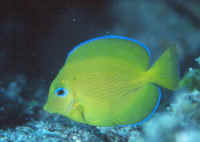
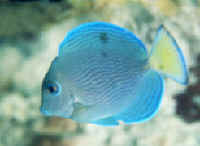
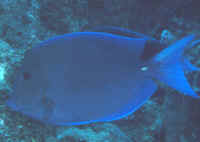
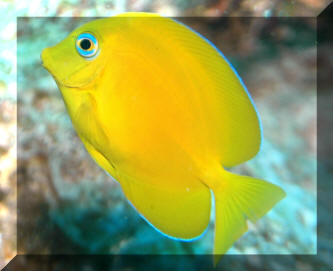
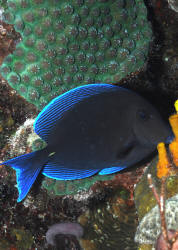
| Acanthurus coeruleus
Bloch & Schneider 1801, the Atlantic Blue Tang; though not as
dazzlingly beautiful as the other two "Blue Tangs"
(Paracanthurus hepatus & Acanthurus leucosternon) this
Caribbean surgeon makes a fine aquarium addition. One of a handful
of Acanthurus that are overall yellow as juveniles, the Atlantic
Blue Tang stays small enough for modest sized
aquariums. |
 |
 |
 |
|
Acanthurus coeruleus (Juvenile)
|
Acanthurus coeruleus (Midsize.)
|
Acanthurus coeruleus (Adult)
|
Bigger PIX:
The images in this table are
linked to large (desktop size) copies. Click on "framed"
images to go to the larger size. |
 %20MD.JPG)
%20MD.jpg)
%20MD.JPG)
 |
|
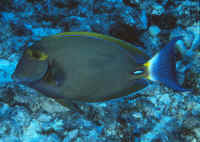
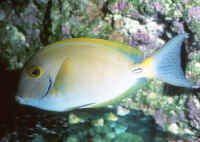
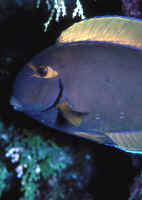
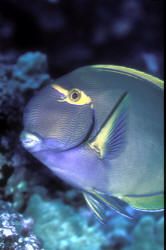
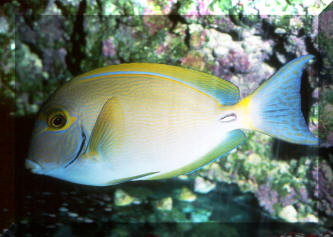
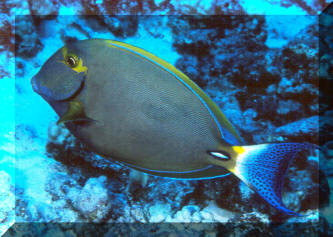
Acanthurus dussumieri Valenciennes 1835,
the Eyestripe or Dussumier's Surgeonfish; palani in HI. This is a highly
variably colored fish. Some are drab gray, whereas some I've
seen from Hawai'i sported brilliant yellow around their body
margin with beautiful royal purple highlights. This surgeon is
more like the genus Ctenochaetus in its feeding habits, sifting
sand and detritus in addition to algae scraping. Specimens off
Maui, in an a hobbyist tank and a profile of one off Queensland,
Australia. To eighteen inches long in the wild.
|
| Acanthurus fowleri
de Beaufort 1951. Fowler's Surgeonfish. Western Pacific:
Philippines, Indonesia, Papua New Guinea, Solomon Islands, and off
northwestern Australia. To: 45 cm. Photo by SaraM at
SDC. |
.jpg)
|
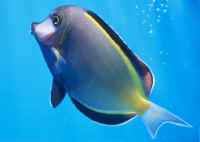
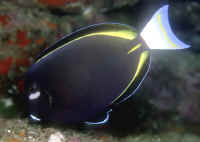
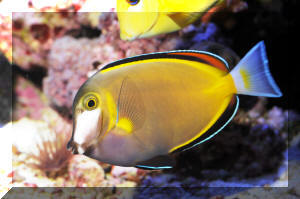
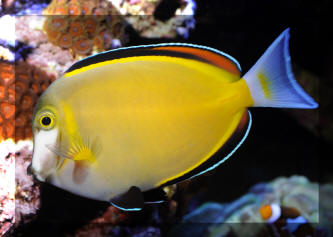
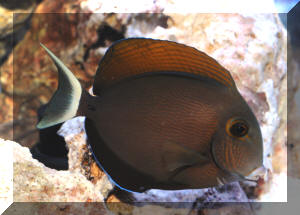
| Acanthurus japonicus (Fowler 1946),
the White-Faced Surgeonfish; also sold as a/the Gold-Rimmed or
Powder-Brown Surgeon, confusing it with A. glaucopareius
(nigricans) (see below). A. japonicus has a much larger white eye
patch. Ranges from the Philippines to Japan and is relatively
hardy. A nigricans, the Powder-Brown at right for comparison (Nuka
Hiva, Marquesas pic). |
|
Bigger PIX:
The images in this table are linked
to large (desktop size) copies. Click on "framed" images
to go to the larger size. |

%20MD.JPG)
%20MD.jpg) |
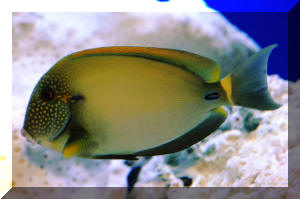
| Acanthurus maculiceps (Ahl 1923), the
Freckle face Surgeon. To some 16 inches in the wild, about half
this in captivity. Indo-West Pacific. A more common import the last
couple of years in the West. Pricy but beautiful and
hardy. |
|
Bigger PIX:
The images in this table are linked to large (desktop size) copies.
Click on "framed" images to go to the larger size. |
|
|
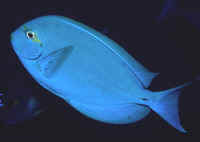
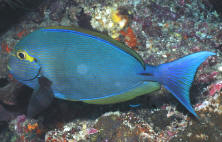
| Acanthurus mata Cuvier 1829, the Elongate
or Mata Surgeonfish. Indo-Pacific; Red Sea, eastern African coast
to French Polynesia, Japan, GBR, Micronesians. Similar to A. xanthopterus lives almost exclusively on
zooplankton. Long misidentified as A. bleekeri. To 50 cm.
One off of Gili Air, Lombok, Indonesia, another in Mabul,
Malaysia. |
|
Bigger PIX:
The images in this table are linked to large (desktop size) copies.
Click on "framed" images to go to the larger size. |
.JPG) |
To: Part 2,
Bad Acanthurus Species,
Surgeonfishes: Tangs for Marine Aquariums
Diversity, Selection & Care
New eBook on Amazon: Available here
New Print Book on Create Space: Available
here
by Robert (Bob) Fenner |
|
|
|


%20MD.JPG)