 |
|
| Home | Marine Aquariums |
Freshwater Aquariums |
Planted Aquariums |
Brackish Systems |
Ponds,
lakes & fountains |
Turtles & Amphibians |
Aquatic Business |
Aquatic Science |
Ask the WWM Crew a Question |
| Please visit our Sponsors | ||||
Fin issue 7/22/19
Acanthurus monroviae; stkg./sel.
7/7/14 Thompson Tang (A. thompsoni); Acanthurus sel.
11/19/13 Problem with Orange Shoulder Tang
4/15/13 Upgrade Stock List Questions'¦The *Which Tang* Debate ~ 01/08/09 Hi There Mr. Fenner, and WWM Crew, <<Hiya Adam, EricR here>> I'm looking for some insight into stocking a 180 Gallon (6' x 2' x 2') Aquarium. <<Okay'¦ I'm happy to offer my opinions>> I have some inhabitants from my current 90 Gallon Aquarium that will be making the move. The list includes (1) Powder Blue Tang 5", (1) Yellow Tang 4", (1) Sixline Wrasse, (1) Yellow Watchman Goby, and (2) Ocellaris Clowns. With the exception of the Powder Blue (added this past August), and the Clowns (added about 1 month ago), the fish have been together for about 2 years. I've got 2 fish that I have my eye on, but my gut tells me I'll only be able to add 1 of them to the 180. <<Oh?>> The fish in question are the Blue Jaw Trigger Fish, <<Ah'¦ An excellent choice I think>> and the Tennenti Tang. <<Mmm, this second choice is questionable>> The new tank will have around 120 LBS of live rock, set up in a pillar style. <<Neat>> This is to hopefully maximize swimming room. <<Excellent'¦ And wise>> This tank, as with my 90 Gallon, will be a mainly LPS Reef with a shallow sand bed of 1-2". The sump will have a Chaetomorpha Algae Refugium. The protein skimmer with be a MSX250 rated for a 640 Gallon Lightly Stocked Tank or a 425 Gallon Medium Stocked Tank. The main circulation in the tank will be achieved by 2 Vortech MP40W's, rated at 3000GPH each. <<Some nice flow'¦ And will be appreciated by all>> I changed 15-20% of <<It looks like some of your data was cut short/lost?>> So after that list I hope I didn't leave anything important out!! <<Hmm, I think I have enough info>> What do you guys/gals think? <<I think the Trigger would make a fine addition, but I have concerns the Tennenti Tang may prove too large (can reach 14-inches in the wild) and aggressive in the long term, for this tank>> Would they both be good additions? <<Not in my opinion, as explained>> Would neither be good? <<The Trigger should be fine>> If the Tennenti isn't a good choice can you recommend me another tang other than a Kole or Tomini? <<Mmm, a couple'¦ Although a Ctenochaetus species would probably be less problematic re aggression among the Tangs, have a look at the Mimic Tang (Acanthurus pyroferus), adults are quite striking and much better looking than the pictures on the NET reveal. Another option might be the White-Faced Tang (Acanthurus japonicus). These are generally superb aquarium specimens. Either of these will remain of a moderate size and have proven to be healthy and hardy feeders in my experience. And of course, the best option will be to introduce all tangs to the new tank at the same time>> Thanks so much in advance. -Adam <<Happy to share. EricR>> Acanthurus thompsoni, gen. care 12/3/08 Hello, <Salud Frank> My local fish store has a small juvenile Thompson's Tang that I am interested in purchasing. I am unable to find that much information regarding this species. I've only found just a handful of pics. Is this a rare species? <Mmm, not in its natural range, but in the trade, yes... Not a great beauty, and Thompson's doesn't therefore demand much in the way of "diver pay"... so it is most often turned out of fence nets (the predominant collecting technology for reef fish species altogether) in favor of species that generate more revenue... But I've collected in, unintentionally, many times in Hawai'i' and seen it in abundance in the Cooks, Polynesia....> What are their feeding habits? <Feeds continuously during the day on lower areas of rock on small filamentous algae, and likely aufwuchs... associated life... the higher rocks, larger algae are consumed mainly by other Acanthurid species... and still others feed on these materials on the sand> Are they aggressive or timid? <Mostly the latter... rarely get into tussles, unless backed into a corner, attacked, or placed in too-crowded settings> What's the appropriate tank size for this guy? <Mmm... at least a 75 gallon... and a comment re how many to stock... Thompson's is found as individuals, "pairs" and in larger shoals at times... Makes for a more interesting arrangement... if you have room> Any help would be much appreciated. Frank R Meadors <Welcome. Bob Fenner> Hybrid tang... Acanthurus sel. 8/18/08 Hey guys, I was wondering about the hybrid Powder Blue/Gold Rim Tang that a few fish sites claim to carry. Do you think these may be hardier or more resistant to disease than a standard Powder Blue? <Mmm, no. About the same> I have never seen a store carry these and have never heard of anyone keeping one. I was wondering if you had experience with these... I really want a Blue but don't want to put the rest of my 125 at risk. thank you, Alan <Think I have a pic... Nope... don't see on WWM nor on the ext. HD I have with me, but have seen. Not a good choice for such a small volume... Bob Fenner>Question about Dussumieri Tang, sel. 7/20/08 Dear Bob Fenner, Recently I just acquired a Australian Dussumieri Tang from my local pet shop. Its around 7.25 inches long. Very colorful. I paid $290.00 total. Was this a good deal? My buddy who owns the store claims he gave it to me at cost and that one would normally retail for around $500.00 at this size from Australia. Is that true or is he simply feeding me a line of crap? I was just curious. I've waited since November of 2006 for one of these fish to finally show up. Christopher Faiola <Mmm, well... a tang of this size from Australia... has a good several tens of dollars in freight alone in it... You could have gotten this fish from Hawai'i... not that uncommon here... for much less. BobF> Which Tang? -- 06/13/08 Hi Crew, <<Hey Kirk!>> A few questions if you don't mind. <<Fire away>> I have a 240 (8x2x2) FOWLR, 200 lbs of LR (25 of that in fuge), as such I have a fair amount of swimming space. <<Good'¦is important>> Current stock list of Sargassum and Redtooth Trigs, Sunset Wrasse and Harlequin Tusk, and Coral Beauty and newest addition a Maculosus Angel. <<A few 'biggies' for sure (Sunset, Redtooth, Maculosus)'¦and will 'fill up' even this large tank'¦at maturity>> Sunset is the biggest fish at 5 inch. <<For now>> I would like to do an Acanthurus Tang, I am in between the Sohal (am worried about aggression) or the Dussumier (do they get too large even for my 8 footer?). Which (if either) do you suggest? I'm torn. <<I don't think aggression is 'too much' of a concern considering the existing stock list. But I do think either tang will eventually be too much/get too big for the tank and existing tankmates, period. Perhaps a smaller Acanthurus species'¦maybe A. japonicus or A. pyroferus'¦ or even A. leucosternon>> Do you think a "school" of 3 or 5 Green Chromis would work with my aggressors to round out my stock list? <<Likely so, yes>> I have a Mag 18 as my sole return pump. <<This is all the 'flow' you have? Should have more>> With the head loss, I figure it is moving about 1300 gallons per hour total through the 2 returns. Do I need more movement? <<In my opinion'¦yes. Water movement is appreciated, even required, by the fishes too>> Possibly an upgrade to a Mag 24 or a powerhead? <<Up to you'¦but I think a Tunze Stream or two would be a nice addition>> Thank you, Kirk <<A pleasure to assist. EricR>>
Acanthurus sohal / Paracentropyge multifasciata compatibility 12/9/07 Dear WWM-Crew, <Alexander> I would like to thank you for answering my question on magnesium supplements a while ago. Now I have another question regarding something completely different - stocking my new tank... I have a new 205 gallon reef tank (total system is a bit more than 250 gallons) set up recently and am now doing a bit of planning regarding my livestock. I do intend to get a pair/small harem of Paracentropyge multifasciata (Multibarred Angelfish), a Pseudocheilinus hexataenia (Sixline Wrasse) and one or two pairs of Gobiosoma evelynae (Sharknose Goby). My intention is to see the social/courtship/spawning behaviour of the gobies and the angelfish (although I will not try the almost impossible, i.e. raising dwarf angelfish). <Mmm, okay... though I feel compelled to state that many Centropyge are being produced nowadays through aquarium aquaculture... See the name Frank Baensch here in Hawaii> My question would be if it would be possible to add an A. sohal to this kind of livestock? <Mmmm, I would not do this, nor encourage you to... out of a sense that the Sohal would become too much of a/the alpha fish here... likely bully (or seem to) these other much more easygoing fish choices... I would look to other acanthurids... perhaps of the genera Zebrasoma, Ctenochaetus, even other smaller, easier-going Acanthurus... instead> My concern would be that the angelfish would very much be dominated by the tang. <I agree, share this concern> I know it is an aggressive fish but it surely is one of the most beautiful fish available (should maybe be named Acanthurus pyxispandorae / Pandora's Box Tang) <Ahh!> and I would love to have it in my tank. Would it make sense/be ethical to maybe add some other fish (tangs/wrasses/anything annoying enough) to get the A. sohal's attention away from the angelfish or would maybe the wrasse get most of his attention anyway (being striped horizontally like the tang and swimming around all the time)? <Might work... but... then again...> Do you think this is worth a try or is it downright impossible? Thank you in advance & best wishes, Alex <IMO/E, not worth the probable outcome. Cheers, Bob Fenner> Re: Acanthurus sohal / Paracentropyge multifasciata
compatibility 12/9/07 Dear Bob, thank you for your
quick answer. I see that the concerns I had are pretty much the same as
yours and it was important for me to get your opinion. So I will not
experiment with the peace in the tank and go with a Ctenochaetus or
maybe an Acanthurus coeruleus. <Ahh, good> Best wishes, thank you
again, Alex <Thank you for sharing Alex. BobF> Stocking List
for Reef Tank, Acanthurus Questions 4/26/07 Hello WWM Crew,
<Hello.> I would like to start off by saying that your site is a
great resource, and to thank you for the time and effort you have put
into providing the useful information; I have consulted it many times.
<Awesome.> I am planning on a 135-gallon (6' long) reef set
up, with primarily SPS corals. <Neat.> I am in the process of
selecting my livestock in a advance of even purchasing the aquarium, so
that I can avoid incompatibility issues with fish and make sure all of
their needs are met. <Very good.> I'm planning on it being,
however the stocking list finally turns out, a peaceful community
set-up. It will most like include a pair of leopard wrasse, <A tough
species, dietary needs are hard to meet at times, do take an in-depth
look at this one.> a small harem of flasher or fairy wrasse,
<Careful with how many and exactly what type of wrasses you add
here...there could be territorial issues.> a scooter blenny,
<This animal is actually a dragonet and I would not keep one with so
many competitors in the tank.> a shrimp / prawn goby pair, a neon
goby, and a pair of venustus angelfish. <Only if you can attain a
pair. which aren't easy to come by.> I was also considering a
powder blue or achilles tang as a single larger fish, which would be
added as the last fish after the tank is well established. It would be
the only tang in the aquarium. My question was - first, if the size of
the aquarium would be adequate for either of the tangs mentioned,
<As long as the aquascape is done in such a way that it provides
good surface area/swimming room then yes, but just one.> and second,
if they would be too aggressive for a tank largely dedicated to
smaller, peaceful fish. <The animals you mentioned should be small
enough and inhabit different areas of the tank...should be out of the
tangs radar so to speak.> I know that the powder blue (and achilles)
can be quite aggressive to congeners, <Correct.> but would they
ignore completely unrelated fish such as the wrasse and others? ... Or
would they be too intimidating in the competition for food and space?
<Usually not one extreme or the other, somewhere in-between.>
Thanks for your comments and your time, <Be sure to read up on both
of these Acanthurus species, both are notoriously difficult and
commonly have crypt/ich...and are picky eaters as well.> Chris
Mimic eibli tang Acanthurus tristis 8/29/06 I am interested in purchasing a mimic eibli tang. <And I just saw one of these at Jenkinson's Aquarium here in NJ> As they get older do they change their coloration to more of brownish, yellowish color or do they keep their juvenile coloration which is that of the eibli angel? <Mostly the latter> If so, is it better to get a smaller one since it will probably take years to lose their juvenile coloration? <Have only seen ones of 3-4 inches ever offered in the trade.> Would they get along with other tangs of different shape and species? <Mmm, should if not "too crowded"> Thanks, Alan <Welcome. Bob Fenner> Achilles Tang - Specimen selection and use of FW dip with Meth Blue 7/19/06 Hello, <Hi there.> I have a few questions if you don't mind.<Sure, no problem.> I have a 100g reef system with tons of mushrooms, a torch coral, a frogspawn, two devils hands, some feather dusters a BTA. For fish I have a yellow tang, purple tang, one powder blue Chromis and a clown goby. Oh, and a bunch of snails and hermit crabs. I want to add another fish to this mix but am wondering what. I just lost my sohal tang <So sorry to hear that> that just disappeared over the weekend, but he was doing very well temperament wise with the other tangs. <There is a good chance he was not getting along as well with the other 2 Tangs as you thought he was.> I would like to add an Achilles tang, but I know this fish has its troubles. <Yes it does and to be honest 100g is really to small to house more than a single Tang. I would suggest you leave well enough alone and choose another species.> How do I know that I have a good specimen? Please have a look at this article. It discusses specimen selection '¦ http://www.wetwebmedia.com/acanthurTngs.htm.> I read the site and you say the best come from Hawaii and are caught at night. How do I request a fish like that at my LFS? <Hmmm, start by asking. I am pretty sure they will not be able to tell you what time of day the fish was caught, but you may be able to get information about it's source.> Also, what is the best dip to use before putting him in the tank? Methyl? Also, what amount of Methyl do I use with the freshwater and how much water do I use for the dip? Please help if you can. <My personal preference is not to use chemicals or medications prophylactically, so I would not recommend the use of Meth Blue. I would however recommend quarantining new arrivals. Hope this helps, Leslie> Clown Tang Problem...A Tang For Expert Aquarists Only - 06/06/2006 I have a small Clown Tang that I have had for a few weeks. When I got up yesterday morning his head was very dark, almost black. This happened overnight. Also he is swimming only using one lateral fin. His appetite is fine. <Water quality issue more than likely. You certainly didn't pick one of the hardier ones. These guys have a very high mortality rate. Pristine water quality and a good diet will go a long way in keeping the Clown Tang healthy. You say his appetite is good, so you won one of the battles. Do feed marine based seaweed and algae. It will strengthen their immune system and become a little less aggressive...Yes, a very aggressive fish. Good luck. James (Salty Dog)> Any suggestions? <If your experience level is low to moderate, I'd see if you can return this fish for store credit/exchange.> Dan Re: Clown Tang Problem...A Tang For Expert Aquarists Only - 06/06/2006 I have had a Achilles as well as a Powder Blue successfully. <A little easier to keep than the Clown Tang. "Have had"?> My water quality is good 1.023. Nitrates below 20. Nitrites 0. <Water quality isn't just 1.023 salinity and nitrates below 20 and nitrites 0. Other factors are stable non-fluctuating temperature and pH, absence of dissolved nutrients (An excellent skimmer goes a long way here), weekly 10% water changes are a few. Do read here, Dan. http://www.wetwebmedia.com/watchgantart.htm> If it is water quality, wouldn't it have developed over a few days? <Not necessarily. Very hard to tell water quality by looking at it.> And why would it affect his use of a lateral fin? <Was not implying that this was the cause of the fin not being used, is difficult to say without actually observing. For brief periods, I have observed tangs exhibit this behavior. What I was getting at is the difficulty in keeping the Clown Tang alive for any length of time.> He is eating Nori and grazing. <Good> I know that is an aggressive fish but I needed to have something straighten out my Achilles. <As long as the fish is eating well, just observe/monitor for health decline, hopefully you will have some luck with this fish. James (Salty Dog)> Goldrim Tang question what? 3/27/06 Bob, <James today. Bob is in Hawaii chomping at the bit to get home.> How are you? Love the site. <Thank you.> Wanted to ask a question about tangs.......I was wondering about the durability of the goldrim tang. Is it better than the Achilles Tang? <I would say yes.> I tried two of the achilles tangs and they both got Ich and died. <Acclimation/quarantine?> In you articles you say they are more durable than most of the tangs in this family. Also, would a Sohal tang be a better fit. I know you feel that these fish are very hardy. <Hardy for a fish in this family. Cannot compare to damsel hardiness for sure.> My tank is only 100 gallons and I have a yellow and purple tang. When I did have the Achilles tang, all three got along fine. I would love an experts advise. <I wouldn't add another tang in your 100. The tangs you have will get quite large and three will be a crowd.> Thanks, <You're welcome. James (Salty Dog)> Jeromy Tang Acanthurus addn. Question 02/12/06 Hello, Love the site!!! I have a quick question for you. I have a 100 gallon reef system with 2 powder blue Chromis, a yellow tang, a purple tang (they get along great!!) Mandarin goby, and two Percula clown fish that live in my bubble tip!! I was wondering if I could add an Achilles Tang to the mix. <Doubtful> I know tangs can get nasty, but I just love the way the fish looks and would love one. Please let me know if this would work, or if not, what other "show" fish I could put in with the "gang" Thanks, Jeormy P.S.-Keep up the good work <Thanks. Not a hardy species... not good in this setting. Bob Fenner> Poorly Atlantic Blue Tang.... 2/3/06 Hi All, We have a 55 UK gallon tank, with 30 kilos of Live Rock, MC500 Deltec, 2 power heads, 250 halide and two blue arcadias. Fish stock includes Mandarin Yellow tang Atlantic blue tang 2 Green Chromis 2 percula clowns Brownbarred goby Six lined Wrasse 9 red hermits 6 turbo snails 1 cleaner shrimp. Our problem is our Atlantic blue tang, it seems to have what I can only described a bubbly skin and there are a couple of white spots on it. <Unfortunately... quite prone to such troubles... as are most Atlantic Surgeonfishes> We are guessing its Ich but we're not getting much help from our LFS who have told us the just leave him and he will get over it?!? <Not if it were indeed crypt/ich... but I doubt this is what you are observing... otherwise your other fishes would be mal-affected as well> We are concerned as we are relatively new to this and would like to do what is right! I've read a lot of articles on this site with regards to freshwater dips, garlic copper and so on and from this have deduced freshwater dips are the way to go. Would you think this was advisable? <Not w/o knowing what is going on here> He is still eating well but does seem a little irritable. Many thanks for any help and advice you can give to us Brits as I haven't found a website as useful as yours in the UK. Emma and Simon, Lake District, UK <Mmm, need more information re the chemical make-up of this system. Were your fishes quarantined ahead of placement? I would be leery re "adding something" here in the way of "medicine"... Is there an aquarist friend, stockist who might come by and take a look at your set-up, livestock? Bob Fenner> Acanthurus coeruleus 8/15/05 Hi Bob, <Brian> I was looking through your site doing additional research on the Atlantic Blue Tang, Acanthurus coeruleus, and I had a couple of questions. Should I strive to get a juvenile or an adult, or am I going to have to just take what there is? <A larger juvenile to a smaller adult (about 3") is best> I have to put in a request at my LFS because I haven't seen one there and haven't asked if I can get a juvi or an adult but if I can I wish to know which is better. And secondly, I'd like to know if the guide to marine fishes with the 500+ essential species by Scott Michael is for the most part accurate. Any response would be great. Brian <Is for the most part accurate, as are most all Scott Michael's writing efforts. I have a (bad) habit of writing in my books, particularly "corrections" (to send, share with authors, publishers), and have a total of three for this work. Bob Fenner> Tangs in the Reef (5/2/05) Greetings, crew! Hope you are well. <Well enough thanks. Steve Allen with you tonight.> I love your site; what a wealth of information! Don't know where I'd be without it. :) <It has helped me over the years too and it is an honor to participate.> Now, my questions: I plan on (eventually) building a large (at least 120g) reef tank with a fishless refugium. <Nice size. Consider saving up some more bucks and getting 180.> Ideally, I'd love to have at least one yellow tang in the display... they're my wife's favorite. <Stick with one.> But, I understand they are not always the best reef denizens. <Hmm. I wonder who says that. Yes, they can be aggressive, but they are herbivores and will leave your corals and other invertebrates.> Would having a yellow tang pose a considerable risk to my corals/inverts? <No> If so, is there any way to mitigate this risk, or would I be saving myself heartache by leaving them out? <No worries.> If I did put a tang in the tank, would it be best to just have one since a 120G isn't that big and they're territorial with conspecifics? <I would not add any other Tang. There are so many compatible alternatives that are equally beautiful. A few that come to mind right away are the Flame Angel (a bit risky in a reef, though), and the Royal Gramma, and genus Cirrhilabrus wrasses come quickly to mind. Get a copy of "Marine Fishes" by Scott W. Michael and have fun considering your many options.> Also, I had a question about Gracilaria. I understand that Tangs love it... <Tang Heaven> ... and that it can be grown in the refugium. <With difficulty because it needs a lot of circulation and light.> When harvesting, would it be good to feed it to the Tang(s), or would that defeat the goal of nutrient export? <Great to feed some of what you harvest to them and toss the rest, then you accomplish nutrient export and Tang health.> Also, I'd like to grow Chaetomorpha along with it, and perhaps the purple algae octodes for aesthetics (I'm sorry, I can't remember the name exactly, and can't find it on WWM...). <Ochtodes> Would this be unadvisable (in, say, a 30G), due to chemical competition? <Yes. Best not to mix.> If I should pick just one, which would you pick (... with nutrient export as a goal, especially if there won't even BE any tangs in the reef tank! <G>)? <I've had great success with Chaetomorpha, but few Tangs will eat it. You could always try to establish the right conditions for Gracilaria and give it a try first. You might want to get "Reef Invertebrates" by Bob Fenner and Anthony Calfo. There is an excellent section on refugiums and algae. Don't take my word for it, read the reviews on Amazon.> Sorry about the length... I really did start with just one question! But, it always snowballs. <They do multiply, don't they?> Anyway, thanks so much for your advice, time, and work! I appreciate it. <I hope it helps. Enjoy your Tang. Be sure to quarantine all new fish.>
- Acanthurus lineatus - Dear Bob, <Actually, JasonC here today...> I am really interested in purchasing a Lined Surgeonfish. My dealer gets them regularly and right now has a 5 inch individual. He has been there for about 3 weeks. He is very fat and has great coloration. When I go up to the glass he becomes very curious and checks me out. I have been there a few times to observe him and every time he is eating algae and Mysis shrimp. If I purchase him, he will be placed in an 90 gallon FOWLR aquarium with a 3 inch Yellow Tang. Water quality is excellent and the water movement is about 12 times turnover. There are a ton of hiding spots for him and the other tang to hide. Do you see problems with them getting along in this size of tank? <Yes... these fish are well known to be hyper-aggressive in captivity and with growth. Additionally need a lot of space, more than a 90 gallon tank will provide.> If size is a problem I will be upgrading to a larger tank in the next year. <Then I'd wait to get one of these until then... keeping in mind that it still might very well kill many of your other fish.> There is a lot of algae growing in the tank and I will give them Nori soaked in Zoe and maybe Mysis at least twice a day. Thank you for your advice. Sam Reef (Real name) <Cheers, J -- > Achilles Tang Hi, I am interested in purchasing an Achilles Tang I saw at a local store. My concern is that it is a grayish color as opposed to the black color you always see in pictures. It is a beautiful fish, but is there any thing I should be concerned about? << Achilles Tangs are not for beginners, and I would be reluctant to purchase one. They often do poorly in captivity.>> Should I shy away from it? << Color loss is not a good sign. But here is what I would do. If the pet store has had it for at least two weeks, and you see them feed it, and it eats; well then I would say it is okay to chance. Otherwise I would wait until you find one that meets those three criteria items. >>Any advice would be great. Thanks in advance. Dave << Adam Blundell>> Clown Tang I have a question about a clown tang. I was thinking of getting one for my 25 gal. reef tank. He is pretty small now but I don't know how big they get or how their behavior is. Could you tell me if this is a wise purchase or not. > Thank you, Adam Brock >> Thanks for asking ahead of purchasing this fish. Actually an Acanthurus lineatus in such a small system is a poor idea... it will be getting larger, soon... and is quite a territorial animal... I'd look into other species... none of them tangs... for your 25. Bob Fenner Convict Tang Hello, I've read all there is to read about the convict tang and it seems to be something I'm interested in trying. <Acanthurus triostegus... a great fish> I will probably order through FFX. How are they in shipping? <Hmm, mixed...> Relatively easy??? I have a 55 gal. reef tank with a Christmas wrasse, a pygmy angel, a false Percula clown and 2 fire fish. No algae trouble, the snails, crabs etc. take pretty good care of things so I am prepared to supplement this tang with Nori. Nothing was noted in your articles regarding disease tolerance of this species, any difference compared to the yellow tang? <Not as sturdy as the Zebrasomas... appreciate larger quarters, being in a group... Bob Fenner> thanks for any help or suggestions, Joanne Nobre Powder blue tangs Mr. Fenner, I have been involved in a lively debate regarding the suitability of powder blue tangs for the home aquarium. I don't remember where I read the statistic, but it seems to me that I read that upwards of 90% of these fish do not survive over 3 months from time of capture. <That is my opinion, relating actually of historical survivability of this species (Acanthurus leucosternon)> Do you believe the mortality of powder blue tangs (Acanthurus leucosternon) is truly this high? What is your opinion of keeping this fish? <Please see my "rundown" on this species, genus, family.... posted on our site: www.WetWebMedia.com> Thanks for your advice. Brian Daniell <You're welcome my friend. Be chatting, Bob Fenner> Adding new fish (Marine selection) I recently asked a question about adding new fish on Flying Fish Express. I have a purple tang and a tomato clown, I was told that I could add another tang of the genus Acanthurus. <Hmm, the Purple tang... Zebrasoma xanthurum is not of the genus Acanthurus> I looked at a powder blue tang and an Achilles tang. If they are an acceptable addition what size should I get them. <Both very poor choices. Please read over our site: www.WetWebMedia.com re these species, other Surgeonfishes> Bigger or smaller than the purple tang. the tang is approximately 3 in. I am not looking to get big fish I would like to have more smaller fish in my tank for more activity. if I chose to add dwarf angels how many could I add and of what type would get along. I am leaning toward the flame angel but like the keyhole also. I would appreciate any help being that your info has helped me in the past. thanks <Then do read over the WWM site. Bob Fenner> Looking for a Acanthurus dussumieri OR Acanthurus blochii Bob, Where can I get one of these surgeons?? Acanthurus dussumieri or blochii.. Do you know of any place where I can get one of these fish?? Thanks <Check with you local fish stores... they should be able to "special order" these fishes. And for sure the fine folks at the Marine Center can/will send you these. Their link, logo is on most the WWM pages. Bob Fenner> Going to buy a Australian Dussumieri Tang from FF Express...... Bob, I'm going to order a 7" Australian Dussumieri Tang from FF Express. $229.00 . Is this a hardy Tang? <Yes> And are the ones from Australia just as pretty as the ones in Hawaii? <More so IMHO> I'm looking in the Baensch Marine Atlas, there is a nice pic of one. Which I think its a full blown adult. I would hate to blow my money and get a drab plain looking tang. Anyhow I cant find much info on this tang. I even checked in the Wet Web Media. Anyhow any input will be greatly appreciated. <This species coverage is under the genus, Acanthurus. Bob Fenner> PS my setup is a 240 gal. FO liverock tank. + 20 gal. refugium Tankmates 10in. vlamingi tang 10 in. panther grouper 4in. emperor Angel sub adult 95% change 2in. flame hawk 6in. Miniatus grouper 5in. Naso tang 4in. majestic angel thank you, Linstun Achilles tang Mr. Fenner, I have a few questions about the Achilles tang and a hybrid that occurs between it and the gold rim (powder brown). I have a 150g tank with a lot of LR, probably at least 125lbs, a protein skimmer, and I have excellent water conditions. I was wondering what you would think about my adding an Achilles tang to my tank as I think they are just beautiful. I have read your book and been to your WetWebMedia site and have gathered that they are somewhat touchy fish and they don't usually survive in captivity. <You are correct... and also tend to be "ich magnets" so to speak... Very important to get healthy specimens in good shape up front... acclimate them quickly, completely, and place them in a very well established, large, optimized system> You mention that they need very high oxygenation in the water, which can be provided by lots of water movement, correct? <Yes> Also you mention that they need or enjoy higher salinity, in the 1.023-1.025 range. Other than these requirements and obvious good water quality, why do they not make it very often. <A few things... as the genus and family goes, Achilles are "soft-bodied" and take a beating being caught, moved around... Their nature tends to a "wild side" with specimens frequently injuring themselves from swimming into tank sides et al. during the first few days/weeks of captivity... Their mouths are frequently mal-affected from the above and subsequently they may give up feeding...> Do they get ich or carry it most of the time, or do they not eat or what. I just wonder because I have happened across some other hobbyists on the internet that keep the Achilles tang and just love it. <It is a fabulous species. Just on average, not easy to keep in captivity> If I were to try to keep one, what should I do to increase the fishes chance of survival? Also, I have seen another Achilles tang that is absolutely incredible looking, it is an Achilles-powder brown (gold rim) tang hybrid that has got to be the most amazing fish I have ever seen. It has the basic Achilles colors, except the tail is bright powder blue. I have included a pic of it so you know exactly what I am talking about. I just wanted to know what you know (if anything) about the fish and if it is harder to keep than an Achilles or easier, what it might take to keep it, etc. <Should be about the same> Some guy on a fish forum says his LFS is selling them and I just wanted to know if I should try it, or stick to the regular Achilles. And one last thing about the Achilles, is there a certain locale that I should try to get it from (i.e., Hawai'i, Maldives, etc) that would produce a healthier, hardier fish? <Are you in the United States? If so, the best ones come out of Hawai'i to here> As much info as you have about the Achilles and the hybrid would be great, as I am really thinking about trying this fish. Thanks, Bob <Sounds like you're about ready. Bob Fenner> Tangs Selection I was thinking about purchasing a male Vlamingi Tang and a Sohal Tang from MarineCenter.com for my 280 FOWLR. <Both beautiful animals, suitable for very large systems> My first question deals with the transformation of the Vlamingi tang from Juv. to adult. I know as Juv. that they are gray silver) with blue dots but will they ever reach full adult coloration like the pictures shown on wetwebmedia.com and fishbase.org? <In a two hundred eighty gallon tank? Possibly (have seen this) over a handful of years. Not "full size" (more than two feet with streamers), but color wise should transform... btw, the "real bright" coloring is not "permanent" as shown with male pix... but transitory, more of a flashing, signaling/communication to other fishes (their species and not)> The people at the marine center say that the pictures that I see are males at full adult coloration and they never have gotten them in at that stage. <No, too big, expensive to ship... would not likely survive being caught, moved at that size> Also will these two Tangs be okay in my 72x30x30 tank together? <Should be... different habitat/niches... the Sohal near bottom, Vlamingi at top> I know that both get pretty big but my tank is kind of empty now with just a 15" Dragon Eel, 6" Red Coris Wrasse and 5" Twin spot Wrasse. The only other addition after these two are made is possibly a Pink Tail Trigger. Will all these occupants get along okay? <Should do so> BTW-- Which sea should I be concerned about getting the Vlamingi Tang from? <No real difference here, for this species. Excellent from everywhere. Bob Fenner> Thanks Tang Recommendation <Hi, Calvin... Anthony Calfo again> Hello. I was looking into a tang for my 55g. I was thinking, will a yellow tang, or mimic tang work? <possible but allow for plenty of room. Yellow tang would be better> How about a Sailfin? I w as also considering an Atlantic blue, or a hippo. <all three unsuitable for the long-term... they will outgrow the aquarium in 2+ years or die prematurely from the compromise> Please tell me which ones will work. Thanks. By work, I mean have enough room in the 55. <keep reading and learning, bud. Anthony> Bob please take a look, Clown Tang... some differences of
experience, opinion Hello: I am a biologist, specializing in
habitat re-creation. All Tangs school, but not year-round.
<Agreed, and some species, localities far more than others> The
Clown Tang schools year-round and is one of the few Tangs that breeds
gregariously. <Acanthurus lineatus? Does not school often at
any of a few dozen places I have photographed and collected them. It is
almost always found singly, I assure you> According to my sources at
the American Marinelife Alliance, only Tangs caught in the Philippines
are usually drug-caught, and also from the Fiji Islands <What? Tangs
are not targeted for the ornamental industry in Fiji by and large...
and no fishes are captured there by anything other than fence and hand
net techniques... In the Philippines, Acanthuroids are rarely taken
with cyanide... again, I lived there and have visited on many
occasions... other fishes are captured with poisons however> and the
Clown Tang is rare in those waters. Call your local public aquarium,
and ask them about their record of success. Bet you'll find they
have a hard time with them too. <Don't know what you're
referring to by a hard time... historic survival rates? I am sure you
are right if this is what you mean... this species, A. lineatus does
not fare well in captivity> I worked at the New England aquarium as
a Grad student for a few years as part of my R.A. program at U.R.I.
They couldn't keep them alive under absolutely perfect conditions
in schools of 6 or more. The only way they kept them alive was to
increase school size to more than 20. <Interesting. About what
size individuals were involved? Can you tell me where these
originated?> Incidentally, almost all Clown Tangs (Acanthurus
lineatus), are collected in Micronesian crystal-clear waters in depths
of about 25 feet using nets. They do occur on reef flats and on the
SEAWARD reef margin, but do not occur in shallow turbid water that I
know of. I have checked six references on this and they all agree that
the fish occurs in clear water only above the reef, <Agreed.
This is overwhelmingly the conditions where I've encountered the
species> though they may also be found in lagoons. All references I
found say they require very well-oxygenated clear water. <Again,
agreed> Like most Tangs, they are rarely caught using sodium cyanide
as their skin absorbs the drug directly and damages the sub dermal
tissue. Drug-caught Tangs usually die on their way to the wholesalers
and never even make it to market. Tangs are easy to catch with nets
when they school. One diver guides the school into seine nets held by
another diver. Why use drugs? <Can't think of many good
reasons... am surprised you seem to state that the group IS collected
with cyanide, then categorically state why it cannot be so...> Take
it with a grain of salt. If you get one, let me know how you make out.
<With what, a grain of salt? In our stores (gone years back) we
rarely offered much of the (if memory serves) of the 32 species of
Acanthurus, and almost never, A. lineatus. I don't deal with
collecting this species at all, nor keep it in marine aquariums... Bob
Fenner> Dave
|
|

|
Features: |
|
| Featured Sponsors: |
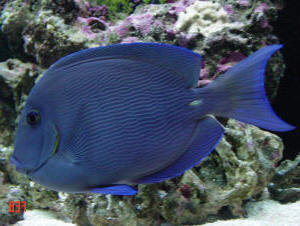 Very nice pic, specimen. RMF