 |
|
| Home | Marine Aquariums |
Freshwater Aquariums |
Planted Aquariums |
Brackish Systems |
Ponds,
lakes & fountains |
Turtles & Amphibians |
Aquatic Business |
Aquatic Science |
Ask the WWM Crew a Question |
| Please visit our Sponsors | ||||
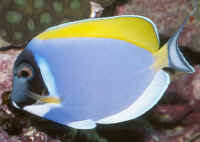
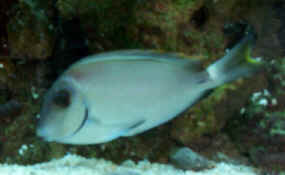
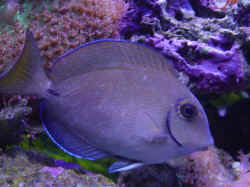
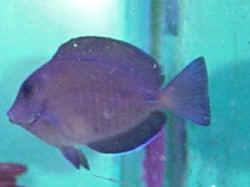
- Powder Blue Tang, Shoehorn Style - Hi, I currently have a regal tang about 2 inch, and am thinking of purchasing a powder blue tang. Will they fight or will they just mind their own business, as I would really like to keep one of these fishes. <Depends on the size of the tank.> My tank is 23 gallon, and has a 100 gallon protein skimmer, 55 gallon canister filter 6 pieces of live rock on the bottom, which takes up around 3 gallon, and the other 20 gallons is remaining for the fish. <This tank is much to small for the regal tang let alone a second one. I cannot recommend that you keep any more fish in this system.> Baring in mind I will have a new, and bigger set up for Christmas to move the tang(s) into. <I'd wait until you actually have the system set up and running for a couple of months before attempting a powder blue - these fish on average do quite poorly in anything but the largest systems. Please read here: http://www.wetwebmedia.com/badacanthurusaq.htm > I do know that they may be aggressive towards each other, but I don't think this will be a problem, as I have seen many different species of tang in the same tank. <Well, that doesn't make it a smart or good long-term choice. I would not place a powder blue tang in a tank of this size - please don't put this fish in your tank at this point.> Please could you fill me in on these questions, I would very much appreciate it. Regards Aaron. <Cheers, J -- > You've been misquoted! Hello guys... specifically Bob. Are you in any way affiliated with marine depot live? <The owner, Ken Wong, his girlfriend/fiance Amy and others there (esp. Alvin) are friends, associates in the trade> The reason I ask is that several of their fish descriptions are copied literally word for word from the pages of your website. Many of the photographs are the same as well. Of particular concern to me is the fact that they have misquoted your description of the powder blue tang. Below is your description of the fish, and in caps is the part they chose to include on their site: ACANTHURUS LEUCOSTERNON (BENNETT 1833), THE POWDER BLUE TANG; besides being notorious carriers of parasitic diseases, most specimens don't even make it through the capture and shipping stages. But some of you are screaming, "this isn't a difficult fish! a I'VE KNOWN PEOPLE TO KEEP THE POWDER BLUE FOR YEARS! THOSE HEALTHY FEW THAT ARE WELL RECEIVED AND CARED FOR - WITH LOTS OF LIVE ROCK AND ALGAE IN LARGE, WELL-ESTABLISHED REEFS - DO occasionally LIVE FOR EXTENDED PERIODS. Needless to say, the omission of the first section, along with their cleverly leaving out the word "occasionally," completely changes the meaning of your words. You would think if they were going to lie about the ease of caring for this fish, they could at least write it themselves and not take your words and mess them up. Also, you are not cited anywhere on the site that I could see, so I guess they are guilty of plagiarism as well (is that spelled right?) In conclusion... sue the pants off these guys. They must be loaded, right? Well, maybe I'm going a bit far, but it upset me to see them repeatedly copying you word for word and in this one instance (and maybe others) completely altering the context and meaning of your advice. You've been a big help to me and my tank in the past, and I thank you all. keep up the good work! -Mario <The company did buy a bunch of images from us for internet use, but not our "spiels"... will bring this to Ken's attention. Thank you for the head's up. Bob Fenner> How do you measure success? Tang life 10/8/03 Thanks. That is what I have always heard too. My only thing is I had an Achilles once even in a 20 gallon high tank for a long time, then moved it to a 45 gallon, for a few months and then eventually to a 90 gallon tank. I had that tang for over 3 years and never had any trouble with it. I truly believe the only reason it dies is because I moved to go to school, and was not there to take care of my tank like I had been. Trust me, I lost a lot of fish when that tank went down! I was heart-broken! This is the only reason why I was thinking of adding it. Thanks! -D <you do need to be more realistic here, mate. Having an Achilles for 3 years is not success when the animal naturally lives well over a decade. You simply lucked out and had a hardy one that survived despite your care. Most would not... and your next one is unlikely too. Please be mindful of their needs and the demands we place on these fishes and this hobby (responsible use of a living resource). Best of luck, Anthony> Treating Powder Blue Tangs Dear Bob, Hi again. I have questions on Powder Blue. I understand that they are territorial fishes but one wholesaler told me that they can be put together by some means without any problem. However he never revealed how to do that. Have you heard of this before? <This is a social species in the wild. Can be kept together in aquariums, even crowded at a wholesale, transshipping facility> Common disease for Powder Blue is white spot. Currently, I'm using copper ion to treat the disease. Is there a safer way to treat Powder Blue white spot such as dipping in fresh warm water or with Methylene Blue? <Copper is not recommended... again, please read through WWM, use the search tool on the homepage re this species, Cryptocaryon> I heard that putting them in long tanks will prevent them from getting white spot comparing to isolating them in tight quarters. Is this true? <Likely will help... to reduce stress, hence likelihood of infestation> Currently I'm implementing the dip/bath fresh water system with Methylene Blue using sodium bicarbonate to control pH between 8.0 to 8.4. Is this ok? How concentrated is the Methylene Blue and how long is the dip normally? <Posted on WWM> Sorry for the long questions. <You will benefit MUCH more from a thorough understanding of these situations from reading the articles posted on WWM, and the related FAQs there. Please don't re-ask what has already been responded to. Bob Fenner> Thanks Cheers, Charles HAWAIIAN CONVICT TANG BOB, YOU LINK http://wetwebfotos.com/Home?actionRequest=articleView&articleID=10 http://wetwebfotos.com/Home?actionRequest=organismView&organismID=108 this link has a Hawaiian Convict tang (sub species) in the top picture. Hint: the Hawaiian has the second bar extending past the pectoral fin all the way to the bottom of the belly. The number of bones/rays in the fins is also different than the non-Hawaiian. I must spend too much time reading Jack Randall's books. ABOUT Hawaiian tangs has a picture of the NON-Hawaiian convict tang. Do you know how to tell the difference? ALOHA John Dawe <Evidently not... though have seen, photographed "Maninis" in a bunch of countries, places... That Dr. R... just two nights back was stymied at a SDMAS meeting by someone asking what species of Bristlemouth tang they had... I said, "likely a Ctenochaetus striatus"... but Dr. Jack has expanded the number of species recently (groan). Be chatting. Bob Fenner> -Closed loops and PBTs- Hello to all at WWM: I have only 2 questions this time. I know you're going to say.......just two? Here goes: 1) I want to add more circulation to my existing 110 gal FO set up. Currently I am using an Iwaki 30 RXLT for my return pump from my sump. I have another Iwaki 30 that I wanted to use in a closed loop for circulation. The Iwaki has one inch fittings but I am not exactly sure how to get the water from the main tank to the pump. I will be using one inch flexible tubing but is there some type of elbow I need to go over the top rim of the tank? This I assume will need some type of strainer on the end.....any additional thoughts? <I've attached pictures of the gorgeous inlet to my closed loop that I made with a Mag 9. The mess of PVC parts not connected to a pump is the inlet which hangs on the back of the aquarium with the strainers hidden behind the rockwork. It doesn't have to be fancy, just make sure that the pipe is at least as large as the inlet of the pump so it doesn't get restricted. From the 3/4" inlet of my mag, I T'd it off into 1" pipe w/ two strainers. This way the flow is greatly reduced through the strainers; preventing anything delicate from being sucked up inside!> 2) I have a powder blue tang for just over 2 mos. When I first got him he was in my QT for 3 weeks and seemed to be doing well. I transferred him to my main tank and after one week......you guessed it...ich. I could not transfer back to QT since I was already using the tank for another "fish project". Anyway I decided to use hyposalinity therapy, which I have used in the past with great results. I reduced the SG to 1.009 at 81 degrees. I kept it at this level for approximately 4 weeks. I monitored my water parameters throughout the whole time (pH , etc.) I have been slowly increasing it and so far as of today it is at 1.017. All signs of if ich are gone, all other fish are doing well but my concern is my powder blue tang. My tang seems to have changed its feeding habits. It used to gobble up the Julian Sprung Sea veggies but now barely picks at them. The same holds true for all other types of food I give (Seaweed selects, flakes, Mysis, clam, brine shrimp). The tang seems eager to eat but once the food gets to him he seems to just swim around and through it but not eat it. He is starting to get thin and I was wondering from your experience can/will the tang recover and start eating more? <Powder blues aren't the hardiest fish ever, as you well know by now. Since it still eats a little, I'd pick up an anti-internal parasite food (such as Jungle's Pepso Food) and feed that to it for a while. Otherwise there's really nothing else that can be done besides making sure that every piece of food that it eats is chock full of vitamins.> By the way, I have a few tanks including 2 reef tanks for many years but was very reluctant to get the Powder Blue. This was one fish I have always wanted but knew the difficulty involved in keeping it. I broke down and got one and have been struggling for the last 2 months. Right now it's become "personal". I am pretty confident, with the help of WWM, we can get this fish back to health. I am just not sure if I am on the right track. Thanks so much for all of your valuable time. <Good luck with that beautiful fish, hopefully it will make a turn-around. -Kevin> Gene
Tangling With Tangs! Hello, I would like to start this email by thanking you and the rest of you who make your site possible. It is a great source of information. I am impressed that you even have an "email-and-ask" section. <All part of the fun world of WetWebMedia! Scott F. with you today!> I would also like to apologize in advance for the length of this email. <No problem! Ask away- that's what we're here for!> I am about to set-up a 120 gal tank with rock, water, sand etc. from a 5-year-old established reef (75gal.) system. This new tank will be mostly SPS and I am trying to plan what fish would be compatible in this system. It will have a ~20gal. refugium and skimmer as it's primary filtration. <Sounds nice> From the old tank, I would like to keep my Royal Gramma and my yellow tang. However, I would love to keep a powder blue tang in this new tank. I know that this fish has a bad rap but I also know that there are more than a few people who have kept; and are keeping this fish healthy. Is the powder blue tang one of those fish that transport poorly and whose survival is based on its acclimation? <Yep- and the collection. Many of these fishes are doomed from the start because they are not collected properly. And when they are mishandled along the way, it just gets worse...> I ask because my local fish store has a 4-5" specimen that has been in the store for over three weeks and is eating very well. I figured that this is as good an acclimation a fish in a LFS could have. Could you please give me any tips for its care? I plan on searching for more info but I figured I'd start here and as well as posting in Reef Central. <Well, it certainly is a good sign that he's eating already. Be sure to quarantine this fish in your home for at least 3 weeks before you release it into the aquarium. Even though he was doing well in the LFS, you're not home free! He could have been exposed to lots of other potentially sick animals, and really needs careful acclimation, close observation, excellent water quality, and a diet high in vegetable matter (Nori, Gracilaria macroalgae, etc). Make sure that all environmental parameters in your tank are as steady as possible, with very little fluctuation. Keep the oxygen level as high as possible, and don't overcrowd. That's essentially the way to succeed with this fish!> My LFS said that keeping more than one tang in this tank would be feasible but three is better than two because any aggression would be more dissipated this way. So what third tang would you recommend to match up with these two (a yellow and powder blue) or would you even recommend a third at all? <This is where I start ducking the tomatoes...! Frankly, I would not keep more than one tang in any aquarium under 6 feet in length. In fact, I'd probably avoid more than one in any tank under 240 gallons! Others may disagree with me fervently, but if you've ever spent time observing tangs in nature, you'll realize that they need a lot of space to thrive. The same is true in captive situations. It just doesn't seem fair to me to pak theses fishes in. If you are thinking of more than one, I would agree that you should go for three to help disperse aggression. You need to have different sizes and different genera of tangs for this to work well. I'd limit myself to, say- one Ctenochaetus, one Zebrasoma, and one Acanthurus species. I've seen people keep multiple tangs in smaller aquariums, but that doesn't make it right. It's your call, but if it were me, I'd enjoy just one tang (remember, the Powder Blue can reach almost 10 inches in length, so keep this in mind when stocking the tank. Again, that's my take on things, but it's your tank and your call here! And, no- I'm not one of those "Tang Police" guys you'll find on Reef Central, but I do believe in stocking conservatively with tangs.> I have a tentative list of fish to keep that I would like you to constructively critique: -Yellow tang (1) -Powder Blue tang (1) <Well, you heard my take on the tangs, so make your call> -Royal Gramma(1) -pair of true Perculas -harem (of 3- one male two females) flasher wrasses <Wonderful choice for a reef tank!> -Mandarin dragonet (one) (but after tank is very well est. to give pod population time to grow) <Great thought!> -Is there room for any other fish? [i.e.. pygmy Angel (Flame, Eibli, or Coral Beauty), Firefish, pair of neon gobies, or pair of Banggai cardinal] - not all of these just one. <If you go with just one tang, I'd go for the Firefish. Also, you could try a Centropyge angel. This is another one of those choices that you have to make based on your tolerances...They can and do nip at corals, so the very real possibility exists that they me damage some of yours. I like fish more than I like corals (and I LOVE corals, so you can imagine how I feel about fishes!), so it's a risk that I am willing to take in my tank (and my angel doesn't nip my corals...maybe I'm lucky?). I'd go with the Coral Beauty- seems to have a better track record than many Centropyge for not chowing down on aquarium corals> Please let me know your thoughts and experiences. <Again, it's all about choices here. I see no real flaws with your stocking plan. I think it's kind of neat to see small fish in a larger tank, but other people like a few larger fishes in their large tanks- totally up to you. Just plan around your tolerances, the needs of the fishes and corals, and your ability to provide a high level of care. You really seem to have a handle on things, so go for it! Good luck! Regards, Scott F> Sohal question in my 230 Reef This question is for Bob Fenner if possible. <Go ahead> Bob, I am the guy who has the 6" Asfur in my 230 soft coral and invert reef. The Asfur (who my kids named King of the Red Sea) is doing great and readily eats out of my hand. He has been doing well for about 4 months now. I just added a 5" Sohal which will be the only other fish in this tank (except for a school of Red Sea Chromis). I want to give them room to grow and be healthy long-term. The Sohal was in quarantine for two weeks before going into the 230. My question is the Sohal eats of the live rock all day long (this is good). However, I have a lot of red bristly macro algae that grows on the rocks. The Sohal loves this stuff. The problem is he has some of it stuck on the outside of his mouth. I guess it is kind of thorny. He is eating everything in site but I do not want him to get an infection on his mouth or anything. It has been on the outside of his mouth for two days now (not sure if it is the same piece or what). Is this something to be concerned with or will he be ok? <Not concerned this point, should be okay> Thank you for all your help. I look forward to some of your new books out soon!!! <Me too! Bob Fenner> Andrew More fish? Hey guys, <Hey Tommy, Don with you this AM> Just found this web site and been reading way too much. Lots of great info. Once upon a time I had a beautiful powder blue tang in with my yellow tang and a Kole tang. After about 2 or 3 months, the powder blue started swimming real fast and into the glass and rocks. He tenderized his head in two days or so and died soon thereafter. (That's where it hit me that a fish this big won't fit down the toilet, much to the delight and ridicule of my wife, sister, neighbors, etc.) No one at the LFS had a clue. You seemed to have the answer as pasted below: "the powder blue is probably pacing in your tank (common behavior in small tanks where they swim back and forth against the glass)... or will be soon." "My strong advice is to pull the powder blue soon as it is the most likely to suffer in the short run 12-18 months for a mere 4 feet of swimming space. Its just a needy/sensitive fish." My first question is this. I have 75 gallon oceanic tank. The dude was only four or five inches long! How much room does one need? <6' min, 8'-10' would be appropriate for this fish, depending on other inhabitants. Still, a very sensitive fish. While you brought this up, ponder this: The powder blue was 5" that is about 10% of the length/height of the tank eh? If you are 5' tall consider living in a 48x18' box (pretty close to a 3 bedroom/2 floor house). You might think, not bad eh? Now add furniture taking up 20% of that space. Add 17 other individuals of varying size that are taking up maybe another 30% of that space (and are CONSTANTLY on/around you, literally in your face as it were) Throw in a dozen or two little lap dogs running around. All of this only getting worse as everyone grows and competes over time. See what the powder blue tang was up against? I won't even start on the polluted atmosphere/environment that you would have to live in <G>> Ok, here is the rest. I have: 75 gallon tank w/sump about to be out of bio-balls as per your site. three 96w PCs (two daylight and one true actinic) 1200 gph mag drive with a creative multi output so I have no power heads in the tank, but good movement/stirring of water 1.023 salinity 79-81 degrees 85 ph, (might remember wrong, but in the recommended range per test) <Will assume a missing decimal here 8.5> 0 ammonia 0 nitrite > 20 ppm nitrate for the first time EVER, yeah <Again, I am thinking < 20ppm> 350 ppm calcium about 30 - 40 pounds live rock <all sounds good, maybe more live rock as you can afford it> beautiful yellow tang, 2 in. when I bought it almost a year ago, now 4+ in. mean as hell yellow damsel, too quick for me to catch, but leaves familiar neighbors alone. i.e. hard to add new fish very docile blue damsel two awesome fat-faced (good eaters) true Percs. Love these guys pajama cardinal two Banggai cardinals Firefish goby pistol shrimp (aka bulldozer) watchman goby (These two are the coolest thing in the tank. SO entertaining!) handful of hermits (Scarlets, Hawaiians, blue legs, etc.) three Mithrax crabs (very cool) two starfish (one brittle, black hairy thing and one serpent, neat when you can see it) various snails (Nassarius, turbo, Astreas, etc.) one pink poo (pink and brown cucumber) two Hawaiian feather dusters one skunk cleaner shrimp two peppermint shrimp and some slowly dying green star polyps I have had my tank set up for a couple of years. Ok, I'll admit, I am a real slacker. I am terrible about water changes. I do 25 - 33% once every two or even three months. Go ahead let me have it, if you want. <No need as you already see/understand the problem here. BTW, you (and you fish) have been pretty lucky too! <G>> But especially after adding my protein skimmer, water seems to be great. Even my nitrates that were 80 + is down to >20ppm and has been for a month and I have not changed my water recently. I use a mechanical water filter when I add tap water, no RO/DI. I never quarantine, but am considering doing so after the scare tactics used on this site. <Believe me, not scare tactics at all. Soooooo many times a new fish is added to an existing tank and before you know it, everybody is being flushed. Tried and true, success speaks for itself> That's about the history. Now, I can't and never could get coralline algae to grow. Any guess as to why? And I get a light coating of red or brown algae on the glass that has to be cleaned every three to five days. I think this is normal, but would like to hear that from you. Comes off easily enough with my magnet cleaner, but clouds the water for about 10 minutes or so afterwards. <You don't mention Alkalinity, could be a factor stifling coralline if too low. Do you have a lot of other algae? This would 'choke' the coralline out. Look for BGA and diatoms using the Google search on WetWebMedia.com. This is what you describe. Regular water changes (like 10% weekly) would help (but then you already know that eh?), reducing Nitrate more would benefit as well. Removing the bio-balls will help as well (in removing nitrate). High nitrate is causing the demise of the coral. Needs to be at 0 to keep any> And lastly, what other types of fish might be agreeable to add? Or do you think I have enough. I case you lost count, I currently have nine fish! My Kole tang died after several months, so I was thinking about adding another, since everybody seemed to get along with him. My goal is more fish, not a reef style. (cheaper) And I really like the Firefish, so was thinking about adding another. <I would not recommend another tang of any type. One tang to 75G is plenty (too much IMO in the long term). Firefish have been known to battle each other (to the death) as well. The yellow damsel is going to be a problem, unless you add something bigger/more aggressive, again not recommended with the other peaceful/number of inhabitants you have. The aggressive damsel is a concern. If you cannot remove and find a new home for this one, I would recommend you stay where you are at as the aggression will likely stress the new fish to death. If the yellow damsel can go then maybe a canary wrasse would be a good addition. Would fit well with the other fish as it is peaceful. I would consider the swap but not an addition. BTW, the yellow tang is likely to become more and more a bully. May have to make a decision about this fish in the future as well> Thanks for the help, and great site!! <You are very welcome, Don> Tommy Re: Yellow Tang Illness? My wife and I are new to Salt Water
Aquariums. We have been doing everything told to get the
best water results. Over this time table we have introduced
new fish as allowed with instruction. Yesterday we
introduced a Powder Blue Tang to our 55 Gallon Tank. Now we
notice that our Yellow Tang has become very pale in color and has
almost a dandruff look to his body. We also introduced a
cleaner shrimp (2). Please advise if the Yellow Tang has
become ill. He acts more shy and has focused toward one
corner of the tank. <Mmm, sorry to state, the new Tang is not an
aquarium-hardy species, and placing it with a Yellow Tang not a good
idea (they're not very compatible)... Likely a latent parasite (ich
and/or velvet) has been "triggered"... Much to say re these
issues. I strongly suggest going to our root web: http://www.wetwebmedia.com/ and using
either the Marine articles index or the search tool there to study
about Tang compatibility, Tang Disease, Cryptocaryon,
Amyloodinium/Velvet... Quarantine... and quickly. Your fish/es will
soon be dead w/o fast action. Bob Fenner> Thank You
Re: surgeon fish (A. nigrofuscus) Hi! I wrote about a month ago about my trouble with surgeon fish. I bought a protein skimmer not real fancy) and what the LFS said was a blue eyed tang. Sometimes I wonder about them. I looked everywhere and finally came to the conclusion that it was Acanthurus nigrofuscus. It seems that there is very little information out there on this species and I wondered if you knew about them. He seems to be doing well. He's not the prettiest fish I've ever seen, but has an interesting personality. I have a 55 gal. and wondered how big he might get or what kind of fish I can put with him maybe another kind of tang-hopefully). I also have two domino damsels and a brackish puffer that's been acclimated to salt (he's green with black dots, not sure of the name). they all get along fine. Will I eventually need a bigger tank? <Not for the Tang which could get to be around 8". For more on your Tang, try: http://www.wetwebmedia.com/acanthurTngs.htm I'm more concerned for your puffer, which would do much better in fresh to brackish water, and is really classified as a freshwater puffer. For more on puffers try: http://www.wetwebmedia.com/BrackishSubWebIndex/fwbracpuffers.htm and http://www.wetwebmedia.com/BrackishSubWebIndex/fwbracpuffaqs.htm I suggest you look at your overall tank load and size as is. Tangs generally do not get along with other Tangs and many Tangs need considerably more space than 55 gallons. Maybe check out the marine stocking pages when you are researching the above links. Hope this helps. Craig> Re: Powder Blue Blues Hi Scott, I just want to say thank you to you and the WWM crew. I've learned so much from this website I've spent numerous hours reading the FAQs about everything. <Great!> Probably more time then I should considering I'm currently jobless. But, I'm so intrigued about all the information on this website, its so interesting. I wish I knew about this stuff sooner. Your suggestions were great! Here are some of the measures I took, I'm not sure what actually brought him around, but he's finally eating! *Changed the water *Provided Gracilaria (not sure what type, but looks very similar to the "Ogo" looks red and prickly). I would like to eventually set up a refugium to grow the stuff. Only down fall, is it makes a mess in the tank. *Purchased live rock about 8lbs to start with. (he likes to pick on that) *Purchased some purple flakes made of seaweed. (he began eating this stuff) The guy at the store told me to soak it for a few minutes to soften it up before feeding him. I think this was key. <Good> Now he eats pretty aggressively formula 2 and other flakes (soaked for few minutes) I'm so happy and relieved. This was a stressful experience. <New fishes drive everybody crazy. I never buy a fish that I haven't seen feed at the store> I'm not sure exactly what brought him around, but just glad that he's eating. <Me Too!> I plan on purchasing some more live rock later, I just didn't want to add it all at once, <Good idea> plus it very expensive I'm also planning to set up a refugium to grow the macro algae. I can't thank you guys enough for all the good advice here. Keep up the good work people like myself really appreciate it! <The pleasure is ours. I'm glad that we've helped. Hey! Who knows? Maybe you'll find a new job in the fish industry!> By the way I was wondering if you had any recommendations on fish stores in San Diego, CA? <Octopus Garden, and Aquatic Warehouse...Best advice? Check the phone book. I personally use several LFS. I rarely need/want their advice. It seems to me that many LFS like to promote miracle cures for just about everything. I simply want to buy healthy animals and quality equipment...I'd rather skip the infomercials and use my own brain instead> I've been going to the Aquatic Warehouse, <That's my favorite!> but I'm beginning to learn the necessity to do your own through research and not to trust the people at the fish stores. <Exactly! Learn the biology/reasoning behind why aquarists do things in a particular way and decide if the approach makes logical sense to you. This works for sandbeds, quarantine tanks, supplements, just about everything fishy! On another aside...If you get ready to buy something and you're not sure what to do with it (equipment or livestock) skip the purchase and research. Funny how stores never run out of anything permanently...> Thanks again <Our pleasure! David Dowless> Maurice Powder Blue Tang Ready To Move In! I have a quick question about moving a Powder Blue Tang that I am going to move to my display. What is the safest and least stressful way to move him to the display? The display systems water and quarantine are the same through water changes. <Glad to hear that you quarantined him properly! That's going to make a huge difference in his long-term health! By creating consistent, identical water conditions between your quarantine tank and main system, you will really lessen the potential stress of moving this fish to his new home.> Should there be a freshwater dip before placement and if so how long? <I would do a freshwater dip on this fish after he completes the quarantine process successfully. I do perform a freshwater dip on arrival of the fish, just before I place him in quarantine. IMO, another FW dip is not needed unless you notice some kind of parasitic condition, and, of course, in that case, you wouldn't be placing him in the main system yet! A tip in creating a stress-free move to the new tank: Don't use a net, which can damage this fish. Instead, use a plastic specimen container to "scoop up" the fish and then place him in the tank. It's much less stressful for this guy.> Thanks again for all of your awesome help in making this Tang healthy. It has been about a month and a half now and with all of your great help he is finally ready and in top notch form. Thanks, Ian Roff <Well, Ian- thanks for visiting our site, and for sharing your experience quarantining a fish that has a touchy reputation! I think you really did it right! Good luck! regards, Scott F.> Feeding a Powder Blue Tang WWM people, <David D. at your service this evening> I purchased a medium size Powder Blue Tang from my LFS approximately 2 weeks ago; I have a 100 gallon tank. <OK> This tang had been living in a reef tank, but was donated to the LFS as the previous owner was leaving the state. My question is what do these tangs eat other than algae on the rocks <Won't eat hair algae. Will eat some Caulerpa> small bubble algae <unlikely to eat this>, and the Ocean Nutrition Green Marine Algae sheets I clip in the tank? <Will definitely eat this. If you want a cheaper alternative, try Nori from the Asian section of the supermarket. Get the dried form not the one that has been baked. It's much cheaper than the greens at the LFS> Powder Blue Blues Hi, <Scott F. at your service this morning!> I have a powder blue tang that has been kept for two weeks. Sorry that it hasn't been quarantined but it did go through freshwater dip before going to the tank. <Well- I won't scold you at this point- but please, please quarantine all new arrivals in the future, okay? At least you did the FW dip, so you got it 50% right!> It used to behave normally. However, today I saw it occasionally rubbing itself against the sand bed and sometimes dashing around the tank. <could be anything from a parasite to a full-blown illness- hard to say from here..> Since my tank has lots of live rock forming caves, it is very difficult to catch it for medication. I have two cleaner shrimps but they did not seem to help. I know you would not recommend cleaner wrasse but my area does not have alternatives, like neon gobies. Should I buy a cleaner wrasse to help? <Please do not purchase any cleaner wrasses, regardless of how dire your situation might be, okay? It just sends the wrong message to retailers, wholesalers, and collectors that there is a demand for these fish, which absolutely should be left on the reefs> If not, what should I do? Are there any other alternatives to cleaner wrasse? I really love the tang and didn't want to lose it. Thanks and regards, Manus <Well, Manus, I commend you on your level of dedication and willingness to take decisive action to save the fish! My best recommendation is, unfortunately, the most difficult one-You need to remove him to a separate tank for observation and/or treatment (once you confirm what the illness is. DO refer to the disease FAQs on wetwebmedia.com). Assuming it is ich, you would be best served by removing all of your fish to such a treatment tank as well, because the illness (assuming, once again that there is one-and it sounds like there might be one) is in your system, whether it's obvious right now, or not. Don't take any chances- err on the side of caution and get the fish out! Let your main system sit without fish for about a month, which will result in the near elimination (notice I didn't say "complete"-that's virtually impossible in any system) of any parasites that are present in your system. After the "fallow" period, you can more-or-less safely return the cured fish to the tank. It's not a fun procedure, but it really can work1 You'll certainly learn the value of quarantine for new fishes- it's a lot less painful for you (and your fishes) if you do that first! But you seem eager and dedicated to your animals- I know that you're going to do just fine in the future! Good luck!> Powder Blue Blues (Pt. 2) Hi Scott, <Good Evening!> Thanks a lot for your prompt reply. Please let me clarify a bit more so that I fully understand what I have done wrong. The powder blue tang did initially go to quarantined tank. But it's only for 1 day. The reason is when I return home on the second day, the quarantined tank is very cloudy and the fish seems a bit more stress than before. So, I decide to simply put the tang to the main tank. <I understand your reasons for moving him so soon, but quarantine should be a 3 week process, minimum...You can use a more capable filter in your quarantine tank, which should keep the water clear, and chemically stable.> My powder blue tang is about 4 inches. The quarantine tank is only about 10G. Water is from the main tank, so with exactly the same water parameter. The biological filter is a sponge that has been placed in the main tank 3 days before setting up the quarantine tank. The quarantine tank just got a simple hang-on filter from Eheim, a plastic flower pot as cave and a heater. Can the small size of the tank the cause of the cloudy water? How about a 20G? This is the maximum size I can afford since I'm living in Hong Kong and the flat here is usually quite small. <I think you're using the right kind of filter...perhaps you could employ a finer grade of filter pad inside to better absorb fine particulate matter? Regular (2 to 3 times weekly) small water changes and careful feeding during quarantine should help, too. Thanks and regards, Manus <I think you are definitely on the right track! Just keep refining your techniques...I'm sure that your tang will make a full recovery with your fine care! Good luck! Regards, Scott F.> Powder Blue Tang My Powder blue tang <often called an "ich magnet"> has been acting weird the last couple of days. He just came off copper about six days ago. He hasn't eaten in two days and was breathing really crazy hard. <The breathing concerns me. Something is probably wrong. Have you tested the water for ammonia, nitrite, PH, etc?> So I figured that the ich might not have been totally gone so I redosed him yesterday and today he looked much better. <Are you testing the water for copper? Too much can quite easily kill the little guy.> He ate less than what he used to during the initial copper treatment but he seems like he is coming around. <Copper will disturb the symbiotic bacteria that reside in the intestinal tract of surgeons/tangs. I would expect a loss of appetite during treatment.> I had just noticed that he seems to be breathing through his right gill only. The left one isn't moving at all. What could this mean? <His gill(s) may be burned from the copper.> It is in a quarantine tank and has been for about three weeks now. I have been changing 25% of the water every day and adding ammo lock to the water. <I assume you're adding ammo lock because you've had a problem with ammonia? Ammonia alone can burn the gills of any fish.> No matter what I do I just can't seem to get him to a 100%. Maybe I removed the copper too soon after showing no signs of ich. <Extended copper treatments (weeks instead of days) are never good. IMO, if this were my fish, I would get rid of the copper, give the fish a freshwater bath (same PH and temp as the QT), keep the tank water at a constant temperature, and optimize the overall water quality. I would also vacuum the bottom of the QT every day for at least two weeks. This will help get rid of the cysts that have fallen to the bottom of the tank.> I removed it two days after no sign of spots on his body. Does copper kill ich and make it fall off the fish? <Ich, even without the presence of copper has a life cycle that occurs on and off the host. Before adding this fish to the main tank, it needs to be ich-free for at least 3-4 weeks.> Thanks, Ian Roff <My pleasure. For more detailed information on fish disease, treatments, and thousands of other saltwater topics, check out wetwebmedia.com. Best wishes, David D.> Sohal Tang Anthony, <cheers, my friend> I have read through all the WWM's FAQ's about Sohal Tangs... a very beautiful fish. <yes... magnificent but not for most private aquariums> I would like to purchase a 5" Sohal to go in my 180 FOWLR as the last fish in the community. <I'd never recommend it. This fish is too large and too aggressive for a 180. It gets about 2 feet long as an adult. Really a public aquarium fish species. Most in captivity die from complications from stress of the confines of small aquaria (under 600 gall). These fishes will not grow to their tank size but stunt and die prematurely instead. You might enjoy it for some years, but it will be hard on the fish> I recently returned/donated the Clown Trigger I had because he was starting to get real nasty, aggressive when eating and I think he ate my gold neon goby & Bi-color Pseudo! <no doubt... an inappropriate mix> I took a chance and lost. <heehee... I wouldn't have even played those odds <G>> The remaining inhabitants are as follows... 6" Purple Tang (large) 5" Christmas Wrasse (small) 1" Percula Clown (small) 1" Velvet Damsel (small) 3/4" Blue Damsel (small) 4" Bi-color Angel (med.) 3" Checkered Blenny (small) 1" Green Chromic (small) I have read that the Sohal can get kind of nasty but only with it's conspecifics. <and everything else! A sohal can be even more belligerent and territorial than a trigger. I believe that a Sohal will eventually wreck this tank> When it gets much larger he will get nasty but not like the Clown Trigger who will eat the other fish. <I have seen too many Sohals bully fishes of all sizes into poor health and disease as well> I have read many articles and noticed some people keep Purple Tangs and Sohals and they eventually settle in quite nicely together. <still an irresponsible mix for the adult size(s). See here for adult sizes/specs: http://filaman.uni-kiel.de/Summary/SpeciesSummary.cfm?genusname=Acanthurus&speciesname=sohal Should I have any concerns with Sohal and compatibility issues with the other tank mates? <yes, my friend. Please admire this fish from afar. Else its like keeping a great Dane in an apartment (or a closet!) because it was so small and cute and fit as a puppy <G>. Best regards, Anthony> Re: Sohal Tang Thanks Anthony, Very discouraging news about the Sohal Tang but I will definitely take your advise. <I'm grateful to hear it, my friend.> It's a damn shame the local Fish Store's sell the Sohal even knowing all of these factors. <you aren't kidding! It is one of the strongest motivating factors for the many hours we spend here as volunteers answering queries for our fellow aquarists. Too many merchants knowingly or ignorantly (don't know and are unlikely to care if told) sell inappropriate animals that cannot live (dietary requirements) or simply get too large for humane captive aquariums (short of large public aquaria). Leopard sharks get 6 to 9 feet long, most parrotfish reach 2 to 3 feet long... some bigger, most stingrays mature to 3 feet or larger... etc. Almost none of these creatures should be offered for sale to casual aquarists for impulse purchase. I have no problem at all with an intelligent retailer selling such creatures to intelligent aquarists that have the hardware to support these special needs... on special order. But to stock them and tease the casual aquarist and just plain lie about captive needs is very disappointing. You my friend are truly an inspiration as an educated consumer that has done his research before buying the animal. Too many buy on impulse and ask questions later <G>. Kudos to you!> If I told them I had 180 they'd said that's perfectly fine. <fascist fibbers. A 2 foot adult fish in a tank that is not more than 2 foot wide (maybe 6 feet long) is... ahhh... not cool. I'm not sure what kind of math they do...heehee> Help me here. I need to add one more fish but not sure now which one to get. I wan to get a bright colorful fish to go with my purple tang and other smaller fishes. Which fish would be best? <definitely not another tang to hedge our bets for compatibility. Why tempt fate when their are so many other beautiful and contrasting fishes from other families. Dramatic colored wrasses and hogfish for example> I tried other tangs like the Hippo and Yellow and they were too much of a problem. <yep> Angels and butterflies are very fragile and sensitive to many conditions. <actually a Raccoon butterfly is a hardy and tough fish. Quite attractive too... especially Red Sea species with red spots> The reason I chose the Sohal as a good addition was because of the fish's hardiness rating. I like the Achilles and Powder Blue Tangs but they both require pristine water conditions and higher salinity and I don't want another 'ICH magnet'. <exactly! no more tangs> The Purple Tang never gets ich, seems immune. What fish do I get that goes well with my group? Thanks. <Blue striped (Annularis) angels are indestructible show angelfish, Coris gaimard are so beautiful and hardy once established (full 4week QT on arrival though... hardy but ship rough)... even the cheap and underrated Porkfish (yellow, blue and silver striped) from the Atlantic are handsome and shoal. Many choices to be had... personal preference. Best regards, Anthony> Powder Blue Blues! I have had my Powder Blue Tang home for a week now. I don't have a quarantine tank. <Gotta get one of those!> He has been fine up until now but today he seems weird. He is going back and forth from one end of the tank to the other really fast. Hasn't done this before constantly. He seems to be rubbing on the rock a lot more than he used to. My levels are PH 8.2, Ammonia 0.5 which has been like this for about 3 weeks, Nitrite 0, Nitrate 20. My Lionfish's behaviour hasn't changed at all. <Detectible ammonia is not normal-please re-check and verify the reading. Take appropriate action to see that you don't see any ammonia reading in the future.> I am starting to get real concerned and am going to get a quarantine tank tomorrow and set it up. <A good long-term move. Keep a sharp eye on the lionfish, as well. Be sure to quarantine all future purchases for 3 weeks before placing them in your main system> I know this fish is hard to keep in captivity, what should I do? <The first thing is to take a good hard look at your tang. Are there any apparent spots, sores, parasites? At this point, removing him to a hospital tank may be a prudent move. You should perform a freshwater dip before placing him in the hospital tank (see www.wetwebmedia.com/dips_baths.htm for more information). Keep a close eye on the tang during its stay in the hospital tank, and be prepared to take appropriate action should symptoms continue. These fish require careful feeding (lots of algae in their diet) and above average water quality for optimal long-term health.> I don't want to lose it. What is the fastest way to get the quarantine tank running with sufficient biological filtration? <Generally, you should keep a sponge filter or media in your sump at all times for such emergencies. At this point, you may need to rely on one of commercial nitrifying bacterial cultures to "jump start" your filter. Keep observing your fish carefully, use the resources on wetwebmedia.com, and always, always quarantine! I'm sure that your tang will do okay if you act promptly. Good luck! Scott F.> Thanks, Ian Roff Powder Blue Blues II The tang seems to have a few very small spots on his side and his face has kind of turned white instead of black. The blue areas are starting to go pale as well. He has seemed to settle down a lot bit but is still rubbing on the rock. What should I do? <Well- sounds like ich, but difficult to be certain from here. If it were me, once I verified that it was ich, I'd perform a 3 to 5 minute freshwater dip, followed by a stay in you hospital tank. I would administer a commercial copper sulphate treatment and follow the manufacturer's instructions for use. Always test for copper if you elect to go this route. You need to make sure that you are maintaining a proper therapeutic concentration. Keep a close eye on your fish during the treatment period, maintain high water quality in the hospital tank, and good feeding. Copper is very effective, but is tough on tangs if administered for long period of time; do be certain that ich is indeed the condition that you're dealing with. Check out this FAQ: wwwmarparasitcurfaqs.htm to make sure. Good luck, Scott F.> Re: Powder Blue Tang, Possible Ich Outbreak Hi Scott it's me again sorry for all the questions but I am getting even more concerned after reading some information on the site about ich and fish dying. <Not a problem, my friend-that's what I'm here for> My Lion seems to be twitching a little bit a using his pectoral fins to swat at himself, just started. my wife reminded me that last Saturday we stupidly put in a cleaner shrimp that became dinner 3 hours latter. Could this have anything to do with this problem? <Possible but unlikely. And the idea to use "biological" cleaners, such as shrimp is generally a good idea, actually> How can I tell for sure if it is ich? <Fish with ich generally exhibit "scratching", and a sprinkling of small white spots throughout the infected fish's body> Will this cause me to have to do something drastic to my main tank? <At this point, I would operate on the assumption that all fish in your main system are infected, and follow the freshwater dip, copper sulphate treatment protocol in your hospital tank as outlined previously. If it were me, I'd let the main system run without fish (leave the inverts alone) for at least a month performing routine maintenance as usual during that time) while treating the fishes in the hospital tank. DO NOT add any medications to your main system! With time, patience, and quick action on your part (not to mention, careful observation), you will be successful at beating this malady. You're on the right track-keep it up! Regards, Scott F.> Powder Blue Tang I have had my Powder Blue tang home for 4 days now and it is very busy picking at the live rock (155lbs) and I put in some dried seaweed on a clip which he eats as well. <Good!> But the fish doesn't seem to want to come up to the top for flake food. <There is no flake food in the wild, so you fish does not yet recognize it as food.> I have Tetra, when I sprinkle it on the water the fish doesn't either pay attention or doesn't even notice. Is there something else I should try to do? <I would continue with the Nori for now, later attaching some other vegetable matter foods (something like Formula Two) on the same clip. Please search www.WetWebMedia.com for additional husbandry tips on this fish.> The fish is very active and playful and looks very healthy. Not getting skinny or anything. Thanks, Ian Roff <You are welcome. -Steven Pro>
Disappearing Convict Tang Hello, <<And hello to you, JasonC here.>> I have a convict tang which I owned for about 6 months that is having trouble maintaining weight. He eats very well but seems to be slowly getting thinner. Lately I have been feeding 4 times a day alternating Mysis, brine shrimp plus, seaweed selects, and a high quality Spirulina flake but he continues to get thinner. <<As a quick aside, these Tangs [Acanthurus triostegus] really lean towards the more vegetarian side of things... you may want to try and encourage some hair algae to grow on live rock in a separate system and then cycle this in and out of the main system as needed so the fish has something to graze on.>> Originally I suspected that he was being outcompeted for food by his tankmates but he seems to get plenty of food. He is housed with a hippo, Sailfin tang, emperor angel, maroon clown, Sailfin blenny, and a wrasse all of which are in excellent shape. <<How big is this tank?>> Would you have any suggestions on determining if internal parasites are the cause and any course of treatment? <<No way to determine this for certain, but is a definite possibility. If so, you might try the garlic treatments others are so fond of for treating Ich [I'm not a believer in garlic as an ich treatment]. But I do know the original use of garlic was specifically for treating internal parasites.>> I was thinking of feeding freeze dried brine soaked in a solution of Flagyl. <<It might be worth a try, but I would try the garlic first - it also acts as an appetite stimulant.>> Thanks, Richard <<Cheers, J -- >> Re: Disappearing Convict Tang Thanks for the advise. I will give the garlic a try and let you know the results. The tank is a 140 gallon. <<Ah good, was just making sure things weren't too crowded. Crowding causes social problems that would add as much to the wasting away of your tang, just due to intimidation and the like. Good luck with the tang. Cheers, J -- >> Acanthurus dussumieri Dear Mr. Fenner, <Steven Pro this morning.> I write you because I would wish to buy an Acanthurus dussumieri but I had a bad experience some years ago with Acanthurus leucosternon which ended in the almost total loss of all my fishes (with Cryptocaryon). <That is the reason we are all so strict about proper quarantining measures.> It is for this that I inquire to know if A. Dussumieri is as sensitive to the white points as A. leucosternon, A. japonicus, A. Achilles that I decided never to maintain for the reasons quoted above. I am afraid that in the introduction of this fish in the tank, it makes one pushed with white points, if it is hunted with the present fishes in the tank (Berlinois of 1000 liters with surgeon: A. sohal, A. coeruleus, A. tennenti, A. olivaceus). I thank you beforehand for your answer. Cheers <Setup a quarantine tank and hold the fish for a minimum of four weeks and you should be ok are far as disease goes. Take a look here http://www.wetwebmedia.com/quaranti.htm for additional information. -Steven Pro> Re: Acanthurus dussumieri Dear Steven, I planned to put the A. dussumieri in a quarantine tank for several weeks. But I'm afraid that it does white points once it will be in the reef tank in spite of it stay in the quarantine tank. This is the reason I wanted to know if this species is as sensitive to the white points as A. leucosternon. <IME, all surgeonfish are equally prone to Cryptocaryon, but a four week minimum stay in QT will alleviate the problems. -Steven Pro> Sexing Tangs Bob, How can I tell if my 9in. African clown tang is a male or female? <<Lorenzo Gonzalez filling in for Bob/Anthony, et al.. You're asking about Acanthurus lineatus, or A. sohal (the Red Sea version of A. lineatus), I presume? Sadly, one can only sex these by carefully observing adult behavior in a large group. (The male is larger, and commands a harem of females. Cheers, Zo>> Thanks Linstun
Tang Info Hi Bob (or counterpart), Do you have any experience with the tang "Acanthurus tennentii" or doubleband tang? Looking for general info and/or care requirements. <little info available in popular literature for this species. Do browse the profile at fishbase.org: http://filaman.uni-kiel.de/Summary/SpeciesSummary.cfm?ID=1259&genusname=Acanthurus& speciesname=tennentii > Thanks much, Terence <reference and treat this species like Acanthurus triostegus (convict tang) and A. Olivaceus (orange shoulder tang). They ship and handle poorly, and should only be kept in very large, long tanks. Best regards, Anthony> Question on powder-blue tang question on powder-blue tang and... Anthony says Caulerpa Good? (AKA the Pigs started flying post and snowballs were just spotted...) Hi Bob, <Anthony Calfo in his stead... Steve and I decided to duct tape Bob to his desk chair and feed him applesauce with a slingshot because he insists on being a world traveler instead of working on the new Reef Invertebrates book...Ha! OK... now what's our excuse?> Please find attached an image of my tang. If you look on the side at high magnification you will see something. Is it a scratch or a parasite or HLLE? Looks like some "white stuff" like sand on the side close to the right gill. It is aggregated and it is almost along the gill on the black. <thanks for the picture... it was very clear and helpful. Illuminating a compliment and criticism of your system... 1) a compliment to your obviously thorough attention to nutrient control as the live rock wholly in the picture is devoid of any soft turf or nuisance algae. Just carbonate rock and corallines. 2) (the crit) Because of your strict nutrient control... the tank is entirely inhospitable to an average herbivore... let alone a delicate (nutritionally) herbivore species like the Powder Blue. Your fish has enlarged olfactory pores and HLLE.. almost certainly mitigated by a dietary deficiency. No supplemental feeding can replace the quality of natural algae species... you need to have some. And if brine shrimp or terrestrial plants make up any significant part of this fishes diet (spinach, lettuce, etc)... I am no less surprised of its condition. Regular readers of the WWM FAQs hear me rant about how Caulerpa refugiums are useless for most systems... well, SURPRISE: this is a great application for a Caulerpa refugium. Fish displays with high bio-loads and heavy herbivorous fishes will flourish very fine if you add/install a fishless Caulerpa refugium. Let the plants grow quick and absorb a lot of nutrients, harvest the plants and feed them to the fishes... the fishes excrement will help to grow new plants! A wonderful cycle. Marine algae like Nori seaweed are helpful too. Still... such tangs still get a lot of microplankton in the algae they eat. Feed crustaceans like Gammarus and mysids as well> Did he attacked or was attacked by a starfish? <nope... few starfish if any could catch this tang> Please advise. Sound stupid but I hate loosing an animal... <not stupid at all my friend. I admire your empathy> Regards, Mike <best regards, Anthony> Re: question on powder-blue tang Hi Anthony, thanks for the quick response :-D <my pleasure> I did feed it with Nori seaweed and mysids shrimps as well as brine shrimps but it does not seemed to eat any of those. <keep offering the Nori and mysids. Throw the brine shrimp away... seriously. It is a nutritionally hollow food and fish literally starve to death on it. Find some live rock from a high nutrient tank (LFS or fellow aquarist) that has a bunch of scrub turf algae on it. Let him graze naturally in the meantime> He is a new addition to my tank (Aug. 15) and started to show these HLLE next day at night. <very interesting! and rather sudden... could likely be stress induced. Is this a smaller tank? Powder Blues are notorious for pacing (swimming nervously back and forth) in tanks that are too small (under 6' long... needing 100+ gallons) or in tanks with modest water flow (They like VERY strong water movement). Do consider if these are possible my friend> Since it takes a couple of days setting a refugium, I guessed I will give him Caulerpa in the mean time. <helpful indeed> Is it too late or there is still hope that he will recover ? <it can easily recover> Thanks for your good advice. Regards, Mike <with kind regards, Anthony> Questions, goosing nitrification, Powder Brown Challenge, skinny
trigger Hi Dr Bob, <Hello> I hope you are well today. You
keep on amazing me by helping out so many people and asking so little
in return, I am very impressed with you and your crew. <I am
impressed with the folks here for these reasons, but not myself...
assuredly, if you had spent as many years, hours studying, working in
the field... you would know, do more> I have 3 questions for you
today if this is alright ? <We'll see> Question 1 - We have a
huge aquarium here in the city and they have this "wonder
product" they use for cycling their tanks, they call it Comprazyme
(I have no idea how to spell this) and its a brownish powder. On a
130gallon FOWLR tank they add less than a teaspoon of this stuff and 3
days later they start adding livestock, it never shows any ammonia or
nitrates after this My LFS borrowed some of this powder and tested this
with the same results - he also cycles his tanks so quickly now. I have
been searching all over for information about this Comprazyme and
haven't found a thing - does this sound familiar to you at all ?
<There are various yeast and bacteria derived (even synthesized)
enzymes that will "do the trick" of nitrification... many
have been developed for the sewage treatment and industrial clean-up
businesses... None are really appropriate for aquarium use IMO/E.>
Question2 - I have a new Powder Brown Tang, which has been in my
quarantine tank for a couple of days now. I am detecting some nitrites
in the QT, about 0.3ppm and it doesn't seem to be increasing or
decreasing. Since day 1 my the Tang has been scratching himself every
now and again (which could be normal according to one of your articles
about tangs I read earlier). I think you normally say that nitrites of
above 1.0 is dangerous, so can I keep the tang in the QT if the
nitrites stay at 0.3 ? <Yes, though do make efforts to lower
this... utilize some ready bacterial involvement from your main
tank> I did a 25% water change yesterday with no effect. My main
tank has zero nitrites, so I'm tempted to move the tang to my main
tank but I'm very scared to do that, due to past nightmares. this
is why I set the QT up in the first place. <I would NOT move this
specimen. Too much risk of parasitic outbreak/transference>
Question3 - In my main 140 gallon tank I have a small Picasso
Triggerfish, it is a very interesting fish and I just love its behavior
etc. The only problem I have is this little guy's appetite - it
eats and bites anything it can get its teeth on. It is literally biting
holes into my live rock and ripping it apart. I don't mind
replacing some live rock every now and again, but I'm worried that
he is killing the live rock, if this is possible. Can he damage the
live rock, i.e. killed the life on it? <Only to an extent... I would
try offering some other live foods in an attempt to "fill it
up"... like whole shellfish (on the opened shell or headless (e.g.
"Cocktail" sans sauce) shrimp of different kinds.> Thanks
in advance and my apologies for the many questions. <No worries, Bob
Fenner>
|
|
|||||||||||||||||||

|
Features: |
|
| Featured Sponsors: |