 |
|
| Home | Marine Aquariums |
Freshwater Aquariums |
Planted Aquariums |
Brackish Systems |
Ponds,
lakes & fountains |
Turtles & Amphibians |
Aquatic Business |
Aquatic Science |
Ask the WWM Crew a Question |
| Please visit our Sponsors | ||||
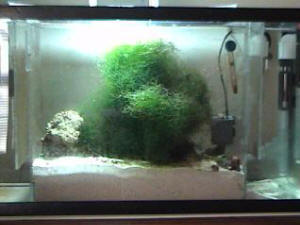
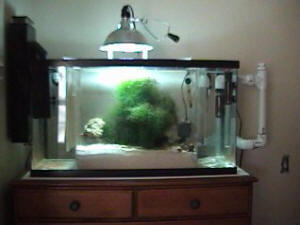
Chaetomorpha experiment
5/18/19 Caulerpa in a DT with tangs?
12/21/16 query for growing pure culture of Amphidinium
carterae 3/5/12 Refugium: Ok to use algae harvested to feed
fish. 7/13/2010 Algae Growth?/Growing Algae
5/6/10 Phytoplankton culture and culture density measurement 7/7/06 Hello, <Hi there> I would like to say thank you in advance for your time. I have a few questions with regards to culturing phytoplankton. The purpose is for a small look at invertebrate larvae nutrition requirements. My primary reference is Dr. Toonen's 1996 "Home Breeder's FAQ for Marine Invertebrates". I am not a "real scientist" I originally only wanted to set up a nano-reef, but I got sidetracked while reading. <Sounds good> In establishing my culture, I'm planning to use local natural seawater (I'm on the coast of NC) that I will pasteurize. I am also planning to use the commercial Micro-Algae Grow formula as my nutrient. The phytoplankton cultured will be fed to invertebrate larvae (species as yet undetermined) that are maturing in aerated flasks (also pasteurized NSW, but no other nutrients added). Larvae growth will be measured by optical microscopy. 1. In order to determine if the larvae are feeding, I need to know the density of algae in culture at different points in time following feeding. I can do this by making cell counts, however: A Sedgewick-Rafter counting cell seems too large (1mL volume) for the densities recommended, even a Palmer counting cell (.1mL volume) seems excessive. There are gridded Sedgewick-Rafter cells available, including one from Aquatic Eco-Systems that is reasonably priced. Can I responsibly use a gridded cell? <Yes, I have used these> Or, because I cannot ensure an even distribution of plankton across the grid is this a bad idea? <Will be able to get enough distribution that by randomly counting a number of cells, you should be able to get good approximations> 2. Even allowing for a gridded cell, a microscopic cell count will take time. I know from your site and others, that it is not possible to get an accurate density measurement solely by eying the coloration of the culture, but I got the impression that this had to do with "eyeballing" the culture. I have the opportunity to pick up a used spectrophotometer cheap... If I measure take the absorption at x nm* for different densities of algae, wouldn't I get a reasonably accurate count of algae density? <Yes... a simpler device, a colorimeter (one set wavelength of light for absorption/transmission) will/would even work here. You can/should develop your own "curve" for density (counted) versus readings with this tool> *-where x would be determined by trial and error 3. This is the worst question I guess, and if you tell me to keep searching I understand: I find it's easy to get life cycle information (when it exists) for a species when you already know it's name, etc. But I have not found a database of larval stage characteristics of ornamental invertebrates. Could you recommend a test subject? Ideally it would be: a. cheap and common, b. externally fertilizing, c. easy to induce gamete release, d. has a planktotrophic larvae phase that lasts less than 2 weeks. <There is much known re "close" invertebrate species, but this takes a bit of familiarity, practice in "searching the literature"... I strongly encourage your visiting a large college library (of a school with a Bio./Zoology dept.), and having a Reference Librarian "show you the ropes"... Computer search bibliographies are very productive here... and a lot of fun... "Time whips by"...> Part d. is the hard one to search for. <Not too difficult as you will find> Again, thank you for your time. Your site is an incredible resource. -Tony <Glad to share. Bob Fenner> Phytoplankton, reactor 7/4/06 Hi folks. I have been wondering if a AquaMedic Phytoplankton reactor would be useful in my reef tank. I have a 180 gal. reef tank with a DSB ( 275gal. total system water). Two refugiums are also running on this system. <Very nice> The first is a live rock with a DSB with blue light. The second is an upstream fuge with Chaeto and no sand with light running opposite. The tank has been running for seven months and I have gone thru the predictable algae bloom sequences. But the most fascinating event is when the macro algae vanished for no apparent reason. During the fifth and the sixth month I was battling Derbesia turf in numerous location on my live rocks. Early in the set-up I put two Emeral <Bam! Emerald> crabs in hopes to control this Algae. In addition I put a Sailfin Tang and a bunch of Hermits crabs and a variety of Algae eating snails to control it. Since the snails eat only Micro-Algae and the Emeralds might eat the turf Algae I wasn't convinced that they were guilty of eliminating all of turf Algae. My own theory is that I think the loss of algae was from the maturing of the whole system and the uptake of nutrients from the two refugiums. <Very likely the principal factor> All parameters of the tank are in normal range. Phosphate were high in the first three months and then zero. Currently my fish and coral list is Purple tang, Sailfin tang, Lemon Peel Angel, Lawnmower Blenny, Mandarin Goby, Sandsifting Goby. Coral: Ricordea, Euphyllia ancora, Frogspawn, Mushroom, Feather Duster, Crocea Clam, pulsing Xenia. My questions is does the lighted refugiums/scraping of algae off the grass provides enough Phytoplanton to feed the tank on a constant basis? <Mmm, plankton... is floating not attached... but likely the reproductive events of the glass-attached algae are contributing some algal plankton> I like the Idea of the reactor feeding some of my inverts plus provide foods for the zooplankton in my refugiums. <Me too> But Is it already happening anyway? <To some extent, yes> My other question is how do Copepods travel from the refugiums to feed my fish and Corals? <Yes... get "sucked up", pumped, or overflowed (depending on make-up of your systems components...)> Does it take some human intervention like stirring of sand or shaking of the refugiums? <Mmm, nope> Thanks for taking the time to answer every e-mails that come your way including mine. Sincerely Stephan <Thank you for writing, sharing. Bob Fenner> Growing algae 6/25/06 - I seemed to have read somewhere I could place my own rocks in the sun to grow algae so that I would have a constant source of natural food for my yellow tang. I am obviously doing something wrong, as I have had several pieces of dead rock outside in a glass, and even tried plastic, container for over two weeks and nothing. Most days are very sunny with 90° temperatures here. Any advice would be appreciated. Laura <<Laura: If I understand correctly what you are saying, you are trying to grow algae on rocks outside in the air so then you can harvest the algae off the rocks or put the rocks back in the water. Correct? Well, I don't know where you read that; but, any algae that would grow on the rock outside of the tank would probably pollute the tank or not be the type of algae that the Tang would want to eat. The better way to get algae to feed your Tang would be to buy Seaweed Sheets (called Nori) that the Japanese use to make sushi. You can find Nori in most Asian markets. In most pet shops they sell clips with suction cups that you can attach to the inside of the tank and clip the Nori to. If you can't find the clip, you can attach some Nori to a rock with a rubber band and place it inside the tank for the Tang to feed on. Best of luck, Roy>> Re: growing algae 6/25/06 - Thank you for your response. I actually have the clip and Nori strips, but I was trying to give them a variety of food. I am most appreciative of your help. Laura <<Laura: Glad to hear you already know about Nori. I used to feed it very regularly and then I noticed a lot of algae building up on the rocks in my tank. I realized that the Tangs would just sit around and wait for me to feed them Nori every day. Now, I only provide it as an occasional treat and every one of them seems fat and happy. If you don't have enough algae growing naturally to sustain them, and you want variety, here are some other options. You can buy Julian Sprung's Seaweed Selects. While fairly expensive (compared to Nori), they will give you variety you can buy off the shelf. Another option is for you to learn how to grow Gracilaria macroalgae (also known as Tang Heaven because they like it so much) in a separate tank. Tangs will also usually eat Chaetomorpha macroalgae, though I have read that some people think it is not as good as Gracilaria for their Tangs. If you do some more research, you may find other varieties of macroalgae that Tangs will eat. Best of luck, Roy>> DIY DT's I want to make my own DT's. From what I have found, all it is saltwater in a jar that sits under light and kept warm for a week or two. The water will turn green and then you have DT's. Is this true? <Not exactly.> If so how can they sell it for $16.00? There has to be more to this. <Please take a look at the following articles: http://www.reefs.org/library/talklog/r_toonen_102500.html http://reefkeeping.com/issues/2002-07/ds/index.htm> Thanks so much for your time! <You are welcome. -Steven Pro> BGA in algae cultures The aquaculture facility I work for is encountering problems with BGA in our batch culture system. The water used is filtered down to .35micrometers and it is UV'ed. BGA is predominantly in our T-Iso cultures and is becoming a problem for the larvae it is being fed too. Could you advise on how to eliminate BGA all together? Any advice would be appreciated. <The S.O.P. is to bleach/acid wash the contaminated cultures and start over with Cyanobacteria-free culture media and Isochrysis... You likely know this already... sorry to be the re-enforcer of not-so-good news. Bob Fenner> Cathy -Yummy, yummy Ogo- I have a Naso tang and it loves to much on "Ogo" (Gracilaria?). I know that people use it in sumps for nutrient export, but currently, I don't have a sump (using a skimmer and LR/LS and regular water changes). What would be the best way to keep Ogo fresh? In a bucket with SW? Should I run a filter? <It should be lit, kept at 76-82 deg, and filtered. You should be able to keep it for weeks like this in a bucket or small aquarium. Your Naso will thank you! -Kevin> Or just a powerhead? Thanks. Yun Too LITTLE Algae?? >WWM Gunk Guru: >>Surely you can't mean ME. >After months of fighting hair algae and Cyano-slime, I seem to have suddenly reversed fortunes. I have a Lawnmower (Jeweled Rockskipper) Blenny that has feasted for months since the setup of my 100 gallon reef tank on all kinds of single cell annoyances, gaining a stomach that would make a Hell's Angel proud. To give him some buffet dining partners, I added some small Sally Lightfoot crabs and a Rock Boring Urchin (true name, it's not very exciting to watch) along with 100 small blue leg and red hermit crabs, and about two dozen snails of various flavors. I've also upped my skimmer to an Aqua-C Remora Pro, and setup a nice little ozonizer that spits out 100 mg of O3 per hour and keeps the RedOx at about 310 mV or so. I've finally added a juvi Regal tang (Doryiatus disneyus) that has a bottomless stomach for algae ... and, I now have to squint like Clint Eastwood to find any algae at all. The drawback it that I've noticed my Blenny is losing some weight, and the Sally Lightfooters seem to have less and less to munch on. The Rock Boring Urchin cruises over the entire landscape much more frequently in what I assume is a heightened search for yummy green snacks. So (here's the question, thanks for waiting) >>Believe it or not, my pleasure! >...have I over-controlled my algae? >>It certainly sounds like it, especially if you're relying on the algae alone to meet the dietary needs of these denizens. Could it be time to consider setting up a 'fuge for macros? >I could stand to give away or lose everything that needs it, except for the Blenny, who was my first fish and has survived major ammonia spikes and a 10-minute fresh air dip... >><GIGGLE!> >Thanks, SLC >>Would it be out of the question to set up a 'fuge or otherwise supplement their diets? If not, consider either or both options, with the additions of Nori and romaine lettuce. Otherwise, you may very well indeed have to remove some of these animals, and I would start with the Sally Lightfoot crabs and some snails. Crabs first, for sure. I'd like you to keep the urchin, just because it's really boring. Marina Growing Gracilaria [*Note to Bob: Chris has shared with us a nice summary of his experience growing the popular macroalgae Gracilaria here. Perhaps we can place it prominently I the archives or FAQs for easy access/referral by the crew and WWM readers? Thanks, Anthony] <Will do, Bob> Growing Gracilaria 11/11/03 Hi Anthony, Thanks for your advise in response my previous email regarding the growth of Gracilaria. <always welcome my friend> I am just reporting back to you some good results on growing Gracilaria - Red Macro Algae. <much appreciated... this will be very helpful to add to the consensus for all to see/read and learn from> In the first 4 weeks I have been very successful in acclimating the seaweed as I have seen some steady growth... new fronds and full color. I feel have established a very suitable environment for this macro algae to grow effectively. Here are the specifications... 1. A separate tank - One with high nutrient levels. A tank dedicated to feeding just the Algae... but high Nutrient Levels a must. I add a silverside or formula 1 once a week.. but being careful to not overfeed the tank; over feeding may allow growth of diatoms and other competing micro algaes. <good points here: monospecific culture, as algae and plants are competitive (chemically and otherwise) with each other just like reef invertebrates. And the finesse of nutrients... not too much or too little> 2. Trace Minerals - I dose about 7-8 drops of both Chelated Iron and Magnesium daily and perform a small monthly water change to replenish calcium levels and other trace elements. <the need varies by system... but you are finding your way here. Excellent> 3. Cold water - best growth for Gracilaria in between 60 F - 70' F. <this is not necessary, although fine if it worked for you. Much Gracilaria is grown commercially in the shallows (at surface level) in the tropical seas on lines and tumbling in baskets> 4. Strong Water Movement - I have a 800 GPH pump in the sump and it's return to the hex tank at a 12 " vertical spray bar which pushes & tumbles the Gracilaria around the tank in a circular motion (like a washing machine). At no time is any of the seaweed just sitting.... it's always tumbling. <yes... excellent and often overlooked by aquarists> 5. Strong Lighting - I have a 125 Watt Fluorescent Blue Actinic bulb hanging directly above the water column. Gracilaria grows in deeper waters and does better with Actinic Lighting. <again variable here... the commercial culture of Gracilaria ("Ogo" of food fame) is done so at the surface of the water. But the genus is adaptable and wide-ranging. I would suggest more/brighter daylight here to most aquarists> Please let me know of any individuals who are interested in purchasing 7-8 ounce portions of Gracilaria at a low price. They can contact me directly at XXXX@hotmail.com. <do be sure to establish it well in your local market through the LFS and aquarium societies so that you can retrieve some if/when your colony crashes> Thanks! Chris <thank you very much for sharing this Chris. Its always good to pay it forward. Anthony>
Kole Yellow Eye, feeding stones I read your article on wetwebmedia.com and I was particularly interested in the section on feeding. I have a yellow eye that caught ich but I was able to treat him in a quarantine tank for a few weeks. He has been back in my main 75 gallon reef tank for three weeks but seems to be on the skinny side and very pale. I was interested in the sentence that you stated "My favorite "gimmick" with these fishes is to utilize an algal covered "feeding stone" as a site for engendering food-taking behavior". What exactly is a feeding stone and where might I get one? If you have any other advice on getting him enough food would be greatly appreciated. Thanks! Cauley <"Feeding stones" are actually made by the aquarist... either in an aquarium (sans algae eaters) or in other containers (like large jars near a window), but you won't want to wait to make these. Do look into buying some palatable macro-algae... either from an online vendor like Inland Aquatics or Indo-Pacific Sea Farms, or perhaps a local retailer or hobby-club member. Bob Fenner> Phytoplankton reactors 9/18/04 I was able to meet Bob Fenner recently in Raleigh and really enjoyed this. <he is larger than life... blessed to know him> I also now have Anthony's propagation book and it is outstanding. I was hoping to get feedback about a phytoplankton reactor. <all good... but do realize that in aquaria, the overwhelming demand is for zooplankton. Very little phyto is needed to support this. It is commonly abused as a supplemental staple IMO> My interest is in diversity and nutrition, especially nonphotosynthetic animals. I'm trying to replicate cryptic environments. The Dendro thing fascinates me (as it does everybody). <do consider other/better aposymbiotic cnidarians like Scleronepth.s and Chile corals> My background is clinical neurology. The experimental system I have consists of a 120 connected to an Ecowheel with a wave 2K, a 120 with Turbelle stream 6200 on controller set up for laminar flow around a central divider, two twenty five gallons for experiments with refugia, and a 75 sunlit and compact fluorescent tank DSB currently culturing Chaetomorpha. I am underwhelmed by the Ecowheel. The system has a 75 gallon sump with a large Reef Concepts skimmer; automatic top off and water changes via LiterMeter, SG 1.026. I have tried feeding Corals and Clams cryopaste and am still working with it. I have plans to construct a small greenhouse to continue this type of research. <fantastic to hear... do let me/us know if we can be of help with shared opinions> I do think that stirring the sand bed is the best thing going for nutrition. <very helpful... agreed> The detritus is recycled not added, and interestingly I have noticed that the sand bed diversity is clearly greater in areas that are gently blown off twice daily compared to nonstirred areas. I really think a little storm activity is good for the sand bed. I drain off the turbidity slowly over the overflow into the sump, and then to the tanks. <the reef is quite dynamic even in the calmest parts... much more than our tanks> My question is about a phytoreactor that I have going in one of the 25s. I have grown green water for years- sometimes unintentionally!- and this is my first attempt at a phyto reactor. I used DT's to start; I currently add no nutrients. I am not stirring- this setup reminds me of the saltwater tubs Joyce Wilkerson described that she keeps outside for rotifer cultures, and that emboldened me to try not stirring, no airstone. The pH gets high and slows down the growth. I think the pH is more steady when the lights are turned off at night allowing some digestion and co2 release. Perhaps the lack of stirring will help phyto diversity. I am concerned about toxins generated from this reactor. <weak issue... no worries> I'm not sure of the benefit compared to Reed Mariculture cryopaste. <live is better than any processed product IMO on one glaring point - particle size. Most always smaller with live (no clotting or coagulating in time)> The green water probably contains lots of things- ciliates, bacteria- and it does seem (Bob Stark) that there is already plenty of bacteria in our tanks. The reactor does seem to pull out nutrients well- discarding the stuff seems to be an effective microalgae scrubber. I think we know a lot about many of the filter feeders- and the ones of most interest to me, the "Dendros", seem to only take SOME of their nutrition from phyto. <true... some take none at all... bacteria, floc, other nanoplankton> So, the questions- 1) Do you know anyone who has long term success with a phyto reactor like mine? Any suggested improvements based on this experience (stirring/air, UV, getting rid of it and using cryopaste)? <phyto culture is a science... many people have refined techniques to learn from. Have you chatted with the folks at Florida Aqua farms? Pioneers and suppliers> 2) Any news about successful experience with Dendros from somebody knowledgeable? <none I am aware of recently... rather that not all aposymbiotic Nephtheids in the trade are Dendros... which is a good thing. Seek Scleros instead when you can find them> 3) I am going to visit GARF, inland seafarm, and Tropicorium in February for my 50th birthday. Do you know of any really professional greenhouse outfits I might also need to visit? <I like Tropicorium and Inland Aquatics very much. medium sized scale but quality personnel. Most of the outfits farming reef inverts in the US are cottage industry sized. But you may want to see about a visit to ORA in Florida some time... after they recover from hurricane damage> Thanks so much for your advice Charles Matthews MD <best of luck, Anthony> Tang food/algae? 2/11/05 I have recently purchased a Sailfin tang as soon as he was in his new home he proceed to eat a green plant that had came on the live rock which I think is Caulerpa. Could I grow this in a small tank 12 by 10 by 10, using the old water from weekly water changes and lighting with a full range Fluorescent light, <it could... but there are much easier and less noxious algae to grow. Gracilaria would be ideal tang food... sold as "tang heaven" from IPSF.com> would I need a heater or a filter maybe a little live rock? <yes... bright light too. At least 5 watts per gallon> I would like to do this as the Sailfin seemed to like it but there's not that much of it and I thought it would be a nice supplement to its diet, <a nice idea, but not necessary. Do look for "Nori" seaweed at an Asian grocery store or sushi supplier> assuming it's ok for it to eat it. If it's not is there any thing else I could grow with a similar method that would be ok? <it is somewhat to very toxic over time (Caulerpa) in large portions. Do avoid IMO> Thanks, Andy <best regards, Anthony> Pyrocystis fusiformis - 12/11/05 Greetings from snowy Pittsburgh! <<Hello from a bit more temperate SC!>> I just wanted to thank you all for your efforts. <<Very welcome>> I'm new to the aquarist lifestyle and I'm happy to report that my 90gal FOWLR has been quite successful in the past 4 mos. largely due to the wealth of information you guys <<and gals>> provide (the site frequently keeps me up till the wee hours of the am). <<Hee!>> I have one quick question (for now): I came upon an interesting suggestion in the Phyto FAQs, where a man suggested growing Pyrocystis fusiformis in a FOWLR tank. I was wondering if there has been any update on his activities or if you have encountered any new information regarding its toxicity to fish, LR or even SPS/LPS corals (before I try my own culture/controlled experiment). <<If you didn't find any on the site, then likely no new info/updates.>> The web info I usually find references the plankton as a "neato" school experiment. <<Let me suggest you try contacting some of the commercial fish/seahorse breeders ('Ocean Rider' comes to mind). These folks culture their own phytoplankton from necessity, and if willing to share info, may be able to help.>> Many thanks, I'll be writing again soon. Regards Brandon <<Regards, EricR>> Gracilaria parvispora culture - 02/16/2006 Hi, <Hello> I would like to start growing Ogo as a food source for a few yellow tangs. My problem is it is expensive and a screw up would be costly. So I would like to run my plan by you before I start. I will put the Ogo in a 10 gallon tank, lighting will be 96 watts from power compact bulbs, and water motion will be provided by power heads pumping a total of 560 gallons per hour (more if needed). <Not needed... circulation can be much less vigorous> Nutrients will be provided from water from the main tank, and possibly from frozen food juice added once a week. I write this because after reading from your archives I am kind of discouraged from others not so successful attempts. Any tips or suggestions would be appreciated. Thank you, Aron <? Not difficult to culture... I would boost (through new water additions) the alkalinity and biomineral content... 12 dKH, 450 or so Calcium, about three times whatever calcium is in Magnesium concentration... and keep out other algal species... Bob Fenner> Ogo and quarantine 03/07/06 Hi, <Aloha> I ordered some Ogo from Indigo <Hee! Will send to Gerald, Heslinga... Indo-> Pacific Sea Farms about a week ago. It is currently in a 15 gallon qt tank. It is under 96 watts of PC light, and it is being tumbled around by a powerhead which might be too powerful. Salinity is 1.025, temp is 80 degrees, PH 8.3, no ammonia nitrite or nitrate, calcium 400, and the water is RO/DI. My problem is I don't know if it is doing all that well. The plants <Algae> are still red, but the tips might be turning slightly white. <Not atypical> Is this from two much light? <Likely "just" shipping, stress> I would hate to lose the Ogo before I had a chance to use it, so is it safe to add some to the tank for food for my tangs, <Yes> or should I wait the two week quarantine period. <Are you concerned re Aiptasia, or? I would search through it, feed a bit off, move some to other quarters for culture (if you have them)...> I contacted IPSF and they said quarantine was not necessary, but I am still a little leery about putting it in the tank. So do you think this okay, or should I wait? Thank you, Aron <I wouldn't likely wait. Bob Fenner, who will eating Gracilaria in po'kes on the Big Island in another day or so>
|
|

|
Features: |
|
| Featured Sponsors: |