 |
|
| Home | Marine Aquariums |
Freshwater Aquariums |
Planted Aquariums |
Brackish Systems |
Ponds,
lakes & fountains |
Turtles & Amphibians |
Aquatic Business |
Aquatic Science |
Ask the WWM Crew a Question |
| Please visit our Sponsors | ||||
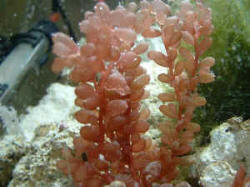
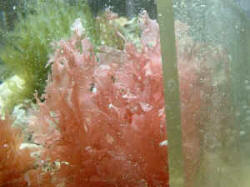
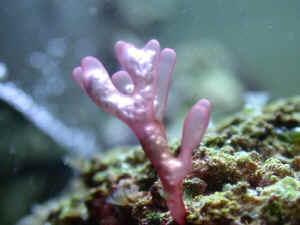
Botryocladia (red bubble algae) 1/11/04 New to the reef thing!!! So the questions might be silly sorry. <no worries... keep asking questions and learning> I have a 120 gal reef tank and about 130lbs of live rock. After buying the live rock I had run out of money so basically have watched the rock grow with only a couple corals in the tank and hermits and snails. <excellent. Not enough aquarists have such time/patience to let the rock establish without fishes. The quality of live rock is much(!) better for this> Anyway I have a lot of what I think is Botryocladia skottsbergii over a lot of the live rock. I don't really have any other "bad" algae problems no slime in my tank very few of the big green bubble. 1. Should I be concerned about it? <not at all... it is very desirable to most aquarists. Rather hard to procure and somewhat "ethereal" in existence. Enjoy it while you can> 2. Is there anything that feeds on it? <actually... and overwhelming variety of herbivores will eat it. It will disappear once you begin stocking the tank unless you take the time to set up a refugium on the tank (very good idea) and remove some that safe vessel for safe keeping. Anthony> Growing Gracilaria [*Note to Bob: Chris has shared with us a nice summary of his experience growing the popular macroalgae Gracilaria here. Perhaps we can place it prominently I the archives or FAQs for easy access/referral by the crew and WWM readers? Thanks, Anthony] <Will do, Bob> Growing Gracilaria 11/11/03 Hi Anthony, Thanks for your advise in response my previous email regarding the growth of Gracilaria. <always welcome my friend> I am just reporting back to you some good results on growing Gracilaria - Red Macro Algae. <much appreciated... this will be very helpful to add to the consensus for all to see/read and learn from> In the first 4 weeks I have been very successful in acclimating the seaweed as I have seen some steady growth... new fronds and full color. I feel have established a very suitable environment for this macro algae to grow effectively. Here are the specifications... 1. A separate tank - One with high nutrient levels. A tank dedicated to feeding just the Algae... but high Nutrient Levels a must. I add a silverside or formula 1 once a week.. but being careful to not overfeed the tank; over feeding may allow growth of diatoms and other competing micro algaes. <good points here: monospecific culture, as algae and plants are competitive (chemically and otherwise) with each other just like reef invertebrates. And the finesse of nutrients... not too much or too little> 2. Trace Minerals - I dose about 7-8 drops of both Chelated Iron and Magnesium daily and perform a small monthly water change to replenish calcium levels and other trace elements. <the need varies by system... but you are finding your way here. Excellent> 3. Cold water - best growth for Gracilaria in between 60 F - 70' F. <this is not necessary, although fine if it worked for you. Much Gracilaria is grown commercially in the shallows (at surface level) in the tropical seas on lines and tumbling in baskets> 4. Strong Water Movement - I have a 800 GPH pump in the sump and it's return to the hex tank at a 12 " vertical spray bar which pushes & tumbles the Gracilaria around the tank in a circular motion (like a washing machine). At no time is any of the seaweed just sitting.... it's always tumbling. <yes... excellent and often overlooked by aquarists> 5. Strong Lighting - I have a 125 Watt Fluorescent Blue Actinic bulb hanging directly above the water column. Gracilaria grows in deeper waters and does better with Actinic Lighting. <again variable here... the commercial culture of Gracilaria ("Ogo" of food fame) is done so at the surface of the water. But the genus is adaptable and wide-ranging. I would suggest more/brighter daylight here to most aquarists> Please let me know of any individuals who are interested in purchasing 7-8 ounce portions of Gracilaria at a low price. They can contact me directly at XXXX@hotmail.com. <do be sure to establish it well in your local market through the LFS and aquarium societies so that you can retrieve some if/when your colony crashes> Thanks! Chris <thank you very much for sharing this Chris. Its always good to pay it forward. Anthony> Growing Gracilaria 12/3/03 Anthony, Thanks again. Just another follow up... I have done a bid more research and testing and found that this particular species, (Gracilaria verrucosa) like most Red Gracilaria, reproduces seasonally, in the spring and fall by dropping off thousands of fine spores which attach themselves to the substrate and then germination and growth of spores are also influenced by environmental conditions such as seawater temperature, light intensity, salinity, etc. Experiments have shown that the highest number of spores are released at 20-25 ?C (approx. 70 F shows highest spore Desiccation). Any temperatures much higher or lower would not allow Gracilaria to develop the reproductive spores for Desiccation. Also, When mature plants are kept in seawater of different specific gravities, those in seawater of lower specific gravity would release spores earlier than those kept in water of higher specific gravity. I have seen spores develop immediately when I dropped the salinity between 1.015 to 1.017. This would explain why people have been unsuccessful with keeping Gracilaria alive for any length of time in systems with the higher Specific gravities. Just some more feedback. Here's a very interesting article on the culturing of Gracilaria... http://www.fao.org/docrep/field/003/AC263E/AC263E00.htm Thanks, Chris <much thanks for sharing this Chris. Please do consider though that what happened naturally is not always the optimal way of culturing an organism, but rather simply what they have adapted to in their given niche. Commercial culture of this genus in warmer waters with brighter light and in tumbling suspension are established methods of exploiting better growth. Much like aquarium grown clams and corals that grow 4-10 X or faster than expected wild growth as we learn to finesse/manipulate species for optimal culture. Best regards, Anthony> Fauchea Red Algae 11/3/03 Sorry, I do have one other question. Have you heard of and know anything about Fauchea Red Algae? Thanks, Paul <it is an interesting algae that can be a plague in tanks without proper nutrient control. Have you referenced this species on the website I sent you in the last e-mail? www.algaebase.org see their links for this genus here - http://www.algaebase.org/action.lasso Anthony> Macroalgae II 11/3/03 Thanks for the info. I will research algae on your web site better. I just have one more question about it. From what you said below, I take it that I should pick one type of algae that I want to use, and use only that one, correct? <correct> For example, if I think Chaetomorpha is the one to go with, buy and use nothing but it. <exactly... else one species will dominate the others and worsen water quality in the process (during the fight). Anthony> Help identifying saltwater plant: Red Seagrapes - Botryocladia 11/2/03 Hi, I love your site...many thanks. I've searched around trying to identify this plant, but haven't found any good leads. All I know is that the Chinese name translates to 'Red grape tree'. Hope the picture helps, Thanks Again Craig <very fine picture... clearly a Rhodophyte of the genus Botryocladia. We discuss this and most marine algae extensively in our new book "Reef Invertebrates". Please also consider bookmarking algaebase.org as an excellent reference. Best regards, Anthony> Growing Red Gracilaria 10/29/03 Crew, <howdy> I am following up on a question regarding the growth of Red Gracilaria. Could someone tell me what is the optimal environment for which Red Gracilaria will grow? <very bright light and strong water flow> I have a separate 27 gallon tall Hex tank set up with a large pump inside for strong circulation. <good> I have tried to grow Gracilaria in this tank before but it did not seem to last that long (3 months) and the Tangs ate it faster than it would grow. <correct... it is very palatable... sold commercially as "Tang Heaven" by IPSF.com> What are the requirements for optimum growth? <a separate vessel like a refugium acting as a vegetable filter> Has anyone had any success with growing it? <it is very easy and commonly grown. Just not in the display proper with tangs stocked too soon/early ;)> Lighting? Are Florescent plant bulbs adequate? <sort of.. not so much here though. Fluorescents are poor for deep tanks (beyond 12"). In traditional squat aquaria, 5 watts per gallon is reasonable at minimum> Water Movement? <strong enough to keep it tumbling> Movement of Gracilaria? Salinity? Temperature? <all at NSW levels> Nutrient Levels? What do I feed Gracilaria and how often? <inline to the nutrient rich display is usually good enough for food. Again, keep in a refugium> Any dosing ... Iodine, Calcium? <iodine may be quite useful here... go light though> Keep it by itself or with Live Rock and Fish? <the former> Thanks, Chris <best regards, Anthony> Algae ID 10/20/03 I have searched all over to find something that looks like this but to no avail. Have you any ideas? I think it is some form of algae. It has grey "arms" with dark brown stubby bits which would be polyps on a coral - growing well near the surface of the tank under the T5s. Came with some coralline LR and has grown several arms in the last week of about 1-2" long in a sideways spreading habit. What is it? What do I do with it? <its a Red algae (Rhodophyte) of the genus Laurencia or perhaps Halymenia. Tough to tell from the unclear image and small nubbins of a specimen. Generally harmless although any macroalgae can be a nuisance if the nutrients are high enough in the system. Doa search at www.algaebase.org and see if any pics look familiar to you. Anthony> "Ogo-Mania!" Hello. I have a 4" yellow tang (Tango) and would like to start feeding it some fresh macro algae like you suggest. Any idea where I can buy Gracilaria (on the internet) so I can start propagating it at home? All of the LFS's in my area only seem to carry grape Caulerpa, and even that is only on a limited basis. Thanks! Sherri Wilson, Buffalo, New York. <Ahh- you can get my favorite stuff (Gracilaria parvispora aka "Ogo") from my favorite e-tailer, Indo Pacific Sea Farms in Kailua-Kona (www.ipsf.com)! They call it "Tang Heaven", but whatever you call it- your tang will call it "delicious!" This stuff rocks! Enjoy! Regards, Scott F.> -Yummy, yummy Ogo- I have a Naso tang and it loves to much on "Ogo" (Gracilaria?). I know that people use it in sumps for nutrient export, but currently, I don't have a sump (using a skimmer and LR/LS and regular water changes). What would be the best way to keep Ogo fresh? In a bucket with SW? Should I run a filter? <It should be lit, kept at 76-82 deg, and filtered. You should be able to keep it for weeks like this in a bucket or small aquarium. Your Naso will thank you! -Kevin> Or just a powerhead? Thanks. Yun
Re: red algae Dear Mr. Fenner, Thank you for responding to my question about red algae. I will give your suggestion a try. It never even dawned on me to try something like some floating plants to cut down on food and light source. <Yes... often there is a form of chemical competition as well (allelopathy)> I will let you know how it goes. <Please do> I guess sometimes you just need someone to look at the problem and help with a solution. As far as my aquatic background, well life just wouldn't be complete if I didn't have at least a half dozen tanks going at once. I have about 20-25 more tanks that I will be setting up here in the near future, so I can get my hatchery going again. I am going to start with angels again and try to work on the color strains I was working on before. And I'm raising up some clown loaches to give them a shot also...any input there would be greatly appreciated. <Most are still wild-collected in Indonesia, but have been spawned... with and w/o hormonal manipulation... by trying "environmental cues" (i.e. lowering water level, temperature), mimicking conditions in the wild> I will also be setting up at least one saltwater tank when I get my customers tank back together. I will also start collecting lots of hard to find and keep species, which I did before. I like a challenge when it comes to my finny friends. I'm hoping that this will turn into a retail shop and consulting and maint. business in the future. Again thanks for your help, I'll let you know how it goes. Patty Ashley <A lifetime of adventure unfolds. Bob Fenner> Growing Red Gracilaria... Hello folks, It's Howard in WI again starting up Refugium number 2 for the second time. The intended purpose of this refugium is to grow more pods and a great deal of macro algae which, hopefully, also replace the Caulerpa in Refugium number 1(30 gallons of racemosa with 6 inch sand bed, pods, worms, and some peppermint shrimp.) <Cool> Number 2 is a fresh start after a huge plague of red micro algae which came in with some live sand and wiped out all of the Gracilaria, Chaetomorpha, and shaving brush and then began to show up in the show tank. <Ew, fabulous.> I dumped everything and started again with a clean tank. I want to give the new Red Gracilaria every chance to grow and reproduce before adding anything else. It has a six inch sand bed and plants are placed on various levels from the surface to the bottom of the tank. About 300 GPH flows from the show tank overflow through a baffle box (removes any big chunks, the only mechanical filter) through the refugium overflows to the sump. No measurable nitrates, nitrites, or ammonia; ORP 350-370; Ca 400-500. I use no additives except bicarb and Kalk. Lighting is 250 watts of 10,000k CF 2 inches above the water surface. Water changes are 10% weekly. Fish, polyps, SPS and soft corals all beautiful. <Excellent> My problem is that the new Red Gracilaria is already turning green to white on the tips. This is happening at various depths. What does it take to grow this plant? It looked great when it arrived from the vendor. There is nothing else in this tank to compete with it or eat it. Should I give up again and try something else? Is it too much light? Water too clean? <Yep, that's the problem I've always had with Gracilaria is that it will not grow in a tank with a low nutrient load or one that is heavily skimmed. This stuff grows in high nutrient areas, I've heard little success of people getting this stuff to grow. Your best bet is Chaetomorpha, it's such a great alternative to Caulerpa. -Kevin> Howard - Gracilaria - <Good morning, JasonC here...> To the
Best Crew There is: So, I mail-ordered some Red Gracilaria, mainly for
nutrient uptake. I get the thing, and it's a huge
"portion". I only have a 10 gallon QT, and it takes up like
half the tank. My problem is how do I keep it in place?
Would a mesh bag or women's hose restrict it too much? <I'd
think the bag would work better than the panty-hose.> I will have a
sump on my 55 gallon display by the time it is ready to come out of QT,
but either way I am going to want to keep it in place. <I'd go
ahead and place this stuff in the sump. If the algae is from a
reputable source, then you probably don't need to be so rigid about
quarantine with is.> While I am here, any other fish besides tangs
(i.e.: small/peaceful/community/reef-safe) eat this stuff? <The
algae-eating gobies and blennies might eat it, but I'm not certain.
Same goes for pygmy angels. Best to do some reading on those fish in
the various sections on WetWebMedia.> Thanks, Rich.
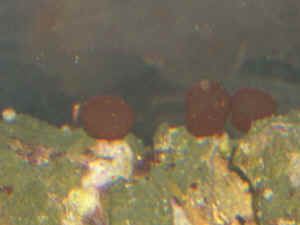
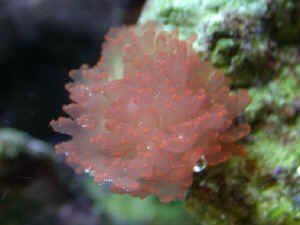
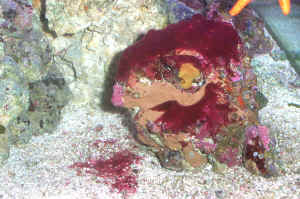
Seeking info on Lithothamnion lenormande for school project Hello Mr. Fenner, I am writing in the hope that you can help me. For a school project (I am doing a Certificate in Conservation Biology) I have been assigned to find information on various species. One of those on my list is Lithothamnion lenormande. I have searched in various books and all over the Internet, but have been unable to find detailed information on it. If you know anything about its habitat, size, geographic distribution and life history characteristics, I would be extremely grateful for any information you could give! Thank you so much. Kristin in New York <We have members of this encrusting red algae off our (California) coast, but am not familiar with this one. What little info. I'm aware of is posted on our (searchable) site, www.WetWebMedia.com. You really should make a trip to a large (college) library and do a computer literature search re. Please see here: http://www.wetwebmedia.com/litsrchart.htm Bob Fenner> Hawaiian Ogo... Lolo for Ogo! Aloha WWM Crew, <Eh Howzit Jeff, Scott F. with you (one haole with one Big Island girl)> Your web site is DA KINE (the best). I can't thank you guys enough for the great service you provide. I live on the island of Oahu and have a 55 FO tank. I have a question about Hawaiian Ogo (seaweed). I noticed that the local markets have fresh Ogo bagged for consumption. I was wondering if you could place that Ogo in your sump or main display. <If you got the Ogo already refrigerated, chances are it will not grow in your sump or aquarium. If it's fresh, meaning you "jus' wen pick em from da ocean water," then, the Ogo will probably survive and grow. I have had success growing fresh Ogo in a 10 gallon aquarium with an airstone. Please note that Ogo (Gracilaria parvispora) needs a lot of light and should be kept in suspension in order to grow at its best> Moreover, would it be okay to place shoreline rocks from the North Shore into my tank without worrying about pollution and other negative consequences. Thanks for all your help. <Jeff, are you referring to coral rubble or lava rock? If it's coral rubble, it may be okay after curing. If it's lava rock, it may not work in a closed system, because of the possibility that it could release lots of compounds that will induce microalgae growth. Also, you might want to check with local authorities to see if it's legal to collect rock.> Jeff <Malama Pono and A hui hou! Scott F.> Small Blue Patches (Algae of some sort?) Might be a Rhodophyte, BGA... I have an odd question. I have recently been struggling to control hair algae outbreak. I have noticed on the tufts of algae very small blue dots or patches. Do you have any idea what this is? <can you proffer a picture of better description, my friend? Patches of what? A different color to the algae or something seemingly unrelated. If so... shape, texture... anything else to help us here? Anthony> Red algae/plant Thanks for the feedback! My hermits, snails and cleaner shrimp haven't touched them from what I can tell (but maybe I just haven't seen it). <they are the wrong kind of herbivore for this job... they feed on microalgae/diatoms. You need a fish grazer likely> Any idea what might find this thing tasty? <a Foxface/Rabbitfish or some tang species> When should I be worried about it taking over the tank and possibly causing problems for other inhabitants? <really just an aesthetic matter... trim back as you desire/wish> Thanks again, Andy <best regards, Anthony> Cool Marine Plant... Where're those pix!? Hi, <cheers, mate> I have done search after search in every location I can to identify something that is taking over my substrate. I hate to bother you with questions but I have looked everywhere and I am starting to worry at this point. <no bother... and no worries> The first thing that I saw was this purple anemone looking creature that is attached to a live rock. <actually a fluid/bulbous red algae species> It doesn't seem to have a stalk, but just little stubby arms waving around. It has the diameter of a nickel and is no more than a centimeter high (and growing). Here is a picture. I wasn't worried but then around the same time that he popped up 30-50 of these other little guys popped up. <cool...> They started small, about the size of a pen head, but some have grown to the size of a pencil eraser or slightly larger. While the first one was on top of a rock (I guessed that possibly the first one on the rock is the same species and spawned the smaller ones), these little guys are only on the substrate. They are round balls with little dark spots that might possibly be stubby arms. Here is a picture of these guys. I think I can collect them if I have to but if they are good to have or won't do any harm, then I don't mind them. <no harm at all... likely you have or can easily find an herbivore to graze them down if you like... else enjoy!> This is a FOWLR tank. I GREATLY appreciate your help and your faq's are a bible to me. Hope all is well, Andy <our pleasure... with kind regards, Anthony> Red Algae <<Greetings, JasonC here...>> Can you give me some direction regarding where I am going wrong in trying to control the red algae (probably Centroceras & Wrangelia) in my aquarium? <<My guess would be BGA - Cyanobacteria, not really an algae but certainly behaves like one.>> I have a 50 gallon tank, Fluval 404, BakPak Skimmer and powerhead for circulation. I feed my 3 fish and 2 shrimp carefully. Readings are H 8.2, Temp 78-80, Ammonia 0, Nitrite 0, Nitrate 10 mg/L. I do a 5% water change every other week. I run 3x30 watt full spectrum and 1x30 watt actinic for 12 hours a day. I've just added a couple of small pieces of Marshall Island living rock and a small bunch of Caulerpa. However, the red algae covers everything within a week to 10 days. How can I reverse this? <<I would add one or two powerheads to the tank, perhaps more to increase the water flow inside the tank. This is the best way as it makes it very difficult for the algae to take hold. You will also have to continue the manual removal until you gain the upper hand. Cheers, J -->> Coral I.D. (actually a red algae) Hi The Crew, <Howdy> Hope you guys enjoyed the hot summer. I have this thing growing out on one of my live rocks about two months ago, now it grew to about 4" around. It feel soft at touch, and the appearance like Japanese maple tree. Would like you guys to identify it for me. As always appreciate your expertise. <It's a species of Red Algae. Please see here: http://www.wetwebmedia.com/redalgae.htm> PS: Just thought you might interest to see this picture: One of my tomato clown in a purple tipped Condylactis anemone. SWEEEEET. <Very nice as well. Bob Fenner> Wayne Algae/Coral I.D. Hi The Crew, <Hi the fellow fish nerd> Hope you guys enjoyed the hot summer. <I'm thinking about shaving my entire body... heat index is over 100 here in Pittsburgh with serious humidity. Sneeze and it triggers a thundershower> I have this thing growing out on one of my live rocks about two months ago, now it grew to about 4" around. It feel soft at touch, and the appearance like Japanese maple tree. Would like you guys to identify it for me. As always appreciate your expertise. <it is clearly a red algae species... very attractive to me. Enjoy it!> PS: Just thought you might interest to see this picture: One of my tomato clown in a purple tipped Condylactis anemone. SWEEEEET. Wayne <with kind regards, Anthony> Re: High ammonia levels. Dear Bob, Was talking to my stockist about using "Nori", and they asked me if I was sure that it didn't contain oil. Bought it from a super-market in a sealed pack, made by a company called Sanchi, and it simply reads: ingredients: Nori (Porphyra tenera). Green light? <Yes... nothing else added here> You suggested I used this stuff whilst I was waiting for my ammonia level to go down, now at about 0.6 (much better!). And is this the same type of low pollutant stuff as purple seaweed (Porphyra umbilicalis), which I was already using? <Bingo> Also, the patches of brown/red algae have really started coming up on pretty much everything, which the blenny loves (bicolor, & my other fish is a little lipstick tang), and while I recognize this as a sign of "life establishment", <Yes, well put> & bearing in mind that you advised me not to clean anything till the ammonia was 0, can you give me any tips about controlling it?<Yes sir. Please read here: http://www.wetwebmedia.com/algaeasfriend.htm> Should it turn green? My system is now nearly 11 wks old. Your advice as always will be much appreciated. Hamish, UK. <You're on a/the right track. Bob Fenner> Red algae... Did I write this? Heeeeeeeee! Hi, I noticed that the coral reef of the red sea has red algae everywhere. Is it possible to attain this type of algae in an aquarium? If so, then how? And is it a good source of food for my hepatus tang? <Please read through our principal site: www.WetWebMedia.com Bob Fenner><<Can, is posted on WWM and yes. RMF>> What in the heck is this? (red algae) Greetings! <and Salutations... Anthony Calfo in your service> I was wondering if you could help identify this thing growing on my rock. It came in on the rock and I figured it would just die as it was shipped from Fiji and did not look that great. For size it is about the size of a baseball. There is also a branch or two on other spots on the same rock. I have enclosed some photos. Thanks! If the photos don't help, it is maroon colored and fuzzy. Thanks! <Adam... in general terms, you have a calcified red algae species. Guessing to the generic level, it is like Galaxaura although I only know of it from the Atlantic. Are you certain it came in with Fiji rock because the rock in your pictures resembles Atlantic/aquacultured rock (which would make ID down to genera more akin to the aforementioned Galaxaura)? Nonetheless... a very nice branching and partially calcified alga. Cool. Anthony Calfo>
The Real Deal With Bob... and red algae Hello Steve or Anthony, or however else might be answering Bob's email, So what's the deal with Bob, is he really in a show, or symphony? It just seems like you guys are kidding around. If he really is, I'd like to go attend a show. That would be neat to see him with yet another hat on: Bob the marine aquarist, Bob the runner, Bob the diver, Bob the traveler, Bob the landlord. <Actually the truth must be told sometime... Bob is using us as a test to work the site while he searches for greener pastures. Seriously, greener pastures... he wants to be an Alpaca shepherd in South America and he is taking classes on birthing large hoofed livestock in preparation. Anthony><<Heeeeee! Love a llama! RMF>> Any who, I have a small problem, I bought some red algae (don't know what kind - it looks like a fern, but red). <a lot of Red kelp on rock is shipped out of Indo and sold in LFS reef tanks> Slowly over the months it has lost it's color. New shoots are red but eventually turn light pink or white. <typical... some species need extremely bright light> Specifics: 55g reef tank, 1 Kole tang, 2 cleaner shrimp, 75lbs. live rock, Berlin system, pH=8.2, no ammonia, no nitrates, Ca=400ppm, alk=8.5 ( and it does fluctuate some), and 384W power compact lighting on a 12 hour cycle. The algae is located high up in the tank. (???) <probably good, but I'd need a picture or a name to fine tune the advice for you> Also, my coralline algae is bleaching. <what are you day, night pH readings, calcium and alkalinity? Also, are the corallines bleaching throughout the tank or restricted to an area? Also, have you upgraded your lighting recently (sudden bright lights bleach corallines easily. will recover in time> I do add a 2part alk and calcium supplement every other day. Any ideas on what is wrong? (Hope that was enough information.) Thanks for any advice, Jana <best regards, Anthony> Something growing in my reef (spiky, reddish, not moving... mmm) ID Hello Mr.. Fenner my name is Tori and I work with a fella named matt who told me to email you about something I have growing in my reef. <Okay> I don't have a scanner or I would send a picture, first let me tell you what I have running.. then I will describe the organism. I have a twenty nine gal. SeaClear tank, aprox.35-40 lbs of live rock with various things on it.. green stars, mushroom anemones, leather coral, yellow polyps, green buttons, x-mas tree rock.. torch coral, mandarin dragonet, yellow eye tang, maroon clown and two Tridacna clams. <Wow, quite a bit of life in such a small volume of water> what has me baffled is this thing that looks just like fire, that started growing really good when I put some light on the tank, it grew when I only had 40 watts on it <a marine glow, and a power glow> then I put two 55 watt power compacts on it as well.. now it is really growing. as I said it looks like fire, with the outside surface being bright red and very smooth.. branches growing from the base are sharp on the end, and spiky like a drawing of fire would be and the inside surface is bright orange. it seems to be rather ridged, moving in the strong current but not much. its still sort small only about an inch or so tall but branches are still growing. there are no visible polyps or tubes. it is really magnificent I must tell you... one of the most beautiful marine things I have ever seen! I can not find a picture of this thing, or anyway to find out what it is. I think I may have another growing across from the first one, but it still looks like a bud now on the rock. I am in the business of selling fish so I have some good equipment on this reef: Rena Filstar xp1, 90gal. Berlin protein skimmer, two Rio powerheads and one power sweep at the top <to keep the stars happy!> live sand, and coral. this tank has been running for at least two years.. I hope you can help me.. matt said you were the fish guru! thank you, Tori Craig <Thank you for writing. Don't know exactly of course, but what you describe sounds like some sort of red algae (Rhodophyte). Please read here: http://www.wetwebmedia.com/redalgae.htm and the coralline algae article thereafter. Please have a friend with a digital camera take a few shots to send along. Bob Fenner> Fauchea sp algae Sel., and Garibaldi Info Hi Mr. Fenner, <Howdy> I basically have two questions. The first is do u know of any suppliers who ever have the Fauchea sp red algae? <In stock? No... but with a few key-stroke inquiries of the folks who handle live macro-algae you can find out if any of them carry this genus> I was lucky enough to have this come in on a piece of live rock in a previous tank, it is so kelp-like, it is soft and slimy and flows in the currents, one of a kind, and it grows and grows, had to trim it each week, I never thought I'd fall in love with algae like I did that stuff. I want some more but can't ever find it. LFS usually have green Ulva, Caulerpa and red grape algae, don't see anything else. Also, I have two juvenile garibaldi damsels in there own tank, they sure fetch a hefty price for a damsel, $50 each, do u know why, (if any other reason than the fact they are the protected CA state fish). <This, the costs of collecting them out of the other half of their range (Hypsypops also come out of Baja California, thankfully. The folks there are not as backward as the Alta Cal.)> I want to keep them and let them grow out to their big Oscar like size. Ever heard of spawning Garibaldi's in the aquarium other than in public aquariums? <Mmm, no... and did work up a bibliography on the species years back (have same in print, not computer, if you'd like me to send along a copy). Our site: http://wetwebmedia.com/garibald.htm> (I'm hoping I have a female and male, but I read there is no outward way to tell.) I'm assuming they were caught in a more southern tropical area down the California coast, but I'm keeping their temp at 75F. Anyway, lots of Fauchea reds would make their tank more like a kelp forest. Any recommendations for any other kelp like macro algae? <Most any that will live in the temperature, other conditions you're making will do> How about a piece of the real giant kelp off of CA? :) (I'm assuming it wouldn't do well in the aquarium, hehe) <Very hard to grow in aquariums... need colder water, nutrients...> but, two feet of growth a day sounds like a really efficient protein skimmer to me! hee hee. I have a feeling I'm gonna have to get fake kelp :(. Okay, I'm done, thanks for any info, Dennis <Ah> PS personal question, what is the highest number of aquariums you have ever had in your home at any one time? :) <As a mere youth, a couple of dozen (in the sixties), but nothing real big... like an eighty gallon marine. But our old businesses had several hundred in one building for holding, breeding, shipping... and we did fabricate, install marine systems of thousands of gallons, and have worked on ones of hundreds of thousands, consulted, installed mechanicals and controllers on ones of millions of gallons...> I have 3, one with big marine fish/live rock, I love my Miniatus grouper, he's so beautiful, and is growing so fast. <A gorgeous species> The other with smaller saltwater, royal Gramma, jewel damsel, tomato clown, etc/live rock and of course my new garibaldi tank. <A worthy project. Have combed their nests, raised the young, had some trials with their nematode parasite fauna off of San Diego... Be chatting, Bob Fenner> Red algae ID Hi Bob, It's been awhile since I have drawn
upon your knowledge . I figured it was about time to do so again so
today I bring you an algae question. What I have is variegated in
color, ranging from pink to dark blue/purple. It grows rapidly , and
does not seem to care where. It is soft and spongy and does not readily
"pop" when squeezed between your fingers . It grows in small
oval disc's stacked close together and on top of each other sorry
for that wonderful description) in a bunching fashion. Any Idea what it
is and how to control it . <Hmm, stacked as you say, sounds like
Halimeda, but soft... a Botryocladia species..? the color range?
Perhaps due to other algae growing on its segments (corallines, greens,
blue greens... Just pinch, cut off the masses of it you don't want
and remove> The tank has a refugium with lots of Caulerpa in it
.Thanks for your time. <Be chatting. Bob Fenner> |
|
|||||||||||||||||||

|
Features: |
|
| Featured Sponsors: |
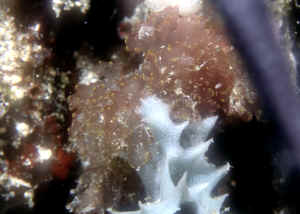 A bunch of Nemastoma in N.
Sulawesi.
A bunch of Nemastoma in N.
Sulawesi.