|
FAQs about Bristletooth Tangs, Genus Ctenochaetus
Disease/Health
2
FAQs on
Bristlemouth Tang Disease:
Ctenochaetus Disease 1,
FAQs on Bristlemouth Tang Disease by Category:
Diagnosis,
Environmental,
Nutritional,
Social, Trauma,
Pathogenic
(plus see
Tangs/Rabbitfishes &
Crypt),
Genetic,
Treatments
Related Articles:
Ctenochaetus,
Related FAQs: Ctenochaetus Tangs 1, Ctenochaetus Tangs 2, Ctenochaetus Identification, Ctenochaetus Behavior, Ctenochaetus Compatibility, Ctenochaetus Selection, Ctenochaetus Systems, Ctenochaetus Feeding, Ctenochaetus Reproduction, Surgeons In General, Tang
ID, Tang
Behavior, Compatibility, Systems, Feeding, Disease,
|
|
Surgeonfishes: Tangs for Marine Aquariums
Diversity, Selection & Care
New eBook on Amazon: Available
here
New Print Book on Create Space: Available
here
by Robert (Bob) Fenner |
 |
Flame fin Tomini tang
5/19/19
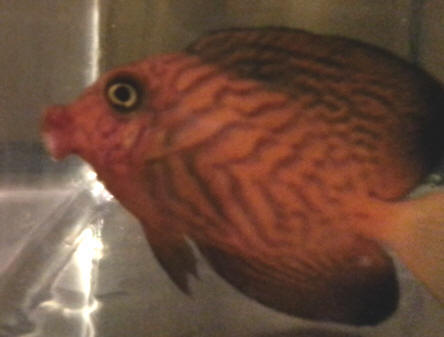
Just purchased a flame fin tang and has been in QT for 4 days. I have
noticed that the fish is not eating anything, wants to but doesn't.
He/she looks to have something in its mouth.
<Mmm; a growth... from... a physical trauma? Not uncommon>
I have asked on a couple different forums but only got the usual "don't
buy fish from there" instead of any type of help. The only way I can
describe it is, it makes the same motions that cichlid does when it has
babies in its mouth. I can't really see into its mouth since it won't
face me. Doesn't scratch, but does twitch a little when it looks like
its trying to keep whatever in its mouth. I wondered if it had a piece
of the substrate from the store in its mouth and its stuck. It is thin
and would like to see it eat something. I have been putting Nori strips
rubber banded to a square frag plug and also Mysis shrimp soaked in
Selcon. Any ideas or suggestions?
<To continue to try offering different foods... am a giant fan of
(perhaps surprising) good quality, highly palatable dried prepared
foods. Hikari and Spectrum pellets (yes)... offered a few times daily>
Thanks for any help you can give!
Stacey Reagan
<And do read on WWM re Ctenochaetus spp. foods/feeding/nutrition FAQs.
Bob Fenner>
|
Tomini tang mouth injury
5/15/19
Good morning,
<Morning Cindy>
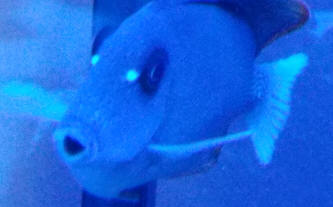
This Tomini tang has been in my 75-gal reef for about a year and a half with no
issues. I noticed yesterday that he was hiding in the rocks and didn’t come out
for Nori as usual. During last evening’s feeding he chased food and tried to eat
but his mouth seems stuck open and maybe a little swollen – it’s hard to say.
<Could be a physical trauma or something stuck in its mouth>
Today he is swimming in the open in a sort of bobbling fashion. His fins are
clamped (I think), he is clearly in some sort of distress. Not picking the rocks
or glass at all. Tankmates are several different species of wrasse, a recently
added Eibli angelfish (I have not seen the two interact much, they have avoided
each other though the Eibli has been aggressive toward other tankmates), a
couple clownfish. Some smaller, innocuous fish, a BTA and a mini carpet ‘nem.
There are no other signs of disease – no spots, gills not red, etc. All other
tankmates behaving as usual.
<How about your water quality, maintenance practices...sometimes (more than we
thought) it could be environmental>
I’m concerned, clearly he’s in distress and the other fish (notably 2 of the
wrasses and the angel) keep swimming by him.
<Are you sure these fish are not bothering the tang at all?>
I am hesitant to remove and stress him further unnecessarily but don’t want
anyone to get hurt.
<I recommend you reduce stress by dimming the lights for a couple of days and
see if condition is reverted, also try feeding with Spectrum 1mm pellets,
perhaps it will be easier for the tang to swallow than the Nori until it resumes
normal feeding.>
Also, if there is treatment I would initiate it but not sure what, if any.
<I wouldn’t treat, there are no clear signs of a disease.>
Please share your thoughts.
Gratefully, Cindy
<Hope this helps, Cindy. Wil.>
|
 |
|
Re: Tomini tang mouth injury
5/16/19
Thank you for the suggestions I turned the lights down to less than half, and
fed some 0.5 and 1.0 mm Spectrum. The Tomini definitely was able to get a couple
of the 1.0 mm so I will continue with that for a couple of days. His swimming
seems improved and his fins less clamped, so that’s good I guess.
<Ahh good>
I don’t suspect aggression from the wrasses, they have all been in the tank
together since I got the Tomini well over a year ago (ish). The Eibli, however,
is new and is quite the jerk.
<Could be>
I’ll be re-homing him soon. I haven’t seen him go after the tang, and the tang
is quite a bit larger, but I wouldn’t be surprised.
I have been suffering coral losses for several months without knowing a cause so
SOMETHING is going on regarding water quality but I’ll be darned if I can figure
out what it is. I test Alk, Ca, Mg, NO3, PO4 weekly or more and they are all
within generally accepted limits for a reef tank. I mailed off a test, the only
really notable outliers were low Iodine and Boron and high Lithium. I am strict
with my 15% weekly water changes. If there is something amiss with my water
quality, I can’t find it ☹
<Have you tried with another test kit? Reagents go bad with time and give
erroneous readings, temperature and salinity also play an important role in the
health of corals. >
As always, thank you for sharing your knowledge. I will update if any changes.
Cindy
<You’re welcome Cindy, do please keep us posted. Wil.>
Re: Tomini tang mouth injury
5/18/19
Happy Saturday WetWebMedia Crew,
<Happy Saturday Cindy>
Just thought I would update you, my Tomini with the injured mouth is unchanged.
I turned the lights down and fed Spectrum 1.0 and 0.5 pellets. The first day he
got 2 pellets but nothing since then.
Yesterday he didn't even try. He is just sort of swimming aimlessly around the
tank with his mouth open. I tried to get a good look but I can't see anything
wrong from outside the tank. Fortunately the other fish
are leaving him alone. He isn't emaciated yet but surely will be soon.
<Fish can go for days and even weeks without food, so I wouldn't worry about the
feedings...for now>
Do you have any other thoughts?
<Yes, do you have a quarantine tank or another stable, cycled tank where you can
move the tang? maybe a friend's or your LFS;...sometimes fish improve just by
moving them to another tank.>
Thank you, Cindy
<You're most welcome. Wil.>
|
Re: Tomini tang mouth injury
6/3/19
Happy Holiday!
<Same to you Cindy!.. sorry for the delay.>
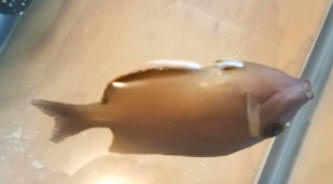
The Tomini tang I wrote about last week has not improved and is doing worse.
Although he seems able to move his mouth he hasn’t really been eating. He can’t
keep himself upright in the water – for a few days he was “head down” but now
keeps log rolling or just going belly up. I hate to see his struggles. His
abdomen is visibly bloated.
<Bloated is usually caused by something ingested or gas accumulation..>
I tried feeding food soaked with commercially available
Metronidazole/Praziquantel combo in case the problem is intestinal parasites or
worms, but he doesn’t seem to be able to get the food. Per your suggestion I
moved him to a hospital tank. When that didn’t work I added Praziquantel to the
water.
If you have any suggestions I would be very grateful.
<If you don’t see any improvement in the next few days, administer Epsom Salt;
as a laxative; at 1 teaspoon per five gallons of system water.>
Thank you,
Cindy
<I hope this helps, Cindy. Wil.>
|
 |
|
Re: Tomini tang mouth injury
6/3/19
Thank you for the reply!
I did try the Epsom salt, but he died the next day ?
<Ohh...sorry to hear that. >
Thank you so much for your assistance and knowledge!
Cindy
<Will be here to help anytime. Cheers. Wil.>
|
|
Tang... Using WWM 2/1/15
My chevron tang seems to have developed a white or clear spot on the
side of his mouth...
<Not good>
haven't been able to get him to eat seaweed from a clip but he usually
grazes on my live rock...fish store had him for 6 months and I've had
him for about a month. Any ideas?
<All sorts; but related to this Ctenochaetus? Just read what's archived
re the genus, health, trauma on WWM. Bob Fenner>
Tomini Tang Twitching
6/5/14
Hi Bob,
<Dave>
Would you be kind enough to tell me what you would do in this situation?
I have a 2.5 inch Tomini Tang currently in a 10 gallon
quarantine tank. When I first saw him, he had some
damage/scratches/sores on one side,
<Likely from capture, handling... perhaps from unsuitable tankmates>
but I had been looking for a Tomini locally for some time, and decided
to buy him anyways. The sores resolved completely without my help after
1-2 weeks, and the fish LOOKED perfect. I have been feeding it Mysis,
Spirulina/brine shrimp combo, and Nori, and it’s been eating well.
<Ah good>
The fish is extremely skittish,
<As are all tangs when small... and easy prey>
making it very difficult to observe before it darts into it’s PVC pipe.
However, I noticed from the beginning it would periodically
twitch its head and rapidly flick its dorsal fin down, then raises it
only to flick it close to the body again.
<Natural behavior>
Most of the time the fin is normally extended.
I don’t believe this is a display-type behaviour in response to seeing
its reflection, as it does the same thing when the room is brightly lit,
and a reflection absent, as in a darkened room.
Even though it has never shown any flashing/scratching behaviour, and
was breathing normally, I suspected it may have flukes. I am now into
the 7th week of quarantine, and last week decided I would try treating
with PraziPro. The first few days of treatment were uneventful, but I
hadn’t seen any cessation to the behaviour.
After 6 days, I did a water change and treated again. This time, the
fish seemed bothered by the treatment. Gill movements increased
frequency, and it would periodically extend it’s mouth as if yawning. It
has been 3 days now since the start of the 2nd dose, the fishes
breathing has improved somewhat, but still faster than before, it
continues to twitch as it always has, and continues to eat well. I’m in
a bit of a conundrum. Is the rapid gill movement and yawning due to the
Prazi, or parasites?
<Could be either or both>
Is the twitching due to a pathogen, or just a fish with a weird habit?
<Again; some such twitching is to be expected... may have survival
value... displaying the animal as unsuitable, less suitable as a food
item. There are many "twitchy" marine organisms... the "wormy" gyrations
of juvenile grunts/sweetlips, coughing of anglers/frogfish...>
I’m thinking that under the circumstances I have little to gain by
keeping the fish in quarantine beyond this 7th week, and treating with
Prazi again.
<Agreed>
What do you think is the prudent course to take?
<Move this fish; perhaps through a pH adjusted freshwater bath to the
main/display system>
I was careful not to introduce (known) pathogens into my 120 gallon
reef, which only houses 3 fish, and don’t want to change that,
especially since this guy will probably be the last addition. Suffering
paralysis by analysis!
<I understand; fully>
Thanks very much,
Dave
<Welcome. Bob Fenner>
Re: Tomini Tang Twitching 6/28/14
Hi Bob,
<Dave>
I had written you about 2-3 weeks ago about a small Tomini Tang I had in
a 10 gallon quarantine for what was at the time, about 6-7 weeks. My
concern was that though I never saw anything unusual on his
body---outside of some scrapes when I first purchased him, which healed
up within a few days---he would frequently shake, and twitch. During
that time I did 2 treatments with PraziPro thinking it could be flukes.
He seemed quite stressed by the treatment, and afterwards showed no
change in behaviour.
<About par for that course>
After consulting with you, I left him in quarantine for another week,
and finally added him to 120 gallon reef display, that houses 3 other
fish. He seemed very happy swimming all over the tank. He quickly
befriended my Royal Gramma with whom he frequently swims, though now my
Gobies won't come out
due to fear...
<Just give them time>
but that's not why I'm writing. He's been in the tank about 2 weeks now,
and will swim normally and then suddenly fire off like a bullet, shake
spasmodically, and then resume to normal swimming.
<Not unnatural... Tangs and other fishes do this in captivity and the
wild>
I have also noticed a single white spot on his belly just below his
pectoral fin, which has been
there for 3 days.
<Eh! No worries>
There don't seem to be any other markings, and I have never seen him
scratch against objects.
Now, I don't think a single spot necessarily means Ich, especially after
not showing any physical signs for nearly 2 months, but together with
the strange behaviour, this has me worried. Disassembling the rockwork
to catch my fish for treatment seems extremely "unappetizing", but also
premature at this point until I see some other signs...but I'm wondering
what your thoughts are. Might this pass, or is it clearly a parasitic
problem?
<Pass>
Is there something i should do? Needless to say, I'm bummed, especially
after doing things the "right" way with the long quarantine. Thanks in
advance.
Thanks you,
Dave
<Patience. Cheers, BobF>
Re: Tomini Tang Twitching 6/28/14
Bob,
I can't thank you enough for you quick and helpful responses!
It's almost embarrassing how concerned I can get about my livestock, and
interesting how a short visit of the online reefing sites demonstrates
how many others feel the same way! It's the enormous investment of time,
money and energy spent researching, creating and running a system. The
ups and downs...not to mention the love of nature, and attachment to our
animals!
Cheers to you as well, and have a great weekend!
Dave
<Thank you Dave. BobF>
Opaque White Spots on Tomini Tang Pectoral Fins
11/10/08 Hello, <<Howdy>> Long time reader - first
time writer. <<Cool!>> Thanks for all the great info.
<<Welcome>> My wife and I have a 70 gallon FOWLR tank. The
parameters are as follows: Ammonia 0, Nitrite 0, Nitrate 0, Specific
Gravity 1.025, pH 8.2-8.3 Ecosystem 3012 with skimmer and Chaetomorpha
Approx 40 lbs of live rock (we have been slowly increasing with time)
The occupants of the tank are: Tomini tang <<Not easily
kept>> Pearlscale butterfly, Dwarf flame angel, Yellow clown
goby, Bullet goby, 2 Ocellaris Clowns, 2 Skunk shrimp, 2 Fire shrimp,
Various cleanup crew (snails and hermit crabs) There does not appear to
be any problems with occupants getting along together. <<Looks
like a fine mix>> My question is in regards to the Tomini tang.
We have had him for several months with no problems until this morning
when I noticed several opaque white spots on his front pectoral fins.
The spots are not as pronounced as Ich. (We have tried to take some
pictures of the fins and the Tomini is not a willing subject. The spots
are rather subtle.) <<And perhaps nothing to be concerned
with>> The Tomini is acting normally, feeding, grazing and
zooming around the tank. I'm not sure how concerned I should be
about this? <<Me neither but likely not too much. The spots may
simply be a "mood" indicator>> We have not noticed any
spots on the other fish. I can put him in a QT (of course not without
tearing apart the tank), but I don't want to put undue stress on
the fish (and myself) if it is not warranted. <<I am in agreement
here. I would simply keep an eye on the fish for now>>>> We
quarantined him when we got him. The Tomini did not do well, he did not
want to eat and started to decline so I popped him into the main tank
after approximately 10 days and he perked right up. <<This was
wise of you'¦ As intimated earlier this species can be
difficult to acclimate to aquarium life, but is fairly hardy (in my
experience) once done so>> With regards to UV sterilizers, I have
read on your site that you feel that water quality and a healthy diet
are the key to a healthy system. <<Indeed>> Our trusted LFS
has been suggesting a UV sterilizer as the best way to prevent problems
over the long haul with disease and parasites. Your thoughts?
<<UV sterilizers are by no means a panacea, and certainly no
replacement for good maintenance and sensible stocking, but they can
serve as a useful adjunct to systems such as yours>> Thanks in
advance for your input. Jim <<Happy to share. EricR>>
Kole Tang Question, Ctenochaetus
acclimation, lack of quarantine 5/28/2008
Dear Crew, <Andy> I was reading up on Kole Tangs
because I'm thinking of purchasing one for my 110g display and I
noticed in the article written by Bob
(http://www.wetwebmedia.com/koletang.htm) that he generally advises
against quarantining this species and instead using an extended pH
adjusted freshwater dip (how long is "extended"?). <Five
or so minutes... w/ constant observation, "swirling" of water
or the use of mechanical aeration (a "bubbler")> Has
anything changed/is this still good advice? As always, thank you! Andy
<Is still my opinion. This pc. was penned w/in this last year...
maybe should have incept. dates... Cheers, Bob Fenner>
Ctenochaetus disease 4/27/07 Hi,
<Diego> When I realized what you meant for "live in your
city" it was too late, I hope I didn't look too silly.
<Mmm, no> Thank you for the quick reply and the huge help.
Unfortunately the Tennent Tang died while I was doing a freshwater
dip to cure a great number of black spots that he had. I followed
the dipping procedure but I think that something went wrong with
the pH adjustment (I didn't wait enough time for the PH to
adjust and when I measured the pH after the dip it had dropped to
7.6-7.8). Bad way to learn it but it won't happen the next
time. After reading on your website I decided to try with a
Bristletooth tang, which seems more suitable for my tank (75
Gallons). <Yes> Strangely enough my LFS has scarcity of Kole
tangs and abundance of Tomini tangs. <Mmm, they likely don't
buy from dealers that carry much in the way of Hawaiian imports...
the "drop" this year is huge for Ctenochaetus
strigosus> This brings me to my current problem. I bought the
Tomini on Sunday and it is currently in the quarantine tank with a
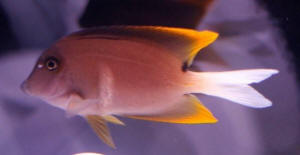
6 line wrasse, today I noticed a big mark/bump on his side behind
the pectoral fin (see pic1). I think It could be some kind of skin
lesion due to him bumping into something in the tank, <Likely
so> especially since on the other side it has some scratches in
the same region (see pic 2). Could it be something else? Should I
treat it with something? <Possibly... Nitrofurazone... see WWM
re dosage, SOP> The water in the quarantine tank comes from the
main system and currently is: Salinity 1023 temp 78-78.6 F pH=8.2
alkalinity=7.5-8dKH (slowly rising in the main system due to the
use of Kalkwasser) Nitrites 0 Nitrates 5-10 ppm (<5 in the main
system). The fish is still shy and scared but eats the enriched
(Selcon) Mysis shrimp and the only odd behavior is some fast jerks
to the side (this could make him bump into objects) while swimming
and sometimes when he is standing still in one place. Thank you
very much,
Diego
<Welcome. BobF> |
|
|
- Yellow Eyed Tang with Tail Rot 6/16/06
- Hi I recently bought a yellow eyed tang and it looked healthy
when I bought it. They said it was eating properly (they all say that)
and has been doing great. I got him home and noticed his tail is
beginning to "rot away" its not that bad but it is
noticeable. He swims around fine and is constantly grazing....he has
tried the green algae but doesn't seem to like it. I have noticed
he likes certain things in the formula one. I did readings and ammonia
is 0, alk is 0, ph 8.2, nitrate is 5.0 and nitrite .05 (0ppm) I was
think maybe a parasite since he seemed to want my hermit to clean
him....so i bought a cleaner shrimp. What are your thoughts.... Thanks
mIke <I think that all things being equal, that the tangs tail will
heal. You could add some quality fish vitamins like VitaChem to
encourage the process, but there's not really much you can do but
be patient. Cheers, J -- >
Kole tang discolored spot (can't figure this
out) 3/27/06 Hello guys, hate to be a
pain, but I can't figure this out. I have read about
every tang disease I can find on your site (and looked at the pictures)
and I just can't come to a conclusion about this. I have
had this Kole tang for about a month, he is a very small fish 2-2.5
inches max <Is very small! Am wondering who in HI has a mist/barrier
net of such small mesh/draw that would collect such a specimen> and
I feel pretty good about keeping him alive up till this point since I
have read any tang under 3 inches is extremely difficult to keep alive.
<In general, for most species, yes> The tank is a 55 gallon with
1 false percula clown, Kole tang, cleaner shrimp, 2 peppermint shrimp,
flower anemone, and a neon green bubble tip anemone. <Two species of
anemones in this sized system is "asking for trouble"> A
couple weeks ago he developed some small BB sized discolored spots
(almost white do not look raised) well after a couple days they
completely went away and left no holes or scares or anything, the clown
seems to be absolutely fine. Now today a new spot about the
same size has appeared since last night, between his head and dorsal
fin. I work at a LFS and no one seems to know what this
is. I have been feeding him spectrum pellets... <Good
product... high palatability, nutritional value> its the only thing
I can get him to eat, he has no interest in dried Nori (red or green)
and I have very little algae in the tank so he is probably not getting
enough "veggies" but I have tried feeding him about
everything under the sun and he has no interest. I have to
put the spectrum pellets on a rock to get him to eat because he is so
shy. I have also been letting some natural sunlight on the
tank for a couple hours a day which I have read helps HLLE, but I
don't think that's what this is. <Me neither> All of my
water parameters are fine, ammonia 0, nitrites 0, nitrates 2.5,
phosphate < 0.5. Since I work at a LFS I am able to do
plenty of water changes to keep my water at tip top
shape. So, what do you think, is this a vitamin
problem? Sorry about the lengthy email but I wanted to make
sure I included everything. Thank you for your time and a
great site. <Mmm, could "just" be stress... but the two
anemones... could definitely be at play here... in efforts to
"poison" each other, are likely mal-affecting your fishes. If
nothing else, I would remove one of these... and soon. Bob Fenner>
Re: Kole tang discolored spot (can't figure this
out) 4/1/06 Thanks for the quick response
sorry I was not able to thank you earlier...working 2 jobs 14 hours a
day doesn't leave you much free time. <Yikes! Hope
your commute is short... to allow sleeping time!> I have returned
the flower anemone to the store I work at and the tiny Kole tang looks
all better, once again thanks for the quick response I
really appreciate it. <Ah, very welcome. Bob Fenner, who used to
work long, continuous hours, and now plays about as long>
Sick
Kole Tang 1/30/06 Hello!
About two months ago my
husband and I purchased a Kole Tang. Our quarantine tank was
set up by placing water from the main display tank into a 20
L. We placed "used" filter media into the
filtration unit and left the bottom bare. A large PVC elbow
was also placed in the tank for cover. A few days
after introducing the Kole to this system the nitrite levels were
becoming toxic and obviously stressing our fish. We did a
60-70% water change and kept monitoring the water
quality. Again the nitrite levels rose and stressed the fish
(very rapid breathing, dark color change). I had observed
this fish at the LFS for a week before purchase and he did not exhibit
any outward signs of illness/disease. Even though I knew the
stress he was suffering could cause a previous latent disease to
manifest itself <Well-stated> I still felt that the best option
at this point was to place him in the main display. Six
weeks go by in the main tank and by all outward appearances the Kole
seemed to be doing well. Although finicky, he would eat Sea
Veggies and Spirulina flakes with a gusto that matched that of our
Oscars. Formula Two frozen was offered repeatedly but he
didn't seem too enthused with it. In the meantime I
tried to find a source of Formula Two flakes. I typically
give everyone (12 tanks) a thorough visual check up at least once a
day, often times more. <Good practice> Unfortunately
two days went by where I was unable to do this and, being held firmly
in the grip of Murphy's Law, this is when disaster
struck. When I saw the Kole he looked like he had been
dropped in a pile of dust bunnies. <Yikes> After
checking the water parameters in the previously mentioned quarantine
tank I moved him (to quarantine). Upon very close
inspection he had clear, round, raised bumps all over his body in
addition to the "cotton like" patches. After
investigating the archives of WWM media I concluded that I should treat
him for parasites and fungal infection. I added Fungus Clear
and Parasite Clear (Jungle Products) to the water. <These are not
efficacious here> Over the next few days he started to
look better. By the end of the treatment period indicated on
the package, our Kole looked pale but only had a few minute areas of
fungus left. We performed the recommended water change and
treated again for fungus. The package directions indicated
that this would be OK. After the second treatment he looked
pale and had less of an appetite but looked free from
disease. Great, I thought, I'll perform a water change
and leave him there for a little while. During these
treatments we were testing the water quality with a reagent
kit. PH =8.2, Ammonia=0,
Nitrites=0, Nitrates=30 were the regular
readings. I thought all was going relatively well until he
started to look worse. The fungus and clear bumps returned
with a vengeance. His skin also started to get dark, sub
dermal patches. Then the ammonia and nitrite levels started
to rise. I had placed a different thermometer in the tank
after the last water change and consequently noticed that there were
wide variances in water temperature too. It seemed as though
the main display was the only place where I could keep the tank
parameters stable enough to effect a cure. So out goes the live rock,
in goes the Kole. I have read the WWM archives for hours
trying to find out what exactly is wrong with our Kole <Mmm, w/o a
microscopic exam. it is not worth definitive speculation... but could
be a number of external parasites here... a prophylactic dip/bath
enroute to either quarantine and/or your main tank would have been
useful here> and what the best method for treatment
is. I'm confused, frustrated and mostly heartbroken
because it seems that my best intentions only lead to the further
demise of our Kole. There are a wide variety of answers by
many different people in the WWM archives. It is a great
resource however a novice or amateur aquarist such as myself can find
it difficult to know which course of action is the most
appropriate. I'm hoping you can suggest a solution that
will help us, it would be much appreciated. Thank you.
Sincerely, Christina <Thank you for writing so well...
clear and thoroughly. At this point, if you have "other
water" from a non-contaminated "clean" system, I would
move the Kole out of the present treatment system, lightly bleach/wash,
sterilize it, add the "used water", prepare a slightly dilute
(1.022 spg) bath with ten drops of 37% formalin/formaldehyde (37%
solution) per gallon, add aeration and leave the Kole in this for five
minutes, moving it to its re-made quarters... Wait three days and begin
a copper treatment... chelated will be better than free cupric ion...
with testing... for three weeks. Bob Fenner>
Kole Tang -
01/03/2006 Hey guys, <Hi Tate.> My Kole that I have had for 5
months started looking a little odd earlier this week, but it did not
occur to me that he may be sick. He was just a little bit lighter in
color than usual in the early morning and the rest of the day he would
be a nice rich color. <Possibly just the normal, "night"
color.> Today I noticed that he has spots of the discoloration
around his head and I am wondering if this is a sign of some sickness,
or if he is just simply changing color for some unknown reason. <Bad
signs IMO. Diet is often an issue with these, have you researched HLLE?
Other nutrition related disease?> The only thing that I have changed
in the last couple of weeks is the lighting schedule, and that was a
fairly sizeable change. <Probably stressed your livestock as
well.> I will probably do a 20% water change when I get home this
evening just to help out. <Good start, but do research that diet
info. Are you heavily feeding greens (like you would a Yellow Tang) by
chance?> Thanks in advance. Tate <You're welcome. - Josh>
Re: Kole Tang EMERGENCY 12/24/05 I e-mailed yesterday
about a Kole tang that has an Ich infestation. James instructed to
catch him and treat him with copper. Unable to catch him
last night, I added a cleaner shrimp and a dose of Marine Max - as
suggested by my LFS based on his experience with the
product. Dilemma of the night - he LOOKS better - better
color, looks like he may have eaten, fewer and smaller Ich
spots,<Fewer Ich spots doesn't mean the parasite is
waning. Once they enlarge they burst into many more
individual cells that will be looking for a host very soon.>
etc. But, he is resting upright on the sand against a rock
and breathing pretty hard. <Doesn't sound very good to me.>
Will a possible chase tonight be his doom before the
Ich? The better color is a big mixed message! <Yes it
is. As I said earlier, if you don't catch and treat he
is going to die anyway, so the choice is yours. Rarely will
non-copper based medications cure a fish infested with
Ich.> Still try to catch him and treat with
copper? I just don't know where he stands at this
point. Please advise ASAP - I know - it's two days
before Christmas - so I really appreciate your help that much more.
<I've been advising but apparently you don't want the hassle
of removing him which is going to require removal of most rock so the
stress from the catch is minimal. Do quarantine future purchases for at
least 30 days. James (Salty Dog)> Thanks,
Misty
| Sick Yellow-Eyed Tang 8/31/05 Hey there,
<Hi> Great website, but it's a little hard to navigate
and search. <Do you have (specific) suggestions on how we might
improve these aspects?> Good resource nevertheless. I
wanted to seek some professional advice about my sick yellow-eyed
tang. I purchased it about 3-4 weeks ago. My
60 gallon tank has been cycled through for a few weeks before that,
and I introduced a small spotted damsel to start the
bio-cycle. When I purchased the yellow-eyed tang, I also
introduced a small clown fish at the same time. I
secluded the damsel in fear that it would be too aggressive for the
clown and the tang, but after rearranging the live-rock and
releasing the damsel after a few days, they seemed to get along
quite well. Very recently within the past 24 hours, my yellow-eyed
tang had secluded itself under a large piece of live-rock and
didn't come out of its hiding place. Usually, it
would be waiting with the other two fish for me to feed
them. Before yesterday, the tang seemed to be swimming
very normally, and I fed it Formula 2 pellets w/
garlic. He seemed to be eating those fine, but
wasn't too keen on the seaweed sheets. <Takes time...
familiarity> I did an immediate 10-15% water change, and lifted
the live-rock it was hiding under, only to find the tang on its
side and breathing heavily. I do not have a quarantine tank, so I
had to seclude it in a small glass fish-bowl that is semi submerged
in my 60-gallon tank. My only other idea was to place it
in the homemade sump, but was afraid of the water pump catching the
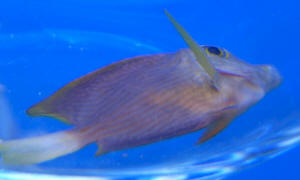
tang in its vacuum inlets. I've attached two
pictures of the tang. It is still breathing and still
has normal coloration. The only other symptoms are that it looks
anorexic (it has only looked this way within the last 24 hours),
and seems to swim normally when in a gentle
current. Any help/advice is appreciated. <Mmm,
well, this specimen is badly emaciated... starved... So, at least
part of the answer here is poor handling prior to your receiving
the fish... "It has a low index of fitness"... this
coupled with stress of moving, a new tank... I would return it to
the main tank, and hope it recovers of its own accord... Do take a
look at pix of other/healthy Ctenochaetus species... notice how
much more well-fleshed they are. Yours is way too skinny. Bob
Fenner> |
|
|
Surgeonfishes: Tangs for Marine Aquariums
Diversity, Selection & Care
New eBook on Amazon: Available
here
New Print Book on Create Space: Available
here
by Robert (Bob) Fenner |
|
|
|