|
FAQs about the Coral Beauty Dwarf Angel
Stocking/Selection
Related Articles: Coral
Beauty Angels, Marine
Angelfishes, Flame
Angels,
Related FAQs:
Coral Beauties,
Coral Beauty
Identification, Coral Beauty
Behavior, Coral Beauty
Compatibility, Coral Beauty
Systems, Coral Beauty
Feeding, Coral Beauty
Disease, Coral Beauty
Reproduction, Flame Angels
1, Best FAQs on Centropyge,
Dwarf
(Centropyge) Angels, Dwarf
Angel Identification, Dwarf Angel
Selection, Dwarf Angel
Compatibility, Dwarf Angel
Systems, Dwarf Angel Feeding,
Dwarf Angel Disease, Dwarf Angel Reproduction, Marine Angelfishes In
General, Selection, Behavior,
Compatibility, Systems,
Health, Feeding, Disease,
|
%20vert.jpg)
|
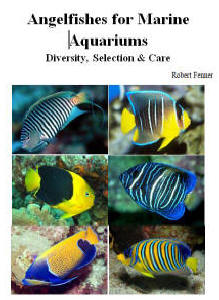
Angelfishes for Marine Aquariums
Diversity, Selection & Care
New eBook on Amazon: Available
here
New Print Book on Create Space: Available
here
by Robert (Bob) Fenner |
 |
Is it possible? Coral Beauty Comp./Stkg. 3/18/17
<Hi Aaron, Earl today.>
Hello! Big fan here! I have a bit of a question to ask. I have a 40
gallon mixed reef with a coral beauty, approximately 3 inches and most
likely male due to the fact that I got it from a shop who I saw had him in a
tank to himself for around three months, anyways, I have been interested
in possibly pairing up the coral beauty and was wondering if I could do
it in the 40 breeder with no plan of upgrading tank size in the near future?
<This is playing with fire. Assuming they do not get along, and I would bet they
will not, how prepared are you to physically remove one of them from a
functional reef tank? I would not consider this but if you do, have a solid
game plan for rehousing one of the fishes if/when that becomes a necessity.
You would also need a way to monitor their interactions intensely (as close to
24/7) maybe with help from a spouse, etc.. Look up the topic of introducing
potentially troublesome fishes on WWM (pasta strainer "shark
cages" and such; helped me with similar problems back in the day). In short, I
would look into the many, many safer options and also ask myself "why?" as in,
what is the motivation? Visuals? Interesting behavior? These
can be good reasons but with so many other options for a small reef tank and so
much risk with the angels, I'd look elsewhere. All this applies to any same or
similar species angelfish to some degree. Some of my favorites
and ones I will go out of my way (and budget, Argh!) to keep but they definitely
have their share of attendant issues.>
Also, to add to that, I was possibly hoping to pair it with a deep water coral
beauty. Would this be possible? I know pairing Centropyge species can be risky.
Thank you. -Aaron
<Hope this helps and please follow up, this adds info for fellow aquarists to
come! -Earl C.>
Re: Is it possible?
3/18/17
Thank you Earl! I figured it would not be possible (well maybe haha). The reason
for the question was to see if I could possibly pair them and have a breeding
pair as I am very interested in the breeding of marine angels
especially Centropyge and Paracentropyge species.
<If you can get that going, cha-ching! But that is a whole different ball of wax
and not in the real of a hobbyist in their own home to attempt.
Breeding most marine fish is a herculean task, frankly.>
Also, it was going to be a pair only species tank with the two and the small
yellow clown goby and skunk cleaner shrimp I have in the with the male right
now. Maybe one day I'll upgrade but not in the near future. Thank you again!
<Get a bigger tank, use the 40g as a fuge/sump maybe ;) but
this is coming from a guy who is looking at a switch to a 350 or similar to
house a shockingly quickly growing queen angel. They lure you in and don't let
go
once you fall in love with angelfish! Anyway let us know how it works out.>
Re: Is it possible? 3/19/17
Thanks again Earl haha, angels really do have the power to lure us in, sirens of
the sea i may say haha. So i just got a hold of a lfs and the owner who i know
very well due to the fact that i have worked there for a while said if i help
him with his corals in his 125 frag tank he's setting up, he will give me a 100
gallon tank that he got from a guy that needs to be extensively cleaned up and
resealed due to it sitting outside but once i clean it up and reseal it its all
mine. So now that i have a plan for a bigger tank, maybe i could get this
project going. Also, would a majestic angel be happy in a 100 gallon if there
wasn't a lot of tank mates maybe just a pair of coral beauties and some smaller
docile tankmates?
<Low and wide is definitely the way to go (pretty much whenever possible, imo).
Probably a no on the majestic angel though...they can get 8"+. It seems like
your interests and intents are better suited towards some of the
"middle-sized" marine angels (Lamarck's and other Genicanthus). Check them out.
They are not hard to find in mated pairs, they are gorgeous, interesting
behaviorally, and sexually dimorphic,>
I should include that the 100 gallon we are talking about is shaped like a 40
breeder just bigger dimensions. Thanks again Earl! -Aaron
<Make sure it's sealed very carefully if it's been out in the weather for any
length of time. Once it's all done and seems ready, you can put layers of
newspaper or similar underneath it, fill it, and leave it for a few days. If
there are any leaks, the paper will reveal it. Also a good time to test
bulkheads. Definitely have it drilled if it isn't. WWM has more info on this. On
another note, a lower, wider than standard 100g tank is not easy to come by
cheap so IMO it's probably a great score if you can indeed get it operational.>
Question Follow-up about Coral Beauty Trio
1/7/13
I would just like 1 clarification to make sure that I did not
misunderstand something. If I purchase 3 Coral Beauties under 3"
and place them together (in my now 180 gallon mixed reef), things should
be go well regarding the 3 Coral Beauties cohabiting, correct?
<Likely so>
If I buy them this small I will not need to try to sex them, correct?
<Yes>
I have not been able to find reliable information about sexual dimorphism
among Coral Beauty angels.
<Don't know that there is such>
Thanks again for all your help.
<Welcome. BobF>
Coral Beauty Hardiness- Location, Location, Location!
5/24/07 Hello Crew! - and specifically a big Texas
"Howdy" to Bob, as we haven't spoken in quite some time.
I need to drop him a special "line" some time soon and I
still need to get to Fiji. <Hi there! Scott F. with you tonight!>
I have searched the site for specifics on this issue without seeing it
addressed, but being "timing/event" sensitive it is probably
best to ask the question again anyway. So, please forgive if I am
redundant. <No problem...that's why we're here!> My
questions are in regards to the current availability/hardiness of
Centropyge bispinosa, the beautiful Coral Beauty Angel, one of my
personal favorites. <One of mine, too- a favorite in one of my
favorite families of fishes!> First of all, knowing that you remain
abreast of all things salty, where are the hardiest specimens of C.
bispinosa being collected currently that are making their way to
dealer's tanks? Does one region surpass another at this time for
exceptional hardiness over another and is there really a preferred
origin with this genus-species as with many others? <Great
questions. I've been doing a lot of personal research on various
Centropyge species lately, and I've been talking to some of the
local wholesalers here in L.A., as well as shop owners and others in
the know. The current consensus is that the hardiest C. bispinosus are
coming from Australia and Polynesia. The collection practices in these
countries are much more conscientious and yield consistently healthier,
hardier specimens than those that come from areas such as The
Philippines. Much effort has been put into training local fisherman
into utilizing better collection practices (without chemicals,
dynamiting reefs, etc.), but change is slow. Bottom line- at this time,
I'd try to find a Coral Beauty out of Australia or Polynesia.
Reputable e-tailers, such as Marine Center or Live Aquaria can help you
locate specimens from these locales and others where better collection
practices are common.> I ask primarily because I feel that the
quality of these animals that I am seeing today is superior to the ones
that I have owned or viewed 3 to 4 years ago. This may be an aberration
or coincidental to my experience but they seem to be far more robust,
inquisitive, and active at the LFS. I would like to think progress has
been made and the industry is ramping up in terms of knowledge,
resulting in increased environmental awareness, and subsequently more
acceptable collection, transportation, and transfer methods.
<Agreed...change is happening for the better. As Bob has mentioned
often, we as hobbyists can "vote with our pocketbooks" and
pass on specimens that appear to have been collected with chemicals, or
from locales that have not embraced more conscientious collection
practices. We should speak up and let our local fish stores know that
we want specimens from reputable collectors/suppliers. Not always an
easy thing to do, but it can and will make a difference in the long
run.> I ask because four to five years ago I owned two Beauties, one
immediately after the demise of the first (which didn't last more
than 5 months). The second also succumbed after only a few months in
the tank, manifesting the same symptoms - a brief period (less than a
week) with loss of vitality, appetite, activity and awareness. They
went down fast. <Sad to hear...Many possibilities as to why this
happened.> Looking back, these specimens seemed to meet the criteria
of healthy animals when acquired but comparatively did not display as
much vigor as those I am now seeing. This 55 gallon reef system had
already been running successfully, without the loss of any other
fishes, for about 3 years - all parameters in check. It contained 70
lbs. of live rock, which served as constant forage and cover and these
fish were good eaters of all other fare. There were no signs of any
disease present or any harassment/conflict from and with mates, as
well. <An excellent environment for Centropyge species.> This
particular system is still running successfully, going on 8 years now.
It currently houses a 5 year old Tomato Clown, a smaller Foxface of
about 3" (which will need to move eventually, requiring larger
quarters - YES!), an Azure Damsel, and a Yellow Dottyback, all healthy
and getting along remarkably well. I am planning on acquiring another
C. bispinosa and would like to know the current state of the species as
far as origin, availability and hardiness are concerned. <Just a
word of caution: The welcome this fish receives may not be all that
warm if the Dottyback, Clown, and Damsel assert themselves..!> I
would like to be armed with updated information when I enter the store.
I would feel a sense of confidence in knowing that the order of things
is superior today, if this is indeed the case. <Again, I agree that
there are many better quality specimens arriving today than ever
before.> Thanks, Crew, for your dedicated support to all of our
efforts. David Bell Highland Village, Texas <And best of luck to
you, David! Hope that your Coral Beauty works out great! Regards, Scott
F.>
Angelfishes for Marine Aquariums
Diversity, Selection & Care
New eBook on Amazon: Available
here
New Print Book on Create Space: Available
here
by Robert (Bob) Fenner |
|
|
|

