|
FAQs about DIY Tanks, Sumps Made of
Acrylic
Related Articles: Making Your Own Tanks, Sumps, Designer Marine tanks, stands and
covers, Aquarium
Repair, Marine System
Components, Canopies, Covers & Lighting
Fixtures,
Related FAQs: DIY
Tanks, Sumps 1, DIY Tanks/Sumps
2, DIY Tanks/Sumps 3,
DIY Tanks/Sumps 4, & FAQs on
DIY Tank & Sump : Design, Shape/Size, Materials, Tools/Construction/Sealants, Plumbing... DIY
Glass Tanks, DIY Wood Tanks,
DIY Other Material Tanks... &
Tanks, Stands, Covers, Custom Aquariums, Stands,
Covers..., FAQs on Commercial, Custom and DIY Tank:
Design, Shape, Materials: Acrylic,
Glass, Other... Tools, Location, By Make/Brand/Manufacturer Name, & Acrylic Tank Repair,
|
Acrylic Tank Fabrication
Not really a
question. Today's list of questions included some about making
you own tank. TAP Plastics, a somewhat local firm that deals
primarily in acrylic, has a website that includes a downloadable
set of documents concerning how to work with acrylic sheet
goods.
The link to their info page:
http://www.tapplastics.com/plastics/plasticsinfo/acrylic.html
Regards,
Charlie H.
<Thank you for this link. Will post. Bob Fenner> |
|
Acrylic Aquarium build. 1/20/19
Hi guys/Bob,
<Good morn Mike>
I’ve built a custom (cell cast) aquarium 60”X36”x 24.5” high top and are 1/2”
acrylic, side panels are just shy of 3/4” acrylic. Joint gaps before glue are
.02”. Glue used is Scigrip 42.(you can’t beat 4000psi) Some small bubble here
and there and some crazing. Tank holds water fine. Long side panels bow measured
from Center with a two foot level,
<A note here: I'd use a longer level... >
I get a 1/16” gap from left to right at either end of level. From top to bottom
I get 1/8” gap at either end of my 24” level. Is this bowing ok?
<Mmm; likely so; considering the thickness of acrylic used here. Are you sure
the stand itself is level?>
I get very little bow at the short ends of my tank. I drained half the water and
found the bow very similar than when the tank is full.
<Ah, yes; the material is not going to bow itself>
I was planning on running an old Tunze wave box on the tank as part of a stress
test to test the seams. Tank panels were laser cut and all lasered edges were
shaved off till stress bowing of the panels were relieved.
<Oh! Neat! Not a worry then.>
One of the well known tank manufacturer wanted to make this tank out of 100%
1/2” acrylic. I totally didn’t want that!!!
<Agree/d>
Thanks for your help.
Mike
<Thank you for sharing. Bob Fenner>
|
.jpeg) .jpeg) |
|
Re: Acrylic Aquarium build.
1/21/19
Hi Bob,
<Mike>
The tank isn’t perfectly level but I did make sure there was no twist in the
stand before adding water to the tank. I used a high quality level. Accurate
to .0005”!
<Wow>
I can certainly use a longer level or straight edge for the 60” but I was
using it as a brief reference. I would imagine 18” past my 2ft level at
centre would be 1/8-3/16” gap at either end. I can confirm this when I do
another water test.
<Yes I would>
I have to ask you again. How comfortable are you with the thickness of
acrylic I used, high quality glue, my application method and amount of
bowing?
<Am very fine w/ all>
Best regards Bob!
Mike
<Cheers, BobF>
Re: Acrylic Aquarium build.
1/30/19
Hi Bob,
<Hey Mike>
How much bulging is too much on the long side at mid height going horizontally
(gap at either end of the 60” length on a straight edge?
<Mmm, maybe a half inch... going back to your other dimensions; particularly the
24.5" height. Some acrylic is softer than others... the flexing is not such a
big deal (right, define "such"); but bulging rarely indicates a propensity for
structural failure>
I’d like to know what the maximum Gap your comfortable with regarding 3/4” thick
acrylic. We’ve established 1/8” vertically at Centre.
<That's more than fine mate. I would not worry Re.>
Thanks,
Mike
<Welcome. Bob Fenner>
Re: Acrylic Aquarium build. 1/31/19
Thanks Bob!!
<Welcome Mike>
Yea tank is 24.5” high but the 3/4” panels are 23.5” tall alone. That worked in
the acrylic calculator on the DYI guys website. I could always cut the tank and
make it shorter in height and re-glue the top back on.
<I'd leave all as is>
Thanks so much for your input Bob. It’s a heavy tank going on concrete slab.
<Thank goodness; and hey, could be worse. Think if it were made of glass! >
Best,
Mike
<And you, BobF>
Re: Acrylic Aquarium build. Holes, placement
2/1/19
Bob,
<Mike>
I forgot to ask. I have to drill 2-2” holes for bulk heads half way up on the
36” side of the tank and off to the side. Also a 1” or 1.25” bulk head closer to
the top of the tank on that same side. The return from pump is a Varios 8 from
reef octopus. We’re talking up to 2700Gph . Should I be too concerned about the
hole locations? Ex. Proximity to each other? Proximity to side corner or top?
Any risks?
<Not too much of a concern. Please read over our replies to such:
http://www.wetwebmedia.com/pbholessizeplace.htm
and the linked files above>
( regarding overflow bulk heads being half way up the side. It gives me the
option to run the tank at a lesser volume in case there’s a weight bearing load
issue.
<... as in on the floor? I'd have a structural engineer into check unless this
is a concrete slab>
Also, a leaky bulk head will only drain half the tank. ;)
<Yes... but, a problem in the plumbing will drain it down this far. DO search
WWM re Overflow Designs... I'd mount mine near the top... Bob Fenner>
Mike
Re: Acrylic Aquarium build. 2/15/19
Bob,
<Mike>
I might as well run this by you. I noticed along one side at the bottom, the
bottom isn’t straight.
<?>
It seems that the bottom isn’t perfectly flat and straight. 1/16” over 40” of
the 60” length. I may cut the glue out. Create a proper gap and re fill with
glue.
<Glue? What sort of product? Acrylic tanks are generally solvented, not glued.>
In case you don’t understand, the bottom fell away 1/16” over 40” of the 60”
length.
<Am daft I guess... "fell away"?>
Or should I just leave it?
Mike
<I would likely leave it; modify the stand, or insert a foam sheet under to take
up some of the stress here.
Bob Fenner>
Re: Acrylic Aquarium build. 2/15/19
Bob,
<Mike>
Epoxy weld on 42. Side panels are standing on the bottom, in design.
<Yes; a solvent, not much "body" at all... And yes to the sides as they are:
standard practice>
When gluing the bottom. I had .02” clearance all the way around the bottom
(manufacture recommended min. Gap) except one area that was not in line.
<... gaps made with... piano or other wire are de rigueur. Not in line I don't
like>
The gap opened to 1/16” to produce that bulge but that bulge was in turn filled
with the epoxy unknowingly. (Epoxy SG42.) I will likely saw the seam and clamp
straight and re fill with SG42 unless you object.
<Mmm; I hope I don't come across as (too) lazy; but I'd test, use this tank as
is>
The rest of the bottom is perfect. The tank will sit on two layers of 3/4”
plywood.
<And a thin sheet of Styrofoam twixt the tank and wood please>
Regards,
Mike
<Cheers, B>
Re: Acrylic Aquarium build.
2/20/19
Hi Bob!
<Miguel>
How about 1/2” interlocking children’s black foam play mat cut to the footprint
of the tank instead of 1/2” pink Styrofoam for it to sit on.
<Well; thicker than it need be; but mighty fine! B>
Regards,
Mike
|
|
Acrylic Coast to Coast Overflow 12/19/17
Good Day,
I'm building an acrylic tank 60" x 60" x 30" out of 1" cast with top
bracing. Instead of 1 long opening on the back, I have 2 cutouts, 2-1/2" x 18"
for a semi coast to coast overflow.
<Mmm; am concerned re the structural integrity of the back now....>
They have a 6" gap between them. The top will attach in 3 places for added
strength.
<Good for the top; what about the back?>
I made the overflow box 40" x 12" x 12" . 1" thick material. Inside dimensions
are 38" x 11" x 11". I plan on having it 1/2 to 3/4 full of water when running.
My question is about the support needed for the box.
Will welding it to the tank be enough support or should I weld triangular
support gussets under it. If so will 2 work (one on each end) or will it be
better to put 3 under it?
Cheers,
Dana
<Good questions (whew!). I would add the gussets you mention. As large and as
many as you deem reasonable. Bob Fenner>
Re: Acrylic Coast to Coast Overflow 12/19/17
Bob
Here is the tank on its side. I took a picture of the back so you can see the
cutouts.
You think the back will be a problem even with the top having those 3 places as
attachment points?
<Too much stress on the remaining span... I would not have cut this tank like
this...>
Cheers
Dana
<I do hope there aren't (catastrophic) problems here. Bob Fenner>
|
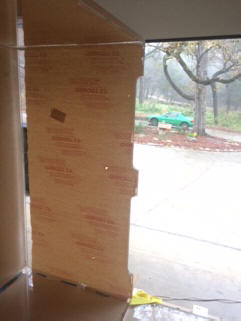 cutouts on right vertical
 |
|
Acrylic Aquarium Question- help
10/25/27
Hello-
<Howsit?>
I’ve been reading your forum on Acrylic seams, cracks, etc and wanted to ask Bob
Fenner a question. I can’t see where to post a question and was wondering how to
reach him? I just built my first aquarium, it’s 300 gallons and I have some
concerns about the seams that I wanted to ask him. Can you advise where to ask?
<This is it mate. Please ask away. Bob Fenner>
Thank you!
David
Re: Acrylic Aquarium Question- help 10/25/27
Hey Bob! So, like I said I just finished my first build, of a 300G acrylic for
my home. It’s 1” acrylic on all sides and 1/2” on the top and bottom.
<? I encourage folks to have tops, bottoms of acrylic tanks at least the
thickness of the rest... thicker if the tank is tall>
It will be set on top of a solid wood stand with a 2” thick concrete countertop.
Dimensions are 72x24x30. Everything was cut with CNC machine and all the pieces
are square/plumb, etc.
<Good>
All my sides came together perfectly and my top went on perfectly... my only
concerns are with the bottom piece. I did the bottom last, and with all the
weight (even using the pins method) the weld-on #4 didn’t create solid clear
joints like everywhere else. There were like 5-6 spots total around the whole
base where it created pockets that sealed and I just couldn’t wick it in there.
Doing this over, I think I would’ve used the 2-part epoxy, but overall the
solvent did really well considering it’s 1” thick acrylic. So, all things
considered I’m happy that the joint pockets happened on the bottom piece rather
than the corners or the top (I think?) take a look at the attached pics and let
me know your thoughts. Would a catastrophic failure be possible if only the
bottom seams are like this, since it’s fully supported underneath? Like I said,
90% of the bottom piece is good, but there are several pockets that are there.
Thank you for your help!
David
Ps. After reading all the forums, I realize I could have added doweling if need
be, but I already added a thick bead of #16 around all the bottom seams for
extra support. I filled the tank twice and let it sit for a couple days and had
no leaks, no movement, no cracks or hazing, etc.
<Mmm; okay... IF there is further concern (or reason for concern!), I would add
the doweling all around the inside bottom. Bob Fenner>
|
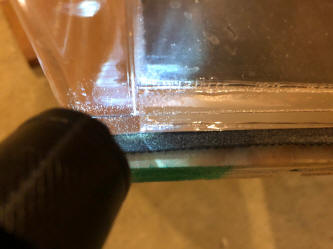
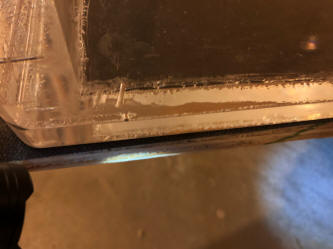 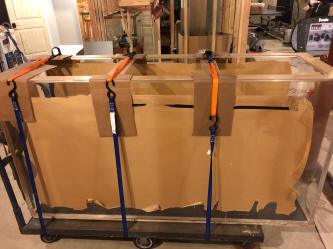 |
|
Acrylic Viewing Pane 3/25/17
Hi all,
<John>
I am hoping to have built a 2.8 metre by 2.8 metre by 1.5 metre high cement
panel aquarium. The viewing window will be about 2.8 metres long by 1.5
metres high. Viewing window supported around all 4 sides by cement paneling
with rebate. Can you help with an estimate of the thickness of acrylic
window.
yours
John
<Yes; depending on the quality of the acrylic sheet available and your
adverseness to risk and bowing, 60-70 mm... Here's a handy calculator:
http://diyfishkeepers.com/AcrylicThicknessCalculator.htm
John Wilkins
Rural GP
Cygnet Tasmania
<Bob Fenner, San Diego, CA>
|

Top view

Front viewacrylic thickness
further query 6/6/17
Hi Guys …. thanks for your reply .. you linked me with your acrylic
calculator. I have indeed previously used this calculator on my specs.
<Okay>
window 1.5m height, 2.75 m length... your calculator suggests thickness
6.6cm
However I still have some queries about this result
I understand that the calculator assumes an all acrylic aquarium
My build is 2.8 metre by 2.8 metre by 1.5 metre high cement aquarium.
My intended viewing window is supported around all 4 sides by cement
paneling with rebate for the acrylic pane.
My question is … does this 4-sided cement support change the required
acrylic pane thickness.
<IMO/E no; I would go with as thick as you can afford; a minimum of 6.6 cm.>
I have worn myself out reading so many discussions on this subject … my
brain is getting a bit frayed around the edges.
<A few pertinent notes: There is a definite "spectrum" of acrylic quality...
some are softer, given to more/less bowing, scratching, clarity, uniformity
in thickness....>
I am hoping your experts can give me your definitive estimation of the
thickness I need for this project
yours
John
<If this were me, my project... thicker. Bob Fenner>
Re: acrylic thickness further query
6/8/17
thanks for your reply. I will make sure the viewing pane is of the best
quality acrylic. Bob Fenner... so if if was your project ... exactly what
would you ask for ... thickness and quality
<Best quality available and at least 2.5" thick; a note: 2" if good glass
available rather than acrylic>
Cost is not an issue at all .. I am budgeting $150,000 for the whole
project. My engineer would really like an idea of the viewing-window specs
as it is not his area of expertise. I have attached a diagram for your
interest
John
<You sent this w/ your orig. query. Cheers, Bob Fenner>
John Wilkins
Cygnet Tasmania
|
Acrylic tanks
11/18/14
I want to attach two acrylic tanks together to make one large tank. Is
this possible? How should I go about doing this? Danielle
<Mmm; either by cutting off a side from each tank, or drilling a hole in
each and connecting them with a cylinder of acrylic... See WWM re the
use of solvents with acrylic. Bob Fenner>
Q & A about acrylic 11/19/13
Thought this was interesting Bob, might want to share it.
http://distributionbizwiz.wordpress.com/2007/08/23/acrylic-q-a/
Jamessales-3@orphek.com
<Ah yes; will do. B>
Mixing and matching acrylic thickness
11/6/12
Hello, I know you guys have answered a zillion questions about acrylic
tank construction and hope you have time for one more. I'm building one
using 1.5" Polycast GP dimensions 120x36x36 and was wondering if I would
be able to get away (safely) with using 1.25" thickness for the bottom.
<I would make this bottom the same 1.5" thickness>
Although I've seen tanks this size use thinner material I really want to
minimize bowing and have some 1.25 in the garage that is a few years old
Id like to make good use of.
<I'd use it/this for the top instead>
I will probably use #4 vs. #40 because I'm not able to anneal this tank
and will be assembling it on site. Do you think Weld-on #4 is ok for
something this size?
<Should be>
Thanks for all of the help you've
provide in the past.
<Welcome. Bob Fenner>
Please Help/DIY/Acrylic Refugium 1/25/12
Hello
<Hello Scott>
I got your site from a friend of mine. I am building a 35gal refugium
for my 75gal reef tank out of 1/4" lexan (polycarbonate). The only
thing I need to know what glue or cement to use to assemble it ? I have
asked so many people but nobody can say for sure about it and don't
want any toxins in the water. This is probably a stupid question to you
guys but if you can help that would be great !
<The Weld On brand of acrylic cement is what you need.
It's available in different viscosities depending on how fast you
want it to set up. Marc Levenson has a tremendous amount of
information on his site as to working with acrylic.
http://www.melevsreef.com/allmysumps.html>
Thank you for your time
<You're welcome. James (Salty Dog)>
Scott Early
DIY Aquarium, Lg. Acrylic 1/31/11
Hello Crew,
<Hello Tina.>
Once again I am back to ask more questions. I am in the process of
designing an aquarium for my husband to build me (He is a carpenter,
but never built an aquarium). Its going to be about 350 gallons; the
dimensions are 96 long x 36 wide x 24 tall. The design is a bit odd and
I have never seen one constructed this way, but I have a couple reasons
for it.
<Hmm, I have built a few of similar size and it is very nice! But
this is way too big a project for a first aquarium, I do hope he has
acrylic experience. I would check around with local clubs or forums to
see if there is somebody that has done this before that can assist
here.>
To start, the actual aquarium will be constructed from acrylic. I would
like your advice on the thickness of the acrylic. I have done a lot of
research and found so many different answers for this question. I
was
thinking 3/4" inch thick, but I have read people using ½
inch.
<Definitely the thicker of the two for this dimension. Some would do
this in 1/2", but the tank would bow, be quite unsettling.>
I also wanted to know what weld on product number you recommend? I was
going to order weld on
# 4, but I wanted to make sure before I order it.
<Would be my choice, with some #16 to fill any gaps you may end up
with.>
Do the corners of the acrylic have to be bent?
<No, with these dimensions you would be hard pressed to find a sheet
large enough anyhow.>
Or, could they just be bonded together with the weld on flat surface to
flat surface?
<Yep.>
Can I spray paint the back and two sides of the outside of the acrylic?
If so, what paint do you recommend?
<I know many have used Krylon Fusion for this, but I personally
would simply use a water based roll on paint such as basic
latex.>
The top acrylic will be 4 around the top, and 3.... 4 braces going
front to back. Should this
all be one piece? Or, can it be done with scrap pieces?
<It can be done with scraps, but one whole piece with a large radius
in each corner is better. With the scrapes you end up with 90 degree
corners where the supports meet. That is a high stress point and can
lead to failure.>
Now the odd part is I have designed a 3/4 plywood frame for the bottom,
1/2 plywood for the complete back and both sides. The front will be
framed 4 all around. The plywood will have 2x4 beams vertically every
12 and horizontally will have a 2x4 top and bottom beam. They will be
glued, nailed and have metal brackets. Installed on the outside of the
beams will be a decorative painted wood.
<Are you talking of framing around the aquarium or under it? If
around I would really take a look on the net for plywood tanks with
just an acrylic or glass viewing panel.>
Should the beams be closer?
<Every 12" is more than enough.>
Is the thickness of the plywood going to support the acrylic any
better? Or will there be a problem? Would you recommend thicker
plywood?
<The thicknesses you list will be fine.>
Should I put something between the acrylic and the plywood?
I was thinking of using foam insulation, would that be ok to use?
<Is exactly what to use, the rigid Styrofoam type.>
What would be the safest paint to use on the exterior wood? I wanted to
use interior latex paint, but I want to make sure it will be safe.
<Just fine.>
This aquarium will be on the first floor in my home. My husband is
going to reinforce the floor by framing support beams in the basement
under the tank. The tank stand will also be built by my husband.
<Ah, so I do take the above regards framing around the tank. With
the dimensions you list and the thicker acrylic there will be no need.
If you are going to frame it in I would simply go with thicker plywood
all around and search the net re plywood tanks.>
I am not sure where to start with the stand, my husband was thinking of
framing it with 2x4 every 6, would that be suitable?
<It will more than enough. No need for every 6".>
If so, should he do that throughout the whole inside of the stand?
<No, but would be beneficial to have some cross beams at the top to
support the plywood in the middle.>
Or, what would you recommend?
<Take a look at the tank and stand calculators on GARF.org. I
don't agree with it all, for instance it will recommend 1/2"
for your tank because it is 24" tall (there are other factors),
but it will give you the basic idea on assembly and stand
construction.>
I hope you can understand my aquarium design. I am hoping the plywood
will make it sturdier.
<I do and would like to reemphasize, this is a huge system to build
as a first project. At the very least get some acrylic scrap to
practice with!>
Thank you
Tina
<Welcome, Scott V.>
Re: DIY Aquarium, lg. acrylic, plywood now
1/31/11
Hello Scott V,
<Hello again!>
Thank you for your quick response.
<Happy to help.>
You have made it very clear that this is too big of a project for the
first timer.
<I speak from a very assorted mechanical background and bad
experiences!>
I assume you mean the acrylic tank, and the plywood tank of this size
would be safer for a first
timer.
<I don't like these tanks, is just my personal taste, but they
have become very popular due to cost and ease of fabrication IMO.
Especially with your husband's background, I really think this is
more appropriate.>
I originally wanted to do the plywood tank, but I was worrying that it
may not work. My biggest concern is my fish being safe.
<They work great. In some ways (especially if fiberglass
reinforcement is used) they can be much more durable.>
My husband was going to practice some with the acrylic, but if you
think our best bet would be the plywood tank. Then thats what I will
have him do, I am going to do more research on plywood aquariums, but I
still would like your opinion on a few things.
<Sure. I can tell you as somebody that has done acrylic work for
many years now, I am still hesitant to take on big projects like this.
There is just too much stuff you do not learn until it is too late.
People look at the cost of Acrylic and the "ease" of
fabricating. This leads to many "I built it myself" type
stories in the forums. Well, let us wait and see.>
If we do the same dimensions 96L x 36W x 24T, what type of plywood?
Will 3/4 plywood with the framing I explained in the last email work
fine?
<Yes.>
I read DIY aquariums on GARF.org, it shows to put glass in the plywood
tank to use aquarium silicone; will that work if I use a sheet of
acrylic?
<It will. Really silicone does not form a mechanical bond of any
significance with plywood, marine resin or acrylic. It is merely a
sealant. Water pressure holds it in place. For my money I would go
glass for a viewing panel here. Cheaper, more scratch resistant and the
problem with glass (edges and precise dimensions relying on others)
does not really come into play here. That is unless you suspect you
will have Babe Ruth in there swinging something.>
If not, what should I use to bond the acrylic to the plywood and have
no leaks. That site also said for my size to use 1/2 glass, does that
also go for the acrylic or do you still suggest the 3/4? GARF.org gave
some great information on the proper epoxy to use that will be safe for
my fish.
<Oh yes, the calculator is great for this stuff. With both acrylic
and glass (there is a plywood with acrylic choice) they recommend
1/2". I would go with that for glass, but still 3/4" for my
taste in acrylic. Fact is minimum acrylic thicknesses, while they do
work fine, will bow out in the middle and look unsightly. It kills me
to constantly read from manufacturers of acrylic tanks that acrylic has
less distortion than glass, then they build it out of a thickness that
makes it look like you are viewing your tank from a globe type
fishbowl. But again, that is just my opinion, I hate bowed and wave
front tanks for the same reason. I refuse to own or install those.
People ask me to and I say no. Few are happy with them, even far fewer
buy the same again.>
Are plywood aquariums dependable?
<Yes, very much so when constructed properly. With a carpentry
background your husband should be more than capable. The waterproof in
mostly just a bit of busy work!>
How long do they usually last? Should the epoxy be reapplied every so
many years? Or, is it durable for
a long time? In your opinion, how safe are plywood aquariums?
<To all of the above, I really have no issue, nor have seen any, so
long as the look is what you want. I just personally like the whole
front at the least opened up for viewing. If a "viewing
window" is a look you like I would not hesitate a bit to do
this.>
Thank you so much for your time,
Tina
<Welcome!>
Re DIY Aquarium, Lg. Acrylic 1/31/11
Hi Scott,
I might add that Marc Levenson has a tremendous amount of information
on his site as to working with acrylic.
http://www.melevsreef.com/allmysumps.html
James
Did I Mess This Up, Lg. acrylic tank bowing
9/8/10
Hello WWM
<Hello Josh>
Question on acrylic aquariums. I purchased a 500 (more like 480) gallon
acrylic aquarium. I checked the bonds all around it and all are solid
with no gaps/hazing/bubbles etc. I was actually impressed with the
seams. The tank dims are 8 x 3 x 32 inches. Here's where I got a
little uneasy. I test filled the tank and it bowed about 1/2 to 1 inch
(eyeballing here). Upon
inspection I noticed the material was 1/2 or 5/8 inch!!!!! All I've
seen with most tanks this size is 3/4, but they were 36 tall? Am I in
trouble here? Again no major stress signs just normal wear, and the
seams are solid. Did I just buy a 500 gallon sump?
<All large tanks will have some bow in them when filled and is not
cause for alarm. I'm guessing this tank was previously owned and if
the original owner had no problems, you should not as well. But to be
on the safe side, how about sending us a pic of the tank (filled) taken
from the top.>
Thanks
<You're welcome. James (Salty Dog)>
Josh
FW Ray... hlth. 12/30/09
Hey guys I was checking around your site for some information before
wasting your time with questions so I'll keep it short. I have a P.
reticulata ray and it seems to have lost a lot of its tail during
transportation (the stingers are basically a cm from the tip of the
tail).
It's not injured any more, but I was wondering if the tail would
ever regenerate?
<Often times can/does... "if" the area is not
"too" decomposed back>
The specimen is still small around 5 inch disc diameter. The other
question was I need to design a final custom tank for her and had a few
questions. I've heard acrylic was lighter than glass but hard to
work with,
<Not hard, just different to cut, anneal (rather then glue)... have
done extensive work w/ both>
plus I like the no shattered glass aspect. Are acrylics hard to
seal?
<No>
Would you recommend acrylic or glass for a large shallow ray tank
6'x3'x18"?
<Acrylic over glass myself>
Finally would a tank this size be able to be supported by a standard
floor (1st or second story) due to the surface area spreading the
weight or would I be better off on the concrete basement floor?
<Yes... think of the weight per square foot, inch of a lady in high
heels... may need to have the stand/base shimmed to level. See WWM re
both material use in tank construction and stands...>
.....Thanks in advance for your time.
Sorry I just remembered one more thing...Does Potamotrygon
reticulata
possess 2 stingers or is the second one a replacement for the 1st as it
is shedding off?
<... One... are you referring to claspers? Bob Fenner>
Re: ray...sorry last email was an accident... Acrylic tank
const. 12/31/09
Thanks alot
<There's no such word>
for your help..sorry for confusion I accidentally sent the last
email
before typing anything. You better be getting paid for answering
questions
<Nope. Something of much greater and lasting compensation; the
knowledge of having help others of earnest need, desire>
because you obviously know what you are talking about. When you say
annealing acrylic tanks I have a few questions. Would this be
accomplished with a heat gun?
<No; solvent. Read here: http://wetwebmedia.com/diyacrylic.htm
and the linked files above>
The FAQs I've read about acrylics involve sealant
<Not sealant... as in, there's nothing "left" between
joints>
rather than heat. I'm assuming attaching them by essentially
melting them together would create a much better seal (assuming I
don't end up creating gross melted uneven corners).
<There is such a process as "sonic welding" of large
acrylic panels... as in for large, mainly public aquariums; but in your
case solventing is what will be done>
I forgot to ask would a 6'x3'x18" acrylic need center
bracing <... depending on the thickness of acrylic used>
or is there enough surface area already?
<Enough for what?>
And finally to clarify "> Sorry I just remembered one more
thing...Does Potamotrygon reticulata
> possess 2 stingers or is the second one a replacement for the 1st
as it is shedding off?
> <... One... are you referring to claspers? Bob
Fenner>"
I meant the stingray is apparently female but has two stingers on
it's tail. Is this a species I.D. characteristic or can many
species possess more than one stinger during part of the shedding
process (i.e. will she lose the second stinger). The further back
stinger appears to be partially unsheathed from stinging or maybe the
stinger shedding process that I'm not 100% familiar with. Once
again thanks so much -Nigel
<Yes to the shedding of multiple stingers. Usually there is one
functional, with one more growing to replace it. BobF>
Building my own acrylic aquarium 9/23/09
To whom it may concern,
I have been reading over your FAQ's on DIY acrylic aquariums all
night.
I just have a few questions if you don't mind?
I plan on building an acrylic aquarium that measures 96Lx48Wx24H.
According to the garf.org website it recommends that I use 1/2"
cell cast acrylic.
<Or thicker... the 1/2" is going to bow a bit in the middle of
the long panels>
After reading over your FAQ's I came across a response were it
stated that if the aquarium is wider that 32" the thickness of the
acrylic must be at least 3/4" thick.
<Yes>
Upgrading to this thickness is out of my price range. Would 1/2"
acrylic suffice?
<If the bottom is sufficiently supported (as in 4 by 4's) yes...
just the bowing in the mid front and back panels...>
When building the acrylic aquarium do place the walls of the aquarium
on top of the bottom acrylic sheet or do you place the walls on the
side of the bottom sheet?
<On top>
I do apologize if you have answered this question already. I must have
overlooked it when I scrolling through FAQ's.
Thanks for all that you do!
Brent
<Glad to help. I would get some help here from folks who have
acrylic experience. Not hard work to do, but easy to make simple
errors. Bob Fenner>
|
Acrylic pipe for an aquarium, RMF's go
7/14/2009
Hi,
I am interested to build an aquarium using acrylic pipes. This
aquarium will be filled with water (the aeration of the water
will take place in another tank) The diameter is 30 in. and the
length is 50 ft, divided in 10 sections of 5 ft length.
<Interesting>
The simple thing would be to buy the pipes, but I could not find
them. The dimensions could be modified, if there are some
commercial options available.
+ Do you know if there are commercial suppliers of acrylic pipes
for this diameter?
<Mmm, I do not... But I do think this could be
fabricated...>
The option I am currently exploring is to bend 20 pieces of cell
cast acrylic sheet (see attached file) and I have the following
questions: + to calculate the acrylic sheet thickness, I should
only consider the water
column height, which is 30", so the adequate thickness is
3/4"?
<I think you could get away with 1/2">
+ in order to assure no leaks, would it be better to glue the
joints, or to follow a solvent welded process?
<Solvent or sonic>
+ which type of support would you recommend for this design?
<Something sturdy... bead-blasted steel rod, with a
"V" shaped support at the bottom>
+ in addition to visual inspection, is there any other method to
check for cracks, bond failures, or crazing, as a preventive
maintenance program?
<There are non-invasive techniques...>
Thank you.
Francisco Velázquez
<I'd contact Reynolds re:
http://www.reynoldspolymer.com/
Bob Fenner>
Tubular Aquarium. MikeV's go
7/15/2009
Hi,
<Hi Francisco.>
I am interested to build an aquarium using acrylic pipes.
<A different approach.>
This aquarium will be filled with water (the aeration of the
water will take place in another
tank) The diameter is 30 in. and the length is 50 ft, divided in
10 sections of 5 ft length. The simple thing would be to buy the
pipes, but I could not find them.
<There are several facilities that can get it for you. here is
one:
http://www.spartech.com/townsend/acrylic_tubes.html>
The dimensions could be modified, if there are some commercial
options available.
+ Do you know if there are commercial suppliers of acrylic pipes
for this diameter?
<Yes, see above.>
The option I am currently exploring is to bend 20 pieces of cell
cast acrylic sheet (see attached file) and I have the following
questions: + to calculate the acrylic sheet thickness, I should
only consider the water
column height, which is 30", so the adequate thickness is
3/4"?
<You can go a little thinner as it is tube and pressure is
applied evenly to all surfaces. you should be able to use
5/8" (16mm) + in order to assure no leaks, would it be
better to glue the joints, or to follow a solvent welded
process?
<Solvent welded.>
+ which type of support would you recommend for this design?
<That is largely dependent upon where the tank is going to be
displayed At a minimum, supported at each joint and midway
through each span.>
+ in addition to visual inspection, is there any other method to
check for cracks, bond failures, or crazing, as a preventive
maintenance program?
<None that are user friendly that I am aware of.>
Thank you.
Francisco
<My pleasure, MikeV>
|
 |
Re: Acrylic pipe for an aquarium 7/15/2009
Thank you Bob.
<Welcome Francisco. Please do send along some images of your
project... In fact, do consider writing up your experiences in an
article for sale to the pulp and e-zine outlets in our interest.
Cheers, Bob Fenner>
Re: Acrylic pipe for an aquarium 7/15/09
Thank you Bob,
it may take some time for this development, as there are many
uncertainties, but certainly it would be a very good article. I
will let you know.
<Thank you>
One more question. If I need an acrylic tank, lets say around 30
inches in diameter, and 44" height, constructed with a cast
acrylic sheet, thermoforming: is a thickness of 9 mm
adequate?
<Mmm; I'd rely on the fabricator to tell you... but would
go with 12 mm minimum myself>
The seam will be welded along the length. The tank will be filled
with water.
Would it work to put a steel belt around the reservoir to add
mechanical strength and avoid a thicker acrylic?
<No; not a good idea>
I know the optics of the acrylic is affected, but this tank is
for a laboratory.
Best regards,
Francisco
<Do contact Jim Stime, a friend who does such custom installs,
large round acrylic... re... I'm cc'ing him here.
BobF>
Re: Acrylic pipe for an aquarium 7/15/09
Hi Bob and Francisco,
Cylinder tanks are very very expensive. I have known of three
cylinder tanks in the LA area. Two of them were seamed and they
both split their seams. One was local and flooded a surf clothing
shop, the second I only heard about.
The third is a 'spun-cast' seamless cylinder that I
installed myself locally ( 44" diameter X 66" tall ).
You can see it in many of the LA Fishguys aquarium reality video
shows on-line.
If cost is an issue or you have an area that would not be
affected from a seam failure of the tank then go for the seamed
version. If you have the money and are looking for a safer tank I
recommend the 'spun-cast' version. Note that this version
has specific predetermined diameters and depending on who your
vendor is you may be forced to buy a certain length / height as
well.
Jim Stime, Jr
805-241-7140
Aquarium Design - www.aquarium-design.com
MyFishTank.com - www.MyFishTank.com
Midwater Systems - www.Jelliquarium.com
LA Fishguys - www.LAFishGuys.com
<Thanks much Jim. See you soon... IMAC west I guess; end of
the mo. BobF>
|
|
A Good Laugh 09/20/09
I was looking at my website today and found this thread. One of
my sites members Chris, ( a really nice great guy btw ) was DIY
ing a sump for his reef tank. After completing the sump (and
eating dinner) he realized that the 2 containers he had used to
hold the baffle in place were sealed inside. The look on his face
is priceless. lol A Jenkins
<Wot a hoot! Am sure SeaChem will be happy to see another ap.
for their line... Heeee! BobF>
|
 |
Thank you in advance... Your site is great! Acrylic
sourcing 4/11/09
Hello,
<Ryan>
Do you happen to know of a one stop shop supplier (with a variety of
colors, etc.) of acrylic plastics close to Minneapolis, MN?
<Mmm, I do not, but I do have some ideas...>
Sorry for such a boring question! I keep finding wholesalers, and none
seem to be specialized in plastics. I only need a little bit once in a
while because I'm a student. Perhaps 24"x24"x1/16"
to 1/4". Any suggested
online sites with good prices and staff will also be considered. Thank
you...
I will be making small scale architectural models and will be cutting
with a laser.
<Neat!>
Any advice on which Weld On formula (or other) would be the best?
<Likely #16 here>
I would like it to set very quickly for small pieces, without clamping
if at all possible. I will also want to use a syringe like applicator
so it doesn't get too messy. Thanks again!!!
Ryan
<Take a look in the on-line and in-print "Yellow Page"
directories... In a town of such size there are likely a few outlets.
In this thickness, even the larger "hardware stores" (Home
Depot, Lowe's) will likely carry sheet for resale. Bob
Fenner>
Thank you in advance... Your site is great! ScottV chimes
in 4/11/09
Hello,
<Ryan>
Do you happen to know of a one stop shop supplier (with a variety of
colors, etc.) of acrylic plastics close to Minneapolis, MN?
<Mmm, I do not, but I do have some ideas...>
<<I have a few, but for the quantity you are talking about you
may be better off going to a local store and buying "scrap"
material. Even Home Depot or Lowes carries an extruded acrylic that
machines better than some of the cast acrylics out there.>>
Sorry for such a boring question! I keep finding wholesalers, and none
seem to be specialized in plastics. I only need a little bit once in a
while because I'm a student. Perhaps 24"x24"x1/16"
to 1/4". Any suggested
online sites with good prices and staff will also be considered. Thank
you...
I will be making small scale architectural models and will be cutting
with a laser.
<Neat!>
Any advice on which Weld On formula (or other) would be the best?
<Likely #16 here>
<<If this is indeed laser cut, to a good point of precision, do
use #3 for a fast setup. Scott V.>>
>>Oh! Want to state my reason/rationale for the #16... I have
found that folks who are very new to acrylic work need more time,
jelly-like solvent, even if the pieces are "jointed" or
precision-cut... RMF<<
I would like it to set very quickly for small pieces, without clamping
if at all possible. I will also want to use a syringe like applicator
so it doesn't get too messy. Thanks again!!!
Ryan
<Take a look in the on-line and in-print "Yellow Page"
directories... In a town of such size there are likely a few outlets.
In this thickness, even the larger "hardware stores" (Home
Depot, Lowe's) will likely carry sheet for resale. Bob
Fenner>
Cylindrical tank. Acrylic des. 11/14/08
Dear Crew, Hi! I am a big fan of your website and truly appreciate the
help and information you are giving everyone. I am building an Acrylic
aquarium which is cylindrical in shape. It is of 8mm thickness(5/16th
of an inch) thickness which is a little over a quarter of an inch. The
diameter is 28 inches. What is the maximum height I can make it without
having the aquarium break. The acrylic is going to be die cast type not
extruded. Also what would be the capacity of the tank in the suggested
height in Gallons. Thanks for your advice in advance. Kind Regards,
Raghav Kochhar. <Mmm, I wouldn't go over 20" in height with
this thickness and type of material... the volume... Pi R squared times
the H (divided by 231 cubic inches per gallon)...
http://wiki.answers.com/Q/What_is_the_answer_for_finding_the_volume_of_a_cylinder_8_height_and_3_base
here would be about 53 gallons, before taking out volume for gravel et
al. Bob Fenner>
| Acrylic Build Question 02/07/08 I am
currently looking into building a wood tank with a large viewing
panel on the front and a small one on one side. My question is
about the large one. Would 1" thick acrylic be good for an
86" x 48" panel? >... no< The water level would be
over the top of the panel. I have posted a picture of the tank
design (sorta bad picture). What do you think, is 1" good
enough? <Will deform too badly, fail...> The water height
would be about 60-65" total the extra 10-15" would be the
bottom bracing and some space at the top for lighting and fans.
<... how do you intend to seat/seal this viewing panel?> The
panel would be a little of the bottom of the tank so there maybe
say 5" of water then the panel for 48" then water for
another 8-10" or so above the top above the panel. A little
background on why this size tank, the only way for me to upgrade
tanks at this time is to make it fit in the spot my current tank is
in, so taller it has to be. Here is a picture of what I am thinking
http://www.marinelifeweb.com/woodtank/images/front2.jpg Thanks,
Eric <... I would use a minimum of 1 1/2" thick material
here... And read over the DIY tank making materials archived on
WWM... Am concerned re responding just directly to your query
here... as it may well be leading you astray by not addressing
other, vital issues. Bob Fenner> |
|

|
Acrylic Tank Construction Advice...Going Rimless?...Best To Consult
A Tank Builder/Manufacturer 10/03/07 Gentleman, <<Greetings
Dennis...and BTW...very capable Ladies here as well>> I am
constructing a large acrylic aquarium (50x50x30). <<This is
inches I presume?>> I intend to use 3/4" acrylic for the
bottom and sides and initially wanted to keep the top open; but
realized this probably wouldnt work. <<Mmm, no...not at this
height, with this thickness of acrylic>> At best, this would
leave a tank with heavy bowing on all sides. <<Very heavy,
yes...>> At what acrylic thickness would you use to keep an open
top and also prevent any bowing? <<Hmm...can only speculate, but
likely thicker than is practical (1.5 or more)>> If this is not
practical, then what width would you use for a Euro-brace that was
1" thick over the top of the aquarium? <<One-inch is
probably not heavy/thick enough for the Euro-brace to keep the
dimension small. I have a 30 tall acrylic tank made from ¾ material
(sides and top) that has a 7 apron around the top perimeter WITH two 10
cross-braces (8 tank). The tank does not bow, but is quite the pain to
work in so I well understand your wish to go rimless>> Regards,
Dennis <<I very much suggest you poll a broader audience and/or
speak to someone who manufactures such tanks as a matter of routine.
You could either contact a manufacturer like Tenecor, or give the DIY
forum on Reef Central a try. Tenecor was very helpful with
suggestions/advice when I wanted to make some modifications to my
tank...but then I bought it from them. The RC forum has a couple guys
who manufacture acrylic tanks who routinely peruse the forum and are
willing to answer questions/provide advice (one called Acrylics (James)
comes to mind...you might even try sending him an email or private
message). Good luck with your project. EricR>>
| Acrylic fabrication 2/12/07
Hello....I am building some acrylic fish tanks (1/2 in cell cast
36*24*24 full top panel with cut outs) and was wondering what
method you use to heat the acrylic for bending. I would
love to be able to use 1/2 inch and bend it. <Mmm... well... you
could build/fashion a heat table as we and others have... with an
element (electrical) flanked by two cold water pipes (flat)... and
a second-time piece and standards for tilting the acrylic panels up
to the appropriate angle in time... But I would likely call, use
these at a local fabricators rather than build my own for a one
time use> Also do you use shims when bonding with the Weldon 3?
<Not usually... but a good idea to use gigs or wood clamps at
least to hold all in relative place...> I have heard that using
small wire shims will raise the panel a SMALL amount. <Yes...
too much with thin material (under an inch thick let's say)>
This supposedly allows better flow of the solvent. <Mmm... not
necessary... the solvent will easily flow/occupy the gap if cut
right, fitted closely> You remove them just after applying the
solvent and then lightly clamp the panels. <... Uhh... I'd
be practicing with some "cut-offs" if I were you...
before trying the "real thing" here> I usually have
good results not using them but there are a few places on the joint
that do not appear to have full contact. <Not good... bad
cutting...> The joints do not fail but they are not crystal
clear all the way like the store bought tanks. Looking
for any tips you may have <I'd be inserting some corner
bracing...> Also how do you start building a tank? <?> I
started by lightly clamping the front. back and sides together. I
then placed that onto the top panel (upside down) that I had
already cut out for access. <Good... this is how I, and our
"old" companies used to do... for small/ish systems> I
then solvent welded the top and the sides. After that set up I
flipped it over and set it onto the bottom panel. I reached through
he top panel cut outs and solvent welded the bottom panel. Here
area couple pictures of the 90 gal I just made. <Very nice!>
I added the back panel to the black top after these pictures were
taken sorry for all the questions but I value your advise on this.
LOVE this site!!. I am getting ready to build a new 8*24*24 240 gal
tank to go in the wall <Sounds like you're ready! Cheers,
Bob Fenner> |
Re:... acrylic tank white-out seam
repair? 2/14/07 Ok so I should get some 1/2 inch
wide and 1/2 inch thick square stock to use as
reinforcement along the inside joints? <Yes, I would for sure...
Do take a close-look at the square stock... often it is only really
square on two sides... the others being convex... Of course you
want the truly square faces against the repair> Also I was
wondering if it would be safe to router the edges of
the tank so that they are a bit round and not such a
sharp corner. <Yes... as long as the joints themselves are left
intact> I was thinking a 1/8 inch or so. I
was prepping the next sheets I am using for the tank I am building
now. I used 400 wet sanding to remove any machining marks and
make a totally smooth surface to solvent weld. Hoping for some
crystal clear welds :) <Yes... Want to mention (for
you and posterity) that you might want to look into a "higher
number" Weld-On product (more gel-like)... and perhaps better
gear for cutting the sheets... should be flush, not require any
sanding...> Thanks again for the help!!
Ed
<Welcome. Bob Fenner> |
| Re: Acrylic fabrication -
02/15/07 OK I will router the edges some to knock off the
corners and I will make sure that the square stock I use as
reinforcement is perfectly smooth on the contact
sides. I was also wondering about a triangular rod that
would fit into the corners.. any ideas on that? <Have
used this as well... Will work, yes> The place that I get the
acrylic from cuts the panels to my specs but I am sure they
are not using a $200 blade either to make the edges finished.
<Mmmmm... am surprised the edges aren't more
"clean"... Do they have suggestions re sanding them
smooth?> The Wet sanding worked awesome. I now have welds that
are 99% crystal clear. <Mmm... okay> I took a 2x8
inch x .50 inch scrap and solvent welded another identical piece on
top as in a "L" shape. I then cut
1.5 inch strips of sand paper and used it as a guide
block for sanding. This worked great for keeping
me square on the edge <Sounds good> I used the
#3 because I was under the assumption that it
was the solvent of choice I have read
that the #16 gel was not as strong and
therefore not to be used for actual joints but ok for baffles and
such.. I heard the # 4 was just a tad bit slower in set
up/dry time I used a similar solvent to the #3 about 15
yrs ago when I made my first 240 gal tank. <As an important note
here... I met with friend Leng Sy/EcoSystem yesterday... he was
down picking up a good quantity of #3... Said that Weld-On has
changed formulations in recent years... the number 3 is what most
everyone uses on the west coast...> It held up great
but unfortunately was dropped during a move and suffered
some cracks. The place that cut those sheets for me used
a blade that did leave a really level edge on it.
<Good> Again, thanks so much for your input and advice. I
appreciate the time and effort it takes to do this. Ed
<Thank you for the input and clarifications. Much appreciated.
BobF> **On a personal note I have owned a Mortgage Company for
18 years so if you have any Mortgage related questions please
feel free to ask :) <And for this!> |
Re: Acrylic fab... and fab tools!
2/18/07 OK I went out and bought a nice Delta planer this
weekend. <How nice!> I can now clamp the panels
together, run them on the planer and make them all
the exact same size and finish the edges in one move :)
This thing is just awesome, what a time saver. It weighs
@200 lbs so it was a bit of a load to get down in my
basement by myself, but I won the battle :) <Oomph!> I built
the base of a skimmer I am making for a guy and the joints are
just beautiful! <Great> What is your opinion on Chemcast
Acrylic? I have read in one place from a very experienced tank
builder not to use it for aquarium use. I searched trying to find
more info but could not. <Mmm... I have heard similar opinions
from folks re this Mexican co. product... though they are
(admittedly) one of the largest producers in N. America... I have
heard, what I would couch as rumours, that it (as a general stmt.)
is "too soft"... that sometimes their sheets are
inconsistent in thickness... quality> I hope he is wrong but if
not then the 2 tanks I just built will be reptile tanks
I guess. Thanks again Ed
<Good attitude. Thank you for sharing. Bob Fenner> |
|
|
Drilling Acrylic Can anyone offer some experience/advice for the
placement of holes in acrylic tanks in relation to the seams? I'm
setting up a large reef system and I'm plumbing 1 inch bulkhead
returns (two per end) in the ends of the 3/4 inch acrylic tank. I want
to place the bulkheads as high as I can and was wondering if I can
drill the holes right next to the top seam? My understanding is once
acrylic is solvent glued it's essentially all one piece, yes?
Thanks! Eric <My general "rule of thumb" is to leave gaps
at least as wide as the cut out diameter from seams. You can adjust the
water height in the system with plumbing distal to the tank if this is
a/the concern... either ell's, tee's or valves. Bob
Fenner>
Acrylic pricing In my never ending search for better pricing
on acrylic sheet, I have noticed a great difference in pricing by web
searching. Is the only difference the competition between companies in
their area? Or are there other circumstances that I should be aware of.
<There is some local variation, but the trade in acrylic is highly
layered in terms of master distribution, volume discounting> I have
found one company out of Utah that sells a 4x8x1/2 sheet of cell cast
for about $195 + shipping (truck line) and free cutting down to 24 x 48
for UPS shipping. So far this is the best deal I have come across.
<This is indeed a deal... do check re the quality of the sheet
however... buy brand name/s if you can... as there is some important
variation in this product... some is quite flexible... some more soft,
easier to scratch> From a business point of view, are there any
lower prices out there to either maximize the bottom line or sell the
end product at a lower price than the competitor? What info if any can
you give me? Thanks again for your glorified answers oh wonderful
master. <Good questions... as I don't have ready answers (!)...
if you can deal in volume (not likely), there is quite a bit of
"wiggle room" in negotiating. Bob Fenner>
Re: acrylic pricing I emailed this company in Utah and they
wrote back they carry Lucite L, Chemcast and an import sheet. What is
the best of the 3? and are they good for aquariums? <Very likely the
Lucite L... there are specifications for all acrylic... you should
request these spec.s and endeavor to understand what they represent.
Bob Fenner>
Acrylic pricing update would I contact the manufacture
directly for the specs? <Joe, not to step in here but just wanted to
let you know some things. I'm sure Bob will also jump on this
question. Acrylic pricing is currently going through the
roof because as you know it is an oil based product. I know that the
cost of the custom tanks we've been making has pretty gone up
simply because prices of acrylic have gone up so high. Most local
plastic places will meet online prices or come pretty darn close and
its pretty standard for most acrylic places to do at least three
"cuts" per sheet. Also, generally if you buy more than one
sheet you can get them for a much better price than if you just buy one
sheet. They generally have prices for one sheet, two to nine sheets and
then nine and above sheets. Most of the specs on acrylic
brands can be found online because most of these companies have gone on
the web. But let me also make you aware of something that's out
here recently and I'm not telling you that this company is guilty
of it, just making you aware of what to ask. Make sure you know the age
of the acrylic. While acrylic doesn't really age there
can be problems with what's been on the acrylic while it is sitting
around so be sure and ask the AGE of the acrylic that these gentleman
are selling. Also, there are rumored to be problems with the
imported acrylic and gluing. I personally haven't used it so
can't tell you whether that is the case or not. One thing I look at
closely when I look at acrylic specs is the ability of light to pass
clearly through it. Just my two cents. MacL> Re:
acrylic pricing would I contact the manufacture directly for the
specs? <You could, yes. They should be available on the Net though,
and distributors have these as well. Bob Fenner> Re: acrylic
pricing I went to the manufactures websites for Lucite and Chemcast
and Lucite seems to be the better of the two products. Chemcast as far
as I can tell is an import from Mexico. <Yes. Bob Fenner>
- Building My First Acrylic Tank - Hi There,
First off, I've been addicted to your site and check the new
FAQ's daily for useful info. Anyway, I want
to start building my own acrylic tanks and I have found a detailed
instruction book on the web which shows exactly how to design right
through to how to use the solvent's properly. The only
thing is I not completely sure on thickness. Since this is
my first tank I am starting small and would like to build about a 30-40
gal tank for my 2 dwarf gouramis, yo-yo loach and red fin
shark. My problem is that the instructions say that 1/4 inch
is good enough for tanks up to I think 12 inches (I have misplaced this
valuable info right now) and 3/8 inch is good up to 18 inches
high. I have read on your site that length of a tank
doesn't matter only height but can I really build a tank that is 12
inches tall and 48 inches long out of 1/4 inch? <I wouldn't...
it's always worth while to overbuild, have a margin of error.
Likewise, the thickness will really be determined by the materials. You
can get specifications from the acrylic manufacturers that will serve
as a guide.> This wouldn't be the an ideal tank but for argument
sake is this actually realistic. I am obviously asking
because 1/4 inch is so much cheaper but it will cost a lot more to
clean up all the water when it lets go. <True.> I am still
planning to use 1/4 inch for my first tank just so I don't waste a
ton of money on a failed tank. I will build a tank smaller
with a divider (basically two separate tanks in one) for my
feeder fish (I know they're not the best but my red bellies refuse
dead food) so that one side is QT for a month and then get moved to the
"safe to eat side ". This would be about a 20-25 gal
tank. Your expertise would be greatly appreciated.
<Well... as an experimental build, I'd encourage you to hone
your skills with the cheaper materials. Tanks can be placed outside on
a flat surface and filled with a hose to see how they hold up. Once you
have your design and technique down, then go for the more expensive
materials.> The real reason I want to start building my own is my
piranhas are going to be needing a bigger tank soon (next 3-4 months)
and I would like to build a tank for them which is going to be around
60-75gal as I only have two. Thank you in advance Mike P.S if you know
of any ways to get my piranhas to eat anything but feeders that would
be great. I've tried mixing live with salmon chunks,
krill they eat sometimes, but usually they refuse and then the fin
nipping and body wounds begin. Starving is out of the
question as one has just recovered from an eye injury caused buy the
other during my attempt to starve them so they would eat something
else. They are about 4 and 4.5-5 inches long right now and
GROWING! Thanks! <Is perhaps the major drawback of
piranhas... think your plan to quarantine feeders may be your best bet,
that and continue trying to mix in other foods from time to time.
Cheers, J -- > Bonding Silicone/Lexan Plexiglas Could you
tell me if silicone will attach Lexan Plexiglas to a glass aquarium or
if you can only attach glass to glass with silicone? Thanks, Amy
<Silicone will weakly bond Acrylics, but are not to be trusted in
aquarium applications of any real size/depth. Solvents for this purpose
are the route to go. Bob Fenner> Acrylic question Hey,
WWM-ites (particularly the acrylic construction experts), <Hi Glen,
I don't know what you consider an expert. I just delivered a six
foot acrylic tank so my family builds them. Hopefully that qualifies
me.> Things are plugging right along with the 55 gal community
tank. We're stocking up, and nearing our piscine
limit. Chemistry is performing nicely, pH running 7.0-7.1
and our weekly 20%+ water changes are keeping the nitrate levels at
just over 10 ppm. We've moved the eight surviving baby
Swordtails to a 5-1/2 gal tank, along with a Panda Cory and a really
cool Mayan statue head (just to irritate my wife!)<I LOVE
IT!> In the big tank, we've replaced the fake
driftwood arch with a real cypress driftwood arrangement (for the
Otocinclus to gnaw on), and have replaced most of the fake plants with
real ones, including a line of Vallisneria, quite a Cabomba forest,
dwarf and giant hair grass, planted (huge) and floating watersprite,
java moss, and red Ludwigia and Alternanthera. We're waiting for
the plant-carrying LFS to get a red water lily to finish our live plant
assortment. <Get a dwarf lily or you might have size problems
lol.> We've upgraded to a four-foot 110-watt AGA compact
fluorescent fixture, which really makes the colors snap. The plants are
doing well with the higher light level (duh!), and I'm hoping their
consumption will start reining in the rather amazing algae growth.
<It will, I know its got to be frustrating though.> I have
roundly chastised myself for overfeeding the fish (new owner,
poor-starving-fishy syndrome) and causing the algae bloom, but I'm
going to let nature take its course (thanks, once again, to the advice
on WetWebMedia!) I haven't decided whether I'm going
to do any CO2 augmentation for the plants. Maybe in the
wet-dry, which brings me to the topic of this query. <Bring it
on!> I've designed a DIY wet-dry filter, big enough
to support multiple tanks when we get into our non-rental in a year or
so. <Ooooo nice.> The sump portion will be 24x13x13, and the
removable biotower will be 16x16x12 (biomedia capacity just over 7-1/2
gallons). 2" deep floss/media/drip tray drawer, Mag 7
pump, Durso standpipe fed by a Busko surface extractor, etc. etc.
etc. Investigating the types and recommendations for the
acrylic has me going in circles. <Ahhh that one I can help you with,
we've made many, many sumps and wet/dries.> Questions (and
please don't be gentle - if the answer is "quit obsessing, buy
the cheap/expensive stuff and build it", feel free to say so!):
<I would never say it in that way, to my way of thinking you simply
cannot do enough research when you are doing something for your
tank!> I'm leaning toward 3/8" acrylic, but 1/4" is
sure cheap! <You really do not need the 3/8, with what you have
designed you won't get any bowing. Your height really determines
the stepping up in size of the acrylic. If you keep each piece cut
under 24 inches tall you should be just fine.> I've designed in
3/8" square cross braces in the biotower and sump, to control
bowing in the longer spans of plastic. <The bowing won't be
significant enough that you'll need the 3/8ths, simply brace with
1/4 and you'll be just fine.> Total catastrophic
power-outage water load will be a bit under twelve
gallons. I know the 3/8" will provide structural
integrity and the "gee whiz, look at the pretty acrylic"
factor, but would 1/4" really work just as well? Of
course, this ignores the 5/16" and 9mm stuff! <I promise you
that it will work as well. Now just a few
hints. Route the edges because plexi is sharp and it will
cut you, if you route the edges or you flame polish them regardless of
the size it will eliminate most problems in cutting.> Most of the
tank-building sites say (essentially) not to think about anything less
than cell-cast acrylic. I've seen all the reasons why -
superior clarity, harder surface, nicer machining characteristics, etc.
In small quantities, cell-cast is danged expensive - I haven't
found it for anything under $7/sq. ft. for 3/8"
material. Continuous-cast, on the other hand, can be had for
just over $4/ sq. ft. for 3/8", and extruded less than
that. Other than the "gee-whiz" factor, is there a
compelling reason to go with cell-cast for this project? <Cast
acrylic, continuous cast acrylic and extruded acrylic are types of
manufacturing processes. Each process is made from acrylic with
different properties and subsequently show different characteristics in
the fabrication process and in the finished products. Cast acrylic is
the most dense and therefore the strongest. It also tends to bond with
the strongest seams. For aquarium applications use domestic brands
(Polycast, Acrylite GP, Plexiglas G material) I use the Plexiglas G
most frequently. Continuous cast material have a density close to Cast
materials. (Lucite material) Good for small aquariums, filters and
museum quality display cases. Extruded is an inexpensive low-density
material for Point of purchase displays, signs etc. I just don't
think with extruded that you will get the attachment you need with the
water pressure.> What will be the disadvantages if I use continuous
cast? I'm leaning away from extruded - is there a
particular brand that would justify my rethinking this? If
cell-cast is really that much better/easier to work with/more stable
over the long term/other, I can convince myself to spend the extra
money (over continuous-cast), but why spend
unnecessarily? Should I spend any time looking at Lexan or
other polycarbonates, or is that super-duper-extreme overkill?
<Lexan is beautiful but sooooo expensive. Frankly I can't touch
it here.> If you have any other suggestions, comments, guidance, or
whatever, I'd appreciate hearing them. <I think you'll be
happy with the thinner Plexiglas for this particular project.> Once
again, thanks for your fantastic site! I noticed your
"support this site" link at the bottom of the
homepage. Is it new, or have I been that
inattentive? I'll be chipping in as soon as I clear it
with the Bride. <We are trying hard to keep the site free and of
course the answers. But it takes a large amount of money to maintain
this site. I'm glad you find the site helpful and please let me
know what you do and how it works. MacL> Glen
Another acrylic thickness question Hello to all.
I stumbled upon your site about 6 months ago and now read it daily ...
a wealth of information and a joy to read. I am in the planning stages
of my dream tank: a 300 gallon (96" x 24" x 30") FOWLR
(I love angels and butterflies!) Most of the inhabitants and some
equipment will be coming from an exiting 125. I have everything
planned, including equipment requirements, plumbing diagrams, even my
livestock wish list. When I went to order the tank, I realized I had
one unanswered question. The tank is being built by a company called
Tru-View and will be made from 1/2" acrylic for the sides and top
and bottom. My existing 125 (72" x 18" x 20") uses
3/8" on all sides except the back which is 1/2". The
thickness of the new tank has me concerned. I spent several hours
reading you posts regarding thickness recommendations and am still
confused. I don't mind a little bowing, but I do live in earthquake
country (Northern California) and want a tank that will be as safe as
possible. The tank will reside on concrete slab in a finished garage /
playroom. So, is 1/2" good enough? Or would you recommend
5/8" or 3/4"? Thank you for your time. Dana
>>>Hi Dana, I'm very familiar with TruVu, and have owned
many tanks made by them over the years. They are actually made locally
not far from my house. I've also had a number of tanks custom made
over the years. What you need to be concerned with is
"thrust" which is the pressure the water exerts against the
inside walls of the tank. This is a function of the height of the tank,
and the width. As long as you stay below 26", and no wider than
say 32", 1/2" works, even if the tank is 10 feet long.
Although 1/2" is standard on certain tanks, and will work just
fine on a 24" high tank, any higher and I'd go up to
5/8". Since it's only 24" wide, no reason to move up to
3/4". It will NOT provide more earthquake resistance (I live in
California too) but it will not bow nearly as much, and it will be
stronger. The thicker the acrylic, the more surface area on the joint.
Just a piece of mind thing. In general, even on smaller tanks, I always
kick the thickness up a notch. Cheers Jim<<<
Plastics Suppliers 2/15/05 Hey all,
<howdy> Do any of the Pittsburgh folks know where I can go to buy
acrylic scraps and/or sheet material? I am looking for pieces to build
a sump. Thanks! Ed <locally is a bit expensive at places like
Cadillac Plastic if still in business. You may want to simply do mail
order. US Plastics Corp (Lima, OH... Google them) has a big inventory,
not the cheapest prices though, but great customer service and fast
shipping from OH. Anthony>
- Refugium Construction - Hi, I would like to thank all of
the crew members at WWM for all of their quick and helpful responses
they given me. I tried to search for a question similar to mine, but I
couldn't find what I was looking for. <Seems odd... I
answered a similar question not three days ago.> I am working
on a 15 gal. sump, actually it is running, but I do not have it
chambered so I can make it a refugium. I think to convert this I would
just need to seal two panels, one on each side, so that the center
would have most of the flow going over the top and not affecting the
middle chamber. My first question is, what would the best material to
use as panels? <Glass or acrylic - either will do, would use
the one that's easiest to get your hands on.> I was
thinking Plexiglas from Home Depot. <Sure.> Secondly,
is there a silicone sealant that can be used underwater without adding
any pollutants to the tank? <None that I would suggest - you
should really plan on doing this work in a dry tank.> Or am I
just going to have to drain the tank and use the sealant?
<Yes... this is your best bet.> I know that your site
recommends using 100% silicone sealants without additives, will the
silicone package say that it is aquarium safe or am I just to assume
that it is? <If you pick up the silicone from a local fish
store, you should be all set... even though Home Depot does carry
silicone that will do the job, they have too many tubes of the wrong
kind that would be too easy to grab. There is such a thing as
"aquarium sealant" that can be obtained at your
LFS.> Thank you again for your help. <Cheers, J -- >
Acrylic tank question Hello, I am building my
own acrylic tank, the dimensions are 48"W x 96"L x 48"D.
Is 1" - 1 1/4" acrylic sufficient enough to hold water?
<Mmm, well... it is... but... if this is for a "fish tank"
and there are no really pressing desires to make it this tall...
I'd cut the height down to three feet or so... much easier to work
on... and whether the setting is high/low (standing, sitting), a better
"dimensional aspect" IMO... the tank will bow pretty
noticeably even if braced... and from your website am sure you are
aware of the cost difference between the one and a quarter... or what I
would use here (if going with the four foot height), one and a half...
Worth it... structurally and from a resale point of view. Bob
Fenner> Thank you for your prompt response. Thanks, Bob North Please
visit us at: http://www.splashescreative.com/
<Neat!>
Re: acrylic tank question Bob, Oops! I
made a mistake. This is a prop to be used for a magic illusion however
the dimensions I gave you were wrong. The correct dimensions are
48"W x 96"L x 96"D. We are committed to the 8'depth
dimensions and cannot waiver from this. (I've already talked him
down from 12'). We will be using full 4'x 8' sheets of
acrylic. Do you think that the 1 1/4" thickness will hold water
and the magician without bowing or breaking? <Not worth the risk.
Our old companies used to fabricate acrylic aquariums (in addition to
other work)... and for any tank of eight foot depth I would NOT use
less than two inch cast> What thickness would you suggest? I
appreciate your promptness. Thanks, Bob North <Do a bit more looking
about... but, please... no less than two inch. Bob Fenner>
Appropriate acrylic adhesive for reef tank Hello, <Hi
there> I purchased an adhesive (Devcon Plastic Welder) for my DIY
skimmer and I have a quick question regarding any problems with this
adhesive. Will this adhesive leach any harmful chemicals
after it has cured 24 hours? Any input will greatly be
appreciated. Thank you. David <No worries... their MSDS:
http://www.tapplastics.com/uploads/pdf/MSDS%20Devcon%20Plastic%20Welder.pdf
Once cured there is none left... not a glue... but a solvent. Bob
Fenner>
Acrylic DIY supplies 6/13/05 Hello, I've been
searching on your site for some recommendations for acrylic or
plastics. I want to make a black acrylic box open in the
bottom and top with a slot in the middle to hide my Turbelle pump in
the aquarium. The question I have is where can I find a
supplier? Are the easy to find where I live, Dublin, CA or
is there one you can recommend on the internet? I'm
looking for the black acrylic. Thanks, Brent <Most major
metro areas have an acrylic supplier. Check your local
yellow pages under "plastics - sheet, rod and
tube". If you don't find someone local, do search
for the websites of commercial plastics or US Plastics. Both
sell retail online. Best Regards. AdamC.>
Acrylic aquarium construction 7/14/05 I don't know which is
the best way to hold the acrylic pieces together in order to glue them
and construct my acrylic aquarium. Could you help me? Thanks. Giannis
<Building acrylic aquariums is generally NOT a do-it-yourself
project. Special solvent cements are required, and the
joints between the panels have to be perfectly machined to
fit. There are specialized techniques for using spacers in
the joints to allow the cement to enter the joint, and then removing
the spacers to make a perfect seam. Clamps and jigs must be
used to hold the panels in place until the cement cures. I
strongly suggest doing a lot of research or leaving this project to the
professionals. Best Regards. AdamC.>
90 gal aquarium Hi. Like to say that there is some great info
on the site. <thanks kindly> Im in the process of scraping some
money together to build a 90 gal saltwater aquarium. I plan to make it
out of 1/2" acrylic. Dimensions of 48"x18"x24".
Calculator says it should be about 90 gals. Im also gonna glue in a top
brace for added support. <will certainly be necessary. And are you
working from specs with deflection tolerances of the material that
you've bought or are you just building a hand grenade?
<G>> My question is, can I build a 180 gal with the same
materials and same dimensions except the width being 36"?
<While I am not an expert on acrylic, I can tell you that glass
aquaria wider or taller than 30" cannot safely be built without a
four sided capture (welded angle iron/steel, etc). And since 1/2 glass
suffers less deflection than acrylic, a 180 will 1/2 acrylic is
unlikely to be sound without very intrusive bracing if at all>
I'd like to give my silver Pacu a little more room to grow in....
What do you think? <I agree... the Pacu needs much more room.
Anthony>
SMALL DIY Tank Dear Bob, Most of the help I can find on the
web is for REALLY large DIY tanks. I am interested in constructing an
equally small one. I am trying to go the least technical route b/c I
have limited experience with tools but always want to try. I would like
an aquarium about 10"d x 18 or 20"l x 10.5"h, and I
would like it to be lighter than glass and moveable (not while full of
water). This is kind of like a short 10 gallon-- Not an available
aquarium size. <Okay> I am wondering if I could make such a tank
out of 1/4" Plexiglas, with a wood frame. <Yes, could be
done> From what I've read, I understand that the plexi-to-plexi
bonding would require something like Weld-On. <Yes, or similar
solvent> What about bonding the plexi to the wood frame? <Only
for looks in this size, shape system. You could use a smear of silicone
to hold the wood together and to the plexi> Or is a frame not
necessary for strength of the Plexiglas? <Correct> If my project
is even possible, could you please help with a general description of
the steps that should be taken in constructing a small tank with plexi
and wood? <Measure, cut the pieces, tape or clamp the pieces in
relative place, squirt/place the solvent... let cure for a day...> I
can handle plexi, glues, wood, staining, nails and screws, but I'm
afraid I have trouble with anything much more technical than that
(marine plywood, epoxy, fiberglass tape...). <Not necessary to
be/get too involved> Thanks so much for your help. Your website and
FAQs are really helpful. I hope I can do you proud :) <You have my
friend. By being, expressing yourself. Bob Fenner> Jill Petersen
Atlanta, GA
Building Acrylic Tank Dearest WWM Crew, <Hi Shawn> The
best piece of advice I got when I asked about beginning in the marine
aquarium hobby was READ READ READ. Thanks to your site I haven't
had to go far to log over 100 hours of reading just on your site in the
last two weeks. I've kept fresh water tanks since I was a young
child and have been very successful at it, breeding everything from
livebearers to some quite difficult tetras. I've decided to start
with a small semi-reef environment to experience the basics with plans
to build a much larger than normal system in the next year. My problem
arises with probably what I figured to be the most basic of formulas
and was hoping that since I haven't found it anywhere else on the
net or your site that maybe in your all-but-omnipotent knowledge
someone there might be able to help me out. Is there a specific
mathematical formula for finding the pounds per square inch exerted by
salt water? I hope that made sense, lol, I know that water as it
pertains to aquariums exerts more force on the top of the aquarium as
opposed to the bottom, my problem is finding a formula for figuring out
what material tensile strength I need to build a specific sized
aquarium...any help you could offer would be greatly appreciated.
Sincerely Yours, Shawn King, AKA reefrookie <Yes, there is a formula
for figuring out the thickness the material should be based on the
height, length, etc. These formulas are specific to the various types
of materials, glass, acrylic, etc, and subgroups of these based on
formula or proprietary differences. Many of the acrylic manufacturers
offer product fact sheets containing this information as it is specific
to their material. I would start with the manufacturer of the material
you want to use. Craig>
Acrylic Hi guys, quick question. I am in the process of
making an acrylic sump. Had everything cut.. sides, dividers and have
all the glues ready, but I screwed up a couple pieces tonight trying to
take just a little bit off the sides (and now I need some new
pieces),!@##*...bad night. Here lies the problem. There is no place in
my town to get the thickness I was working with. So I had to order
everything to begin with. My sump dimensions are... sides
30"x16" and the ends are 16"x16". Was using
.177" or 3/16" acrylic and even had some 1/4 from another
time. The only place that sells acrylic has it in .100" or
1/10" do you think this is to thin for my sump? <Too thin for
me... unfortunately... not enough bonding surface... and will bow too
much... I would hold off till you have the 3/16" material> Will
still use 3/16 and 1/4 baffles/dividers, probably 3 of them in the
sump. Let me know what you think. Thanks again, Bryan <Patience my
friend. Bob Fenner.>
Building acrylic tank I just found your site and have been
looking around it. Very nice, I plan on looking more. <Okay> I
was trying to find a formula on how thick to make an acrylic tank. I
noticed in the /dessysfaq2.htm page you talk about 1/2" vs.
3/4" on a 24" tall tank. I've got an idea for a tall
tank, but not sure how thick to make. I had a few companies quote the
tank but some say 1/4" some say 1/2". I understand about the
bowing being reduced with thicker material but eventually there must be
a minimum thickness decided by a formula. <More like "general
guidelines... there is some "fiddling" with these rules of
thumb depending on a few factors... length, earthquake proofedness,
surface/top bracing... quality of material used (this does vary)... I
would likely go with 3/8" and maybe opt for a bit thicker material
for the bottom... 1/4" will bow too much... and thicker all the
way around is too expensive/rich for my blood> Can you tell me where
I can find this formula? Thanks, Steve Larson <Due to the
litigiousness of this society, I doubt if anyone will/can refer you to
such... I'd check out the systems made for resale, go with at least
what they are made of. Bob Fenner>
My Acrylic Aquarium Dear Wet Web Crew, I am
discouraged. After reading today's FAQs, I am concerned
that my new acrylic aquarium is under-engineered. My
110"L x 45"H x "38"W aquarium is being constructed
with 1" acrylic walls (7/8" actual thickness), 1/2"
bottom, 3/4" top. Bob's advice was to use the same
material thickness for top/bottom as walls. Further search
for FAQs on acrylic aquarium construction lead me to conclude that
1" material may be inadequate for 45" height (salt
aquarium). <Mmm, I would have upsized the
bottom... and looked into the cost of thicker material for the sides,
front, back> Is this design unsafe? <Likely will be okay if
placed on a good (strong, planar, level) stand> Am I going to be
faced with excessive bowing? <Subjectively... up to you
to decide. If you're mainly going to be viewing head-on, likely not
too bad> The top has not yet been glued on, so still have an option
to reduce height (although I'm sure at great
expense). What is the maximum recommended height for 1"
acrylic? <About four feet... the bowing question
is a matter of the "run" (length) of the system as well as
height> I'm hoping for reassurance that the existing design will
pass engineering muster. At this point, safety is a greater
concern than bowing - but I really need frank advice. <Should be
fine. Bob Fenner> Thanks in advance. Steve
Re: My Acrylic Aquarium (stand) Bob, Thanks much for your
reply. Making this kind of investment is
unnerving. Your response is reassuring, but I can see that I
now have more work ahead of me to ensure the provision of flawless base
support (stand). <Yes, absolutely critical.> I
plan to use a single layer of concrete foundation block for the stand
with 1.5" of plywood between block and tank. Concrete
blocks will provide contiguous support under tank accept for areas
where 4x1.5" bulkheads and associated plumbing run the length of
the tank. Bulkheads are planned to be cut near the
edges of the tank (leaving about 2" of material between holes and
edges). Any concerns here about stand or about placement of
bulkheads? <This whole apparatus is set on a concrete foundation? I
would use a "water level" (the tank itself) to make certain
of its planarity. Please see here: http://www.wetwebmedia.com/tksstds.htm>
Given my 1/2" thick bottom, am I introducing
significant additional risk by cutting holes for bulkheads? <Yes...
If this tank has not been assembled yet, I would have this bottom made
of 1" material. Much to say here... IF a tank of your dimensions
was built with the sides, front and back panels atop (as opposed to on
the sides) of the bottom, this would not be such a concern... but
cutting through the bottom for throughputs, and having to leave space
around these to fit plumbing... makes me uneasy. Our companies used to
fabricate acrylic aquariums as well as installing hundreds made by
others... in Southern California... where the ground shakes
occasionally. I like to shy on the conservative side here. I would
either NOT drill the holes in the bottom (and instead make them near
the top back edge) OR secure a thicker bottom. Bob Fenner> Thanks
again! Steve
Re: My Acrylic Aquarium Bob, I am grateful for the
advice. The four walls of the tank are 'resting' on
top of the bottom and are glued in this fashion. Given this
assembly technique, would bottom holes be acceptable? <Not for
me> Could I reinforce around the bulkhead underneath the
tank by gluing an additional 6"x6"x1/2" plate (thus
creating a 1" section in places where the bulkheads pass through
the bottom)? <Unfortunately no. Have seen this tried time to time...
too much likelihood of these added pieces joints failing. Bob
Fenner> Thanks and regards, Steve
Re: My Acrylic Aquarium Bob, Thanks yet again for your
response. I see your point, and I have resigned myself to
the fact that the meager thickness of the bottom leaves me with no
alternative but to formulate a different approach to plumbing.
<Yes... this tank will hold some 825 or so gallons... with water
weight of 6,600 or so pounds...> If you have any patience remaining
for me, I'll share a bit more detail about my original design,
offer a possible contingency in light of the issue above, and then
leave the door open for any suggestion(s) you might have. The aquarium
is designed to fit an available space in my home. I am
dividing an unfinished storage room in the basement with this
aquarium. Walls will be constructed to frame the aquarium,
and one half of the space will be finished as the viewing area for the
aquarium. The other half of the room (behind the aquarium) will serve
as the pump room, filtration area, work area, etc. <Good idea to
have plenty of space.> The visible area from the viewing room is 9
feet (but an alcove area actually extends several feet beyond the
viewing area). Given that my local aquarium manufacturer was
charging me for full 10 foot sheets of acrylic, I decided to build the
aquarium 10 feet long with a 1" acrylic wall divider at the 9 ft
mark and a second 1' wall at the 10 ft mark. The
intent here was to use the last foot as a sump that would enable me to
draw water from the bottom of the tank, flow into the bottom of the
sump, and then overflow into pipes 1-2" below the surface of the
sump (i.e. tank water line). This would allow me to
effectively circulate water to the bottom of the tank, draw unfiltered
water from the place where waste and detritus naturally accumulate, and
achieve the benefits of a surface draw without any visible pipes or
plumbing in the main tank. If I spring a leak in my plumbing
at any point down-stream, the tank will not drain below the level of
the surface feed pipes. The only risk to the system is
obviously the plumbing connecting the main tank to the sump (a leak
here will drain the tank). <Yes> Original Design: My original
design was based on a UG filter to draw water down through a course
gravel bed and out bulkheads distributed evenly across the bottom of
the tank and deliver water to the aforementioned sump. In
previous dialogue, you encouraged me to avoid using UG filters and
guided me towards a sand bottom. Many hours spent mulling
through your FAQs helped me clearly understand the logic of your
recommendation and convinced me a redesign was in order. Redesign #1:
Your recommendation to use a DSB now seems like the optimal
choice. The height of my tank (45") leaves
plenty of room for the DSB. I still wanted to incorporate
the principle of drawing unfiltered water from the bottom of the tank,
so I repositioned the location of the bulkheads from the center of the
tank to back perimeter. I designed a simple acrylic box
structure (full length of tank, 5"W, 4"H) that will rest on
the bottom of the tank, butted up against the back wall and resting
over the (4) 1.5" bulkheads. A small 1/8" opening
runs along the full length of this chamber and protrudes above the DSB
to draw water across the DSB, down into the chamber, out the bulkheads
and up into the adjacent sump. Bulkhead location in the
bottom of the tank seemed optimal because it would ultimately suck out
any detritus that settled into the chamber. Keeping the
chamber to the rear of the tank drove the requirement of locating the
bulkheads as close to the edge of the tank as possible. Today's
dialogue has again exposed flaws in my design. Drilling through a
1/2" bottom plate will push the limits of a marginal design.
Anything short of full, stable support for a tank weighing 7,000 lbs,
resting on a 1/2" sheet of acrylic is unwise at best - plumbing
underneath is out. <Yes> Redesign #2 Where do I go from
here? I would still like to draw water from the bottom of
the tank. I would like to maintain a very clean tank
interior (no visible bulkheads, stand pipes, etc). I could
keep this chamber concept alive by simply shifting the bulkheads to the
rear wall (as you suggested) but my objectives above would require me
to drill holes for the bulkheads leaving only 2" of material from
the bottom edge of the sheet. 1" thick acrylic makes
this less of a concern than the 1/2" sheet, but is it still to be
avoided? <If practical. You could run plumbing for the main tank
intake inside the system... with just one pipe (that you'd have to
prime and cap... coming up, over the wall of the in-tank sump... But I
encourage you to consider yet another possibility... of using space
behind the tank for a much larger sump... having the water exit from
thru-hulls in the sump area (if you'd like) with overflow and
near-bottom draw of water to the sump from the tank... and batch
processing, treating the water in the external sump... the internal one
is going to be too much trouble (1' width is a pain to get in/out
of as you'll see) and the circulation you'll want will be too
much to draw in and move through it.> Is the concept of drawing
water from the base of the tank to maximize the removal of waste and
detritus valid? <Yes... but dependent on many other factors> Does
my design concept of using a chamber buried within the DSB to
unobtrusively draw water to the sump have a chance? <Not IME> I
am open to rethinking the whole water flow design concept and would
gladly leverage any learning's from your training and
experience. Of course, the tank itself (dimensions, material
thickness, sump) offers little flexibility for change as it is
essentially complete (small consolation - no holes drilled yet). <I
see> I obviously should have done more homework before I started
this project - I thought I knew more than I did. Spending 10
years in the marine hobby from 1976-1986, with 5 years working for a
LFS, helped me learn a lot, but that education seems to be about as
useful today as my father's slide rule. "My how
things have changed". <Yes> I've learned a tremendous
amount over the past month, thanks to your website and all of the
resources present, not the least of which has been your personal
council. I've read Paletta's book and have yours on order.
I'm playing 'catch-up', and intend to learn a lot more
before this aquarium is officially launched. <You'll do fine>
Again, thanks for your ear and for your guidance to date. Regards,
Steve <I wish you lived close/r to San Diego... we have a hobbyist
club here with folks that have large systems as yours... who have gone
through similar approaches, trials... You could simply visit with them,
see what they have done. I would abandon the current design, and add a
large external sump (like 200 gallons... like a polyethylene tote...)
and likely drill the tank, attach street elbows to the bulkheads (to
adjust overflow of the main tank height... and do some dreaming,
scheming re pump choices... Bob Fenner>
Re: My Acrylic Aquarium Bob, Again, thanks for the
advice. Living in San Diego certainly has its appeal - its a
bit warmer than Minneapolis this time of year..... <Brrrrr~> An
additional external sump makes sense (fed from the small sump attached
to the main tank). I also like the idea of feeding water
from the main tank directly to the small sump through the dividing wall
(surface overflow and near bottom draws). At this point, you've got
me convinced to get rid of external plumbing all together, if possible.
<Ah, good> Is there any benefit to drawing water from near bottom
on both ends of the tank (accomplished by running a piece or two of
1.5" PVC under the DSB from the far end of the tank into the small
sump), or is drawing from only one end of the tank adequate (nine feet
seems like a long ways to pull from only one end). <Better to not
complicate things here... with sufficient water movement no worries re
detritus accumulation. Do take a read through WWM's marine plumbing
areas... starting here: http://www.wetwebmedia.com/pbfaqsmar.htm
and on for much more input on possibilities. Bob Fenner> Thanks and
regards, Steve
Re: My Acrylic Aquarium Bob, Thank you for your time and
helpful advice. This is a great website and a tremendous
resource for the hobby. <Glad we have found each
other> I'm off to read up on plumbing, sump design,..... <Ah,
good. Bob Fenner> Steve
Re: diy acrylic aquarium Thanks Bob for the quick response
re. my 72"x20"x24" acrylic thickness but it brought up
more questions. First, does it matter if the sides "frame"
the bottom panel or can they sit on top of it? <Better to build the
sides, front and back on the bottom> If they can sit on top, why
does the thickness of the bottom piece matter if it will be totally
supported as acrylic tanks should be) by the stand? <Mmm, helps to
resist shearing force... by uneven support underneath (the stand, what
it in turn sits on)... the most force is actually on the bottom>
Does thinner material (3/8" vs. 1/2") "stretch"?
<Yes, to a small extent more> I've already got the material
and am trying to avoid spending any more $$ unless I HAVE to? My wife
is rooting for no more material, but I think she will be much more
upset if 150g hits the floor! Thanks again, Scott <Agreed... if you
haven't cut the sheet and the paper is still on it, ask the
supplier to allow you to trade it in for 1/2"... This is what I
would do. Bob Fenner>
Re: diy acrylic aquarium One last question...for now. Do you
know if it would be possible to purchase 1/4" acrylic and solvent
bond it to the 3/8" to "create" a 5/8" thick piece
for the bottom (as an alternative if the acrylic guy won't exchange
3/8" for 1/2") Or am I grasping at straws that don't
exist! <The latter. Bob Fenner>
Re: diy acrylic aquarium I am making my own
72"x20"x24"h acrylic tank. I am using 3/8" for the
bottom and 1/2" for the sides. <I would make the bottom (and
top, see below) at least 1/2"> I am planning on two 1 1/2"
overflows that will be located in a 5"x20" overflow box built
into one end as this tank is sitting on a partition wall and will be
viewed from the other three sides. First, will these overflows be
sufficient if/when I gradually progress to hard corals? <should be,
yes> Second, I was planning on using 3/8"x3" strips of
acrylic to make a rim around the top of the tank with three
3/8"x5" strips used as bulkhead braces (front to back) spaced
evenly. <I would make the top one piece, route out the openings for
access> Will these "strips" be sufficient to reduce bowing
or should I get a solid piece of 3/8" and make cutouts as is
commonly done? And is 3/8" thick enough for the top? <Make the
top, bottom, at least as thick as the sides, front/back. Bob
Fenner>
How thick is thick enough? (custom tank construction) Hi, I
have read hours of great ...GREAT info on this site!. I am building My
own tank and I plan to start next week. It will be plywood and acrylic
(Plexiglas) the dimensions I would like to build will be 96" long
x 24" deep x 48" Tall, I have priced all of the items to
include the very hefty 1" thick sheet of Plexiglas.... BUT?? will
1 inch of thickness be ok? also will 1" thick plywood be enough?
The rest I can Handle through the outstanding idea's and
instructions in your site, Thank you very much, Sincerely, Michael
Waszak <Mmm, well... if this tank's viewing panel were braced
all the way around it would do, but likely bow too much (to suit me)...
I would increase the thickness of the plexi and paneling if it will fit
your budget. Bob Fenner>
Re: How thick is thick enough? Thanks bob, I have decided to
change the tank size to officially, 96x18x48. with the
4x8 foot plexi @ 1" thick. do you believe that the glass and 1
inch plywood wood with these dimensions would cut down on the bowing?
<These are the same dimensions as listed before (for the building
materials)... the width (L X W X H) is not important here... the depth
is. The "answer/response" is the same)> ( the master plan
here is really a compromise, My wife Loves LONG! and I've always
wanted a tall tank....) She plans on lots of smaller schooling fish.
fish turning wouldn't be an issue (depth)......another question i
guess would be should I drop down to 96X12x48? i really appreciate the
time you give to help people like myself. I will send you a finished
pic or 10 :-) oh yeah..It will be braced all the way around! <I
think we/I am confused here... the middle dimension you list is the
height? You can easily have this tank three feet (36" in height
made of these materials with little detectable bowing, risk of
structural failure. Bob Fenner> WHAT WE ALREADY DISCUSSED~ Hi, I
have read hours of great ...GREAT info on this site!. I am building My
own tank and I plan to start next week. It will be plywood and acrylic
(Plexiglas) the dimensions I would like to build will be 96" long
x 24" deep x 48" Tall, I have priced all of the items to
include the very hefty 1" thick sheet of Plexiglas.... BUT?? will
1 inch of thickness be ok? also will 1" thick plywood be enough?
The rest I can Handle through the outstanding idea's and
instructions in your site, Thank you very much, Sincerely, Michael
Waszak <Mmm, well... if this tank's viewing panel were braced
all the way around it would do, but likely bow too much (to suit me)...
I would increase the thickness of the plexi and paneling if it will fit
your budget. Bob Fenner>
Sump Baffles Hi All, <Hello> I have a sump
question. I read an old FAQ about an acrylic sump a guy was
making and he wanted to attach a few acrylic baffles in
it. Bob mentioned that as long as they are not structural,
you can avoid using the Weld-on product and just use silicone rubber,
the type you find at the hardware store. I got some stuff
from Home Depot, 100% aquarium use silicone, I assume this is what he
meant? <Yes> Also, since I will be adding two baffles, one for
the divider of the first chamber to the second which will go from the
bottom up about 9 inches or so with water overflowing over the top, and
another smaller one a few inches high in just in front of the bulkhead
to the return pump to prevent bubbles or whatever else, I assume these
are not going to be structural in any way. They should be
able to hold back the weight of the water without any problems, using
only the silicone. Is this correct? <Correct. Give the
Silicone a day to cure before filling the sump. Bob Fenner> Thank
you Paul
Acrylic tank building Hello to the greatest crew on earth.
<Howdy> Couple of quick ones I hope, I am considering building my
own acrylic tank. Call it 48"L x 20"W x 24'H,( 100g ?). I
was planning on 1/2" and wondered if a 3/4" x 1 1/2"
solid oak frame around the top would be adequate to prevent bowing of
the front/back. <Should be> Would you recommend any further front
to back bracing? <Yes. At least a brace front to back on the top...
or better, a solid piece with holes routered out for access...
solvented along the entire top edges... like production acrylic
tanks> Also I was planning on bending the front and sides from one
piece, if I build a jig to secure the front could I bend the sides
around a 3/4" dowel using a blow torch or would a heat gun be
better? <... careful here. I strongly encourage you to just
"butt" the corners together for this system. The heating gear
for doing bends is more involved... easy to ruin many sheets in
experimenting. Do you live near a manufacturer, fabricator that does
heat-bending? Do call, visit them first if you're still interested
in pursuing bent corners> I built my own 30g sump with 3/8 as well
as my own overflow box with good success so I think I'm up for the
challenge, any suggestions or pitfalls to look out for? <Mmm,
many... make sure your cuts are square, clean... maybe use more viscous
(thicker) solvent...> Also was planning two 1 1/2" overflows in
back corners, would this be adequate for a 40 gallon sump. I
figured this would give me about 1400 gph? <Okay> As always your
kind help is very much appreciated. <Have you considered making such
tanks for others? I sense a pet-fish entrepreneur here. Bob
Fenner>
A Small Set-Back (catastrophic tank failure) Hello, Bob.
Thought I'd share this evening's adventure with you and your
readers. My project of the past 6 months suffered a slight
set-back this evening. In the process of filling my
112Lx38Wx45H aquarium with water for it's second wet test, it
suffered a catastrophic failure. When the water was about
4" from the top, I heard the dreaded sound of a very deep thud
(sounded like ice cracking on a Minnesota lake during the spring
thaw). Upon hearing the thud, I knew immediately the tank
had failed and I quickly turned off the water. Within a few
seconds the entire front 1" sheet of acrylic gave way and my
surprised wife (who was down the hall) later described the tidal wave
of 800 gallons of water approaching her with a certain amount of
disbelief. <Oh no!> I've spent the last several
hours wet-vac' ing the carpet in the basement - probably getting up
around 100 gallons. The rest will wait until tomorrow
morning for professionals to come with industrial sized vacs and fans
to finish the job. <Money well spent> Three flooded
bedrooms and a flooded family room all have very soggy carpeting.
Storage rooms have lots of soggy boxes. The aquarium room
has holes in the dry-wall where the 6'x4' chunk of broken
1" acrylic was swept 9' across the room and into the opposite
wall. The 9' ceiling is wet where the water hit the wall
and splashed upwards. The dislodged acrylic broke a leg on a
6' ladder that was in its path as well as crushing a metal
chair. I am grateful that my kids were not in the room
watching at the time - injuries would have been likely. <Have seen
damage from such breaking tanks. Agreed> The top failed at almost
exactly the mid-point of the middle cut-out (not at a corner) which
leads me to believe the front face actually failed first. I
measured almost 3/4" of deflection on the front pane during the
first wet test. <...> On the positive side, the aquarium failed
during a test run with clean tap water. It could have failed
somewhere down the road with 800 gallons of salt water, 1,000 lbs of
aragonite sand, and with significant live stock in tow. I
choose to be thankful for the circumstances of today. <You are wise
here> I'm off to bed. Tomorrow is going to be a busy
day........ Regards, Steve Walker <Will you rebuild this tank with
thicker material... or perhaps "cut down the height with the
1"? Bob Fenner>
Starting Over (800 gallon acrylic) Hello Bob and WWM crew,
<Hello Steve> Following the failure of my 800 gallon aquarium two
nights ago, clean- up is well underway. Carpet has been
pulled up, padding thrown out, baseboards removed, industrial sized
fans everywhere, industrial sized de-humidifiers humming
away. It sounds a bit like the continuous drone of a jet
engine in our house. <Thank goodness no one was injured> The
cleaning service I hired suggested I was fortunate things are not worse
and estimated that this will be a relatively quick clean-up that
shouldn't take more than 7-10 days of aggressive
blowing/dehumidifying to complete. I'd hate to be
'unfortunate' in this situation. <Have seen, been part of
some of these cases> While much work remains to simply get back to
the place where I started this project (not the least of which is
carving up the remains of the old 1000+ lb aquarium and hauling it
away), my mind is moving towards thoughts of starting over.
<Good> My aquarium manufacturer is re-grouping and is preparing
their plan for a second attempt at this aquarium. I intend
to be a bit more involved in the selection of materials on this
go-round. Your thoughts would be greatly appreciated here
(and I fully understand that your thoughts do not constitute an
engineering recommendation and should not be relied upon as such).
<Okay> It is my desire to maintain the original design
specifications (112Lx38Wx45H). The price of acrylic seems to rise
exponentially as thickness increases beyond 1". <Yes. It
does> I believe I will find a way to fund the leap to 1.25",
but this will likely be my limit and may need to adjust my design
accordingly. <Okay. A comment re the cost of acrylic sheet... There
is a "strata" of manufacturers, distributors, dealers... and
fabricators can fit in most anywhere in this scheme... What I am trying
to say is it pays to "shop around" for the materials here...
There is a HUGE range of costs/pricing...> If I hold to the plan of
45" height, have you observed aquariums with these approximate
dimensions constructed with 1.25" acrylic that seemed structurally
and visually sound? <On this run (length) of tank, the
tallest I would go with one and a quarter material is forty inches...
really. AND I would make the rest of the tank out of the same
thickness... including the top and bottom of course> If you would be
willing to offer an opinion, I will further ask what you would consider
to be the maximum height for 1.25" acrylic and 1.0" acrylic,
respectively (while maintaining a healthy safety margin and acceptable
visual appeal)? <There are a few stipulations (set on a
flat, planar, level, strong stand... and that the cuts are clean,
square... and the solventing done "appropriately"... and
there is a factor for the length of the system... but all this taken
into consideration, 36" height for 1" material all the way
around... and forty inches for 1.25"... and for four feet of
height... 1.5"...> No worries if you prefer not to speculate on
these questions. <These are not speculations... our companies
fabricated acrylic aquariums for several years (fourteen if memory
serves)... and... yes, we tended to be overly conservative... as many
of our sales and installs were in California (where the ground shakes
considerably at times)... or sold to "unknowns" that might
have not done quite as conscientious a job in some way/s that might
compromise the structural integrity of our tanks...> I
understand they are better suited for the manufacturer - but nothing
beats the opinion of an experienced and trusted aquarium fabricator.
<Agreed> Thank you again for your valuable website and for your
willingness to provide capable assistance. I remain gratefully yours,
Steve <A pleasure to share, learn. Bob Fenner>
Re: Starting Over - Bob, <Howdy, Bob is in Brooklyn giving
a pitch, today you get JasonC instead...> Thanks very much for your
candid advice on acrylic thickness for my large aquarium re-design.
<Indeed, what a story.> Given the recent catastrophic
failure of my 800 gallon aquarium, my tolerance for risk is gone. <I
don't blame you.> A conservative design with an ample margin of
safety is the only approach that will suffice - not only for my own
well-being, but for my wife's as well - recognizing that I need to
regain her trust and support before I can, in good conscience, move
forward with another attempt. <I hear that.> Negotiations still
remain with my aquarium fabricator regarding the losses I have
incurred, but hope to quickly put that behind me and focus my energies
on plans for a (safe) 40" high aquarium using 1.25" acrylic.
<Do consider building in a margin of safety, either go with thicker
material at that height, or lower the height - just to add to the fault
tolerance.> Until that time, I hope to make good use of my second
chance at designing my system. More reading, dreaming,
planning. <Sounds good.> Best regards and deepest
thanks, Steve <Cheers, J -- >
-Starting Over - Large Acrylic Aquarium Design Hello Bob, In
our last correspondence, you recommended a thorough search of acrylic
suppliers to find the most reasonable price for 1+ inch
acrylic. I was amazed at what I found. 1 and 1/4
inch stock varied in price from $570 to $960 for 4ft by 8ft
stock. Do you believe the quality of the materials offered
varies enough to account for (or contribute to) these price
differences? <Not likely. More a matter of price
differences due to lack of competition> I have modified my
design/expectations to accept a shorter run length of 8 ft, instead of
the 10 ft used in my original (failed) design. I intend to
use 1 and 1/4 inch material everywhere. My design is
intended to maximize volume with available 4'x8' sheet stock -
96"L x 48"W (possibly a bit narrower) x
40"H. My question is as follows: If 40"
is the maximum safe height for this material, does the 40" limit
represent the true height of the water column, or the combined height
of base + walls + top? Put another way, if I use 1 and 1/4 inch base
and top, are 40" Walls acceptable (resulting in total tank height
of 42.5")? <Yes, this last> Thanks again for
your assistance. Best regards, <Bob Fenner> Steve
Acrylic questions Bob, A couple of questions for you
regarding acrylic and its use in sump/tank construction: 1) What
type/brand of acrylic would you recommend for aquarium construction.
There are many types: Plexiglas, Acrylite, Optix, etc, and I'm not
sure which one (if any of these) are appropriate for aquariums (i.e..
transmit PAR light, maintain rigidity-avoid warping, avoid
discoloration, etc). <Hmm, actually most acrylics are pretty much
the same. What people call them are more brand names then different
formulations. I am a big fan of Reynolds as a manufacturer...> 2)
What type of acrylic cement is best for capillary bonding acrylic in
aquariums (Weld-on#3 ?). <Weld-on for sure... Number three is
okay... look for/use a "gel" type if this is one of your
first tries at making acrylic anything> 3) What type of acrylic
would you recommend for filtering UV while allowing other light to
transmit freely (esp. PAR). <Again, just whatever type you can find
that is reasonably inexpensive of about the right thickness. I would
not transmit "useful" light through the acrylic... shine it
directly into the water> Lastly, I've found a fluidized bed
filter used in the shrimp aquaculture industry that's rated at
handling 2 lbs of shrimp feed per day. Any guess at how much raw live
rock this filter could handle if I used it in the curing process -
along with heavy skimming (i.e.. skimmer output set to 5 times the
number of gallons of water, with 1 gallon of water per lb of Fiji rock
in the curing tank). <A guess is "a bunch"... Shrimp are
very dirty animals to culture... I'd guess if the folks who
engineered this are saying "two pounds of shrimp feed", this
equates to hundreds of pounds of live rock. Really. Bob Fenner>
Thanks!
Acrylic Real quick. With acrylic to glass contact, the 100%
silicone I have read about in the F&Q's will work right? <I
wouldn't trust it for aquaria... but for little
troughs/trays/filters...maybe> And definitely for acrylic to
acrylic. <do use proper acrylic glue for this> About
cutting acrylic for bulkhead fittings. I have hole cutters for doors
and such. this will work fine, <yes if sharp> and put the
silicone on either side of the bulkhead and let stand 24 hrs.
<OK... but neoprene gaskets that come with many bulkheads compress
nicely and are more reliable> Great job guys, Bryan. <thank you
kindly, Anthony>
DIY info Hello <Cheers.. Anthony> Do you know were I
can get some info. on building a acrylic self-contained tank with a
sump and skimmer all in one. Thanks for your help and your time. Frank
Thomashefsky <many places on the Web... please try the DIY link on
www.ozreef.org best regards, Anthony Calfo>
Aquarium manufacture Bob, I live in Australia now and I
noticed that all the aquariums for sale here are glass. I am wondering
how hard it would be to set up a small facility to manufacture acrylic
aquariums. <Not hard. A few thousands of dollars on the low
end to a few tens of thousands for more serious investment,
production> Do you know much about the manufacture of aquariums or
do you know anyone that I could contact by e-mail who might know?
<We used to fabricate up to two inch thick acrylic tanks. Have
several friends in the trade who do this> I need information on how
the front piece is bent, jigs and fixtures for manufacture, on exactly
the type of plastic used (do they use regular acrylic or is it coated
to be scratch resistant?), <Not coated... some "brands",
makes are a bit more scratch resistant, none totally> the thickness
of plastic for various sized aquariums etc.. Do you think it would be
possible to set up a manufacturing facility? <Possible,
sure> I think that it would be too expensive to import the tanks
because they take up so much space, and the Australian dollar is very
low so anything from the USA is too expensive. <I do
understand this. We're headed that way for a few weeks next month.
Land, food, diving... a bargain>> I like the pictures that you
send out every day. <Ah, am glad to hear> Good luck, Mike
Sweet <Mike, a very good idea for you to investigate, invest your
time if serious at this point. Here on the West coast of the U.S. or
the U.K... (where friends are who will help), to learn first-hand what
is involved. Let us keep talking this over. Bob Fenner>
Aquarium manufacture Dear Bob, I knew you a long time ago at
the fish club in San Diego. Currently I live in Australia. <Ah
yes, you lucky pug. Which part?> I have noticed that most of the
aquariums for sale there are glass and look like they were made in
someone's back yard. I was wondering how hard (and expensive) it
would be to set up a small facility to build acrylic aquariums.
<Not too hard... considering/stipulated you can secure the sheet,
solvent to meld... and relatively simple tools (for a small volume of
business) like a table saw, blades for cutting plastic, clamps, propane
burners for burnishing...> Most of the small aquariums for sale in
the USA have bent corners instead of glued corners. Is that for looks
or for some other reason? <Mainly looks... (though time to make
tanks reduced, a bit stronger... like castle keeps.) heat-bending is
simple once you have the heating gear, jigs made up, timing down...>
I think that it would be too expensive to import aquariums to Australia
from the USA due to the low value of the Oz dollar. <How about the
cost of acrylic itself...? And is there some sort of market currently,
one you could hope to create... within a few years?> Do you know
anyone I could contact about this subject? I will be in the USA until
December 29. <A bunch of folks... who would likely help you
themselves. Please contact Craig DeWalt of CASCO/SeaClear:
c_dewalt@seaclear.com, check out their site, www.seaclear.com on the
net re your wishes, visit. We are old friends/associates... make that
middle-aged ones, so please do mention my name.> Are you still
living in Mira Mesa? <Yes... moved a whole couple of miles to
the north recently... sigh. But we're hauling down to the
"land down under" this March...> I was in Fiji two years
ago and went out diving with Walt Smiths' collectors a lot. They
were very friendly to me. I heard that you came out to give a
talk. <Yes, folks so nice they put up with even me...>
Unfortunately, I couldn't attend. I hope that all is going well
with you. I like your web site. <Hope to dive with you soon!
Bob Fenner> Mike Sweet
Acrylic Thickness Are there any guidelines to follow when
building an acrylic aquarium or for a 90H measurements of 48x18x24 what
would be the acrylic thickness needed? Thanks <Yes... some for
structural strength... at least 3/8" (with an annealed top that
serves as a brace), better 1/2" for the sake of cutting down of
deflection/bowing. Bob Fenner>
Acrylic Thickness I am looking into building an Acrylic
Aquarium with the following dimensions: L=48" X W=24" X
H=20" which will have a capacity of 100G. What would be the
thinnest Acrylic I could use? <1/2" with a capture/top
piece.> I would like to use 3/8" (.375 in) if possible as I can
get a good price on 48"X48" sheets. Gregory A. Maher <I
would build a smaller tank. Something in the 36" long, 30 gallon
range. -Steven Pro> <<RMF thinks the 3/8" would be fine
here... used for this height tanks in the industry>>
Most Everything You Ever Wanted To Ask/Know About Acrylic
Aquariums Dear Bob, I have tried to put all my questions in one
list. Can you help me with any of these? Thanks for your help. Mike
<<Greetings, Mike. JasonC here, and I will do my best... >>
1) What thickness of acrylic is used for 20 gallon, 50 gallon and 100
gallon tanks? <<Well... the answer depends on the actual
dimensions of the tank. On a general rule of thumb, perhaps 3/8"
for a 20 up to 1/2" for the 100 - if there were one long panel,
perhaps 5/8" or up to 3/4" for larger tanks. Probably best to
break out the calculator and the acrylic manufacturer's spec sheet
and do some homework.>> 2) Are the top, bottom and sides of the
tank all the same thickness? <<Again, this depends on the desired
dimensions of the tank. The safe assumption is that IF you are making a
perfect cube, all walls can be the same thickness. If you start
stretching the cube into a rectangle, then the assumption
changes.>> 3) Do they use regular acrylic glue or a special glue?
<<As far as I know, it's a standard acrylic glue - creates a
molecular bond.>> 4) Are the corners bent to a different radius
for different size tanks? <<Corners are bent to a different
radius for different thicknesses of material and visibility.>> 5)
Can a small tank be made that has glued corners instead of bent
corners? <<Sure.>> Why are bent corners usually
sold? <<Easier than jigging up and adhering four walls with
perfect 90 degree joints.>> 5.5) What is the radius of the bend
of 20, 50, and 100 gallon tanks? <<Depends on the
material.>> 6) Is the radius of the bend for strength or
for looks? <<Both... the material would maintain is strength for
a while beyond a bend that ceases to look clear.>> 7) Is
the acrylic bent on a specialized machine or is it heated with a local
heating element and bent over a mold? <<Depends on the
application. On smaller panels, I have seen a blow torch used. On
larger, curved aquariums a large walk-in oven is used.>> 8) Can
the acrylic be trimmed to fit after it is bent or does it have to be
bent perfectly? <<Well... the whole job has to be done perfectly.
Cuts, joints, bends, you don't really get a second chance on the
same piece of material.>> 9) Is it very hard to bend acrylic over
a mold and get a perfect bend? <<Let's just say that it is a
skill, and one that can be learned. But not so simple that you'd
get it on the first try.>> 10) Are there any special tricks that
you know that help in bending the front piece of acrylic?
<<Patience, lots of patience, that and a fairly exacting eye for
detail.>> 11) After the front piece is bent, are there any
special difficulties gluing on the top, back and bottom?
<<Well, you want the thing to hold water... it's not as easy
as it might seem.>> What order is best? <<Probably
front to the back, and then that assembled piece to the bottom.>>
12) Have you heard of someone setting up a small shop to make acrylic
aquariums? <<Uhh... Jason Kim of Aqua C comes to mind. He
makes a fine line of protein skimmers, but also makes custom tanks and
sumps. If I'm not mistaken, he started out as a one man operation.
His skimmers are quite popular, and so he's not a one-man-show any
more.>> 13) What fraction of aquariums sold in the US are acrylic
now? <<Couldn't tell you... but a quick mental survey says:
depends where you live. If you live in an earthquake zone, you might
not have a choice. Acrylic tanks are more expensive than their glass
cousins so income plays a factor.>> 14) What is the difference in
wholesale price of glass and acrylic aquariums in the US? What is the
difference between the internet price and the wholesale price?
<<I really don't have that information. You'd do best to
ask the actual wholesalers and retailers.>> 14) What are the
major advantages of acrylic? <<Two come to mind... acrylic
is a better insulator. That and it is also much more clear than glass
tanks which become more green as the glass gets thicker.>>
Disadvantages? <<There are three disadvantages. One,
price - acrylic tanks are much more expensive than glass tanks of the
same size. Two, acrylic is easy to scratch and it's easy to do with
a large chunk of live rock. This also means you need special cleaning
pads. Third, and if you keep a reef tank, coralline algae has a strong
attraction to plastics, acrylics included. This means that you either
need to clean the viewing panels constantly, or go after them with
special scrapers when you can't see the inhabitants any more like I
do ;-) >> 15) Approximately how many manufacturers of 20-100 gal
stock acrylic aquariums are there in the USA: 5, 10, 25?
<<That's a good question, but I just don't know the
market that well. I'd bet there are more than five, but not 25.
Maybe more than 10 but not many more. Just a guess though.>> 16)
Is it better to use a router, table saw or a panel saw to cut the
acrylic? <<A precision table saw with special blades for cuts.
Router for cleaning the edges. Hope that helps. Cheers, J --
>>
|
DIY Tank Hello I am planning on building a small tank to
fit in the corner of a bar. It will be made out of acrylic not
sure if 1/4 or 3/8(your advice) it shouldn't be any more then
like 30-35 gallons I think. <Can be calculated... take half
the width as the average of the side lengths... multiply it by
length, height, divide by 231 (cubic inches per gallon)... voila,
gallons> Because of the design (which I e-mailed an
attachment) I don't think bending would be possible cause of
the sharp angle or would it be better to bend the acrylic as
opposed to having cut joints. <Mmm, could be bent... or
jointed. You might have folks in the fabrication business bid on
this... look under "plastics" in your phone
directories... or on WetWebMedia.com's links pages for long
distance suppliers> Everything I have read said bend to 90
degrees and have never read anything state a smaller angle like
45 or what ever. I have a rotozip cutting tool with a acrylic
cutting bit, I was told these are one of the better tools to cut
acrylic with (Do you know?). Any info would be great... <Mmm,
not familiar with this tool/line. Not a cutting issue though...
but one of heat-bending. I would like to continue this discussion
further. I encourage you to brace this design more fully at the
surface (if it were me, I'd use at least 3/8" material
all the way around, router an oval in the top for access welding
the top edge onto the top all the way around... and would like to
chat over filter ideas... cut outs for overflows, returns...
lighting? Bob Fenner> Great site, keep up the good work, James
Re: Hello ? on DIY Tank Hello Bob, Thanks for the fast
reply to my question, I have got in touch with an acrylic fab
business here in town (Kalamazoo, MI) about bending the front and
side panel. So far it sounds like it won't cost as much to
have them do it and put it together then what it would have cost
me for the 3/8th sheet($147). <Yes... as I thought...
much better> As far as filtration I'm looking at a compact
power filter (H.O.T) type. There isn't space for a sump
unfortunately cause of the way the bar was built. I was even
thinking of trying a Skilter filter (not the best) but I had one
on a 30 gallon a few years back and it seemed to work well for
the smaller tanks. Plus it has a protein skimmer in it, But I
also have a larger one for maintenance. This will be saltwater
with mushrooms and a max of 3 fish and maybe a few low light
corals. <A shame there isn't room below for a sump...>
Lighting I was thinking of having 2x30 watt bulbs in a 03 and
10,000k combo or 2x 50/50 for the corals as the fish don't
really need intense light. There won't be a deep bed if
substrate inch tops and the live rock and substrate will be
seeded from my 40 gallon reef that I have now. Let me know what
you think about this stuff I have been doing saltwater for about
18 years, and sometimes we over look the obvious, know what I
mean? Love the website!!! <Do know what you mean (do so all
the time)... the lighting should be fine. Bob Fenner> Thanks
again, James Wesley
|
|
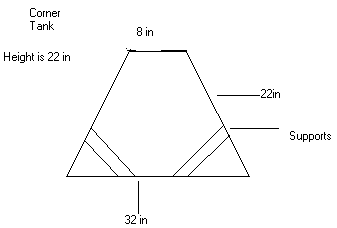
|
| Building an acrylic aquarium I was
wondering if you could help me with a few questions. I am thinking
about building an aquarium about 55 gal or so and I have read many
articles about what thickness of acrylic to use for what height
aquarium and so forth. I was wondering if you could use thinner
acrylic if you were to frame the tank with a plywood box. (please
see attached drawing) <Not really... the thickness should
be about the same or the same per height... If this is a
"typical" 55 of 22" height (or even twenty inches),
I would opt for a minimum of 3/8 inch (even half if you can afford
it)... the bracing may well help to prevent bowing, even
breaking... but the mid front and back will bow badly and result in
noisome distortion if you try 1/4... or yikes, less thickness>
For example, could you use 1/4" acrylic on a 24" high
tank in this manner. I have also read about the wood and glass
tanks but I would like to keep at least 3 viewing sides open. The
wood I could get free and the 1/4" acrylic costs significantly
less than the 1/2" so I figured I'd ask someone else what
they thought before I flooded my garage. If it is possible to do
this how substantial do you think the frame would have to be?
Thickness of the wood 5/8 or 3/4? <Not really practical here...
though I have made many (hundreds years back) of glass fronted (and
you could make cut-outs for the sides as well) and plywood, resin
and fiberglass (stripping is best here, pre-made and available in
rolls) tanks... with 3/4 and 1" ply and good brass screws (2
1/2 or three inch)> and how much of the viewing area would I
have to cover? <For the glass et al. structures, a good three or
four inch edge is good all the way around> Would it be a good
idea to pad the inside of such a frame and to give it rounded
edges? If it did work it would then be very easy to incorporate a
nice wooden hood. Thanks for you time, Great website! Christopher
C. Hehn <I like the way your mind and writing presents
it/themselves... do keep investigating. Maybe Oz' Reef:
http://www.ozreef.org/ Great, one-stop DIY site for pet-fish types.
Bob Fenner> |
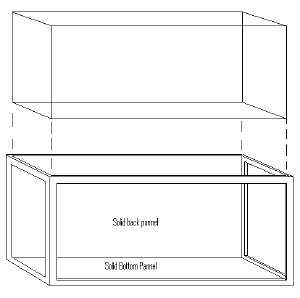 |
Plexi glass glue Hi there once again, I have a question about
the type of glue people use to put together plexi glass. <Most
folks use a commercial acrylic solvent... like Weld-On> I hear that
the best way to glue two pieces together is to use a solvent called
Methylene Chloride. <This is a principal ingredient. Toxic,
flammable, not generally available to the public.> can't seem to
find it in Home Depot or Lowe's. Do you know where it might be
available? <Check with the businesses listed in your phone
directories who sell or do plastic fabrication> I also wanted to ask
if you know whether this solvent (Methylene Chloride) can be used to
glue plexi glass+regular glass together, or is it just for plexi
glass+plexi glass? <Only the latter> On another note, I'd
like to thank you for responding so quickly, and for being real
informative. It's advise like this, that I wish I had for
everything I come across. Your help is greatly appreciated. Thanks,
Hamilton, Riverside, CA <Glad to be here helping. Bob Fenner>
Re: plexi glass glue Thanks for your help, but I'm not
quite sure about what you meant by (only the latter). <The
last statement... these solvents are only for acrylic to acrylic
bonding> Can you describe this in another way? And is (Weld On) safe
for fishes. Well I guess it is since you said everybody else uses it.
Thanks for your help. <Safe after cures (a day or so)... it actually
"leaves"... melting/melding the Plexi as one piece. Bob
Fenner>
DIY Acrylic Tanks Hi this is Abraham, my first time here.
I'm looking to utilize acrylic sheets for marine fish holding
systems. My question is how do you cement the sheets together, meaning
which material is aquarium safe? In addition, which silicone sealant is
aquarium safe? One more question, how do you figure the thickness
needed of the acrylic sheets needed for reservoirs for the sump tanks?
I understand that it depends on how much water is being held in one
given place. So for instance, a holding system of 8 feet long by 2 feet
wide and making several of these units tiered one above the other in
relatively shallow pools, no more than a foot high. For example; what
thickness of acrylic sheets is minimally needed. Understandably braces
are needed on top as well. Please try to help me out with this as soon
as you guys can. Thank you and I am gratefully appreciative of your
time and efforts. <Please begin here http://www.wetwebmedia.com/diytksfaqs.htm
and follow on through the related FAQ files for the answers to your
questions. You can also use the Google search engine at the bottom of
each page to help you locate topics quickly. -Steven Pro>
Acrylic Wall Thickness for Large Tank 7/17/04 I am building a
very large tank in the shape of an equilateral triangle. The
dimensions are 24 feet long by 8 feet to the point of the triangle by 4
feet high (or deep). It will be placed on a strong 18 inch
concrete floor. I am guessing that 2" for the sides and
1 inch for the top and bottom should hold well but I am just basing
that on my limited engineering experience. Do you know how I
could find out if these dimensions will be OK. Can you
recommend any structural engineers if I need one or is it not that
complicated if I know how to figure it out. Thanks Dimitrios
<Hi Dimitrios! I hope when you say that you are building
this tank, that you mean you are having it built. This is
not a DIY project! I would begin by contacting some of the
following: A large public aquarium, Reynolds Polymer and San
Diego Plastics. I would consult a structural engineer about
the floor. A public aquarium should be able to direct you to
large tank manufacturer (SD Plastics is one, but this project may be
beyond even their capabilities). Reynolds polymer makes very
large, very thick acrylic material for public
aquariums. They can probably direct you to a manufacturer
that deals in large display tanks. There are wall thickness
calculators on the 'net for acrylic tanks, but they only apply to
rectangular tanks. Good luck! Adam>

