|
|
| Home | Marine Aquariums |
Freshwater Aquariums |
Planted Aquariums |
Brackish Systems |
Ponds,
lakes & fountains |
Turtles & Amphibians |
Aquatic Business |
Aquatic Science |
Ask the WWM Crew a Question |
| Please visit our Sponsors | ||||
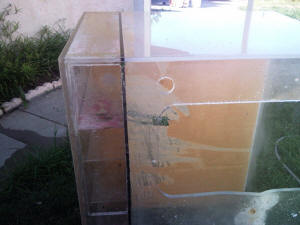
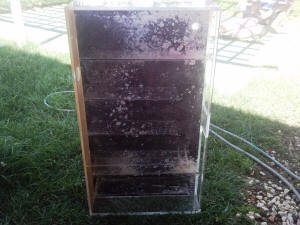
450 gallon glass aquarium with (just) euro brace ?
1/30/19
Tank question; use as an aquarium 9/16/15
Saltwater Fish Only holding systems; dis. control, set up.... MUCH to
consider 8/14/15 Re: commercial holding tank questions
5/18/13
Reef Ready Tanks vs. Standard Tanks 11/12/10 Large Reef Tank Design Questions Gentlemen - I have written to you in the past with questions concerning things in one of my tanks ( I have 4 - 1 large predator, Two Reefs, and a micro reef). I write today on a different topic and hope either you can help me or point me towards those who can assist me. Feel free to forward this to anyone you deem appropriate I'm a high tech guy or had been for the last 15 years (until this years layoffs - No I opted out instead of fighting it out with the rats on a sinking ship, you know eventually they will turn cannibalistic). Any who to make a long story short, there are 9 of us good friends and coworkers who all sold their souls for stock options and cash for a minimum of 10 years each. After opting out of this each of us was tired of the rat race of that lifestyle ( constant travel to exotic foreign cesspools - Aah vacation is so much different than work isn't it). All of us spent this time transferring the industry from the US to everywhere else it was cheaper to do it (quite a few strange places I will admit - Japan, Korea, Malaysia, France etc) so it is truly a sinking ship here domestically - We decided to form a group to build a business just for fun but that we could experience our old sense of self worth - So we created the Los Vatos corporation to build something similar to a Dave and Busters but less glitzy and more affordable to the average man (because even though each of us made 6 figures we all complained that a $250 night out with the wife and kids to have a good time is just plain outrageous). I digress though so on with it - We created this corporation and are in the process of designing our first family entertainment center with the concept of letting everybody have fun at a fraction of these other places, while introducing our hobbies / interests to the world at large (cold beer, nice cars, video games, billiards, good food, water, fish). All but 2 of us a coastal creatures who grew up on or very near the water 4 from the Texas gulf coast and one each from Northern and Southern California. The poor guy from Phoenix doesn't know what he missed). Where do you guys come into it ??? Well my partners know of my fascination with Saltwater (another partner is a freshwater guy with multiple biotope aquaria his best is a local Texas one) as such they gave me a space 40 feet long by 15 feet deep in our restaurant waiting area / entry bar to create an aquarium of large scale - Here is where you guys come in - I have this big space and a general idea of things, however I would like to do a more natural setup sliding away from technology as much as I dare to ensure my charges well being - I am collecting information on the "Ecosystem Approach" as my micro reef works this way - It had been running as such for about a year before I ever heard of it and it is generally agreed between my friends it is the best looking of all my tanks. Size constraints do not allow me to convert the other 3 tanks to this method to test it on a grander scale. All these run just as is Bob's book. In short while not on par with you or your cohorts I may actually know a couple of things, but I am smart enough to know what I don't. I've read about Richard Harker's 2000 gallon aquarium and envision it's construction along similar lines, but I wanted to pick you guys brains with the question -- <our pleasure to help> If somebody walked up to you and said here is this space 40' X 15' X 12' - I want to build and aquarium for myself - What would you do? <many possibilities here. I take great pleasure too in system planning and conceptual designs. I covered some such dynamics in the first chapter of my Book of Coral Propagation... even more dramatic designs in the second volume (early 2003). I have also consulted a few large public aquaria on top of many private systems as well. It would be my pleasure to dream with you. Without haphazardly spewing stream of conscious fantasy designs... let's do this up right. Let me trouble you to send me a simple photograph of the allotted space (or draw a diagram if you like). I'm looking to get an idea of the surrounding environment and its likely integrity/functionality with the system and its application... looking for access to drains, water supply, electricity, etc.> I eagerly await your input or direction and fully respect that this is not a question so easily answered <agreed... not in a simple e-mail. Lets see a basic floor plan or photo of layout and that will open the floodgates for the imagination. Fair warning... expect dramatic from me :p > and I also want to add I want to do this myself not to save cash in a commercial venture but more along the lines of I dream of it. <understood and admired, my friend. I believe this to be true for what so much floor space could otherwise be used for commercially. I'm looking forward to chatting more. I also noticed that you are in Texas... I'll be in Dallas 9/26-9/30 at MACNA (www.dfwmas.com). Perhaps we can chat even more there if you'll be making the trip to that great marine conference. With kind regards, Anthony Calfo> PS: feel welcome to call me at 412-795-XXXX. We can chat more So you don't think I'm a crank with nothing better to do than waste your time - Here is my personal information - (512) 257-XXXX if you call I will be happy to call you back and expand a little on things - It's tough to catch my vision in an email. 37 years old Electronics Engineering degree (specializing in the manufacture of semiconductor chips from sand to Pentium 4) XXXX North Cannes Drive, Cedar Park, Texas (Austin suburb) 78613 Ric Raley <Do not be afraid to try new things Amateurs built the Ark Professionals built the Titanic> Tank design I am building a 48x48 with full top out of .5 cell cast ,and would like to know if i can go 30" on height. I cannot find a acrylic thickness calculator or a definite on any thing. Help would be greatly appreciated since the material is on the way, and the supplier is going to cut it for me. THANKS <You could make an acrylic tank of these dimensions from half inch material, but even with an annealed top it will bow badly on all sides. For thirty inches tall and this "run" (length of sides) you really should use 3/4" material. Bob Fenner> Acrylic Tanks You guys have been so helpful and WWM has been a god send. Sorry to pester, but another question. <Never a bother- that's what we're here for!> Standard acrylic tanks that are 72" X 24" X 30" made by Tenecor are 1/2" thick. This seems a little thin, what do you think? They will make one in 3/4" but it will cost 50% more. <I'd be comfortable with this thickness, but if you feel more comfortable with 3/4", then go for it!> I was thinking to get them to change the dimensions to 72" X 30" X 24". Would this help with the thickness at 1/2"? Less bowing/cracking possible? <Well- no one can guarantee the degree to which a tank will bow once filled, but Tenecor makes very high quality products, and I'd follow their recommendations, with regard to acrylic thickness> I currently have a glass 180, which I've had for 20 years, but have vowed to never move again. So Acrylic, which you guys in all your post seem to like better. Thanks in advance. Brian <I love acrylic- so many benefits...just be careful when cleaning it so you don't scratch it, okay! Good luck! Scott F.> Deciding on Tank The penny pincher is back for more advice. Thanks for your response last week to my question regarding should I get a 125 or 75 gallon tank with the variable being the lighting. My birthday is this week and by this weekend my purchase will be made. Also, purchased your book and I love it. I have several questions though and they are as follows: 1. Any difference in tank quality based on manufacturers such as Perfecto, All-Glass, Oceanic ...etc.? I saw an advertisement on Perfecto tanks that looked pretty good and Oceanic tanks looked a bit expensive comparatively. <Perfecto and All-Glass are about the same in quality IMO, but the Oceanic product is worth the money in difference.> 2. Any suggestions/advice on tank stands made of oak, pine, particle board? I saw a good deal on a pine stand. <No to anything made of Particle board materials...> 3. Any suggestions/advice on a hood? I'm leaning towards a glass hood, so down the road I can upgrade my lighting without replacing the whole hood. My thought is that it would be cheaper to take this path. <You mean a glass "top" right? Rather than Acrylic, or? You might want to look into just leaving the top uncovered... and making, buying a hood of wood (coated), plastic construction... with a reflective interior> 4. As for lighting, how many total watts of Fluorescent lighting would I need to support live rock and hardier inverts? What's the best combination? (example 1 actinic to 2 full spectrum day light bulbs) <This can be a tricky question... 3-5 or so watts per gallon or so should do it... the proportion you state is about right...> 5. How many watts of power compacts to support live rock and hardier inverts? for same support? What's the best combination? (example 1 actinic to 2 full spectrum day light bulbs) <About the same... in terms of wattage consumed> 6. Can I combine fluorescent and power compacts and if so what is the optimum combination? <Yes, the watts consumed proportionality is not important> 7. You mention in several of your Q&A's regarding reduction of phosphates that the food source may have an impact on these levels. I checked my food sources and some do not list the make-up of food in such detail and others have what is called polyphosphates. Is polyphosphate a culprit of high phosphate levels? <Possibly... but not generally... most any food-source of phosphate period is going to be readily absorbed, otherwise taken out of any maintenance equation in an up-and-going system> I know that this is a lot of information, but I just want my investment to be a beneficial one for me and my livestock for a long period of time. Thanks in advance for your insight/advice. Nick <I understand, and you're welcome, Bob Fenner> Tank Diagram Mr. Fenner, I am sending you my second draft of my tank design. The picture shows what is planned for behind the tank and the placement of it's equipment. I'm not sure if you remember the picture I sent to you a few days ago. <I do> I showed how my equipment would be housed in our walk in closet behind the tank, allowing us to have the tank built into the wall. Well after much debating my wife can not part with the closet space. I have now designed our setup using the stand the aquarium came with. My major hurtle was that the cabinet has a wall in the center, dividing the cabinet in half. I am not at all brave enough to take it out and find other ways to support the tank (75gallons.) My idea, as you will be able to see in the picture, is to drill two holes into this dividing wall. That will allow me to run piping from the sump (on the right facing behind the tank) to the refugium (on the left facing behind the tank) and vice versa. <Drilling round holes (not near the edge of "the wall") should be fine... Definitely do not remove this support> Would you mind looking over this design and let me know if you feel I have a disaster on my hand? My concerns as of this Monet they are subject to change, and often do) are; 1) The placements of the gate valves. I fear they are not at the right place to have the best control over the flow. Or if I even need them on the overflows. <They're fine... situate them where it is easiest for you to adjust (probably just once)...> 2) I wonder if how I planned to two overflows to join is a smart idea. <I would leave them separate.> Do I need to increase the pvc diameter from 1" to 2" at the place they join? Or should they just run independently to the sump? <Independent or to 1 2" (surface area of a circle = pi R squared...> 3) Will I need baffles in the sump? <Not really> I fail to see (I am quite blind to where bubbles will become problematic) a need for them in this design. I will need to find a DIY place (id they are in fact needed) to find a way to make baffles in a Rubbermaid sump. :) <A few ways... best with "races" or guides siliconed to sides, bottom so that baffles can be raised, taken out...> I am sorry for the long post and for pestering you so much this week. Your help both through your web site and by email make a word of difference. Thank you so very much! Josh <No worries. The Mag4 going from the sump to the refugium is likely oversized... I would look into something smaller flow rate wise... 3-4 volumes per hour turnover here is about right. Bob Fenner> |
|

|
Features: |
|
| Featured Sponsors: |