|
FAQs about Tanks/Marine Systems:
Location/Placement
Related Articles: Size Doesn't Always Matter!
Thoughts on the Desire to Create Bigger Marine Aquariums By
Scott Fellman, Making Your Own Tanks,
Sumps, Designer Marine tanks, stands
and covers, Aquarium Repair, Marine System
Components, Canopies, Covers &
Lighting Fixtures,
Related FAQs: Tanks, Stands,
Covers, Custom Aquariums,
Stands, Covers..., FAQs on Commercial, Custom Tank:
Design, Shape, Materials: Acrylic,
Glass, Other... Tools, By Make/Brand/Manufacturer Name, DIY Tanks, Sumps 1, DIY Tanks/Sumps 2, DIY Tanks/Sumps 3, DIY Tanks/Sumps 4, & DIY Tanks, Sumps 1, DIY Tanks/Sumps 2, DIY Tanks/Sumps 3, DIY Tanks/Sumps 4, & FAQs on DIY Tank
& Sump : Design, Shape/Size, Materials, Tools/Construction/Sealants, Plumbing... DIY
Acrylic Tanks, DIY Glass Tanks,
DIY Wood Tanks, DIY Other Material Tanks...
|
Somewhere it will be appreciated... not too near
doors, windows to the outside... or drafty hallways... Near
electrical outlets, convenient to water, drainage/toilet...
|
Re: Acrylic Aquarium build. Holes, placement
2/1/19
Bob,
<Mike>
I forgot to ask. I have to drill 2-2” holes for bulk heads half way up
on the 36” side of the tank and off to the side. Also a 1” or 1.25” bulk
head closer to the top of the tank on that same side. The return from
pump is a Varios 8 from reef octopus. We’re talking up to 2700Gph .
Should I be too concerned about the hole locations? Ex. Proximity to
each other? Proximity to side corner or top? Any risks?
<Not too much of a concern. Please read over our replies to such:
http://www.wetwebmedia.com/pbholessizeplace.htm
and the linked files above>
( regarding overflow bulk heads being half way up the side. It gives me
the option to run the tank at a lesser volume in case there’s a weight
bearing load issue.
<... as in on the floor? I'd have a structural engineer into check
unless this is a concrete slab>
Also, a leaky bulk head will only drain half the tank. ;)
<Yes... but, a problem in the plumbing will drain it down this far. DO
search WWM re Overflow Designs... I'd mount mine near the top... Bob
Fenner>
Mike
|
Re: Planning Question; tank placement 8/20/13
Hi Bob,
<Kev>
Well we've had yet another change of plans. It looks like we might
be moving sooner rather than later. So I'm going to focus my
energy on determining where to put the fish tank in the next house.
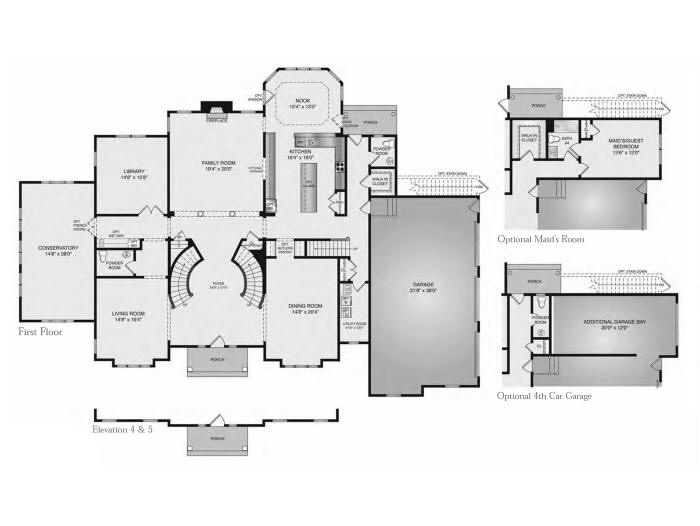
Below is the floor plan we're looking at. I would have liked to
have the tank as a look through room divider in the family room and
kitchen, but it looks like that won't work since we'd lose too much
cabinet space. Now I'm looking at the conservatory.
<Here or as a stand alone in the foyer would be my choice>
I'm thinking of doing a very similar set up to what I did in our basement
and using the powder room to access the tank and have only a picture
frame of the tank visible in the conservatory (again - just like what
you saw in the video I linked in my previous email below). My main
question is how big an issue would it be for the tank to be in a space
with so many windows?
The house would face south so I wouldn't think the tank would get direct
sunlight, but I don't want to have an algae problem if the there is too
much light.
Thanks,
Kevin
<In these times/years, the sunlight not such a big issue. The type of
glass used in the Conservatory is important... and some natural light is
useful... just a bit more maintenance, choice of livestock really. Bob
Fenner>
[http://renaissanceprop.com/wp-content/uploads/2010/05/LexingtonFirstFloor.jpg]
|
 |
RE: Planning Question
8/20/13
Where is the foyer would you position the tank - I hadn't thought of that?
I would probably prefer somewhere I can sit and enjoy the tank as opposed to
foyer, but if the other spots won't work the foyer would make for a very
impressive display upon entering the house.
<Yes; my thought as well... along w/ being able to see from the LR and
dining... Are you going w/ a traditional rectangular shape? Considered
bull-nose, perhaps circular, polygonal? BobF>
RE: Planning Question
8/20/13
If I put the tank in the conservatory I would us the tank I have currently
which is a 135 L rectangular. If I went with the foyer I would be open
to whatever you thought would be best. I'm still a little unclear on
exactly where in the foyer you would position the tank?
<Depending on size, shape (centered in front of door, twixt stairways,
lengthwise most likely for all)>
Are you suggesting it would go in the middle of the floor (under the
chandelier)?
<IF more upright; circular, hex or other-agonal, likely so. B> |
Aquarium Placement (Bob or James, care to
comment?) 12/13/10
Hey,
Thanks for the great site, I use and recommend it all the time. This
may be a question for an electronics expert, but I figured I would ask
you first.
I am thinking about setting up a 120 gallon freshwater aquarium under a
TV hanging on the wall. There would be about 8" from the top of
the tank to the bottom of the TV and the tank will have glass lids. Do
you think the humidity or moisture will cause problems for the TV?
Thanks for the help,
Jeremy <><
<I think this would be a very bad idea for all sorts of reasons.
Yes, aquaria produce a lot of humidity. They also tend to splash, at
the very least, when the fishkeeper is maintaining the tank, and that
water can
easily splash onto electronics. At the same time, a large aquarium
needs plenty of clearance because of depth and the large size of
devices such as filters, and when you're maintaining these,
there's going to be water at the very least dribbling out of hoses
and whatnot. So you don't want mounds of wires behind the tank, or
for that matter, something above the tank that gets in the way of you
working inside the tank. There may well be ways to completely isolate
the back of the tank from the front, e.g., by fitting the tank in a
recess behind the wall, so only the front pane of glass is directly
below the TV set. That's the sort of set-up you'll see in
public aquaria, sushi bars, and so on. But unless you're a
qualified electrician AND an experienced aquarist, I find it hard to
recommend anything that places water and high voltage in such close
proximity. Besides, once you have a nice big aquarium, it's not
like you'll be watching TV anymore!
Cheers, Neale.><<In addition, RMF wouldn't situate a tank
thus as it would be too distracting, hard to watch the TV>>
Re: Aquarium Placement (Bob or James, care to comment?)
12/13/10
Thanks for the quick reply. I understand your concerns. I will look for
another place to put the tank that my wife will be ok with. To clarify,
it is a flat panel TV that only sticks out from the wall about 4"
and the
power and cable connect to it high on the wall so there would be no
wires associated with the TV behind the tank. The tank would sit at
least that much off the wall so it is almost the opposite of the
scenario that you mention. Putting the tank in the wall is not an
option, I wish it was though. I think you are right though, better safe
than sorry, so I will be looking for a new location.
Thanks and Merry Christmas,
Jeremy
<Hello Jeremy. James G., who is, according to his biography page at
WWM, a "Field Service Engineer/Industrial Electrician",
agreed with me on what I said to you earlier today. So I think your
decision to go with the safe route is probably best. Merry Christmas to
you, too. Cheers, Neale.>
Noise around SW systems 4/2/10
Hello Crew, hope all is well with everyone!..My boss has decided to
have a 200gallon saltwater tank installed in a catering hall. My
question is..
will the fish suffer too much stress from the noise of ear drum numbing
music?
<Ah, no>
I know I STRESS...haha. I'm concerned the constant vibrations would
cause them harm. And if so..then how would one "sound proof"
an aquarium?
Thank you so much for your time.
Laurie from The Palms
<Thank you for your concern, but it is at times VERY noisy in the
seas... with waves crashing, good sound transmission (much better than
the air), and many animals making a racket. I've installed and
maintained systems in
night clubs... no problem, 'cept keeping drinks out of them! Bob
Fenner>
Feedback: RF flatscreen interference
6/27/09
Hey, all !
<Kent>
No question, just FYI feedback.
<Ok>
I had written in a few months ago with questions & concerns dealing
with heat/humidity and RF interference when mounting a flatscreen TV
directly above my intended 90 gal reef tank. You thought the setup
would most likely be ok.
<Yes>
Due to the very small size of my house and living room, to be able to
get back into the hobby, this mounting setup was my only viable
option.
It is up and running(finally!!). I have a 50"plasma, cable TV
reception-pre and post converting to digital broadcast. It is in
extremely close proximity to my 2 250w HQI MH and 2 54w actinic HO
lighting(1'-3' distance), with the ballasts for each, just
below the tank.
I have zero RF interference issues. The only precaution I took was to
install those round magnets around the power cables that were supplied
with my TV(can get at Radio Shack, also).
<I see>
Heat and humidity? Was taken care of by mounting a 50" long x
18" tall sheet of thin Lexan or acrylic to the wall just below the
TV, and then attaching a thin piece of black plastic mounted from my
canopy( canopy necessitated by being directly under TV), extending the
10" back to the Lexan, which, when you push the canopy back,
contacts and makes a seal. A canopy fan inside the canopy blows the
hot, moist air out the back, but must divert to the ends of the canopy
and go around the TV, instead of flowing straight up into the TV.
<Reads like a very good design>
So far, zero issues with this set-up. Plus I'm able to maintain
80-81 ½ deg. water temp. with only the canopy fan(runs
constant), and another fan over the sump(runs when MH are on).
Yes, the TV is considerably higher on the wall than I'd have if
there was no tank. And It's taken some getting used to, but I find
myself watching the tank much more than the TV, anyhow. Those fishes
got more reality shows going on than any TV could come up with.
Any questions or more details, feel free to contact me at
kent.warren@XXXX, thanks for listening.
Have a great weekend!
Kent Warren
<Thank you for sharing. Bob Fenner>
Controlling Humidity and Using Substrate from an
Existing Tank -- 05/09/09
I have several salt water aquariums and I moved them into my basement
last year. A 90 gallon with a 35 gallon refugium, a 12 gallon, a 20
gallon, two 10 gallons and my RO/DI water has a loose fitting lid. Only
one of the 10 gallons has a lid. Since then, I have had huge moisture
problems with evaporation, humidity and even a mold outbreak in the
summer when it is extremely humid,
<<Mmm, I see'¦ It sounds as if you don't have enough
air-exchange/enough fresh air circulating through the
basement>>
I am in Chicago and the humidity can be high during the summer.
<<I live in South Carolina'¦so I do understand about
'humidity'>>
Currently, I run a dehumidifier almost nonstop. The dehumidifier has a
bucket so I empty the bucket at least once a day.
<<Indeed'¦ But it sounds like rather than
'collecting' the moisture and keeping it in the room (to
evaporate to the air yet again) until disposed, that you need a means
of pulling the moist air 'out' of the room'¦preferably
'exchanged' with dried/drier air'¦but just exhausting
the super-saturated air from the room and letting it be replaced
'naturally' (e.g. -- from the other rooms of the house) should
provide some measure of relief>>
So summer is coming fast and I need to change things.
<<Agreed'¦the mold is nothing to ignore>>
I got a different container for my RO/DI water with a tight fitting
lid
<<Do be sure to add some aeration/water movement to blow off
CO2>>
and I got rid of one of my 10 gallons. I purchase an air conditioner
dehumidifier that vents outside getting rid of its accumulated
moister.
<<Ah! An excellent move>>
I am going to get rid of two more tanks the remaining 10 gallon, and
either the 20 or the 12 gallon.
<<Will also help'¦but may prove unnecessary with better
ventilation of the room>>
I want to keep the remaining 20 or 12, but I am going to move the one I
keep to the main level of my home. I am leaning to the 20 gallon
because it has a 65 gallon Coralife Supper Skimmer. Any other
suggestions to control humidity?
<<You are on the right track (removing the excess moisture-laden
air from the room). I have a 500g (en toto) reef system I built in to
the wall between my living room and dinning room. One of my concerns
during planning/construction was accumulated moisture in such a
confined space'¦especially during the very long humid months
here in SC. My solution was to install a 'bathroom' exhaust fan
in the ceiling above the tank that vents to the outside of the house. I
have it on a thermostat, but even so it runs pretty much 24/7. This has
proven effective for more than 5-years now>>
Also, can I use the sand from 12 gallon nano-cube with has 1 inch to a
1 ½ sand bed in my 20 gallon?
<<Sure'¦ Be aware there will be some die-off of the
in-fauna just from the movement/re-layering of the bed and monitor for
any spikes in Nitrogenous compounds re>>
The 20 gallon has a shallow sand bed and so does my 90 gallon, the
refugium has a sand bed over Miracle Mud. Any ideas would be great, but
money is tight for the next 12 to 18 months.
<<Reuse the sand'¦just be aware of its
pitfalls'¦though I think with the amount/depth you list, the
risk is slight. Regards, Eric Russell>>
Mounting A Flat Screen TV Over My Saltwater Tank
2/11/09 Space is at a premium in my current house for adding a
saltwater tank. Moving my 48" flatscreen TV from a stand to a wall
mount seems my best choice (space-wise), and putting a 75-110 gallon
saltwater below it. However, I've read it's recommended to
mount a sheet of Lexan to the plaster behind the tank to prevent salt
vapors from doing harm to the plaster. <I've always had a tank
against a wall (35+ years) with no visible damage to the plaster or
drywall. As long as no air stones are used in the tank and a glass top
is fitted, damage to the wall should not be an issue.> Which leads
me to ask if these vapors would also destroy my flatscreen mounted
directly above the tank (is there a minimum distance recommended?),
<First, if you have a wood canopy, you will need to put some sort of
stop on the hood so it isn't going to be resting on your flat
screen when you are feeding/servicing the tank. Secondly, if MH
lighting is used, I would not mount the cooling fans on the top of the
cabinet. Exhaust from the air above the water's surface may cause
some damage to your flat screen and internal components. As to the
TV's height above the tank, I would shoot for 18" if you have
to room and the tank isn't too tall. I'd shop for a tank with
an 18" maximum height. Is better to have more length/width than
height, creates more air/gas exchange per gallon of water. A tank size
of 60" x 18" x 18" is available. Other than what I have
mentioned, I see no problems other than the fact the tank lights would
have to be off to watch TV, would be too distracting.> and would the
lighting choice (MH?) affect the cable reception? <If the proper
cable is used, it should not affect reception. Reputable cable
installers will use RG6 cable which has a very high noise rejection
rate and is the cable of choice for HDTV. If your home is prewired to
wall plates, I'd make sure RG6 is being used and not RG59 which was
used in the past. Not only is the rejection rate lower in the RG59, but
the lower bandwidth of the cable will reduce HDTV performance. The
cable should be clearly marked as to it's type. If you should have
noise problems, which I doubt, you would need to buy a good line
conditioner/filter. There are a few good brands out there such as
Monster and Panamax. I'm into home theater in a big way and I use
line conditioners on all my equipment. Monster provides a lifetime
guarantee should any component connected be damaged due to lightning
strikes, power surges, and product fault itself. I've got about 16K
invested in my equipment, and the price of a conditioner is pretty
cheap insurance in my opinion. They will also provide a cleaner picture
to boot.> Thanks in advance! <You're welcome. James (Salty
Dog)> Kent Warren
|
Location of a big tank 4/20/08
Hi, <Hello Terri> I'm in the process of moving my fish
from a 225 to a new 300 gallon tank. This is a fish only set up,
and equipment includes a closed canister filter, very large, that
fits under the cabinet with the skimmer and uv, a chiller that
will go off to the side, and T-5 lighting. Should I leave enough
space to walk behind the tank if needed or just a few inches from
the wall? After tomorrow, this won't be an issue! Thanks,
Terri <Mmm, well... A few inches at least is a good idea to
allow ventilation/circulation of air to discount moisture/mold...
and to provide a gap for possibly heat/cooling by conduction
through an outside wall... Am not so sure re a big space to get
behind... as may "look funny" and really not net you
that much benefit, in reaching, moving gear, electrics,
plumbing... but, to each their own! Cheers, Bob Fenner>
Re: Location of a big tank 4/22/08 Bob,
Thanks for the advise, the old tank had a short cabinet, and some
things had to be set between the wall and the cabinet. This tank
has very generous cabinet space, and was set a few inches away
from the wall as you mentioned. Cabinet size may not be first on
everyone's list, but can really make a difference. <Agreed
and good point... the roomier the better> The tank looks
incredible, and the best part was watching the fish swim in their
new home! Best regards, Terri <And you, BobF>
|
Location, Location, Location 12/29/06
<Hi Kim, Pufferpunk here> I am new to the marine aquarium hobby
and have had my 55 gallon tank set up for five months
now. Fortunately for me but unfortunately for my tank, I
will be moving to a new home. I basically have a choice of
two locations for the tank in the new home. In one location,
it would be subject to a surround sound system, which is used about
twice a week or so. With the other choice of location, the
tank would be about eight feet away from the main door. Both
locations would be an in-wall type installation. I've read
conflicting information on your site regarding whether sound causes too
much stress on fish. And I've also read to keep tanks
away from drafts. I don't know whether the opening and
closing of a door would be akin to locating the tank next to a drafty
window or if I'm being too paranoid about it
all. I've put a lot of time, effort, stress and money
into this tank thus far, so I'd like to make sure I get things
right straight away in the new home. I suppose my question
is this: Which is the lesser of two evils? Loud
sound, or occasional air from the door being
opened? Hopefully your answer is not an absolute no on both
options, since I really don't have any other choices aside from
selling the tank, which I really want to avoid! <I'd
go with the door, away from the loud noise. ~PP> Thanks
for your time,
Regards, Kim in Boston
|
|