|
FAQs on Marine Algae Identification
24
Related Articles: Avoiding Algae Problems in Marine System,
Algae
Control, Marine Maintenance,
Nutrient Control and Export,
Marine Scavengers, Snails, Hermit
Crabs, Mithrax/Emerald
Green Crabs, Sea Urchins, Blennies, Algae
Filters, Ctenochaetus/Bristle Mouth
Tangs, Zebrasoma/Sailfin Tangs,
Skimmers, Skimmer Selection, Marine Algae, Coralline Algae, Green Algae, Brown
Algae, Blue-Green
"Algae"/(Cyanobacteria), Diatoms, Brown
Algae,
Related FAQs: FAQ ID Visual
Guide, Marine
Algae ID 1, Marine Algae ID 2,
Marine Algae ID 3, Marine Algae ID 4, Marine Algae ID 5, Marine Algae ID 6, Marine Algae ID 7, Marine Algae ID 8, Marine Algae ID 9, Marine Algae ID 10, Marine Algae ID 11, Marine Algae ID 12, Marine Algae ID 13, Marine Algae ID 14, Marine Algae ID 15, Marine Algae ID 16, Marine Algae ID 17, Marine Algae ID 18, Marine Algae ID 19, Marine Algae ID 20, Marine Algae ID 21, Marine Algae ID 22, Marine Algae ID 23, Marine Algae ID, 25, SW Algae ID 26, SW Algae ID 27, SW Algae ID 29, SW Algae ID 30, SW Algae ID 31, SW Algae ID 32, SW Algae ID 33, SW Algae ID 34, SW Algae ID 35, SW
Algae ID 36, SW Algae ID 37, SW
Algae ID 38, SW Algae ID 39, & Marine Algae Control FAQs 2, Marine Algaecide Use, Nutrient Limitation, Marine Algae Eaters, Culturing Macro-Algae; Controlling: BGA/Cyano, Red/Encrusting Algae, Green Algae, Brown/Diatom
Algae,
|
New! FAQ, ID Visual Guide
|
 |
New Print and
eBook on Amazon
Marine Aquarium Algae Control
by Robert (Bob) Fenner
|
|
Identification 10/15/08
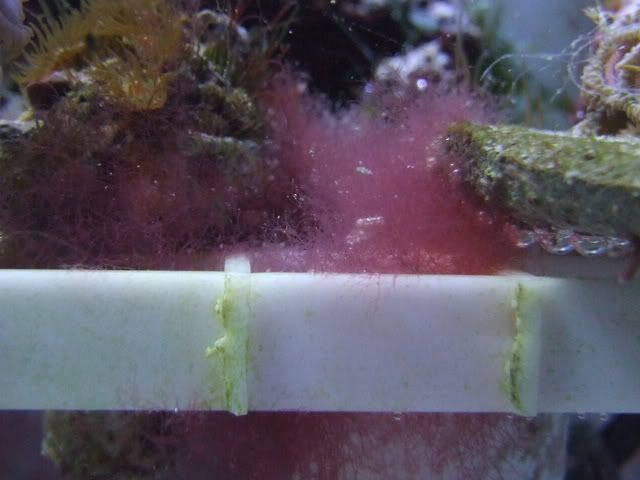
I am trying to find out if this pinkish/red stuff is a type
of algae or a sponge & how to get rid of it. It started
on my egg crate & is moving to my frags.
http://i159.photobucket.com/albums/t135/BibleSue/DSCF6506.jpg
http://i159.photobucket.com/albums/t135/BibleSue/DSCF6505.jpg
Thanks,
Susan
<Looks like a form of BGA. Read here for information on
ridding yourself of this stuff:
http://www.wetwebmedia.com/bluegralgae.htm. Welcome, Scott
V.>
|
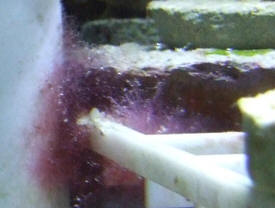 BGA... RMF
|
Re: Identification 10/16/08
Thank you for replying. <My pleasure.> It is
not Cyano. It is about the color of coralline
algae. <I still do believe Cyano to be the ID,
the color is just in the name; comes in many
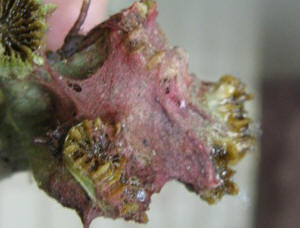
forms.> This is what it looks like dry.
http://i159.photobucket.com/albums/t135/BibleSue/IMG_0351.jpg
http://i159.photobucket.com/albums/t135/BibleSue/IMG_0352.jpg
This is what it looks like right after pulling it
off. I don't have large amounts since I took
everything out & scrubbed it off the egg crate
& picked it off the corals Sat. night. It is
already starting to grow back. <Indicative of
BGA.>
http://i159.photobucket.com/albums/t135/BibleSue/IMG_0353.jpg
http://i159.photobucket.com/albums/t135/BibleSue/IMG_0346.jpg
<A 'quick' jaunt through the Marine
Algae ID FAQ pages (there are 25 of them!) will
show you similar forms of BGA. A microscope of
moderate power will tell you for sure, the BGA will
lack discernable nuclei. Anyway, the eradication
plan is the same either way. Scott V.>
|
 BGA... BGA... |
|
A little identification help please --
10/13/08
Hello crew,
<Greg>
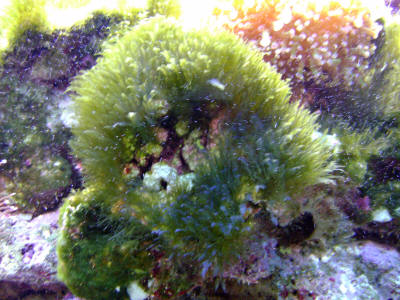
I've had this algae/plant growing in my 150 reef tank for
quite a while. Very pleasant looking but starting to spread more
than I'd like.
<Mmm, yes>
Neither my tang, blennies, hermits or snails seem to munch on
it.
<Not very palatable... to much of anybody>
Could you help identify it
<Mmm, likely a species of Derbesia>
for me and suggest a way to lessen the spreading.
<See WWM, the Net re this name... and likely Bryopsis... both
"treated" about the same... best by competition, denial
of nutrients... a few approaches to these...>
(I have multiple corals so limiting the lighting would probably
have to be minimal). I'm running the PhosBan reactor so
there's not a phosphate problem.
<Okay...>
Also, I've worked with you (Bob) before so my water quality
is "up to snuff." Over the past few months I've
replaced all lights, drained water from frozen food and done
weekly water changes to keep nitrates very limited.
Thank you,
Greg Esposito
<If there's room, you might try other predator groups...
maybe a Siganid... S. stellatus if you can find one... BobF>
|
 |
|
A little identification help please - follow-up...
Grn. alg. contr. 10/15/08 Hello again Bob,
<Greg> Thanks for the info below regarding the
Bryopsis/Derbesia problem. I've done more research on your
site trying to get a good handle on the specie and ways to
eliminate/control it. <Can be persistent!> I wanted to run
by you what the LFS just told me when I stopped in to get a fresh
batch of C-Balance and look for Caulerpa. <Mmm... a bit to say
re both... the Wilkens, nee TLF product is fine, but I'd
definitely pass on this genus of Chlorophyte (folks do try to use
mainly C. verticillata to outcompete Bryopsis et al. for you
browsers)... reasons gone over and over on WWM> First, let me
say that my LFS (The Living Sea) has been around for quite some
time and I've generally found the owners to be pretty
knowledgeable. <I also have heard many good anecdotes re>
That said, I asked them today if they were familiar with the
algae to which they grimaced and quickly said, "you'll
never get rid of that algae"... <Heeeeeee! Man,
that's a dire statement!> "we've never found
anything that would eat that"..."it will be the last
thing to die in your tank." <Along with terrestrial
cockroaches? Heee!> I left the store with the options of: 1)
Take out the affected rock, wash it and scrape off the first
layer in hopes of getting it all. But, if I miss one strand of
the Bryopsis, it will all grow back. <May be> 2) Take out
the affected rock and let it dry/die. <Another approach> 3)
Leave the tank "as is" and expect to have to shut the
whole thing down if the algae spreads. <Sheesh!> Are things
that bleak? <Mmm, nah> My 150 was born in October of 2006
complete with Current Orbit Halides/Actinic T-5 lighting system,
protein skimmer, PhosBan reactor, UV sterilizer and chiller. I
run carbon, too, and my refugium is stocked with Chaetomorpha sp.
per your advice. 35 gallon water changes are done weekly or
bi-weekly....mostly bi-weekly. I do have a R.O. system, make my
water and perform all tank maintenance. Specs: Salinity: 1.025
Nitrates: 10 or less Phosphates: 0 Ph: 8.2 to 8.4 Alkalinity: 6.5
to 7 Calcium: 440 to 460 Temp: 75 to 77 Actinics run 11am to 8pm
and halides run 12pm to 7pm. Refugium lights on from 8pm to 11am.
Stock: Most of my corals are large (8 to 12 inches) including
Leather, Elegance, Frogspawn, Bubble and Toadstool. 6 inch Sail
fin tang, 4 inch Copper banded Butterfly, 2 medium Chromis, Male
and Female Maroon clowns, Lyre tail Anthias and 2 Lawnmower
Blennies. Also, a lot more snails and hermit crabs than you would
prefer...as you've told me before. <Mmm, I'd still try
the Siganid, possibly some Sacoglossan: search: what eats
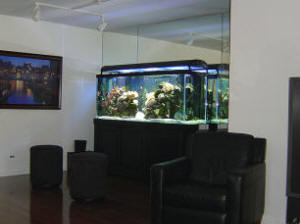
Bryopsis> I've attached a picture of my tank, too.
<Ahh! Very nice! What a beautiful setting altogether!
Something right out of "Beautiful Aquariums, Homes and
Gardens" magazine!> Thanks so much! Greg Esposito
<Don't despair Greg... I've seen the end of the
world... this isn't it. Bob Fenner>
|
 |
|
A little identification help please - follow-up
10/15/08 Whoops...also forget to mention I have 6
maxi-jet 1200 powerheads hooked up to a Wavemaster machine.
<With such a fancy setting, I thought you'd likely be
vested in Tunzes! B>
LOL. Maybe I should add Tunzes as our fish and corals deserve the
very best we can offer them. Thanks for the guidance, as
always.
Greg
<Welcome my friend. BobF>
|
|
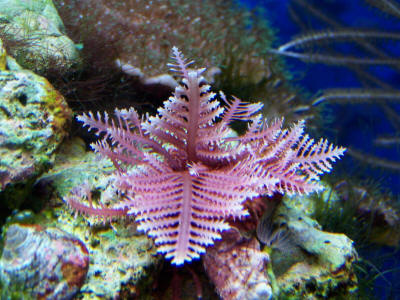
Algae I.D. 09/27/2008 Greetings Crew,
<<Good morning, Andrew today>> Thanks for the great
site! I have looked high and low for information on this algae
but I can not find it anywhere. Forgive me if I've simply
overlooked it. Thanks in advance. <<Corallina elongata I
would suggest. Please do use your search engine for plenty of
info on this algae>> John T. <<Thanks for the
questions, hope this helps. A Nixon>>
|
 Beautiful. Beautiful. |
|
Re: algae? 9/20/08
My last reply may not have sent, I will try again from here then
through my work email.
<Okay... did you get my response? Oh, I see it below>
Live Stock= Regal Tang, Percula Clown, Flame Hawk, Mandarin,
Scooter Dragonet, Yellow Blue Spot Goby, Two Pajama Cardinals,
Long Tentacle Anemone, Christmas Tree Worm,? lost a Purple Tang
and Royal Gramma that had been in there about a year.? About 10
each of Hermit Crabs and Snails.
One Acropora frag, Two Montipora frags, Two Small LPS - (Frog
Spawn and Torch Coral), two tree? Sponge (not doing well at all
now),
<Rarely do in such settings>
Coco Worm (Christmas Tree Worm), Purple Gorgonian, One small
Ricordea mushroom coral, small amount of star polyps. All of this
never seems to be growing very well either,
<Typical Cnidarian incompatibility issues...>
like not at all (just surviving).? Feeding it DT formula every
third day, with pump off for 20-30 minutes.
I have a 10 mb video file of the tank and slime.? I will have to
send that from home, here is an attached photo from that
video.
<A mix of decomposers that are "best situated" to
your present circumstances. Again, the best means of disrupting
them is to alter the conditions in the system as stated ayer...
Bob Fenner>
|
 |
|
Diatoms? 9/20/08
Hello, and thank you for your time,
<Howdy, welcome>
As you can see from the photos, I have quite a bloom of some sort
of algae.
I was initially suspecting that this is a diatom bloom.
<Mmm, nah>
However, there are a couple of characteristics that make me
question my initial assumption.
This "bloom" seems to be completely light dependant.
The sand is almost perfectly white every morning when I turn on
the lights, and then within a couple of hours reaches this ugly
brown color. The algae is somewhat filamentous, but does not
appear to be "slimy" as I have seen Cyanobacteria
appear to be. It seems to be acting like a glue to the sand
(making is clump together); as you can see from the photos of the
tank ornament, it is nasty stuff. The "clean" photo is
immediately after a turbo grazer had a feast, and the other tank
photo is only a few days later. I didn't think that diatoms
were dependant on light,
<Mmm, yes they are>
but this stuff seems to be. My tank parameters are: ammonia:
0ppm, nitrites: 0ppm, nitrates: 5-10ppm, phosphates: 0ppm,
<Mmm, do consider that the algae et al. here can/does
remove/concentrate nutrient, making it unavailable in the water
for tests>
calcium: 300ppm (this is lower than I would like, but I have been
battling high alkalinity from using tap water).
<See WWM re possible paths here... easily done>
The steps that I have taken to solve this problem are: switched
from treated tap water to R/O water, started using Phosban (with
the hopes of removing any silicates), water changes only seem to
help for a day or so (and then they come back with a
vengeance),
<Another clue>
and I have tried stirring the top layer of sand only to see the
freshly exposed sand turn brown within a couple of hours. The
lights are about 6 months old (260W of compact fluorescents)- do
you believe that the age of these could be the problem?
<Mmm, likely secondarily>
The tank has been running for about 8 months without any of this
algae, and now within the last month this stuff has taken
control. I do weekly 20 gallon water changes, and my aquarium is
155 gallon with a 20 gallon sump.
<Do you grow macroalgae here? You should... or get another or
larger sump/refugium to do so>
I, unfortunately, am using a SeaClone 100 skimmer (that never
seems to function -maybe my entire problem?),
<A part of it at least. Again, see WWM, plan on, get a real
skimmer>
a Fluval FX5 canister (cleaned weekly), and I am using Chemipure
in the canister filter. My fish include: 1 hepatus tang, 1 Eibli
mimic tang, 1 green chromis, 2 Ocellaris clowns, 1 marine Betta,
1 sleeper banded goby (he likes to spread this brown stuff all
over the tank), 1 clown goby, 1 engineer goby, 4 large turbo
grazers, countless Nassarius snails, 1 large brittle star, a
colony of green star polyps, a colony of brown button polyps, and
two stalks of pulsing xenia. I have the corals about halfway up
the water column, and the algae hasn't made it that far yet,
but now it is getting close and I need to act. Before this algae
took over I was having great purple coralline growth, but now
this stuff is over growing the coralline (as you can see in the
photos of the tank ornament). I'm getting very frustrated
because I can't seem to control this stuff. I have silicate
and magnesium test kits coming in on Monday. Any advice would be
greatly appreciated.
Thank you again for your time,
~William Millis
<Well, very likely what you are seeing, battling is
principally BGA/Cyanobacteria... can be "fought" in a
few ways... enhanced RedOx (via the skimmer improvement
partly/easily, the culture of macroalgae)... I would also look
into making a DSB in the added sump space... At any length, all
is recorded for your perusal here:
http://wetwebmedia.com/marine/maintenance/maintindex.htm
the third to last tray. Enjoy the learning, empowerment of
knowledge gain, practice. Bob Fenner>
Re: Diatoms?
I am truly sorry that I forgot to include my PH value: 8.4,
<Fine, not a factor>
and I have completely covered the entire aquarium with blankets
to eliminate the chance of ambient light from the room. However,
this had no effect on the growth.
<Won't. BobF>
Thank you again,
~William Millis
|
 |
|
Good Versus Bad Algae 9/18/09
hey guys,
<Angela>
After what i consider to be a nearly total catastrophe...
<... where are the spaces...>
Quickly...I live in Phoenix AZ and my AC went out. before i knew
it My water temp was over 100
<Yeeikes!>
( lesson learned) I now have a chiller. My 65g reef
died...everything..corals, polyps, leathers, anemones, paired
clowns snails...EVERYTHING all except for my Yellow tang..God
bless him. Anyway....I broke it down and restarted using the same
live rock. 10-15% water changes every couple days for a few
weeks...everything seems to be going OK so far. Water parameters
are good. PO4 = 0, NO4 = 0 NO3 = 0 Ca+ = 500 PH 8.3 temp 82
degrees .
The coralline is seeming to spread nicely however There is a new
addition...the Dark green algae you see pictured.
<This is actually, likely BGA...>
At least I think that's what it is..there are several dime to
quarter size spots scattered in the tank and if you look in the
top right corner of the tank there is some lighter green growth.
Is this something I should worry about? THANKS BUNCHES
<Mmm, I would read:
http://wetwebmedia.com/algaeasfriend.htm
and the linked files above... till you understand what is going
on, what your options (for control) are. Bob Fenner>
|
  |
|
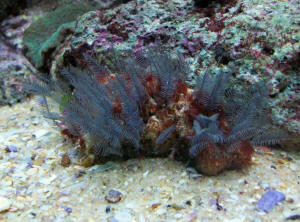
Purple Feather Weed? Could Be Feather Hydroids!
9/13/08 Hi Guys and Gals, <Hi there, Andrew> While
snorkeling today (thank God it's warm enough to get in the
water again!) I came upon this fascinating (to me anyway)
feather-like organism. <it's neat looking, that's for
sure.> I couldn't help but lift a small piece off the rock
for an experiment in my 20Gal. <Were you wearing gloves at the
time?> Tank is currently about 2 months old, cycled with 6Kg
semi-cured live rock, and live sand. Ammonia, Nitrite @ 0, and
Nitrate is at about 10 at the moment, <Just keep an eye on the
nitrates, don't let them get above 20ppm.> temp steady at
26 Deg C, and salinity is 1.022 <Salinity's a little on
the low end, but okay.> Stocking is 1 bicolour Dottyback, 2
tiny blue/green chromis, 1 even smaller yellow coral goby, 3
small hermits, and about 8 snails. All very happy in their
current home. <Good> Which brings me to my actual
question.... What the heck is it!? <I sincerely hope I'm
wrong, but those sure look like feather hydroids to me (Family:
Plumulariidae). If so, they're not the best addition to a
system, to say the least. Also, after going in for a close-up,
that red macro-algae on the right side of the rock looks very
similar to a variety that can be invasive and very difficult to
control.> I found it in full sun at a depth of about 9'
(growing on a football sized tunicate) <Wow!> ..in a bed of
sand held together with fine hair algae. It came away in a nice
clump about 2" across. It now graces the front of a lightly
stocked tank. Each "feather" is separate from the next,
and grows just like a real bird feather would, <Yep>
looking side on, you can see a single "tap" root about
the length of the feather itself. <That long 'tap'
root along with the unusual color is what's keeping me from
being absolutely sure those are hydroids.> I'm pretty sure
in between the main subject of the pic is some juvenile Dictyota,
<It looks like a Rhodophyta/red algae of some sort, but I
can't see it well enough to narrow it down further. Dictyota
is a brown algae (Phaeophyte) that's usually green,
yellow/brown, or even blue. I've never seen red. It could be
something like Scinaia.> ..but cannot find any reference to
the feather like growth (which I find most attractive), <I
find it very attractive as well. By the way, I couldn't find
any similar looking macro-algae in that color either - and I was
hoping I would!> ..but am a little cautious of! <Good call!
Hydroids can sting the living daylights out of you. Please see
the information and species 'Gymnangium' half-way down
this link (as well as associated links at the top):
http://www.wetwebmedia.com/hydrozoans.htm Here's a good
close-up of a feather hydroid. Note the similar, almost
bumpy/broken appearance of the 'branches'. Those bumps
are actually individual feeding polyps that have little stinging
tentacles surrounding them:
http://www.poppe-images.com/images/image_info.php?picid=929540
.> If you could help identify it, I would be most
appreciative. <Well, I'm pretty sure those are hydroids,
but I'm hoping Bob will confirm or deny.> I make an effort
to Identify everything I can myself, <Good for you! Not only
do you get the satisfaction of solving a mystery, you also learn
quite a bit along the way.> ..but find it difficult to locate
images on your site unless I know the name of the organism I am
looking for. <See below> Is there an image library
somewhere grouped in broad categories like fish, algae inverts
etc. that I am yet to find on your site?? <Not a specific
image library as yet, no, but it's been discussed. In the
meantime, Bob has the site organized/sectioned off into topics
that include many terrific articles with photos of representative
species in the most commonly seen genera. Usually that will give
you enough information to help narrow things down a bit.
Here's the main page for marine topics:
http://www.wetwebmedia.com/marine/index.htm . Just pick a
subject, start with the articles for an overview (with photos)
and go from there.> I would love to help myself in future
where possible. <I'd try the above and/or use our Google
search engine:
http://www.wetwebmedia.com/WWMAdminSubWebIndex/question_page.htm
> Thanks for your time. All the best. Andrew.
<You're very welcome, Andrew. Take care, -Lynn>
|
 Hydroid. RMF Hydroid. RMF |
|
Identification help...BGA
9/9/08 Heya Crew, <Hello Phil.> My tank has been
up and running for 6 weeks. Being new to this hobby, I have no
idea if what is in the picture is good or bad. <Not desirable,
but common.> Please help by identifying the "growth"
and "silvery" bubbles. Thanks. <It is simply BGA,
Cyanobacteria. BGA is photosynthetic, hence the off
gassing/bubbles. It is indicative of a not so great water
quality. > -Phil <The link below will give you the low down
on what this stuff is and how to eliminate it. Scott V.>
http://www.wetwebmedia.com/bluegralgae.htm
|
 |
Macro identification -08/05/08 I think
this type of macro algae is Saw Blade Caulerpa <'tis so...
as far as I can tell from the photo provided.> but I am not
sure. I was hoping that you could help me out by identifying what
kind of macro algae this is. <Best,
Sara M.> |
|
|
|
|
New Print and
eBook on Amazon
Marine Aquarium Algae Control
by Robert (Bob) Fenner
|
|
|