 |
|
| Home | Marine Aquariums |
Freshwater Aquariums |
Planted Aquariums |
Brackish Systems |
Ponds,
lakes & fountains |
Turtles & Amphibians |
Aquatic Business |
Aquatic Science |
Ask the WWM Crew a Question |
| Please visit our Sponsors | ||||
Re: re: Lighting question; Now algae growth in a new sump
8/29/13
Crack in sump Please help
5/19/13 Sump/Refugium + Fluval 205 question
1/11/12 Refugium and Sump Cleaning
11/19/11
Sump Questions/Nitrate Control
9/22/10 Newbie question: Water changes with a sump
12/14/2009 Dead Coralline Algae in Sump --
10/26/09 I See it in my Sump: BGA Control
5/8/2009 Sump Cleaning 8/9/08 Hi All -- <Hello> Can you tell me how to clean the detritus out of my sump. It is on the floor so siphoning is not an option. I guess I could buy a pump but wouldn't all the stuff running through the pump be a bad thing? <Not really.> Are you aware of any special pumps, vacuums or other devices I might use for my situation? <None that I would recommend.> I used to use a plunger pump (for want of a better term) that sucked up gravel and ran the water through a cloth bag, then returned it to the aquarium. But as I recall they were not very good. Any info. would be appreciated and yes I did comb through many of the faq's without turning anything up on this particular problem. <A few things. A simple powerhead with a hose to pump it out when you do water changes will work, just stirring it up and letting the tank's filtration handling it, or just leave it alone. Unless it is grotesquely dirty you really do not need to clean it. If it is that bad, there are other problems amiss.> Thanks! Eric <Welcome, Scott V.>
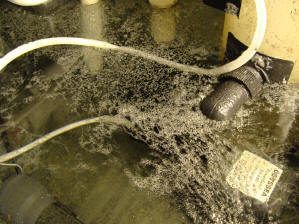
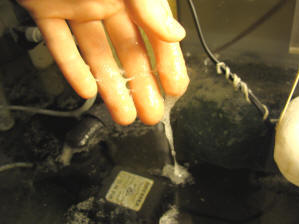
A Question About Odd Growth in Sump 11/16/2007 <Greetings, Mich here.> I have a 150-gallon saltwater fish only aquarium. It has 4 inhabitants- a 6-year-old dogface puffer, a hippo tang , a 7+-year-old Foxface and a 3-year-old Picasso trigger. <Congratulations on the keeping these fish alive for so long.> Their diet consists of daily fresh mussels, and formula 2 and an algae wafer my puffer loves. <You might want to consider a vitamin supplement such as Selcon, which also has HUFAs (highly unsaturated fatty acids) My question is about the internal sides of the sump. I now see little colonies about the shape and size of dimes. They are out of the flow of water. Each little circle has the most amazing bright pink dots. Is this bacteria? <Unlikely.> harmful? <Doubtful.> It just reminds me of stuff growing in Petri dishes from my old microbiology days. And I know pseudomonas can be truly beautiful colors. <Yes... cleaned plenty... Did my student work-study in the managing the autoclave... Stinky!> Could you please comment? <Well a photo here would be most helpful... likely hitched hiked its way on you live rock and found your sump to be a suitable home... I could only guess at this point but it is not likely harmful.> Should I leave it alone or clean it away? <I would live and let live.> Tank is 7 year old with live rock. Thanks for your time. <Happy to share. Mich> Bacterial Bloom In Sump 10/04/2007 Thanks for the response, I <PLEASE, all would-be queriers, capitalize your "I"! Not only will I not have to capitalize them for you, but you can be proud of representing yourself with a capital letter. Exciting! -SCF> thought I'd just update you on the situation - I came home from work yesterday and found my sump absolutely crystal clear. I have yet to do a water change, so once again I am at a loss to explain what was happening. Would just like to say a BIG THANK YOU for taking the time to give your advise freely. Many Thanks. <No problem, this cloudy water happens a lot with bacterial blooms. It is possible you had a large enough food/carbon source in the sump to create a bacterial bloom that lasted as long as there was available nutrients to sustain the bloom. I use Vodka or sugar to cause a heterotrophic bacterial bloom in my tanks that usually last 48 hours to help increase these bacterial colonies. This technique is known as "carbon loading" and is a very risky endeavor. The bacteria produced in the bloom feed on nitrate ions thru respiration until the ions are no longer available and then they die back and are no longer visible. It is possible that some type of bloom took place in your sump and ended it's life cycle with nice clear water. Continue to monitor water quality and good luck with your overall system! Rich-aka-Mr. Firemouth>
Cloudy sump - 09/24/07 Hi to all, <Hi Neal,> i have looked through the previously asked questions, but cant find one similar to my own. Here goes - I have set up my sump BEFORE setting up a tank. So i have a sump which is a 180 litre glass affair, with a ocean runner 2500 return pump running through itself, a DSB 12" X 17" AND 6-8" deep. I have 2 kilo's of live rock in there as well (separate to the DSB). I decided to do this 1, to mature the sand bed and 2, funds for main tank are a bit lean. I have a Deltec apf600 skimmer which i have not connected yet. I have loads of life in the sump already - worms, snails, a purple crab (we call him Pinchy) loads of tiny fleas ? crabs ? flicky things etc. It has been set up for 4 weeks, i have not done a water change yet but i have topped up with fresh RO. since i spotted all this life the sump has developed a cloudy appearance. I do have a big bag of carbon in the sump as well. Is this cloud plankton ? <I would suggest you start with the water change. Change at least 25% of the water with new saltwater. I believe this to be a bacterial bloom.> and should i not start the skimmer until i have the main tank ? <I would wait to use the skimmer until the main system is online. The main reason is nutrient export is easily handled thru water changes on the smaller sump.> This is my first marine tank, i have read constantly over the last 6 months but am at a loss to explain what is happening. ANY help you can give me would be greatly appreciated. Thanks. You all do a great job and i cant stress how important sites like yours are. Thanks. Neil. UK. <the only other things I would like to add is...If the cloudy water persists after 2 or more water changes than some additional info on water params will be required. If the problem continues after the main system is online with the skimmer than I would recommend a UV sterilizer be used. But for now lets do the water changes and see if the problem clears itself up. Thanks Rich aka Mr. Firemouth> Sump Question, maint. 9/6/07 I recently removed bioballs from my sump. I have been noticing a film that has been growing in my sump and I have no idea what it is or how to remove it. It cakes onto the powerheads in my sump and only grows in the sump. My forms of filtration include a protein skimmer, a hang on refugium, live sand and live rock. I use a sponge for the overflow box. The closest explanation I have found for this film is anaerobic bacteria that grew from nitrates. <Are you sure it's not Cyanobacteria? Anaerobic bacteria grow where there's no oxygen (so usually deep inside a filter, or 3" below the top of the sand bed).> My nitrates are currently at 20, no nitrites, no ammonia, PH 8.3, calcium 470, dKH 12. I use RO water for top of water and to mix up salt. If you have any idea of what this film might be and how I will be able to get rid of it, I would be very happy. Note: I did not have this film when I had the bioballs in. <Right now it sounds like Cyanobacteria. Your tank is probably adjusting to the removal of the bioballs. You can do more water changes and manually clean the film. But hopefully, if it is just a "re-cycling" from the bio-ball removal, it should eventually correct itself. Best, Sara M.> Filter Box Cleaning 8/28/07 Hi Guys! I've been searching the site for hours on this topic and can't seem to find the answer I need...hopefully I won't need 'the punishment' for asking a question that appears 10 times on the site. I was led to believe that you send out 2 tough guys who force the guilty aquarist to drink his skimmer cup. (And since I have the AquaC Remora that you often recommend, I can tell you that I definitely DON'T want to drink that much yuck.) <<Heeeee! Ewwwww! Heeeeee! RMF>> So I'm changing filter media the other day (on an Emperor 400) and I noticed all these whitish, worm-like things all over the walls of the filter box. They were stuck to the sides and filling every crevice top and bottom. When I pulled out the media, some of the stuff dislodged and went into the tank. Since the instructions for the unit say to clean it out regularly (and it seemed gross), I scrubbed out all of this gunk with a brush. I replaced only one of the filter pads (I alternate replacement of these); and put back the existing bio-wheels (which I left floating in the tank during cleaning). When I asked about this at my LFS, the guy said I messed up and should have left these 'critters' alone because they were beneficial. He warned me that I may have caused problems because I disturbed an important part of the filtration process. I have to add that this particular LFS seems to give me a lot of advice that conflicts with what I read here on WWM; but sometimes his advice seems good (and he takes my phone calls...). But I've taken to trusting WWM more than anyone else. So what's the answer? Do I scrub this thing out regularly or do I let the 'garden' grow in there? Thanks, Mike. <Hello Mike. Those little white worms, if small (a couple of mm across) and spiral shaped are spirorbid tube worms (family Spirorbidae). They are harmless filter feeders, and very common in marine tanks, especially inside filters. If the worms are thread-like, and anything up to a few cm long, then they're most likely Serpulid worms (family Serpulidae). Again, harmless filter feeders, and also very common in marine tanks. Bob may correct me on this, but to the best of my knowledge they don't contribute anything to biological filtration as such. They certainly don't remove ammonia or nitrite. Indeed, they're "fouling" organisms, meaning they impede the flow of water, so potentially they can reduce the efficiency of the filter. (Certainly, polychaete worms like these are notorious fouling organisms on water pipes around power stations and the like.) For what it's worth, when I help my marine-fishkeeping friends clear out their filters, I brush away those tubeworms without any sense of anxiety. Cheers, Neale> Refugium Issues... gen. des., maint. f's 7/12/07 Crew, <Scott F. With you today!> I'm almost done asking you all the questions I have about marine aquariums (yeah right!). I finally got my refugium up and running and am very excited (which does not accurately describe my wife's feeling). <Hey, what's a little more smelly, water in the house, right?> It's a DIY model--30 gallon covered clear thick plastic tub with a 1/2" bulkhead for inflow and a 1" bulkhead for outflow. Substrate is 40lbs of 1mm aragonite, along with 3+ lbs (5 or so pieces) of Fiji live rock and a nice big ball of Chaetomorpha. Lighting is by two $9.99 17W NO fluorescent "Grow Lamps" made by Lights of America that claim to put out 75W worth of incandescent light--lighting is on a reverse cycle with my display. I have e-mailed the manufacturer because I'm curious about the temperature of these bulbs. My LFS uses these lights all the time for refugiums and swears by them . . . we'll see. <I've used 'em before...they work fine for growing macroalgae, in my experience> Water is moved at a relatively low rate by a MaxiJet 1200 (295gph) that sits in my sump. Because of the head (about 2.5ft) , I'd be surprised if I am getting 100 gph. It certainly isn't enough to toss the Chaetomorpha about, but it is a steady flow. <That's fine, in my opinion. You don't want too much flow in there. Since one of the refugium's important jobs is to foster nutrient export via growth of macroalgae and purposeful fauna, you don't need the water flowing through there at a blistering pace.> I'm not really sure what, exactly, I hope the fuge to accomplish. Certainly nutrient export via the Chaetomorpha is one goal. I assume that I will also get some denitrification from the sand bed, which has a really interesting contour because I ran a power head in the vessel for a few days to circulate the water before I hooked it up to my display, but depth ranges from a small section of 0" (at which I placed my live rock) to 3-5+" throughout. <You'll also benefit from the production of natural plankton and other food sources, which can flourish in the protected environment that a refugium provides.> Before jumping into this, I read (about 5 times) the chapters of Reef Invertebrates regarding refugiums and live sand/DSBs. <Some of the best material ever written on the topic, IMO!> I also did a lot of reading on WWM (I also spent a lot of money). From this, I have gathered a few things that I hope you can confirm/deny/guide me: 1. Don't mix macroalgae types. True? If so, does this rule apply only to macroalgae, or all vegetation? In other words, should Chaetomorpha be my only vegetation? If not, do you have any suggestions for others? <I wouldn't, for the simple fact that you're creating competition in an area designated for unimpeded growth.> 2. Don't suffocate the sand by placing a bunch of live rock on top of it. True? Right now, I have 5 relatively small pieces of rock that I added to (hopefully) speed up pod/creature intro into the refugium and to give these "creatures" some hiding/breeding spots, etc. I placed a few pieces where there is no (or very little) sand depth and then loosely stacked the other pieces on or around that base. Should I add more live rock scattered around the fuge, or leave as is? <I wouldn't worry about the rock causing problems. I can see myself getting on to the soap box and preaching about the unwarranted fear of "detritus" that we have, and why some folks fear putting rock on top of sand...nah- not gonna start!> 3. Don't go out of your way to add sand sifters, especially hermits and others that will eat pods. True? <I doubt that they'll eat copepods to any extent, but they may definitely decimate populations of other beneficial infauna and possibly disturb some processes going on in the sand bed.> I did throw in 2 Nassarius Snails. I also noticed that there are some tiny brittle stars. <No problem, IMO.> 4. Is my flow enough? Should I add a small power head to the fuge to circulate more water internally? <Again, you don't want to over do it...Sure, you could try another powerhead, but see how it goes.> 5. Speaking of pod culture, and this may tie into the above answers. Obviously at this point my fuge is mostly water and sand. As time goes, hopefully my Chaetomorpha will take up more room and I'll have to start pruning it. In the mean time, should I add anything like pieces of filter pad, prefilter sponge pieces or egg crate to give the pods/mysids more areas to hide/grow? <I'd just let them multiply in the natural materials that you've provided them...> Thanks for all of your help. This is really fun. Andy <And that's what it's all about! Keep having fun! Regards, Scott F.> Sump Set-Up 2/28/07 Hey! Ryan here. <James with you today, Ryan.> I have a 110 gallon reef set-up. Currently using 2 Aquaclear 110's for filtration which were recommended by my LFS, Argghhh!!. <Not bad, but would rather see you with a flow rate over 2000gph.> Anyway, I bought a 29 gallon tank to convert into a sump/refugium, and will be doing this very soon. My question is, do I need to cycle this tank separately before connecting it to the main tank? <Not necessary, as the display tank water has already cycled, and in very short time, will inoculate your sump with beneficial bacteria. Here is a link to an index of articles that you may find useful in your planning. http://www.wetwebmedia.com/marsetupindex2.htm> Thanks so much for your help. <You're welcome. James (Salty Dog)> 911..... I think... Not ready for prime-time reefing 12/31/06 Hi Guys <Does this term include women? Am wondering> I just realized by reading your forums that I may have a serious situation. Here's what happened. Late afternoon yesterday (Fri Austin TX) the power went out due to a storm and I had to drain some of my sump water so it wouldn't overflow. (I'm new at this and didn't realize all I had to do was close the ball valve) <Actually... not a good idea to have to rely on having to adjust anything here... The sump should be able to handle the transit volume should a/the pump or electric fail... mark the maximum height of water (starting with the power off, the sump filled up), with the power on, and don't fill the sump beyond this> Yes I know my sump is supposed to handle this situation but my 'aquarium guy' decided to remove the bio balls and replace them with live rock rubble to try and eliminate the microbubble problem. This doesn't work and the displacement for the LR vs. bio balls has made the sump too small to handle the drainage. I'm going back to bio balls to fix this prob but that's got nothing to do with this). <...> When the power came back on the pump sucked out the intake chamber and in turned sucked up a bunch of air before I could get the water back in fast enough. <Ditto> I didn't think fast enough to pull the plug. Hard knocks. Now I've got so many micro bubbles from both intakes to the tank that it looks like intense smoke!! I've tried plugging and unplugging the pump many many times to avail. I just found out this is dangerous to critters even tho they are minimal because it's a 8 week tank. I do have a nice size Goniopora and a flame scallop (I didn't know these shouldn't be in such a new tank and low survival) <Very poor choices...> and cleaning crew. No fish. I've got a 90 ga. AGA with 15 ga. Eco-system sump. <Too small...> No skimmer. <I'd add> Also a Aqua-Euro chiller tee'd into my supply. The pump is an Iwaki WMD40RLXT which I was going to replace with a Pan World 100PXX because its quieter (I hope) and I've got about 13 ft head pressure due to 15- 90's and 3 ball valves. It's a 4 ft rise to the intakes to the tank. The Iwaki doesn't even move the water in the tank. I have a Rio 600 to do it. <Watch this pump... easily burn out> Next prob: Due to the holiday I can't get my replacement pump until Wed. I'm worried about my critters etc. but what can I do? Any help will be much appreciated. Thanks, Lorie <... fill the sump, bleed the air out of the line/pump (by turning off and on if that's all your plumbing will allow)... and read re sizing sumps to tanks, plumbing... Here: http://www.wetwebmedia.com/marsetupindex2.htm Where you lead yourself. Bob Fenner> Re: How do I clean the foam block in my sump with out killing the good stuff that's living in it ? 12/21/06 Thanks for your quick response! how do you siphon your sump as it is on the floor level, do you know what I mean? do you have to use a pump ? Thanks again. Nemo 1 <A small pump can be utilized here, with a length of properly sized aquarium tubing attached if a standard gravel siphon is not possible. -JustinN> Cyano in sump - why? 1/19/04 Been having a minor Cyano issue in my sump. It's 2 part both about 18x15, first plenum+4inch - layer of red slime on sand, second mud and Caulerpa - on the surface caught on the branches. Don't get it anywhere else in the tank. <a simple matter of lack of flow... you need more flow my friend: 20X turnover recommended> Water parameters pretty good though phosphate maybe 0.03ppm (hard to tell with kit!) <yikes... too high. Do look at Phos-ban or the like> and nitrate about 10ppm. Sump light is a marine white reversed 12 hours. Tank is about 650l and sump (150l) flow is about 3000l/h, fed by gravity overflow, skimmer, and staged weirs so wouldn't think circulation or aeration is an issue. <I see... perhaps then too diffused. Cyano typically grows in areas where detritus collects> Read the info pages and searched FAQ and found that it's presence is not ideal, but not sure what is causing it, or more specifically, how I can get rid of it, other than lying on the floor for 15 minutes every few days, pulling it out with a fork! Thanks in advance! Peter <just increasing flow and skimming more aggressively (getting daily or near daily full cups of dark skimmate?). Anthony> Sump Noise... Hi Bob and friends, Thank You for this site...and your efforts. I have set up a 135 gal reef tank with two 1 1/2 overflows and two 3/4 returns. Glass tank. The protein skimmer is an Aqua C EV 240 with a Mag 12. My sump is a BS2 - 14x18x30 run with a Mag 24. The skimmer isn't running yet though the Mag 24 is keeping us awake at night, very loud. I'm trying to put some sponges around it. The plumbing is primarily tubing. The space in the sump is jammed with the skimmer and pump on one side, and larger pump on the other with approx 2 feet of coiled 1" tubing running to the output and up to split into a tee and into two 3/4 returns. Any advice for the noise.? Also, one overflow is moving twice the amount of water, so we have more excess noise from the overflows and then the noise from the intakes on the sump, back suction and water splashing... HELP! Signed, White water >>>Hello Andrew, I'm sorry but I don't have enough information to really help you. Can you place a piece of rubber under the pump? Do you have room in the bottom of the stand for insulation? You need to think about insulating that area, as you can only minimize the noise that the equipment makes to a small degree. Also, use Durso standpipes on your overflows, they are easy to make and SILENT. Jim>> HA in Sump/Refugium I have a sump for my seahorses that I also use for a 'refugium' There is some LR and a few pc.s of macro algae, one red type algae and a Caulerpa SPS (spelling) I know the Caulerpa is questionable and will eventually try to eradicate it... my problem is hair algae..... I was told that it is good nutrient remover and to let it go..... it just looks horrible and it's interfering with my pump......<I would trim it back....I would not allow the algae to interfere with the powerhead/pump> I would like to keep the majority of the critters that have taken to residing in my sump but rid the HA... any suggestions? <I would just take small amounts of it out...and make sure there are not any pods or other little critters hiding in the algae.> Shall I not worry too much about losing some critters as I am sure it is bound to happen....BTW it was also suggested that I keep detritus in the sump as it feeds the chain so to speak...kinda goes against a lot I read???? <I would leave some but not an awful lot> My sump is a 20g with about 10g water in it with some LR , an urchin and a 20 w 6700 bulb.... how do I turn this around into an awesome macro algae refugium?<I would search the WWM site and read the FAQ's that are similar to yours, you should probably find some interesting ideas on how to turn this refugium around, Good luck, IanB> THANKS Denise - Sump Ponderings - Ah. To make that clearer, with a tank that has a sump, as water evaporates, the level in the sump falls. This is because any effort by the return pump to fill the main tank beyond a certain point causes a rapid increase in water flowing back into the sump, effectively "freezing" the main tank level. <That's certainly one way to look at it - another way would be that there is a hole in your tank... there's no way to fill the tank beyond the hole without covering the hole first.> Conversely, changes in sump level have almost no effect on the rate of water returned to the tank. Hence, water in the sump that is available to the return pump acts as "buffer" capacity against changes in the level of the main tank. <I don't see it this way... or perhaps the term "buffer" is overloaded. If we are agreed that the water level in the tank cannot change because there is hole in it, then the sump is simply a reservoir.> The difference between the amount of water in the sump at maximum system capacity and when the pump begins to suck air is the "buffer capacity" of the sump. (This is, of course, ignoring any reserve volume allowance for back drainage when the pump shuts down.) <Yes... "buffer capacity" is overloaded, and in conjunction with marine tanks can be a source of confusion. Buffer capacity typically refers to the alkaline reserve in the system, and not how much water the sump can hold. We merely differ over terms.> Thinking of the above, recently, was what caused me to ask how much buffer capacity a system can tolerate. I tried calculating what happens and found that a 10% drop in system volume from evaporation results in about a 0.2% change in SG. That is, in a system that is at 1.024 to begin with will climb to around 1.026 (all other factors being equal.) A 5% change runs half that much. So, now I know how large to size the buffer section of my new sump and how much capacity is available for a refugia grow some Gracilaria for my Zebrasoma scopas. <Fair enough.> Of course, just when I get it all to my liking I'm likely to need a bigger tank for the tang. But that needs negotiation with "She who must be obeyed." <Cheers, J -- > - Descent into the Maelstrom - Hi <Hello.> Need some advice to solve the age old noisy problems associated with having a sump. Quick description of tank, sump and plumbing: 4ft*2ft*2ft tank with 3ft* by 12" sump (made from old aquarium). The return pump I am using is a Rio 2100 (2500litres per hour I think), the base of the tank is drilled with a 1 1/4" pvc tube fitted, so that the water overflows into it. The waste pipe under the tank is then put through a spray bar into the sump which doesn't slow the flow at all (big holes and many of them drilled). The Rio2100 return pipe is 3/4" which is standard Eheim type flexi-pipe (that's just what fits on the pump easily). I haven't fitted any pre-filter on to the down pipe yet or anything - it acts like a whirlpool and is very very noisy - advice please? <Sure... this is not an uncommon problem. At the very least you could try the Durso Standpipe - a device that's been around for a long time, but some fellow slapped his name on it and now that's what everyone calls it - just put those words into your favorite search engine. Your other option, which is just as easy to execute is to take a chunk of air-line tubing, roughly 3/4 the length of your overflow plumbing - that's from the top of the standpipe to the place where the water exits the plumbing into the sump. Insert the air-line into the overflow plumbing and leave a six to ten inch bit sticking out the top - secure in any way you see fit. You'll find the noise goes away almost instantly.> I haven't slowed the flow down anywhere yet. thanks Meirion <Cheers, J -- > - Sump Filter - I have been doing salt water tanks for a year
and a half. I starting with a sump filter unfortunately my electricity
went off and came back on. I came home and my tank had almost
overflowed all over my floor. We have a large house and occasionally
our electricity goes out. I decided to put a Tetra Tec and Fluval on
and ditched the sump. Recently I bought a new wet dry system. I am
wondering how I prevent the sump from overflowing. I heard I need to
drill a hole in the u tube then I heard I need to drill a hole in the
input tube and I have also heard of a t valve. I am wondering what I
need to do to fix this before I set it up again. Help! I may have to
buy an automatic overflow box <This is what I would recommend - this
or some form of built in overflow box, or even a new tank with a
built-in overflow. Feeding a sump or a wet/dry filter with just a
U-Tube will almost always lead to a flood when the power cycles.>
Thanks Alicia
Micro Bubbles You guys have been a great help since my reef
beginnings on 1/10/03. Now for the next problem. I have what I believe
is a 20 gal AMiracle sump. Inside is a gs-2 protein skimmer. There is
one 3/4" bulkhead that leads to a little giant md-2 that pushes
water thru a heater/chiller and back into the sump. A second 1"
bulkhead leads into the quiet one that pumps water thru a ql-25
ultraviolet sterilizer (this is now 3/4" tubing since leaving
quiet one pump) and into top of tank via 3/4" x 6" black
flexible ball type tubing. I also have a magnum 350 with constant
carbon filtering. I had a 275gph power head but I removed it since I do
not like the way it looks. The return was a j-tube with 1" flex
tubing into the sump. With this setup I estimated about 1000gph turn
over. (this is a 90 gal tank) With this setup I have very few
microbubbles. I decided to increase my gph turnover. To do this I first
bought a CPR cs150 continuous siphon overflow with an 1800gph flow
capability. This was added to my original J-tube overflow that now
helps to handle my extra flow and is a backup overflow. The cs150 uses
1.5" pvc into my sump. I then added another 1" bulkhead from
my sump to a little giant 4-mdqx-sc. From this pump it goes thru
1" tubing where it tees off into two 3/4" x 12" black
flexible ball type tubing. This now gives my tank around 1800gph
turnover, eliminates any dead spots and helps with nutrient export. The
problem is with all this turbulence that is now in my sump I am getting
MANY micro bubbles. How can I eliminate them? <This is a lot of flow
through a 20 gallon sump! First, drain lines should extend under sump
water line if possible to eliminate as much splash and air intro as
possible. Into a mesh filter bag may help. Extend to degree possible
the distance between drain line and return pump inlet. Use sponges or
baffles to make water rise and fall on it's way to pump inlet,
giving bubbles opportunity to float to surface. Try checking in Marine
Set-ups for some ideas to eliminate bubbles, also the DIY section.
Craig> Plumbing the Sump Hi WWM Crew, <Hi Paul, PF with you here tonight> First, let me say thanks for all of the guidance you have already provided through the FAQs and other info on your site, it has been an immeasurable help in clearing the confusion in my newfound interest in marine aquaria. On to my question. I have recently acquired a Perfecto 220 gal tank (72x24x30H) which I plan to use first for fish (with LR and live sand) and eventually for coral. The tank was drilled with three holes in line at one end. The holes are big enough for bulkhead fittings for 1" PVC. Hopefully this should work well since I intend to set the system up in a 'peninsula' format with the short end with the holes being up against the wall. The system does not have an overflow box. One of the LFSs has two tanks setup (same as the one I have) that are just using straight 1" PVC standpipes for the overflows (no boxes). What are the disadvantages to this? <A box lets you draw the water off the top, this water contains most of the organics that skimming is trying to remove from the tank.> What are my options for adding an overflow box? <Here's the results for the google search I did: http://www.google.com/search?hl=en&ie=UTF-8&oe=UTF-8&q=DIY+overflow > I thought I might silicon in a piece of 1/4" acrylic, with notches cut in the top, across that end of the tank if I need to? If I don't need the box, how far below the top of the tank should I make the standpipes? <Look the DIY sites over, and look at using Durso style standpipes, you'll be happy you did.> I plan to run the center hole into my sump (28 gal Rubbermaid, should I get a second one? see info on refugium below) and return it via an Iwaki WMD40RLXT (about 5' of head) and a SCWD with the outlets going to opposite corners of the tank. I planned on using the other two holes for closed circuit circulation using the same setup as the sump (i.e.. Iwaki WMD40RLXT and SCWD) for each hole. Three pumps total. It sounds like a lot of pumps, but doing the calculations gives me less than 3,000 GPH (not including the head created by the SCWDs which sounds fairly substantial from most of what I've read). <SCWDs produce the same head as a 90deg elbow ~ per my conversation with the manufacturers, don't forget the heat the pumps put out.> I like the idea of having three pumps since It would allow me to deal with a failure or servicing without a huge effect to the flow in the tank. <Redundancy is a good thing.> I have a Rubbermaid 55 gal ag.. tub which I plan to use as a refugium with Mangroves and macroalgae and about 3-4" live sand/mud and some LR. I plan on plumbing the refugium so that it is gravity fed from the sump and maintain the same water level in both (zero head from sump to refugium). The return from the refugium would be an Eheim 1048 directly back into the main tank at about 100 GPH (to avoid traumatizing/mincing the critters pumped out of the refugium any more than necessary). <It would be better to have the refugium gravity feed into the tank, and have the refugium fed by the Eheim.> Is regular PVC glue/primer ok to use? <From what I understand, no it's not. Some brands are ok, others are toxic. The DIY sites should have more info.> Will seven return nozzles (two from each main pump and one from the refugium) be enough for a system this size? <I imagine more than enough.> I planned to place one in each corner except for the corners where the overflows are and the refugium return somewhere near the center. <Sounds good, especially with the SCWDs.> Thanks again for all your help. Paul <Your welcome, have a good night, PF> - New Sump, New Problems - Hello, <Hello to you, JasonC here...> I just installed a new AquaClear pro 75 wet dry system and now all my fish are breathing fast and DYING!! <Really...> ran to the pet store to test ALL my params. and all is good. <Do tell more about your system - what filtration did you have before you installed the sump? Is that filtration running now? Did you clean the sump before you installed it? Is there a new pump on the system? Is there new plumbing? As they say, the devil is in the details but I feel like I'm missing some of them here...> Salinity was a little high at 26 but I think that was done in a rush to do a water change. any ideas? I out of ideas myself. <Again... I'd like to answer the question but without more information, and you say the store tests were fine... it would be a wild guess and potentially unhelpful.> Jason <Cheers, J -- > Sump melted by heater? >Hello to all at WWM: >>Good morning, Marina here. >This might sound like a silly question but here goes. I currently have two 200w Visi-therm heaters in my sump. I have always been concerned if the suction cups did not hold and the heater actually was laying directly on the acrylic can it in fact melt the sump? Always wondered......never asked until now. Thanks a million, Gene >>If the sump is acrylic, and the heater were to become stuck in the 'on' position, yes, it could happen. Is it *likely* to happen? Not very likely at all. But, if really concerned, then you could simply slip them into a sleeve of PVC, with many holes/notches cut into it, they won't usually be sufficiently hot to melt PVC. I would like to suggest spacing the heaters, though, to help reduce temperature differentials. I like having one hidden in the tank, and one remotely located (the sump). -Sump questions- I have been looking into buying a sump for some of my tanks. A sump look easy to but I was looking systems and pumps and thought about the sump overflowing or the water level in the pump going to low. <Both of these issues are not anything to lose sleep over.> If the tank water siphons out using an overflow in the tank wouldn't the return pump in the sump have to pump the same amount of water back to the tank? Even if the flow rate was off by a few gph wouldn't there be problems like the sump overflowing? <Think about it: The overflow can only suck down as much water as is being pumped up since it's running on a gravity siphon. Just be sure you know your overflow boxes max GPH rating (most single 1" ID u-tube style overflows can handle a max of 600gph). As long as you follow the rules, it will be good to you!> I would also like to have a dosing system to drip into the sump and a denitrator the using water from the tank and drips it back slowing into the sump. <Ah, just install a deep live sand bed (over 3.5" deep) to remove your nitrates. They also do oodles of other good things for your tank.> How do I factor these into picture. <No biggie, if the doser is for top-off water, you'll need to figure out your evaporation rate first. My favorite way to eliminate the low-sump-pump-gurgling problem is to install a float valve or switch to automatically top-off with purified water.> Last question, what brand sumps and pumps do you like. The BioRocker by Kent marine looks very nice and sound good but I have not seen and reviews for them. <If you are using live rock and sand, you will have no need for a sump with a bio filter. In this case a cheap aquarium or Rubbermaid tub will do. If you've got money to burn and want something really cool, get one custom made. Good luck! -Kevin> Thanks for all your help, Andy. - Cyano in Sump; Good or Bad? - HI there all, <Howdy.> Recently I put some macro algae in my sump and fitted two Narva white T5s. The algae seem to be growing ok but I also have a thickish mat of dark red Cyano developed recently. <Undoubtedly spurred by the new lighting.> I never had any in the tank. Here is my question: is it a good thing? <Not really - it will compete for nutrients.> Will it spread? <It can.> Will it feed on the excess nutrients in the tank providing a suitable place for critters to multiply? <It will do those things, but there are other macro algae you should encourage - Cyanobacteria really isn't one of them.> Thanks for you great site. Massimo <Cheers, J -- > Sump overflow prevention 10/6/03 Hi, First let me say that your site is very informative, thank you for your help. <thanks kindly... please do tell a friend> Is there a way to keep the water in your tank & sump from spilling onto the floor if the power goes off? Yuell <yes, my friend... very easily! It requires simple planning. Any/all return tubes must either be pierced at the top for a vented flute to break a siphon during power outages... or (my preference) any such return lines are to be limited to near or above the water surface. More importantly, the sump needs to be sized big enough to handle any minor backflow during a power failure. A sump that is 20-40% of the display tanks size is a fair minimum. Do seek local aquarists (aquarium society) and LFS to give you an eyes-on exposure to a properly adjusted and sized sump system. Best regards, Anthony> Sump noise Hello, I appreciate the service you folks have at WWM. I just have few questions. I converted my wet dry into a sump. I took the filter media box and bio balls out ( I have 60lbs of Tonga live rock in a 55gal tank). I attached a 1" pvc pipe long enough to extend from my overflow flexible hoses to the bottom or my sump. there is a lot of water noise from the pipe's water pressure hitting the bottom of the sump and rising to the surface water level of the sump. <add a prefilter bag it will get rid of noise and bubbles> there is also water noise from my output water of the skimmer. I enclosed a picture. the left side is the return pump. the right side is the overflow and skimmer side. the foam block keeps the microbubbles away from the return pump. can u tell me how to reduce the noise from the overflow and skimmer side? <Pics did not come threw try using sponges Hope this helps Mike H> thanks very much Sump-mania >Hello, fellow fish hobbyists. >>Hello. >I have a few questions for you, and I thank you in advance for your always-insightful and informative comments. >>Let's hope mine qualify. >Recently (over the last couple of weeks) I put in a 30 gallon refugium/plenum under the tank to replace my 20 gallon wet/dry trickle system that was used for my 150 gallon tank. >>Alright. >After monitoring water levels for several days, I removed the bioballs over the course of a week with no detrimental effect to the tank, although nitrates were still around 50 (as they have been since I've had the tank - thus the reason for my putting in the refugium/plenum). >>sounds like a plan to me. >The FOWLR tank has about an inch of crushed coral substrate and 125lbs of live rock, although I suspect that it isn't truly live rock any more because the previous owner may have treated the tank with copper (I can't verify this, though). >>Well, at the very least the rock has been repopulated with nitrifying bacteria. >I've owned the tank and the rock for over 5 months, and the rock does have coralline algae growing in abundance on most surfaces, although it had none when I received the tank (which came, established, with the rocks and surviving aquatic life). This leads to my first question: over time, can sufficiently porous dead rock become live rock? >>Yes, and no. It can indeed become repopulated, but not to the extent (read: variety) that it would be were it recently harvested with little to no loss caused by something like the aforementioned copper treatment. However, coralline is, at least, a very good thing. >Is there a way to determine whether or not my live rock is truly live rock? >>For the average hobbyist, none that I know of. Scientific analysis would be the only way to determine faunal variety resembling freshly harvested live rock. As I said before, chances are that it's at least populated with nitrifying bacterial colonies. >Given the size of the old sump, the rock is undoubtedly carrying a lot of the bio-filtration load. Frankly, I'm not positive that the rock was treated with copper, but I have a strong suspicion that it was. However, there is no copper detected when using a copper test kit. >>All is relatively well, then. If you wish to re-establish some variety, buy some UNcured live rock, and cure it yourself doing many water changes to ensure least loss of flora and fauna in situ. >Currently, the refugium/plenum is just a plenum, and I'm reconsidering whether or not to add plant/animal life to it, given the fact that, after the plenum, 2.5 inches of crushed coral, and 2 inches of live sand, there is only 4 inches of surface water left in the main chamber of the refugium. >>I'm wondering why you didn't go with the much simpler method of a deep sand bed, both work though. >If the water level is any higher than four incest over the surface sand while the return pump is running, I risk overflowing the tank when I turn off the return pump (the main tank has two overflow boxes draining down into the refugium/plenum and old sump). Is four inches of surface water enough to add plant life to the new refugium for use as a water scrubber? >>I'm sure it is, just take care as to what macroalgae you're placing. The Caulerpa species I can think of would do fine, be careful not to let too much surface area become dry, though. There certainly ARE other species of macroalgae, and a good source is Mary Middlebrook's seacrop.com or Inland Aquatics. >If I did, would it negate some of the effects of the plenum, especially if plants/algae dig into the top layer of sand? >>Not being anywhere nearly as familiar with plenums as I am with refugia, I can't answer that very well for you. However, I don't see why the roots of the macros would necessarily interfere with the sand's ability to convert nitrogenous wastes, other than utilizing some of it first. >Can I add detritivores to the refugium with only four inches of surface water, and would it be detrimental to functionality of the plenum? >>Again, cannot speak to functionality of a plenum WITH detritivores, but with a deep sand bed their use is encouraged. If you kept the detritivorous life to animals such as Archaster typicus (white or sandsifting starfish), and maybe certain types of cukes, I see no issue for their safety. >I found that I needed a place for my protein skimmer, so I drilled a hole into the new refugium/plenum and into the old sump, and I added bulkheads and a ball-valve between the two so that water could be skimmed in the old sump and sent into the plenum/refugium (by gravity). >>I strongly suggest that unless you're using the ball valve to completely open or close off water flow, replace it with a gate valve (finer tuning, less chance to "stick"). >Currently I have one of the main tank's overflows going into the old sump to be skimmed, and the second overflow goes into a drain chamber in the refugium. My thought process for this was that I wanted to "feed" the refugium/plenum while still having the water skimmed. As it stands I can redirect the flow either way (or keep it as it is). Do you see a problem with the way I have it set up now? >>I'm not positive I understand this mental diagram, but do you mean that some water goes into the 'fuge and some goes to be skimmed? Actually, thinking about it, I see no problem with this, and it gives the microfauna we often wish to culture in a 'fuge more of a chance to grow. >My last question(s) are: Would it be better for me to add plant life to the old sump instead of the refugium/plenum? >>Water flow might be an issue, also, if you have a pump in there you would want to maintain good accessibility, and avoid any overgrowth. >If so, I wouldn't be able to put sand in the old sump, because of the skimmer pump. >>It doesn't require sand, just *something* to attach to, this can be crushed coral, or small chunks of live rock. >Would macro algae be able to attach to rock and/or egg crate material with no real substrate? >>Or unreal substrate? Essentially, yes. See above, think pea gravel. >Or should I forego plant life altogether for live rock? >>What for? I think you can have the best of both worlds. >I could get 20lbs of live rock in the old sump in addition to having the plenum in the new refugium/plenum tank. >>Be careful of too much water displacement, have a plan for loss of power, mate. >If I run live rock without plants in the old sump, does it need any light to be effective as a nitrate reducer? >>No. >I wouldn't mind running plants and live rock. Do you see a problem with this? >>No. >Also, I noticed you don't like Caulerpa. >>Anthony doesn't like Caulerpa, I like it just fine and had excellent results when I used it (when it was legal in California), as well as seeing a financial benefit from harvest. I did not mix species, I lit with normal output fluorescents, dedicated 1/3 of my tank to it, and unwittingly harvested properly by removing holdfasts and all, not just pruning the fronds like a houseplant. >What plant/algae do you recommend as a nitrate export method? >>Personally, I did great with Caulerpa, C. taxifolia IIRC. If you want other options, I suggest checking out "The Natural Marine Aquarium-Reef Invertebrates", or calling a place like Inland Aquatics or checking Mary's site. Too vast to name here. >I hope my written description is clear enough, but if you'd like for me to sketch a diagram, I'd be happy to. In any case, I guess I've asked all of my questions. Sorry for the long e-mail. Thanks again, T. Cave >>Any relation to Nick? No problems with all the questions, but do know that we sometimes have differences of opinion/knowledge here. Marina Sump questions...Flooding? I e-mailed you a few days ago with skimmer questions and have since ordered an AquaC Remora for my 72g bowfront. <<good move in my experience/opinion. I have the pro on my 75 and works very well>> Thanks for the tips! Now I am interested in setting up a sump/refugium for this tank. I have a 29gAll-Glass that is not being used and would like to use this as the sump/refugium. I would like to do this without drilling the tank and have some ideas but I'm not 100% positive that they'll work and am still at a loss on a couple of things. I've checked out all of your sump FAQ's and have also checked http://www.ozreef.org/diy/index.html but none of the designs there look like they'll work and they don't address my concerns. I've attached a drawing of my basic design, this is a front view at approx measurement of a 29g. I'm figuring on just using a tube with gravity siphon to get the water from my tank to the sump which will be located in the stand below my 72g. This way the siphon can be set so that if the water in the tank gets too low it would drop below the end of the tube and would stop the siphon. << What about when the pump comes back on??? >> The first section would be 6" wide and is where the water would enter the sump. It is also where I would place the heater and possibly the skimmer but I ordered a HOT type skimmer so am not sure if it will work here. << YES put the skimmer here, it needs to be the first to 'touch' the raw water from the tank>> The first divider would be glass or plexi positioned 3" from the top (this is to provide an overflow in case the water level gets too high) and3" from the bottom of the tank. The second section would be 3" wide and would be a place for filter floss/carbon/etc and would have a plastic mesh top at a height of 8-9" to prevent the filter media from overflowing into the refugium part. The second divider would again be glass or plexi but positioned flush with the bottom (sealed) and 9" from the top of the tank. The third section would be 15" wide and would have a sand bed with liverock and Caulerpa. The third divider would be the same as the second in position and composition. The fourth section would be 6" wide and would be the area for the return pump. <<You could make this smaller, just big enough to house the pump (if you are going to use a submersible) So far, does this sound like it would work? Are there any things I should change? My major stumbling block is what to do about a return pump. I'm not sure how to do this without risking the pump pumping too fast and overflowing the main tank. <<A simple gate/ball valve on the return line and you can adjust the flow. Never put a valve on the overflow line >> Any suggestions? Are there any pumps on the market that have an auto shut-off so that it would shut itself off if the water in the return area dropped below a certain point? << Not that I am aware of, that doesn't mean they don't exist though ;) You can get float switches that turn off the electricity when the level gets so low (or so height)>> Thanks for all the help! I look forward to hearing/reading your thoughts on this. <<Ronni, I and I think most here, would never rely on a siphon overflow. It is not a matter of if it fails, but when. Then you have 60+ gallons of water to deal with. Ruined carpet, drywall/plaster, and it gets worse from there. Have the tank drilled and sleep easy. BTW, your picture did not come through but you might check here http://www.wetwebmedia.com/sumprffiltfaqs.htm Somewhere in this set of FAQs there is a 4 chamber diagram that is very similar to your design. Don >> Ronni I am a nobody, and nobody is perfect; therefore I am perfect.... Dust In The Wind (And In The Sump) As a cheap way of regulating my water temperature I installed a muffin fan (used in computers) above the sump. Evaporation keeps the water temperature regulated at 79 to 80 degrees F. I have to add between 1/2 and 1 gal of fresh water per day to keep water levels normal. I do 15 gallon water changes every other week on this 55 gallon marine aquarium. Lately, I have notice small white fuzzy balls forming in the skimmer, the sump and even inside the protein skimmer. Is this the fan blowing air born dust into the water or something else? Water chemistry is checking out OK and the fish are happy campers... any ideas? Ken. p.s. I finally have a healthy blue tang. <Well, Ken- hard to say from here, but I'd bet that you're right about the dust. You may want to try manually removing the stuff to verify if it is indeed dust. Let's face, unless you live in a plastic bubble, there is always the possibility of dust being drawn in! You may want to try to really vacuum or dust the areas surrounding the sump to see if this makes a difference. You can periodically clean the fan itself with a small brush (like a paintbrush or small auto detailer's brush). Hope that this helps! BTW- Blue Tangs are awesome when they're healthy, huh? Scott F.> Bubbles in Sump Hi Crew, I have read a number of FAQ's on microbubbles in sump but not able to solve the problem. I have a 200 gallon tank with the sump (72 gallons) in basement. There is about a 8 foot drop for my 2 inch PVC pipes (2 of them) to run from the overflow to the sump so when the water reaches the sump it crashes and generates significant bubbles (almost looks like a foam). I have ordered an Aqua-C EV240 but not set up yet so I know the problem is not the skimmer nor any pinhole leaks in my return plumbing (that has all been checked). I have put a sponge and tried to put up a couple of baffles but my Iwaki 100 RLT pulls the water through the sump quickly and the bubbles continue to get pulled through. What type of materials will actually trap these bubbles or is there a way to modify my sump so as to capture them in an area and have them pop before getting back into the return. <The easiest fix is going to be to add two micron filter bags to the drain lines. These should stop the microbubbles, but they will require cleaning almost every single day. If that gets too tiresome, I would modify your sump with baffles, forcing the water to go under and then over two planes. This should force most of the bubbles to the surface to burst before the return pump.> Thanks in advance, Joe <Best of luck to you. -Steven Pro> Detritus Settling in Sump There is some junk at the bottom of my sump and I would like to get it out. What is the best way to do that? <It is probably detritus and you should be able to siphon it out with the next water change.> It sits under the tank and is too low to use a gravity feed siphon. <Unlikely. Water will always flow downhill. Your sump bottom is in your stand and raised a few inches from the floor. The water level in the sump is anywhere from 6-12" deep. You should be able to draw a siphon. The easiest way will be to shut off your sump return pump. Allow the sump to fill, if it does not fill to the top, siphon water from the tank to the sump until it is filled. This will create a bigger difference and aid in siphoning. -Steven Pro> Getting Rid of Bubble from the Sump <<got my seat-belt on...>> Part III Thanks for part 1 and 2 'I just want to get rid of the bubbles and use the overflow to its max.' <<what bubbles? I'm not sure I understand where those are coming from...>> When the water flows down the intake pipe it is connected (under the tank) to a 25/34 mm Eheim hose. This hose drops in to my sump tank When the water flows out of the hose it has thousands of bubbles. The sump is a Amiracle wet/dry (no bioballs) - I took out the flex hose and the adapter and just slid the Eheim hose through the hole (as I indicated I don't do acrylic plumbing yet). <<ok, got it.>> I now have all of those tiny bubbles in my sump. They flow under/over baffles ten through some foam (which helps very little) and then to the return pump Rio 2500 - These bubbles (which are about 25% less then started with due to baffles and foam) get shot back into my tank. - Those are the bubbas that are making me lose sleep. <<you lose sleep over this? These are not the type of bubbles that can harm the inhabitants of your tank. In any case, I think it is very hard to get rid of EVERY bubble, no matter the set up. I would not worry about these little things so much and be concerned more about what's good for the animals in your tank.>> Since you have the same tank - what is the max flow it can handle - any other tips on the tank?? <<If I recall, that overflow is designed for six or seven hundred GPH. Tips on the tank... you mean like don't throw a brick at it?>> Yes you have answered all of my other question very well - thank you. The reason I ask about the Rena is b/c the air holes on the outside seem to have melted and this has almost stopped my skimmer from working. <<interesting>> Ironically not enough bubbles :) I don't have a fan under my tank so this may have caused it, not sure. I have called and sent Rena an email but no reply from them yet. Thanks Brad <<Cheers, J -- >> More on Getting Rid of Bubble from the Sump Sorry to keep bugging you. The bubbles do drive me crazy - they make the tank look cheap and ugly. And yes I do lose sleep over them :( <<ok>> Can you just give me a few ideas/suggestions of things that might help. Do you have bubbles - if not please describe your setup <<I have a Tidepool 2, my 75 is a Fish-Only with Live Rock. The Tidepool sump has an AquaC EV-150 sitting in it. This is all returned to the tank, with small bubbles in it, however... I've never thought that it made a tank look cheap and ugly. You could look/shop around for a different sump arrangement that perhaps lets water stay in there a little longer, settle-out, etc. I recall that you mentioned your sump is an model from which you have removed the bioballs - I bet if you put the bioballs back in the problem would go away to an extent [which might leave you with a new problem]. Why? Design... this is the way it's made. Perhaps it's time to start learning about cutting/gluing acrylic. Or at the very least saving for a new reef-appropriate sump.>> <<<If I recall, that overflow is designed for six or seven hundred GPH. >>> If the flow rate is 600/700 then I should not have to scale my Rio back right - which I am doing now. <<You should run it full bore, yes.>> If I put it full throttle then I get 5 times more bubbles :( <<You gotta get over that... there are still some things left for you to try, replace, but I think no matter what, you will always get some bubbles back into the tank.>> Thanks Brad <<You are welcome. Cheers, J -- >> Chest Freezer Hello Crew, I finally made the commitment and started plumbing a sump for my aquarium in a different room, the only problem is the only room to plumb to was the garage. Needless to say, this room does not have the best insulation, and since I live in British Columbia, the temperature can get low during the winter (which is coming up soon). I know a lot of people have trouble keeping their temperatures down with all their pumps/lighting running, but I assume I will have some problems keeping my temperature up during the winter if a large volume of water in the sump and refugium is kept in the cold garage. <Yes, I suspect this will be a real problem.> I was wondering perhaps if it was possible to use a small chest freezer (or a less filled larger one) whether it works or not is of no consequence since I was just hoping it would provide added insulation to the contained water. Would it? <Perhaps, but you could just as easily insulate your sump using Styrofoam insulation on the bottom and sides. This may help but not completely solve your potential heat loss and subsequent electrical bills heating the water.> And if all the heating was remoted to this location, plus the powerheads and return pump, and the lighting on the main system, would my chances of keeping temperatures stable be good? <I have no idea how cold your garage is going to get. If under 70 degrees, I suspect you will have a real problem.> I have a couple other concerns. Are the plastics that freezers are made from non-toxic? I assume they should be since we keep food in them. <Yes, they should be safe.> Also, would running the freezer with the lid closed (with a light mounted inside or on top with a cut-through) kill my air transfer, or would the volume of the air inside the freezer be plenty? <If you cut it out for your light and mount a small fan, you may still be ok. I think you have more serious problems related to temperature instead of aeration.> Anyhow just a thought, other than using a trusty Rubbermaid. Thanks, Chris <Good luck to you! -Steven Pro> - Sump Problems - Greetings, I thought I would add a little further information in that in the pictures I first sent the water level is very high in the sump. If I run it at a level lower than the highest baffle, the output is very, very low -- 300-400gph maybe. I have attached further pictures showing operation at a lower water level in the sump. The first two pictures show the water behavior and level with the pump closed down about 3/4 and the last shot with the pump opened up most of the way. So if I run it at a low water level and the pump opened up I end up with bubbles occurring closer to the pump. If I run it with a high water level the bubbles are an issue from the input to the sump. AAARRRRRGGGHHHHHHH!!!! <Bubbles at the input side of the sump shouldn't be that big of a deal - that's what all those weirs in the sump are supposed to address.> What do I do? Help please WetWeb Superheroes! <Run the sump at the higher water level. Cheers, J -- > |
|
|||||||||||||||||||||||

|
Features: |
|
| Featured Sponsors: |
.jpg)
.jpg)
.jpg)
.jpg)
.jpg)