 |
|
| Home | Marine Aquariums |
Freshwater Aquariums |
Planted Aquariums |
Brackish Systems |
Ponds,
lakes & fountains |
Turtles & Amphibians |
Aquatic Business |
Aquatic Science |
Ask the WWM Crew a Question |
| Please visit our Sponsors | ||||
wasting midas blenny... Cuke Incident 11/4/11 Erratic Fish behavior, Scorpaeniform cascade event,
losses 3/15/11 New reef aquarium, fish scraping against rocks and
substrate 1/7/11
Cloudy water tank crash 7/26/10 Non emergency Query; SW wipe out
event 3/19/10 Edible or Burnt Hot Dog Sea Cucumber
Poisoning Event -- 03/04/10 Losing Fish 6/18/09 Something Amiss... SW poisoning event...
from... 4/23/2009 Mystery deaths... "coral fish allelopathy" 3-5-09 Well, it comes time for me to write back in to you guys, for your well appreciated advise and support. The pic I have attached is of my Stomatella varia, you identified it for me the first time I saw it. I just happened to catch it out exploring for the first time since! I thought you might like to see it (its gotten a little bigger!). You can use the pic on your site if you want. <Thank you for this> To catch you up on what I have; 5 1/2 month old 29g (40lbs live sand, 50lbs live rock) LPS tank (Diaseris, Euphyllia, Trachyphyllia, Caulastrea, Micromussa, Dendrophyllia, and Echinopora), a few small SPS (xenia, zoos, and mushrooms), and one Leather (Nephthea). I am well aware of being over stocked with corals, and am in the process now of researching new equipment for a 90g I will be purchasing this spring. I believe I have the chemical warfare under control <I would NOT add any more Cnidarian life here> with weekly 5g water changes, and am now using Chemipure in my hob filter (I just started using this 4 weeks ago, and am not sure how often I should change this out considering my tank load. <I would "leap frog" the one unit of Chemi-Pure with a new one, leaving two units in at a time... removing the one that is two months old...> I was changing my regular carbon biweekly until trying this). I am also using an AquaC remora skimmer. My corals are not my concern in this email. They are growing fast, and I actually have a few new polyps forming on my Dendrophyllia! I should add, that along my hitch hiker Stomatella, I have a few small hermits, an Emerald crab, a Turbo, and Trochus snail, a Fire shrimp, and lots of hitch hiker stars which are all doing well. My parameters are; SG 1024, PH 8.4, NH3/No2: 0, No3: 5. I have had some trouble keeping Ca and KH stable, trying to keep KH at 10, and Ca at 440. The tank doesn't seem to like to stay that high, and tends to stay at KH 7-8, and Ca 400-420. My fish are my concern today, and after reading and reading, I am writing. Since Dec, I have tried and tried to keep fish, and they keep dying! <... Is almost certainly resultant, closely related at least, to interactions between your disparate groups of "corals"> In Dec. I bought a Royal Gramma, and a Banggai Cardinal. They each made it 2 weeks to the day, finally at the bottom gasping for air, and dying quickly after. I let my tank go fishless for 5 weeks, and bought another Gramma. He seemed to be doing well, so a week later I bought another Banggai. My 2nd Banggai made it just under a week, dying with a white string of death, and gasping for air. My Gramma was still eating, so I tried another fish (a Flametail Goby) In the middle of this, I thought maybe there may be a parasite in the tank, catching my Gramma flashing on the rock once. I read up on your website, and bought a Neon Goby, so he could clean any thing up if there was. Well, my Gramma made it another 2 days, and then my Flametail committed suicide! UGH!! Didn't he know that he couldn't swim on my hardwood floor??? <Heeee, Ohhhh> I even have a cover on my tank! Well, I waited 2 more weeks, and was given another Banggai by my awesome LFS. He had a hard time at first, not eating for 4 days, then he came around and was eating like a monster, and all of a sudden, 2 weeks after he came home, white string of death, gasping for air..... What none of us can figure out, is what the heck???!!! <Read here: http://www.wetwebmedia.com/cnidcompppt.htm or perhaps better, use the in-place search tool with the terms: "coral fish allelopathy"> My Neon, is still the happiest creature in the tank with his goofy little face, now in my tank for 6 wks!!! <This group of fishes lives in close association with "corals"... is much more tolerant of their activity> His staying alive (which is great of course), is confusing all of us! I drip acclimated each fish each between 45 min.s and 2 hours each, nothing works. One thing though, I did lose a peppermint shrimp in the mix, but I honestly think he got beat out of food and home by the fire shrimp who didn't seem happy to have him around. (I will be buying a QT tank along with my 90g btw). I did have some minor Cyanobacteria, that I siphoned out when the last Banggai was in the tank, thinking that may the problem. <Good... might be an influence as well> I also replaced my 50g HOB with a 70g HOB, and added a 3rd powerhead to the tank. It didn't save him. This seems to happen after every water change (I am using RO/DI), but I can't go without doing changes so what now? <Save up for the 90... keep what you have now, try to be satisfied that you are doing the best you can... and read> I never lost a fish setting up my Mbuna Cichlid tank which has been running solidly for a year now, loosing these fish has been heart breaking! <Good... a good thing to have such a response to loss> I have an idea that you will be telling me not to add anything, but in the hopes of being able to keep one or 2 more fish.... Sorry for the long winded explanation, thanks again for your input!! Nancy <Thank you for sharing Nancy. Your "situation" is not uncommon at all... With time going by, often there is "better success" in introducing new life to such settings as yours... In reading, going over the ppt presentation cited above... you'll encounter a process of "Boris Karloff-ing" water back and forth twixt a main/display as yours, and a quarantine system for new arrivals... "acclimating" them over some weeks time... This may work here for introducing new fish livestock. Bob Fenner> Dwarf lionfish poisoning tank 8/12/08 We had a fuzzy dwarf lionfish in our tank for about two months and everything was going good, that is until this morning when we woke up to find it dead. <Oooh> So we quickly removed it and thought everything would be fine. When we returned home from work we noticed our other fish were not looking so good so we tested the water and everything was good so we changed the water to see if that would fix the problem while changing the water we found our pink skunk clown and royal gamma were dead as well so we still thought changing the water would fix it. <Might help...> Well it didn't are other fish were still put them in a different tank <Ahh, very good> that we have and they are doing much better. So I was wondering if the death of our lionfish caused this <Very likely is implicated... along with perhaps whatever the "cause" of the Lion loss was> or if it is something else and if it was the lionfish how do we get are tank back up so our fish can return home. James <I would change out a good deal of the water volume, vacuuming the gravel, utilize a good volume of high-quality carbon in a bag, in your water/filter flow path... wait a few days, add one of the fish back to test... Bob Fenner> Who killed the Damselfish? - 07/19/08 Hello, <Fabrice> I hope this email finds you all well <Thank you> I have a 20 gallons tank with plenty of sand and live rocks, 5 blue fins damsels fish <Yikes!> (tiny ones) the water conditions are optimal, 0 Nitrite, traces of Nitrate less than 20. I also have a similar tank with just a general star fish and a sea cucumber (black hairy fellow an inch long). <... I wonder what species this is> I am setting up another tank a 40 gallon one to combine the 2 an give more space to the sea creatures. <Ah, good> Today I just temporarily transferred the sea cucumber and the starfish into the damselfish tank. Within 30 minutes 3 of the fish die with awful skin burs the other 2 I took them out and placed them in a kind of refuge. they are not going to make it they show the same symptoms. <Something toxic...> I have these animals for over a year...I never encounter anything like this before. I checked the water after the accident and the condition are the same as stated above. The Starfish and the sea cucumber are still fine grazing around the tank. Any insides on who is culprit in this water version of Agatha Christie's mass murder case. Thanks Fabrizio <I principally suspect the Sea Cucumber... some have quite toxic defensive means, and "let loose" when disturbed... as in, when moved. Please read here re: http://wetwebmedia.com/cukecompfaqs.htm I would remove this animal. Bob Fenner> Tank Wipeout Aftermath -- 06/28/08 Nature Hello Masters of the SaltWaterverse! <All bow down> Your site is terrific and your answers are always very helpful and often amusing. <Heeeee!> It is the most informative website I have found. <Okay, enough, my head won't fit through the door> Have spent many, many nights up till the wee hours reading the various posts to my husbands annoyance! He's not an animal lover like me. I have a 47g tall tank. It has a live DSB with 3" of aragonite on the bottom, and 2" of oolite on top, 45 lbs live rock, pc quad 50/50 lighting, 450 bio-wheel filter, SeaClone 100 skimmer, and 3 X Koralia 1 400gph powerheads for water movement. Is this too much water movement? <Mmm, no> I have one in the back behind the LR pointed down and one on either side at the front at different heights pointed toward each other. The tank parameters are as follows: calcium 420, KH 16 (and counting!), <Too high!> PH 8.5, Nitrate 0, Nitrite 0, SP 1.021. <Mmm, too low> KH is very high due to the following ( I think! ): tank was fully cycled, everything was perfect, water parameters were perfect, had fish, corals etc. everything healthy, happy and growing and doing great. Then, Wham! The sweet little sea cucumber that the LFS sold me as a sand sifter died and poisoned everything in the tank! <Argghhh! Too common> (hanging head in shame over not researching this critter before purchase, have since purchased Bob's book to smarten my brain up!) The only survivors were my snowflake eel, 2 hermit crabs, 3 snails, 1 Blastomussa coral and 1 snake polyp coral. I have since cleared out all the remains, did a 50% water change, 3 X 20% water changes, disassembled and scrubbed the skimmer, cleaned out the filter and added a second clean filter to it. Now I cannot seem to get the KH down. I have tested each time I've done a water change and the numbers are high each time ( stick test as well as reef master liquid testing each time). I have purchased a new cleaning crew and 5 damsels which are in the tank and doing fine, even the eel seems fine at the moment, but time will tell. <Mmm... likely some high tension amongst the damsels in this shape, volume system> With the KH being so high I stopped the daily dose of calcium. <Good> Any suggestions other than time, that will lower the KH? <Mmm, yes... these are posted though> Asked at the LFS and they had no clue. Also, did the Cuke explosion kill my live rock and copepods? <Not likely altogether> I purchased more copepods since this happened figuring they died as I want to get another Green Mandarin goby and want to be ready for it when it arrives. <The Echidna should go... likely most of the damsels as well...> Your advice is most appreciated and definitely needed. Thanks a lot Crew! Cindy <See here: http://wetwebmedia.com/marine/maintenance/index.htm scroll downnnnnnnnnnnnn. Bob Fenner> What went wrong!? Small SW tank troubleshooting 05/30/2008 Hello, <<Hey, Andrew with you today>> I have a 24 gallon aqua cube which has recently become a 24 gallon death cube. In the beginning we started out with a 12 gallon and moved to the 24 gallon, in recent months everything has been great. We had a good share of soft corals and live rock. In the tank we had an orange diamond goby, (Moby the goby), a Blenny (Lenny the blenny), a black and white striped damsel (pokey), Clown fish (primo) and half yellow half purple fish(mystery). We also had some crabs, 1 porcelain, 1 emerald and a few hermit. We had a turbo snail and a starfish and black sea urchin. Everything was great, levels were good and everyone was happy. <<Ok>> Then it happened. My wife and I went to a new aquarium store to look around, we were ah struck when we came across this slug, a Nudibranch, he is purple with yellow horns and flames out his back. <<Ah yes, could be a few different species of Nudi, please do identify from here http://www.wetwebmedia.com/nudibran.htm >> We were told they are easy to care for and that they ate sponges, something we didn't have. <<Yes, this is true. All have their own specialist diet>> They sold us a light blue sponge also saying they were easy to take care of, just drop it in the tank and make sure it doesn't get exposed to air. So we got home and acclimated the slugs (we also purchased a lettuce Nudibranch) and put the blue sponge in our tank. This was on last Sunday. <<Ok>> Everything seemed to be happy, then my wife came home from work on Tuesday, called me and told me something was wrong, the soft corals were shriveled up and hadn't come out and 2 of the fish were dead (mystery and pokey). All the other fish were breathing heavy and sitting on the bottom of the tank. The blue sponge appeared to be dying, the blue was falling off and u could see the white spongy skeleton underneath. I immediately pulled the sponge out and tossed it along with the dead fish. I tested the water and the nitrates were showing 160ppm! <<Yikes>> I also tested the ammonia but it was fine. I immediately did a 10 gallon water change per a friend. The nitrates seemed to have dropped to around 80ppm, the next day (last night) when I got home from work (after picking up some supplies at our normal aquarium store) 80% of our soft corals were dead, Moby ,Lenny, black sea urchin, starfish and turbo snail were also dead. I pulled all of them out, did another 10 gallon water change, added charcoal and a bag of something (white) that is supposed to absorb nitrates and nitrites. This morning the water seemed crystal clear, Primo was still alive along with the Crabs. I did another water test last night after the water change and the nitrate was 40ppm. I hear that the blue sponge releases a deadly neurotoxin when it dies and that is what wiped everything out. Im not sure what spiked the nitrates. Any insight? <<Not "usually" blue sponges which release this, more so with some red sponges. Do not rule out the possibility of the Nudibranch releasing toxins. Please do read page 3 of the above linked web page on Nudibranchs. The spike in nitrates will be down to the death in the tank, ammonia --> Nitrite --> Nitrate. I would be tempted to remove the Nudibranch, return to the store>> John C. Curry <<Thanks for the questions, hope this helps. A Nixon>> Mystery deaths 9/7/07 I work at a LFS, I have a customer whom has lost several fish. Water parameters are all great, Nitrates less than 5ppm, .5 on the phosphates, <Soluble? This is high> 8.2 for the ph, and currently a Fire shrimp and some hermits are enjoying life, health as ever. After there initial losses they waited several weeks, then replaced there fish, 48 hrs and they were floaters. While testing of their water (everything great) they admitted to not performing a water change in 6 months. I suggested two large water changes, with a day in between. In addition to a 72hr dark period to clear up some Cyano. <This is likely the culprit here> After waiting two weeks, in that time the Cyano. all but disappeared, water chemistry looked even better, they took home a Orange spot sand sifter and a yellow tail damsel. The fish lasted five days, st least the sand sifter, the Damsel is M.I.A. presumed dead though. I hope you can offer some guidance on our situation. I am at a loss, and would like to help them. Maybe some parasite which does not require a fish host to complete it's life cycle is lurking within their tank. I hope you have a fresh perspective on this problem. Let me know if I left out any pertinent info. Thanks for what you do, James. <I do suspect a latent/residual toxicity from the long-standing water and BGA... If it were me/mine, I'd have these folks dump the water, bleach all... and re-set-up... Please read and have them read here: http://www.wetwebmedia.com/clnornart.htm and the linked files above. Bob Fenner> What happens within the tank when an Anemone dies? 12/20/07 Hi Crew, <Hello Bobby, Brenda here!> I have a question about Condylactis Anemones. <Okay!> If I were to buy a Condylactis, and it happen to die (obviously not hoping, just sort of planning ahead), what would happen within the tank? Would this pretty much crash my tank? <It is a definite possibility, especially in smaller tanks.> I'm new to anemones so any information about what happens after their death would help. <They can fall to pieces, and are very hard to get out of the water in one piece. You may need to siphon a lot of it out. It smells horrible, and will cause an ammonia spike. You will need to do several large water changes over the next few days. Having a supply of premixed saltwater is always recommended for emergencies. I recommend researching their care several months in advance so you can eliminate the chances of it dying. More information here: http://www.wetwebmedia.com/marine/inverts/cnidaria/anthozoa/anemones.htm > Thank you very much, Bobby <You're welcome! Brenda> Help requested. Reef toxic event... Holothuroids? Algae? 02/17/07 G'day Bob, Loved the Conscientious Keeper & sell it regularly in store.... <Ah, good> But flattery is not what has led me to correspond. I was wondering if it would be possible to pick your brains. <Only have a mite left... but go ahead> I realize you must get no end of requests, but I am stumped at the moment, and could really use some help. I am a retailer in Australia, been keeping marines for 20+ & reef for 15 or more, but I have a problem tank at the moment that I can't get a grip on... The tank in question is a 5 * 2 * 2 1/2 foot reef with deep sand bed (crushed marble chip) 3" deep closed loop circ system, (6000 LPH) main return pump (6000 LPH) (rainbow lifeguard quiet ones in both cases) One 2,300 LPH powerhead mounted close to surface of water. Nutrient export via a Turboflotor 1000 skimmer ( on for ~14 hrs a day, off for a couple of hours while dosing supplements) <Good technique> Bare sump no trickle Tank has a 25 litre refugium <Am sure we both wish this were larger> fed from main outflow line from tank, & fuge has been lit 24 / 7 in past, but lights are off now. (more on this later) Tank is equipped with a chiller, and runs at a constant 25 deg C. Tank contains approx 125 kg liverock (270 lb) Various corals ranging from Sarcos to fungi's, Duncanopsammia, Scolymia, Turbinarias, Morphs, and until recently a 14 year old Tridacna (sadly departed but not related to this story directly) All Supplements used are Seachem, apart from one liquid coral food that we use from a different manufacturer. Main aquarium lit by 2 * 250w 13,000 k halides Fuge is lit using a 24 watt 50 /50 actinic 10k PL power compact . Tank usually runs at...... P.H. 8.0 - 8.2 SG 1.024 KH 9 - 11 dKH nh3 0.3 - 0.5 ( not 100% happy with the zero on the test kit though, Hagen ammonia kit in use) No2 0 no3 Currently ~ 5ppm but sometimes as high as 10 Ca++ 420 today, targeting 450 as a rule. PO4 under .5 ppm today. Additives used: Reef builder for KH buffering Reef buffer when necessary for P.H. (Not frequent) Reef magnesium Reef strontium Reef Iodide and Reef Plus ( which is a multi vitamin / amino acid supp. Magnesium strontium & Iodide are not tested for currently, Seachem's basic dose rates are used. W/changes of 175 litres (from 750) performed when NO3 is on the rise So much for the overview, here's the problem. Corals look good, My fish keep dying. <Mmmm> Around 3 months ago, a sudden procession of deaths took out Zebrasoma flavescens Lo vulpinus //Synchiropus splendidus// Amphiprion ocellaris ( over 8 years in captivity ) :'( Rock hopper blenny (Salarias sp.) * 3 in rapid succession <Something toxic, amiss... that doesn't affect Cnidarians> and also during the past few months all cucumbers (H. edulis predominantly but not exclusively) seem to have vanished, though a number of strombid shell are still active in turning over the sand bed. <... a clue here> I have saved one half of the clown pair which is currently in a hospital tank, but there is a comet grouper C. altivelis which due to difficulty in removal has sat in the tank apparently unaffected for the entire time. I placed a Sailfin tang Z. veliferum into the tank 4 days ago, Dead overnight I placed a Salarias blenny suspended in a restricted net so the animal could not eat anything from within the tank and would be protected from any predation (none suspected), Dead overnight I have had a (I'm pretty sure) Dinoflagellate bloom in the refugium on & off over the last few months but the lighting on the fuge has been off for a number of weeks, & there is no trace of anything macro or micro algae wise... (coralline growth in main tank is excellent by the way) I am running out of thoughts, and any steers in any direction would be greatly appreciated if you can spare the time. Thanks in advance, Bruce. <My primary suspect here is the Sea Cucumbers... they can be extremely toxic to fish life, leaving other phyla unscathed... But the mention of the Diatom bloom... brings to mind the possibility that an algae toxicity might be at root... In either case, a very large water change and the use of chemical filtrants is the route I would take here (a kilo of activated carbon, perhaps a couple of pads of PolyFilter)... and the careful testing (in a week or so) of the water/system with a tough fish... perhaps a couple of damsels. Unfortunately, as of yet, there are no good, inexpensive means to test for such random toxicities... but I can see this in the coming years. Cheers, Bob Fenner> Dead puffer with cut open side; Tetrodotoxin release ? -- 04/16/07 Hey, How are you all today? <Hi. Don't know about the others, but I'm ok.> Well last week my puffer died due to ich. I tried everything to get rid of the darn parasite, but nothing has helped. <Sorry for your loss. Much too common with porcupine puffers.> I worked up to see my porcupine puffer dead. I couldn't recognize the fish. The skin was off and his under side was cut open (yes I saw his stomach!!). I don't believe my eel attacked it, because my eel would maybe be dead due to toxins. I'm guessing my starfish tried to eat it, but left it alone after it tasted the puffer. <Not necessarily. Moray eels are resistant to several similar toxins, so, although I do not have specific information about them and Tetrodotoxin (marine puffer toxin), it seems well possible for moray eels to eat puffers. However, in your case I suggest he tried to puff (as they often do before they die) and his connective tissue (weak due to whatever reason) and skin cracked. I have seen such cases or/and the results in tanks with no other fish.> My question is: did toxins release from the puffer into the water? <Improbable. Tetrodotoxin does not dissolve well in saltwater. In contrast, boxfish (not puffers) can secrete ostracitoxin (informal name for the still unnamed boxfish poison), which does dissolve in saltwater. To be on the safe side you may want to filter with fresh carbon.> It seems like my lionfish wants to eat, but he can barely open up his mouth to grab the food. Any thought? <Watch him. Could be lock jaw, which in general is supposed to be caused by an unvaried diet or vitamin deficiency. Could also be a sign of an infection with the parasite your puffer had. See if he is breathing heavy to confirm.> Oh, I'm also selling the aquarium setup if your interested! Thanks! Ben. <Take care. Marco.> Hebrew Cone (Conus ebraeus), Poisonous? Yes! Degree of toxicity... ? 5/13/07 Hello crew, <Hi Jana, Mich here.> I am trying to find on the Internet how poisonous the Conus ebraeus is? <Well it does kill it's prey, primarily Eunicid and Nereid Polychaete worms, by injecting them with conotoxin, a potent neurotoxin that disturbs the ion channels involved in neuromuscular transmission, typically resulting in paralysis.> I found information on other cone shells but not on this particular one. <Yes, I too am having difficulty finding anything specific to this particular species. There are more than 600 members of the Conidae family and only 30 documented cases of envenomations by Conus in humans, some resulting in death. The most toxic is reported to be Conus geographus, though C textile, and C marmoreus are also associated with an increased of mortality. I have been unable to find any reports describing the degree of toxicity of the conotoxin associated with C. ebraeus, but it is certainly something to take seriously and the effect of the conotoxin would likely vary between individuals. Also worth noting is current research on members of this family for the treatment of pain and conditions such as Parkinson's.> Is it found in Australia and how poisonous is it. <The distribution of Conus ebraeus occurs in the Indo-west Pacific and Eastern Australia as far south as Sydney. Many thanks, kind regards, Jana. <You're welcome. Mich> Nudibranch/Anemone Slime Upsetting Fish? Yep! 6/6/07 Hello, <Greetings, Mich with you today.> I had a quick question about the effects of Nudibranch or anemone slime on fish. I added a rock flower anemone, a couple Cerith snails, and a lettuce Nudibranch (I got a bit of hair algae for him to get rid of) into my tank today and while acclimating them and adding them into the tank a great deal of the slime they had produced while in their bags went into the water. <Yikes!> I tried to remove some of it but couldn't get it all. Anyway, about 2 hours after adding in these items my four fish (2 true Percs, a bicolor blenny, and a purple Pseudochromis) began to scratch their faces/ gills on rocks. They then stopped for a while but began to scratch again a few hours later. <Likely a reaction to the toxins introduced into the system.> I have had a problem in the past with ich but I made sure to quarantine all the fish for 6 weeks using hypo salinity and left the main tank free of fish as well. The hypo salinity seemed to work as all the fish returned to a relaxed state and their symptoms of ich went away so after their long quarantine period they were reintroduced into the main tank. It has been 2-3 months since this outbreak and they have shown no signs of ich since. I have also added no new fish into the tank since then. <Ok.> Basically, my question is whether or not their sudden scratching could be from the introduction of these new inverts and the slime they produced during their long journey from the fish store or if the fish have ich or some other parasite infestation again and just be chance they didn't begin to feel it until 2 hours after I introduced the new items? <Probably a result of the chemical hazards added to your tank.> After testing my water my results were normal. <Ok.> In your opinion, should I prepare for a possible parasite infestation or wait and observe the fish before acting? <I would wait and observe, though this stress response can weaken the immune system allowing parasitic organisms a more favorable foothold.> Also, do fish ever scratch on rocks to mark territory? <Mmm, not that I'm aware of.> I am guessing the answer is no but it was worth asking because my fish seemed to all scratch on the rocks around the same time and then suddenly stop almost in unison. <Again, no doubt a response to environmental stress. You should add an extra bag of carbon ASAP and consider a larger water change.> Thanks for any advice you can give me and sorry if this has been answered before. <Hope this helps. Mich> Marine Question/s... mis-stocked SW, no Q, mis-treated, Crypt infested, poisoned... -- 07/24/07 Hello. I'm new to the sport of Marine Fish keeping. I have a 55G, with a protein skimmer rate for up to 70G, a large powerhead, and dual bio wheel filter. 140 pounds of live rock, and 80 pounds of live sand. I have 3 clowns, <All of the same species I hope/trust> 2 Chromis, 1 yellow tang, 1 Naso tang <Not enough room for this genus/species here> and 1 yellow boxfish. <Do read re this last... on WWM> Also had about 12 hermit crabs, and 10 snails. The boxfish was the last addition. Everything was going perfect, all levels at 0, then suddenly that changed......the boxfish had a spot on it's back where it was still yellow, but more pale, the LFS toll me that was because he was getting older and he was changing colour. Turns out it was the start of ick, or something? <Maybe> Anyway, within a few days he was covered in ick, which transferred to all my other fish. I tried Kick-Ick <Worthless... and you added this nonsense to your main system... Mistake> for 7 days which did nothing, I had to turn my protein skimmer off to use the stuff, and my ammonia went crazy, up to 4.0 or higher! <... toxic> I stopped with that treatment after some fish died (the box and Naso) Put the protein skimmer on, got my levels back to normal, then started copper a/p LFS. Well the instructions on the bottle were terrible, and I ended up overdosing. I quickly did water changes till I got the dose back down. All my bristle worms came out and a lot of them died on the sand. I treated with copper for 2 days <?> at 0.25, but everything else died except the yellow tang and 1 Chromis. The yellow tang has a small red spot under it's side but no sign of ick, same with the Chromis. So I stopped the copper, <...> put my carbon back in to remove the copper because it was killing everything. So now I'm left with my tank with a bunch of dead stuff (took out whatever I could, some worms can't get at them unless I totally tear down everything). Known alive are 1 5" Bristleworm, 2 large hermit crabs, 3 small, 2 snails, 1 yellow tang and 1 Chromis. My water levels are back in check. Where do I proceed from here? I'm scared of getting more fish and them dying on me again. I don't know what my next step is? Help!? <With what?> ps. I don't buy from the LFS that sold me the boxfish anymore! Aging spot my A@@! I don't get a chance to look at your website all the time, any chance you could e-mail me back what you think my next move is? Thanks so much, your site is amazing!!!!!!!!!! <Read here: http://wetwebmedia.com/parasittksfaqs.htm and the linked files above... Bob Fenner> Blenny Death Question -- 07/18/07 Hello, We have an office tank 90 gallon. Although I know a lot about the tank we have a professional come in and do water changes etc. ... Last week we could not find the Blenny fish and never did and then 3 days later the flame angel died. We take the fish out as soon as we see them dead but were unable to find the Blenny. All the water chemistry and temperature were in normal range but all the fish began having problems, ick and dying off. My question is could the Blenny have spiked the tank upon dying? Also we had an explosion of tiny white sand stars (I don't know what they are exactly) come out and they were everywhere after we noticed the flame dead. We had 4 or 5 small fish die and there are 3 left to go. (Probably tonight) They are not doing good. We cant figure it out and wondered if it could be the Blenny who polluted the tank. Thanks for your help! Nancy <Greetings Nancy, Jim here. A 90 gallon tank is more than large enough to withstand the death of your blenny without spiking even a little bit. Something else is at work here, and has caused not only the death of your blenny, but the deaths that followed. Ick (C. irritans) has been introduced into your system somehow, and at this point, without more information, I'm leaning towards this pathogen as the cause of your problems - not the result of some other problem. Have you added any fish recently? Are you in the habit of quarantining new arrivals? Give me a bit of information as to how you have stocked this tank. Cheers Jim > Worst case scenario. Vacation Wipe Out, Restarting 7/24/07 Hi Bob and crew, <Hello> My tank of 1 year old got wiped out and I don't know what to do. Please help!!! <Will try> Here is the situation'¦ I went on vacation and left the fish to a nice lady to care for them. The saddle back puffer died (after being harassed by a pair of tomato clowns) shortly after I left and no one was there to remove him until at least 24 hours later. Apparently, the dead puffer released its toxin that killed most everything else in the tank. <Does happen fairly often.> When the lady showed up the next day, she was horrified by the scene and didn't know what to do. All the dead fish was left in the tank for another day until she finally tracked me down and got instructions to remove them. By that point, the few survivors gone belly up also. There are over 30 casualties all together. <Wow> She removed all the dead fish she could finds and I asked her to leave the system running in the hope that at least the live rocks could be saved. I came home late last night after two weeks of vacation. The tank is full of algae, but otherwise completely lifeless. Everything is dead, including anemones, starfish, snails and corals. <Welcome back.> I couldn't even find any copepods in the gravel anymore. <Probably a few did make it.> Additionally, a few dead fish been stuck behind some rock works while decomposing for two weeks. There appears to be a white fungus that cocoons the rotted fish under water. Needless to say, I am totally grossed out. Interestingly, the little Seachem ammonia indicator tag is showing a safe level of ammonia in the water. <Shows you the value of those indicators.> I feel really bad for the lady and worst for the fish. Incidentally, one of the filters sprung a leak last year while she was taking care of my tank. Water continuously leaked all over the hardwood floor and she had to mop it all up and did repairs while she had me on the phone. Poor thing! I am sure she'll run away the next time I mention the word 'vacation'. <Hope you got her something nice.> Anyway, here are my questions: 1. Could a little Toby puffer be so full of toxin as to have wiped out the tank? <Yes> 2. After the cleanup of dead fish, do I need to do anything more then just changing the water and filters material? <Probably need lots of water changes to get the nutrient levels back in line, but nothing beyond that.> 3. Are the live rocks and sand dead/poisoned? <Can still be used.> 4. Do I need to cycle the tank again? <Is cycling now I bet.> Thanks! -Hoshing <You are starting from scratch here, need to recycle the tank, add a few pounds of new live rock to reseed everything and give it some time to get back up and running. Now I need to go call the women watching my tank while I'm here in Hawaii.> <Chris> My entire 52g tank wiped out - Anemone Toxins - 7/26/07 <Hi Kimmy> I have 3 saltwater aquariums: one 52g, a 40g hexagon, and a small hospital tank.<Okay> Recently, something went through and wiped out my entire tank. <I'm so sorry to hear that!> Not sure what it was, and hoping I might find some answers from you all. <Hope so!> My 52g was set up as a non-aggressive fish only tank. I had a Valentini puffer, 2 mated Clowns, a Longnose butterfly, a blue tang <needs a larger tank>, a Hawkfish, and a high hat fish in there. I also had a pink tip Haitian anemone, a sea slug, cleaner shrimp, and a red legged hermit crab. My problems seem to have started with getting a chocolate chip starfish. I know that sounds crazy, <Not at all> but that's when they started. It was a very large star with quite an appetite. Needless to say, it ate my sea slug, and part of my anemone. <Yep, chocolate chip stars/Protoreastor nodosus are attractive, but have big appetites -- for just about anything.> Thinking that the anemone could regenerate itself, we left it in there. <Risky> It seemed for the first day to do just that, but it soon after, just died. <Recovery depends on how much damage was done, overall health prior to, and would need pristine water conditions.> It shriveled up and turned to mush. <Not good at all> We removed the starfish and put him into my hospital tank, by itself, hoping to save anything else from being eaten. Apparently, the shrimp we were feeding it wasn't enough. <Agreed> It was then that my fish began dying. First to go was the Longnose butterfly. Next was the blue tang. These were followed by the Hawkfish, the mated <clown> pair (one and then the other), and lastly the high hat. The only one that didn't die was the Valentini puffer. <Tough little dude> He was taken out and placed in with the starfish in the hospital tank because I thought there must be something wrong with the water in the 52g. <Definitely> Needless to say, the Valentini ate and killed my starfish. <The sea star wasn't the only creature with a big appetite> I swear if it's not one thing it's another! <It sure seems that way sometimes, doesn't it, but hang in there!> We then placed the cleaner shrimp and the red legged hermit crab over into the hospital tank...woke up this morning, and the darn Valentini ate my cleaner shrimp too! I found that really strange because they were both the best of friends in the 52g. Weird huh? <You don't mention what size hospital tank they were all in, but considering a puffer's appetite, if it's pretty small tank/not a lot of hiding spaces, then that's not too surprising.> Anyhow, the water in the 52g has been tested repeatedly and tests fine. <even ammonia?> The tank looks great. Not sure what could have killed all of my fish. I do have a theory on this, let me share it with you. <Sure> All of this seems to have started after the star killed my anemone. <Yes indeed> I read someplace that the anemone has some sort of ink <?> in them which is poisonous. <Hmmm, nothing ink-like in an anemone> Do you think that maybe when the star ate the anemone, it released some of that poison into the water which could have killed all those fish? <I do believe that the death of the anemone was the factor here. Unfortunately, when one dies, it can pollute a tank very quickly.> Should we have removed it right away? < In hindsight (always 20/20!), we'd both say 'Yes!', but it's understandable that you'd have wanted to give it a chance to survive (especially if you were unaware of the possible consequences of it dying). The way I see a situation like this is that although it's very hard on an already stressed anemone to remove it, if you think it's failing, it's best to take it out. It's just not worth the risk.> It seemed as if all the fish who died had a really hard time breathing prior to their passing. <Have read of the same thing happening following anemone deaths.> The one who had it the worst was the blue tang...it even turned colors. <Yep, majorly stressed> I felt so bad about that! <Understandable!> I couldn't think of what to do to help it. We put it into the hospital tank <That's what you do!> and it seemed to help, but not much, and it died anyhow. <I'm so sorry. It must have been past the point of no return, and/or couldn't deal with the additional stress of capture/relocation.> The fish who died all seemed a bit disoriented and all acted strange prior to their passing. Have you ever heard of anything like that? <Not about being disoriented, but acting strangely, labored breathing - yes.> Any suggestions? <As for anemones in general, as stated earlier, they can cause real problems in a tank when they die. That's the sort of thing that's good to know ahead of time, and where researching the animals you plan to keep comes in handy. A complication with anemones is that with all that soft tissue, once they do die, decomposition can progress pretty rapidly. Please see WWM FAQ's for more on incidents like this (starting here): http://www.wetwebmedia.com/anemhlthfaq6.htm > Should we empty the tank, clean it, and start completely over with it? <You can if you want, but I don't think it's necessary. I'd do several (at least three) large (at least 50%) water changes, run carbon, monitor water chemistry, and let the tank go fallow for about a month.> Is there something I can put in the water to make it ok for fish? <Unfortunately, no> Tests o.k.'s I don't know...unless it's that poison from the anemone. <My guess as well> Can't think of what else it would be. I hate thinking about having to empty it completely and start over when there is so much money into that tank already, <Agreed> it's been cycled and looks great. One thing I noticed too, after the star ate the anemone, the tank became so clean. <Hmmm> Prior to, we had a brown algae problem which was being handled by the turbo snails and the sea slug, the cleaner shrimp, and the red legged crab...but then BAM white clean. Almost like everything was bleached clean, but no bleach was near that tank. I can assure you that. Weird huh? <Mmmm, yes. Not sure what the deal was there> Another thing that caught my attention, and I thought maybe could have started this: During one of our last visits to the fish store, we picked up some more turbo snails for the tank. One of the snails had some green stuff on its back which we assumed was algae and thought not a lot about. That green stuff turned into bubbles of sorts. It looked really gross. Any idea what that stuff might have been? <Was it slimy? It sounds like Cyano/BGA - tons of info at WWM about this stuff.> Could it have been responsible for killing off my tank? <No> Be aware, during all of this, my water levels showed great. so I just haven't a clue what happened. <I'm surprised that the ammonia levels weren't elevated, but ??> Please help, Kimmy <Hope the above info helps. Again, sorry for your loss! Take care - Lynn) Dead Cowfish - 04/23/2006 Hello, <Hi Justin with you today.> I had a Small Long horned Cowfish (1 inch) die Sometime last night. This morning I woke up to find My Yellow tang breathing really heavily. My clowns and Gramma seem OK right now. I did a 10% water change. Should I move all My fish to a Quarantine? It is only a ten gallon since I am 13 And don't have very much extra money. <Your cowfish probably released its tetradotoxin poison when it died. Please be VERY careful, and do a water change of about 30% of the tank. Wear gloves as well. Continue to do 30% water changes for the week and you should be fine. If your fish seems even more ill, do a 80% water change ASAP.> Great Site Chad <Write back and let us know if you need more help.> <Justin (Jager)>
Ptereleotris evides (black
Dartfish) immunity to Porcupine Poison?
7/16/06 Hi, <Hello there> the question I have is short, the
reason is not. I will add the reason just in case I am on the wrong
track. <Okay> Q. Having trawled around the Web & your as
always excellent site I cannot confirm a suspicion, If the Black
Dartfish (Ptereleotris evides) is known at all, to be resilient or
immune to the Porcupine Puffer's toxin (released when stressed)?
<Mmm, don't know> The reason for this question is that this
morning I woke up to a tank of dead fish. The porcupine puffer was
stressed but the two black Dartfish were fine. <Interesting... could
be that they were the smallest... had/have the largest percentage gill
surface area... more sedentary/less need for dissolved oxygen...>
Tank: 90ukgal - 3 year old Filters Fluval 404 on spray bar, Fluval 304
& LAC 828 Vecton UV15 sterilizer Deltec MCE 600 (considering
changing due to bearing noise problem) Lid houses 2 T5 lights &
Marine blue Live rock, 3/4" to 1" sand, no corals RO changes
Water quality spot on bar 1mg/l Phosphate (before water change) Fish
established 1- 3 Years: 5" Pink tail Trigger - RIP Cleaner Wrasse
- RIP 4.5" Blue Cheek Goby - RIP Two 4" Monos - RIP 4"
Sailfin Tang - RIP 5" Birdnose Wrasse in final transition from
female to male - RIP 5" Porcupine Puffer - now RIP Two
3.5"-4" Black Dartfish - fine (now, just incase, in other
marine tank) Circumstance: On light feeding last night I noticed two
light rocks out of position (dislodged) - so I repositioned. This
morning I awoke & found all but the puffer & Dartfish dead
(Pinktail was floating). At 80 degrees F & a topped up water level
to the spray bar, <He's likely the one who was
"bothering" the puffer> I initially wondered about oxygen
depravation. <Me too> After a couple of phone calls once the dead
were removed, I setup a hasty water change & did 30% approximately
40 min.s later. <Good move> As my one available QT tank was set
for freshwater due to an ongoing ammonia problem in my Discus tank (due
to a piece of wood in the inlet tube of my Eheim Wet/Dry making it run
low - still awaiting it to cycle as do daily water changes) & the
other QT tank is rearing toadfish; I shot down to my LFS and got some
more carbon media. When I left the Porcupine was still stressed, when I
got back he was slightly puffed up & RIP. On removal he was coated
in slime (I assume another toxin release) & the same rocks were
dislodged again. <Strange about the rocks...> So far I assume a
toxin release (some of the RIP fish were agape - & fairly quick
after feeding last night as two out of 4 defrosted frozen shrimp were
still left; a big oddity), but to my amazement the Dartfish were
fine/happy??? Taking no chances (I do anything to help my fish) I
transferred them into my reef tank (open topped with 6" rise above
the water, I will be watching for jumps till I can be sure of the other
tank). <Good> I am told the carbon should clear up the toxin now,
but still wonder about the tough little Black Dartfish. <Me too>
Any input would be greatly welcome/appreciated. Ed <It may well be
that Microdesmids are more "immune" to tetrodotoxins... or
perhaps it was/is something to do with gaseous exchange at play here.
If it were me, mine, I would likely change about all the water out of
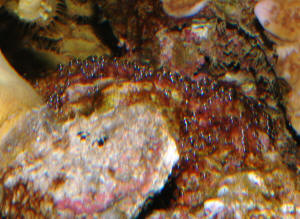
the contaminated system... for general purposes. Bob Fenner> Dead Anemone Residue...Mushrooms Vacating - 07/03/04 Hi Guys, <Hello Nancy> I had a medium bubble anemone for over a year who was home to a tomato clown. A few months ago it moved to the underside of a rock and slowly withered away and left a cottony white layer where it's base had been. Not knowing if the anemone would grow back from this I left it in place. I now have a large covering of this on an adjacent rock and the resident mushrooms are vacating the rock (which they used to cover). Is this something I want to eradicate or is it a friendly unknown species who has taken up residence. This is a 75 gal tank with a deep sand bed that has been up and running without incident for 2+ years, (initially set up in 98 but had a severe algae problem and I had to tear down, scrub and redo to get rid of it all.). H2O parameters seem ok, fish are happy, very little algae, VHO lights + Moonlights. I will attempt to attach a pic but I am digitally challenged, sorry if it doesn't work. <Pic was sent with no problem. <<But not saved for posting... RMF>> Nancy, any residue left by a dead anemone should definitely be removed. This can be quite toxic to the rest of the inhabitants. Probably why your mushrooms are heading west.> Thanks, <You're welcome. James (Salty Dog)> Nancy D
Sea cucumber disaster 8/8/06 I don't really have a question for you, just a cautionary tale you might share with your other readers. <Please do> I went to the LFS this past Saturday afternoon to get an easy-to-care-for fish of some kind, saw a pink and green sea cucumber, and made an impulsive last minute change to my plan. Big mistake. HUGE mistake. I later paid your site a visit for a refresher on Cukes. I had forgotten all about them expelling their guts into the water and pondered whether or not I wanted to take it back and see about an exchange It made that decision for me early this morning when it went nuclear and killed all my fish, though the other inverts seem ok. I did a 30% water change this morning and will do a couple more in the next day or so. I'm hitting it with some new charcoal as well. This is a small tank, so it was only three fish. No real real financial loss, but it is definitely irritating and embarrassing. I know 99% of the blame falls on me, but I really wish LFS had said something about a critter that dangerous. The money they made on the Cuke is much less than the money they lost by losing me as a customer. <...> As strongly worded as your warning against Cukes is, maybe you should put some skulls and crossbones and biological hazard symbols on it as well. Thanks for maintaining such a great site. It really comes in handy, especially if used prior to a purchase. Thanks, Ty <Thank you for this. Bob Fenner> Urchin question 8/20/06 Hello WWM Crew, <Sara> I have a few of questions regarding a Lytechinus variegatus urchin ( I was able to id from your site), I hope you can help me out with. My first question is if a Lytechinus variegatus urchin is in the process of dying, or not doing very well, is there any chance it could release toxins in to my tank? <Mmm... yes... this species is a member of the Family Toxopneustidae... toxic to even the touch... to fishes, humans> Should I remove this urchin from my main tank? <Unless it were very large (hundreds of gallons), exceedingly well circulated and filtered I would not introduce a member of this family> I had noticed that my urchin had been losing spines at an alarming rate recently and had stopped moving around the tank. When I turned him over there was a brown/tan worm on him. This worm was not a bristle worm, rather it looked more like a common earth worm (only much, much smaller.) It had small bristles on it's side, but the bristles were not near as large as a bristle worm's. <There are actually thousands of different species...> I also have noticed that there are deep red spots on the outside of the urchin it almost looks like blood. After I removed the worm from the urchin he immediately improved and began to slowly move around the tank again. So, I guess my main questions are should I remove this urchin from my tank and quarantine him? <Yes, I would. Don't use your hands in contact... scoop into a container... i.e., don't expose to the air...> Is there any risk he will poison my tank if he dies or is dying? <Again, yes> Lastly, are there any know worms that are parasitic to urchins, or was this worm just a result of him dying/not doing well? <Could be either/both> Thank you so much for your help, Sara <Welcome. Bob Fenner> Toxicity of Cyanobacteria... can be extreme 8/27/06 Hi Crew, <Thomas/Tom> I have developed what I believe to be a Cyanobacteria problem in a 30 gallon with 2 Gobies, 2 soft corals, and 1 Fireshrimp. This algae is purplish in color and sort of thread-like, forming masses that hold together reasonably well. <Is likely a BGA> I have found several suggestions on your site about how to go about correcting this problem, which I will get to work on. But I still have a question. Prior to water changes, I have been attempting to break up this algae to syphon at least some of it out during those changes. I have noticed my Fireshrimp suffering after water changes (looks bad, like he might not survive). In today's change, I noticed that he looked bad, before the new water goes in, which is why I started to suspect this had something to do with what I was doing to the algae. <Mmm, either this and/or some part/aspect(s) of the new water... Both very common> So, can disturbing Cyanobacteria release toxics into the water that serious affect a Fireshrimp, but not Gobies or soft corals? <Oh yes. Bob Fenner, touching on this subject today at a presentation to the NJRC in Pt. Pleasant, NJ> Thanks, Tom Deadly toxin? 9/5/05 Hello WetWebMedia crew members, <Alex> I have a 72 gal. tank that has been running for almost 2 years now. About 2 months ago something terrible happened, I fed my fish (at that time, pair of tomato clowns, hippo tang, 4 stripe damsel and green spotted puffer) early in the morning as usual and everything was normal and good but by lunch time the puffer, the tang and the male tomato were dead. All the inverts and corals were ok. I double checked parameters and everything was good (zeros for ammonia, nitrite and nitrates, PH steady at 8.2, Calcium at 420 ppm, density steady at 1.024, etc.) I immediately did a 50% water change and replaced the carbon in the canister filter. <Good> Unfortunately the 4 stripe damsel and the female tomato died slowly over the next 2 days. The problem is that ever since, every fish that I have tried to add and that seem healthy (quarantined for at least 2 weeks at my LFS and properly acclimated) die within one hour !!!! Symptoms include paralysis along with rapid breathing, but they only show up about 5 to 15 minutes before the fish dies. The corals in the tank (mushrooms, bubble, pumping xenia and finger leather) and inverts (mainly Astrea and turbo snails) are still doing fine. I have kept doing the regular maintenance that include top off and 10% weekly water changes and 20% monthly water changes, carbon replaced weekly, skimmer emptied daily, adding trace elements, etc. yet I just lost a Naso tang today. I have no idea what can be causing this and I'm almost ready to give up due to the frustration, sadness and money wasting situation my tank has been in for the past couple of months. I think it might be a toxin of some kind. <Agreed> I'm thinking about nuking the tank and starting over from scratch. <This is, ultimately, your best shot...> I don't think any of the corals I have can produce enough quantities of a powerful toxin like that, right? <Correct> If so, is it possible that it might be impregnated and accumulating in the live rock? And why it's not affecting the snails and corals, just the fish? Thanks in advance for your help. Alex. <Something very toxic, and persistent here... most likely microbial in nature... but might be related to the puffer... as you state, the best approach is to drain, clean everything and re-set-up... the cnidarians can be moved, the current LR rinsed in freshwater... and placed in the tank again. Sorry to read of your situation. These "wipe-out syndromes" are less common in recent years, but still troubling. Bob Fenner> Blue tang sick......please help 2/9/06 I purchased a blue tang from a very large and reputable LFS about 2 weeks ago and since I bought him he just keeps getting worse! In my almost 2 month old 150 gallon tank I have * Yellow moray ( 3 feet) * Zebra eel ( 4 feet) * Miniatus Grouper ( 5 inches) * Marine Betta ( 5 inches) * Maroon clown (3 inches) * Large bubble tip anemone * Naso tang ( 6 inches) * Yellow tang ( 3 inches) * Blue hippo tang ( 5 inches. very sick!) * 15 large soft corals I have VHOs with more than enough lighting (just below requirement for frags) and 160 pounds of live rock. All my parameters are in check although just yesterday I did get a nitrate spike (in safe levels however) <Numbers please> but everything is fine now¦ anyway on to the sad part. For about 2 days he swam around (the hippo) and shook while swimming occasionally swimming on his side although he definitely did not do this in the LFS! Anyway after that he hid in the rocks and pretty much stayed there since now¦.. about 2 weeks (no eating, swimming, hardly any activity whatsoever) he dame up today leaning on my snail on the glass not moving and I caught him with my net <Must be sick!> and made a protective plastic sanctuary at the top of my tank with a cut laundry basket with a little home from shade from the light and etc. Now that I see him he has transformed from the beautiful fish I bought, into a fish with faded blue spots and his yellow tail looks like a beat up feather duster and is off white from the bright yellow it used to be. There is also a cluster of tiny red spots oh his tail which I have no idea what it is. He looks awful please help me I have read over 200 inputs with no real definitive answer and am blue in the face with no progress. It would be a shame if he didn't make it Thanks so much <Very likely this new fish is reacting to a chemical "soup" situation your other fishes have become classically "adapted" to... their combined wastes, the soft corals... If you want to save this fish it needs to be moved to other quarters pronto... The overstocked situation in your 150... I'd stick to what you have. Bob Fenner> Urchin mysterious death-poisoning of tank 02-05-06 Dear Crew, <Dawn> My tank recently crashed. Most everyone was saved, except the fish, who perished very quickly. It happened while I was at work; my housemate reported tank looked great at 3pm. It was cloudy / milky by the time I got home 3.5 hours later, fish were dead, and most everything else was severely stressed. I suspect the death of a Diadema setosum or Antillarum (not quite sure which it was) is what triggered the crash. <Could, yes> I think it died, (it hadn't been well for some time, it had dropped it's spines 3 times in recent months), and in turn created a toxic soup that caused tank crash. I do not have good facts for this, just my suspicions. I've been researching for info re: toxicity of urchins in the tank once they die, but having very little success. I did find this on WWM, but little else in the Urchin articles and FAQs - "There are no absolutely reef safe urchin species IMO... too much chance of mysterious death-poisoning of the system" ~ Bob Fenner. My questions: What leads Mr. Fenner to the above conclusion? What can you all tell me about the death of sea urchins poisoning a tank? Could you point me in the direction of additional information? Thanks in advance and kind regards, Dawn < http://www.google.com/custom?q=urchin+poisoning&sitesearch=wetwebmedia.com Bob Fenner> Sea slug Toxin? Oh yes 02-05-06 Morning guys! <Too cheerful...!> Just found your web sight and it's now booked marked! <And the site too?> I've been searching all over the web trying to find an answer to my problem! About a month ago I purchased a beautiful sea slug. A week later I found it dead, caught in my filter. <Yikes... am trying to put away the pix from the last trip... and am on to the Opisthobranchs... and reading re just how toxic some of them are... no wonder they can be so gorgeously colored and not predated, eh?> A week later all my fish except for one damsel were dead! ( Niger Trigger, reef beauty, Butterflyfish, cardinal, yellow tang) I forgot to mention that my tank is a combo reef/fish 50 gallon. My soft coals and one Anemone were not affected nor were the cleaner shrimp, hermit crabs and turbo-snails. I immediately suspected the death of the sea slug and sure enough read that these slugs secret a defensive toxin. <Yes... but not so much a secret to the fishes they're found with... just in the confines of an aquarium...> I performed a 50% water change and replaced all my filters. I let the tank "stand" for 3 weeks then introduced one blenny to the tank. Within 36 hours it died! It's skin was sloughing off and fins looked as if they were dissolving. <Yep> My question is; should I completely start over with new live sand and live rock??? ( the rock is still very purple in color) or let the tank recycle for a longer period of time???? HELP! Great sight, Jim <Mmm, if it were me, mine I'd try adding a good quantity, quality of activated carbon in your filter flow path, let another few weeks go by and try some other "test fishes". Bob Fenner> Suspended red algae ... numerous iatrogenic problems, SW 3/3/06 Dear WWM, <I, not "i"> recently treated my 55 Gal tank for ick <... not your main tank? No...> and then treated the tank with Maracyn TC for secondary infections. the result was a full bloom of red suspended (algae?) <Likely... a BGA> i have done two 15 Gal. water changes in the last five days. it has been reduced from a dark (blood) red to a purplish pink. i lost three clowns a powder blue tang <Inappropriate for this size system> a goby and four damsels in the process. I'm left with a lonely yellow tang an empty pocket book and a heavy heart. i have a Skilter 400 filter <Insufficient...> and a Corallife full spectrum light 30lbs of live rock and live sand and started the tank with Bio nitrites Jan 1. this is my first marine tank and my kids think I'm a failure. can you help me? <You can definitely help yourself...> the red algae is not like anything i have seen online. yours truly, "red in the face" <Put some time aside, read on WWM re Marine Set-up, Maintenance, Stocking... you've made a few grievous, avoidable errors... educate yourself. Bob Fenner> Sea apple... disaster - 03/05/06 My sea apple has some type of orange string coming out of her "butt" what is this? What should I do? <Carefully, and I mean with utmost caution, remove this animal INCLUDING this material. Please see here: http://wetwebmedia.com/cukecompfaqs.htm Bob Fenner> Too much Caulerpa? 5/3/04 hi again crew. <howdy> first off, some good news. thanks for the advice re: nicotine on the fingers from a couple of months back. i think that was what was causing my sudden fish death syndrome. <its amazing how easily contaminants are carried into the tank... aluminum from underarm anti-perspirant, acetone from ladies (or men's - Doh!) painted fingernails, petrol products from under finger nails, etc> since then, I've bought a grabber and latex gloves, and haven't suffered any losses in quarantine (knocking on wood aquarium stand :) <excellent to hear... and it protects you from pathogens too!> I'm up to a Rabbitfish, 6 green Chromis, and a brittle star. all seem to be healthy and happy. well, i used to have 7 Chromis, but i think it got sucked through a pump (i was away on vacation). anyway, to my question. I have tons of green grape algae. <Arghhhh... this is believed to be the most toxic/noxious of all the common Caulerpas. Do be careful> to the point where it's literally like a forest around my live rock. i had figured that the Rabbitfish would have cut it back, but it seems to love prime reef (no veggies there). <many fish will not eat this/other Caulerpas because of their noxious composition> it loves the formula 2 (basically, enriched Nori) i give it, but just doesn't seem to graze. i think it's a baby and scared (it's about 3 inches, and has it's spines up and hides most of the time). i don't want to stop the formula 2, because i know it's a staple in their diet, and i don't want it to just eat the prime reef if it's so young. <correct> so, should i get another herbivore to "teach" it/trim back the algae? <not likely or recommended> I know having too much Caulerpa is not the worst problem to have... <on the contrary... there are serious risks with it... toxicity, vegetative events, etc. We describe this at length in our Reef Invertebrates book and there is quite a lot on this topic in the WWM archives. Do a keyword search with the Google.com search tool from the home page for Caulerpa and see much> also, both the Chromis' and the Rabbitfish are listed in Scott Michaels book (500 marine fishes) as feed 2-3 times a day. isn't that a bit excessive? <good heavens no! These are fish that feed on plankton and algae, respectively, almost constantly in the wild. Small frequent feedings are best> i feed once per day, and think that's too much. <perhaps the quantity at one sitting so too much... but not the frequency.> thanks in advance-- rob <best regards, Anthony> Toxic blue boxfish Hello, I have a 65 gallon tank with approx. 65lbs of liverock and a 3" Picasso trigger and a 3" Niger trigger that get along peacefully. <You're lucky. Don't expect it to continue, especially in a tank that size> I am considering adding a blue boxfish to the tank and am expecting some initial aggression to occur until territories are re-established. How real is the threat of the boxfish poisoning the whole tank during this stressful acclimation period? <Don't get the boxfish. The aquarium is already going to be overcrowded whenever your triggers grow. Also, boxfish should not be housed with aggressive tankmates - they are best left a species tank. Please read our archives regarding boxfish for more information> Thank you. <No problem. M. Maddox>
Poison Polyps? On Friday a friend gave me two small mushroom anemone polyps. I put them in my tank and did not pour in the water. They opened up. By Tuesday, four of my six fish died, with no ich markings or obvious infections. I checked the chemistry of the tank, which was great. Is it possible that the polyps could have infected the tank? Thanks much, Joel Sappell <Well, Joel, I doubt that it was some form of parasitic infection, as you would most likely have seen some external signs. This all points to some type of poisoning (metabolic or otherwise). This wipeout came on too fast to be an illness, IMO, unless you exposed your fish to an extremely virulent infection of some sort. Look beyond the obvious here for a cause...Perhaps there was some sort of metal, or other potentially toxic substance introduced to the water? When you checked the water parameters, did you look at the "basic stuff", such as ammonia? Sometimes ammonia spikes can occur for various reasons, and kill with frightening rapidity. It may be just coincidental that the mushrooms were introduced before this die-off occurred...Sorry I couldn't through a little more light on things here...In the absence of obvious disease signs, it may very well have been a poisoning of some sort...Keep looking for answers...Good luck! Regards, Scott F> - Anemone Stings and Toxic Tank Question - Do you mean that if they are stung by the Tube Anemone that they will die immediately? <Really depends on the extent of the sting.> Or can it take a few hours? <Both.> From the contamination in the tank, could that cause the fish to look as though they are peeling or flaking? <Yes. Cheers, J -- > Re: problem with reef I bought the flower pot a month ago and it died within 24 hours and 2 days ago I bought the anchor and 2inch maxima and as soon as I put the anchor coral in my tank a white secretion came out of it and I just bought the protein skimmer 2 days ago along with the coral and clam thanks David P.S what can I do to make this tank better >> Time... and timing... The Goniopora (Flower Pot Coral)) no doubt poisoned the next couple of animals... and you're dollar foolish and late with the skimmer... Wait, read, have patience... take a gander at the materials stored on my website... www.wetwebmedia.com... for insights into system set-up, livestock selection... environmental disease, toxic tank conditions... Bob Fenner Caulerpa/toxic waste spill episode Anthony, <good
afternoon, dear> After the Caulerpa/toxic waste spill episode, I did
a 25gal water change using the gravel vac to pull out all of the
remaining bits of dead plant matter where it had settled. (water was
clear when I did this) <excellent> Then, I added about 25lbs of
live rock. Now, 2 days later, my water is very cloudy. <was the rock
fully cured...and can you confirm that with a zero ammonia/nitrite
test...or did you just get snookered again (no mail order rock, right?
Its OK if you'll cure it separately, but never to be put/trusted
right in display> I have battled cloudy water before, but this is a
weird cloud. It has almost a yellowish hue to it, and even more
strange, when the morning sun comes in, you can actually see the
make-up of the cloudiness and it slowly drifts around resembling
cigarette smoke. You can only see this under the right sunlight
condition, otherwise it just looks murky. It is difficult to make out
objects on the far side if you are looking down the 6ft length on the
tank. I have been aggressively changing filter medium as it becomes
clogged with this seemingly never ending supply of dead plant material,
but there seems to be no more now. <may indeed be poor
quality/uncured rock...any odor? Skimmer working like mad, I
suppose> Do I.... 1) Simply wait for it to clear? <water
tests please> 2) Do another water change? <yes...perhaps
several> 3) Shoot myself? <nope.. but patience and the
investment into a quarantine tank for all fish/plants/rock to got
through for 2-4 weeks first would save you grief> This is
disturbing. On a lighter note congratulations on your spritehood!
Thanks again, -Pat <thank you, the Queen Mum was shorter in person
than I thought she would be when I was knighted...er, spirited.
Anthony> Is my tank poisoned? Mr. Fenner, <Anthony Calfo in your service> Thank you for answering many of my other questions from other sites. I now have a huge problem! I have a 54gl corner with a Fluval 304 w/ activated carbon, 55lbs of LR, 15lbs of LS, protein skimmer, and 2 powerheads. My stock list is 1 Wellsophyllia, 1 torch coral, 1 maxima clam, 1 pearl bubble, 1 Caulastrea?), assorted mushrooms and polyps, <I admire the fact that your coral selection is thematically compatible... mostly LPS corals and the others mostly low/med light and high nutrient just the same. The clam is the only oddball and is OK if kept high in the tank. I wish more aquarists were more conscientious of this... too many SPS, LPS and softies all mixed together> 1 Anthias, 1 royal Gramma, 1 citron clown goby, and 1 false clown. My water parameters have been at 0 with temp 77, Alk 11dKH, calc 390 until today. I found my pink and green cucumber dead but still had its guts intact and my impatiens Cuke dead with its guts expelled. This must have happened during the day because everything was fine until I came home. I was doing my normal water testing once per week) after I removed the Cukes and all my parameters have jumped! My ammonia is now .35, nitrites .3, nitrates 30 but calc and Alk stayed the same. I also added a piece of LR from a LFS on Saturday but all levels were normal as I was checking them everyday since the addition of that piece to make sure there were no spikes. Could it be from the Cukes or is it from the LR? <more likely the Cukes but it is still not severe> What can I do to lower the levels before any damage is done to the corals? <aggressive protein skimming, carbon and especially PolyFilters and good water changes> I also now know better than to have Cukes as part of the clean up critters event though my LFS said they would be great additions! Thanks for all the help. Chris <I'm really not too critical of sea cucumbers myself. They are fascinating and their toxicity is highly variable and overrated. They can be kept and even propagated. Best regards, Anthony> Question: Hey Bob I enjoy reading your replies to others problems especially when I come to the same conclusion before I read yours but now I have a question that I hope you can answer for me. I have a 240 gallon tank that has been set up for about 5 months. I use a 350 magnum, HOT magnum, and a HOT wet/dry filter as well as a number of power heads. Basically a lot of scraps that I have from other tanks in the past. I also use a "home made " filter for polishing on a once every few weeks basis. As far as fish, I have 2 Leopard sharks and a Masked Puffer right now. My problem is that about two weeks ago I noticed my tank started to turn green so I tried to "polish" the water with no success. It got to the point where it looked like Mountain Dew. I did some tests and it was always fine and the fish seem to not be affected by it at all. I never left any uneaten food around in the tank either. I started doing MAJOR water changes in the past week or so and it is better but still not clear like it should be. Do you have any suggestions? I'm thinking of buying a protein skimmer but will that rid my tank of the discoloration or are water changes the best way? Also what do you think could have caused this in the first place? I was thinking of using a algaecide but I asked about it at a local pet shop and they said that there were no algaecides made for saltwater just freshwater and I really didn't want to take that risk if I didn't have to. I really don't like adding anything to my tanks. Any help would be appreciated. Bob's Answer: Hey Tim... you're experiencing "unnatural selection" of a sort. The probably single-celled green algae that are proliferating in your system are taking advantage of a lack of competitors and predators and over-running your view! Yes, I do have somethings that I'd do, and encourage you to chew on. One, definitely get a big skimmer going on this system. With Triakis semifasciata eating how much they're probably doing, not to mention that beefy puffer!!! You need to extract some of the gunk that is feeding your algae problem. The cheapest, surest way to do that is through foam fractionation. Do you run any amount of carbon through any of those Marineland filter products? You should. A few pounds in polyester bags and switch them out every few weeks... BTW there are algicides for marine systems, but in your case... I wouldn't fool with them. The copper-based ones are DANGEROUS with sharks especially. I have a 125 reef tank that experienced a major melt down The tank is 4 months old with 150 pounds of hand picked Fiji rock, wet dry system, ETSS Gemini 750 downdraft skimmer, UV, 3 175 watt metal halide lights with 2 6' VHO. Water parameters are normal. Ammonia is 0. nitrite 0. Calcium is hovering around 450. Carbonate hardness is 10. Tank temp about 77-78. The other day I came home from work and found my fish breathing rapidly. I have 16 fish. The fish show no signs of disease. No white spots. Nothing. The next morning everything is dead except two clown fish and a Banggai cardinal. What happened? <System components and parameters sound okay, and the real clincher clue is the fish livestock that is still around... Some sort of acute poisoning event occurred that favors fishes that live in close association with invertebrates... over those who do not. Now, what is it? Did you have a large sea cucumber? Something happen with a largish stinging-celled animal? Something, somehow triggered one or more of your other non-fish organisms to release toxins into the system. Something got sucked into an intake, something got stung severely, fell on to something else... At this point, I would encourage a large water change (about half), a change in chemical filtration media (or addition if you don't generally use same), and a good month abstinence for adding more livestock of any kind.> |
|

|
Features: |
|
| Featured Sponsors: |
 crop
crop Mr. K., re-do this wall!