 |
|
| Home | Marine Aquariums |
Freshwater Aquariums |
Planted Aquariums |
Brackish Systems |
Ponds,
lakes & fountains |
Turtles & Amphibians |
Aquatic Business |
Aquatic Science |
Ask the WWM Crew a Question |
| Please visit our Sponsors | ||||
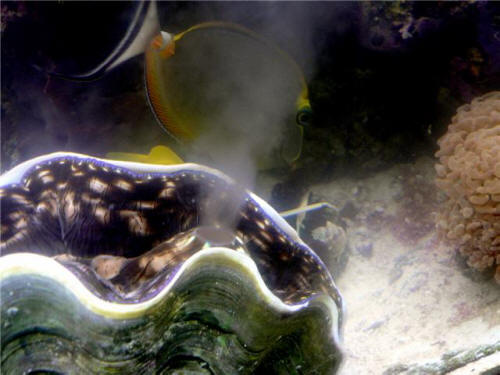
Re: Squamosa Spawn and Coral Bleach = Clam and Cocktail Sauce? 5/22/07 <Hi MJ, Mich here again.> Now in all seriousness, what is the outlook for these very large clams. <Alright I kind of figured you might have a "real" question but the other was a lot of fun!> Will future spawnings be likely? <Spawning can occur spontaneously, but spawning can also be induced by drastically changing the environment, perhaps the new environment, i.e. your system, triggered your recent arrival to spawn.> Will more coral bleachings be likely? <Less likely if the environment remains stable. Clams can be induced to spawn by mechanical manipulation, by increasing water temperature (to 33C or over 90 F) and by environment stress... sort of a last ditch effort for survival/reproduction. More here and related links in blue: http://www.wetwebmedia.com/tridacreprofaqs.htm> Do you think that it is likely this spawning is the cause of the coral bleaching? <I'm not sure, but I guess it is possible the reproductive material could negatively impact life in such a small-enclosed system (at least when compared to the ocean).> They happened very closely together in a closely monitored tank. Why were other organisms not affected? <Possibly a matter of geography, or just particular sensitivity or maybe the two occurrences were unrelated.> Mr. Fenner? Anthony? Help...... <Will try.> Thanks <Welcome! Mich> MJ Tridacna clams... aquaculture 12/16/06 Hi Bob, I am trying to breed Tridacna clams in my farm in Vietnam. Do you help me the Tridacna clam's breeding process, or where I can have it. Best Regard, Trung <Mmm, there are "standard works" in this field... Look for the names Gerald Heslinga, James Fatherree... and folks who will travel/consult with you on site re... do you intend to make this an intensive (on land) operation, or more extensive... growing out your stock in the sea? If you'd like, we can discuss various aspects of this process here... through a course of emails. Bob Fenner> Re: Tridacna clams 12/19/06 Hi Bob, <Trung> I need to know what kind to feed larva of Tridacna. I have been used phyto to feed them. <What species? How administered? Do you add fertilizer (organic, inorganic) to their water... is this in "raceway" culture...? How open?> Do you tell me how to titillate the clam and how to fertilize the eggs. Best Regards, Trung <... This is covered in works by Gerald Heslinga and James Fatherree you've been referred to... many people develop/use a "kit" to collect gametes... stress their broodstock to release such using physical "stress", chemical prep.s... Bob Fenner> Re: Tridacna clams 12/20/06 Yes, we used heat stress to titillate spawning for clam. Best Regards, Trung <Heeeeee! Like your wording here! Does work... in the west, sometimes referred to as getting (or giving I guess) "the hots". Hee heeeeee! BobF> Stress induced spawning in clams? Moved my maxima to another tank today, it doesn't seemed to have liked the move, and seems to emitting a milky "smoke" from it's excurrent siphon. Stress induced spawning? Expelling algae? > I didn't remove it from the rock, just moved the entire rock...it's gaping pretty badly, but still responding to light and such as quickly as it did. > Worried :\ > Anyone have any input? Thanks yes... quite possibly stress induced spawning (sperm from immature clam... egg production/capability doesn't occur until they are much older/larger). You may have heard that stress is commonly used (or was) to induce spawning by Tridacnid farmers. Breeders would be moved to warm shallow lagoons near the time of a full moon. To harvest gametes the breeders sometimes are brought ashore in the sun to "bake" for a while, then immersed in fresh, cool seawater some minutes/hours later. (the farmers often hedge their bets too by injecting serotonin). I had a similar stress induced spawning occur in my GH with some big Squamosas (see the Tridacnid section of BOCP1 if interested). Ant- (who can't resist answering mail even while in KY state <G>) Looking for Tridacna Clams-or seeds Hello Bob, my name is Michael from Miko-Marine in Berlin, we're an importer for corals and inverts in Germany. I've got one question: Can you tell me some sources or Tridacna farms in the pacific ocean where I can order Tridacna-clams or Tridacna seeds who can export to Europe? <Can help direct you to folks who might be able to help you. Gerald Heslinga of Indo-Pacific Sea Farms (http://www.ipsf.com/) and Barry Neigut of Clamsdirect.com (I've cc'ed him here, see above) should know where to look next. Good luck, life. Bob Fenner> Thanks and best regards Michael Miko-Marine Pannwitzstr.79a D-13403 Berlin - Germany - tel. 0049 176 26098337 fax. 0049 30 40912406 e-mail: Miko-Marine@gmx.de Raising Tridacnid Clams spawning in captivity - 2/12/04 I have just had a spawning of 3 clams in my tank and wanted to know if it is possible to raise T. clams in and home setting. <Not unheard of but, likely a very challenging and expensive endeavour.> If so how? <Well, you might want to look through the knowledge already written on the subject and come up with a plan.> I can't seem to find any info. <Daniel Knop's book is a great source for info to start. Here are some web links: http://aquanic.org/publicat/usda_rac/efs/ctsa/130.pdf http://www.animalnetwork.com/fish2/aqfm/1998/aug/shell/default.asp http://www.ctsa.org/PublicationList.aspx http://www.ctsa.org/upload/publication/CTSA_143631672855187292852.pdf These links of course, are just a start. You might want to get in touch with those in the know and introduce yourself as one who is interested in the research. Might glean some very important knowledge. I hear this is a competitive, expensive, frustrating trade to get into. I wish you luck and let us know what else we can do to assist. ~Paul> thanks Brett Lind Clams Hello my name is Christopher I would like to know were I could find information on breeding Tridacnid clams thanks for your help <A few places on the net. Try the Breeder's Registry first. Link can be found on WWM: http://www.wetwebmedia.com/links.htm |
|

|
Features: |
|
| Featured Sponsors: |