|
Related FAQs: Tridacnid Identification, Tridacnid Behavior, Tridacnid Selection, Tridacnid Compatibility, Tridacnid Systems, Tridacnid Lighting, Tridacnid Placement, Tridacnid Feeding, Tridacnid Disease, Tridacnid Disease 2, Tridacnid Health 4, Tridacnid Health 5, & Tridacnid Reproduction, Giant Clams, Tridacnids 2, Tridacnids 3, Tridacnids 4, Tridacnid Clam Business, Bivalves, Bivalves 2, Lighting Marine
Invertebrates,
Related Articles: Got Tridacna? A beginner's guide to
keeping Tridacnid clams by
Laurie Smith, Example Chapter
from NMA Reef Invertebrates book, on Giant Clams, A Brief Guide to the
Selection and Placement of Tridacnid Clams by Barry Neigut,
Tridacnid Health:
Pinched Mantle Syndrome in Giant Clams by Dr. David Basti,
Deborah Bouchard & Barry Neigut, Bivalves, Mollusks,
Lighting Marine
Invertebrates,
/The Conscientious Marine
Aquarist
The Giant Clams, family
Tridacnidae
|
|
| Bob Fenner |
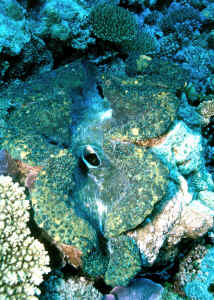
Tridacna gigas, Australia
|
Superfamily Tridacnacea, Family Tridacnidae, the Giant
Clams
Typically with heavy shells of a convoluted
nature, often ribbed on their outside with scales. Mainly found
associated with stony corals, sometimes embedded in their
matrix.
| Tridacnid mantle. The extension of the mantle
encourages photosynthesis by symbiotic zooxanthellae located in the
Clam's tissues; removing carbon dioxide to supply the algae,
who in turn produce oxygen and sugars for the Clam. |
|
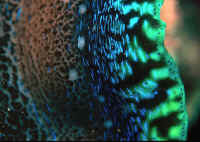
| Hippopus hippopus (Linnaeus 1758), the China
Clam. Malay Peninsula to Australia, out to Micronesia and Tonga.
Found in shallows on reef flats and patch reefs. To sixteen inches
shell width. No large opening at the shell base. Brownish mantle
with many fine white lines of its surface. This one in
captivity. |
|
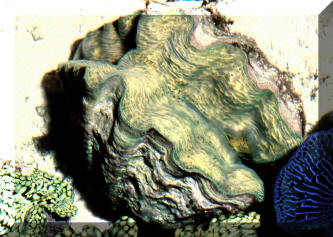
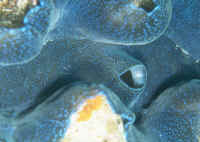
| Tridacna crocea Lamarck 1819, the Crocus
Giant or Burrowing Clam. Malay Peninsula to the GBR; Philippines,
Guam, Fiji. Distinguished by having about six rounded ribs highly
adorned with fluted scales. Small species; to about six inches
across. Filter feeder that also utilizes photosynthates. A couple
in captivity and a close-up taken in Australia's Great Barrier
Reef. |
|
Bigger PIX:
The images in this table are linked
to large (desktop size) copies. Click on "framed" images
to go to the larger size. |
|
|
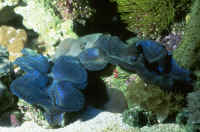
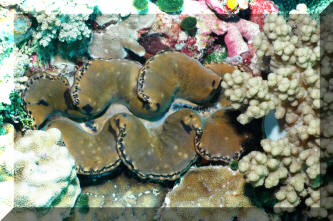
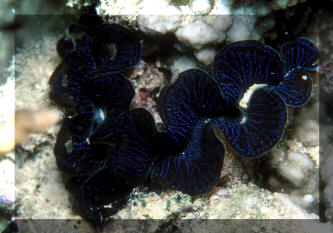
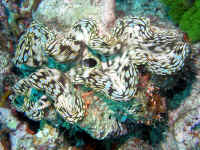
| Tridacna derasa (Ruding 1798), the Derasa Clam.
Cocos Keeling, Australia, Fiji, Indonesia and the Philippines. Very
low sculpturing on the shell, which has its base near the anterior
end rather than posterior (as all other species of Tridacna).
Shells can close tightly together (unlike T. gigas). Often
yellow/golden streaking in mantles. |
|
Bigger PIX:
The images in this table are linked to large
(desktop size) copies. Click on "framed" images to go to
the larger size. |
|
|
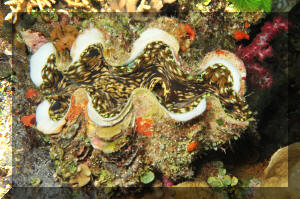
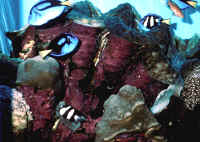
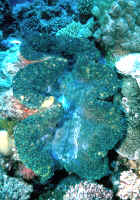
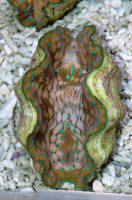
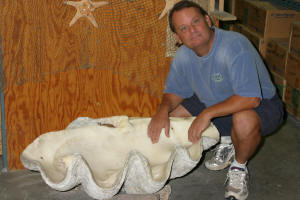
| Tridacna gigas (Linnaeus 1758), the Giant
Giant Clam. Smooth shell with no concentric sculpturing. The
largest bivalve and mollusk in the world at up to 1.3 meter in
length. Malay Peninsula to Marshalls and Fiji. At right: One in an
exhibit at the Waikiki Aquarium, Honolulu, Hawai'i, and a
big-boy (about four feet across) at "Cod Hole", in the
Coral Sea, north of Cairns, Queensland, Australia, and a four
incher at Barry Neigut's Clams Direct business in San Diego,
CA. Below a really big valve of a gigas at Marty Beals Tideline in
Los Angeles (137 kg. about 41" across at the widest... and
BobF... too heavy and wide as well... Photo by James Fatherree. Oh,
James says the world's record is 54"/137cm. wide and much,
much heavier (220 kg.s)... More than RMF by far! |
|
Bigger PIX:
The images in this table are linked to large
(desktop size) copies. Click on "framed" images to go to
the larger size. |
|
MD.jpg)
|
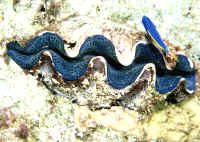
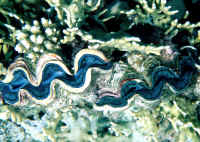
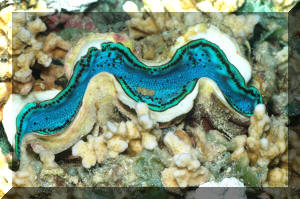
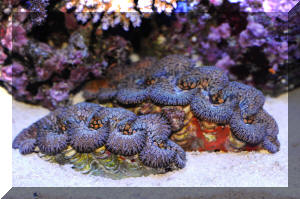
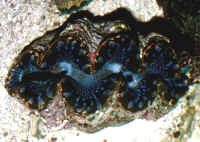
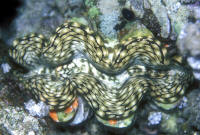
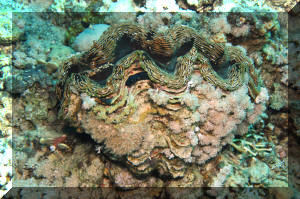
| Tridacna maxima (Roding 1798), the Large
Giant Clam. Has well-developed concentric growth folds. South
Africa to the Red Sea out to the Line Islands, but not in
Hawai'i. Common in its range. To about sixteen inches in
diameter. Characterized by elongate, triagonal shells, dense,
narrow-spaced folds on the shells (wavy appearance). Fiji and Red
Sea and captive juvenile images below. |
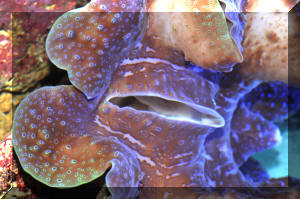
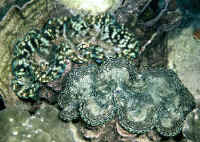
| Tridacna squamosa Lamarck 1819, the Fluted
Giant Clam. Distinguished by the presence of large leaf-like fluted
edges on its shell. South Africa to the Red Sea to the Marshall
Islands. To sixteen inches across. Relies on photosynthesis
for a major part of its nutrition. Below: These in Pulau
Redang, Malaysia are near full size. Next, aquarium and Red Sea
images. |
Bibliography/Further Information:
www.clamsdirect.net
| Here's James Fatherree and Barry Neigut out in front of the
latter's San Diego-based Clams Direct business location... both
have been working on a Tridacnid Husbandry book for ages... when
will Knop's decade old work be supplanted? Pic by RMF... Oh, is
now! 2006. |

|
|
|


%20MD.jpg)
%20MD.JPG)
.JPG)
.JPG)
%20MD.JPG)