|
FAQs about Green Spotted Puffer
Foods/Feeding/Nutrition
Related Articles: Green
Spotted Puffers, Alone But
Not Lonely: The Importance of Keeping Puffers
Individually by Damien Wagaman, The
Arrowhead Puffer, Tetraodon suvattii, miraculously
malicious, Freshwater/Brackish Puffers, True Puffers,
Puffers in General, Burrfishes/Porcupinefishes, Tobies/Sharpnose Puffers, Boxfishes, Puffy & Mr.
Nasty, Puffer Care and Information,
Related FAQs: GSPs 1,
GSPs 2, GSP
Identification, GSP Behavior,
GSP Compatibility, GSP Selection, GSP
Systems, GSP Disease, GSP Reproduction, BR Puffers 1, BR Puffers 2, BR
Puffers 3, BR Puffer
Identification, BR Puffer
Selection, BR Puffer
Compatibility, BR Puffer
Systems, BR Puffer Feeding,
BR Puffer Disease, BR Puffer Reproduction, Brackish Water Fishes in
General, Puffers in
General, True Puffers,
Freshwater Puffers, Burrfishes/Porcupinefishes, Tobies/Sharpnose Puffers, Boxfishes,
|
|
Green spotted puffer 7/12/18
I have a green spotted puffer and I have had him for about a month now!
<Do remember these are brackish water fish, despite what pet stores tell you.
They will not live well or live long in freshwater conditions. Adults may even
need marine conditions, though I'd argue around SG 1.005 is perfectly adequate
for a long and healthy life, i.e., about 9 grammes marine aquarium salt mix per
litre of tap water (that's about 1.2 oz per US gallon).>
He is still very small and bright!
<Neato!>
But I noticed tonight his left side by his tail is almost flat looking but his
right side and head are fine! I’m not sure what could be wrong with him I just
didn’t a total tank clean.
<Puffers can/will change their shape somewhat, especially when they're overfed.
But they can also turn dark when stressed, which can make them look very
different.>
But I also was wondering could he need his teeth trimmed this little and what
could I feed him other then the flakes they gave me at the pet store?
<Yikes! Flakes are not an option here. Sure, if he eats them, once in a while
they're useful. But he should really be eating mollusk and crustacean foods,
whether small snails, or small shrimps, or slivers of seafood. A variety,
really. Even if your puffer can't eat whole 'cocktail' shrimp (which shouldn't
be a staple anyway) he should be able to eat krill or brine shrimp. Do let me
have you read, here:
http://www.wetwebmedia.com/brackishsubwebindex/gspsart.htm
http://www.wetwebmedia.com/ca/volume_6/volume_6_1/thiaminase.htm
http://www.wetwebmedia.com/brackishsubwebindex/gspfdgfaqs.htm
The key things are: use mussels and prawns/shrimps sparingly; use snails and
cockles liberally; choose crunchy foods where you can; visit marine aquarium
shops for suitable bite-size frozen foods such as krill and Spirulina-enriched
brine shrimps for economical staple foods.>
I’ve been looking into his diet and such but no one can seem to help me and I
don’t think he is big enough for shrimp.
<He'll manage small frozen whole shrimp when he's bigger, but as a youngster,
frozen krill and brine shrimp are more realistic. You can also try woodlice from
the garden -- assuming no pesticides have been used. Bloodworms, daphnia and
other pond foods are an option too.>
Please help and the faster the better!! I am worried he has become my baby
quickly
<Hope this helps. Cheers, Neale.>
Re: Green spotted puffer 7/13/18
Okay I will check into other food today! But the place I got him from told me
that he was raised on flakes so far and that he should be fine with those for
now until he got bigger but upon my research is why I asked about it!
<For a start your Puffer was wild caught. It wasn't 'raised' on anything.
He may/may not eat flake, and if he does, that's great. Flake will provide a
good range of nutrients. But it won't do anything for his beak.>
Also how will I know when he needs his teeth trimmed because he is only about
and inch and half or maybe two if that big right now he has grown a lot since I
got him as well!
<If you can see the teeth all the time, they're probably too long, and if he
can't easily eat, they need dental work. Bear in mind that it's easier to trim
the beak when the overgrowth is slight. Let me direct you to some reading:
http://www.wetwebmedia.com/fwsubwebindex/smpufferdentistry.htm
Personally, I wouldn't use a net to hold the puffer while doing the work,
but wet hands firmly. Nets can be rough and can damage fish.>
Now I have him in a small tank at the moment because I was worried he was
getting sick so I upped the salt level a bit to help him over it but he may not
need it!
<He needs salt. Quite a bit of it. Do read, understand about these fish.
They are brackish water fish, not freshwater fish. If you're not buying marine
salt mix, and not weighing out substantial amounts each water change, you're not
keeping it right. Cheers, Neale.>
Re: Green spotted puffer 7/13/18
(Cheyanne here) I got freeze dried shrimp that he loved he ate till he was full
and I took the extra out but he loved it I have not seen him eat this well ever
so I’m happy I found you guys
<A-ha! Good news he's eating well, and glad to help. Cheers, Neale.>
Green spotted puffer help! Sys., nutr.
4/26/18
Hi
I hope all is well,
<And likewise to you.>
I saw some articles about puffers and was hoping you could help. I am looking to
set up a green spotted puffer aquascape/bioscope and have a few questions:
- what substrate would be the best/most natural in comparison to their natural
habitat?
<Estuarine and coastal marine environments are very varied. But an 'idealised'
environment might include a mix of sand and broken seashells on the substrate,
perhaps with a bit of gravel mixed in. Rocks are often encrusted with bivalves
such as oysters and mussels, so either of those, perhaps siliconed onto the
rocks before use, could help to recreate an oyster reef of the sort you see
around estuaries and harbours. I'd tend to leave out corals and large, obviously
marine seashells like conches, as these tend to favour fully marine
environments, so wouldn't be quite so authentic.>
- what plants are found in their natural habitat?
<Primarily seagrasses and mangroves, neither of which are easy. Seagrasses need
strong lighting, while mangroves are trees that have only their roots
underwater, so while relatively widely traded, they aren't really equivalent to
the plants we grow in freshwater tanks. At low salinities, you can use
Vallisneria species to mimic seagrasses, but above around 1.003, these won't do
well in the long term. Unfortunately for the aquarist, there really aren't any
obvious mid to high salinity brackish water plants because such habitats are
frequently silty in the wild, so any plants there grow above the waterline. At
low salinities though, pretty much anything that thrives in hard water will do
well at SG 1.001-1.003, including Amazon Swords, Vallisneria, Java Ferns, hardy
Cryptocoryne species, and so on.>
- are the brackish/salt requirements different as juveniles than to adults? What
is the ideal level of salt?
<A very complex question! In practice, the salinity isn't critical, so long as
it's not freshwater. So if you wanted to keep a GSP at 1.005 indefinitely, it'd
be fine. It'd probably thrive in water at SG 1.003 for that matter! But a lot of
aquarist find these fish do well in marine tanks, and that opens up a few useful
options, including the use of live rock, protein skimmers, and even tankmates
like Damsels that are punchy enough to do well alongside puffers.>
-my local shop has some in stock and put aside for me. They are currently in
freshwater. How best to introduce the salt to the water? Presumably slowly over
regular water changes as opposed to adding loads on day 1?
<Either. GSPs, like most brackish fish, are extremely hardy. In the wild they
presumably have to be able to cope with changes in salinity as the tide moves in
and out. So while I would set the tank up to match the shop simply to minimise
stress, and only change the salinity across several weeks for the sake of the
filter, people can and do acclimate them to brackish water immediately after
purchase.>
- the ones in the shop are currently juveniles, 1-2 inches, can I fit 6 to 8 in
120 litre tank if I intend to rehouse them into a big tank as they grow?
<Yes, at that size they should coexist, assuming water quality was good and all
were feeding well. A singleton can easily fill a tank around the 180 litre mark
though, and you'd probably need to allow a good 80-100 litres for each extra
specimen. I have seen GSPs kept in twos without bother, but other specimens are
notoriously cranky and aggressive. You really do need to keep an eye open for
the tell-tale circular bite marks on the flanks -- a good sign of aggression>
-what is the best diet (i know pure meat with some shell fish for their teeth
but wondering about regularity/variety). Would frozen bloodworm once a day with
shell fish/snails 1-2 times a week be OK? What would be optimum?
<I'm not a huge fan of gorge-feeding predators, even if it is 'more natural'.
Let's be clear, GSPs in the wild will be constantly foraging on low-protein
foods including algae, organic detritus, and of course various small
invertebrates. This is why they seem hungry all the time -- they're programmed,
if you like, to constantly feed because what they'd be eating in the wild
wouldn't be particularly nutritious. On top of that, predators have a tendency
to consume a large amount, digest relatively little, and pass out a lot of
organic waste the filter has to process. Regurgitation is a common problem as
well. While you'll have to observe your fish and see what works for you, I
always preferred to offer small, regular meals that kept the puffers active,
rather than filling their bellies to such a degree they'd settle down, curl up,
and sleep off their meal for a few hours!>
The shop have put them aside till the weekend so hoping to buy them then.
<Cool.>
I have a freshwater tank already set up and fully cycled (was being used to
raise fry) and therefore able to ‘adjust’ it to the scope in a short time frame.
Though obviously it is something I want to get right and not rush.
<Understood. GSPs will thrive in freshwater for weeks if not months,
particularly if you have hard water. So by all means get the fish home, feeding,
and maybe do a small (~20%) water change with water at SG 1.003, so that the
resulting aquarium salinity will be barely SG 1.001. That'll be enough to keep
the fish in tip-top health, while not stressing the filter bacteria. From there
on in, weekly water changes with water at SG 1.003 will nudge the overall
salinity up to SG 1.003 after a few weeks. That's still 15% seawater, and more
than enough for GSPs in the medium term. You can plan what to do next as they
grow.>
Thank you in advance for your help!!
<Most welcome. Neale.>
Re: green spotted puffer help! 4/27/18
Hi Neale
Thank you very much for your detailed reply, I feel in a much more
knowledgeable/informed position to set up the tank
<Glad to help, and good luck! Neale.>
Re: green spotted puffer help! 4/30/18
Hi Neale,
Firstly - I got my GSP's - they are awesome!
<Yes, they are. And a good size too, when mature. Big enough to impress your
mates, but not so big you need a mortgage to house them properly.>
The tank has a good internal filter, however I just remembered I have a spare
external filter and all new filter sponges for it. I was thinking as the puffers
are messy - I should add the external filter as I have it anyway.
<Maybe. While pufferfish are messy, you also keep fewer of them in an aquarium
than, say, Guppies. I'd be aiming for a water turnover rate around 6 to 8 times
the volume of the tank per hour while small, and above around
8 cm/3 inches, I'd kick that up to the 8-10 times per hour. In other words, if
your tank had a capacity of 200 litres, you'd choose filters that collectively
provide a turnover rate around 1200-1600 litres/hour while they fish were
little, and up to 2000 litres/hour for subadult and older specimens. Make
sense?>
Is there any issues to having 2 filters?
<None at all. But avoid over filtering while the fish are small, so as not to
tire them out. You also don't want so much air/water turbulence that the water
becomes supersaturated with oxygen, as that can cause problems. But
other than that, nope, multiple filters is fine.>
Is there any issues to putting on a filter with entirely new sponges?
<Nope. If one filter is mature, and the other entirely new, the new one will be
matured within a very short span of time. Alternatively, you can dedicate the
new one to mechanical filtration, cleaning out the filter media aggressively,
ensuring nice clear water.>
I know normally a 'new' filter would mean cycling the tank - but I assume if
there is already a filter on and working and the tank is well cycled then this
wouldn't be an issue?
<Correct.>
Thanks
Kind regards,
Nat
<Most welcome. Neale.>
Re: green spotted puffer help! 5/1/18
Thanks!
<Welcome.>
Apologies for the bombardment of questions - if it is too many please feel free
to tell me to stop!
<Will do.>
I have been feeding frozen bloodworms and that has gone down well. In order to
vary the diet I wanted to try introduce something else, ideally something with a
hard shell in order to help their teeth.
<Yes; I'm skeptical about such foods ever being a 100% solution to the
'overgrowing teeth' problem, but it does help, and some pufferfish species are
more prone to the problem than others. Do bear in mind crunching algae from
rocks is probably a significant part of their diet in the wild, so it's not just
whole invertebrates. You can also take a hammer to mussels and cockles to break
their shells a bit, and allow the pufferfish to wear away their teeth as they
feed on such food items that might be too big to crunch open whole. Whole frozen
cockles are sold in marine aquarium stores, while mussels and cockles are sold
in some grocery stores.>
I was thinking of trying live red cherry shrimp at some point. At 1-2 inches are
the puffers too small for live shrimp?
<They'll certainly have a good go at them, but this is a crazy expensive way to
try and feed them. Red Cherry Shrimps aren't all that crunchy, so their impact
on the puffer's teeth will, individually, be minimal. You may as well just
collect woodlice from somewhere in your back garden you know is free of
pesticides. Much the same amount of crunchiness, readily consumed, and zero
cost.>
I was thinking of getting say 10 shrimp and my thoughts were as follows:
Either I could keep them in a breeding trap in the tank and release a few to see
if they get eaten and then a few days later a few more.
Alternatively, if the puffers are not interested then I could release all 10,
they may breed and increase and eventually the puffers may eat them?
<The Red Cherry Shrimps will be dead in hours, whether harassed or eaten
outright.>
I'm not really sure how best to go about this as I've never used feeder shrimp
before.
<Some marine aquarium shops sell native shrimps from the Thames Estuary and
elsewhere called 'river shrimp' and these make good food for brackish water
puffers. They can be gut-loaded before use, and will survive many days, even
weeks, in anything from SG 1.005 upwards. They'll survive some hours even in
low-end brackish to freshwater conditions.>
If not shrimp - any alternative ideas?
<See above. I'd honestly be less given to live foods for now. You can get good
frozen foods that'll be better value, such as Krill, while cockles and white
fish fillet provide better nutrients than shrimps do (shrimps contain
thiaminase, which we don't want). Whole lancefish are good for bigger GSPs, as
are live or cooked crayfish, cooked brown shrimps (expensive, but delicious in
potted shrimp!), even things like king prawns like you'd buy in Asian
supermarkets. You can also find dried whole shrimps in Asian supermarkets, and
these are a good value, if occasional, treat. As mentioned already, crustaceans
(and mussels) should be a small part of their diet, with cockles, white fish
fillet, lancefish, squid, and insects being generally better all around when it
comes to nutrients. Some source of greenery needs to be considered too, whether
Spirulina-enriched brine shrimp, gut-loaded worms or shrimps, or even cooked
peas and algae wafers, if your puffer takes them.>
I have followed your advice in not overfeeding them ��
<Glad to hear it!>
Thanks again in advance - I really appreciate all of your help ��
<Most welcome. Neale.>
Re: green spotted puffer help! And 8's 5/10/18
Hi Neale,
How are you?,
<All good.>
As an update - I started adding salt at my last water change and all seems to be
going well!
<Great!>
Quick question - A local shop I noticed have figure 8's in
(about 2 inches). My GSP's are 1.5-2 inches. From my research - they both like
Brackish and come from similar environments - could I put a few in there?
Or best not to?
<While young, yes, they will cohabit reasonably well. GSPs tend to be a bit more
snappy, while Figure-8s are perhaps a bit more active. But there's not much in
it either way. As they get older though, GSPs do become substantially bigger and
potentially more dangerous. Also remember that they're somewhat different in
optimal salinity. Figure-8s are freshwater to low-end brackish, doing best at a
low salinity, maybe SG 1.002-1.005; your GSPs, on the other hand, while
perfectly fine at SG 1.003-1.005 for long
periods, perhaps indefinitely, are often kept in higher salinities, even full
marine conditions.>
I know ultimately the GSP's will outgrow them, but the intention is anyway in
12-18 months to get a bigger tank.
<Ah, yes!>
At which point I'll possibly put the GSP's in the bigger tank and keep the F8's
in the existing tank?
<Sure.>
From my understanding it takes easily 2-3 years for GSP's to grow anywhere near
full size anyway?
<Something like that, yes. Many specimens never get particularly big, though
well-kept ones should comfortably reach 10 cm/4 inches, and be stocky with it.>
Even as juveniles can it be done? Or best to keep species only?
<See above. Yes, but with caution, and likely not indefinitely.>
Thanks
Nat
<You're welcome, Neale.>
GSP feeding question 11/28/14
I have a young GSP that my husband bought in a moment of guilt from
Wal-Mart. We put him in his own 15 gallon cycled brackish hospital tank
(1.004 sg). He's doing awesome. I feel he'll do well and make a full
recovery, when I'll transfer him to his own cycled 30g. My question is,
through reading questions and answers on your page, what vitamins should
i soak his food in to help with healing and infections? I know vitamin c
and garlic are good; what dosage do i give? How about vitamins for my
very healthy, very happy 2" GSP? Probably the same, but thought I'd ask.
Thanks,
Elizabeth
<You don't really need to soak food in vitamins if you offer a big
variety.
Just as with humans who eat at least a half-decent variety of meals, 90%
of the time vitamins just produce expensive urine because our bodies are
good at extracting vitamins. However, with predatory fish such as
Puffers which only eat meaty foods (cockles, squid, tilapia fillet for
example) rather than flake or pellets (which are vitamin enriched
anyways) there is an argument to be made in favour of vitamin
supplements. You can go to an aquarium shop and buy vitamin supplements
for use in marine aquaria.
Seachem Garlic Guard is one such, but there are many out there. Usually
you dip the food in the stuff, then use it. Most dissolves in the
aquarium water, but some may stay in the food. Pufferfish often get
deficient in vitamin B1 (thiamine) because certain meaty foods,
especially mussels and shrimps/prawns, contain something called
Thiaminase that destroys vitamin B1. So looking for a product with
vitamin B1 in it would be a plus if you use mussels and prawns a lot.
All this said, if you can get your Puffer eating a varied diet, ideally
including food with some plant content (e.g., Spirulina-enriched frozen
Brine Shrimp) and minimise the use of Thiaminase-rich foods, you should
be fine without vitamin supplements.
Using vitamin supplements is not without expense or risk either. Let me
direct you to some reading:
http://www.wetwebmedia.com/vitaminmarfaqs.htm
http://www.wetwebmedia.com/ca/volume_6/volume_6_1/thiaminase.htm
http://www.wetwebmedia.com/brackishsubwebindex/gspsart.htm
Cheers, Neale.>
GSP diet 8/13/14
Hi
im thinking of getting a few gsp or figure 8s as a cull tank for
deformed baby fish I cant sell, I am also raising electric blue lobsters
and might be getting some varied small crayfish.
is it safe for a puffer to eat an Australian electric blue lobster?
<Mmm; yes>
I will be mainly feeding the cull guppies to the lobsters, and them to
the puffers, which will hopefully help their teeth.
I also have a lot of trumpet snails from tiny babies to 1" (between
1000-2000 ish..) would those with a good vitamin enriched food be a
decent diet?
<If the Puffers can break their shells>
will be having them in a 30gal min to start. with filtration for around
50g brackish (marine salt) crushed coral sub. might even add some
mangroves.
Thank you for your time and knowledge =)
Craig
<Do read on WWM re these Tetraodontids... many are lost to easy mistakes
by aquarists. Bob Fenner>
Puffer eating beetles
6/10/14
Hello Crew!
<Sam,>
I'm here to seek your expertise again. My green spotted puffer
is living fine by itself in a fully-cycled 30 gallon tank. It's around
3inches now, only grew 0.5cm in around 5months. Do you think the growth
is a little too slow? Or is this normal?
<It is a bit slow, but I wouldn't worry much. If it's happy and lively,
then it's presumably healthy.>
It's moderately fat and happy, but I'm wondering what's stopping it's
growth in length. I feed it once a day, with vitamin-soaked frozen
clam/prawn. And I feed anti-parasite herbal treatment once a month as
well.
Also, I'm a little worried that it's been feeding on the pea-sized
beetles that get attracted to its tank light. I have never heard of
puffers feeding on beetles, and my puffer has eaten at least 3 in a week
(one of my family members reported it to me). Do you think it would do
any harm? I actually think it's a good source of calcium and protein but
you know, just in case:)
<It's likely fine. All sorts of terrestrial insects end up in rivers,
and these are an important source of food for fish. Mealworms are
actually used to feed many large fish, and crickets are used to feed
those like Archers that prefer insect foods.>
Lastly, I'm wondering if it would do any harm to my little 3inch puffer
if I slowly convert it to saltwater? Right now it's around 1.011-1.012.
It's hard to get the common brackish plants to adapt to this sg and I'm
worried about the nitrate level since there are currently no plants at
all.
<Indeed. For a young GSP, it's just as well to stay at a low salinity,
1.005, and use hardy plants. Once the fish is about 8 cm/4 inches, you
can then adapt it to seawater. Keeping very young specimens in seawater
isn't frequently done, and I don't know how safe this is.>
I do weekly 30% water changes though. So I'm thinking of converting it
so that I can put plenty of macroalgae in the tank:)
<A good plan. They also work well in tanks with live rock, and live rock
is excellent for reducing nitrate levels.>
Thanks in advance for your help!
Cheers, Sam
<Most welcome, Neale.>
Green Spotted Puffer 2/8/14
Hello,
I have had my GSP for seven years now and recently he stopped
eating. He won't eat any kind of food, frozen or live. He's
lost a lot of weight from not eating much any more, and now he just
won't eat at all. His tank, water, and temperature is all okay. I was
wondering if there was anything that I could do to help him, or is it
just because he's getting older?
Thank you,
Branndea
<Hello Branndea. Seven years isn't particularly old, more middle age for
a Green Spotted Puffer, so I wouldn't write this chap off just yet. I'd
expect a GSP to live for at least ten years, and I'm sure some specimens
live for much longer than that when kept well. Now, putting aside
ammonia and nitrite poisoning (e.g., from being kept in new aquaria
without adequate filtration) the main reason GSPs get sick is from
inadequate salinity. They are brackish water fish, and to some degree
the older they get, the more sensitive they are to being kept in
freshwater conditions.
You say nothing about salinity in your message, which rings alarm bells
for me, so the first thing to consider is how much marine aquarium salt
you're adding to the water. You really should be using something like 10
gram/litre (about 1.4 oz per US gal) for a specific gravity of not less
than SG 1.005-1.006 at 25 C. Ideally, you'd be well above that with a
fish this age, nearer half strength seawater; let's say a specific
gravity of 1.010 (16 g/l or 2 oz/US gal). Many of the people who keep
GSPs with the fewest problems do so by keeping them in marine aquaria,
SG 1.018-1.025 depending on the situation and type of tank. In any case,
since your GSP will presumably be living alone, raising the salinity is
a no-brainer, so over the new few days up the salinity a few notches on
the specific gravity scale, e.g., from 1.005 to 1.007, and see what
happens. Don't make massive, overnight salinity changes because that'll
stress the filter bacteria and that'd mean you'd be fighting an ammonia
spike. But the higher the salinity, then very likely the happier your
GSP will become, assuming you're starting from a freshwater or trivially
low brackish water salinity.
Hope this helps, Neale.>
|
Pufferfish not eating
5/18/11
Hello guys!
<Hello!>
I'm writing to let you know that thanks to your site I saved
my GSP. I live in Mexico, and although there are many pet stores
and aquariums, it's quite rare to find a devoted aquarist as
a LFS owner who really knows all the details about fish keeping
and thus, give accurate advice.
<Oh. Well, the good news of course is Mexico is packed with
fascinating native fishes, many of which are popular around the
world. I have some Ameca splendens next to me here, and
they're are/were native to part of the Ameca river system in
Jalisco.>
Two weeks ago I noticed that my 3" puffer started
not eating. It was a very busy time for me (2-3 day
trips twice in that period of time) so I wasn't alarmed until
I came home and noticed that he was extremely skinny and
his belly was sunken in :( black coloration and
all.
<Does tend to indicate stress. Puffers quickly turn dark when
unhappy, and may well stop feeding.>
I did a lot of research and came to the conclusion that it could
be a parasite infection, but I never saw any parasite. Despite
that, and the fact that my lps advised to treat for parasites, I
did a 3 day treatment with Metronidazole and Praziquantel
(general cure) with no visible signs of improvement.
<Indeed. Puffers are not particularly prone to disease.
Indeed, they're usually quite hardy. But they do need the
right water chemistry. What sort of pufferfish do you
have? To give three common examples: Tetraodon
biocellatus needs brackish water (SG 1.003 at 25 C is ideal),
while Tetraodon fluviatilis and Tetraodon nigroviridis need
brackish to marine water (SG 1.005-1.010 at 25 C is
fine).>
At this point I was hopeless. My puffer had not eaten for more
than two weeks and time was running out, but it was a particular
case on your website that gave me a hint... someone asked about a
puffer with cloudy eyes that couldn't see well and acted
clumsy. Then I realized that my puffer was not eating because he
couldn't actually find the food I was putting in the tank! I
tried everything: pellets, snails, ghost shrimp, brine shrimp...
and he chased everything and looked hungry, but never got to
eat.
<Oh dear. Puffers can be difficult to feed. Not so much
because they won't eat -- healthy puffers will eat lots of
food -- but they do need a balanced diet, and without a good
variety, they are prone to vitamin deficiency.>
It wasn't until I tried with a tiny piece of prawn held with
chopsticks that the puffer ate to the point to fill his belly!. I
guess my hand was to big to miss! XD I'm guessing that he is
struggling due to bad water param.s, surely because he's been
living in a 20 gal aquarium and he needs more than that.
<May well be the case. Tetraodon biocellatus is fine in 20
gallons, but Tetraodon fluviatilis for example will need 50
gallons.>
The crisis was probably because I moved two months ago and messed
up the cycle. (I never noticed until now), poor little one.
I'm moving him to a new, bigger aquarium. What can I do to
keep the water param.s at their best while he's in his 20
gal?
Thank you very much!
Claudia.
<Claudia, I do need to know the species of pufferfish. There
are many pufferfish traded as pets. I've named three of the
commonest. But there are true freshwater ones, as well as some
marine species that get sold as freshwater fish occasionally. So
a photo might help. Cheers, Neale.>
Re: Pufferfish not eating
5/18/11
Thank you for your quick response Neale!
<No problem.>
Sorry for not being specific. It's a green spotted puffer
I'm talking about =)
<It is indeed a Green Spotted Puffer, Tetraodon nigroviridis.
A brackish to marine fish. So unless kept in brackish water, will
not live long. Kept in freshwater they tend to live 2-3 years,
and then die. In brackish or marine conditions, can live 10+
years. Your specimen is also underweight. Not fatally so. But
still, does need some good meals. Try a mix of these things:
tilapia fillet, earthworms, cockles, cooked peas. Once or twice a
week, use these: mussels, shrimps, prawns. These three things
contain Thiaminase, so if used too often cause problems.>
cute little thing.
<Yes. Do read:
http://www.wetwebmedia.com/ca/volume_1/cav1i1/green_spotted_puppies.htm
>
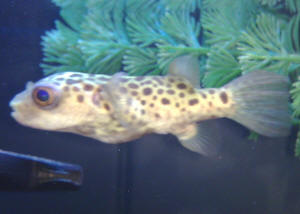
This is a picture of him yesterday, after eating!
<Good luck, Neale.>
|
|
 GSP GSP
|
Green spotted puffer... beh., fdg., hlth... reading
8/14/10
About 3 months ago I purchased a green spotted puffer.
<Ah yes, a lovely brackish to marine species. Unfortunately sold as
a freshwater fish by some retailers.>
He is in a 20 gal tank and has no tankmates at this time.
<Not a community fish anyway, and best kept alone or with its own
kind.>
About a week ago I opened a new package of bloodworms and noticed he
was not eating them. The store got in a different brand. I am not sure
if that has anything to do with my issues or not?'¦.
<Possibly; when puffers refuse food, it's a good sign
they're stressed. Healthy specimens will eat most meaty foods with
gusto!>
yesterday I noticed that he is as round as a basketball. I didn't
think anything of it at the time and thought maybe he finally decided
to eat. However today he seems to be a little bigger and I decided that
it wasn't because he ate the bloodworms (looks more solid)...water
checks out just fine and the temp is steady. He does swim some but also
spends a lot of time laying on the bottom of the tank....I did put some
small snails in his tanks a few days ago and I am not seeing them in
there....up until a couple days ago he was very active and bright green
and white now he is puffed up sluggish and slightly black.....could it
be he just ate the snails and it takes longer for those to
digest?.....Thank you for your help....Tammy D.
<The black colour is also alarming, as is the lethargy. My guess is
you're keeping him in freshwater, or something close -- a
"pinch" of salt per gallon doesn't count as brackish
water! He will also need a bigger tank once more than a couple of
inches long, I'd say 40 gallons for specimens 3-4 inches long, and
55 gallons for adults. Do understand this species needs brackish water,
at least SG 1.005, i.e., about 9 grammes marine salt mix per litre of
water, about 1.2 oz per US gallon. Tonic salt won't do, and his
lifespan in freshwater will be short. Do read here:
http://www.wetwebmedia.com/ca/volume_1/cav1i1/green_spotted_puppies.htm
http://www.wetwebmedia.com/BrackishSubWebIndex/bracsystems.htm
Cheers, Neale.>
Sick green spotted puffer... RMF suggests boycotting
Wal-Mart, sending their mgmt. letters re 5/19/10
Please help me my kids
<Uh-oh...>
picked out two green spotted puffers that Wal-Mart sold as freshwater
fish.
<Hope you have a big brackish water aquarium. Two GSPs will need to
be maintained in a 55 gallon aquarium once mature, since they reach 15
cm/6 inches within a couple of years and are sometimes very aggressive.
They are
brackish water fish, and should not be maintained below SG 1.005, i.e.,
a salinity of about 9 grammes of marine aquarium salt mix per litre of
water [about 1.2 oz per US gallon].>
They also said appropriate for small tanks and with many other
fish.
<No and no. Even juvenile GSPs will need at least 20 gallons of
water, and they'll outgrow that tank within a year. They are
fin-biters, and view other fish as nothing more than meals to be eaten
either whole or one chunk at a time.>
After research some say salt some say fresh water which is it?
<They must have brackish water, or they can also be kept in a marine
aquarium. GSPs will die if kept in a freshwater aquarium.>
Today one of them looks like each eye has a bubble over it and looks
like a white film over mouth what should I do?
<Start by reading:
http://www.wetwebmedia.com/brackishsubwebindex/gspsart.htm
http://www.wetwebmedia.com/brackishsubwebindex/bracsystems.htm
Until these fish are moved to appropriate conditions, they won't
get healthier. They're likely suffering from acute ammonia/nitrite
poisoning if this is a new aquarium, or stress because of the wrong
water chemistry.
Either way I'd be treating for Finrot and/or Fungus, perhaps both,
whilst also ensuring conditions were appropriate to those required by
this species. And as some general advice, you're the adult, so
don't let children make decisions where living creatures are
concerned. Children have zero concept of responsibility, and their
interest wanes in new pet animals after about 15 seconds. GSPs are big,
difficult fish that should live some 10-15 years if properly cared for.
By all means keep pufferfish yourself and share them with your
children, but for gosh sakes don't buy them for
your kids, any more than you'd buy them a snake or some other
exotic pet.
Cheers, Neale.>
Re: Sick green spotted puffer 5/19/10
Yes I know this I was a vet tech for 8 years and if the accurate
conditions where on the aquariums at Wal-Mart I would have never
purchased these fish, I promised my children fish we where mislead
about conditions of these I
bought under the assumption we had accurate living conditions!
<Indeed, but as a vet I'm sure you're all too familiar with
the difference between good intentions and actual reality. A German
Shepherd is a great dog, but only in a particular situation where it
gets lots of exercise and strong handling. Just so with puffers. Great
fish, but not for everyone. As for relying on the pet store, would you
rely on a car salesman when buying a new automobile? I imagine not.
You'd go through all the various magazines and consumer reports on
each model, comparing the pluses and minuses, and then come up with a
balanced decision. Just so when buying livestock, whether it's a
stick insect, a German Shepherd, or for that matter a Green Spotted
Puffer. Hope this helps. Cheers, Neale.>
Puffer fish won't eat: Puffer dentistry.
5/16/2010
I have a Green Spotted Puffer Fish in a salt water tank with a Coral
Beauty Angel a Blue Damsel and a Pajama Cardinal Fish. He has always
gotten along very well with all of them (3 years)
<Ok.>
I feel horrible but I noticed he has grown teeth and I can not get him
to eat anything. Is there anything I can do at this point.
<Sure.>
A friend recommended a weekend feeder because of the vitamins and
nutrients in it. Is there anything I can do to get him to eat? And keep
him alive?
<If his teeth have become completely overgrown, you will need to
trim the teeth manually. Please read here:
http://www.wetwebmedia.com/fwsubwebindex/smpufferdentistry.htm
http://www.wetwebmedia.com/fwsubwebindex/smpuffdentfaqs.htm
as well as the linked pages at the top of each page.>
<MikeV>
Re: Puffer fish won't eat: Puffer dentistry. 5/16/2010
Thank you so much for getting back to me so quickly.
<Hi, no problem.>
I have everything I need and will be trimming the teeth today or
tomorrow.
<Good.>
One question. By 3 drops of clove oil, do you mean with an eye
dropper.
<Yes three drops from an eyedropper.>
I don't want to add too much.
Thank you!
<Best of luck.>
<MikeV>
Re: Puffer fish won't eat: Puffer dentistry. 5/16/2010
Hey, it worked!!
<Great news!>
I was worried because he was really dark and because I thought he might
be too weak from not eating. But it was the only thing I could do so we
did it. Thank you so much.
<Glad we could help.>
He still hasn't eaten anything but he is swimming around a lot
more. I'm sure he is stressed and he has a few bloody marks on his
face, probably where I had to hold his lip up but he seems much
happier.
<You can try offering food in the morning and see how he
does.>
<MikeV>
Hoping to add GSP... incomp., sys.... reading
3/9/10
Hello and thank you in advance for your time,
<Happy to help.>
I have a 39 gallon freshwater aquarium set up right now with about 20
guppies (correct ratio of male to females for breeding), a Pleco,
bamboo shrimp, Ramshorn snails, and some failing gold Inca and black
mystery snails.
<None of which are suitable for life alongside a GSP. Green Spotted
Puffers are *brackish* water fish that need to be maintained at around
SG 1.005 when small, and anything from SG 1.010 to full marine
conditions once adult. They are omnivores that eat shrimps and snails,
and wild fish at least include fish fins on their diet, so anything
kept alongside them is likely to be nipped. These are very much
personality fish you buy expressly for maintenance on their own. That
said, some success has been had mixing them in marine tanks with feisty
Damselfish and the like.>
I have learned since the purchase that apple snails are not necessarily
the best to keep because of the hibernation period they need, and I
will be returning them to the LFS. Anyway, in a few days I would like
to add some GSP's, 2-3 depending on your recommendations.
<Not with the livestock you have.>
I am hoping to be able to breed the guppies and snails quick enough to
sustain the puffers and maintain my breeding stock of guppies and
Ramshorn snails.
<Won't work. Unless you have a pond, you'll never produce
enough live food for a Pufferfish. Be under NO illusions here: in an
aquarium as small as this, any shrimps and snails will be eaten (or at
least damaged). As for the Guppies, they'll probably be nipped and
eventually eaten, but this sort of behaviour does seem to vary from
Puffer to Puffer.>
I will be supplementing with additional food sources, frozen brine
shrimp most likely,
<A treat, not a staple; contains almost no nutrition at all.>
and I am ok with adding in as many snails as I need to (I work at a Pet
Store, so they are free), and hopefully only a few guppies a week.
<What's with the feeder guppy mentality? Puffers don't need
to eat fish, and any Guppies cheap enough to use like popcorn will be
maintained under fairly dismal conditions.>
I am aware that the bamboo shrimp is not going to last to long with the
puffer, but I will be giving him the best life I can until this
point.
<Won't work this way. The poor Atyopsis will be pecked, worried,
subject to amputations by the puffer for weeks if not months before
finally being killed.>
Do you think that this would be possible.
<Not a snowball's chance in Hell.>
Right now a separate feeder tank is not an option.
<Least of your worries.>
Another question I have is, can the Pleco be slowly moved into
brackish, as I will be switching to brackish once the puffers are in
the tank (waiting because I know that no store keeps them in the
correct, brackish, conditions and they will be coming from
freshwater.)
<No. Plecs can't be kept at the brackish water salinities Green
Spotted Puffers require.>
Looking forward to some insight.
<Certainly provided. A terrible idea you have here. Back to the
drawing board with you!>
Teach me well, because as I said I work at a Pet Store, and
unfortunately I often have to do a lot of studying outside of the
training that I get at work to get the knowledge that I feel I need to
pass on to customers.
<A laudable intention.>
I think it goes without saying that I am fairly new to aquatics as a
whole, but I am a sponge for knowledge, so teach away.
<Have done so.>
Studying the rest of your site as you read,
<Enjoy!>
Kyle
<You would do much better thinking along the lines of a freshwater
puffer species. A small group of South American Puffers could coexist
with a Plec (I have mine with Panaque nigrolineatus) though Guppies
will certainly be nipped. As for snails and shrimps, these are mere
pufferfish food, so any combination of the three is doomed, like
keeping pigs with truffles.
Cheers, Neale.>
Re: Hoping to add GSP, foods, live fish as foods,
3/10/10
Thank You so much for the speedy reply, was not expecting that. Wow,
where to begin. I completely agree, back to the drawing board it
is.
<Indeed! But happy to help.>
Just to verify, it is an moral question when it comes to feeding live
fish, is it not?
<Both. In terms of morals, it's certainly cruel and unfair on
the prey. In the wild prey animals have space enough to avoid predators
most of the time, something that doesn't happen in an aquarium.
Also, wild versions of Goldfish and Guppies are not deformed, so they
have subdued colours for camouflage, and the right shape for swimming,
neither of which holds true for the farmed versions of these fish.
Finally, we don't really know whether death by ingestion is
painless or not, and there's science either way when it comes to
whether fish can feel pain or not. Almost no predatory fish in the
hobby needs live fish as food. So all things considered, it's
morally difficult to justify feeding live fish to most
predators.>
Or do you advise against it for some other reason?
<Yes. There are several practical issues. Firstly, cheap
"feeders" commonly introduce parasites. Anything cheap enough
to be a feeder won't have received much in terms of healthcare or
water quality. Secondly, certain feeders (specifically Goldfish and
Minnows) contain Thiaminase and large amounts of fat. Thiaminase leads
to Vitamin B1 deficiency, and there's ample evidence now that this
is a major problem for predators in the wild and in captivity. Bob
Fenner has established that *the* major cause of premature mortality
among Lionfish is the use of Goldfish as feeders, with all the
specimens he's autopsied having unnatural amounts of fat around the
internal organs. Finally, there seems to be a link between aggression
and the use of live food, with the predators that settle best into
community systems being the ones fed fresh or frozen foods instead. In
short, if you can get a predator onto non-live foods, you're not
only going to save massive amounts of time and money, but you'll
also be providing a better, healthier diet. To the folks who think
they're losing half the fun, let them instead concentrate on
teaching their predators to become hand tame.
My Ctenolucius gar for example feed from forceps, and that way I can
show off what a good fishkeeper I am whenever people come to
visit!>
I guess it makes sense that even once the puffer has had its fill he
would bother the ones that weren't lunch.
<Actually, animals, especially puffers (and of course humans too!)
will eat much more in one sitting than they need to. Overfed puffers
put a tremendous strain on the filtration system, with issues such as
nitrate levels and background acidification coming into play. It's
best to feed modestly, small amounts, perhaps daily, perhaps less often
when the fish is mature.>
It seems that I'll be needing another tank.
<For GSPs, yes. They're best kept alone, with their own kind, or
in a tank that might ultimately be converted to a marine system so you
can add Damselfish.>
My thoughts were, to escape the issues involved with the commercially
sold feeders, rosy reds, comet goldfish, etc, such as diseased
unhealthy fish, that I would try to breed my own.
<Almost never worth bothering with. By all means have a tank of
snails in the yard, and use these as often as you want. But don't
go out of your way here. You can maintain pufferfish perfectly well on
foods from the grocery store. Unshelled shrimp, squid, cockles, tilapia
fillet and so on all make good staples. Do read Marco
Lichtenberger's excellent piece of Thiaminase though, so you can
choose the right seafood:
http://www.wetwebmedia.com/ca/volume_6/volume_6_1/thiaminase.htm
You want to limit Thiaminase-containing foods to the minority portion
of the diet.>
Guppies because of the quick reproduction and hardiness of the fish, as
well as their tolerance of salt when introduced gradually to their
existing freshwater tank, and their ability to live in brackish
water.
<This is true, but fancy Guppies are less productive than wild
Guppies, and neither matches Mosquitofish. In any case, you won't
be able to produce these in anything like the numbers you're
imagining.>
I am willing to do what it takes to keep all of my fish happy and
healthy, including the ones intended as feeders, however short or long
they would be living in my tank. And as you said, the one cheap enough
to feed are kept in dismal conditions.
<Yes.>
My guppies were kept in our community tanks under prime conditions, not
the feeder tanks, which is why I would feel safer feeding them to the
puffers than the feeder tank fish, which unfortunately are kept under
fairly dismal conditions, mainly massive overcrowding =(. I didn't
design the store, I just work there. I thought maybe the guppies
outnumbering the puffers would make it possible for them to still
breed, but I thought wrong lol.
<I fear so, unless the tank was 1000 gallons! I've seen Guppies
kept with Piranhas in zoos, but beyond that sort of scale, this just
doesn't work.
It's been tried many, many times.>
What would you recommend for feeding puffers than if not live fish.
<For juveniles, wet-frozen krill, Mysis, chopped cockle and mussel,
and things like the legs from unshelled shrimps are all ideal. Woodlice
(what Americans call Roly-polys I believe) also go down well, and of
course any snails of suitable size, such as Physa spp. Adults will eat
much the same thing, but for economy's sake you'll probably
want to scale up to chunky fish and seafood: cockles, mussels, squid,
crab legs, whole shrimp, tilapia fillet, etc. Again, snails of suitable
size are good. There are some puffers that take dried foods like algae
wafers and marine fish chips, so you might try these, but generally
flake and pellets are ignored (though two of my six puffers enjoy
Hikari Cichlid Gold).>
I've seen it all over the web that brine shrimp are appropriate
(explanation, not defence of the issue),
<Baby brine shrimp (nauplii) are excellent, but adult brine shrimp
contain very little in terms of vitamins. You can buy wet-frozen
fortified brine shrimp that have vitamins added, and these would be a
good addition to the diet of any fish.>
as well as thousands of videos of puffers eating live food, but
obviously you can't trust everything you see. As I said I get all
the Ramshorn snails that I want for free.
<Well they're excellent, so long as they're from a fish-free
pond. Anything collected from a pond with fish runs the risk of
introducing internal parasites.>
As to why GSP, we had some come into the store for adoption and I fell
in love.
<They are lovely fish, to be sure.>
They were used to freshwater, coming from Wal**rt, but didn't seem
to be doing to well in our tanks, low ph I think.
<Likely so, or something similar.>
I was planning on bringing them home but unfortunately they didn't
make it at the store. I don't know about where you are, but here
they are always sold acclimated to freshwater, and I wanted to give
them a chance to thrive by slowly moving them over to brackish.
<Sometimes sold as "freshwater" fish here too, but
thankfully not by the better shops.>
As you said these fish are full of personality, and they stuck in my
head from the moment I saw them.
<Yep.>
I am dreadfully sorry about the small amount of knowledge that I have
coming from the LFS. I am new there, but I wouldn't say that anyone
has any more knowledge than myself at the store.
<I'm glad you've established your niche and you're
willing to work at it. I hope you'll be able to share your
knowledge with your colleagues and your customers.>
What would be some good staples to read so that I can educate myself
and my coworkers in the fish we sell (all freshwater, mollies, platys,
guoramis, goldfish, Plecos, swords, etc. as well as African, Oscar,
blood parrot, and just recently flame mouth cichlids.)
<We do have a listing of books that those of us here at WWM have
found useful and recommend to others, here:
http://www.wetwebmedia.com/fwsubwebindex/bookswwmsugg.htm
>
Unfortunately the store has a habit of hiring folks off the street with
very little experience and then training them, but I feel our training
should be much more extensive.
<I agree.>
I will be speaking to my GM about possibly requiring some sort of
outside training beyond what corporate sends us.
<There *are* courses for tropical fish shop specialists out there,
at least here in the UK, and the shops often display certificates to
show that their staff have completed these courses and "raised
their game" to the next level. That's something I think
reflects well on any store.>
Thanks again, cruising your site as you read,
Kyle
<Glad to help. Enjoy your fishkeeping and your work! Cheers,
Neale.>
Puffer, GSPs, 12/11/09
Hello. I have 3 1.5" GSPs in a 50 gallon tank. They are a somewhat
new addition to our home (about 3 months). Their water is almost
perfect condition and I am in the process of raising the salinity (at
the moment it is a little less then slightly brackish), which from my
research is what is necessary.
<Ah, yes... particularly with larger, growing specimens as yours
here.
Please read: http://wetwebmedia.com/BrackishSubWebIndex/gspsart.htm>
I am only having one problem one of the fish is really skinny
<A bad sign>
and has been since we got him, at first I just thought it was stress, I
am really worried now. He eats great, his color is good, and he seems
to be acting normal (like the other GSPs), but he is still really
skinny. I think he may have a parasite, and if so is it contagious, and
if it is, why have my other puffer shown no signs? What would be the
best treatment for a multi-fish tank.
<Do give a read above the citation I've sent you to, to further
read re the health/diseases of these fish. It may be prudent to add a
vermifuge/anthelminthic and antiprotozoal to their favored foods...
These are gone over on the site/WWM. Bob Fenner>
GSPs not wanting snails! 11/05/09
Hi Crew! First off, a little background information. I have two green
spotted puffers that I've had for about a year and are between 2.5
and 3 inches.
<How sweet they must be!>
They're in a 175 gallon setup and it is full salt (a little early,
I know, but they have been doing wonderfully).
<Fine.>
Water quality is great, they have tons of live rock so they're not
bored.
They are perfectly healthy and eat like little pigs... but they wont
eat snails.
<Not uncommon. Snails are difficult to eat, and if given easier and
tastier alternative foods, tend to ignore them. Much like how humans
would sooner eat junk food than a salad.>
I have tried EVERYTHING to get them to eat snails. I've tried
different kinds of snails, I've tried crushing the snails, I've
tried shoving snails inside a large shrimp to "trick" them,
and I've tried starving them for a
couple days.
<Try starving them for a week or two. Won't do them any harm at
all.>
None of this works. Right now they eat frozen mysis or brine shrimp 2
days a week, crab or lobster legs 3 times a week, large shrimp 2 days a
week, ghost shrimp and squid whenever I can find them, and sometimes
will munch on the pellets meant for the two damsels sharing the tank
with them (Great use of a 175 with four fish, I know, but the puffers
will need that space eventually).
<Damsels and GSPs tend to get along rather well, so I wouldn't
look at this combination too harshly. You may decide to add some of the
very pretty, but very aggressive damselfish species you couldn't
keep in a standard community or reef tank. Look at the tank as an
opportunity rather than a problem.>
Anyways, their teeth are starting to get a little long. They don't
look like bugs bunny or anything yet, but long enough that I'm
concerned. I'm terrified to trim their teeth (I'll do it if I
have to) and I wish they would just eat the snails!
<To be honest, trimming their teeth isn't a big deal. I keep
Colomesus asellus, a species infamous for its fast-growing teeth. While
a combination of crunchy foods and a sandy aquarium seems to slow down
the rate at which their teeth grow, it doesn't completely remove
the need for me to occasionally trim their teeth. I have a step-by-step
guide here:
http://homepage.mac.com/nmonks/Projects/pufferdentistry.html
In other words, if your puffers resolutely refuse to eat snails,
it's no big deal.>
Do you have any suggestions to get them to eat the snails?
<Hunger makes the best sauce...>
I'm desperate! Also, if you have any ideas of how to feed them
better, I'm open to advice.
<Do choose snails they can swallow whole. A common mistake is to put
big snails in there, assuming the puffer will peel them open like a can
of beans. They don't. Want puffers tend to do is bite the whole
snail, and more crunch the shell down, and if they can't get most
or all of the shell in their mouth, they won't do this.>
Thanks so much for your help!
Carol M.
<Cheers, Neale.>
Re: Novice Makes a Ton of Mistakes That May Kill Fish. Is
the problem fungus? 8/12/09
Sorry I forgot to keep you up to date!? I guess I lost this email!
Thank
you for your help!
<Happy to help.>
All of my fish survived.? Mostly I think I was overreacting (especially
about the puffer, whom I baby more than anyone ever should baby a
fish... it's almost a little creepy, but I admit to it!)? I used
Melafix to treat the Popeye after all of the other treatments had been
filtered out, and replaced the water with reverse osmosis water in 25%
increments.?? No eyes were lost, no fish died, and I really learned a
valuable lesson.
<Good.>
BUT! I have a question:? My Green Spotted Puffer had
been staying in the tank, until I noticed some odd behavior.? She used
to pick on EVERYBODY, even the Green Terror who is more than twice her
size and another cichlid who chases the other fish so violently I'm
on the verge of giving him to the pet store down the street (who swears
they won't flush him), however, I think she may have suffered a
little bit of a "beat down."?
<Green Spotted Puffers, widely called GSPs, aren't community
fish. Period.
End of story. Adult males are territorial when mature, and both sexes
view the fins of other fish as potential food. They are normally kept
alone or with their own kind. 30 gallons is about right for one, 55
gallons for two.
Finally, GSPs need brackish water. They CANNOT be kept indefinitely in
freshwater, whatever the guy in the pet store might have suggest.
Indeed, there's some evidence they need marine conditions to
breed.>
She had been swimming only in the top corner of the tank and avoiding
the other fish (I at first assumed she'd go back to her old ways,
and kick some tail but she didn't!) She was once so aggressive I
had to fight to convince everyone she was worth it, but she began
running away from even the feeder fish! Her colors even got very
dark.
<What is the salinity of the water? When GSPs lose colour, it's
often a sign that they're being kept in the wrong conditions.
Juveniles need to be kept at around SG 1.005 at 25 degrees C, about 9
grammes of marine salt mix per litre of water. Adults will need about
twice that salinity.>
I was scared, so I bagged her up (she usually stays at my 55 gallon
that has no place in my house and therefore stays at my
boyfriends') and took her home. Before I even got out of the car I
noticed her colors had brightened and she was genuinely (and a little
stupidly) exploring the bag (a normal fish store bag with about four
inches of water in it.).
<OK.>
Anyhow, she seems fine, (she explores the tank and "herds the
feeders," watches me type pretty intently, and hasn't really
slept yet), but she's stuck in a tank that I know is too small for
her, (I think it's only ten
gallons).
<Do not feed this fish feeder fish. Indeed, don't feed ANY fish
feeder fish. The only people who use store-bought feeder fish are
people who haven't thought through what they're doing. I'm
not against the use of live
fish _per se_, as it can be the only way to keep (a very few) difficult
predatory fish species. But those feeders must, repeat MUST, be
home-bred and gut-loaded. The most idiotic thing you can do is buy
Goldfish or Minnows as feeder fish. At the price they're sold at,
they're maintained in squalid (read: disease-ridden) conditions,
and they're also filled with fat and Thiaminase that cause MAJOR
health problems. Luckily, here in the UK, feeder fish simply aren't
sold any more, but in some parts of the world
they may still be on sale. Don't buy them. Read more, here:
http://www.wetwebmedia.com/ca/volume_6/volume_6_1/thiaminase.htm
http://www.wetwebmedia.com/fwsubwebindex/fdgfdrartneale.htm
http://www.wetwebmedia.com/goldfshfd.htm
>
She's only about an inch long, and the only other inhabitants are a
couple of fiddlers, who are scared of her (she enjoys chasing them onto
the land, or into the tunnel underneath it), and some feeders I got for
her.
<Why...? Where did you read that GSPs eat small fish? What book?
They don't. They eat invertebrates and some plant material, as well
as the fins of larger fish. Do read here:
http://www.wetwebmedia.com/brackishsubwebindex/gspsart.htm
>
How long can/should she stay there??
<Few days, maybe weeks. GSPs need brackish water conditions.>
I'm a little short on the cash I would need to get a bigger tank,
and before I borrow money from my parents (and persuade them it's
necessary)
I'd like to know the time frame.
<Don't buy a fish until AFTER you have researched its needs. In
this case, you've created an expensive problem, because you have a
fish that gets big (15 cm/6 inches) and is so aggressive it can't
normally be kept with other species. It grows quickly, and within a
year will be at least half grown.
I'd like to be able to offer a cheap workaround, but you know what,
there aren't always quick solutions. Hence, you research BEFORE you
buy. I'd have told you this if you'd asked, and saved you some
money.>
AND do you think she could go back into the big tank anytime?
<No.>
Thank you for your input!
Kim
<Cheers, Neale.>
Freshwater Snails... culturing for food 8/22/09
Hello, I just purchased a Green Spotted Puffer fish.
<A fascinating brackish water species. Sadly, often kept in
freshwater, where it quickly dies. Do see here:
http://www.wetwebmedia.com/brackishsubwebindex/gspsart.htm
While I'd like to think you're keeping your puffer in brackish
water, you'd be surprised how many people don't, and the
consequent numbers of sick and dead Green Spotted Puffers there are in
the world! Juveniles are best kept around SG 1.005 at 25 degrees C/77
degrees F, that's about 9 grammes of marine salt mix per litre.
Adults should be kept in more saline conditions, around SG 1.010, or
15.5 grammes of marine salt mix per litre.>
I also purchased 12 little snails that range from the size of a pea to
the size of a pin head. The snails are a different variety (Ramshorn
and others.) I do not know anything about snails but have been told
these reproduce very quickly.
<Quite possibly, but rarely fast enough to provide live food in a
pufferfish aquarium. Even if the puffer only eats a modest meal of ten
snails, that's practically the whole of your population. Repeat
that daily, and you'll quickly wipe out any population. The
exception to this may be the Malayan Livebearing Snail (Melanoides
spp.) that thrive in brackish water and stay hidden under the
substrate, but these have such tough shells their value as food is
essentially zero. Only when hungry will puffers go for them, and even
then, only the smallest specimens. Some aquarists consider them a
danger to puffers, their shells being strong enough to crack pufferfish
teeth. Whether this is a valid risk or not is debatable, but it's a
concern some experienced keepers have raised. So, in total, there's
no point whatsoever adding snails to a pufferfish tank on the basis of
providing a suitable amount of food. It won't work unless we're
talking a pond-sized aquarium where a population of hundreds, if not
thousands, of suitable snails (e.g., Physa spp.) could be
maintained.>
The fish store said they were all self reproducing. I put all 12 snail
into a 1 gallon aquarium along with an air stone. I do not have any
substrate in the tank just an empty bottom. It has fresh water that was
treated with "Prime" and is at room temperature. The snails
were all very active crawling all over the sides of the aquarium. I put
a piece of lettuce in the aquarium (washed in treated water) and put
the air stone on top of it to push the lettuce down to the bottom. When
I got up the next day all the snails were laying on the bottom of the
aquarium. I kept an eye on them and none of them have moved since.
after it got dark I took a flashlight and looked in the aquarium and I
could see 1 of them coming out of his shell but he never moves. I
removed the lettuce and put an algae wafer in the bottom along with a
little bit of tropical flake food. At this point they are not moving
around. I got these to feed the puffer fish but I am afraid to give
them to the puffer because I do not know what is going on. I have
checked the ammonia, nitrites and nitrates but since it is fresh water
only 2 days old everything was at zero. I did put 6 other snails into a
30 gallon aquarium the was already cycled but I cannot find them at
this point. I got the 1 gallon tank free and I figure they would be
easy to find so I could feed the puffer. Any help would be
appreciated.
<Rear suitable snails in another tank. Physa spp. are ideal for
smaller puffers (to around 8-10 cm) while larger puffers will take
Planorbis, Vivaparus spp.>
Thanks
-Jon
<Cheers, Neale.>
Re: Freshwater Snails 8/22/09
Neale,
<Jon,>
WOW!!! Thanks for the fast response! I have posted on forums on my
journey to learn more about puffers, snails and others and all I get is
"I think" and "Maybe."
<I'm glad to have helped.>
I appreciate you also commenting on the puffer as well. I actually
found the webpage you referenced right off the bat when doing my
Googling. This puffer is about 1" big and has been kept in
freshwater.
<Still a pup! Can be somewhat delicate when young, but not
especially difficult to keep.>
You think it is best to start slowly changing him to brackish water
now?
<Don't do anything radical. Simply use normal water changes to
replace water with slightly brackish water. For a fish this size, SG
1.003 is ample. That's about 6 grammes of marine salt mix per
litre. So if you take out a 15 litre bucket of water, add 15 litres
with 15 x 6 = 90 grammes of marine salt mix. Once the fish is more than
twice the size he is now, do water changes where you're replacing
water with water that has 9 grammes of marine salt mix added per litre,
i.e., a 15 litre bucket would contain 15 x 9 = 135 grammes. This is
about SG 1.005 at 25 degrees C. In theory, you can keep GSPs perfectly
well even at that low salinity, but once the fish are near full grown
(around 10 cm/4 inches) you may care to nudge the salinity upwards to
SG 1.010, about 15.5 grammes of marine salt mix per litre.
Again, you'd do this simply by doing water changes. Going slowly
like this allows the bacteria in the filter to adjust.>
I also read that they come with parasites in them and they should be
medicated right away which will extend their life. Is this something I
need to do?
<Not unless there are obvious signs of infections. Over-medicating
can cause all sorts of problems. Brackish water will kill a wide range
of external parasites anyway, including Ick and Velvet as well as
various "worms" and "lice".>
How can you tell how much food is enough for them?
<With puffers, a good rule of thumb is to feed them until their
bellies slightly swell outwards. They shouldn't look like they
swallowed a bowling ball! Skipping a meal once a week does no harm.
Vary the diet, offering mostly shell-on foods such as krill, daphnia,
bloodworms, etc. Some puffers enjoy cooked peas. Soft meaty things like
squid and mussel are good for them, but use in moderation to avoid
problems such as constipation and vitamin deficiency.>
I read they will eat until they rupture their stomachs.
<Myth.>
If I drop 1 snail into the tank (the puffer goes wild) his stomach gets
fairly large after he eats it so I stop feeding him at that point.
<Fine.>
Am I feeding him enough food?
<So long as he isn't "hollow" bellied, he's
fine.>
Keep in mind the snails are about the size of a pea or smaller. Your
page says you have to GSP as well. What is best to feed a puffer of
this size?
Your page says one thing to feed them is ghost shrimp.
<Adults certainly enjoy them.>
Being that my puffer is only about 1" big will he be able to eat
ghost shrimp or is he to small?
<Probably not. Daphnia and brine shrimps, as well as wet-frozen
krill and mysis, will be fine. My puffers sometimes refuse things like
krill and mysis, I suppose because these foods are "hard
work" to chew and swallow.
Don't relent! If needs be, starve your puffer a day or two, and
then offer these nutritious goodies.>
Can I keep the ghost shrimp with the snails or will the ghost shrimp
try to eat the snails? I think I need to make a trip out to the store
to find some other types of food. I have been giving him a snail every
other day and freeze dried brine shrimp (which you do not list as a
food for them.) I did by some shrimp for me and gave him a little piece
which he looked like he really enjoyed. I have only had him for about 1
week at this point.
<Brine shrimp are a fine treat, and they're full of fibre, but
they contain almost no other nutrition. So while fine once a week,
don't use them too often.>
I did find that most of the snails did move late last night. When I got
up most of them were around the algae wafer, others were on the sides
of the tank. Should they be constantly moving? <Yes.>
I read on your posts that some people have experienced the snails
laying on the bottom and just moving at night. Other say their snails
are constantly moving. I am sure it also depends on the type of
snail.
<Precisely so.>
Thanks for taking the time to answer my email.
<My pleasure.>
I have a friend who has been raising cichlids for 15+ years but when it
comes to brackish\salt water fish and puffers he doesn't really
know too much about them. It is nice to see that someone with
experience is willing to take time to respond to so many emails (of
which I bet you get a lot of) and take the time to help others out so
they can learn the best way to care for their aquariums.
-Jon
<We try and do our best, at least. Enjoy your fish! Cheers,
Neale.>
Fish question (Tetraodon nigroviridis; health, diet)
6/19/09
WWM Crew,
<Hello Stacey,>
I have 3 green spotted puffers in a brackish 30 gallon tank. I
originally had 4 and I've had them for about 6 months now. The
fourth one became sick and the fish store I went to really wasn't
any help. They gave me an antifungal fish medicine and told me to
separate the fish so I put that one in a ten gallon tank and the
medicine seemed to kill the fish just from the chemicals that ate away
at it.
<It is certainly true that some medications appear toxic to
Pufferfish. It isn't common for Fungus to be a problem in brackish
water aquaria; for whatever reason, fungi just don't seem to do
well under such conditions.
But bacterial infections such as Finrot and the misleadingly named
Mouth Fungus (also known as Columnaris) can occur. Neither will be
cured by anti-fungal medications; to treat them, you need something
like Maracyn designed to deal with bacteria.>
However, I realise another one of my puffers is starting the same
symptoms.
<Now, when two fish suffer the same problem, you have to start
looking at the bigger picture. Begin by reviewing water conditions.
Thirty gallons isn't viable for three puffers above, say, 10 cm/4
inches, simply because these fish are so messy and put a heavy strain
on the filter. Check the ammonia and nitrite levels, which need to be
zero, and the nitrate, which should be 20 mg/l or less most of the
time, and certainly never higher than 50 mg/l. Weekly water changes of
25% or more are important. Also check the water chemistry; these
puffers need hard (10-25 degrees dH) water with a pH around 7.5 to 8.
If you have a specific gravity about 1.010, then a protein skimmer is
an option. You should not be keeping these puffers below a specific
gravity of 1.005, which is equivalent to 9 grammes of marine salt mix
per litre; that's roughly 1.5 level teaspoons of marine salt mix
per litre, or about 5.5 level teaspoons (or 1.18 oz) of marine salt mix
per US
gallon. I mention this because a lot of people think brackish water is
a teaspoon of tonic salt per gallon -- it's not!>
The fish just hangs out at the top of the water in the corner breathing
heavily, looks bigger than normal, and will not eat. I switch off
between feeling the fish bloodworms, ghost shrimp, and feeder fish and
I recently
began giving them small snails.
<Never, ever use feeder fish. Who recommended this? Why would you
feed anything as parasite- and disease-laden as feeder fish to your
pets? Let's recap the proper diet of Green Spotted Puffers: snails,
krill, cockles, squid, cooked peas, algae wafers. Don't use mussels
or shrimps/prawns too often because these contain a lot of Thiaminase,
and over time, can lead to a Vitamin B1 deficiency. A couple times a
week is fine; rest of the week, use other foods.>
Do you have any idea what might be wrong with my puffer, and what I can
do to save him?
Thanks,
Stacey
<Cheers, Neale.>
|
A sweet picture of a sweet puffer 6/2/08
Dear Wet Web Media (and most especially Pufferpunk, whose
unflagging knowledge leaves me awed), <Awww... shucks, thanks
Micah. What a wonderful compliment!> I'm just writing to
send you a picture of the GSP whose life PP saved. He now happily
patrols his sectioned-off 15 gallons (the other 30 gallons of the
tank are shared by a few Malawi cichlids) and he readily partakes
of common pond snails, thawed frozen blood worms, gut-loaded
ghost shrimp and Spirulina-enriched brine shrimp. Next, we're
going to try to introduce some cichlid pellets, though it's
much harder to make those look even sort of lifelike... =)
<I'm so glad he's doing well. Be sure to feed your
puffer lots of meaty foods. Here are more ideas on foods for your
puffer:
http://www.thepufferforum.com/forum/library/feeding/feeding-your-puffers/
How are the plans for his own tank? I'm sure the cichlids
would like to have their tank back soon. For some reason, I
can't download pics from this site but I'm hoping it will
come out on our FAQs. An update on his happiness & health is
a fantastic end to the wonderful birthday I'm having today!
Thanks for keeping in touch. ~PP>
|
|
Re: A sweet picture of a sweet puffer
6/10/08 Pufferpunk, <Hi Micah> Today I
transferred the puffer to his own tank (now detoxed of all the
ammonia caused by the dead snails and bacteria... I changed out
90% of the water and vacuumed the gravel, though I didn't
wash any of the gravel or decorations because I've had the
filter running on that tank the whole time my puffer has been in
the cichlid tank). I tested the levels in the tank, and they
read: ammonia 0 ppm, nitrites 0 ppm, nitrates 40 ppm, <Best
kept below 20.> pH 8.2. Temperature is between 78-80 degrees
Fahrenheit. Specific gravity is negligible -- at least, it
doesn't even register on my hygrometer. <Hydrometer> In
a week I'll add a small amount of marine salt so I can start
introducing him to the brackish water he should be living in.
<Yes, I'd give him & the biological bacteria some time
to settle in.> I do have one question, about feeding him.
He's turned out to be an incredibly picky eater, though not
in terms of frozen vs. live food. He readily accepts
Spirulina-enriched brine shrimp and blood worms (both thawed
shortly before being offered to him), but he hates more or less
everything else. He won't eat ghost shrimp (I put a few in
his tank, and a week later they were still all alive), he
doesn't like plankton (he'll take a bite and then spit it
out), he doesn't like krill (he seems to really enjoy tearing
them up but not swallowing them), he won't accept cichlid
pellets (those don't even make it into his mouth), and
he's hit or miss when it comes to pond snails. I know he
needs a more varied diet than he's getting, but he
doesn't seem to want anything else I've been offering.
Any ideas? I've heard soaking food in a garlic solution
beforehand can whet the appetite. <Garlic should enhance his
appetite. I don't know of any healthy puffer that would ever
turn down live worms. ~PP> Cheers, Micah
|
Re: Green spotted puffer; feeding. -- 02/02/2008
Thank you for that great advice. <You are welcome.> I will be
watching the puffer very close. I know that they need snails to keep
their teeth dulled down, when I asked my LFS they told me that I cannot
get them as small as I was asking for. I know they are as small as the
GSP eye. What is the name of this snail...perhaps I can buy them online
somewhere. <No specific small snail species is needed. You can feed
them smaller specimens of bigger snail species. Most puffer keepers
feed various Ramshorn snails, pest snails or common pond snails of
adequate size, which they breed in a small tank or even a bucket. You
could try getting some from a fellow hobbyist with a planted freshwater
tank. Many would be glad if you'd take some of the snails off their
hands. Only Malayan trumpet snails, however, are considered to hard and
being possible teeth crackers by some puffer keepers. Please see here
for some advice on snail breeding
http://www.thepufferforum.com/forum/library/feeding/basic-snail-breeding/
, and also other adequate puffer food items:
http://www.thepufferforum.com/forum/library/feeding/feeding-your-puffers/
. Green spotted puffers do not have very fast growing teeth like South
American puffers or Auriglobus spp., I feed mine snails (mostly
Ramshorn) approx. once a week and cannot observe any visible growth of
the teeth. Of course there may be some variation within this
species.> Thanks, Jessica. <Cheers, Marco.>
GSP hunger strike and stress lines 1/23/08 Hey
there, thanks for the great site, it's been wonderful for all my
puffer troubleshooting so far. However, I do have a problem that's
been worrying me. First, back-story: a week ago my impulsive roommate
bought two baby GSPs from Wal-Mart, the LAST two. Needless to say they
were rather unhealthy. Both the 'big' one (about an inch long
without the tail) and the little one (maybe half an inch? super itty
bitty compared to the first) had concave bellies and I suspected IP.
<If my "IP" you mean internal parasites, I'm
skeptical. Almost all instances where non-veterinary-trained aquarists
declare "internal parasites" as the reason their fish are
sick or die, the actual problem is something else, most often poor
husbandry of some sort or another. Pufferfish have a relatively short
digestive tract, and will appear to be "empty" quite soon
after feeding. Assuming that the retailer wasn't caring for this
fish properly, e.g., by offering them flake food, then chances are the
fish are hungry and will need a few square meals to get back into
shape. But beyond that, nothing too taxing.> My roommate soon
figured out she wasn't up to the challenge of GSPs and so gave them
to me. I've been doing the best I can for them (upgraded to
brackish water with marine mix salt, adding a teaspoon every day or
every other day till I get to a SG of 1.010, offered fine gravel and
sand for digging, lots of hiding spots, keeping the water parameters
IMMACULATE, 10% water changes daily instead of 25% since they're
still stressed, constant water temp of 80F, ph of 8.2) unfortunately
due to my dorm's strict rules they can't be in a tank larger
than 5 gallons (as soon as I move to my apartment this summer that will
change big time and each will have his very own much larger tank).
<All sounds good. A few comments though. GSPs are truly euryhaline
fish, and the actual salinity isn't all that important. Juveniles
are found in brackish water, but adults, oddly enough, in freshwater.
Under aquarium conditions, they don't do well in freshwater
permanently, in the sense of being more sensitive to disease. But in
the short term, there's no rush to change the salinity in your
tank. It's actually much more critical you make sure the filter is
happy, and rapid changes in salinity can stress the filter bacteria. In
my experience, you can switch the filter bacteria from freshwater to
anything up to SG 1.005 without problems. But once you go above that,
there's some sort of re-jigging going on the filter that means you
need to be careful. For the first 6-12 months of a GSPs life,
there's ABSOLUTELY no need to raise the SG above 1.005, so I'd
stabilise conditions there for now. Apart from causing less stress to
the filter, you'll also save money on the salt, which will mean you
can do more water changes more often. Nitrate (and old water generally)
is FAR more unpleasant for your GSP than salinity. The temperature is
far too high: 25 C/77 F is more than adequate. High temperatures mean
less oxygen and faster metabolism, two things you don't want to
have to deal with in a small aquarium. I agree a 5 gallon tank is
inadequate for a GSP, and my gut feeling is that even by summertime
this year, that tank is going to look very cramped. Once you have the
bigger tank, set it up at, say, SG 1.008 to SG 1.012, as you prefer,
mature the filter, and once matured, install the pufferfish from the SG
1.005 5-gallon tank. GSPs can easily adapt to this change in salinity
within an hour using the drip method (i.e., put in a third-filled
bucket of SG 1.005 water, dribble in high salinity water, and once the
bucket is filled, lift the puffer out and put into the new tank.>
Other than the occasional stare-down at feeding time, there's no
tank aggression so far (I guess because they're still so young).
<Likely so. Males are believed to guard the eggs (if not the fry),
so it is probable that only sexually mature males become aggressive.
Much like cichlids, gouramis, killifish, etc.> The bigger one pretty
much ignores the little one, and the little one sticks to the big one
like glue. I know this is a total anthropomorphisation, but the little
one seems to enjoy the company? <Entirely possible. Many fish are
more or less social when young, and only become territorial as they
mature. Angelfish are classic examples. The "friendliness" of
pufferfish does vary with species as well as specimen, so it's
difficult to make general statements with this particular group of
fish. On the other hand, puffers are smart animals, and likely their
default behaviour does get modified by being kept in captivity. My
experience is that puffers in busy tanks are less likely to become
nippy or aggressive, but others have had entirely different
experiences. So who knows for sure!> Whenever they get separated
he'll furiously buzz around the tank till he finds the big one,
then settles down and happily follows his friend. <Heh!> Anyway,
to get to the point, the little guys just don't really have
appetites. <Try live food, and try variation. All my puffers love
bloodworms, and they also get chopped seafood of various kinds,
including squid, mussels, and prawns. Brine shrimp and daphnia usually
work well with small puffers. They also love live woodlice (terrestrial
isopods), and these are easy to find in the garden under rotting wood
and flowerpots.> Since they won't eat medicated foods I treated
the tank with fizzing IP tablets. I've been offering dried krill,
Tubifex worms, bloodworms, daphnia, and brine shrimp, and not much has
appealed. <I find freeze-dried foods a total waste of time. Others
have success with them, but not me. Do try "wet frozen" foods
as an alternative.> I've been combing this podunk little town
for snails to feed and have only managed to acquire 5 pond snails. The
bigger GSP was all over the snails and finally got a little tummy, but
the tiny GSP didn't seem to know how to eat them. <Wild GSPs
likely don't eat many snails, so you may be onto a loser here.
While I agree snails are a very good food item, wild GSPs are more
omnivorous taking crustaceans and insects alongside molluscs. They also
eat plant material and, apparently, the fins and scales of larger fish.
So broaden the menu, and you're more likely to have success. My
puffers don't actually like snails all that much, so I've
pretty much given up on this, except in adding some Melanoides spp.
snails to the system and letting them eat any baby snails they
find.> To prevent possible bullying by the bigger one at mealtimes,
I have a little container that I fill with tank water and put the
little guy in with choice bits. I offered all the dried fare and
several snails the size of his eye. He seemed interested in the snails,
but couldn't figure out how to eat them. I crushed one for him and
he pecked at it, then just started swimming around the QT till I put
him back in the main tank. <Sounds good, but removing fish to feed
them is kind of a hassle. Try hand-feeding. I use metal forceps of the
sort used for dissections. Cheap and easy to obtain. Most fish, even
quite nervous fish, will take food from forceps willingly. Also avoids
the problem of you being nipped!> Last night I got some raw frozen
in shell shrimp at the grocery store and chopped one up into teeny
pieces and offered it thawed to both fish (little one in the feeding QT
as before). The big one absolutely could not get enough and filled up
his little tummy (much to my relief) but the little one pecked at the
pieces then ignored them. <A staple food item for my tropical fish.
Do remember that prawn contains a lot of Thiaminase, which breaks down
Vitamin B1, so don't use it every single day. Unshelled prawns are
the best: puffers love the legs, tail fins, and seemingly the eyeballs.
I eat the meat in the tails myself! Sometimes they come with prawn
eggs, and those are a rich, oily treat loved by most small fish.> I
know puffers are often stressed for a bit after a big move, and I know
they can survive a little while without eating, but I'm so worried
the little guy is way too small to survive a hunger strike!
<Force-feeding is an option, and I have done this once to reclaim a
very sick puffer. But it's a last resort sort of option. Do try
varying the diet as indicated above. Once you've done that, get
back in touch if you really feel the need to force-feed the fish, i.e.,
it's condition is obviously declining.> Other than the concave
belly, the little one is acting healthy: white tummy, no stress lines,
actively buzzing around the tank, fanned tail, responsive to my
approach, etc. The big one, however, has had stress blotches on either
side of his mouth and a dotted stress line above his tummy (though his
tummy is snow white and he acts otherwise healthy; responsive and
inquisitive and etc). <All sounds fine. The colour of the abdomen is
a bit hit and miss frankly, so while useful up to a point, don't
put too much store by it. What matters by puffers is their [a] activity
and [b]"chubbiness". Sick puffers tend to sit at the bottom
and look bony, especially around the face.> I have tried everything
I know to help. I keep the aquarium light off to lower stress,
obsessively monitor water parameters, keep the water sparkling and
aerated, offer as much of a variety of food that's small enough for
babies (ghost shrimp are WAY too big), I'm currently growing some
sea monkeys to stimulate an appetite (but they take a week or two to
mature), I even got desperate and tried the holistic garlic juice food
treatment, which totally did NOT work. <Didn't work when I tried
it, either.> Neither fish has lockjaw or overgrown teeth, and
I've offered pieces of cuttle bone to add to their crunchy diet.
<Not sure they eat cuttlebone. I wouldn't worry too much about
the teeth just yet. Some puffers never get bad teeth, and even the ones
that do, it's an easy enough fix.> I am so sorry this is so
long, but I wanted to give you as much info as possible. I've spent
the majority of my time over this past week researching GSPs and
brackish setups, spent over half my budget on treatments and foods and
general aquarium stuff, and pretty much done everything I can think of
to help. When they grow bigger I can feed them larger and more
appropriate fare like ghost shrimp, but right now they are just so
little. <I think you're doing all you can at the moment.>
Please help me, I'm so worried about the big one's stress and
the little one's starvation! I feel so awful for not being able to
give them a bigger home yet, like I'm totally failing at my
responsibility to give these guys a better life, and if they end up
dying for no reason other than their 5 measly gallons, I will be
crushed. <Only time will tell.> On a completely different note, I
have a question that my research has failed to answer. The bigger GSP
occasionally comes up to the glass, opens his mouth, and makes a sound
that can only be described as a cricket chirp. <All puffers seem to
make noises periodically. I think it's their teeth grinding. Seems
to be normal, and in fact quite a few fish make noises, we just
don't tend to notice them.> He isn't puffing, and seems to
do it without provocation. Is he bored or distressed? What in the world
does this mean, and is it normal? <Yes, don't worry about
it.> Thank you for your time ~Kimberly <Cheers, Neale.>
Green Spotted Puffer, Coquina Clams, and Mole Crabs,
feeding -- 12/13/2007 Hi, Marco and Jeni and Crew! <Hello,
Marco here today.> I wrote in a few weeks ago about my GSP, Pete.
He's the one that had his own "personal trainer" that was
quite expensive and who bit my Perc Clown resulting in a move into his
own tank. <I remember.> I also wrote in with questions about
rearing snails. As things would have it, I now have a 20 gallon set up
with black sand, cuttlefish bone, and a couple of plants, as well as
many Ramshorns that can be moved from the 3 gallon into the 20 gallon
for rearing. I'm afraid that snail production won't keep up
with the amount of crunchiness Pete needs to keep his beak trimmed.
<It will take some time, but you will soon see snail eggs on the
glass and plants and in a few weeks, when they reach the size of the
puffer's eye, they can be fed. A 20 gallon tank should easily be
sufficient. GSP are not among the species with very fast growth of
teeth, 1 to 2 snails every 2 or 3 days are sufficient in my
experience.> Last evening I opened my bag of frozen silversides (for
my torch coral in a different tank) and saw a small black mussel/clam.
I don't know which it was, but I'm guessing it was a clam. I
fed it to Pete, and he happily crunched through the shell. I've had
trouble getting him to eat clams/scallops/mussels of any kind besides
that one. I've tried soaking in garlic, grating, chopping, etc. I
bought fresh, froze it, thawed it, whacked it on a counter to break the
shell. He will just spit any of them out or ignore them altogether.
<Training puffers to eat new types of food can take a while and will
need some patience. Have you read here?
http://www.thepufferforum.com/forum/library/feeding/problems-feeding-your-puffer/
> As luck would have it, I live in the Florida Panhandle a
stone's throw from the beach. Yeah! <Nice. I probably would not
be able to work if I was living by the sea.> While combing the
beach, I've seen these small burrowing clams, which are locally
called "periwinkles". After a search, I've found the
names.....Coquina clams - Donax variabilis (common names are also
"wedge", "bean", and "surf" clam ). Here
are some links to pictures and info:
http://zipcodezoo.com/Animals/D/Donax_variabilis.asp#Physical
http://www.pbase.com/katemalone/image/4845690/large
http://www.mitchellspublications.com/guides/shells/articles/0021/
<Hey, great. You really did your research prior to writing.>
There is an abundance of these Coquinas right near my home. I think
Pete would love them, they are just the right size (he'd HAVE to
crunch through them) but I want to make sure they would be okay to feed
to him. <Yes, as long as your beach is not polluted and the
collecting of those animals is legal. As far as I know, they are even
fine for human consumption. Your last link suggests to use them to make
a broth, too.>. If so, how would I prepare/store them? Wash in
freshly mixed water and freeze? <Exactly, although I think you can
use seawater to rinse them.> I would thaw them in a mixture of
Selcon, Zoe, and Marine C. <Sounds perfect.> Would I need to
sterilize them in any way or would freezing do the trick? <Freezing
should be sufficient.> I'd thought about dropping some in his
tank for him to hunt in the sand..... I don't think I could keep
any of them alive in the tank because their natural environment is one
with daily cycles of waves. <I agree and would not put more in the
tank than he eats on one day.> I'm also thinking that the
crunched shells would be a good addition to the Fiji pink sand
substrate (maybe help to buffer???). <'¦at least to a small
extent.> There is also an abundance of mole crabs (Emerita
talpoida). Are these okay to feed Pete? They are crunchy crustaceans
that I have open access to. How would I prepare and store them? Here
are some links. http://www.assateague.com/mole-cr.html
http://animaldiversity.ummz.umich.edu/site/resources/cynthia_parr/Sept_Oct_2002_009.jpg/view.html
<Should be fine, too. I would treat them just like the Coquina and
not feed them alive.> Thank you so much for your help/advice in the
past and I look forward to hearing your response. Corinthian.
<Sounds you are doing great. Carry on. Marco.>
Re: Green Spotted Puffer, Coquina Clams, and Mole
Crabs... + Now, raising snails... for puffer food --
12/14/2007 Marco, Within two hours of placing the snails into the
20 gallon, I had a cluster of eggs smack-dab in the middle of the front
pane of glass. Now, a few days later, they are gettin'
down-and-goin' to town. Another question: I've read that one
should rinse lettuce leaves (Romaine), dry them, then freeze them for a
few minutes before feeding to the snails. Is it okay to just buy a head
of lettuce, separate the leaves, wash, dry, and leave in the freezer
until needed? <Sounds okay. Personally I prefer feeding well washed
slices of cucumber and other vegetables in addition to old (but still
good) fish flakes. Ramshorns are not picky and as long as you do not
poison them with pesticides or heavy metals they seem to thrive on
various foods.> What I buy always goes bad in the fridge before the
snails can eat it all. It may be a silly question, but I want to make
sure before I do so. Thanks for the link on picky puffer feeding.
I've read it. Pete doesn't have a problem with other dead
foods. Loves squid and bloodworms (dead, of course) and will even eat
some greens (macro algae). He also gets mealworms (live) and snails
when I have them available......I'll try the chopstick trick and
see if I can get him to eat clams/oysters that way....or maybe I
won't need to now that I can use Coquinas. Speaking of feeding him
live foods....my backyard is Roly-Poly Central (Woodlice). I think I
read somewhere that these are okay to feed him. Just double-checking
with you. Are they? <I feed them from time to time to GSPs and other
puffers, but they are not among their favourite foods and seem not to
be very tasty.> There are no pesticides that we use, so they should
be okay in that regard. Our sprinkler system does use water that
isn't potable, though. <You can rinse them and freeze them if
you are feeling unsure.> By the way, I called the Florida Fish and
Wildlife Conservation Dept and was told that I could remove 20
clams/crabs at a time without a license. Yeah! <That's good
news. Very good you called.> Hey, where's your picture under the
Crew Bio section? I've seen Jeni on her Harley and Bob in his
leopard print wrestling tights (eeeee hehehehe), Anthony with his
beanie and goatee (you ROCK, Dude); plus pictures of other crew
members. But no Marco.....! What gives? I'm just sayin', is
all. <I'm very shy and reclusive.. just kidding. Will send a
picture to Bob if needed. Until then you can find a picture on my
homepage http://www.geo-lichtenberger.de.vu/ , click at 'Zur
Person'.> Thanks again, Corinthian. <Not much to do here for
me, but lots of good information for other GSP owners by you. Thanks
for writing. Great how you care for Pete. Marco.>
|
Problem with my green spotted
puffer; Not eating - 11/28/2007 Hello, WWM crew. <Hi
Marie.> I'm hoping you can help me. <Will try.>
After searching through the FAQs I didn't see anything that
quite matched this situation, so now I'm coming directly to
you for advice. I bought a Green Spotted Puffer a little over two
weeks ago, and he hasn't eaten anything yet. So far I've
tried feeding him frozen bloodworms, live ghost shrimp, and live
black worms. He looks at the food, but he just watches it sink to
the bottom instead of going after it. I know he's supposed to
eat snails, but so far every fish store I've been to
didn't have any small enough. <Ask fellow puffer keepers
for snails, many breed them. At www.thepufferforum.com you will
find quite a bunch. Also, small pest snails are often found in
the plant departments of the shops. It's best to start snail
breeding before buying the puffer you want to feed with them.>
Could it be that his teeth are overgrown already? <Possible,
but you would see that. He'd look like a bunny with the teeth
of the upper jaw reaching all over the mouth.> At first I
thought he just didn't feel like eating because he was in a
new environment, but it's been long enough that I'm
assuming he should have adapted. <Yes.> I don't think
there's anything wrong with the water, because the nitrite
and ammonia levels are both 0, and I recently did a 50% water
change with water that I bought from the fish store.
<Nitrates?> The salinity is only about 0.004, but
that's because he was kept in freshwater at the store and
I'm slowly changing it to brackish by 0.002 per week.
<Okay.> Do you think he might have a disease or parasites?
<Possible, but impossible to diagnose from the one
symptom.> He started acting lethargic shortly after I got him,
and now he's much darker in color and he keeps his tail bent.
<Signs of feeling uncomfortable.> How long can he live
without food, and what food should I try next? <A few weeks,
depending on how his health condition was before the hunger
strike. You should try to get some snails and possibly try some
unprocessed sea foods from the grocery store. Clam and mussel
meat, as well as shrimps are usually accepted. Ask what he was
fed in the store if you haven't already. Many puffer keepers
swear on garlic (mostly as an solution) as an appetizer. Would
certainly be worth a try, too.> Thanks. - Marie. <Sounds
you are doing everything right. Hope he starts eating and gets
well again. Marco.>
Re: Problem with my green
spotted puffer; Not eating - 11/29/2007 Thanks for the
advice, Marco! <You are welcome.> I went to the supermarket
today, but I couldn't find any clam or mussel meat that
wasn't spiced, so I bought crab instead. Is crab alright for
puffers to eat? <Yes, very good.> The problem now is that
I'm not sure how to feed it to him, because he won't come
to the surface when I'm near the tank. He hides whenever he
sees people coming. <That is some shy Green Spotted Puffer!
Usually it is exactly the opposite when they have settled in. So,
you will only have the possibility to drop a tiny piece of crab
into the tank and watch from the distance if he eats it. Also
consider garlic as a possibility to make the food smell more
delicious (at least for the puffer).> I went back to the fish
store too to find out what they fed the puffers, and they said
blackworms, which he won't eat for me. They gave me some
small feeder fish to try instead. I know that feeder fish
aren't very nutritious <'¦and possibly carry
diseases and parasites'¦>, but I'm hoping that
he'll at least get something in his stomach. He stalked them
a few times, but he hasn't tried to eat them yet. You said
you can't diagnose a disease based on lethargy alone,
<true'¦ diagnosis is difficult on living fish and
lethargy accompanies many diseases.> but today I noticed some
other possible symptoms. His eyes are starting to look red, and
sometimes he seems to be twitching. <Sounds like problems with
his slime coat, can have many reasons, too. Check water quality
(see below). If he is also breathing fast look for salt grain
like spots (but don't confuse them with the tiny spikes they
have), could be a beginning white spot infection.> I can't
tell for sure, but I think it's his right side that is
twitching the most, and he sometimes swims crooked with his right
side facing down. <This swimming with bent tail and dark
colors is the way they swim when feeling stressed, unwell or
tired.> Does that sound like an illness you're familiar
with? If so, can it be treated? <No and not directly unless it
is white spot.> Thanks. <Check again its environment: tank
large enough? Tank properly cycled before the puffer was added?
Still 0 ammonia and 0 nitrite? Nitrate below 30 (should be
monitored due to all the feeding attempts)? Temperature 74 - 78F?
Enough surface movement to provide enough oxygen? Substrate and
decorations safe for aquarium use? Was a water conditioner and
marine salt mix from the fish store used to prepare the water for
your partial water changes? Specific gravity really at 1.004? It
sounds your puffer is having an exceptionally difficult time
settling in. For feeding I'd try the garlic with a piece of
crab and also the black worms (sure he did not eat some, while
you have been away?). Here is another article on feeding
difficulties with some more suggestions: http://www.thepufferforum.com/forum/library/feeding/problems-feeding-your-puffer/.
I still hope your puffer eats and gets well again.
Marco.>
Re: Problem with my green
spotted puffer; Not eating, now env., sys. and Wood Use -
12/01/2007 My fish ate yesterday! It was so exciting.
<Good news.> When I checked the water parameters again, the
nitrites had gone up so I treated for that and within hours he
started eating. <There you go. The tank was not properly
cycled. Whatever you did to cycle it, apparently it didn't
work. Do daily water changes to keep the nitrites down until they
stay at 0. Consider using BioSpira to instantly cycle the tank.
Dry cycling products appear to be less efficient.> I'm
still keeping an eye on him for any other possible problems, but
I think that was the main issue. Now I have two other questions.
<Okay.> Can I put Mopani wood in the tank after I've
soaked it in a bucket of water for a few days? The instructions
say that soaking it should remove all the tannins, but since
puffers are sensitive, I don't want to put it in the tank
unless I know it will be okay. <I would not put wood in a
brackish tank, especially not a small one. Due to the salt wood
often starts to rot, which can result in a serious decline in
water quality. However, some pieces of wood for aquaria seem to
be already 'mature' enough and don't undergo these
rotting processes. So, if you want to try, test it first in a
bucket or a fishless tank and let it sit there for a few weeks to
see what happens.> Also, will a smaller tank cause health
problems for him <Yes. Practically he will be poisoning
himself with his own waste.> , or will he just stay little?
<Will likely die at a young age and small size.> I live in
a small apartment and right now I have him in a 10 gallon tank,
because I can't find a spot to put anything bigger. <You
will inevitably have to get a bigger tank for him or your puffer
won't live very long. In large enough tanks they can get more
than 10 years. There are small puffers e.g. dwarf puffers that
can live happily in a 10 gallon tank but not Green Spotted
Puffers. See
http://www.wetwebmedia.com/ca/cav1i1/green_spotted_puppies.htm
for their basic requirements.> I don't mind if he
doesn't grow to his full potential size, but I don't want
to compromise his health and comfort by keeping him in a small
tank. <You would. If you are interested in the health of this
animal your options are: get a larger tank (and cycle it properly
this time) or find another home for him.> Thanks for
everything. You've been a big help! <Thanks for your kind
words. Marco.>
Re: Problem with my green
spotted puffer -- 12/04/2007 Okay, thanks for the info. About
the tank size, I'll look into getting a bigger one, and if I
absolutely can't find a place to put it, I can ask my friend
with a 70 gallon tank if she'd be willing to adopt him.
<Good to hear. I hope you find the space, if not remember this
fish needs brackish water (made with marine salt mix from the pet
store) when giving it away.> For now though, is it okay to
cycle the tank with BioSpira while he's in it? <Yes can be
used with the puffer in there. Also, monitor your nitrates until
you have a larger tank available and do water changes to keep the
accumulating nitrates at least below 30.> Thanks again for all
your help. I really appreciate it. Marie <You are most
welcome. Marco.>
|
|
GSP Not Well (improper feeding,
no heater)... Sys., hlth., fdg.... 11/26/07 Hi, <Hi,
Pufferpunk here> I have had my leopard skin puffer for about a
year and a half now and just recently he is not doing so well. It
started out as him not eating frozen brine shrimp after a year of
eating them. <Very poor choice of food, especially if using as
a staple. Adult brine shrimp are not nutritious, being made up of
mostly water. Puffers need crunchy, meaty foods. See:
http://www.thepufferforum.com/forum/library/feeding/feeding-your-puffers/
> So I switched to feeding him snails for most of the time and
he loved them. <Much better choice.> Because I was leaving
for the holidays I decided to leave a couple of feeder fish in
his tank to see if he would eat them. The next day I found he ate
three of them! I bought more and left for the holidays, after
returning I found that he had eaten only one and was laying on
the bottom of the tank. <Ooooh, even worse choice than before.
Feeders are not only an unnatural food source for a puffer but
they are a fatty food that lives in poor conditions, passing all
kinds of pathogens onto your puffer. See:
http://www.thepufferforum.com/forum/library/feeding/feeders/ >
I also found that I mistakenly left the window open that was
right next to his tank so I figured that is why he was not doing
so well. I filled his tank with warmer water and he seemed to be
doing much better but the next day I found him laying on the tank
bottom again. I rushed out and bought a heater and put it in the
tank but after two hours his state has not changed. Is there
anything more that I can do?! <All tropical fish need heaters
to keep their tank temp steady, around 78. You don't mention
the tank's water parameters--a must to list, whenever asking
a query about a fish that is not well. You should always be aware
of the ammonia, nitrite, nitrate pH & specific gravity levels
of your tank. How much salt is in there? Are you using marine
salt? What is your water change schedule (how often/how much)?
What size tank is it? Tank mates? Knowing all of these factors
can keep your puffer healthy & long-lived. My first
suggestion to you would be to do a 25% water change right away
& do another 25% later in the day, after removing the dead
carcasses of the goldfish. Dechlorinate with Prime. Never feed
them to your puffer again! Follow the suggestions in the feeding
article linked above, after your puffer seems to be feeling
better (an ill fish will not eat). Please write back when you
have answers to my questions & I can help your puffer
further. ~PP>
Re: leopard skin puffer
Stunting a Puffer/Cleaning Tank 11/27/07 Thank you so much
for your help. <I'm trying...> Ever since I bought him
I have been feeding him the wrong thing and have never known it.
<I hope you have read the article on feeding your puffer &
will improve his diet.> I took out the fish immediately and he
seems to be doing a lot better. He is swimming on his own now.
When I do clean out his tank I put aquarium salt (about 1 tbsp
for 5 gallons) along with dechlorinator. <That is not nearly
enough salt for a year-old puffer & you must use marine salt
to make brackish water. Have you read the GSP article I wrote?
http://www.wetwebmedia.com/BrackishSubWebIndex/gspsart.htm >
He is in a 5 gallon hexagon tank and seems to have plenty of room
since he is by himself. <How large is he? If he has been
living in a 5g all this time, I'm afraid he may be stunted. I
don't like starting even a juvie in a tank smaller than 10g
& eventually a 6" adult will require a minimum of
30g.> I clean out his tank about every two weeks, since it is
by the window & seems to develop lots of algae. When I do
clean out his tank I take out all the water (I know your not
suppose to but I've been doing it ever since I have gotten
him and it hasn't affected him) and replace it. Everything
else in his tank seems to be correct (nitrate, nitrite levels, pH
etc.) <"Correct" means nothing to me. I did inquire
as to what those levels are & hoped for exact numbers. This
manner if cleaning is extremely stressful for your fish. I
recommend either moving your tank away from the window, covering
the sides exposed to the window & doing your cleaning weekly,
by doing a 50% water change, rather than the 100% bi-weekly you
are doing now. Good luck with your puffer & his very soon
upgrade to a larger, brackish water tank. ~PP>
|
Topaz puffers not eating -- 11/06/2007 Hi,
<Hello.> I bought 2 Topaz Puffers 4 days ago and they will not
eat anything. I have tried feeding them live bloodworm, frozen daphnia
and flakes but they don't seem interested. The shop sold them to me
as FW fish as they have been bred in FW <I hesitate to believe that.
There is not one report on the breeding of Tetraodon fluviatilis aka
Ceylon puffer aka Topaz puffer. This is a brackish water species
sometimes venturing into fresh water rivers, where it is caught and
shipped. For aquarium care you will inevitably need brackish (or
marine) water.> and they are 3-4 inches long. The shop fed them live
bloodworm on the day I bought them. Their bellies are black the
majority of the time and they tend to swim around the same area. Do you
think that they are still adjusting to the tank or do you think they
may be ill? Thanks. <Puffers need some time to settle in. In
addition it is important to provide a good water quality and a tank of
sufficient size. See http://www.wetwebmedia.com/ca/cav1i1/green_spotted_puppies.htm.
Care for your puffers is the same, although they'll get slightly
larger than their green spotted cousins. Cheers,
Marco.>
Feeding Green Spot Puffer Mealworms
10/31/07 <Hi Ciara, Pufferpunk here> Is it safe to feed my
green spot puffer meal worms?? <Mealworms are fine as an occasional,
crunchy food. They are very fatty though & should be not fed as
more than a treat. For more feeding ideas, see:
http://www.thepufferforum.com/forum/library/feeding/feeding-your-puffers/
> Thanks for your informative site! <You're welcome! Have you
seen this GSP article?
http://www.wetwebmedia.com/BrackishSubWebIndex/gspsart.htm ~PP>
Ciara
Puffer Fish Question, GSP... fdg....
ham-on? -- 10/30/2007 Hello, I have a green spotted puffer
who has been doing very well so far. Tonight I was eating some Canadian
bacon (basically ham) and I pinched off a little piece and gave it to
him. I was not thinking when I fed it to him that it might make him
sick. Do you all know if eating this little piece of ham will cause him
problems? I am afraid that he will not be able to digest it or that the
sodium will cause him problems. I'm really worried now. Please
help! Thanks so much. <One little piece will probably do no harm.
But this isn't something to repeat. The meat of warm blooded
animals contains oils that congeal into solid fat in the cold body of a
fish. This can cause serious problems. Processed foods can also contain
chemicals that are harmless to us but untested on fish, so why risk it?
If you want to give your Puffer a treat, buy some unshelled prawns. You
eat the meat in the tails, and the puffer can have the head and the
legs. He'll go wild for them! The crunchy shells also help them
wear down their beaks. Store any leftovers in the freezer wrapped in
tin foil, and break off a little when you're feeding your Puffer. A
cheap, easy way to augment a healthful diet. Practically any raw or
boiled seafood is good for them: squid, mussels, clams, etc. Cheers,
Neale>
Re: Puffer Fish Question
10/30/07 Thank you so much! He seems ok so far, but I guess time
will tell. Thanks again! I love your site!! <Thanks for letting us
know he's doing well. Good luck, Neale>
Feeding Your Green Spotted
Puffer 10/29/07 <Hi Marshall, Pufferpunk here> I have a
rather weird story. I have a green spotted puffer who was looking
great, feeding well and having no problems whatsoever. Then tonight
when I fed him, I noticed that one of his sides are convex and then
other is concave. It appears that he has broken his spine? His swimming
is not as smooth as it used to be. The really odd thing about this
problem is I had it happen to a dwarf puffer before. The previous
puffer looked like this one and continued to be able to swim less and
less and then won't eat and finally died. I don't know if it is
a deficiency in his diet. I feed the tank blood worms. <Puffers do
get "lumpy" after eating. There is a chance though, that your
puffer could have internal parasites. See:
http://www.thepufferforum.com/forum/library/hospital/internal-parasites-prevention-and-treatment/
Any diet that is not varied will be deficient. Here are feeding tips
for your puffer:
http://www.thepufferforum.com/forum/library/feeding/feeding-your-puffers/
Thanks for your time, Marshall
Green Spotted Pufferfish Dentistry
8/10/07 Hi, <Hi Samantha, Pufferpunk here> I have a dwarf
green spotted puffer his teeth are grown together, it has gotten to the
point he can no longer eat! <What do you mean by "dwarf"?
GSPs aren't a dwarf species. They actually grow quite
large--6" not including their tail.> I feed snails, oysters,
blood worms, crab, shell on shrimp and lobster sometimes. <All good,
crunchy foods.> I am to the point of catching him and filing his
teeth down but I am afraid the shock would kill him. is there anything
I can do ?? <See:
http://www.wetwebmedia.com/FWSubWebIndex/smpufferdentistry.htm Also:
http://www.wetwebmedia.com/BrackishSubWebIndex/gspsart.htm and:
www.thepufferforum.com Good luck! ~PP> Thanks, Samantha
My Two Green Spotted Puffers...
sys., fdg.... gen. 7/14/07 Hi, I have a few questions I hope
you can answer me about my two GSP's. <Hello. Will certainly
try!> I bought them yesterday and they are living in a 2.5 gallon
tank. Is this to small for them? <Yes. Far too small. Even a tank 10
times that size would be too small for two GSPs. These are mutually
antagonistic fish that will reach around 12-15 cm in length. A single
specimen works well enough in a 30 gallon tank, but when you add a
second specimen, life becomes a bit less predictable because some
(perhaps males?) are rather aggressive. A 55 gallon tank is often
recommended as a good size for two GSPs, and I don't see any reason
to argue with that.> The lady at the store said that the tank should
be a gallon a fish so that is why I bought a 2.5 gallon tank, but I am
not sure if she is right. <No, she's wronger than a wrong thing
on the wrongest day of the year. Use some logic. Why would a
"gallon per fish" even be possible? A Great White Shark is
"a" fish, and yet it obviously wouldn't even fit in one
gallon of anything.> I was also wondering if one day one of the fish
will eventually eat the other, since I would not want this to happen
because I already love them dearly. <GSPs do not eat fish. They eat
shelled invertebrates in the wild and should receive same in captivity.
Shrimps, snails, clams, etc. are all good.> Is it also possible that
one fish is more intelligent than the other and eat all the food?
<Doesn't seem likely that intelligence would be the issue. But a
*dominant* fish can certainly bully another fish and steal all the
food. This is quite common among animals generally (ever seen dogs
"share" food?).> About how many bloodworms should they eat
a day? <Ideally, none. They need *shelled* food or their teeth
become overgrown. Visit your local supermarket and check out the
seafood counter to see what's there. Unshelled prawns are often
good for the smaller specimens. Otherwise, pond snails are excellent
and you can also buy frozen mini clams and krill from the tropical fish
store. Really anything crunchy will do.> They look constantly hungry
and looking for food and they eat when I feed them, but I don't
want to give them more than they're supposed to eat. <They are
hungry because pufferfish have evolved to fill themselves with low
quality food. Most of what they eat in the wild is indigestible, so
they eat a lot of it, passing out all the "ash" as its called
(broken shells, mainly). If you give them just soft food, there's
no bulk so they don't feel full. Just like humans when they eat
candy bars and cakes. We don't feel full after eating them even if
we've had plenty. But if its something we're meant to eat, like
salad and grains, we feel more full because of the bulk.> Also one
has blue eyes and the other has green. Does this differentiate them of
being a male or female? <Nope.> Or how do I know if they are a
male or female? <Only another GSP can tell...> Is there anything
very important I should know? <Are you keeping them in brackish
water yet? They do not do well in freshwater. And brackish water
isn't "add a teaspoon of salt per gallon" or anything
like that. You need marine salt mix and a hydrometer to measure a
specific gravity around 1.010. Be sure and read this --
http://www.wetwebmedia.com/BrackishSubWebIndex/gspsart.htm > Thank
You for your time and consideration. <No problems. Enjoy your new
pets. Cheers, Neale>
Green Spotted Puffer, Skinny
Puffer 5/11/07 <Hi Demetrius, Jeni/Pufferpunk
here> I'm sending you this email as I am very worried about one
of my fish, Tetraodontids <Tetraodon> nigroviridis (GSP). I
have a pair of mature GSPs in a sub-brackish (approx 1.0004-5) set-up,
<They should be in high-end brackish to marine by now.> well
planted, well fed and up until now in perfect breeding condition- one
being a very round bodied and fat male, the other a slimmer but also
rounded female. <There is sure way to sex
GSPs. There has been no documented successful breeding of
this species in captivity> I noticed 2 days ago the female has lost
a very significant amount of weight and body mass, from her mid-point
it is as though the fish has been pinched or emptied of its
innards! I am very worried. Their diet is very varied and
up until now they have both been eating voraciously. <Possible
internal parasites.> I put in some fresh bloodworms for them that
the emaciated fish has difficulty eating. Is this a problem of
the teeth? <Another possibility.> Can the fish lose so much body
mass so quickly? <Yes, with either of these diagnosis,
although internal parasites is usually a gradual wasting away of the
fish.> I will take her to the local store (a large one, well-known
for expertise) for a look and inspection of teeth if necessary.
<I think it would be less stressful to do this yourself with a
bright flashlight & without removing the fish from the
water. If the fish's teeth are so long it is starving,
it should be very noticeable--looking like a beaver.> I wondered if
with your huge experience, you could indicate the possible problem.
<See: http://www.wetwebmedia.com/FWSubWebIndex/smpufferdentistry.htm
http://www.wetwebmedia.com/BrackishSubWebIndex/gspsart.htm
http://www.thepufferforum.com/forum/library/hospital/internal-parasites-prevention-and-treatment/
Many thanks and kind regards, Demetrius
Dentistry for GSP 12/23/06 Hi
<Hi, Pufferpunk here> I have a problem with my green spotted
puffer. I've had him for about two years. He's in a
tank all on his own with lots of places to hide. When I got
him, I didn't know much about how to properly care for a
puffer. I fed him frozen food and have been doing so for
most of the time I've had him. He is probably a little
under two inches, but there is no doubt that his teeth are way to
large. His teeth were already very large when I was told I
should be feeding him snails. I've since thrown small
bite sized snails into his tank, but I've only ever seen him hold
them in his mouth briefly before letting them go again. As
far as I know, he ignores the snails. Despite having very
long teeth, I've seen him viciously tear away at and eat frozen
food and he is quite active. However, recently he
doesn't seem to want to eat anymore. He doesn't swim
up to his food like he once did and he definitely isn't as active
as he once was. It's obvious that he is thin and his
teeth are too long. Now, I've seen him still pick at
food and I know he can in fact open his mouth despite his huge teeth,
but he just doesn't seem to want to eat. I've since
taken him back to the fish store I bought him at to have a look at him
and they all agreed his teeth were way too long. I had them
test his water and it was fine. I'm wondering if
he's not eating because of his long teeth. If so, how
can I safely trim them without hurting him? I can't
force him to eat so getting him to munch of a few snails seems out of
the question. Any suggestions? I fear if I
don't do something soon, he'll starve and I'd really rather
not loose this fish. <Pufferfish Dentistry: http://www.wetwebmedia.com/FWSubWebIndex/smpufferdentistry.htm
Feeding Your Puffer: http://www.thepufferforum.com/forum/library.php?p=53
> Thanks so much for your time
GSP--Feeding, Tank Size? 11/23/06
Hey there, <Hi, Pufferpunk, here> I've been recently
interested in green spotted puffer fish and I have a few questions. One
is how many puffers a 55 gallon could have? I was thinking two or three
knowing that they are very territorial and can grow to 6
in+. <The recommended MINIMUM tank size for these larger brackish
puffers is 30 gallons. You can always add fast/moving tough
fish like damselfish or a tomato clownfish, when it moves up to marine
conditions. I had more than one in a 55g & I think one
would have been quite happy in there by itself. Definitely
no more than 2 but that is really pushing it & then, no other tank
mates.> Another question is about how they need snails to keep their
teeth from overgrowing. How big should the snails
be? I read that they should be the size of the puffers eye, is this
true? <Correct--smaller, they ignore them--larger, they just suck
the meat out, not benefiting from the "crunch factor" of
biting through the shell & keeping trimmed teeth.> If it is how
can I get these and how many should be fed to each puffer?
<You should be able to find pond snails at most aquarium shops on
live plants. They are generally considered pests &
should be gladly given for free. You can start your own
snail breeding tank. Here are some articles on snail
breeding & general puffer feeding info: http://www.thepufferforum.com/forum/library.php?cat=7 >
I'm planning on using reef sand. Is that a good idea? I read
it's a good buffer for the water. If it is, how much
should I need for a 55 gallon long tank? <No more than 1" of
sand, otherwise it will need thorough weekly stirring, to prevent
anaerobic pockets of bacteria (toxic). Quite difficult on a
heavily decorated, large tank. I prefer using crushed coral
& cleaning around & under decor with a Python, during weekly
water changes.> My next question is about the
filtration. I currently have a penguin 330. Is
this enough or do I need more filtration? <I am not
familiar with the Penguin but if it circulates 330g/hour, I don't
think that's enough. On tanks less than 50g, I use a HOB
filter, like the Aquaclear 500 for mechanical & biological
filtration. Over 55g, I add a canister filter for extra
biological filtration, like the Eheim 2213.> The last question is
what kind of aquascape should I include in this tank? <Puffers are
intelligent fish & need lots of decor to
investigate. Since I had no marine tanks at the time, I went
the fake SW decor look. Here's my 55g GSP tank:
http://img.photobucket.com/albums/v345/Pufferpunk/Pufferpics/55gGSPTank.jpg >
If you have any more information I might need to know to keep my new
friends healthy and to help them thrive, please let me know. <Check
out the articles in the library I linked you to & the forum at:
www.thepufferforum.com. See ya
there! ~PP>
Diet for Green Spotted Puffers - 26/4/06 I've
had my GSP's for about 3 months. <I have three of the blighters
too... fantastic fish.> Since I got them I've been trying to get
them as much variety in their food as I can, but they only seem to like
the sun dried shrimp. I have tried several kinds of canned seafood
which are supposed to be their favorite foods, but all they ever do is
spit it out. They attack the dried shrimp and its gone within seconds
though. I also give them occasional live ghost shrimp loaded with flake
fish food, which disappear within minutes. They are active and healthy,
but I'm worried they aren't getting enough variety. Am I right
to be concerned or will they be alright with just the shrimp?
<You're right to want to improve their diet. Do try fresh
shellfish (not canned). Mine love all shellfish - mussels, cockles,
whelks, clams. They're also partial to whole fresh shrimps tied to
a clip. For all fresh seafood, it is best to freeze it for a day or two
first, and then thaw it out in a cup of tank water before feeding (be
sure to discard the dirty water beforehand). You may also want to check
out the Puffer Forum - www.thepufferforum.com - for more ideas. Best
regards, John.> Green Spotted Puffer ... foods/feeding,
sys. - 04/14/2006 Help me Web crew! <I'll give it my
best shot, Mindy. Tom here> My roommates bought me a GSP. They have
one in their saltwater aquarium and it is fascinating! It swims to you
and almost "plays" with you. <Personality to spare with
these guys/gals!> My husband is away in Iraq right now so my
roommates thought it would be a good idea to give me something to take
care of that wouldn't be too difficult but might become a little
companion. I am in love! His name is Hootie. :) <You're secret
is safe with us...until this gets posted to the FAQ's, of course.
:)> I have some questions about him, though, and I haven't
really found the answers anywhere else on the website. My Hootie is
REALLY small. He's about the size of a quarter so I am wondering
what I can feed him since he is so small. <There are a variety of
foods that Hootie would be interested in either in the frozen or live
form. One thought that comes immediately to my mind is live brine
shrimp. My favorite LFS stocks these and most of my tropical fish go
nuts over them. They shouldn't prove to be "intimidating"
to Hootie since they tend to be itty-bitty themselves. Small snails
might go over well, also. One of the most important things to remember
with your Puffer is that he must have hard food to feed on to keep its
teeth from growing too large. Like furry rodents, their teeth continue
to grow throughout life and must be kept "worn down" to
prevent serious feeding problems down the road. Also note that some
Puffers can be fussy eaters with some only taking live food. Thrill of
the "chase", I suppose. :)> The people where I bought the
tank told me he would eat tropical fish flakes (I read on your site
though that this is absurd) so we got some Sun Dried Gammarus also, but
he doesn't seem interested in them either. Then we pulled out a
frozen clam that my roommates feed their puffer and he doesn't seem
to care about it either. The clam though is the size of him so maybe
that's why? I'm just wondering what your thoughts are.
<Although high quality flakes are an terrific source of nutrition
for a lot of fish, your Puffer needs meaty foods. Please, stay away
from feeder fish, as well. (Yes, Hootie would probably gladly dine on a
Guppy.) All too often, though, these "feeder" fish can carry
diseases and, frankly, aren't particularly nutritious at all. Why
invite problems? As for the clam, maybe Hootie got bored waiting for it
to "burp". :) (Seriously, if the clam is Hootie's size,
he won't mess with it.)> Also, I read that they are sort of
"affectionate" fish but mine seems to be a loner. If I put my
face or my finger up to the tank, Hootie runs to the other side like
he's afraid of it. What's up with that? <Hootie's a fish
and you are a "people". He doesn't know what a
"people" is quite yet. Once he realizes that you aren't a
predator and, better yet, you bring him food, you'll have his
undivided attention. Not to worry...> Despite his eating habits and
lack of social skills he appears to be happy. He swims around a lot and
his back fin is out and fanned and his belly is white so he's doing
good right? <Sounds good to me...> My last question is about the
water. Is my fish really a freshwater fish? Will I ever have to put him
in a saltwater tank or can I keep him always in freshwater like he is?
<He'll be fine for the time being in freshwater but you should
plan on acclimating him slowly(!) to "brackish" water in the
future. He might seem okay in a freshwater system but he won't
thrive in one. In fact, you'll find yourself coming closer to
marine (saltwater) conditions with Hootie than brackish conditions -
salinity: 1.010 - 1.020. On the high end of "brackish"
conditions.> I have Aquarium salt and we put a little of that in the
tank because we weren't sure but the store he came from said he was
totally freshwater. Their tanks at the store are freshwater and he had
been there for two weeks already. So what do you suggest for my new
friend? <At Hootie's stage of development, the fish store got
away with a no-brainer. Many animals that need brackish conditions are
sold as FW fish because, as juveniles, they ARE freshwater fish. What
folks aren't told, in far too many instances, is that these fish
won't last long in FW. Plain and simple. That said and, before I
start "soapboxing", you'll need Marine salt as opposed to
Aquarium salt. Aquarium salt is great for FW applications, when
merited, but your Puffer will need Marine salt, ultimately, in his
tank. Instant Ocean (Marineland) is a fine product for your application
and contains the elements needed in your water. Please check WWM for
acclimation procedures. Additionally, we've got an FAQ section
specifically for brackish systems.> I know it sounds like a lot I
just really like him and I want him to stick around to meet my husband
when he comes back. I think they'd like each other. <I know I
can speak for the entire WWM crew when I say that we all look forward
to the day when your husband returns to you and, to Hootie.>
Thankfully yours, huffmindy <Tom>
Re: Green Spotted Puffer ... foods/feeding,
sys. - 04/14/2006 Tom, Thank you so much for responding so
promptly. Hootie says hello. <Please tell Hootie I said,
"Hey!"> It's the strangest thing; After I got your
response I noticed that Hootie is starting to stare at me. He still
pulls away if I come too close too quick, but I think he's getting
used to me. <Glad to hear that. Also an indicator, of sorts, of good
health/well-being. If he were stressed or sick, he likely wouldn't
be showing curiosity toward you.> Also a great thing happened. After
days of seeing nothing I decided tomorrow I will go to the store and
get shrimp to try. I turned off his aquarium light to go to bed and
after I did that he swam up to the top and lunged at a dried baby
shrimp I put in the tank earlier that day! Just to be sure I put in two
more and he ate them both! I've figured him out; I guess he just
likes to eat in the dark. How weird is that? I'm still going to get
him some live food, but it's good to know how to feed him now.
<A lot of fish naturally feed nocturnally so, in those cases, this
wouldn't surprise me. I'd venture that Hootie will change this
behavior once he's totally at ease with you. In fact, I practically
guarantee it! Right now, though, he's probably feeling more
comfortable foraging at night when he can give his full attention to
food and not trying to figure out how you fit into the scheme of his
life. He'll put two and two together rather quickly from here
on.> Thank you so much for helping me and my new best friend.
<More than happy to be of service.> Sincerely
thankful, Huffmindy and Hootie <Tom> Feeding Green
Spotted Puffers 12/5/05 Hello, <Hi, Pufferpunk here> I have a
small green spotted puffer about 3cm long. <I bet he's really
cute!> I purchased him a few days ago and he isn't eating. They
gave me some floating pellets and told me he would eat those, he
didn't. Well he would swim over to them nibble them and lose
interest and swim away. <He's probably hungry but that's not
the proper food for him. One of the most difficult aspects of keeping
these special fish is their diet. All puffers are predatory fish and
need hard-shelled, meaty foods to keep their teeth trimmed. Like
rabbits, their teeth grow constantly and can overgrow enough to cause
starvation in the fish. Puffers eat crustaceans in the wild. Foods for
smaller puffers are frozen/freeze-dried krill/plankton, gut-loaded
ghost shrimp, glass worms, crickets, worms and small snails (the size
of their eye). Snails are an essential food to a puffer\u2019s diet,
especially when small. Many serious puffer keepers breed their own
snails. As your puffer gets larger, there are many more crunchy
foods for them to eat. Larger Green Spotted Puffers will eat cut-up
pieces of scallops, shrimp, crab legs, whole mussels, clams, oysters,
squid, lobster and crayfish. Mine love to chase live crayfish, fiddler
crabs and gut-loaded ghost shrimp. I gut-load (pre-feed) my live food
with algae wafers, so my puffers get their veggies. I buy most of these
foods at the fish department of my grocery store, freeze and later thaw
in warm vitamin water as needed. Smaller puffers (under 2")
need to eat every day, skipping one feeding/week. Feed them until their
bellies are slightly rounded. Medium sized puffers (2-4") should
be fed every other day. Larger puffers (4-6) should be fed every 3-4
days. You may find this schedule difficult, as puffers are very adept
at begging for food! Feeding puffers every time they beg will cause
fat, lazy fish and eventually you will be killing them with
kindness.> I have been looking at other questions people have asked
and seen they have had the same problem. You recommended snails. That
may be the best thing to feed them but is it the easiest? If it's
the only way to feed them what is the simplest way to do it? And what
size snails or other food would be best for my small Green Spotted
Puffer? What is the best way to breed snails and how? After he eats the
snail what do I do with it? <You can leave the shells in the tank,
or siphon them out.> I hope I am not asking too much I just want to
take care of him the best way possible. Please respond ASAP--I
don't want him to die because he isn't eating. Thank you
very much, John <As well you should! Check out www.thepufferforum.com for more
pufferinfo. ~PP>
Feeding GSP 5/21/05 Thank you Pufferpunk, for the
reply. I'm glad to know that 2 snails/day/puffer isn't
over doing it. Now, you said that I should try and vary their
diet, and I was wondering, if I want to feed them people shrimp,
I'm assuming it should be shell-on, cut into small enough bits for
the little guys (~1 inch), and raw, correct? <You got
it! It is best to freeze 1st, to get rid of any
nasties. I like to thaw in warm vitamin
water. You can buy liquid fish vitamins at most aquarium
shops.> I would hate to feed them something wrong and hurt them,
they are so happy in their new home!! Thank you for all of your work
here. I owe my knowledge and success to you. Great Job!
<Awwwww, shucks... Anything for happy
puffers! ~PP>
Feeding Green Spotted
Puffers 8-19-05 Hello guys and gals, I'm assuming
Pufferpunk is the one answering this, although all of you are
brilliant!! <Yup, Pufferpunk here!> Ok, enough sucking
up.:) Tank Info: I have 2 young (each ~1") very healthy
GSP's, living in a 65 Gallon tall hex tank with a large bio-wheel
filter. The tank was 'instant cycled' with Bio-Spira (I
had to order it in, as I live in Canada and it's not available
here). Ammonia 0, Nitrites 0, Nitrates <10ppm. I've had
these guys for two weeks now. I do a 50% water change every week,
gravel washing (with my siphon) the crushed aragonite substrate.
I have adjusted the specific gravity to 1.003 during this time, aiming
for 1.005, considering their size. Water is hard and alkaline (Ph
8). I feed them blood worms once a day, as much as they can eat in 2-3
minutes. Now to my question: I have a small pond snail breeding
set-up, and I have been feeding them 2 small snails each per day.
Is this too much food along with the worms?
Their bellies are rounded after feeding. They still
swim actively through the tanks plants after eating. Thanks in
advance for any help! <Everything sounds great! I'd
skip a feeding 1x/week & see what else you can scrounge up to make
their diet as varied as possible: crickets, plankton, pieces of people
shrimp, or whatever else you can find in the produce (fish dept) of
your grocery store. ~PP>
Green Spotted Puffer Lost Appetite 5/13/05 Hello, <Hi,
Pufferpunk here> I have a common brackish 2" Green spotted
puffer in a 10 gal tank. <At this size, he needs to be upgraded to a
larger tank (eventually 30g for him at 6").> He has always had
a very hefty appetite and ate mostly frozen brine shrimp for the couple
months I've had him. <There is little to no nutrition in brine
shrimp. They are mostly water.> Recently (about a week or so ago),
he just stopped eating. He had been alone for most of the time I had
him, with just a Pleco and a couple danios and he looked lonely, so I
recently got a figure 8 puffer to join him. <Puffers are fine on
their own. The fish you have in with him will not appreciate living in
brackish water (except the F8). Your puffer should be kept in mid-range
BW at the size he is (1.012-14), by now. That's roughly over 2 cups
of marine salt/5gal.> The figure 8 became dominant and was hogging
all the food, so I assumed he was tired of fighting for it. So I moved
the figure 8 to my other tank, because he seemed stressed having him
around and figured that's why he stopped eating. <Is the other
tank BW? The F8 requires a SG of 1.005. Again, not appreciated by FW
fish.> Its been almost a week since he's been "alone"
again and still hasn't eaten. I understand these guys commonly go
on "food strikes" but in addition to this his mouth is wide
open all the time (like he can't close it). I checked to see if his
teeth had overgrown, but they had not and when I was checking his mouth
he was closing it so its not like he can't. He just refuses to eat.
I tried putting in some frozen blood worms and clam for variety but he
just snubs it and moves on. He's still active and seems healthy, so
I just want to know if I should be concerned yet or if there was
anything I could try to encourage the little guy to start eating again.
<The 1st thing I'd do is check his water parameters: ammonia,
nitrItes, nitrAtes, pH & SG. Make sure those are all within
parameters 9ammonia & nitrIte 0, nitrAte <20, pH around a steady
8, SG 1.012-14). See: http://www.wetwebmedia.com/BrackishSubWebIndex/gspsart.htm
for care & feeding of this fish. If the parameters are ok, I'd
consider a larger tank. You can also try stimulating his appetite with
garlic products available at your LFS. Thanks a lot, Henry <Hope
your puffer is happier soon! ~PP>
Puffer teeth Hello Mr. Fenner. Well....seems my green
puffer's teeth have grown too long. He can still eat, and I'm
feeding him snails regularly, but they don't seem to stop the
growth. I've looked through your website and can't find an
actual description for grinding down your puffers teeth (I apologize if
I somehow missed it). How can I file down my puffers teeth. <I
assume that you browsed the FAQ's on this page:
http://www.wetwebmedia.com/diodontidfaqs.htm... beyond that it is about
as simple as it sounds. A rotary tool (Dremel tm, or the like), a
gently handled fish wrapped in a towel wet with aquarium water, a
helper or IV drip raining saltwater in the gills for the short time
that it takes (be sure not to stress the puffer when caught for the
procedure). I'll make sure Bob gets this message with a request for
a possible referral to published info(?) from the puffer queen (Kelly
J). Kindly, Anthony Calfo> Thank you, Mark Keusenkothen
Diet for a Small Puffer (08/31/03) Hi, <Hi! Ananda and the
puffers here tonight...> I understand from many many website that
puffer fish needs shell food... <Yup. Snails and crustaceans are
their favorite foods.> However, my puffer is only 2CM to 2.5CM and
the mussel or whatsoever shell "mouth" will be close when we
buy from the market so how do they feed on the meat inside the shell is
even bigger than the fish? Some suggested cracking the shell first but
does that make my tank very messy?? <I bet it would! Skip the
mussels, especially if they're freshwater mussels (which can harbor
puffer-harmful parasites). I would switch to snails for your little
guy. You should be able to get pond snails for free from your local
pet-fish store; they often come in on the plants. You can
even start up a small "fish bowl" to breed snails for your
puff. Another food that is good for small puffs is shrimp tails in the
shell. First, you get to eat the best part of the shrimp. Then leave a
bit of the shrimp tail in the shell, freeze it, and then drop it in
with the puffer. The tiny, tiny ends of crab legs might work for this,
too, though I haven't tried that.> Currently I am feeding dried
shrimp so is that ok for the teeth?? <Sure, though depending on the
type of shrimp, it may not be enough to keep his teeth worn down and it
might not be as nutritious as you'd like. I'd suggest getting
some fishy vitamins (I use Dick Boyd's). Thanks! Regards, Jensen
Wee <You're quite welcome. --Ananda>
Diet for a sick puffer Hey, <Hey hey! Ananda here
today...> I think I have a green puffer. I'm not sure if
that's the type but here's a pic of it. http://i.xanga.com/mzscandalous/Nick%20Jr.jpg
<Well, it's a green-spotted puffer, and he needs help. His belly
should be white! A puff with a dark or grey belly is a stressed,
unhappy, or sick puff.> Well, I bought it a couple of days ago and
it was fine until I added large rocks into the tank. <Uh-oh. What
kind of rocks? (What do they look like, if you aren't sure of the
type?)> The workers at the fish store told me it's a fresh-water
fish. <"Bzzzz, wrong answer" to them.> But when I read
the frequently asked Qs & As, it might be a Brackish type fish.
<Yup, it is. He needs some salt in his water. Get a SeaTest
hydrometer (the only one that reads the lower values) and some Instant
Ocean.> Well, it stopped eating after I added the rocks in and it
developed black spots on the white dorso area. <Dorsal
is on the back of the fish, ventral is on the belly of the fish, so I
think you mean ventral area.... Anyhow, that's not good. Where did
you get the rocks?> It hardly swims and it just lays around the
bottom of the tank all day. I use to have it in a really small tank but
I moved it into a 10 gallon tank since my friend told me it needs more
space. <Yup, your friend is right about that one.> Please help. I
really don't want this fish to die. <Me neither.> I've
also been feeding it frozen brine shrimp because they recommended it at
the fish store. <Brine shrimp can be compared to junk food, and not
favorably. Your puff needs a better diet -- he's been underfed for
a while. It might be easiest to with some shrimp tails -- you eat the
shrimp body, puff gets the shrimp tail, in the shell. He should also
get some snails -- the freebie pond snails from the LFS are ideal, and
you can raise them in your little tank. There's a lot more on what
you can feed puffers in the Puffer Feeding FAQs, found under both the
brackish puffer and marine puffer sections on the WWM site. To find
them, use the Google search tool at the bottom of the Daily FAQ page
and look for "Puffer Feeding FAQ".> Please reply soon and
sorry if I'm bothering you about this. <We are here to be
"bothered". :-) Also check out the WetWebMedia chat forums at
http://wetwebfotos.com/talk
-- often, you can get a reply faster there, since you don't have to
wait for an email to travel the net. And I check the forums at least a
couple of times a day.> Thanks. Kathy <You're welcome!
--Ananda>
Re: Diet for a Small Puffer (09/01/03) Hi, Thanks for your
reply.. <Ananda here again, and you're welcome.> One more
thing <<I would switch to snails for your little guy. You should
be able to get pond snails for free from your local pet-fish store;
they often come in on the plants. You can even start up a
small "fish bowl" to breed snails for your puff.>> But
the snails I see here are rather big .. like the shell can be 1CM in
diameter?? is this type of snail small or big?? <That particular
snail might be too big, but you could always toss one in with your puff
and see what he does. If you get a bunch of snails, you can raise your
own, and give your puff the smaller ones. Just put them in a container
with water and feed them daily. You don't have to feed them fish
food; you can give them slices of boiled veggies. When you do a water
change for your puff, do a water change for them, too.> Thanks a
bunch! Cheers, Jensen Wee <You're welcome! --Ananda>
Spotted Green puffer issues... Aloha Web crew... <Ananda
here, answering the puffer questions.> Terrific website... I have
found more info on your site compared to any other out there....
<Thanks, and glad it's helped.> Part of my question was
answered by your FAQ area on the puffer fish... I have 4 spotted green
puffer fish in a long 30 gallon tank (which gives them plenty of room
to hang out together or get away from each other)... I also
have 3 green Chromides in the tank with them and 1 huge algae eater
(big so they won't eat it).. <How large are these
fish currently? The green Chromides will need a much larger tank
eventually, as they get up to 16" long.> All of my puffers look
very healthy and swim around a lot (up and down and from tank end to
tank end).. There is something up with one of the puffers
though... He lays on the bottom of the tank quite a bit...
He loses all of his spots and turns pretty dark, almost like he is
hiding from everything and trying to get some rest...
<Do you have plenty of stuff for them to hide in and swim through in
the tank? Is this puff getting enough to eat?> When he feels like
it, he does get up off of the bottom and starts swimming with the other
puffers... They all seem to like being together... Once he starts
swimming, you can see his belly is pretty black from tail to mouth...
<Not a good sign at all.> If you come to the side of the tank and
give him some attention, the black almost all goes away and his spots
come back immediately.... <Puffers are some of the most intelligent
fish out there. Paying attention to him is reducing his stress
level.> I read on your site that the spots can go away for mood or
camo, but what about the black belly? I have read on many
sites that a black belly means they are sick... If that is the case,
why does it come and go? <Is the puff's belly truly black, or is
it grey? Grey is a sign of stress, and I have seen that come and go
quickly. The black, however... do check the feces of this fish and the
others in your tank. They should be uniformly dark-colored. If the
feces from the puff in question are different, the fish may have
intestinal worms or parasites.> The tank is a brackish water tank...
I have some synthetic salt in the tank as well as aquarium salt...
<What specific gravity level are you keeping these fish at? Also, if
you have any ammonia, nitrite, or nitrate reading, do a water change as
soon as possible and increase the frequency or amount of your regular
water changes.> None of the other fish show signs of being ill and
the one that I'm concerned about doesn't have any signs of ick
or anything else.... <Which is why I'm suspecting a
possible internal problem.> The puffers eat pretty well.. I let a
bunch of small goldfish swim around and they eat them whenever they are
hungry... <Please desist with the goldfish immediately.
These are NOT good for your puffers' health! The scales on the
goldfish are relatively large, and feeder goldfish are notorious for
carrying diseases.> I also feed them frozen brine shrimp and
crawdads every now and then... <Do consider adding snails and other
more puffer-appropriate foods. See http://www.wetwebmedia.com/pufferfdgfaqs.htm
for info on puffer foods.> Any advice on my little puffer would be
greatly appreciated... Keep up the great work on your website...
<Will do.> aloha for now Gary <Aloha. --Ananda>
Care & Feeding of GSPs 2/11/04 <Pufferpunk again>
<Oh boy do we have a lot of work to do! 1st of all,
please use the proper capitalization in your letters. It is
taking me quite a while to go through all your letter & fix that,
to post on the WWM site. If you can't do this, I
can't help you.> I asked the workers at the fish
store how much salt and what kind of food they ate before I got the
puffers. <Most LFS know nothing about keeping puffers or brackish
fish.> They told me to put in 3 tablespoons in my 10 gal tank. Its
doc Wellfish's aquarium salt. <GSPs are born in FW, they migrate
through the estuaries (streams) between FW lakes and the ocean, to live
out their adult lives in saltwater. Although you may hear
these fish do fine in FW, they will grow larger, have brighter
coloration, suffer less disease and live longer in higher
salinities. It is our duty as fish keepers to keep our
friends in the best possible conditions for their health and
happiness. Therefore, you must use marine salt. Aragonite or
crushed coral substrates are used to help maintain a stable alkaline pH
of around 8. I suggest keeping GSPs at low-end BW when
juvenile <2', (in a specific gravity, or SG of 1.005-08), at
2-4', medium BW (SG 1.010-15) and adult >4' SW (SG
1.018-22). You will need a hydrometer to measure the
salinity. It takes a cup of salt/5 gal of water to raise the
SG .005. If the puffer you purchase is in FW at the store,
then you should start out your tank in FW and raise the SG .002/week,
until you reach the desired SG. This is so you don't
destroy the good nitrifying bacteria as you add salt. SW
bacteria are different than FW, so you need time for the SW bacteria to
develop as the FW bacteria dies off slowly. > The puffers at the
store were being fed frozen blood worms so that's what I bought. I
wanted to get ghost shrimps, but they might be too big for the puffers
to eat. <One of the most difficult aspects of keeping these special
fish is their diet. All puffers are predatory fish and need
hard-shelled, meaty foods to keep their teeth trimmed. Like rabbits,
their teeth grow constantly and can overgrow enough to cause starvation
in the fish. Puffers eat crustaceans in the
wild. Foods for smaller puffers are frozen/freeze-dried
krill/plankton, gut-loaded ghost shrimp, glass worms, crickets, worms
and small snails (the size of their eye). Snails are an
essential food to a puffer's diet, especially when small. Many
serious puffer keepers breed their own snails. As your
puffer gets larger, there are many more crunchy foods for them to
eat. Larger GSPs will eat cut-up pieces of scallops, shrimp,
crab legs, whole mussels, clams, oysters, squid, lobster and
crayfish. Mine love to chase live crayfish, fiddler crabs
and gut-loaded ghost shrimp. I gut-load (pre-feed) my live
food with algae wafers, so my puffers get their veggies. I
buy most of these foods at the fish department of my grocery store,
freeze and later thaw in warm vitamin water as
needed. Smaller puffers (under 2') need to eat every
day, skipping one feeding/week. Feed them until their
bellies are slightly rounded. Medium sized puffers
(2-4') should be fed every other day. Larger puffers
(4-6') should be fed every 3-4 days. You may find this
schedule difficult, as puffers are very adept at begging for
food! Feeding puffers every time they beg will cause fat,
lazy fish and eventually you will be killing them with kindness.>
I'm not sure if my tank is cycled. I let everything run for a week
before I bought the puffers. I did water test before and a few days
after I put them in, the water seems ok. <running a tank is not in
anyway cycling it. Puffers must be introduced into a fully
cycled tank. Please do not cycle your tank with puffers in
it, or any other fish for that matter. Fishless cycling is
quick and doesn't do harm to a living thing. You can also
'instant cycle' with Bio-Spira. You need to add your
fish immediately after adding these live bacteria to your tank. Read
this article & all the recommended links. Read all this
over several times until you understand it completely: http://www.tomgriffin.com/aquasource/newtanksyndrome.shtml>
The big one always chases the little one, anything I can do about that?
My friend said to get a third fish of a different type so that the
bigger puffer will pick on both so there will be less stress on the
smaller puffer. I have flower pots and plants in the tanks so they can
hide, but the big one is always picking on the smaller one. <Your
tank is way too small for 2 aggressive puffers. You can
start a young one out in a 10-15g tank, but once it is >2' they
need a 20-30g tank/fish. Keep in mind, in tanks this small,
puffers will not be tolerable of tank mates.> <To keep these
special, wild-caught fish healthy & happy (they can live 10+years),
you need to do more research on them. Puffers are not
beginner fish!!! ~PP>
GSP Questions 2/23/04 <Hi Tim, Pufferpunk again> I
didn't know about all of those foods. What foods can I find at my
LFS that I can feed him?? <For smaller puffers, crickets, worms,
krill & plankton should be found at your LFS. Most of
the food my puffs eat, I find in the fish dept of my grocery
store. I freeze & thaw in warm vitamin water as
needed.> The snails are currently in the tank and he is free to eat
them as he pleases. I don't know how I can control how much he
eats. <Most serious puffer keepers keep a separate tank for snail
breeding.> The tank is a freshwater tank and he seems to be doing
fine now. <Mostly sold as freshwater fish, they are really a
brackish water species. Born in FW, they migrate through the estuaries
(streams) between FW lakes and the ocean, to live out their adult lives
in saltwater. Although you may hear these fish do fine in
FW, they will grow larger, have brighter coloration, suffer less
disease and live longer in higher salinities. It is our duty
as fish keepers to keep our friends in the best possible conditions for
their health and happiness> Is it normal for them to want their
picture taken???? Mine does. If I bring the camera near the tank, his
little yellow spot gets huge and really bright and his belly gets snow
white. <He probably thinks you're going to feed
him. They are great beggars!> Also, are they sensitive to
certain colors?? I put a little glass dome in the bottom of the tank on
it's side for him to make into his home because I read on some
sites that they like to live in caves and drift wood. The thing is red
and he doesn't really seem to like it. Any info on living quarters
for him would be greatly appreciated. <I've never noticed my
GSPs hanging out in caves. Although they do a lot of
investigation of the decor, they mostly swim out in the
open.> He is in a 30 gallon tank with 1 painted
glass fish, 1 hatchet fish, 2 tiger barbs, 3 zebra Danios, 1 fish (not
sure what it is. It is clear with black tips on its fins), 1 Gourami, 1
red tailed shark, 2 Cory cats, 1 small angel fish, and 1 Pleco. would
it hurt to put salt in the water for the puffer. <None of those fish
will appreciate any kind of salt. Eventually, your puffer
will do severe damage to the angelfish, Hatchetfish, & any other
fish not fast enough to get away from puffer teeth. Puffers
are best kept in a species only BW tank. Please refrain from
purchasing painted fish. It is cruel to the fish &
doesn't last anyway. See: http://www.canadiangoldfish.com/dyed.htm
Your puffer is going to grow to 6" eventually & require at
least a 20-30g tank. I suggest you set-up a separate
(cycled) BW tank for him.> Thanks, Tim <Give your puffer the best
care & it will reward you for years to come!
~PP>
Vacation Feeding for Green Spotted Puffer How many days is it
safe to go without feeding a green-spotted puffer. He is about1-1/2
inches long & usually eats 1 small slug and 3-4 large Spirulina
flakes twice daily. I will be gone for two days and then
again 1 week in Sept. I plan on having someone come by
daily to feed him in Sept., but am not sure about the weekend
thing. Thanks, Donna <Feed well a few days before the
trip and I think it can get by for a couple days. Don>
Feeding Green Spotted Puffers 2/29/04 Great article, thanks!
<thanks a lot! ~PP> Now about the snails: I have 3
pond snails I'm trying to get to breed. It's only been 2 weeks
so I'm sure I need to give it more time. I'll be adding 2 more
snails this week to try and up the chance. Try raising the temp in the
snail tank. If not (just a bowl, or something too small)
just be patient. Supplement snails from as many LFS as you
can get to.> But, what size snails will a puffer (GSP about
2.5") eat? I figure I can give him one the smaller ones I have
just to tie him over till I get some snail babies. Yes? No?
<Usually, the rule of thumb is snails as big as their eye, or
you'll have to crush them a little (yuck!).> I've had
him/her/it on a ghost shrimp, blood worm diet. those don't grind
down the teeth do they? Anything else besides snails that will work
till my "breeding program" comes thru? <You can try all
sorts of things from the fish dept of your grocery
store. Small mussels, pieces of crab legs, shell-on shrimp,
small crayfish, fiddler crabs, etc. Happy
dining! ~PP>>
Eating Problems Hi there, I just browsed through your FAQ
page and I think you may be the only one to help me. I have a common
spotted puffer (the brackish variety), about 1.5in. long in a 10 gal.
tank. Actually, there WERE two of them...unfortunately I fell for an
undergravel filter system which, because it trapped all the waste,
caused my nitrite levels to skyrocket. (strangely, the ammonia was
fine) Daily water changes did nothing to alleviate the problem,
probably because the readings were way off the charts. The one little
fellow died as a result (I think that's what it was, anyway). Not
wanting to kill another, I took the whole system out and replaced it
with a canister filter (Aquaclear). The powerhead from the undergravel
is still in there (with a small QuickFilter) for extra movement and
hopefully so a biological filter will develop in there.
<Yes> The nitrite levels are fine now BUT, and here's my
current problem: the fish won't eat (at least not the way he
should). Even in the cruddy water, he ate like a pig, but now he just
picks at his food. Furthermore, he likes to explore the tank a lot
(tons of rock-caves), and every once in a while, he disappears behind
the powerhead. Whenever he reappears from there, his belly is
completely black. After a couple of minutes, he'll go back to a
nice bright white (belly) but I am a little worried. Could he just be
moody (as was suggested by the LFS)? <Yes, likely so> Also,
I put a java fern in there, hoping it would live, and so far it's
looking pretty good (except when he tears chunks out of it). I read
that it is a good idea to make plant matter available to them as food
every once in a while. Does this go for all puffers? <To some
extent, yes> My species? He seems to love it (at least he did, when
he still ate...). Besides the plant, he gets a variety of silver sides,
brine shrimp, salad shrimp (the little ones from the supermarket) and
blood worms (all frozen) and (when I can get them form a reputable
tank) live snails. He hasn't had snails lately, but he's not
interested in any of the other stuff. Any ideas? <Likely no
problem here. Some residual reaction from the nitrite poisoning... and
these puffers do go on feeding strikes for no apparent reason from time
to time> Also, I'm getting conflicting info on the salinity
levels: some say 0.800, others 1.005 and others again 1.020. Mine is at
around 1.008-1.010. Could this be the problem? <Could be a
contributing factor... the high side I'd use is 1.010... low
1.005> How quickly should I elevate salinity if it's too
low? <Please read here:
http://wetwebmedia.com/bracmaint.htm> The LFS had him in water which
was barely spiced. Anyway, could it be that he's still getting used
to the new system? <Yes> Is he, maybe lonely? <Not
likely> I know they're supposed to get nasty as they get older
but these two seemed to play really nicely together. I plan to get him
another buddy but not until I get everything straightened out
perfectly. I'm still doing frequent water changes, but I test for
levels first so I don't stress him unnecessarily. He gets treated
with StressCoat (when necessary) and I add Stress Zyme with every water
change. Also, my pH levels are right around 7.0. <Should be a bit
higher...> Again, I've gotten conflicting info on ideal levels,
but the general consensus seems to be that it should be a little more
alkaline. I didn't want to mess around with too many things at
once, but could this be the solution for my problem? <Once again,
likely a contributing factor> (If so, how quickly do I change the pH
level?) Anyway, I think I've written too much but I'm hoping
you can give me the info I need. Many thanks, Nina <Do read over the
WetWebMedia.com re pH/Alkalinity in freshwater systems. Bob
Fenner>
Re: Puffer Eating Problems Very grateful for the quick and
helpful response. He IS eating now, just not as quickly as he should.
Again, thank you very much. Nina <Good to hear/read of the improved
appetite. Should continue to do so. Bob Fenner>
Brackish Puffers Hi Bob, <<Hello, it's JasonC this
time...>> I am attempting to set up a Brackish Aquarium and am
finding info. that is quite contradictory to that of our local fish
stores.... <<Not unusual at all.>> I had owned a
green-spotted puffer a couple years ago, unfortunately fell deeply in
love with the fish...he died about a month after I purchased him. I was
quite heart broken and decided to go back to freshwater. Admittedly, I
did not do much homework on caring for such a fish. I have a 55 gallon
tank, w/ lots of plants (artificial) and caves, rocks etc. I was told
to acquire a PH of 7.5-8.0. Which I have...on every site I read, it
states low 7's..that is a big discrepancy. I was not told anything
about salt at all. I need salts?? <<Oh yes, brackish is
specifically something between ocean water and fresh water, and even
this can vary a little bit depending on the species you want to
keep.>> Another issue is that of food...I was told to feed
roughly 6 guppies/wk for one puffer. But, I have heard nothing of
guppies, only of brine and shrimp pellets. <<I wouldn't
recommend the brine shrimp or live guppies. There are many pellet and
flake foods which would provide more complete nutrition.>> I am
only bothering you because I have read so much and to be quite honest,
growing impatient and discouraged due to all the different info.
<<No need to be discouraged. Continue with your research and at a
certain point you formulate your own consensus.>> I currently
have a green spotted puffer on hold at the store.. pls. help. I just
need the basics. <<Here's a great place to start:
http://www.wetwebmedia.com/BrackishSubWebIndex/bracsetup.htm >>
Thanks for your time, Kim De Cell <<Cheers, J -- >>
|
|