|
FAQs about Green Spotted Puffer
Identification
Related Articles: Green
Spotted Puffers, Alone But
Not Lonely: The Importance of Keeping Puffers
Individually by Damien Wagaman, The
Arrowhead Puffer, Tetraodon suvattii, miraculously
malicious, Freshwater/Brackish Puffers, True Puffers,
Puffers in General, Burrfishes/Porcupinefishes, Tobies/Sharpnose Puffers, Boxfishes, Puffy & Mr.
Nasty, Puffer Care and Information,
Related FAQs: GSPs 1,
GSPs 2, GSP
Behavior, GSP Compatibility,
GSP Selection, GSP Systems, GSP
Feeding, GSP Disease, GSP Reproduction, BR Puffers 1, BR Puffers 2, BR
Puffers 3, BR Puffer
Identification, BR Puffer
Selection, BR Puffer
Compatibility, BR Puffer
Systems, BR Puffer Feeding,
BR Puffer Disease, BR Puffer Reproduction, Brackish Water
Fishes in General, Puffers
in General, True Puffers,
Freshwater Puffers, Burrfishes/Porcupinefishes, Tobies/Sharpnose Puffers, Boxfishes,
|
There are several different species of puffer
that go by the name Green Spotted, most get quite aggressive and
will end up killing your snails, shrimp, and become fin
nippers... ChrisP
|
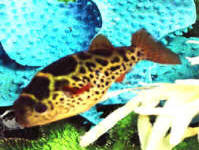
| Tetraodon
fluviatilis Hamilton 1822, the Ceylon Puffer to aquarists,
Green Puffer to science. Asia: India, Sri Lanka, Bangladesh,
Myanmar and Borneo. To six inches in length. A common Puffer in the
aquarium trade, but an aggressive fish fin and scale nipper as
adults. A freshwater to brackish species (higher spg as adults).
Feed on crustaceans, worms, mollusks, algae and detritus in the
wild. Second photo on right by Jeni Tyrell/PufferPunk
http://www.fishbase.org/Summary/SpeciesSummary.cfm?ID=11270&genusname=Tetraodon&speciesname=fluviatilis |
|
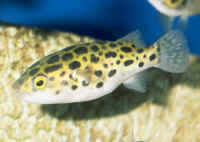
| Tetraodon
nigroviridis Marion le Proce 1822, the Leopard or Green
Spotted Puffer (aka GSP). Freshwater to Brackish; pH range: 8.0 -
8.0; dH range: 9.0 - 19.0. Tropical: 24-28 C. Asia: Sundaland,
Indochina, Myanmar, Sri Lanka, Philippines, Malaysia and Indonesia.
Probably found in India. Often seen in the trade, but very
aggressive. Should be kept solitarily. Feeds on mollusks, worms,
algae and other fish's scales!
http://www.fishbase.org/Summary/SpeciesSummary.cfm?ID=7763&genusname=Tetraodon&speciesname=nigroviridis |
|
Just a
simple question. GSP growth 6/23/10
Hi there,
<Perry,>
I've had my GSP for about 3 months now and I'm tired of reading
through conflicting information available on the internet about the
fish, and I'm told you might be able to help.
<Oh noes!>
So basically I'm wondering if you or any other site has ever
published a link with information regarding the GSP growth cycle?
<In terms of growth rate or maximum size?>
I am after reading that the fish can grow to be anywhere between 4 to 8
inches depending on which site you read, and I'm after reading
complaints from several people about stunted growth in their
puffer.
<Ah, I see. The biggest specimens can be about 15 cm/6 inches long
in terms of "standard length", that is, the distance between
the nose and the end of the caudal peduncle. Some aquarists also
include the tail fin in their
measurements of length, which scientists don't, so likely fish that
are reported as being above 15 cm/6 inches in length are simply
specimens that weren't measured in the same way. In any case, a big
specimen will have a body about the size of a man's hand, with the
tail fin on top of that. On the other hand, some specimens never get so
big, and really anything between 10-15 cm/4-6 inches would be
"normal".>
At this point, I haven't noticed any growth in my puffer really and
I'm wondering if their just slow growers?
<Can easily be, though it does depend on how big your specimen is.
If you bought a tiddler an inch long, he should be 2-3 inches within a
year.
Growth slows down a lot after that, but should be about adult size
within three years.>
I guess mostly what I'm looking for is to find out if theirs a way
to age my fish and how big he's really going to get.
<You can age fish -- but it requires digging their ear bones out! So
no, you really can't do this with pet fish.>
Everyone will say a number as the max size of the fish but no one says
how long it takes for him to get that big.
<A lot will depend on temperature, salinity, the nature of its diet,
and various other factors. Also, do be open minded about the fact you
might not have a GSP! Figure-8 puffers and South American puffers can
look very similar, but are much smaller.>
Any help you could possibly offer would be greatly appreciated.
Thankfully, Perry
<Hope this helps. Cheers, Neale.>
Re: Just a simple question, ID 6/23/10
HI again,
<Perry,>
Thanks Neale for the quick response.
<No problem.>
I appreciate the help it actually cleared quite a bit up for me.
<Cool.>
I was fairly certain that my puffer is a GSP but I never heard of the
South American puffer. I will definitely have to look that one up.
<OK.>
Any suggestions on how to tell for sure that my puffer is actually a
GSP?
<Figure-8 puffers have two eye-spots on each flank (forget about
trying to see the "figure 8" on the back as that's not
always there, and some GSPs have this too!). One eye-spot is close to
the base of the tail, and the other slightly forward and up, close to
the base of the dorsal fin. The South American puffer has bee-like
bands of green and black, as well as a distinctive black ring going
around the base of the tail.>
From the pictures I have seen I am pretty sure that he is but I
wouldn't say that I am 100% certain. Thanks again.
<By all means send along a photo, no larger than 500 KB
please.>
~Perry
<Cheers, Neale.>
|
Green
Spotted Puffer <ID, sexing, gen.>, clown, snails... 30
gal... 5k US $?!!!..... 11/18/2007 I've written in the
past regarding GSP's sexing and breeding. I was the one who
mentioned the girl at the local pet store who said she'd
visually sexed and then bred GSP's. Jeni told me that she was
sure she (girl at store) was mistaken and she must be talking
about dwarf puffers. I went back to the store for clarity, and
she assured me that it was not dwarves, but GSP's. Anyway,
it's neither here nor there to my current situation (just
wanted to post an update). <I do absolutely agree with Jeni
here. You (or the LFS person) described a dark line at belly of
the males. Such lines are a keel, which some puffer species
(genus Carinotetraodon) have. It can be erected e.g. during
courtship. GSP do not have this keel (many have been dissected).
Therefore, if this person bred puffers that had black belly
lines, they were of the genus Carinotetraodon and no GSP. Does
not mean they were Dwarf Puffers, other Carinotetraodon spp. have
been bred, too. I do not say it is impossible to breed GSP, but
some details of this specific story (black line, size of the
fish) make it sound unlikely GSP were bred here.> I know this
will be quite lengthy, but I'm hoping to convey to you my
interest and efforts and the out-n-out headaches I've
experienced. I also hope that others MAY learn from my mistakes.
All of this was a HUGE learning experience for me. I'm
growing and learning and really TRYING to do the right things.
<Sounds good so far.> Okay, about a year ago, I bought the
cutest little fish I'd ever seen. This was before researching
(have I learned a LOT in the last year). My GSP was put in a
freshwater community tank. I eventually moved him out and put him
into a 30 gallon tank of his own and stared raising the SG with
Instant Ocean. I used SeaFlor shell substrate (looks like a bunch
of small coral chunks and hermit shells), lots of plastic plants
and reef "bone" to build tunnels. Once the SG hit
1.018, I went to a pet store and struck up a conversation with an
employee there. Even though I was researching like mad, I
didn't feel prepared or knowledgeable enough to make the
conversion to full marine on my own. I knew basically nothing and
I trusted this guy. I paid him to come to my house, remove the
substrate and replace it with live sand (Fiji pink), he also
brought lots of live rock and some Tonga branch. He constructed a
beautifully scaped setup that is quite unique. I was convinced to
upgrade EVERYTHING mechanical for my tank (basic Eclipse setup
that was eventually "gutted" in order to incorporate a
Fluval 405 and a Red Sea skimmer while maintaining the look of
the Eclipse hood). So, now I had this "condo on the
beach" for Pete (the puffer) and Pete had his own personal
trainer, lol (the tank man). All went well with the conversion,
so I hired this guy to come weekly for water changes. He
continually brought things for my tank that I didn't ask for,
never expressed a desire for, but was ASSURED they would be great
compatible additions for my tank. I kept researching but felt
very pressured to buy the things he brought. <Here is were the
problems began. If you do not want something he is bringing
along, you have to say so clearly. When someone is trying to sell
you something and you feel pressured leave him alone or send him
away.> Eventually, the 30 gallon held Pete, a mated pair of
true Percula's (charged $100.00 for), <Tank is too small
for them and the GSP, not only because of water quality, but
territoriality. Prices are pretty high, even if I convert $ into
some hard currency.> 3 Firefish (charged $75.00 for), <Tank
is too small for them, the clowns and the GSP.> 2 blood shrimp
(charged $75.00 for), 2 anemones that died immediately (of
course, I was charged for these, too), 2 Hawaiian Feather Dusters
($30), 2 Florida Fighting Conchs (don't remember the price),
a Flame Scallop ($?), Ricordea mushrooms ($50.00), yellow polyps
($45) and that's all I can remember at the moment. <Again:
high prices for this small world.> With each new addition, I
researched and travelled to neighbouring cities to provide the
specialized food needed (DT's Phytoplankton for scallop and
feather dusters). My freezer is full of frozen fish food as well
as human food I've bought for the fish. I eventually tore
down the tank and removed all of the fish except for 1 Firefish I
couldn't catch and Pete and the two clowns and a Scooter
Blenny I purchased myself (which I add purchased Tigger-Pods and
other copepods on a regular basis). My tank is teeming with Mysis
shrimp, amphipods, and the Coralline has taken off (I upgraded
lights and started added calcium supplements while watching my
pH). My tank currently houses the Blenny, a Firefish, the two
Fire shrimp (which reproduce, AMAZING to see the little critters
swimming around), <Good to hear of this success.> 2 conchs,
2 Nassarius snails, 2 Mexican turbo snails, 1 Margarita snail,
various mushrooms, a torch coral that the clowns have started
hosting, 2 sea stars (1 brittle, 1 serpent), the polyps and some
star polyps. I also have a nasty hitchhiker crab I haven't
been able to catch along with some very large bristleworms. Pete,
though, ended up being unhappy. <This is not a reef species.
They can be kept at marine conditions, some zoological gardens
and many hobbyists do that, but GSP most commonly occur in
coastal mangrove areas, estuaries and frequently enter rivers.
Although some of these environments may have full strength
seawater salinity, none of their natural habitats is comparable
to a reef tank. The main reason to keep a GSP at marine salinity
is that due to skimmers and live rock it is easier to keep the
water quality permanently high.> GO FIGURE. He was pacing all
the time, and losing weight though eating regularly (he's fed
snails occasionally, squid, Selcon and phytoplankton loaded live
brine, Mysis shrimp, dried plankton (reconstituted with Selcon,
Zoe marine, Marine C, and Garlic Extreme). <The diet sounds
good, maybe feed more bivalves and snails as the main staple.>
In conjunction with his weight loss and pacing, I noticed a large
chunk taken out of the female clown's pectoral fin (I suspect
that her aggression increased once she and the male started
hosting the torch. I think she "attacked" Pete one too
many times and he bit back). <Some GSP are quite aggressive, a
few do not accept tankmates at all.> I haven't lost any of
the snails or shrimps to the puffer (except for the baby
Blood's that he, and the rest of my fish, ate). I knew this
impossible situation wouldn't work and I was disheartened
because of all of the energy, effort, and money spent over the
last year (I'm approaching about $5,000 at the moment on a 30
GALLON TANK). <Yikes does this tank maintaining person have a
wooden leg, an eye patch and a hook instead of a hand? You wanted
a tank for a GSP and not a high end reef tank, did you?.> The
original tank was started for PETE, and I felt like my ignorance
(even though researching voraciously in all of my spare
moments....there's a whole WORLD of information about marine
tanks. While I consider myself to be reasonably intelligent (if
not too gullible) I simply couldn't absorb all the
information I needed to know while I allowed the inertia of the
tank to snowball out of control). <Start with some books, e.g.
Bobs book, and sites like WWM instead of paying 1000s of dollars
for questionable advice. Not all LFS employees and owners are
pirates, but without researching much by yourself, you will have
a hard time to evaluate whose advice is good and who will make
you pay for thing you do not want or need. Reading is the easiest
way to achieve enough knowledge to make your own experiences and
reasonable decisions. Without reading you are likely to fail or
become a treasure chest. Advanced fellow hobbyists re usually a
more reliable source of information, local clubs are good places
to get into contact with them.> My willingness to trust
someone whom I believed sensed my desperation to "act"
for my fish and willingness to open my pocketbook for my hobby
saw an easy way to make money. I'm truly not trying to come
off like a victim...I let Pete's Personal trainer after he
came to my house and installed an EcoAqualizer ( I told him 3
times not to do it) and charged me $250 for this contraption and
for and cleaning the 30 gallon tank. He never left my house for
less than $90 and that was for simply cleaning the 30 gallon.
<Hope you can return the hardware you do not want and get your
money back. Possibly talk to the boss of this person.> Alas,
one of my friends gave me a 28 gallon tank. I added the water
from a LFS's main display tank, added Fiji pink sand, a
bubble wand (Pete loves these), plastic plants and a huge chunk
of live rock. I added the LFS's tank water because we have to
go out of town and I wouldn't be here if any cycling went on
while we were gone. I have a Whisper filter running on it along
with a submersible Fluval filter. No ammonia, no nitrites, and
nitrates below 20. I look to upgrade the filtration and lighting
within the next two months (Christmas is coming). <OK. A
skimmer would be a good addition, it could remove nitrogenous
waste before it is turned into nitrates by the filters. Since you
have a FOWLR (fish only with live rock) tank you do not need the
Whisper and the Fluval for anything, but some current. Ideally
the live rock should do all the biological filtration. In case
you remove them or replace them by a small powerhead, do not
remove both at the same time to avoid a minicycle.> Several
months ago I started a 3 gallon Eclipse tank for breeding snails.
There are a few large Ramshorn snails in the tank that lay eggs
regularly, but I'm not seeing many babies grow. The eggs
hatch, I see a large amount of dots (baby snails) and then I
don't see them any more. I have a chunk of cuttlefish bone to
harden the water, I use no heater, the filtration is the simple
Eclipse filtration and there is a huge wad of java moss. I feed
regularly with algae tablets (that don't contain any kind of
copper), bloodworms, and Betta pellets. I don't change the
water that often. I read somewhere that most success comes from
using water change water from another tank. There is no
substrate. On to my questions: 1) Today I accidentally fed Pete a
Malaysian Trumpet Snail (it was mixed in with my Ramshorn
snails). He ate the whole snail, shell and all. Will this hurt
him? It was small enough that he could swallow the whole thing.
<Some puffer keepers report that the shells of these snails
are hard enough to break the teeth of a puffer. As long as this
did not happen he will likely be fine.> 2) Should I add a
sponge over the intake on the 3 gallon Eclipse snail breeder
tank? Do you think that is where the baby snails are disappearing
to (getting sucked up the intake and ending up on the filter
pad)? <Possible, have a look a that pad to confirm. You could
try adding a sponge.> Should I add a small heater (I just
bought one). <A heater can accelerate the snail breeding, but
be careful not to over heat this small volume of water.> 3) Is
it okay to use fresh RO/DI water for the snail tank? <No. It
has no hardness the snails need to build up their shells, the
cuttlefish bone alone will not be sufficient.> Should I use
treated tap water? <Yes, thats better.> I've read the
few articles online about rearing snails, but I'm at an
impasse. <Have a look at www.thepufferforum.com. Youll find
more information there.> 3) With diligent water changes and
eyes on water parameters, will Lulu's fin heal (the female
Clown whose pectoral fin was bitten)? I think Pete bit her into
the "meat" of the fin, although I don't see any
sores or anything alarming (besides the chunk missing). <Will
likely heal. If the bases of some fin rays have been removed,
they will not grow back again but Lulu will probably get well,
again. Anyway, watch the wound for possible infections.> I
know this was long and I thank you if you've read thus far.
<No problem. Only the part about your puffer trainer was
horrible and hopefully will warn some people not always to
believe everything they are told.> This past year has been an
increasingly stressful experience for me (and my livestock, no
less). I was trying to do the right things, which, many of them,
ended up being the most wrong things to do. <I hope you are on
the right track now and still able to enjoy this mostly wonderful
hobby. Read on, learn and the mistakes of the past will not be in
vain.> Thank you for any and all help, Corinthian. <I hope
I helped. Cheers and good luck. Marco.>
Re: Green Spotted Puffer, clown, snails.....
11/20/2007 Marco~ Thanks for your response! <Welcome.>
I really liked the way you explained the genus differences
between the puffers. I really tried to "pin down" more
information from the girl at the LFS, but she seemed to be
wishy-washy using a lot of "I don't remember" to my
questions. The size of the fish, as SHE described them, matched
the size of GSP's. I thought I was going to stumble on some
kind of new "break-thru" information regarding GSP
sexing and breeding. Silly me. Lol <<I dont think this was
silly. There are several people claiming GSP were bred, but so
far hard evidence is missing.>> <Here is were the
problems began. If you do not want something he is bringing
along, you have to say so clearly. When someone is trying to sell
you something and you feel pressured leave him alone or send him
away.> I hear ya, Marco. The way he handled things was very
slick and I'm not nearly as naive as I used to be. As
I've said, I really learned a lot. <<Thats great to
hear. The more knowledge, the less trouble, the more fun.>>
<This is not a reef species. They can be kept at marine
conditions, some zoological gardens and many hobbyists do that,
but GSP most commonly occur in coastal mangrove areas, estuaries
and frequently enter rivers. Although some of these environments
may have full strength seawater salinity, none of their natural
habitats is comparable to a reef tank. The main reason to keep a
GSP at marine salinity is that due to skimmers and live rock it
is easier to keep the water quality permanently high.> No
wonder he was so unhappy. His current tank is only 28 gallons,
but is what I could pull together on the spur of the moment. I
know he'll be much happier in it. <<I wish him (and
you) a long and happy life.>> <The diet sounds good,
maybe feed more bivalves and snails as the main staple.> He
won't touch clams or oysters...even when soaked in Selcon
& Garlic Extreme. <<Did you open them? Smaller puffers
are often unable to crush too large bivalves. It is true their
teeth need abrasion, but bivalves are also good food, because of
their nutritional value. So, it is ok to open them for the
puffer. The GSPs I know eat almost everything (plants, flakes,
wood, fingernails), your specimen seems to be more picky.>>
There were some small bivalves that hitchhiked in with the live
rock. He never touched them. Maybe in his new tank, where he is
the only fish in it, he will become more "territorial"
and more willing to "investigate" resulting in him
eating more clams and oysters. Hhhhmmm....maybe he was "over
stimulated" or on "overload" in the other tank and
that's why he didn't bother anything in it.
<<Possibly stressed by all the unknown life and Cnidarians
in there.>> My snails just aren't living to sizes large
enough to feed him right now, but I do supplement them with fish
store nuisances when I can. <Yikes does this tank maintaining
person have a wooden leg, an eye patch and a hook instead of a
hand? You wanted a tank for a GSP and not a high end reef tank,
did you?> Yes, the tank was for the GSP. I said I wanted
something very simple. But, then I "needed" this or
"needed" that and with the additions that showed
up....they were so pretty, and I'm sure you know how things
like that often go. I would have never bought those things myself
(file clam, tube anemone that I had to get rid of, etc. etc.),
but when they were brought to my house and I was assured by
someone "in the know" that they would be great in my
tank....well, now I have a tank for THOSE things and a new one
for the GSP. Boy was I stupid. My future plans are to have a
90-120 gallon tank. I really want a Dog Face Puffer.
<<Great fish, too.>> <Start with some books, e.g.
Bobs book, and sites like WWM instead of paying 1000s of dollars
for questionable advice. Not all LFS employees and owners are
pirates, but without researching much by yourself, you will have
a hard time to evaluate whose advice is good and who will make
you pay for thing you do not want or need. Reading is the easiest
way to achieve enough knowledge to make your own experiences and
reasonable decisions. Without reading you are likely to fail or
become a treasure chest. Advanced fellow hobbyists re usually a
more reliable source of information, local clubs are good places
to get into contact with them.> I have TCMA by Mr. Fenner as
well as Bornemann's book. I just bought Wilkerson's book
on clownfish (now I'm in love with my clowns). I read all of
these voraciously when I'm NOT reading WetWebMedia.
<<Sounds like you are well prepared now.>> This has
been my "home" since I found this site when searching
for GSP information. AND, I was reading this site, but as I said
in my previous post, I couldn't read enough fast enough and I
was letting things get out of control. By the time I was learning
what I needed to know about Zoanthids and Ricordea, I was having
to learn about tube anemones....see what I'm saying? I
don't know why it was so difficult for me to just put my foot
down, but it was. A mistake I won't make again. <<We
live to learn.>> I live in the FL panhandle and I can't
find any local clubs (even when searching on the net).
<<You could ask at http://www.swfmas.com/ if they are aware
of clubs in NW Florida. Also check MASNA: Marine Aquarium
Societies of North America (If you want to start a club it may be
worth talking to them anyway). Id be surprised if there was no
club in the entire area, especially in cities like Pensacola,
Tallahassee.>> I have a girlfriend who just got into the
hobby not too long ago. We've talked about starting some sort
of society, but I don't even know where to begin....but
I'd LOVE to do it! Just in the last 2 months, my friend's
120 gallon tank broke on the bottom and flooded her house. She
was able to salvage her live rock and a couple of fish and a bit
of sand (her tank had just finished cycling). Another friend
treated his 90 gallon reef tank with antibiotics and it killed
EVERYTHING in his tank. He was devastated. Had I known he was
GOING to do that, I would have done what I could to stop him. So,
we NEED some type of society here where we can all get together
and share information and frags and create friendships with
others who love this hobby. If you can lead me in the right
direction, I'll be glad to follow up with it. <<One way
to get in touch with new fellow hobbyists to meet, share
information and swap items and animals, possibly on a regular
basis, are the different LFSs. Depends on how outgoing you are
and if you like talking to strangers. Second way to find people
is to look for local ads in newspapers and the net, especially
people already selling or swapping frags. When you have found a
small group of friendly reefers/fish keepers you could try to
find a place and date to meet, have a drink and share aquarium
stories. Thats how it usually starts. Sometimes it stays at this
informal level, sometimes a club is formed. Also consider
thepufferforum.com as you are interested in puffers. It is a
great place for experience exchange, too.>> I've duly
noted your advice regarding my specific questions. <<Hope
it helped.>> Marco, I think I'm on the right track now.
This website provides a plethora of information. I just read and
absorb everything I can and I just LOVE this place. Thank you and
to all who offer such immeasurable information and support.
Corinthian <<You are welcome and I wish you good luck with
your future endeavours. Marco.>>
|
Re: Marine Stocking, GSP, Tangs in a Small Tank
9/14/07 Hi, <Hello> Thanks for the reply, so I should
definitely get rid of the puffer fish (whom like you said is naturally
a brackish fish, but has been in full saltwater for over a year and is
doing more than fine), and maybe 2 of the clowns? <There are several
different species of puffer that go by the name Green Spotted, most get
quite aggressive and will end up killing your snails, shrimp, and
become fin nippers, if you are willing to take the steps necessary to
keep this fish then go for it.> I wasn't sure how to interpret
your claim that 2 of them might die off, is this because of competition
between the clowns? <The dominant pair will most likely kill off the
less dominant pair eventually.> To be fair though, they all have
been together for over 6 months now without any previous problems.
<Wait until they become sexually mature and start trying to
breed.> I do realize that I need a larger aquarium for the hippo
tang, but since I bought it at such a small size, I figured I have
plenty of time to upgrade my tank in the future. <Stock for what you
have now, all too often the bigger tank never materialises, and the
damage of a too small tank starts much earlier than most people
realize.> Without the puffer, and maybe 2 of the clowns, do you
think this tank could be fairly compatible? <I think you will start
seeing behavioral problems with the tang before long, but otherwise the
tankmates should be fine.> Thanks, Dan <Chris>
Pufferfish for Dummies 5/14/06 Dear Crew,
<Hi, Pufferpunk here> I am interested in purchasing a puffer
fish. I know nothing about fish and I am actually kind of scared of
fish but I saw a little yellow puffer fish I fell in love with at the
store (Wal-Mart). <Certainly can't blame you for that!> The
woman in the department knew NOTHING about the fish and have not been
able to find anyone at any other pet stores who can tell me all I need
to know. <Not surprised there either. Puffers are the
most misinformed fishes in the hobby.> The puffer fish I am
interested in was about the size of a quarter, white belly, yellow in
color with little black spots. <Green spotted puffer, Tetraodon
nigroviridis.> Should I get more than one puffer so they will not
get bored and lonely? <Not necessarily; puffers don't get
lonely. See: http://www.wetwebmedia.com/ca/volume_2/cav2i6/lonely_puffer/lonely_puffer.htm
You could keep several of these puffer together if you raise them up as
juveniles. Keep in mind they require at least 30 gallons
each as adults.> What kind of food do they eat (I read brine shrimp,
mosquito larvae, hard things to keep their teeth warn down, etc).
<Feeding your Puffer Friend: http://www.thepufferforum.com/articles/puffer/food.html
> Do you suppose this was a dwarf puffer fish? Or another species?
<I'm sure it's the GSP. Wal-Mart's been
selling tons of these lately.> How big of tank should I have? How
often do I need to clean it or can I get a tank cleaning fish?
<Everything you need to know about the care of a GSP: http://www.wetwebmedia.com/BrackishSubWebIndex/gspsart.htm
> Also, would Wal-Mart be an okay place to buy a little fishy or
should I try to find one at an actual pet store? <Personally, I have
boycotted Wal-Mart for the care of their fish for over 10 years.> I
need all the information to keep a happy, healthy puffer
fish!! Please share all your knowledge! THANK YOU!! <Then
you should go over to www.thepufferforum.com & read, read,
read! PP> -Rosie
Puffer
Color? 11/10/05 Hi Pufferpunk, <Hi there> I saw
your article on green spotted puffers. In the picture above
it looked like your puffers had red tipped fins. I was
wondering if this is a thing that comes when they mature, because I
have one that is <2 and it doesnt have the red tipped
fins. I find this a desirable trait and was just
curious about it. <Sorry, just a reflection from the
pinkish decor behind the fish. Their fins are just like any
other GSP's. ~PP>
GSP id, keeping? Hello! <Hi, MikeD here>
My boyfriend and I recently got puffers<Some of my favorite fish>
(about 2 months now). I've been doing a lot of research
on them and I really think they're Green Spotted
Puffers. I just want to make sure, as I'm not sure where
else to go because the LFS we went to simply had them listed as
freshwater puffers,<Most do, but they rarely are, with most actually
being brackish> which is what we were looking
for. It's a really good store and he's gotten a lot
of fish from them before, I just want to make absolutely sure what type
of puffers these are so I can give them the right conditions. So can
you tell what kind they are?<Your question couldn't have come at
a better time. This month's on-line magazine has an excellent
article on these entitled "Brackish Fishes Green Spotted Puppies,
er...Puffers" by Jeni C. Tyrell, well worth the read if you have
the time> http://wetwebmedia.com/ca/green_spotted_puppies.htm
What salinity should they be at?<They can tolerate pure freshwater
to a pure marine environment> They are in a hundred
gallon tank right now and I'm guessing that they're a little
under 2". I've read that it's normal for them
to turn a little grayish and nap at the bottom, even if they curl up a
little. once they wake up though, they are bright again.<Yep. The
dulling of color often indicates sleep, with the curled tail being a
protective posture, much like you curling up in a ball to nap.>
Surprisingly, they aren't very nippy.<That's because of the
large tank. In crowded conditions they can be aggressive with their own
kind, other puffers and slow, long-finned fishes> They
are currently kept with a bunch, maybe 20 goldfish (I know I know
bad<very>, but they were feeders for the previous black Arowana
in that tank that recently passed <Sorry to hear that, as it's
one of my all-time fave freshwater fish>. they range from about 1 -
3") and he didn't have the heart to get rid of them<he
really should. Goldfish are copious waste producers that often make
conditions unsuitable for more delicate species and actually do better
if kept at lower temperatures than most tropicals>, a green
scat<another brackish water species that will do much better with
some salt, up to full marine levels>, and a pleco<Now THIS is a
freshwater fish and one that typically doesn't do well with
puffers...by laying still on the bottom, they are just too tempting and
their armor is no challenge for the puffer's
teeth>. So it's totally a freshwater tank with a
salinity that measures at a little more than 1.001. If they
are Green Spotted Puffers, how soon do we have to start turning up the
salinity levels and how much?<The sooner the better and with 2-3
tblspns marine salt/gal. on up to full marine> They seem very
happy. They're wonderfully colored and zip along happily
attacking all the food we give them with adorable vigor. We
feed them brine shrimp<brine shrimp usually is a poor choice as it
has very little real food value> and bloodworms. I
don't understand how to feed them anything else, but would like
to. I know what type of food to feed them, but they're
so small, I don't see how they can fit it in their mouths.<Their
teeth are VERY strong, and they can bite off whatever size pieces they
need with little or no effort> I don't want their
teeth to overgrow either, so how can I portion them so they can eat
them happily?<by letting them bite off pieces from hard foods, such
as shrimp with the shell on or whole crayfish, their teeth are
naturally worn down> I really want to feed them some
snails, but my boyfriend doesn't want snails running rampant in his
tank<snails rarely run rampant in a tank containing puffers, as they
eat them, shell and all> or go through the trouble of raising
shrimp.<You're saying shrimp, but I'm guessing you mean
brine shrimp?> How do we compromise? Do frozen foods stay
hard enough after defrosting to grind down teeth?<Yes, if the shell
is left on the shrimp, the same kind that we eat, no if you mean brine
shrimp> I live in San Diego and he lives in LA with the tank, so I
only have so much influence over what happens with the tank.<That
one only you can solve! Good Luck!> How many more puffers should we
get so they'll be happy?<you don't need to add any
more> I don't want them to argue<They will
anyway...that's their nature> and I'm not sure how to sex
them.<no matter, as I don't believe they've been bred in
captivity yet> I don't want them to get bullied by
goldfish either.<Not likely, and in fact they may/probably will
eventually start attacking the goldfish's fins, possibly to the
point of killing them> I actually want to move the
puffers or the goldfish to another tank especially if they require
brackish or salt water, but again, this is something I can't
dictate.<Again, a very good idea. If the decision isn't made,
eventually the puffers are likely to take matters in their own hands
(fins?) with dead goldfish likely the end result.> I have a very
limited budget, do you have any suggestions?<not other than
separating the goldfish and the pleco from the puffers and scat>
I'm sorry about so many questions. I've really been
researching to try to find the answers, but these are the questions
that no site seemed to answer completely or the results I find are
contradictory. We bought the puffers assuming they were
freshwater, but as I did more research I started having doubts.<very
wise and well done> Please help me so that I can give
these puffers the best home possible. I know that you don't want
huge emails, so I'm sending you links. Hopefully these pictures
will help you identify the type of puffers I have.<again, as you
suspect, probably Tetraodon fluviatilis> http://i.xanga.com/jessijessi/nyc%20nj%20may04%20108.jpg
http://i.xanga.com/jessijessi/nyc%20nj%20may04%20109.jpg
And here's a picture: Thank you so much in advance!<You're
welcome. I hope we've helped a little> Jessica
Which is which? (Spotted Green Brackish
Puffers) I wrote you a few days ago now I have another question; I
have seen in many sources, yours included, the names Tetraodon
Fluviatilis and Tetraodon Nigroviridis as what seem to be the same
fish. I cannot tell the difference through the photos I have seen
between one and the other species, or if there even is one; the fish I
have looks like all the photos I have seen associated with these names,
except one; In your archives you have Tetraodon Fluviatilis with 2
completely different pictures for the same name. This is important to
me in my research of my particular species of puffer and how he needs
to live. I am now so utterly confused, please help! My fishy needs this
info! =) <Sorry for the confusion. I only find the one image
associated with the name Tetraodon fluviatilis (though both species do
come into the trade... from the same countries... and are... yes,
unfortunately called the same in the trade. Please see here:
http://www.wetwebmedia.com/fwpufferfaqs.htm re someone else's input
on this "name game". Bob Fenner> Thanks Mallika
A Puffer by any other name would smell... Hi!
<Hi, Trish... Anthony Calfo here answering Bob's mail while he
is away on a fantasy fish collecting trip, as we are told, wearing
nothing but a natural bikini made from the hide of a capybara that he
caught himself, and armed only with a buck knife clenched between his
teeth> I recently bought 4 baby puffers - the spotted green kind.
<AKA: Green Puffer, Spotted Puffer, Leopard Puffer, etc.>
However, different websites seem to give it different Scientific names.
Some say it's TETRAODON FLUVIATILIS, others say it's TETRAODON
NIGROVIRIDIS. <I'm not certain...Bob can confirm, but it is my
understanding that they are one in the same and that T. nigroviridis is
the valid name> The pictures of both species on the internet look
the same so I can't tell which species mine is. My puffers have an
iridescent green background with round spots. What is the difference
between Tetraodon Fluviatilis and Tetraodon Nigroviridis? Would really
appreciate it if you can clear up my confusion...Thanks, Trish
<I'll borrow your confusion and add it to my own cerebral
clutter... best of luck to you, Anthony>
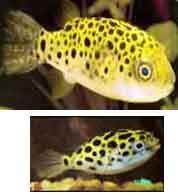
| Interesting puffer observation Hi Bob, I was
wondering if you could give me your opinion on something that has
been puzzling me regarding the green spotted puffer. I have spoken
to you before, I have a large tank with 15 puffers, a mixture of
figure 8's (Tetraodon biocellatus) and Green Spotted (Tetraodon
nigroviridis.) I have been keeping puffers for a long time and have
a keen interest in them. On observation of my puffers I notice that
there is a distinct difference between the green spotteds and for
some time I have been convinced that some of them may be a slightly
different species. I have attached a picture (scanned for
viruses-don't worry) for your to view. I find that some of them
are rounder in the face with large spots and black eyes and a more
'cartoony' appearance. Others have a longer nose with very
reflective blue eyes and a wiser look about their face and more
erratically patterned spots (as in the top picture.) Do you think
there could be a slight difference? I have looked up all the
literature I could find and they all seem to be labeled as the same
species. Only one of my specimens displays these blue eyes and it
is very young, perhaps this goes with age? <Have noticed these
differences at times as well... think they may be due mainly to
size, geographic variation... perhaps developmental history
(winners, alpha types versus not)... Worth investigating the root
papers dealing with the morphometrics of the species. Could be
searched through fishbase.org to start bibliography. Bob Fenner>
Kris |
|
Death of 2 puffers hi there... <Hello>
will be grateful if u could help enlighten me... I bought 2 green
spotted puffers... let's call em A and B... I put them in a fairly
large aquarium round 4 to 5 feet wide kinds...A was pretty active when
I brought it back, eating all the bloodworms I'm feeding them...
but B is kinda sluggish... and when tries to eat something, A chases
after it, so B gave up and I haven't seen it eating at all for few
days... and soon B develops this horrid brown black colour all over
it's body and start getting real skinny... after a few more days it
died... I tot it was some rivalry stuff with the 2 of em so I ignored
A...is still eating fine and pretty active until one day it refuses to
eat and at the end of the day it turn brown like B and died... I
don't know what's the problem cuz at first I thought it was the
water ... I just use freshwater without adding salt) cuz some sites
says that puffers can survive in freshwater... so I tot B was weaker...
but then the active A sudden death just puzzles me... before they died
they don't seem to have any growth whatsoever on em and the color
on their body always fluctuates from yellow to brown patches... is it
really hard to keep puffers?... I heard they are hardy fish and the
thing is my dad rear his other tropical fishes in his tanks till the
water turns green and they still seem to be all right... thanks
<Yikes... very likely these "freshwater" Puffers were not
so "fresh"... Please take a read over the "Freshwater
Puffers" materials stored on our site: www.WetWebMedia.com and try
to identify what type you had... I suspect these two perished mainly
for lack of the salts found in their natural waters. Very common, and
unfortunate. Bob Fenner>
My 3 Puffers Hello. I am hoping that you will
be able to help me with my puffer fish. I have 3 of them, in a 6 gallon
tank. They are pretty small still, and I think that they are MBU
Puffers. <Yikes... a very small volume of water for this species...
hard to maintain stably... and these can be very "mean"
toward each other> They are the green one's with the black spots
on them. <Hmm, actually... this may be another species. Please
see our site: www.WetWebMedia.com and in turn Fishbase.org for
identification of this "freshwater puffer".> Lately I have
noticed that their colors are changing. Sometimes the green is a deeper
green and sometimes it is a more fluorescent green. But then sometimes
there is some brown coloring between the white area and the green. What
is this caused from? <Could be simply "mood"
changes, nutrition, water quality, even communication amongst them>
I was reading some of the other people's problems with their
puffers and one person said their puffers turned brown and then died.
Are my fish sick? <Maybe... most likely from "water
quality" issues... may well be "brackish", needing some
regular concentration of salts...> I feed them blood worms, and all
3 of them eat them aggressively, so I don't think that it's
from lack of food. <Solely this one item? Their diet needs to be
expanded my friend. How healthy would you be only consuming your one
favorite food?> I have also noticed that one of them is always
trying to jump out of the tank. Is the tank too small for them.
<Yes, for sure> I have heard that the puffers will do okay in
either a large or medium size tank, and like I said before, they
aren't very big. What does it mean when they don't have their
tail flared compared to when they do have it flared? <Once
again, a number of possibilities: the beginning of a rapid
flight/swimming due to... aggression, fear... communication?> I have
also noticed lately that one of the fish is hanging out in the very top
corner of the tank where he is cornered in behind the heater and the
filter. Is there something wrong? <Possibly... likely this is
the more subdominant individual and it's finding solace in staying
out of the way of its nippy conspecifics... do look into either a
larger system, making it brackish, and/or trading in all but one of
these fish.> Sorry for all of the questions, but I am new to this
and I love my puffers and don't want them to die. Thanks - Kari
<I appreciate this... extend your caring to investigating proper
husbandry of your wet pets. Bob Fenner>
Puffer Info Hello again. Thank you very much
for your advice before regarding my puffer fish. I had questions about
my 3 green and black spotted puffers in a 6 gallon tank; one of them
was starting to turn brown. Well, the one that was turning brown died
the next morning, <Yes, sorry to learn of this loss> it was sad,
but the other 2 are still ok for now. I put a couple of rocks in the
tank and they seem to like that. But one is a lot bigger than the
other, and is constantly starting to chase the little one around. The
little one spends a lot of time hiding behind the rocks now. I am
afraid that it will die. <All very typical... need larger quarters
to get away from each other> It is still eating great and
everything. Today I was in a pet store and I noticed that one of the
tanks had little puffers the same as my small one with other bigger
fish. Unfortunately I don't remember what kind of fish they were
with. I was wondering if the little puffer would do okay in a 30 gallon
tank that has about 5 mollies in it, a small guppy sized fish that has
horizontal stripes on it, a Gourami, and 2 fish that look like bleeding
hearts but they are darker shades of reddish orange. They are all
pretty lively but docile in the sense that they don't nip at each
other and pretty much leave each other alone. They are all bigger than
the little puffer except for the one with the horizontal stripes on it.
But it's an extremely fast little guy. Would the little puffer eat
him? I would really like to get the little puffer out of the small tank
with the mean big one in it. What do you think? Thanks! Kari
<Well... the Puffer is not likely to be bothered too much by the
fishes you list... in fact, the Puffer is much more likely to bite bits
out of some of the new tankmates... You ought to check the
physical/chemical requirements/ranges of these fishes to assure that
they are mixable... maybe on fishbase.org... many of the fish species
you list tolerate/enjoy hard alkaline, even brackish water, the
"tetras" you tentatively identify do not... Bob
Fenner>
Puffer confusion!!! (brackish id) Dear Robert,
First of all I'd like to thank you for a great website. I'm in
the process of putting together my second website at the moment, and
I'm running into some difficulty with classifying Pufferfish. My
confusion lies in the fact that there exists t. fluviatilis and t.
nigroviridis. I have been researching and trying to differentiate the
two the best I can, since I'm going to be profiling them in my
website, "Puffernet". If I'm not mistaken, the two are
from the same part of the world (southeast Asia) but are brackish and
freshwater, respectfully. Is this correct? <Both these Tetraodons
are brackish and fresher water... take a look at the coverage of
nigroviridis (note spelling) and fluviatilis offered on the
fishbase.org site> I don't seem to be the only one confused on
this matter, as many genome sites (you'd hope they would know the
difference) are calling them the same fish when there's two
different species as per you and fishbase). It would seem to me that t.
fluviatilis has a more torpedo-like shape and is brackish, while t.
nigroviridis exhibits a more club-like form and is freshwater.
<Like, agree with your morphological assessment> If I am correct
in my nomenclature, are there any other distinguishing characteristics
for these two fish? I do realize that t. nigroviridis is an inhabitant
of freshwater streams and rivers, and wish to pass that information
onto the masses so these fish can be properly cared for. Once again, I
was wondering if you could shed a little more light on differentiating
the two fish. Thanks so much for your time. Fred <Both fishes do
best in water with some consistent salt mix make-up... both pugnacious,
nippy toward unwary tankmates, both require meaty foods in their
diets... fluviatilis "shinier", more discrete, consistent,
smaller dots... Bob Fenner>
T. fluviatilis or not T. fluviatilis? Esteemed
Mr. Fenner, <Steamed, like rice?> I have two spotted puffers sold
to me as Tetraodon fluviatilis, when I bought them both looked similar
and I requested the liveliest of the bunch. The pet store had them in
brackish water and being impatient I brought them even though the tank
I had cycled at home was freshwater (a little salt). I raised the
salinity in the 20gal. tank to 1.002 while I acclimated the puffers to
the new temp. in their little baggie. This being done I guess I crashed
my bacteria because it was touch and go with ammonia and nitrate levels
for awhile and the tank was cycled for 2 weeks and both levels were 0
before I added more salt (and puffers). <Yes, astute of you to
notice> Anyway, now the ammonia and nitrate are fine: temp.78, pH
8.0, sal. 1.002. But one puffer seems much happier than the other...his
belly is always black I read here about the color of their bellies
changing and it does for one but the others stays black. Black belly is
also much rounder and I suspect that I have two different kinds of
puffer, maybe one fluviatilis (brackish) and one nigroviridis
(freshwater)? <Maybe... I would like to suggest another more likely
possibility. That one is "happier" than the other... or
reciprocally, that one is making the other miserable... typical amongst
these species> The pet store says that they could be different but
could offer no suggestions for keeping both happy in the same tank.
Should I try to take the balloon shaped one (I suspect nigroviridis)
with the black belly to a freshwater tank? How would I do this without
killing the fish? <You need to ascertain the species definitively...
do take a look through the pix on fishbase.org re... and re switching,
acclimating them to other spg/salinities, can be done (slowly) over a
period of days to weeks... by water changes, addition of less or more
salty make up water...> Also I notice that one has a pattern of very
small spots or specs (not disease) tapering off into the tail while the
other has a "clear" tail, I haven't seen this mentioned
anywhere as a possible way to tell these two apart but...Please help me
make these fish happy. Thanks, Tim <Again, very observant of you.
The markings are likely more to do with stress than species
differences. I would separate these two. Bob Fenner>
Re: T. fluviatilis or not T. fluviatilis?
Thank you for the quick reply, I will begin separate the two and see
what happens. The fish with the black belly actually seems to bully the
lighter one a bit... Thanks again, Tim <Yes... understood you to
state this... yet it may well be the more stressed individual of the
two just the same... as you'll see. Bob Fenner>
Re: T. fluviatilis or not T. fluviatilis? Mr.
Fenner, I separated the two and put the one I thought might be T.
nigroviridis in freshwater. The result has been dramatic. Like two
different fish. The LFS said to just lower the salinity in the brackish
tank and "let them adapt" but I thought they were a bit
flippant about the whole issue, hopefully all fish will remain happy as
they are. Thanks for your help. Tim <A pleasure my friend. Delighted
to read of your diligence. Bob Fenner>
|
|



