|
|
| Home | Marine Aquariums |
Freshwater Aquariums |
Planted Aquariums |
Brackish Systems |
Ponds,
lakes & fountains |
Turtles & Amphibians |
Aquatic Business |
Aquatic Science |
Ask the WWM Crew a Question |
| Please visit our Sponsors | ||||
|
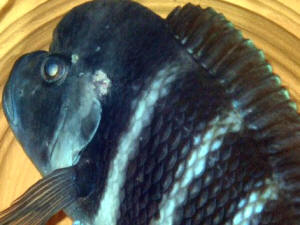
Questions re cichlid pop eye and tank KH level Red Empress With Pop Eye 2/11/09 Dear Bob, < You have Chuck here this time.> I have read your cichlid disease FAQs through Google search and found they are very informative. But I could not find the answer for mine so I am thinking giving it a try by emailing you. Thank you very much in advance. I am a new cichlid lover. I have a red empress (female, 5'') whose right eye appears cloudy and protruding gradually for about one week now, and a red patch on the lower gill (same side). I checked on the internet and saw pop eyes' picture, looked very alike. Now I have put the fish in a 5 gal hospital tank. My questions are: 1) is the tank too small for her? < I usually recommend at least a 10 gallon hospital tank. Most medications have dosages in 10 gallon increments.> 2) I have bought antibacterial (API Melafix) and I also have amoxicillin (for human) at home. I was wondering which one I should use? I heard antibiotics works better, if so, what dosage should I use? < Melafix can be used as a tonic and has been found to be useful in some infections in wild Anabantoids. I would recommend getting some Metronidazole and Nitrofuranace. The Metronidazole is effective against Protozoans while the Nitrofuranace is effective against bacterial infections as well as an antifungal treatment.> I tested my tank water (120gal), CH=180, KH=80, pH=7.0, Nitrite=0.2, nitrate=40, ammonia = 0. (My tap water has similar CH, KH and PH.) I have read from some websites that African cichlid need Alkaline water such as KH over 200, pH over 8.0. I was wondering if it is necessary to increase KH level artificially, if so, what product would your recommend? Can I use baking soda? Thank you very much Jessica < The nitrates should be under 20 ppm. This may be part of the problem. Do a 50% water change and treat as recommended. Your red empress is from Lake Malawi and the pH and hardness requirements are not as demanding as the Lake Tanganyikan cichlids. I would recommend a Lake Malawi buffer to slightly increase the pH and hardness. Make sure that you mix the buffer outside the tank and check it before placing it in the tank. I usually recommend adding the newly buffered water when doing small water changes.-Chuck>
Haplochromis Help Victorian Haplochromis With Problems 2/7/09 Hi, Just wondering if you might know what is wrong with our Thick Skin ( Red Tail). His eyes are milky and puffed up and one of them has a white spot on the film of his eye. Regular water changes are being done and the pH levels are about 8.2. His tank mates include 5 females and 1 male & 3 female Lombardoi. Both males are same size and we have yet to witness them being aggressive in anyway, but I don't want to rule it out if there is a possibility that one doesn't like the other. Any ideas as to what we can do to fix the red tails eyes? He is the only one with this condition. Thank you in advance! Matthew & Angela < Your Haplochromis red-tail is from Lake Victoria. The Ps. lombardoi are from Lake Malawi. The Ps. are usually bigger faster, have thicker scales and more teeth that the Victorians. If there was any serious fighting then the Victorians would surely come out on the short end of the stick. Victorian cichlids do not like elevated water temps. Anything over 80 F and they start to get sick. It sounds like you male has come down with a bacterial infection. I would recommend isolating him in a hospital tank and treating him with either Nitrofuranace or Erythromycin. Keep the water at around 75 F. Follow the directions on the package.-Chuck>
Cichlid, pop-eye please assist 8/1/08 Hello, I have read through many of your postings but really feel I need guidance concerning my yellow cichlid. <Fire away!> I set up a freshwater 55gallon tank on July 4, 2008. I am new to cichlids, but I have been spending hours researching online about them. (And finding that I have done SO many things wrong, but 5 out of 6 cichlids are now currently very happy.) I have Mbuna cichlids. I realize I have done so much to my cichlids, but please help guide me to what I should do for my little yellow one. <Ah, the cichlids we call Mbuna run the range from relatively easy to keep, tolerant fish (such as Yellow Labs, Labidochromis caeruleus) through to extremely aggressive, potentially tankmate-killing monsters like Blue Zebras (Pseudotropheus zebra/Maylandia zebra). Contrary to what you might imagine because of their similar water chemistry requirements, you can't throw them all into the one tank and hope they'll get along. They won't. The aggressive, potentially hyperdominant (read: nasty) fish will systematically bully and potentially kill anything it doesn't like.> At first, I bought four 1" to 1 1/2" cichlids, but one wasn't eating or swimming and died within 72 hours. I took that cichlid back to the store, replaced it, and bought 4 more (for a total of 8.) I noticed my tank was starting to smell, so I did a 10 gallon water change which sadly killed 4. I bought 3 more and an algae eater (for a total of 7--I should have just left my tank alone and let it cycle.) <The algae-eating fish is redundant in the Mbuna tank. Mbuna eat algae, and without it won't do all that well. Mbuna are also super-sensitive to poor water quality. While not *quite* as sensitive as, say, marine fish, they aren't far off. You need nitrate levels 20 mg/l or less, and zero ammonia and nitrite. All this recommends against keeping anything as messy (and big) as Plec.> All of the fish were happy for a good week and a half. Then I noticed my little blue one had a white patch on his side, was not eating, and was isolating himself. I thought maybe his fin was torn off, but the next day I noticed it had gotten worse. I did not have a spare tank at that time and was worried that my other fish might have the same infection, so... <The white patch was very likely Finrot or Fungus, and this would be caused by either poor water quality and/or physical damage. Let's recap: clean water has no smell, or if it does, the water should smell sweet thanks to all the plant life. If the tank smells offensive in any way, that's a very bad thing. It usually means there's decay in the tank, e.g., from uneaten food. Mbuna absolutely must not be overfed, and their diet should be biased towards green foods rather than anything high protein. Feed sparingly, from a mixed menu, and not just pellets/flakes. I'd recommend greens (tinned peas, cooked spinach, Sushi Nori) along with whole (i.e., low protein, high fibre) invertebrates like bloodworms and brine shrimp. Now, you also have to have lots of filtration and generous water changes or the water conditions will be poor. I'd recommend a filter offering not less than 6 times the volume of the tank in turnover per hour. So if you have a 55 gallon system (the minimum for Mbuna in all honesty) you'd get a filter with something over 330 gallons per hour turnover. External canister filters work great for this, but you can also use a undergravel with powerheads at each end of the tank. Read any book on Rift Valley cichlids for more on this topic. Water changes should be 25-50% per week. The more the better. Obviously the fish need hard, alkaline water, so understand water chemistry and manage this aspect accordingly. Again, a book on Malawi cichlids will help.> I treated the whole tank. With Melafix (which seemed to do no good, as I have seen you do not recommend it either) and Pimafix. <Both products may have value as preventatives, but aren't reliable as cures once the infection has set in.> I also treated the whole tank with Jungle Parasite Buddies because I saw the blue one had long stringy thin feces. Now my tank is a wreck. The other 6 were fine, but just stayed on one side of the tank. The blue cichlid got worse by the day and after 3-4 days(?)the fungus/bacteria (that I thought Pimafix would help) had eaten him. <At the moment you're wasting your money. In fish healthcare, just as with humans, you must identify the disease first, and then buy the treatment. You're randomly adding stuff here, hoping something will work. Slow down. It's better to work logically, step by step. So far all these symptoms are fairly generic, and tend to imply a reaction to poor water quality. Stringy faeces can be a symptom of poor diet, Hexamita, and many other things. So let's slow down and try and get to the bottom of things!> That same day my little yellow one started isolating itself on the other side of the tank where the blue one had been and would not eat. <He's being bullied. He has no place in this system.> Its mouth seemed to have white cottony fungus/bacteria on it. <Quite possibly Finrot, Mouth Fungus (actually a bacteria), or plain vanilla Fungus. All three follow on from physical damage. Think of them as the "gangrene" of the fish world. Easy enough to treat using products like Maracyn (in the US) or eSHa 2000 (in Europe). But treating them won't stop them coming back, so if this fish is bullied -- as it is -- and getting damaged, you'll cure one round of infection only to have to deal with again a few days or weeks later.> I quickly bought a 2 gallon tank with a filter, put the yellow cichlid into it, and treated the hospital tank with Jungle Buddy Fungus Clear and aquarium salt, and kept the temperature stable at 80. The next day, I noticed she was getting white cottony growth on her cheeks. <Needs treatment as stated above. Also note that "aquarium salt" is harmful to Mbuna, and known to cause something called Malawi Bloat. Again, any book on Mbuna will explain this.> By the 3rd day, the cottony growth on her cheeks was gone and her mouth looked very good. She was still not eating, and on the 4th day (yesterday) I noticed one of her eyes is bulging a bit (pop-eye, I assume.) I read that it could be from unclean water, trauma, bacteria, etc. <Pop-eye tends to work two ways. If only one eye is bulging, then physical trauma is the likely cause, with bacteria having set in secondarily. If both eyes are bulging, the infection is more likely to be systemic and caused by serious problems with water quality. Either way, treatment with an antibiotic (such as Maracyn) can help, but recovery is often very slow and depends on the fish otherwise being maintained in ideal conditions.> While all of this was going on with my yellow cichlid in her own tank, I have done plenty of water changes to the main tank, and they are SO happy. Nitrites and Nitrates are 0, ammonia is minimal, temperature stays at a constant 80F, ph is staying constant at 7.5 and very slowly raising to the appropriate ph level for cichlids thanks to Cichlid Salt and crushed coral in my 2 filters, and my very soft tap water is now hard and in cichlid range. <Understand this, there is no "minimal ammonia". All ammonia, any ammonia, is bad. Saying "minimal ammonia" is as meaningless as saying someone is "almost pregnant". So, here's at least one fundamental problem -- the ammonia. Mbuna have ZERO tolerance of ammonia, and long term it WILL cause harm. If you have ammonia in the aquarium, then one (or two, or three) of the following is true: [a] the tank is overstocked; [b] the tank is under-filtered; and [c] the tank is overfed. Pick and choose as seems appropriate, and act accordingly.> The Jungle Buddies Fungus/Bacteria medicine said to not retreat until after 4 days. Since it had been the 4th day, and I noticed the pop-eye and all cottony growth gone, I did a very slow and gradual water change in her tank (after checking the ph on both and they were almost identical) using the main tank's water to fill her tank. She seemed fine with the change and maybe a little happier too (aside from not eating and the pop-eye and being weak) so I put her into a small breeder tank inside the main tank while I rinsed her small tank with hot water, then cool water, and used the main tank water to refill it. <Cleaning the hospital tank is pointless if you're killing the filter bacteria as well. Be sure you understand what's going on here: hot water will kill filter bacteria, and the resulting ammonia crisis will stress/sicken any fish put in here.> I put the Jungle Buddies Fungus/Bacteria medicine back into the small tank and put her back in it last night (it says it treats pop-eye as well as fungus and bacteria.) <Oh good.> Her eye is still bulging. I do not see any cottony growth or abnormalities on her anywhere aside from the eye, no appetite, and weakness. (I can't tell if both eyes are bulging, but one is definitely larger than the other and I can see the skin(?) covering over it.) <This does happen with cichlids, and is usually a very good sign that not all is well in their tank.> I'm going to leave my main tank alone for good, but keep checking ammonia, nitrites, nitrates, ph. My question (after my long novel) is what should I do about my yellow cichlid? Should I leave her in the hospital tank with the Fungus Clear (that says it treats pop-eye) for the full 4 days? <Isolate from other fish, yes. Not sure 2 gallons of water is safe, but if that's all you have at the moment then so be it. Long term this fish needs to be re-homed.> Should I leave her in her own tank with just water from the main tank? Should I add some Epsom salt to her tank to help the swelling? <If you want.> I think my main concern is that she has not been eating for at least 5 days and is weak. <I'd be getting worried too. She won't eat if water quality is bad though, so check you have zero ammonia/nitrite first before you even think about offering food.> I am glad that all of the cottony white is gone and her mouth and cheeks look clear. <Good.> Thank you so much. <Hope this helps, Neale.>
|
|

|
Features: |
|
| Featured Sponsors: |