|
FAQs on African Cichlid Diseases 8
FAQs on African Cichlid Disease:
African Cichlid
Disease 1, African Cichlid Disease 2, African Cichlid Disease 3, African Cichlid Disease 4, African Cichlid Disease 5, African Cichlid Disease 6, African Cichlid Disease 7,
FAQs on African Cichlid Disease by Category:
Diagnosis,
Environmental,
Nutritional,
Social,
Infectious (Virus,
Bacterial, Fungal), Parasitic (Ich, Velvet...),
Genetic,
Treatments,
Related Articles: African Cichlids,
Malawian Cichlids: The Mbuna and their Allies By Neale Monks,
The Blue
Followers: the Placidochromis of Lake Malawi by Daniella
Rizzo, Cichlid Fishes,
Related FAQs: Cichlid Disease,
Cichlid Disease 2, Cichlid Disease 3, African Cichlids in General, African Cichlid Identification, African Cichlid Selection, African Cichlid Behavior, African Cichlid Compatibility, African Cichlid Systems, African Cichlid Feeding, African Cichlid Reproduction, Cichlids of the World, Cichlid Systems, Cichlid Identification, Cichlid Behavior, Cichlid Compatibility, Cichlid Selection, Cichlid Feeding, Cichlid Disease, Cichlid Reproduction,
|
|
|
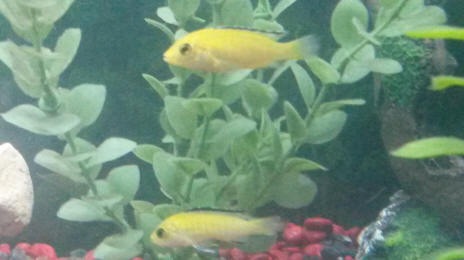
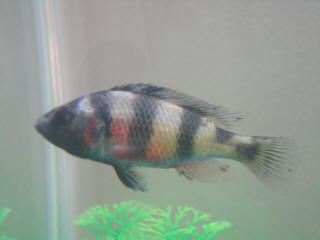
My Electric Yellow is skinny between the fin and tail
1/29/15
Hi,
<Kel>
I recently changed my tank from community fist to Chichlids and last
Saturday I bought a couple baby African chichlids for my tank.
<Cichlids, not the gum sounding name>
The following day I noticed one of my electric yellows was looking
really skinny. Between it's fin and tail it is very skinny.
<I see this in your pic>
Can you please help? I have spoken to the pet shop and they don't know
what is wrong with it. I can not remember it looking funny when I bought
it though I can not see how over night it would end up like this. I have
attached a pic and in the pic you will see both my electric yellows. The
bottom one is the one I am concerned about. I have since separated it
from the tank incase it is bad but it is now only hiding and hardly
eats. I am not sure if it was eating well when I first bought it. What
should I do?
<Not panic... there might be some sort of pathogen, infectious or
parasitic involved here, but more likely than not by far this one fish
is simply "starved". Your good care (feeding and water quality) will see
its rapid improvement. I'd be feeding a high quality small pelleted food
(e.g. Hikari, Spectrum) three, four times per day; making sure the water
is hard, alkaline and not too warm... as gone over and over for
Malawians on WWM>
Cheers,
Kelly
<Welcome. Bob Fenner> |
 |
|
Gill problems /RMF 12/2/14
I noticed that one of my older Neolamprologus multifasciatus was
sort of gasping and looking stressed. I did an extra change to
see if that would help and when it did not I decided to move her to a
clean highly oxygenated hospital tank.
<Good moves>
I gently scooped her up with the net (there is no way she was injured by
this) and when I put her in the new tank she was bent and her gills
seemed to be turning inside out. I have never seen anything like this,
she was fine one second and the next bent and struggling to swim with
her gills exposed. Do you have any idea what may have caused this?
<Can only guess of course... I take it that no other livestock
was/appeared, appears mal-afflicted... Which rules out most all water
quality possibilities. Perhaps this one "ate a bad bug"... that somehow
got into the system (can be opened w/ a sharp single edge razor if
dead); or somehow swallowed gravel? Am referring this email to Neale for
his independent response.
Bob Fenner>
Gill problems /Neale 12/3/14
I noticed that one of my older Neolamprologus multifasciatus was sort of
gasping and looking stressed. I did an extra change to see if that would
help and when it did not I decided to move her to a clean highly
oxygenated hospital tank.
I gently scooped her up with the net (there is no way she was injured by
this) and when I put her in the new tank she was bent and her gills
seemed to be turning inside out. I have never seen anything like this,
she was fine one second and the next bent and struggling to swim with
her gills exposed. Do you have any idea what may have caused this?
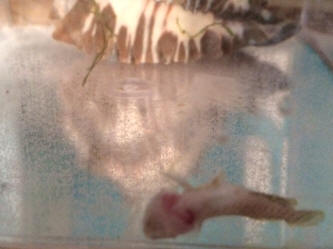
<From what I can see this little chap looks beyond stressed. She looks
like she's on the way out, to be honest, and rather underweight, as if
starving for a while, perhaps from lack of food or else chronic disease
of some sort. But in any case, Neolamprologus, like all Tanganyikans,
react badly to all sorts of environmental stresses. So review the
obvious. Sudden changes (drops) in pH are lethal to them. Ensure the
water has adequate buffering capacity (carbonate hardness) and mineral
content (general hardness). Make sure the pH is solidly stable in the
right range, anything between 7.5 and 8.2 is fine, but the number
shouldn't vary much. Exposure to toxins such as paint fumes,
insecticides, herbicides, etc. can all be extremely lethal to cichlids,
something I learned the hard way when keeping Nanochromis. Review
exposure via sprays in the air and accidental contaminations via
buckets, pipes, etc. Nitrate is the slow killer with cichlids, so keep
below 20 mg/l, through water changes and moderate stocking, but do also
check ammonia and/or nitrite (I favour nitrite as the more reliable of
these two). Velvet is a parasite that often affects the gills before
it's visible on the skin, so that's another consideration.
I've cc'ed our cichlid expert here, Chuck, in case there's something
he'll want to add. Cheers, Neale.>
|
 |
|
Re: Gill problems
12/4/14
Thank you for your help. She was a very small female but other than being
old had no health issues whatsoever until this happened out of no place.
female "Multies" rarely reach over .75-1" and she was ten which put her well
over her expected lifespan.
<Indeed. But keep an eye out for other fish behaving oddly.>
She may have been a bit smaller than normal as she just laid eggs just over
a week ago and didn't eat much when guarding them in her shell. I put her
down shortly after sending the email. It looked as if her gills had swollen
into big red protruding bubbles. And it happened in an instant. So sad as
she has been with me a long time.
<I can well imagine. Neat cichlid to keep, these.>
Thank you so much for your help.
<Welcome. Neale.>
|
|
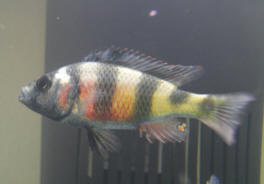
Need help with cichlid 8/15/14
Color Change in Lake Victorian Cichlid
I've aquarium about half year. I like cichlids a lot, I have 5 since I
bought aquarium and I bought additional cichlid 1 months ago, but
he started change color in bright red on the
profile sides. But he eat very well and he's
always very active. I'm so worried about him.. Is that skin
disease and how to treat it? I attached photos. Thanks. I hope
you can help
me.
< Your Zebra Obliquidens from the Lake Victorian basin is a male and the
reddish coloration is normal. No need to treat for anything. Chuck>
|
 |
HELP...fish dead in 3 days... African Cichlids, no data,
rdg. 6/8/14
I keep African cichlids and in the last 3 days i have lost half my tank
stock. When it first started all the water parameters were good but i
did a 50% water change anyway's. Now things seem to be moving even
faster.
please help diagnose my problem.
<Need data... Read here:
http://wetwebmedia.com/AfCichDisDiagF.htm
Bob Fenner>
I don't know if i am signed up with you guys any more but my email works
also. Here are some pics.
<Nothing attached>
My Auratus Cichlid is sick 3/23/14
Hello,
<Sarah>
My female auratus cichlid seems to be struggling to
survive. She is in the tank with a male
auratus who has been harassing her
attempting to mate but she doesn’t seem
interested. She spends all her time getting
away from him and is now completely exhausted. She lays in corners
hiding and only stirs if i walk up to the tank. I’ve noticed over the
past few days that she has stopped eating, and
has stopped pooping, and that area has become swollen
and red.
<These fish need to be separated. Now>
I’m wondering if there's
anything I can do to make her better? There are 3 other cichlids in the
tank and 4 zebra danios. The cichlids eat Omega One Cichlid pellets
and the danios eat flakes. All the levels in
the tank are healthy, I do regular water changes (once a week, about
50%) and it’s a 45 gallon tank. Please
help! And thank you so much for your time!
Sarah
<Let's have you read here:
http://wetwebmedia.com/FWSubWebIndex/afcichdisf8.htm
and the linked files above. Bob Fenner>
Re: My Auratus Cichlid is sick 3/24/14
Thank you so much for responding so quickly! I have temporarily elevated
her in a large net in the same tank so none of the other fish can get at
her, she's resting and in the past couple hours she seems to be feeling
a bit better.
<Good>
I don't have a proper hospital tank and everything is closed for the
evening. what would be the smallest safe size of container I could put
her in until I can get to the store in the morning?
I don't think I can leave her in the net.
<A floating plastic colander... READ where you were referred. B>
Sick Cichlid
Sick Ps. Acei 12/30/13
I have a mature male 5" acei experiencing extreme difficulties. He
was in a 55 gallon tank, with 5 electric yellows, a female Saulosi,
a neon chiwindi peacock, a sunburst peacock, and a Pleco, and a female
mature acei.
I saw this before in a male Saulosi I bought from another enthusiast,
for my female, but he started with the behavior after having him only 2
days.
This was over a year ago, and he was never in the main tank, but
segregated with the female alone in a 30 gallon tank. After he
started to fail I removed the female and returned her to the main tank.
He starting having a slight "S" curve to his body, and swimming
vertically when relaxed. He would swim horizontally when he was
feeding, or actively swimming. No lesions, no marks, no
fuzz, no patches. His tail is changing color now, after a month,
but I think it's because he balances on it quite often.
I removed him from the tank and started searching the web for answers.
Thinking it was swim bladder related, I didn't feed for approx 3 days,
then offered peas, which he wouldn't eat. I haven't provided any
medication.
I've started offering his usual food again, but he will lay at the
bottom of the tank, on his side, until I go in to the room, and when he
sees me he struggles to swim, and will eat, but can't stay coordinated
enough to get much food. He has been out of the community tank for
over a month now, and continues to decline.
I saw this before in a male Saulosi I bought from another enthusiast,
for my female, but he started with the behavior after having him only
about a week. This was over a year ago, and he was never in the
main tank, but segregated with the female alone in a 30 gallon tank.
After he started to fail I removed the female and returned her to the
main tank. After several weeks of no improvement I put him down.
I had done a 50% water change in the main tank on Xmas day, and today
found the female acei dead under a "bridge" and the Saulosi "missing".
Several months ago I lost another mature male acei, with the same
symptoms, but I thought he had been injured in an ornament. Before
whatever it was could progress, he was killed by others in the tank.
I did a 75% water change today in the main tank, but didn't clean the
filter, an HOB, to maintain beneficial bacteria.
Two days ago I went into my local fish store, to ask for help, they had
no suggestions. Believe it or not though, in one of their mixed
tanks they had what appeared to be a acei with the same symptoms, early
onset (S shape, vertical swimming). I tried to explain to the 2nd
guy what was happening, and although he agreed the fish was not acting
normally, he thought it was because others were picking on it. I
strongly disagreed. My fish has been segregated for over a month
and continues to deteriorate. The LFS fish was being harassed
because of the behavior, but barely if at all even at that, from what I
could see.
Help. I'm at a loss. Is there anything I can do to help my
fish, should I put him down? Kathy
< The Ps acei is a schooling fish that feeds on algae that grows on
logs.
Being from Lake Malawi it requires hard alkaline water and water temps
in the mid 70's F. Internal problems usually are the result of a problem
diet.
This fish should be fed a diet high in algae like Spirulina. You
provide no data on how you have been keeping your fish so I can't
comment. Usually fish with internal problems are having problems
digesting proteins or the binders in the fish food. Herbivorous
fish with long intestines sometimes have these food elements getting
stuck in their intestines and the bacteria in the gut start to break
theses blockages down. Hopefully the bacteria can be inhibited and
the blockage can be passed. Medications like Metronidazole and Furanace
are absorbed into the fish and can have some effects on these bacteria.
Unfortunately they can also cause problems with the fish's internal
organs. So I would isolate the fish in a hospital tank and treat with a
combination of Metronidazole and Furan 2. When the fish starts to eat
again then remove the medication from the water with water changes and
carbon. When it is strong enough you can place him back in the tank.
-Chuck>
RE: Sick Cichlid
Sick Ps. Acei II 12/30/13
Thank you, Chuck';
He's been on NLS cichlid food since I got him as a juvenile, probably
close to 3 years now. Our tap water is typically hard, and I've
keep the water around 76. Will algae wafers help, any other food
like the zucchini I feed
the Plecos? I'll get the meds you've suggested and start them right
away.
Thanks! Kathy
< I personally like the NLS fish food and don't think that is the
problem.
The Ps acei is not normally aggressive and may be stressed being a
single acei in a mixed Mbuna tank. besides the meds other things that
will help will be adding some salt to the tank and doing frequent water
changes. Good luck. Chuck>
Red zebra cichlid; usual lack of data
11/15/13
I have a baby red zebra. He is maybe just over 21/2 in long. He has been
fine since I got him a year ago when he was a fry. Never had a problem
besides him always redecorating lol.
He was fine this morning but I noticed him swimming slow and a lil
wobbly
so I put some food in to aw if he ate or not and while he was eating he
did
a complete back flip. He isn't bloated. Or showing any signs externally.
He
just went to the bathroom and it looks normal.
Tank is
Am. 0
Nitrite 0
Nitrate 0 ( just carried out water change today but it never even makes
it
to 20ppm)
<No; as in zip NO3? Unusual>
He has been eating Cyclops, rotifer, Spirulina, zucchini, and an
occasional bloodworm stolen from a Ropefish.
I have removed him from the tank so he isn't caused more stress. But
need
to know where to go from there.
Thank you so much for your help.
<Water quality? Tankmates are fine I take it; what are they? Do review
what is archived on WWM re Mbuna, Malawi cichlid systems. Bob Fenner>
Re: Red zebra cichlid 11/17/13
It was 0 at that point when I tested cu
<.... what was zero? [NO3]? Not with the use of a canister filter... try
another test kit. B>
I had just carried out a large water change few hours before.
The system is a 55 with a canister filter rated for double and an
addition 2 job filters rated for up to 55.
I over filter due to the inhabitants mostly being Geophagus. Other than
that are four Ropefish an one bicher. None of them are aggressive at
all.
The zebra has been getting on great. Before he was in a 20g grow out
tank and when I put him in the 55 he was ecstatic. Swimming back and
forth and shoveling substrate everywhere lol.
I pulled him out and put him in a hospital tank with brand new water and
prime overnight and he seems to be back to normal.
I was doing some reading on your site and was having trouble finding
what I needed. And I just wrote cus I didn't want him to die while I was
researching. I will continue to read on your site. You guys are an
amazing resource. And are greatly appreciated.
|
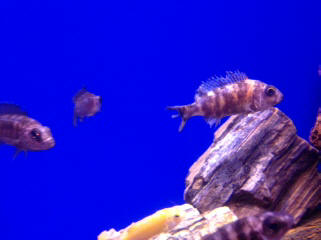
Fin deterioration on African cichlids 10/11/13
First let me thank you in advance for the help.
<Welcome>
I have a 180 gallon African cichlid tank with a wet dry filter.
pH 8.0, NO3 25,
<... I'd be checking this... And is this measure (supposedly) Nitrogen
as nitrate or? I suspect the actual concentration is MUCH higher... I'd
check with another test kit; a good one>
NO2 0, NH4 0. The fins on the fish have been deteriorating over the
last 3 months. Recently, the scales on the head are eroding like HLLE.
<I see this>
The fish are fed 2x a day New Life Spectrum cichlid blend.
<A fave; fab; what I fed my African Cichlids for years; both from Pablo
Tepoot>
I'm beginning to think there is stray voltage in the tank.
<Nah>
For equipment there is an Iwaki 70 external pump, 40w ultraviolet uv,
Hydor power head, and a chiller. I tested the tank with a
multimeter in the past but didn't get a reading with the multimeter.
In retrospect however the chiller may have been off during the test.
Would the chiller be a viable cause?
<Highly unlikely>
How would I go about using a multimeter to test this (I want to be sure I
used it properly the first time around)?
Thanks again,
Justin
<What you have is almost assuredly "classical" metabolite poisoning. I
would either ditch the wet dry entirely or modify it, clean the
mechanical media... Daily... yes; every 24 hours... Do search, read re
trickle/wet-dry technology on WWM. Not appropriate for your setting.
Sorry for my didactic-ness this AM. Am running short... as usual. Please
do write back if you have further questions, need for clarification. Bob
Fenner>
|
 |
|
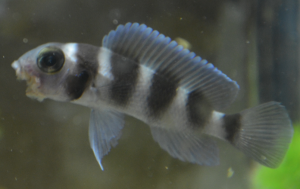
Five Bar Cichlid Missing Bottom Jaw/Fungus Infection (Bob,
another Melafix *fail* for your collection!!!)<<sigh...>>
3/25/13
I have a single juvenile five-bar cichlid (Neolamprologus tretocephalus)
living alone with 2 Synodontis catfish that are around the same size as
him. I believe that mine may have injured his lower law due to his
aggression (he likes to bite at rocks, glass, etc.) At first, it was a
small injury, but due to my neglect at realising the issue's severity,
the injury started growing white fuzzy stuff all over the lower law,
disintegrating it and leaving him barely able to eat. I've been treating
him with strong doses of MelaFix, but the situation has gotten worse and
worse over the last few days. The water temperature is at 78*F, pH is
8-8.2, and nitrite is at 0. After the injury, he has become more and
more withdrawn, hiding in a cave most of the time, but he still appears
physically healthy besides the mouth area. Any help would be more than
welcome, as I just want to know if there is a chance to save him. If
not, should I euthanise him? I would only euthanise him if it was the
last option though, but he is struggling more and more to eat food.
Thank you,
Duncan
<To be honest, yes, I'd euthanise this fish. Without jaws, the fish
cannot feed. Melafix is, at best, a preventative, and shouldn't be used
as a direct treatment for infections once they become visible. Think of
it more like an antiseptic than an antibiotic, something you use on a
kid with a cut, but not someone who has gangrene (which is, effectively,
what Finrot, Fungus and Mouth "Fungus"/Columnaris are). So once you see
an infection, use a true, reliable medication like Maracyn or whatever.
You'll find 30 drops of clove oil in one litre of aquarium water will
create a useful killing bath that sedates the fish quickly, and then
kills the fish within a few minutes (but leave the fish in the bath for
20-30 minutes, since fish death is determined as 10 minutes after the
last gill movements). Cheers, Neale.>
|
 |
|
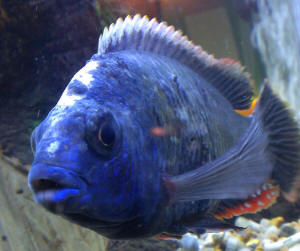
Skin issue with coral twain reef cichlid. Please help!
12/31/12
Hi,
I hope you can help me. I have had this wild caught coral twain reef
<I assume you mean Protomelas sp. 'Steveni Taiwan' , also known as the
Taiwan Reef Cichlid.>
now for a year and he has always seemed healthy and still does besides
this skin issue.
<Yes, I see. Looks like there's some erosion of the skin plus excess
mucous.>
As you can see from the picture, he's got a moldy fuzz appearance on his
eye as well as forehead, bottom fins, and side. It started with just the
discoloration on his side and now has progressed to what you see. The
tank parameters are 0 ammonia, 0 nitrates and nitrates. Ph is 8.0. I do
20 to 30% water changes every 2 to 3 days. I use 1 tablespoon of salt
per gallon,
<Why? You do understand that careless use of salt causes problems for
Malawian cichlids; do read up on Malawi Bloat.>
water conditioner, Malawi buffer,
<Assuming this is Malawi (or Rift Valley) salt mix, then you shouldn't
need to add the tablespoon of salt. If the buffer is simply pH 8 buffer,
then you are creating a problem. The pH of Lake Malawi is around 8,
that's true, but your job is to raise carbonate and general hardness
through the use of an appropriate mineral salt mix; do read here:
http://www.wetwebmedia.com/fwsubwebindex/fwh2oquality.htm
The Rift Valley Salt Mix is cheap and easy to make at home.>
stress zyme
<To the tap water?>
and ammonia neutralizer when needed.
<Ah now, this is worrying me. Are you adding ammonia neutralizer to tap
water? That's fine. But if you have non-zero ammonia levels in the
aquarium and think adding ammonia neutralizer will help, then you have a
problem.
Ammonia in aquaria should ALWAYS be managed through filtration,
typically, biological filtration.>
It wasn't always like this as up until 3 weeks ago, I always had .25
ammonia.
<Then your tank is overstocked, overfed, and/or under-filtered. It's
also why your Protomelas is sick.>
The tank has been setup for 1 year. I have searched everywhere and have
no clue. Anyone I have spoken to has never seen anything like it.
Please respond.
Thanks,
Mark
<Protomelas inhabit extremely clean water. They are sensitive to poor
water quality. They are also rather shy and peaceful, so you MUST NOT
keep them with aggressive fish like Mbuna or they will be stressed. I'd
bet all the money in my pockets that the problem here is environmental:
the tank is too small and/or under-filtered (hence the non-zero ammonia)
and that you've stressed this fish through the wrong water chemistry
(see above) and poor water quality and perhaps the wrong tankmates.
Review, and act accordingly.
As for medication, a combination of Metronidazole and Nitrofurazone
works wonders with cichlids, ideally, used in your quarantine tank
(which I presume you have if you've bought an expensive wild-caught
cichlid like this). Hope this helps, Neale.>
|
Re: Skin issue with coral Taiwan reef cichlid. Please help!
12/31/12
Thanks for the reply. After reading over my question again I realized I put
that I use a tablespoon of salt per gallon. This is incorrect. I use a
tablespoon per 5 gallon. It's regular aquarium salt. Not cichlid salt.
Should I not use it?
<Absolutely not; at least, not by itself. Aquarium salt (also called tonic
salt) is sodium chloride. This is the major salt that makes seawater salty
(there are actually dozens of other salts in seawater, though in smaller
amounts). Rift Valley cichlids are specifically adapted to the minerals of
the lakes; in the case of Lake Malawi, it's calcium salts that are the
majority, not sodium salts like sodium chloride. The real issue is the way
they effect osmoregulation, which is the process whereby the fish get the
right balance of minerals and water inside their cells. The wrong sort of
minerals outside the body, or the wrong amount of minerals, and the fish
either dehydrates or gets continually "flooded" with water (kind of like a
fish drowning, if you can imagine such a thing). If you go back and read the
Practical Approach to Water Chemistry article, you'll see that there's a
"salt mix" that includes baking soda (which is sodium bicarbonate), Epsom
salt (which is magnesium sulphate), and marine aquarium salt mix (which
includes both sodium salts and calcium salts). The amounts you need of each
is very small, teaspoon or tablespoon quantities per 5 gallons. So the mix
costs pennies a month. But the benefits for your Rift Valley cichlids will
be substantial and long-term. Don't change all the water chemistry at once,
but over the next few weeks, as you change out 20-25% of the water, replace
with new water that has this Rift Valley salt mix added. Cheap, easy and
effective -- not often I get to recommend something that's so simple!>
Also, it's a 75 gallon tank filtered by an Eheim pro 350 filter. There's
currently 16 fish in the tank. 2 yellow labs,
<Labidochromis spp. should be okay with Protomelas, but watch them.>
1 short body Flowerhorn, 1 blood parrot,
<Neither of these belong in here; remove them ASAP. Their behaviour is
somewhat milder than the Mbuna, especially the Blood Parrots which can be
easy targets for fin-biters like Pseudotropheus zebra>
3 red zebras,
<Pseudotropheus zebra; potentially extremely aggressive and incompatible
with Protomelas spp.>
1 red empress,
<Protomelas taeniolatus; another peaceful species.>
1venestas,
<Nimbochromis venustus; another peaceful species.>
1 red jewel,
<Hemichromis bimaculatus; doesn't belong here. A West African rainforest
species that does better in soft to medium-harm, around neutral water. Not
especially aggressive outside of breeding.>
1 blue Melanochromis, 1 albino Melanochromis and 1 regular female
Melanochromis,
<Melanochromis males can be psychotic, especially Melanochromis auratus;
Melanochromis johanni is somewhat less aggressive and could cohabit with
Protomelas in a large aquarium.>
1 socolofi,
<Pseudotropheus socolofi; not as psychotically aggressive as Pseudotropheus
zebra or Melanochromis auratus, so potentially viable with Protomelas given
lots and lots of space.>
1 female balloon Flowerhorn,
<See above; simply doesn't belong here.>
1 peacock.
<Aulonocara spp. should not be kept with most Mbuna, especially
Pseudotropheus zebra and Melanochromis auratus. Usually wind up battered or
simply so stressed their lifespan is appreciably shortened.>
The ammonia neutralizer is only put in once a week after a water change
added directly to the tank.
<Why? Do review water quality management, i.e., filtration and stocking, and
thereby ensure ammonia sticks at zero. Do understand "false positives" for
ammonia are possible with certain types of tap water (containing chloramine)
even after treatment. Does tap water register an ammonia level of zero
before and then after adding water conditioner? If there is *no* ammonia
detected in *both* those tests, but you *do* detect ammonia in the aquarium,
then filtration and/or stocking are wrong.>
All fish were added at the same time when they were babies so they have all
grown up together and there is literally almost no aggressiveness besides
for the 2 yellow labs chasing each other.
<Very surprised, to be honest, but every tank is different. That said, your
Protomelas is clearly stressed and that's why it's making extra mucous (the
white stuff) and collecting in "scars" or "pits" on the head (cf.
Hole-in-the-Head and Head-and-Lateral-Line diseases). In any event, your
aquarium sounds overstocked to me, and will be once some of these fish reach
full size -- an adult Flowerhorn needs a 75-gallon tank just for itself.
Hmm… what else… do get and read something on cichlid-keeping by the likes of
Paul Loiselle or Ad Koenig. "The Pocket Professional Guide to Cichlids" by
David Boruchowitz is another good book. If you're on a budget, "Fishkeepers
Guide to African Cichlids" by Paul Loiselle can be bought on Amazon.com for
a measly $0.03 plus shipping; while a bit dated in style and content, it
covers all the basics and Loiselle really knows his stuff. Once you've
decided you want to get serious about cichlids, then find "The Cichlid
Aquarium" by Paul Loiselle; not an easy read and not for beginners, but if
you know fishkeeping moderately well, this is the absolute bible on
cichlid-keeping and cichlid-biology. Out of print for years, but on Amazon
for under $20.>
Thanks
Mark
<Welcome, Neale.>
Re: Skin issue with coral Taiwan reef cichlid. Please help!
12/31/12
My tap water has 0 ammonia,
<Before and after adding your water conditioner of choice?>
as well as the 75 gallon tank. I know the test is correctly measuring
ammonia as I have 5 other tanks and a couple are at .25 at the moment.
<Which implies the livestock are producing ammonia faster than the filter
can process it (i.e., convert it to nitrite and then nitrate). Review
stocking density, filter capacity and feeding regimen, then act accordingly.
One of these factors, perhaps more than one, is wrong.>
I have been using the Aquino ammonia neutralizer in the other tanks to make
the ammonia and nitrates less harmful until it comes down so I guess I just
got in the habit.
<Easily done.>
You are correct, I should not be using it if I don't need to.
<It's harmless in itself. But if you have persistent ammonia in your
aquaria, the problem is with water quality management. So rather than adding
chemicals, establish what the problem is (why there's more ammonia in the
tank than the filter can handle) and adjust the tanks accordingly.>
Now forgive me for questioning you as I know you have many more years of
experience then I do.
<Perhaps.>
But if the setup currently works and everyone is getting along meaning the
5" male and 4" female Flowerhorns and 1 parrot then why remove them.
<Because the Flowerhorns won't be 5 inches for long and the Parrot won't be
small for long either. Flowerhorn Cichlids are hybrids as you probably know,
so their precise adult size can be difficult to predict, but it will be
around the 10-12 inch mark (males tending to be a little bigger than
females). Remember that the overall size of an animal (i.e., its mass)
increases as the cube of any changes in length. So while a 10-inch
Flowerhorn may be only twice as long as a 5-inch specimen, it's mass will be
EIGHT times than of the 5-inch specimen, and therefore it needs EIGHT times
the oxygen and produces EIGHT times the ammonia. Make sense? In any case, a
Flowerhorn singleton needs no less than 75 gallons, and a pair (inasmuch as
pairs exist with these very aggressive fish) will need twice that amount of
water, if not more -- and even then there are no guarantees the male won't
decide to murder the female one day.>
They keep to themselves and don't bother anyone or the Taiwan reef.
<These fish are all still young, by the sounds of it. Hmm… you know the game
of Russian Roulette? Let's say you play it once, and survive. Does that make
it a safe game? Same thing here. Because your young cichlids have so far
gotten along doesn't mean they will do indefinitely, and the odds are NOT in
your favour. You have a poor combination of species that reveals little
understanding of what particular cichlids need, i.e., not enough reading.
Mixing Aulonocara with Mbuna is a classic beginner's mistake. You may have
come across Mary Bailey in your reading on African cichlids. We've got a
trio of her articles here at WWM that you'll find useful:
http://www.wetwebmedia.com/FWsubwebindex/MalawiPeacocksAulonocaraMaryB.htm
http://www.wetwebmedia.com/FWsubwebindex/StkgLkMalawiTksArtBailey.htm
http://www.wetwebmedia.com/FWsubwebindex/DwarfMbunaArtMaryB.htm
Mbuna occupy a very specific niche that makes them both fun to watch and
difficult to mix with other cichlids. You may decide to try out your own
combinations and wait to see what happens. That's fine, but do be aware of
the problems, and when you see signs of stress or damage, be prepared to
make adjustments. Do understand that mixing Aulonocara with Mbuna, for
example, may not result in the immediate death of the Aulonocara, but rather
the Aulonocara tend to live shorter, less happy lives than if they were
properly kept.>
The issue you see on the Taiwan has always been there since I bought him a
year ago, besides for the eye part. You say it's excess mucous but there is
no white color to this. It's the same color as the purple scales. It's bumpy
and mold like looking.
<Yes. Do see previous e-mail with suggestions on medications. But the
immediate problem here is stress of some sort. More the Protomelas species
you have to a suitable "peaceful" Mbuna community and it should recover with
little if any need for medication.>
It looks like fungus but the same color as his body. Thanks again!
Mark
<Welcome. Cheers, Neale.>
|
Poor Electric Yellow Lab Girl 11/9/12
Hi Crew! I have been coming to your website for many years now, and just
love it! Thanks for that and I hope you can help me. I have a 90 gal
Mbuna tank that has mixed cichlids in it. All the popular ones, I guess
you'd say. I have a current resident number of approx 50 of those that I
can see. They're breeding like crazy and I have a "rock cliff" with lots
of cracks and cranny's for babies. But that's a whole other email. I
actually have a more pressing problem. I have a poor Elec Lab and a
Mixed Blue female. I have had them since I got the tank 2 yrs ago.
They're my original inhabitants. The Elec Lab has always been healthy
although timid and the blue mutt did suffer from a bad bout of hole in
the head when she was about 1" big, but was always healthy after, as
well. Both mothers were prolific breeders. Often carrying about 2 or 3
weeks after spitting. I let nature take it's course in my tank.
Basically it's sink or swim in there. I do an 80% water once a week and
make my own rift lake buffer salt. Chemistry is always near perfect. The
situation is both moms are wasting away. My blue's head is half white
and both mom's cheeks are so sunk in. Their bellies are so super skinny.
They are swimming and behaving as they normally would. They eat a little
more then they usually do. But they just aren't recovering at all. My
Lab has been like this for a month and has blood under the skin between
her upper lip and my blue just isn't gaining anything. They both have
always recovered quickly after a brood. Are they just done? Has old age
or breeding stress claimed my poor little girls? Is there anything I can
do at this point? Is there really any point to saving the ole girls?
Thanks for any help you can give me.
Mandy
<Assuming these fish are with males, and that the females don't
outnumber the males by at least 3 to 1, the stress of breeding is very
likely a key factor here. In the wild females wouldn't be carrying eggs
all the time. They'd be able to choose when to breed, so they'd be able
to spend some weeks between broods feeding themselves. Remember, while
carrying eggs they can't eat, so if they're always carrying, they're
never feeding. Isolating the females after breeding is very important,
and while the "sink or swim" makes sense in terms of controlling the
number of fry, it makes no sense at all if the females can't remove
themselves from the males. Your tank is small -- by Mbuna standards --
so the fact females can't avoid the males is likely a major problem. So,
what you want to do is isolate the females, medicate with Metronidazole,
and feed them well for a couple months. The alternative is what you
often see in "generic" Mbuna tanks -- females dying prematurely because
of the stress, so you end up with just males. Cheers, Neale.>
African Cichlid Trouble, Compatibility, And Reading -
10/15/2012
Hi Team,
<Hi, Sandeep! Sabrina with you tonight.>
I went through your website and the faqs. You guys are doing an awesome
job. Thank you guys for being there.
<Thank you so much for these kind and encouraging words.>
I wanted to consult you for this issue. I had 6 Blood parrots in my
previous set up (tank 6X2X2).
<Is this in.... feet? inches? or? If in feet, then that's a
great sized tank.>
They all died due to some issues with their lungs.
<Gills. No lungs in fish, except for very rudimentary lung-like
structures in some few very strange fish (like, as the name implies,
lungfish). The blood parrots, a hybrid of South American cichlids,
have just ordinary gills.>
I had consulted my nearby dealer to check what was happening , and tried
all those things like cleaning the gavel, cleaning the filter and
changing the water.
<This was good advice from the dealer. I only wish they'd
suggested you test your water....>
Then applying ocean free's different kinds of medicines (almost in all
colors).
<Medicating is ALWAYS dangerous, unless you know EXACTLY what you're
treating.... Mixing medications can have disastrous effects, both
on the fish and on the biological filtration of your tank, which then
worsens the water quality, thereby reducing the fishes' chances for
survival and recovery....>
They died after around 3 months one by one. I couldn't eat or work for
days.
<Sorry to hear it, Sandeep.>
Now I have that tank in a new setup, all African cichlids.
<A very vague statement.... Africa, as you know, is an enormous
continent, with many, MANY different fishes from different places with
different needs. Typically, however, when folks say "African
cichlids", they're usually referring to the fish of the great rift lakes
- Malawi and Tanganyika. For the moment, I'll assume that's what
you mean.>
They all seems to be healthy. But they too are dying without any reason.
<By definition, then, I think it's safe to assume that they're actually
not healthy. There is something "wrong" here, either with the fish
or with the water.>
No bacterial or fungal infection that one could see from outside. No
change in behavior. However almost every day the juvenile ones keep
dying and this is something which I would never expect. I have a red
dragon Flowerhorn as well in a 3X1.5X1.5 tank
<I'm still not sure exactly what unit of measurement you're using, but
if this is in feet, then this tank should be considered very small,
especially for a Flowerhorn, and even more so if you're mixing species
of African (rift lake) cichlids. And I do very much hope that the
Flowerhorn is not in the same tank as the African cichlids; please do be
aware that Flowerhorn, a hybrid of South American cichlid species, has
VASTLY different water requirements from those of rift lake cichlids!
Water that would be good for the Flowerhorn would ultimately weaken or
even harm rift lake cichlids, and vice verse.>
he is with me for a month now. He is nearly 2 inches long. But he
wouldn't come out at all. He would always hide behind the filter. He
eats well otherwise.
<Hopefully just acclimating.... However, at his small size, if he
is in with rift lake cichlids, he may just be trying to hide to stay
alive.
Really, these fish can't mix; their water requirements are just far too
different.>
Now I am afraid if it's the same issue that my parrots had is happening
to my African cichlids as well? How do I diagnose the issue, and how do
I fix it?
<Sandeep, your first and most important step is to have a very good
understanding of the "health" of the water in the tank. You will
need to test the water for Ammonia, Nitrite, Nitrate, and pH, at a
minimum.
Ammonia and Nitrite must always be ZERO, and Nitrate as low as possible,
at least below 20ppm. If you do not have test kits for this, see
if your local fish dealer will test them for you. Ask them to tell
or show you the readings; don't settle for an answer like "Your water is
okay" or "pretty good".... you need to know the actual values to
have a clear idea of the quality of your tank's water. As far as
pH goes, most South American cichlids want soft, slightly acidic water,
though many will tolerate a very wide range, as long as the pH is
stable, and the Flowerhorn is no exception to this. The rift lake
cichlids, on the other hand, have VERY specific pH and hardness
requirements, and can suffer if those are not met. I would advise
you to read, on WetWebMedia and other places, about the needs of the
fish you are keeping. As you gain a better understanding of the
animals, where they come from, and what they need, you'll be better
prepared to provide for them - and you'll enjoy them more, too.
They're great fish, and learning about them is almost as much fun as
watching them!>
Please forgive me if my question is not clear , or if you had already
answered these before.
<The only lack of clarity is a lack of detail.... Without
information like the readings for water quality, number of fish in the
tank, how long the tank has been established, etc., there's
unfortunately not a lot that we can tell from a distance. Your
best move is going to be to test your water, have a better understanding
of the needs of your fish, and keep learning and enjoying. Your
fish will thank you for doing a little bit more research. Here are
just a few links to help you get started:
http://wetwebmedia.com/FWSubWebIndex/fwmaintindex.htm (a listing of
articles and FAQs on maintenance, water quality, disease.... Scan
through and see which of these might be most helpful, and start
reading....)
http://wetwebmedia.com/FWSubWebIndex/tangcichsystems.htm
http://wetwebmedia.com/ca/volume_5/volume_5_2/malawian_cichlids.htm
http://wetwebmedia.com/FWSubWebIndex/StkgLkMalawiTksArtBailey.htm
http://wetwebmedia.com/FWSubWebIndex/malawisysf.htm
http://wetwebmedia.com/FWSubWebIndex/tangsysfaqs.htm
Please also note the other links on those pages to other FAQs that may
be of interest, and also be aware that there is TONS of information
available via a simple Google search - not just at WetWebMedia, but all
over the 'net. Rift lake cichlids are a very well-loved and
enormous group of fish that is written about quite often. You
might also enjoy Ad Konings books, which you might find here:
http://www.cichlidpress.com/ . He's a cichlid "hero" of sorts, and
his books are quite nice. I hope these leads will get you started
in the right directions, and I'm sorry I can't give you a short and
simple answer to your problem. The only "real" answer, like so
much in life, is to learn.>
Thanks & Regards
Sandeep MK
My best wishes to you and your fish. -Sabrina>
African Cichlid Trouble, Compatibility, And Reading - II - 10/15/2012
Hi Sabrina,
<Hi again, Sandeep!>
Thanks for the quick reply. Sorry about the confusion.
<No worries.>
1st tank: Malawi and Tanganyika (all measures are in feet). Nearly 20 of
them in it.
<I see.>
2nd one : Flower horn. Alone in the tank. Again the measures are in
feet.
<A good tank for him to start out in. Hopefully he is just
acclimating, but do keep a close eye on him and his behavior.
Water changes won't hurt, either.>
I am located in Bangalore India, and we don't have much options to test
the water (at least not available in common, however will check all the
options available )
<Is it an option (and affordable) to purchase test kits online?
With shipping costs, etc., perhaps this is cost-prohibitive, I don't
know. But if it's possible, it might be worth your while. In
the US, one of the best "easy" (and easily available here) test kits are
those made by API (not the test "strips", the liquid reagent kits).
Let me know if you want/need a link to see what kit(s) I mean. In
any case, if it is not possible to get test kits (or even if it is,
it'll be a while before they get there if you have them shipped), your
only current course of action that is really useful (aside from reading,
of course!) is water changes. Possibly big water changes, too,
since we can't currently know what exactly is "going on" in your tank
water. What you describe sounds more environmental than anything
else, and fixing the environment (with water changes) is perhaps the
best thing to do.>
Thank you for all the links.
I'll read through them and will get back to you if I have more doubts.
<I do hope you'll find helpful information as you read.>
Thanks & Regards
Sandeep MK
<Best wishes always, -Sabrina>
|
African Cichlid Tumor? 10/8/12
Cichlid Tumor Treatment
Hi Crew! I’m hoping you guys can provide some advice or insight regarding a
sick African cichlid- “Bumblebee” (Pseudotropheus crabro) that I have had
for almost 4 years now. He is just over 5 inches in length.
Tank Info- 75-gallon freshwater tank; Marineland Emperor 400 HOB filter; 2
airstones powered by Whisper air pump; Tahitian moon gravel/sand which
replaced pebble gravel over a year ago. AquaSafe water conditioner used
during all water changes.
Tank mates- 1 acei cichlid (approx. 5.5 inches in length) ; 1 electric
yellow (3.5 inches in length); all 3 cichlids bought within 2 weeks of each
other and were at similar sizes at purchase; no other tank mates ever.
Bumblebee has generally been in the middle hierarchy of the tank as the acei
is the most dominant tank inhabitant and the electric yellow as the least
dominant with no major incidents- just the usual territorial/chasing
behaviors exhibited by all 3 over the years. There are also a number of
Anubias plants in this tank that have been in the tank for just over 2
years. The system has been quite stable with no major environmental concerns
outside of a submersible heater that went bad early in 2011 and water temps
dropped for a few days before I noticed.
Water quality is tested at least monthly with 15-25% water changes completed
every 2-3 weeks or more frequently on some occasions. I feed daily Hikari
Cichlid Gold medium floating pellets and Omega One Super Color small sinking
pellets simultaneously to help with aggression during feeding- no changes
over the last couple of years in terms of diet.
In July of 2012 I first noticed 1 then 2 small “pimples” developing on
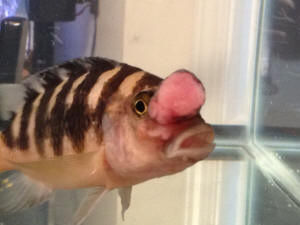
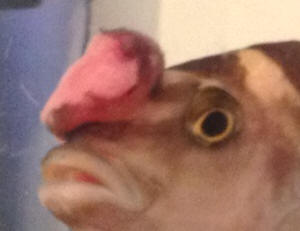
Bumblebee’s nose between the eyes (see first image). No other concerns noted
at that time- no changes in activity; appetite still great, etc.. Water
quality was tested and was in range of the tank norms (pH 7.6; 0 Ammonia; 0
Nitrites; 5-10ppm Nitrates; 81.5 degrees F). I have always added a low
amount of aquarium salt during water changes (1 tbsp per 10 gallons or half
the recommended dose due to the plants in the tank) but I increased the salt
to the recommended 1 tbsp per 5 gallons at that time hoping that the pimples
were just the result of scratching against décor or an aggressive tank mate.
No changes observed whatsoever with tank mates to date.
Over the past month the 2 pimples have begun to grow quite rapidly with no
other changes noticed in activity except that the bumblebee has been the
least dominant tank mate since mid-August. Appetite has been great/no
changes in activity levels.
Last Monday (10/1) Bumblebee began flashing against the tank decorations
rubbing the large tumor-like growth and removing some of his skin showing
the inner pink ulcer/tumor. I immediately removed him to a 20 gallon
hospital tank with that change in his behavior. Water quality in the
75-gallon tank was fine upon testing (pH 8.0; Negative for ammonia and
nitrites; 5-10 ppm nitrates; 82.2 degrees F)
I have treated him for the past week with API’s T.C. Tetracycline powder- 2
packets per day due to 20 gallon quarantine tank with 25% water changes
every 2 days.. I used that treatment for 6 days with no results (see other 2
images attached).
Bumblebee continues to flash against the corners of the tank and has
debrided some of the ulcer/tumor- there are no décor or substrate in the
hospital tank only a heater, airstone, and AquaClear 50 HOB filter.. I
removed the tetracycline and it’s brownish water discoloration by placing
activated carbon in the tank and have done significant water changes to the
hospital tank.
Many of the FAQ’s on WWM that seem similar to my cichlids issues have
suggested the use of Nitrofuranace and Metronidazole. The products in my
area containing those ingredients that I could find this weekend are the API
products “General Cure” and “Super Ick Cure”. I added today to the clean
hospital tank the “General Cure” for a 20 gallon treatment since the active
ingredients are 250 mg Metronidazole and 75 mg Praziquantel per packet.
I am attaching a couple images to clarify what this looks like because this
seems to perhaps be a tumor issue as opposed to a bacterial, fungal, or
parasitic condition.
The ulcer/tumor is quite large now and looks like it might be spreading just
below his right eye and my other concern is that it might be growing inside
of Bumblebee’s mouth and I can see a slight pink growth near the top of the
mouth (but this is difficult as you can imagine to see definitively). There
do not appear to be any changes in his breathing at this time.
Appetite during and since the completed Tetracycline treatment has been very
minimal but that seems to be the norm with antibiotic use as I understand.
I appreciate your input and perhaps someone has had some experience in this
type of concern- if not I will continue to run the current course of
treatment and if unsuccessful I will enjoy the time remaining with Bumblebee
unless it causes him distress as I’m really concerned about what could be
growing inside of his mouth and how that might impact his quality of life.
Sorry for the length here but I wanted to describe everything I could to aid
in your input- to clarify my questions now are as follows..
1. Any thoughts as to the epidemiology of this growth?
< I have had this same situation before and was lucky enough to have a fish
vet friend of mine do a biopsy and take a look under a microscope. It turned
out to be cancerous tumor.>
2. Should I continue the “General Cure” treatment over the next 4-6 days?
< Probably not effective.>
3. Should I simultaneously use the “Super Ick” powder with the “General
Cure” to combine 3.6mg malachite green and 60 mg Nitrofurazone per packet
along with the Metronidazole?
< I would recommend that you surgically remove it. I have done this before
with mixed results. I would place the fish in a wet towel and hold him
still. Take a single edged razor blade and trim the tumor flush with the
contour of the head. be careful to only cut into the tumor and not into the
head tissue. Treat the wound in a hospital tank with a Nitrofuranace type of
antibiotic. It may grow back. Watch for secondary infections.-Chuck>
Thank you so much for your time in this regard!
Mark King
|
 |
|
African cichlid dying... Malawi bloat? Beaten
9/4/12
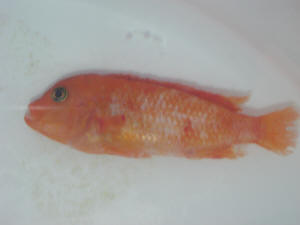
Hello there. I have a red zebra cichlid who is suffering from what I
thought was Malawi bloat
<Mmm, no; don't thinks so>
but I am unsure and now think the treatment may have exacerbated the
problem.
She is a female red zebra in a 55 gallon African Cichlid set up. I have
had her for about two years since she was only about 3/4"! She is now
about three inches long, has made it through two sets of offspring with
the dominating male of the tank, has made it through multiple brutal
attacks by the males in the tank
<Not this one though>
where I thought she would dye <die>
because her fins were all gone.. ultimately, she is generally a very
tough fish!! And my favorite fish in the tank! I currently have 8 fish
in the tank. I want to increase the number to decrease aggression, but
every time I add new fish, they are killed within a couple of days.
<Too late to add more here>
About two weeks ago I added three new fish. Two of the new ones were
attacked to death and killed within the first week. I of course removed
them immediately and followed with water changes. Yesterday morning, my
red zebra wouldn't eat. I was thinking maybe she was holding fry again
but I couldn't see into her mouth and her jaw didn't look extended, so I
just kept an eye on her. By the afternoon her fins were all frayed and
she had some white areas on her body that looked like scales had fallen
off. She was hovering near the top of the tank, stiff looking, and
smaller fish were swimming up to her and nibbling at her. She wasn't
even fighting back or trying to swim away. I removed her, put her into a
5 gallon bucket filled about 2/3 with tank water and 1/3 new water, with
a heater and bubbler. By the evening, the white patches were spreading,
she was laying on her side at the bottom, breathing hard, and her chest
area on her underside looked very swollen. I did some research
and thought her symptoms sounded like Malawi bloat
<... no; this fish was beaten to death. A 55 gallon isn't enough room
for what you have in mind, Mbuna need space, habitat to get away from
each other>>
so I ran out to the store to find some Metronidazole or Clout. Of course
my LFS did not carry anything useful... all I could find was Tetra
Parasite Guard which was the only product containing Metronidazole but
unfortunately it doesn't say what the percentage or mg of the
ingredients are. I put a half tablet into a cup of water, let it
dissolve, and added it in. I also added 1 tsp Epsom salts as I read it
is helpful to clean their bowels if it is truly Malawi bloat.
This morning when I left for work, she seemed okay. She was at least
sitting up right instead of on her side, but the white patches were
spreading more and were kind of slimy looking. By the time I got home
from work this evening, the water was very cloudy, and she has some
areas that almost look like blood blisters on her fins and body. I can
even see some small vessels. She was also floating upside down.
I filled a clean 5 gallon bucket with new water, moved the heater and
bubbler, added some more salts, no antibiotics this time, and once the
water got to temp, moved her over. Within minutes she was back on her
side instead of floating upside down. She looks terrible though.
I'm very upset because she is my favorite fish and I would be sad to see
her pass. At this point I don't know if there is something else I can
try in order to help save her or if it is better to just humanely
euthanize her :(
Any insight would be great
Thanks,
Nicole
<As stated, I don't see much promise here... maybe the removal of this
one fish will "re-set" the social dynamic in this tank, allow all to
live together for a while longer. Bob Fenner>
|
 |
|
Help my cichlids suddenly sick & dying
1/24/12
Hello,
<Pam>
I am hoping that you guys can help me. I have a 125
gallon fresh water Cichlid tank. I have had a cichlid
tank for several years. I have just restocked my tank about 3
months ago because my old fish service killed almost my whole
tank of adult beautiful cichlids by changing my
underground filter
<A poor choice for filtering these systems>
this past spring by sterilizing my tank. It has been recycled
& I have had about 15 small healthy fish for over 4 months.
It is powered by 2 separate Marine land 360 filters,
<Ahh, much better>
3 power heads with an underground filter.
I had 15 small 1.5-3 inch various African cichlids all healthy.
The new fish servicing company who cleans my tank talked me into
buying there 17 much larger (5-6 inch)
<Yikes...>
various cichlids because they wanted to start a salt water tank.
I agreed, since my tank was so big and appeared half empty.
<Mmm, better (by far!) to start all small and have grow up
together... Now you have Mbuna wars!>
This took place about 2 ½ weeks ago, all went well
with the move. His fish were acclimated to my water, I had done a
40% water change about a week before and rearranged the tank the
night before. All the fish appeared healthy for the first week.
Then last week all of a sudden 4 of his fish had white covered
over one of their eyes. I started treating with Melafix
<Worse than worthless. Might have killed off your bio-filter.
See WWM re this product by API>
& added more African cichlid salt as per directions. However
the next day a couple of other fish suddenly developed ulcer
looking sores on their bodies, I have had several other fish die
with white patches on their heads mostly & others have
developed rather extensive ulcers in a matter of 12 hours. When
the other fish were noted with ulcers I started treating with
both Melafix & Pimafix.
<...>
The cloudy eyed fish look a little better, however many of the
fish that look healthy are not eating along with the cloudy eyed
fish. Also 2 of the cloudy eyed fish have developed ulcer looking
lesions on their head by the cloudy eye. Please help me figure
out what is going on, what is it? & how do I treat it?
<Can't tell what it is from the data proffered, hence, no
way to suggest a treatment>
Do I continue Melafix & Pimafix?
<I would never use these period>
My water parameters were good & remain good. Ph 7.5-8.0,
Nitrites negative & Nitrates 10. I have been doing water
changes about every 3 days since the health problem.
<A good reflex defensive mechanism>
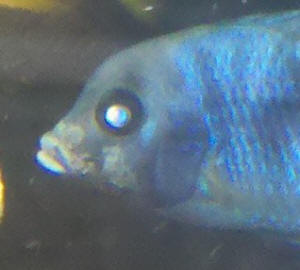
I have also attached pictures to help give you a better picture
of what is going on with my fish.
<... I see the scarring... looks to me to be from
aggression>
Thanks so much. I am anxious to hear your response. I would love
to save my fish & I don't want to add the wrong medicine
& stress them out any further.
Sincerely,
Pam
<There may be a secondary (decomposer) mechanism at play here,
but my best guess is the new, larger fishes are simply killing
each other off principally. Best never to add to established
African Lake Cichlid communities. Bob Fenner>
|
  |
Having babies has
upset my tank and now I have two dead cichlids. Need advice.
Lake Malawi Tank Deaths 1/5/12
I started with 4 different cichlids in a 50 gallon tank. The fish had
been very healthy and survived a move from Kansas to Texas spending a
day in a 10 gallon bucket. My fish included:
Male Metanochromis auratus - Very territorial
Male Pseudotropheus Socolofi - Easy going but gave nothing up to
the
Metanochromis if bothered.
Female Metriaclima Estherae - Was fish who had babies
Female ? Nimbochromis Venustus - Keeps to itself - not aggressive -
Doesn't have a blue face so I think it's a female.
I didn't know anything about cichlids when I bought them for my
son, I just thought they were pretty. I didn't know what I was
getting into. I learned that the fish were very territorial, but they
seemed to divide up the tank and mostly got along. I have had the fish
for well over two years. The issue started after my female Metriaclima
had babies. I didn't realize she was pregnant. She would disappear
for long periods of time and then just show up again. Anyway, babies
showed up in the tank one day. I tried getting the babies into another
tank, but they were so tiny and hiding up inside my rocks and I
couldn't get them out without fear of killing them.
I thought mom must have been defending them because she was suddenly
flailing on the bottom of the tank one day. I got her out and put her
in the other tank but couldn't save her. She looked like she had
been beaten up as her fins were all messed up. To make sure it was not
a tank issue, I did a water change, etc. Nitrate was a bit high but
came down after I did the water change. The rest of the levels looked
fine.
Yesterday I noticed that my male Pseudotropheus was not coming out for
food but eating from the bottom of the tank. He is always building a
nest down under the rock and stays there most of the time, but not
coming out to eat was new. This morning he was at the top of the tank
in a vertical position looking beaten up. I immediately moved him to
the other tank. But I don't think he's going to make it.
I have about 4 babies that have survived and they seem to be growing
and doing well. I'm concerned that I have two dead fish. I assume
my aggressive male is killing off the other fish, but I'm concerned
I'm missing something and maybe something else is going on disease
wise. I'm still going to try and get my babies out and into a
smaller tank, but that leaves me with only two fish left of my original
four. Any suggestions? Am I on the right track or should I be looking
for something else.
Thank you, Christine
< Lower the water temp to the mid to low 70's. Add some dither
fish like giant Danios, or other large schooling fish. This should
lower the aggression levels.-Chuck
my African cichlid has two perfectly round balls on the bottom fin 12/11/11
<Be quiet! If the other cichlids hear about it, they'll want
some too! But seriously, sounds like Lymphocystis. Quite common when
Perciform fish like cichlids aren't kept in perfect conditions.
What's the aquarium like? How big? What's the water chemistry?
How low do you keep nitrate? That's nitrate with an "a"
-- I assume nitrite with an "i" is zero. A photo would help
with the diagnosis. Cheers, Neale.>
<<Egg dummies? RMF>>
Re: my African cichlid has two perfectly round balls on the bottom fin
12/11/11
My filter had went out I bought a new one the fish is in a tank all
alone what medicine should I go buy
<If this is Lymphocystis, there's no cure. It'll go away by
itself in a few weeks or months. Lymphocystis is a viral disease. The
swellings are usually some sort of off-white to cafe-aut-lait colour,
and may have a rough texture. Do look online for photos. Another
possibility is some sort of Finrot, quite common when fins are damaged
and water quality is poor. There are many medications for this; consult
your retailer, but avoid the "preventative" type medications
like Melafix, Pimafix, Stress Coat and so on. You want a reliable
antibiotic or antibacterial. Again, look online for photos of
Finrot.>
Lol u r a trip needed that laugh
Glad I could amuse. Cheers, Neale.>
Re: my African chiclid has two perfectly round balls on the bottom fin
12/12/11
<<Egg dummies? RMF>>
<<<Possibly, Bob, but those should be obvious yellow-white
oval shaped markings on the anal fin, rather than balls. Totally out of
left field, but I did also think about Ophthalmotilapia ventralis, a
species with males that have very weird egg-shaped structures at the
end of their pectoral -- not anal -- fins. Anyone keeping this
expensive, rarely-sold species would know they had one, surely? Cheers,
Neale.>>>
<Ah, one never knows. C and B, B>
Re: my African chiclid has two perfectly round balls on the bottom
fin
It is such a beautiful fish he is blue and black
<Doesn't really narrow things down, I'm afraid. Photo?
Cheers, Neale.>
Re: my African chiclid has two perfectly round balls on the bottom
fin
Yes this fish was expensive ! Money isn't an issue we u by things
you enjoy and yes I knew what kind of fish I bought it is my second one
!
<A photo will help. Meantime, review Lymphocystis, Finrot, egg
dummies on male Pseudotropheus, and what Ophthalmotilapia looks like.
Cheers, Neale.>
Copadichromis azureus with Long Stringy Feces 10/27/11
Hello team!
The background (apologies if it's too much detail): I currently
have 3 tanks, 75 Gallon, 55L Gallon, and 20L Gallon, with Lake Malawi
Cichlids.
My 55L gallon (the only tank with a problem fish) has been cycled for a
couple of months. I perform 2 25%-30% water changes per week. I am
running an AquaClear 70 filter with a filter-max III prefilter (along
with a 36" bubble wand across the back for increased water
movement, aeration, and aesthetics. Water parameters are normally 0
Ammonia, 0 Nitrate, and 0-20 Nitrate (depending on how close it is to
the water change).
I add 1tsp of Instant ocean, 1 tsp of Epsom salt, and 1 tsp of baking
soda to maintain GH and KH and my pH is a steady 8.2. My feeling is
this helps to replicate the conditions in Lake Malawi. I use Prime (2
drops per gallon) as a dechlorinator and to bind with the ammonia
released from the Chloramine in my municipal water. All
additives/conditioners are added to a 5-gallon bucket with tap water
that matches tank water (~80 Fahrenheit) during water changes. Water is
removed from the tank via a gravel siphon with hose and venturi
attachment for the sink.
Food includes: New Life Spectrum Cichlid formula, Hikari sinking
carnivore pellets, Spirulina 20 flakes.
Feeding schedule: 2-3 times a day. Different foods during the day
(perhaps pellets in the morning, flake in the afternoon).
Tank mates: 4 Labidochromis caeruleus (sex unknown), and one Synodontis
eupterus.
Problem fish: 4.5 inch male Copadichromis . He is a very strong blue
and otherwise healthy. He eats well, especially the Spectrum Cichlid
formula, and Hikari sinking carnivore pellets (which is fine as the
flake is mainly for the Yellow Labs). However, I have never seen him
have a "healthy" feces. It is always long and stringy.
When I noticed the issue, it was a white long stringy "poop."
I assumed it was intestinal parasites, so I treated with Jungle (now
Tetra) Tank Buddies.
I treated the whole tank in case this was widespread. I treated twice
in 48 hours with a 25% water change in between (per the directions). I
have not seen any worms protruding from the fish's anus while
inactive. As a side note, the largest male lab seems to have gotten a
bit thinner in the face (but nowhere else), so I think perhaps he had
some sort of irritation to his gills cause by flukes.
I followed up with Jungle Parasite Clear fish food per the
directions.
It's now several weeks later, and he continues to have long stringy
feces; however, they are not white.
I am concerned this is a sign of some sort of health issue, and I would
like to address it before it's too late. He appears otherwise
healthy and active, and I'm looking forward to introducing three
females that are currently under quarantine (will be moving most of the
labs to the 75 gallon at that point). I'm nervous about adding the
females and moving the labs if his health issue is contagious.
I have another Copadichromis (a pet store hybrid) in the 75 Gallon who
has normal feces with the same feeding schedule, so I'm not sure it
is entirely dietary in nature.
Any help or advice would be greatly appreciated. Thanks in advance!
Herb
< Your fish is fine. The water temp is a little high for Lake
Malawi. I would suggest lowering it to 75 F. In the wild this fish is
found in the mid water column feeding on plankton and doesn't get
much algae directly.
The additional fiber of the Spirulina flakes are probably making up a
larger portion of the diet than the sinking
pellets.-Chuck>
|
African Chiclid
Red Spots on African Cichlid 10/24/11
I was wondering if you have any idea what the red spots are on my
cichlid if they are dangerous to it and if so how to cure it.
Thanks Ben
< You have some sort of Lake Malawi cichlid. It is possibly a
cross and the red spots could be normal coloration and not a
disease at all. If he is acting normal without clamped fins or
showing any discomfort then I would just make sure the water is
hard and alkaline, and the nitrates are under 20 ppm. Add a
little rock salt to the water and he should be
fine.-Chuck>
|
|

Re: African Chiclid
Red Spots on African Cichlid II 10/25/11
The spots just appeared a couple of days ago and they look like
they are raised bumps
the only thing is he's not really eating. the ph is
6.0 but it always has been and the nitrates are fine
Thanks Ben
< Raised bumps are not part of this cichlids normal
coloration. The fact that he is not eating and raised bumps means
we might have an internal infection. This fish does better in
hard alkaline water. Long periods in acidic water may have
affected the immune system in your fish. In a hospital tank raise
the pH to at least neutral and treat with a combination of
Metronidazole and Furan-2.-Chuck
|
red sore on head with scrape & a white
dot on left fin of African cichlid
Africa Cichlid Care 10/21/11
Hi...my name is Kim & I have a 21 month old African Cichlid that
has been staying at the top of his 10 gallon tank for the past 2 days
or so. Today I noticed he has a red sore on left side of face &
what looks like a circle, as if a scab would have fell off. Also, a
white dot on the left fin & redness under same fin. Did notice a
red line on top of body, on both sides. His mouth looks bigger to me,
noticed him gasping once & last night, as I turned out the lights,
I heard a big splash! I just did a 25 percent water change. Prior to
this, the pH was 6.2 (which has been for a long time & he has been
fine), the nitrite was 0, alkalinity was 0, hardness was 75 & the
nitrate was 20-40 ( yesterday it was 20). My test kit does not include
ammonia. He is usually in his cave, (which, I'm hoping, he may have
just rubbed his face because he is getting big), or he is usually
picking up the gravel & moving it around, his name is Hades.
Yesterday I had added a bit of distilled water, since it was getting
low & I have been sick, so I am about a week late doing the monthly
cleaning & 50 percent water change. I also just added the 5 ml
amount of Stress Zyme+ & a teaspoon of AquaSafe, which are the only
chemicals I ever use. I feed him flakes every other day, but got
confused & may have fed him a small amount 2 days in a row,
didn't feed yesterday, fed today but he didn't eat. He is my
only fish & part of my little family. Can you please help? I
can't even eat or sleep. He has had me scared in the passed &
always pulled through. I always have used distilled tap water, but if I
have to clean tank & do another water change tomorrow, is it
alright to use the water you buy in the stores? Thank You!
Kim & Hades
< There are a couple thousand species of cichlids from Africa so
African Cichlid can mean many different kinds of cichlids with
different requirements. I assume you are referring to a rift lake
cichlid. Cichlids from Lake Malawi and Lake Tanganyika require hard
alkaline water. They are pretty tough and can probably handle your
distilled water treatment but would do better with water that is more
like the waters they come from. If your tap water is in the alkaline
range then start by doing water changes with treated tap water. This
should bring the pH up into the alkaline range. Add a teaspoon of rock
salt to the tank too. This will increase the body slime and help fight
off the bacterial infections you are seeing. If no improvement is seen
in a week then treat with an antibiotic like Furan-2 or
Myacin.-Chuck>
Mysterious Deaths. 9/24/11
Hello,
<Hello,>
A few months ago I decided to turn my 100gal community tank into an
African Cichlid tank. I was very excited and started
with about 10 small
<'¦baby'¦>
1"-2" Assorted Africans
<A very bad way to start. Did you have a plan? Lots of Rift Valley
cichlids won't cohabit for long. Peacock Cichlids for example
shouldn't be kept with Mbuna, and not all Mbuna get along with each
other, some being notably more aggressive than others. Throwing
together a bunch of cichlids will simply result in successive deaths
through stress and fighting until the bullies, usually Zebra Cichlids
and Melanochromis auratus, end up ruling the tank.>
a 6" Pleco
<Doesn't belong.>
and a 4" Featherfin Catfish.
<Will be damaged and likely prone to diseases and stress. Synodontis
euptera is an African catfish, yes, but from soft water rivers not the
Rift Valley lakes. Africa is a big place, bigger than, for example,
North America, and yet you wouldn't dream of assuming a fish from
California would want the same conditions as a fish from Alaska. The
same here. The bland name "African cichlid" is as meaningless
as saying "American fishes" because it simply doesn't
reflect the sheer diversity of species in the continent. There are
African cichlids from rainforests, from swamps, from estuaries, and
yes, from a variety of lakes, some of which are hard water lakes but
certainly not all of them. Do, please, research your fish
first.>
Everything was fine for about 2 weeks and then a cichlid died and it
was all down hill.
<Not surprised.>
I lost a fish a day until I had no cichlids left. My PH is at 8.4
Ammonia is 0 Nitrates and Nitrites are 0 Temperature is about 79
degrees. The fish (who had very hardy appetites) one by one stopped
eating, then would hide and stay very close to the bottom of the tank,
didn't swim around much and their gills would go crazy like they
weren't able to breath.
<Poor water circulation, lack of water chemistry control, social
behaviour issues'¦ all sound possible. You haven't
mentioned water chemistry yet, just pH. How hard is your water? How are
you buffering the pH? What's the carbonate hardness?>
There were no other physical signs of being sick, and I did treat with
Clout before I lost the last 3 and it was ineffective.
<Randomly adding medications prior to diagnosis almost never
works.>
After that experience I moved my Pleco and Catfish to a Q-tank and
observed them for any signs of illness for one month (they are
perfect). I cleared out my 100gal and completely started over. My water
quality is exactly the same as before. This time I started with 4 Acei
cichlids 3",
<Pseudotropheus acei, a fairly mellow species.>
one week later I added 2 Electric yellows 3",
<Labidochromis caeruleus, another mellow if nippy species; should
work with Pseudotropheus acei just fine.>
and one week later added 2 orange blotch peacocks 4".
<A hybrid between Aulonocara species and a Pseudotropheus species.
Not highly regarded by advanced hobbyists because it's a hybrid
more than anything else. Isn't a bad fish though, and most
specimens are fairly easy-going. Does need a rather different diet to
Mbuna though, and combining the two types of fish, Mbuna and Peacocks,
in one tank means neither is going to get the "right" diet
all the time, so you have to be extremely careful what you feed
them.>
They had lived in harmony for exactly one week then I noticed 2 of my
Acei's exhibiting the same behavior as the previous batch of
assorted cichlids. (Bottom of the tank, not active, breathing heavy,
not eating) and the next day both were dead.
<Sounds like lack of oxygen and/or unstable pH. The dismal quality
of "Mixed African Cichlids" in North American pet shops
especially makes life even more difficult, so mail-ordering in the US
has much to recommend it. In other parts of the world the selection of
Rift Valley cichlids is often rather better, e.g., in England, where
you should be able to get wild-caught or at least good quality farmed
specimens that are genetically purer and much more robust. City
aquarium clubs can be another good source; the US in particular enjoys
large numbers of fish clubs and these promote cichlid breeding among
their other fine attributes.>
I'm not sure what I'm doing wrong. I have owned fish for a few
years now and I work at a local fish store, its extremely frustrating
not knowing what's happening in my own tank! please let me know
what you think!
<Do start by reading:
http://www.wetwebmedia.com/FWsubwebindex/StkgLkMalawiTksArtBailey.htm
http://www.wetwebmedia.com/FWsubwebindex/MalawiPeacocksAulonocaraMaryB.htm
http://www.wetwebmedia.com/fwsubwebindex/DwarfMbunaArtMaryB.htm
http://www.wetwebmedia.com/ca/volume_5/volume_5_2/malawian_cichlids.htm
http://www.wetwebmedia.com/fwsubwebindex/fwh2oquality.htm
Hope this helps. Cheers, Neale.>
Dying Tropheus duboisi
6/30/11
Greetings Crew! I write in at a loss as to what is killing to my
Tropheus Duboisi. I currently have 6 (down from 8) young adults ranging
from 3 to 3 1/2" in a 55 gal tank with lace rock and a 3 in DSB
for just about a year.
Last Thursday I noticed that one had died (without my permission). So
after a minor panic attack I tested the water and did a 15% water
change. The only variance from my normal water readings was the
nitrates (1ppm) were a little higher then usual which come to find out
that my Pleco was not eating the algae tabs so they were rotting on the
bottom. After removing the Pleco and changing the water and sucking up
the leftovers I figured that I had the issue solved till another one
died on Saturday. As of Monday they weren't eating so I tested the
water again and found the nitrates were .5 ppm, 0 nitrites and
chlorine, KH 150, pH 7.5. So not sure what else to do I removed all the
rock and did a thorough cleaning and changed 50% of the water. As of
this morning only 3 will eat, 2 have no interest in food and one is way
pale sitting on the bottom looking like its about to expire (again with
out my permission). I have 8 other tanks ranging from 10 to 125 gal all
running with various Rift Valley Cichlids that are eating and not
dying. The only thing I have done to the tank is add another basket of
crushed coral to the Emperor 400 filter I have on it to raise the pH up
a bit but I did that several weeks ago. As far as fish food I use Omega
One algae flakes and kelp flakes. Kind of at a loss as to what I should
do?
When I took the dead ones out they weren't bloated or chewed up,
with out being a vet I didn't see anything abnormal. Would having
that uneaten food in there cause that much of a disturbance that they
would stop eating altogether? Should I just keep doing 10-15% waters
changes every couple days? What would prevent them from eating or at
least trying to eat beside swim and breed its all they have to think
about. if only our life was that easy :)Thanks Paul
< There should never be left over food in a Tropheus tank. Feed only
enough food so that all of it is gone in 5 minutes. Let some algae grow
on the rocks. Tropheus have very long digestive tracts. It is easy for
a problem to develop in such a long gut. Everything else looks fine.
The rest of the Tropheus could be treated with Metronidazole and
Nitrofuranace. Once they start to eat again you are
fine.-Chuck>
bald patches, but not sores... 5/16/11
Hi!
Love the site, I browse it every time I have a question.
<Ah good>
On my issue though, after a few minutes of searching I didn't find
anything matching my fishes symptoms.
I have a female turquoise peacock cichlid (she is in a
6' 120 gal Malawi all peacock/hap tank). She was bought as a male
for an all male tank, but turned out to be female.
<I have kept, and currently have Aulonocaras as well>
I realise she is likely stressed as one of two females in an all male
tank (I've tried to rehome them without success) but I don't
think that is the cause of her symptoms as the other female looks
fine.
She has bare patches of skin on her body, where it looks like she has
rubbed her scales off. She doesn't flash any more than any of the
other fish, so I don't think its caused by excessive flashing. The
patches are not red, bounded by red, or rubbed raw thru to tissue. She
is skinny, but not so's anyone not "fishy" would
notice.
<Mmm>
She eats well and swims fine. She's not as active as the others,
but I figure it's because she needs to hide a bit for a break from
her tank mates.
<The third "strike"... some one/s is/are bothering this
fish here. That its missing scales, is skinny, and "needs to
hide" calls for re-moving this fish to elsewhere>
I've had her for over a year now and after a few parasite
treatments in the beginning I kinda gave up on it, thinking it was just
some weird thing she did at night. However, a year later, I have
another fish who is skinny, though again, not so much that anyone but an
aquarist would notice. No bare patches though. I have noticed a bit of
flashing, and one or two instances of head shaking over a few weeks
time. This causes me to rethink the worms/parasites issue,
unsuccessfully treated previously. I also read that it might be fish
tuberculosis. I see now I should have pursued it further back then.
Your thoughts please? It's so hard to diagnose fish. Also, whatever
she has, being in the tank a year leads me to believe that, even though
they show no symptoms, the other fish all have to be infected as
well?
pat...
<Pat, what you so well describe is very common in keeping these
types of fishes... the "odd fish out" trends to poor
condition, behavior and ultimately perishes. This is NOT an infection,
nor pathogenic at all, but a social phenomenon... The only real
solution is to move such "Beta" fishes, keep them apart from
the "Alpha" ones. Bob Fenner>
Re: bald patches, but not sores... 5/16/2011
Thanks very much for your reply, Bob - its a relief that its not
parasitic/infectious and endangering the whole tank.
I will keep on trying to rehome her, and in the meantime, pick up a
smaller tank that I can relocate her to.
<Yes>
WEBSITE PROBLEM: Not sure if you know or not, but when I visited your
site today, it was reported as an "attack page" and its very
difficult to use it, and I'm sure newcomers would simply quit.
<Yes, thank you... we are "working on this"
feverishly.>
<<Is one of the rotating banner ads... we're trying to
isolate/determine which...>>
thanks again
pat...
<Cheers, BobF>
Salt Treated Tank 5/6/11
Good Morning Crew,
<Paul>
I am happy to say this is the first time I have had to write in
regarding poor fish keeping on my part. I recently set up a new 55 gal
tank in my basement and much to my surprise during the spring thaw we
had all sorts of water problems coming up through the floor and walls
in my basement.
<No fun for sure>
During my panic to try to save the rest of my tank stands I neglected
the new tank because it was not in dangers way, which is no excuse but
it happens. After the danger was over and started the clean up I
realized that the heater and filter had not been plugged in for a
couple days and the 2 out of the 3 Aulonocara Lwanda
that are in there had what looked like a white fuzz on them. So I did a
40% water change and added some aquarium salt (1 tablespoon per 10
gallons) and turned the heat up to 80 degrees.
Left it run for 3 days and did another 40% water change and treated
with salt again. The fungus its gone but one of them has a bad cloudy
spot on his eye which I doubt will ever go way but I am hopeful.
<Will likely go away in a few weeks time>
This weekend I will be doing my regular maintenance without adding the
salt.
<Mmm, rather than "Aquarium Salt", see Neale's formula
here for these Great African Lakes fish:
http://wetwebmedia.com/FWSubWebIndex/RiftVlySaltMixF.htm
I am getting a breeding set of 3 4"-5" Mpimbwe Frontosa
<Need more room than this...>
pretty soon and I would like to put them in this tank. How soon should
I wait before I can move these fish around?
<A few weeks>
And when/if I do move them should I do almost a complete water change
or will the salt have no lasting effects in the tank?
<I'd change the "saltiness" out over time... no more
than 50% changes in a week>
Paul
<Bob Fenner>
Re: Salt Treated Tank 5/6/11
Bob,
<Pablo>
Thanks for the fast reply! I should of looked into what the salt was
going to do to the water but I needed to treat these fish with
something other then harsh chemicals.
<Mmm, well, actually, combinations of metals and non-metals (salts)
can be very harsh indeed>
Thank you for pointing that out to me. I know that the Frontosas should
be in a bigger tank but I have 4 Synodontis multipunctatus in my 125
gal that from what I have read can interrupt cichlid breeding and I
have high hopes to get them to spawn.
<Perhaps another system? You don't need that sofa! Cut that bed
in half length-wise! Shower in the sink and fill up the tub! Cheers,
BobF>
Re: Salt Treated Tank, African Cichlid Repro./Breeding
5/6/11
Bob,
<Paolo>
Believe it or not I have had this discussion with my wife and she feels
that the tub should be off limits. No sense of imagination I say.
<Heeee!>
Should of seen the look on her face when I first said that a 55 gal was
too small. I might have to put my Aulonocaras in the 55 with the
Synodontis.
<A better use of space; yes>
They take to<o> long to grow
<Lots (daily) water changes and frequent (several times daily) small
feedings...>
and color from fry and I'm running out of floor space for grow-out
tanks.
On a different note I have a 72 gal bow front tank that currently holds
12 Tropheus Ndole Bay that I am trying to get to breed, so far they
haven't spawned yet (not for lack of trying on the males part). Is
it safe to let these release them on their own in the tank?
<I would not... IF you're desire is to optimize/maximize
"output" you'll need a separate grow out system>
There is to much rock work in there to try and catch the holding
females for me to even think about trying as well as the stress it
causes on the whole system.
<Mmm, well...>
I also have a 90 gal tank that holds 12 juvenile Tropheus Ikolas, 12
Eretmodus cyanostictus and 4 Cyprichromis Leptosoma with a gravel
substrate. I would dearly like the Eretmodus to spawn but I am afraid
that there is <number> to <again> many other fish<es>
in the tank as well as the wrong kind of substrate (sand I read is
preferred). What do you think the odds of successfully spawning and the
survival rate of the fry would be?
<With a bit in the way of provided habitat: http://www.cichlidae.com/article.php?id=222
easily enough>
Thank you
Paul
<Velkommen, B>
|
Is my Melanochromis sick? Reading 4/27/11
I bought "pretty" a month ago or so. We did our water
change and now she continues to be a top swimmer by the filter
area. Why is this?
<Mmm, most likely trying to avoid some "alpha"
organism>
She never swam or stayed at the top of the water, she was always
a bottom swimmer or hiding out in a cave. She was rubbing herself
on the rocks then the other fish started to do that too.
<Could be indicative of a parasitic situation, or nothing. I
take it you didn't quarantine your new/incoming
livestock>
We did a 50% water change and added chemicals to the water for
Ick and all of that. She is acting weird to me. Any
suggestions?
Thank you
Kathleen
<To read, more in hopes of discovering what might be wrong
here environmentally and give you insight as to the data
we're looking for, as you don't mention water tests, the
set up, foods/feeding, tankmates...
Start here: http://wetwebmedia.com/FWSubWebIndex/afcichdisfaq5.htm
and the linked files above. Bob Fenner>
Re: Is my Melanochromis sick? 4/27/11
Thank you so much, Bob. Sorry for not including all the details.
I'm at work and only had a quick minute to type that up.
I really appreciate you and your forum.
Right, we started w/ a few fish now we are up to like 15
in our 60 gallon tank.
<Fifteen... of what?>
Didn't quarantine all the other fish when we added the new
ones one by one.
Thanks to your site though, I have been reading a lot about
things and other folks questions/answers and so on. I now know
much more thanks to your site!! Yes, I need to get a kit to test
the water. I was thinking maybe the ph is not hard enough
still.
<pH, perhaps not high enough, along w/ hardness>
The other fish are no longer "scratching" since we did
the water change and treated the water for Ick and chlorine.
<... w/ what?>
It's just weird since she is always hanging out now by the
two filters/pumps that are hanging in the back of the tank. Never
did that before and was never scared of anyone either. She would
chase some of the other fish at times and so on.
<Keep reading. B>
Re: Is my Melanochromis sick? - Fish details and pics for
u
<Have deleted your pix... we ask that such be limited to
hundreds of Kbytes...>
Okay on lunch break. Here is a list of my fish. See photo's
too. Maybe to help me figure out what some of them are?
<This mix is incompatible and way too much for the 60 gal.s of
volume>
We have all African Cichlid's with the exception of 2. We
have 1 South American Convict and 1 Tropical Tin foil barb
2 Electric Yellows
2 Metriaclima Estherae (Red Zebra) - orange fish
1 Melanochromis Chipokee - the one I think may be sick
1 Convict Cichlid - stays to itself
1 Genus Henucgrinus
1 Tin Foil Barb (Orange fin) - the cichlids try
to eat him sometimes and have taken bites out of his scales so
that is why he looks like that. :(
1 Tiger Oscar
1 Mbuna - (blue fish)
1 Metriaclima Callainos?? Or is this the Petrotilapia, or the
Pseudotropheus/Metriadima? - the purple dolphin looking one &
the caramel one
1 Bumblebee
1 Albino Pink -don't know real name light pink with red eyes
and gold around it. Looks like the Red Zebra but Albino pink
1 Turquoise one that's like the Genus Henucgrinus but not
spotted, bright though. Not in the pics it was hiding
1 Algae Eater - the Cichlids ate its eyes off but still
living.
Treated the water with a bottle of Ick treatment and water
conditioner. The Ick is called Quick Cure
<... Formalin... too toxic... may well have "killed
off" your bio-filter bacteria. See WWM re this as
well>
fast relief for Ick and protozoan parasites by Aquarium Products,
the other water conditioner is called Aqua Safe by tetra Aqua. I
have used them before never any problems. Due to the scratching I
treated the water. We never seen any white spots at all on any of
the fish. I just panicked.
Thanks, Bob
<Read>
Re: Is my Melanochromis sick? - Fish details and pics for
u
So no luck on the determination of what fish I have? Did u see
the pics?
Did I get most of the right? - Oh I see you only can have a few.
I have reattached 1 photo only.
And you state that this mix is incompatible?
<See WWM re each species>
Why is that cuz of the Convict in there? Or other reasons? And
you are saying that we need at least 130gallon maybe for the
amount of fish in there as they will outgrow the tank persay?
<per se>
And what does this mean? <... Formalin... too toxic... may
well have "killed off" your bio-filter bacteria.
<See WWM re>
Is that why the fish tank already smells even though we just
changed the filters And changed out the water by 50%?
Where is this that u are asking me to go to? See WWM re this as
well.
|
|
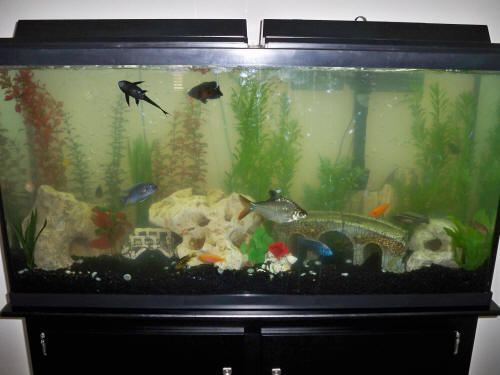
Cloudy mess... trouble ahead
|
Re: Food? 4/27/11
And due to our mix, what should we feed them? We give them Cichlid
Gold, B. Shrimp and Cichlid pellets. All of them eat all of this
and I do not see bloat at this time.
Thx,
Kathleen
Re: Is my Melanochromis sick? -Apologies
4/27/11
And, I just wanted to say, Sorry, Bob. I just now went to the home
page and actually read the tips on asking the questions and things
you guys ask for BEFORE sending in questions. I will make sure I do
that going forward.
<Thanks>
I just got so caught up on wanting to know all the answers from the
pro's I didn't think. Plus, being at work makes this kind
of hard. I will do this after work from now on as well.
Sincerely,
Kathleen |
Cichlids Dying Rapidly-- 03/20/11
Cichlid Tank Die Off
Hello. I have a 90gallon cichlid tank. I am running 2 Fluval filters a
405 and 305. I have sand from home depot and about 70 lbs of live rock
and couple lbs of other rock. I also have a Rena air 400 for air
supply. my pH is around 7.8. Nitrates are higher around 60-80ish,
nitrite is 0 and ammonia is 0. I have 25 African cichlids currently
from yellow labs, peacocks, scats and few others. I have never had and
problem with fish dying until the last few weeks. I purchased a 4 yr
old Calvus from a friend and seemed fine. The next morning I woke up
and found 3 fish dead.
I immediately brought him back because I figured he killed them. They
had no bite marks on them or anything noticeably wrong. Over the next
couple of day I lost another 5 cichlids all were fine the day before
and found dead with nothing wrong with them. It has been 2 weeks now
since anything else has happened.
What could of caused the death of 8 fish in little over a week? Could
the calvus had brought some sort of parasites to the tank? I keep the
salinity around 1.008ish brackish. I lowered it a little thinking maybe
the salt was burning their gills please help. Thanks Adam.
< Nitrates become a problem at anything over 20 ppm. Nitrates are
less toxic but they are still very harmful to your fish at these very
high levels. As your fish died the levels of ammonia and nitrites
continued to rise and added to the problem. The new fish could not
handle the nitrate level and died pretty quickly. The salt was not
helpful, in fact probably inhibited the FW bacteria needed to convert
the ammonia and nitrites to nitrates.-Chuck>
Re: Cichlids Dying Rapidly
Cichlids Quickly Die 3/21/11
I was able to scoop the dead fish out right away and my ammonia levels
and nitrites never changed from 0. None of the fish that died were new
either the tank has been set up for little over a year now. So does
more salt make the nitrates higher? I am unclear about the last
sentence sorry. Thanks for the fast response
< The high nitrates are the major cause of the tank crashing. The
new fish could not tolerate the excessive nitrate levels and quickly
died. When they died the ammonia levels had the potential to spike.
This only adds to the stress. The rift lakes are not brackish. They are
hard and alkaline. Salt increases the slime coat over the skin and
gills. This may have made your cichlids more tolerant of the high
nitrate levels. salt does not increase the nitrate levels.
-Chuck.>
Re: Cichlids Dying Rapidly
Cichlids Dying Rapidly III 3/22/11
There were NO new fish added that died. And I am unsure how long the
nitrites had been high for because I had never tested them. They are
still high. There are still 25 cichlids and there have been no problems
for about 2 weeks. I don't believe nitrates had anything to do with
this because they are still high and always have been. Most people are.
The ammonia and nitrites never changed.
Adam
< There are two different scenarios, sick fish or sick tank. When a
fish is sick the pathogen usually only affects old or weak fish that
become vulnerable to disease due to stress. A sick tank, one that water
conditions are not favorable to keeping aquatic organisms in an optimum
level is a sick tank that stress fish. When fish are stressed then they
are vulnerable to organisms detrimental to their overall health.
Nitrates in the 60 to 80 ppm is a problem. It may not have been a
problem in the past but it is one now. Losing 8 fish in a week would be
very rare due to a single disease. It is a sign that something is wrong
with the tank. You may live in an area with high nitrates in the tap
water due to living in an agricultural area where fertilizers have
leached into the groundwater. Check the nitrates of your tapwater. If
they are less than 60-80 then start to change the water to bring the
nitrates down. You asked the question and this is the best answer based
on the information you have provided. I would like to recommend the
book "Enjoying Cichlids" by Ad Konings. this book will help
you with all aspects of cichlid keeping.-Chuck>
Re: Cichlids Dying Rapidly
Cichlids Dying Rapidly IV 3/24/11
So the calvus may have contributed to the start of the overall health
problems is that what you are saying?
< The nitrates were already very high. The additional fish elevated
ammonia, nitrites and nitrates to the aquarium water. When you added
the new fish it just added to the problem and the levels just reached a
toxic level with the addition of the new fish sooner than if you had
not added the new fish.>
He bothered no one and he was gone after the 1st day because I thought
he killed 2 fish but 6 more died after he was gone.
< Big calvus can be killers if they are breeding and defending a
female in a shell or protective cave. If the calvus was a killer you
would have seen very obvious aggression towards the other fish.>
Nitrates out of my tap are 0 tested them and it is also the law you can
get sick from nitrates if you are to constantly drink water that has
them.
< There are limits to how high the nitrates can be in domestic
drinking water. >
I have done several changes and nitrates have not changed.
< Your tap water is zero and the aquarium water is in the 60-80 ppm
range of nitrates. A 50% water change should have cut then in half just
by a matter of dilution. Something in the tank is contributing to the
excessive nitrates. This week clean the filters and change 1/3 of the
water. Next week vacuum the gravel and change another 1/3 of the water.
Dead fish, uneaten food and decomposing plant matter can increase
nitrogenous waste.
Also feed the fish once a day and only enough food so that all of it is
eaten in 5 minutes. Over a couple of weeks you should see a decrease in
the nitrates.-Chuck>
African Cichlid injury
Lake Malawi Cichlid Injuries 12/14/10
Hello! I have read through as many of these as I can and I think a few
seem have come close to answering my question, but I want to make sure
so that I do not mistakenly neglect any needs of my fish that may
jeopardize it's health. I have an electric yellow male African
cichlid and a smaller brown cichlid. They were once in separate tanks
because they are both highly aggressive, although the larger yellow
fish is much more so. The second tank was damaged in a move and they
are now in a 20 gallon partitioned tank
together until the new 50 gallon tank arrives. Now that they are in the
same tank, they both have been healthy despite their cramped living
conditions. Last week I came home to find the brown fish some how
escaped and was on the side of the yellow fish. They were not bothering
each other, but the startling thing was that the yellow fish was laying
on the bottom of the tank in the rocks gasping. It stopped gasping once
I moved the other fish back to it's side, but it remained laying on
the bottom of the tank for four days with little to no movement. I was
certain it would not make it. Then today, it began swimming again and
it is clear it has quite a bit of fin damage. It appears that the brown
fish must have been nipping at the yellow fish, although I did not see
that happen. One other post I read suggested that neurological damage
can occur when a fish runs into the side and it may take several days
to recover. I cannot be certain this is what happened, but now that the
yellow fish is back to swimming, I wanted to know if there are any
specific measures I should take to ensure its recovery? Thanks!
Sincerely, Tamara
< I suspect that something startled the tank and both fish responded
by attempting to jump out. One made it to the other side and the other
probably hit its head on the top of the tank and suffered some trauma.
Look for signs of fungus on any damaged areas. Keep the water clean.
Treat with Furan-2 or Erythromycin if any fungus starts to
appear.-Chuck>
Fish out of water 9/13/10
Hi! I have a 3-inch African cichlid in a 10 gallon
tank.
<Overstocked, I'm sure. What sort of cichlid are we talking
about? Hard to imagine any three-inch Mbuna doing well in 10 gallons.
Of course not all African cichlids are Mbuna, but for some reason a lot
of people equate them.>
I was cleaning his tank last night and he was in a bowl while I was
cleaning. After the tank was clean, I left him in the bowl with a towel
over it for a couple of hours so the water would have a chance to get
to room temperature. I left him alone for those 2 hours so I could go
to the store and he was on the floor when I came back. (He jumped from
the bowl onto my desk, then onto the floor). He was still breathing,
but there was no water around the bowl, so he must have been there for
a while. I picked him up with the net and put him in the tank and he
swam around a little bit, but he's been laying on the bottom of the
tank, still breathing. It's been about 14 hours since I found him
and I've tried to leave him alone and not stress him out.
<By now, I'm guessing he'll be fine.>
I do check on him every hour or so, except when I was sleeping. He
hasn't had much food (I was gone on Saturday and couldn't feed
him till yesterday and I only gave him one meal) and he can't make
it up to the top of the tank to get his food. I'm not sure how to
feed him or what I can do to make him better. Please help!
<There's not much you can do either way beyond watch. The use of
a slime coat supplement like Stress Coat would be a plus, but otherwise
just wait and see. If you see signs of infection, you may need to treat
against Finrot, but I wouldn't do that pre-emptively, wait until
there's reason to do so. As always, make sure water quality is good
and that the temperature is right for the species concerned. Obviously
water chemistry should be optimised, but don't make any sudden
changes because this fish is already stressed, and even
"improving" things could make him even more stressed.
Cheers, Neale.>
|
My African Cichlid, lack of data,
reading 9/11/10
Please help. My African Cichlid is acting funny. I am not sure
what kind of cichlid it is. But, today I noticed that it is
resting at the bottom of the tank, and seems very scared.
It's fins are kind of close to the body, and the tail fins a
tight together. They are not spread apart like they normally are.
It seems like there may be a couple white spots on the fins, but
I am not sure if this is normal or not. This cichlid is usually
very active swimming with its mate. All my other cichlids are
just fine.
<What species?>
But a couple of them scratch them selves on the rocks (including
its mate, and I think it used to do the same).
What may be wrong with it?
<What water quality tests/gear do you have?>
Is there anything I can do to help it?
<Where, when in doubt, water change>
I attached a photo of the cichlid. as u may be able to see how
its tail fin is all together and how is it laying at the bottom
of the tank. It does swim around a little, but seems like it is
having troubles doing so.
<History of adding livestock, freshwater foods, anything else
here? Read:
http://wetwebmedia.com/FWSubWebIndex/afcichdisfaq5.htm
and the linked files above. Bob Fenner>
|
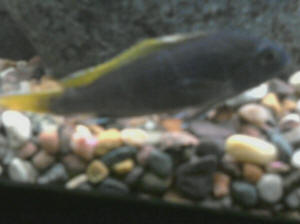 |
what's wrong with my yellow labs?
Lake Malawi Cichlids With Mystery Deaths 8/25/10
I have a tank of 25 Mbuna including 3 yellow labs (2m/1f)
ammonia/nitrite/nitrate all good
<ammonia and nitrites should be zero. Nitrates should be under 20
ppm.>
ph, temp, hardness all good
<pH should be well above 7. Water temp should be in the mid 70's
F. Water should be hard and alkaline.>
I had a random Ps. demasoni death a week ago. He was hiding and
wouldn't eat or come out of his spot. The next day I found him,
well I found his spine - the fish ate him to the bone after he died.
Didn't know how he died A few days later I found out my female
yellow lab was holding. I didn't know who it was from - I had 2
yellow lab males.
A few days later my yellow lab male wouldn't move out of his hiding
spot or eat or come out. The next morning he was dead.
Thinking maybe my labs were being harassed (because the female was
holding?)
I put the remaining female and male in their own 20g tank (same water,
filter, gravel) so it was not stressful and it was already established.
My male started acting similar to the way the other male did before he
died so I thought I better take him out
Its only been 24 hours, but the male isn't eating, He's
breathing heavy, rarely moving and laying on his stomach/side. He is
weak and exhausted.
He looks fine. His color is good, and there are no signs of aggression
or white/black/gold flakes on his body, he looks physically normal
What are your thoughts?
< Too much food or the wrong kind of food. Feed only enough food so
that all of it is gone in a couple of minutes. They should be fed a
food high in vegetable matter. No earthworm flakes or foods like that.
Look for something with Spirulina in it.-Chuck>
African Cichlid - bosses fish - dying. HELP!!
8/5/10
Hi - my boss had a tank full of healthy cichlids before he left for
vacation last Thursday.
<Okay.>
Friday of last week I noticed the larger yellow one hiding in the
corner.
It does that sometimes when the smallest one decides to go all
bitey.
<Sounds like your boss has some work to do establishing a healthy
community tank. If fish are attacking one another, there's
something wrong. His fault, not yours, for making poor choices in terms
of aquarium residents.>
Anyway - he's still there and he looks BRUISED all on the inside!
His tail even looks like it has blood in the end of it by the fins. He
has no open wounds, no major "puffing" except where it seems
blood has pooled.
<Could very easily be haemorrhaging or simply damaged. Finrot
commonly follows on from physical damage. The sick fish needs to be
isolated and then treated with an antibiotic. A tank divider can work
in the short term
-- not a breeding trap, too small! -- perhaps until your boss gets
back.
Use an antibiotic to help the fish recover. Lowering the temperature
down to 22 C/72 C may also help by cooling their ardour a bit.>
These are the CEO's fish, any idea what I can do to help them?
<In terms of just adding a magic potion -- nope, not much will
suddenly make aggressive fish nice again. It sounds like the bully has
decided to kill this weaker fish. One or other will need to be removed.
Your local fish club may be able to help; if you're in a city, see
if your local club can come rescue this fish. A pet shop might take the
fish, but I wouldn't bank on it. Euthanasia is an option, though
not a desirable one.
http://www.wetwebmedia.com/euthanasia.htm
Unfortunately a lot of these Malawian cichlid office tanks are put
together rather unwisely, and even if the fish are fine for a few
months, eventually something goes wrong. If there's a contract for
maintaining the tank with the aquarium designers, perhaps they can come
help. If your boss created the tank, he clearly needs to review the
species stocked and act accordingly.>
Tracie
<Good luck, Neale.>
|
New 330L tank with Cichlids
Stressed Out Lake Malawi Cichlid Tank 8/2/10
Hi, I just acquired a tank with about 8 Cichlids of which one is
an Albino.
Water Stats below:
330L
Amm = 0
Nitrite = 0
Nitrate = 5
pH = 7.4
Hardness = Unknown
I use Seachem Prime, but will be getting a water conditioner
suited to cichlids this week, as the LFS in my area (all 3 of
them) do not sell products specific for cichlids.
I have the lights on at most 3 hours per day - no plants (except
for silk), no driftwood, about 25kg limestone.
I have a large external canister filter, but I am unsure if it
contains carbon as I have not cleaned it yet as when I got the
tank the person who brought it did not leave the water in the
tank, but only the media and some poo in the gravel, so I had to
replace the water completely. I conditioned all the new water but
I imagine it would have gone into a cycle of how big I do not
know, so I left all media in there to assist with the
cycling.
I left the tank for just over a day and collected the fish. It
has now been two weeks and most fish look good, there is what
appears to be some fighting, but I have a feeling the Albino
Cichlid is injured. Since I got him his appearance has not
changed much, and not owning Cichlids previously I am unsure if
anything is wrong and how serious. I have attached a picture.
His fins are very ratty and his tail fin is not that great
either. Overall he is not very attractive, but he does have
bursts of energy. The main thing I am very concerned about is he
is always at the top, so much so you can see
his body bobbing above the water. I have been doing weekly water
changes of around 10 - 20% and I have bought a heap of limestone
(as mentioned above), added some Epsom salt (3 teaspoons only to
a container first then gradually introduced). The others do chase
him a bit, but they all chase each other, and it seems they are
playing most of the time. I am just really concerned about the
gasping, none of the others are doing it.
Any advice would be appreciated.
Thank you Teresa
< Albinos are typically weaker than normal colored fish. I
suspect that this one is getting picked on and has a corner
refuge picked out where he sits and takes a beating from the
other fish. Floating plants, plastic tubes etc.. provide hiding
places near the surface away from the territories of the meaner
fish below. Keep the water at 73 to 75 F to keep the cichlids
from wanting to breed and this should reduce the
aggression.-Chuck.>
|
 |
|
Sick Malawi cichlid 7/29/10
I would appreciate your help with this one. One of my cichlids
has developed a series of cysts on both sides at the base of her
top fin.
<I see this in your images>
The tissue on both sides is being destroyed and looks like it
will eventually create a hole at this site as it progresses. This
is one of my most colorful fish, so I would like to save it, if
possible. He is eating well and appears to be suffering not at
all from whatever this is. He lives in a 125 gallon tank with
about 40 other cichlids.
<Mmm, of what species mix?>
The water tests fine and there are breeders in the tank, so I
don't think it's the water. I have enclosed pictures of
the fish and close-ups of the growth[s] as clear as possible.
Many thanks for your help. JBH
<I would move this fish to a separate treatment system (use
two nets to catch it), and treat it w/ Nitrofuranace... Can't
tell "what" the specific cause/s might be from photos,
your lack of information on water quality, but this should stop
this from progressing. Bob Fenner>
|
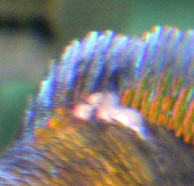 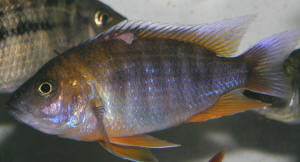 |
|
Re: sick Malawi cichlid 7/29/10
Thank you. Unfortunately, it died.
<Ahh, sorry to read/realize. Sometimes these sorts of
(apparent) injuries become systemic, bacterial et al.
involvements, that can bring about death quite quickly. This and
your other fish appear healthy otherwise. BobF>
|
Hello, bulging side Af. cichlid 7/24/10
Hi,
I have a 15 year old cichlid African I
believe. She has just started developing a bulge in her side and the
tail is very warped to the right side. She still has a great appetite
but seems to have trouble swimming properly! I checked your site but
couldn¹t seem to find an exact similar case. Please
help!
Sincerely,
Christopher
<Hard to say without a photo, Christopher, but at 15 years old
it's very likely this is probably "old age", what
biologists refer to a gerontic growth. There may be a tumour, benign on
otherwise, pressing against the abdomen. Or perhaps there's simply
a skeletal deformity of some kind. Unlike mammals, fish grow throughout
their lives, but in captivity they can live longer than in the wild,
and sometimes the growth of elderly specimens becomes screwy. Fifteen
years is a very good age for a Pseudotropheus cichlid for example,
which would likely live less than 5 in the wild. Because they don't
live to get so old in the wild, evolution hasn't worked to suppress
such developmental problems. In any case, if the fish is still happy
and feeding, I'd not worry overmuch. Cheers, Neale.>
Protomelas taeniolatus still flashing 7/22/10
Neale,
As I was working on the 55gal tank I was keeping a eye on my 72 with
the Protomelas taeniolatus female that had been flashing and scratching
her head on the gravel and I saw her doing it again, this time with a
little more vigor. So I checked the water parameters again and found
the following results nitrites and chlorine at zero and the nitrates at
10 ppm. The water for all my fish tanks come from the same source and
none of my other cichlids are showing any signs of stress. Water
conditions were my first thought but everything is within the desirable
parameters for these fish.
My second thought would be Ich but I haven't seen any white spots
on her or the other fish. No labored breathing like it's in their
gills. They have been in the tank for 2 months now which should of been
more then enough time for a out break of Ich to occur. I'm not
going to start dumping chemicals in there just to see what might happen
without knowing what is the most likely cause. What else could cause
her to do this?
Thanks
Paul
<Hi Paul. It does sound like either Velvet or Ick might be an
explanation, and a low-impact approach might be to use the old
salt/heat method. This shouldn't bother cichlids at all in the
short term -- though I'm sure you know about the possible
connection between sustained use of salt and the appearance of Malawi
Bloat. I do agree, the use of formalin, copper, etc. is generally best
avoided where possible. Do also look to see if the water is silty, and
check the sand you're using is "burrower friendly" --
some aren't, and these will irritate their gills if used in cichlid
tanks. Carib Sea are good about stating which are safe to use in such
tanks, and you can find the info on their web site, but other
manufacturers are not so transparent. One reason I recommend smooth
silica sand is precisely because it's always safe to use. The same
can't be said about Tahitian Moon Sand and the like. Cheers,
Neale.>
Re: Protomelas taeniolatus still flashing
7/22/10
Neale,
Thanks for the quick response!
<No problems.>
The substrate in this tank is aquarium pebbles so the water is quite
clear.
I'm going to try the heat salt method. The correct salt to use
would be sea salt or kosher salt?
<Kosher or non-iodised "cooking" sea salt is fine. What
you don't want is marine sea salt mix as that has added carbonate
that will affect the pH and hardness. Actually, for the fish you're
keeping it probably could matter
less! But I'd still use tonic, kosher, or non-iodised cooking
salt.>
As I understand it the mixture is 2-3 tablespoons per gallon with
elevated temp to about 84-86, leave heated over a period of three weeks
correct?
<Pretty much. I prefer to make up a jug of water with the amount of
salt required added to it, and then dribble this "brine" into
the tank in stages across a couple of hours. Minimises any shock to
your fish. Not that cichlids are much phased by salt, but some fish
are. I'd bump up the aeration if possible, because higher
temperatures means lower oxygen solubility.>
Then a 50% water change weekly, vacuuming the gravel well each time and
adding the salt/water mix with the new water? Is there anything that
I'm forgetting?
<Nope, sounds fine. I tend to do my usual water changes rather than
extra-large ones, especially when salt-tolerant fish like cichlids and
livebearers are concerned. But if you're sure you won't
otherwise change the pH or hardness by doing a 50% water change, sure,
do that instead.>
Paul
<Cheers, Neale.>
Could it be the rocks?
Lake Tanganyika Cichlid Die -Off -- 06/9/10
Dear Friends, I have had fish tanks for over 30+ years and I recently
decided to change my 150 gallon tank from salt to fresh water.
Water in my area is hard and I was planning a Tanganyika tank. I had
some interesting rocks I found in a nearby quarry, the rocks were
actually pieces of stalactites (or stalagmites), and they looked nice.
I also had a few pieces of lava about the size of large softballs. To
first test the water I had introduced a few mollies and then a few
weeks later, just to be sure, I added a few angel fish. All was fine
for a few weeks. I did water changes and things seemed fine so I
finally introduced about 15 small Tanganyika cichlids. After about two
weeks, within a 3-4 day period all the cichlids, who lived all around
the rocks, started to die off, not the angels and not the mollies. I
had my water checked at my local fish store and all seemed okay so I am
stumped what caused the sudden deaths. I was
wondering, could it be the stones? Either the stalactites or the lava
rocks? I read that stalactites are primarily limestone. Could this be
my problem? Thanks for your help. Great site. Mark
< Thanks for your kind words. Lake Tanganyikan cichlids like hard
alkaline water around 82 F. A water test that comes back
"fine" is useless. Ammonia is very toxic at high pH levels.
With only a few weeks of cycling your tank
may not have the bacteria needed in sufficient numbers to adequately
deal with those toxins. Lake Tanganyikan cichlids are very diverse with
many different feeding requirements. Tropheus for example are
vegetarians and do
not do well on a diet too high in animal proteins. Check out the book
"Enjoying Cichlids" by Ad Konings to help you select cichlids
once your tank is tested.-Chuck>
Re: Could it be the rocks?
Cycling Problem In New Cichlid Tank 6/10/2010
Chuck, Thanks for your prompt reply.
So you don't think it's the limestone or the lava rocks, but
rather the tank
has not properly cycled enough?
< Limestone type materials and lava rock are commonly used by
cichlid keepers in the US with no ill effects. One way to check on the
cycling is to check the ammonia, nitrites and nitrates
yourself.>
I have a 150 gallon with an overflow to the sump, the overflow tower is
filled with bio-balls and I have the sump filled with pond matrix and
then the water circulates back to the tank.
So if it's a problem of cycling then I will have to work on
that.
Any other suggestions?
Check the pH. of your tap water. If it is soft then the changes in pH
are a problem for the Tanganyikans.-Chuck> Thanks, Mark
African Cichlid Floating Upside Down 4/10/2010
Good afternoon, My name is Kim and my boyfriend and I are worried about
our fish. For the past three weeks our fish has been floating upside
down.
The first week It was floating upside down on the bottom, since then
he/she had enough strength to float to the top.
It (fish) appears that its belly is swollen, yet it's still
swimming, but upside down.
The fish is over 10 years old with a 29lbs tank. There are 2 other
cichlids in there too.
Do you have any advice? Could you please help. Thank you so very
much.
Binki
< Your cichlid probably has an internal infection. The bacteria in
the gut are producing gas and it cannot escape the intestines, It maybe
too late. Try treating with a combination of Metronidazole and
Nitrofurazone.-Chuck>
T duboisi Breathing Hard 4/9/2010
Hi, I have searched your site for an answer and still haven't found
anything. I have added 4 small cichlids to an established tank one of
them being a duboisi. All of the new additions are fairing well except
the duboisi. He doesn't move much and displays rapid gill movement.
I hate to lose him and am at a loss on what to do. My parameters are
fine I have checked and double checked. I have raised cichlids for the
past 2 years and have never had a problem. Can you give me some
advice??? Thanks in advance,
Chris
< The T. duboisi is a specialized algae feeder from Lake Tanganyika.
He requires clean, 80 F ,hard and alkaline water. In the wild they eat
algae. Animal based protein in their diet causes internal problems and
blocks up the intestines. The blockage is then feed on by the bacteria
in the gut.
The bacteria reproduce and extent the gut causing a bloated look.
Treated early it can be cured with a combination of Metronidazole and
Nitrofuranace. If the fish is still eating then a medicated food is the
way to go.-Chuck>
Question on African Cichlids
Dying African Cichlid -- 02/25/10
Hello all. I have a question in regards to African Cichlids. At work
there is a tank that has these little critters. There a number a brown
and orange ones which I think are a Pseudotropheus according to your ID
section if I have that right. There are also some blue ones that might
be partially from the Mbuna group. I guess this depends because of the
fish farms do all that mixing. The blue on these fish are not as rich
as the one in a photo I saw on your site under the ID page. These guys
are a little more faded. There is one other one that is largest in the
tank. It is albino and it has the same patterns on its sides as the
blue ones. I am guessing it belongs to a different group of African
Cichlids. My issue is that one of the blue one developed what I believe
to be cataracts a few weeks back and it is completely blind. In
addition, it has a severely arched belly. My guess is that it has had
no food as it cannot see where the food is. It color has gone from that
blue I described before to a dark gray color. It swims mostly
vertical
against the side of the tank looking for food. From my observations, it
has to be suffering from hunger pains and is becoming an annoyance to
the other fish. The others will peck at if it has invaded territory.
From what I read about this guys, they are territorial and protective
of breeding areas. They can be mild aggressively as well.
Unfortunately, I think this fish is going to die at some point within
the next week or so. I think it might be beyond saving. I spoke with
the employee at our company that feeds the fish the other day and
related to her that she should contact the party in charge of coming in
and caring for the fish. I spoke with her today and she said she
spoke with the party. She stated that the party was aware of the
fish's condition the last time they were in to maintenance the
tank.
She said the guy did not seem to care as if he was not going to do
anything about it. What an idiot. I mean the tank is always clean and
well maintained. The fish are always in good health. My question, what
can we do if the fish dies. We have no equipment to catch it. It spends
all of its time on the side of the tank opposite to the side that
has
the only opening into the tank to feed them. Thanks for your help on
this.
I really enjoy your site and reading on these little critters. Neal
Hammersmith
< Unfortunately fish are only objects to sell by many people in the
fish business. An African cichlid that has been squeezed out by a lack
of available territories really has no place to go. Have the service
remove the fish and let the fish die on him and not on you. A dead fish
may create ammonia spikes. It will be unsightly and smelly. Next time
they come in have then remove the fish so you don't have too. The
fish will probably just be thrown away in the trash.-Chuck>
Re: Question on African Cichlids
Dying Fish In Display Tank 2/28/10
Thank you for the heads up. I believe the service has been
notified.
In addition to ammonia spikes, is there anything else that you would
suggest mentioning to the service?
< If everything else is fine then it appears that they are doing
their job.>
I was observing the tank some more and the blind fish is definitely
limited on space. I believe from past observations that this guy was
#2. The #1 slot going to the albino. Since the fish is blind and so
forth I can see how he has down to last fish on the pole, especially
with this species territorial behaviors.
Is it true that these type of fish prefer a more basic or alkaline pH
level?
< Your fish come from Lake Malawi. The water there is hard and
alkaline with a pH around 7.5-7.7. You may want to check the water
temp. At above 75 F they tend to be more aggressive because they want
to breed all the
time.-Chuck>
Electric Yellow with Sunken Belly 2/4/2010
Hello, I've been running a Malawi Cichlid tank at work for just
over a year now, containing plenty of caves and a mixture of Electric
Yellows, Rustys, Royal Jewels, C. Afras and Cuckoos. The additional
Bristlenose catfish pair I put in there to keep the algae down have
liked it so much that they've bred several times, although the fry
never seem to last long once they start wandering out of their
crche, so the inhabitants generally seem quite happy with
the setup.
The fish are fed once daily an Eheim automatic feeder that drops enough
Hikari Cichlid Gold (baby size) pellets to be consumed within two
minutes and they receive a manual dose of Omega One shrimp pellets once
weekly. No Tubifex worms and definitely no blood worms (I put signs on
the tank to dissuade well-intentioned employees).
The tank is cleaned weekly, including a gravel vacuum and about 30%
water change. Local council water is quite variable in quality ranging
from about pH 6.7 to 7.9 out of the tap on any given day (as tested
with a digital pH meter). Water going into the tank is treated with
Seachem Prime to de-chlorinate and Seachem Cichlid Lake Salt and
Malawi/Victoria Buffer to get the pH to around 8.2 and dGH/dKH to
around 6 (as tested with API GH&KH and High Range pH test kits).
Ammonia is 0, Nitrite is 0 and Nitrate is less than 10ppm (again
measured with API kits).
Most of the fish have put on significant size since being introduced
(some nearly doubled). This one Electric Yellow, however, hasn't
really put on much size and has a slightly concave/sunken belly. On the
assumption that he was shy and not getting enough food (Cichlids are
quite voracious eaters) I took him home a couple of months ago and
isolated him in a spare tank to give him some peace and quiet. After
going through a house move a couple of weeks ago, though, he has been
living in a pH 6.8 tropical community tank. He seems quite happy in
there, staying and eating with the Clown Loaches as they shoal and
dance back and forth along the front glass, but still he has a sunken
belly. The community is fed a mixture of Omega One Super Color flakes,
Sera Catfish chips and Omega One shrimp pellets nightly. He's
visibly getting enough food now so I'm wondering if he has an
internal parasite/bacterial problem. Do you have any suggestions on
what condition he may have and how to
treat it? Thanks and kind regards, Anthony.
< You are right in assuming that he is being pushed around in the
bigger Malawi tank. In the wild they come from very deep water with not
much competition. In the community tank the water temp is probably too
high for a Malawi cichlid. Lake Malawi runs from 73 to 77 F. At higher
water temps the metabolism may be too high to gain any weight. Being a
Labidochromis, he doesn't really eat algae off the rocks like the
other Mbuna do. They are
more of a picker, than a grazer, You have the right idea with the baby
pellets, this gives all the fish a chance to eat and get something.
Your fish are larger now so it may be time to increase the amount of
food. In public aquariums they would hand feed this fish to make sure
he gets enough food, at least once in a while. If you thing there is an
intestinal infection, then treat in a hospital tank with a combination
of Metronidazole and Nitrofuranace.-Chuck>
Re: Electric Yellow with sunken belly
Treating a Sunken Belly On An Electric Yellow 2/4/2010
Hi Chuck, Thank you for the advice. I'll try sourcing some
Metronidazole and Nitrofuranace to treat the little guy in a hospital
tank and keep my fingers crossed. I'd like to see him put on
condition so that I can put him back in the Malawi tank with the other
electric yellows (territorial disputes excepted).
I'm not sure temperature is a problem here, although I admit it
hadn't occurred to me as a possibility before. It makes sense that
it affects their metabolism and digestive processes, however, both
tanks are very close to the 73-77F (23-25C) range that you've
recommended.
The Malawi tank at work is in an 24/7 air conditioned environment (our
developer/server room area) so the ambient air temperature stays close
to 23C/74F all year round. The tank itself is only slightly warmer than
this (26C/78F) due to heat generated from its pump and lighting
systems.
There is an electric heater in there, too, but it is set to 21C/70F to
act as a safeguard should the air conditioning fail during winter. I
also test it occasionally during tank maintenance by turning the dial
up until it comes on and then setting it to 21 again.
At home, since I don't have air conditioning, the spare that tank
he was in and the community tank that he's currently in are hooked
up to Hailea chillers so they never get above 26C/78F.
Thanks and kind regards, Anthony.
< These medications can be found online at
Drsfostersmith.com .-Chuck>
African cichlid fin loss -- 01/12/2010
I have a 178 Gallon African cichlid tank. I only have 6 small (about 2
inch) fish. I've noticed they have been losing there fins.
<Two obvious issues. First, social behaviour. Malawian cichlids are
notoriously aggressive, and casual aquarists often have no idea how to
choose species to avoid problems. Something like a male Melanochromis
auratus will "hold" a territory about 55 gallons in size, and
ANY other fish in that amount of space will be viewed as a threat.
Weaker males of this species, other members of the genus, or really any
other cichlid with similar colouration WILL be attacked and eventually
killed. Likewise, Pseudotropheus zebra is another seemingly psychotic
cichlid. Of course in the right tank they're fine, but if you throw
these super-super-aggressive cichlids in with milder species, don't
be surprised if some end up dead.
The second issue is Finrot. Whereas fighting results in obvious tears
to the fin, Finrot goes along with the appearance of bloody sores on
the mouth and body. Typically, fin erosion removes the membrane first
and the fin rays second, so the fins look ragged rather than cut.
Finrot can follow on from fighting, but more often it is a result of
chronically poor water quality or inappropriate water
chemistry.>
I'm not sure if it is an illness or if they are nipping each other.
Some have small chunks missing
and some have the entire top fin gone. I've had 2 fish die last
week.
<Not good.>
What do you think is going on?
<Review environmental conditions, check the species installed are
compatible, and act accordingly.>
Thanks!
<Cheers, Neale.>
|
Nemo the Red Zebra Cichlid 1/6/10
You guys may not remember me, but in late April of 06, I came to
you for help with Nemo, my Red Zebra Cichlid, after he'd had
his fins ripped off by his previous tankmates, and developed a
big infection. I just wanted to thank you again for all your
help, and he's still doing awesome at 4 years old :) I
attached a picture of him. He's a good looking little
guy.
<Oh yes>
He lives in a 30 gallon tank ALONE. He's too aggressive with
everything else. He did have a Tiger Barb friend for about 2
weeks while my mom was setting up a new tank, and surprisingly,
they got along. I'm thinking of
buying a large Pleco for Nemo's tank since the algae gets so
bad. I'm thinking if it's a big one, he'll leave it
alone...
<Likely so. Perhaps an Ancistrus species... will "do the
job" and not get too big here>
Thanks again! I recommend you to my fishkeeping friends all the
time. All my friends love Nemo, and I can't imagine my life
without him. :)
Zhara
<Thank you for this follow-up. Bob Fenner>
|
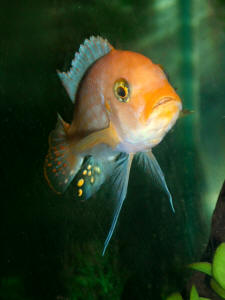 |
|
Jewel Cichlid help 12/31/09
Hey guys great site very informative! I was hoping you could help
me with my African Cichlid he's about a year old and he's
not been himself as of late.
<Start with the obvious: review water quality, water
chemistry, temperature and tankmates. Just to recap, Hemichromis
spp. need clean, fairly well oxygenated water that isn't too
warm. They're riverine fish and sensitive to stagnant
conditions. Around pH 6.5 to 7.5, 10 degrees dH is ideal, with a
temperature of 25 degrees C. Nitrite and ammonia should be zero,
and nitrate less than 20 mg/l. Tankmates should be big enough not
to be viewed as food, but not substantially larger and more
aggressive either, otherwise bullying can occur. Aquarium size is
crucial with this species as it becomes shy if it feels cramped;
I'd go with something upwards of 180 litres for a pair, and
proportionally larger if kept alongside other species.>
I have been trying to determine what the problem is so I can fix
it before it's too late for him but have had no luck
searching for the symptoms. It started off with loss of appetite,
loss of color and then he began hiding all the time. With no
interest in food for about 3 weeks I began to get worried because
he is (was) the most ferocious fish in the tank at feeding time
and just in general.
<Generic symptoms of stress, really.>
This morning was a complete change I noticed that he was back to
his aggressive self when it came to eating also with putting his
larger tank mates in check (this fish is unbelievably tough) and
he had some color. I was very happy until I noticed that he is
actually not really eating because he is spitting the food out
after chewing it up and I am not sure if he's getting any of
it at all.
<Try switching to something else. These fish are largely
carnivores, so a mix of wet-frozen foods including occasional
offerings of lancefish or whitebait would be sensible.>
I dropped a few cichlid gold pellets in the tank tonight and he
rushed to the surface to get them but then he just spit them back
out again. He began to get some color back and is now more active
so I guess that's some improvement right? All the other fish
in the tank are fine and I have checked my water parameters they
are ok too. Their diet consist of Hikari gold pellets, Hikari
frozen blood worms, Hikari Cichlid staple, Hikari frozen brine
shrimp, live earth worms and backyard insects (which I
haven't feed in a while since its winter time here) not all
at once of course.
<Sounds fine.>
Any suggestions on what could be wrong with my fish and what I
have to do
to help him would be greatly appreciated by me and even more by
my sick Jewel L. The picture attached is when he was healthy and
normal about 1 month ago.
Thanks
Tom
<Difficult really to say anything specific. Provided the fish
is still rounded and not showing signs of starvation, I'd not
be worried overly.
Don't feed the tank for a couple of days, maybe longer, and
then offer something fresh, like chopped shrimp of white fish
fillet. Assuming you haven't caused problems by using feeder
fish (which can introduce parasites) or foods too rich in
Thiaminase (see WWM re:) there's nothing obvious wrong with
the diet you've been using so far. If all else is equal, a
little hunger might spur your Hemichromis into eating something
in a few days' time. Cheers, Neale.>
|
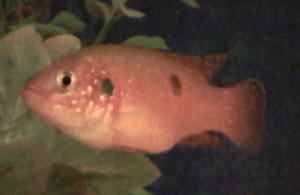 |
Epsom Salt Dosage - safe level for African cichlid fry
Rusty Cichlid Injured/Diseased 12/22/09
Hello Crew, I have a Iodotropheus sprengerae (Rusty) cichlid that
appears to have damaged it's eye - I noticed it a week ago - it was
scarily swollen but he was acting normal and the swelling seemed to go
down so I thought I
dodged a bullet. Over the weekend, he was appearing to not feel well -
not eating, just hanging amongst the rocks and the eye, although not
nearly as swollen looks cloudy. Today while feeding the rest, he got
chased out of the rocks and ended up at the top corner of the aquarium
- amazingly enough I was able to pop a hatch and get him netted.
It's a 240g with 70 cichlids and full rockwork - netting him was
incredibly lucky.
So I carted him over to my 10 gallon that has one inhabitant, a
Astatotilapia latifasciata (Obliquiden Zebra) fry that is about
3/8" long.
His name is Lucky as I found him the day after Thanksgiving floating at
the top of the tank (Oh Noes - dead baby) but when I netted him, he
started doing back flips! I have lots of Pseudotropheus sp. demasoni
(Pombo Rocks)
fry that are surviving in the main tank but the Zebra fry just
don't seem to be smart enough to make it. Anyway,
I was thinking on using Epsom Salt on the Rusty but am concerned that a
concentration enough to aid him might cause harm to the fry. (Could not
find in the FAQ on Epsom salt and fry).
In observing the Rusty, he is seems to be gasping. He has a couple of
areas on his side that appear to injuries to his scales (very very
small but noticeable) His dorsal fin looks like it's been nipped in
a couple of spots and he's currently got his head stuck in the
stream of bubbles from the airstone! His fins are not clamped but
he's not swimming very much and the tail fin seems to be curving
up. He's not well. He is about 3" long.
What would you recommend for dosing level and for how long? Should I
consider treating with Ethyromicin also? And if I did use an
antibiotic, the same question comes up as to enough medicine to treat
him could possibly be harmful to the fry. My well water from the tap is
pH 8.2, KG/GH 12 so frequent water changes are not a hassle.
Main Tank: 0 ammonia, 0 nitrite, 20 nitrate (time for the weekly wc).
QT: 0 ammonia, 0 nitrite, 10 nitrate
Thank You in advance. I LOVE this website and all the good that you
do.
Dawn Gulick
< Thank you for your kind words. Forget the salt as a treatment. At
this stage you need some serious antibiotics. I would recommend
Nitrofuranace or another Furazone type antibiotic. The eye problem s
probably a symptom of an internal infection as well. When you treat the
tank, the antibiotics will probably not affect the fry directly. It
will or may affect the biological filtration so there may be deadly
ammonia spikes. Any nitrogenous wastes have an affect on the growth
rate of young fish. Try and keep the water quality as good as possible
after the treatment until the biological filtration get back up and
going. It may be almost like starting from scratch.-Chuck>
|
Pseudotropheus acei - parasite?
Parasites On Ps Acei 12/18/09
Hello WWM Crew, I hope you are well this morning (or whatever
time of day it is on your particular slice of earth).
My Pseudotropheus acei cichlids have white "things"
(descriptive, yes?), clinging to their fins. I have researched
various diseases/parasites, but I am completely flummoxed as to
what this could be. They look like white lines, approximately
two-to-three millimetres long, mostly clinging to the Aceis'
pectoral fins, although today I noticed two new ones on the
dorsal and anal fin of a mouthbrooding female (photo attached).
They are much larger than Ich. The one on her dorsal fin looks
like a little oblong egg. Yesterday, this particular female had
one attached to each pectoral fin, but today they have
disappeared, leaving only faint white traces. They seem to hang
on for a couple of weeks, then disappear. None of the other
Cichlids have them, only the Acei females. There has been only a
total of six of these white things over the past three weeks or
so; it is not something that is spreading fast. Do you have any
idea what this is?
Here are my tank specifics:
Ammonia: 0
Nitrite: 0
Nitrate: 5 - 10
kH: 9
gH: 13
pH: 8.0 - 8.2
50 gallon breeder aquarium
50% weekly water changes
Temperature: 25 C
Food: New Life Spectrum pellets, frozen Mysis, Emerald Entre,
various flake, Sushi Nori, cooked/shelled peas.
Decor: lots of hornwort, Vallisneria, rocky hiding places
Inmates: four Pseudotropheus acei (1M/3F), four Labidochromis
caeruleus, (1M/3F), three Aulonocara stuartgranti (1M/2F).
Thanks so much, as always, for your help! Carla
< A treatment of Fluke-Tabs should remove the parasites from
the fish.-Chuck>
|
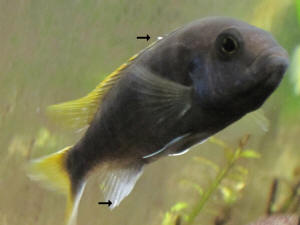 |
Hello (Cichlidae; red tube from the anus)
11/13/09
I recently wrote to you about my tank and want to say you have great
advice. I have another question for you..one of my female peacocks has
some type of clear reddish tube coming out one of her reproductive
holes...does this mean she is pregnant or sick??
<Difficult to say without a photo. The spawning tube (or genital
papilla) on female cichlids looks like short, blunt tube with a rounded
tip. It almost looks like a little wart. It's very different from
the equivalent structure on the males, which are longer, usually
angled, and have a pointed tip. Anyway, female cichlids normally show
their genital papillae for very short periods, at most a day either
side of spawning. Males will show there for longer periods, often
several days. If your female is showing her spawning tube, she will
either be spawning or just about to, and she should be obviously
engaged in spawning behaviours of some kind.
Now, a prolapse is very different. This is where a bacterial infection
of the colon causes it to expand and protrude from the anus. This is
very serious, and is a good sign that environmental conditions and/or
diet are very wrong. Treatment with antibiotics, fixing the
environment, and feeding exclusively high fibre foods (e.g., cooked
peas, live daphnia, but nothing dried) can help. The use of Epsom salt
in the water may also help speed up recovery. Chuck outlines the basic
therapy on this page, about half-way down:
http://www.wetwebmedia.com/FWSubWebIndex/texascichfaqs.htm
Finally, there are Camallanus worms. These are red, clearly wriggling
worms protruding from the anus like little red threads. You will need
an anti-helminthic medication to treat them.
http://www.wetwebmedia.com/FWSubWebIndex/nematodesfwf.htm
Cheers, Neale.>
Sick Cichlids please help
Sick Cichlid Tank 11/11/09
Thank you for taking my question.
< No problem.>
I have two remaining African Cichlids (of 3 ) I have had for 5 years or
better. They are 4 inches long and live in 25 gallon tank. Recently we
added the algae eaters to reduce the algae in the tank.
< The algae problem can be traced to high nitrate levels. Keep the
nitrates to under 20 ppm. Ammonia and nitrites should be zero.>
The fish became erratic, swimming lifeless, barley holding on. We did a
complete water change and
complete cleaning of everything.
< Bad idea. You have now lost all the bacteria that break down
nitrogenous wastes. You now have a new tank and probably need to cycle
it all over again like a new aquarium.>
The two algae eaters died as well as one Chiliad. <?>
The water has been tested over and over again. The water numbers are
perfect.
<Perfect equals zero ammonia and nitrites. Nitrates should be under
20 ppm.>
With n hours the fish are standing on there noses or laying on there
side and their fins laid back. If we transfer them into another tank
with fresh water they come around for about 4 to 8 hours and then back
to previous condition. Both have started to develop brown on there fins
and one has brown around its nostrils. Then after a while there skin
turns white in color. They are orange. This has been going on for three
weeks they are trying so hard to hold on and the sadness is they try to
help each other in the tank and recognize us. We have been back and
forth to the pet store they have run out of suggestions, we have read
on your site the diseases and some symptoms are the same but can not
cure them .Please please Help.
Thank you so much,
Jim and Carie Scott in Raleigh NC
< Lets start by checking the water. African cichlids like hard
alkaline water. The pH should be at least 7.0 or higher. The water temp
should be between 73 and 77 F. Use a very good water conditioner that
removes both chlorine and chloramines. Check tithe water source as well
as the aquarium.
The brownish coloration is a bacterial infection. If it is causing
these kinds of symptoms then the infection is very advanced. I would
recommend treating with Erythromycin or a Furanace antibiotic. Add
about 1 tablespoon of sea salt or rock salt to the aquarium. to
increase the slime coat.-Chuck>
Hello (African cichlids, mysterious deaths...) --
11/10/09
Hello....i have a 75 gallon African cichlid community tank. I have
about 50 cichlids give or take...
<That's a lot of fish for a tank this size.>
recently I lost two fish with no sign of seeing it before hand..the
fish were not stressed and did not look like it was caused by
aggression...they died out of no where about 5 days apart...
<Fish rarely die for no reason. It's worth remembering that
"African cichlid" and "community tank" are
contradictions in terms, and poor choices when selecting species can
end up with dominant males killing off any fish they view as rivals.
Mbuna in particular are hyper-aggressive, and can be very, very hard on
most Tanganyikan cichlids as well as the less aggressive Malawian
species. Non-dwarf Mbuna will batter dwarf Mbuna, so again, you have to
be careful even then.>
I recently been adding new fish...I make my weekly water changes and
maintain a good environment, and feed them once daily...
<Adding new fish is fine, but almost always, new fish are viewed
with more hostility than fish that are already there. Standard
operating practise is to remove all the fish and/or rocks, rearrange
the rocks, and then add the new and old fish together. This way, you
reset the balance of aggression and territory holding. Obviously, if
you add small fish that bigger fish will view as threats, those small
fish will be killed.
I have two filters and good oxygen
<I'm concerned your tank is very heavily stocked, and given
that, water quality may be less good than you think. Double check your
water chemistry is between pH 7.5 and 8.2, the hardness is above 15
degrees dH, and the carbonate hardness is around 7 degrees KH. Water
quality must be excellent:
0 ammonia, 0 nitrite, and nitrate levels less than 20 mg/l.>
do you think you can help me and maybe give me advice on prevention so
it does not happen again, and I could keep my fish healthy... Thank
you, Sal
<Do read here:
http://www.wetwebmedia.com/FWSubWebIndex/afrcichlids.htm
http://www.wetwebmedia.com/ca/volume_5/volume_5_2/malawian_cichlids.htm
http://www.wetwebmedia.com/FWSubWebIndex/tangcichsystems.htm
Cheers, Neale.>
Orange cichlid - whitey kinda fungus mouth
9/29/2009
Hi team! (and great site btw!)
<Thanks!>
We have a 4ft tank with cichlids and two Bristlenose Plecos (who are
breeding at the moment). We also have two electric yellows who have
mouths full of eggs and fry. So clearly a happy tank...
<Seemingly so, but I wouldn't read *too* much into whether or
not Labidochromis and Pseudotropheus spp. are breeding -- they tend to
do that readily, even when other factors, such as social behaviour, are
amiss.>
We have two orange cichlids who have developed little white fungus
lips.
The fungus isn't big, but we wanted to check your thoughts
anyway.
<Usually means fighting, and often alongside water quality issues.
Your Orange cichlids, if Rift Valley cichlids, are likely
Pseudotropheus estherae or something similar. When males fight, they
wrestle with their jaws, and if the skin is damaged, it can become
infected. Ordinarily this isn't too serious and heals quickly, but
if the males can't stay apart (i.e., the tank is too small) and/or
the water quality isn't perfect, the wound won't heal quickly
enough, and a secondary infection sets in.
Bacterial and fungal infections are both common. True fungal infections
look like white cotton threads, but Columnaris (also called Mouth
Fungus) is a bacterial infection that looks somewhat similar, though
off-white to grey and the threads are shorter.>
One looks like he has a very short and landscaped white moustache (very
minimal growth), the other looks like he just has a white coloured lip
as opposed to orange (i.e. no fungus growth).
There are no other fish in the tank who have it, and they are all still
eating really well, they all seem to get along really well.
<As I say, this is likely from fighting. Review stocking, separate
the males, and treat with a suitable anti-fungal and
anti-bacterial.>
Could this be from the fish foraging through the rocks on the bottom,
or possibly continually doing their shimmy dance (clearly another happy
couple) and chasing each other?
<The "Shimmy Dance" is likely fighting. Do check the sex
of the fish concerned. Male Pseudotropheus estherae and in fact
virtually all male Pseudotropheus spp. are hugely intolerant of one
another. A four-foot tank isn't going to have sufficient space for
two males of the same species.
Normally Pseudotropheus are kept as a harem (one male, two or more
females) or else in very large groups (including at least five males of
each species). As harems, they're easier to keep and observe, but
big groups allow "overstocking" which is where the aquarist
does massive amounts of extra work so that more fish can be kept. Do
see here:
http://www.wetwebmedia.com/ca/volume_5/volume_5_2/malawian_cichlids.htm
>
We do a weekly water change , there's no excess food in the tank,
and the Plecos keep it spotless. Its not an aggressive tank either.
<If these are Mbuna, then the tank is much more aggressive than you
think it is.>
This is the first instance of fungi / sickness that we've had.
<Likely wasn't much fighting when the fish were young...
they're older, maybe sexually mature now, and that's when the
trouble starts.>
It hasn't spread to fins or skin or tail etc, and doesn't
appear to be from a wound or dead flesh.
Any suggestions as to what this could be and the best way to fix
it?
From all the way Down Under
Lahnie
<Hope this helps, Neale.>
Lake Malawi Cichlid problem
Malawi Cichlids With Indented Stomachs 9/29/2009
I have an 80 gallon tank with eleven full grown Malawis (ice blues,
labs, red zebras, etc.) that has been set up for 2 years. I do
regularly scheduled water changes and cleanings, never alter food and
the conditions
in the tank have remained the same for at least a year. I have had no
sick fish at all. I am noticing a strange phenomena now though, and
I'm not sure how to describe it. I tried to take a picture and my
camera won't
focus. I've browsed all over and can't find anything like it.
About five of my fish have a markedly "indented" or
"inverted" abdomen! It started with one and seems to have
spread slowly to the others in the last few
weeks. They are all eating and behaving normally. Any ideas? Thank you
so much - Jennifer Brown
< Could just be age. In the wild they usually only live for a couple
of years. In the aquarium they get bigger and live longer, then
sometimes develop body abnormalities like indented stomachs, curved
spines etc...
Just to make sure I would recommend a water change and try changing the
diet to a pelleted food.-Chuck>
Lake Victoria Cichlids - Still sick? 9/11/09
WWM,
<Jimmy,>
I just want to thank you in advanced. Here is my situation: I purchased
a group of 7 Pseudotropheus flavus Chinyankwazi and a group of 7
Pundamilia nyererei Ruti Island.
<Not in the same tank, I hope. Pseudotropheus come from Malawi,
which has different water chemistry to Lake Victoria, which is where
Pundamilia nyererei come from. So while often sold in the "African
Cichlid" section, they need different conditions to do well. There
are also substantial differences in temperament. While both aggressive,
Pseudotropheus flavus is much more aggressive than Pundamilia nyererei,
not to mention twice the length.>
The day I put them in, a noticed 1 of the Flavus swimming kinda funny
along with having a bloated stomach. The next morning, I caught him and
put him in one of the floating internal breeding houses; I worked all
day and came home to find him dead. I assumed it was bloat based on how
large is stomach was.
<Could be a variety of things. Physical damage could be one, i.e.,
internal bleeding, if coupled with bruises and damaged fins. If you put
these two species together, then that's definitely a possibility.
Another very
possible explanation is a negative reaction to water chemistry
changes.
Since the two fish need different water conditions, putting the
Victorian cichlids into Malawi water chemistry could be a shock, or
vice versa, exposing Malawians to the less hard, slightly above neutral
conditions
Victorians want. Careless use of salt can also cause problems: see
Malawi Bloat. Back in the day, people used to put "tonic
salt" in Malawi tanks, and it seems to have been a major cause of
mortality. Again, there are other issues to consider: nitrate
concentration, oxygenation, etc.>
There was one more flavus that was breathing hard and laying at the
bottom doing nothing - I treat with Metronidazole (using Jungles
Parasite clear) which seemed to do nothing.
<And will do nothing, unless the problem is specifically Protozoans
of the type treated by this medication, e.g., Hexamita.>
So I went and bought "General Cure" from API and the Flavus
made a come back and started to swim and eat.
<Again, no particular reason to expect a cure without knowing what
you're treating. Indeed, throwing in multiple treatments without
understanding why can do more harm than good. Much to be said for
removing sick fish to your hospital tank, observing, and then treating,
once you have a diagnosis.>
The whole tank was treated, however I noticed most of the Ruti Islands
with a white "nub" sticking out around the anus. There is no
red coloration, it is just white and almost looks like a bubble.
<Could be a prolapse; does happen. A common mistake with Mbuna and
especially Victorians is to give them mostly meat-based foods (e.g.,
flake) rather than what they really need, greens! Constipation leads to
digestive tract problems, that leads to bacterial infections, and in
the infections cause the prolapse.>
Each Ruti has this bump, and for some reason, it is not going away. I
want to say it's bloat, but the fish do not appear bloated. They
are swimming and they are always, always hungry. I have been doing 30%
and 50% water changes along with adding aquarium salts AND Epson
salt.
<What do you mean by "aquarium salts"? A Malawi tank
should only, repeat ONLY have proper Rift Valley salt mix used; see
here:
http://www.wetwebmedia.com/FWsubwebindex/fwh2oquality.htm
Salt by itself, i.e., NaCl, can lead to problems, e.g., bloating. Do
review the literature on these two cichlid fish groups: there are
countless books out there.>
Nothing I do is getting rid of these little white nubs on my Rutis.
Any suggestions? I am sorry I cannot attach a picture, they just wont
stay still and catching them among a few hundred pounds of rocks is
nearly impossible. I do not want to stress them anyway.
Thanks,
Jimmy
<Do review the needs of the two fish groups being kept here,
especially in terms of diet, water chemistry. Likely some mismatch
responsible, either directly or in terms of susceptibility to ambient
bacterial infections.
Antibiotic treatment and a greens-based diet should help with the
prolapse.
Cheers, Neale.>
Re: Lake Victoria Cichlids - Still sick?
9/13/09
Neale,
<Jimmy,>
The Flavus and the Ruti can both be put into the same tank, see the
following:
http://www.cichlid-forum.com/profiles/species.php?id=1664
http://www.cichlid-forum.com/profiles/species.php?id=889
<These two links say nothing of the kind! If you look, there are
differences in size, aggression, and, if you read anything about Lake
Victoria versus Lake Malawi, water chemistry. Every single book or
magazine ever written about these two groups of fish recommends they
not be kept together. Sure, you can try, but it's dollars to
doughnuts that the much bigger and much more aggressive male
Pseudotropheus will bully, perhaps kill, the Pundamilia unless the
aquarium is of truly vast size (by which I mean 200 gallons upwards).
I've just finished editing an article by an experienced cichlid
keeper all about Lake Victoria cichlids. It'll be out in the
upcoming Conscientious Aquarist magazine, and I strongly suggest you
have a read when that happens.>
As you can see, water hardness, water PH, and temps are all relatively
the same.
<I'm relatively the same thing as a chimpanzee, but I don't
invite chimps to family reunions. The devil is in the detail, and
it's getting the details right that separates expert from casual
fishkeepers.>
Both groups are fry, measuring around 1-1.5". There is no
aggression between the groups and there is no aggression within each
group.
<Still sexually immature. I'm talking about once the males
become big enough to stake out territories.>
The fish were shipped to me in separate bags, so the chances that the
Flavus died because of injuries do to damage caused by other fish is
unlikely. Again, they were shipped in separate bags, so the Rutis and
the Flavus were never with each other until put into the tank. When I
did put them in, as I said, no aggression or fighting occurred within
or among both species.
<OK.>
I do, however, think that its possible that damage happened during
shipment; however, if this is the case, why did it only effect 1 fish
out of 14?
<The weakest fish is usually picked off first, then the next
weakest, and so on.>
I must say, that I do not think water chemistry has anything to do with
this. My PH is 8.2. My temp is 82 degrees F. 0 Ammonia, 0 Nitrite, and
Nitrate is around 5-10.
<The pH is a bit high for Victorian cichlids; the optimum is around
pH 7.5, 10 degrees dH. I note you're not mentioning either
carbonate hardness or general hardness, but merely pH. As you hopefully
realise, pH is largely unimportant when keeping fish except so far as
it is stable from week to week. Hardness and carbonate hardness are
substantially more important.>
The aquarium salt I used is the one that API sells (API Aquarium Salt).
I have never used table salt, and never will.
<API Aquarium salt is merely repackaged table salt. It's not the
same thing as Rift Valley salt mix. By all means combine with Epsom
salt and Baking Soda to produce a Rift Valley salt mix, but once the
box is done, for gosh sakes buy some marine salt mix; only the latter
has the full mix of trace elements, whereas aquarium salt has virtually
nothing useful. This issue has been discussed so many times,
there's really no need for you to reinvent the wheel.
http://www.wetwebmedia.com/FWsubwebindex/fwh2oquality.htm
Plain aquarium salt -- what you're using -- seems to one factor
leading to Malawi Bloat. Before aquarists understood the importance of
water chemistry, they did what you're doing, added aquarium salt to
Lake Malawi and Lake Tanganyika aquaria, and Malawi Bloat was a very
common problem.
Since switching to proper Rift Valley salt mixes (which you can buy, if
you don't want to make yourself) the incidence of Malawi Bloat has
become a lot less common. So please, just pick up a book on African
Cichlids (anything by Loiselle or Konings is good) and read the darn
thing, cover to cover.
Save yourself, and your fish, a lot of grief. You're making
beginner's mistakes here, and while I'm happy to help each and
every time, you'll be a lot more pleased with yourself if you can
pre-empt some of the possible problems.>
I have only fed them one thing, and one thing only: Omega One Super
Veggie:
http://www.omegasea.net/super_veggie_flakes.html
I do not believe this food would cause any harm to either species.
<It's a good food. But do mix things up a little. Dried foods,
used constantly, can cause dietary problems. Fresh green foods are the
make-or-break additions to the diet with a lot of cichlids, reducing
the risk of vitamin deficiency and constipation.>
I have read some of your input to other people and will try to feed
smaller portions a few times a day. Maybe this will help?
<This is actually recommend practise, because at least some of these
cichlids have relatively short guts, being adapted to constant grazing.
So one or two big meals per day is largely a waste. So yes, a good
idea.>
Should I try treating the tank with Nitrofurazone and see what that
does?
<Yes, this can help treat a prolapse anus; as discussed here:
http://www.wetwebmedia.com/FWsubwebindex/afcichdisfaq3.htm
but do think carefully about what the triggering factors might be, and
act accordingly.>
Thanks,
Jimmy
<Cheers, Neale.>
Re: Reply to Victorian Cichlids... 9/15/09
Neale,
<Jimmy,>
General Hardness (GH) is 300 ppm.
<Is this calcium oxide or calcium carbonate? Technically it should
be calcium oxide, but for historical reasons many (most?) test kits
quote calcium carbonate equivalencies. That being said, 300 mg/l
calcium
carbonate would be ~18 degrees dH.>
Carbonate Hardness (KH) is 160 ppm.
<This is always calcium carbonate, and in this case, ~9 degrees
KH.>
I do not know what these transfer in to as far as degrees, but I
believe they are pretty spot on.
<For what? Lake Malawi has hard, basic water, whereas Lake Victoria
is more neutral, moderately hard. It doesn't matter hugely, but my
point is that these lakes *are not the same*, and Lake Victoria is in
most regards a fairly typical large lake like many others in East
Africa. Lake Malawi (and Lake Tanganyika) are different in that the
geology of the area means their water picks up a lot more minerals as
it drains into the basin. Lake Malawi has about twice the mineral
content of Lake Victoria.>
Although I did not combine those 3 products (baking soda, marine salt,
and Epsom salt) I did put them in separately minus the baking soda;
I've been using marine salt and Epsom salt along with api's
aquarium salt. Seems as if I should just cut out the aquarium salt and
add the baking soda.
<Why? Rather than reinventing the wheel, I suggest you review the
Rift Valley cichlid salt recipe described on WWM, as well as on other
Rift Valley cichlid orientated web sites. The proportions of the
minerals isn't
absolutely critical -- for one thing, Lake Tanganyika and Lake Malawi
have very different mineral contents anyway -- but I would use all
three. The cost is negligible, so what's to lose? If you have hard
water out of the tap, you might not need to use so much, and what is
suggested for 5 gallons here at WWM might be fine for 10, even 15
gallons.>
2 different Flavus have created little round "nests" in the
sand already.
<Neat!>
However, I have yet to see any aggression thus far.
<Babies.>
Im not saying that it wont happen, but for now they seem fine and are
coloring up nicely.
<Good.>
I purchase the fish from Dave's Rare Aquarium Fish (in San Antonio)
and I discussed the inhabitants of the tank before making my final
decision. Dave was comfortable with the Flavus and the Ruti mix and
noted that they should do well together.
<Fine.>
He knows his fish, so I trust his opinion.
<Cool.>
They're in the tank now, so its my problem if they start
fighting...something tells me, however, that they'll leave each
other alone (just as they are now).
<Let's see. The nature of my work here at WWM is to provide
advice that works in as many situations as possible. I certainly do
things at home I'd not recommend other aquarists do! So if I'm
over-cautious, that's the reason why. But the flip side is this:
I'm cautious because each day we get dozens of "problem
fish" e-mails, and aggression is one of the most common problems.
If I say that two fish might not get on, it's not because I'm
trying to sell you another fish tank, it's because I know that
there's a risk of things going awry. Please do understand this.
With that said, by all means see what happens, and honestly, I do hope
it works out. Both species you're keeping are colourful and
interesting.>
Thanks again Neale,
Jimmy
<By the way, do stop by the new CA magazine, here:
http://www.wetwebmedia.com/ca/CAHomepage.htm
There's a piece on Victorian cichlids by Daniella Rizzo in there
you might enjoy.
Cheers, Neale.>
Re: Reply to Victorian Cichlids... 9/15/09
Neale,
Yea, I'll hope for the best, and I'll keep you updated
(hopefully with pictures soon).
<That would be nice.>
Where is the best place to get Nitrofurazone if you don't mind me
asking?
<No idea; here in the UK, it's a prescription-only medication.
In the US, Aquarium Pharmaceuticals market at least one version, called
Furan-2 I believe. There may well be others.>
You have been most helpful. Much appreciated.
Jimmy
<Good luck! Neale.>
Persistent Ich
Cichlid Tank Going Bad 8/15/09
Please help. We have two tanks, one 30 gall tank with 8 healthy various
cichlids. We have a 20 gal that we have used as a hospital tank in the
past. Really, it's just a waiting room for death! No fish ever
recover.
From all descriptions, it appears the fish have Ich (white spots/slime
all over their bodies), but none of the products we've purchased
have worked.
Three days ago we purchased a pair of cichlids (sorry, my husband does
not remember what kind). They were young and the female had babies in
her mouth. She released the young early and she is now dead. The male
is on
his way. The babies seem to be growing and we're churning out the
brine shrimp, but I feel they are doomed. Before we put these new fish
in, my husband put new everything in the tank after having hand cleaned
it while it was dry. It's just this tank but we can't figure
out why! Temp seems good, we've done multiple water changes,
disc'd feeding bloodworms after reading some of your articles,
feeding flakes, Cichlid Diet Pellets (small red balls that sink). We
have used Ich Cure with Formalin by Aquatrol, Ampicillin (250mg),
Metronidazole (250mg) and most recently ProSeries Fungus Cure by
Aquarium Pharmaceuticals. Aside from the money we are throwing away,
and we're into the hundreds now, my kids are bereft every time one
dies! Please, help before the babies go.
< The medications used in your hospital tank have probably affected
the bacteria that provide the biological filtration required to convert
deadly ammonia into less toxic nitrites and then finally nitrates. A
true hospital tank has very little sand and no biological filtration.
Once a fish is placed in the tank the water is medicated. The fish
should not be fed during treatment. Water should be around 80 F.
During treatment the tank should get a 50% water change between
treatments.
Siphon off any fish waste during the water change. Organics in the
water can absorb some of the medication and reduce the dosage. Once the
treatment is complete you can add a filter with carbon to remove the
medication from
the water. Take some used filter media from the established tank and
squeeze some of it into the hospital tank filter to get the biological
filtration established. Continue with water changes to control the
nitrogenous wastes. If the fish is healthy for a couple of weeks then
it should be ok to be placed in the main tank.-Chuck>
<<And eight Mbuna or Utaka type cichlids is likely too many for
this sized, shape system. RMF>>
Re: Persistent Ich
Persistent Cichlid Deaths 8/29/2009
Chuck, we continue to need help. Thank you for input on the hospital
tank.
Our 30 gallon tank, which was previously healthy, experienced some sort
of epidemic as well. We lost 4 fish, but not to Ich. They had no
outward sign of disease, at all. Four are left and they've seemed
healthy for
three days now. Our favorite, a large zebra cichlid now has red marks
on his side and bottom fin, as well as his tail. It looks as if
he's bleeding!!! His skin looks ok, but he is lethargic and not
eating. Any ideas???
< Start by checking the water quality. The ammonia and nitrites
should be zero. The nitrates should be under 20 ppm. Your fish like
hard alkaline water. The pH should be well above 7. If these parameters
are not met then the fish get sick and die from diseases that that the
poor water quality makes them vulnerable too..-Chuck>
Cyrtocara moorii; damaged lips, infections
7/30/09
Hi,
<Hello,>
I really need help. I purchased some Cichlids from a gentleman that
lives close to me. I bought them because they needed a good home and
this man had just lost his job and such so he obviously needed the
money.
<I see.>
I am really worried however. About two days ago I noticed one of the
blue dolphins had what seemed like a busted lip, but I just figured it
was from a fight.
<Can well be; when fish are moved from one tank to another,
there's often a struggle to reassert dominance. It also depends on
the size of the tank, and a fish used to a bigger tank moved to a
smaller tank may take time readjusting to new boundaries. Yet again,
water chemistry and water quality can be issues; with Malawian
cichlids, clean, hard, basic water is essential, and if moved into a
tank with soft and acidic water, or detectable levels of ammonia and/or
nitrite, opportunistic infections such as Finrot can follow.
http://www.wetwebmedia.com/ca/volume_5/volume_5_2/malawian_cichlids.htm
So there's a bunch of factors. That said, damage to the mouth is
typically from fighting.>
Well it got worse today and now it seems like her bottom lip is rotting
off and her fins are too. They look inflamed and dark red. It looks
like a horrible infection, I hadn't noticed it, and maybe because
it just happened, but another cichlid, that the gentleman called a Big
Spot, has ruined fins also.
<Well, without some details on the tank it's difficult to say
what's going on. At minimum, we need the pH and the nitrite levels
so we can factor out environmental issues. You're aiming for 0
nitrite (as well as 0 ammonia, and nitrate levels no higher than 20
mg/l if possible). Water chemistry should be hard (10+ degrees dH) and
basic (pH 7.5-8). Since Blue Dolphin cichlids (Cyrtocara moorii) are
pretty big, your tank will need to be a generous size, and even a 55
gallon tank is at the low end of what these fish require. They're
also fairly peaceful fish, and more aggressive species, particularly
Mbuna, can cause them serious harm.>
One of my other dolphins has what looks like a "busted lip"
now too!!! I don't know what is going on, but I need to fix it. I
tried researching it on the internet and couldn't find anything
that looked like it. Please help, what do I do? Or are my fish
doomed?
<Doubt they're doomed, but do treat for Finrot (e.g., with
Maracyn, eSHa 2000, etc.) and test, at minimum, the pH and nitrite.
Review tankmates, aquarium space.>
--Thanks
---Anna
<Cheers, Neale.>
Cichlid problem 7/27/09
Hi Crew,
<Hello,>
One of my Mbuna stopped eating about two weeks ago, started
"gasping" a bit, and began to lose his color only near the
dorsal fin. None of the other fish showed any symptoms at all. I tested
the water as soon as we noticed he was having a problem (ammonia: 0,
nitrite: 0, nitrate: 30).
Since the nitrate levels were a bit high, I did 30% water changes every
other day and then continued doing frequent small changes after the
levels got down to about 10.
<Very good. Do also check water chemistry. As you doubtless know,
Mbuna need hard, alkaline water to do well. Aim for pH 7.5-8, hardness
15+ degrees dH, and a carbonate hardness upwards of 5 degrees KH.
Slight variation from week to week shouldn't cause problems, but
they are sensitive to acidification, and if the pH drops below about
7.2, they tend to get ill very quickly.>
Since doing so the nitrate levels have consistently been between 10 and
25, everything else at 0. I also tried feeding him peas in case there
was a blockage. Still, his health continued to decline and he still
refused to eat. He at times would sway from side to side while swimming
(kind of like a waddle) and stayed in one of the rock caves at all
times.
<May simply be genetic or old age; these symptoms are pretty
nondescript, and if the other fish are fine, would tend to adopt a
"review the basics" approach. Check things like water
chemistry, diet, social behaviour and so on are all within the ranges
required by the species you are keeping. A typical Pseudotropheus
cichlid should live at least 5 years, though 7-8 years is typical for
healthy specimens maintained under good conditions.
But inbreeding can mean that some simply aren't as robust as they
should be, while hybridisation throws up all sorts of variables that
are difficult to predict.>
Finally, today I found him hanging at the top of the tank and some of
his scales appeared to be peeling off on their own. His body had a
wrinkled appearance, and since he looked like he was suffering I
decided to euthanize him. I inspected him closely after and there was
no bloating, no red patches, no visible external parasites, etc. Any
idea what this might have been?
<Not really, no.>
Laura
<Sorry couldn't offer more help. Cheers, Neale.>
Novice Makes a Ton of Mistakes That May Kill Fish. Is the
problem fungus? FW 7/21/2009
Hi. Great site!
<Hello and thanks.>
I really hope you can help me with some of my many problems, though you
already have with a few! I'm sorry this is still so
long'¦ I've done my best to edit it, but I'm really
trying to be as thorough as physically possible. It seems like I've
so far done a very, very BAD job with my aquarium, mostly because I
rushed into it before thinking anything through. I'm going to see
the lady who runs the local pet store soon, and she has always been
helpful, but I'm hoping to receive either new ideas or consolation
that whatever she tells me is true. Sorry to say I'm feeling a
little cynical, and overwhelmed.
<Oh.>
I'm super new to aquariums, and have a lot of questions about a
'problem tank' I seem to have brought upon myself, so prepare
to roll your eyes, but keep in mind that I've only had a beta
(lived three years!) who came in his vase/glass jar, and didn't
know any of the rules except that I needed to feed them'¦ (I
know I should have researched it now, but it was a split second
decision, which landed me with a 55g tank, light and filter system for
$20, for my 'lake fish' (his name was Herman, caught him a net
myself, he was less than an inch long'¦) who died before I
got the tank home.)
<I see.>
First of all, you should know that my tank is roughly 55g, freshwater,
20 with aquarium salt,
<Don't know what this means. "20" what? The thing with
salt is you either have a brackish water aquarium, or you don't.
Unless you're using salt for treating Ick, there's no need to
add salt otherwise, and any amount of salt adequate for brackish water
fish will eventually kill freshwater fish. There's no "middle
ground". It's a binary thing, like being pregnant. You either
are pregnant or you're not, there's nothing in between.
Likewise you either have a brackish water aquarium with sufficient salt
for those brackish water species, or you don't.>
and currently a dosage of methyl blue, pH stabilizer, and the
anti-ammonia crud; all of which I am adding in accordance with the
directions, and slowly, because I really don't need any more
problems with the tank.
<Why are you adding any of these? Let's review. Ammonia-remover
removes ammonia from tap water; it will not, repeat, will not, remove
ammonia produced by fish. So if you have some amount of ammonia in an
aquarium because there are too many fish or an immature filter, adding
ammonia-remove will have no useful impact. Secondly, pH stabiliser is
almost always a bad idea unless you are an expert fishkeeper. A
brackish water aquarium will have a stable pH because you add marine
salt mix. A hard water aquarium for Malawi cichlids or livebearers will
have a stable pH because you add Rift Valley salt mix (which you can
make for pennies at home). The only situation where most aquarists need
pH stabiliser is where soft water fish are being kept in a (typically
small) soft water aquarium. Once the pH goes below 7, the chances are
carbonate hardness is very low, so pH tends to drop between water
changes. Unless you're doing that, using pH stabiliser is not
really going to help, because you're not tackling the water
chemistry problem head-on.>
I have 1 single waterfall, 1 double waterfall, a bubbler that is
currently going through a curtain, and a heater, which I'm not sure
I should run (the temperature is about 80F, which is ok, (I think) for
cichlids, and I'm afraid of the heat fueling the fungus, if
it's cotton mouth?).
<Fish need a certain temperature to be healthy; above or below it
their immune system weakens, and Fungus and Finrot become probably. For
things like Malawi Cichlids, that temperature is 25 C/77 F, and
anything above or below that value becomes increasingly stressful.
Summertime highs a few degrees above shouldn't do any harm because
the tank will cool a bit at night, but do try and avoid temperatures
above 28-30 C/82-86 F for any length of time.>
I'm planning on taking out all of the gravel so I can sit it out,
let it dry, bake in the sun to hopefully kill the fungus, (will that
work?)
<Not really, no.>
and rewash it, and replace it when (fingers crossed!) my fish are
finally healthy. I'm also going to take out the live plants and
various ornaments.
<Why?>
So here is the list of fish and their ailments. I have in total seven
fish and two fiddler crabs, that I have moved to another tank because
they need land, and do not tolerate most fish meds as well as others.
(I have 1 Green Spotted puffer, one orange African cichlid, one grey
convict (who my friend is sure is some other type of cichlid, he's
grey with vertical black stripes, and shiny blue-ish green lines and
dots), one I believe is a green terror, a long dark blue one with
horizontal light blue stripes, and a mystery cichlid that is purple wi
th darker purple vertical lines and orange fins.
<These fish are largely incompatible. The Green Spotted Puffer
absolutely must be kept in brackish water; 1.005 at 25 C, around 9
grammes marine salt mix/litre is the absolute minimum for long-term
care. Extended exposure to such conditions will kill the
cichlids.>
All but the puffer were sold under the name cichlid with some list
after them, but I can't remember them all. All of the fish I have
bought from the local PetSupermarket have passed on (and I think it was
those feeder fish who brought the diseases too, they have warts, but
the lady at the store assured me they were eggs'¦ later to
find the guppies are live birth! Not that it's not my
fault'¦ but I'm going to be stubborn about it and
boycott'¦ at least until I get a quarantine
tank'¦ which, only having one fish, I didn't know
about.) I'm going to make up genders for them, because though I
think I know some, I'm pretty sure most of them are wrong.
<Indeed.>
Green Spotted Puffer: Her name is Afragorica (ugly'¦ I know,
but I was trying to say something else and it stuck.) I got her from
Wal-Mart (didn't know it would be a problem'¦ and I
don't believe it was this time. Got lucky, I guess) and haven't
had a problem until yesterday, wayyy after some of the others went
downhill, even though she was among the first added to the tank.
Unfortunately she now has a slimy white fungus? (like the stuff on Oink
(the mystery fish's) eye) on parts of her body and mouth. She may
have a dark spot on her belly, too, but it comes and goes with the
lighting, and I can't tell if it's there or not (if it is,
it's minor, hardly noticeable, and possibly a color marking,
because it is only seen near the borders on her white belly, and does
not grow.) There does not appear to be any kind of rot yet, and
it's not grainy enough to be ick. What is it?
<Fundamentally, the standard reaction of GSPs to being kept in
freshwater tanks. Putting her in brackish water as outlined above
should prevent the problem happening again, and treatment with an
anti-Fungal should fix what she has now.>
Should methyl blue fix it?
<Methylene blue should work, yes, but in conjunction with improved
environmental conditions.>
I gave her a 30 minute bath in the 10g 'hospital tank' with
twice the dosage (as directed'¦ good or bad? Is methyl blue
ok for scale-less fish?) and she seemed happy enough, but there seems
to be little improvement, though I've done it twice over the course
of the day. She's eating well'¦ though she's
disappointed because I haven't put in much live food over the
course of the last week due to the ailments, and bad water. There's
one (wart free!) feeder guppy left, and she chases it, but it's
about her size so she hasn't managed to catch it yet.
<Do not use feeder fish.>
I'm guessing the fact that she's still making the attempt is
good. She's been eating the flakes, and some cichlid crumbles.
Where she is not infected she seems very shiny. What can I do?
<GSPs should eat a mix of seafood plus some greens. I'd
recommend a bag of frozen seafood from the grocery store (cockles,
mussels, squid and prawns here in England). You can also use wet frozen
fish foods including lancefish, bloodworms, krill, etc. Offer cooked or
tinned peas occasionally. Make the diet as varied as possible to avoid
problems with Thiaminase (mussels and prawns have high levels of
Thiaminase, and over time, this causes severe health problems.>
Orange African Cichlid: Her name is Starshine. She seems healthy,
eating, and swimming normally, BUT she has developed green
'eyebrows' and 'half a mustache.' It's not fuzzy,
and doesn't seem to be growing (I noticed it a week ago, but
it's too small, and I don't ha ve a clue what it
is'¦) Is it possibly new coloring, or is she sick? Would you
like a picture? I'm pretty attached to her, and would hate to see
her go, especially because it seems like it's just starting, if
it's anything at all.
<Again, likely an environmental issue. Malawian and Central American
cichlids need hard, basic water.
http://www.wetwebmedia.com/ca/volume_5/volume_5_2/malawian_cichlids.htm
http://www.wetwebmedia.com/ca/volume_6/volume_6_1/central.htm
Aim for pH 8, general hardness 15+ degrees dH, carbonate hardness 5+
degrees KH. See here:
http://www.wetwebmedia.com/FWsubwebindex/fwh2oquality.htm
There's a Rift Valley salt mix; use it! Also treat for
fungus.>
Convict: His name is Moonus'¦ No problems for now, though he
did have some tail-rot just after I got him. Should I take him out and
treat him separately? Can I leave him be if I take him out? He
doesn't seem to be sick at all.
<As for the Orange cichlid.>
Green Terra: I named him Oliver, because he's an orphan fish, I
adopted him from another tank because, though he's bigger than my
fish (probably two inches long), he's very timid and was getting
his behind kicked by another fish. No problems still, but I still gave
him a bath. Can I take him out too?
<Aequidens rivulatus and Aequidens pulcher are widely confused, so
check which you have. Adult Aequidens rivulatus can get along with
Convicts rather well, given space, but Aequidens pulcher is a big,
fairly peaceful community fish. Aequidens pulcher is a soft water fish
by the way. Aequidens rivulatus is as well, given the choice, but does
just fine in moderately hard water.>
The 'big blue one:' He's not so big as he is long, but
hasn't got a name yet. He's very aggressive, and still likes to
chase the other fish, but seems like he may have the fungus on the
edges of his fins, though it's not fuzzy or filmy like the others,
and seems opaque'¦ This has not grown or receded, though he
is too fast for me to catch to put in the bath, and the
'fungus' may even be faded coloring'¦ because
I'm sure if the illnesses don't get these guys the stress
I'm putting them under might. Is this possible? Or is it the
fungus? Do you want a picture?
<It's all pretty generic really. Fungus and Finrot (and indeed
Columnaris, called Mouth Fungus) often occur together and are caused by
the same things: poor water quality and the wrong water
chemistry.>
The mystery-PetSupermarket-Cichlid- Oink: Firstly, I realize that Oink
is probably going to be lost, but I'd really like it if he
didn't die, because he's quite nice when he isn't busy
being sickly. The first indicator of illness (in all of my fish), Oink
began his plight two days ago, when I noticed he had an extremely
cloudy eye, but it seemed to be a fuzzy film, identical to many fungus
pictures, but on his eye. I am guessing it came in the night, because I
didn't see it beforehand except as 'eyebrows', (which I
suspected were Ich, due to the amount of itching all of my fish had
been doing before I added meds'¦ and put in an anti Ich
called 'QuIch') and found it early this morning covering his
eye so thickly that I couldn't see the eye through the film. Can a
fish get fungus on its eye? I did a water change and added methyl blue
to the tank (too much?).
<You are likely medicating without logic, and used carelessly,
medications will interact with each other, or else poison the fish. Do
identify the problem first, the attempt to remedy the causative
factors, and finally treat -- sparingly -- using the correct, not
random, medication.>
Everyone still seems fine, but the eye was still terrible, so I did
some research and gave him a bath, which cleared it up so much that I
thought he would be clean the next time I did (decided to give him some
time between the baths though he seems to enjoy them more than he does
the tank, because he does more swimming and less floating.) I gave him
another bath a few hours later. Unfortunately, whatever it was grew
back within five hour s, so I gave him another bath (though the
recommended dose is two a day'¦ he was looking so bad I
thought he may die if I did, or if I didn't.) I'm afraid he may
lose his eye, in which case I'm lost as to what to do'¦
Do I need to catch it, to keep the others from eating it?
<Ideally.>
Can I somehow make it easier for him to deal with his loss? (Seriously,
I have been warned, but I think it may devastate me. I can't stand
thinking it's going to happen and I can't do anything for him.)
It's apparently a little bulgy, but, in all honesty it looks the
same to me as the other, and no different than hours before. I
mentioned he likes to float which brings me to the fish that Oink was
meant to replace.
<Fish live just fine with one eye. I'm sure they'd like
both, but they manage fine. Their lateral line system is a sort of
"radar" that helps them to a degree we really can't
imagine. That's why fish are perfectly happy in water so dark or
murky they can't see anyway.>
I had a cichlid, who seemed fine in his PetSupermarket tank but very
very ill in my own. As soon as I brought him home he began gasping
(like possible gill flukes?) and spent much of his time on top of the
water. He died within 24 hours, and I couldn't figure out what was
wrong with him (aside from the gasping) until another one of my fish
died from the same thing, eventually laying on the bottom of the tank
and letting the others eat him until I pulled him out of there and put
him in an empty 10 gallon my boyfriend's brother had gotten the day
of, and graciously lent me in hopes of saving his favorite fish, and is
now serving as a hospital tank. He died wi thin hours, but I'm
wondering if the flukes were caused by a parasite or something equally
as contagious, because the other fish was extremely healthy before the
new one was put in. What's going on? How can I fix it? Is it over,
or is it hiding somewhere in my tank?
<I honestly doubt a "mystery disease" is the thing here.
It's all so generic that it simply screams "water
quality/chemistry issues".>
Currently I am doing LOTS of water treatment, with the antifungal, the
aquarium salt, and 50% water changes. Can I do anything else for them?
There are (what I believe to be) actual fungus spores floating in there
and I scoop those out too'¦ I think they come off Oink's
eye'¦ but Oliver likes to eat them, which scares the
daylights outta me. Speaking of lights'¦ on or off for
fungus? I realize I messed up, and really, really, need help, and have,
in fact been researching fish ailments until two in the morning three
nights in a row, (once again, great site!), in addition to spending
most of the day on water and fish treatments. HELP ME!
<Do really need [a] water chemistry, at minimum pH, and ideally
carbonate and general hardness too; and [b] water quality, at minimum
nitrite, but ammonia and nitrate useful too.>
Hoping for anything'¦
Kim
<Hope this helps. Cheers, Neale.>
On an unrelated side note, I'm watching my friend's fish, which
include a black molly, and a sunset molly. A different molly died
before everyone left, and I believe it's because her bubbler is not
only out of the tank, but unplugged (?) I wanted to know how long the
two could stay that way...? Her tank is really small, I think probably
a travel tank of about a gallon (give or take half). Should I put the
bubble r in the water for a little while everyday, or leave it in?
<Mollies will die in tanks one gallon in size; really need 20+
gallons to have any chance of survival, and the water needs to be warm
(around 28 C) and slightly brackish (5 grammes/litre upwards). Frankly,
would put this poor fish out if its misery... it has no hope.>
She said not to worry... but they're pretty new and one already
died, and the oxygen situation is looking bad. The fish are pretty
sluggish, they hide and ignore food... I've put the bubbler in
once, should I do it again?
<Read, have your friend read.
http://www.wetwebmedia.com/FWSubWebIndex/mollies.htm
Cheers, Neale.>
Re: Novice Makes a Ton of Mistakes That May Kill Fish. Is
the problem fungus? 7/21/09
Thank you very much for your help. They all seem to be much better this
morning, the puffer is completely clear, and only the mystery fish
seems to be having any trouble at all, but also seems to be much
better. Currently the only thing in the water is methyl blue, and the
chemistry seems better.
<Good news.>
I was under the impression that cichlids like aquarium salt because the
lady at Petco told me they could be kept together, and the cichlids in
the store also used the salt. Do I need to get it out, or let it run
its course?
<Just do regular water changes, and over the weeks, the salt will be
flushed out safely. Over the long term, salt seems to be a triggering
factor for Malawi Bloat in African cichlids. Salt doesn't harden
the water
or raise the pH, which is why it's of no use when keeping cichlids
from Malawi, Tanganyika, or Central America. (Though that said, some
Central American cichlids tolerate brackish and even saltwater
conditions very well, but none actually need brackish water, and adding
a teaspoon of "tonic salt" per gallon doesn't make
brackish water anyway; you need marine salt mix for that.)>
I think I've learned a lot, and I won't make the same mistakes
again.
<Cool.>
Thank you again!
Kim
<Happy to help.>
As for my friend's fish, I've tried to explain it to her, but
she's not hearing it... I don't know what to do, but feed them,
and maybe fix up the tank, but I'm sure they'll die because
I'm only watching them this week,
and will not listen about the tank size. :[
<Ah, the same frustration as I often feel here, when I tell someone
their Goldfish needs a 30 gallon tank, or their Betta needs to be kept
warm, or their turtle needs dry land and a basking lamp. You do what
you can do; the rest is up to them; call it Karma, if you will. Cheers,
Neale.>
Lake Malawi Tank Problems 7/11/09
Hi, my name is Chris and I've been keeping African cichlids for
about 2 years. I have a 135 gallon tank witch is a little over stocked
about 300 inches of fish. It has a Fluval FX5 and a Rena Filstar XP3 as
well as 2 hydro sponge filter 5s for filtration. I do a weakly/every
other week 40% water change. I feed mostly Kens fish cichlid pellets
and occasionally soak them in a vitamin complex. Well last week after
doing a 30 percent water change and complete gravel vacuum I started to
lose about 3 fish a day. When I find them, they have their mouths wide
open and extended and look a little bloated but not much and all there
fins have red streaks in them(normally clear fins) even the pectoral
fins. I tested the water and it read: ammonia .12, nitrite .3, nitrate
5 and pH is 7.6. I added a uv sterilizer and some aquarium and Epsom
salt. but I'm still losing fish. also right before they die they
swim upside down and listlessly for at least an hour. also only the
fish 3" or bigger have died. the smaller fish 2-3" have bean
ok.
any help would be appreciated..Thanks, Chris
<You may have wiped out our biological filtration when you cleaned
the tank. The ammonia and nitrites should be zero. The high readings
are weakening the fish and may be causing secondary bacterial
infections. Try smaller water changes (20%) but do them twice a week.
Don't feed for a few days until the readings start to level
out.-Chuck>
|
Cichlid Injury or Disease? Former 6/23/09
Hello.
<Hi there>
I've recently started up a new Lake Malawi Mbuna Cichlid tank.
I've been a hobby aquarist for a few years now and this is my first
stab at a cichlid tank.
<Some fun!>
Here is my setup:
4 Electric Yellow Labs
4 Red Zebras
36 gallon,
<Mmm, going to be some tussling>
with crushed coral substrate, plenty of river bed rocks and slate
arranged for plenty of hiding spaces and territory markers. The tank
has been fully up and running for about 2 months. The 4 labs were added
first, then the zebras a couple weeks later.
Water parameters:
Temp: 80F
pH: 8.2
Ammonia: 0 ppm
Nitrite: 0 ppm
Nitrate: < 10 ppm
KH: 11
GH: 6
Here's my concern. A few days ago I noticed one of the red zebras
has a milky white patch
<Told you so>
on the bottom-left side of its body just above it's pelvic fin,
very easy to see given its deep orange coloring. The fish currently
measures about 3 inches long, with the patch being about half the size
of a dime. Nearby the patch are a few "frayed" scales that
are also white, looking similar to someone who starts to peel after a
bad sunburn. Now, the patch appears to be spreading along its
underbelly.
There are also a few more of the frayed scales.
Most of the time the fish in question will hide, except during
feeding.
Its behavior is otherwise normal.
Originally, this fish did not hide. However, b/c of the excessive
hiding I can't help but think it's gotten in a few fights,
lost, and is now just scared.
<An accurate assessment>
Its fins do not appear to be nipped, nor any eye damage or growths
around its mouth. I've tried to find pictures of common fish
diseases, but haven't been able to find anything to make a
definitive diagnosis. The closest possibilities I have found are Velvet
or Costia.
<Nah>
Unfortunately I cannot supply a pic as I stated that the fish is
usually hiding making it very difficult to photograph.
Thanks.
- Aaron
<Much more likely just secondary infection from physical injuries...
You may want, need to isolate the one fish... ultimately a few
others... Please read here:
http://wetwebmedia.com/FWSubWebIndex/afcichdisfaqs.htm
and the linked files above. Bob Fenner>
Re: Cichlid Injury or Disease?
6/24/09
Bob,
<Aaron>
Thanks for the response.
<Welcome>
You stated that it's most likely a secondary infection. Is there
anything I need to do when I isolate the fish (medicate, etc)?
<Nothing I would do, no... other than move the damaged fish where it
can heal of its own accord, and feed in peace>
Also, I was planning on getting 4 more fish (most likely electric blue
johanni's) to complete the stocking scheme.
<No my friend... this system is already over/mis-stocked>
I figure with 12 fish in a 36 gal aquarium, there will be a large
enough population to spread out any aggression so that individual fish
are not bullied.
<Mmm, can work... with very careful feeding... attention to the
arising of an "alpha" bully>
I'm using a 60 gal canister filter which (hopefully) should be
enough to handle the larger bio load.
<Am not such a fan of canisters for African Cichlid systems... or
I'd at least add some more/redundant filtration. Perhaps a hang-on
power filter of size>
Thanks again.
Aaron
<Welcome again my friend. BobF>
Re: Cichlid Injury or Disease? (Update)
6/27/09
Bob,
Thanks again for you input. It's been quite helpful.
The fish in question is no longer hiding. It's now swimming
around normally with the other fish.
I did manage to get a few pictures (albeit a *little* fuzzy for
some) to help give you a better idea of what I've been
describing.
<Looks like a true fungus... Yikes!>
Needless to say the area in question has spread since I first
e-mailed you.
I still agree with your diagnosis of fighting wounds.
<I too>
There's nothing around the fish's eyes or mouth, and
nothing on its fins. I just want to be as certain as
possible.
Thanks.
-Aaron
<This fish may heal of its own accord... but I'd at least
be reading:
http://wetwebmedia.com/FWSubWebIndex/fwinfectdisef5.htm
and the linked files above... BobF>
|
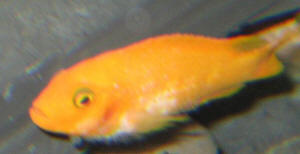 |
Re: Cichlid Injury or Disease? (Update)
6/27/09
Bob,
Thanks again for replying. It's been quite helpful.
I've moved the fish to a hospital tank and am treating it
with Pimafix to help treat the fungus.
I'll be sure to read the link you passed along.
- Aaron
<... Aaron, please read where you were referred to... I would
not use this API product, nor any of their other
"fixes" period. B>
Re: Cichlid Injury or Disease? (The Final Update)
6/27/2009
Bob,
Bad news. No sooner did I receive your last response that I found
the fish belly up.
I appreciate all the help you gave me. I always try to research
what the best course of action is whenever a problem arises.
Unfortunately, a lot of time you get conflicting advice (to
medicate or not to medicate, etc).
<Yes... and what is/are the choices one has, must make here?
To discern fact from non-... set upon a path of your
choice>
I guess you just have to base your actions on previous
experience, of which I only have a few years worth.
<Mmm, not so... our civilization is built upon the vast
experiences, efforts, trials of our forbearers... Mostly recorded
as writing... some of it extant in the working memories of others
(e.g. the WWM Crew)>
Every incident is a learning experience. I only wish this one
would have worked out for the best.
Thanks again.
Aaron
<Well... thank you for your (conciliatory) follow-up... I do
wish you well.
BobF>
|
African Cichlid problem
Malawi Cichlid With Hole In The Head 6/19/09
You have a great site, I have learned a lot browsing through it.
<Thank you for your kind words>
Please help me asap!
Background:
55 gallon tank
Inhabitants: One 6-7" female Fossorochromis Rostratus (6.5 years
old),
Three
1-inch female Aulonocaras
Filtration: Eheim 2213 canister filter
Nitrates: 5 ppm right before water change
Nitrites: 0
Ammonia 0
pH: 7.5
Water Change Frequency: 40-50% twice a week Food: homemade from
internet recipe and Hikari Marine A Temperature: 76 F Symptoms: All
inhabitants healthy with absolutely no prior medical problems.
The Fossorochromis recently began showing minor symptoms of hole in the
head disease, much to my dismay. I went through a round of Metro+ and
added liquid vitamins to her food with no discernible improvement, but
no worsening either. Yesterday noticed a reddened area and
"pimple" near her mouth and her fins were down. Suspected
bacterial infection of some kind.
As I hadn't had time to research the situation fully (gram positive
or negative or something else entirely) and haven't had to use
antibiotics of any kind in the last 6 years of this hobby, I added the
only thing I had on hand, Pimafix. Yes, I am aware that is like giving
herbal remedies to an MSRA patient, but I had nothing else and live an
hour from the nearest pet store. This morning her fins are back to
normal intermittently but she is breathing very hard. I added an air
stone and am in the process of changing the water yet again to increase
oxygen content. She appears to be breathing easier now, but not back to
normal. I own nine freshwater aquariums and fortunately have never seen
this before so I don't know what is going on.
All the rest of the inhabitants in her tank are just fine. Any ideas
are welcome! Thank you for your time and suggestions. Rebecca
< There are ideas about the causes of hole in the head disease
without any scientific evidence to back them up to my satisfaction, but
you have eliminated some of the theoretical causes. Some people think
it is bad water. This is not the case because you water conditions are
fine and you are up on your water changes so it is not nitrogenous
waste either. This comes down to diet. Usually food with fish meal
contains enough calcium for fish to build their bones as they grow.
Since you make your own fish food it is hard to tell if your food has
enough calcium in it. Larger fish need more calcium to replenish the
calcium needed to build their bones. Try Spectrum New Life pellet food
for awhile and see if this makes any difference. I have never had a
problem with HITH while using this food. If this works then in your
situation we may have found a possible cause and cure.-Chuck>
Update on African Cichlid situation... hlth.
Malawi Cichlid With Hole In The Head 6/19/09
Thought I would add an update. After the massive water change, which
rid the tank of Pimafix, the Fossorochromis in question returned to
breathing and acting normally, so maybe her problem was due to
that.
<Possibly>
I don't plan to use that product again.
<I would not>
However she still has the small raised red bump by her mouth and the
beginning HITH situation.
<Likely best cured by providing ongoing optimized water quality and
nutrition>
I will refrain from adding any more medication, herbal or otherwise,
without strong recommendation.
Thanks
for your time.
Rebecca
<Thank you for sharing. Bob Fenner>
Re: African Cichlid problem
Cichlid With HITH 6/21/09
Thank you for your advice. The reddish sore resolved into another small
HITH-like hole, but at least no infection. She is acting normally. I am
purchasing Spectrum New Life pellet food online as I write this and
implementing daily 25% water changes just in case. I will update you on
the
results as soon as something changes. Thanks again. Rebecca
< Try to increase the calcium content of the water by adding some
crushed coral to the filter. As it dissolves into the water it may be
ingested by the fish.-Chuck>
Re: African Cichlid problem
Hole-In-The-Head Treatment 7/1/09
I purchased the recommended New Life Spectrum food. Until the food
arrived, I added powdered calcium to the water and a little to her food
as well as a big mesh bag of crushed coral. Since following your
advice, one hole has gotten so small I have a hard time finding it, the
other two don't seem to have changed too much yet (although all
redness is gone), and no new holes are forming. She looks and acts
normal and I have high hopes that she is recovering. Thank you for
sharing your theory and giving a friend back to me! I will update again
when something major occurs, such as (hopefully) her complete recovery.
Rebecca
< Thank you so much for writing back. It is times like this that
makes me glad that your question was asked and that all fellow
aquarists and their pet cichlids might benefit from our WWM forum.
Hopefully the recovery will continue and this disease will no longer
become an issue.-Chuck>
Re: African Cichlid problem
Hole-In-The-Head Cured on African Cichlid -- 10/3/09
I apologize for taking so long to get back to you and I want to thank
you again for your advice. My female Fossorochromis has fully recovered
and does not seem to be having any further issues with
hole-in-the-head. I am feeding her (and all my African cichlids) New
Life Spectrum food along with krill and small shrimp. Once a week I
supplement her food with a little calcium and glucosamine (which is
apparently derived from shellfish and shrimp shells). I have also added
crushed coral to her canister filter media. Everything seems to be
going well now and has been for the last few months. Thank you,
Rebecca
< Glad to hear everything worked out OK.-Chuck>
|
Hoping you can ID this disease for me... reading
6/16/09
I have done a lot of research and I'm having a difficult time
figuring out what this is, I think its fin rot but not sure. My
Cobalt Blue Zebra has had this for about a month now. I tried
treating it with Melafix but this
did not seem to do anything.
<See WWM re this "fix"... worthless>
Any help would be much appreciated.
Thanks
<Does appear to be a secondary infection... very close to the
"egg dummies" of this male... could be due to
"biting" near... Read here:
http://wetwebmedia.com/FWSubWebIndex/fwinfectdisef5.htm
and the linked files above. Bob Fenner>
|
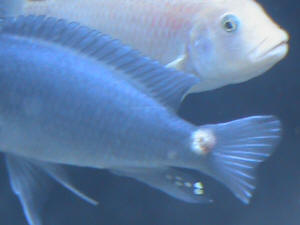 |
|
Re: Hoping you can ID this disease for
me, Mbuna... 6/17/09
Thanks Bob my plan was to stop feeding for a week, do a large
water change this weekend and purchase the Seachem KanaPlex.
Thanks for your help these Fish infections are hard to figure out
sometimes.
<Does read/sound like a good plan John... These fishes are
really very tough... with good care (water quality, nutrition)
they almost always "bounce back' w/o much in the way of
medicating. BobF>
|
Cichlid Wound and salt use/cichlids 6/9/09
Good afternoon!
<And morrow to you>
I have a 130 gallon cichlid tank set up about 9 months ago, the tank
itself has been running for around 5 years. One of the cichlids is a
hybrid of Pseudotropheus Elongatus (as far as I can tell) and I
originally saved him from somebody's dirty cichlid tank. They had
over a dozen fish at one time but eventually only had two left due to
neglecting their water changes, so I quickly put them into my tank.
<Too often a circumstance>
I believe in overkill when it comes to filters, so I have an old Eheim
canister filter, Rena XP3, Fluval 404, and two Marineland Emperor
400's.
Ammonia=0, Nitrite=0, Nitrate<10, 250 GH, 100 KH, 7.4 pH (I'm
also curious if that's alright or if I should really try to get the
water to be more acidic), and water temperature at 78 F.
Ever since I first got him, the Pseudotropheus Elongatus has had a
bubble-like "blister" on his face. It would slowly grow until
it suddenly burst and opened up, revealing fleshy pink beneath. Within
a few days it would heal over and became nearly unnoticeable, but a few
weeks would go by and the routine would repeat itself. Keeping the
water ultra-clean with 30% weekly water changes seemed to keep it at
bay for awhile, but recently it is getting very bad. For the past two
or three weeks, it has slowly grown into a large, fleshly, pink crater,
about 1 cm in diameter. It doesn't resemble any hole-in-the-head
that I've Googled for pictures of, and it doesn't seem to be
red with any blood, and there's no white worms or anything on it,
it's just lumpy and pink. It looks as if it's starting to
spread to just above his mouth as well. It looks almost as if his flesh
is slowly getting eaten away.
<Mmm, might well be an entrenched bacterial or protozoan issue...
inherited from previous poor care>
I really don't want to lose this fish. Since I don't know
exactly what it is, I'm thinking about trying Clout to see if it
would help, but I wanted to contact you first. I also have two large
crayfish in the tank and I'm worried the Clout will kill them.
<It might do so indirectly. I would instead look into the
antimicrobial Nitrofuranace and antiprotozoal Metronidazole>
I can attempt to get a picture of the wound if you think it will
help.
<Not really, no>
I also have a separate question: what is your take on using aquarium
salt for cichlids?
<Salts, combinations of metals/non-metals are present in all
freshwaters to extents, mixes... However, adding more is often of no
use to counter-productive. One should know what the present/source
water salt content is and the needs, ranges of tolerance/liking for
salts for the species in question. Of a carte blanche answer, the
Cichlid fishes et al. of Malawi and Tanganyika do better with a mix of
some salts added in many situations... Those of the New World and
Asia... as well as most all other bodies of water in Africa, not much
at all>
I've read different thing. Some say don't use any salt. Some
say use salt, but not normal aquarium salt as it won't help a
thing. They then say to use salt used in salt water tanks or Epsom
salt. What do you think I should use and how much?
<Please read here:
http://www.wetwebmedia.com/FWSubWebIndex/saltusefaqs.htm
and elsewhere on WWM re Cichlid Systems...>
Thanks for your time!
Dayton
<Welcome. Bob Fenner>
|
Old Frontosa With Hole In The Head
06/03/09
Hi guys, I have a frontosa. He is about twelve years old. I have
medicated him with every thing I can think of, Nitrofuranace and
Metronidazole. If I am not mistaken it is hole in the head?, You
cannot see it very well in the picture but that is a deep hole on
the side of his face not just surface.
and he also has transparent grape like clusters by his eye and
his face is pitted pretty bad, am I right about the hole in the
head?
< That is definitely Hole-In-The Head.>
He has had this for a about two years, I have been thinking about
putting him down with Finquel. I am sending you some pics. If the
pics are to big, please let me know and I will try to make them
smaller. Thank you Michelle
W.
< Thanks for the pictures. Your frontosa is very old and may
not respond to the medication. First lets start with the water
quality. The ammonia and nitrites should be zero. The nitrates
should be under 20 ppm. The pH should be as close to 8.0 as
possible. The water temp should be around 82 F. The diet should
include a high quality pellet with fish meal as a major
ingredient. Now that he is sick you should try and feed him some
medicated food with Metronidazole in it. Your fish has been sick
for a very long time and his age makes recovery a very slow
process. You used the right medications, it is just that in hard
alkaline water these medications are not as
effective.-Chuck>
|
|
cobalt blue cichlid emergency
Malawi Cichlid With Damage 6/1/2009
Hello, I've been searching around your site to find a similar
problem, but have been unable to find anyone with what appears to be
the same problem our fish is having. We have a 75 gallon tank, had two
yellow labs and a cobalt blue. One lab was picking at the other, so we
took out the one that was being picked at. He's doing fine now in
our other 75 gallon, his fins and tail have all grown back nicely with
color. He's happy there. The blue was always one to hold his own,
so we weren't concerned that they would not get along. He was as
clear as a bell, eyes, fins, scales...perfect health. Two days later,
we found the lab picked at him so severely that his pectoral fins and
tail were half gone, and a couple spots on his side; not sure if these
were from the lab or damaged when he tried to get away, on some tank
decorations maybe. And he has been unable to stay upright, and swim
with much control; he's even rolling a bit, like a kayak. We
immediately surrendered the bad lab to the LFS, that was yesterday. Put
in some Metronidazole we had, but it wasn't quite enough.
Today, can't find any LFS with any meds at all. We may have to
travel an hour to get some, but wanted to know if you had any thoughts
on what the problem might be. This buoyancy issue began with the damage
from the lab, so we don't think it's bladder disease, though
I'm not completely sure.
Talked to my fisheries biologist brother, and he didn't think
bladder could have been damaged by lab, and suggested checking the eye
swim reflex, which looks good when he spins (referring to the fish
looking toward his belly when he spins), so we don't think it's
neurological. We changed out 50% of water, and figure we need to treat
again...I tried attaching a video, but it's quite large (12.4
megs), so email probably wouldn't allow, or it would take days to
download; I don't have anywhere to post to (maybe you have an
idea?). Hopefully you will have some ideas on how to treat based upon
my description here...we are surprisingly attached to these guys...hope
we don't have to euthanize. Thank you for any help you may be able
to provide.
(Checked water yesterday: ammonia 0, nitrite 0, nitrate 20, pH 6, have
maintained these levels for 5+ years now).Kim
< The internal damage could be from the physical trauma caused by
direct hits on the flanks or by stress to the internal organs from the
attacks. The loss of the fins could effect the fish's ability to
control it's movements. Keep the water clean and watch for
bacterial or fungal infections. As the fins grow back the swimming
should improve. If the fish is not eating then medications like
Metronidazole and Nitrofuranace should be tried.-Chuck>
Redness near pectoral fins...
Electric Yellow Cichlid With Reddish Sides 6/1/2009
Good Day WWM Crew, I'm a newbie & just started my first 195
litre freshwater aquarium. The aquarium has been operational for the
last 1 month. It holds 5 yellow electric cichlids and 2 powder blue
cichlids. It's
got lots of rocks & caves with white sand & crushed corals as
the aquarium's base. Water pH level range is about 8.0 to 8.3,
tested ammonia level is at 0. I feed the fishes twice a day. Chemicals
added to the water
consist of standard anti-chlorine, standard aquarium salt, Ocean
Free's Vitamin Complex, Ocean Free's Super Battle Bacteria. I
feed my fishes Sera's Vipan flakes. Recently noticed that 1 yellow
cichlid has an enlarged left eye & redness on both sides of the
body that is connected to the pectoral fin. This fish looks slightly
tired, still swims around, is still alert but eats less. I noticed the
redness about 5 days ago. I have not
done any medical treatment as of yet. So far, I have changed about 15%
of the aquarium water once every 2 days. Washed my 2 filters once a
week. Been adding the Vitamin complex each time I change water. I
noticed that the redness has changed to red-pink this morning on one
side of it's body. The other 6 fishes still look ok, no signs of
redness yet. Hope the 6 don't catch whatever this fish has.
Appreciate if you can share your experience on how to solve this. I do
not have a spare tank to be used as a treatment tank. And I'm
worried that some meds might destroy the good bacteria that is part of
the bio-filter.
Thank you in advance. Regards, Roger (Singapore)
< The reddish coloration is a sign of irritation. This could be a
chemical imbalance or a bacterial attack. The pH is fine. I would check
the nitrites and nitrates. The nitrites should be zero and the nitrates
should be under 20 ppm. The enlarged eye could be the start of pop eye.
This is an infection behind the eye socket. I would recommend cleaning
the filters on alternative weeks. Clean filter one on the first week
then clean filter two one the second week. This will make sure that you
don't wash away the biological filtration. Back off on the salt, it
is not needed.-Chuck>
Re: Redness near pectoral fins... 6/1/2009
Lake Malawi Cichlid With Redness Around Fins
Hi Chuck, I checked the particular fish and noticed that there is some
fine redness lines on the part above its mouth. I don't have
nitrites and nitrates test kits at the moment, but I did manage to
clean 1 filter. I have been doing daily 10% water changes since sending
my first email to you on the 29th May. I visited my local pet shop and
the owner sold me some yellow powder, which he said would cure the
redness. I have no idea what the contents are, since the wordings on
the pack are all in Japanese. But after doing some research on the
Internet, I suspect he sold me some Acriflavine. I haven't used it
yet though. As a precaution, I did purchase a bottle of Interpet's
Anti-Internal Bacteria. Please advice if I should keep to the water
changes, or if I should start to use the meds I bought.
Which one should I start with? Yellow powder or Interpet? Thanks in
advance. Regards, Roger
<The yellow powder may be an antibiotic called Nitrofurazone. Check
with the pet store to find out exactly what you bought. Acriflavine
won't help.
The Nitro will work but may harm your biological
filtration.-Chuck>
Re: Redness near pectoral fins...
Redness On Lake Malawi Cichlid II 06/02/09
Found out that the yellow powder is called m-nitrostyrene sodium salt,
which is a fungicide. My fishes have been swimming in it for a few days
now. I don't think it's doing the trick cos my sick cichlid is
starting to change from yellow to black. I'm going to do a 10%
water change again tonight and start with Interpet's Anti Bacteria.
Regards, Roger
< Fungicides are useless when treating diseases on fish. A fungus
will attack dead tissue and will usually not attack living tissue. A
antibiotic is probably in order since the water changes don't seem
to work. When using an antibiotic be careful because it may affect the
biological filtration so watch for ammonia spikes.-Chuck>
Re: Redness near pectoral fins...
Medicating An Established Aquarium - 06/05/09
My 1 sick cichlid actually looked much better, 24 hours after I did a
10% water change & introduced Interpet Anti Bacteria to the tank.
His body was turning slight more yellow now (still on the dark side)
and his pectoral joints were not so red anymore. I felt happy and it
looked like the Interpet was working. Plus the booklet for Interpet
said that it was safe for bio-filters.
Then a new problem arose. I should not have listened to my LFS and used
the yellow powder. Looks like the yellow powder killed off my
bio-filter.
Yesterday at 6 pm, I noticed that another cichlid was looking tired and
turning color from yellow to black. Oh no, another sick fish. This
makes 2 now!!
I tested the water immediately and found 0.5 ammonia. My fishes were
under heavy ammonia poisoning attack since my water pH is high. Plus
the water smelled bad.
I quickly changed 20% water, added loads of bio-filter bacteria,
anti-chlorine & vitamin complex, then I went to bed. This morning
when I woke up, ammonia was back to 0 and nitrites were 0 too.
Questions:- How many days should I let my fishes recover from the
ammonia attack before I start my 2nd dose of Interpet? Should I even
continue to heal the internal infection now or just rely on water
changes and vitamin?
Regards, Roger
< This is why we usually recommend treating fish in a hospital tank
instead of an established aquarium. The antibiotics seem to be working
but the ammonia spike can be deadly. If I did not have the option of a
hospital tank I would recommend the following. First thing I would do
is clean the filters, vacuum the gravel and do a 50% water change.
Remove any driftwood.
One the first day I would medicate as per the directions on the
package.
The next day I would do a 50% water change. One the third day I would
medicate again. On the fourth day I would change 50% of the water. On
the fifth day I would medicate for the last time. On the sixth day I
would change 50% of the water and add a good activated carbon to remove
any left over medication. On the seventh day I would add Dr. Tim's
One and Only bacterial starter culture and resume lightly feeding the
fish. Do not feed sick fish.-Chuck>.
Re: Redness near pectoral fins...
Ammonia Stress On Fish - 06/05/09
Hello WWM Crew, I came home from work today and checked on the fishes.
The 2 still look tired. So I added an extra 5ml of bio-filter bacteria,
just to make sure the ammonia stays at zero.
In all your years as aquarist, have you ever successfully manage to
save a fish from ammonia stress? Did the fish eat, swim and have all
it's normal body functions/looks again? What was the fastest and
longest time it took for your fish to recover from ammonia stress?
Regards, Roger
< The main physical trauma to fish is a severe reduction of the gill
tissues. If too severe then the fish usually don't recover because
they can't breath. The ammonia trauma depends on the concentration
of ammonia and how long the fish are exposed to it. As you already know
that the ammonia ion is more deadly at basic pH ranges.-Chuck>
Re: Redness near pectoral fins...
Fish With Redness Near Fins Slowly Getting Better 6/11/09
Hello again, It's been 7 days now, main tank has been on Interpet
No.9 Anti Bacteria. My bio-filter has not been compromised in anyway,
which is good news. I've been following your medication & water
changes steps. My water's pH is on the 8.0 to 8.3 range. Ammonia
and nitrites are at zero. Both fishes look slightly better.
- I notice that they are more willing to swim around with the others
now, instead of just lying at the bottom of the tank to rest.
- The darkness on their skin has slightly faded off but they are not
fully yellow again.
- Eating is still an issue. They grab the flake but spits it out.
- I still notice redness at the pectoral fin joints and around the
mouth.
I've looked closely at them and found no other signs of sickness.
Fins are ok, no worms sticking out of their bodies, lips are not
rotting or swollen...etc
I really hope they make it and not die of hunger. I'm out of ideas
as to what is causing the redness around the pectorals and mouth. Is
there anything else I can do? Should I stop the Interpet?
Regards, Roger
< I am unable to find out what the ingredients are for the patented
formula for Interpet No. 9,. Anti bacterial. It is difficult to tell if
it is really working or the water changes and improved water quality
are improving the overall health of your fish. The fact that the
biological filtration wasn't affected makes me wonder about the
effectiveness of the medication. In the U.S. I would recommend using a
real antibiotic like Nitrofuranace or Erythromycin because I know what
is in these medications . If one did not work then I could switch to
another. If the fish is improving then I would continue with the
existing treatment.-Chuck>
Re: Redness near pectoral fins...
Antibiotics May Affect Biological Filtration
6/13/09
Hi WWW Crew, I checked the Internet and found that API (Aquarium
Pharmaceuticals) is an American company. After browsing their website,
I found that they too sell medications that are bio-filter safe.
Products like Furan-2, Melafix, Pimafix, Tetracycline and Triple Sulfa
does not hard bio-filter. So would you question the effectiveness of
these API products since they claim that these are bio-filter safe?
Have you had successful experiences with them? Regards, Roger
< Medications can say anything they want on the package. Bacteria
convert ammonia to nitrites and then nitrates. Different kinds of
bacteria attack the living tissues of aquarium fish. Is it possible for
some antibiotics to be selective enough to only kill the bacteria
attacking the fish? Sure it is. In your particular situation you have a
fish with some redness around the pectoral fins along with some other
symptoms. Are you satisfied with the results of treating with Interpet
#9? If you are, then continue to treat as per the directions on the
package. If not, then it hasn't worked.
I would recommend treating with a known antibiotic like Nitrofurazone
or Erythromycin. Regardless of what they say on the package I would
recommend treating in a hospital tank. If you have to treat in the main
tank then I would still caution you about ammonia and nitrite
spikes.-Chuck>
Auratus distress?? 5/6/09
Greetings Folks:
<Hello James,>
I'm a beginner with a 29 gal fresh water Cichlid tank purchased
from a local fish supplier, not a chain store. He buys directly from a
long known, to him, breeder.
<A nice practice.>
I had done some reading about the hobby beforehand and asked the
obvious questions about the cycle, feeding, and cleaning, etc. He
assured us that we could enjoy the hobby without a lot of
technicalities and to start with inexpensive fish until we had some
experience and might want to upgrade.
<It's true, up to a point. Does depend very much on the size of
the tank and the fish chosen.>
So, I have to this point relied on his guidance. We have now had the
tank in operation for just over three weeks without any obvious
problems, except the one about which I will soon describe and is the
reason I am writing.
<OK.>
Anyhow, the glass tank is equipped with a Tetra Whisper EX 45 filter. I
have also put in an air stone and a Mini-Jet sub pump for water
circulation. The tank is decorated with plastic plants and structures
for cover. The bottom is rough gravel, about .5" to 1.25"
diameter, about two inches deep across the entire bottom.
<If you don't have (live!) plants with roots, you really want to
minimise the depth of gravel. Gravel is "dead space" whereas
additional water moderates pH variation and dilutes water quality
problems. So in tanks with no plants (or just floating plants and
epiphytes) you use just enough gravel or sand to cover the glass and
stablise any rocks/ornaments.>
We started with three African Cichlids.
<Ah, major mistake here. With few exceptions, none of the widely
traded Rift Valley cichlids (which is surely what you mean) are viable
in 29 gallons. Yes, you could stick 'em in there, but chances are
they'll tear each other to bits, or else end up with assorted
problems caused by water quality/chemistry issues.>
I wish I could identify them all to you but searching bleary eyed
through four internet photo sites devoted to Cichlids, I could only ID
several ( I will continue my search, though I guess the easy way would
be to just ask the LFS). Of the first three, one was a female
Melanochromis Auratus about 1.5" long, an albino about 2"
long, and an small, inquisitive orange fellow with a few random black
markings.
<Also, another mistake. The hobby is inundated with hybrid Rift
Valley cichlids, which have poor colours and unpredictable behaviour
and adult sizes. Never, ever buy a Rift Valley cichlid that doesn't
come with its Latin name, and even then, be alert to possible hybrids,
and only pick fish that precisely match the photos in your book. While
there are rare varieties of, say, Pseudotropheus zebra different to the
blue specimens you'll see in your book, such fish will be pricey,
so you'll know they're genuine. Cheap Malawian cichlids (by
which I mean Mbuna costing under £5/$7 a pop) are highly
likely to be hybrids, and almost certainly so if sold as "Mixed
African Cichlids"!!!>
My LFS said that cichlids were pretty hardy, that the cycle would take
care of itself, and to come back in a week with a water sample. We did
as he said. The water tested "perfect" and he said we could
add three more fish if we wanted to. Of course we did, since the first
three fish seemed to be doing quite nicely. We added a male Auratus, a
Pseudotropheus Saulosi, and an additional albino.
<Now, Melanochromis auratus is possibly the most psychotic fish in
the hobby. Males will dominate 55 gallon systems, by which I mean they
can/will kill other fish they don't like. Pseudotropheus saulosi is
a "dwarf" Mbuna and consequently easier to house, even though
it isn't especially peaceful; you can simply expect to keep a group
in a slightly smaller tank than, say, Pseudotropheus zebra, and fights
are less likely to end in death, merely mayhem.>
After an evening of getting acquainted, they all seemed to be getting
along famously.
<Often seems to be the case when immature; I cannot stress too
strongly the point that it's the sexually mature males of all these
fish that cause the problems. Just because your juveniles get along
when they're an inch or two in length, there's no reason at all
to imagine they'll stay tolerant of one another.>
The next week the water again tested "perfectly" and we added
three more fish. Another Saulosi and two larger fish about 2"
long, a white guy with a couple of black horizontal stripes from
mid-torso to the top, and a blackish purplish brute with a gorgeous
purple horizontal stripe mid-torso. Curiously, the two larger fish
immediately sought shelter and seemed generally disagreeable for a
couple days. About a week later, I noted some brown spot algae, so I
did about a fifteen percent water change, using Tetra AquaSafe in the
added water, getting the temp as near as possible to the existing tank
water, about 78 Dg F., and changed out the Tetra charcoal filter (which
was filthy). About ten days later, we went back to the LFS. The water
tested "perfect" again.
<Do really want to encourage you to use numbers, not concepts, when
talking about water quality/chemistry. At minimum, buy a nitrite test
kit and a pH test kit; you're after 0 nitrite and a pH around 8 for
these fish. Ideally, you'd want a carbonate hardness (KH) test kit
as well; on this, you're after around 10 degrees KH.>
He said that the brown algae was normal for the stage of the tank and
not to fret about it.
<Up to a point, true.>
He said we could add a couple of Clown Loaches and a Pleco, so we
did.
<No, no, no... not in this tank. Clowns need an entirely different
habitat, and the Plec is redundant. Mbuna eat algae, and so do Plecs;
at best, the Plec is competing with them for food, and at worst,
competing for space and filtration capacity too. I'd take all the
loaches and catfish back.>
The Pleco and the big purple guy had some issues about who was going to
occupy the shelter of the sunken pirate ship, but by the following
evening peace and harmony reigned. The Loaches are a delight, the Pleco
is hard to find most times. Overall they are all fascinating and ever
ready to eat. I've tried to keep my wife from feeling sorry for the
little beggars and not to overfeed them.
<Quite.>
Food: the LFS recommended using pellets used by the breeder, Extreme
Aquatic Foods Inc, Cichlid Diet pellets. Since adding the Loaches and
the Pleco, I also use Top Fin Algae thins.
<Fine.>
To the problem: This past Monday, I did a 20% water change because it
is becoming obvious that these guys and gal are not bashful about their
bodily functions.
<Plecs defecate constantly; they're herbivores, and that's
what herbivores do. If you've ever spend time with horses or cows,
this won't be news. To a degree, it's true for herbivorous
cichlids too. This is why you need a heavy duty filter; I'd install
something rated at 8-10 times the volume of the tank in terms of
turnover per hour; so for s 30 gallon tank, your filter should be
between 240 and 300 gallons per hour in capacity. Anything less
isn't going to work, long term.>
All seemed right with their world, except yesterday we noted that the
male Auratus was sort of isolating himself, hiding under plant leaves,
or in the corner of the tank. He did not engage in the usual chasing
activities with the female or other fish. Today is more of the same and
he is not eating. Additionally, after watching him closely for an hour,
it seems that he is not using his right side fin/flipper as he meanders
slowly from spot to spot. He is not lying on the bottom or on any
structure but seems to prefer the under-leaf hideout or to keep his
right side near the side of the tank. None of the other fish are acting
strangely, or exhibit any outward indications of problems There is a
lot of debris in the water and I will do a water change tomorrow.
<My gut reaction is a water quality issue. All Malawian and
Tanganyikan cichlids are hypersensitive to nitrate, and even trace
levels of ammonia and nitrite will severely stress them. In addition,
busy aquaria (i.e., overstocked ones) will experience much faster pH
changes than lightly stocked tanks, and unless you have a very high
level of carbonate hardness, Malawian and Tanganyikan cichlids should
only be kept in water that has been "hardened" with cichlid
salt mix; see here:
http://www.wetwebmedia.com/FWSubWebIndex/fwh2oquality.htm
Specifically, you're after 0 ammonia; 0 nitrite; less than 20 mg/l
nitrate; a stable pH 8; general hardness 15+ degrees dH; carbonate
hardness 10+ degrees KH. Temperature isn't critical, but around 25
C/77 F is about right; avoid higher temperatures unless you
specifically increase water circulation as well; these fish are
sensitive to low oxygen levels, and the warmer the water, the less
oxygen it holds.>
I can't give you water chemistry because to this point I have
relied on the LFS for the technicalities.
<Without the numbers, it's really difficult to say anything
useful. It's sort of like expecting a doctor to diagnose something
on the basis of you saying you don't feel good, but without him
checking your pulse, temperature, red blood cell count or whatever. It
all comes down to cold hard numbers! But to keep you going for the
moment, have a read of this:
http://www.wetwebmedia.com/ca/volume_5/volume_5_2/malawian_cichlids.htm
>
I intend to change that but the LFS says more problems are created by
adding "treatments" and to just be sure to keep the water
clean and not overfeed.
<Up to a point, yes, adding treatments or chemicals to the water --
such as the mindless addition of aquarium salt -- at best does nothing
and at worst complicates things. But in the case of Malawi and
Tanganyika cichlids, it's virtually impossible to keep them
properly without adding a cichlid salt mix to each bucket of water. You
also need to be using coral sand -- not gravel -- and the tank should
be decorated with limestone such as tufa rock -- not plants, wood, etc.
Strong filter turnover is also important. Every aspect of the aquarium
should be tailored towards increasing carbonate hardness, buffering
against pH changes, and optimising water flow.>
So.........?
Thanks,
JM
<Cheers, Neale.>
Tropheus kiku has developed a bulge.
Wild Tropheus With Bulge 4/1/2009
The fish is a female wild caught Tropheus sp. Red .
She has been in the US for at least 17 months. Problem occurred around
Oct/Nov 2008. (Arrived from the lake Nov/Dec 2007 I believe)
I bought this colony from friend who is a large collector of Tropheus
here in Houston (where I live) in Jan 09, and he is keeping this female
until we can resolve this. (as he has more of the facilities to do this
for me, but I am doing as much leg work as I can, so I can take home my
last fish)
She has developed a bulge on one side of her body. Pictures included
see below. She is currently in a 20g hospital tank.
She has been medicated with a Melafix, Pimafix, Clout, Epsom salt and a
few other medications. Nothing seems to help. She eats, poops and
everything a fish normally does, including coming to the glass when
someone is near, come to the surface to hit the food like any Tropheus
does. I am most interested in a diagnoses, as this is something I have
yet
been able to determine. Weekly 50% water change.
pH 7.75 electronically measured.
None of the other fish in the tank she was previously was in shows any
signs of this issue. This fish was in a tank with 10 other and 35+
Ikola (all WC). Hopefully the pictures will assist the most.
There is a lot of them so please bear with me.
http://www.thehouseofdew.com/fish/fishtour/fishtour2009/tanktour2009-1-009.jpg
http://www.thehouseofdew.com/fish/fishtour/fishtour2009/tanktour2009-1-010.jpg
http://www.thehouseofdew.com/fish/fishtour/fishtour2009/tanktour2009-1-011.jpg
http://www.thehouseofdew.com/fish/fishtour/fishtour2009/tanktour2009-1-012.jpg
http://www.thehouseofdew.com/fish/fishtour/fishtour2009/tanktour2009-1-013.jpg
http://www.thehouseofdew.com/fish/fishtour/fishtour2009/tanktour2009-1-014.jpg
http://www.thehouseofdew.com/fish/fishtour/fishtour2009/tanktour2009-1-015.jpg
http://www.thehouseofdew.com/fish/fishtour/fishtour2009/tanktour2009-1-017.jpg
http://www.thehouseofdew.com/fish/fishtour/fishtour2009/tanktour2009-1-018.jpg
http://www.thehouseofdew.com/fish/fishtour/fishtour2009/tanktour2009-1-019.jpg
http://www.thehouseofdew.com/fish/fishtour/fishtour2009/tanktour2009-1-020.jpg
http://www.thehouseofdew.com/fish/fishtour/fishtour2009/tanktour2009-1-021.jpg
http://www.thehouseofdew.com/fish/fishtour/fishtour2009/tanktour2009-1-022.jpg
http://www.thehouseofdew.com/fish/fishtour/fishtour2009/tanktour2009-1-033.jpg
Thank you J Jesper, Jesper Houken Prairie Fyre Administrator
< Wild fish come in with all kinds of parasites both internal and
external.
Dealers can medicate to get rid of some parasites but sometimes not all
of them. Because you fish is wild there is no way to determine the age
of the fish. Older fish have a much more difficult time with stress
then younger fish. I have had wild A. calvus with the same problem. I
would recommend a treatment of a combin ation of Metronidazole and
Nitrofuranace and raise the water temp to 82 F. This combination should
treat both internal and external infections. While diving in lake
Tanganyika in 2002 I actually found wild fish affected with this
condition.-Chuck>
|
|

