FAQs on African Cichlid Diseases
6
FAQs on African Cichlid Disease:
African Cichlid
Disease 1, African Cichlid Disease 2, African Cichlid Disease 3, African Cichlid Disease 4, African Cichlid Disease 5, African Cichlid Disease 6, African Cichlid Disease 7, African Cichlid Disease 8,
African Cichlid Disease 9,
African Cichlid Disease 10,
African Cichlid Disease 11,
African Cichlid Disease 12,
FAQs on African Cichlid Disease by Category:
Diagnosis,
Environmental,
Nutritional,
Social,
Infectious (Virus,
Bacterial, Fungal), Parasitic (Ich, Velvet...),
Genetic,
Treatments,
Related Articles: African Cichlids, Malawian
Cichlids: The Mbuna and their Allies By Neale Monks, The Blue
Followers: the Placidochromis of Lake Malawi by Daniella
Rizzo, Cichlid
Fishes,
Related FAQs:
Cichlid Disease, Cichlid Disease 2, Cichlid Disease 3, African Cichlids in General, African Cichlid Identification, African Cichlid Selection, African Cichlid Behavior, African Cichlid Compatibility, African Cichlid Systems, African Cichlid Feeding, African Cichlid Reproduction, Cichlids of the World, Cichlid Systems, Cichlid Identification, Cichlid Behavior, Cichlid Compatibility, Cichlid Selection, Cichlid Feeding, Cichlid Disease, Cichlid
Reproduction,
|
|
African Cichlids
scratching 5-1-08 Malawi Cichlids With Stubborn Itch
Hi Chuck, We wrote to you back in January 2006 about
an issue with our fish scratching on rocks, gravel, etc. I've
included the e-mails below. Just wondering if we could ask for your
advice one more time! I'll give you an update... After your advice
we treated for Ich/ Protozoa infection on two separate occasions. The
first dose didn't stop them scratching so our local fish shop
recommended a second, prolonged treatment with a different brand (i.e. 2
treatments back to back). That proved to be a disaster; it not only
failed to stop the scratching, but also killed many fish. We were left
with a few P. saulosi, P. acei and some Synodontis catfish. We spoke to
many fish shops and no one could help us or suggest any further
treatments. One said it could be the water conditioner or that it could
just be natural behaviour. Having lost so many fish we had given up on
treating them any further and just thought we'd see how things go.
Over the past 2 years we've completely changed the rock, the sand,
all water conditioners/hardeners/etc., tried different foods, got a
bigger canister filter, put in some powerheads, added Seachem Purigen
to the filter (changed monthly) and maintained good water conditions
throughout. (Phew) All the fish seemed very healthy. They bred many
many times (to the point that there were far too many for the tank) and
even our Synodontis population tripled using the saulosi as hosts.
Everything was perfect...except they were STILL scratching! A week ago
we sold all the fish except the Synodontis and bought a colony of 5
large venustus (1 male 25cm, 4 females 20cm). Unfortunately I noticed
the male scratching last night. I can't see anything visually
wrong, no spots or anything. We checked the water conditions and got
the following: GH = 22 deg., KH = 10 deg., pH = 8, ammonia = 0,
nitrites = 0, nitrates < 5ppm (didn't register any on the test).
I'm absolutely stumped and very frustrated. It seems obvious that
it's a parasite... Do you have any ideas on what it could be? Is
there any way of testing the fish before trying to treat them? Any
natural remedies that won't kill the fish? Any non-parasite ideas?
Sorry about the long e-mail! Thanks in advance. Carl & Monica <
Ideally you take a sample of the protective slim from the skin of the
fish and look at it under a microscope. Look for parasites that may be
causing the irritation. If you tried the Rid-Ich, then I am surprised
that it didn't work. Generally new fish are stressed and they
produce lots of this protective slim. Sometimes they produce enough to
overcome the parasite and the organism becomes less of a problem. To
increase the slim you could add aquarium or rock salt. You don't
want to add too much because the slim will coat the gills and impede
respiration. Other natural remedies would be to increase the water temp
to the mid 80's F. Higher temps increase the metabolism of the
organism and they cannot keep this up. Think of it as giving your tank
a fever to fight a cold. I would start by adding a tablespoon of salt
per 5 gallons of water and raise the water temp to 83 F. If the fish
act too stressed then reduce the water temp until they feel more
comfortable. If the eyes are also cloudy then it could be bacterial.
Try Furanace, it works well on both bacteria and funguses. Minerals and
metals may also cause the irritations. You could set up a quarantine
tank and fill it with treated R/O or treated distilled water. That way
you are in control of the minerals/metals in the
water.-Chuck>
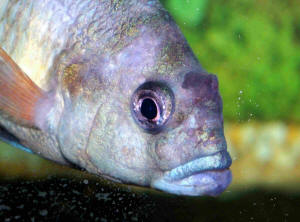
| Can you identify this? 4/24/08 Lake
Victorian Cichlid With Growth On Forehead Hi everyone, I really
need help with trying to identify what ailment my fish has and how
to treat it. The fish is a SP44 Lake Victoria Hap. He had developed
what appeared to be some sort of fungus on his lower lip and on his
head. I set up a 10G hospital tank and after making sure he was
acclimated properly and was comfortable in the 10G,I began
treatment with Jungle Fungus Eliminator. His lip cleared somewhat
but the patch on his head would not get better. After a month I did
some research and decided that maybe the problem wasn't fungal
in nature. So after doing a water change, running carbon, and
waiting a couple weeks I began to retreat using Seachem ParaGuard.
The fish has been in the QT tank now for 3 months and although his
lip has completely healed the patch on his head will not go away. I
have stopped treating him last week, and I am not sure what to do
now. He has been active, with good color and has been eating very
well al this time. I noticed tonight the patch seems to be getting
worse, and he is now flashing, rubbing the infected area on rocks
and gravel in the tank so its beginning to really bother him. I
began the ParaGuard treatment again, but I hope you can help me
with diagnosis and a proper course of treatment. Attached are a few
pics. I do not want to lose him. Thanks for your time Eric <
After reviewing your photos I think that you male hap has scar
tissue from either fights or from foraging in very coarse
substrate. As he forages through the sand the abrasive edges scrape
up his mouth and face. This trauma to the face opens up wounds that
can get infected. These start out as a bacterial infections. Things
like fungus feed of the dead and sloughing tissues. These diseases
can be treated using antibiotics like Furanace but they will
comeback as long as the abrasive materials are still in the tank. I
would consider changing the substrate in the main tank. Another
possibility is fights with other cichlids. Cichlids are very
aggressive and if your Victorian hap is sharing an aquarium with a
lake Malawi Mbuna, then the teeth on the Mbuna can cause lots of
damage on the opposing fish. Try the Furanace while he is in the QT
tank and keep up on the water quality.-Chuck> |
|
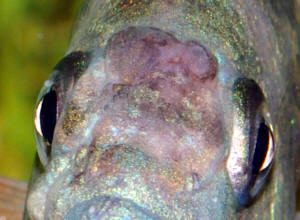
Great pix! RMF.
|
African Cichlid Help 4/1/08 Hi, I have a
65
gallon tank and my only female is gasping for air and hiding at the top
the tank by the filter/heater. <Do check water quality and
chemistry: these are classic signs of distress, and sometimes certain
individuals or species respond to problems faster than others.> I
can't lose her - she gives me babies! Don't know what to do. I
added water conditioner and cycle by Nutrafin. The other fish seem to
be swimming around a little faster than usual. Never had this happen
before. What can I do. should I add medicine Maracyn??? Think the PH is
okay but ph reader is on the fritz. Just changed the water as usual
yesterday. <As I say, check water. But if you have the right water
chemistry and good water quality, the social behaviour may be an issue.
Unreceptive females (perhaps simply because she's getting old, or
not eaten enough recently) often get hammered by sexually active males.
This is extremely common with cichlids, and indeed other aggressively
promiscuous fish like livebearers and halfbeaks. If this is the case,
removing the female to a quarantine tank for some rest-and-recuperation
might be just the ticket. Female African cichlids are often quite mild,
so depending on the species, you may even be able to keep her for a
while in a standard community tank.> Help Please <Cheers,
Neale.>
Black calvus breathing really hard for air
03/19/2008 I bought a black calvus and it is breathing really hard
for air. <... Mmm, all fishes (in fact all livestock) is damaged,
stressed in shipping/moving... hence one part of the suggestion to
quarantine, allow it to "rest up" before being placed in a
community setting where it may be harassed, have to compete too hard
for food...> I put him in well established tank, 80 degrees PH 7.9
nitrites and nitrates are in a normal parameters. <... need data,
not subjective evaluations> The other cichlids he is with are doing
fine and breathing normal. He just sits on the substrate doing nothing.
He does not have any signs of disease no white spots or no cloudy eyes
all fins are good he sits right side up no swaying or anything what do
you think Troy <... Read more widely on the Net re fish physiology,
husbandry, particularly the value of quarantine... there is very likely
nothing "wrong" with this Cichlid than that it's new. Bob
Fenner>
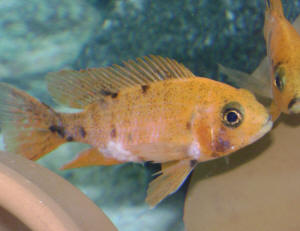
| can you help me identify this disease, no
info. 3/6/08 Im am currently treating this with
Melafix. <Worthless> Last night I also realized that another
fish has this also, along with his fin almost missing. please help
me. David <... not with the lack of data presented... Read here:
http://wetwebmedia.com/FWSubWebIndex/afcichdisfaqs.htm and the
linked files above. Bob Fenner> |
|
|
Cichlid question Treating Sick Cichlids
3/6/08 I am sorry to have to ask you busy people for help but at
this point, I just have to do it. I am certain that I know nothing
about my fish. I thought that I was ready after 3 years of having 1
beautiful bright yellow cichlid in a 55 gallon tank, that I could
handle 5 more. I purchased 3 and put in a 10 gallon tank for 3 weeks.
All seemed great. Moved them to the 55. 2 weeks later, purchased 2
more. The lady at PetSmart said that I had chosen Jewel Cichlids. They
looked fantastic! I put them straight away in the 55 gallon tank, big
mistake. I have had the tank for 10 years. During that time I kept easy
fish, community fish really. Then we moved and I gave away all my fish,
broke down the tank and relocated to another state. Got settled into
new place and began rebuilding my tank environment. Set up tank and
left it empty for months. Then friend gave me a tiny little yellow fish
that I loved! Turns out it was the Electric- something or other- yellow
cichlid that I have now and he is big he is about 3 or 4 inches long
and 2 or so wide... Beautiful fish! I had only had 1 cichlid for 3
years, I have had fish and lots of sicknesses and realize that I am
still a novice. I have tested the water and all was well there. My fish
started to act strange. They eat good and always have. However, they
would dart wildly around the tank and appeared to be bouncing
themselves off the tank decor, what I thought could be considered
scratching... first thought was Ich. I watched my fish more closely. I
noticed them kind of jerking, but no spots of any kind. No visible
anything's. I frantically search the web and decide that it must be
bacterial or parasitic. Flukes was my final diagnosis. I made a plan to
treat with a broad spectrum parasitic hoping that I would nail the
problem even if I was just a touch off. I purchased a medication called
Quick Cure for parasites. Upon coming home and checking out the fish, I
noticed some frayed fins which I thought could be fin rot or just
typical fish fighting I had Melafix on hand as always. So, after I used
the Quick Cure that morning as the package directed, I used the Melafix
about 12 hours later thinking all should be fine to mix the 2 as long
as I didn't do it like right together. Well fish haven't been
doing the jerking thing, and they still eating well but they are still
occasionally bouncing off the tank decorations and have begun to change
color. I had a blue striped cichlid, I think I may have identified him
as some sort of peacock blue cichlid but I am still learning there too.
He looks like a ghost right now, he has became pale sickly looking
totally not what he was yesterday. He eats good and doesn't hide,
swims well and all that. As for the Jewel's they have went from
mostly red and yellow to brownish or black. They look dirty if that
helps any. My water levels have changed just a bit, but still nothing
to worry about there I don't think. But a new finding is that one
of my Jewels has a white spot on his head just above his eye. That was
not there when I first noticed signs of something amiss. I have been
treating for 3 days now and planned to do partial water change at day 7
and gravel vacuum. I have changed about 10% today. I have no idea
what's going on with these fish but I know something isn't
right. I seriously hope I don't kill them. :) If there is any
advice you could offer me at this point, I would greatly appreciate it
and again, I know you are busy and hope I haven't disturbed you too
much. Thanks! -Jerriesue < Your electric yellow and the peacock
cichlid come from Lake Malawi. They like hard alkaline water that is
about 77-79 F. These fish are usually pretty resistant to Ich but
sometimes come down with protozoa infections that cause them to dart
around. The best treatment is to check the water quality and treat with
Formalin. The Quick Cure you are using is a copper product that in my
opinion is very dangerous to use. The levels of copper needed to kill
parasites are very close to the same levels that kill fish. I would
recommend doing a 50% water change, treat with the Formalin and add a
tablespoon of rock salt per 10 gallons of water. The jewel fish comes
from African rivers but can handle the same water conditions and
treatments.-Chuck>
|
My frontosa swimming sideways
Frontosa Swimming Sideways 3/2/08 Hey guys, My husband and I
have had a 7 stripe frontosa and we think he is going on thirteen
years old. When I test my water I test mainly for the ammonia,
the nitrates and the pH. The ammonia is ppm. <You did not
include a number but the ammonia should be zero.> The nitrate
is ppm. < Once again you did not include a number but the
nitrates should be under 20 ppm.> The pH is between 7.8 and
8.0, the temp is 80 degrees F. He is in a 55 gallon tank with a
cat. He has had a bulged eye for almost a year, I tried to treat
it several different times but it didn't get any better, I
don't know if that has anything to do with the way he is
swimming, (kinda of sideways) I am sending you a short movie clip
that I just took of him and that way you can see exactly what I
am talking about, I hope that is OK, I thought it would be more
help to see then to try to explain it, and was hoping you could
suggest a treatment for him, I just put Maracyn-Two in his tank
but I have no clue if that is going to help. Thank you for your
time. Michelle < You fish is very old and has an internal
infection. Try treating him with a combination of Metronidazole
and Nitrofuranace. If he is still eating then try getting him to
eat a medicated food with Metronidazole in
it.-Chuck>
Re: My frontosa swimming
sideways 3/5/08 Getting Medications Online Hi
Chuck, This is Michelle again, you said to use Metronidazole and
Nitrofuranace, Do you know what website I could purchase it on ?
I really would appreciate it, Thank you so much. <
DrsFosterSmith.com will have what you need.-Chuck>
Re: My frontosa swimming
sideways 3/5/08 Old Cichlids Getting Sick Thank
you Chuck, I have a few questions, How do you know if your fish
is sick or just old? < In the wild these fish rarely live past
a couple of years. As they slow down they are usually picked off
by predators.> If they are old do they always get sick before
they die, Or does there organs just give out and they pass on ?
<In a long term captive situation they are probably not
exposed to too many pathogens. In this case as organs start to
deteriorate normal bacteria that feed on waste may start feeding
on the decaying tissues.> And does a old fish act different
from a young fish? <Young fish get sick too except they have a
greater resistance to fight off diseases and recover more
quickly.> If yes, How? < Old fish past their prime may not
respond to medications and never get well.> I just need to
know because I have a brichardi that is nine years old and he
sitting on the bottom of the tank. Is that old for a brichardi?
< Yes, both your fish are well past their prime.> I have
been feeding him the Anti Parasite food by Jungle ,He is eating
but scoots on the bottom. I need to get the Metronidazole and
Nitrofuranace, Thank you again! < Old fish like this can be
hard to cure, especially after so much time has past. Good
luck.-Chuck>
|
My African cichlids... hlth.? Env.
2/19/08 hello I have a question. my cichlids are rubbing against
the rocks and shaking what do I do?. I have just added CopperSafe how
long will it take before I could do a water change?. and if this works
how long will it take before the sickness will go away?. I have a 72
gal bow with 50 cichlids and my tank is about 1 month old. please help.
<Hang on a second. This tank is one month old, contains 72 US
gallons for water, and contains 50 cichlids? Given that even with small
fish you wouldn't keep more than an inch of fish per gallon, with
African cichlids this stocking density is insanely high. So first
things first: tell me about water chemistry and water quality. Fish
'flash' (as this rubbing or scratching behaviour is called)
when they are irritated. Sometimes the irritation is caused by
parasites, but often by sudden changes in pH or poor water quality
(ammonia and nitrite especially). Assuming these are Rift Valley
cichlids, how are you stabilising the pH? What is the pH level
immediately after a water change, and what is the pH a week after a
water change -- this will tell you how stable the pH is. All aquaria
become acidic over time, and with African cichlids slowing this
acidification is essential. So you need to ensure you have lots of
carbonate hardness. What is the carbonate hardness in your tank?
That's measured in degrees KH, and shouldn't be confused with
general hardness (degrees dH) although you need to know that, too. For
African cichlids, a general hardness of around 20 degrees dH and a
carbonate hardness of at least 7 degrees KH is required. Next up, what
about filtration? What is the nitrite concentration in this tank? What
about the nitrate? How much water do you change per week? (Should be at
least 50%.) What is the capacity of the filter? Minimum should be 6
times the volume of the tank in turnover per hour, but realistically 10
times the volume is what a heavily stocked cichlid tank really needs.
I'm asking you all this stuff because your fish are likely
irritated/ill because of environmental issues rather than disease by
itself. In any case, I feel your tank is massively overstocked, and
unless you're a very expert fishkeeper rearing large numbers of
juvenile fish that will be sold before they get too big, this tank just
won't work. Cheers, Neale.>
Tropheus With Bloat 1-22-08 Hi WWM, I have a
Tropheus duboisi which I believe has swimmers bladder. Its stomach got
large and the area where it poops was swollen. I wasn't sure what
it was so I started to put in medication since its a juvie. MelaFix)
I've been doing this for over a week and the fish finally took its
first bite after 2 weeks of not eating. So far the fish's swelling
as decrease but its stomach is staying round but not to the sides as
much as expanding downward. I don't think it's dropsy since its
scales aren't sticking out at all even at its largest point. Any
ideas on what to do now since its half way to recovery I think? Plus I
noticed that my tanks nitrates were very high around 80-100ppm. Can
this cause the fish to become ill like this? I did a 35 % change the
other day and it was still high so I did another 50 % so its back to
normal. When I add the water to the tank I pour it in from a gallon
container, now can pouring the water to quick cause harm to the fish? I
don't know if it contributes to the fish's illness. My tank is
46 gallon with other Tanganyika cichlids mostly different Tropheus.
Thanks, Chris <When algae eating cichlids become stressed or are fed
food too high in protein they sometimes get an internal infection. This
infection usually results in a bloat or dropsy type symptoms. The usual
treatment is to improve the fishes overall conditions and treat with
Metronidazole and Nitrofuranace. If the fish is eating you can feed a
medicated fish food with Metronidazole in it. Big changes in pH and
temperature can stress a fish and increase its chances of getting an
infection.-Chuck>
| Sick Lake Malawi Cichlids 1/14/08 Hello
WetWebMedia. I just recently bought 3 assorted African cichlids and
they are about an inch to an inch and a half long. I have a 55
gallon tank with a 48" hood with 3 t8 bulbs (about 32 watts
each), ammonia = 0, nitrite = 0, nitrate = lower than 20, I'm
guessing like 10 (between the 0 and the 20), pH = 8.5 ,temp = about
78 F, kH = 75, alkalinity = 300, chlorine = 0. So the water seems
fine. I have the Tetra Whisper Power Filter 60 and filled the
filter bags with Ammo-carb to help control the ammonia better. So
Anywho. I bought an Electric Yellow Cichlid (Labidochromis
caeruleus), a Elongated Mbuna (Pseudotropheus elongatus), and a
Snow White Socolofi (Pseudotropheus socolofi) but more on the brown
side and not so albino looking. Here are some picts if they work
and links if they don't. [image: Snow White Socolofi][image:
Elongated
Mbuna]<javascript:OpenWindow('http://www.petco.com/Shop/AlternateImages.aspx?FamilyID=101074&sku=',
420, 510, 'AlternateImages', 2);>[image: Electric Yellow
Cichlid] http://www.petco.com/product/101074/Elongated-Mbuna.aspx
http://www.petco.com/product/101083/Electric-Yellow-Cichlid.aspx
http://www.petco.com/product/101097/Snow-White-Socolofi.aspx Ok
back to my problem. I noticed when I brought the blue African
cichlid home it had white things hanging off its mouth, and I
thought they were an external parasite of some sort, so I was
expecting him sadly to be the first to pass away and he was. The
Socolofi and the electric yellow seemed really happy and were
swimming around together checking out the new surroundings like
best buddies. Then I noticed the next day that the Socolofi was
sitting under the rock formation I had not really moving and kind
of gasping. Now today I found him partially on his side and gasping
even more. My water conditions seem perfect so I don't know if
those are the problems. I treated the water with conditioning salt
because that said it helps protect gills from toxic nitrates if
that was my problem and he seems to be doing a LITTLE bit better
but not much. I am wondering if he has a parasite of some sort or
if there isn't enough oxygen in the water or what. My Electric
is still zipping around the tank all happy. So I don't know
what's up. Right now my Socolofi is sitting my livebearer
breeding container, because that has seemed to be magical with my
other fish that have been sick and brought them back to life just
being in there hahaha. So yes he is separated from the yellow one
right now. Any help would be great. Thanks. < The problem is in
the food you are feeding them. The two fish that have already died
eat algae off the rocks in the wild. The electric yellow actually
eats small invertebrates. You fish food you are feeding has too
much protein in it for the algae eating cichlids. They have
problems digesting this food and tends to plug them up. The
electric yellow can handle this food so he is fine. The sick fish
should be treated with Metronidazole and
Nitrofuranace.-Chuck.> |
Growth On Gill Of Jewel Cichlid 1/9/08
Hi. I have 4 cichlids I think their Jewels. They've had a pretty
rough life so far. My brother rescued them from a neglectful owner.
Anyways I have suffered losses of old age and power outages (no air
flow or heat) but now one of my females has developed a growth (?) in
its gill. I have had a really bad algae bloom for quite sometime but I
had two pumps to try and minimize it to no avail (although my breeding
pair really seemed to love it and they breed continuously). I
transferred all my fish into an entirely new tank 2 days ago and I
noticed just how bad her gill has gotten and I have searched the
internet and haven't been able to see something similar. She has
been eating fine, her colour is bright and swimming fine although
slightly terrorized by the breeding pair, and this seems an odd way to
describe a fish but a little mopey? I chalked the mopyness up to her
mate dying about 2 months ago, but she's been hanging out with the
other single male now. Back to the growth, it looks like her organs are
coming out of her gill and has been like that for I would say a month
and a half and looks like its been getting bigger. All the other fish
are fine. I am by no means even slightly knowledgeable about these fish
and I really need some help!! Thanks! Mandy < I would recommend
isolating the affected fish and treating for parasites with Fluke-Tabs.
This would take care of any worms or fish lice that would be attacking
the fresh blood in the gill tissues.-Chuck>
Pseudotropheus socolofi albino holding? Breeding Ps.
socolofi or Bloat -- 1/04/08 I was just researching Pseudotropheus
socolofi albino. I have one and by the day "her" abdomen is
growing larger - I have not officially vented for sex. I thought maybe
she had Malawi bloat however research indicates that bloat is a very
pronounced area in the abdomen - a bump. "Cracker's"
abdomen is pushing out - girth is getting bigger all around by the day.
Is she holding? <Unfortunately it sounds like your fish has bloat.
When a female Lake Malawi cichlid is "holding" it refers to
the fry or eggs being incubated in her mouth. The extended belly and
labored breathing is a sign of stress and that your fish needs
help.> There are 12 other Malawi Mbunas in the 55 gallon tank and
none of them exhibit signs of illness i.e. bloat. I even have Ad
Konings book and still can't figure out if the indications of
holding. Oh and another telltale sign of holding is her fins are frayed
- perhaps from the breeding male's aggression? < The fins are
frayed from other fish biting them. This has nothing to do with
breeding.> No other fish's fins are disturbed - all are perfect.
Cracker is now almost laying down, hovering a couple inches above the
substrate, respiration seems somewhat strained. When I was cleaning the
tank about a month ago (I do 25% water changes on a weekly basis), I
found a baby! I tried to rescue it but it didn't survive...The tank
is full of rocks and hiding places - when I found the baby, I also
placed a terra cotta pot in the tank. I would so much appreciate your
advice please!! Thank you!! Lisa. < Typically albino fish are not as
hardy as normally colored fish. They are usually picked on by other
tankmates and this causes stress. The stressed fish become ill and then
are picked on even more, making things worse. I would recommend that
you isolate this fish and treat for bloat with Metronidazole and
Nitrofuranace.-Chuck.>
Malawi Cichlid Wipeout! 12/26/07 Happy Holidays! I
had a tragedy over the holiday season that I am trying to find an
answer to. I had a tank full of Malawi cichlids and all in the same day
EVERY single fish in the tank were on the bottom dead except for a few.
<Water quality, chemistry, air pollution, or temperature are the
only issues likely to kill all the fish at the same time very quickly.
Check all and act as required.> I thought maybe it was a water
quality issue so I did two fifty percent water changes and put some
tiger barbs in. Before I knew it, they were covered in small white
spots all throughout the body including eyes. <Likely common
Whitespot/ick, caused by stress. So whatever was at a lethal level when
the Malawians died is now merely at a stress level after the two water
changes. Transportation of new livestock can often trigger these sorts
of infections too.> What I am trying to understand is why not a
single white spot of Ich or velvet showed up on any cichlids, they were
completely asymptomatic. <Which is why it's a water issue.
Things like paint fumes, pesticides, alcohol, etc., can cause the rapid
death of lots of fish. Blocked filters, overheating, etc., can also
cause sudden and otherwise asymptomatic deaths.> Have you ever heard
of African Cichlids being completely resistant to fish
parasites/protozoan? <Nope.> Or is it a coincidence and did they
die from something else and the barbs happened to get Ich?
<Coincidence is two fish dying in the same week. All the fish dying
at once isn't a coincidence.> Thanks <Cheers, Neale.>
|
Paralyzed African cichlid - 11/20/07 Hello Crew, I just
wrote you last week about identifying a Floridian killifish
(thanks for the lead, Neale! I am still looking) but now I am
hoping you can help me with an unrelated problem. <Okay, fire
away!> First, a bit of background. I broke down and
redecorated my 55 gallon cichlid tank on Saturday. I started a
bit late, so by the time the tank was drained and ready for the
decor to be put in, I was ready for bed and too tired to
continue. I figured that the cichlids would be all right
overnight in a 15 gallon holding tub, since there was plenty of
filtration (two hang-on backs rated for 50 gallons each plus an
Eheim canister rated for 60 gallons) and aeration (a 16"
bubble wall) circulating the water in the Rubbermaid tub. Also
plenty of plastic plants for hiding. <Ah, I think I see where
this is going...> Well, I guess that 20 African cichlids are
not too happy about sharing a 15 gallon tub for that long
together, because two of them jumped out during the night.
<When I store fish in buckets, I always put lids on, with
towels on top to make it nice and dark.> One was totally dead
- it had a bit of blood near the gills, which makes me think that
the cats might have investigated the flopping fish - and the
other was entirely grey and washed out, dry and crispy. I felt
awful! I washed the two fish under the cool running tap (my tap
water is well water, not chlorinated, incidentally) and to my
amazement, one of them actually started to breathe, ever so
slowly! I couldn't believe it, because he must have been on
the laminate floor for a while to become completely desiccated.
<Yes, it's amazing how resilient fish can be. There are
many stories similar to this, and only last month I rescued a
goby from a similar level of dryness. He's fine now, swimming
about normally with nothing to show for his accident but a few
missing scales.> I put the fish in my biggest net and draped
the net across the tub, and in about 5 minutes the fish was
struggling, so I let him back in along with the rest. After the
tank was finished, I put him in with the 55 gallon tank along
with all the others. Since he struggled to be caught just like
the rest of them, I figured he might pull through. I didn't
realize how serious his condition was... <Oh.> After about
two hours of laying on his side in the front corner, I gently
prodded him and he sprang to life, but he swam so awkwardly... as
though the back half of his body were frozen. He hid towards the
back, and I removed him and put him back in the tub because I
feared he might bury himself somewhere in the display tank and
die there. Again, he struggled to be caught, but after I put him
in the tub he just laid on his side, which is what he has been
doing ever since. <Does sound as if he's damaged
somehow.> His fins are red and frayed and he looks so
uncomfortable. <They will heal.> He still looks dry, even
underwater. I thought he might be coming down with Finrot or
fungus so I put some API General Cure in the water. <The
"dryness" you see is damage to the skin and loss of
mucous, often along with missing scales that fall out after
exposure to air. In any case, while it looks rough for a while,
it will heal.> I was too hasty and realized afterward that
this medication is for parasitic infections, not Finrot or fungus
- the active ingredient is Metronidazole and Praziquantel. The
medication is not concentrated in the water, I only put 1 packet
(which is supposed to treat 10 gallons of water) in the 15
gallons of water. I also did a 1 gallon water change this morning
when I vacuumed the bottom of the tub. Would you recommend
absorbing the medication with carbon? <No point. It'll be
metabolized by the filter bacteria in a few days anyway, and
water changes each week will dilute it.> I added Epsom salt to
the water in case it could make him more comfortable, 1
tablespoon diluted in the new gallon of water I added back. I
know that this fish is probably beyond hope, but when I take him
out thinking it is time to bring out the clove oil, he struggles
wildly - which makes me wonder if maybe there is hope. Is there
anything more I can do? Should I add tonic salt or any kind of
remedy? <Assuming he hasn't sustained serious damage to
the spine or nerves, the skin and fins will recover, and to some
extent so will mild damage to the muscle blocks on the flank and
caudal peduncle.> Do you suppose it was the desiccation that
made him paralyzed, or could he have broken his back on the floor
when he fell? <Either or neither.> He fell from quite a few
feet onto the laminate floor. <Ouch.> When he swims, it
almost looks like his back fins are stuck together, but it seems
more likely that his spine is damaged. In any case, I would love
to know whether you advise euthanasia or not, because my gut
feeling is that this is the most humane thing to do...I'm
just not absolutely sure. <It's a personal choice. If the
fish is steady, swimming, and feeding, then I'd give the guy
a break and see how things turn out. If he obviously can't
feed himself and gets harassed by his tankmates, then moving to a
hospital tank for a couple of weeks might be a good idea. If even
after that there's no sign of recovery, then certainly
euthanasia may be the best option. But fish have amazing healing
abilities, far beyond anything seen in mammals, so I'd
certainly wait a while before doing anything rash.> I included
a picture in case it helps. I hope you don't mind, but I also
included a picture of his tank, because in the photo he looks so
awful and seemingly emaciated, I would like you to see that I
really do take good care of these fellas! <It's a nice
tank, and your fish doesn't look that bad. Traumatised and a
bit beaten up, but nothing fatal.> They get fed a variety of
foods, including blanched vegetables, New Life Spectrum pellets,
Spirulina flake, cichlid flake and algae wafers, very rarely
frozen brine and bloodworms, and a couple times a week a frozen
mash of mussels and peas. <Sounds nicer than what I had for
dinner! You obviously take good care of your pets.> I know 20
cichlids is a lot for a 55 gallon tank, but these are a spawn
from an accidental pairing of an Eduard cichlid and a yellow lab.
<Ah, this explains it. When I saw the fish, I thought
"Yellow Lab" but couldn't quite confirm.> Since
they are mixed, I can't trade them in, and this is the
biggest tank that I have room for without sacrificing furniture
and appliances! <You're doing the right thing here. While
"accidents happen" with cichlids just as much as with
careless teenagers, not everyone does the right thing afterwards.
I'm glad you've chosen to do so.> Thank you so much
for listening, and I apologize for writing such a lengthy email.
I am just so distraught by this. <Don't be too distraught.
Take these things as learning experiences.> I believe I speak
for all of us who are immersed in the hobby...we are enormously
grateful for your website, made possible by your generous
donations of time and effort. Thanks again. Nicole <Thanks for
writing, and good luck! Neale.>
Re: Paralyzed African cichlid - 11/20/07 Thank you so
much for your reply again, Neale! <You're most
welcome.> Yes, I have certainly learned my lesson. I've
been very fortunate, as I have two "lidless" aquariums
with large openings in the front where the fish could jump out,
and so far (knock on wood) I haven't had any kamikaze fish!
<Hmm... matter of time, I suspect. At the least, get two bits
of glass cut at your local DIY store. Make them wide enough to
rest on the tank, but maybe 1-2 cm short at each end, so
there's a free flow of air. This is cheap way to make a tank
safe for acrobatic fish.> I guess they must feel comfortable
in their tanks. The lighting is subdued, and they're in a
dedicated room so no one startles them. It makes sense that the
cichlids would jump out of a holding tank though, since it must
freak them out to be netted and whisked out of their tank and
into a little tub! <Indeed. This is exactly right.> I had
the tub on two chairs because I didn't want the cats peering
in, since I know that they love nothing more than drinking
straight out of the filter output! I guess they think of them as
little drinking fountains just for them. <It's the lack of
chlorine. Cats hate the taste of it. That's why they ignore
clean water in their bowls, but drink for fish tanks, puddles,
ponds, etc. It's no problem. The water in a properly managed
aquarium will do a cat no harm.> I also thought the canister
filter might work better with the intake and output at a higher
elevation. From now on I will cut little notches on the lid to
allow the equipment to make its way in there. <Just putting
the lids on loosely with the pipes sticking in and out should do
the trick (in my experience). Newspaper or towels can also be
used effectively.> Just one more thing...and I'm so sorry
if this is a dumb question! But wouldn't the fish suffocate
if they were in a container with a lid on it for very long?
<If the lid was airtight, yes. But I don't advocate that.
Just rest the lid loosely on the container. All it needs to do is
"bounce" an airborne fish back into the tank. Nothing
more. In situations where fish slither out (like eels), then
half-filling the bucket and putting the lid on tightly becomes a
better approach.> Sort of the way we would eventually
suffocate if we were trapped in an elevator? <Not sure this
would happen. Elevators surely aren't airtight.> I figured
a towel would be okay since it is breathable. But when you put a
lid on your buckets, the fish don't run out of air? An update
on the cichlid, by the way. He is still laying on his side, not
eating, and some scales have definitely fallen off because he
looks like he's speckled with bloody marks. <The bloody
patches are dead skin and lost scales. Assuming you treat for
Finrot and fungus, the skin and scales *will* recover.> I put
an algae wafer right near his head but he didn't touch it for
an hour, so I removed it. Every so often I find him in different
places, always on his side, so I know he is ambulating himself
somehow. I just changed three more gallons of water, because in
the 15 gallon tub where he is isolated, nitrates were a little
high (20 ppm, my water has 0 nitrates out of the tap) and I
definitely saw him "wagging" his front fins the entire
time the new water was pouring in. So it's not much of a
hopeful sign, but it is something. I'll keep him isolated for
at least a week, and I'll do daily 3 gallon water changes.
<Really, it's a question of time. If nothing improves
after a couple weeks, then consider humanely destroying him. But
otherwise, just let him heal naturally.> If he gets better,
I'll be sure to let you know! <Cool.> Again, thanks so
much for your prompt and extremely helpful reply. Nicole
<Happy to help.> P.S. Thanks for the encouragement! I too
am dismayed by how many people turn their mixed Malawi's in to the
fish shop, who for some reason accept them without qualms.
<Because they sell...> Even worse is that it seems
sometimes these crossbreeds are not just an accident. Just last
month I went to a fish shop with a tank full of twenty or so of
some kind of hodgepodge African cichlid. This cichlid looked like
a bag of Skittles! It looked to be some sort of a mix of
Pseudotropheus and Haplochromis, and sure enough the store
"didn't know what they were, but they were really
colorful" and definitely African. Ugh! <And it's this
that makes the African Cichlid hobby look bad. When you see
pure-bred stock, the colours are amazing. Coral reef brilliant.
Top-notch Yellow Labs and Blue Zebras are just as vivid as, say,
Yellow Tangs or Blue Chromis damselfish. This is why we love
African cichlids. But when you see generation after generation of
crossbreed fish, you end up with vaguely blue, vaguely orange,
vaguely yellow fish in the stores, and people say "why
bother?". I hope we see the market change for the better
here, with people concentrating on keeping and breeding decent
stock, so everyone gets to see African Cichlids at their best.
Cheers, Neale.>
|
|
 .JPG)
|
|
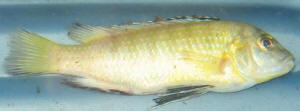
I really need your help. African cichlid
hlth. -- 11/17/07 My I have a pale blue African
cichlid, whom I've had for 2 and a half years, I'm really
worried about him because he's recently developed a growth
coming out of his genitals (I attached a similar picture,
although it isn't my fish.) I just treated the tank for Ich,
and stopped the treatments about 2 weeks ago. He's been
eating fine, and swimming around regularly the whole time until
just a few days ago. Now he's being very immobile, staying
the corner under the filter and not coming to the spot he usually
eats at. What should I do? I've grown so attached to him, and
I don't want to lose him! -Amanda <Greetings. Your fish
has a prolapsed anus, that is, a secondary bacterial infection
has caused the back end of its colon to swell up and become
inflamed, such that it now extends out of the vent. While the
causes for this are difficult to pin down in every case, mostly
its due to problems with diet (as you'd perhaps imagine). The
majority of cichlids are herbivores or omnivores adapted to
eating a high fibre diet; in the aquarium, we think we are being
kind by giving them high protein food like flake, pellets and
frozen bloodworms. While adequate as a treat, for many cichlids
this is the wrong staple and ends up causing problems just like
this. Rift Valley cichlids of the Mbuna type are all either
exclusively or primarily herbivores that feed on algae in the
wild. So what we should give them is algae, algae, some more
algae, and then algae for pudding. Maybe once a week we can then
add some zooplankton or insect larvae. This point really cannot
be stressed strongly enough: the reason your fish is sick is
almost certainly not enough fibre in its diet, so you need to be
switching to things like Spirulina flake, tinned peas, Sushi
Nori, sliced softened vegetables, and other green foods. Most
cichlids adore fresh Spirogyra and other green algae straight
from the garden pond, if you can supply it. To actually deal with
the prolapsed anus right now, you need to treat with Epsom salts.
A dosage of one tablespoon per 5 gallons should do the trick.
Make the "potion" up in a jug and then add it to the
tank; don't add the Epsom salt straight to the aquarium! This
is a laxative and will help the swelling go down and the
alimentary canal sort itself out. Don't feed anything other
than "greens". Tinned peas are ideal. Oddly enough,
LIVE daphnia and brine shrimp also work well, too. Do not feed
anything else. Not flake, not pellets, not nothing!!! The idea is
to use the fibre and the laxative to get things sorted out. Flake
and other dried foods will simply work against you. Continue this
regimen until the fish is healthy. And once it is, revise what
you feed your fish. Remember, with Mbuna, green food good, meaty
food bad, and dried food worst of all! Cheers, Neale.>
Re: I really need your help. -11/18/07 I
can't thank you enough! -Amanda <We're happy to help.
Good luck, and if things don't improve, let us know. Cheers,
Neale.>
Re: I really need your help. Do I add the salts
everyday? or just once? -11/19/07 I've only added it once
because I wasn't sure.. He seems to be getting better, but
the anus seems to be getting worse and protruding even more, and
he isn't eating. <Amanda, you add the salt only once to
the tank, and then to each new bucket of water added. So if you
take out one bucket of water, you add one new bucket of water
with the proportional amount of Epsom salt added. The idea is to
maintain the concentration of Epsom salt for days, weeks as
required. Cheers, Neale>
|
Re: I really need your
help. 12/5/07 So nothing has been working,
I've tried feeding him and not feeding him, keeping the
Epsom salts at consistent levels, I called the local vets
and they weren't sure what to do, and I don't know
if my fish is suffering or not. Do I have to put him down?
Or can they live that way? -Amanda <Amanda, can you send
a picture? Might help to understand what's the score
right now. At some point you may need to review the welfare
of the fish. If the fish is suffering, unable to swim
about, and looking lethargic and unstable, the painless
destruction may be appropriate. If the fish is simply
bloated but otherwise normal, you can probably afford to
wait. Do check background conditions in the tank: pH,
hardness, etc. Cheers, Neale.>
Re: I really need your help.
12/5/07 He really didn't like the camera in his
face! The quality isn't very good, but that should give
you an idea of whats going on. - Amanda <I can't see
too much, but it does look pretty bad. I'd be watching
the fish and seeing if it is in distress. If it is, and
there's been no sign of repair in the last two or three
weeks, then I'd likely painlessly destroy this fish.
Never a nice thing to do, and certainly not something to do
because you can't be bothered to follow through with
the time, expense required to heal a fish. But you do seem
to have done everything you can, and if the fish is in
pain, then destruction might be the right move. But if its
swimming about happily enough, and feeding and defecating
normally, then time may be the issue. Some sicknesses can
take months to clear up. Cheers, Neale.>
|
|
|
|
Dying Fish! Malawi bloat Strikes Cichlid Tank
11/13/07 Dear WetWebMedia, I sincerely hope someone can help me! A
few month's months ago, my 6 yr old son received a 29 gallon
aquarium set-up for his birthday. After some research, we decided to
stock it with Malawi Cichlids. Initially, everything went fine. We
slowly stocked the tank until we had 7 fish. The day after our fist 1/3
water change, my son dumped a lot of food into the tank. I immediately
scooped it out with a spoon, getting all that I could see lying on the
gravel. I also feel that for some time we had been over feeding the
fish. I have now adjusted our feeding schedule to 2x / day with only as
much as they can consume in 45 seconds. Regardless, a few days / weeks
after this episode, some of the fish started to die off. I noticed that
right before the fish would die, they would stop eating, become
lethargic, and their bodies became covered with white material that
looked like a cross between crusty and white cotton. I initially wrote
this off as stress, but as more fish started to die, I knew it must be
something else. I consulted with a person who raises cichlids and he
thought the fish had a fungus due to overfeeding. Even as this email is
being written, 2 more are dying! Unlike the other fish that have died,
the 2 that today, are fading rather quickly, do NOT have anything
growing on their bodies. However, just like all the fish that have died
so far, the 2 that are about to pass are laying on the bottom of the
tank. They will try to swim and end up just sinking to the bottom. Of
notice is the fact that they are breathing very rapidly using both
their mouths AND their gills. It is important to note that in addition
to the filter, I have 3 air stones running in the aquarium, so oxygen
should not be a problem. All of the fish that have died so far have
done this rapid breathing. In regards to the tank itself, I am dosing
15 ml once daily of the Melafix and 15 ml of Pimafix. The carbon filter
has been removed. Before starting the med's, I did a 1/3 water
change. I bought test strips and am testing the water a few times a
day, and everything is well within optimal range. To be sure, I took a
sample into the pet store today and everything checked out fine. My
tank is negative for nitrates and nitrites. The tank temperature is a
steady 80 degrees. Does any of this lead you to believe I might have
something else going on in the tank? Should I treat for something else?
I am so frustrated I just don't know what to do. As a matter of
fact, I just checked on the fish and have lost another just in the time
it has taken me to write this email! On another note, I am using the
filter that came with the tank, however, I am thinking of upgrading to
Fluval 305 or an Aquarium Pharmaceuticals filter system. I will buy one
that changes out 200 gallons per hour. Any advice as to my selection of
filters will be appreciated. Thanks to all in advance for your time and
consideration to my fish woes! I look forward to your response(s).
Sincerely, Joe < You cichlids come from Lake Malawi in Africa. The
water there is very hard and alkaline. Lower the water temp. to 75 to
77 F. They make a living by eating algae off of rocks and require a
food high in vegetable matter. Try a flake food that has spiraling
algae in it or a good vegetable flake. I suspect that the food you are
currently feeding is too high in protein. These fish can't handle
too much protein in their digestive tract and it blocks them up. The
bacteria in their gut starts to feed on the food and it bloats them up
and stresses them out. if you wanted to try and cure them you could try
a combination of Metronidazole and Nitrofuranace. treat them on the
first, third and fifth day. Do 50% water changes in between the days
you medicate and vacuum the gravel. This disease usually hits the fish
when they are about two inches long and are just becoming sexually
mature. I would recommend an out side power filter that moves at least
250 gph. -Chuck>
Mbuna milk mustache? -- 10/18/07 Hi Neale, Quick
question for you. One of my Mbuna has a perfectly symmetrical white
triangle that has formed around his mouth and "chin."
Unfortunately I don't have a digital camera and not able to send
along a photo. The water quality is good (nitrites and ammonia - 0;
nitrates below 20ppm; pH 8.0). Do you suppose this may be a fighting
wound? I've never observed the Mbuna "mouth fighting." No
other fish exhibit any fungus-looking attributes... Thank you and I
look forward to hearing from you! Lisa. <Hmm... assuming that this
isn't normal colouration (you never know with the more obscure
Mbuna) then it could be simply dead skin following a fight. In which
case, I'd personally use some mild antibacterial like Melafix just
to be on the safe side. If things got worse, then Finrot medication
would need to be used. Cichlids do indeed fight with their jaws, and
what you describe is not uncommon. Presumably the teeth damage the
skin. Anyway, keep an eye out for secondary infections, and if they
occur, treat for Finrot. Good luck! Neale>
Re: Mbuna milk mustache? 10/19/07 Thanks
Neale, shall I then move the injured fish to a separate tank to
medicate? (sorry if this is an obvious question) Lisa <I'd treat
it in the tank. If the problem is minor (which seems to be the case)
you may as well avoid problems with stress and damage caused while
capturing the fish. Cheers, Neale.>
Flashing in Mbunas 10/14/07 Hi Neale,
<Lisa,> I was just reading through the website. I noticed many
Mbuna owners spoke of their fish "flashing." In just about
all accounts, the crew attributed this to a high nitrate or ammonia
problem. <Or Whitespot, or any number of other things that irritate
the gills. Like dropsy, flashing is a symptom rather than a specific
disease or syndrome. Think of it as a heads-up that not all is well I
your aquarium.> I've noticed some of the Mbuna flashing however
the nitrates are steady at 10-20 ppm, ammonia and nitrite levels are 0.
I assumed their flashing was due to quirky Mbuna behavior. <It can
be. Flashing as a mating behaviour is where the cichlid zooms in front
of another, either as a threat or to display itself to a potential
mate. Flashing as a result of disease or irritation is where the fish
zooms against a rock or some sand, to scratch itself deliberately. In
the wild, this behaviour presumably dislodges external parasites, and
the fish is doing this in response to a similar stimulus, i.e.,
irritation.> The only water chemistry challenge I have is increasing
the carbonate hardness (I'm adding cichlid salts to partial water
changes as you recommended). I religiously change 25% of the water
every other week and take a full set of readings every weekend
(nitrite, nitrate, ammonia, pH, kH). <Very good. I'd personally
do more water changes, at least 25% per week, but if your water quality
is good, it's no big deal. But as a reminder to others reading
this: the great advantage of buying fish that *prefer* your local water
chemistry is you can do big, regular water changes without the expense
of modifying the new water each time beyond adding dechlorinator.>
Should I be concerned about the flashing Neale - it is not too frequent
however I do notice the fish doing it from time to time. <Look to
see what they're doing. If they're just darting about, then
it's not a problem and likely behavioural. If they're
scratching against objects (something fish otherwise avoid, for fear of
damaging their scales and mucous coat) then you may have a problem.>
Also regarding water chemistry - in both my livebearers and goldfish
tanks (i.e. guppies, Plecos, Corys, variegated platys, tetras) despite
incorporating crushed coral into the canister filters, the kH will not
increase beyond 4 or 5 however the pH has gone up to 7.8-8.0.
<I'd leave things be for now. While on the low side for guppies
and goldfish, it's fine for tetras and cats. The main thing is that
the crushed coral will inhibit any pH crashes. The pH will stay
alkaline and probably very steadily around the 7.8-8.0 mark regardless
of what happens.> Is there a buffer I can use that will slightly
increase the hardness of the water without making the pH exceedingly
alkaline? <Don't worry about it for now. Over the long term, see
how your fish do. What I'd expect to see is that all the fish are
happy, and the pH doesn't change much at all, implying the water
chemistry is nice and stable. At the end of the day that's the
important thing. At some point, it's a case of diminishing
returns.> Looking forward to hearing from you. Thank you so much.
Lisa. <Cheers, Neale>
Sudden dying fish advice! 10/3/07 Hi
<Hello.> I hope you can help me, am a bit of a novice fishkeeper
and after a promising start am slight concerned about the goings on in
my tank! <Oh dear.> I have a 35gallon freshwater aquarium, which
ive had for three weeks (originally my brothers and kept for 6yrs). It
had 5 Malawi's and one Plec and I added another 8 Malawi's,
another Plec and 5 red claw crabs (about 2cm each). <Red-claw crabs
are brackish water animals, and shouldn't be kept in a freshwater
tank. They are also amphibious animals, and keeping them permanently
submerged is cruel. Kept properly, they are more like frogs, rooting
about on land, but dipping in the water to moisten their gills
periodically.> Everything was going fine but then in the last 24hrs
both my catfish and the alpha male (a 2.5inch blue zebra) of the tank
have died! <Check water quality when two fish suddenly die.> I
have checked all the levels and everything is normal. <Define
"normal". I'm assuming you aren't using brackish
water, so the conditions aren't normal for your crabs at least.
More specifically, have you tested the nitrite level? Also, what's
the pH and hardness? Malawi cichlids need fairly hard water to do well
(at least 10 degrees KH, and a pH around 7.5-8). I don't know what
Malawi cichlids and Plecs you are talking about, but 13 Pseudotropheus
zebra and two common Plecs such as Pterygoplichthys multiradiatus
simply cannot be kept in 35 gallons of water. There is no way water
quality will be acceptable for them all. Even a single common Plec
needs around 50 gallons of water, at least.> My concern is that,
could this be the work of the crabs and should I really get rid of
them? The shop said they could live together but now am not so sure
<Crabs shouldn't kill most fish, though they will certainly
catch and kill very small fish like guppies. But unless you are keeping
them in a brackish water vivarium with a sand-bank and wood for them to
climb about on, then no, this isn't an acceptable home.> Advice
would be most grateful as I don't really want £80 stock
all to die off! <Indeed.> Best regards, Lester <Lester, you
need to sit back and review the aquarium conditions. A 35 UK gallon
tank is simply too small for all the fish you are keeping. What will
happen is that the fish will die, one by one, until the aquarium
reaches its "carrying capacity". You can delude yourself into
thinking the aquarium is fine, but Science doesn't work that way,
and until the population reaches a sensible level, fish will keep
getting sick and die. For 35 gallons, you should be thinking about,
say, one or two Ancistrus Bristlenose catfish along with maybe three
cichlids (one male, two females). Nothing else will work in the long
term. Hope this helps, Neale>
Mysterious African Cichlid Deaths -- 08/01/07
Hello! First off for you I have a big thank you for the wealth of
information I have in the past found on your site! It has saved me many
times in the past, and many more times at the very least satisfied my
curiosity. For the first time, though, I've been unable to find
the answer to my question via the great Google god. I am having
mysterious deaths in my African cichlid tank. It's a 75g tank, with
a Rena FilStar xp3 filter. It's been running for about 6 months. I
used a fine gravel for substrate as a compromise between sand and
gravel -- it's probably about 3 or 4 mm diameter. I decorated with
some Texas holey rock and a few pieces of driftwood. I've got 2
plants in there that have managed to be tough enough -- one Anubias,
and one java fern. Inhabitants: 1 Copadichromis borleyi (4" ish) 3
Labidochromis caeruleus (1"-2") 3 red zebras (2") 4
sunshine peacocks (2"-3") 1 German red peacock (2") 2
Kribensis (3") 1 rubber lip Pleco (2") 4 jacobfreirgi (sp?)
peacocks (2") 3 Pseudotropheus acei Water tests show pH 8.2, 0
ammonia, 0 nitrite, and under 20 nitrate. Temp stays at 78F. The
problem I'm having is this...every 3 weeks or so, 1 fish dies. They
die in the same way. They are breathing heavily, lying on the bottom or
up in a corner, no marks on them, no fins shredded, no nothing... but
within a day of my noticing that behavior, they die. When I find the
body the whole ventral side is generally white. Peacocks die in this
manner more so than the Mbuna, or at least it seems like it. *All*
remaining fish in the tank continue to act normal and look great. Water
tests always look fantastic. I'm out of ideas :(-heather < The
yellow type peacocks generally don't do well in Lake Malawi
community tank situations. That are easily stressed and come down with
internal infections. The yellow type peacocks do better in a species
only tank. You can isolate them and treat them with Metronidazole as
with a bloated cichlid. It may cure them now, but placing them into the
main tank may be delaying the inevitable. I would also look into
changing the diet to one high in Spirulina algae.-Chuck>
| Blue Ahli - Sad Story. Electric Blue Treated With
Melafix -- 06/15/07 I had the pleasure of stumbling onto your
site after trying to do some research for something that was
affecting my Blue Ahli. (Like that past-tense...?) Unfortunately, I
wasn't able to find any medication that could help the little
guy out, and after 4 days of care the little guy passed on. But, I
wanted to pass this information on in case you guys might have a
solution and someone finds their fish are affected by a similar
problem. I apologize for the large pictures, but I wanted some
detail for myself, and didn't have Photoshop installed to
reduce the quality/size for you. Nonetheless, here's my story:
I put my 80 gallon tank back together (it's been dry for 2
years) about 2 weeks ago and purchased a couple of small Jack
Dempseys, two small Green Terrors, and two small Firemouths to
start the tank. I also purchased a ProClear 120 Wet/Dry filter to
replace my old Emperor filter that I had on there. To start the
tank of with some bacteria my local aquatics store offers what they
call GO-Juice... it's essentially just the crud they squeeze
out of a used fish filter sponge. Works quite well and I've
used it before to start this tank off several years ago. Well, the
six fish were doing fine, but after about 1 week, I went back to
the store and noticed several Africans which caught my eye. Since
the store owner and I have known each other for quite some time, I
asked if I could trade in my juvenile South American Cichlids and
get 4 Africans. "No problem, just get the pH up, and you
should be fine." Well, this last Saturday, I traded in my
Amazonians and bought two Venustus, one Bleekeri, and a Blue Ahli.
In order to get them used to the difference in pH, I performed a
drip over a 5 hour period into a 5 gallon bucket that they were in.
The pH in Florida is kind of high anyways, from the tap it sits at
around 7.8 and the tank was probably at 7.4, so I performed a 15%
water change to the tank to increase the pH a bit more during the
drip. When I was finished with the drip, (that included taking out
50% of the water after it filled the bucket, and running the drip
some more) I put them into the tank and they appeared to do well
and seemed to get accustomed to the tank quite well. To aid in
waste removal, and since the filter at this point still really
hadn't built up the ability to remove ammonia or nitrites, I
decided to also add 4 plants; two Amazonian Swords, and two other
freshwater plants that have an onion like bulb at the bottom and
are long and leafy. It seems on Sunday all seemed to be doing well,
and I was quite sure everything was going to be alright. On Monday,
I got up in the morning to look at the fish, and I noticed that the
Blue Ahli had a white "mark" near the top of his right
gill (see attached pic 1) and he didn't eat any of the Cichlid
pellets. I didn't think much of it and I went back to the store
and asked the folks there what they thought I should do since the
fish weren't so happy about the hard Cichlid pellets, so I
picked up some Super Soft Frozen Food Alternative by HBH and I also
picked up some Brine Shrimp. When I got back to the house, I
noticed the Ahli just wasn't going after the new soft tasty
looking pellets. Heck... he was not even interested in the Brine
shrimp... not one bit! I immediately took one of my 5-gallon
buckets and prepared it with a double dose of salt and
dechlorinator. I put an airstone in there and then put the poor sap
in the bucket. Well, I went back to work for a couple of hours, and
then decided to go back to the aquatics store and get their opinion
the situation and one of the clerks hands me some Maracyn.
Thinking, wow that's pretty stringent, I decided to stop at a
PetSmart on my way back home, and listened what the aquatics folks
there had to say. They recommended a bottle of Melafix made by API
Aquarium Pharmaceuticals. Apparently this stuff is all natural and
the aquatics clerk told me, it's what they use when they have
problems with their fish. So, I decided to give this Melaleuca
based (extracted from Tea Trees) stuff a try first. (Boy... it sure
makes the water smell better... let's hope it works as well on
the fish) After I put the Blue Ahli in the bucket, he seemed to pep
up a bit and swim quite a bit more, so I thought this stuff should
work quite nicely then. Tuesday... The Blue seems to be a lot more
active, but no improvement in the physical condition. The white
area now appears to have some redness in it, it's getting a bit
fuzzy, and a patch of it seems to have developed near the poor
guy's mouth. Well, I did a 10% water change to the water (since
there wasn't a filter attached to the bucket), and re-dosed it
with the Melafix and Lake Salt early in the morning. I figured that
since he hadn't eaten in 2 days that the level of waste
shouldn't be too bad, and I tested the water at 7.8, zilch on
ammonia and nitrites... good to go I thought. Maybe this is just a
part of the disease's stages... At lunch that Tuesday, I
checked the Ahli... nope... seems to be little worse. Still active,
but the infection seems to be spreading. I put in a 1/2 dose of the
Melafix and a full dose of the Maracyn. I immediately busted out
that old Emperor filter, cleaned it thoroughly and was looking
around for something to put it on since I don't have an extra
tank laying around. So, I found a 69 quart Rubbermaid plastic
filing bin. I cleaned it thoroughly and set it up with some bagged
aquarium sand I had sitting around (which I washed until the water
came up clear) all in a two and half hour lunch period (I'm on
Salary ok?!! :-) ). I also decided to stop by at the Aquatics store
that evening and get the owners opinion about the Rubbermaid
container vs. the Bucket. Well, he wasn't too happy about the
fish's condition and he said that I was to use a half dose of
this green and yellow capsule. He said the water will turn yellow
which is a normal process. Keep the fish in the bucket, keep
aerating it as I've been doing, don't change the water,
salt it every morning with a normal dose, and bring him water
samples. Well, that evening kept a close eye on the water. The temp
was staying at around 80 - 81F and the chemicals hadn't changed
either... 7.8, 0, 0. Lets see what the poor guy looks like
Wednesday morning... Wednesday morning came around... not looking
good for the poor guy... quite active, not darting aimlessly, just
more active than when he was in the 80 gallon tank. But, the whole
right side of his head was now affected! So, I changed 10% water,
dechlorinated the added water, added a little salt... not much, and
put in another dose of Maracyn. Lunch-time... no change, he seemed
to be breathing in and out some skin from his lips now and along
with his eye getting a little cloudy from the infection... looked
quite sad really. Didn't make me feel good either. Even the
water's edge on the bucket had a reddish tinged buildup on
it... like his flesh was just liquefying and floating to the top.
That evening... not much better. Checked water temp, chemicals...
normal. I then had enough and popped in 1/2 of that green/yellow
capsule, no more Melafix! Let's see if there's improvement
the next morning. Today... Thursday. Woke up... checked the fish.
Yellow water, reddish residue/buildup near the water level. Man...
I'm not feeling good about today. I called the aquatics store
and asked if the owner was around because I wanted to get his
opinion about putting the fish down and out of his misery... well
he wasn't there and the clerk advised me that he didn't
think that the owner would want me to put him down just yet.
"Call back in an hour or so... he should be back from
lunch." So, I went home for lunch myself... as I was sitting
at the computer, I hear splashing from the bucket every now and
then. Didn't think much of it... maybe he's just getting
restless in that bucket. A half hour later... more splashing. I got
up and checked the bucket... he was darting about upside down
before I got close to the bucket, and when I stood over it, he
stopped. Lifeless. I got a net, pulled him out of the bucket, took
my last few pictures (also attached) and was quite amazed with the
speed of which this "disease" hit... and the fact that
his anal region looked ulcerated...? I'm thinking Mouth Rot
that progressed to the insides? I'm not quite sure... The other
fish in the 80 gallon... watching them like hawks and they seem to
be doing just fine. I make sure not to overfeed them, just trying
to prevent The Bloat and excess waste. I feed them once a day now,
ever since the Blue got affected by the disease... I was feeding
once in the morning, once at lunch, and then at night... small
doses. Now, just enough for each fish, like 1 - 2 pellets each. The
Venustus are about two inches each, the Bleekeri is about 3 inches
long and they are a joy to watch and feed. Just too bad the Ahli
didn't have the same success these guys did... Anyways,
there's my book and I'm sticking to it. Maybe this story
will help some other individuals with a similar issue and hopefully
this'll provide a better outcome for them. Do you guys have any
insight on this situation? < Your Sciaenochromis ahli is an open
water fish predator from Lake Malawi. I suspect that during a fight
or being chased he injured himself on something in the tank. The
wound got infected and a secondary fungus infection set in. These
fish are actually quite delicate as far as these cichlids go. The
stress from his injury and the high water temps caused him to
probably bloat up. So now you had two problems. An internal and
external infection. Although some people swear by it, I have heard
that Melafix works better as a general tonic then as an actual cure
for most diseases. I would of recommended placing the fish in a
hospital tank with clean water at 75-77 F. Treat with both
Metronidazole for the internal infection and treat the external
infection with a full dose of Nitrofuranace.-Chuck> Other than
that... you guys provide a great resource and you've helped me
be more aware of treatment methods and medications. Regards,
Mark |
|
|

