|
FAQs on Discus Disease, Pests
3
FAQs on Discus Disease:
Discus Disease 1,
Discus Disease 2,
Discus Disease 3,
FAQs on Discus Disease by Category:
Diagnosis,
Environmental,
Nutritional,
Social, Infectious,
Parasitic,
Trauma, Treatments
Related Articles: Plants +
Discus = Wow! by Alesia Benedict, Planted Aquariums: Plants and Discus: What They Need To
Thrive By Alesia
Benedict, Discus Divas, Glitz,
Glam and Lots of Demands by Alesia Benedict, Juraparoids, Neotropical Cichlids, African Cichlids, Dwarf South American Cichlids, Asian Cichlids, Cichlid Fishes in General, Related FAQs: Discus 1, Discus 2, Discus Identification, Discus Selection, Discus Compatibility, Discus Behavior, Discus Systems, Discus Feeding, Discus Reproduction, Cichlids of the World, Cichlid Systems, Cichlid Identification, Cichlid Behavior, Cichlid Compatibility, Cichlid Selection, Cichlid Feeding, Cichlid Disease, Cichlid Reproduction,
|
|
Sick discus need help 5/19/18
Hey ! My discus fish is not eating since 3days after the death of his
tank mate and today he has clamped its fin.....and is in stress
<Yes, probably is stressed. May well be suffering from whatever killed
the other Discus in your tank. Review the conditions in the aquarium. To
recap, Discus need a large tank (for a pair, probably over 150 litres/40
US gallons) and certainly need good quality water with the right water
chemistry. In other words, 0 ammonia, 0 nitrite, and a nitrate level
below 20 mg/l. Water chemistry should be relatively soft for farmed
Discus: 1-12 degrees dH, pH 6-7.5. Wild-caught Discus are more fussy,
and must have very
soft water, more like 1-5 degrees dH, pH 6-6.5. Water temperature should
be relatively high, 28-30 degrees C. Discus are omnivorous in the wild,
and need a varied diet in captivity. They are prone to Hexamita and
Hole-in-the-Head diseases though, both of which are more likely if they
are given monotonous, low-vitamin diets lacking fresh greens; cooked
peas, for example, are usually eaten by hungry Discus without too much
fuss. Cheers, Neale.>
Discus; doing poorly, need info.
4/17/18
Hi
<Hello Caroline!>
A friend recommended you for advise!
<Advice too>
I have a mature 240 litre and hi have recently added 6 new discus fish.
2 of them have 1 fin clamped with what looks like a bit of fun got
<Fungus I take it>
and are breathing rapidly and occasionally flicking fins.
I've used Melafix so far but it doesn't seem to have helped.
<Do see WWM re this herbal treatment. Of little use to detrimental>
Can you suggest a different treatment pls?
Many thanks Caroline
<Need to know more re the water quality, system here. Temp., pH,
hardness of the water; nitrogenous compound concentrations... Are these
fish eating? What? I'd increase the aeration, water movement for now,
add activated carbon filtration ASAPractical as an aid to remove
undesirable materials.
DO please write us back with the information requested, and images of
the system, fish if you can. Bob Fenner>
Discus /Neale
4/18/18
Hi
A friend recommended you for advise! I have a mature 240 litre and hi
have recently added 6 new discus fish.
<Nice.>
2 of them have 1 fin clamped with what looks like a bit of Finrot and
are breathing rapidly and occasionally flicking fins.
<This could simply be a result of stress or rough handling, both of
which can cause these symptoms. They should respond to a two-fold
approach here.
Firstly, remove sources of stress. Dark tank, quiet, and above all good
water quality should help. Secondly, medicate appropriately, using a
reliable anti-Finrot medication. Depending on where you live,
antibiotics like Kanaplex would be a good call, or else something like
eSHa 2000 if you live outside the US.>
I've used Melafix so far but it doesn't seem to have helped.
<Indeed not. It's fairly unreliable.>
Can you suggest a different treatment pls?
<See above.>
Many thanks Caroline
<Most welcome, Neale.>
Re: Discus /Neale
4/18/18
Thank you very much I'll try ESHa 2000. Do I leave water changes though
for that as I usually do 15% daily at the mo?
<I would not do any water changes during the course of medications. If I
recall, eSHa 2000 takes 3 doses across 3-4 days. But if you must do a
water change because of water quality problems, do it 24 hours after
dosing.>
You're the second person to say that about Melafix can I ask why? Not
questioning you just to understand better.
<It's at best a preventative. It is very unreliable as a medication once
things get bad. Experience through working with WWM is that a lot of
folks who use it find it doesn't help. Some people find it makes things
worse. No personal experience of that, but I would be sympathetic to the
argument that in 'wasting time' with Melafix, the Finrot gets worse,
maybe fatally so.>
My water is fine nitrates 25ppm but my Tap water tends to be around 20
too...
<Should be find for most fish, but Discus are a trifle sensitive, as are
most cichlids. I'd be very aware of this, and think of ways to keep
nitrate as low as practical.>
Thx
Caroline
<Cheers, Neale.>
|
Discus fins black 4/17/18
Dear Sir,
<Anupam>
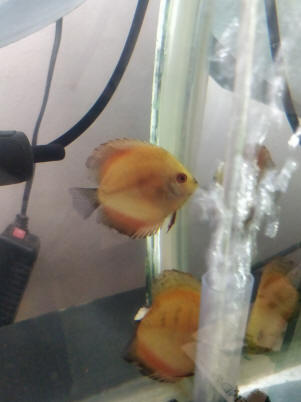
Two of my discus fins are turning black even water temperature is in between
86-88 F and I am changing daily 50% water change thinking if they have any
stress due to water quality it can be reduce down. For your reference I have
attached a pic also of them.
<I see this blackening and that the unpaired fins are badly frayed. What is the
pH, hardness of the water here?>
Can you please suggest me the right solution which can solve this problem.
<Need more information. Also, do you have a place to put these fish that is not
so stark? Another tank with decorations, plants? I would lower the temperature
down to the low 80's also. High temp. is not necessary or
desirable with cultured Discus>
Thanks in advance.
Yours Sincerely
Anupam
<Welcome. Bob Fenner>
|
 |
|
Discus fins black /Neale
4/18/18
Dear Sir,
Two of my discus fins are turning black even water temperature is in between
86-88 F and I am changing daily 50% water change thinking if they have any
stress due to water quality it can be reduce down.
<Could be.>
For your reference I have attached a pic also of them.
Can you please suggest me the right solution which can solve this problem.
<Typically, dark black patches are put done to exposure to ammonia. So do
check the ammonia reading of your aquarium. It should really be zero. The
water chemistry is important too. Discus need soft, acidic water to do
well. For sure the farmed ones are more adaptable, but they rarely do well
in very hard water. I'd be aiming for 1-12 degrees dH, pH 6.0-7.5. Of course
at low pH levels biological filtration operates poorly, so under-stocking is
important.>
Thanks in advance.
Yours Sincerely
Anupam
<Most welcome, Neale.>
Re: Discus fins black /Neale
4/18/18
Hi,
thanks for the suggestion....will check the ammonia and also follow your
instruction regarding DH and PH and check and will update you the progress.
Thanks,
Anupam
<Glad to help, and good luck! Neale.>
Re: Discus fins black /RMF again 4/18/18
Hi,
<Hello again Anupam>
Thanks for your suggestions...currently i have not put plants as i have
ordered for soil and waiting for that.
<Mmm; all this, the plants, soil, should be put in weeks to months ahead of
the Symphysodon>
I read that if tank is not planted water temperature should be in between
86-88F and if tank is planted water temperature should be in between 84-86F
hence i put temperature in between 86-88F.
<For wild fishes; these are cultured>
I am not sure much about stark what you mean to say but the place where i
put the fishes is calm and quite. Kindly advise.
<Back to reading, study... at least what is posted on WWM... ALL re Discus.
They need shelter, decor... to be able to get out of the light>
PH level i will check and let you know.
Thanks,
Anupam
<Read; don't write. Bob Fenner>
|
Discus just not 'happy' :( 11/13/17
Hi Crew,
<Greetings Liese>
Apologies for the tale of woe, but the more forums I check for 'advice'
the more confused I get, so I hope you guys might be able to untangle
the reasons for my Discus being generally 'off'. So, I have a 60 gallon
(280 litre) tank with, as of the last few weeks, 4 adult Stendker discus
(had 5 for the last 3 years but recently one died, perhaps all part of
the same issue here?).
<Maybe; let's see your data>
I do 3 partial water changes a week (overall works out about 30-35% a
week), using aged tap water, treated with Prime and warmed before
adding. I used to do larger water changes (20% 3 times a week) using
water directly from the tap (I did use Prime and warm water too!) but
when my fish first started to look unhappy I was advised to age it for
24 hours, so now storage issues mean I can only change 35-40 litres at a
time.
<Storing the new water for a week (or even more) is advised>
Water parameters currently and for many months are: ammonia and nitrite
zero, nitrate somewhere between 10 and 20ppm,
<Well; I should mention, so I am... even cultured Discus don't like NO3.
I'd have you read on WWM re methods of reducing, keeping this
metabolite under 10 ppm>
pH 7, temperature 83F. I have also had the water
checked at the local fish store just in case my test kits were wrong,
but no problems there. Water out of the tap is pretty soft. I
feed a mix of beef heart, flake, pellet food.
<Mmm; I made MANY pounds of beef heart mix for my Symphysodon decades
back, but this component has largely fallen out of favour>
So, compared to a few months ago, my fish are all so much darker in
colour, almost black at times, I can see strands of slime coat
coming off a couple of them, and they're not eating with as much gusto
as previously :(
<Something wrong here. I suspect, as usual, first and foremost, issue/s
with the environment>
At various points over the last few months I've treated for Hex,
internal bacterial infection, worms, flukes,
<? All these fish have been in captivity for years? Where would
pathogens be introduced here?>
trying to eliminate obvious issues first, but nothing has made any
noticeable difference so I have to assume that there is another reason
for their stress/symptoms? I know 6 is the magic Discus number, but my 5
were always OK and I was reluctant to upset the status quo since I know
my tank is only 'just' big enough for 6.
<I would not add more to a sixty gallon>
I will get another couple if you think that will help, but I'd really
like to get to the bottom of the current issue before throwing more fish
into the unhappy mix. Since getting my discus 3 years ago, I added a
shoal of 10 Corydoras sterbai about 6-8 months ago who are doing really
well, breeding regularly (very cute babies!) and zooming around on the
tank bottom.
<Ahh, a good sign... at least conditions suit them. Am curious as to
your water temperature; as C. sterbai is a cooler water species
(typically 70-77 F) and Discus warmer>>
So, this has now got me thinking. Could all the Cory 'action' on the
bottom of the tank be upsetting my Discus?
<Doubtful, but a remote possible influence>
I'd say there is a pretty 'normal' amount of aggression between my
discus generally, although recently the biggest one has been chasing two
of the others around. Maybe now there are only 4 the hierarchy is being
re-established?
<I think you'd see over aggression here if this were so>
I'd really appreciate your advice as I'm at a point now where I don't
know what to do for the best. I have no space in my house for a bigger
tank so can't go down that route (I would if I could!), but it upsets me
to see my once-beautiful Discus shadows of their former selves :(
Thanks in advance,
Liese
<If it were my system; I'd try to systematically reason out the source
of the trouble via elimination, manipulation of one variable at a time.
Do you use chemical filtrants? Near the top of my trials, I'd use a pad
of PolyFilter, and/or a unit of ChemiPure in your filter/flow path, and
see (it should be obvious w/in a few days) if improved water quality is
an/the issue here; next... I'd raise the temperature a few degrees F.
Please do report back with your further observations. Bob Fenner>
Re: Discus just not 'happy' :( 12/5/17
Hi Bob,
An update on the Discus, wish it was good news. So, despite Polyfilter,
an increased water temperature and water changes to get nitrates well
below 10ppm, I got up this morning to find the blackest of my Discus had
died. It had seemed to perk up a bit the last couple of days and was
showing its stress bars rather than being completely black. Then last
night it was hovering close to the water surface.
<Darkness, poor body orientation... are very bad signs>
I turned up the aeration but obviously that didn’t help. No water change
yesterday so I can’t even blame that. So, of the 3 I have left, I now
have one who’s swimming slightly head down. Seems ok otherwise, eating
and out and about. I’m not treating for anything, although I do have
swim bladder medication on standby. It’s definitely not constipated.
Sorry for yet another ramble, at the moment I feel like banging my head
on a brick wall! I’ll keep up the water changes and see how these 3 get
on. On the plus side, they’re not aggressive towards each other....best
wishes. Liese
<Without knowing what, if anything, is amiss here; am wont to suggest a
change. IF they were mine, I might try adding a "black water
tonic/extract" in the hope of positively influencing water quality here.
There are a few such products, or you can make one yourself from a peat
product. Bob Fenner>
water change over done; incl. Discus sys. f' /Bob's go
12/17/16
Hi Crew & Merry Christmas!
<And to you and yours Elaine!>
My tank has been running for about three years. It has been in the
current configuration and stocking for six months. I think I
over did it with water changes.
<I see your statements below, and do agree. Nowayears water quality is a
dicey, changeable proposition. Best, as gone over (READ) here:
http://www.wetwebmedia.com/fwsubwebindex/fwh2ochgs.htm
TO: pre-make up the change water and STORE for a few days, a week ahead
if this is the interval for maintenance>
In an effort to make water changes easier, I changed from the
bucket method (40% three times a week) to a hose connected to directly
to the tap and thinking that more is always better, I changed my normal
40% water change to 80%.
<Yikes!>
Then because a water change out is almost always the answer to any
issues. I did anther 80% water change using the hose. All my
discus
<Eeyikes! Symphysodon, even the much more tolerant to change modern
cultured specimens, are sensitive to water quality vacillation,
parameters outside bounds>
started flashing, turning dark and labored breathing. Since nothing but
my water change method had changed in this tank for 6 months I targeted
the water change method as the issue. After lots of research, I have
determined that by using the hose directly from the tap into the tank
without aeration I mostly likely caused three issues (1) a micro bubbles
probably compounded by the current colder temps, (2) rapid pH shift
because of the increased percentage of water changed at once, (3)
ammonia/nitrite issue because my tap water's high ammonia, nitrate and
nitrite levels <Aye ya... got to convince you to get/use a large
(Rubbermaid Brute is a fave) dedicated trash can and lid, heater,
circulating pump (that you can
use to deliver the new water as well as stir it about)... for water
changes, NOT use direct tap/mains>
and by putting it directly into the tank the Prime couldn't work fast
enough to treat the water in the tank.
Tank Information
80 US gallon
Temp 84 deg F
8 discus 3 to 3.5 inches (domestic tank bred)
6 rummy nose tetra (12 were added about 6 months ago)
6 sarbi <Sterba?> Cory cats
1 bristle nose Pleco
1 large 4 year old angel fish (favorite hobby is picking off the tetras)
Sand substrate
Moderately planted - swords and crypts
Drift wood
2 Eheim 2217 Filters
Air Stone - running at night
Feed 2 times a day - rotation of flake, frozen blood worms, sera discus
pellets, frozen baby brine
Tank
Untreated Tap
Ammonia
0
6
<?>
Nitrate
0
2
Nitrite
25
40
<The above two matters are switched around>
pH
6.5
7.5-8
KH
40
40
GH
120
120
Steps Taken
Daily water 40% water changes using buckets - for 4 days
Turned air stone on full time
Increased temp to 87 deg F
Added 2 table spoons aquarium salt with each water change
4 of the discus have fully recovered, they are eating and their color
has returned. 4 are still hanging in the back of the tank, hiding in the
plants, not eating and two of these are still very dark. I'm not sure
what my next steps should be.
Thank you,
Elaine
<Perhaps Santa is bringing you the above gear... and an RO device for
Xmas!? Bob Fenner; sending/handing off to Neale>
water change over done /Neale's go
12/17/16
Hi Crew & Merry Christmas!
My tank has been running for about three years. It has been in the
current configuration and stocking for six months. I think I over did it
with water changes. In an effort to make water changes easier, I changed
from the bucket method (40% three times a week) to a hose connected to
directly to the tap and thinking that more is always better, I changed
my normal 40% water change to 80%. Then because a water change out is
almost always the answer to any issues. I did anther 80% water change
using the hose. All my discus started flashing, turning dark and labored
breathing. Since
nothing but my water change method had changed in this tank for 6 months
I targeted the water change method as the issue. After lots of research,
I have determined that by using the hose directly from the tap into the
tank without aeration I mostly likely caused three issues (1) a micro
bubbles probably compounded by the current colder temps, (2) rapid pH
shift because of the increased percentage of water changed at once, (3)
ammonia/nitrite issue because my tap water's high ammonia, nitrate and
nitrite levels and by putting it directly into the tank the Prime
couldn't work fast enough to
treat the water in the tank.
Tank Information
80 US gallon
Temp 84 deg F
8 discus 3 to 3.5 inches (domestic tank bred)
6 rummy nose tetra (12 were added about 6 months ago)
6 sarbi Cory cats
<Sterbai? As in Corydoras sterbai? An excellent companion for Discus.>
1 bristle nose Pleco
1 large 4 year old angel fish (favorite hobby is picking off the tetras)
<Ah yes, this is what they do, as I have warned aquarists, many times;
these cichlids *are* predators. Not necessarily good companions for
Discus though; somewhat different water chemistry requirements (white
vs. blackwater) and certainly more pushy. Altum Angels might be okay
though.
Would beware of introducing diseases from Angels to Discus; Angels do
seem resistant/immune to some pathogens that Discus are not.>
Sand substrate
Moderately planted - swords and crypts
Drift wood
2 Eheim 2217 Filters
<Excellent filters.>
Air Stone - running at night
<Interesting, but logical.>
Feed 2 times a day - rotation of flake, frozen blood worms, sera discus
pellets, frozen baby brine
Tank
Untreated Tap
Ammonia
0
6
<Are you saying there's 0 ammonia in the tank, but 0.6 mg/l in the tap
water?>
Nitrate
0
2
Nitrite
25
40
<If you mean the tank has 0.25 mg/l nitrite, whereas the tap water has
0.4 mg/l, I'd still be wary of this; even trace nitrite *is* a stress
factor, more so in acidic pH conditions than alkaline -- the opposite of
ammonia, which is less toxic in acidic conditions.>
pH
6.5
7.5-8
KH
40
40
GH
120
120
Steps Taken
Daily water 40% water changes using buckets - for 4 days
Turned air stone on full time
Increased temp to 87 deg F
Added 2 table spoons aquarium salt with each water change
4 of the discus have fully recovered, they are eating and their color
has returned. 4 are still hanging in the back of the tank, hiding in the
plants, not eating and two of these are still very dark. I'm not sure
what my next steps should be.
<Well, I'd stop feeding altogether until nitrite is zero. I'd be
focusing on biological filtration here, given ammonia is zero but
nitrite is above zero. Check water flow, check the media, and if
necessary give one of the filters a thorough clean this weekend, and the
other the same next weekend (I'd not do both at the same time). Rinse
media in buckets of tank water,
rather than tap water, so the filter media bacteria aren't stressed in
any way. But do squeeze sponges until the water runs through them as
clear as you can. Optimise water flow rate: the maximum flow with the
minimum turbulence. This might mean using spray bars, reverse flow
undergravel filters or something else to distribute current evenly.
Review stocking
density, feeding frequency, and remove any decaying organic matter.>
Thank you,
Elaine
<Cheers, Neale.>
Help, Discus poorly. 6/20/16
Hi,
<Hello Daniel>
I'm sorry to bother you but I don't know what is happening to my discus.
I tried your article on poorly fish, self diagnosis, but the link isn't working.
<Yikes!>
I have 2 discus in a community tank, it's 240l.
<Mmm; well... Discus aren't really "community" fishes... Can be kept with some
other species... best w/ others hailing from the same soft, acidic, hot water
habitats... but... Best in a group mainly of their own...
Symphysodon spp.>
One seems perfectly fine, the other is always at the back of the tank hiding and
is always sitting on either the floor/ the heater or ornaments.
His head seems to be angled up a lot and his fins are always down.
<Bad signs>
Temp is 28deg C
PH is 6.5
Ammonia is 0
Nitrite 0
Nitrate 10ppm
Planted tank with plenty of hiding places.
I do water changes once every 2 weeks and clean filter on alternate weeks.
Diet is frozen bloodworm, daphnia, mosquito larvae. Tropical flakes.
Please help!
Thanks you.
Daniel.
<What other species are present? Some/one may be badgering the hiding fish.
This may sound/seem strange, but if it was me/mine, I'd add another Discus...
these are social animals, and best kept in odd numbers if only a few animals...
that way one can't be beating up on the other solely. Bob Fenner>
|
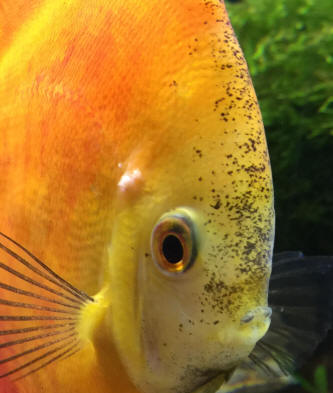
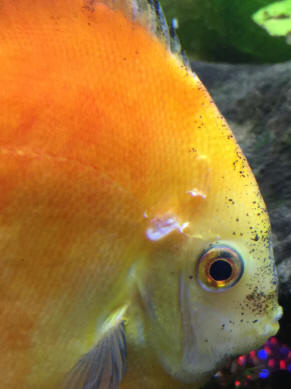
White spot on discus
3/9/15
Hi there,
<Jan.... your pix files are an order of magnitude too large>
Just wondering what would be this white stuff on my discus?
<Look to be physical cut damage>
Started as just one white pimple (1st picture)
then it grew (2nd picture)
<Mmm; think this fish is either frightened... at night, dashing itself into
something hard; or another organism is harassing it. Should have read here:
http://wetwebmedia.com/DiscTraumaF.htm
and the linked files above. Bob Fenner>
Thank you |
Re: White spot on discus
3/10/15
Here's a smaller version of the picture. Hope it will open this time.
<All opened... Did you read where you were referred? BobF> |
Discus burned from heater (just add Melafix, Bob?)<<Don't
raise my BP!>> 1/27/15
Hi there,
We just added couple discus in our tank and one of them started sulking
and didn't notice he was sulking by the heater. When I moved him,
there's a white mark, scales sloughed off and u can see his white meat.
The damaged area is about half inch.
<Oh dear.>
Right now, I have him QT with Melafix and 2 tbsp of Aquasalt. Temp is
about 84-85F.
<Apart from the salt and the Melafix, neither of which are helpful,
you're doing everything right. Time, good water quality, the right diet
are all that's needed here. In spotlessly clean water (0 ammonia, 0
nitrite, below 20 mg/l nitrate) fish have an astonishing ability to
heal. Provided the wound stays clean, it will be covered with mucous
very quickly, largely sealing it off from the outside, and new skin will
start growing within a few days. You should see clear signs of healing
after a week or so. Adding salt doesn't really do anything helpful,
particularly for soft water fish like Discus. Instead make sure the
water soft (less than 5 degrees dH, and the lower the better) and keep
the pH at 6-6.5 or even slightly below. Why?
Because bacteria don't enjoy acidic water, and many fish from blackwater
habitats -- such as Discus -- are actually overwhelmed by bacteria if
kept in alkaline conditions should they become stressed for some reason.
Since
you're keeping Discus, you presumably know all about water chemistry,
and I'd like to think you're keeping this fish in soft, acidic
conditions anyway.>
Am I doing this QT right? Any medication u can recommend?
<Not really any medication for burns. An antibacterial is worth having
on hand in case Finrot appears, but adding Melafix may or may not be
helpful.
It's an unreliable medication, and while it is sold (in part) as a
preventative, something to stop infections getting started, in some
situations it makes things worse. Bob F is not a fan, and I can
certainly think of better, more reliable medications.>
Thank u
Mike
<Cheers, Neale.>
|
White parasites on discus
5/1/14
Hello,
I'm having a problem with my discus that have the kind folks at
simplydiscus stumped. First, some background. I have 8 discus in
a 210 gallon tank and change @ 40% of the
water every two days, with the temp at
82. It's a lightly planted tank with a sand substrate, and the
other
inhabitants are some cories, a large school of neons, and various
snails.
Two months ago, my discus developed white spots.
<I see this/these>
Thought Ich at first, but then they grew out -
protruding from the fish 1-2mm.
<A bit large... though, for the record/browsers, what one actually sees
on fish
hosts is NOT the actual parasites, but accumulated body mucus from
irritation... can be largish at times>
Three days later, they all fell off and fish
appeared normal.
<... like a single generation instance of Ich>
Since my initial observation,
they've appeared 3 more times. Tried treating with formalin/malachite
green (quick cure), PraziPro, and
Metronidazole flake (although I was trying to
treat Hexamita with that last one, only because I see what appears to be
HLLE on a couple fish)
<Beware of too much Metro/Flagyl use (will kill the fish)... and the
HLLE is likely due to treatment... IF applied
properly some should have killed the snails, likely the Tetras>
while boosting the water changes significantly.
Today I noticed the white spots returning. I assume this is a parasite
but at a loss as to how to combat this. Any
ideas?
<Yes; a microscopic examination of some of these spots scraped onto a
slide... may be nothing but Symphysodon mucus/bumps...
How was the Prazi applied? Are these flukes?
Bob Fenner>
Thanks,
Jon
|
 |
White parasites on discus
5/1/14
Thanks for the input! I applied the PraziPro directly to the tank - I was
thinking some form of body fluke is a possibility.
<How much and how? Did you try introducing via foods? See WWM re. B> |
sick discus. Reading
4/23/14
Hello Timbra sent me to you!
I was given three sick discus! we thought parasite. There were three two
died pretty quickly. The last one was treated with General cure for four
doses.
<What do you think you were/are treating for?>
was not 100 percent better so moved him in with my big guys at which at
first his sprits were listed. I have still never seen him eat but day
before last he was out and not hiding.. this am he was at top with fins
clenched then he moved around a pit..while in big tank...its prob been
bout a week i have used PraziPro but he still ahs white poop and like i
said doesn't look really happy..any advice? He's small bout two inches
<... Perhaps lumenal issue, protozoan... I'd have you read here re
Metronidazole use:
http://wetwebmedia.com/FWSubWebIndex/discusdisf3.htm
and the linked files above. Bob Fenner>
Re: sick discus
4/23/14
i believe i was treating for Hexamita.
<.... Octomita now-named... General Cure "contains Metronidazole and
Praziquantel in quick-dissolve powder form" should do this in proper
use>
white stringy poop and not eating...when he's out and about with the
group he looks normal..but the times he withdrawals he looks bad i go
home in two hours so i can check on him then, i did read the article.. i
kinda felt the way that guy did he was miserable when he was alone . The
big tank was treated with PraziPro
<.... Read the FAQs please; and run your writing through
spelling/grammar check before sending. BobF>
|
Please Help for Identifying the disease
1/20/14
Hi
<Sup Sup?>
This is my first mail to WetWeb media.
<You are a stranger here but once>
Today morning I found one of my discus dead with white belly .
My all other fish including 3 discus are absolutely fine.
<Ahh>
I have found few white spot on discus pectoral and caudal fin three days
back. But today I found all white spot gone. I have attached a picture
of dead fish. I want to know what is happening with this fish because I
never saw this before.
Previously the discus was not eating and hanging tank top corner
with some bloated stomach.
Already I have tried epson salt and tank temperature to 30C. I have
measured and found all parameters are absolutely fine.
[image: Inline image 1]
Regards,
Supriya
<IF all Discus were similarly affected I might guess (and have you
confirm with microscopic examination of a skin scraping) body flukes,
perhaps one of a few Protozoans. But the fact that the sole Symphysodon
is thus leads me to believe it was "picked on" by <an>other fish
present. This does happen; and is likely related to the isolated,
non-feeding behavior... Too crowded, de-selected... other factors. I'd
keep your eyes open for aggression amongst your remaining fish/es;
remove the bullied, or bullier if obvious.
Bob Fenner>
|
Re: Please Help for Identifying the disease. Symphysodon
1/21/14
thanks a ton for reply. Today i have evacuated my 4 nos 4 inch clown loach
from my discus tank because they are very notorious swimmer also destroy my
live plants.
But i don't really understand after dead why my discus belly turned white?
<It was very likely gone over roughly by another (fish)... Possibly the
loach; but more often by a "sucker" of some sort... A rogue "Pleco" perhaps>
Regards,
Supriya
<BobF>
|
Discus problem. Lack of data, rdg. 2/11/13
Hi
Crew
I have a pair of blue diamond discus with me since last 2 yrs.
<Ok>
Since last week there is a problem with them. They have turned dark and
refuse to eat normally as they used to. Their fins are also stuck to
their body .
<Something off here... When, where in doubt, massive water change/s w/
Symphysodon... Or moving to another established system>
They are aggressive as usual. My water temp is at about 32 degrees as I
am located In India. I have done a recent water change.
Could you suggest me a solution to the problem . I will be very much
obliged.
Thanks in advance.
<Can't "tell" more w/o knowing more... re water quality, the set up, any
changes done or perceived recently. So, I'll refer you: Read here:
http://www.wetwebmedia.com/FWSubWebIndex/discusdisf3.htm
and the linked files above. Bob Fenner>
Re: Discus problem. 2/12/13
hi
bob
<Not you too Amit! Proper nouns, the beginnings of sentences are
capitalized. Next you'll be telling me/us that you're a Wall Street
Journal reporter>
thanks for replying promptly to my mail. i have gone through the
link forwarded by you. I would like to add more regarding the
discus that i have observed \that have started swimming erratically. I
am located in India so there is no ph testing kit available at
my local lfs.
<Can surely be ordered via the Net>
I normally fill the water directly from my tap. I have been doing
this for
the last 5 years but there was no problem.
<Does the tap/source water vary in quality? Likely so>
can you suggest me a medication for my sick fish.
<Not w/o knowing what the issue is, no>
I am worried about them.
water changes every week and I feed my fishes with Tetrabits and frozen
bloodworms. My temp in the tank is at 30 degrees. I
have a corner filter. I have 1 inch black gravel in my tank.
I normally siphon of all the dirt from the bottom every week.
<Have you read on WWM re Discus as you were directed?>
is it possible for you to diagnose the problem and suggest me any
medication.
thanks in advance
<Please, don't write w/o following directions first. BobF>
still white spot? Symphysodon...
other Protozoa 11/27/12
Hello, I have had my tank up and running for a few months now. Tank cycled
using ammonia and have had no issues since on this side of things.
Tank is a 55g with 3 cardinal tetra's, 1 ram and 9 small discus. I realise
this is to many for size of tank and will rehome some discus when they grow
some.
<Good>
Ammonia, nitrite are zero, ph 7, kH I maintain at 4 using bicarb at water
changes as my tap water is super soft with 0 buffer. GH sits at around
50ppm.
<These are cultured Symphysodon, so there should not be an issue of too hard
water>
I have been tackling a Ich out break which has been fatal to 1 ram, 4
tetra's and sadly my smallest discus.
Ich came in with cardinals, don't have space for quar tank.
Im on the second course of Waterlife's Protozin now, the first course helped
a lot but was obviously just short of eradicating it.
<The fish in the pic sent along looks very poorly>
My temp is 30 degrees. Water changes before treatment was 30% twice a week,
sand substrate.
My question 7 of my discus are now looking great, colour back, fins erect,
very alert etc but 2 small ones are not doing very well at all, the white
spots have become light coloured patches.
<I'd keep these separated from your others... in a different tank>
Could you tell me if this is still white spot on them
<I don't think it
is; instead that it's accumulated body mucus/slime coalescing into distinct
dots... the real issue something else. Perhaps Octomita/Hexamita, other
protozoan/s; quite common unfortunately in far east imported Discus at
times... Read here re:
http://www.wetwebmedia.com/FWSubWebIndex/hexoctfwfs.htm
and search WWM re treatment... re Metronidazole in particular>
or have they developed something else like body rot from the stress etc.
Pic below, I've added a tank and healthy pic for you to see also.
many thanks.
[IMG]http://i360.photobucket.com/albums/oo47/deansie26/55G%20Discus%20tank/011.jpg[/IMG]
[IMG]http://i360.photobucket.com/albums/oo47/deansie26/55G%20Discus%20tank/010.jpg[/IMG]
[IMG]http://i360.photobucket.com/albums/oo47/deansie26/55G%20Discus%20tank/012.jpg[/IMG]
[IMG]http://i360.photobucket.com/albums/oo47/deansie26/55G%20Discus%20tank/001.jpg[/IMG]
<Separate them... and treat pronto... via food/s, feeding. Bob Fenner> |
 |
|
Re: still white spot? Discus...
11/27/12
Thanks for your help, they have both perished now but I will read the
likes <links> you provided.
<Ok...>
I'm not sure if you mis-understood what I wrote but its just the lack of
buffer that I add bicarb. My tap water is 1kh so I just buffer it to
stop ph swings.
<Ahh, I see.>
Thanks again
Jamie
<Welcome. Bob Fenner>
disease, FW... 11/28/12
Hello, I have had my tank up and running for a few months now. Tank
cycled using ammonia and have had no issues since on this side of
things.
Tank is a 55g with 3 cardinal tetra's, 1 ram and 9 small discus.
<... I responded to this ayer... See WWM re>
I realise this is to many for size of tank and will rehome some when they
grow some.
Ammonia, nitrite are zero, ph 7, kH I maintain at 4 using bicarb at
water changes as my tap water is super soft with 0 buffer. GH sits at
around 50ppm.
I have been tackling a Ich out break which has been fatal to 1 ram, 4
tetra's and sadly my smallest discus.
Im on the second course of Waterlife's Protozin now, the first course
helped a lot but was obviously just short of eradicating it.
My temp is 30 degrees.
My question 7 of my discus are now looking great, colour back, fins
erect, very alert etc but 2 small ones are not doing very well at all,
the white spots have become light coloured patches. Could you tell me if
this is still white spot on them or have they developed something else
like body rot from the stress etc. Pic below, I've added a tank and
healthy pic for you to see also.
many thanks.
<... same response. B>
|
Sick Discus... social...
6/15/12
Hello,
<Allison>
I was talking to you guys about my discus with the Hex,
<... a six sided system? Hexamita?>
I received the Metronidazole and treated him. He recovered, so he's back
in the big tank.
<... the system itself is infested. All fishes there need/ed to be
treated>
After being put back into the big tank, i realized that he'd not grown
much, and the other discus had.
<Happens>
She's quite the bully to him and he stays in the corner hiding
in a plant most of the time,
<Very likely needs to be moved elsewhere; particularly if this
is a small/ish tank or hexagonally shaped>
But when he does come out to eat,
He has black lining the tops of his fins, very thin
line, but as far as i know it's not supposed to be there.
<Common stress coloration... Move it, NOW>
And also his ventral fins are completely black and there's a black patch
around that area that covers maybe a quarter size of his body.
I've got no idea what's happening to him,
>.... then you haven't been searching, reading on WWM>
I am happy that he's back to swimming happily and no longer sick like he
was,
But I'm kind of worried about this new development.
Any ideas of what it is, and what i can do to get rid of it?
Or should I not worry at all?
<As above... move it or it will perish... Be
chatting, Bob Fenner>
Re: Sick Discus 6/16/12
well today he came out in good color and the other discus is leaving him
alone.
<Ah good>
the entire tank was treated for the Hex for a few days before putting
him back in.
It's not a hexagon shaped tank, it's a rectangle 55 gallon.
<I see>
and i did search your website, and all i could find where questions
about the entire body being black,
<Ahh, I see. Thank you>
not just that specific region.
<Is about the same... cause and effect>
Today he's out and about and only changes color like he was if he's back
hiding, which he hasn't done for the past 4 hours I've been keeping an
eye on him.
So do you think i should still move him?
<Not w/ your latest observations. I would just keep a close eye; a
look-see each time you're by the tank; particularly during feedings>
He seems like a complete new fish today.
there is also a blue dwarf gourami that hangs out with him, not
aggressive towards him or anything, but is the fact they're the same
color a possibility why his color was strange?
<Mmm, don't think so>
seems like a long shot but maybe not.
<Thank you for this further report. BobF>
Re: Sick Discus
thank you for helping me.
at feeding he comes out and is fine, so I guess as long as he doesn't go
back to what he was he's alright.
Thanks again. (:
<Welcome. B>
discus has always been sick 5/15/12
hi I bought 4 discus five months ago and one was hiding and black
coloured I only took it because I felt sorry for it and thought he
would do better if it was in my aquarium .it has grown slightly in this
time as I ensure that I drop food where it is hiding. I have spent
days searching for advice but not spotted anything suitable for my
problem
<Indeed?>
It would flash it colours at times when the mood took it, but now
its
colour has gone white all over its body, the fins have just a touch of
blue in them but very little, its fins are erect
<Discus only behave normally (and show bright colours) when they are
"happy", by which I mean they are [a] kept in the right environmental
conditions and [b] kept with the right tankmates. Let's be clear about
how demanding Discus are. These aren't community fish! They are best
kept ALONE, and no-one should think about adding tankmates before
keeping them on their own for a good six months first. Just keeping
Discus happy is difficult, so adding tankmates makes life more difficult
that it needs to be. Secondly, they are fairly demanding in terms of
water chemistry and water quality. They must have soft water, or at
least, not hard water. By that I mean something like 2-12 degrees dH, pH
6-7 for the standard farmed varieties. Water quality needs to be
excellent: 0 ammonia, 0 nitrite, and less than 20 mg/l nitrate.
Actually, virtually all cichlids need similarly good water quality, and
virtually all cichlids will sicken if kept exposed to nitrate levels
above 20 mg/l (as is often the case with tap water in urban/suburban
areas, and almost always the case in Southern England where I live).>
all ph etc .etc are spot on
<Meaning what? I really do need your numbers here, not your
interpretations. See above for what they should be.>
and the other 5 discus, 3 clown loaches and two dwarf gouramis are in
wonderful condition,
<I hope this aquarium is huge! Clown Loaches pump out massive amounts of
waste, and unless we're talking 200 Imperial gallons/900 litres, it's
unlikely you can provide good water quality for BOTH the Clown Loaches
and the Discus.>
all fed 4-5 times a day, partial water change 20+ % 1-2 times weekly
temp 29c
<Would dial this down to 28 C outside of wanting to breed them.>
I have never seen any excrement from any of the fish but with what they
eat there must be lots coming out.
<Perhaps.>
in a 4ft tank 189 litres 42 uk gallons the two red Turks are now
double its size and nearly adults.
<Much too small for all these fish. Do be aware that only a *mated* pair
of Discus will cohabit. Otherwise, keep a singleton or a group of six.
In groups of 2-5 specimens, Discus usually end up with one bully and the
rest being bullied. You may not see the bullying (some of it is
chemical) but you'll surely see one dominant fish and the others staying
smaller, eating less, and displaying their stress colours, typically
darker with vertical bands.>
its a peaceful tank for having discus in it.
<Hmm…>
heavy planted and oxygenated ( aerated ). spend most of my nights
searching for signs of what sexes I have in there, there are two other
blue discus in there but they have grown a bigger size should I take it
out to my other tank 6 ft which has Mollies and Guppies in it ( for
maturing of water purpose? nothing new in there thanks for any
advice given , sorry no photo
<Mollies and Guppies need fundamentally different water chemistry to
Discus. I do need the water chemistry values to say something specific
about these systems, and their usefulness for Discus.>
regards Laurie
<Do believe stress, incorrect care are likely to blame here. Hope this
helps. Cheers, Neale.>
Re: discus has always been sick 5/16/12
hello Neale
<Laurie,>
this little fish was purchased from a tank with 50 or more discus and
was the only one that was not happy and hungry. I kept discus
years ago and with out any problems. I apologize for not sending you the
water parameters but since they were within all specifications it did
not seem to matter Again Sorry Poor excuse I know..
Temp. 27 now was kept high to induce breeding ( hopefully)
<I see.>
GH 30
<Very high! Much too high for Discus.>
KH 0
<Too low. Would be surprised if the pH is stable. Are you using a pH
buffer?>
Ph 6 with peat
<I would not adjust pH using peat. How do you know the pH is stable?
Plus, below pH 6, filter bacteria stop working.>
No2 oo5
<Do you mean 0.5? Do believe your biological filtration is borderline…
filter bacteria work better above 6.5, and ideally you shouldn't allow
the pH to go below 7 unless there's a damn good reason. Discus will be
fine at pH 7, provided the hardness isn't excessive, say, 5-10 degree
dH.>
No3 10
<Fine.>
I find it annoying how most people use different measurements ( ppm ,etc
) very confusing for a lay person ( My problem, Suck it up as they say.)
<Well, not for me to say… I do prefer the simpler units -- degrees dH or
KH for hardness. But so long as you know what them mean qualitatively,
i.e., "soft", "hard", and shades in between, that's fine! Likewise, with
nitrite, nitrate and ammonia, so long as you know what's good and what's
bad, use whatever you want.>
The fish is looking fine today, with as usual, fins extended (showing
much more colour on the fins and white on the facial bones only now) and
in the mid to high water table
I have been cycling my new tank for two months now so with the baby
guppies in there for a change of diet It now gets ox heart, fish flakes,
frozen brine shrimp, dried food, raw prawns, and blood worms.
<Fine.>
I keep looking out for the old strains of discus but all we seem to get
here in Aus. is the modern strains without any bars on their sides (
although I do have a old style brown one which I love dearly
don't recall where I got him from ,probably just a throwback to the wild
varieties
<Yes.>
I am still hopeful of this sick one getting its health back to increase
the numbers of breeding fish, never had any success before but the
numbers 3 or 4 probably was to blame for it
<Could be. Getting groups of six does seem to be the magic number for
getting stable schools of Discus, and from those six, there's a good
chance of at least one of each sex.>
On another thing ( while I've got you) how many breeding discus can my 6
ft tank 63.40 UK gallons take.?
<A group of six will be fine in there… but a matched pair of breeding
cichlids, even Discus, could take over that tank. You might be okay if
their "nest" is at one end of the tank. But if their nest is in the
middle … it could be trouble for the other Discus!>
Again you guys are wonderful
Many thanks and kisses
Laurie
<Glad to help. Cheers, Neale.>
Re: I need your help, please. Discus... comp./hlth.
4/28/14
Hello again,
Despite your wonderful advice my boyfriend got me discus and I was so
happy,
I didn't have the nerve to take them back.
Sorry!
<?>
They're actually doing very well with my angels.
They've established their areas and can happily swim next to each other
with no pecking or anything.
But I do have a question.
I have 2 discus now.
They're male and female.
Young, never mated.
And the male is just slightly smaller.
My question is that he's been acting a little odd.
He's kind of hanging low to the sand and seems very lethargic.
He also hugs himself with his fins.
<Bad signs...>
I know they like dark places and such so at first I wasn't too worried,
But then I noticed the fin thing.
I did a water change, about 30% roughly, and that helped the female come
out a little, but no change in the male.
I do have a bubble wand and a powerhead running so could it be possible
that the current it too strong?
<Not likely, no... How large is this system? Water temp.? Hardness?>
I see no change when they're off too so that seems unlikely.
Thanks for your advice,
<.... Please read here:
http://wetwebmedia.com/FWSubWebIndex/discusdisf3.htm
and the linked files above. Bob Fenner>
Allison.
Re: I need your help, please. Discus fdg. 5/4/12
the tank is 55 gallons, temp sits around 80 degrees, all of the
water parameters are fine.
<Specifically…? We do need numbers. For a start, the water is
too cool, with 28 C/82 F being optimal for Discus, up to 30 C/86 F for
breeding. Water hardness must be low, at least no higher than 10-12
degrees dH for farmed Discus, and the pH needs to be slightly acidic to
neutral, pH 6-7 being about right for farmed Discus. Ammonia and nitrite
levels must be zero, and nitrate MUST be low, 20 mg/l at the absolute
most.>
I tried reading up like you said, but that didn't offer me much help.
<Hmm…>
I did get to treat the discus separate from the tank, but medicate their
food to get rid of any cross- contamination for the angels, which I've
done. The Male Discus is now currently in a 10 gallon, with this "Rid
all" medication and seems to be slowly getting better.
<Which "Rid All" medication? There's a variety, each for certain
diseases. No one medication treats everything, and if used
indiscriminately, most will do more harm than good.>
he's still not eating though, any advice of how I can entice him to eat?
<As with all, and I mean ALL, Cichlidae, Discus will eat like pigs when
they're happy and healthy. If your Discus isn't feeding, it isn't about
"enticing" him to eat, but about asking why he isn't hungry. Solve that
riddle, and you're done. Environmental issues (water quality,
temperature, lighting, tankmates) are usually at the heart of problems
with Discus. Some farmed stock are susceptible to worm infections to be
sure, but generally farmed Discus are otherwise adaptable, hearty fish
given the right environment. Cheers, Neale.>
Re: I need your help, please. Discus hlth.
5/15/12
the sick discus is in a 10 gallon tank that's at 88 degrees actually.
<Very small volume for a Symphysodon of any size... and the temp.,
dangerously high in terms of gas exchange>
all the numbers check out in the tanks, ph is around 6.2
hardness is 190.5
<These are fine, particularly if this is a cultured specimen>
basically everything checks out water wise.
However, where my discus originally were bought from, had all of their
discus die off.
Their fish have all sorts of illness now, we got lucky and the others we
have from that store aren't sick, but perhaps the discus were exposed to
some serious illnesses .
But I believe this could be Hexamitiasis,
he has the stringy white poop and the other symptoms,
but he just started eating yesterday and the dark color over his body
has lightened.
<... I would post-haste treat (via foods) w/ Metronidazole and
Praziquantel. See WWM ASAP re. Bob Fenner>
So now I'd like to ask,
Do you think I should purchase the m Metronidazole and medicate him
still?
he's not 100% better, but seems to be fighting it off.
Is there another medicine you suggest that would be better?
I have to order the Metronidazole off of the Seachem website because
it's not found around here, I'd really like to find something around
here rather than order online, but will do so if I need to.
Re: I need your help, please. 5/16/12
I only have him in the 10 because it's all I had
he's only in this small of a tank until I've got him healed up ,
<Do monitor at least NH3, NO3>
and I decided it'd probably be a good idea to separate him so he's not
bullied, and doesn't transport what he has to the tank anymore than what
he has already .
I can only afford the Metronidazole right now , and I've barely got
enough for that with shipping and handling because no one carries it
around here.
Will that be enough?
<Can't tell>
I read it can be toxic to over treat,
<Ah yes>
so what do you suggest as a healthy dosage without the combination once
I receive the Metronidazole ?
<... posted; this/WWM is not a bb. Is a reference system. Read>
Is there anything else I can combine with it that may be quite cheap or
even found in common households ?
<No; not as far as I'm aware>
Thanks so much for your help,
I really do appreciate it .
<Welcome. BobF>
Re: I need your help, please. 5/16/12
I am monitoring all the water parameters everyday, and do small daily
water changes.
I will have to try the Metronidazole by itself then.
He's a little guy so hopefully he'll be able to fight them off.
I know you're just a reference site, but I'm looking for anything to
help me right now.
Thanks.
<... When you can afford it, a/the Anthelminthic. B>
Re: I need your help, please. Symphysodon hlth.? 5/19/12
I should treat him with the Anthelminthic when I can afford it?
Should I do that even if he's healed up?
<Yes I would>
Oh, and I should medicate the big tanks food I read, But should I only
do that once?
<Once will do it, depending on what used. B>
Re: I need your help, please. 5/19/12
Okay will do,
I'll medicate the food with the Metronidazole.
Will that be okay?
<Review what we've exchanged,>
It's going to be another 2 weeks before I can get the other medication.
I'll have to order that one too.
Thanks for your help .
Re: I need your help, please. Discus... hlth., fdg.... – 5/22/12
So I've got the medication, I've medicated the sick discus.
But I'm really confused as far as how to medicate the big tank's food.
<Search WWM re>
I feed them flake food in the morning, and blood worms or brine shrimp
at night - blood worms right now,
<See WWM re these sewer worms as well>
I was thinking I'd do it to the blood worms because you have to put the
food in the freezer with the medication, and blood worms have to be
frozen anyway,
<Will rot if left out>
But is it as simple as putting the bloodworms in some water, with some
medication and throwing it in the freezer?
the bottle says something about food paste?
I'd really like to medicate the big tank soon,
because the sick discus seems to be doing better already, even before
the medication,
I'd really hate to reintroduce him to the tank and become reinfected.
<B>
Re: I need your help, please. – 5/22/12
thanks,
<... Welcome>
although navigating your website is still a big confusing.
<big?>
the search bar for searching your website rather than through Google
just results in highlighted things like "to" within a word,
<Ah yes>
so it doesn't really yield much result.
I've figured it out I think.
<Ah good>
Hi I need help with angel fish!
And Discus... mis-treated, no reading
11/28/11
Hi there!
<Yellow!>
I don't know if you guys can help me, but this is weird. I have
there huge tanks/Aquarium in my house. 85 gallon (4 months old),
155
gallon (7 months old) & 200 + gallon (1 year old). I have
angel fish in all the 3 tanks.
I have a single pair in 85 gallon and 155 gallon tank. Which is
healthy and fish are happy in those 2 tanks. My other 200 + gallon tank
had 9 angel fish (same age and size) and 4 discus (different age, size
and new to the tan).
<Three and tank; with you so far>
The tank which is 200 + gallon, had no problems, It was going fine. One
day I added 4 discus to the tank.
<Sans quarantine>
When I had purchased the 4 discus fish, I put both thin discus in
my 85 gallon and the both shy discus fish in 200 gallon (they were in
there for more than a month). Later on I did moved the both shy discus
to 155 gallon tank, where they were in there for more than 15 days.
When I added them and uploaded pictures of them on a forum. People over
the forum informed me, that all the 4 discus has internal parasite.
<Quite common...>
So I needed to cure them. I asked for a suggestion to a LFS here
(same place where I purchased the discus) and followed his medication
procedure (confirmed it on a forum as well).
<... not so fast pardner... What med./s? and the SOP employed
please>
That is, moved the discus fish into a bath tub and started the
treatment,
<?!>
where they died the very next morning.
<Most such Symphysodon treatments are administered via
foods...>
However, I don't think so the discus were sick. 1 of them stayed in
the corner, the 2 of them were extremely thin, the 4th red discus (my
love) was okay, but he was shy once in a blue moon. The discus which
stayed in the corner all the time, use to come out only, when I use to
exit the room.
When I use to get back in the room, again he use to hide behind the
trees.
The previous owner said of this 4 discus said, his 4 blue diamond
discus died in the same tank where these discus were there. So he
don't want to go into loss and he does not has time to take care,
so he is selling his fish.
But still as per forum users and shop keepers, I followed their
advice.
Now the problem started after discus's death. The tank which is 200
gallon + had around 9 angel fish along with the 2 discus (which were
moved to a different tank later and into a bath tub). In those 9 angel
fish 2 were males, 6 were females & 1 undetected (however suspected
male). The very next day after the discus died, 1 of my female angel
fish had a big tummy (I knew the trouble has started, thinking internal
parasite has spread),
<Your changes in time are maddening>
but she was not on any of her side or upside down. She was swimming
perfectly. She was constantly on top of water. I moved her to a tub for
cure & she died. Then same thing started to happen with 4 female
angel fish and the undetected angelfish (one at a time). However the 2
males are healthy and perfect till date. Now I am left with a female
and 2 male angel fish. Where as the other 2 tanks fish are happy and
healthy, without any problem. I have done more than four times 80%
water change even past 2 weeks. Currently the last female angel fish in
the tank shows no signs like that, since I have done water change
yesterday. Still wondering this thing, the discus were there in all the
3 tanks, 2 tanks are healthy from past 2 months without a problem. The
biggest tank of mine had problems with only female angel fish. The shy
discus were big and dead, where and the thin ones are improving and
currently in 200+ gallon tank with angel fish. Any idea about
what's going on? I hope I haven't confused you guys. LOL.
:P
<... Well, could be your choice or means of administering
"med./s" are the problem here (can't tell as you
haven't related what was used and how), and/or that there is some
biological agent involved here (Protozoan, Worm...), or...?
DO read here: http://www.wetwebmedia.com/FWSubWebIndex/discusdisfaqs.htm
and the linked files above, and here for Angels:
http://www.wetwebmedia.com/FWSubWebIndex/FWAngDisF6.htm
and on WWM re the use of whatever it is you've been pouring in...
Oh, and Metronidazole and Anthelminthics...
Bob Fenner>
Re: Hi I need help with angel fish! & Discus, hlth.
11/29/11
Thank you for you reply's!
Didn't expect is so quick.
<Glad to help.>
So here are the answers to the questions.
Regarding the discus cure, the LFS told me to move them in the bath tub
as all the 3 tanks had angel which were healthy and discus may spread
the disease.
<Would treat ALL fish in ALL tanks if there's any risk of
cross-contamination, e.g., through moving fish between tanks, shared
buckets and nets.>
The LFS store keeper requested me to use Metrogil or Flagyl to cure the
discus fish. He came and check the size of my bath tub. I checked the
medicine shop here and Metrogil was available at the moment, so e told
me to add 4 bottles of Metrogil and fill the entire tub. As soon as I
added discus to the tub, they were happy. However next morning they
died.
<Used correctly, ideally with veterinarian help, Metronidazole
(Flagyl) should be completely safe.>
So I believe I will have to make 1 more tank for my remaining 4 discus
fish. XD kewl. I will do that by today itself. & Also once the tank
is ready and cycled. Shall I keep it bare bottom tank for discus? As I
have heard that bare bottom tanks are best for discus fish.
<There is an argument for bare-bottom tanks when keeping Discus.
They're easy to clean, and with less "dirt" in the tank,
there's less risk from bacterial infections. On the other hand,
avoid bright light bouncing off the glass at the bottom -- Discus hate
this! There is an ample literature available on the care of Discus,
here at WWM and elsewhere. Modern forms are fairly hardy, and can be
kept in traditional tanks with plants and gravel. But avoid mixing with
known carriers of diseases, such as Angels, and keep stocking levels
LOW.>
So do you want me to currently put the medicine in all the tanks or
only infected tank?
<See above.>
~Lucky~
<Cheers, Neale.>
Re: Sort of sickish Gourami in
new Discus tank 10/18/11
Hi, crew,
Thank you again for all your wonderful advice. Wasn't sure whether
to start a new thread, but now one of my smaller discus has been hiding
in the back for over a week, and now light eating has turned into not
eating--not even live food.
<Worrying. Do review the tank carefully. Apart from water quality
and chemistry, look at social behaviour. Discus can be bullies, and the
smaller one could easily end up starving because the bigger ones push
it around.
Discus should be kept in pairs or groups of 6+ specimens. Singletons
can do fine in quiet aquaria.>
Simultaneously the old pearl Gourami has developed a bit of a gray
patch on his head again.
<Odd.>
The Gourami is eating and chasing the female, but remains very thin,
fins still not really growing back, still indentations in his head, but
not exactly holes like HITH. (Your advice about the live brine shrimp
did help him. I did continue to use some of the Jungle Anti-Bacterial
food, but not exclusively, and all the fish ate that too--did I create
a resistant something???)
<Probably not.>
Anyway, with the discus hiding for over a week now (he does get
bullied, but this is a personality change), I am thinking of treating
the whole tank with Metronidazole. Or should I move the Gourami &
the hiding discus into quarantine for treatment?
<I would treat the whole tank, if economical to do so.>
I hesitate to overmedicate (especially with an Ancistrus), but if the
Gourami has transferred something, it's probably in the whole tank,
right?
<Yes. But often these parasites and bacteria are latent in all fish,
and only cause problems when the host is stressed somehow.>
Tank parameters are all the same, 000, very low kH,gH,pH7, the only
difference is that I started using some live blackworms to try to get
the small discus to eat. That worked briefly, but now all the other
fish pig out on them except him.
Thanks again in advance.
Jackie
<Cheers, Neale.>
Re: Sort of sickish Gourami in new Discus tank
10/18/11
Thanks very much Neale. I will treat the whole tank. You've set my
mind at ease about it.
I have 6 discus, all fairly similar in size when I got them, and that
bullying issue you mention is something I am concerned about. The two
biggest food hogs have gotten bigger, while this little guy who used to
be
very pugnacious and go toe-to-toe (fin-to-fin?) with them now just
hides.
For a while I thought maybe the biggest one had shown him who's
boss. I haven't ever seen white or clear feces on this fish, or any
of them, for that matter.
I will medicate with metro, and see if he comes back to his old
self.
Thanks very much, and for the quick reply as well!
Jackie
<Glad to help. Your analysis and what you plan to do sound correct.
There may be a combination of bullying alongside a possible parasite
infection.
Some aquarists deworm Discus regardless, and stay prepared to treat for
Hexamita as well. While Discus are less prone to bullying than Angels,
it does happen. Not much can fix this, though removing them all, moving
the plants and rocks about, then reintroducing can sometimes reset the
social hierarchy. Removing the bully for an hour or two can also work.
Adding more should help, but may not be an option in all cases.
Removing the bullied one might end up with the next smallest being
picked on. Cheers, Neale.>
Re: urgent Discus fish
laid eggs again. 8/11/11
Dear Sir,
<Howsit?>
One more discus fish stomach is swollen & eyes are bigger. I
started treatment of metrogyl 400mg 3tablet.
but I find now result. can I dip discus fish in potassium permanganate
water.
<Too toxic... I'd not use KMnO3 unless it was the only thing
available>
I want to safe his life.
On internet 100 of homemade food recipes are available for discus
fish.
I want you to suggest the best homemade food for discus fish.
can you please give me the recipes.
<You'll have to look about yourself here. There are quite a few
formulations; many based in part on terrestrial animal meat. Bob
Fenner>
discus fish
treatment 7/25/11
Dear Sir,
<Hello!>
I am having blue diamond breeding pair.
<Okay.>
from past 15 days the male discus is pointing
downward. he is healthy and even eating Too much. while eating
he get straight. I have putted Epsom salt for 5 times but no effect.
please give treatment for this problem.
<Difficult to give an answer here. I need more information. How big
is the aquarium? What is the water chemistry? What is the water
temperature? What food do you use? Inbreeding and constipation are both
possibilities, particularly if the fish is otherwise healthy: i.e., it
eats well, has bright eyes, normal colours, and has interest in its
companion. Diet can be cause problems if lacking fibre or if it
contains too much fat. Parasites shouldn't be a problem if you have
been using dry and/or wet-frozen foods, but some live foods can
introduce parasites such as intestinal worms, particularly Tubifex, a
known carrier of "Whirling Disease". Cheers, Neale.>
Re: discus fish treatment
tank size is 2ft x 2ft x 2ft.
<A bit over 200 litres/50 gallons. Should be acceptable for a pair
of Discus.>
I feed them beef heart.
<Do need more variety than this.>
color and eyes are perfect.
the female is too active.
<Really? Are you sure it's active, or does it look stressed,
nervous or alarmed? Check the water quality. Cichlids often get jumpy
if nitrite and ammonia levels rise, or if there's something else
wrong with the system.>
temperature id 30 degree c.
<A bit warm for routine maintenance. Keep them at 28 C most of the
time, and up to 30 C only for spawning. Don't try and spawn them
until they're a good size and only after proper feeding. As for why
your male can't swim, you still haven't said anything that
seems obviously wrong. The diet could be at fault though. Review
constipation in cichlids, and vary the diet accordingly. Good
high-fibre foods for Discus include brine shrimps and daphnia. Cheers,
Neale.>
Re: discus fish treatment 7/25/11
thanks
<You're welcome.>
can you suggest some medicine for them.
<Not really. Unless you know what is wrong with your fish, you
cannot safely add medication. Random use of medicines will cause more
problems than it will solve. Review the things I've mentioned, and
act accordingly.
Try contacting a local or international Discus club, perhaps via an
online forum, to see if anyone else has seen this particular set of
symptoms. Do be open minded: most sickness is caused by problems with
maintenance rather than disease, and inbreeding can complicate things
even further.>
I am doing treatment for my leopard male discus fish. at start he was
doing white poo shit.
<We do prefer family-friendly language here! But clear, slimy faeces
that lack colour are a common symptom of Hexamita infection. This is
normally treated using Metronidazole; nothing else works.
http://www.wetwebmedia.com/fwsubwebindex/hexoctfwfs.htm
Hexamita infection is common among farmed Discus. It is probably latent
in most farmed cichlids, but if the fish is stressed, the parasite
multiplies wildly, and that's what causes problems. Other symptoms
include lethargy, odd swimming, loss of colour or dark colour, and
ultimately death. Remember to remove carbon when medicating.
Calculating the correct dosage is difficult to do, and advice from a
vet is very, VERY useful.>
I put Epsom salt for 5 times. then on 4 day I saw fins are darker &
got fungus.
I put Tetracycline 500mg capsule. after 3days I saw his stomach is
swollen. I put Epsom salt 5 times after every 4 hours & metrogyl
400mg 2 tablet. but still the stomach is swollen and fish is not
eating.
please guide me sir
<Do see above. Cheers, Neale.>
My discus health
problem 5/15/11
Hi to all crew members,
Good evening.
<Hello Ravindra,>
One of my small red turquoise having health problem.
Description-all of sudden he is behaving abnormally. as per my
observation he is not getting the food properly. so he become a weak
member in the team.
What shall I do to recover fast ?I don't want to lose her in any
case.
<Do need information here. How big is the aquarium? How many fish
are in the aquarium? What is the water quality like (nitrite and
nitrate in particular)? What is the temperature? What is the water
chemistry? Most problems with Discus come down to social problems, poor
water quality, or too low temperature. Farmed Discus are pretty robust
compared to their wild ancestors, but they still need considerable
care. Do read:
http://www.wetwebmedia.com/fwsubwebindex/discusfish.htm
http://www.wetwebmedia.com/ca/volume_2/cav2i2/discus/discus.htm
>
Second query.
One my red snakeskin not swim normally. he swim little vertically i.e.
head down and tell on upside. What is a meaning of this. and some time
his shit become white colour.
<Sounds like Hexamita. Copious, colourless faeces are a common
symptom.
Quite common among cichlids generally. Becomes a problem when the
cichlids are stressed. Non-zero nitrate levels and diets without enough
FRESH greens are two common causes of stress that lead to Hexamita.
Metronidazole (Flagyl) is the only reliable medication. Do read:
http://www.wetwebmedia.com/fwsubwebindex/hexoctfwfs.htm
http://www.wetwebmedia.com/metranidazole.htm
>
what medicine I should provide to recover.
Thanks & regards
Ravindra
India
<Cheers, Neale.>
discus problem... STILL NOT
READING 5/6/11
HI
Bob
<Amit>
I am located in India. I have a 4 juvenile discus housed in a 20 gallon
tank. I do 40 percent water changes after every 3 days. I siphon off
the feces also. All my water parameters are normal.
<Need actual values (numbers)... for what is tested>
The temp of water during summer is 31-32 degrees.
Recently one of my discus is swimming erratically and sometimes upside
down or lying flat in the corner or either hiding. He is also refusing
to eat.
<Very bad signs, symptoms. Have you read where you've repeatedly
been referred to on WWM?>
Can you let me know the reason behind this and also suggest me an
appropriate treatment for my discus.
<Likely environmental... Again, and hopefully for the last time,
READ on WWM re Symphysodon:
http://wetwebmedia.com/FWSubWebIndex/discusfish.htm
and the linked files above. B>
Thanks in advance
Amit
|
discus plague? (Bob, any
thoughts'¦?)<<>>
2/8/11
I have purchased 6 Discus and they are currently housed in my QT
tank.
50ish Uk gal. I have had these for one week and they have
developed what looks like Plague? Please see picture
attached.
<Yes, very sick indeed!>
They are huddled in the corner and 2 and floating on top. They
are all producing excess mucus and the sand
<Are you sure this is not Whitespot?>
is sticking to the fishes body, The fins also look to be getting
eaten away.
<Presumably Finrot or some other opportunistic bacterial
infection.>
What do you suggest?
<Would work through a checklist of possibilities. First,
Whitespot. Heavy infections will cause excess mucous production,
lethargy, Finrot, and ultimately death. Secondly, review
environmental conditions. Specifically, check you have zero
ammonia and zero nitrite in the system; check also the
temperature is sufficiently high, i.e., around 28-30 C; and
finally, check the water isn't too hard, 1-10 degrees dH
being about right for farmed Discus (although pH is secondary to
hardness in importance, the pH shouldn't be above 7.5). If
you can eliminate these two, then yes, Discus Plague may be the
issue, but do remember that most so-called "Discus
Plague" cases probably aren't, in the same way most of
the bacterial infections people call "Fish TB" are
nothing of the sort. Discus Plague is primarily an issue with
cheap Discus mass-produced on farms in Southeast Asia, but these
are precisely the same Discus likely to be bought be
inexperienced aquarists, so knowing when a Discus has Discus
Plague and when it's been killed by poor care is very
difficult to judge. But if you are an experienced aquarist who
has handled Discus before, then you could consider Discus Plague
as a possibility here.>
Daily water changes as per plague or is this something completely
different?
<Treatment for Discus Plague is extremely hard. If the fish
gets better, it does so under its own steam. Medications serve no
purpose at all, and ones with copper and/or formalin in may well
make things worse. Instead, optimal water conditions do seem
crucial. That's why daily water changes are recommended -- to
optimise living conditions by removing nitrate. If you can do
that, great, but you do need to make sure you water changes
don't cause pH, hardness or temperature changes, and also
don't stress the fish by lowering the water level in a scary
way (turning the lights out is a big plus). Discus Plague as
normally defined appears to be viral, something equivalent to
Dwarf Gourami Iridovirus or Koi Herpes Virus in nature if not in
symptoms.>
Thanks Paul.
I have also added Cuprazin as advised by LFS
<Not my favourite anti-Whitespot medication. Would recommend
eSHa EXIT over this as more reliable. But would not use either if
I didn't think Whitespot was to blame. Most anti-Protozoan
medications are toxic, and in stressing your Discus, reducing its
ability to fight off a viral infection. Cheers, Neale.>
re: discus plague? (Bob, any
thoughts'¦?) 2/8/11
thanks for the reply the water has been spot on over the week I
have been doing 10% water changes every day
<<RMF would change half every day>>
I have 6 neon tetras in there as well its just that the guy
who sold me them told me it was velvet
<Look for a golden sheen on the body. Velvet typically attacks
the gills before anything else, so fish with Velvet will often
"gasp" or exhibit laboured breathing.>
and to add salt and Cuprazin,
<Hmm'¦>
but when I was talking to a local guy today he said it could be
the plague,
<Could be, but by no means certain. Because it's viral,
outside of a fish laboratory, there's no way to
confirm.>
I was using water that I had in a bucket for a couple of days
with an air stone in so it was only at room temp when I was
adding it so the temp will of been dropping off while doing
w/c
<Do review conditions, symptoms as stated in last e-mail, and
act accordingly. Cheers, Neale.>
|
|
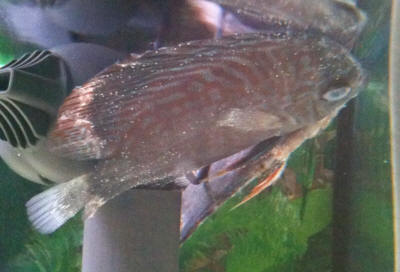
RMF could swear this IS Ich and bacterial challenges... would
remove the Neons, raise the temp. to high 80's F., add
aeration and 250 mg. of Nitrofuranace per ten gallons... see WWM
re...
|
More re: discus plague? (Bob, any
thoughts'¦?) 2/8/11
thanks for the reply the water has been spot on over the week I
have been doing 10% water changes every day
<<RMF would change half every day>>
<<<Neale would not disagree, provided water hardness, pH
and temperature are kept steady. If you're not 100% sure you
can control these factors, changing smaller amounts, say, 25%,
may be better, but at the same time, do other things to minimise
nitrate levels in the tank -- stock the tank very lighting, feed
minimally, use plants to export nitrate (ideally via a
"vegetable filter" in a sump so light is kept outside
the tank, else floating plants like Indian Fern that produce
shade while growing rapidly). Cheers,
Neale.>>>
Re: discus plague? (Bob, any
thoughts'¦?) 2/8/11
Hi Bob,
<Neale>
Yes, you will see that was my first thought too -- hence my list
of things for Paul to check through before assuming this is viral
Discus Plague.
<<I did, and do... this one fish, and likely all others are
very close to death from both the protozoan and bacterial
challenges. Need treatment immediately>>
Paul -- bacterial infections through the punctures in the skin
caused by mature Whitespot parasites are EXTREMELY common.
Cheers, Neale
<<Paul: See and heed my comments on the dailies.
B>>
|
Sick Discus --
02/05/11
Good morning crew,
<Salve!>
I have 17 discus in a 240g aquarium. I run a constant drip, (approx. 2
gal per hour). My nitrates are maybe 10ppm.
I've had 11 of the discus for 12 to 15 months. 2 of them had that
white poop thing
<Stringy, white faeces from cichlids is usually caused by Hexamita,
but can have other causes.>
about a year ago were treated in a quarantine tank, recovered, and have
been fine ever since.
<Okay.>
About 8 weeks ago I purchased 6 discus from Kenny in Daly City.
Followed his direction and everything has gone well.
2 weeks ago I changed out my black sand to white sand so that I could
more easily view my fish and to lighten everything up.
<They won't like that! In fact I doubt the colours will improve.
Discus show their best colours in shady tanks.>
For about a week I've noticed the smallest discus hanging in the
corner first thing in the morning when I feed. (similar behavior to the
white poop thing). I just assumed that maybe it was taking him a little
longer to wake up than the others. It wasn't until this morning
that I noticed that he wasn't really eating. (so now the symptoms
are much more consistent with the white poop thing)
<Agreed. Would assume Hexamita, and treat accordingly. I'd
probably treat all the new batch, but that's up to you. Certainly
the ones exhibiting odd symptoms.>
Then it seemed to happen right before my eyes that one of the other
"new" fish darkened and began a behavior that I can only
describe as "tail standing" .
<Not good, and with Discus usually implies overall weakness, perhaps
through lack of food.>
I've removed both fish to a quarantine tank and began treatment
with "API General Cure"
<Not a particularly useful medication except for a few, easily
identified things. Despite the marketing, this product isn't a
cure-all by any means!>
Any advice would be greatly appreciated.
Thank you
Pat
<Would recommend a combination of Metronidazole and Nitrofuranace, a
good combination for cichlid ailments such as these.
http://www.wetwebmedia.com/metranidazole.htm
http://www.wetwebmedia.com/fwsubwebindex/FWHLLECases.htm
Cheers, Neale.>
Re: Sick Discus 2/14/11
Hi crew,
I thought I'd give you an update:
<Ok>
The discus that was doing the tail stand thing seems to have recovered
completely. He was bullying the other sick little guy so I put him back
in the display tank.
<Good>
The other little guy seems better, he is eating, although he's not
eating very well.
He's in a 10 gal quarantine tank. Thought I'd a 50% water
change, and see if that causes any improvement.
<Needs more room than this... but do keep up the water change
regimen.
BobF>
Pat
Male adult discus constantly
swims head down
Discus Stays Head Down In Tank Corner 11/22/10
Hello Crew, I have been keeping discus for a few years now in a 100gal
tank, pH 6.8; dGH 0.5; dKH 0; temp 30 C; nitrites / ammonia/ nitrates
all 0.
< Hard to believe zero nitrates unless the resin you mention is
specifically for nitrogenous waste..>
I do about a 12% water change most weeks using RO water with carbon,
resin, micro and membrane filters adding Pro Discus Mineral.
I run two external filters and clean them out alternately monthly using
RO water and rinse the filter media in the RO water I have used to
rinse out the sponges and discard half the sponges at each clean
out.
One of a pair of breeding discus I think developed TB and just slowly
wasted away despite continuing to eat well. Her partner became
reclusive and adopted a head down position so I put them both into
quarantine. This male had been responsible for killing a rival male
previously and in the process severely damaged one eye resulting in the
lens hanging outside the eyeball for a few weeks which gradually seemed
to resolve and his eye now looks normal. I tried all forms of remedies
including worming, Hexamita etc.
none of which made any difference so I just kept them in the quarantine
tank.
Eventually the wasting discus died. Her partner remains in head down
position, eats well (though I'm not sure his vision is all that it
should be as although he can clearly see he does tend to bump in to
things, such as the filter or artificial plants, easily) and loves any
live food I put in, swimming around actively chasing it, but resumes
head down as soon as he is finished. He tends to reside in one small
area of the tank unless
feeding.
This situation has been maintained for several months and I am
reluctant to put him back into the main tank for fear of infecting my
other discus which seem perfectly healthy.
Do you have any thoughts? Many thanks Mike
< The tank conditions, and maintenance procedures seem fine. I would
start to look at the diet. You mentioned live food but did not mention
the diet. Live foods like worms may contain parasites. Live adult brine
shrimp has almost no nutritional value. I would recommend trying to
feed a high quality pellet or flake food. It will be difficult at first
since they will probably hold out for live food since they have you
trained to feed that to them. Place the food in the tank for 5 minutes.
Remove any uneaten food after that. After a few days they will get
hungry enough to at least try the food. Once they accept it then you
will probably see a difference in the behavior.-Chuck>
Re: Male adult discus constantly swims head down
Discus Stays Head Down In Tank Corner II
11/22/10
Hello Chuck, I use Zeolite in the filter media to get rid of
nitrogenous compounds.
Thanks for the advice however I always feed with a mixture of frozen
bloodworm, TetraMin crisps, and Tetra Prima Discus. I only occasionally
give them live food such as bloodworm or daphnia or enhanced brine
shrimp to get them chasing their meals. The fish feeds avidly and will
swim up to the surface to feed if there's anything floating but
when finished resorts to head down. I did worm him with Mebendazole but
that made no difference.
Regards Mike
< Blood worms may absorb toxins from the mud they are found in. I
would stay away from the bloodworms for a couple of weeks and see if
that makes any difference in the behavior.-Chuck>
Re: Male adult discus constantly swims head down
Discus Stays Head Down In Tank Corner III
11/24/10
OK I'll see what happens and let you know. All the others (15 of
them) are fine on the same diet however. Best wishes Mike
< Stress is a big factor in diseases. This fish may be at the bottom
of the pecking order and that could play a major roll. Move some of the
decorations around so the fish need to set up new territories and then
see if that helps too.-Chuck>
Re: Male adult discus constantly swims head down
Discus With Head down In Corner IV 11/24/10
I moved the fish from the main tank into my quarantine tank several
months ago with his partner who subsequently died (I think from TB) by
just wasting away despite continuing to feed. He was already head down
when I moved them both. He used to be the largest and most vigorous of
my fish at the top of the pecking order and as previously mentioned had
killed a rival who was trying to move in on his partner one evening in
a huge battle when his eye was damaged. He still feeds avidly and looks
expectantly when I approach with the feed tub but is still head down. V
Strange!
< If he is alone in a hospital tank with his head down then I still
am thinking internal infection and sticking with my recommendation of
Nitrofuranace and Metronidazole.-Chuck>
Re: Male adult discus constantly swims head down 11/27/10
Finding Nitrofuranace
Hello Chuck I've never heard of Nitrofuranace. Do you mean
Nitrofurantoin and do you have any dosage guideline? Mike
< At drsfostersmiths.com it is listed as Furan-2.-Chuck>
Finding Nitrofuranace For Head Down Discus 11/28/10
< Go to dersfostersmith.com . It is listed under Furan-2. Follow the
directions on the package.-Chuck>
Question... FW, Discus sys.
issues... overcrowded, metabolite build-up...
8/20/10
Hi,
<Hi Max! Melinda here tonight!>
I have read your F.Q but I need help for the following.
<Okay.>
I have 75l freshwater fish tank with 13 Discus, 2 Angels & 1
Betta.
<Is this tank 75 liters, as in less than 20 gallons? Or am I not
understanding correctly?>
I use conditioned tap water 7.6 ph, Ammonia: 0.25, Nitrite: 0.25 &
Nitrate around 80.00 ( I have not been able to bring it down ).
<The Nitrate is a problem, but the Ammonia and Nitrite worry me
more: for some reason (likely overstocking, if my above guess on the
volume of the tank is correct), this tank isn't cycling. Please
read here:
http://www.wetwebmedia.com/fwsubwebindex/fwestcycling.htm.>
I add salt with every water change.
<How much are you adding? Salt can be used to detoxify Nitrate if
you're adding it in the correct amounts with water changes. Please
read here:
http://www.wetwebmedia.com/fwsubwebindex/SaltUseFWArtNeale.htm.
Otherwise, I'm not sure what the salt is for.>
Recently I am losing only Discus. They start being in the corners,
develop fin damage, white patches on the body & not feeding &
eventually die...
<Various issues due to water quality/overstocking.>
I even had one dead with hole(scare) in the head & another one
suddenly lost balance & it was up-side-down for two days until it
died. One of them has darkened in colour.
The rest of Discus seems to be o.k. with no visible signs of illness
but they are not active like any other Discus.
<Your fish are in bad shape. Is this tank really only 75 liters? The
fish can't possibly be full-grown, if so, they literally
wouldn't be able to
move. In any case, your problems likely lie in the numbers you gave me
above for Ammonia, Nitrite, and Nitrate. The tank is overstocked, and
your maintenance may also be lacking... please read here on
maintenance:
http://www.wetwebmedia.com/fwsubwebindex/fwmaint.htm.>
Please help me urgently...
<Max, there's certainly something wrong with your system, and
it's causing your fish to fall ill. That "something" is
the water they live in. This can be due to a number of issues,
including the following: fail to cycle properly in the first place,
overstocking, overfeeding, lack of proper filtration, and/or lack of
proper maintenance. I think most of these are covered in the links
above, but here is a link on filtration:
http://www.wetwebmedia.com/fwsubwebindex/fwfiltration.htm.
In addition, what cannot be ruled out at this point is that your source
water is introducing Nitrate into the system. Do test your source water
to help gain clues as to what could be causing poor water quality.
However, with this stocking list, I wouldn't doubt that your
Nitrate would be as high as it is, even if you do regular
maintenance.>
with regards
Max
<I hope this helps, Max. Please do write back if you have further
questions after reading.
--Melinda><<Well done Melinda. BobF>>
Discus fin rot! 6/8/10
Hi crew,
One of my discus has what I think is fin rot just above what would be
his forehead. Part of the fin looks like it is deteriorating and has
something white on it (definitely not ich). I've quarantined him in
a ten gallon tank. I've never
had a fish with fin rot, but I don't know how else to describe what
I'm seeing, nor do I know how to treat. I've got eight discus
total. The other seven seem fine. The sick one first got my attention
because he wasn't eating.
Please help!
Thank you,
Pat
<Hello Pat. Without a photo it's difficult to diagnose this.
Possibilities include Finrot, Mouth Fungus and Hexamita. Finrot
typically begins on the fins as bloody swellings that eventually decay
into the raggedy fins we associate with the disease. Mouth Fungus --
actually a bacterial infection also called Columnaris -- is more common
around the mouth, as you'd expect.
Distinguishing it from Finrot isn't easy, but Mouth Fungus tends to
look fibrous, hence the analogy with Fungus. Hexamita is a parasitic
infection that may or may not be responsible for Hole-in-the-Head
disease. Discus, like all cichlids, are prone to both straightforward
Hexamita infections and Hole-in-the-Head, the latter appearing as white
pits in the head that suppurate over time, releasing dead white goo.
Does this help any? Cheers, Neale.>
Re: Discus fin rot!
Hi Neale,
<Hello Pat,>
I don't see anything around his mouth. I also don't see any
holes anywhere (head or body). When I described the location as being
above his "forehead", I was attempting to describe the
location of the affected "fins". The affected fins are the
ones that form what sort of look like "spikes" or
"fingers". Having said that, the affected area is
approximately in the middle of this "spike" area.
<Finrot should look very distinctive. The fin membrane decays from
the outside edge inwards, so the profile of the fin becomes ragged.
Usually, the fin rays stick out beyond the receding fin membrane. You
usually see red or at least orange/white specks on the fins where blood
vessels have become congested, especially near the base of the
fin.>
Now, this morning, I got out my flashlight so that I could get a real
good look at him, and to look for the red swelling you described. I no
longer see any white "fungus" looking stuff at the base of
the fins. The fins look a lot better although a little like part of
them has "melted away" ?
<Fin membranes and eventually fin rays can, will fall away as the
infection progresses. Given good water quality, a healthy diet, and if
necessary medication, fins heal back very quickly.>
The fish seems to have improved in appearance. Is this possible.
<Sure.>
He's still not eating and I think one of the other seven isn't
eating as well.
<Stress, including social stress through bullying, can make fish
vulnerable to secondary infections. Finrot often follows on from
aggression, though that's uncommon among Discus. But with that
said, Discus can be bullies
sometimes, so keep an eye out for it.>
I had Hexamita in a couple of these guys on the 15th of last month. Do
you think it might be a recurrence?
<Doesn't sound directly related. Hexamita typically manifests
itself though white, stringy faeces, loss of overall condition, and in
some cases the appearance of "weeping" pits on the
head.>
Thank you for your help and patience with me
Pat
<Cheers, Neale.>
Discus hanging in corner, beh.,
hlth. -- 5/17/10
Hi crew,
Last Monday that I moved my eight Turquoise Discus to my 240.
They all seem to be doing fine, but one hangs in one of the corners and
I don't really see him eat even when the food passes right by his
nose.
He seems to be the runt.
<Perhaps. But do be aware of the symptoms of worm infections, e.g.,
Camallanus, and also Discus Plague.>
He doesn't seem to be getting skinny, but he also doesn't seem
to be growing like the rest. I also thought I saw white poop coming out
of him soon after the move.
<A common symptom of Hexamita infections, treated using
Metronidazole.
http://www.wetwebmedia.com/fwsubwebindex/hexoctfwfs.htm
http://www.wetwebmedia.com/metranidazole.htm
Prompt treatment is essential. Although contagious, it's likely
latent in all farmed cichlids, and only becomes problematic under
certain circumstances, typically stress, non-zero nitrate levels and/or
the use of a poor quality diet. I wouldn't treat the other Discus
unless they were obviously sickly. Note that Metronidazole needs a
clean aquarium to work well, so remove as much organic detritus from
the aquarium and filter as possible.>
Any ideas?
<Cheers, Neale.>
Re: Discus hanging in corner -- 5/18/10
Hi crew,
I've isolated the discus in a ten gallon bare bottom quarantine
tank with a product called Parasite Clear.
<Never used this, so can't comment from personal
experience.>
After I contacted you, I noticed 2 more not eating so I've included
them in with the first one. The remaining 5 are really eating
aggressively. The package lists the following ingredients:
Praziquantel
Diflubenzuron
Metronidazole
Acriflavine
The package does not state quantities.
The directions say to add one tablet per 10 gallons of water.
My question is:
How long do I need to treat these fish?
<Follow the instructions on the packaging. Doing otherwise rarely
helps.>
Again, the only symptoms are not eating. Their fins are erect, not held
close to their body, respiration seems normal. I mentioned that I saw
white poop, perhaps I should watch for poop in the ten gallon. It
shouldn't be
too difficult since it's bare bottom.
Thank you very much for your help!
Pat
<Do read the articles linked to last time. Cheers,
Neale.>
Re: Discus hanging in corner
5/24/10
Hi crew,
I'm happy to report that my sick discus are eating today after just
24 hours after being treated with API General Cure which contains 250mg
of Metronidazole!
<Ah, good>
After 4 days treatment of Parasite Clear, I wasn't seeing any
improvement.
I found another LFS about 90 miles away that still didn't have
exactly what I was looking for, but better than what I was using.
I changed out all the water from the ten gallon quarantine tank,
refilled with fresh water from my 240 gallon tank, added the medicine
and fish at about 11:30 AM yesterday. As of 2:00 PM today all 3 fish
are eating. There is still 3 more days of treatment based on the
directions, but I was so excite, I wanted to share the good news!
Pat
<Thank you for doing so... and do continue to monitor water quality,
do such change-outs. Cheers, BobF>
Re: Discus hanging in corner, now FW
quarantine 5/25/10
Hi crew,
I can't remember ever having fish survive a quarantine procedure.
When its complete, do I just remove them from the quarantine tank and
reintroduce them to the display?
<Is the standard method for freshwater fishes... Though some folks
use the opportunity to run them through prophylactic
dips/baths...>
Or should I do a 100% water change on the quarantine tank (using
display tank water), and allow them more Time?
Thank you!
Pat
<Welcome. BobF>
Sick discus, help !!!!!!!!
Sick Discus 3/8/10
I have a sick discus and I'm pretty sure he has Hexamita he has
white stringy feces and is not eating one fish make that two fish have
already died the pet store gave me some Metro. But I'm not sure how
to properly administer this ??? the website where I found you says soak
food in 1 percent metro 1 percent of what ??? how much metro is that
??? a teaspoon tablespoon in terms of quantity I don't know ????
and what do I put some Metro in a cup and throw fish cube in it and
just let it soak in the fridge??? I also read 250mg of Metro directly
into the water per every 10 to 20 gallons ???? I'm greatly confused
I don't anymore fish to die please help !!!!!! Thanks, Freddie
Baigen
< If your discus is eating , then getting the medication into the
food is the best treatment. Check the ingredients for the medicated
foods at the fish store. If they don't have it then you can buy it
online at Drsfostersmith.com. You can also buy the medication to add to
the water directly. In the meantime I would recommend a 50% water
change, clean the filters and vacuum the gravel. Organic matter seams
to interfere with medications.-Chuck>
Discus fin rot 11/11/09
Dear Crew,
<Hello Victor,>
First I must thank you for your helpful site.
<Glad you enjoy.>
However, I am still facing a problem.
<Oh?>
My discus in my 33 gallon tank are currently suffering from fin
rot.
<Do review water quality first and foremost, and also think about
any sources of physical damage, such as fin nipping, fighting, or
careless handling by the fishkeeper. These are almost always the root
causes of
Finrot.>
The tank is a 33 gallon with 3 discus, the largest with a diameter of 5
inches, and a Raphael catfish.
<This tank could easily be overstocked, depending on the size of the
fish and how much food you're adding.>
It is a planted tank, ph 7, nitrate 40 (it never seems to change even
after water changes) and I do 2-3 20% water changes a week.
<I see.>
I also recently added a CO2 thing in October.
<This shouldn't in itself cause Finrot, but rapid changes in pH
can be stressful, so check this. Do also remember than biological
filtration works best at pH 7.5; as pH drops, biological filtration
works less well, and below pH 6, it stops working altogether. So if the
pH drops too far below 7, you can easily have spikes of nitrite and
ammonia.>
I have tried using Pimafix and nothing has happened.
<Largely useless tea-tree oil remedy. Do use a proper medication,
e.g., eSHa 2000, Maracyn, etc.>
Earlier, like September I saw their fins starting to get a bit ragged,
but now they are starting to miss chunks of their fins. I am very
worried because they never got fin rot, even before in their old
overcrowded tank
of 20 gallon. What could be the cause of the loss of their fins?
<See above.>
Thank you, Victor
<Cheers, Neale.>
Metronidazole for breeding pair...
Symphysodon 9/16/09
Dear Crew
We have been doing a lot of reading, and are still somewhat confused
about the dosage for Metronidazole.
We have a breeding pair of Red Turquoises and have had them for about 3
months now. The male went off his food quite a few weeks ago and had
white stringy poo, so we treated him with Octozin by Waterlife. His
symptoms improved and we thought he started eating again. We also
treated the female with Octozin and then put the pair back
together.
<Never found Octozin terribly useful, to be honest.>
In the last couple of weeks however, we have noticed that he is taking
in food and then spitting it out again and swimming off rather than
eating the smaller pieces of food. We also have not noticed him poo at
all. He is dark in colour and hanging at the top of the tank.
<Sounds like Hexamita or similar; do review things like diet, water
temperature, and nitrate concentration, all relevant facts where
cichlids are concerned.>
We read that the most likely thing to be wrong is flagellates and the
best treatment for this is Metronidazole, however we have found many
conflicting methods for dosage.
<Optimal dosage is quoted in milligrams per kilogram of fish weight.
The fish can then be *fed* the precise amount of medication required
for proper effect. Because so few people know how heavy their fish are,
fishkeepers tend to go with a milligram per litre dosage instead, e.g.,
250 mg per 37.5 litres/10 US gallons (you will find both higher and
lower dosages recommended in the literature). But with the best will in
the world, this is a rough-and-ready approach. Your vet will have a
listed dosage in milligrams per kilogram fish weight, and you'd be
best going along with that.>
We live in the UK and have obtained 200mg tablets from our local vet.
We have the pair in a 100litre tank, all water parameters are fine and
we are raising the temperature to 32 degrees C (as we read that
Metronidazole will not work at temperatures lower than this) Currently
it is at 30 degrees and the male's colour has already improved,
although his stress bars are still visible. Please could you advise us
what the optimum course of treatment for Discus would be.
We were also wondering if there was any information regarding whether
this drug affects the fertility of fish, in particular Discus, as we
recently found out that Acriflavine can cause fish to become
sterile.
<Not heard of any such side effects re: Metronidazole, but an
infertile fish is certainly better than a dead one, so can't
imagine this being an issue as such.>
Thank you for your time, look forward to hearing from you.
Joe and Harriotte.
<Cheers, Neale.>
|
help Hexamita problem ?? Discus dis.
f' 8/18/09
Hi crew,
<Abhishek>
Firstly thanks a ton for the previous times you guys have helped
and the way the site is kept up. Ok have two queries...
1. My discus in a planted tank seem to have got Hexamita (seems)
attaching some pics along. The fish have very good appetite and
am feeding them freeze dried blood worms, freeze dried Tubifex,
NLS spectrum Thera +A , NLS discs formula, NLS spectrum grow.
<None of which have medicinal value for treating
Octomita/Hexamita>
Tank size is 48' * 18 * 18'. Water is changed twice
weekly 30% with RO water . PH is a 6.8 mainly due to the
driftwood.
Ammonia is 0. Filtration is by 2 Eheim 2217 canister filters
which house sponge in one and carbon with Zeolite in another.
Water temperature is kept at 28 degrees with the help of a Jager
300 watt heater. Lighting consists of
6 compact fluorescents of 30 watts each.
All the rest of the fish that include Angels
<A poor idea to mix these with Symphysodon... see WWM, books
re>
and Ramirezi are thriving. the
discus do get ample of food and still are getting paper thin,
with black spots or pepper on the body. There is no aggression in
the tank so far. It has been up and running for the past 11
months now. Feces of the smaller discus are a little pale but
not white completely. My LFS sent me
Intestinal
Hexamita clear medicine, as he has seen remarkable results with
it . You can
check the stuff at http://www.bigfish88.com/ .
<The ingredients are not listed... little is in
English...>
Would like to know if I should start giving Metrogyl
<What is this? Metronidazole hopefully>
and Nitrofuranace to the fish.
2. My 2 inch FH has a bloated stomach, is of food and sitting on
the bottom of the tank. Prior to this I did see white stringy
knotted feces hanging from him. Just bought this guy 10 days
back. H is in a temporary tank of 36'* 18 '* 18' with
two Aquael unfiltered 1000. Temp is at 30 degree PH is 7.5
,ammonia is 0. I have done 50% and then next day 30% water change
now added Metrogyl 500mg (IV form) 50 ml and Nitrofuranace to the
tank as he is not eating. Have cleaned the filters also.
Attaching pics f him also.
Need help.
--
Abhishek Singh Gaur
Adios Amigos.
<... you crashed our mail server, by sending 30 some Megs of
images...
100's of Kbytes is all we allow. Follow directions... Read
here:
http://wetwebmedia.com/FWSubWebIndex/hexoctfwfs.htm
and the linked files above. Bob Fenner>
|
  |
Re: help Hexamita problem ??
8/18/09
Hi Bob,
Yes Metrogyl is Metronidazole I have it in IV form of 500mg
concentration.
<Ahh, so, I take it you will be injecting this... rather than
hoping to administer via ingestion>
The angels were put in on request of my daughter, but they are
going to the LFS as planned.
<Ah good>
Sorry about the crash caused will send the pics again.
<No need>
still waiting for a reply to my second query.
<Please see WWM (again) re Octomita... and Metronidazole...
can't be just added to the water... BobF> |
Discus Not Growing
7/23/09
Hi, I have a 75-gallon tank with 5 Discus, a Uaru, a Rummynose, and a
small assortment of various Cory catfish. The Discus and, especially,
the Uaru, are growing nicely; however, one of the two Cobalt Blue
Discus I have is as small as he was when I got him and the others about
9 months ago. Even the one that is growing is doing so at a very slow
pace, but at least he's growing. The runt, or "little
guy," which is what I tend to refer to him as, seems to be eating
his fair share of food, which consists primarily of frozen blood worms
(mosquito larvae), brine shrimp, and plankton, during every feeding.
Also, the water is always crystal clear and kept at a steady 82
degrees, at times, 83 or even 84 on the really hot days of Summer. 30%
water changes are done once a week as well. All things considered, in
addition to him acting healthy and his colors being so vibrant, I am
stumped as to why the "little guy" is not growing. I say,
"little guy," but, for all I know, he could very well be a
she. Any help or advice would be greatly appreciated. Thank you.
Regards, Gregg
< Three things could be the cause. The first is nutrition. With a
varied diet like that, nutrition should not be the problem unless he is
being chased away from the food and actually getting less food than the
other
fish.. The second is water quality. High nitrogenous wastes interfere
with the growth of young fish. High protein diets do produce lots of
this waste. The ammonia and nitrites should be zero and the nitrates
should be under 20 ppm. <<Much lower. RMF>> The last
is genetics. In the wild small fish are removed from the gene pool by
predators. No such predators are usually found in an aquarium. Most
commercial discus breeders sell everything they produce with little
concern for long term results. I'm afraid you just may have a
runt.-Chuck>
Discus with white poop - weighing options
-- 06/12/09
Hello Crew,
<Hello,>
Not long ago I got two new Stendker Discus from Discus Hans in
Baltimore.
They are in an established 75 gallon tank, pH 7.6, temp 82, GH 8
degrees, ammonia=0, nitrite=0, nitrate=10ppm. Tankmates are two other
discus, a few tetras, 4 cories, and 2 small Plecos.
<I'm not wild about mixing Corydoras with Discus; with the
exception of Corydoras sterbai, most traded Corydoras prefer cooler
water than Discus, so one or other species ends up being stressed and
has a shorter life than otherwise.>
I noticed a couple days ago that the larger of the two fish (5")
became less interested in food and began spitting out the blood worms I
have been feeding them. Today I noticed that the fish had a white poop
coming out and had little or no interest in eating.
<Well, most fish prefer a variation of food, and will bore of any
one thing. So if you're keeping Discus, it's a good idea to
cycle bloodworms, brine shrimps, earthworms, daphnia, flake foods and
pellets through the
week. Beef heart is an old stand-by, and you can add this to your
frozen food collection, though aquarists tend to use this food
sparingly rather than the as the staple that it once was. Letting fish
starve for 24 hours
does them no harm at all, and often they take foods willingly
afterwards that they otherwise ignored.>
I did some research on the discus forums online and of course as is the
case with nearly any issue like this, there are as many different
diagnoses and cures being suggested as there are people posting. I
don't want to
blindly medicate the fish, but from what I read, the problem seems to
either be Hexamita or intestinal worms depending on who you ask. My
questions are as follows:
<Hexamita infections are quite common among tank-bred cichlids, and
some argue they're ubiquitous, and merely switch from being
harmless to lethal only if environmental conditions and/or diet
shortcomings allow.>
1. I think hex is the more likely scenario. Do you agree, or do you
think worms more likely, or do you think it would be better to medicate
for both types of parasites.
<I'd go with Metronidazole first, since the copious production
of pale (mucous-rich) faeces is a classic symptom of Hexamita
infection.>
2. If I medicate the entire tank with Metronidazole or Praziquantel,
will either of these medications affect the biological filtration of
the tank?
<Used correctly, the filter should be unharmed; the one treats
Protozoans, the other helminths, and neither is strongly
anti-bacterial.>
3. I have not had good luck saving any other fish that I have removed
to an outside tank and medicated. If I do nothing, do you think there
is any chance the fish could recover on its own?
<Cichlids rarely recover from Hexamita infections on their own;
it's almost always lethal unless treated early on.>
4. If I medicate the fish in a separate, uncycled tank, would I be able
to use Amquel to keep ammonia in check, or would using Amquel adversely
affect the potency of the medication?
<Would treat all the fish together on the assumption
cross-contamination is likely, even probable.>
Thanks for your help.
Joe
<Cheers, Neale.>
Help me (Symphysodon; mystery deaths)
6/6/09
Hello dear Neale,
<Hello again,>
How are you? I hope you will be fine there. Neale I have 4 discus in my
tank of 90 gallon.
<Should be kept in groups of six or more; in smaller groups, Discus
tend to be bullies, until just one mated pair is left, and the others
are so battered they have to be removed.>
Neale I am used to feed them twice a day and they finish all of them in
2 to 3 minutes. Neale today my small discus died and I observed it from
last 2 days it was showing in balance in its movement while
swimming.
<I need more information that this. What's the water chemistry?
What's the water quality? To recap, Discus need 0 ammonia, 0
nitrite, less than 20 mg/l nitrate, less than 10 degrees dH hardness,
and a steady pH somewhere between 6 and 7.5.>
I think it died due to swim bladder disease or due to the constipation
problem?
<Neither is likely. Discus aren't especially prone to
constipation, and on the usual diet of good quality flake foods plus
frozen (or live) invertebrates should do very well. "Swim Bladder
Disease" is a catch-all name given by some hobbyists to a range of
different things. Almost always, when fish die from what people think
is "Swim Bladder Disease", they actually died because of
something else. For example, water quality problems, inadequate diet,
etc. In the case of Discus, you can add to this pH stress when people
try to keep them in soft water without using a buffer, and starvation,
when Discus are forced to compete with more active fish. Discus are
sensitive to certain parasites carried by Angelfish, and if the two
species are mixed, Discus may sicken and die. Not always, but
sometimes. So how the Discus are kept prior to you purchasing them
matters as well.>
I don't know Neale what happened wrong? Water condition is perfect.
Please tell me that what is swim bladder and constipation problem and
how can we cure our fish? What is the cause of these two diseases? How
can we prevent them? I am very much depressed why is these disease are
so common in fish? Please help me, waiting for your reply.
Thank you,
Ali Zaheer
<Much written about Symphysodon, here:
http://www.wetwebmedia.com/FWSubWebIndex/discusfish.htm
Good luck, Neale.>
Discus... stress beh., hlth., incomp. with
angels 12/12/08 Good afternoon, I am hoping you
can help me out with a discus problem. Currently I have a 330 litre
tank with a ph of 6.4 and temp at 28C as well as quite a few fishes, 20
Rummy nose 4 bristle nose 4 angel fish (paired, very territorial) 10
Zebra Danios 1 blue diamond discus 4 red melon discus (Is this too many
for the tank?) <Sounds great. But Angels can be quite waspish, so
I'd watch how the Discus behave. It's pretty common for Angels
to bully Discus. There's also a risk of transmitting diseases that
Angels don't seem too bothered by, but can cause real problems for
Discus.> The red melons were added 6 days ago. On the 1st day they
got "head butted" by the blue diamond a fair bit, I read up
on a site and dismissed it as a greeting of some sort. <Well, Discus
are hierarchical, but if you upped the group to six, I'd fully
expect them to settle right down.> Now the 4 red melons are slowly
showing black patches on their face. There is one that is particularly
bad, his upper and lower fin has a dark shade around the edges while
his back fin has gone from clear to black. I've read your previous
posts about unhappy discus turning black, in my case it is only to
their head and fins their body is still bright red. <Could well be
stress; Discus when stressed typically show a series of dark vertical
bars on the flanks. I'd carefully observe the interactions within
the Discus group, as well as between the Discus and Angels. But as ever
with Discus, do a quick check of water quality and especially water
chemistry. In soft water tanks pH can drop rapidly, and as pH drops,
biological filtration becomes less efficient, basically stopping
altogether at around 6.0. Cheers, Neale.>
Re: Discus 12/14/08 Thank
you Neale, for the prompt reply, I will move the Angels out in the next
couple of day and put in 2 more red melons. Will let you know how it
goes. Regards, Leon <Sounds like you have a good plan there. Let me
know if things still don't work out. Good luck!
Neale.>
|
Discus with I believe with HLLE (yep!)
11/05/08 Hi I have a 75 gal tank with 8 Discus four are
the size of the picture I am sending and the remaining being
silver dollar in size. Filtration is a Penguin BioWheel 350
filtered with Bio ceramic filter balls and filter cartridges
w/activated carbon, second one is a whisper filter 60 gal that I
use filter cartridges with. 1 airstone. Gravel1-1 1/2" deep.
Artificial silk plants. Feeding is as follows: San Fran Bay
Frozen Spirulina Brine shrimp, San Fran Bay frozen beef heart,
Beef heart flakes, Hikari bio encapsulated w/vitamins bloodworms,
Hikari microwafers, frozen plankton, omega one color flakes,
omega one vitamin flakes, Tetra cichlid sticks. I dose the water
with VitaChem once a week and add to frozen food. I vary the food
giving flakes and frozen everyday and feed 4-5 times a day. Water
parameters today are: AMM- 0, Nitrite- 0.3, PH- 7.5, temp- 85
degrees. Water changes are done once a week at 75% change with
Kordon NovAqua Plus. I want to make sure this is HLLE I noticed
Sunday clear matter floating around like poop but totally
transparent note all fish have normal poo. This was
discovered on fish yesterday added salt and this morning it is
worse can you let me if I am correct in HLLE and I've read
the threads metro is what I should use. The first picture is
yesterday, next two are today. <Greetings. This does indeed
look very much like Head-and-Lateral-Line-Erosion, or HLLE. This
disease is "caused" by one of two things, possibly
working in combination, though the precise details are obscure.
The Hexamita parasite is at least partially involved, and while
normally associated with problems with the digestive tract
(commonly observed as white, stringy feces due the excess mucous
production) the parasites somehow can spread to the surface of
the fish under certain situations. Once that happens they cause
the sensory pits on the head and flanks to become infected and
ultimately the pits decay, causing the tell-tale wounds we call
Hole-in-the-Head (HITH) or HLLE, depending on where the wounds
are seen. It is possible Hexamita is latent in many fish, and
only under specific situations does it become a problem, and both
diet and water quality seem to be extremely probable triggering
factors. With cichlids, any nitrate level about 20 mg/l seems to
lead to a, elevated risk of HLLE/HITH. Every cichlid I have ever
seen with the disease was in an overcrowded tank or one with
infrequent water changes, and this is based partly on
observations of my own mistakes! Bob Fenner has also written
convincingly about the appearance of HLLE/HITH in marine fish as
being closely related to lack of vitamins. Herbivorous fish are
particularly prone to receiving inadequate diets, and cichlids
are overwhelmingly at least partially herbivorous in the wild.
Even fish-eating cichlids will be consuming herbivorous fish, and
in that way consuming the plant material in the guts of their
prey. Tinned peas, Spirulina flake and cooked spinach are usually
taken by even the most carnivorous cichlids. So while the
immediate treatment is Metronidazole, long term you need to
review water quality and diet, and see if there's anything
there you can improve. Cheers, Neale.>
|
  |
Sick discus- Discus Not Eating
06/15/08 I have an 8 month old discus that was
very healthy last week no it is not eating and is pooping clear I read
it could be internal parasites but what can cure it ? Please don't
say metro because I've been reading that it don't really solve
the problem? Please I don't him to die Thanks < Check the water
quality of the tank. Ammonia and nitrites should be zero and the
nitrates should be under 20 ppm for domesticated discus and under 10
ppm for wild discus. The water temp should be around 80 to 82 F. If
these look OK then do a 50-30% water change and vacuum the gravel.
Clean the filter too. Now that the environmental factors have been
addressed we can look at some of the others. In the wild discus
actually eat algae and very small aquatic invertebrates. Sometimes
commercial foods are too rich for their long intestinal tracks. These
foods may cause a blockage. Now the bacteria in the gut start to break
down the food instead of the fish's body absorbing it. As the
bacteria grow and multiply it extends the gut of the fish and stresses
the rest of the body. Not too many medications can be absorbed into the
fish's body. If too much time goes by then no medication will work
because the infection has gotten too large. The bacteria or other
parasites grow faster than the medication can kill it. Other factors
include organics in the water. Many medications are absorbed by the
activated carbon in the filter or by the mulm found in the gravel. When
not treated effectively the bacteria and other parasites can build up a
resistance to any medication and will make it totally ineffective.
Metronidazole is a reasonable treatment. It needs to be done early and
often. You may have already waited too long for any treatment to work
at this time. If you want to believe the other source that
Metronidazole doesn't work, then I have heard that Clout or a
triple dose of Furanace has worked on occasion.-Chuck>
Fin nipping in all discus tank -- 04/1/08
Hi guys. It has been a while since I sought your sage advice, but I am
back again with a new issue. First, I want to thank you for all of the
extremely useful advice that you have given me in the past!
<Cool.> I have a 55-gallon discus only tank that is home to 8
discus ranging in size from 3-6 inches or so. All of them have done
well together from the beginning and we are starting our 3rd year now.
Obviously, some of them eat a lot more than others-the size difference
between the largest and smallest fish is staggering. And although they
do chase each other around and have face-offs every day, there have
been no injuries, and all of them have eaten well (some better than
others!), and stayed healthy and active...until now. <Oh?> I
recently noticed one of the medium-size discus hanging out in the
corner by himself instead of with the rest of the group, but didn't
think much of it at the time. Not long after that, I noticed some very
obvious fin-nipping damage on the back edges of his dorsal and anal
fins. I then realized that it had been a few days since I had seen him
joining the community meals along with everyone else. That was about a
week ago and I still have not see him eat. On top of that, the exterior
cover to his gills looks kind of frayed, his color has become pale, and
he is breathing faster than the other fish. <Discus are of course
territorial once mature and in the mood for breeding. So it may well be
you have one mated pair that are driving off the other fish. But if it
is just the one fish showing signs of ill health, consider other
factors, e.g., Finrot rather than nipping. Do a water quality test.
Look over the fish for signs of eroded lateral line, hollow stomach,
red patches on the body or fins, etc. Different symptoms will help pin
down different diseases.> I have read that damaged fins will grow
back, so although I found the damage to his fins very disturbing
(especially after two years of harmony in the tank), I didn't
immediately panic but maybe I should have. I thought perhaps that they
were not getting enough food, so I increased the amount of food per
feeding, but stayed on the same schedule. (morning and evening). After
all, I have never seen my discus stop eating when they could still
graze around and find any more morsels of food. Okay, so more food is
going into the tank and mealtime lasts a little longer, but the guy
with the fin damage still doesn't eat. All of the others eat
ravenously, then graze until the food is all gone. They look really
healthy and vibrant-like they could jump out of the tank and arm
wrestle me! I see no obvious evidence of disease on any of the other
fish. <Hmm... I'd tend to suspect this fish is otherwise ill
rather than nipped. Check water, but also check the fish itself for
signs of Hexamita or whatever.> I am afraid that I have waited too
long now. There has been no improvement in the past week and I am
afraid I am going to lose him now. Any advice will be gratefully
accepted. <Would use an antibacterial/antibiotic medication now on
the assumption that at least a secondary infection is likely.
Quarantining the sick fish and observing carefully would be
sensible.> Nothing changed before this happened-no new fish or
decorations. Water changes 30-35% weekly as usual. What could have
caused this? <Difficult to say without seeing the fish or knowing
anything about the environment.> Thank you for reading my post and
for any advice you can offer. <Cheers, Neale.>
Ick, FW... Discus incl. -03/27/08
Hello, I have discus and cardinal tetra in a 44 gallon tank. The tetras
have the ich white spots. As soon as I noticed them I raised the tank
temperature to 82-84 removed the carbon filter and treated with
Rid-Ich. After several days and treatments the ich was still on them. I
then did a 50% water change and began treating with super ich
treatment. The discus appeared to be stressed so after two days put
filter back in and did water change. Cardinals still have white spots
but not noticeable on Discus. What can I use to get rid of the Ich and
not harm or stress the discus? Any assistance you can give me would be
greatly appreciated. Susan <Hi Susan. There's really no magic to
Ick medications, and when they don't work, it's either because
the disease was misidentified (e.g., it's Velvet, not Ick) or else
the medication was used improperly (e.g., wrong concentration, without
removing carbon, etc.). So check these things; it's easy to make
mistakes. Next up, I'd recommend trying alternate brands of
medication. I've found some medications much less effective than
others in some instances. I'm not a huge fan of raising the
temperature when using copper/formalin medications IF the Ick problem
is being dealt with early on. The standard operating temperature for
Discus is around 28C/82F, and that should be ample warmth to speed the
Ick life cycle to under a week. Raising the temperature makes more
sense with coldwater/subtropical fish where the life cycle takes
longer. Because Ick damages the gill membranes, the combo of high
temperature (= low oxygen) coupled with the Ick damage can lead to
breathing problems for the fish. In any case, removing carbon
shouldn't be causing distress to your fish. If you have so much
organic material being dumped into the aquarium that the water turns
nasty within a few days, you have bigger problems than Ick! Seriously,
carbon plays no particularly useful role in freshwater aquaria so I
wouldn't bother with it. Do always check that "modules"
in filters don't have hidden carbon sachets. Carbon exists in the
hobby primarily as a way for manufacturers to extract cash from
consumers, and they love to build in carbon (costs pennies) into
filters to force inexperienced consumers to buy new carbon modules
every month. Almost every time I've experienced or been told about
Ick medication not working, it's been because there was carbon
somewhere in the system. Cheers, Neale.>
Sick Discus questions ??? 3/12/08 Hello, My
Grandson & I have a sick Blue Cobalt Discus. We noticed him hiding
in a hollow resin log the other day, and he's also stopped eating.
He's lost some of his color, and his eye's have gone from red
to jet-black. Today, we noticed two small lesions just above the mouth,
look almost like two nostrils (hole in the head ?); His eyes are
beginning to bug out a bit as well. The other Discus in the tank seem
to be in great health, so we decided to put the little guy in the
hospital tank. I have the temp in the hospital tank turned up to
approx. 88 F. with good aeration and a dose of "General Cure"
in the water. He is also exhibiting symptoms of internal parasites,
white trailing fecal matter. The fish in question is young, barely
2" in length, that's being generous. Can you please tell me if
I should be treating him/her with anything additionally ? Thanks in
advance for your time, Dan & Gabe. <Does sound like
Hole-in-the-Head. Do read here:
http://www.wetwebmedia.com/FWSubWebIndex/fwhllefaqs.htm Usually treated
with Metronidazole in the food, though there are some off the shelf
medications as well, e.g., eSHa Hexamita 'Discus Disease'.
Regardless, this is difficult to cure in very small fish, and you must
certainly treat promptly to have any chance of success. Do also
remember HITH is triggered by environmental issues even if a parasite
is the problem. Water quality, particularly nitrates, are a common
triggering factor with cichlids. Cheers, Neale.>
Discus plague 3/5/08 Dear sirs, I am
a discus keeper from Macedonia. I have been keeping discus fish for
many years very successfully. Recently, I made a huge mistake in
keeping discus. I have a 450l tank with all equipment needed. I kept my
fish at 86F, performed regular water changes and everything was
perfect. <Very good.> A week ago I went to a local pet store
seeing a new discus imported fish from Asia. I could not resist the
fish colour and I bought two new fish for my tank. I owned six
semi-adult discus in my tank which were a good size of 15cm in
diameter. I made a disastrous mistake of introducing the new fish in my
tank without putting the new ones in quarantine first.
<Uh-oh...!> I had a severe outbreak of Discus Plague in my tank.
All my fish get sick with symptoms of darkening of their colour, hiding
in the corner of the tank with clamped fins and finally swimming in
disoriented way. <Could be 'Discus Plague' but do remember:
many other diseases cause the same symptoms. A lot of people blame
Discus Plague, but unless you are a microbiologist or a vet, actually
confirming that Discus Plague is to blame is impossible. So you must be
broad minded. Check water chemistry and water quality. Think about
other disease-causing organisms that could be to blame, such as
Hexamita. Toxic chemicals can also cause similar problems; for example
paint fumes. Also check the behaviour of other fish in the tank.
Loricariid catfish such as Plecs for example will sometimes decide to
suck on the mucous on the side of the Discus. Needless to say this
causes intense stress, and a stressed Discus is not a healthy Discus!
So be sensible and look at the big picture rather than *assuming* it is
Discus Plague.> The new two fish were not so inflicted so I returned
them to the store. After few days of fighting with the virus I decided
to stop my fish from misery. Now I only have my albino and long fin
albino Bristlenose Plecos in my tank and I am continuing to perform
massive water changes to clean the tank from the reminders of the
virus. My Plecos did not get ill as they are not inflicted with the
discus diseases. Can Plecos carry the disease? <Unlikely; but I
wouldn't keep Plecs with Discus anyway for the reason mentioned
above.> I am planning to reintroduce a new discus fish in my tank as
the tank is without any discus now. How long would last to be safe to
put new fish in the tank? <I would tend to remove all the fish if
possible, and run a course of anti-protozoan medications and then a
course of anti-bacteria medications. While doing this, remember to keep
adding occasional pinches of fish food so the filter bacteria have
something to "eat".> Should I medicate the tank with
something before introducing new group of fish? <I would, yes.>
Thank you in advance for your answer. Yours Igor! <Hope this helps,
Neale.>
Re: DISCUS AND AMMONIA SPIKE AFTERMATH... induced
Discus prob.s, hypochondria... reading 2/1/08 Hi , thanks for
your response <... where is the prev. corr.?> to my ammonia issue
I bought the AmQuel + and that has resolved the ammonia( chloramine in
my tap water at H20 changes), can I use this everyday at water changes
the bottle says to wait 24 hours between applications and since I need
to do wc everyday is it ok. <Can be used daily, continuously if
necessary> Second question is I noticed that one of my discus has
two small white spots on his caudal fin, treated with combo formalin
and malachite green per directions for three days (whole tank) <!?
VERY toxic... I would NOT place formalin in a biological system>
with wc of 20% each day, also the carbon was removed. <Likely all
your biological filtration/nitrifiers have been wiped out> However
on the second day of treatment I noticed that the fish looked like they
had Finrot and on two of them they appeared to have swollen abdomens,
as well as red around the nose area. <Effects of formalin poisoning
and nitrogenous waste exposure...> I did a 65% wc and replaced the
carbon. My nitrites spiked to 0.3mg/l and the ph was at 7.8 which is
normally 7.6. I should mention that the tank was setup in late Sept.
and was cycled properly (AQUACLEAR 110) but I live in an area where we
are experiencing more frequent power outages and I am not always at
home so the time the filter is down is not always noted. I have a 75
gal, with two filters a BioWheel 330 and a AquaClear 110 the latter was
the original and it was the one that I turned off (fear of media had
become anaerobic) after an outage of 4 hours in late Dec. <Likely
so> which meant the BioWheel was only cycled for about 3 weeks and
on its own. I Have since put some filter media in from a well
established tank on Tues. of this week can't find BioSpira even on
the Marineland site says error when click to buy. Could this and the
combo of the ammonia (that is in tap water) spike caused this problem
in my tank with my fish. <Yes> Could it be a bacterial infection.
<Is this a question?> This is all the symptoms that my fish are
displaying dark colored, clamped fins, as of today they don't look
swollen in the abdomen, Finrot looks a little better gave 1 treatment
of parasite clear tank buddies by jungle active ingred. ( Praziquantel,
Diflubenzuron, Metronidazole and Acriflavine) <... for?> and
redness around their nose area. What to do next I haven't done
anymore Rx only added salt <? On Symphysodon? A poor idea> and
have kept lights off and feeding sparingly they haven't seemed to
have lost their appetite at all. Thanks in advance. <Uhh, I'd
stop pouring in medications (you're killing these animals with
same) and invest your money and time in educating yourself... There are
quite a few good Discus books about, and some useful information on the
Net re the genus. Ours:
http://wetwebmedia.com/FWSubWebIndex/discusfish.htm and the linked
files above. Bob Fenner>
|
|